EP0439777A2 - Alkenyloxygruppen aufweisende Siloxancopolymere, deren Herstellung und Verwendung - Google Patents
Alkenyloxygruppen aufweisende Siloxancopolymere, deren Herstellung und Verwendung Download PDFInfo
- Publication number
- EP0439777A2 EP0439777A2 EP90124495A EP90124495A EP0439777A2 EP 0439777 A2 EP0439777 A2 EP 0439777A2 EP 90124495 A EP90124495 A EP 90124495A EP 90124495 A EP90124495 A EP 90124495A EP 0439777 A2 EP0439777 A2 EP 0439777A2
- Authority
- EP
- European Patent Office
- Prior art keywords
- formula
- radical
- siloxane
- carbon atoms
- atoms per
- Prior art date
- Legal status (The legal status is an assumption and is not a legal conclusion. Google has not performed a legal analysis and makes no representation as to the accuracy of the status listed.)
- Granted
Links
Classifications
-
- C—CHEMISTRY; METALLURGY
- C09—DYES; PAINTS; POLISHES; NATURAL RESINS; ADHESIVES; COMPOSITIONS NOT OTHERWISE PROVIDED FOR; APPLICATIONS OF MATERIALS NOT OTHERWISE PROVIDED FOR
- C09D—COATING COMPOSITIONS, e.g. PAINTS, VARNISHES OR LACQUERS; FILLING PASTES; CHEMICAL PAINT OR INK REMOVERS; INKS; CORRECTING FLUIDS; WOODSTAINS; PASTES OR SOLIDS FOR COLOURING OR PRINTING; USE OF MATERIALS THEREFOR
- C09D183/00—Coating compositions based on macromolecular compounds obtained by reactions forming in the main chain of the macromolecule a linkage containing silicon, with or without sulfur, nitrogen, oxygen, or carbon only; Coating compositions based on derivatives of such polymers
- C09D183/14—Coating compositions based on macromolecular compounds obtained by reactions forming in the main chain of the macromolecule a linkage containing silicon, with or without sulfur, nitrogen, oxygen, or carbon only; Coating compositions based on derivatives of such polymers in which at least two but not all the silicon atoms are connected by linkages other than oxygen atoms
-
- C—CHEMISTRY; METALLURGY
- C08—ORGANIC MACROMOLECULAR COMPOUNDS; THEIR PREPARATION OR CHEMICAL WORKING-UP; COMPOSITIONS BASED THEREON
- C08G—MACROMOLECULAR COMPOUNDS OBTAINED OTHERWISE THAN BY REACTIONS ONLY INVOLVING UNSATURATED CARBON-TO-CARBON BONDS
- C08G77/00—Macromolecular compounds obtained by reactions forming a linkage containing silicon with or without sulfur, nitrogen, oxygen or carbon in the main chain of the macromolecule
- C08G77/04—Polysiloxanes
- C08G77/38—Polysiloxanes modified by chemical after-treatment
-
- C—CHEMISTRY; METALLURGY
- C08—ORGANIC MACROMOLECULAR COMPOUNDS; THEIR PREPARATION OR CHEMICAL WORKING-UP; COMPOSITIONS BASED THEREON
- C08G—MACROMOLECULAR COMPOUNDS OBTAINED OTHERWISE THAN BY REACTIONS ONLY INVOLVING UNSATURATED CARBON-TO-CARBON BONDS
- C08G77/00—Macromolecular compounds obtained by reactions forming a linkage containing silicon with or without sulfur, nitrogen, oxygen or carbon in the main chain of the macromolecule
- C08G77/48—Macromolecular compounds obtained by reactions forming a linkage containing silicon with or without sulfur, nitrogen, oxygen or carbon in the main chain of the macromolecule in which at least two but not all the silicon atoms are connected by linkages other than oxygen atoms
-
- C—CHEMISTRY; METALLURGY
- C08—ORGANIC MACROMOLECULAR COMPOUNDS; THEIR PREPARATION OR CHEMICAL WORKING-UP; COMPOSITIONS BASED THEREON
- C08L—COMPOSITIONS OF MACROMOLECULAR COMPOUNDS
- C08L83/00—Compositions of macromolecular compounds obtained by reactions forming in the main chain of the macromolecule a linkage containing silicon with or without sulfur, nitrogen, oxygen or carbon only; Compositions of derivatives of such polymers
- C08L83/14—Compositions of macromolecular compounds obtained by reactions forming in the main chain of the macromolecule a linkage containing silicon with or without sulfur, nitrogen, oxygen or carbon only; Compositions of derivatives of such polymers in which at least two but not all the silicon atoms are connected by linkages other than oxygen atoms
-
- Y—GENERAL TAGGING OF NEW TECHNOLOGICAL DEVELOPMENTS; GENERAL TAGGING OF CROSS-SECTIONAL TECHNOLOGIES SPANNING OVER SEVERAL SECTIONS OF THE IPC; TECHNICAL SUBJECTS COVERED BY FORMER USPC CROSS-REFERENCE ART COLLECTIONS [XRACs] AND DIGESTS
- Y10—TECHNICAL SUBJECTS COVERED BY FORMER USPC
- Y10T—TECHNICAL SUBJECTS COVERED BY FORMER US CLASSIFICATION
- Y10T428/00—Stock material or miscellaneous articles
- Y10T428/31504—Composite [nonstructural laminate]
- Y10T428/31652—Of asbestos
- Y10T428/31663—As siloxane, silicone or silane
Definitions
- the invention relates to siloxane copolymers containing alkenyloxy groups and to a process for their preparation.
- the invention further relates to the use of the siloxane copolymers containing alkenyloxy groups in compositions which can be crosslinked by light.
- US Pat. No. 4,617,238 describes light-crosslinkable compositions which contain the organopolysiloxanes mentioned above, and onium salts which catalyze the cationic polymerization of these organopolysiloxanes.
- the object was to provide siloxane copolymers containing alkenyloxy groups which can be prepared in a simple process, the process making it possible to introduce more than one alkenyloxy group on a silicon atom.
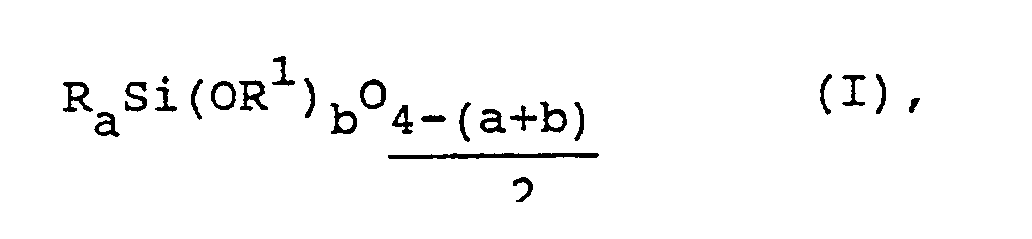
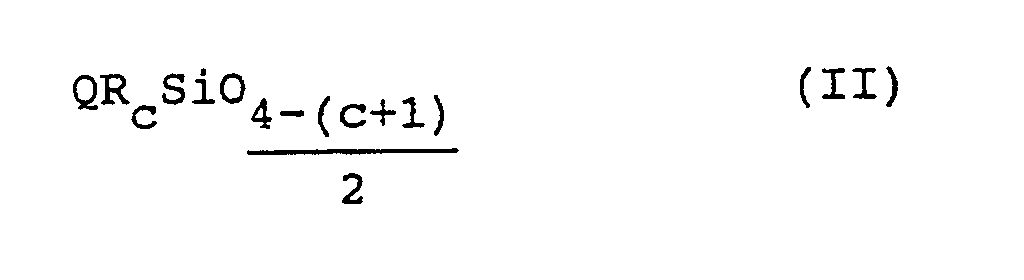
- the siloxane copolymers containing alkenyloxy groups preferably contain siloxane units of the formula (I), at least one siloxane unit of the formula (II) per molecule and at least one unit per molecule selected from the group of the units of the formula (III), (IV) and (V).
- the invention further relates to a process for the preparation of the siloxane copolymers containing alkenyloxy groups, characterized in that
- x is 3 or 4 and Y is a trivalent or tetravalent residue.
- the organopolysiloxanes containing alkenyloxy groups according to the invention preferably have a viscosity of 5 to 5 ⁇ 105 mPa ⁇ s at 25 ° C, preferably 50 to 50,000 mPa ⁇ s at 25 ° C.
- radicals R are alkyl radicals, such as the methyl, ethyl, n-propyl, iso-propyl, 1-n-butyl, 2-n-butyl, iso-butyl, tert-butyl, n-pentyl, iso-pentyl, neo-pentyl, tert-pentyl, hexyl, such as the n-hexyl, heptyl, such as the n-heptyl, octyl, such as the n-octyl and iso-octyl, such as the second , 2,4-trimethylpentyl, nonyl residues, such as the n-nonyl residue, decyl residues, such as the n-decyl residue, dodecyl residues, such as the n-dodecyl residue, octadecyl residues, such as the n
- halogenated radicals R are haloalkyl radicals, such as the 3,3,3-trifluoro-n-propyl radical, the 2,2,2,2 ', 2', 2'-hexafluoroisopropyl radical, the heptafluoroisopropyl radical, and haloaryl radicals, such as the o- , m-, and p-chlorophenyl.
- alkyl radicals R 1 are the methyl, ethyl, n-propyl, iso-propyl, 1-n-butyl, 2-n-butyl, iso-butyl and tert-butyl radical.
- the methyl and ethyl radicals are preferred.
- alkyl radicals R 1 which are substituted by an ether oxygen atom are the methoxyethylene and ethoxyethylene radical.
- the radical R 2 is preferably a hydrogen atom.
- alkyl radicals R3 are methyl, ethyl, n-propyl, iso-propyl, 1-n-butyl, 2-n-butyl, iso-butyl, tert-butyl, n-pentyl -, Iso-pentyl, neo-pentyl, tert-pentyl and hexyl, such as the n-hexyl.
- radicals R5 are alkyl radicals, such as the methyl, ethyl, n-propyl, iso-propyl, 1-n-butyl, 2-n-butyl, iso-butyl, tert-butyl, n-pentyl, iso-pentyl, neo-pentyl, tert-pentyl, hexyl, such as the n-hexyl, heptyl, such as the n-heptyl, octyl, such as the n-octyl and iso-octyl, such as the second , 2,4-trimethylpentyl, alkenyl such as the vinyl and allyl; Cycloalkyl radicals, such as cyclopentyl, cyclohexyl, cycloheptyl radicals and methylcyclohexyl radicals; Aryl radicals, such as the phenyl radical; Al
- the organopolysiloxanes (2) used in the process according to the invention particularly preferably contain an average of 2 to 6 Si-bonded hydrogen atoms.
- the organopolysiloxanes (2) with at least one Si-bonded hydrogen atom per molecule preferably have a viscosity of 0.5 to 20,000 mPa ⁇ s at 25 ° C, preferably 5 to 1000 mPa ⁇ s at 25 ° C.
- organopolysiloxanes (2) are copolymers of dimethylhydrogensiloxane units and dimethylsiloxane units, copolymers composed of dimethylhydrogensiloxane, dimethylsiloxane and methylhydrogensiloxane units, copolymers of trimethylsiloxane units and methylhydrogensiloxane units, copolymers of trimethylsiloxane, dimethylsiloxane and methylhydrogensiloxane units, copolymers composed of dimethylhydrogensiloxane, dimethylsiloxane and phenylmethylsiloxane , Copolymers of dimethylhydrogensiloxane and methylsiloxane units and copolymers of dimethylhydrosiloxane and phenylsiloxane units, copolymers of methylhydrogensiloxane and diphenylsiloxane units, copolymers of methylhydrosiloxane
- organopolysiloxanes with at least one Si-bonded hydrogen atom per molecule including those of the preferred type, are generally known.
- Organic compound (1) is used in the process according to the invention in amounts such that aliphatic double bond in organic compound (1) to Si-bonded Hydrogen in organopolysiloxane (2) in a ratio of preferably 1.5: 1 to 20: 1, preferably 2: 1 to 10: 1.
- Organic compound (1) can be combined with organopolysiloxane (2) depending on their functionality and molecular weight in almost any desired manner within very wide limits.
- a ratio C C: SiH of greater than 20: 1 leads exclusively to the monohydrosilylation of the organic compound (1), which is not preferred.
- catalysts (3) promoting the attachment of Si-bonded hydrogen to aliphatic multiple bonds the same catalysts can also be used in the 1st stage of the process according to the invention as have hitherto been used to promote the attachment of Si-bonded hydrogen to aliphatic double bonds .
- the catalysts (3) are preferably a metal from the group of platinum metals or a compound or a complex from the group of platinum metals.
- platinum halides for example PtCl4, H2PtCl6 * 6H2O, Na2PtCl4 * 4H2O, platinum-olefin complexes, Platinum-alcohol complexes, platinum-alcoholate complexes, platinum-ether complexes, platinum-aldehyde complexes, platinum-ketone complexes, including reaction products of H2PtCl6 * 6H2O and cyclohexanone, platinum-vinylsiloxane complexes, such as platinum-1,3- divinyl-1,1,3,3-tetramethyldisiloxane complexes with or without a detectable amount of inorganically bonded halogen, bis (gamma-picoline), trimethylenedipyridineplatinum, dicyclopentadieneplatinum, Dimethylsulf
- the catalyst (3) is preferably in amounts of 0.5 to 1000 ppm by weight (parts by weight per million parts by weight), preferably in amounts of 2 to 100 ppm by weight, in each case calculated as elemental platinum and based on the total weight of organic Compound (1) and organopolysiloxane (2) used.
- the addition reaction (or hydrosilylation reaction) in the 1st stage of the process according to the invention is preferably carried out at the pressure of the surrounding atmosphere, that is to say at about 1020 hPa (abs.), But it can also be carried out at higher or lower pressures.
- the hydrosilylation is preferably carried out at a temperature of 50 ° C. to 150 ° C., preferably 80 ° C. to 130 ° C.
- inert organic solvents can be used, although the use of inert organic solvents is not preferred.
- inert organic solvents are toluene, xylene, octane isomers, butyl acetate, 1,2-dimethoxyethane, tetrahydrofuran and cyclohexane.
- Excess organic compound (1) and any inert organic solvent optionally used are preferably removed by distillation from the siloxane copolymers containing alkenyl groups and prepared in the first stage of the process according to the invention.
- siloxane copolymers containing alkenyl groups obtained in the 1st stage of the process according to the invention are described in the simultaneously filed patent application with the internal name Wa 8927-S.
- the double bond in the alkenyl groups A of the formula -OCHR2CR2 CH2 rearranged to the carbon atom adjacent to the ether oxygen atom in the presence of catalysts promoting this double bond rearrangement (4).
- catalysts (4) can be used which have hitherto been able to promote such a rearrangement of the double bond.
- catalysts (4) are metallic or finely divided platinum, ruthenium, rhodium and palladium, where these metals can each be carried on supports such as activated carbon, and compounds or complexes of these elements which are present in the alkenyl groups obtained in the 1st stage of the process according to the invention having siloxane copolymers are soluble or are fixed to supports such as activated carbon or polymeric phosphine ligands.
- preferred catalysts (4) are those of the formula RuCl2 (PPh3) 3, RuHCl (PPh3) 3, RuHCl (CO) (PPh3) 3, RuH2 (CO) (PPh3) 3 and RuH2 (PPh3) 4.
- the catalyst (4) is preferably in amounts of 0.1 to 1000 ppm by weight, preferably 5 to 100 ppm by weight, in each case calculated as elemental metal and based on the total weight of organic compound (1) and organopolysiloxane (2) , used.
- Strong bases such as potassium tert-butoxide, can also be used as catalysts (4), but these are due to not preferred due to the high amounts used. Rearrangement of double bonds with these strong bases are described in CC Price, JACS 83 , 1772 (1961) and G. Kesslin, J. Org. Chem. 31 , 2682 (1966).
- the siloxane copolymer containing alkenyl groups obtained from the 1st stage of the process according to the invention is mixed with the catalyst (4) and the mixture is heated.
- the reaction is preferably carried out at a temperature from 80 to 200 ° C., preferably from 120 to 150 ° C., preferably at the pressure of the surrounding atmosphere, at about 1020 hPa (abs.), And preferably in a time from 0.5 to 20 Hours, preferably 4 to 10 hours.
- no solvent is used.
- the alkenyl groups A in the organic compound (1) are also rearranged into alkenyloxy groups B.
- the rearranged organic compound (1) can be removed by distillation from the siloxane copolymers prepared in the second stage of the process according to the invention. If it is not removed, it is capable of cationic polymerization or copolymerization with the alkenyloxy groups of the siloxane copolymer due to its content of alkenyloxy groups B.
- the siloxane copolymer containing alkenyloxy groups obtained in the second stage of the process according to the invention is a cis / trans isomer mixture with respect to the alkenyloxy groups, the cis isomer mostly predominating.
- the alkenyloxy group is a 1-propenyloxypropyl group
- the following isomer mixture is present:
- the two-step process according to the invention proceeds according to the following reaction scheme, exemplified by using pentaerythritol triallyl ether acetate as the organic compound (1) and an ⁇ , ⁇ -dihydrogendimethylpolysiloxane as organopolysiloxane (2):
- the various stages of the process according to the invention can be carried out in succession in one and the same reaction vessel or in separate reaction vessels. It is preferably carried out in succession in one and the same reaction vessel.
- the process according to the invention can be carried out batchwise, semi-continuously or fully continuously.
- the siloxane copolymers containing alkenyloxy groups according to the invention can be crosslinked in a light-initiated, cationic polymerization.
- catalysts for light-initiated crosslinking are the bis (dodecylphenyl) iodonium salts described in US Pat. No. 4,279,717 (issued July 21, 1981, Eckberg et al., General Electric Company), such as bis (dodecylphenyl) iodonium hexafluoroantimonate or Bis (dodecylphenyl) iodonium hexafluoroarsenate can be used.
- the invention therefore relates to the use of siloxane copolymers containing alkenyloxy groups, preferably containing units of the formula (I), (II) and optionally at least one of the units of the formula (III), (IV) or (V), preferably containing units of the formula (I '), (II') and (III '), in light-crosslinkable compositions based on the aforementioned siloxane copolymers.
- the siloxane copolymers containing alkenyloxy groups according to the invention are preferably crosslinked by ultraviolet light, preference being given to those having wavelengths in the range from 200 to 400 nm.
- the ultraviolet light can e.g. generated in xenon, low mercury, medium mercury or high pressure mercury lamps. Also suitable for crosslinking by light is that with a wavelength of 400 to 600 nm, that is to say so-called “halogen light”.
- the siloxane copolymers containing alkenyloxy groups according to the invention can be crosslinked by light in the visible range if commercially available photosensitizers are also used.
- the cationic polymerization of the siloxane copolymers containing alkenyloxy groups according to the invention can of course can also be initiated by the usual Bronsted or Lewis acids.
- the invention also relates to the use of the siloxane copolymers containing alkenyloxy groups according to the invention for the production of coatings which can be crosslinked by light.
- Examples of surfaces to which the coatings according to the invention can be applied are those of paper, wood, cork, plastic films, e.g. Polyethylene films or polypropylene films, ceramic articles, glass, including glass fibers, metals, cardboards, including those made of asbestos, and of woven and non-woven cloth made of natural or synthetic organic fibers.
- plastic films e.g. Polyethylene films or polypropylene films
- ceramic articles glass, including glass fibers, metals, cardboards, including those made of asbestos, and of woven and non-woven cloth made of natural or synthetic organic fibers.
- siloxane copolymers containing alkenyloxy groups according to the invention can be applied to the surfaces to be coated in any desired manner which is suitable and widely known for the production of coatings from liquid substances, for example by dipping, brushing, pouring, spraying, rolling, printing, e.g. B. by means of an offset gravure coating device, knife or knife coating.
Landscapes
- Chemical & Material Sciences (AREA)
- Chemical Kinetics & Catalysis (AREA)
- Organic Chemistry (AREA)
- Health & Medical Sciences (AREA)
- Medicinal Chemistry (AREA)
- Polymers & Plastics (AREA)
- General Chemical & Material Sciences (AREA)
- Life Sciences & Earth Sciences (AREA)
- Engineering & Computer Science (AREA)
- Materials Engineering (AREA)
- Wood Science & Technology (AREA)
- Silicon Polymers (AREA)
- Macromonomer-Based Addition Polymer (AREA)
- Compositions Of Macromolecular Compounds (AREA)
- Paints Or Removers (AREA)
Abstract
- (a) Siloxaneinheiten der Formel
- (b) je Molekül mindestens eine Siloxaneinheit der Formel
und gegebenenfalls
- (c) je Molekül mindestens eine Einheit ausgewählt aus der Gruppe von Einheiten der Formel
Description
- Die Erfindung betrifft Alkenyloxygruppen aufweisende Siloxancopolymere sowie ein Verfahren zu deren Herstellung. Weiterhin betrifft die Erfindung die Verwendung der Alkenyloxygruppen aufweisenden Siloxancopolymere in durch Licht vernetzbaren Zusammensetzungen.
- Aus US-A 4 617 238 (ausgegeben 14. Oktober 1986, J.V. Crivello et al., General Electric Company) sind Organopolysiloxane bekannt, die je Molekül mindestens eine Si-gebundene vinyloxyfunktionelle Gruppe der Formel
H₂C=CH-O-G-
enthalten, wobei G ein Alkylenrest ist oder einen Alkylenrest bedeutet, der mindestens durch ein zweiwertiges Heteroatom oder eine Kombination von Heteroatomen unterbrochen ist. In US-A 4 617 238 sind durch Licht vernetzbare Zusammensetzungen beschrieben, die die vorstehend genannten Organopolysiloxane enthalten, sowie Oniumsalze, die die kationische Polymerisation dieser Organopolysiloxane katalysieren. - In US-A 4 208 319 (ausgegeben 18. Juni 1980, P. August et al., Wacker-Chemie GmbH) ist die Umsetzung von vier aliphatische Doppelbindungen enthaltende organische Verbindung, wie z. B. Tetraallyloxyethan, mit einem Silan mit Si-gebundenem Wasserstoff in Gegenwart von die Anlagerung von Si-gebundenem Wasserstoffatom an aliphatische Doppelbindung förderndem Katalysator beschrieben. Bei dieser Umsetzung werden praktisch 100 % d. Th. betragende Ausbeuten an 3 aliphatische Doppelbindungen enthaltendem Organosilan erhalten. Die so erhaltenen Organosilane werden als Verstärkungsadditive in durch Schwefel oder Radikale vernetzbare Massen auf Grundlage von organischen Polymeren und Füllstoffen verwendet.
- Es bestand die Aufgabe, Alkenyloxygruppen aufweisende Siloxancopolymere bereitzustellen, die in einem einfachen Verfahren herstellbar sind, wobei das Verfahren es erlaubt, an einem Siliziumatom mehr als eine Alkenyloxygruppe einzuführen. Weiterhin bestand die Aufgabe Alkenyloxygruppen aufweisende Siloxancopolymere bereitzustellen, welche bei Einwirkung von Licht, insbesondere von Ultraviolettlicht, unter kationischer Polymerisation besonders rasch vernetzen. Diese Aufgabe wird durch die Erfindung gelöst.
- Gegenstand der Erfindung sind
Alkenyloxygruppen aufweisende Siloxancopolymere enthaltend - (a) Siloxaneinheiten der Formel

R¹ gleiche oder verschiedene Alkylreste mit 1 bis 4 Kohlenstoffatom(en) je Rest, die durch ein Ethersauerstoffatom substituiert sein können, bedeutet,
a 0, 1, 2 oder 3,
b 0, 1, 2 oder 3
und die Summe a+b nicht größer als 3 ist, - (b) je Molekül mindestens eine Siloxaneinheit der Formel
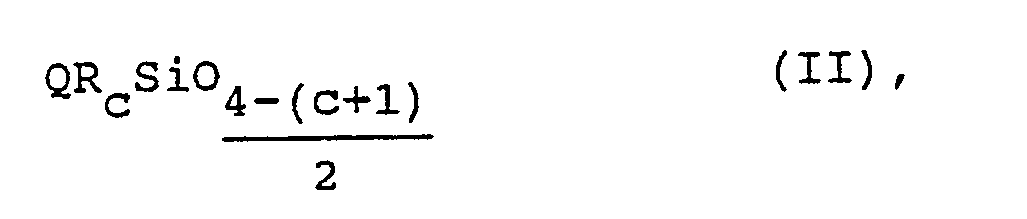
c 0, 1 oder 2 ist,
Q einen Rest der Formel
- CH₂CHR²CHR²OY(OCR²=CR²CH₃)x-1
bedeutet,
wobei R² gleich oder verschieden ist, ein Wasserstoffatom oder einen Methylrest bedeutet,
Y einen dreiwertigen, vierwertigen, fünfwertigen oder sechswertigen Kohlenwasserstoffrest mit 2 bis 20 Kohlenstoffatomen je Rest bedeutet,
der durch Gruppen der Formel- OH
- OR³ (wobei R³ einen Alkylrest mit 1 bis 6 Kohlenstoffatom(en) je Rest bedeutet)
- OSiR

-
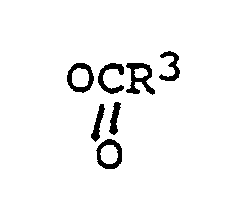
- X (wobei X ein Halogenatom bedeutet)
oder durch mindestens ein Sauerstoffatom, Schwefelatom oder eine Carbonylgruppe unterbrochen sein kann, oder einen dreiwertigen Rest der Formel
≡P, ≡P=O oder ≡SiR⁵
bedeutet, wobei R⁵ einen einwertigen Kohlenwasserstoffrest mit 1 bis 8 Kohlenstoffatom(en) je Rest bedeutet,
oder ein vierwertiges Element, wie
x 3, 4, 5 oder 6 ist, - (c) je Molekül mindestens eine Einheit ausgewählt aus der Gruppe von Einheiten der Formel


Q¹ einen Rest der Formel


- Vorzugsweise enthalten die Alkenyloxygruppen aufweisenden Siloxancopolymere Siloxaneinheiten der Formel (I), je Molekül mindestens eine siloxaneinheit der Formel (II) und je Molekül mindestens eine Einheit ausgewählt aus der Gruppe der Einheiten der Formel (III), (IV) und (V).
- Gegenstand der Erfindung ist weiterhin ein Verfahren zur Herstellung der Alkenyloxygruppen aufweisenden Siloxancopolymere, dadurch gekennzeichnet, daß
- in einer 1. Stufe
mehr als zwei aliphatische Doppelbindungen aufweisende organische Verbindung (1) der allgemeinen Formel
Y(OCHR²CR²=CH₂)x ,
wobei R², Y und x die oben dafür angegebene Bedeutung haben,
mit Organopolysiloxan (2) mit mindestens einem Si-gebundenen Wasserstoffatom je Molekül in Gegenwart von die Anlagerung von Si-gebundenem Wasserstoff an aliphatische Doppelbindung förderndem Katalysator (3) umgesetzt wird, wobei das eingesetzte Verhältnis von aliphatische Doppelbindung in organischer Verbindung (1) zu Si-gebundenem Wasserstoff im Organopolysiloxan (2) ein solches ist, daß Alkenylgruppen aufweisende Siloxancopolymere mit durchschnittlich mehr als zwei Alkenylgruppen A der Formel
-OCHR²CR²=CH₂ ,
wobei R² die oben dafür angegebene Bedeutung hat, erhalten werden und dann
in einer 2. Stufe
die Doppelbindung in den Alkenylgruppen A zu dem dem Ethersauerstoffatom benachbarten Kohlenstoffatom umgelagert wird durch Erhitzen des in der 1. Stufe gewonnenen Alkenylgruppen aufweisenden Siloxancopolymeren in Gegenwart von eine solche Umlagerung der Doppelbindung förderndem Katalysator (4), wobei Alkenyloxygruppen aufweisende Siloxancopolymere mit durchschnittlich mehr als zwei Alkenyloxygruppen B der Formel
-OCR²=CR²CH₃ ,
wobei R² die oben dafür angegebene Bedeutung hat, erhalten werden. - Vorzugsweise ist x 3 oder 4 und Y ein dreiwertiger oder vierwertiger Rest.
- Die erfindungsgemäßen Alkenyloxygruppen aufweisenden Organopolysiloxane besitzen vorzugsweise eine Viskosität von 5 bis 5·10⁵ mPa·s bei 25°C, bevorzugt 50 bis 50 000 mPa·s bei 25°C.
- Beispiele für Reste R sind Alkylreste, wie der Methyl-, Ethyl-, n- Propyl-, iso-Propyl-, 1-n-Butyl-, 2-n-Butyl-, iso-Butyl-, tert.-Butyl-, n-Pentyl-, iso-Pentyl-, neo-Pentyl, tert.-Pentylrest, Hexylreste, wie der n-Hexylrest, Heptylreste, wie der n-Heptylrest, Octylreste, wie der n-Octylrest und iso-Octylreste, wie der 2,2,4-Trimethylpentylrest, Nonylreste, wie der n-Nonylrest, Decylreste, wie der n-Decylrest, Dodecylreste, wie der n-Dodecylrest, Octadecylreste, wie der n-Octadecylrest; Cycloalkylreste, wie Cyclopentyl-, Cyclohexyl-, Cycloheptylreste und Methylcyclohexylreste; Arylreste, wie der Phenyl-, Naphthyl-, Anthryl- und Phenanthrylrest; Alkarylreste, wie o-, m-, p-Tolylreste, Xylylreste und Ethylphenylreste; und Aralkylreste, wie der Benzylrest, der α- und der β-Phenylethylrest. Bevorzugt ist der Methylrest.
- Beispiele für halogenierte Reste R sind Halogenalkylreste, wie der 3,3,3-Trifluor-n-propylrest, der 2,2,2,2',2',2'-Hexafluorisopropylrest, der Heptafluorisopropylrest, und Halogenarylreste, wie der o-, m-, und p-Chlorphenylrest.
- Beispiele für Alkylreste R¹ sind der Methyl-, Ethyl-, n-Propyl-, iso-Propyl-, 1-n-Butyl-, 2-n-Butyl-, iso-Butyl-, und tert.-Butylrest. Bevorzugt sind der Methyl- und Ethylrest. Beispiele für Alkylreste R¹, die durch ein Ethersauerstoffatom substituiert sind, sind der Methoxyethylen- und Ethoxyethylenrest.
- Bevorzugt ist der Rest R² ein Wasserstoffatom.
- Beispiele für Alkylreste R³ sind der Methyl-, Ethyl-, n-Propyl-, iso-Propyl-, 1-n-Butyl-, 2-n-Butyl-, iso-Butyl-, tert.-Butyl-, n-Pentyl-, iso-Pentyl-, neo-Pentyl, tert.-Pentylrest und Hexylreste, wie der n-Hexylrest.
- Beispiele für Reste R⁵ sind Alkylreste, wie der Methyl-, Ethyl-, n-Propyl-, iso-Propyl-, 1-n-Butyl-, 2-n-Butyl-, iso-Butyl-, tert.-Butyl-, n-Pentyl-, iso-Pentyl-, neo-Pentyl, tert.-Pentylrest, Hexylreste, wie der n-Hexylrest, Heptylreste, wie der n-Heptylrest, Octylreste, wie der n-Octylrest und iso-Octylreste, wie der 2,2,4-Trimethylpentylrest, Alkenylreste, wie der Vinyl- und der Allylrest; Cycloalkylreste, wie Cyclopentyl-, Cyclohexyl-, Cycloheptylreste und Methylcyclohexylreste; Arylreste, wie der Phenylrest; Alkarylreste, wie o-, m-, p-Tolylreste, Xylylreste und Ethylphenylreste; und Aralkylreste, wie der Benzylrest, der α- und der β-Phenylethylrest.
- Bevorzugt als Alkenyloxygruppen aufweisende Siloxancopolymere sind solche, die
- (a) Siloxaneinheiten der Formel
R₂SiO (I')
- (b) je Molekül mindestens zwei Siloxaneinheiten der Formel
QR₂SiO1/2 (II')
und
- (c) je Molekül mindestens eine Einheit der Formel
O1/2R₂SiQ¹SiR₂O1/2 (III')
, - Beispiele für mehr als zwei aliphatische Doppelbindungen aufweisende organische Verbindung (1), die in der 1. Stufe des erfindungsgemäßen Verfahrens eingesetzt wird, sind solche der Formel


(CH₂=CHCH₂O)₂CHCH(OCH₂CH=CH₂)₂
(CH₂=CHCH₂O)₂CHCH₂CH(OCH₂CH=CH₂)₂
CH₃C(OCH₂CH=CH₂)₃
C(OCH₂CH=CH₂)₄
(CH₂=CHCH₂O)CH₂[CH(OCH₂CH=CH₂)]₃CH₂(OCH₂CH=CH₂)
(CH₂=CHCH₂O)CH₂[CH(OCH₂CH=CH₂)]₄CH₂(OCH₂CH=CH₂)
Si(OCH₂CH=CH₂)₄
Si[OCH(CH₃)CH=CH₂]₄
P(OCH₂CH=CH₂)₃ ,
O=P(OCH₂CH=CH₂)₃
und
(R⁶O-CH₂-)4-kC(-CH₂-OCH₂CH=CH₂)k
(R⁶ bedeutet Wasserstoff oder einen Rest der Formel
und k ist durchschnittlich 2,5 bis 3,5, bevorzugt 2,9),
wobei die letztgenannte Verbindung ein bevorzugtes Beispiel ist. - Beispiele für den Rest Y sind daher solche der Formel


≡P und ≡P=O .
- Verfahren zur Herstellung von organische Verbindung (1) sind in EP-B 46 731 (veröffentlicht 3. Oktober 1984, F. Lohse et al., Ciba-Geigy AG) beschrieben. Die Verbindung der Formel
(HOCH₂)4-kC(CH₂OCH₂CH=CH₂)k
wobei k 2,9 ist, ist beispielsweise bei der Fa. Shell AG käuflich erwerblich und wird als Pentaerythrittriallylether vertrieben. Die Verbindung der Formel
wobei k durchschnittlich 2,5 bis 3,5, bevorzugt 2,9 ist, wird durch Umsetzung der vorstehend genannten Verbindung mit Acetanhydrid oder Isopropenylacetat gewonnen. - Vorzugsweise werden in der 1. Stufe des erfindungsgemäßen Verfahrens als Organopolysiloxane (2) mit mindestens einem Si-gebundenen Wasserstoffatom solche der allgemeinen Formel

wobei R die oben dafür angegebene Bedeutung hat, - e
- 0 oder 1, durchnittlich 0,005 bis 1,0,
- f
- 0, 1, 2 oder 3, durchschnittlich 1,0 bis 2,0 und die Summe e+f nicht größer als 3 ist,
- Bevorzugt werden als Organopolysiloxane (2) mit mindestens einem Si-gebundenen Wasserstoffatom solche der allgemeinen Formel
HdR3-dSiO(SiR₂O)O(SiRHO)pSiR3-dHd (VII),
wobei R die oben dafür angegebene Bedeutung hat, - d
- 0 oder 1,
- o
- 0 oder eine ganze Zahl von 1 bis 1000 und
- p
- 0 oder eine ganze Zahl von 1 bis 6 bedeutet,
- Besonders bevorzugt enthalten die bei dem erfindungsgemäßen Verfahren eingesetzten Organopolysiloxane (2) durchschnittlich 2 bis 6 Si-gebundene Wasserstoffatome.
- Die Organopolysiloxane (2) mit mindestens einem Si-gebundenen Wasserstoffatom je Molekül besitzen vorzugsweise eine Viskosität von 0,5 bis 20 000 mPa·s bei 25°C, bevorzugt 5 bis 1000 mPa·s bei 25°C.
- Beispiele für Organopolysiloxane (2) sind Mischpolymerisate aus Dimethylhydrogensiloxan- und Dimethylsiloxaneinheiten, Mischpolymerisate aus Dimethylhydrogensiloxan-, Dimethylsiloxan-und Methylhydrogensiloxaneinheiten, Mischpolymerisate aus Trimethylsiloxan- und Methylhydrogensiloxaneinheiten, Mischpolymerisate aus Trimethylsiloxan-, Dimethylsiloxan- und Methylhydrogensiloxaneinheiten, Mischpolymerisate aus Dimethylhydrogensiloxan-, Dimethylsiloxan- und Phenylmethylsiloxaneinheiten, Mischpolymerisate aus Dimethylhydrogensiloxan- und Methylsiloxaneinheiten und Mischpolymerisate aus Dimethylhydrogensiloxan- und Phenylsiloxaneinheiten, Mischpolymerisate aus Methylhydrogensiloxan-und Diphenylsiloxaneinheiten, Mischpolymerisate aus Methylhydrogensiloxan-, Dimethylsiloxan- und Phenylsiloxaneinheiten und Mischpolymerisate aus Dimethylhydrogensiloxan-, Dimethylsiloxan- und Phenylsiloxaneinheiten.
- Verfahren zum Herstellen von Organopolysiloxanen mit mindestens einem Si-gebundenen Wasserstoffatom je Molekül, auch von solchen der bevorzugten Art, sind allgemein bekannt.
- Organische Verbindung (1) wird bei dem erfindungsgemäßen Verfahren in solchen Mengen eingesetzt, daß aliphatische Doppelbindung in organischer Verbindung (1) zu Si-gebundenem Wasserstoff in Organopolysiloxan (2) im Verhältnis von vorzugsweise 1,5 : 1 bis 20 : 1 , bevorzugt 2 : 1 bis 10 : 1 , vorliegt. Organische Verbindung (1) kann mit Organopolysiloxan (2) in Abhängigkeit ihrer Funktionalität und ihres Molekulargewichtes annähernd beliebig in sehr weiten Grenzen kombiniert werden. Ein Verhältnis C=C : SiH von größer als 20 : 1 führt aber ausschließlich zur Monohydrosilylierung der organischen Verbindung (1), was nicht bevorzugt ist.
- Als die Anlagerung von Si-gebundenem Wasserstoff an aliphatische Mehrfachbindung fördernde Katalysatoren (3) können auch in der 1. Stufe des erfindungsgemäßen Verfahrens die gleichen Katalysatoren eingesetzt werden, die auch bisher zur Förderung der Anlagerung von Si-gebundenen Wasserstoff an aliphatische Doppelbindung eingesetzt werden konnten. Bei den Katalysatoren (3) handelt es sich vorzugsweise um ein Metall aus der Gruppe der Platinmetalle oder um eine Verbindung oder einen Komplex aus der Gruppe der platinmetalle. Beispiele für solche Katalysatoren sind metallisches und feinverteiltes Platin, das sich auf Trägern, wie Siliciumdioxyd, Aluminiumoxyd oder Aktivkohle befinden kann, Verbindungen oder Komplexe von Platin, wie Platinhalogenide, z.B. PtCl₄, H₂PtCl₆*6H₂O, Na₂PtCl₄*4H₂O, Platin-Olefin-Komplexe, Platin-Alkohol-Komplexe, Platin-Alkoholat-Komplexe, Platin-Ether-Komplexe, Platin-Aldehyd-Komplexe, Platin-Keton-Komplexe, einschließlich Umsetzungsprodukten aus H₂PtCl₆*6H₂O und Cyclohexanon, Platin-Vinylsiloxankomplexe, wie Platin-1,3-Divinyl-1,1,3,3-tetramethyldisiloxankomplexe mit oder ohne Gehalt an nachweisbarem anorganisch gebundenem Halogen, Bis-(gamma-picolin)-platindichlorid, Trimethylendipyridinplatindichlorid, Dicyclopentadienplatindichlorid, Dimethylsulfoxydethylenplatin-(II)-dichlorid sowie Umsetzungsprodukte von Platintetrachlorid mit Olefin und primärem Amin oder sekundärem Amin oder primärem und sekundärem Amin gemäß US-A 4 292 434, wie das Umsetzungsprodukt aus in 1-Octen gelöstem Platintetrachlorid mit sec.-Butylamin, oder Ammonium-Platinkomplexe gemäß EP-B 110 370.
- Der Katalysator (3) wird vorzugsweise in Mengen von 0,5 bis 1000 Gew.-ppm (Gewichtsteilen je Million Gewichtsteilen), bevorzugt in Mengen von 2 bis 100 Gew.-ppm, jeweils berechnet als elementares Platin und bezogen auf das Gesamtgewicht von organische Verbindung (1) und Organopolysiloxan (2), eingesetzt.
- Die Additionsreaktion (oder Hydrosilylierungsreaktion) in der 1. Stufe des erfindungsgemäßen Verfahrens wird vorzugsweise beim Druck der umgebenden Atmosphäre, also etwa bei 1020 hPa (abs.), durchgeführt, sie kann aber auch bei höheren oder niedrigeren Drücken durchgeführt werden. Ferner wird die Hydrosilylierung vorzugsweise bei einer Temperatur von 50°C bis 150°C, bevorzugt 80°C bis 130°C durchgeführt.
- In der 1. Stufe des erfindungsgemäßen Verfahrens können inerte, organische Lösungsmittel mitverwendet werden, obwohl die Mitverwendung von inerten, organischen Lösungsmittel nicht bevorzugt ist. Beispiele für inerte, organische Lösungsmittel sind Toluol, Xylol, Octanisomere, Butylacetat, 1,2-Dimethoxyethan, Tetrahydrofuran und Cyclohexan.
- Von den in der 1.Stufe des erfindungsgemäßen Verfahrens hergestellten Alkenylgruppen aufweisenden Siloxancopolymeren wird vorzugsweise überschüssige organische Verbindung (1) sowie gegebenenfalls mitverwendetes inertes organisches Lösungsmittel destillativ entfernt.
- Die in der 1. Stufe des erfindungsgemäßen Verfahrens gewonnenen Alkenylgruppen aufweisendenen Siloxancopolymere sind in der gleichzeitig eingereichten Patentanmeldung mit der internen Bezeichnung Wa 8927-S beschrieben.
- In der 2. Stufe des erfindungsgemäßen Verfahrens wird die Doppelbindung in den Alkenylgruppen A der Formel
-OCHR²CR²=CH₂
umgelagert zu dem dem Ethersauerstoffatom benachbarten Kohlenstoffatom in Gegenwart von diese Doppelbindungsumlagerung fördernde Katalysatoren (4). - In der 2. Stufe des erfindungsgemäßen Verfahrens können die gleichen Katalysatoren (4) eingesetzt werden die auch bisher zur Förderung einer solchen Umlagerung der Doppelbindung eingesetzt werden konnten. Beispiele für Katalysatoren (4) sind metallisches oder feinverteiltes Platin, Ruthenium, Rhodium und Palladium, wobei sich diese Metalle jeweils auf Trägern wie Aktivkohle befinden können, und Verbindungen oder Komplexe dieser Elemente, die in dem in der 1. Stufe des erfindungsgemäßen Verfahrens gewonnenen Alkenylgruppen aufweisendenem Siloxancopolymeren löslich sind oder an Trägern wie Aktivkohle oder polymere Phosphinliganden fixiert sind. Beispiele für bevorzugte Katalysatoren (4) sind solche der Formel RuCl₂(PPh₃)₃, RuHCl(PPh₃)₃, RuHCl(CO)(PPh₃)₃, RuH₂(CO)(PPh₃)₃ und RuH₂(PPh₃)₄.
- Der Katalysator (4) wird vorzugsweise in Mengen von 0,1 bis 1000 Gew.-ppm, bevorzugt 5 bis 100 Gew.-ppm, jeweils berechnet als elementares Metall und bezogen auf das Gesamtgewicht von organische Verbindung (1) und Organopolysiloxan (2), eingesetzt.
- Als Katalysatoren (4) können auch starke Basen, wie Kalium-tert.-butylat, verwendet werden, doch sind diese aufgrund der hohen Einsatzmengen nicht bevorzugt. Umlagerung von Doppelbindungen mit diesen starken Basen sind in C. C. Price, JACS 83, 1772 (1961) und G. Kesslin, J. Org. Chem. 31, 2682 (1966) beschrieben.
- Zur Umlagerung der Doppelbindung zu dem dem Ethersauerstoffatom benachbarten Kohlenstoffatom in den Alkenylgruppen A wird das aus der 1. Stufe des erfindungsgemäßen Verfahrens gewonnene Alkenylgruppen aufweisende Siloxancopolymer mit dem Katalysator (4) vermischt und die Mischung erhitzt. Die Umsetzung wird vorzugsweise bei einer Temperatur von 80 bis 200°C, bevorzugt von 120 bis 150°C, vorzugsweise beim Druck der umgebenden Atmosphäre, als etwa bei 1020 hPa (abs.), und vorzugsweise in einer Zeit von 0,5 bis 20 Stunden, bevorzugt 4 bis 10 Stunden, durchgeführt. Vorzugsweise wird kein Lösungsmittel mitverwendet.
- Wird in der 1. Stufe des erfindungsgemäßen Verfahrens die organische Verbindung (1) nicht destillativ entfernt, lagern sich auch die Alkenylgruppen A in der organischen Verbindung (1) in Alkenyloxygruppen B um. Von den in der 2. Stufe des erfindungsgemäßen Verfahrens hergestellten Alkenyloxygruppen aufweisenden Siloxancopolymeren kann die umgelagerte organische Verbindung (1) destillativ entfernt werden. Wird sie nicht entfernt, ist sie aufgrund ihres Gehaltes an Alkenyloxygruppen B zur kationischen Polymerisation oder Copolymerisation mit den Alkenyloxygruppen des Siloxancopolymeren befähigt.
- Das in der 2. Stufe des erfindungsgemäßen Verfahrens erhaltene Alkenyloxygruppen aufweisende Siloxancopolymer ist ein cis-/trans-Isomerengemisch in Bezug auf die Alkenyloxygruppen, wobei das cis-Isomere meistens überwiegt. Beispielsweise wenn die Alkenyloxygruppe ein 1-Propenyloxypropylrest ist, so liegt folgendes Isomerengemisch vor:

- Das erfindungsgemäße 2-Stufen-Verfahren läuft nach folgendem Reaktionsschema ab beispielhaft dargestellt durch Einsatz von Pentaerythrittriallyletheracetat als organische Verbindung (1) und einem α,ω-Dihydrogendimethylpolysiloxan als Organopolysiloxan (2):

- Der Reaktionsablauf und damit das erhaltene Endprodukt hängt entscheidend von dem in der 1. Stufe eingesetzten Verhältnis von C=C-Doppelbindung in organischer Verbindung (1) zu Si-gebundenem Wasserstoff in Organopolysiloxan (2) ab. Es werden je nach eingesetztem Verhältnis C=C:SiH - wobei das Verhältnis C=C:SiH immer größer als 1 sein muß - Siloxancopolymere erhalten, die am Kettenende und entlang der Kette freie Alkenylgruppen A der Formel
-OCHR²CR²=CH₂, wie -OCH₂CH=CH₂,
aufweisen, wobei es zu Verzweigungen entlang der Kette kommen kann durch Weiterreaktion der freien Alkenylgruppen entlang der Kette mit den Si-gebundenen Wasserstoffatomen des Organopolysiloxans (2). In der 2. Stufe wird dann die Doppelbindung in den freien Alkenylgruppen A umgelagert und es werden freie Alkenyloxygruppen B der Formel
-OCR²=CR²CH₃, wie -OCH=CHCH₃,
erhalten. In der 1. Stufe werden in Gegenwart von den Platinkatalysatoren die Allyloxygruppen, -OCH₂CH=CH₂, bereits in einem geringen Ausmaß (bis zu 15 Mol%) zu Propenyloxygruppen, -OCH=CHCH₃, umgelagert, so daß in der 2. Stufe sich ein Gleichgewicht zwischen Allyloxy- und Propenyloxygruppen einstellt, in dem das Verhältnis von Allyloxygruppen zu Propenyloxygruppen üblicherweise 4:96 beträgt, also ein Umsatz in bezug auf die Propenyloxygruppen von ca. 96 % erzielt wird. - Die verschiedenen Stufen des erfindungsgemäßen Verfahrens können in ein und demselben Reaktionsgefäß hintereinander oder in von einander getrennten Reaktionsgefäßen durchgeführt werden. Vorzugsweise wird es in ein und demselben Reaktionsgefäß hintereinander durchgeführt. Das erfindungsgemäße Verfahren kann absatzweise, halbkontinuierlich oder vollkontinuierlich durchgeführt werden.
- Die erfindungsgemäßen Alkenyloxygruppen aufweisenden Siloxancopolymere sind in einer durch Licht initiierten, kationischen Polymerisation vernetzbar. Als Katalysatoren für die durch Licht initiierte Vernetzung können beispielsweise die in US-A 4 279 717 (ausgegeben 21. Juli 1981, Eckberg et al., General Electric Company) beschriebenen Bis-(dodecylphenyl)iodoniumsalze, wie Bis-(dodecylphenyl)iodoniumhexafluoroantimonat oder Bis-(dodecylphenyl)iodoniumhexafluoroarsenat verwendet werden.
- Gegenstand der Erfindung ist daher die Verwendung von Alkenyloxygruppen aufweisenden Siloxancopolymeren vorzugsweise enthaltend Einheiten der Formel (I), (II) und gegebenenfalls mindestens eine der Einheiten der Formel (III), (IV) oder (V), bevorzugt enthaltend Einheiten der Formel (I'), (II') und (III'), in durch Licht vernetzbare Zusammensetzungen auf Grundlage von vorstehend genannten Siloxancopolymeren.
- Vorzugsweise werden die erfindungsgemäßen Alkenyloxygruppen aufweisenden Siloxancopolymere durch Ultraviolettlicht vernetzt, wobei solches mit Wellenlängen im Bereich von 200 bis 400 nm bevorzugt ist. Das Ultraviolettlicht kann z.B. in Xenon-, Quecksilbernieder-, Quecksilbermittel- oder Quecksilberhochdrucklampen erzeugt werden. Zur Vernetzung durch Licht ist auch solches mit einer Wellenlänge von 400 bis 600 nm, also sogenanntes "Halogenlicht", geeignet. Die erfindungsgemäßen Alkenyloxygruppen aufweisenden Siloxancopolymere können durch Licht im sichtbaren Bereich vernetzt werden, wenn handelsübliche Photosensibilisatoren mitverwendet werden.
- Die kationische Polymerisation der erfindungsgemäßen Alkenyloxygruppen aufweisenden Siloxancopolymere kann natürlich auch durch dafür übliche Brönsted- oder Lewissäuren eingeleitet werden.
- Gegenstand der Erfindung ist schließlich auch die Verwendung der erfindungsgemäßen Alkenyloxygruppen aufweisenden Siloxancopolymeren zur Herstellung von durch Licht vernetzbare Überzüge.
- Beispiele für Oberflächen, auf welche die erfindungsgemäßen Überzüge aufgebracht werden können, sind diejenigen von Papier, Holz, Kork, Kunststoffolien, z.B. Polyethylenfolien oder Polypropylenfolien, keramischen Gegenständen, Glas, einschließlich Glasfasern, Metallen, Pappen, einschließlich solcher aus Asbest, und von gewebtem und ungewebtem Tuch aus natürlichen oder synthetischen organischen Fasern.
- Das Auftragen der erfindungsgemäßen Alkenyloxygruppen aufweisenden Siloxancopolymeren auf die zu überziehenden Oberflächen kann in beliebiger, für die Herstellung von Überzügen aus flüssigen Stoffen geeigneter und vielfach bekannter Weise erfolgen, beispielsweise durch Tauchen, Streichen, Gießen, Sprühen, Aufwalzen, Drucken, z. B. mittels einer Offsetgravurüberzugsvorrichtung, Messer- oder Rakelbeschichtung.
- 89 g 1,1,2,2-Tetraallyloxyethan werden mit 5,4 mg Platin in Form einer Lösung von Platintetrachlorid in 1-Octen vermischt und die Mischung wird auf 110°C erwärmt. Zu dieser Mischung werden unter Stickstoffatmosphäre und Rühren bei 110°C 581 g eines α,ω-Dihydrogendimethylpolysiloxans, das 250 mg Si-gebundenen Wasserstoff enthält, zugetropft. Nach ca. 3 Stunden Rühren bei 110°C sind 98 % der Si-gebundenen Wasserstoffatome des α,ω-Dihydrogendimethylpolysiloxans umgesetzt. Bei 120°C und 10⁻³ hPa werden dann alle flüchtigen Bestandteile destillativ entfernt. Zu dem Umsetzungprodukt werden dann bei 130°C und 1020 hPa (abs.) unter Stickstoffatmosphäre 110 mg RuHCl(Ph₃P)₃ zugesetzt und die Mischung 16 Stunden lang bei 130°C gerührt. Es wird eine klare, gelbe Flüssigkeit mit einer Viskosität von ca. 1100 mPa·s bei 25°C erhalten. Das so gewonnene Siloxancopolymer enthält im wesentlichen neben Dimethylsiloxaneinheiten, Siloxaneinheiten der Formel

und Brückeneinheiten der Formel
wobei bei den 1-Propenyloxygruppen, CH₃CH=CHO-, gemäß dem ¹H-NMR-Spektrum das Verhältnis von cis-Isomer zu trans-Isomer 70 : 30 beträgt. Das 1-Propenyloxygruppen aufweisende Siloxancopolymer besitzt ein Äquivalentgewicht von ca. 1300 g pro Mol C=C-Doppelbindung. - 114,4 g Trimethylolpropanallylether (hergestellt gemäß EP-B 46 731 ) mit einer Jodzahl (= Zahl, die angibt, wieviel g Jod von 100 g Substanz gebunden werden) von 266 werden mit 3,8 mg Platin in Form einer Lösung von Platintetrachlorid in 1-Octen vermischt und die Mischung wird auf 105°C erwärmt. Zu dieser Mischung werden unter Stickstoffatmosphäre und Rühren bei 105°C 273 g eines α,ω-Dihydrogendimethylpolysiloxans, das 0,6 g Si-gebundenen Wasserstoff enthält, zugetropft. Nach ca. 4 Stunden Rühren bei 105°C sind 99 % der Si-gebundenen Wasserstoffatome des α,ω-Dihydrogendimethylpolysiloxans umgesetzt. Bei 120°C und 10⁻³ hPa werden dann alle flüchtigen Bestandteile destillativ entfernt. Zu dem Umsetzungprodukt werden dann bei 130°C und 1020 hPa (abs.) unter Stickstoffatmosphäre 200 Gew.-ppm RuHCl(Ph₃P)₃ zugesetzt und die Mischung 8 Stunden lang bei 130°C gerührt. Es werden 315 g eines klaren, fast farblosen Öls mit einer Viskosität von 380 mm²·s⁻¹ bei 25°C erhalten. Das so gewonnene 1-Propenyloxygruppen aufweisende Siloxancopolymer besitzt ein Äquivalentgewicht von ca. 900 g pro Mol C=C-Doppelbindung.
- 48 g Pentaerythrittriallylether mit einer Jodzahl von 281 (käuflich erwerblich bei der Fa. Shell) werden mit 2,2 mg Platin in Form einer Lösung von Platintetrachlorid in 1-Octen vermischt und die Mischung wird auf 105°C erwärmt. Zu dieser Mischung werden unter Stickstoffatmosphäre und Rühren bei 105°C 435 g eines α,ω-Dihydrogendimethylpolysiloxans, das 0,046 Gew.-% Si-gebundenen Wasserstoff enthält, zugetropft. Nach ca. 8 Stunden Rühren bei 105°C sind 98 % der Si-gebundenen Wasserstoffatome des α,ω-Dihydrogendimethylpolysiloxans umgesetzt. Bei 120°C und 10⁻³ hPa werden dann alle flüchtigen Bestandteile destillativ entfernt. Nach dem Filtrieren werden zu dem Umsetzungprodukt dann bei 130°C und 1020 hPa (abs.) unter Stickstoffatmosphäre 76 mg RuHCl(Ph₃P)₃ zugesetzt und die Mischung 8 Stunden lang bei 130°C gerührt. Es wird ein 1-Propenyloxygruppen aufweisendes Siloxancopolymer erhalten, das eine Viskosität von 1190 mm²·s⁻¹ hat, das eine 1-Propenyloxygruppe pro 32 Siliziumatome besitzt und ein Äquivalentgewicht von ca. 2400 g pro Mol C=C-Doppelbindung aufweist. Das Verhältnis von cis-Isomer zu trans-Isomer beträgt bei den 1-Propenyloxygruppen 70 : 30. Folgende Daten werden aus dem ¹H-NMR-Spektrum erhalten:

- Zu 100 g des in Beispiel 3 hergestellten Siloxancopolymeren werden 2 g einer 50 %-igen Lösung von Bis-(dodecylphenyl)jodonium-hexafluoroantimonat, das gemäß US-A 4 279 717 hergestellt wurde, in Propylencarbonat zugegeben. Die Mischung wird mit einem Glasstab auf mit Polyethylen beschichtetes Papier in einer Dicke von 3 µ aufgetragen. In einem Abstand von 10 cm zum beschichteten Substrat sind zwei Quecksilbermitteldrucklampen mit einer Leistung von 80 Watt/cm Leuchtlänge angebracht. Nach weniger als zwei Sekunden UV-Belichtung wird ein klebfreier Überzug erhalten, der Klebstoff abweisend gegenüber mit Acrylatkleber beschichtete Papieretiketten ist.
und gegebenenfalls
wobei R, Q und Q¹ die oben dafür angegebene Bedeutung haben, enthalten.
bei dem erfindungsgemäßen Verfahren eingesetzt.
Claims (8)
- Alkenyloxygruppen aufweisende Siloxancopolymere enthaltend(a) Siloxaneinheiten der Formel

R¹ gleiche oder verschiedene Alkylreste mit 1 bis 4 Kohlenstoffatom(en) je Rest, die durch ein Ethersauerstoffatom substituiert sein können, bedeutet,
a 0, 1, 2 oder 3,
b 0, 1, 2 oder 3
und die Summe a+b nicht größer als 3 ist,(b) je Molekül mindestens eine Siloxaneinheit der Formel
c 0, 1 oder 2 ist,
Q einen Rest der Formel
-CH₂CHR²CHR²OY(OCR²=CR²CH₃)x-1
bedeutet, wobei R² gleich oder verschieden ist, ein Wasserstoffatom oder einen Methylrest bedeutet,
Y einen dreiwertigen, vierwertigen, fünfwertigen oder sechswertigen Kohlenwasserstoffrest mit 2 bis 20 Kohlenstoffatomen je Rest bedeutet,
der durch Gruppen der Formeloder einen dreiwertigen Rest der Formel- OH- OR³ (wobei R³ einen Alkylrest mit 1 bis 6 Kohlenstoffatom(en) je Rest bedeutet)- OSiR -
- - X (wobei X ein Halogenatom bedeutet)substituiert sein kann oder durch mindestens ein Sauerstoffatom, Schwefelatom oder eine Carbonylgruppe unterbrochen sein kann,
≡P, ≡P=O oder ≡SiR⁵
bedeutet, wobei R⁵ einen einwertigen Kohlenwasserstoffrest mit 1 bis 8 Kohlenstoffatom(en) je Rest bedeutet,
oder ein vierwertiges Element, wie
x 3, 4, 5 oder 6 ist,
und gegebenenfalls(c) je Molekül mindestens eine Einheit ausgewählt aus der Gruppe von Einheiten der Formel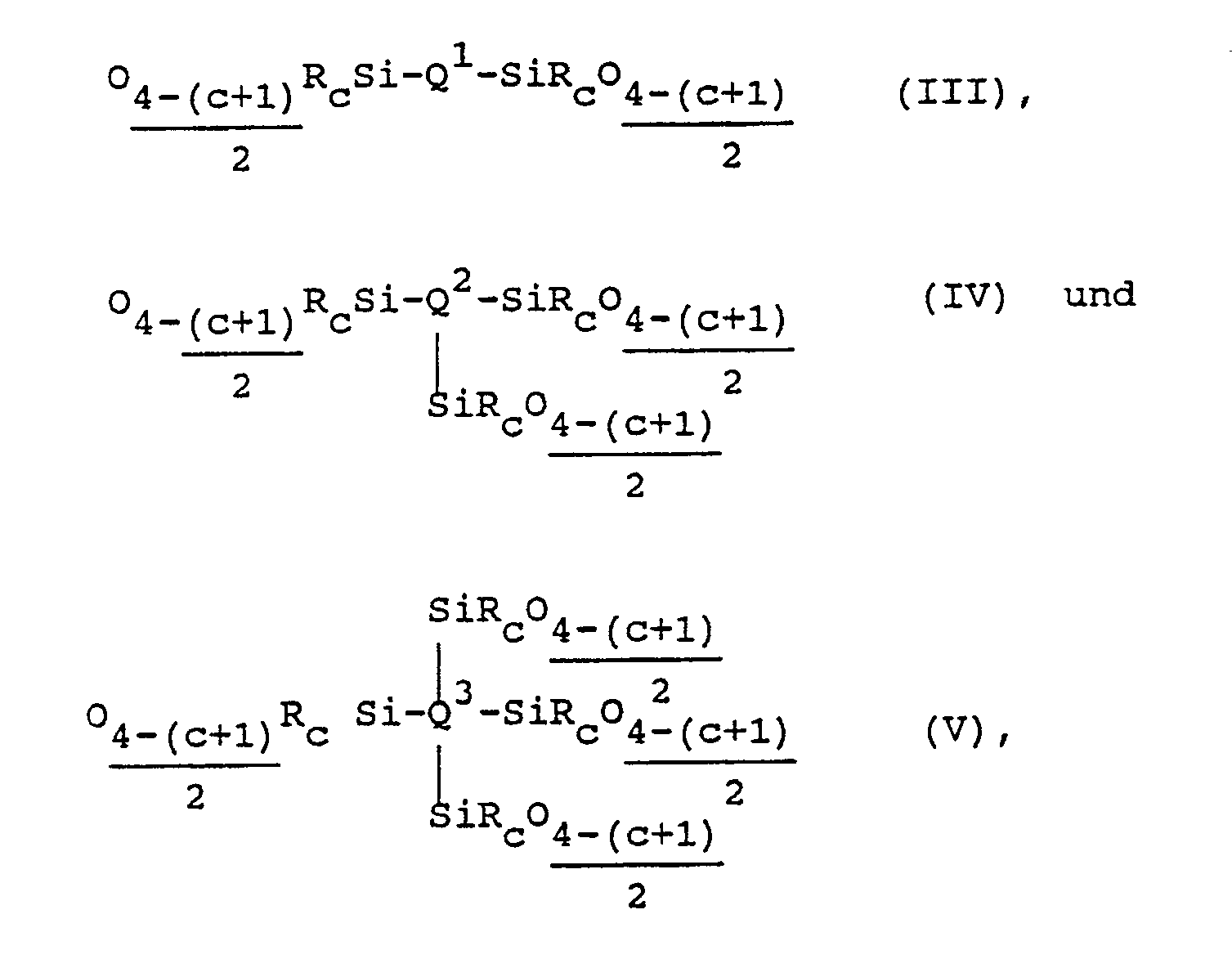
Q¹ einen Rest der Formel


- Alkenyloxygruppen aufweisende Siloxancopolymere nach Anspruch 1, dadurch gekennzeichnet, daß sie Siloxaneinheiten der Formel (I), je Molekül mindestens eine Siloxaneinheit der Formel (II) und je Molekül mindestens eine Einheit ausgewählt aus der Gruppe der Einheiten der Formel (III), (IV) und (V) enthalten.
- Alkenyloxygruppen aufweisende Siloxancopolymere nach Anspruch 1 oder 2, dadurch gekennzeichnet, daß sie enthalten(a) Siloxaneinheiten der Formel
R₂SiO (I')
(b) je Molekül mindestens zwei Siloxaneinheiten der Formel
QR₂SiO1/2 (II')
und
(c) je Molekül mindestens eine Einheit der Formel
O1/2R₂SiQ¹SiR₂O1/2 (III') ,
wobei R gleiche oder verschiedene, gegebenenfalls halogenierte Kohlenwasserstoffreste mit 1 bis 18 Kohlenstoffatom(en) je Rest,
Q einen Rest der Formel
-CH₂CHR²CHR²OY(OCR²=CR²CH₃)x-1
Q¹ einen Rest der Formel
x 3, 4, 5 oder 6 ist und
Y einen dreiwertigen, vierwertigen, fünfwertigen oder sechswertigen Kohlenwasserstoffrest mit 2 bis 20 Kohlenstoffatomen je Rest bedeutet,
der durch Gruppen der Formeloder einen dreiwertigen Rest der Formel- OH- OR³ (wobei R³ einen Alkylrest mit 1 bis 6 Kohlenstoffatom(en) je Rest bedeutet)- OSiR -
- - (wobei X ein Halogenatom bedeutet)substituiert sein kann oder durch mindestens ein Sauerstoffatom, Schwefelatom oder eine Carbonylgruppe unterbrochen sein kann,
≡P, ≡P=O oder ≡SiR⁵
bedeutet, wobei R⁵ einen einwertigen Kohlenwasserstoffrest mit 1 bis 8 Kohlenstoffatom(en) je Rest bedeutet,
oder ein vierwertiges Element, wie
- Verfahren zur Herstellung der Alkenyloxygruppen aufweisenden Siloxancopolymere nach einem der Ansprüche 1 bis 3, dadurch gekennzeichnet, daß mehr als zwei aliphatische Doppelbindungen aufweisende organische Verbindung (1) der allgemeinen Formel
Y(OCHR²CR²=CH₂)x ,
wobei R² gleich oder verschieden ist, ein Wasserstoffatom oder einen Methylrest bedeutet,
x 3, 4, 5 oder 6 ist und
Y einen dreiwertigen, vierwertigen, fünfwertigen oder sechswertigen Kohlenwasserstoffrest mit 2 bis 20 Kohlenstoffatomen je Rest bedeutet,
der durch Gruppen der Formel- OH- OR³ (wobei R³ einen Alkylrest mit 1 bis 6 Kohlenstoffatom(en) je Rest bedeutet)- OSiR -
- - X (wobei X ein Halogenatom bedeutet) substituiert sein kannoder einen dreiwertigen Rest der Formel
oder durch mindestens ein Sauerstoffatom, Schwefelatom oder eine Carbonylgruppe unterbrochen sein kann,
≡P, ≡P=O oder ≡SiR⁵
bedeutet, wobei R⁵ einen einwertigen Kohlenwasserstoffrest mit 1 bis 8 Kohlenstoffatom(en) je Rest bedeutet,
oder ein vierwertiges Element, wie
mit Organopolysiloxan (2) mit mindestens einem Si-gebundenen Wasserstoffatom je Molekül in Gegenwart von die Anlagerung von Si-gebundenen Wasserstoff an aliphatische Doppelbindung förderndem Katalysator (3) umgesetzt wird, wobei das eingesetzte Verhältnis von aliphatische Doppelbindung in organischer Verbindung (1) zu Si-gebundenem Wasserstoff im Organopolysiloxan (2) ein solches ist, daß Alkenylgruppen aufweisende Siloxancopolymere mit durchschnittlich mehr als zwei Alkenylgruppen A der Formel
-OCHR²CR²=CH₂ ,
wobei R² die oben dafür angegebene Bedeutung hat, erhalten werden und dann
in einer 2. Stufe
die Doppelbindung in den Alkenylgruppen A zu dem dem Ethersauerstoffatom benachbarten Kohlenstoffatom umgelagert wird durch Erhitzen des in der 1. Stufe gewonnenen Alkenylgruppen aufweisenden Siloxancopolymeren in Gegenwart von eine solche Umlagerung der Doppelbindung förderndem Katalysator (4), wobei Alkenyloxygruppen aufweisende Siloxancopolymere mit durchschnittlich mehr als zwei Alkenyloxygruppen B der Formel
-OCR²=CR²CH₃ ,
wobei R² die oben dafür angegebene Bedeutung hat, erhalten werden. - Verfahren nach Anspruch 4, dadurch gekennzeichnet, daß als organische Verbindung (1) solche der Formel
(R⁶OCH₂)4-kC(CH₂OCH₂CH=CH₂)k,
wobei R⁶ Wasserstoff oder einen Rest der Formel
- Verfahren nach Anspruch 4, dadurch gekennzeichnet, daß als Organopolysiloxan (2) mit mindestens einem Si-gebundenen Wasserstoffatom je Molekül solches der allgemeinen Formel
HdR3-dSiO(SiR₂O)o(SiRHO)pSiR3-dHd (VII),
wobei R gleiche oder verschiedene, gegebenenfalls halogenierte Kohlenwasserstoffreste mit 1 bis 18 Kohlenstoffatom(en) je Rest,d 0 oder 1,o 0 oder eine ganze Zahl von 1 bis 1000 undp 0 oder eine ganze Zahl von 1 bis 6 bedeutet,verwendet wird. - Verwendung der Alkenyloxygruppen aufweisenden Siloxancopolymere nach Anspruch 1, 2 oder 3 in durch Licht vernetzbare Zusammensetzungen auf Grundlage von vorstehend genannten Organopolysiloxanen.
- Verwendung der Alkenyloxygruppen aufweisenden Siloxancopolymere nach Anspruch 1, 2 oder 3 zur Herstellung von durch Licht vernetzbare Überzüge.
Applications Claiming Priority (2)
| Application Number | Priority Date | Filing Date | Title |
|---|---|---|---|
| DE19904002922 DE4002922A1 (de) | 1990-02-01 | 1990-02-01 | Alkenyloxygruppen aufweisende siloxancopolymere, deren herstellung und verwendung |
| DE4002922 | 1990-02-01 |
Publications (3)
| Publication Number | Publication Date |
|---|---|
| EP0439777A2 true EP0439777A2 (de) | 1991-08-07 |
| EP0439777A3 EP0439777A3 (en) | 1991-10-23 |
| EP0439777B1 EP0439777B1 (de) | 1994-09-07 |
Family
ID=6399189
Family Applications (1)
| Application Number | Title | Priority Date | Filing Date |
|---|---|---|---|
| EP19900124495 Expired - Lifetime EP0439777B1 (de) | 1990-02-01 | 1990-12-18 | Alkenyloxygruppen aufweisende Siloxancopolymere, deren Herstellung und Verwendung |
Country Status (10)
| Country | Link |
|---|---|
| US (1) | US5231157A (de) |
| EP (1) | EP0439777B1 (de) |
| JP (1) | JPH0737530B2 (de) |
| AT (1) | ATE111126T1 (de) |
| CA (1) | CA2035396A1 (de) |
| DE (2) | DE4002922A1 (de) |
| ES (1) | ES2058745T3 (de) |
| FI (1) | FI96431C (de) |
| MX (1) | MX174357B (de) |
| NO (1) | NO178667C (de) |
Cited By (4)
| Publication number | Priority date | Publication date | Assignee | Title |
|---|---|---|---|---|
| EP0607869A1 (de) * | 1993-01-14 | 1994-07-27 | Wacker-Chemie GmbH | Alkenylgruppen aufweisende Siloxancopolymere, deren Herstellung und Verwendung |
| EP0686652A1 (de) | 1994-06-08 | 1995-12-13 | Wacker-Chemie GmbH | Radikalisch vernetzbare Alkenylethersiloxanmassen |
| WO1997023548A1 (de) * | 1995-12-22 | 1997-07-03 | Wacker-Chemie Gmbh | Aliphatisch ungesättigte reste aufweisende organopolysiloxane, deren herstellung und deren verwendung in vernetzbaren massen |
| WO1998027163A1 (de) * | 1996-12-17 | 1998-06-25 | Wacker-Chemie Gmbh | Härtbare organosiloxanmassen |
Families Citing this family (55)
| Publication number | Priority date | Publication date | Assignee | Title |
|---|---|---|---|---|
| DE4123423A1 (de) * | 1991-07-15 | 1993-01-21 | Wacker Chemie Gmbh | Alkenylgruppen aufweisende siloxancopolymere, deren herstellung und verwendung |
| EP0626718B1 (de) * | 1991-09-20 | 2002-12-18 | Hitachi, Ltd. | Anzeige mit Antireflektionsschicht, Kathodenstrahlröhre und Flüssigkristallanzeige |
| US5331020A (en) * | 1991-11-14 | 1994-07-19 | Dow Corning Limited | Organosilicon compounds and compositions containing them |
| DE4215076A1 (de) * | 1992-05-07 | 1993-11-11 | Wacker Chemie Gmbh | Vinyloxygruppen aufweisende Siloxancopolymere, deren Herstellung und Verwendung |
| US5866666A (en) * | 1992-05-07 | 1999-02-02 | Wacker-Chemie Gmbh | Siloxane copolymers containing vinyloxy groups, their preparation and their use |
| DE4215030A1 (de) * | 1992-05-07 | 1993-11-11 | Wacker Chemie Gmbh | Vinyloxygruppen aufweisende Siloxancopolymere, deren Herstellung und Verwendung |
| US5466845A (en) * | 1992-06-12 | 1995-11-14 | Wacker-Chemie Gmbh | Sulfonium salts and process for their preparation |
| DE4310733A1 (de) * | 1993-04-01 | 1994-10-06 | Fraunhofer Ges Forschung | Selbsthärtende Systeme |
| US5436309A (en) * | 1993-04-19 | 1995-07-25 | Dow Corning Corporation | Photo-crosslinkable silicones comprising oxyalkylene styrene groups and their use |
| US5348771A (en) * | 1993-11-19 | 1994-09-20 | Dow Corning Corporation | Method of producing an oxygen barrier coating containing trimethoxysilyl functional pentadienoate |
| US5919885A (en) * | 1994-02-18 | 1999-07-06 | Fraunhofer-Gesellschaft Zur Foerderung Der Angewandten Forschung E.V. | Covalently and nucleophilically self-curing systems |
| US5486422A (en) * | 1994-04-19 | 1996-01-23 | Dow Corning Corporation | Photo-crosslinkable silicones and their use |
| JP3272929B2 (ja) * | 1995-11-30 | 2002-04-08 | 信越化学工業株式会社 | 硬化性オルガノポリシロキサン組成物 |
| US6093222A (en) * | 1996-04-04 | 2000-07-25 | Ck Witco Corporation | Diesel fuel antifoam composition |
| US6001140A (en) | 1996-04-04 | 1999-12-14 | Witco Corporation | Diesel fuel and lubricating oil antifoams and methods of use |
| DE19718634A1 (de) * | 1997-05-02 | 1998-11-05 | Wacker Chemie Gmbh | Strahlungs- oder thermischhärtende Organosiloxanmassen mit (Methyl)styrolgruppen |
| DE19731961A1 (de) * | 1997-07-24 | 1999-01-28 | Wacker Chemie Gmbh | 1-Alkenyloxygruppen aufweisende Organosiliciumverbindungen, deren Herstellung und Verwendung |
| US6225434B1 (en) | 1997-08-01 | 2001-05-01 | Ppg Industries Ohio, Inc. | Film-forming compositions having improved scratch resistance |
| FR2769165B1 (fr) | 1997-09-26 | 2002-11-29 | Technical Maintenance Corp | Systeme sans fil a transmission numerique pour haut-parleurs |
| FR2781580B1 (fr) | 1998-07-22 | 2000-09-22 | Technical Maintenance Corp | Circuit de commande de son pour systeme de reproduction audiovisuelle numerique intelligent |
| FR2781591B1 (fr) | 1998-07-22 | 2000-09-22 | Technical Maintenance Corp | Systeme de reproduction audiovisuelle |
| US6174983B1 (en) | 1998-11-12 | 2001-01-16 | C. K. Witco Corporation | Silicone terpolymers with high refractive indices |
| AU5649400A (en) | 1999-09-21 | 2001-10-11 | Goldschmidt Ag | Photoinitiators containing urethane groups for cationic curing |
| FR2805377B1 (fr) | 2000-02-23 | 2003-09-12 | Touchtunes Music Corp | Procede de commande anticipee d'une selection, systeme numerique et juke-box permettant la mise en oeuvre du procede |
| FR2805060B1 (fr) | 2000-02-16 | 2005-04-08 | Touchtunes Music Corp | Procede de reception de fichiers lors d'un telechargement |
| FR2805072B1 (fr) | 2000-02-16 | 2002-04-05 | Touchtunes Music Corp | Procede d'ajustement du volume sonore d'un enregistrement sonore numerique |
| FR2808906B1 (fr) | 2000-05-10 | 2005-02-11 | Touchtunes Music Corp | Dispositif et procede de gestion a distance d'un reseau de systemes de reproduction d'informations audiovisuelles |
| FR2811175B1 (fr) | 2000-06-29 | 2002-12-27 | Touchtunes Music Corp | Procede de distribution d'informations audiovisuelles et systeme de distribution d'informations audiovisuelles |
| FR2811114B1 (fr) | 2000-06-29 | 2002-12-27 | Touchtunes Music Corp | Dispositif et procede de communication entre un systeme de reproduction d'informations audiovisuelles et d'une machine electronique de divertissement |
| FR2814085B1 (fr) | 2000-09-15 | 2005-02-11 | Touchtunes Music Corp | Procede de divertissement base sur les jeux concours a choix multiples |
| DE10210015A1 (de) * | 2002-03-07 | 2003-09-25 | Wacker Chemie Gmbh | Verwendung von Alkenylgruppen aufweisenden Siloxancopolymeren als Antimisting Additive in vernetzbaren Siliconbeschichtungszusammensetzungen |
| US8332895B2 (en) | 2002-09-16 | 2012-12-11 | Touchtunes Music Corporation | Digital downloading jukebox system with user-tailored music management, communications, and other tools |
| US8103589B2 (en) | 2002-09-16 | 2012-01-24 | Touchtunes Music Corporation | Digital downloading jukebox system with central and local music servers |
| US10373420B2 (en) | 2002-09-16 | 2019-08-06 | Touchtunes Music Corporation | Digital downloading jukebox with enhanced communication features |
| US12100258B2 (en) | 2002-09-16 | 2024-09-24 | Touchtunes Music Company, Llc | Digital downloading jukebox with enhanced communication features |
| US9646339B2 (en) | 2002-09-16 | 2017-05-09 | Touchtunes Music Corporation | Digital downloading jukebox system with central and local music servers |
| US8584175B2 (en) | 2002-09-16 | 2013-11-12 | Touchtunes Music Corporation | Digital downloading jukebox system with user-tailored music management, communications, and other tools |
| DE10341137A1 (de) * | 2003-09-06 | 2005-03-31 | Goldschmidt Ag | Verwendung von hydroxyfunktionellen Polyalkylorganosiloxanen als Lösungsmittel für kationische Photoinitiatoren für die Verwendung in strahlenhärtbaren Siliconen |
| DE102006027339A1 (de) * | 2006-06-13 | 2007-12-20 | Goldschmidt Gmbh | Kationisch strahlenhärtende Controlled Release Beschichtungsmassen |
| US9171419B2 (en) | 2007-01-17 | 2015-10-27 | Touchtunes Music Corporation | Coin operated entertainment system |
| US12450978B2 (en) | 2007-01-17 | 2025-10-21 | Touchtunes Music Company Llc. | Coin operated entertainment system |
| DE102007005508A1 (de) | 2007-02-03 | 2008-08-07 | Evonik Goldschmidt Gmbh | Verfahren zur Reduktion des Trennwert-Anstiegs bei der Herstellung von No-Label-Look-Etiketten |
| US10290006B2 (en) | 2008-08-15 | 2019-05-14 | Touchtunes Music Corporation | Digital signage and gaming services to comply with federal and state alcohol and beverage laws and regulations |
| US8332887B2 (en) | 2008-01-10 | 2012-12-11 | Touchtunes Music Corporation | System and/or methods for distributing advertisements from a central advertisement network to a peripheral device via a local advertisement server |
| US8849435B2 (en) | 2008-07-09 | 2014-09-30 | Touchtunes Music Corporation | Digital downloading jukebox with revenue-enhancing features |
| US10564804B2 (en) | 2009-03-18 | 2020-02-18 | Touchtunes Music Corporation | Digital jukebox device with improved user interfaces, and associated methods |
| CN102449658A (zh) | 2009-03-18 | 2012-05-09 | 踏途音乐公司 | 娱乐服务器及相关的社交网络系统 |
| US10719149B2 (en) | 2009-03-18 | 2020-07-21 | Touchtunes Music Corporation | Digital jukebox device with improved user interfaces, and associated methods |
| US9292166B2 (en) | 2009-03-18 | 2016-03-22 | Touchtunes Music Corporation | Digital jukebox device with improved karaoke-related user interfaces, and associated methods |
| US12112093B2 (en) | 2009-03-18 | 2024-10-08 | Touchtunes Music Company, Llc | Entertainment server and associated social networking services |
| CA3034363C (en) | 2010-01-26 | 2021-04-06 | Touchtunes Music Corporation | Digital jukebox device with improved user interfaces, and associated methods |
| GB2511003B (en) | 2011-09-18 | 2015-03-04 | Touchtunes Music Corp | Digital jukebox device with karaoke and/or photo booth features, and associated methods |
| US11151224B2 (en) | 2012-01-09 | 2021-10-19 | Touchtunes Music Corporation | Systems and/or methods for monitoring audio inputs to jukebox devices |
| US9921717B2 (en) | 2013-11-07 | 2018-03-20 | Touchtunes Music Corporation | Techniques for generating electronic menu graphical user interface layouts for use in connection with electronic devices |
| KR102533342B1 (ko) | 2014-03-25 | 2023-05-17 | 터치튠즈 뮤직 컴퍼니, 엘엘씨 | 향상된 사용자 인터페이스를 가지는 디지털 주크박스 장치 및 관련 방법 |
Family Cites Families (8)
| Publication number | Priority date | Publication date | Assignee | Title |
|---|---|---|---|---|
| US2983745A (en) * | 1956-07-18 | 1961-05-09 | Dow Corning | Silpropoxanes |
| US3197432A (en) * | 1962-07-02 | 1965-07-27 | Gen Electric | Transparent resinous organopolysiloxanes |
| DE2655877A1 (de) * | 1976-12-09 | 1978-06-15 | Wacker Chemie Gmbh | Verfahren zum herstellen und verwendung von silanen |
| DE2918254C2 (de) * | 1979-05-05 | 1984-08-30 | Th. Goldschmidt Ag, 4300 Essen | Verfahren zur Herstellung von vernetzten Organopolysiloxanen und deren Verwendung in abhäsiven Beschichtungsmassen |
| US4709067A (en) * | 1986-05-20 | 1987-11-24 | Union Carbide Corporation | Method for preparing methacryloxy and acryloxy containing organosilanes and organosilicones |
| JPS6363684A (ja) * | 1986-09-04 | 1988-03-22 | Shin Etsu Chem Co Ltd | 有機ケイ素化合物 |
| EP0266895A3 (de) * | 1986-10-03 | 1990-03-07 | Dow Corning Corporation | Silizium enthaltende Dioxolan-, Diol- oder Diakrylatverbindungen, ihre Herstellung und Anwendung |
| US4911986A (en) * | 1987-02-09 | 1990-03-27 | Dow Corning Corporation | Curable silicone compositions comprising vinyl monomer |
-
1990
- 1990-02-01 DE DE19904002922 patent/DE4002922A1/de not_active Withdrawn
- 1990-12-18 ES ES90124495T patent/ES2058745T3/es not_active Expired - Lifetime
- 1990-12-18 EP EP19900124495 patent/EP0439777B1/de not_active Expired - Lifetime
- 1990-12-18 AT AT90124495T patent/ATE111126T1/de not_active IP Right Cessation
- 1990-12-18 DE DE59007063T patent/DE59007063D1/de not_active Expired - Fee Related
-
1991
- 1991-01-25 JP JP764891A patent/JPH0737530B2/ja not_active Expired - Lifetime
- 1991-01-30 FI FI910441A patent/FI96431C/fi not_active IP Right Cessation
- 1991-01-31 US US07/648,107 patent/US5231157A/en not_active Expired - Fee Related
- 1991-01-31 NO NO910363A patent/NO178667C/no unknown
- 1991-01-31 CA CA 2035396 patent/CA2035396A1/en not_active Abandoned
- 1991-02-01 MX MX024378A patent/MX174357B/es unknown
Cited By (4)
| Publication number | Priority date | Publication date | Assignee | Title |
|---|---|---|---|---|
| EP0607869A1 (de) * | 1993-01-14 | 1994-07-27 | Wacker-Chemie GmbH | Alkenylgruppen aufweisende Siloxancopolymere, deren Herstellung und Verwendung |
| EP0686652A1 (de) | 1994-06-08 | 1995-12-13 | Wacker-Chemie GmbH | Radikalisch vernetzbare Alkenylethersiloxanmassen |
| WO1997023548A1 (de) * | 1995-12-22 | 1997-07-03 | Wacker-Chemie Gmbh | Aliphatisch ungesättigte reste aufweisende organopolysiloxane, deren herstellung und deren verwendung in vernetzbaren massen |
| WO1998027163A1 (de) * | 1996-12-17 | 1998-06-25 | Wacker-Chemie Gmbh | Härtbare organosiloxanmassen |
Also Published As
| Publication number | Publication date |
|---|---|
| MX174357B (es) | 1994-05-10 |
| ES2058745T3 (es) | 1994-11-01 |
| US5231157A (en) | 1993-07-27 |
| DE59007063D1 (de) | 1994-10-13 |
| DE4002922A1 (de) | 1991-08-08 |
| CA2035396A1 (en) | 1991-08-02 |
| NO178667C (no) | 1996-05-08 |
| NO910363D0 (no) | 1991-01-31 |
| FI910441A0 (fi) | 1991-01-30 |
| NO910363L (no) | 1991-08-02 |
| NO178667B (no) | 1996-01-29 |
| JPH0737530B2 (ja) | 1995-04-26 |
| EP0439777B1 (de) | 1994-09-07 |
| JPH05320346A (ja) | 1993-12-03 |
| FI96431B (fi) | 1996-03-15 |
| ATE111126T1 (de) | 1994-09-15 |
| FI910441A7 (fi) | 1991-08-02 |
| FI96431C (fi) | 1996-06-25 |
| EP0439777A3 (en) | 1991-10-23 |
Similar Documents
| Publication | Publication Date | Title |
|---|---|---|
| EP0439777B1 (de) | Alkenyloxygruppen aufweisende Siloxancopolymere, deren Herstellung und Verwendung | |
| EP0396130B1 (de) | Alkenyloxyfunktionelle Organosiliciumverbindungen, deren Herstellung und Verwendung | |
| EP0786463B1 (de) | Vernetzbare Zusammensetzungen | |
| EP1008615B1 (de) | Alkenylgruppen aufweisende Siloxancopolymere | |
| EP1323768B1 (de) | Alkenylgruppen aufweisende Siloxancopolymere als Antimisting Additive für Siliconbeschichtungszusammensetzungen | |
| DE4123423A1 (de) | Alkenylgruppen aufweisende siloxancopolymere, deren herstellung und verwendung | |
| DE69301643T2 (de) | Verfahren zur Verwendung von Epoxysilikon-Trennschichtzusammensetzung | |
| EP0439778A2 (de) | Alkenylgruppen aufweisende Siloxancopolymere, deren Herstellung und Verwendung | |
| WO1998031727A1 (de) | Polymere organosiliciumverbindungen, deren herstellung und verwendung | |
| EP0639206B1 (de) | Vinyloxygruppen aufweisende siloxancopolymere, deren herstellung und verwendung | |
| EP0454130B1 (de) | Vernetzbare Zusammensetzungen und deren Verwendung zur Herstellung von klebrige Stoffe abweisenden Überzügen | |
| EP0508491B1 (de) | (Meth)acryloxygruppen aufweisende Organosiliciumverbindungen, deren Herstellung und Verwendung | |
| WO2003074591A1 (de) | Si-gebundene wasserstoffatome aufweisende siloxancopolymere als antimisting additive für siliconbeschichtungszusammensetzungen | |
| EP0690062B1 (de) | Furanylgruppen aufweisende Organosiliciumverbindungen | |
| EP0503668B1 (de) | Alkenylgruppen aufweisende Organosiliciumverbindungen, Verfahren zu ihrer Herstellung und Verwendung dieser Organosiliciumverbindungen | |
| EP0424960A2 (de) | Alkenylgruppen aufweisende Organosiliciumverbindungen, Verfahren zu ihrer Herstellung und Verwendung dieser Organosiliciumverbindungen | |
| EP0639205B1 (de) | Vinyloxygruppen aufweisende siloxancopolymere, deren herstellung und verwendung | |
| EP0881250B1 (de) | Verfahren zur Herstellung von Si-gebundene Wasserstoffatome aufweisenden Organosiliciumverbindungen | |
| EP0885922B1 (de) | Organosiliciumverbindungen enthaltende vernetzbare Zusammensetzungen | |
| EP0431609A2 (de) | Sulfosuccinatgruppen enthaltende Organopolysiloxane | |
| DE10062180A1 (de) | Wässrige standfeste Creme von Organosiliciumverbindungen |
Legal Events
| Date | Code | Title | Description |
|---|---|---|---|
| PUAI | Public reference made under article 153(3) epc to a published international application that has entered the european phase |
Free format text: ORIGINAL CODE: 0009012 |
|
| 17P | Request for examination filed |
Effective date: 19901218 |
|
| AK | Designated contracting states |
Kind code of ref document: A2 Designated state(s): AT BE CH DE ES FR GB IT LI NL SE |
|
| PUAL | Search report despatched |
Free format text: ORIGINAL CODE: 0009013 |
|
| AK | Designated contracting states |
Kind code of ref document: A3 Designated state(s): AT BE CH DE ES FR GB IT LI NL SE |
|
| 17Q | First examination report despatched |
Effective date: 19930224 |
|
| ITF | It: translation for a ep patent filed | ||
| GRAA | (expected) grant |
Free format text: ORIGINAL CODE: 0009210 |
|
| AK | Designated contracting states |
Kind code of ref document: B1 Designated state(s): AT BE CH DE ES FR GB IT LI NL SE |
|
| REF | Corresponds to: |
Ref document number: 111126 Country of ref document: AT Date of ref document: 19940915 Kind code of ref document: T |
|
| REF | Corresponds to: |
Ref document number: 59007063 Country of ref document: DE Date of ref document: 19941013 |
|
| REG | Reference to a national code |
Ref country code: ES Ref legal event code: FG2A Ref document number: 2058745 Country of ref document: ES Kind code of ref document: T3 |
|
| GBT | Gb: translation of ep patent filed (gb section 77(6)(a)/1977) |
Effective date: 19941011 |
|
| ET | Fr: translation filed | ||
| EAL | Se: european patent in force in sweden |
Ref document number: 90124495.4 |
|
| PLBE | No opposition filed within time limit |
Free format text: ORIGINAL CODE: 0009261 |
|
| STAA | Information on the status of an ep patent application or granted ep patent |
Free format text: STATUS: NO OPPOSITION FILED WITHIN TIME LIMIT |
|
| 26N | No opposition filed | ||
| PGFP | Annual fee paid to national office [announced via postgrant information from national office to epo] |
Ref country code: SE Payment date: 19961115 Year of fee payment: 7 Ref country code: FR Payment date: 19961115 Year of fee payment: 7 |
|
| PGFP | Annual fee paid to national office [announced via postgrant information from national office to epo] |
Ref country code: AT Payment date: 19961119 Year of fee payment: 7 |
|
| PGFP | Annual fee paid to national office [announced via postgrant information from national office to epo] |
Ref country code: NL Payment date: 19961120 Year of fee payment: 7 |
|
| PGFP | Annual fee paid to national office [announced via postgrant information from national office to epo] |
Ref country code: CH Payment date: 19961122 Year of fee payment: 7 |
|
| PGFP | Annual fee paid to national office [announced via postgrant information from national office to epo] |
Ref country code: BE Payment date: 19961126 Year of fee payment: 7 |
|
| PGFP | Annual fee paid to national office [announced via postgrant information from national office to epo] |
Ref country code: GB Payment date: 19961128 Year of fee payment: 7 |
|
| PGFP | Annual fee paid to national office [announced via postgrant information from national office to epo] |
Ref country code: ES Payment date: 19961216 Year of fee payment: 7 |
|
| PGFP | Annual fee paid to national office [announced via postgrant information from national office to epo] |
Ref country code: DE Payment date: 19961224 Year of fee payment: 7 |
|
| PG25 | Lapsed in a contracting state [announced via postgrant information from national office to epo] |
Ref country code: GB Free format text: LAPSE BECAUSE OF NON-PAYMENT OF DUE FEES Effective date: 19971218 Ref country code: AT Free format text: LAPSE BECAUSE OF NON-PAYMENT OF DUE FEES Effective date: 19971218 |
|
| PG25 | Lapsed in a contracting state [announced via postgrant information from national office to epo] |
Ref country code: SE Free format text: LAPSE BECAUSE OF NON-PAYMENT OF DUE FEES Effective date: 19971219 |
|
| PG25 | Lapsed in a contracting state [announced via postgrant information from national office to epo] |
Ref country code: LI Free format text: LAPSE BECAUSE OF NON-PAYMENT OF DUE FEES Effective date: 19971231 Ref country code: FR Free format text: THE PATENT HAS BEEN ANNULLED BY A DECISION OF A NATIONAL AUTHORITY Effective date: 19971231 Ref country code: CH Free format text: LAPSE BECAUSE OF NON-PAYMENT OF DUE FEES Effective date: 19971231 Ref country code: BE Free format text: LAPSE BECAUSE OF NON-PAYMENT OF DUE FEES Effective date: 19971231 |
|
| BERE | Be: lapsed |
Owner name: WACKER-CHEMIE G.M.B.H. Effective date: 19971231 |
|
| PG25 | Lapsed in a contracting state [announced via postgrant information from national office to epo] |
Ref country code: NL Free format text: LAPSE BECAUSE OF NON-PAYMENT OF DUE FEES Effective date: 19980701 |
|
| GBPC | Gb: european patent ceased through non-payment of renewal fee |
Effective date: 19971218 |
|
| REG | Reference to a national code |
Ref country code: CH Ref legal event code: PL |
|
| NLV4 | Nl: lapsed or anulled due to non-payment of the annual fee |
Effective date: 19980701 |
|
| PG25 | Lapsed in a contracting state [announced via postgrant information from national office to epo] |
Ref country code: DE Free format text: LAPSE BECAUSE OF NON-PAYMENT OF DUE FEES Effective date: 19980901 |
|
| EUG | Se: european patent has lapsed |
Ref document number: 90124495.4 |
|
| REG | Reference to a national code |
Ref country code: FR Ref legal event code: ST |
|
| PG25 | Lapsed in a contracting state [announced via postgrant information from national office to epo] |
Ref country code: ES Free format text: LAPSE BECAUSE OF NON-PAYMENT OF DUE FEES Effective date: 19981219 |
|
| REG | Reference to a national code |
Ref country code: ES Ref legal event code: FD2A Effective date: 19990114 |
|
| PG25 | Lapsed in a contracting state [announced via postgrant information from national office to epo] |
Ref country code: IT Free format text: LAPSE BECAUSE OF NON-PAYMENT OF DUE FEES;WARNING: LAPSES OF ITALIAN PATENTS WITH EFFECTIVE DATE BEFORE 2007 MAY HAVE OCCURRED AT ANY TIME BEFORE 2007. THE CORRECT EFFECTIVE DATE MAY BE DIFFERENT FROM THE ONE RECORDED. Effective date: 20051218 |