EP0440246B1 - Dispositif du frein pour fils ou torons métalliques - Google Patents
Dispositif du frein pour fils ou torons métalliques Download PDFInfo
- Publication number
- EP0440246B1 EP0440246B1 EP91101324A EP91101324A EP0440246B1 EP 0440246 B1 EP0440246 B1 EP 0440246B1 EP 91101324 A EP91101324 A EP 91101324A EP 91101324 A EP91101324 A EP 91101324A EP 0440246 B1 EP0440246 B1 EP 0440246B1
- Authority
- EP
- European Patent Office
- Prior art keywords
- strand
- braking
- brake
- fact
- roll
- Prior art date
- Legal status (The legal status is an assumption and is not a legal conclusion. Google has not performed a legal analysis and makes no representation as to the accuracy of the status listed.)
- Expired - Lifetime
Links
- 230000001419 dependent effect Effects 0.000 claims abstract description 33
- 239000000463 material Substances 0.000 claims description 9
- 230000000452 restraining effect Effects 0.000 claims 2
- 230000008901 benefit Effects 0.000 description 7
- 238000010586 diagram Methods 0.000 description 7
- 230000008859 change Effects 0.000 description 6
- 238000004804 winding Methods 0.000 description 5
- 230000000694 effects Effects 0.000 description 3
- 230000007246 mechanism Effects 0.000 description 3
- 239000004020 conductor Substances 0.000 description 2
- 230000007423 decrease Effects 0.000 description 2
- 238000000034 method Methods 0.000 description 2
- 230000008569 process Effects 0.000 description 2
- 230000005417 remagnetization Effects 0.000 description 2
- 230000006835 compression Effects 0.000 description 1
- 238000007906 compression Methods 0.000 description 1
- 230000008878 coupling Effects 0.000 description 1
- 238000010168 coupling process Methods 0.000 description 1
- 238000005859 coupling reaction Methods 0.000 description 1
- 230000003247 decreasing effect Effects 0.000 description 1
- 230000005484 gravity Effects 0.000 description 1
- XEEYBQQBJWHFJM-UHFFFAOYSA-N iron Substances [Fe] XEEYBQQBJWHFJM-UHFFFAOYSA-N 0.000 description 1
- 229910052742 iron Inorganic materials 0.000 description 1
- 239000002184 metal Substances 0.000 description 1
- 229910052751 metal Inorganic materials 0.000 description 1
- 238000012544 monitoring process Methods 0.000 description 1
- 230000007704 transition Effects 0.000 description 1
- 238000011144 upstream manufacturing Methods 0.000 description 1
Images



Classifications
-
- F—MECHANICAL ENGINEERING; LIGHTING; HEATING; WEAPONS; BLASTING
- F16—ENGINEERING ELEMENTS AND UNITS; GENERAL MEASURES FOR PRODUCING AND MAINTAINING EFFECTIVE FUNCTIONING OF MACHINES OR INSTALLATIONS; THERMAL INSULATION IN GENERAL
- F16D—COUPLINGS FOR TRANSMITTING ROTATION; CLUTCHES; BRAKES
- F16D63/00—Brakes not otherwise provided for; Brakes combining more than one of the types of groups F16D49/00 - F16D61/00
-
- B—PERFORMING OPERATIONS; TRANSPORTING
- B65—CONVEYING; PACKING; STORING; HANDLING THIN OR FILAMENTARY MATERIAL
- B65H—HANDLING THIN OR FILAMENTARY MATERIAL, e.g. SHEETS, WEBS, CABLES
- B65H59/00—Adjusting or controlling tension in filamentary material, e.g. for preventing snarling; Applications of tension indicators
- B65H59/10—Adjusting or controlling tension in filamentary material, e.g. for preventing snarling; Applications of tension indicators by devices acting on running material and not associated with supply or take-up devices
- B65H59/16—Braked elements rotated by material
-
- B—PERFORMING OPERATIONS; TRANSPORTING
- B65—CONVEYING; PACKING; STORING; HANDLING THIN OR FILAMENTARY MATERIAL
- B65H—HANDLING THIN OR FILAMENTARY MATERIAL, e.g. SHEETS, WEBS, CABLES
- B65H59/00—Adjusting or controlling tension in filamentary material, e.g. for preventing snarling; Applications of tension indicators
-
- B—PERFORMING OPERATIONS; TRANSPORTING
- B65—CONVEYING; PACKING; STORING; HANDLING THIN OR FILAMENTARY MATERIAL
- B65H—HANDLING THIN OR FILAMENTARY MATERIAL, e.g. SHEETS, WEBS, CABLES
- B65H59/00—Adjusting or controlling tension in filamentary material, e.g. for preventing snarling; Applications of tension indicators
- B65H59/02—Adjusting or controlling tension in filamentary material, e.g. for preventing snarling; Applications of tension indicators by regulating delivery of material from supply package
- B65H59/04—Adjusting or controlling tension in filamentary material, e.g. for preventing snarling; Applications of tension indicators by regulating delivery of material from supply package by devices acting on package or support
-
- D—TEXTILES; PAPER
- D07—ROPES; CABLES OTHER THAN ELECTRIC
- D07B—ROPES OR CABLES IN GENERAL
- D07B7/00—Details of, or auxiliary devices incorporated in, rope- or cable-making machines; Auxiliary apparatus associated with such machines
- D07B7/02—Machine details; Auxiliary devices
- D07B7/06—Bearing supports or brakes for supply bobbins or reels
-
- B—PERFORMING OPERATIONS; TRANSPORTING
- B65—CONVEYING; PACKING; STORING; HANDLING THIN OR FILAMENTARY MATERIAL
- B65H—HANDLING THIN OR FILAMENTARY MATERIAL, e.g. SHEETS, WEBS, CABLES
- B65H2701/00—Handled material; Storage means
- B65H2701/30—Handled filamentary material
- B65H2701/31—Textiles threads or artificial strands of filaments
Definitions
- the present invention relates to an apparatus for imparting a braking force to an advancing strand.
- strand is intended to encompass all linear structures, such as wires, yarns, bands, ropes, and the like.
- a strand brake is disclosed in U.S. Patent 3,830,050, which relates to a wire stranding machine.
- the known brake is universally usable for the adjustment of the tension of a strand, and it is used in particular for the adjustment of the tension of wires, bands, yarns, etc., which are withdrawn from a freely rotatable supply spool with a brake.
- Such known brakes have the disadvantage that the braking effect and, thus, also the increase of the tension are dependent on the amount of the strand tension.
- Another disadvantage is that despite the control, the tension increases as the spool empties from the full to the empty condition, when the brake is operative on the spool. This increase of tension is larger, the greater the tension is.
- the brake is adjusted to a certain strand tension right from the beginning. This tension is adjusted for the stationary operation to a rated speed; it can nonetheless be too high for the threading of the strand and for the startup of the machine, and can lead to difficulties, in particular to strand breaks. This applies especially to the use of the strand brake in machines in which the strand which is restrained by the brake, subsequently forms a free flying balloon.
- the first and second braking means are arranged in series along the path of the advancing strand.
- the first braking means comprises a device for monitoring the strand tension together with a brake which is controlled as a function of the strand tension.
- a frequently used braking means of this type is a so-called compensating arm brake.
- Such a brake allows the supply spool of the advancing strand to be braked by a spring force, and the spring force can be relieved as a function of the increasing strand tension which is measured by the compensating arm.
- the strand tension is controlled by a compensating arm, which is pivoted in one direction by gravity or the force of a spring and guides the yarn in a loop, the size of the loop being dependent on the tension of the strand.
- the position of the compensating arm in turn controls the braking force applied to the supply spool.
- an apparatus for imparting a braking force as defined in the preamble of claim 1 is known. It represents a winding device comprising two braking means for a running yarn being positioned one behind the other in the yarn path.
- the upstream brake by friction directly acts upon the yarn pulled over the end of a supply package and the downstream brake mechanically acts upon the axle of a tension pulley about which the yarn is wound.
- the brakes are controlled dependent on the tension in the yarn running to the winding spindle.
- the known combination of braking means is not suited for solving the described problems in a wire stranding machine in which the wire must be withdrawn tangentially from a rotatably mounted supply spool for avoiding an unwanted pretwisting of the components to be stranded. Furthermore it is disadvantageous to directly contact the wire for braking its speed on cause of possible damages and not to brake the supply package and its rotational speed.
- a magnetically acted brake for braking a wire in a coil winding machine is known from GB 21 37 237 A.
- the gap between a stationary mounted permanent magnet and a magnetizable disc is controlled herein dependent on the movement of a tension bar which is acted upon as a function of the tension in the advancing wire.
- electromagnetic brakes are especially suitable, such as, for example, an eddy-current brake.
- an eddy-current brake a magnet performs a movement relative to a soft-iron disc with a layer of an electric conductor.
- eddy currents are induced in the layer of the electric conductor, thereby producing a movement dependent braking moment. Consequently, the eddy-current brake has the advantage that the "threading" of the strand, i.e., the pulling of the strand into the machine is to be carried out under very little tension of the strand, which is only applied by the compensating arm brake.
- Eddy-current brakes for takeup devices are known, note Trade Journal "Draht” 1962, pp. 53-59.
- the present invention is concerned with effecting a combination of a mechanical and a movement dependent brake. Consequently, the produced strand tension is composed of two portions.
- the mechanically produced portion is preferably kept small in relation to the movement dependent portion, and as a result, mechanical troubles, such as, for example, the decreasing diameter during the unwinding process, have only a slight effect on the overall strand tension.
- Essential is that at a speed which remains constant, the larger, movement dependent portion should also remain constant. The overall change of the strand tension resulting from an interference is therefore small.
- the second or movement dependent braking means comprises a roll about which the advancing strand is wound, and an eddy-current brake which comprises a stationary magnet and an electromagnetic disc which is connected to the roll and positioned adjacent the magnet.
- a drive mechanism for example a belt drive with a step-down gear, so as to obtain a high rotational speed of the eddy-current disc and thus high braking forces. If only slight strand tensions are produced, an operative connection in the opposite sense, i.e. a step-up gear, may be provided.
- the eddy-current brake and the other, movement dependent brakes have the further advantage that the balloon tension in cabling, winding and twisting machines can be kept very low at low speeds, and increases only with the speed. This permits a balloon to be formed at low speeds, so that the friction of the strand on the deflecting guide members and thus also the wear on the deflecting guide members remain very small. As a result, it is possible to adapt the braking effect to the speed and to the speed-dependent balloon tension of the strand.
- the second or movement dependent brake may employ a hysteresis brake, which has the advantage that it is possible to adjust a very small braking moment which is exerted by the mechanical compensating arm brake, so that only a very slight change of this braking moment occurs.
- the essential portion of the braking moment is to be produced by the hysteresis brake and is, therefore, constant so that the change of the braking moment, which occurs on the compensating arm brake as the diameter of the spool changes, is slight in relation to the overall braking moment.
- a magnet performs a movement relative to a magnetizable hysteresis material, whereby a continuous remagnetization of the hysteresis material occurs.
- a constant braking moment results which is independent of the relative movement.
- a disadvantage of the above described, movement dependent brakes, in particular the eddy-current brake is that the braking force is not upwardly limited. Consequently, the braking force is also dependent on the operating speed. It is possible, though, to make a compensation by the adjustment of the gap between the primary and the secondary portion of the eddy-current brake.
- another object of the present invention is to limit the braking force during a standstill and additionally also at the startup, but to keep it otherwise constant irrespective of the operating speed. Primarily, it is intended to facilitate threading and to adapt the strand tension to the growth of the balloon which occurs with the startup of the machine.
- the present invention may further include a speed controlled clutch, by which the second braking means is engaged.
- the second braking means is composed of two brakes, which are successively arranged.
- the brake clutch which is speed-dependent. This function can be advantageously performed, for example, by a centrifugal clutch.
- a braking of the non-drive end of the speed-dependent brake clutch by a hysteresis brake has the advantage that the hysteresis brake is free of wear, and otherwise dependent on movement, but substantially independent of speed.
- the adjustment of the speed-dependent brake clutch allows in this embodiment to set any desired, optimal transition between a lower level of the strand tension, which exists at a standstill, and an upper level of the strand tension, which exists during a continuous operation.
- the second braking means be arranged, when viewed in the path of the strand, downstream of the measuring point for the strand tension of the first braking means.
- the strand 1 is withdrawn from a supply spool 2, for example, by a twisting, cabling, processing or rewinding mechanism at a constant speed v.
- the supply spool 2 is mounted on a shaft 4, which is supported for free rotation, and which is provided with a brake. To this end, the supply spool 2 is firmly connected with a brake disk 3.
- the brake disk 3 is partially looped by a brake band 10, which is stationarily attached at point 12 and connected at its other end to a compensating arm 7.
- the compensating arm 7 is a lever which is pivotally connected at a single pivot 8.
- the compensating arm 7 mounts a roll 5, which is partially looped by the strand as it is withdrawn from the supply spool 2.
- the compensating arm 7 is pivoted by a compression spring 9 to the left (counterclockwise) as seen in Figure 1, so that the brake band 10 is tensioned.
- a deflecting roll 6 Arranged in the path of the strand downstream of the compensating arm roll 5 is a deflecting roll 6.
- the deflecting roll 6 is followed by another pair of stationary rolls, comprising a deflecting roll 13 and a measuring roll 14.
- the deflecting roll 13 and measuring roll 14 are supported for free rotation.
- the mounting shaft of the measuring roll 14 is fixedly connected to a metal disc 15, which is designed as an electromagnetic disc. It is also possible to connect the electromagnetic disc 15 with the measuring roll 14 via a drive mechanism with a step-up or a step-down gear.
- Opposite to the electromagnetic disk 15 is the face of a magnet 16. Left between the two is a small gap with a width S, which is preferably adjustable so that the magnet 16 is displaceable in the direction toward the electromagnetic disc 15.
- the full supply spool has an initial diameter D, and the diameter decreases to a diameter d as the strand is withdrawn.
- the strand advancing from the supply spool loops about the compensating arm roll 5 and the deflecting roll 6 respectively at about 180°, so that it is guided in this region in the shape of an S or a Z.
- the compensating arm roll 5 moves substantially parallel between the strand segment advancing to it and the strand segment leaving it. Downstream of the deflecting roll 6, the strand loops several times about both the deflecting roll 13 and the measuring roll 14.
- the strand 1 drives the electromagnetic disc 15 at the rated speed of the machine at a constant speed.
- eddy currents are generated in the disc, and a braking moment is produced, which causes a tension or force F2 on the strand.
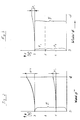
- This tension F2 is plotted in the diagram of Figure 3.
- the force of spring 9 further causes a tension or force F1 on the strand respectively in the strand segment advancing to the compensating arm roll 5 and in the strand segment leaving such roll.
- the force of spring 9 pivots the compensating arm so as to increase the strand loop, which is formed between the supply spool 2 and the stationary deflecting roll 6.
- the brake band 10 is simultaneously tensioned to result in an increased braking of the supply spool 2, with the consequence that a tendency to an increase of the strand tension develops.
- the process is reversed when the strand tension increases.
- the torque exerted by the tension F1 on the supply spool is dependent on the diameter of the latter. Consequently, the tension necessary to overcome a predetermined braking moment is smaller at a large diameter D of the supply spool than at a small diameter d.
- this second portion F2 is selected greater at a predetermined, constant strand speed than the first, tension-dependent portion F1. Consequently, the change delta F1 of this portion is likewise slight in relation to the overall strand tension.
- Illustrated in the diagram of Figure 2 is the variation of the strand tension over the diameter of the supply spool for a compensating arm brake only.
- the amount of the diameter dependent increase delta F1 of the tension can be kept low. However, it is percentagewise large in comparison with the overall strand tension, namely just as large as in the case of a higher selected tension. In the case of a higher selected tension F1, however, a large absolute deviation delta F1 will result as the strand tension varies over the diameter of the spool.
- the combined braking apparatus of the present invention has the advantage that the variation of the strand tension in the course of a winding cycle is small both as to the amount and as to the percentage.
- the electromagnetic disc 15 When designed as a hysteresis brake, the electromagnetic disc 15 is replaced with a disc 15 of a material having a high magnetic retentivity, i.e. a hysteresis material, and which is magnetized by the stationary magnet 16, and which consequently opposes, due to the necessary remagnetization, the relative movement due to a braking movement which is substantially constant.
- a material having a high magnetic retentivity i.e. a hysteresis material
- the measuring roll 14 is connected, via a speed-dependent brake clutch 17, with a further brake 18, which brakes the non-drive end of the brake clutch 17.
- the second braking means comprises the brake clutch 17 and the brake 18.
- the brake clutch is constructed as a centrifugal clutch.
- the shaft of the measuring roll 14 is provided with pivot levers 19, which are connected to the shaft and accommodate clutch shoes 20 at their free ends.
- the pivot levers 19 are pulled radially inwardly by springs 21.
- the non-drive end of the brake clutch 17 is a rotatably supported cup 22 which surrounds the clutch shoes 20.
- the brake 18 is constructed as a hysteresis brake with a disc 15 of a hysteresis material and a stationary magnet 16.
- the strand which is withdrawn by means not shown, such as twisting device, as shown in DE-OS 35 31 680, is guided over the measuring roll 14 and drives the same.
- the centrifugal clutch 17 does not engage. Consequently, the second braking device on the rolls 13 and 14 does not exert a braking force on the strand.
- the braking force is exerted only by the first braking device, and thus the strand tension can be very low.
- the brake clutch 17 engages.
- the braking moment exerted by the magnet 16 on the disc 15, however, is still greater than the moment transmitted by the clutch shoes 20 and the clutch cup 22. Consequently, a braking moment is transmitted on the measuring roll 14, which corresponds only to the moment transmitted by the brake clutch.
- This moment is speed-dependent and increases with the speed.
- a certain speed which can be set by adjusting the centrifugal springs 21, the coupling moment on the non-drive end of the brake clutch 17 overcomes the braking moment exerted by the brake 18, with the consequence that now the moment on the measuring roll 14 corresponds to the moment exerted by brake 18.
- the variation of the strand tension, which is exerted in this manner at the startup of the machine is represented in the diagram of Figure 5.
- the design of the brake clutch 17 results in a substantial consistency of the variation of the tension and the strand tension, which is exerted by the ballooning strand as a function of speed.
- Figure 6 of the drawings illustrates the known relationship between rotational speed and braking force for both an eddy-current brake and a hysteresis brake.
- the braking force of the eddy-current brake increases with the rotational speed, and with the force being smaller in the case of a large air gap between the cooperating surfaces.
- the braking force depends only on the fact that there is relative movement between the cooperating surfaces and it is generally independent of rotational speed.
- the force is inversely related to the dimension of the air gap. This distinction is of importance since in a speed dependent brake the braking force is transformed into heat and the heat increases with speed, whereas in a brake which is independent of speed, the generation of heat is constant and can be kept at a low level.
Landscapes
- Engineering & Computer Science (AREA)
- General Engineering & Computer Science (AREA)
- Mechanical Engineering (AREA)
- Tension Adjustment In Filamentary Materials (AREA)
- Ropes Or Cables (AREA)
- Yarns And Mechanical Finishing Of Yarns Or Ropes (AREA)
- Braking Arrangements (AREA)
- Manipulator (AREA)
Claims (11)
- Appareil pour appliquer une force de freinage à un toron avançant (1) qui est extrait d'une bobine d'alimentation (2), comprenant des premiers moyens de freinage (3, 10), et des seconds moyens de freinage (14-16, 18) pour appliquer une force de freinage au toron avançant (1), les premiers moyens de freinage (3, 10) étant commandés en fonction de la tension du toron avançant (1),
caractérisé par le fait que :
les seconds moyens de freinage (14-16, 18), qui se trouvent en aval desdits premiers moyens de freinage (3, 10) dans la direction d'avance du toron (1), sont actionnés en fonction du déplacement du toron avançant et par le fait qu'ils comprennent un rouleau (14) autour duquel le toron avançant (1) s'enroule ainsi que des moyens de freinage actionnés électromagnétiquement (15-16, 18) reliés audit rouleau (14) pour appliquer la force de freinage. - Appareil selon la revendication 1, caractérisé par le fait que les moyens de freinage (14-16, 18) consistent en un disque (15) qui est relié fixement audit rouleau (14) et en un élément fixe (16) monté de façon adjacente audit disque (15), l'un desdits disque et élément fixe comprenant un aimant (16).
- Appareil selon la revendication 2, caractérisé par le fait que les seconds moyens de freinage (14-16, 18) comprennent un frein à hystérésis sensiblement indépendant de la vitesse de rotation du rouleau (14), l'autre desdits disque (15) et élément fixe (16) comprenant un matériau doué d'hystérésis.
- Appareil selon la revendication 2, caractérisé par le fait que les seconds moyens de freinage (14-16, 18) comprennent un frein (15-16) à courants de Foucault pour appliquer une force de freinage en fonction de la vitesse de rotation du rouleau (14), l'autre desdits disque (15) et élément fixe (16) comprenant un matériau électromagnétique.
- Appareil selon la revendication 1 ou 2, caractérisé par le fait que ledit appareil comprend, en outre, une bobine d'alimentation (2) montée de façon tournante pour le toron avançant (1), et lesdits premiers moyens de freinage (3, 10) comprennent des moyens pour réduire la rotation de ladite bobine d'alimentation (2) en réponse à la tension du toron (1) qui est extrait de cette bobine.
- Appareil selon la revendication 5, caractérisé par le fait que lesdits moyens (3, 10) pour réduire la rotation de ladite bobine d'alimentation (2) comprennent : un bras de compensation (7) monté de façon pivotante au voisinage de ladite bobine d'alimentation (2) et autour de l'extrémité libre duquel passe le toron avançant (1) de telle sorte que ledit bras (7) tend à pivoter dans une direction prédéterminée quand la tension du toron avançant (1) augmente, un moyen de sollicitation (9) pour faire pivoter ledit bras (7) dans une direction opposée à ladite direction prédéterminée, et une bande (10) reliant mutuellement fonctionnellement ledit bras (7) à ladite bobine d'alimentation (2) de manière telle que la rotation libre de ladite bobine d'alimentation se trouve réduite à mesure que ledit bras pivote dans la direction opposée à ladite direction prédéterminée.
- Appareil selon la revendication 2, caractérisé par le fait que l'embrayage (17) commandé par la vitesse et comportant un extrémité d'entraînement est relié fixement audit rouleau (14) et que l'extrémité opposée, n'exerçant pas d'entraînement, de l'embrayage (17) est reliée audit disque (15) coopérant avec ledit élément fixe.
- Appareil selon la revendication 7, caractérisé par le fait que ledit disque (15) comprend un matériau doué d'hystérésis et que les moyens servant à appliquer une force de freinage sont sensiblement indépendants de la vitesse de rotation dudit rouleau (14).
- Appareil selon la revendication 7, caractérisé par le fait que ledit disque (15) comprend un matériau électromagnétique et que le moyen destiné à appliquer une force de freinage est un frein à courants de Foucault pour lequel la force de freinage est fonction de la vitesse de rotation du disque (15).
- Appareil selon la revendication 7 ou 8 ou 9, caractérisé par le fait que ledit embrayage (17) commandé par la vitesse comprend un embrayage centrifuge (19, 22).
- Appareil selon la revendication 7, caractérisé par le fait que ledit embrayage (17) commandé par la vitesse comprend des moyens (19, 22) pour commander le fonctionnement dudit embrayage (17) de telle sorte que, dans une plage prédéterminée de vitesses rotativement faibles du toron, la force de freinage exercée par lesdits moyens de freinage (15-16) commandés par le déplacement est supérieure au couple transmis par ledit embrayage (17) commandé par la vitesse et de telle sorte que la force de freinage utile ne comprenne que celle exercée par ledit embrayage (17), grâce à quoi au-dessus de ladite plage prédéterminée de vitesses de toron, la force de freinage utile comprend celle exercée par lesdits moyens de freinage (15-16) commandés par le déplacement.
Applications Claiming Priority (6)
| Application Number | Priority Date | Filing Date | Title |
|---|---|---|---|
| DE4003086 | 1990-02-02 | ||
| DE4003086 | 1990-02-02 | ||
| DE4005073 | 1990-02-17 | ||
| DE4005073 | 1990-02-17 | ||
| DE4019585 | 1990-06-20 | ||
| DE4019585 | 1990-06-20 |
Publications (2)
| Publication Number | Publication Date |
|---|---|
| EP0440246A1 EP0440246A1 (fr) | 1991-08-07 |
| EP0440246B1 true EP0440246B1 (fr) | 1995-05-17 |
Family
ID=27200791
Family Applications (1)
| Application Number | Title | Priority Date | Filing Date |
|---|---|---|---|
| EP91101324A Expired - Lifetime EP0440246B1 (fr) | 1990-02-02 | 1991-02-01 | Dispositif du frein pour fils ou torons métalliques |
Country Status (7)
| Country | Link |
|---|---|
| US (1) | US5342000A (fr) |
| EP (1) | EP0440246B1 (fr) |
| KR (1) | KR910021550A (fr) |
| AT (1) | ATE122642T1 (fr) |
| CA (1) | CA2035417A1 (fr) |
| DE (1) | DE69109699T2 (fr) |
| RU (1) | RU2011451C1 (fr) |
Cited By (1)
| Publication number | Priority date | Publication date | Assignee | Title |
|---|---|---|---|---|
| EP2813456A1 (fr) | 2013-06-11 | 2014-12-17 | Rigas Tehniska universitate | Freinage par câble et dispositif de réglage de la tension vers l'arrière |
Families Citing this family (29)
| Publication number | Priority date | Publication date | Assignee | Title |
|---|---|---|---|---|
| GB2281918A (en) * | 1993-09-21 | 1995-03-22 | Pillarhouse Int Ltd | Wire tensioner with hysteresis brake |
| US6431481B1 (en) * | 1997-08-29 | 2002-08-13 | General Electric Company | Systems, methods and apparatus for winding conductive wires for a stator of an electric motor |
| CA2635258C (fr) * | 2005-12-30 | 2014-07-22 | Overend Technologies, Llc | Systeme de deroulement et d'avance pour fil elastomere |
| US20080272221A1 (en) * | 2007-05-01 | 2008-11-06 | Emerson Ryan P | Fiber tensioning device |
| US20110068208A1 (en) * | 2007-05-01 | 2011-03-24 | Us Government As Represented By The Secretary Of Army | Fiber tensioning device and method of making prestressed structures |
| EP3483360B1 (fr) * | 2008-05-19 | 2022-06-22 | Max Co., Ltd. | Système de freinage d'un dévidoir dans une machine de reliure de renforcement de barre |
| NZ575464A (en) | 2009-03-10 | 2010-07-30 | Holmes Solutions Ltd | Improvements in and relating to braking mechanisms |
| SE534221C2 (sv) * | 2009-10-26 | 2011-06-07 | Ett drivsystem till en rengöringsanordning för tankrengöring och en rengöringsanordning för tankrengöring | |
| DE202012101380U1 (de) * | 2012-04-16 | 2012-06-15 | Fernsteuergeräte Kurt Oelsch GmbH | Seillängengeber |
| CN104280681B (zh) * | 2013-07-12 | 2017-11-10 | 广东美的制冷设备有限公司 | 电机动态负载模拟系统 |
| US9802787B2 (en) * | 2013-09-20 | 2017-10-31 | Reel Power Licensing Corp. | Method of providing a clutch for a spool |
| NZ619034A (en) | 2013-12-16 | 2015-03-27 | Eddy Current Ltd Partnership | An assembly to control relative speed of movement between parts |
| EP3183803B1 (fr) | 2014-08-18 | 2021-04-14 | Eddy Current Limited Partnership | Accord d'une relation cinématique entre des éléments |
| MX364898B (es) | 2014-08-18 | 2019-05-13 | Eddy Current Lp | Dispositivos de enganche. |
| CA2957635A1 (fr) | 2014-08-18 | 2016-02-25 | Eddy Current Limited Partnership | Mise au point d'une relation cinematique entre des elements |
| WO2016029059A2 (fr) * | 2014-08-20 | 2016-02-25 | Mcgowan John Lewis | Dispositif de freinage à courants de foucault pour systèmes linéaires |
| MX391252B (es) | 2014-12-04 | 2025-03-12 | Eddy Current Lp | Aparato de absorción de energía. |
| JP6699906B2 (ja) | 2014-12-04 | 2020-05-27 | エディ・カーレント・リミテッド・パートナーシップ | 渦電流制動を組み込んだ伝達機構及び渦電流抗力を伝達する方法 |
| CN106999736B (zh) | 2014-12-04 | 2021-06-08 | 涡流有限合伙公司 | 更改涡流相互作用的方法 |
| EP3227990B1 (fr) | 2014-12-04 | 2023-10-11 | Eddy Current Limited Partnership | Configurations de freins à courant de foucault |
| JP2018505634A (ja) | 2014-12-04 | 2018-02-22 | エディ・カーレント・リミテッド・パートナーシップ | 要素間のラッチアクティベーション |
| CN118566534A (zh) | 2015-12-18 | 2024-08-30 | 涡流有限合伙公司 | 一种用于动力系统的可变行为控制机构 |
| CN106948197B (zh) * | 2017-04-01 | 2023-01-03 | 东台磊达钢帘线有限公司 | 一种帘线成型控制装置 |
| CN112770993B (zh) * | 2018-08-17 | 2023-11-28 | 施洛伊尼格股份公司 | 导体制动装置和方法 |
| RS67252B1 (sr) * | 2019-05-20 | 2025-10-31 | Schleuniger Ag | Postupak za kočenje najmanje jednog obrtnog valjka uređaja za ispravljanje, mašine za obradu kablova sa uređajem za ispravljanje |
| EP4031254B1 (fr) | 2019-09-20 | 2025-07-09 | Trublue LLC | Systèmes et dispositifs de commande de descente de verrouillage |
| EP4121176B1 (fr) | 2020-03-18 | 2025-03-12 | Trublue LLC | Dispositifs de distribution de ligne |
| CN114289250A (zh) * | 2021-12-14 | 2022-04-08 | 泰州科聚新材料技术研究院有限公司 | 一种感光材料板涂覆感光材料装置 |
| US20240239628A1 (en) * | 2023-01-18 | 2024-07-18 | Reel Power Licensing Corp. | Constant tension coiler with electromagnetic brakes |
Family Cites Families (17)
| Publication number | Priority date | Publication date | Assignee | Title |
|---|---|---|---|---|
| US2519882A (en) * | 1948-04-30 | 1950-08-22 | Gen Electric | Constant torque device |
| US2705362A (en) * | 1950-06-03 | 1955-04-05 | Celanese Corp | Apparatus for winding yarn |
| US2839697A (en) * | 1953-12-08 | 1958-06-17 | Warner Electric Brake & Clutch | Magnetic torque producing device |
| US3042327A (en) * | 1958-01-10 | 1962-07-03 | Us Rubber Co | Quill winder |
| US3259336A (en) * | 1964-04-08 | 1966-07-05 | Automation Machines & Equipmen | Coil winding machine |
| BE776608A (fr) * | 1971-06-25 | 1972-04-04 | Hamana Iron Works Co | Machine a toronner les fils |
| CH545743A (en) * | 1972-06-07 | 1974-02-15 | Eddy current yarn brake - including centrifugal clutch in friction contact with central bolt | |
| DE2404030A1 (de) * | 1974-01-29 | 1975-08-14 | Barmag Barmer Maschf | Verseilmaschine |
| SU860712A1 (ru) * | 1974-02-16 | 1981-08-30 | Бармаг Бармер Машиненфабрик Аг (Фирма) | Канатовьюща машина |
| DE2808470A1 (de) * | 1978-02-28 | 1979-08-30 | Erich Brosa | Fadenbremse und -zugkraftmesser |
| DE2812100C2 (de) * | 1978-03-20 | 1987-04-16 | Barmag Barmer Maschinenfabrik Ag, 5630 Remscheid | Verfahren zum Führen eines aus Einzelsträngen zusammengesetzten Gesamtstranges und Herstellen von gefachten Drahtspulen sowie Vorrichtung zum Durchführen des Verfahrens |
| DE2848384A1 (de) * | 1978-11-08 | 1980-05-22 | Barmag Barmer Maschf | Verseil- oder zwirnmaschine fuer draht |
| GB2117015B (en) * | 1981-12-01 | 1985-10-09 | Mackie And Sons Limited James | Tension control in yarn winding or spooling machines |
| JPS59182167A (ja) * | 1983-03-29 | 1984-10-16 | Tanatsuku Eng Kk | マグネツトテンシヨン装置 |
| US4516739A (en) * | 1984-03-30 | 1985-05-14 | At&T Technologies, Inc. | Magnetically controlled wire tensioning device |
| DE3531680A1 (de) * | 1984-09-13 | 1986-04-24 | Barmag Barmer Maschinenfabrik Ag, 5630 Remscheid | Stahlkordseil sowie verfahren und vorrichtung zu seiner herstellung |
| DE4005739A1 (de) * | 1989-03-03 | 1990-09-06 | Barmag Barmer Maschf | Drehbare ablaufspule |
-
1991
- 1991-01-28 KR KR1019910001380A patent/KR910021550A/ko not_active Ceased
- 1991-01-30 US US07/647,806 patent/US5342000A/en not_active Expired - Fee Related
- 1991-01-31 CA CA002035417A patent/CA2035417A1/fr not_active Abandoned
- 1991-02-01 AT AT91101324T patent/ATE122642T1/de not_active IP Right Cessation
- 1991-02-01 EP EP91101324A patent/EP0440246B1/fr not_active Expired - Lifetime
- 1991-02-01 RU SU914894377A patent/RU2011451C1/ru active
- 1991-02-01 DE DE69109699T patent/DE69109699T2/de not_active Expired - Fee Related
Cited By (1)
| Publication number | Priority date | Publication date | Assignee | Title |
|---|---|---|---|---|
| EP2813456A1 (fr) | 2013-06-11 | 2014-12-17 | Rigas Tehniska universitate | Freinage par câble et dispositif de réglage de la tension vers l'arrière |
Also Published As
| Publication number | Publication date |
|---|---|
| CA2035417A1 (fr) | 1991-08-03 |
| DE69109699D1 (de) | 1995-06-22 |
| US5342000A (en) | 1994-08-30 |
| ATE122642T1 (de) | 1995-06-15 |
| EP0440246A1 (fr) | 1991-08-07 |
| RU2011451C1 (ru) | 1994-04-30 |
| DE69109699T2 (de) | 1995-10-26 |
| KR910021550A (ko) | 1991-12-20 |
Similar Documents
| Publication | Publication Date | Title |
|---|---|---|
| EP0440246B1 (fr) | Dispositif du frein pour fils ou torons métalliques | |
| US2586037A (en) | Uniform strand tension device | |
| US4327873A (en) | Apparatus for regulating the speed of a member delivering or winding a yarn | |
| GB2125072A (en) | Self-adjusting filament tensioner | |
| CN115465725B (zh) | 纺织机的工位、用于纺织机工位的储纱单元和用于在工位处调节运动纱线的纱线张力的方法 | |
| US4650133A (en) | Winder apparatus and method | |
| US4381852A (en) | Automatic tensioning control for winding stator coils | |
| US2741437A (en) | Constant tension take-up and let-off mechanism | |
| US2012208A (en) | Winding machine for filaments | |
| CN1637185B (zh) | 控制至少一根纬纱的供给张力的方法,供给纬纱的装置以及装备有这种装置的织机 | |
| JPH09263359A (ja) | コード類の張力調整機構 | |
| JPH0210070B2 (fr) | ||
| US3982706A (en) | Winding machines having independent spindles | |
| JPH04501695A (ja) | ロールブレーキ装置 | |
| US3063228A (en) | Apparatus for controlling the tensioning of the tapes in electric cable taping machines | |
| US3905560A (en) | Yarn winding mechanism | |
| JPH03206151A (ja) | 糸状材料を織機に給糸する装置 | |
| US3778005A (en) | Mechanism for handling magnetic tapes | |
| US3371879A (en) | Yarn winding apparatus | |
| US2929573A (en) | Compensating mechanism for taping machines and the like | |
| JPS6019666A (ja) | 定張力バネを用いた線の張力調整装置 | |
| US4491206A (en) | Braking device | |
| US3138913A (en) | Winding or lapping machine | |
| EP4600194A1 (fr) | Dispositif et système de contrôle de la tension lors du déroulement de filaments | |
| GB2117015A (en) | Tension control in yarn winding or spooling machines |
Legal Events
| Date | Code | Title | Description |
|---|---|---|---|
| PUAI | Public reference made under article 153(3) epc to a published international application that has entered the european phase |
Free format text: ORIGINAL CODE: 0009012 |
|
| AK | Designated contracting states |
Kind code of ref document: A1 Designated state(s): AT DE FR GB IT |
|
| 17P | Request for examination filed |
Effective date: 19910704 |
|
| 17Q | First examination report despatched |
Effective date: 19930406 |
|
| ITF | It: translation for a ep patent filed | ||
| GRAA | (expected) grant |
Free format text: ORIGINAL CODE: 0009210 |
|
| AK | Designated contracting states |
Kind code of ref document: B1 Designated state(s): AT DE FR GB IT |
|
| REF | Corresponds to: |
Ref document number: 122642 Country of ref document: AT Date of ref document: 19950615 Kind code of ref document: T |
|
| ET | Fr: translation filed | ||
| REF | Corresponds to: |
Ref document number: 69109699 Country of ref document: DE Date of ref document: 19950622 |
|
| PG25 | Lapsed in a contracting state [announced via postgrant information from national office to epo] |
Ref country code: GB Effective date: 19960201 Ref country code: AT Effective date: 19960201 |
|
| PLBE | No opposition filed within time limit |
Free format text: ORIGINAL CODE: 0009261 |
|
| STAA | Information on the status of an ep patent application or granted ep patent |
Free format text: STATUS: NO OPPOSITION FILED WITHIN TIME LIMIT |
|
| 26N | No opposition filed | ||
| GBPC | Gb: european patent ceased through non-payment of renewal fee |
Effective date: 19960201 |
|
| PG25 | Lapsed in a contracting state [announced via postgrant information from national office to epo] |
Ref country code: FR Effective date: 19961031 |
|
| PG25 | Lapsed in a contracting state [announced via postgrant information from national office to epo] |
Ref country code: DE Effective date: 19961101 |
|
| REG | Reference to a national code |
Ref country code: FR Ref legal event code: ST |
|
| PG25 | Lapsed in a contracting state [announced via postgrant information from national office to epo] |
Ref country code: IT Free format text: LAPSE BECAUSE OF NON-PAYMENT OF DUE FEES Effective date: 20050201 |