EP0441810B1 - Procede pour placer des modules sur un support - Google Patents
Procede pour placer des modules sur un support Download PDFInfo
- Publication number
- EP0441810B1 EP0441810B1 EP89911775A EP89911775A EP0441810B1 EP 0441810 B1 EP0441810 B1 EP 0441810B1 EP 89911775 A EP89911775 A EP 89911775A EP 89911775 A EP89911775 A EP 89911775A EP 0441810 B1 EP0441810 B1 EP 0441810B1
- Authority
- EP
- European Patent Office
- Prior art keywords
- modules
- subregions
- plt
- module
- placement
- Prior art date
- Legal status (The legal status is an assumption and is not a legal conclusion. Google has not performed a legal analysis and makes no representation as to the accuracy of the status listed.)
- Expired - Lifetime
Links
Images

Classifications
-
- G—PHYSICS
- G06—COMPUTING OR CALCULATING; COUNTING
- G06F—ELECTRIC DIGITAL DATA PROCESSING
- G06F30/00—Computer-aided design [CAD]
- G06F30/30—Circuit design
- G06F30/39—Circuit design at the physical level
- G06F30/392—Floor-planning or layout, e.g. partitioning or placement
Definitions
- the invention relates to a method for placing modules on a carrier using a module list containing the dimensions of the modules and a network list containing the connections of the modules.
- the starting point is the topology of the circuit, e.g. a circuit diagram showing how a number of modules are interconnected. It is then the job of placing these modules optimally on a carrier, e.g. a chip.
- a carrier e.g. a chip. The placement procedure is described in detail in the cited references to which reference is made.
- the known methods initially aim to position the modules relative to one another.
- the coordinates of the individual modules are calculated in such a way that the center of gravity of the modules lies in a predetermined point, for example the center coordinates of the area of the placement area provided for the arrangement.
- the coordinates of the modules are determined by solving one Optimization problem determined in which a function of the spacing of the interconnected modules is made to a minimum. This optimization problem is solved taking into account secondary conditions which ensure that the modules are as evenly distributed as possible on the placement surface.
- the final and overlap-free position of the modules is determined after the relative placement has been completed. The information of the relative placement is used.
- the object on which the invention is based is to specify a further method for placing prefabricated modules on a carrier.
- the method thus consists of repeating a global placement of the modules on a placement area and subsequent partitioning, these steps being repeated until each sub-area defined by division contains at most a predetermined number of modules.
- the global placement takes place by arranging the modules in the sub-areas such that the modules assigned to the sub-areas fall with their focal points on the center coordinates of these sub-areas.
- the arrangement of all modules of all sub-areas is calculated simultaneously.
- the sub-areas are reached by partitioning the placement area or sub-areas, with the sub-areas achieved by the partitioning being assigned a selectable number of modules and the size of the sub-areas achieved by the partitioning being determined as a function of the assigned modules.
- the subdivision of the placement area or the sub-areas is expediently carried out by horizontal or vertical Cutting lines. All that is required to assign the modules to the sub-areas is to sort the modules according to their x or y coordinates from the previous global placement. It is useful if the partitioning consists of a division of the areas to be divided.
- the repetition of global placement and partitioning can be continued until only one module is arranged in each sub-area. However, it is more advantageous if this repetition is terminated if at most a predetermined number of modules, e.g. 8 modules are included. Then the final arrangement of the modules can be carried out with optimal use of space on the placement area with an optimization step.
- This step can consist of determining all possible subdivisions of the subareas with up to k modules using the result of the global placement and summarizing the dimensions of the subareas found for the placement of a module in a form function. This step can be carried out for all such sub-areas. By adding the shape functions of these sub-areas, the dimensions of all permitted module arrangements can be calculated.
- the method according to the invention has the advantage that modules of different dimensions can be arranged in one plane without overlap, taking into account specifications for the locations of a part of the modules.
- the method optimizes the arrangement with respect to a function of the distances between given groups of modules and with respect to the total area of the module arrangement.
- the method serves in particular the purpose of placing the modules (cells, building blocks) when designing electrical layouts Circuits, ie the implementation of a given functional description of the circuit in a flat local arrangement.
- the dimensions of the modules are specified in a module list.
- the functional description is given as a network list in which all module groups are specified that should be taken into account when minimizing the module spacing.
- the method is suitable for the layout design of integrated cell circuits in standard cell, macro cell, gate array and sea of gates technology as well as for the placement of components on printed circuit boards.
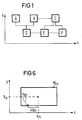
- the problem that is to be solved with the method can consist in converting a circuit diagram, as shown, for example, in FIG. 1, into a layout of the circuit, for example on a chip.
- Figure 1 shows only a schematic diagram of a circuit diagram with a few modules. The modules are marked with large letters. For example, you can display cells from a cell library. The individual modules are connected to one another, the connections being shown in simplified form in FIG. The connections of the modules are also called signals.
- the dimensions of the modules are contained in a module list and the connections of the modules in a network list.
- the module list and the net list are specified and are used to place the modules on a carrier, e.g. a chip.
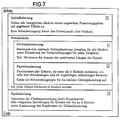
- the modules are placed according to the flow chart of FIG. 7. It can be seen that the method consists of a sequence of alternating steps S, namely global placements S1 and partitionings S2. The sequence ends when each subset of modules resulting from the partitioning contains no more than a predeterminable number of modules.
- the method can expediently be concluded by an optimization step S3, in which the use of space in the sub-areas of the placement area that have arisen is improved by evaluating all possible module arrangements, the coordinates of the modules and their rotational position also being determined.
- all modules M b are assigned to an undivided quantity.
- the net list is given, ie the list of all possibly weighted module groups (nets) for which the distance function is to be minimized. Also given in the module list are the dimensions and connection coordinates of all modules M, the geometric locations of modules with a predefined position (fixed modules) and a placement area. In addition, given ancillary conditions must be observed.
- the placement area is designated PL, which can be part of a carrier TR, for example.
- Modules M are to be arranged on the placement area PL.
- the modules can be movable or they can have a fixed position.
- Movable modules are designated with M b , fixed modules with M f .
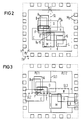
- FIG. 2 shows, for example, a chip which has fixed modules M f connections (pads) on the edge and modules M b , for example cells, movable in the placement area PL.
- the movable modules M b are labeled with large letters.
- the importance of a network can be determined by the weight factor w. With the help of t it is indicated whether a network is connected to a module or not.
- connections pads
- one of the four edges assign and calculate their y-coordinate for left or right connections and their x-coordinate for upper and lower connections.
- the coordinates of the modules are calculated using the system of equations 1.
- this system can also be interpreted as a system of mass points that are connected to spring constants by elastic springs.
- the spring constant corresponds to the importance of the network that is connected to the module under consideration.
- the position of the movable modules M b within the placement area PL results from FIG.
- the modules are arranged around the center coordinates X r , Y r .
- step S1 follows, in which the modules on the placement area PL depend on the formula 1, 2 have been placed, step S2.
- the placement area PL is divided (indicated by the intersection line SL in (FIG. 2).
- the partitioning step the area in which a module can be arranged is thus restricted further and further.
- the result of the repeated partitioning steps leads to a complete disassembly at the end of the method
- the placement area must be placed in as many rectangles as modules and thus in an admissible placement, which differs from the temporary global placements in that the modules are arranged without overlap and in accordance with the rules of the associated design style.
- a placement area PL, PLT is described by width, height, area, center coordinates and the number of modules that are to be placed in this area.
- step S2 the global placement step S1 is carried out again.
- the system of equations 1 is recalculated, but now taking new constraints into account, namely constraints for each sub-area PLT.
- the center coordinates X r and Y r are now related to the sub-areas PLT reached by the intersection of the placement area.
- there would be two sub-areas so that now two constraints for the calculation of the system of equations 1 must be observed.
- the system of equations 1 is calculated simultaneously for all modules and is not carried out separately for each sub-area PLT.
- the result of step S1, global placement is shown in FIG. 3. It can be seen that some of the modules are now assigned to the left sub-area PLT 1 and some to the right sub-area PLT 2. Within each sub-area PLT, the assigned modules are grouped around their center coordinates. The letters of the modules show how the individual modules have shifted from the starting point in FIG. 2 to the sub-areas PLT.
- the global placement step S1 is followed by a partitioning step S2 according to the rules described above.
- each sub-area PLT 1, PLT 2 is subdivided by an intersection line SL2, SL3 and the individual sub-areas are assigned to the newly acquired sub-areas depending on the coordinates obtained in the global placement.
- the size of the areas of the sub-areas is in turn determined in the ratio of the areas of the modules assigned to these sub-areas.
- Step S2 is followed by global placement step S1, i.e. System of equations 1 is now solved taking into account the new constraints. With two divisions of the previous sub-areas, four secondary conditions must now be observed. The result of this calculation is shown in FIG. 4. Subsequent to the global placement, there is again a partitioning, step S2.
- steps global placement S1 and partitioning S2 are repeated until either at most one module remains for each sub-area or at most k modules are provided per sub-area.
- k can be 8. In the latter case, it is necessary to carry out the final arrangement of the modules in a step S3, in which an optimal use of space is sought.
- step S3 the sequence of global placements and partitionings are terminated and the final position of the modules, which results from FIG. 5, is determined in step S3.
- the given placement area is broken down in such a way that each sub-area is assigned at most the predetermined number k of modules.
- the area utilization of the slicing structure achieved is improved both locally and globally.
- each sub-area PLT For local optimization of each sub-area PLT with a maximum of k modules, all possible decompositions of this sub-area are determined and the modules are assigned to the sub-areas created. With this optimization, the results of the global placement are taken into account, so that the effort for the optimization is reduced. For each disassembly and module assignment, the dimensions of the smallest rectangular area in which the modules can be placed without overlap are calculated by traversing the slicing structure. The various possible dimensions of the sub-area just dealt with are summarized in a form function.
- a method by which the slicing structure is traversed and the shape functions are calculated is from La Potin, DP, Director, SW: Mason: A global floorplanning approach for VLSI design, IEEE Transactions on Computer-Aided Design, Volume CAD 5, 1986, pp. 477-489.
- the dimensions of all permitted module arrangements are calculated globally by suitable addition of the shape functions of all subregions. This gives the user the opportunity to select the optimal arrangement for his purposes from the variants offered.
- the principle of partitioning is known per se, but it is usually used for the purpose of reducing the size of the problem. In the method according to the invention, however, it serves the purpose of increasingly restricting the areas in which a module can be arranged. Due to the progressive refinement of the partitioning, an overlap-free arrangement of all modules is achieved at the end of the process. The process is such that all modules are treated simultaneously until the overlap-free arrangement is reached.
Landscapes
- Engineering & Computer Science (AREA)
- Computer Hardware Design (AREA)
- Physics & Mathematics (AREA)
- Theoretical Computer Science (AREA)
- Architecture (AREA)
- Evolutionary Computation (AREA)
- Geometry (AREA)
- General Engineering & Computer Science (AREA)
- General Physics & Mathematics (AREA)
- Design And Manufacture Of Integrated Circuits (AREA)
- Semiconductor Integrated Circuits (AREA)
Abstract
Claims (12)
- Procédé pour mettre en place des modules (M) sur un support (T1) à l'aide d'un ordinateur et moyennant l'utilisation d'une liste de modules contenant les dimensions, et d'une liste de réseaux contenant les liaisons, par la mise en oeuvre des étapes opératoires suivantes :a) on dispose selon une mise en place globale, tous les modules mobiles (Mb) dans la zone de mise en place (PL) du support (TR) de telle sorte que le centre de gravité global des modules est situé au niveau du barycentre (Xr, Yr) de la surface de la zone de mise en place, et on dispose tous les modules fixés (Mf) sur les bords de la zone de mise en place;b) lors d'une étape de séparationb1) on subdivise la zone de mise en place (PL) en zones partielles (PLT),b2) ensuite, sur la base de la position des modules fixée lors de l'étape a), on répartit ces modules en des quantités partielles (Mr) de modules et on associe ces quantités partielles aux zones partielles (PLT),b3) ensuite, on fixe de façon définitive la taille des zones partielles dans le rapport des quantités partielles (Mr) des modules, associées aux zones partielles;c) on dispose simultanément les modules (Mb), au moyen d'une mise en place globale, pour toutes les zones partielles (PLT), sous l'influence réciproque, avec chevauchement de zones partielles, au moyen des liaisons contenues dans la liste de réseaux de telle sorte que les centres de gravité globaux des quantités partielles Mr de modules sont situés respectivement au niveau des barycentres (Xr, Yr) des surfaces des zones partielles associées (PLT);d) lors d'une autre étape de séparationd1) on divise les zones partielles en d'autres zones partielles,d2) ensuite, et sur la base de la position des modules (Mb) fixée lors de l'étape c), on associe ces modules aux autres zones partielles (PLT),d3) on fixe ensuite de façon définitive la taille des autres zones partielles dans le rapport des modules associés aux autres zones partielles;e) on répète les étapes c) et d) jusqu'à ce qu'un nombre, pouvant être prédéterminé, de k modules soit associé à chaque zone partielle.
- Procédé suivant la revendication 1, caractérisé par le fait que les points prédéterminés de la zone de mise en place et des zones partielles sont respectivement les coordonnées (Xr, Yr) de leurs centres.
- Procédé suivant la revendication 2, caractérisé par le fait que pour la mise en place globale, les coordonnées (x, y) des modules sont fixées simultanément de telle sorte que l'on a


des symboles dans les formules ayant les significations suivantes :m numéro de modulen numéro de réseauM = (...,m,...) quantité des numéros de modulesN = (...,n,...) quantité des numéros de réseauxMb C M quantité des modules mobilesMf C M quantité des modules fixésb nombre des modules mobilesf nombre des modules fixésx = (...xn...xm...) vecteur des coordonnées x de tous les réseaux et de tous les modulesy = (...xn...xm...) vecteur des coordonnées y de tous les réseaux et de tous les modulesunm coordonnée x de la borne du réseau n au niveau du module mvnm coordonnée y de la borne du réseau m au niveau du module m
dans le cas où il n'y a aucun raccordementwn facteur pondéral du réseau nFm besoin en surface du module mr numéro de la zone de mise en place PL ou de la zone partielle PLTmr C Mb quantité des modules, à laquelle est appliquée la condition secondaire rXr, Yr coordonnées du centre de la zone de mise en place PL, PLTR nombre des zones partielles PLT. - Procédé suivant la revendication 3, caractérisé par le fait que les modules fixés (Mf) sont déplaçables dans la direction x et dans la direction y au niveau des bords de la zone de mise en place (PL).
- Procédé suivant la revendication 4, caractérisé par le fait que l'affectation des modules (M) aux zones partielles (PLT) s'effectue au moyen du tri des modules en fonction de leurs coordonnées (x, y).
- Procédé suivant la revendication 5, caractérisé par le fait que la division de la zone de mise en place et des zones partielles est réalisée par des lignes de coupe horizontales et verticales (SL), et que des quantités partielles de modules (Mr) sont affectées aux zones partielles (PLT) déterminées par les coupes.
- Procédé suivant la revendication 6, caractérisé par le fait que lors de la division, chaque zone est respectivement divisée par deux.
- Procédé suivant la revendication 7, caractérisé par le fait que des modules (M), dont les liaisons associées croisent la ligne de coupe (SL), sont associés aux zones partielles (PLT) moyennant l'application supplémentaire du principe Min-Cut.
- Procédé suivant l'une des revendications 1 à 8, caractérisé par le fait qu'on arrête la mise en place globale et la division lorsqu'un module (M) (k-1) est disposé dans chaque zone partielle.
- Procédé suivant l'une des revendications 1 à 8, caractérisé par le fait que l'utilisation optimale de la surface est obtenue par détermination de toutes les fragmentations possibles des zones partielles (PLT) avec jusqu'à k modules (M) moyennant l'utilisation du résultat de la mise en place globale.
- Procédé suivant la revendication 10, caractérisé par le fait que la disposition des modules (M) dans les zones partielles (PLT) est optimisée par le fait que pour chaque zone partielle on détermine toutes les divisions possibles et qu'on associe les modules aux surfaces partielles obtenues, que pour chaque division et chaque association de modules, on peut calculer les dimensions de la zone rectangulaire la plus petite, dans laquelle les modules peuvent être placés sans chevauchement, et on rassemble les différentes dimensions possibles d'une surface partielle dans une fonction de forme, et qu'on effectue ceci pour toutes les zones partielles (PLT) et qu'on calcule les dimensions de tous les ensembles obtenus de modules, par addition des fonctions de forme de toutes les zones partielles.
- Procédé suivant la revendication 11, caractérisé par le fait qu'on optimise les positions pivotées des modules.
Priority Applications (1)
| Application Number | Priority Date | Filing Date | Title |
|---|---|---|---|
| AT89911775T ATE103403T1 (de) | 1988-11-02 | 1989-10-26 | Verfahren zur plazierung von modulen auf einem traeger. |
Applications Claiming Priority (2)
| Application Number | Priority Date | Filing Date | Title |
|---|---|---|---|
| EP88118251 | 1988-11-02 | ||
| EP88118251 | 1988-11-02 |
Publications (2)
| Publication Number | Publication Date |
|---|---|
| EP0441810A1 EP0441810A1 (fr) | 1991-08-21 |
| EP0441810B1 true EP0441810B1 (fr) | 1994-03-23 |
Family
ID=8199514
Family Applications (1)
| Application Number | Title | Priority Date | Filing Date |
|---|---|---|---|
| EP89911775A Expired - Lifetime EP0441810B1 (fr) | 1988-11-02 | 1989-10-26 | Procede pour placer des modules sur un support |
Country Status (5)
| Country | Link |
|---|---|
| US (1) | US5267176A (fr) |
| EP (1) | EP0441810B1 (fr) |
| JP (1) | JPH04501475A (fr) |
| DE (1) | DE58907307D1 (fr) |
| WO (1) | WO1990005344A1 (fr) |
Families Citing this family (76)
| Publication number | Priority date | Publication date | Assignee | Title |
|---|---|---|---|---|
| US5598344A (en) * | 1990-04-06 | 1997-01-28 | Lsi Logic Corporation | Method and system for creating, validating, and scaling structural description of electronic device |
| JP3220250B2 (ja) * | 1992-01-09 | 2001-10-22 | 株式会社東芝 | セル自動配置方法 |
| US5566078A (en) * | 1993-05-26 | 1996-10-15 | Lsi Logic Corporation | Integrated circuit cell placement using optimization-driven clustering |
| US5598343A (en) * | 1993-10-01 | 1997-01-28 | Texas Instruments Incorporated | Method of segmenting an FPGA channel architecture for maximum routability and performance |
| JP2922404B2 (ja) * | 1993-11-15 | 1999-07-26 | 富士通株式会社 | 集積回路の配置決定方法 |
| US5818726A (en) * | 1994-04-18 | 1998-10-06 | Cadence Design Systems, Inc. | System and method for determining acceptable logic cell locations and generating a legal location structure |
| US5815403A (en) * | 1994-04-19 | 1998-09-29 | Lsi Logic Corporation | Fail-safe distributive processing method for producing a highest fitness cell placement for an integrated circuit chip |
| US5963975A (en) * | 1994-04-19 | 1999-10-05 | Lsi Logic Corporation | Single chip integrated circuit distributed shared memory (DSM) and communications nodes |
| US5875117A (en) * | 1994-04-19 | 1999-02-23 | Lsi Logic Corporation | Simultaneous placement and routing (SPAR) method for integrated circuit physical design automation system |
| US5495419A (en) * | 1994-04-19 | 1996-02-27 | Lsi Logic Corporation | Integrated circuit physical design automation system utilizing optimization process decomposition and parallel processing |
| US6493658B1 (en) | 1994-04-19 | 2002-12-10 | Lsi Logic Corporation | Optimization processing for integrated circuit physical design automation system using optimally switched fitness improvement algorithms |
| US5557533A (en) * | 1994-04-19 | 1996-09-17 | Lsi Logic Corporation | Cell placement alteration apparatus for integrated circuit chip physical design automation system |
| US6155725A (en) * | 1994-04-19 | 2000-12-05 | Lsi Logic Corporation | Cell placement representation and transposition for integrated circuit physical design automation system |
| US5914887A (en) * | 1994-04-19 | 1999-06-22 | Lsi Logic Corporation | Congestion based cost factor computing apparatus for integrated circuit physical design automation system |
| US5535134A (en) * | 1994-06-03 | 1996-07-09 | International Business Machines Corporation | Object placement aid |
| US5638293A (en) * | 1994-09-13 | 1997-06-10 | Lsi Logic Corporation | Optimal pad location method for microelectronic circuit cell placement |
| US5696693A (en) * | 1995-03-31 | 1997-12-09 | Unisys Corporation | Method for placing logic functions and cells in a logic design using floor planning by analogy |
| JP3504394B2 (ja) * | 1995-09-08 | 2004-03-08 | 松下電器産業株式会社 | 部品配列のデータ作成方法 |
| US5818722A (en) * | 1995-11-03 | 1998-10-06 | Yoji Kajitani | Method of placing and extracting modules |
| EP0791887B1 (fr) * | 1996-02-21 | 2001-05-23 | Matsushita Electric Industrial Co., Ltd. | Procédé et dispositif pour l'entrée des topographies des circuits intégrés du type "flip-chip" |
| US5818729A (en) * | 1996-05-23 | 1998-10-06 | Synopsys, Inc. | Method and system for placing cells using quadratic placement and a spanning tree model |
| US5798936A (en) * | 1996-06-21 | 1998-08-25 | Avant| Corporation | Congestion-driven placement method and computer-implemented integrated-circuit design tool |
| US5844811A (en) * | 1996-06-28 | 1998-12-01 | Lsi Logic Corporation | Advanced modular cell placement system with universal affinity driven discrete placement optimization |
| US5867398A (en) * | 1996-06-28 | 1999-02-02 | Lsi Logic Corporation | Advanced modular cell placement system with density driven capacity penalty system |
| US5914888A (en) * | 1996-06-28 | 1999-06-22 | Lsi Logic Corporation | Advanced modular cell placement system with coarse overflow remover |
| US6067409A (en) * | 1996-06-28 | 2000-05-23 | Lsi Logic Corporation | Advanced modular cell placement system |
| US5870312A (en) * | 1996-06-28 | 1999-02-09 | Lsi Logic Corporation | Advanced modular cell placement system with dispersion-driven levelizing system |
| US5892688A (en) * | 1996-06-28 | 1999-04-06 | Lsi Logic Corporation | Advanced modular cell placement system with iterative one dimensional preplacement optimization |
| US5831863A (en) * | 1996-06-28 | 1998-11-03 | Lsi Logic Corporation | Advanced modular cell placement system with wire length driven affinity system |
| US6030110A (en) * | 1996-06-28 | 2000-02-29 | Lsi Logic Corporation | Advanced modular cell placement system with median control and increase in resolution |
| US5812740A (en) * | 1996-06-28 | 1998-09-22 | Lsi Logic Corporation | Advanced modular cell placement system with neighborhood system driven optimization |
| US5835381A (en) * | 1996-06-28 | 1998-11-10 | Lsi Logic Corporation | Advanced modular cell placement system with minimizing maximal cut driven affinity system |
| US5872718A (en) * | 1996-06-28 | 1999-02-16 | Lsi Logic Corporation | Advanced modular cell placement system |
| US5963455A (en) * | 1996-06-28 | 1999-10-05 | Lsi Logic Corporation | Advanced modular cell placement system with functional sieve optimization technique |
| US6026223A (en) * | 1996-06-28 | 2000-02-15 | Scepanovic; Ranko | Advanced modular cell placement system with overlap remover with minimal noise |
| US5808899A (en) * | 1996-06-28 | 1998-09-15 | Lsi Logic Corporation | Advanced modular cell placement system with cell placement crystallization |
| US5870311A (en) * | 1996-06-28 | 1999-02-09 | Lsi Logic Corporation | Advanced modular cell placement system with fast procedure for finding a levelizing cut point |
| US6085032A (en) * | 1996-06-28 | 2000-07-04 | Lsi Logic Corporation | Advanced modular cell placement system with sinusoidal optimization |
| US5980093A (en) * | 1996-12-04 | 1999-11-09 | Lsi Logic Corporation | Integrated circuit layout routing using multiprocessing |
| US6754879B1 (en) | 1997-01-27 | 2004-06-22 | Unisys Corporation | Method and apparatus for providing modularity to a behavioral description of a circuit design |
| US6718520B1 (en) | 1997-01-27 | 2004-04-06 | Unisys Corporation | Method and apparatus for selectively providing hierarchy to a circuit design |
| US6378114B1 (en) * | 1997-07-01 | 2002-04-23 | Synopsys, Inc. | Method for the physical placement of an integrated circuit adaptive to netlist changes |
| US6385760B2 (en) * | 1998-06-12 | 2002-05-07 | Monterey Design Systems, Inc. | System and method for concurrent placement of gates and associated wiring |
| US6378119B1 (en) * | 1999-05-24 | 2002-04-23 | Dell Usa, L.P. | Method and system for adaptive component placement |
| US6415426B1 (en) | 2000-06-02 | 2002-07-02 | Incentia Design Systems, Inc. | Dynamic weighting and/or target zone analysis in timing driven placement of cells of an integrated circuit design |
| US6957410B2 (en) | 2000-12-07 | 2005-10-18 | Cadence Design Systems, Inc. | Method and apparatus for adaptively selecting the wiring model for a design region |
| US7024650B2 (en) * | 2000-12-06 | 2006-04-04 | Cadence Design Systems, Inc. | Method and apparatus for considering diagonal wiring in placement |
| US7003754B2 (en) * | 2000-12-07 | 2006-02-21 | Cadence Design Systems, Inc. | Routing method and apparatus that use of diagonal routes |
| US6516455B1 (en) * | 2000-12-06 | 2003-02-04 | Cadence Design Systems, Inc. | Partitioning placement method using diagonal cutlines |
| US7055120B2 (en) | 2000-12-06 | 2006-05-30 | Cadence Design Systems, Inc. | Method and apparatus for placing circuit modules |
| US6826737B2 (en) * | 2000-12-06 | 2004-11-30 | Cadence Design Systems, Inc. | Recursive partitioning placement method and apparatus |
| AU2002233977A1 (en) * | 2000-12-06 | 2002-06-18 | Simplex Solutions, Inc. | Method and apparatus for considering diagonal wiring in placement |
| US7080336B2 (en) | 2000-12-06 | 2006-07-18 | Cadence Design Systems, Inc. | Method and apparatus for computing placement costs |
| US7073150B2 (en) | 2000-12-07 | 2006-07-04 | Cadence Design Systems, Inc. | Hierarchical routing method and apparatus that use diagonal routes |
| US7096448B2 (en) * | 2001-01-19 | 2006-08-22 | Cadence Design Systems, Inc. | Method and apparatus for diagonal routing by using several sets of lines |
| US6915501B2 (en) | 2001-01-19 | 2005-07-05 | Cadence Design Systems, Inc. | LP method and apparatus for identifying routes |
| US6507937B1 (en) * | 2001-06-19 | 2003-01-14 | Lsi Logic Corporation | Method of global placement of control cells and hardmac pins in a datapath macro for an integrated circuit design |
| US6745379B2 (en) | 2001-08-23 | 2004-06-01 | Cadence Design Systems, Inc. | Method and apparatus for identifying propagation for routes with diagonal edges |
| US6931616B2 (en) * | 2001-08-23 | 2005-08-16 | Cadence Design Systems, Inc. | Routing method and apparatus |
| US7143382B2 (en) | 2001-08-23 | 2006-11-28 | Cadence Design Systems, Inc. | Method and apparatus for storing routes |
| US6795958B2 (en) | 2001-08-23 | 2004-09-21 | Cadence Design Systems, Inc. | Method and apparatus for generating routes for groups of related node configurations |
| US7058913B1 (en) | 2001-09-06 | 2006-06-06 | Cadence Design Systems, Inc. | Analytical placement method and apparatus |
| US7225116B2 (en) * | 2002-08-20 | 2007-05-29 | Cadence Design Systems, Inc. | Method for eliminating routing congestion in an IC layout |
| US7624367B2 (en) | 2002-11-18 | 2009-11-24 | Cadence Design Systems, Inc. | Method and system for routing |
| US6988257B2 (en) * | 2002-11-18 | 2006-01-17 | Cadence Design Systems, Inc. | Method and apparatus for routing |
| US7171635B2 (en) * | 2002-11-18 | 2007-01-30 | Cadence Design Systems, Inc. | Method and apparatus for routing |
| US6996789B2 (en) * | 2002-11-18 | 2006-02-07 | Cadence Design Systems, Inc. | Method and apparatus for performing an exponential path search |
| US7003752B2 (en) * | 2002-11-18 | 2006-02-21 | Cadence Design Systems, Inc. | Method and apparatus for routing |
| US7010771B2 (en) * | 2002-11-18 | 2006-03-07 | Cadence Design Systems, Inc. | Method and apparatus for searching for a global path |
| US7480885B2 (en) | 2002-11-18 | 2009-01-20 | Cadence Design Systems, Inc. | Method and apparatus for routing with independent goals on different layers |
| US7080342B2 (en) * | 2002-11-18 | 2006-07-18 | Cadence Design Systems, Inc | Method and apparatus for computing capacity of a region for non-Manhattan routing |
| US7047513B2 (en) * | 2002-11-18 | 2006-05-16 | Cadence Design Systems, Inc. | Method and apparatus for searching for a three-dimensional global path |
| US7013445B1 (en) | 2002-12-31 | 2006-03-14 | Cadence Design Systems, Inc. | Post processor for optimizing manhattan integrated circuits placements into non manhattan placements |
| US7089519B1 (en) | 2002-12-31 | 2006-08-08 | Cadence Design System, Inc. | Method and system for performing placement on non Manhattan semiconductor integrated circuits |
| US7506295B1 (en) | 2002-12-31 | 2009-03-17 | Cadence Design Systems, Inc. | Non manhattan floor plan architecture for integrated circuits |
| US8032855B1 (en) * | 2005-12-06 | 2011-10-04 | Altera Corporation | Method and apparatus for performing incremental placement on a structured application specific integrated circuit |
Family Cites Families (7)
| Publication number | Priority date | Publication date | Assignee | Title |
|---|---|---|---|---|
| US3629843A (en) * | 1970-05-11 | 1971-12-21 | Bell Telephone Labor Inc | Machine process for assigning interconnected components to locations in a planar matrix |
| US4342090A (en) * | 1980-06-27 | 1982-07-27 | International Business Machines Corp. | Batch chip placement system |
| US4593363A (en) * | 1983-08-12 | 1986-06-03 | International Business Machines Corporation | Simultaneous placement and wiring for VLSI chips |
| US4577276A (en) * | 1983-09-12 | 1986-03-18 | At&T Bell Laboratories | Placement of components on circuit substrates |
| US4630219A (en) * | 1983-11-23 | 1986-12-16 | International Business Machines Corporation | Element placement method |
| US4908772A (en) * | 1987-03-30 | 1990-03-13 | Bell Telephone Laboratories | Integrated circuits with component placement by rectilinear partitioning |
| US4852015A (en) * | 1987-06-24 | 1989-07-25 | Eta Systems, Inc. | Automatic circuit layout router |
-
1989
- 1989-10-26 DE DE89911775T patent/DE58907307D1/de not_active Expired - Fee Related
- 1989-10-26 JP JP1511083A patent/JPH04501475A/ja active Pending
- 1989-10-26 EP EP89911775A patent/EP0441810B1/fr not_active Expired - Lifetime
- 1989-10-26 WO PCT/DE1989/000688 patent/WO1990005344A1/fr not_active Ceased
- 1989-10-26 US US07/684,902 patent/US5267176A/en not_active Expired - Fee Related
Also Published As
| Publication number | Publication date |
|---|---|
| EP0441810A1 (fr) | 1991-08-21 |
| DE58907307D1 (de) | 1994-04-28 |
| US5267176A (en) | 1993-11-30 |
| WO1990005344A1 (fr) | 1990-05-17 |
| JPH04501475A (ja) | 1992-03-12 |
Similar Documents
| Publication | Publication Date | Title |
|---|---|---|
| WO1990005344A1 (fr) | Procede pour placer des modules sur un support | |
| DE3856234T2 (de) | Hierarchischer Aufstellungsplan | |
| DE112007002221B4 (de) | Graphikanordnungslayout mit maximaler Seitenbedeckung und minimaler Beseitigung von Inhalt | |
| DE3650323T2 (de) | VLSI-Chip und Verfahren zur Herstellung. | |
| DE69824765T2 (de) | Polygondarstellung im Layout eines integrierten Schaltkreises | |
| DE102019116997B4 (de) | Abgriffzellen, verfahren zu deren entwurf und schaltkreis-designsystem | |
| DE3852596T2 (de) | Verfahren zur Erzeugung eines diskreten Netzes zur Simulation mittels finiter Differenzen. | |
| DE69329215T2 (de) | Einrichtung und Verfahren für die unregelmässige Kanalverteilung in schnurlosen Kommunikationsnetzen | |
| DE68927794T2 (de) | Optimierung der Organisation mehrerer diskreter Elemente | |
| DE102014112789B4 (de) | Zellen-Layout und Struktur | |
| DE102017124097A1 (de) | Stromnetzstrukturen und verfahren zu ihrer herstellung | |
| DE102015200694A1 (de) | Verfahren, computersystem und computerlesbares speichermedium zum erzeugen eines layouts eines integrierten schaltkreises | |
| DE10025583A1 (de) | Verfahren zur Optimierung integrierter Schaltungen, Vorrichtung zum Entwurf von Halbleitern und Programmobjekt zum Entwerfen integrierter Schaltungen | |
| DE69532307T2 (de) | Ausdrucks-Propagierung für hierarchisches Netzlisten | |
| DE102016118811A1 (de) | Integrierte schaltung mit versetzten leitenden merkmalen | |
| DE3587055T2 (de) | Verfahren zur verteilung der leitungsbelastung auf einer schaltkarte oder auf einem verbindungspackage mit jeweils mehreren verdrahtungsebenen. | |
| DE3872737T2 (de) | Verfahren zur kombinierung von "gate array"-schaltungen mit standardschaltungen auf ein gemeinsames halbleiterplaettchen. | |
| DE102019124928A1 (de) | Integriertes schaltungsdesign unter verwendung von fuzzy-maschinenlernen | |
| EP3869380A1 (fr) | Procédé, système et programme pour ordinateur pour le floorplanning d'un appareil reconfigurable en utilisant des frontières de régions non-rectangulaires | |
| DE69033641T2 (de) | Stromversorgungssystem für Master slice integrierte Schaltung | |
| DE112004001651B4 (de) | Automatisches Layoutumwandlungsystem und -verfahren | |
| EP0202573A2 (fr) | Cellule de base réalisée en technologie CMOS et procédé pour la configuration automatique d'une telle cellule | |
| DE10317924A1 (de) | Layoutentwurfsverfahren und System zum Liefern einer Umgehungskapazität und einer konformen Dichte in einer integrierten Schaltung | |
| DE10317376A1 (de) | Layoutdatensicherungsverfahren, Layoutdatenumwandlungsvorrichtung und Graphikverifizierungsvorrichtung | |
| DE102021211948A1 (de) | Computerimplementiertes Verfahren und System zum Bestimmen eines Layouts einer gedruckten Schaltung und/oder von Informationen zum Platzieren von Komponentengruppen auf einer gedruckten Schaltung |
Legal Events
| Date | Code | Title | Description |
|---|---|---|---|
| PUAI | Public reference made under article 153(3) epc to a published international application that has entered the european phase |
Free format text: ORIGINAL CODE: 0009012 |
|
| 17P | Request for examination filed |
Effective date: 19910424 |
|
| AK | Designated contracting states |
Kind code of ref document: A1 Designated state(s): AT BE DE FR GB IT NL |
|
| 17Q | First examination report despatched |
Effective date: 19920731 |
|
| GRAA | (expected) grant |
Free format text: ORIGINAL CODE: 0009210 |
|
| AK | Designated contracting states |
Kind code of ref document: B1 Designated state(s): AT BE DE FR GB IT NL |
|
| REF | Corresponds to: |
Ref document number: 103403 Country of ref document: AT Date of ref document: 19940415 Kind code of ref document: T |
|
| RIN1 | Information on inventor provided before grant (corrected) |
Inventor name: SIGL, GEORG Inventor name: KLEINHANS, JUERGEN Inventor name: JOHANNES, FRANK Inventor name: ANTREICH, KURT |
|
| REF | Corresponds to: |
Ref document number: 58907307 Country of ref document: DE Date of ref document: 19940428 |
|
| ITF | It: translation for a ep patent filed | ||
| GBT | Gb: translation of ep patent filed (gb section 77(6)(a)/1977) |
Effective date: 19940607 |
|
| ET | Fr: translation filed | ||
| PLBE | No opposition filed within time limit |
Free format text: ORIGINAL CODE: 0009261 |
|
| STAA | Information on the status of an ep patent application or granted ep patent |
Free format text: STATUS: NO OPPOSITION FILED WITHIN TIME LIMIT |
|
| 26N | No opposition filed | ||
| PGFP | Annual fee paid to national office [announced via postgrant information from national office to epo] |
Ref country code: GB Payment date: 19970909 Year of fee payment: 9 |
|
| PGFP | Annual fee paid to national office [announced via postgrant information from national office to epo] |
Ref country code: AT Payment date: 19970926 Year of fee payment: 9 |
|
| PGFP | Annual fee paid to national office [announced via postgrant information from national office to epo] |
Ref country code: BE Payment date: 19971013 Year of fee payment: 9 |
|
| PGFP | Annual fee paid to national office [announced via postgrant information from national office to epo] |
Ref country code: NL Payment date: 19971029 Year of fee payment: 9 Ref country code: FR Payment date: 19971029 Year of fee payment: 9 |
|
| PGFP | Annual fee paid to national office [announced via postgrant information from national office to epo] |
Ref country code: DE Payment date: 19971218 Year of fee payment: 9 |
|
| PG25 | Lapsed in a contracting state [announced via postgrant information from national office to epo] |
Ref country code: GB Free format text: LAPSE BECAUSE OF NON-PAYMENT OF DUE FEES Effective date: 19981026 Ref country code: AT Free format text: LAPSE BECAUSE OF NON-PAYMENT OF DUE FEES Effective date: 19981026 |
|
| PG25 | Lapsed in a contracting state [announced via postgrant information from national office to epo] |
Ref country code: BE Free format text: LAPSE BECAUSE OF NON-PAYMENT OF DUE FEES Effective date: 19981031 |
|
| BERE | Be: lapsed |
Owner name: SIEMENS A.G. Effective date: 19981031 |
|
| PG25 | Lapsed in a contracting state [announced via postgrant information from national office to epo] |
Ref country code: NL Free format text: LAPSE BECAUSE OF NON-PAYMENT OF DUE FEES Effective date: 19990501 |
|
| GBPC | Gb: european patent ceased through non-payment of renewal fee |
Effective date: 19981026 |
|
| PG25 | Lapsed in a contracting state [announced via postgrant information from national office to epo] |
Ref country code: FR Free format text: LAPSE BECAUSE OF NON-PAYMENT OF DUE FEES Effective date: 19990630 |
|
| NLV4 | Nl: lapsed or anulled due to non-payment of the annual fee |
Effective date: 19990501 |
|
| REG | Reference to a national code |
Ref country code: FR Ref legal event code: ST |
|
| PG25 | Lapsed in a contracting state [announced via postgrant information from national office to epo] |
Ref country code: DE Free format text: LAPSE BECAUSE OF NON-PAYMENT OF DUE FEES Effective date: 19990803 |
|
| PG25 | Lapsed in a contracting state [announced via postgrant information from national office to epo] |
Ref country code: IT Free format text: LAPSE BECAUSE OF NON-PAYMENT OF DUE FEES;WARNING: LAPSES OF ITALIAN PATENTS WITH EFFECTIVE DATE BEFORE 2007 MAY HAVE OCCURRED AT ANY TIME BEFORE 2007. THE CORRECT EFFECTIVE DATE MAY BE DIFFERENT FROM THE ONE RECORDED. Effective date: 20051026 |