EP0446082B1 - Matériau polymérique greffé antiseptique ayant des greffons complexés par des ions métalliques et procédé de préparation - Google Patents
Matériau polymérique greffé antiseptique ayant des greffons complexés par des ions métalliques et procédé de préparation Download PDFInfo
- Publication number
- EP0446082B1 EP0446082B1 EP91400193A EP91400193A EP0446082B1 EP 0446082 B1 EP0446082 B1 EP 0446082B1 EP 91400193 A EP91400193 A EP 91400193A EP 91400193 A EP91400193 A EP 91400193A EP 0446082 B1 EP0446082 B1 EP 0446082B1
- Authority
- EP
- European Patent Office
- Prior art keywords
- unsaturated monomer
- antiseptic
- material according
- grafted
- polymeric material
- Prior art date
- Legal status (The legal status is an assumption and is not a legal conclusion. Google has not performed a legal analysis and makes no representation as to the accuracy of the status listed.)
- Expired - Lifetime
Links
Classifications
-
- D—TEXTILES; PAPER
- D06—TREATMENT OF TEXTILES OR THE LIKE; LAUNDERING; FLEXIBLE MATERIALS NOT OTHERWISE PROVIDED FOR
- D06M—TREATMENT, NOT PROVIDED FOR ELSEWHERE IN CLASS D06, OF FIBRES, THREADS, YARNS, FABRICS, FEATHERS OR FIBROUS GOODS MADE FROM SUCH MATERIALS
- D06M16/00—Biochemical treatment of fibres, threads, yarns, fabrics, or fibrous goods made from such materials, e.g. enzymatic
-
- C—CHEMISTRY; METALLURGY
- C08—ORGANIC MACROMOLECULAR COMPOUNDS; THEIR PREPARATION OR CHEMICAL WORKING-UP; COMPOSITIONS BASED THEREON
- C08F—MACROMOLECULAR COMPOUNDS OBTAINED BY REACTIONS ONLY INVOLVING CARBON-TO-CARBON UNSATURATED BONDS
- C08F251/00—Macromolecular compounds obtained by polymerising monomers on to polysaccharides or derivatives thereof
- C08F251/02—Macromolecular compounds obtained by polymerising monomers on to polysaccharides or derivatives thereof on to cellulose or derivatives thereof
-
- D—TEXTILES; PAPER
- D06—TREATMENT OF TEXTILES OR THE LIKE; LAUNDERING; FLEXIBLE MATERIALS NOT OTHERWISE PROVIDED FOR
- D06M—TREATMENT, NOT PROVIDED FOR ELSEWHERE IN CLASS D06, OF FIBRES, THREADS, YARNS, FABRICS, FEATHERS OR FIBROUS GOODS MADE FROM SUCH MATERIALS
- D06M14/00—Graft polymerisation of monomers containing carbon-to-carbon unsaturated bonds on to fibres, threads, yarns, fabrics, or fibrous goods made from such materials
- D06M14/02—Graft polymerisation of monomers containing carbon-to-carbon unsaturated bonds on to fibres, threads, yarns, fabrics, or fibrous goods made from such materials on to materials of natural origin
- D06M14/04—Graft polymerisation of monomers containing carbon-to-carbon unsaturated bonds on to fibres, threads, yarns, fabrics, or fibrous goods made from such materials on to materials of natural origin of vegetal origin, e.g. cellulose or derivatives thereof
-
- D—TEXTILES; PAPER
- D06—TREATMENT OF TEXTILES OR THE LIKE; LAUNDERING; FLEXIBLE MATERIALS NOT OTHERWISE PROVIDED FOR
- D06M—TREATMENT, NOT PROVIDED FOR ELSEWHERE IN CLASS D06, OF FIBRES, THREADS, YARNS, FABRICS, FEATHERS OR FIBROUS GOODS MADE FROM SUCH MATERIALS
- D06M14/00—Graft polymerisation of monomers containing carbon-to-carbon unsaturated bonds on to fibres, threads, yarns, fabrics, or fibrous goods made from such materials
- D06M14/18—Graft polymerisation of monomers containing carbon-to-carbon unsaturated bonds on to fibres, threads, yarns, fabrics, or fibrous goods made from such materials using wave energy or particle radiation
- D06M14/20—Graft polymerisation of monomers containing carbon-to-carbon unsaturated bonds on to fibres, threads, yarns, fabrics, or fibrous goods made from such materials using wave energy or particle radiation on to materials of natural origin
- D06M14/22—Graft polymerisation of monomers containing carbon-to-carbon unsaturated bonds on to fibres, threads, yarns, fabrics, or fibrous goods made from such materials using wave energy or particle radiation on to materials of natural origin of vegetal origin, e.g. cellulose or derivatives thereof
-
- D—TEXTILES; PAPER
- D06—TREATMENT OF TEXTILES OR THE LIKE; LAUNDERING; FLEXIBLE MATERIALS NOT OTHERWISE PROVIDED FOR
- D06M—TREATMENT, NOT PROVIDED FOR ELSEWHERE IN CLASS D06, OF FIBRES, THREADS, YARNS, FABRICS, FEATHERS OR FIBROUS GOODS MADE FROM SUCH MATERIALS
- D06M14/00—Graft polymerisation of monomers containing carbon-to-carbon unsaturated bonds on to fibres, threads, yarns, fabrics, or fibrous goods made from such materials
- D06M14/18—Graft polymerisation of monomers containing carbon-to-carbon unsaturated bonds on to fibres, threads, yarns, fabrics, or fibrous goods made from such materials using wave energy or particle radiation
- D06M14/26—Graft polymerisation of monomers containing carbon-to-carbon unsaturated bonds on to fibres, threads, yarns, fabrics, or fibrous goods made from such materials using wave energy or particle radiation on to materials of synthetic origin
- D06M14/28—Graft polymerisation of monomers containing carbon-to-carbon unsaturated bonds on to fibres, threads, yarns, fabrics, or fibrous goods made from such materials using wave energy or particle radiation on to materials of synthetic origin of macromolecular compounds obtained by reactions only involving carbon-to-carbon unsaturated bonds
-
- D—TEXTILES; PAPER
- D06—TREATMENT OF TEXTILES OR THE LIKE; LAUNDERING; FLEXIBLE MATERIALS NOT OTHERWISE PROVIDED FOR
- D06M—TREATMENT, NOT PROVIDED FOR ELSEWHERE IN CLASS D06, OF FIBRES, THREADS, YARNS, FABRICS, FEATHERS OR FIBROUS GOODS MADE FROM SUCH MATERIALS
- D06M14/00—Graft polymerisation of monomers containing carbon-to-carbon unsaturated bonds on to fibres, threads, yarns, fabrics, or fibrous goods made from such materials
- D06M14/18—Graft polymerisation of monomers containing carbon-to-carbon unsaturated bonds on to fibres, threads, yarns, fabrics, or fibrous goods made from such materials using wave energy or particle radiation
- D06M14/26—Graft polymerisation of monomers containing carbon-to-carbon unsaturated bonds on to fibres, threads, yarns, fabrics, or fibrous goods made from such materials using wave energy or particle radiation on to materials of synthetic origin
- D06M14/30—Graft polymerisation of monomers containing carbon-to-carbon unsaturated bonds on to fibres, threads, yarns, fabrics, or fibrous goods made from such materials using wave energy or particle radiation on to materials of synthetic origin of macromolecular compounds obtained otherwise than by reactions only involving carbon-to-carbon unsaturated bonds
- D06M14/34—Polyamides
Definitions
- the aim set by the applicant is to propose a material, in particular textile, which has properties antiseptics in a wide pH range including extreme pH, acid and alkaline, and the proportion of metal ions giving it antiseptic properties can vary over a wide range.
- the bonding forces involved during complexation are such that they provide the material with the stability required in the pH range 0 to 12.
- the complexing grafts are obtained by polymerization of at least one ethylenic ester of phosphoric acid of general formula in which R1 is chosen from the group consisting of H and alkyls and R2 is chosen from the group of alkylene and alkylene oxides and / or polyoxides.
- the ethylenic ester of phosphoric acid is ethylene glycol methacrylate phosphate, hereinafter called MAEGP, in which R1 is the group CH3 and R2 is the group (CH2 - CH2).
- MAEGP ethylene glycol methacrylate phosphate
- R1 is the group CH3
- R2 is the group (CH2 - CH2).
- MAEGP ethylene glycol methacrylate phosphate
- R1 is the group CH3
- R2 is the group (CH2 - CH2).
- This product has many advantages. It is particularly soluble in water, which allows the use of concentrated solutions during grafting leading to particularly high grafting rates, greater than 50%.
- the complexing forces ignited with respect to the metal ions are particularly high, which ensures excellent chemical stability of the material.
- the complexing grafts are obtained by polymerization of at least one polymerizable derivative of quinoline, in particular hydroxy quinoline acrylate.
- metal ions having recognized antiseptic properties, and capable of forming complexes, there may be mentioned copper, zinc, tin and mercury.
- This process consists in carrying out a grafting reaction on the polymeric material using at least one unsaturated monomer having at least one complexing function and then bringing the material thus grafted into contact with an ionic solution of at least one metal having antiseptic activity.
- the irradiation step precedes the step of impregnating the irradiated material with the monomer solution.
- the impregnation step can precede the irradiation step.
- the textile material is a polypropylene fabric. It is subjected to an electronic irradiation of 10 kGy immersed in a solution of phosphated ethylene glycol methacrylate (MAEGP) containing this 0.5 to 1 g / l of copper sulphate to delay the homopolymerization. , then purged for 3 minutes with nitrogen before being heated at 100 ° C for 3 hours.
- MAEGP phosphated ethylene glycol methacrylate
- Table 1 gives the values of the grafting rate (A) and of the graft fixing capacity (B) in as a function of the concentrations of the impregnating solution in MAEGP (C1) and in copper sulfate (C2).
- the grafting rate Tg (A) is measured after extraction, it is equal to in which P1 is the weight of the grafted material and P o its weight before grafting.
- This first example illustrates the possibility of obtaining with the MAEGP very high grafting rates, leading to high fixing capacities (B), both in exchange for ions and in complexation.
- the MAEGP solution is obtained by simple dilution of a 76% concentrated primary solution which is preserved during storage without special precautions other than the addition of 200 ppM of stabilizers. 2nd example.
- the textile material is cotton fabric.
- the grafting operation is done by impregnating a 30% solution of MAEGP, by wringing out the impregnated tissue such that the take-up rate is 100%; then irradiation of the impregnated material in an inert medium under vacuum.
- the impregnation is carried out continuously by passing the material through a bath then padding, it is necessary to provide for a supply of renewed solution, by metering pump, in order to take account of the scale of affinity between the functions. complexing agents and the different metal ions present in the bath. Possibly the impregnation can be done by successive passages in several baths, each bath containing one or more specific metal salts.
- the activity spectrum of the material thus rendered antiseptic is a function of the complexed metal ion (s).
- this spectrum is perfectly modular thanks to the material of the invention, from the grafting rate and the quantities of complicated metal ions.
- This is an important advantage compared to the materials in which the antiseptic metal atom is an integral part of a polymer such as the tributyltin polyacrylate described in the document DD-A-207740.
- the tin is linked to the polymer by covalent bond, and not by ion exchange or by complexation.
- the activity spectrum of the material is defined once and for all by the quantity of polymer included in the material. It is not modular, by a simple impregnation, as has been described for the material of the invention.
- the graft materials complexed by antiseptic metal ions are perfectly stable from very acidic pH (pH0) to basic pH (pH12) corresponding to the usual washing media.
Landscapes
- Chemical & Material Sciences (AREA)
- Textile Engineering (AREA)
- Engineering & Computer Science (AREA)
- Chemical Kinetics & Catalysis (AREA)
- Health & Medical Sciences (AREA)
- Toxicology (AREA)
- Medicinal Chemistry (AREA)
- Organic Chemistry (AREA)
- Polymers & Plastics (AREA)
- Life Sciences & Earth Sciences (AREA)
- Biochemistry (AREA)
- General Chemical & Material Sciences (AREA)
- Microbiology (AREA)
- Treatments For Attaching Organic Compounds To Fibrous Goods (AREA)
- Addition Polymer Or Copolymer, Post-Treatments, Or Chemical Modifications (AREA)
Description
- La présente invention concerne un matériau, notamment textile, ayant des propriétés antiseptiques, qui lui sont conférées par un ou plusieurs ions métalliques tels que cuivre, zinc. Elle concerne aussi le procédé de préparation d'un tel matériau mettant en oeuvre la technique du greffage.
- Des matériaux de ce type sont déjà connus depuis longtemps, en particulier par les publications de M.ROGOVIN, par exemple FR-A-1.499.358 et GB-A-1.141.271. Il s'agit dans ce cas d'un matériau cellulosique qui est greffé à l'aide d'acide acrylique puis qui est mis en contact avec une solution contenant des ions cuivriques de telle sorte que, par échange d'ion, les ions cuivriques se fixent sur les terminaisons carboxyliques des greffons. Le matériau ainsi réalisé a des propriétés antiseptiques qui lui sont conférées par l'ion cuivrique.
- Ces matériaux se sont peu développés, principalement du fait du manque de stabilité chimique de la liaison entre l'ion cuivrique et la terminaison carboxique, dans une gamme de pH comprenant des pH trés acides jusqu'aux pH basiques correspondant aux milieux lessiviels. Ainsi le matériau ne peut étre lavé dans les conditions habituelles, faute de quoi une grande partie des ions cuivriques passerait dans le bain de lavage et le matériau perdrait son caractère antiseptique.
- Une autre voie a été explorée qui met en oeuvre la fixation par échange d'ion d'ions métalliques à caractère antiseptique. Cette voie développée par la firme japonaise KANEBO met en oeuvre des échangeurs d'ions sous forme d'une poudre minérale qui est incluse lors du filage de fibres chimiques. Cette technique présente des limitations complètes. D'une part elle est limitée aux seules fibres chimiques et exclut donc les fibres naturelles ; d'autre part la quantité de poudre minérale incluse ne devant pas gêner le filage, la proportion en ions mètalliques est limitée.
- Le but que s'est fixé le demandeur est de proposer un matériau notamment textile qui présente des propriétés antiseptiques dans une large gamme de pH comprenant les pH extrêmes, acide et alcalin , et dont la proportion en ions métalliques lui conférant des propriétés antiseptiques puisse varier dans une large plage.
- Ce but est atteint par le matériau de l'invention. Il s'agit d'un matériau polymérique greffé ayant de manière connue par ROGOVIN, des ions métalliques à propriété antseptique fixés sur des greffons. De manière caractéristique, au moins certains greffons forment des complexes avec le ou lesdits ions métalliques.
- Les forces de liaison mises en jeu lors de la complexation sont telles qu'elles assurent au matériau la stabilité requise dans la gamme de pH 0 à 12.
- De préférence les greffons complexants sont obtenus par polymérisation d'au moins un monomère insaturé possédant au moins une fonction complexante.
- Dans la version préférée du matériau de l'invention, les greffons complexants sont obtenus par polymérisaton d'au moins un ester éthylénique de l'acide phosphorique de formule générale
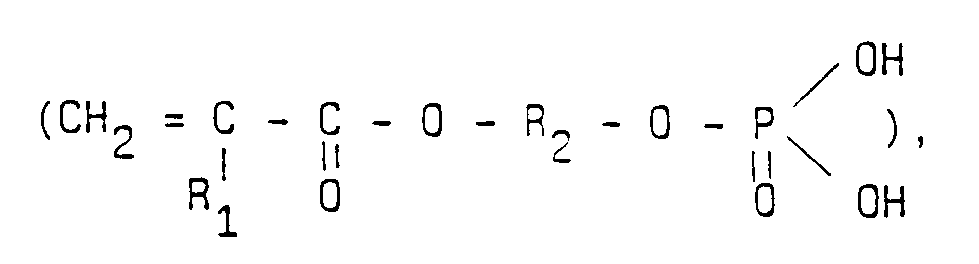
dans laquelle R₁ est choisi parmi le groupe constitué par H et les alkyles et R₂ est choisi parmi le groupe des alkylènes et des oxydes et/ou polyoxydes d'alkylène. - Dans le matériau préféré, l'ester éthylénique de l'acide phosphorique est le phosphate de méthacrylate d'éthylène glycol, dénommé ci-après MAEGP, dans lequel R₁ est le groupe CH₃ et R₂ est le groupe (CH₂ - CH₂). Ce produit présente de nombreux avantages. Il est particulièrement soluble dans l'eau, ce qui autorise d'utiliser des solutions concentrées lors du greffage conduisant à des taux de greffage particulièrement élevés, supérieurs à 50%. De plus les forces de complexation mises en feu vis-à-vis des ions métalliques sont particulièrement élevées, ce qui assure une excellente stabilité chimique du matériau.
- Parmi tous les matériaux possibles de l'invention, on peut citer ceux dans lesquels les greffons complexants sont obtenus par polymérisation d'au moins un dérivé polymérisable de la quinoléine, en particulier l'acrylate d'hydroxy 8 quinoléine.
- Parmi les ions métalliques , possédant des propriétés antiseptiques reconnues , et aptes à former des complexes on peut citer le Cuivre, le Zinc, l'Etain et le Mercure.
- C'est un autre objet de l'invention que de proposer un procédé spécialement adapté pour la préparation des matériaux précités. Ce procédé consiste à effectuer une réaction de greffage sur le matériau polymérique à l'aide d'au moins un monomère insaturé possédant au moins une fonction complexante puis à mettre le matériau ainsi greffé en contact avec une solution ionique d'au moins un métal ayant une activité antiseptique.
- La réaction de greffage consiste à activer le matériau, par exemple par irradiation, de manière à créer des sites réactifs et à le mettre en contact avec le monomère.
- Dans le cas d'un matériau hydrophobe, tel le polypropylène, l'étape d'irradiation précède l'étape d'imprégnation du matériau irradié par la solution de monomère.
- Dans le cas d'un matériau hydrophile , tel le coton ou la viscose, l'étape d'imprégnation peut précéder l'étape d'irradiation.
- L'invention sera mieux comprise et d'autres avantages et caractéristiques ressortiront de la lecture de la description qui va être faite de plusieurs exemples de réalisation de matériaux antiseptiques à greffons complexés par des ions métalliques.
1° exemple. Le matériau textile est un tissu de polypropylène Il est soumis à une irradiation électronique de 10 kGy plongé dans une solution de méthacrylate d'éthylène glycol phosphaté (MAEGP) contenant ce 0,5 à 1g/l de sulfate de cuivre pour retarder l'homopolymérisation, puis purgé 3 minutes à l'azote avant d'être chauffé à 100°C pendant 3h. - Le tableau 1 ci-dessous donne les valeurs du taux de greffage (A) et de la capacité (B) de fixation des greffons en fonction des concentrations de la solution d'imprégnation en MAEGP (C₁) et en sulfate de Cuivre (C₂). Le taux de greffage Tg (A) est mesuré après extraction, il est égal à

dans lequel P₁ est le poids du matériau greffé et Po son poids avant greffage.C₁ (%) C₂ (%) A (%) B (méq/g) 5 0,5 28 1,3 10 0,5 42 2 15 1 52 2,5 - Les valeurs données pour le taux de greffage (A) sont des valeurs moyennes sur dix essais, avec une très bonne reproductibilité (écart de + 2%).
- Ce premier exemple illustre la possibilité d'obtenir avec le MAEGP des taux de greffage très importants , conduisat à des capacités de fixation (B) élevées, à la fois en échange d'ions et en complexation.
- Il est aussi à noter que la solution de MAEGP est obtenue par simple dilution d'une solution primaire concentrée à 76% qui est conservée lors de stockage sans précaution particulière autre que l'addition de 200 ppM de stabilisants.
2° exemple. Le matériau textile est un tissu de coton. L'opération de greffage se fait par imprégnation d'une solution à 30% de MAEGP, par essorage du tissu imprégné tel que le taux d'emport soit de 100%; puis irradiation du matériau imprégné en milieu inerte sous vide. - Différents essais ont été réalisés, mettant en oeuvre des doses d'irradiation variant entre 10 et 30 kGy. Les taux de greffage obtenus sont quasiment constants , étant compris entre 15,1 et 17% quelle que soit la dose pratiquée.
3° exemple. Le matériau textile est un non-tissé contenant 80% de viscose et 20% de polyester. Les conditions de greffage sont les mêmes que pour l'exemple 2. Le taux de greffage est de 17,4 pour des doses de 10 et de 20 kGy. - Par ailleurs des essais ont été réalisés avec une irradiation en présence d'air, et non plus en milieu inerte. Le taux de greffage obtenu était de 12,8% pour une irradiation à 10kGy et de 12,9% pour une irradiation à 20kGy.
- Les matériaux greffés selon les exemples ci-dessus sont aptes à complexer des ions métalliques connus pour leur action antseptique, tel que le cuivre, le zinc l'étain, le mercure, dans des limites de concentration qui dépendent de la capacité de fixation du matériau greffé.
- La complexation est quasiment immédiate , par une simple imprégnation, foulardage de matériau greffé dans un bain contenant le ou les différents sels métalliques.
- Il revient à l'homme du métier de déterminer , en fonction de l'usage auquel le matériau est destiné, les différents paramètres entrant en jeu pour obtenir les concentrations en ions métalliques complexés. Il s'agit du taux de greffage qui détermine, pour un monomère complexant donné, la capacité de fixation en ion métallique. Il s'agit de la concentration en ions métalliques du ou des bains d'imprégnation, selon le mode opératoire retenu. Par exemple si l'imprégnation se fait par passage forcé du bain à travers le matériau, de manière comparable à une filtration, la fixation de tous les ions métalliques sera pratiquement complète et le bain sera épuisé, bien sûr jusqu'à saturation des fonctions complexantes. Par contre si l'imprégnation se fait en continu par passage du matériau dans un bain puis foulardage, il y a lieu de prévoir une alimentation en solution renouvelée , par pompe doseuse , afin de tenir compte de l'échelle d'affinité entre les fonctions complexantes et les différents ions métalliques présente dans le bain. Eventuellement l'imprégnation peut se faire par passages successifs dans plusieurs bains , chaque bain contenant un ou plusieurs sels métalliques déterminés.
- Les quantités d'ions métalliques complexés sont relativement faibles , de l'ordre de quelques grammes de métal par kg de matériau, pour des applications du type cutanées ; elles sont plus importantes, pouvant aller jusqu'à quelques dizaines de grammes pour d'autres applications telles que la stérilisation de l'eau. Dans ce cas de complexation de quelques grammes d'ions métalliques par kg de matériau le taux de greffage requis est faible , de l'ordre de 2%.
- Le spectre d'activité du matériau ainsi rendu antiseptique est fonction du ou des ions métalliques complexés. Comme on vient de le voir ce spectre est parfaitement modulable grâce au matériau de l'invention, à partir du taux de greffage et des quantités d'ions métalliques compléxés. Ceci est un avantage important par rapport aux matériaux dans lesquels l'atome de métal antiseptique est partie intégrante d'un polymère tel que le polyacrylate de tributylétain décrit dans le document DD-A-207740. Dans ce cas l'étain est lié au polymère par liaison covalente, et non par échange d'ion ni par complexation. Le spectre d'activité du matériau est défini une fois pour toutes par la quantité de polymère inclus dans le matériau. Il n'est pas modulable, par une simple imprégnation, comme cela a été décrit pour le matériau de l'invention.
- Les matériaux à greffons complexés par des ions métalliques antiseptiques sont parfaitement stables depuis des pH très acides (pH0) jusqu'à des pH basiques (pH12) correspondant aux milieux lessiviels habituels.
- Le greffage peut ègalement être réalisé à partir d'un mélange de monomères insaturés, pourvu que l'un d'eux comporte des fonctions complexantes pour les ions métalliques à activité antiseptique.
Claims (11)
- Matériau polymérique greffé ayant des propriétés antiseptiques caractérisé en ce que au moins certains greffons forment des complexes avec au moins un ion métallique ayant une activité antiseptique.
- Matériau selon la revendication 1 caractérisé en ce que les greffons sont obtenus par polymérisation d'au moins un monomère insaturé possédant au moins une fonction complexante.
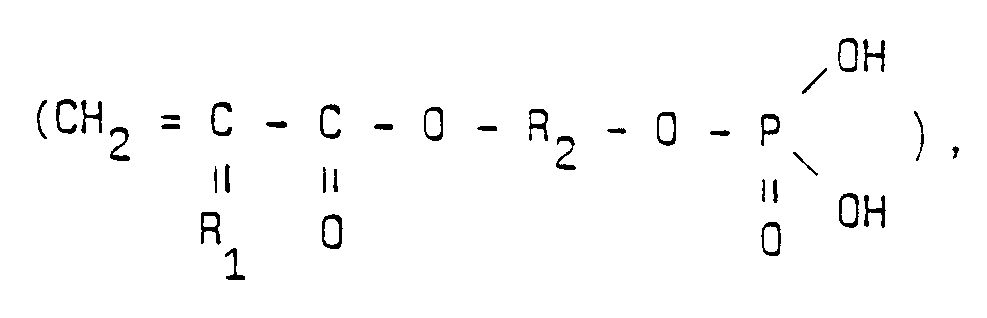
- Matériau selon la revendication 2 caractérisé an ce que le monomère insaturé est un ester éthylénique de l'acide phosophorique de formule générale :
- Matériau selon la revendication 3 caractérisé en ce que le monomère insaturé est le phosphate de méthacrylate d'éthylène glycol.
- Matériau selon la revendication 2 caractérisé en ce que le monomère insaturé est un dérivé polymérisable de la quinoléine.
- Matériau selon la revendication 5 caractérisé en ce que le monomère insaturé est l'acryl hydroxy 8 quinoléine.
- Matériau selon la revendication 1 caractérisé en ce qu'il est complexé par un ou plusieurs métaux divalents, notamment le cuivre et/ou le zinc.
- Procédé de préparation du matériau polymérique greffé selon la revendication 2 caractérisé en ce qu'il consiste à greffer le matériau polymérique avec au moins un monomère insaturé possédant au moins une fonction complexante puis à mettre en contact le matériau greffé avec une solution ionique d'au moins un métal ayant une activité antiseptique.
- Procédé selon la revendication 8 caractérisé en ce que , le matériau polymérique étant hydrophobe, le greffage est réalisé par une irradiation suivie d'une imprégnation d'un bain contenant le monomère insaturé.
- Procédé selon la revendication 6 caractérisé en ce que, le matériau polymérique étant hydrophile, le greffage est réalisé par une imprégnation d'un bain contenant le monomère insaturé suivie d'une irradiation.
- Procédé selon la revendication 8 caractérisé en ce ce, la solution ionique contenant plusieurs métaux ayant une activité antiseptique , leur concentration dans la solution respective est choisie en fonction de l'échelle d'affinité de chacun des ions métalliques correspondants.
Applications Claiming Priority (2)
| Application Number | Priority Date | Filing Date | Title |
|---|---|---|---|
| FR9001621 | 1990-02-05 | ||
| FR9001621A FR2657895A1 (fr) | 1990-02-05 | 1990-02-05 | Materiau antiseptique a greffons complexes par des ions metalliques et procede de preparation. |
Publications (2)
| Publication Number | Publication Date |
|---|---|
| EP0446082A1 EP0446082A1 (fr) | 1991-09-11 |
| EP0446082B1 true EP0446082B1 (fr) | 1995-03-29 |
Family
ID=9393608
Family Applications (1)
| Application Number | Title | Priority Date | Filing Date |
|---|---|---|---|
| EP91400193A Expired - Lifetime EP0446082B1 (fr) | 1990-02-05 | 1991-01-29 | Matériau polymérique greffé antiseptique ayant des greffons complexés par des ions métalliques et procédé de préparation |
Country Status (7)
| Country | Link |
|---|---|
| US (1) | US5194454A (fr) |
| EP (1) | EP0446082B1 (fr) |
| JP (1) | JP2833245B2 (fr) |
| DE (1) | DE69108428T2 (fr) |
| DK (1) | DK0446082T3 (fr) |
| ES (1) | ES2073132T3 (fr) |
| FR (1) | FR2657895A1 (fr) |
Families Citing this family (4)
| Publication number | Priority date | Publication date | Assignee | Title |
|---|---|---|---|---|
| US6039964A (en) | 1997-04-11 | 2000-03-21 | Omni Manufacturing, Inc. | Germicidally protected conveyor components |
| WO2013015307A1 (fr) * | 2011-07-26 | 2013-01-31 | 京都府公立大学法人 | Fibre inhibant la production d'un facteur pathogène et procédé de production de cette dernière |
| CN112227064A (zh) * | 2020-10-28 | 2021-01-15 | 上海威露美生物科技有限公司 | 醛亲核加成络合抗菌纤维、制备方法及应用 |
| FR3136674A1 (fr) | 2022-06-17 | 2023-12-22 | Ouvry | Lingette de décontamination radiologique. |
Family Cites Families (18)
| Publication number | Priority date | Publication date | Assignee | Title |
|---|---|---|---|---|
| CA641174A (en) * | 1962-05-15 | E.I. Du Pont De Nemours And Company | Modification of shaped polymeric structures by irradiation | |
| CA910233A (en) * | 1972-09-19 | Y. Kabanov Vitaly | Method of modifying polymeric materials wood and articles made therefrom by radiation-initiated graft copolymerization thereof | |
| US2998329A (en) * | 1957-08-05 | 1961-08-29 | Dow Chemical Co | Modification of cellulosic articles |
| US3297525A (en) * | 1962-10-19 | 1967-01-10 | Merck & Co Inc | Fungicidal compositions comprising salicylates of 8 hydroxy quinoline carboxylic esters |
| BE681379A (fr) * | 1966-05-20 | 1966-10-31 | ||
| FR1499358A (fr) * | 1966-09-12 | 1967-10-27 | Mo Tekstilny I | Procédé d'obtention de matières fibreuses antimicrobiennes |
| US4001150A (en) * | 1970-11-25 | 1977-01-04 | Kansai Paint Company, Ltd. | Composition for preparing electroconductive resin comprising an unsaturated polyester and phosphoric or sulfonic unsaturated ester |
| US3814703A (en) * | 1971-05-31 | 1974-06-04 | Kansai Paint Co Ltd | Composition for forming an electrically conductive resin film |
| US4179401A (en) * | 1971-07-08 | 1979-12-18 | Garnett John L | Preparation of heterogeneous catalysts including the steps of radiation grafting of an alpha unsaturated monomer to a metal or to an organic polymer |
| US3814676A (en) * | 1971-10-07 | 1974-06-04 | Stevens & Co Inc J P | Radiation process of preparing grafted elastomeric fibers wherein post-decrystallization is employed |
| US3872128A (en) * | 1972-03-08 | 1975-03-18 | Union Carbide Corp | Antimicrobial hydroxy quinoline, ethylene-acrylic polymer compositions |
| US4072640A (en) * | 1976-01-29 | 1978-02-07 | Instituto Venezolano De Investigaciones Cientificas | Copolymerization of vinyl monomers with cellulose and starch in copper ammonium solutions |
| SU608813A1 (ru) * | 1977-01-11 | 1978-05-30 | Московский Ордена Ленина И Ордена Трудового Красного Знамени Государственный Университет Имени М.В.Лононосова | Способ получени привитых сополимеров |
| DE2905531A1 (de) * | 1979-02-14 | 1981-01-08 | Boehringer Mannheim Gmbh | Diagnostisches mittel zum nachweis von leukozyten in koerperfluessigkeiten |
| US4340057A (en) * | 1980-12-24 | 1982-07-20 | S. C. Johnson & Son, Inc. | Radiation induced graft polymerization |
| DD207740A1 (de) * | 1982-06-07 | 1984-03-14 | Bitterfeld Chemie | Verfahren zur mikrobiziden ausruestung zellulosehaltiger textilfasern und flaechenfasergebilden |
| DE3248505A1 (de) * | 1982-12-29 | 1984-07-05 | Bayer Ag, 5090 Leverkusen | 1-cyclopropyl-6-fluor-1,4-dihydro-4-oxo-7(4- (oxoalkyl)-1-piperazinyl/-3-chinolincarbonsaeuren und ihre derivate, verfahren zu ihrer herstellung sowie diese enthaltende antibakterielle mittel |
| DE3318145A1 (de) * | 1983-05-18 | 1984-11-22 | Bayer Ag, 5090 Leverkusen | 7-amino-1-cyclopropyl-6,8-difluor-1,4-dihydro-4-oxo-3-chinolincarbonsaeuren, verfahren zu ihrer herstellung sowie diese enthaltende antibakterielle mittel |
-
1990
- 1990-02-05 FR FR9001621A patent/FR2657895A1/fr active Granted
-
1991
- 1991-01-29 DE DE69108428T patent/DE69108428T2/de not_active Expired - Fee Related
- 1991-01-29 ES ES91400193T patent/ES2073132T3/es not_active Expired - Lifetime
- 1991-01-29 DK DK91400193.8T patent/DK0446082T3/da active
- 1991-01-29 EP EP91400193A patent/EP0446082B1/fr not_active Expired - Lifetime
- 1991-01-29 US US07/647,147 patent/US5194454A/en not_active Expired - Lifetime
- 1991-02-05 JP JP3060870A patent/JP2833245B2/ja not_active Expired - Lifetime
Also Published As
| Publication number | Publication date |
|---|---|
| DE69108428D1 (de) | 1995-05-04 |
| JP2833245B2 (ja) | 1998-12-09 |
| FR2657895B1 (fr) | 1994-04-22 |
| DK0446082T3 (da) | 1995-05-01 |
| EP0446082A1 (fr) | 1991-09-11 |
| DE69108428T2 (de) | 1995-09-07 |
| ES2073132T3 (es) | 1995-08-01 |
| JPH073651A (ja) | 1995-01-06 |
| FR2657895A1 (fr) | 1991-08-09 |
| US5194454A (en) | 1993-03-16 |
Similar Documents
| Publication | Publication Date | Title |
|---|---|---|
| DK2178990T3 (en) | Antimicrobial photo-stable coating composition | |
| EP1569989A1 (fr) | Procede de traitement de surface par photopolymerisation pour obtenir des proprietes biocides | |
| CN105613506A (zh) | 一种卤胺/季铵烯烃类抗菌剂及其在生物可降解纳米纤维材料中的应用 | |
| EP0251314A2 (fr) | Procédé pour la préparation de matériaux absorbants de l'eau | |
| Bajpai et al. | Silver (I) ions loaded cyclodextrin-grafted-cotton fabric with excellent antimicrobial property | |
| EP0257308B1 (fr) | Procédé de préparation de matériel fibreux absorbant l'eau | |
| EP0904445B1 (fr) | Procede pour produire des fibres hybrides hautement absorbantes par ozonisation et polymerisation par greffage, et fibres hybrides obtenues par ce procede | |
| EP0446082A1 (fr) | Matériau polymérique greffé antiseptique ayant des greffons complexés par des ions métalliques et procédé de préparation | |
| JPH0797409A (ja) | ポリマー、固体支持体の防腐保護方法、ポリマーを含有する木綿帛片、およびポリマーの応用 | |
| JPWO2018190328A1 (ja) | セルロース系繊維用湿潤摩擦堅牢度向上剤、それを用いた染色セルロース繊維の製造方法、およびその用途 | |
| JP2016084564A (ja) | 改質セルロース系繊維の製造方法及び当該方法で製造される改質セルロース系繊維 | |
| CN1451811A (zh) | 纳米银系抗菌织物的制备工艺及应用 | |
| EP0441675B1 (fr) | Matériau polymérique à greffons phosphatés et utilisations | |
| JP3194241B2 (ja) | セルロース繊維の改質方法 | |
| EP0527078B1 (fr) | Procédé d'ignifugation de matériaux textiles | |
| EP4674442A1 (fr) | Matériau pour favoriser la libération d'oxygène à partir de globules rouges, et matériau de recouvrement de plaie contenant ledit matériau | |
| JP2739132B2 (ja) | 改質紙 | |
| JPWO2004025016A1 (ja) | 改質繊維布帛およびその製造方法 | |
| EP0116489A1 (fr) | Nouveaux dérivés du mercurobutol et leur application à la protection de supports notamment textiles | |
| EP0704007B1 (fr) | Procede non polluant pour augmenter la resistance humide du papier | |
| CH410291A (fr) | Composition pour le traitement des fibres kératiniques non textiles et utilisation de cette composition pour le traitement des cheveux | |
| EP1289975B1 (fr) | Sel de trialkylammonium epoxyde, procede de synthese et applications | |
| JPS5930963A (ja) | 殺菌性繊維 | |
| JP3276025B2 (ja) | 抗菌性アクリロニトリル系繊維およびその製造方法 | |
| JPS6364548B2 (fr) |
Legal Events
| Date | Code | Title | Description |
|---|---|---|---|
| PUAI | Public reference made under article 153(3) epc to a published international application that has entered the european phase |
Free format text: ORIGINAL CODE: 0009012 |
|
| AK | Designated contracting states |
Kind code of ref document: A1 Designated state(s): CH DE DK ES GB IT LI NL SE |
|
| 17P | Request for examination filed |
Effective date: 19920307 |
|
| 17Q | First examination report despatched |
Effective date: 19931217 |
|
| GRAA | (expected) grant |
Free format text: ORIGINAL CODE: 0009210 |
|
| AK | Designated contracting states |
Kind code of ref document: B1 Designated state(s): CH DE DK ES GB IT LI NL SE |
|
| GBT | Gb: translation of ep patent filed (gb section 77(6)(a)/1977) |
Effective date: 19950329 |
|
| REG | Reference to a national code |
Ref country code: DK Ref legal event code: T3 |
|
| REF | Corresponds to: |
Ref document number: 69108428 Country of ref document: DE Date of ref document: 19950504 |
|
| ITF | It: translation for a ep patent filed | ||
| REG | Reference to a national code |
Ref country code: ES Ref legal event code: FG2A Ref document number: 2073132 Country of ref document: ES Kind code of ref document: T3 |
|
| PLBE | No opposition filed within time limit |
Free format text: ORIGINAL CODE: 0009261 |
|
| STAA | Information on the status of an ep patent application or granted ep patent |
Free format text: STATUS: NO OPPOSITION FILED WITHIN TIME LIMIT |
|
| 26N | No opposition filed | ||
| REG | Reference to a national code |
Ref country code: GB Ref legal event code: IF02 |
|
| PGFP | Annual fee paid to national office [announced via postgrant information from national office to epo] |
Ref country code: ES Payment date: 20090218 Year of fee payment: 19 Ref country code: DK Payment date: 20090113 Year of fee payment: 19 |
|
| PGFP | Annual fee paid to national office [announced via postgrant information from national office to epo] |
Ref country code: NL Payment date: 20090104 Year of fee payment: 19 Ref country code: DE Payment date: 20090123 Year of fee payment: 19 |
|
| PGFP | Annual fee paid to national office [announced via postgrant information from national office to epo] |
Ref country code: CH Payment date: 20090126 Year of fee payment: 19 Ref country code: GB Payment date: 20090128 Year of fee payment: 19 |
|
| PGFP | Annual fee paid to national office [announced via postgrant information from national office to epo] |
Ref country code: IT Payment date: 20090127 Year of fee payment: 19 Ref country code: SE Payment date: 20090108 Year of fee payment: 19 |
|
| REG | Reference to a national code |
Ref country code: NL Ref legal event code: V1 Effective date: 20100801 |
|
| REG | Reference to a national code |
Ref country code: CH Ref legal event code: PL |
|
| REG | Reference to a national code |
Ref country code: DK Ref legal event code: EBP |
|
| GBPC | Gb: european patent ceased through non-payment of renewal fee |
Effective date: 20100129 |
|
| EUG | Se: european patent has lapsed | ||
| PG25 | Lapsed in a contracting state [announced via postgrant information from national office to epo] |
Ref country code: CH Free format text: LAPSE BECAUSE OF NON-PAYMENT OF DUE FEES Effective date: 20100131 Ref country code: NL Free format text: LAPSE BECAUSE OF NON-PAYMENT OF DUE FEES Effective date: 20100801 Ref country code: LI Free format text: LAPSE BECAUSE OF NON-PAYMENT OF DUE FEES Effective date: 20100131 |
|
| PG25 | Lapsed in a contracting state [announced via postgrant information from national office to epo] |
Ref country code: DE Free format text: LAPSE BECAUSE OF NON-PAYMENT OF DUE FEES Effective date: 20100803 |
|
| PG25 | Lapsed in a contracting state [announced via postgrant information from national office to epo] |
Ref country code: GB Free format text: LAPSE BECAUSE OF NON-PAYMENT OF DUE FEES Effective date: 20100129 |
|
| PG25 | Lapsed in a contracting state [announced via postgrant information from national office to epo] |
Ref country code: DK Free format text: LAPSE BECAUSE OF NON-PAYMENT OF DUE FEES Effective date: 20100131 |
|
| REG | Reference to a national code |
Ref country code: ES Ref legal event code: FD2A Effective date: 20110223 |
|
| PG25 | Lapsed in a contracting state [announced via postgrant information from national office to epo] |
Ref country code: IT Free format text: LAPSE BECAUSE OF NON-PAYMENT OF DUE FEES Effective date: 20100129 |
|
| PG25 | Lapsed in a contracting state [announced via postgrant information from national office to epo] |
Ref country code: ES Free format text: LAPSE BECAUSE OF NON-PAYMENT OF DUE FEES Effective date: 20110130 |
|
| PG25 | Lapsed in a contracting state [announced via postgrant information from national office to epo] |
Ref country code: SE Free format text: LAPSE BECAUSE OF NON-PAYMENT OF DUE FEES Effective date: 20100130 |