EP0450594A2 - Signalamplifikation einer DNS-Sonde - Google Patents
Signalamplifikation einer DNS-Sonde Download PDFInfo
- Publication number
- EP0450594A2 EP0450594A2 EP91105249A EP91105249A EP0450594A2 EP 0450594 A2 EP0450594 A2 EP 0450594A2 EP 91105249 A EP91105249 A EP 91105249A EP 91105249 A EP91105249 A EP 91105249A EP 0450594 A2 EP0450594 A2 EP 0450594A2
- Authority
- EP
- European Patent Office
- Prior art keywords
- developer
- molecule
- molecules
- sequence
- nucleotides
- Prior art date
- Legal status (The legal status is an assumption and is not a legal conclusion. Google has not performed a legal analysis and makes no representation as to the accuracy of the status listed.)
- Granted
Links
- 230000003321 amplification Effects 0.000 title claims description 11
- 238000003199 nucleic acid amplification method Methods 0.000 title claims description 11
- 239000003298 DNA probe Substances 0.000 title description 5
- 108020003215 DNA Probes Proteins 0.000 title description 2
- 239000000523 sample Substances 0.000 claims abstract description 131
- 239000002773 nucleotide Substances 0.000 claims abstract description 108
- 125000003729 nucleotide group Chemical group 0.000 claims abstract description 108
- 238000000034 method Methods 0.000 claims abstract description 70
- 150000007523 nucleic acids Chemical class 0.000 claims abstract description 70
- 230000000295 complement effect Effects 0.000 claims abstract description 67
- 108020004707 nucleic acids Proteins 0.000 claims abstract description 61
- 102000039446 nucleic acids Human genes 0.000 claims abstract description 61
- 230000027455 binding Effects 0.000 claims abstract description 19
- 108020005187 Oligonucleotide Probes Proteins 0.000 claims abstract description 10
- 239000002751 oligonucleotide probe Substances 0.000 claims abstract description 10
- 238000001514 detection method Methods 0.000 claims abstract description 9
- 108091028043 Nucleic acid sequence Proteins 0.000 claims description 15
- 239000007787 solid Substances 0.000 claims description 15
- 125000000524 functional group Chemical group 0.000 claims description 6
- UPBAOYRENQEPJO-UHFFFAOYSA-N n-[5-[[5-[(3-amino-3-iminopropyl)carbamoyl]-1-methylpyrrol-3-yl]carbamoyl]-1-methylpyrrol-3-yl]-4-formamido-1-methylpyrrole-2-carboxamide Chemical group CN1C=C(NC=O)C=C1C(=O)NC1=CN(C)C(C(=O)NC2=CN(C)C(C(=O)NCCC(N)=N)=C2)=C1 UPBAOYRENQEPJO-UHFFFAOYSA-N 0.000 claims description 6
- IDBIFFKSXLYUOT-UHFFFAOYSA-N netropsin Chemical compound C1=C(C(=O)NCCC(N)=N)N(C)C=C1NC(=O)C1=CC(NC(=O)CN=C(N)N)=CN1C IDBIFFKSXLYUOT-UHFFFAOYSA-N 0.000 claims description 4
- 108010042747 stallimycin Proteins 0.000 claims description 3
- 229950009902 stallimycin Drugs 0.000 claims description 3
- 108010042309 Netropsin Proteins 0.000 claims description 2
- 125000003396 thiol group Chemical group [H]S* 0.000 claims description 2
- MBVFRSJFKMJRHA-UHFFFAOYSA-N 4-fluoro-1-benzofuran-7-carbaldehyde Chemical group FC1=CC=C(C=O)C2=C1C=CO2 MBVFRSJFKMJRHA-UHFFFAOYSA-N 0.000 claims 1
- 229920002307 Dextran Polymers 0.000 claims 1
- 125000003277 amino group Chemical group 0.000 claims 1
- 150000007942 carboxylates Chemical group 0.000 claims 1
- 125000002887 hydroxy group Chemical group [H]O* 0.000 claims 1
- 238000009396 hybridization Methods 0.000 description 40
- 238000003556 assay Methods 0.000 description 21
- 108091034117 Oligonucleotide Proteins 0.000 description 16
- 108020004414 DNA Proteins 0.000 description 14
- JLCPHMBAVCMARE-UHFFFAOYSA-N [3-[[3-[[3-[[3-[[3-[[3-[[3-[[3-[[3-[[3-[[3-[[5-(2-amino-6-oxo-1H-purin-9-yl)-3-[[3-[[3-[[3-[[3-[[3-[[5-(2-amino-6-oxo-1H-purin-9-yl)-3-[[5-(2-amino-6-oxo-1H-purin-9-yl)-3-hydroxyoxolan-2-yl]methoxy-hydroxyphosphoryl]oxyoxolan-2-yl]methoxy-hydroxyphosphoryl]oxy-5-(5-methyl-2,4-dioxopyrimidin-1-yl)oxolan-2-yl]methoxy-hydroxyphosphoryl]oxy-5-(6-aminopurin-9-yl)oxolan-2-yl]methoxy-hydroxyphosphoryl]oxy-5-(6-aminopurin-9-yl)oxolan-2-yl]methoxy-hydroxyphosphoryl]oxy-5-(6-aminopurin-9-yl)oxolan-2-yl]methoxy-hydroxyphosphoryl]oxy-5-(6-aminopurin-9-yl)oxolan-2-yl]methoxy-hydroxyphosphoryl]oxyoxolan-2-yl]methoxy-hydroxyphosphoryl]oxy-5-(5-methyl-2,4-dioxopyrimidin-1-yl)oxolan-2-yl]methoxy-hydroxyphosphoryl]oxy-5-(4-amino-2-oxopyrimidin-1-yl)oxolan-2-yl]methoxy-hydroxyphosphoryl]oxy-5-(5-methyl-2,4-dioxopyrimidin-1-yl)oxolan-2-yl]methoxy-hydroxyphosphoryl]oxy-5-(5-methyl-2,4-dioxopyrimidin-1-yl)oxolan-2-yl]methoxy-hydroxyphosphoryl]oxy-5-(6-aminopurin-9-yl)oxolan-2-yl]methoxy-hydroxyphosphoryl]oxy-5-(6-aminopurin-9-yl)oxolan-2-yl]methoxy-hydroxyphosphoryl]oxy-5-(4-amino-2-oxopyrimidin-1-yl)oxolan-2-yl]methoxy-hydroxyphosphoryl]oxy-5-(4-amino-2-oxopyrimidin-1-yl)oxolan-2-yl]methoxy-hydroxyphosphoryl]oxy-5-(4-amino-2-oxopyrimidin-1-yl)oxolan-2-yl]methoxy-hydroxyphosphoryl]oxy-5-(6-aminopurin-9-yl)oxolan-2-yl]methoxy-hydroxyphosphoryl]oxy-5-(4-amino-2-oxopyrimidin-1-yl)oxolan-2-yl]methyl [5-(6-aminopurin-9-yl)-2-(hydroxymethyl)oxolan-3-yl] hydrogen phosphate Polymers Cc1cn(C2CC(OP(O)(=O)OCC3OC(CC3OP(O)(=O)OCC3OC(CC3O)n3cnc4c3nc(N)[nH]c4=O)n3cnc4c3nc(N)[nH]c4=O)C(COP(O)(=O)OC3CC(OC3COP(O)(=O)OC3CC(OC3COP(O)(=O)OC3CC(OC3COP(O)(=O)OC3CC(OC3COP(O)(=O)OC3CC(OC3COP(O)(=O)OC3CC(OC3COP(O)(=O)OC3CC(OC3COP(O)(=O)OC3CC(OC3COP(O)(=O)OC3CC(OC3COP(O)(=O)OC3CC(OC3COP(O)(=O)OC3CC(OC3COP(O)(=O)OC3CC(OC3COP(O)(=O)OC3CC(OC3COP(O)(=O)OC3CC(OC3COP(O)(=O)OC3CC(OC3COP(O)(=O)OC3CC(OC3COP(O)(=O)OC3CC(OC3CO)n3cnc4c(N)ncnc34)n3ccc(N)nc3=O)n3cnc4c(N)ncnc34)n3ccc(N)nc3=O)n3ccc(N)nc3=O)n3ccc(N)nc3=O)n3cnc4c(N)ncnc34)n3cnc4c(N)ncnc34)n3cc(C)c(=O)[nH]c3=O)n3cc(C)c(=O)[nH]c3=O)n3ccc(N)nc3=O)n3cc(C)c(=O)[nH]c3=O)n3cnc4c3nc(N)[nH]c4=O)n3cnc4c(N)ncnc34)n3cnc4c(N)ncnc34)n3cnc4c(N)ncnc34)n3cnc4c(N)ncnc34)O2)c(=O)[nH]c1=O JLCPHMBAVCMARE-UHFFFAOYSA-N 0.000 description 9
- 239000003446 ligand Substances 0.000 description 8
- 239000006096 absorbing agent Substances 0.000 description 7
- 238000002372 labelling Methods 0.000 description 7
- 230000002285 radioactive effect Effects 0.000 description 7
- YBJHBAHKTGYVGT-ZKWXMUAHSA-N (+)-Biotin Chemical compound N1C(=O)N[C@@H]2[C@H](CCCCC(=O)O)SC[C@@H]21 YBJHBAHKTGYVGT-ZKWXMUAHSA-N 0.000 description 6
- 108090000790 Enzymes Proteins 0.000 description 6
- 102000004190 Enzymes Human genes 0.000 description 6
- 239000003054 catalyst Substances 0.000 description 6
- 229920001519 homopolymer Polymers 0.000 description 6
- 125000005647 linker group Chemical group 0.000 description 6
- 230000035945 sensitivity Effects 0.000 description 5
- 102000053602 DNA Human genes 0.000 description 4
- 239000002253 acid Substances 0.000 description 4
- 150000007513 acids Chemical class 0.000 description 4
- 239000002585 base Substances 0.000 description 4
- 150000001875 compounds Chemical class 0.000 description 4
- 230000001965 increasing effect Effects 0.000 description 4
- HWYHZTIRURJOHG-UHFFFAOYSA-N luminol Chemical compound O=C1NNC(=O)C2=C1C(N)=CC=C2 HWYHZTIRURJOHG-UHFFFAOYSA-N 0.000 description 4
- 238000003752 polymerase chain reaction Methods 0.000 description 4
- 230000006820 DNA synthesis Effects 0.000 description 3
- 229960002685 biotin Drugs 0.000 description 3
- 235000020958 biotin Nutrition 0.000 description 3
- 239000011616 biotin Substances 0.000 description 3
- 239000002299 complementary DNA Substances 0.000 description 3
- 229940079593 drug Drugs 0.000 description 3
- 239000003814 drug Substances 0.000 description 3
- 230000003100 immobilizing effect Effects 0.000 description 3
- 238000012546 transfer Methods 0.000 description 3
- 108020004635 Complementary DNA Proteins 0.000 description 2
- ISAKRJDGNUQOIC-UHFFFAOYSA-N Uracil Chemical compound O=C1C=CNC(=O)N1 ISAKRJDGNUQOIC-UHFFFAOYSA-N 0.000 description 2
- RJURFGZVJUQBHK-UHFFFAOYSA-N actinomycin D Natural products CC1OC(=O)C(C(C)C)N(C)C(=O)CN(C)C(=O)C2CCCN2C(=O)C(C(C)C)NC(=O)C1NC(=O)C1=C(N)C(=O)C(C)=C2OC(C(C)=CC=C3C(=O)NC4C(=O)NC(C(N5CCCC5C(=O)N(C)CC(=O)N(C)C(C(C)C)C(=O)OC4C)=O)C(C)C)=C3N=C21 RJURFGZVJUQBHK-UHFFFAOYSA-N 0.000 description 2
- MWPLVEDNUUSJAV-UHFFFAOYSA-N anthracene Chemical compound C1=CC=CC2=CC3=CC=CC=C3C=C21 MWPLVEDNUUSJAV-UHFFFAOYSA-N 0.000 description 2
- 230000015572 biosynthetic process Effects 0.000 description 2
- 238000010804 cDNA synthesis Methods 0.000 description 2
- 239000003795 chemical substances by application Substances 0.000 description 2
- OPTASPLRGRRNAP-UHFFFAOYSA-N cytosine Chemical compound NC=1C=CNC(=O)N=1 OPTASPLRGRRNAP-UHFFFAOYSA-N 0.000 description 2
- 230000007812 deficiency Effects 0.000 description 2
- 239000000975 dye Substances 0.000 description 2
- 230000002255 enzymatic effect Effects 0.000 description 2
- UYTPUPDQBNUYGX-UHFFFAOYSA-N guanine Chemical compound O=C1NC(N)=NC2=C1N=CN2 UYTPUPDQBNUYGX-UHFFFAOYSA-N 0.000 description 2
- INAAIJLSXJJHOZ-UHFFFAOYSA-N pibenzimol Chemical compound C1CN(C)CCN1C1=CC=C(N=C(N2)C=3C=C4NC(=NC4=CC=3)C=3C=CC(O)=CC=3)C2=C1 INAAIJLSXJJHOZ-UHFFFAOYSA-N 0.000 description 2
- -1 polypropylene Polymers 0.000 description 2
- 108090000623 proteins and genes Proteins 0.000 description 2
- WQGWDDDVZFFDIG-UHFFFAOYSA-N pyrogallol Chemical compound OC1=CC=CC(O)=C1O WQGWDDDVZFFDIG-UHFFFAOYSA-N 0.000 description 2
- 239000000758 substrate Substances 0.000 description 2
- 238000003786 synthesis reaction Methods 0.000 description 2
- RWQNBRDOKXIBIV-UHFFFAOYSA-N thymine Chemical compound CC1=CNC(=O)NC1=O RWQNBRDOKXIBIV-UHFFFAOYSA-N 0.000 description 2
- QRXMUCSWCMTJGU-UHFFFAOYSA-L (5-bromo-4-chloro-1h-indol-3-yl) phosphate Chemical compound C1=C(Br)C(Cl)=C2C(OP([O-])(=O)[O-])=CNC2=C1 QRXMUCSWCMTJGU-UHFFFAOYSA-L 0.000 description 1
- GEYOCULIXLDCMW-UHFFFAOYSA-N 1,2-phenylenediamine Chemical compound NC1=CC=CC=C1N GEYOCULIXLDCMW-UHFFFAOYSA-N 0.000 description 1
- NIPYQLPZPLBOLF-GBLLEDPASA-N 3'-hydroxy-6'-[(2s,3r,4s,5r,6r)-3,4,5-trihydroxy-6-(hydroxymethyl)oxan-2-yl]oxyspiro[2-benzofuran-3,9'-xanthene]-1-one Chemical compound O[C@@H]1[C@@H](O)[C@@H](O)[C@@H](CO)O[C@H]1OC1=CC=C2C3(C4=CC=CC=C4C(=O)O3)C3=CC=C(O)C=C3OC2=C1 NIPYQLPZPLBOLF-GBLLEDPASA-N 0.000 description 1
- KBTRJWUKQYZNGB-UHFFFAOYSA-N 3,5,7,21-tetraphenyl-23H-porphyrin-2-carboxylic acid Chemical class C=1C=CC=CC=1N1C2=C(C=3C=CC=CC=3)C(C(=C3)C=4C=CC=CC=4)=NC3=CC(N3)=CC=C3C=C(N=3)C=CC=3C=C1C(C(=O)O)=C2C1=CC=CC=C1 KBTRJWUKQYZNGB-UHFFFAOYSA-N 0.000 description 1
- MOTVYDVWODTRDF-UHFFFAOYSA-N 3-[7,12,17-tris(2-carboxyethyl)-3,8,13,18-tetrakis(carboxymethyl)-21,22-dihydroporphyrin-2-yl]propanoic acid Chemical compound N1C(C=C2C(=C(CC(O)=O)C(=CC=3C(=C(CC(O)=O)C(=C4)N=3)CCC(O)=O)N2)CCC(O)=O)=C(CC(O)=O)C(CCC(O)=O)=C1C=C1C(CC(O)=O)=C(CCC(=O)O)C4=N1 MOTVYDVWODTRDF-UHFFFAOYSA-N 0.000 description 1
- WLOADVWGNGAZCW-UHFFFAOYSA-N 3-phenyl-23H-porphyrin-2,18,20,21-tetracarboxylic acid Chemical compound OC(=O)C=1C(N2C(O)=O)=C(C(O)=O)C(=N3)C(C(=O)O)=CC3=CC(N3)=CC=C3C=C(N=3)C=CC=3C=C2C=1C1=CC=CC=C1 WLOADVWGNGAZCW-UHFFFAOYSA-N 0.000 description 1
- CJIJXIFQYOPWTF-UHFFFAOYSA-N 7-hydroxycoumarin Natural products O1C(=O)C=CC2=CC(O)=CC=C21 CJIJXIFQYOPWTF-UHFFFAOYSA-N 0.000 description 1
- AIGLSXACYSPHLX-UHFFFAOYSA-N 7-methyldibenzo(a,h)pyrene Chemical compound C1=C2C(C)=C(C=CC=C3)C3=C(C=C3)C2=C2C3=CC3=CC=CC=C3C2=C1 AIGLSXACYSPHLX-UHFFFAOYSA-N 0.000 description 1
- 229930024421 Adenine Natural products 0.000 description 1
- GFFGJBXGBJISGV-UHFFFAOYSA-N Adenine Chemical compound NC1=NC=NC2=C1N=CN2 GFFGJBXGBJISGV-UHFFFAOYSA-N 0.000 description 1
- 229920000936 Agarose Polymers 0.000 description 1
- 102000002260 Alkaline Phosphatase Human genes 0.000 description 1
- 108020004774 Alkaline Phosphatase Proteins 0.000 description 1
- 108090001008 Avidin Proteins 0.000 description 1
- 241000894006 Bacteria Species 0.000 description 1
- 229920003043 Cellulose fiber Polymers 0.000 description 1
- 230000004568 DNA-binding Effects 0.000 description 1
- 108010092160 Dactinomycin Proteins 0.000 description 1
- 102000006395 Globulins Human genes 0.000 description 1
- 108010044091 Globulins Proteins 0.000 description 1
- 108010001336 Horseradish Peroxidase Proteins 0.000 description 1
- 102000003960 Ligases Human genes 0.000 description 1
- 108090000364 Ligases Proteins 0.000 description 1
- 108060001084 Luciferase Proteins 0.000 description 1
- 239000005089 Luciferase Substances 0.000 description 1
- FYYHWMGAXLPEAU-UHFFFAOYSA-N Magnesium Chemical compound [Mg] FYYHWMGAXLPEAU-UHFFFAOYSA-N 0.000 description 1
- PEEHTFAAVSWFBL-UHFFFAOYSA-N Maleimide Chemical compound O=C1NC(=O)C=C1 PEEHTFAAVSWFBL-UHFFFAOYSA-N 0.000 description 1
- 239000000020 Nitrocellulose Substances 0.000 description 1
- 102000003992 Peroxidases Human genes 0.000 description 1
- 108010004729 Phycoerythrin Proteins 0.000 description 1
- 239000004743 Polypropylene Substances 0.000 description 1
- 108010090804 Streptavidin Proteins 0.000 description 1
- 241000700605 Viruses Species 0.000 description 1
- HCHKCACWOHOZIP-UHFFFAOYSA-N Zinc Chemical compound [Zn] HCHKCACWOHOZIP-UHFFFAOYSA-N 0.000 description 1
- 238000002835 absorbance Methods 0.000 description 1
- 238000010521 absorption reaction Methods 0.000 description 1
- RJURFGZVJUQBHK-IIXSONLDSA-N actinomycin D Chemical compound C[C@H]1OC(=O)[C@H](C(C)C)N(C)C(=O)CN(C)C(=O)[C@@H]2CCCN2C(=O)[C@@H](C(C)C)NC(=O)[C@H]1NC(=O)C1=C(N)C(=O)C(C)=C2OC(C(C)=CC=C3C(=O)N[C@@H]4C(=O)N[C@@H](C(N5CCC[C@H]5C(=O)N(C)CC(=O)N(C)[C@@H](C(C)C)C(=O)O[C@@H]4C)=O)C(C)C)=C3N=C21 RJURFGZVJUQBHK-IIXSONLDSA-N 0.000 description 1
- 229960000643 adenine Drugs 0.000 description 1
- 238000000137 annealing Methods 0.000 description 1
- 239000000427 antigen Substances 0.000 description 1
- 238000013459 approach Methods 0.000 description 1
- 239000011324 bead Substances 0.000 description 1
- 102000005936 beta-Galactosidase Human genes 0.000 description 1
- 108010005774 beta-Galactosidase Proteins 0.000 description 1
- 239000013060 biological fluid Substances 0.000 description 1
- 210000004027 cell Anatomy 0.000 description 1
- 238000006243 chemical reaction Methods 0.000 description 1
- ZYVSOIYQKUDENJ-WKSBCEQHSA-N chromomycin A3 Chemical compound O([C@@H]1C[C@@H](O[C@H](C)[C@@H]1OC(C)=O)OC=1C=C2C=C3C[C@H]([C@@H](C(=O)C3=C(O)C2=C(O)C=1C)O[C@@H]1O[C@H](C)[C@@H](O)[C@H](O[C@@H]2O[C@H](C)[C@@H](O)[C@H](O[C@@H]3O[C@@H](C)[C@H](OC(C)=O)[C@@](C)(O)C3)C2)C1)[C@H](OC)C(=O)[C@@H](O)[C@@H](C)O)[C@@H]1C[C@@H](O)[C@@H](OC)[C@@H](C)O1 ZYVSOIYQKUDENJ-WKSBCEQHSA-N 0.000 description 1
- 210000000349 chromosome Anatomy 0.000 description 1
- 238000002983 circular dichroism Methods 0.000 description 1
- 125000004122 cyclic group Chemical group 0.000 description 1
- 229940104302 cytosine Drugs 0.000 description 1
- 229960000640 dactinomycin Drugs 0.000 description 1
- 230000002950 deficient Effects 0.000 description 1
- 238000013461 design Methods 0.000 description 1
- 238000001493 electron microscopy Methods 0.000 description 1
- 230000007613 environmental effect Effects 0.000 description 1
- GNBHRKFJIUUOQI-UHFFFAOYSA-N fluorescein Chemical compound O1C(=O)C2=CC=CC=C2C21C1=CC=C(O)C=C1OC1=CC(O)=CC=C21 GNBHRKFJIUUOQI-UHFFFAOYSA-N 0.000 description 1
- 239000012458 free base Substances 0.000 description 1
- 230000001939 inductive effect Effects 0.000 description 1
- 230000000977 initiatory effect Effects 0.000 description 1
- 230000003993 interaction Effects 0.000 description 1
- 238000009830 intercalation Methods 0.000 description 1
- 230000002687 intercalation Effects 0.000 description 1
- 239000012948 isocyanate Substances 0.000 description 1
- 150000002513 isocyanates Chemical class 0.000 description 1
- ZBKFYXZXZJPWNQ-UHFFFAOYSA-N isothiocyanate group Chemical group [N-]=C=S ZBKFYXZXZJPWNQ-UHFFFAOYSA-N 0.000 description 1
- 239000002523 lectin Substances 0.000 description 1
- 239000007791 liquid phase Substances 0.000 description 1
- 229910052749 magnesium Inorganic materials 0.000 description 1
- 239000011777 magnesium Substances 0.000 description 1
- 229910052751 metal Inorganic materials 0.000 description 1
- 239000002184 metal Substances 0.000 description 1
- 229910021645 metal ion Inorganic materials 0.000 description 1
- 150000002739 metals Chemical class 0.000 description 1
- JPXMTWWFLBLUCD-UHFFFAOYSA-N nitro blue tetrazolium(2+) Chemical compound COC1=CC(C=2C=C(OC)C(=CC=2)[N+]=2N(N=C(N=2)C=2C=CC=CC=2)C=2C=CC(=CC=2)[N+]([O-])=O)=CC=C1[N+]1=NC(C=2C=CC=CC=2)=NN1C1=CC=C([N+]([O-])=O)C=C1 JPXMTWWFLBLUCD-UHFFFAOYSA-N 0.000 description 1
- 229920001220 nitrocellulos Polymers 0.000 description 1
- 238000007826 nucleic acid assay Methods 0.000 description 1
- 238000007899 nucleic acid hybridization Methods 0.000 description 1
- 230000003647 oxidation Effects 0.000 description 1
- 238000007254 oxidation reaction Methods 0.000 description 1
- 244000052769 pathogen Species 0.000 description 1
- 108040007629 peroxidase activity proteins Proteins 0.000 description 1
- 125000002080 perylenyl group Chemical group C1(=CC=C2C=CC=C3C4=CC=CC5=CC=CC(C1=C23)=C45)* 0.000 description 1
- CSHWQDPOILHKBI-UHFFFAOYSA-N peryrene Natural products C1=CC(C2=CC=CC=3C2=C2C=CC=3)=C3C2=CC=CC3=C1 CSHWQDPOILHKBI-UHFFFAOYSA-N 0.000 description 1
- 150000008300 phosphoramidites Chemical class 0.000 description 1
- 125000003367 polycyclic group Chemical group 0.000 description 1
- 108091033319 polynucleotide Proteins 0.000 description 1
- 102000040430 polynucleotide Human genes 0.000 description 1
- 239000002157 polynucleotide Substances 0.000 description 1
- 229920001155 polypropylene Polymers 0.000 description 1
- 150000004032 porphyrins Chemical class 0.000 description 1
- 230000037452 priming Effects 0.000 description 1
- 108090000765 processed proteins & peptides Proteins 0.000 description 1
- 102000004196 processed proteins & peptides Human genes 0.000 description 1
- 102000004169 proteins and genes Human genes 0.000 description 1
- 229940079877 pyrogallol Drugs 0.000 description 1
- 125000006853 reporter group Chemical group 0.000 description 1
- 230000000717 retained effect Effects 0.000 description 1
- 238000012552 review Methods 0.000 description 1
- PYWVYCXTNDRMGF-UHFFFAOYSA-N rhodamine B Chemical compound [Cl-].C=12C=CC(=[N+](CC)CC)C=C2OC2=CC(N(CC)CC)=CC=C2C=1C1=CC=CC=C1C(O)=O PYWVYCXTNDRMGF-UHFFFAOYSA-N 0.000 description 1
- 238000000926 separation method Methods 0.000 description 1
- 230000003595 spectral effect Effects 0.000 description 1
- MPLHNVLQVRSVEE-UHFFFAOYSA-N texas red Chemical compound [O-]S(=O)(=O)C1=CC(S(Cl)(=O)=O)=CC=C1C(C1=CC=2CCCN3CCCC(C=23)=C1O1)=C2C1=C(CCC1)C3=[N+]1CCCC3=C2 MPLHNVLQVRSVEE-UHFFFAOYSA-N 0.000 description 1
- 229940113082 thymine Drugs 0.000 description 1
- 229940034208 thyroxine Drugs 0.000 description 1
- 210000001519 tissue Anatomy 0.000 description 1
- ORHBXUUXSCNDEV-UHFFFAOYSA-N umbelliferone Chemical compound C1=CC(=O)OC2=CC(O)=CC=C21 ORHBXUUXSCNDEV-UHFFFAOYSA-N 0.000 description 1
- HFTAFOQKODTIJY-UHFFFAOYSA-N umbelliferone Natural products Cc1cc2C=CC(=O)Oc2cc1OCC=CC(C)(C)O HFTAFOQKODTIJY-UHFFFAOYSA-N 0.000 description 1
- 229940035893 uracil Drugs 0.000 description 1
- 238000005406 washing Methods 0.000 description 1
- 229910052725 zinc Inorganic materials 0.000 description 1
- 239000011701 zinc Substances 0.000 description 1
Images
Classifications
-
- C—CHEMISTRY; METALLURGY
- C12—BIOCHEMISTRY; BEER; SPIRITS; WINE; VINEGAR; MICROBIOLOGY; ENZYMOLOGY; MUTATION OR GENETIC ENGINEERING
- C12Q—MEASURING OR TESTING PROCESSES INVOLVING ENZYMES, NUCLEIC ACIDS OR MICROORGANISMS; COMPOSITIONS OR TEST PAPERS THEREFOR; PROCESSES OF PREPARING SUCH COMPOSITIONS; CONDITION-RESPONSIVE CONTROL IN MICROBIOLOGICAL OR ENZYMOLOGICAL PROCESSES
- C12Q1/00—Measuring or testing processes involving enzymes, nucleic acids or microorganisms; Compositions therefor; Processes of preparing such compositions
- C12Q1/68—Measuring or testing processes involving enzymes, nucleic acids or microorganisms; Compositions therefor; Processes of preparing such compositions involving nucleic acids
- C12Q1/6813—Hybridisation assays
- C12Q1/6816—Hybridisation assays characterised by the detection means
- C12Q1/682—Signal amplification
Definitions
- DNA probes are important tools in cell and molecular biology. Specific genes have been located in cDNA and genomic libraries, and have been localized to individual chromosomes through the use of such probes. In addition, labelled DNA probes have been used to detect pathogens such as viruses and bacteria in biological fluids and tissue samples.
- a labelled DNA probe is typically an oligonucleotide conjugated to a label, such as a reporter molecule (also referred to herein as a label).
- a label such as a reporter molecule (also referred to herein as a label).
- the oligonucleotide may be synthetic or natural, and is complementary to a portion of the sequence of the target DNA molecule.
- the reporter molecule may be radioactive or non-radioactive. Non-radioactive reporter molecules are generally preferred for safety and environmental reasons. Some common non-radioactive reporter molecules are detectable enzymes, fluorescent molecules, and biotin.
- the probe may be attached to the label directly.
- the probe may be conjugated to a ligand and detected with a label that is bound to a receptor of the ligand.
- the probe may be conjugated to biotin and detected through the use of avidin or streptavidin that is labelled with a reporter group or of a labelled antibody against biotin.
- the sensitivity may be increased in two ways - target amplification and signal amplification.
- Target amplification may be carried out by the so-called polymerase chain reaction (PCR) method of Cetus Corporation as described in U.S. Patent 4,683,195.
- PCR polymerase chain reaction
- This method is based on the use of two oligonucleotides to prime DNA synthesis catalyzed by a polymerase.
- the two primers are complementary to sequences of opposite strands of double-stranded DNA.
- DNA synthesis occurs in each strand across a region spanned by the priming sites of the target DNA being amplified.
- By repeated cycles of denaturing the DNA strands, annealing nucleotide primers and initiating DNA synthesis with polymerase an exponential increase of the target DNA is achieved.
- This method has been reviewed by Gyllensten in Biotechniques 7 , 700-706 (1989).
- a different approach to increasing sensitivity of nucleic acid assays using oligonucleotide probes is to amplify the signal.
- Segev European Patent Application 292,128, discloses oligonucleotide probes with increased sensitivity. Each probe has multiple branches for labelling.
- Chiswell discloses assays using a primary oligonucleotide probe and a complementary secondary probe.
- the primary probe hybridizes to the target molecule.
- the secondary probe hybridizes to the primary probe and is attached multiple labelling groups.
- U.S. Patent 4,882,269 discloses hybridization assays wherein a sequence of a primary probe hybridizes to the target nucleic acid molecule and a plurality of labelled secondary probes hybridize to different sequences of the primary probe.
- the primary and secondary probes covered by U.S. Patent 4,882,269 constitute the AmpliProbeTM System of ImClone Systems Incorporated.
- Urdea European Patent Application 317,077 discloses hybridization assays for target nucleic acid molecules.
- One or more primary probes called amplifier probes, hybridize to the target molecule.
- a secondary probe called a multimer, hybridizes to the primary probe or probes.
- the secondary probe may be linear or branched. Sequences of the secondary probe hybridize to a multiplicity of labelled oligonucleotides.
- Urdea et al speculate that the secondary probes may also be bound to each other in a series.
- the receptor probe hybridizes to the target nucleic acid molecule, and has a homopolymeric nucleotide tail (i.e. poly A).
- the amplifier strand contains a homopolymeric nucleotide strand (i.e. poly T) capable of hybridizing to the tail of the receptor probe.
- the labelled strand contains a labelled homopolymeric nucleotide strand (i.e. poly A*) capable of hybridizing to the amplifier strand.
- a second homopolymeric amplifier strand i.e. poly A
- a second labelled strand i.e. poly T*
- This further step may be repeated to build a network of amplifier strands and label strands.
- the homopolymeric nucleotide probes disclosed by Collins are deficient in that one has no control over the extent to which each such probe hybridizes to its complementary partner.
- the second amplifier probe may hybridize so extensively with the first amplifier probe that there is an insufficient number of remaining single-stranded nucleotides to hybridize with a third amplifier strand.
- one is not able to maximize the stability of the series of amplifier strands by maximizing the hybridization of each amplifier strand to two additional amplifier strands.
- One objective of the present invention is to provide such hybridization assays. Further objectives of the present invention are to provide hybridization assays having less noise, greater sensitivity, higher signal/ noise ratios, and greater speed than has been achievable with previously known methods.
- An additional objective is to provide for exponential signal amplification in DNA hybridization assays.
- the present invention provides a method for amplifying a signal during the detection of target nucleic acid molecules comprising the steps of:
- the present invention further provides a method for detection in DNA hybridization assays.
- the method comprises a method for detecting the presence of a nucleic acid sequence comprising the steps of:
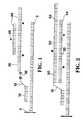
- a target polynucleotide molecule (2) is immobilized on solid surface (5).
- First sequence (10) of primary probe (15) hybridizes specifically to a sequence of target molecule (2).
- Primary probe (15) binds to bridging molecule (20) through means (30).
- Developer molecule (40) hybridizes to the bridging molecule (20) and to additional developer molecules (40). The developer molecules are detectable through label (45).
- Figure 2 is similar to Figure 1, except that the means for binding primary probe (15) to bridging molecule (20) is a second sequence of the primary probe (50) that hybridizes to a sequence of the bridging molecule (20).
- all the nucleotides of each developer molecule hybridize to the bridging molecule and at least one other developer molecule, or to at least two other developer molecules in the developer chain, except for the last developer molecule. In this embodiment, there is no gap between the developer molecules in the chain.
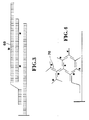
- the developer molecules may be ligated to form a concatamer (60).
- the developer molecules are branched (70).
- Each branched developer molecule is capable of hybridizing to at least three other developer molecules, or to at least two other developer molecule and the bridging molecule.
- the target nucleic acid molecules that can be detected in accordance with the present invention may be any nucleic acid molecule.
- the nucleic acid molecule may be DNA or RNA having any sequence of adenine (A), thymine (T), cytosine (C), and guanine (G), or, in the case of RNA, uracil (U).
- the nucleic acid may be single-stranded or double-stranded. There is no maximum limit to the length of the target nucleic acid molecule.
- the molecule should have at least six nucleotide bases.
- the hybridization assays possible with the present invention may be conducted in solution, although it is preferable for the target nucleic acid molecule to be fixed to a solid surface. Immobilization of the target nucleic acid molecule facilitates detection by permitting separation of the nucleic acid molecule from non-immobilized components by a simple washing step. The immobilization of the target nucleic acid molecule may occur during any stage of the assay prior to detection.
- Any solid surface capable of fixing the target nucleic acid molecule may be used in the present invention.
- Some suitable solid supports include nitrocellulose, agarose beads, modified cellulose fibers, polypropylene, and the like. The solid surface may conveniently be the wall of the vessel in which the assay occurs.
- the target nucleic acid sequence is bound to the solid support by methods known in the art. Such methods include covalent bonding and non-covalent bonding.
- non-covalent bonding examples include hybridization of a nucleotide sequence of the target molecule complementary to that of a nucleotide sequence immobilized on the solid surface. Such immobilized sequences are often referred to as capture probes.
- the target nucleic acid molecule contains a ligand that binds specifically to a receptor on the solid surface.
- Any ligand-receptor combination that does not interfere with the hybridization of the target nucleic acid molecule to the primary probe is suitable.
- Some examples include, for example, biotin-avidin, thyroxine-thyroxine-binding globulin, carbohydrate-lectin, antibody-antigen and the like. Either member of such combinations may constitute the ligand or the receptor.
- the primary probe is a branched or unbranched nucleic acid molecule having a first sequence of nucleotides capable of hybridizing to a sequence of the target molecule.
- the hybridization occurs under normal hybridizing conditions, such as, for example, temperatures between 15-60 degrees centigrade and pH between 6-8.
- the primary probe has a sequence that is complementary to at least six nucleotides of the target molecule.
- the primary probe also has a means for binding a bridging molecule.
- the means for binding the primary probe to the bridging molecule which is referred to as X---Y (30) in Figure 1, may be any of the ligand-receptor relationships mentioned above.
- the primary probe (15) binds to the bridging molecule (20) by means of a second sequence (50) of the primary probe that is complementary to at least six contiguous nucleotides of the bridging molecule.
- the complementary sequences of the primary probe and of the bridging molecule are selected so that the target molecule does not interfere with the hybridization of the primary probe to the bridging molecule.
- the length of the primary probe is not critical, as long as it stably hybridizes to the target molecule and binds to the bridging molecule under normal hybridization conditions.
- the primary probe is not longer than necessary.
- a linear primary probe is preferably an oligonucleotide having 12-100 nucleotide bases.
- the upper limit of nucleotides is not critical, but is determined by convenience, such as ease of synthesis and shorter hybridization times.
- the bridging molecule is a linear or branched nucleic acid molecule that binds to the primary probe and to at least one developer molecule.
- the binding of the bridging molecule to the primary probe occurs by means (30) of Figure 1, as discussed above.
- the bridging molecule has a sequence that hybridizes to the second sequence (50) of the primary probe as shown in Figure 2.
- the bridging molecule hybridizes to the developer molecules under approximately the same conditions that the primary probe hybridizes to the target molecule. These conditions have been discussed above.
- the bridging molecule has a sequence of nucleotides complementary to at least six contiguous nucleotides of the developer molecule.
- the length of the bridging molecule is not critical, as long as it stably binds to the primary probe and hybridizes to at least one developer molecule under normal nucleic acid hybridization conditions.
- a linear bridging molecule is preferably an oligonucleotide having 12-100 nucleotides bases.
- the bridging molecule may be linear or branched.
- the developer molecule is linear or branched and may be self-complementary.
- self-complementary means that each developer molecule is capable of hybridizing to all other developer molecules under normal nucleic acid hybridizing conditions, such as the conditions discussed above.
- Each developer molecule is made up of branches, each of which comprises a nucleotide sequence that is complementary to that of other developer molecules.
- a linear developer molecule is considered to have two branches.
- a branched developer molecule has more than two branches.
- Each developer molecule is capable of hybridizing to at least two other developer molecules or to the bridging molecule and at least one other developer molecule through complementary sequences.
- the complementary sequences of each developer molecule comprise at least six contiguous nucleotide bases.
- the same sequence that binds a developer molecule to other developer molecules also binds the developer molecule to the bridging molecule.
- Chains of developer molecules form under hybridizing conditions. Since each developer molecule is labelled, the extent of amplification resulting from the presently described method increases as the number of developer molecules in the chain increases. There is no limit to the number of developer molecules in the chain. There may be 100 developer molecules, 1,000 developer molecules, 10,000 developer molecules, and even more.
- each developer molecule hybridizes to at least two other developer molecules.
- the last molecule in a chain of developer molecules hybridizes only to the previous developer molecule.
- the developer molecule is labelled in accordance with methods known in the art. Such methods have been described, for example, by Leary et al, Proc. Natl. Acad. Sci. USA (1983) 80:4045; Renz and Kurz, Nucl. Acids Res. (1984) 12:3435; Richardson and Gumport, Nucl. Acids Res. (1983) 11:6167; Smith et al, Nucl. Acids Res. (1985) 13:2399; Meinkoth and Wahl, Anal. Biochem. (1984) 138:267.
- the label may be radioactive.
- Some examples of useful radioactive labels include 32P, 125I, 131I, and 3H. Use of radioactive labels have been described in U.K. 2,034,323, U.S. 4,358,535, and U.S. 4,302,204.
- non-radioactive labels include enzymes, chromophors, atoms and molecules detectable by electron microscopy, and metal ions detectable by their magnetic properties.
- Some useful enzymatic labels include enzymes that cause a detectable change in a substrate.
- Some useful enzymes and their substrates include, for example, horseradish peroxidase (pyrogallol and o-phenylenediamine), beta-galactosidase (fluorescein beta-D-galactopyranoside), and alkaline phosphatase (5-bromo-4-chloro-3-indolyl phosphate/nitro blue tetrazolium).
- horseradish peroxidase pyrogallol and o-phenylenediamine
- beta-galactosidase fluorescein beta-D-galactopyranoside
- alkaline phosphatase 5-bromo-4-chloro-3-indolyl phosphate/nitro blue tetrazolium.
- Useful chromophores include, for example, fluorescent, chemiluminescent, and bioluminescent molecules, as well as dyes.
- Some specific chromophores useful in the present invention include, for example, fluorescein, rhodamine, Texas red, phycoerythrin, umbelliferone, and luminol.
- the labels may be conjugated to the developer molecule by methods that are well known in the art.
- the labels may be directly attached to the developer molecules through a functional group on the developer molecule.
- the developer molecule either contains or can be caused to contain such a functional group.
- suitable functional groups include, for example, amino, carboxyl, sulfhydryl, maleimide, isocyanate, and isothiocyanate groups.
- the label may also be conjugated to the developer molecules by means of a ligand attached to the developer molecule by a method described above and a receptor for that ligand attached to the label. Any of the ligand-receptor combinations described above is suitable. The biotin-avidin combination is preferred.
- a method for labelling the developer molecules in a way that avoids the requirement for immobilizing the target nucleic acid molecule to a solid support and removing non-immobilized components involves the use of two molecules that can be detected when brought within a certain distance of each other. Such labels will be detectable if, for example, non-radiative energy transfer occurs between them. If the energy absorbed from one of the labels by the other is re-emitted at a different wavelength, the labels can be detected. Such absorption and re-emission occurs when the two labels are within a specific proximity to each other. For example, approximately 10%-90%, preferably approximately 25%-75%, and more preferably approximately 40%-60% of the developer molecules are conjugated to a chemiluminescent catalyst.
- the remainder of the developer molecules are conjugated to an absorber/emitter moiety.
- the developer molecules containing the chemiluminescent catalyst and the developer molecules containing the absorber/emitted moiety hybridize to each other so that the chemiluminescent catalyst and the absorber/emitter moiety are sufficiently close in proximity to permit non-radiative energy transfer.
- the distance between the chemiluminescent catalyst and the absorber/emitter moiety is generally within approximately 100 angstroms or less of each other. In the presence of agents effective for inducing light emission from the chemiluminescent catalyst, a measurable amount of light will be absorbed by the absorber/emitter moiety at a wavelength that can be detected.
- the absorber/emitter moiety may be a phosphorescent or fluorescent agent.
- suitable chemiluminescent catalysts include peroxidase and luciferase, both of which catalyze the luminol oxidation.
- Suitable absorber/emitter moieties for the luminol chemiluminescent reaction include free base porphyrins such as uroporphyrin and tetracarboxyphenylporphyrin, metalloporphyrins containing such metals as magnesium or zinc, tetraphenylcarboxyporphyrins, perylene, anthracene, 7-methyldibenzo(a,h) pyrene, and other polycyclic aromatics having conjugated ring systems of sufficient size to produce strong absorbance in the region of luminol chemiluminescence (between 400 and 450 nm).
- the use of energy transfer labelling of this type is disclosed in European Patent Application 70,685. Related methods are disclosed
- the present invention further provides a method for labelling DNA probes that has not previously been described.
- the method is based on the existence of molecules that recognize specific DNA sequences even though the molecules do not contain complementary DNA sequences.
- the binding may occur by any means other than the hybridization of a complementary DNA sequence, for example by intercalation.
- the well known drugs distamycin A and netropsin, and the dye Hoechst 33258, bind selectively to double-stranded DNA that is A-T rich.
- the A-T region comprises AATT, ATTT, or AAATTT.
- the known drugs actinomycin D and chromomycin bind specifically to double-stranded DNA that is G-C rich. The binding of these drugs to DNA has been described by Scott et al, Biochemistry 27 , 7940-7951 (1988) and Gao et al, Biochemistry 28 , 751-762 (1989).
- Hoechst 33258 is described by Teng et al, Nucl. Acids Res. 16 , 2671-2690 (1988). DNA site-specific peptides and proteins are also known and may be used in the present invention.
- site-specific DNA binding compounds are attached to the developer molecules by methods described above. These compounds are detected on the basis of differences in properties of the bound compounds relative to unbound compounds. Such differences include, for example, spectral differences such as UV, NMR, circular dichroism, and others.
- the developer molecules may be multiply labelled.
- Methods for attaching multiple labels to nucleic acid molecules such as those used as developer molecules herein are known in the art.
- multiple labelling may be achieved by means of branched linker molecules as described by Segev in EP 292,128.
- the description and examples of branched linker molecules described by Segev in EP 292,128 is incorporated herein by reference.
- the present invention utilizes three types of probes.
- a primary probe hybridizes specifically to the target molecule.
- a secondary probe referred to herein as a bridging molecule, binds to the primary probe and hybridizes to a tertiary probe, referred to herein as a developer molecule.
- the developer molecules may be self-complementary.
- the relationship of the probes to each other are important.
- the formula for the three types of linear probes may be represented as follows: Primary probe: Z z -A a -Z z -X I Z z -A a -Z z -B b II Bridging molecule: Y-Z z -C c III z z-B' b -Z z -C c -Z z IV Developer Molecule: Z z -C' c -Z z -C'' c -Z z V
- Z represents a nucleotide sequence that may or may not be present. Each nucleotide sequence represented by “Z” is independent of all the other nucleotide sequences represented by “Z”.
- "z” may represent 0-100. Preferably, "z” represents 0.
- the primary probe (15) may be represented by Formula I.
- “A” represents the first sequence of the primary oligonucleotide probe (10).
- the sequence represented by “A” contains a nucleotide sequence that is complementary to a sequence of the target molecule (2).
- the number of nucleotides in the sequence is represented by “a”.
- "a” represents an integer between 6-100, preferably between 8-30, and more preferably between 10-26.
- X represents a group that is part of the means for binding the primary probe to the bridging molecule (20).
- X may, for example, represent a ligand capable of binding to a receptor ("Y") on bridging molecule (20).
- Y a receptor
- "X” represents a second sequence of the primary probe that is complementary to a sequence of the bridging molecule. This second sequence of the primary probe is shown as (50) in Figure 2, and as “B” in Formula II.
- the number of nucleotides in sequence “B” is represented by “b".
- "b” represents an integer between 6-100, preferably between 8-26, and more preferably between 12-24.
- the bridging molecule (20) may be represented by Formula III.
- "Y” in Formula III represents part of the means for binding the primary probe to the bridging molecule.
- "Y” may, for example, be a receptor for ligand "X" of the primary probe.
- "Y” represents a sequence of nucleotides, "B'”, that is capable of hybridizing to the second sequence of the primary probe (50), which is represented by "B” in Formula II.
- the number of nucleotides in sequence "B'” is represented by "b", which has been defined above.
- C in Formula III and IV represents a nucleotide sequence that hybridizes to a sequence in a developer molecule (40).
- the number of nucleotides in sequence “C” is represented by “c”.
- "c” represents an integer that has the same definitions as "b” defined above.
- the developer molecule (40) is shown in Formula V.
- “C'” represents the sequence in the developer molecule that hybridizes to sequence "C” in Formulae III and IV.
- the number of nucleotides in sequence “C'” is represented by “c”, which has been defined above.
- “C''” is a sequence in the developer molecule that is complementary to at least one sequence in at least one other developer molecule, and may be complementary to sequence "C'”.
- the number of nucleotides in “C''” is "c", which has been defined above.
- “C” and “C''” may represent the same or different sequences.
- "C” and “C''" represent the same sequence.
- When “C” and “C”” do not represent the same sequence, they each hybridize to a different sequence of the developer molecule. Both of these sequences are represented by "C'", even though they are not necessarily the same sequence.
- the developer molecules are self-complementary. Important advantages occur when the sequence of the branches of the developer molecule are chosen carefully.
- the sequences of the developer molecules that hybridize to each other, C' and C'' in Formula V, should hybridize uniquely so that it is possible to predict how many nucleotides in a hybridized developer molecule participate in hybridization. As mentioned above, it is preferable for all of the nucleotides of the developer molecule to be hybridized.
- each branch it is preferable for the hybridizing sequence of each branch to contain at least two of the four possible different nucleotides, preferably at least three different nucleotides and more preferably all four possible nucleotides (or hybridizable analogs thereof).
- each of the four nucleotides or analogs thereof constitute at least 5%, preferably at least 10%, and more preferably at least 15% of the total number of nucleotides in a complementary sequence (i.e., A, B, B', C, C', and C'' in Formula I-V).
- each branch of each developer molecule it is preferable for each branch of each developer molecule to hybridize to many branches of other developer molecules. Most preferably, every branch of every developer molecule hybridizes to every branch of every other developer molecule. This result is achieved by providing a branch having a nucleotide sequence with two portions. Each portion is the inverted complement of the other portion. If the sequence were double-stranded, the two portions would be palindromic.
- An example of a suitable inverted complementary sequence is shown in Formula VI: wherein Z and z are as defined above. Any such inverted, complementary sequence is suitable.
- An advantage of an inverted, complementary sequence such as that exemplified in Formula VI above is that it is uniquely self-complementary.
- the nucleotides involved in hybridization are known precisely.
- each branch will hybridize to a branch of another developer molecule having the same sequence as itself under suitable conditions.
- Such developer molecules are referred to herein as self-complementary developer molecules.
- Each such developer molecule can have the same structure as all the other developer molecules, minimizing thereby the number of branches and developer molecules that must be prepared.
- Each branch comprising an inverted complementary sequence in a developer molecule may be the same or different. There may be as many different branches as there are branches in a developer molecule, as long as each branch comprises a sequence that is an inverted complement. It is also possible for some of such branches to be the same and some to be different. To minimize both the number of oligonucleotides that must be prepared and the time required for hybridization, it is preferred for each developer molecule to consist of identical branches.
- An example of a developer molecule having two different inverted complementary branches is shown as Formula VI':
- a developer molecule having two branches, each of which comprising the inverted, complementary sequence shown above as Formula VI when z represents 0, may have the structure shown in either Formula VI A or VI B:
- the ten nucleotides that constitute one branch of the molecule can fold back and hybridize to the ten nucleotides of the other branch. Such internal hybridisation of branches is undesirable.
- the developer molecule have C n symmetry, wherein "n" represents the number of branches.
- n is at least 3.
- each branch is capable of hybridising to every branch of other developer molecules, but is incapable of hybridizing to the branches of the same developer molecule.
- each branch may have additional nucleotides, as shown by Z z in Formula VI when z does not represent 0.
- additional nucleotides would destroy the formal C n symmetry. What is important is that the symmetry relationship be retained for that part of each branch that constitutes the inverted, complementary sequence.
- the nucleotide sequences represented by Z may be ignored for determining the preferred symmetry of the developer molecule.
- each half of the inverted, complementary sequence can hybridize to the other half, either in the same branch or in another branch of the same molecule.
- An example of a branch in a three-branched developer molecule hybridizing to itself is shown in Formula VII:
- the problem of internal hybridization may be avoided by taking advantage of the fact that the undesirable intra-branch hybridization involves half the number of nucleotides as the desired hybridization between two branches from different developer molecules.
- the undesirable hybridization of a branch within a developer molecule involves five nucleotides.
- the desirable hybridization between two branches from different developer molecules would involve ten nucleotides. Therefore, the stringency of the hybridization conditions is selected so that five nucleotides will not stably hybridize, while ten nucleotides will stably hybridize.
- the desired stringency be determined by those having ordinary skill in the art. For example, at temperatures between 22 and 30 degrees centigrade, five nucleotides will not stably hybridize, but ten nucleotides will stably hybridize.
- nucleotide sequences are considered to hybridize to each other or to be complementary to each other if they are sufficiently complementary to each other to hybridize under normal conditions. Normal conditions of hybridization have been described above.
- the nucleotide sequences that hybridize to each other i.e, A and a sequence of the target molecule, B and B', C and C', and C' and C''
- a and a sequence of the target molecule, B and B', C and C', and C' and C'' are perfectly complementary.
- the minimum number of nucleotides in a complementary sequence is the number that stably hybridizes under normal hybridizing conditions as described above.
- the stringency of the conditions generally increases as the number of complementary nucleotides increases.
- the minimum number of complementary sequences is typically 6, preferably 12, and more preferably 16.
- the maximum number of nucleotides in a sequence that hybridizes to another sequence typically does not exceed 100, preferably 40, and more preferably 24.
- the first developer molecule which hybridizes to the target nucleic acid molecule
- the second developer molecule or molecules which hybridize to the primary probe
- nucleotides of the bridging molecule it is preferable for all of the nucleotides of the bridging molecule to hybridize either to the second segment of the primary probe or to at least one developer molecule, so that there are no unhybridized nucleotides in the hybridized bridging molecule. Moreover, it is further preferred for 30%-70%, preferably 40%-60%, and more preferably 45%-55% of the nucleotides of a linear bridging molecule to hybridize to the primary probe and the remaining 70%-30%, preferably 60%-40%, and more preferably 55%-45% of the nucleotides of the bridging molecule to hybridize to at least one developer molecule.
- nucleotides of the developer molecule it is preferable for all of the nucleotides of the developer molecule to hybridize to the bridging molecule and at least one other developer molecule, or to at least two other developer molecules in the developer chain, except for the last developer molecule in the developer chain, which may hybridize to as few as one other developer molecule, so that all of the nucleotides of the developer molecule are hybridized.
- 30%-70% preferably 40%-60%, and more preferably 45%-55% of the nucleotides of each linear developer molecule in the developer chain to hybridize to the bridging molecule or to at least one additional developer molecule, and the remaining 70%-30%, preferably 60%-40%, and more preferably 55%-45% of the nucleotides of each developer molecule, except for the last developer molecule in the chain, to hybridize to at least one additional developer molecule.
- nucleotides of the bridging molecule (20) hybridize either to all of the nucleotides of the second segment (50) of the primary probe (15) or to all of the nucleotides of at least one developer molecule (40), there will be no nucleotides of the bridging molecule that are not hybridized. Under such circumstances, one end of the second sequence of the primary probe (50) will be adjacent to an end of a first developer molecule (52) with no gap between them, as shown in Figure 2. The end of the second segment of the primary probe may be ligated to the adjacent end of the developer molecule as shown in Fig. 3.
- an end of the second developer molecule will be adjacent to an end of the fourth developer molecule.
- the other end of the fourth developer molecule will be adjacent to an end of the sixth developer molecule.
- the adjacent ends of the bridging molecule and the developer molecules may all be ligated to each other.
- the number of developer molecule units in the concatamer may be as large as 100, 1,000, 10,000, and even more. In view of the label on each developer molecule, the amplification of the signal is significant.
- one strand of ligated developer chain is ligated to the primary probe and the other strand of ligated developer chain is ligated to the bridging molecule.
- Such a structure is shown in Figure 3.
- the target nucleic acid molecule is linear and if the sequence of the target nucleic acid molecule that hybridizes to the primary probe occurs at an end of the target nucleic acid molecule, the target nucleic acid molecule may be hybridized to the bridging molecule.
- a suitable enzyme includes, for example, T4 ligase.
- the primary probe, bridging molecule and developer molecule may be linear or branched.
- a molecule is considered to be linear for the purposes of this specification if it has two branches and to be branched if it has three or more branches.
- Each branch comprises a sequence that is capable of hybridizing to a sequence in a branch of the target molecule or of a primary probe, bridging molecule or developer molecule.
- the branches of branched probes and molecules in accordance with the invention need not be different from the branches of linear probes and molecules.
- Linear oligonucleotides as well as the individual branches of branched oligonucleotides may be synthesized by methods known in the art. For example, the automated phosphoramidite method of Warner et al, DNA 3 , 401 (1984) may be used.
- Branched molecules containing DNA sequences may suitably be prepared by methods known in the art.
- branched molecules may be prepared by joining the branches through a linker group.
- the linker group may comprise a multifunctional molecule that is capable of binding to oligonucleotides, preferably to the 5' or 3' end of the oligonucleotides. Suitable multifunctional groups are described in Segev, European patent application 292,128.
- the linker group may also be a group attached to one or more of the nucleotides in the oligonucleotide.
- Branched nucleic acid molecules for use in the present invention may be prepared in accordance with Urdea et al, EP 317,077.
- the Urdea et al application discloses comb structures in Figure 3-1 and at page 8, line 38 et seq; fork structures in Figure 3-2 and at page 10, line 7 et seq; multiple fork and forked comb structures in Figures 3-3 and 3-4, respectively, and at page 10, line 26 et seq; and multiple comb structures in Figure 3-5, and at page 10, line 30 et seq.
- the synthesis of such branched structures is described in Example 2B.
- the Figures, descriptions, and exemplifications of the comb, fork, multiple fork, fork comb, and multiple comb structures in Urdea, EP 317,077 are incorporated herein by reference.
- each branch should be capable of hybridizing to at least one branch of another developer molecule.
- no branch of a developer molecule is capable of hybridizing internally to another branch of the same molecule.
- a developer molecule having three branches may have the structure shown in Formula VIII: wherein represents a linking group.
- Formula VIII there is a three-fold access of symmetry, i.e., C3 symmetry. Therefore, none of the branches can internally hybridise to another branch in the same molecule.
- the bridging molecule may also be branched.
- One branch (B' in Formula II) of the bridging molecule hybridizes to the second sequence of the primary probe (B in Formula I).
- the remaining branches preferably comprise inverted, complementary sequences identical to those used in the developer molecules. More preferably, the second sequence of the primary probe comprises the same inverted, complementary sequence as occurs in each branch of the developer molecule.
- the bridging molecule will be identical to the developer molecule, further minimizing the number of different molecules required to be prepared for the assays of the present invention.
- the primary probe may also be branched.
- the first sequence of the primary probe is complementary to a sequence of the target molecule.
- the second sequence of the primary probe, which hybridizes to the bridging molecule, may appear on multiple branches.
- the total number of branches in the primary probe, the bridging molecule and the developer molecule is at least two. Preferably, there are three or more branches.
- the upper limit of the number of branches is that necessary to prevent excessive steric hindrance. Normally, there will not be more than 5 branches, preferably not more than 3 branches.
- the developer molecules there are 3-5 branches in the developer molecules, and/or the bridging molecules, and/or the primary probe. It is most important for the developer molecule to be branched, since there are more developer molecules than bridging molecules or primary probes.
- the presence of branched developer molecules leads to exponential signal amplification of (Q-1) r , wherein "Q" represents the number of self-complementary branches and "r” represents the number of developer molecules in a chain following hybridization.
- each member of the pair has a different structure that is not self- complementary.
- Each branch of one member of such a pair hybridizes to at least one branch of the other member of the pair.
- the sequence of each branch in each member of the pair is identical. so that each branch of one member of the pair hybridizes to each branch of the other member of the pair.
- the branches of such branched developer molecules are also preferable for the branches of such branched developer molecules to hybridize uniquely to its complementary partner.
- Unique hybridization for the purposes of this specification means that when a sequence hybridizes to its complementary partner, the same number of nucleotides hybridizes each time.
- a branch consisting of homopolymeric oligonucleotides, i.e. poly-A can hybridize to its complementary partner, i.e. poly-T, in almost as many ways as there are nucleotides in the oligonucleotide.
- the sequence of each branch contains at least two different nucleotides, preferably at least three different nucleotides, and more preferably all four nucleotides.
- the branches In order to avoid the hybridization of half of each such sequence to the other half, it is preferable if the branches contain no sequences that constitute inverted complements. Except as indicated above, the branches of the pair of non-self-complementary developer molecules are similar to the branches of the self-complementary developer molecules described earlier, and may be prepared the same way.
- An assay involves at least the following steps:
- the assay may, for example, occur in a liquid phase.
- the target nucleic acid molecule is immobilized on a solid surface. Immobilization may occur by covalently attaching the target nucleic acid molecule to the solid support, as described ,for example, by Albarella et al, EP 144,914; Dattagupta et al, EP 130,523; or Yabusalu et al, WO 85/02628.
- the target nucleic acid molecule may also be immobilized on the solid support by non-covalent means.
- the target nucleic acid molecule may be bound to the solid support by means of a ligand-receptor interaction.
- a sandwich hybridization method wherein the target nucleic acid molecule hybridizes to an immobilized nucleotide sequence in a way that does not interfere with hybridizing the target to the primary probe is also possible.
- Immobilizing the target nucleic acid molecule may occur before hybridizing the primary probe to the target nucleic acid molecule.
- the target nucleic acid molecule may be immobilized after binding the target nucleic acid molecule to the primary probe, to the bridging molecule or to the developer molecules.
- the immobilization step may also occur simultaneously with any of these steps.
- the advantage of immobilizing the target nucleic acid molecule is that the unhybridized labelled molecules may be separated from the immobilized complex prior to detection, thereby reducing the background and increasing the signal-noise ratio.
Landscapes
- Chemical & Material Sciences (AREA)
- Organic Chemistry (AREA)
- Life Sciences & Earth Sciences (AREA)
- Zoology (AREA)
- Wood Science & Technology (AREA)
- Proteomics, Peptides & Aminoacids (AREA)
- Health & Medical Sciences (AREA)
- Engineering & Computer Science (AREA)
- Microbiology (AREA)
- Immunology (AREA)
- Physics & Mathematics (AREA)
- Molecular Biology (AREA)
- Biotechnology (AREA)
- Biophysics (AREA)
- Analytical Chemistry (AREA)
- Biochemistry (AREA)
- Bioinformatics & Cheminformatics (AREA)
- General Engineering & Computer Science (AREA)
- General Health & Medical Sciences (AREA)
- Genetics & Genomics (AREA)
- Measuring Or Testing Involving Enzymes Or Micro-Organisms (AREA)
Applications Claiming Priority (2)
| Application Number | Priority Date | Filing Date | Title |
|---|---|---|---|
| US50362190A | 1990-04-03 | 1990-04-03 | |
| US503621 | 1990-04-03 |
Publications (3)
| Publication Number | Publication Date |
|---|---|
| EP0450594A2 true EP0450594A2 (de) | 1991-10-09 |
| EP0450594A3 EP0450594A3 (en) | 1992-01-22 |
| EP0450594B1 EP0450594B1 (de) | 1996-12-18 |
Family
ID=24002849
Family Applications (1)
| Application Number | Title | Priority Date | Filing Date |
|---|---|---|---|
| EP91105249A Expired - Lifetime EP0450594B1 (de) | 1990-04-03 | 1991-04-03 | Signalamplifikation einer DNS-Sonde |
Country Status (7)
| Country | Link |
|---|---|
| US (1) | US5437977A (de) |
| EP (1) | EP0450594B1 (de) |
| JP (2) | JP3142888B2 (de) |
| AT (1) | ATE146530T1 (de) |
| CA (1) | CA2039517C (de) |
| DE (1) | DE69123621T2 (de) |
| ES (1) | ES2097768T3 (de) |
Cited By (21)
| Publication number | Priority date | Publication date | Assignee | Title |
|---|---|---|---|---|
| EP0552931A1 (de) * | 1992-01-22 | 1993-07-28 | Gen-Probe Incorporated | Hybridisierungsassay unter Verwendung von verzweigten Nukleinsäuresonden |
| FR2710075A1 (fr) * | 1993-09-15 | 1995-03-24 | Bio Merieux | Réactif et procédé pour la détection d'une séquence nucléotidique avec amplification de signal. |
| WO1996000795A3 (en) * | 1994-06-28 | 1996-02-22 | Kalyx Biosciences Inc | Method of amplification for increasing the sensitivity of detecting nucleic acid-probe target hybrids |
| WO1996034984A1 (en) * | 1995-05-01 | 1996-11-07 | Bio-Rad Laboratories Inc. | Nucleic acid detection and amplification by chemical linkage of oligonucleotides |
| US5573914A (en) * | 1991-09-10 | 1996-11-12 | Gen Trak, Inc | DNA/RNA target and signal amplification |
| WO1996017956A3 (en) * | 1994-12-09 | 1997-07-24 | Gene Pool Inc | Method of detection of nucleic acids with a specific sequence composition |
| WO1999024612A3 (en) * | 1997-11-06 | 1999-07-15 | Mosaic Technologies | Multiple sequential polynucleotide displacement reactions for signal amplification and processing |
| WO2000041549A3 (en) * | 1999-01-15 | 2000-11-30 | Perkin Elmer Corp | Binary probe and clamp composition and methods for target hybridization detection |
| WO2000075303A1 (en) * | 1999-06-07 | 2000-12-14 | Kenshi Obaru | Primers for polymerase reactions |
| US6180338B1 (en) | 1992-08-04 | 2001-01-30 | Beckman Coulter, Inc. | Method, reagent and kit for the detection and amplification of nucleic acid sequences |
| US6207368B1 (en) | 1992-08-04 | 2001-03-27 | Beckman Coulter, Inc. | Methods and reagents for controlling chain extension and ligation chain reactions |
| US6238927B1 (en) | 1998-10-05 | 2001-05-29 | Mosaic Technologies, Incorporated | Reverse displacement assay for detection of nucleic acid sequences |
| WO2002031192A1 (en) * | 2000-10-11 | 2002-04-18 | Sanko Junyaku Co., Ltd. | Method of constructing self-assembly of probes and method of detecting the same |
| EP1430150A4 (de) * | 2001-09-24 | 2005-02-02 | One Lambda | Diagnostisches sondennachweissystem |
| US6986985B1 (en) | 1994-01-13 | 2006-01-17 | Enzo Life Sciences, Inc. | Process for producing multiple nucleic acid copies in vivo using a protein-nucleic acid construct |
| WO2009054320A1 (ja) * | 2007-10-24 | 2009-04-30 | Eisai R & D Management Co., Ltd. | 核酸プローブ及びプローブポリマーの形成方法 |
| EP2065465A2 (de) | 1994-01-13 | 2009-06-03 | Enzo Diagnostics, Inc. | Prozess, Konstrukt und Konjugat zur Herstellung mehrerer Nukleinsäurekopien |
| US8114962B2 (en) | 1994-12-09 | 2012-02-14 | The Gene Pool, Inc. | Method of detection of nucleic acids with a specific sequence composition |
| US8389702B2 (en) | 2003-04-03 | 2013-03-05 | Enzo Life Sciences, Inc. | Multi-oligomeric or multi-polymeric compositions comprising labeled moieties and binding partners |
| US9156986B2 (en) | 2003-04-03 | 2015-10-13 | Enzo Life Sciences, Inc. | Multisignal labeling reagents and processes and uses therefor |
| US9696298B2 (en) | 2003-04-03 | 2017-07-04 | Enzo Life Sciences, Inc. | Multisignal reagents for labeling analytes |
Families Citing this family (62)
| Publication number | Priority date | Publication date | Assignee | Title |
|---|---|---|---|---|
| CA2179315A1 (en) * | 1993-12-17 | 1995-06-22 | Roger S. Cubicciotti | Nucleotide-directed assembly of bimolecular and multimolecular drugs and devices |
| US7569341B2 (en) * | 1994-01-31 | 2009-08-04 | Trustees Of Boston University | Nucleic acid directed immobilization arrays and methods of assembly |
| US5561043A (en) * | 1994-01-31 | 1996-10-01 | Trustees Of Boston University | Self-assembling multimeric nucleic acid constructs |
| US6306657B1 (en) * | 1994-06-28 | 2001-10-23 | Kalyx Biosciences, Inc. | Polynucleotide probe and kit for amplifying signal detection in hybridization assays |
| DE19537952A1 (de) * | 1995-10-12 | 1997-04-17 | Boehringer Mannheim Gmbh | Verfahren zum Nachweis eines Analyten |
| JP2002515730A (ja) * | 1995-10-16 | 2002-05-28 | カイロン コーポレイション | 遺伝子発現を変調する因子のスクリーニング方法 |
| US5902724A (en) | 1996-07-12 | 1999-05-11 | Tm Technologies, Inc. | Signal amplification method |
| US5955590A (en) * | 1996-07-15 | 1999-09-21 | Worcester Foundation For Biomedical Research | Conjugates of minor groove DNA binders with antisense oligonucleotides |
| US5853993A (en) * | 1996-10-21 | 1998-12-29 | Hewlett-Packard Company | Signal enhancement method and kit |
| CA2218440A1 (en) * | 1996-12-21 | 1998-06-21 | Boehringer Mannheim Gmbh | Method of analysis using signal amplification |
| WO1998035707A1 (en) | 1997-02-18 | 1998-08-20 | Thomas Jefferson University | Compositions that bind to pancreatic cancer cells and methods of using the same |
| AU8601898A (en) * | 1997-07-29 | 1999-02-22 | Polyprobe, Inc. | Dendritic nucleic acids exhibiting maximal self-assembly |
| US6120995A (en) * | 1997-08-07 | 2000-09-19 | Thomas Jefferson University | Compositions that specifically bind to colorectal cancer cells and methods of using the same |
| US7135333B1 (en) | 1997-08-07 | 2006-11-14 | Thomas Jefferson University | Compositions that specifically bind to colorectal cancer cells and methods of using the same |
| CA2313641A1 (en) * | 1997-12-12 | 1999-06-24 | Digene Corporation | Universal collection medium |
| US20100105572A1 (en) * | 1997-12-19 | 2010-04-29 | Kris Richard M | High throughput assay system |
| JP3267576B2 (ja) * | 1998-11-09 | 2002-03-18 | 三光純薬株式会社 | プローブ高分子の形成方法 |
| EP1274861B1 (de) * | 2000-03-27 | 2009-12-23 | Thomas Jefferson University | Zusammensetzungen und methoden zur identifizierung von krebszellen |
| EP1188841B1 (de) * | 2000-03-31 | 2008-12-24 | Sanko Junyaku Co., Ltd. | Sonde zur herstellung einer polymersonde, verfahren zur herstellung einer polymersonde sowie verwendung derselben |
| US7439016B1 (en) * | 2000-06-15 | 2008-10-21 | Digene Corporation | Detection of nucleic acids by type-specific hybrid capture method |
| US7601497B2 (en) * | 2000-06-15 | 2009-10-13 | Qiagen Gaithersburg, Inc. | Detection of nucleic acids by target-specific hybrid capture method |
| WO2002022885A1 (en) * | 2000-09-18 | 2002-03-21 | Thomas Jefferson University | Compositions and methods for identifying and targeting stomach and esophageal cancer cells |
| US7727713B2 (en) | 2001-06-20 | 2010-06-01 | Nuevolution A/S | Templated molecules and methods for using such molecules |
| KR20040041529A (ko) * | 2001-09-28 | 2004-05-17 | 산코 준야쿠 가부시키가이샤 | Dna 칩의 시그널 증폭방법 |
| US20040029142A1 (en) * | 2002-02-11 | 2004-02-12 | Schon Eric A. | Concatenation-based nucleic acid detection compositions and methods |
| CA2433473A1 (en) * | 2002-07-23 | 2004-01-23 | F. Hoffmann-La Roche Ag | Fluorescent hybridization probes with reduced background |
| AU2003247266A1 (en) | 2002-08-01 | 2004-02-23 | Nuevolution A/S | Multi-step synthesis of templated molecules |
| CN102838654B (zh) * | 2002-10-30 | 2016-05-18 | 纽韦卢森公司 | 合成双功能复合物的方法 |
| DE60330406D1 (de) * | 2002-12-19 | 2010-01-14 | Nuevolution As | Durch quasizufallsstrukturen und funktionen geführte synthesemethode |
| US20070026397A1 (en) | 2003-02-21 | 2007-02-01 | Nuevolution A/S | Method for producing second-generation library |
| AU2004230569B2 (en) | 2003-03-31 | 2007-12-06 | F. Hoffmann-La Roche Ag | Compositions and methods for detecting certain flaviviruses, including members of the Japanese encephalitis virus serogroup |
| ATE447626T1 (de) | 2003-09-18 | 2009-11-15 | Nuevolution As | Methode zur gewinnung struktureller informationen kodierter moleküle und zur selektion von verbindungen |
| US7306915B2 (en) * | 2004-03-22 | 2007-12-11 | Sysmex Corporation | Probe set for detection of target substance and detection method using the same |
| AU2005238378B2 (en) * | 2004-04-28 | 2010-03-11 | Eisai R & D Management Co., Ltd. | Method of hybridization |
| US7939251B2 (en) | 2004-05-06 | 2011-05-10 | Roche Molecular Systems, Inc. | SENP1 as a marker for cancer |
| DE602005020319D1 (de) * | 2004-09-08 | 2010-05-12 | Eisai R&D Man Co Ltd | Verfahren zur bildung eines signalsondenpolymers |
| US7842794B2 (en) | 2004-12-17 | 2010-11-30 | Roche Molecular Systems, Inc. | Reagents and methods for detecting Neisseria gonorrhoeae |
| US20070048759A1 (en) * | 2005-06-10 | 2007-03-01 | Dan Luo | Detection of target molecules with labeled nucleic acid detection molecules |
| LT3018206T (lt) * | 2005-12-01 | 2021-12-10 | Nuevolution A/S | Fermentiniai kodavimo būdai, skirti didelių bibliotekų efektyviai sintezei |
| US8524453B2 (en) * | 2006-02-10 | 2013-09-03 | The Brigham And Woman's Hospital, Inc. | Lectin complement pathway assays and related compositions and methods |
| US20070275388A1 (en) * | 2006-05-25 | 2007-11-29 | Daniel Ryan | Dendrimers that possess a single target annealing site and uses thereof |
| EP2056709A4 (de) | 2006-08-11 | 2013-05-01 | Univ New Jersey Med | Zweifachsensibilisator mit lumineszenzverbindungen, konjugaten und verwendung |
| WO2009022682A1 (ja) * | 2007-08-14 | 2009-02-19 | Eisai R & D Management Co., Ltd. | 標的物質の検出方法 |
| KR20100042082A (ko) * | 2008-10-15 | 2010-04-23 | 삼성전자주식회사 | 신호물질의 밀도가 증가되어 있는 고체 지지체, 그를 포함하는 키트 및 그를 이용한 표적물질 검출 방법 |
| TWI419974B (zh) * | 2008-10-27 | 2013-12-21 | Qiagen Gaithersburg Inc | 於自動平台上之快速結果雜交捕捉法 |
| WO2010088292A1 (en) * | 2009-01-28 | 2010-08-05 | Qiagen Gaithersburg, Inc. | Sequence-specific large volume sample preparation method and assay |
| AU2010242867B2 (en) * | 2009-05-01 | 2016-05-12 | Qiagen Gaithersburg, Inc. | A non-target amplification method for detection of RNA splice-forms in a sample |
| US20100316998A1 (en) * | 2009-06-15 | 2010-12-16 | Massachusetts Institute Of Technology | Methods and compositions for empirical selection of drugs or other molecules |
| EP2478087B1 (de) | 2009-09-14 | 2017-01-18 | QIAGEN Gaithersburg, Inc. | Zusammensetzungen und verfahren zur rückgewinnung von nukleinsäuren oder proteinen aus in zytologischen medien fixierten gewebeproben |
| WO2011088193A2 (en) | 2010-01-13 | 2011-07-21 | University Of Medicine And Dentistry Of New Jersey | Fluorophore chelated lanthanide luminiscent probes with improved quantum efficiency |
| JP2013517803A (ja) | 2010-01-29 | 2013-05-20 | キアジェン ゲイサーズバーグ インコーポレイテッド | サンプル中のhpvの存在を決定および確認する方法 |
| WO2011094514A1 (en) | 2010-01-29 | 2011-08-04 | Qiagen Gaithersburg, Inc. | Methods and compositions for sequence-specific purification and multiplex analysis of nucleic acids |
| EP2572001A2 (de) | 2010-05-19 | 2013-03-27 | QIAGEN Gaithersburg, Inc. | Verfahren und zusammensetzungen für sequenzspezifische reinigung und multiplex-analyse von nukleinsäuren |
| CA2799205A1 (en) | 2010-05-25 | 2011-12-01 | Qiagen Gaithersburg, Inc. | Fast results hybrid capture assay and associated strategically-truncated probes |
| US8669374B2 (en) | 2010-08-25 | 2014-03-11 | Gene Shen | Functionalized cyanine dyes (PEG) |
| EP2678442B1 (de) | 2011-02-24 | 2019-01-16 | QIAGEN Gaithersburg, Inc. | Materialien und verfahren für den nachweis von hpv-nukleinsäuren |
| US10385392B2 (en) | 2011-12-30 | 2019-08-20 | Abbott Molecular Inc. | Nucleic acid hybridization probes |
| WO2014145620A2 (en) * | 2013-03-15 | 2014-09-18 | The Broad Institute, Inc. | Novel hybridization probes and uses thereof |
| CN105722977A (zh) | 2013-10-30 | 2016-06-29 | 绿色生活生物技术有限责任公司 | 用于柑橘绿化枯萎病的发病定量系统和治疗方法 |
| JP7093355B2 (ja) * | 2016-12-16 | 2022-06-29 | アラトム, エルエルシー | ライゲーション増幅を使用する分子検出 |
| EP3696275B1 (de) * | 2017-10-11 | 2025-12-24 | MGI Tech Co., Ltd. | Verfahren zur verbesserung der belastung und stabilität von nukleinsäuren auf einem festen träger |
| CN114544965B (zh) * | 2020-11-11 | 2023-04-28 | 艾克发(北京)生物技术有限公司 | 一种多重信号放大系统及其在免疫吸附竞争法检测中的应用 |
Family Cites Families (13)
| Publication number | Priority date | Publication date | Assignee | Title |
|---|---|---|---|---|
| US4302204A (en) * | 1979-07-02 | 1981-11-24 | The Board Of Trustees Of Leland Stanford Junior University | Transfer and detection of nucleic acids |
| US4762780A (en) * | 1984-04-17 | 1988-08-09 | The Regents Of The University Of California | Method and composition for screening and diagnosing "HCMV" |
| US4882669A (en) * | 1983-11-28 | 1989-11-21 | Canon Kabushiki Kaisha | Multi computer fail safe control apparatus |
| US4724202A (en) * | 1983-12-12 | 1988-02-09 | Molecular Diagnostics, Inc. | Use of non-hybridizable nucleic acids for the detection of nucleic acid hybridization |
| FI71768C (fi) * | 1984-02-17 | 1987-02-09 | Orion Yhtymae Oy | Foerbaettrade nykleinsyrareagenser och foerfarande foer deras framstaellning. |
| GB8405437D0 (en) * | 1984-03-01 | 1984-04-04 | Amersham Int Plc | Detecting polynucleotide sequences |
| DE3420925A1 (de) * | 1984-06-05 | 1985-12-05 | Boehringer Mannheim Gmbh, 6800 Mannheim | Verfahren und reagenz zum nachweis einer nukleinsaeure-sequenz |
| US4683195A (en) * | 1986-01-30 | 1987-07-28 | Cetus Corporation | Process for amplifying, detecting, and/or-cloning nucleic acid sequences |
| EP0204510B1 (de) * | 1985-05-31 | 1991-07-10 | Amoco Corporation | Verstärkung von Hybridisierungssignalen durch Verwendung von komplementarischen DNS-Strängen |
| US4868105A (en) * | 1985-12-11 | 1989-09-19 | Chiron Corporation | Solution phase nucleic acid sandwich assay |
| EP0245206A1 (de) * | 1986-05-05 | 1987-11-11 | IntraCel Corporation | Analytisches Verfahren zum Nachweis und zur Messung einer spezifisch sequentierten Nukleinsäure |
| IL86164A0 (en) * | 1987-04-28 | 1988-11-15 | Tamir Biotechnology Ltd | Improved dna probes |
| CA1339351C (en) * | 1987-10-15 | 1997-08-26 | Michael S. Urdea | Nucleic acid multimers and amplified nucleic acid hybridization assays using same |
-
1991
- 1991-04-02 CA CA002039517A patent/CA2039517C/en not_active Expired - Lifetime
- 1991-04-03 EP EP91105249A patent/EP0450594B1/de not_active Expired - Lifetime
- 1991-04-03 DE DE69123621T patent/DE69123621T2/de not_active Expired - Lifetime
- 1991-04-03 ES ES91105249T patent/ES2097768T3/es not_active Expired - Lifetime
- 1991-04-03 JP JP03071114A patent/JP3142888B2/ja not_active Expired - Fee Related
- 1991-04-03 AT AT91105249T patent/ATE146530T1/de not_active IP Right Cessation
-
1992
- 1992-05-29 US US07/908,584 patent/US5437977A/en not_active Expired - Lifetime
-
2000
- 2000-03-10 JP JP2000065961A patent/JP2000279186A/ja active Pending
Cited By (45)
| Publication number | Priority date | Publication date | Assignee | Title |
|---|---|---|---|---|
| US5869260A (en) * | 1991-09-10 | 1999-02-09 | Gen Trak, Inc | Nucleic acid-antibody constructs and their use in antigen detection |
| US5573914A (en) * | 1991-09-10 | 1996-11-12 | Gen Trak, Inc | DNA/RNA target and signal amplification |
| US5723297A (en) * | 1991-09-10 | 1998-03-03 | Gen Trak, Inc. | Process for detecting an antibody using a nucleic acid amplification probe |
| EP0552931A1 (de) * | 1992-01-22 | 1993-07-28 | Gen-Probe Incorporated | Hybridisierungsassay unter Verwendung von verzweigten Nukleinsäuresonden |
| US6207368B1 (en) | 1992-08-04 | 2001-03-27 | Beckman Coulter, Inc. | Methods and reagents for controlling chain extension and ligation chain reactions |
| US6180338B1 (en) | 1992-08-04 | 2001-01-30 | Beckman Coulter, Inc. | Method, reagent and kit for the detection and amplification of nucleic acid sequences |
| US6017707A (en) * | 1993-09-15 | 2000-01-25 | Bio Merieux | Reagent and method for the detection of a nucleotide sequence with signal amplification |
| WO1995008000A3 (fr) * | 1993-09-15 | 1995-06-08 | Bio Merieux | Reactif et procede pour la detection d'une sequence nucleotidique avec amplification de signal |
| US5695936A (en) * | 1993-09-15 | 1997-12-09 | Bio Merieux | Reagent and method for the detection of a nucleotide sequence with signal amplification |
| FR2710075A1 (fr) * | 1993-09-15 | 1995-03-24 | Bio Merieux | Réactif et procédé pour la détection d'une séquence nucléotidique avec amplification de signal. |
| US6986985B1 (en) | 1994-01-13 | 2006-01-17 | Enzo Life Sciences, Inc. | Process for producing multiple nucleic acid copies in vivo using a protein-nucleic acid construct |
| EP2065465A2 (de) | 1994-01-13 | 2009-06-03 | Enzo Diagnostics, Inc. | Prozess, Konstrukt und Konjugat zur Herstellung mehrerer Nukleinsäurekopien |
| WO1996000795A3 (en) * | 1994-06-28 | 1996-02-22 | Kalyx Biosciences Inc | Method of amplification for increasing the sensitivity of detecting nucleic acid-probe target hybrids |
| WO1996017956A3 (en) * | 1994-12-09 | 1997-07-24 | Gene Pool Inc | Method of detection of nucleic acids with a specific sequence composition |
| US8114962B2 (en) | 1994-12-09 | 2012-02-14 | The Gene Pool, Inc. | Method of detection of nucleic acids with a specific sequence composition |
| US5871902A (en) * | 1994-12-09 | 1999-02-16 | The Gene Pool, Inc. | Sequence-specific detection of nucleic acid hybrids using a DNA-binding molecule or assembly capable of discriminating perfect hybrids from non-perfect hybrids |
| EP1820864A3 (de) * | 1994-12-09 | 2008-01-23 | The Gene Pool, Inc. | Verfahren zur Detektion von Nukleinsäuren mit spezifischer Sequenzusammensetzung |
| US5843650A (en) * | 1995-05-01 | 1998-12-01 | Segev; David | Nucleic acid detection and amplification by chemical linkage of oligonucleotides |
| WO1996034984A1 (en) * | 1995-05-01 | 1996-11-07 | Bio-Rad Laboratories Inc. | Nucleic acid detection and amplification by chemical linkage of oligonucleotides |
| WO1999024612A3 (en) * | 1997-11-06 | 1999-07-15 | Mosaic Technologies | Multiple sequential polynucleotide displacement reactions for signal amplification and processing |
| US6255051B1 (en) | 1997-11-06 | 2001-07-03 | Mosaic Technologies Inc. | Multiple sequential polynucleotide displacement reactions for signal amplification and processing |
| US6238927B1 (en) | 1998-10-05 | 2001-05-29 | Mosaic Technologies, Incorporated | Reverse displacement assay for detection of nucleic acid sequences |
| AU771650B2 (en) * | 1999-01-15 | 2004-04-01 | Applied Biosystems, Llc | Binary probe and clamp composition and methods for target hybridization detection |
| US6432642B1 (en) | 1999-01-15 | 2002-08-13 | Pe Corporation (Ny) | Binary probe and clamp composition and methods for a target hybridization detection |
| US7057025B2 (en) | 1999-01-15 | 2006-06-06 | Applera Corporation | Binary probe and clamp composition |
| US8067165B2 (en) | 1999-01-15 | 2011-11-29 | Applied Biosystems, Llc | Binary probe and clamp composition and methods for target hybridization detection |
| WO2000041549A3 (en) * | 1999-01-15 | 2000-11-30 | Perkin Elmer Corp | Binary probe and clamp composition and methods for target hybridization detection |
| WO2000075303A1 (en) * | 1999-06-07 | 2000-12-14 | Kenshi Obaru | Primers for polymerase reactions |
| US7122310B2 (en) | 2000-10-11 | 2006-10-17 | Sanko Junyaku Co., Ltd. | Methods of constructing self-assembly of probes and method of detecting the same |
| WO2002031192A1 (en) * | 2000-10-11 | 2002-04-18 | Sanko Junyaku Co., Ltd. | Method of constructing self-assembly of probes and method of detecting the same |
| US8512953B2 (en) | 2001-09-24 | 2013-08-20 | One Lambda | Diagnostic probe detection system |
| US9988671B2 (en) | 2001-09-24 | 2018-06-05 | One Lambda, Inc. | Diagnostic probe detection system |
| EP1430150A4 (de) * | 2001-09-24 | 2005-02-02 | One Lambda | Diagnostisches sondennachweissystem |
| US9884889B2 (en) | 2003-04-03 | 2018-02-06 | Enzo Life Sciences, Inc. | Multisignal labeling reagents and processes and uses therefor |
| US8394949B2 (en) | 2003-04-03 | 2013-03-12 | Enzo Life Sciences, Inc. | Multisignal labeling reagents, and processes and uses therefor |
| US8389701B2 (en) | 2003-04-03 | 2013-03-05 | Enzo Life Sciences, Inc. | Multisignaling oligomeric or polymeric compositions comprising labeled moieties and binding partners |
| US9156986B2 (en) | 2003-04-03 | 2015-10-13 | Enzo Life Sciences, Inc. | Multisignal labeling reagents and processes and uses therefor |
| US9696298B2 (en) | 2003-04-03 | 2017-07-04 | Enzo Life Sciences, Inc. | Multisignal reagents for labeling analytes |
| US8389702B2 (en) | 2003-04-03 | 2013-03-05 | Enzo Life Sciences, Inc. | Multi-oligomeric or multi-polymeric compositions comprising labeled moieties and binding partners |
| US10184934B2 (en) | 2003-04-03 | 2019-01-22 | Enzo Life Sciences, Inc. | Multisignal reagents for labeling analytes |
| US10640529B2 (en) | 2003-04-03 | 2020-05-05 | Enzo Life Sciences, Inc. | Multisignal labeling reagents and processes and uses therefor |
| US10647740B2 (en) | 2003-04-03 | 2020-05-12 | Enzo Life Science, Inc. | Multisignal labeling reagents and processes and uses therefor |
| US11028121B2 (en) | 2003-04-03 | 2021-06-08 | Enzo Life Sciences, Inc. | Multisignal labeling reagents and processes and uses therefor |
| US11073512B2 (en) | 2003-04-03 | 2021-07-27 | Enzo Life Sciences, Inc. | Multisignal reagents for labeling analytes |
| WO2009054320A1 (ja) * | 2007-10-24 | 2009-04-30 | Eisai R & D Management Co., Ltd. | 核酸プローブ及びプローブポリマーの形成方法 |
Also Published As
| Publication number | Publication date |
|---|---|
| ES2097768T3 (es) | 1997-04-16 |
| EP0450594B1 (de) | 1996-12-18 |
| DE69123621T2 (de) | 1997-04-17 |
| US5437977A (en) | 1995-08-01 |
| JP2000279186A (ja) | 2000-10-10 |
| JP3142888B2 (ja) | 2001-03-07 |
| CA2039517C (en) | 2006-11-07 |
| CA2039517A1 (en) | 1991-10-04 |
| JPH0788000A (ja) | 1995-04-04 |
| DE69123621D1 (de) | 1997-01-30 |
| ATE146530T1 (de) | 1997-01-15 |
| EP0450594A3 (en) | 1992-01-22 |
Similar Documents
| Publication | Publication Date | Title |
|---|---|---|
| US5437977A (en) | DNA probe signal amplification | |
| US5702891A (en) | HAV probes for use in solution phase sandwich hybridization and assays for detecting the presence of HAV | |
| US6300056B1 (en) | HIV probes for use in solution phase sandwich hybridization assays | |
| US5736316A (en) | HBV capture and amplifiers probes for use in solution phase sandwich hybridization assays | |
| US6072043A (en) | Optimally fluorescent oligonucleotides | |
| EP0521111B1 (de) | Polynukleotid-einfang-assay unter verwendung von in-vitro-amplifikation | |
| US5635352A (en) | Solution phase nucleic acid sandwich assays having reduced background noise | |
| AU634969B2 (en) | Method and reagents for detecting nucleic acid sequences | |
| EP0930370A1 (de) | Markierter Primer, geeignet für die Detektion von Nukleinsäuren | |
| JPH07502655A (ja) | 溶液相サンドイッチハイブリダイゼーションアッセイに用いるためのcmvプローブ | |
| US5618674A (en) | Chlamydiae probes for use in solution phase sandwich hybridization assays | |
| US20020182615A1 (en) | All in one nucleic acid amplification assay | |
| US6004826A (en) | Repair-mediated process for amplifying and detecting nucleic acid sequences | |
| US6020132A (en) | Method of analysis using signal amplification | |
| US6210932B1 (en) | System for detecting nucleic acid hybridization, preparation method and application thereof | |
| HK1006858B (en) | Method and reagents for detecting nucleic acid sequences |
Legal Events
| Date | Code | Title | Description |
|---|---|---|---|
| PUAI | Public reference made under article 153(3) epc to a published international application that has entered the european phase |
Free format text: ORIGINAL CODE: 0009012 |
|
| AK | Designated contracting states |
Kind code of ref document: A2 Designated state(s): AT BE CH DE DK ES FR GB GR IT LI LU NL SE |
|
| PUAL | Search report despatched |
Free format text: ORIGINAL CODE: 0009013 |
|
| AK | Designated contracting states |
Kind code of ref document: A3 Designated state(s): AT BE CH DE DK ES FR GB GR IT LI LU NL SE |
|
| 17P | Request for examination filed |
Effective date: 19920305 |
|
| 17Q | First examination report despatched |
Effective date: 19941010 |
|
| GRAG | Despatch of communication of intention to grant |
Free format text: ORIGINAL CODE: EPIDOS AGRA |
|
| GRAH | Despatch of communication of intention to grant a patent |
Free format text: ORIGINAL CODE: EPIDOS IGRA |
|
| GRAH | Despatch of communication of intention to grant a patent |
Free format text: ORIGINAL CODE: EPIDOS IGRA |
|
| GRAA | (expected) grant |
Free format text: ORIGINAL CODE: 0009210 |
|
| AK | Designated contracting states |
Kind code of ref document: B1 Designated state(s): AT BE CH DE DK ES FR GB GR IT LI LU NL SE |
|
| PG25 | Lapsed in a contracting state [announced via postgrant information from national office to epo] |
Ref country code: GR Free format text: LAPSE BECAUSE OF FAILURE TO SUBMIT A TRANSLATION OF THE DESCRIPTION OR TO PAY THE FEE WITHIN THE PRESCRIBED TIME-LIMIT Effective date: 19961218 Ref country code: DK Effective date: 19961218 |
|
| REF | Corresponds to: |
Ref document number: 146530 Country of ref document: AT Date of ref document: 19970115 Kind code of ref document: T |
|
| ITF | It: translation for a ep patent filed | ||
| REG | Reference to a national code |
Ref country code: CH Ref legal event code: NV Representative=s name: BOVARD AG PATENTANWAELTE |
|
| REF | Corresponds to: |
Ref document number: 69123621 Country of ref document: DE Date of ref document: 19970130 |
|
| ET | Fr: translation filed | ||
| PGFP | Annual fee paid to national office [announced via postgrant information from national office to epo] |
Ref country code: DK Payment date: 19970321 Year of fee payment: 7 |
|
| PGFP | Annual fee paid to national office [announced via postgrant information from national office to epo] |
Ref country code: LU Payment date: 19970410 Year of fee payment: 7 |
|
| ET | Fr: translation filed |
Free format text: CORRECTIONS |
|
| REG | Reference to a national code |
Ref country code: ES Ref legal event code: FG2A Ref document number: 2097768 Country of ref document: ES Kind code of ref document: T3 |
|
| PLBE | No opposition filed within time limit |
Free format text: ORIGINAL CODE: 0009261 |
|
| STAA | Information on the status of an ep patent application or granted ep patent |
Free format text: STATUS: NO OPPOSITION FILED WITHIN TIME LIMIT |
|
| 26N | No opposition filed | ||
| PG25 | Lapsed in a contracting state [announced via postgrant information from national office to epo] |
Ref country code: LU Free format text: LAPSE BECAUSE OF NON-PAYMENT OF DUE FEES Effective date: 19980403 |
|
| REG | Reference to a national code |
Ref country code: GB Ref legal event code: IF02 |
|
| PGFP | Annual fee paid to national office [announced via postgrant information from national office to epo] |
Ref country code: NL Payment date: 20101028 Year of fee payment: 20 Ref country code: FR Payment date: 20101116 Year of fee payment: 20 Ref country code: AT Payment date: 20101031 Year of fee payment: 20 |
|
| PGFP | Annual fee paid to national office [announced via postgrant information from national office to epo] |
Ref country code: DE Payment date: 20101029 Year of fee payment: 20 Ref country code: CH Payment date: 20101028 Year of fee payment: 20 |
|
| REG | Reference to a national code |
Ref country code: CH Ref legal event code: PFA Owner name: SEGEV, DAVID Free format text: SEGEV, DAVID#1125 52ND STREET#BROOKLYN, N.Y. 11219 (US) -TRANSFER TO- SEGEV, DAVID#1125 52ND STREET#BROOKLYN, N.Y. 11219 (US) |
|
| PGFP | Annual fee paid to national office [announced via postgrant information from national office to epo] |
Ref country code: SE Payment date: 20101028 Year of fee payment: 20 Ref country code: IT Payment date: 20101029 Year of fee payment: 20 Ref country code: GB Payment date: 20101028 Year of fee payment: 20 Ref country code: BE Payment date: 20101028 Year of fee payment: 20 |
|
| REG | Reference to a national code |
Ref country code: DE Ref legal event code: R071 Ref document number: 69123621 Country of ref document: DE |
|
| REG | Reference to a national code |
Ref country code: NL Ref legal event code: V4 Effective date: 20110403 |
|
| REG | Reference to a national code |
Ref country code: CH Ref legal event code: PL |
|
| REG | Reference to a national code |
Ref country code: GB Ref legal event code: PE20 Expiry date: 20110402 |
|
| BE20 | Be: patent expired |
Owner name: *SEGEV DAVID Effective date: 20110403 |
|
| PGFP | Annual fee paid to national office [announced via postgrant information from national office to epo] |
Ref country code: ES Payment date: 20101029 Year of fee payment: 20 |
|
| PG25 | Lapsed in a contracting state [announced via postgrant information from national office to epo] |
Ref country code: NL Free format text: LAPSE BECAUSE OF EXPIRATION OF PROTECTION Effective date: 20110403 Ref country code: GB Free format text: LAPSE BECAUSE OF EXPIRATION OF PROTECTION Effective date: 20110402 |
|
| REG | Reference to a national code |
Ref country code: ES Ref legal event code: FD2A Effective date: 20120206 |
|
| PG25 | Lapsed in a contracting state [announced via postgrant information from national office to epo] |
Ref country code: ES Free format text: LAPSE BECAUSE OF EXPIRATION OF PROTECTION Effective date: 20110404 |
|
| PG25 | Lapsed in a contracting state [announced via postgrant information from national office to epo] |
Ref country code: DE Free format text: LAPSE BECAUSE OF EXPIRATION OF PROTECTION Effective date: 20110403 |