EP0451047B1 - Vor Umwelteinflüssen geschützte integrierte optische Komponente und Verfahren zu ihrer Herstellung - Google Patents
Vor Umwelteinflüssen geschützte integrierte optische Komponente und Verfahren zu ihrer Herstellung Download PDFInfo
- Publication number
- EP0451047B1 EP0451047B1 EP91400893A EP91400893A EP0451047B1 EP 0451047 B1 EP0451047 B1 EP 0451047B1 EP 91400893 A EP91400893 A EP 91400893A EP 91400893 A EP91400893 A EP 91400893A EP 0451047 B1 EP0451047 B1 EP 0451047B1
- Authority
- EP
- European Patent Office
- Prior art keywords
- layer
- guide
- optical component
- trench
- layers
- Prior art date
- Legal status (The legal status is an assumption and is not a legal conclusion. Google has not performed a legal analysis and makes no representation as to the accuracy of the status listed.)
- Expired - Lifetime
Links
Images





Classifications
-
- G—PHYSICS
- G02—OPTICS
- G02B—OPTICAL ELEMENTS, SYSTEMS OR APPARATUS
- G02B6/00—Light guides; Structural details of arrangements comprising light guides and other optical elements, e.g. couplings
- G02B6/10—Light guides; Structural details of arrangements comprising light guides and other optical elements, e.g. couplings of the optical waveguide type
- G02B6/12—Light guides; Structural details of arrangements comprising light guides and other optical elements, e.g. couplings of the optical waveguide type of the integrated circuit kind
- G02B6/122—Basic optical elements, e.g. light-guiding paths
- G02B6/124—Geodesic lenses or integrated gratings
-
- Y—GENERAL TAGGING OF NEW TECHNOLOGICAL DEVELOPMENTS; GENERAL TAGGING OF CROSS-SECTIONAL TECHNOLOGIES SPANNING OVER SEVERAL SECTIONS OF THE IPC; TECHNICAL SUBJECTS COVERED BY FORMER USPC CROSS-REFERENCE ART COLLECTIONS [XRACs] AND DIGESTS
- Y10—TECHNICAL SUBJECTS COVERED BY FORMER USPC
- Y10S—TECHNICAL SUBJECTS COVERED BY FORMER USPC CROSS-REFERENCE ART COLLECTIONS [XRACs] AND DIGESTS
- Y10S385/00—Optical waveguides
- Y10S385/901—Illuminating or display apparatus
Definitions
- the subject of the invention is an active or passive optical component in integrated optics, as well as its manufacturing process. It finds an application in particular in the field of radar signal processing in real time, for example in correlators, spectrum analyzers or interferometers, in the field of telecommunications by optical means, for example for the multiplexing or demultiplexing of light signals and in the field of fiber optic sensors.
- the integrated optical component of the invention can be a mirror, a separating plate, a diffraction grating, a focusing lens, a microguide as well as all the types of integrated optical components implementing diffraction grids, such as for example optical couplers; these optical couplers can in particular be used in polarization splitters and polarization converters.
- a separating blade In a complete integrated optical system, a separating blade is very often used.
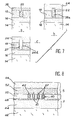
- An exemplary embodiment of a separating blade in integrated optics as described in document FR-A-2 613 826 filed in the name of the applicant is shown in Figure 1.
- Part a of Figure 1 is a sectional view of the separating blade and part b a top view.
- the light guide in which the separating plate is formed consists (part a) of a silicon substrate 2, surmounted by a buffer or lower layer 3 made of undoped silica and then by a guide layer 4 made of Si 3 N 4 with a higher refractive index than that of the lower layer 3.
- the separating blade 6 consists of a trench formed in the upper layer 5, the depth of which is, in this representation, equal to the thickness of the upper layer 5.
- two different guide structures can be defined: a structure (1) Si / SiO 2 / Si 3 N 4 / SiO 2 with effective index N1eff and a structure (2) Si / SiO 2 / Si 3 N 4 / air with effective index N2eff.
- the effective index of a structure depends on the refractive index of the layers constituting it and their thickness.
- I represents the incident light beam
- R represents the reflected light beam
- T represents the light beam transmitted by the blade 6
- N represents the normal to the blade 6.
- the laser diodes use guiding structures having very high refractive index variations between the core and the surrounding medium while the optical fibers have low refractive index variations (of the order of 4.10 -3 at 10 -2 ).
- the confinement of light is very different; 1 micrometer or less (in the junction direction) for the laser diode and 5 to 9 micrometers for the optical fibers.
- the two guide structures are stacked.
- the object of the invention is precisely an integrated optical component as well as its manufacturing method making it possible to remedy the various drawbacks given above.
- this optical component is protected against the environment while ensuring high effective index variations.
- this component when this component is a network, it can be used for efficient co-directive coupling of two stacked optical guides having very different guided mode profiles.
- the component of the invention can be produced from a greater number of materials than those of the prior art and its manufacture is much less critical.
- EP-A-0207725 Also known from EP-A-0207725 is an optical switch comprising a waveguide provided with a channel filled with a switching material also covered with an electrode.
- the invention relates to an integrated optical component, according to claim 1.
- the gas enclosed in the cavity allows a local modification of the effective index of the light guide higher than that obtained in the components of the prior art.
- this local modification of the effective index is fixed only by the gas in the cavity and therefore does not undergo polluting disturbances due to the environment.
- the difference in index created by the cavity is negative, light only exists in an evanescent form in components of the network or coupler type. This ensures good reproducibility of the desired performances as a result of a reduction in sensitivity to the thickness of the cavity, for example.
- a neutral or inert gas such as for example argon, neon, helium, nitrogen, or else to use air or even vacuum.
- gases all have a refractive index lower than that of silica, equal to or close to 1.
- the gases also have the advantage of not causing long-term chemical reactions with the materials of the integrated structure and therefore of not not modify the physical properties sought for the structure.
- air is used as the filling material. Its refractive index equal to 1 makes it possible to associate it with a large number of materials and to ensure a large difference in effective index.
- gases or vapors having particular absorption lines which can for example be optically saturated, (the excitation of the energy levels corresponding to these absorption lines), such as helium, neon, sodium or rhubidium vapors.
- the optical component of the invention can be a mirror.
- the cavity advantageously extends from the upper layer to the lower layer of the light guide.
- the optical component of the invention can also be a separating plate or a focusing lens.
- the dimensions and shape of the cavity define the optical properties of the component.
- the cavity is housed in at least one of the layers of the guide structure.
- the optical component can also be a microguide intended for the lateral confinement of light.
- the optical component is a diffraction grating
- the latter comprises several cavities preferably arranged parallel to each other and each filled with a material of different index; these cavities constitute the lines of the network and are formed in any one of the layers of the guide structure.
- the latter type of component can advantageously be used to couple two guides of superimposed light, with a completely satisfactory energy transfer efficiency.
- the coupling force of a network is proportional to the difference in refractive index between the gas in particular contained in the cavities and the material in which these cavities are formed.
- the greater this difference in index the lower the number of lines can be.
- a diffraction grating with a high coupling coefficient in accordance with the invention allows the coupling of two superimposed light guides with very different guided mode profiles, a first guide consisting of a first upper layer and a first lower layer, arranged on one side and on the other side of a first guide layer with a refractive index higher than that of the first upper and lower layers and a second guide consisting of a second upper layer and a second lower layer arranged on either side of a second layer refractive index guide higher than that of the second lower and upper layers, the first upper layer and the second lower layer constituting a single and so-called coupling layer and the network being housed in the coupling layer.
- a diffraction grating in accordance with the invention also allows the coupling of two guides with very different guided mode profiles comprising a first, a second, a third and a fourth stacked layers, the second and the third layers constituting the guide layers respectively of the first and second guides and having refractive indices higher than those of the first and fourth layers, the refractive index of the second layer being also different from that of the third layer, this third layer comprising cavities filled with a gas having a refractive index lower than that of the third layer.
- the typical difference in refractive index between the guide layer and the adjacent layers is from 5.10 -3 to 2.10 -2 and for a structure with high index jump, this typical index deviation is from 10 -1 to 5.10 -1 .
- a guide with a large variation in refractive index is for example made up of lower and upper layers of undoped silica of index 1.45 or doped with phosphorus and / or boron, of index 1.46 and a layer guide in silicon nitride of index 2.01 or in silicon oxynitride (SiO x N y with 0 ⁇ x ⁇ 2 and 0 ⁇ y ⁇ 4/3) of index 1.45 to 2, in alumina index 1.65 or in organic materials such as PMMA (polymethyl methacrylate) and polyimides whose index varies from 1.45 to 1.7.
- a light guide with a small variation in refractive index is in particular made up of lower and upper layers of undoped silica or doped with fluorine and / or boron and of a silica guide layer doped with germanium, titanium, nitrogen or phosphorus.
- Doping of silica with boron or fluorine decreases its refractive index while doping with germanium, phosphorus, nitrogen or titanium increases the refractive index of silica.
- the networks can work in reflective mode, which has the advantage of making them not very sensitive to technological errors (no networks, width of the cavities, effective indices of the guided modes).
- the mirrors and separating blades of the invention advantageously work in the vicinity of the limit angle of total reflection Al.
- the invention also relates to a method of manufacturing an optical component as defined above.
- the second layer can be deposited by the low pressure CVD technique (LPCVD) or by the plasma assisted CVD technique (PECVD).
- LPCVD low pressure CVD
- PECVD plasma assisted CVD
- this isotropic deposition technique of a layer of material necessarily leads to the formation of a gas bubble, generally of air, in the trench when the aspect ratio is at least equal to 0.5. .
- the exact composition of this air is of course fixed by that of the gaseous atmosphere prevailing in the enclosure of deposit.
- the volume and shape of the air bubble depend on the aspect ratio and the properties of the first layer.
- this air bubble it is possible to modify the shape and the volume of this air bubble by carrying out surface treatments of the deposited layers.
- This creep is possible in particular with layers of silica advantageously doped with boron, phosphorus or both so as to lower the temperature of the treatment relative to the creep temperature of the undoped silica.
- This second mode of implementation is of much more general application than the first mode since it allows, unlike the previous mode, the creation of an air bubble whose aspect ratio is less than 0.5 and for example ranging from 0.1 to 0.3.
- this air bubble can be replaced by another gas, by injection after the deposition of the second layer.
- FIGs 2 and 3A there is shown schematically the manufacture of a separating blade according to the invention.
- a monocrystalline silicon substrate 14 on which a layer of unintentionally doped silicon oxide 16 of 8 to 12 micrometers has been formed, for example by high pressure thermal oxidation of the substrate under oxygen atmosphere between 800 and 1200 ° C.
- the refractive index of this oxide layer 16 is approximately 1.45.
- the guide layer 18 is deposited in silicon oxide doped with phosphorus, germanium, nitrogen or titanium, having a thickness of 3.2 to 10 micrometers. Phosphorus doping is ensured by 10 21 to 10 22 atoms / cm 3 . The refractive index of this layer 18 is close to 1.46.
- a mask 19 of photosensitive resin is formed (part a, FIG. 2) comprising an opening 21 fixing the location of the separating blade as well as its dimensions.
- an anisotropic etching of the layer 18 is then carried out, thus forming a trench 22 in the zone of the layer 18 situated opposite the opening 21 of the mask.
- This etching is for example a reactive ion etching (GIR) using CHF 3 or CF 4 as an attack agent.
- the h / w ratio is at least equal to 0.5.
- a separating plate must have a reflection coefficient of between 30 and 70%. Roughly, it is enough that h is of the order of the magnitude of half of the spatial extension (or spatial width of the guided mode).
- h can be equal to 3.4 micrometers and w equal to 2.5 micrometers, and in FIG. 3A, h can be equal to 5 micrometers for the same value of w.
- a layer 24 of unintentionally doped silicon oxide 1 to 6 micrometers thick or possibly containing a dopant decreasing the refractive index of the oxide is deposited. like boron or fluorine with concentrations of 10 21 to 10 22 atoms / cm 3 .
- This layer is deposited by the chemical vapor deposition technique assisted by a plasma (PECVD) at temperatures of 300 to 500 ° C by thermal decomposition of silane and oxygen or by the chemical technique of low pressure vapor deposition (130 Pa) with these same gases (LPCVD).
- PECVD chemical vapor deposition technique assisted by a plasma
- LPCVD low pressure vapor deposition
- the deposition by PECVD or LPCVD of a layer of silica necessarily leads, for h / w ⁇ 0.5, to the formation of a cavity 26 or 26a containing air 27 housed in the trench respectively 22, 22a.
- the presence of this air bubble causes a significant local modification of the effective index of the guided mode.
- the reflection coefficient R ( Figure 1b) of the separating plate thus formed goes from 0 to 95% when h varies from 0 to 5 micrometers, w being fixed at 2.5 micrometers.
- h 3.4 micrometers
- the transmission and reflection coefficients of the plate are close to 50% and the limit angle of reflection Al is close to 45 °.
- the trench 22c over all or part of the upper layer 24 covering the guide.
- the etching of the layer 24 is followed by the deposition of a layer 28 of undoped SiO 2 , 1 to 10 micrometers thick by PECVD or LPCVD under the same conditions as described in FIG. 2 for the layer 24.
- a cavity 26e is thus formed filled with air, the shape of which is fixed by the height / width ratio of the trench 22c.
- the guide layer, referenced 17, is made of silicon nitride deposited by LPCVD and has a thickness of 100 to 400nm.
- FIG. 4 there is shown schematically an integrated mirror conforming to the invention. As before, this mirror is formed in a wave guide made of Si / SiO 2 / SiO 2 doped + / SiO 2 .
- the deposition techniques and the thicknesses of these layers are identical to those described with reference to FIG. 2.
- an anisotropic etching of the stack of layers 16, 18 and 24 is carried out, using an appropriate mask (see FIG. 2a). 'the depth of the trench 22b formed and w' its width. This etching is carried out over the entire thickness of layers 24 and 18 and on all or only part of layer 16; the attacking agents are for example CHF 3 or CF 4 .
- a layer of undoped silicon oxide 28 of 1 to 10 micrometers is deposited by PECVD or LPCVD under the same conditions as described in FIG. 2 for layer 24.
- a bubble is thus formed 26b air whose shape is fixed by the ratio h '/ w' of the trench 22b.
- the width w 'of the trench 22b must be greater than a minimum value wo in order to avoid any recoupling of the guided mode in the guide structure.
- I and R respectively represent the incident and reflected beams and N represents the normal to the mirror defined by the trench 22b.
- the angle A between the normal and the incident beam must be greater than the total reflection angle Al defined in equation (2):
- Al ArcsinN2 / N1eff where N1eff is the effective index of the guided mode and N2 represents the index of the air bubble, i.e. 1.
- N1eff is of the order of 1.47 and Al of the order of 43 °. So, A must be greater than 43 °.
- the above formula (2) is especially applicable to the mirror; it corresponds to the case where the guided mode no longer exists in the cavity containing the fluid. However, it can be used in place of formula (1) for the separating plates, depending on the value of the reflection coefficient sought.
- the layer 18 of SiO 2 doped with Ti, Ge, N 2 or P is replaced by a layer of Si 3 N 4 of 165 nm deposited by LPCVD by decomposition of silane and ammonia, an N1eff index of the guided mode close to 1.73. In these conditions, A must be greater than 35.3 ° to have a mirror.
- the evanescent wave associated with the total reflection on the mirror 22b has a penetration depth given by the function: exp (- (2 ⁇ / ⁇ N1eff 2 sin 2 A -1 ) x)
- width w ' is much greater than 450 nm and for example equal to 3 or 4 micrometers, practically no light energy can pass through the air bubble 26b.
- the mirror thus formed is very efficient.
- the depth h ' is not critical; it is enough that it is greater than a minimum value ho roughly equal to the spatial width of the guided mode.
- the spatial width of the guided mode represents the width at half-height of the profile of the light intensity of the wave which propagates in the guide.
- the waveguide is identical to that described with reference to FIGS. 2 and 3A.
- the pitch of the network p determines the operating angle A, shown in part b of FIG. 5, which is the angle that the incident beam forms with the lines 30 of the network.
- the deposition of the SiO 2 layer 24 by LPCVD or PECVD on the guide layer 18 leads to the formation of bubbles and therefore to cavities 26c filled with air 27, housed in each of the trenches 30.
- the depth of the trenches h and the index of the material which fills these trenches, here the air, determine the coupling coefficient K between the network and the incident beam and therefore the coupling length Lc ⁇ / 2K of the guided mode with the network.
- the creation of air bubbles 26c of index 1 increases the value of K and therefore decreases the coupling length Lc. This makes the network less sensitive to wavelengths.
- the network Since it is difficult to control the value of the coupling coefficient K which strongly depends on h and on the shape of the bubbles 26c, the network is systematically made to work in reflection. This also makes it possible to make the network less sensitive to technological errors, in particular on the value of the pitch, the width of the trenches or on the effective indices of the guided modes.
- FIG 7 there is shown another method of manufacturing the components according to the invention and in particular the manufacture of a separating or semi-reflecting plate.
- a layer 38 of a material 38 which can be selectively etched relative to the layer 18 and to the layer is deposited over the entire structure (part a).
- upper layer 24 of the optical guide In the case of layers 18 and 24 of silica, it is possible to use a metallic layer and in particular a layer of aluminum or chromium.
- This layer 38 can be deposited by any known deposition technique and in particular by cathode sputtering or by electrolytic deposition for a metal layer.
- This layer has a thickness greater than that of the trench 22.
- the layer 38 has for example a thickness of 10 micrometers.
- This layer is then selectively etched so as to keep metal at least opposite the trench 22, that is to say in and above the trench (metal can also be kept on either side of the trench) .
- This engraving is carried out using a photolithography mask, not shown.
- the metal stud obtained is referenced 38a (part b).
- the deposition of the silica layer 24 is then carried out.
- This deposition can be carried out by all known deposition techniques and in particular by CVD using silane and oxygen as deposition gas.
- a selective attack on the metal pad 38a is carried out, leading to its complete elimination.
- This elimination can be done by a chemical attack in solution from a hole made for example in the layer 24 and connected to the metal.
- a phosphoric acid solution is used and for chromium, a cerium salt solution.
- a separating plate is thus obtained equipped with a cavity 26d containing air whose shape is identical to that of the stud 38a.
- This method allows you to use all deposition techniques for constituting layer 24. In addition, it applies to all values of h / w greater than 0.1 while the method described in FIG. 2 can only be used for ratios of h / w greater at 0.5.
- the guide structure with a large variation in refractive index denoted A, consists for example of a lower layer 44 of refractive index n1 deposited on a substrate 46, of a guide layer 48 of refractive index n2 and an upper layer 50 of refractive index n3, with the layer 48 interposed between the layers 44 and 50 and n2 greater than n1 and n3.
- the guide structure with low index variation denoted B, consists for example of the layer 50, a guide layer 52 of refractive index n4 and an upper layer 54 of refractive index n5, with the layer 52 sandwiched between layers 50 and 54 and n4 greater than n3 and n5.
- n4 must be greater than n1 and n2 must be greater than n4 (the order of superposition of structures A and B can of course be reversed).
- the layers 44, 50 and 54 can be made of unintentionally doped silica or doped with fluorine or boron; layer 48 can be made of silicon nitride, silicon oxynitride or alumina and layer 52 of silica doped with phosphorus, germanium, nitrogen or titanium.
- the layers 48, 50, 52 and 54 can be deposited by LPCVD or PECVD and the layer 44 formed by thermal oxidation of the substrate, so as to have good optical qualities.
- the thickness of the layer 48 is less than the maximum value to be single-mode, of the order of 0.05 to 0.4 micrometer depending on the wavelengths used for a silicon nitride layer, and that the thickness of layer 52 is also less than a maximum value for being single-mode, of the order of 1 to 8 micrometers depending on the wavelengths used and the index differences chosen between the different layers.
- the thickness e1 of the layer 44 must ensure the isolation of the two modes of propagation of the guides A and B of the substrate 46. Also, this thickness must be greater than the penetration depth of the evanescent wave of the guided mode the least confined which propagates in layer 52. Typically, e1 is greater than 12-15 micrometers.
- the thickness of the layer 50 conditions the coupling force of the network. It can be zero (figure 11).
- the coupling between the two guided modes decreases with the thickness of the layer 50. Beyond 3 micrometers for layers of silica and for a layer 48 of silicon nitride with a thickness of the order of 50 nm, the coupling does not exist anymore.
- the thickness of layer 54 is not critical.
- the layers 44, 48, 50, 52 and 54 respectively have a thickness of 8 to 15 micrometers, from 50 to 200 nm, from 0.3 to 2 micrometers, from 1 to 8 micrometers and from 2 to 10 micrometers.
- the pitch of the network and the angle of incidence on this network are chosen to allow the network 40 to work in reflection from so as to prevent the coupled light energy from the structure with high index variation towards the structure with small index variation from being able to return to the structure with high index variation.
- nA and nB are the effective indices of the guide structures A and B, ⁇ the length of wave of incident light, p the lattice pitch and kA ⁇ , kB ⁇ and kR ⁇ are the wave vectors of structures A, B and of the network.
- the coupling network 40 can be obtained by etching the layer 50 just before depositing the guide layer 52, so as to form trenches 42 parallel to one another whose height / width ratio is at least equal to 0.5 then by depositing the layer 52 by LPCVD or PECVD, as described previously with reference to FIG. 2.
- cavities 41 filled with air bubbles 27 formed during the deposition of the layer 52 and housed in the trenches 42 ensure the coupling of the two guide structures.
- these cavities 41 are 10 to 30 in number and the network pitch is 0.3 to 3 micrometers.
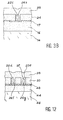
- FIG. 9 shows another embodiment of the diffraction grating ensuring the coupling of the two guide structures.
- the etched layer 50 is carried out (part a) the deposition of a metallic layer which can be etched selectively with respect to the substrate 46 and to the layers 44, 48, 50, 52 and possibly 54 when the metal is removed after the deposition of the layer 54, then this layer is etched so as to keep metal 38b only next to the trenches 43 made in layer 50.
- the etching of this metal layer is followed by the deposition of layers 52 and 54, as described above with reference to FIGS. 2 and 7. (Of course, this layer 54 can also be deposited after the total elimination of the metal).
- metal 38b is eliminated using orthophosphoric acid for an aluminum layer and guide structures in Si / SiO 2 / Si 3 N 4 / SiO 2 / SiO 2 doped + / SiO 2 , via at least one hole passing through, for example the layers overhanging the metal 38b.
- the space initially occupied by the metal 38b and in particular the trenches 43 is then filled with air 27 (part b of FIG. 9).
- the coupling network can also be produced as shown in FIG. 10.
- the metal layer 38 is deposited directly on the entire guide layer 48 (part a of FIG. 10).
- a substantially anisotropic etching of the layer 38 is then carried out so as to form metal studs 38c parallel to each other and equidistant.
- this anisotropic etching is carried out dry with a chlorinated gas or wet with othophosphoric acid as attacking agent.
- the layers 50, 52, 54 (part b) are deposited as described above.
- the etched metal studs 38c are eliminated by the wet method, giving rise to cavities 45 filled with air.
- the layers 52 and 54 can in this case be arranged before or after elimination of the metal studs. To be eliminated, these metal studs are interconnected in layer 50, outside the useful zone of the component, at least one hole made in layer 50 allowing access to the metal 38.
- This method can pose some difficulties for very small network pitches, less than 1 micrometer with regard to the elimination of the metal studs 38c, unlike the method described in FIG. 9.
- the layer 50 can have a zero thickness, as shown in FIG. 11.
- the layer 52 is deposited directly on the metal studs 38c. Before or after deposition of the layer 54, the studs are eliminated as above.
- the deposition of the metal layer is done on the layer 48 in which the parallel trenches 42 have been made.
- FIGS. 5 and 8 to 11 networks with constant steps have been shown which therefore work with collimated incident beams.
- networks similar to those shown associated with collimation optics of the integrated mirror or lens type according to the invention or alternatively to use a network whose features are elliptical or parabolic, or else use a variable-pitch network providing both the coupling and imaging function. This allows, in some cases, to decrease the number of components of a complete optical circuit.
- guide structures with small index variation are insensitive to the polarization of the incident beam unlike guide structures with high index variation. Also, it is very difficult to separate spatially or even, more simply, to select one of the transverse electric polarizations TE or transverse magnetic TM of the guide mode in a structure with low variation of index.
- the air contained in the cavities of the networks can be replaced by another gas.
- the components of the invention can be formed in other materials than those mentioned above and in particular in lithium niobate or tantalate.
- a microguide according to the invention produced in a Si / SiO 2 / Si 3 N 4 / SiO 2 guide structure.
- This microguide comprises in its upper layer 50 made of SiO 2 two cavities 26f, 26g filled with air.
- the difference in index between the air and the silica of the layer 50 ensures good lateral confinement of the light.
- These cavities are obtained by making two parallel trenches 22d and 22e in the layer 50 and then by depositing by LPCVD or PECVD a layer 28 of non-doped SiO 2 .
- the trenches can be formed in all or part of the layer 50 or 44 but not in the guide layer 48.
Landscapes
- Physics & Mathematics (AREA)
- Engineering & Computer Science (AREA)
- Microelectronics & Electronic Packaging (AREA)
- General Physics & Mathematics (AREA)
- Optics & Photonics (AREA)
- Optical Integrated Circuits (AREA)
Claims (21)
- Vor Umwelteinflüssen geschützte optische Komponente, auf einem Substrat (14;46) integriert und einem Lichtleiter (16,18,24; 16,17,24; 44,48,50; 44,48,40,52) zugeordnet, ebenfalls auf demselben Substrat integriert, wobei besagte Komponente wenigstens einen geschlossenen Hohlraum (26; 26a; 26b; 26e; 26c; 26d; 26f,26g; 41; 43; 45) umfaßt, isoliert von der Umgebung, gebildet in einem Graben (22; 22a; 22b;22c; 22d,22e; 30; 42), vorgesehen in wenigstens einer Schicht (16, 18, 24, 50, 52) des besagten Lichtleiters, wobei dieser genannte Hohlraum mit einem Gas (27) gefüllt ist, das eine Brechzahl hat, die kleiner ist als die Brechzahl der besagten Schicht.
- Optische Komponente nach Anspruch 1, dadurch gekennzeichnet, daß das Gas Luft ist.
- Optische Komponente nach einem der Ansprüche 1 und 2, dadurch gekennzeichnet, daß der Graben ein Verhältnis Höhe/Länge ≥0,1 hat.
- Optische Komponente nach einem der Ansprüche 1 und 2, dadurch gekennzeichnet, daß der Graben ein Verhältnis Höhe/Länge hat, das von 1 bis 5 geht.
- Optische Komponente nach einem der Ansprüche 1 bis 4, dadurch gekennzeichnet, daß der optische Leiter eine Unterschicht (16), eine Leiterschicht (18, 17), eine Oberschicht (24) und eine Deckschicht (28) umfaßt, nacheinander auf das Substrat (14) gestapelt, wobei die Leiterschicht eine Brechzahl hat, die größer ist als die der Unter-, der Ober- und der Deckschicht, und dadurch, daß der den Hohlraum enthaltende Graben sich in wenigstens einer der Schichten Unter-, Leiter- und Oberschicht befindet.
- Optische Komponente nach einem der Ansprüche 1 bis 5, dadurch gekennzeichnet, daß der optische Leiter eine Oberschicht (24, 50, 54) und eine Unterschichte aus Siliciumdioxid (16, 44, 50) umfaßt, angeordnet auf beiden Seiten einer Leiterschicht (17, 18, 48, 52) aus Siliciumnitrid, aus Siliciumdioxid, dotiert mit einem seine Brechzahl erhöhenden Dotierstoff, oder aus SiOxNy mit 0<x<2 und 0<y<4/3.
- Optische Komponente des Typs Beugungsgitter nach einem der Ansprüche 1 bis 6, dadurch gekennzeichnet, daß sie mehrere Gräben (40;42) umfaßt, parallel zueinander angeordnet und jeder mit einem Hohlraum (26c,41,43,45) versehen, gefüllt mit dem genannten Gas, wobei die verschiedenen Hohlräume die Linien des Gitters bilden.
- Optische Komponente des Typs Beugungsgitter nach Anspruch 7, wenn dieser von den Ansprüchen 5 oder 6 abhängt, dadurch gekennzeichnet, daß die Gräben (40;42) in der Leiterschicht (18,52) oder der Oberschicht (50) vorgesehen sind.
- Optische Komponente des Typs Spiegel nach einem der Ansprüche 5 oder 6, dadurch gekennzeichnet, daß der Graben (22b) sich von der Oberschicht (24) bis zur Unterschicht (16) des Lichtleiters erstreckt.
- Optische Komponente des Typs Trenner nach einem der Ansprüche 5 oder 6, dadurch gekennzeichnet, daß der Graben (22) im wesentlichen in der Oberschicht (18) des Lichtleiters vorgesehen ist.
- Optische Komponente des Typs Mikroleiter nach einem der Ansprüche 1 bis 6, dadurch gekennzeichnet, daß sie zwei Gräben (22d,22e) umfaßt, parallel angeordnet und jeder versehen mit einem ein Gas enthaltenden Hohlraum (26f,26g).
- Optische Komponente des Typs Koppler nach einem der Ansprüche 1 bis 8, dazu bestimmt, übereinanderliegende integrierte Lichtleiter, einen ersten und einen zweiten, mit sehr unterschiedlichen Brechzahländerungen zu koppeln, dadurch gekennzeichnet, daß der erste Lichtleiter gebildet wird durch eine erste Oberschicht (50) und eine erste Unterschicht (44), angeordnet auf beiden Seiten einer ersten Leiterschicht (48) mit einer Brechzahl, die höher ist als die der ersten Ober- und Unterschichten, und eine zweite Schicht, gebildet durch eine zweite Oberschicht (54) und eine zweite Unterschicht (50), angeordnet auf beiden Seiten einer zweiten Leiterschicht (52) mit einer Brechzahl, die höher ist als die der zweiten Ober- und Unterschichten, wobei die erste Oberschicht und die zweite Unterschicht ein und dieselbe Schicht bilden, Kopplungsschicht genannt, in der mehrere Gräben (42) vorgesehen sind, von denen jeder Hohlräume (45, 43, 41) enthält, die das genannte Gas einschließen.
- Komponente nach Anspruch 12, dadurch gekennzeichnet, daß die ersten und die zweiten Unter- und Oberschichten aus Siliciumdioxid sind, die erste Leiterschicht aus Si3N4 oder SiPxNy ist, mit 0<x<2 und 0<y<4/3, die zweite Leiterschicht aus Siliciumdioxid ist, dotiert mit einem seine Brechzahl erhöhenden Dotierstoff, und die Hohlräume mit Luft gefüllt sind.
- Optische Komponente des Typs Koppler nach einem der Ansprüche 1 bis 8, dazu bestimmt, übereinanderliegende integrierte Lichtleiter, einen ersten und einen zweiten mit sehr unterschiedlichen Brechzahländerungen, zu koppeln, dadurch gekennzeichnet, daß die Lichtleiter gestapelt eine erste (46), eine zweite (48), eine dritte (52) und eine vierte (54) Schicht umfassen, wobei die zweite und die dritte Schicht jeweils die Leiterschichten des ersten und des zweiten Leiters bilden und Brechzahlen aufweisen, die höher sind als die der ersten und der vierten Schicht, wobei die Brechzahl der zweiten Schicht sich außerdem unterscheidet von der der dritten Schicht und diese dritte Schicht Hohlräume enthält, die mit dem genannten Gas gefüllt sind.
- Komponente nach Anspruch 14, dadurch gekennzeichnet, daß die erste und die vierte Schicht aus Siliciumdioxid sind, die zweite Schicht aus Si3N4 ist und die dritte Schicht aus Siliciumdioxid, dotiert mit einem Dotierstoff, der ihre Brechzahl erhöht, und dadurch, daß die Hohlräume mit Luft gefüllt sind.
- Herstellungsverfahren einer optischen Komponente nach einem der Ansprüche 1 bis 15, dadurch gekennzeichnet, daß es die folgenden Schritte umfaßt:- Abscheidung von wenigstens einer ersten Schicht (16, 18, 24, 50) auf der Gesamtheit eines Substrats (14, 46),- Herstellung wenigstens eines Grabens (22, 22a, 22b, 42) in dieser ersten Schicht, dessen Verhältnis Höhe/Länge ≥0,5 ist, und- chemische Gasphasenabscheidung (CVD) einer zweiten Schicht (24, 28, 52) auf der Gesamtheit der so geätzten ersten Schicht, die infolgedessen in dem Graben einen mit Luft gefüllten Hohlraum bildet.
- Verfahren nach Anspruch 16, dadurch gekennzeichnet, daß die zweite Schicht mittels LPCVD-oder PECVD-Technik abgeschieden wird.
- Verfahren nach Anspruch 16 oder 17, dadurch gekennzeichnet, daß man eine Wärmebehandlung der ersten und/oder zweiten Schicht durchführt, um sie verfließen zu lassen.
- Herstellungsverfahren einer optischen Komponente nach einem der Ansprüche 1 bis 15, dadurch gekennzeichnet, daß es die folgenden Schritte umfaßt:(a)- Abscheiden von wenigstens einer ersten Schicht (18, 50) auf der Gesamtheit eines Substrats (14, 16),(b)- Herstellen wenigstens eines Grabens (22, 42) in dieser ersten Schicht,(c)- Abscheiden eines Temporärmaterials (38a, 38b) in dem Graben und über diesem, das man selektiv eliminieren kann in bezug auf das Substrat, die erste Schicht und eine zweite Schicht,(d)- Abscheiden der zweiten Schicht auf der in (c) erhaltenen Struktur, und(e)- Entfernen des Temporärmaterials, infolgedessen sich in dem Graben ein mit Luft gefüllter geschlossener Hohlraum (43) bildet.
- Herstellungsverfahren einer optischen Komponente nach einem der Ansprüche 1 bis 15, dadurch gekennzeichnet, daß es die folgenden Schritte umfaßt:(A)- Abscheiden einer ersten Schicht (48) auf der Gesamtheit eines Substrats (14, 16),(B)- Abscheiden einer Schicht aus Temporärmaterial (38) auf der Gesamtheit der ersten Schicht (48), die man selektiv ätzen kann in bezug auf diese erste Schicht, eine zweite Schicht (50, 52) und das Substrat,(C)- Ätzen dieser Temporärschicht, um wenigstens ein Klötzchen aus Temporärmaterial (38c) zu bilden,(D)- Abscheiden der zweiten Schicht (50, 52) auf der in (C) erhaltenen Struktur, und(E)- Eliminieren des Klötzchens aus Temporärmaterial, infolgedessen sich in dem Graben ein mit Luft gefüllter Hohlraum (45) anstelle des Klötzchens bildet.
- Verfahren nach einem der Ansprüche 16 bis 20, dadurch gekennzeichnet, daß man in besagten Hohlraum ein anderes Gas als Luft injiziert.
Applications Claiming Priority (2)
| Application Number | Priority Date | Filing Date | Title |
|---|---|---|---|
| FR9004255 | 1990-04-03 | ||
| FR9004255A FR2660440B1 (fr) | 1990-04-03 | 1990-04-03 | Composant optique integre protege contre l'environnement et son procede de fabrication. |
Publications (2)
| Publication Number | Publication Date |
|---|---|
| EP0451047A1 EP0451047A1 (de) | 1991-10-09 |
| EP0451047B1 true EP0451047B1 (de) | 1997-10-29 |
Family
ID=9395403
Family Applications (1)
| Application Number | Title | Priority Date | Filing Date |
|---|---|---|---|
| EP91400893A Expired - Lifetime EP0451047B1 (de) | 1990-04-03 | 1991-04-02 | Vor Umwelteinflüssen geschützte integrierte optische Komponente und Verfahren zu ihrer Herstellung |
Country Status (6)
| Country | Link |
|---|---|
| US (1) | US5210801A (de) |
| EP (1) | EP0451047B1 (de) |
| JP (1) | JPH04230708A (de) |
| CA (1) | CA2039526A1 (de) |
| DE (1) | DE69128045T2 (de) |
| FR (1) | FR2660440B1 (de) |
Families Citing this family (74)
| Publication number | Priority date | Publication date | Assignee | Title |
|---|---|---|---|---|
| US5289308A (en) * | 1991-12-20 | 1994-02-22 | Akzo N.V. | Method of making a frequency doubling structure in an optically non-linear medium |
| US5282078A (en) * | 1991-12-20 | 1994-01-25 | Akzo Nv | Method of making a frequency doubling structure in an optically non-linear medium, and a frequency doubling device |
| DE4200397C1 (de) * | 1992-01-10 | 1993-03-04 | Imm Institut Fuer Mikrotechnik Gmbh, 6500 Mainz, De | |
| DE4200396C1 (de) * | 1992-01-10 | 1993-02-04 | Imm Institut Fuer Mikrotechnik Gmbh, 6500 Mainz, De | |
| US5253319A (en) * | 1992-02-24 | 1993-10-12 | Corning Incorporated | Planar optical waveguides with planar optical elements |
| US5356722A (en) * | 1992-06-10 | 1994-10-18 | Applied Materials, Inc. | Method for depositing ozone/TEOS silicon oxide films of reduced surface sensitivity |
| EP0647327B1 (de) * | 1992-06-24 | 1998-03-04 | BRITISH TELECOMMUNICATIONS public limited company | Lichtinduziertes gitter in glas, das b2o3 enthaelt |
| US6229945B1 (en) * | 1992-06-24 | 2001-05-08 | British Telecommunications Public Limited Company | Photo induced grating in B2O3 containing glass |
| DE4231113A1 (de) * | 1992-09-17 | 1994-03-24 | Bosch Gmbh Robert | Integriert optische Schaltung mit einer Bragg-Struktur |
| US5917625A (en) * | 1993-09-09 | 1999-06-29 | Kabushiki Kaisha Toshiba | High resolution optical multiplexing and demultiplexing device in optical communication system |
| FR2716012B1 (fr) * | 1994-02-09 | 1996-04-12 | Corning Inc | Procédé et dispositif d'assemblage d'extrémités de fibres optiques disposées en nappe. |
| US5503902A (en) * | 1994-03-02 | 1996-04-02 | Applied Physics Research, L.P. | Light control material |
| SE503740C2 (sv) * | 1994-04-22 | 1996-08-19 | Ericsson Telefon Ab L M | Optisk fiber innefattande en reflektor samt sätt att framställa en reflektor i en optisk fiber |
| US5600483A (en) * | 1994-05-10 | 1997-02-04 | Massachusetts Institute Of Technology | Three-dimensional periodic dielectric structures having photonic bandgaps |
| US5440421A (en) * | 1994-05-10 | 1995-08-08 | Massachusetts Institute Of Technology | Three-dimensional periodic dielectric structures having photonic bandgaps |
| US5500916A (en) * | 1994-09-09 | 1996-03-19 | At&T Corp. | Method for making Bragg reflectors for waveguides |
| WO1996011516A1 (en) * | 1994-10-05 | 1996-04-18 | Massachusetts Institute Of Technology | Resonant microcavities employing one-dimensional periodic dielectric waveguides |
| US5784400A (en) * | 1995-02-28 | 1998-07-21 | Massachusetts Institute Of Technology | Resonant cavities employing two dimensionally periodic dielectric materials |
| US5732168A (en) * | 1995-10-31 | 1998-03-24 | Hewlett Packard Company | Thermal optical switches for light |
| WO1997026571A2 (en) * | 1996-01-18 | 1997-07-24 | British Telecommunications Public Limited Company | Optical waveguide with photosensitive refractive index cladding |
| FR2748328B1 (fr) * | 1996-05-02 | 1998-07-31 | Loisel Bertrand | Guide optique a reseau de bragg et a coeur en silice |
| US5699462A (en) * | 1996-06-14 | 1997-12-16 | Hewlett-Packard Company | Total internal reflection optical switches employing thermal activation |
| US6149974A (en) * | 1997-05-05 | 2000-11-21 | Applied Materials, Inc. | Method for elimination of TEOS/ozone silicon oxide surface sensitivity |
| FR2765347B1 (fr) * | 1997-06-26 | 1999-09-24 | Alsthom Cge Alcatel | Reflecteur de bragg en semi-conducteur et procede de fabrication |
| JPH11194237A (ja) * | 1997-12-26 | 1999-07-21 | Nec Corp | 光導波路とその製造方法及び光導波路と受光素子の結合構造 |
| JPH11237514A (ja) * | 1998-02-20 | 1999-08-31 | Shin Etsu Chem Co Ltd | グレーティング用光ファイバ、グレーティング用光ファイバ母材およびその光ファイバ母材の製造方法 |
| FR2779835A1 (fr) * | 1998-06-11 | 1999-12-17 | Centre Nat Rech Scient | Dispositif de diffraction de lumiere enfoui dans un materiau |
| US6396988B1 (en) * | 1999-08-13 | 2002-05-28 | Nec Corporation | Optical waveguide device and method of forming the same |
| US6408125B1 (en) | 1999-11-10 | 2002-06-18 | Corning Incorporated | Germanium silicon oxynitride high index films for planar waveguides |
| EP1116967A1 (de) * | 2000-01-13 | 2001-07-18 | Contraves Space AG | Lichtwellenleiterkoppler |
| EP1326809B1 (de) * | 2000-09-29 | 2006-09-06 | Schott Ag | Optisches substrat sowie ein verahren zur herstellung optischer substrate |
| AU2002222205A1 (en) * | 2000-12-14 | 2002-06-24 | Bookham Technology Plc | Integrated optical devices |
| US6532319B2 (en) * | 2000-12-18 | 2003-03-11 | Agilent Technologies, Inc. | Ceramic substrate for photonic switching system |
| US6787868B1 (en) | 2001-09-25 | 2004-09-07 | Lightwave Microsystems Corporation | Microlenses for integrated optical devices |
| US6798939B2 (en) * | 2002-03-14 | 2004-09-28 | Agilent Technologies, Inc. | Bubble stability in an optical switch |
| AU2003233621A1 (en) * | 2002-05-17 | 2003-12-02 | Nanoventions, Inc. | Planar optical waveguide |
| US6709969B1 (en) * | 2002-12-19 | 2004-03-23 | Mark E. Murray | Method for fabricating a gas insulated gate field effect transistor |
| US7349612B2 (en) * | 2003-01-28 | 2008-03-25 | Nippon Sheet Glass Company, Limited | Optical element, optical circuit provided with the optical element, and method for producing the optical element |
| US7206480B2 (en) * | 2003-08-01 | 2007-04-17 | Bae Systems Information And Electronic Systems Integration Inc. | Method of forming interlayer connections in integrated optical circuits, and devices formed using same |
| US20070189669A1 (en) * | 2004-07-22 | 2007-08-16 | Maurizio Tormen | Integrated wavelength selective grating-based filter |
| ITRM20040445A1 (it) * | 2004-09-17 | 2004-12-17 | St Microelectronics Srl | Processo per scavare trincee in un dispositivo ottico integrato. |
| JP2006337748A (ja) * | 2005-06-02 | 2006-12-14 | Fuji Xerox Co Ltd | 光導波路及びその製造方法 |
| US20070154156A1 (en) * | 2005-12-30 | 2007-07-05 | Gary Brist | Imprinted waveguide printed circuit board structure |
| US7561773B2 (en) * | 2006-06-19 | 2009-07-14 | Fuji Xerox Co., Ltd. | Optical waveguide, method of manufacturing the same and optical communication module |
| JP2008020722A (ja) * | 2006-07-13 | 2008-01-31 | Fuji Xerox Co Ltd | 光導波路及びその製造方法 |
| JP2009145867A (ja) * | 2007-11-22 | 2009-07-02 | Sumitomo Bakelite Co Ltd | 光導波路、光導波路モジュールおよび光素子実装基板 |
| WO2010023976A1 (ja) * | 2008-08-26 | 2010-03-04 | 住友ベークライト株式会社 | 光導波路、光導波路モジュールおよび光素子実装基板 |
| US11726332B2 (en) | 2009-04-27 | 2023-08-15 | Digilens Inc. | Diffractive projection apparatus |
| JP2010049280A (ja) * | 2009-11-25 | 2010-03-04 | Seiko Epson Corp | 偏光素子の製造方法 |
| WO2016020630A2 (en) | 2014-08-08 | 2016-02-11 | Milan Momcilo Popovich | Waveguide laser illuminator incorporating a despeckler |
| CN106125308B (zh) | 2012-04-25 | 2019-10-25 | 罗克韦尔柯林斯公司 | 用于显示图像的装置和方法 |
| US9933684B2 (en) | 2012-11-16 | 2018-04-03 | Rockwell Collins, Inc. | Transparent waveguide display providing upper and lower fields of view having a specific light output aperture configuration |
| US10241330B2 (en) | 2014-09-19 | 2019-03-26 | Digilens, Inc. | Method and apparatus for generating input images for holographic waveguide displays |
| EP3245444B1 (de) | 2015-01-12 | 2021-09-08 | DigiLens Inc. | Umweltisolierte wellenleiteranzeige |
| US9632226B2 (en) | 2015-02-12 | 2017-04-25 | Digilens Inc. | Waveguide grating device |
| US10690916B2 (en) | 2015-10-05 | 2020-06-23 | Digilens Inc. | Apparatus for providing waveguide displays with two-dimensional pupil expansion |
| US10416380B1 (en) * | 2016-06-23 | 2019-09-17 | Acacia Communications, Inc. | Suspended photonic waveguides with top side sealing |
| EP3548939A4 (de) | 2016-12-02 | 2020-11-25 | DigiLens Inc. | Wellenleitervorrichtung mit gleichmässiger ausgabebeleuchtung |
| WO2018129398A1 (en) | 2017-01-05 | 2018-07-12 | Digilens, Inc. | Wearable heads up displays |
| US10732569B2 (en) | 2018-01-08 | 2020-08-04 | Digilens Inc. | Systems and methods for high-throughput recording of holographic gratings in waveguide cells |
| KR102745805B1 (ko) | 2018-01-08 | 2024-12-20 | 디지렌즈 인코포레이티드. | 광 도파관의 제조 방법 |
| EP3710876A4 (de) | 2018-01-08 | 2022-02-09 | DigiLens Inc. | Systeme und verfahren zur herstellung von wellenleiterzellen |
| US20200225471A1 (en) | 2019-01-14 | 2020-07-16 | Digilens Inc. | Holographic Waveguide Display with Light Control Layer |
| US20200247017A1 (en) | 2019-02-05 | 2020-08-06 | Digilens Inc. | Methods for Compensating for Optical Surface Nonuniformity |
| CN120405821A (zh) | 2019-02-15 | 2025-08-01 | 迪吉伦斯公司 | 使用集成光栅提供全息波导显示的方法和装置 |
| US20220283377A1 (en) | 2019-02-15 | 2022-09-08 | Digilens Inc. | Wide Angle Waveguide Display |
| US20200386947A1 (en) | 2019-06-07 | 2020-12-10 | Digilens Inc. | Waveguides Incorporating Transmissive and Reflective Gratings and Related Methods of Manufacturing |
| KR102775783B1 (ko) | 2019-08-29 | 2025-02-28 | 디지렌즈 인코포레이티드. | 진공 격자 및 이의 제조 방법 |
| WO2022056264A1 (en) | 2020-09-11 | 2022-03-17 | Shanghai Yanfeng Jinqiao Automotive Trim Systems Co. Ltd. | Vehicle interior component |
| US12399326B2 (en) | 2021-01-07 | 2025-08-26 | Digilens Inc. | Grating structures for color waveguides |
| US12158612B2 (en) | 2021-03-05 | 2024-12-03 | Digilens Inc. | Evacuated periodic structures and methods of manufacturing |
| CN118661138A (zh) | 2021-12-29 | 2024-09-17 | 迪吉伦斯公司 | 利用倒置母版进行全息记录的方法和系统 |
| JP2025515399A (ja) * | 2022-05-10 | 2025-05-14 | 三菱電機株式会社 | 再構成可能波長選択スプリッタ |
| US12306442B2 (en) * | 2022-08-02 | 2025-05-20 | Globalfoundries U.S. Inc. | Structure including grating coupler with optofluidic grating channels |
Citations (1)
| Publication number | Priority date | Publication date | Assignee | Title |
|---|---|---|---|---|
| EP0207725A1 (de) * | 1985-06-26 | 1987-01-07 | THE GENERAL ELECTRIC COMPANY, p.l.c. | Optischer Schalter |
Family Cites Families (9)
| Publication number | Priority date | Publication date | Assignee | Title |
|---|---|---|---|---|
| DE7706786U1 (de) * | 1977-03-05 | 1977-06-08 | Jenaer Glaswerk Schott & Gen., 6500 Mainz | Lichtleitfaser mit querlicht |
| FR2579044B1 (fr) * | 1985-03-13 | 1988-02-26 | Commissariat Energie Atomique | Dispositif de multiplexage de plusieurs signaux lumineux en optique integree |
| JPS6294823A (ja) * | 1985-10-22 | 1987-05-01 | Nippon Telegr & Teleph Corp <Ntt> | 導波形光変調器 |
| FR2613826B1 (fr) * | 1987-04-07 | 1990-10-26 | Commissariat Energie Atomique | Capteur de deplacement en optique integree |
| US4888785A (en) * | 1988-01-19 | 1989-12-19 | Bell Communications Research, Inc. | Miniature integrated optical beam splitter |
| US4932743A (en) * | 1988-04-18 | 1990-06-12 | Ricoh Company, Ltd. | Optical waveguide device |
| US5074629A (en) * | 1988-10-26 | 1991-12-24 | Stanford University | Integrated variable focal length lens and its applications |
| US4961617A (en) * | 1989-07-19 | 1990-10-09 | Ferrydon Shahidi | Fibre optic waveguide illuminating elements |
| US4988157A (en) * | 1990-03-08 | 1991-01-29 | Bell Communications Research, Inc. | Optical switch using bubbles |
-
1990
- 1990-04-03 FR FR9004255A patent/FR2660440B1/fr not_active Expired - Lifetime
-
1991
- 1991-03-22 US US07/673,386 patent/US5210801A/en not_active Expired - Fee Related
- 1991-04-02 CA CA002039526A patent/CA2039526A1/en not_active Abandoned
- 1991-04-02 EP EP91400893A patent/EP0451047B1/de not_active Expired - Lifetime
- 1991-04-02 DE DE69128045T patent/DE69128045T2/de not_active Expired - Fee Related
- 1991-04-03 JP JP3150830A patent/JPH04230708A/ja active Pending
Patent Citations (1)
| Publication number | Priority date | Publication date | Assignee | Title |
|---|---|---|---|---|
| EP0207725A1 (de) * | 1985-06-26 | 1987-01-07 | THE GENERAL ELECTRIC COMPANY, p.l.c. | Optischer Schalter |
Also Published As
| Publication number | Publication date |
|---|---|
| DE69128045D1 (de) | 1997-12-04 |
| DE69128045T2 (de) | 1998-04-23 |
| JPH04230708A (ja) | 1992-08-19 |
| CA2039526A1 (en) | 1991-10-04 |
| EP0451047A1 (de) | 1991-10-09 |
| FR2660440A1 (fr) | 1991-10-04 |
| US5210801A (en) | 1993-05-11 |
| FR2660440B1 (fr) | 1992-10-16 |
Similar Documents
| Publication | Publication Date | Title |
|---|---|---|
| EP0451047A1 (de) | Vor Umwelteinflüssen geschützte integrierte optische Komponente und Verfahren zu ihrer Herstellung | |
| EP0196948B1 (de) | Umkehrbare Demultiplexeinrichtung von einer Mehrzahl von Lichtsignalen in integrierter Optik | |
| EP0461991B1 (de) | Integriertes optisches Monomode-Raumfilter und Verfahren zu seiner Herstellung | |
| EP0179507B1 (de) | Koppler zwischen Wellenleitern, monolithbar auf einem Halbleitersubstrat integriert | |
| EP0323317B1 (de) | Verfahren zur Herstellung von Mikro-Lichtleitern mit niedrigen optischen Ausbreitungsverlusten durch Aufbringen von Mehrfachschichten | |
| EP3610309B1 (de) | Photonischer chip mit integrierter kollimationsstruktur | |
| EP0349038B1 (de) | Einen integrierten Lichtleiter umfassendes Halbleitergerät mit wenigstens einem geraden Teil und einem gebogenen Teil | |
| EP0050545B1 (de) | Integrierte Fresnelsche Linse und deren Herstellungsverfahren | |
| FR3069070A1 (fr) | Dispositif de focalisation optique a pseudo-gradient d'indice | |
| EP0367675A1 (de) | Integrierte Optikvorrichtung zur Messung des Brechungsindex einer Flüssigkeit | |
| EP3563140B1 (de) | Vorrichtung zur detektion von gas oder partikeln und verfahren zur herstellung einer solchen vorrichtung | |
| EP0647311B1 (de) | Völlig integrierter optischer kreisel von sagnac typ | |
| EP0539298A1 (de) | Integrierter elektro-optischer Modulator und dessen Herstellungsverfahren | |
| EP2141520A1 (de) | Kupplungsvorrichtung mit kompensierter Doppelbrechung | |
| EP0324694B1 (de) | Integriert-optische Vorrichtung für die Trennung der Polarisationskomponenten eines elektromagnetischen Feldes und Verfahren für deren Herstellung | |
| EP0668517A1 (de) | Verfahren zur Optimierung der Wellenleiterform und durch dieses Verfahren gewonnener Wellenleiter | |
| EP0210690B1 (de) | Teilerstruktur, diese Strukturen verwendendes optisches Schaltelement und diese Schaltelemente verwendende optische Schaltmatrix | |
| CA2442528A1 (fr) | Spectrometre optique integre a haute resolution spectrale, notamment pour les telecommunications a haut debit et la metrologie, et procede de fabrication | |
| EP0783118A1 (de) | Wellenlängendemultiplexer | |
| EP0252565A1 (de) | Integrierte Halbleitervorrichtung in Form einer Kopplungsanordnung zwischen einem Fotodetektor und einem Lichtwellenleiter | |
| EP3839587A1 (de) | Verfahren zur herstellung von wellenleitern | |
| EP1509794B1 (de) | Optische filtrierungseinrichtung | |
| EP3022594B1 (de) | Optischer koppler mit einer strukturierung | |
| FR2779835A1 (fr) | Dispositif de diffraction de lumiere enfoui dans un materiau | |
| EP4034923B1 (de) | Optisches system und verfahren zu dessen herstellung |
Legal Events
| Date | Code | Title | Description |
|---|---|---|---|
| PUAI | Public reference made under article 153(3) epc to a published international application that has entered the european phase |
Free format text: ORIGINAL CODE: 0009012 |
|
| AK | Designated contracting states |
Kind code of ref document: A1 Designated state(s): BE DE GB IT NL SE |
|
| 17P | Request for examination filed |
Effective date: 19920311 |
|
| 17Q | First examination report despatched |
Effective date: 19940624 |
|
| GRAG | Despatch of communication of intention to grant |
Free format text: ORIGINAL CODE: EPIDOS AGRA |
|
| GRAH | Despatch of communication of intention to grant a patent |
Free format text: ORIGINAL CODE: EPIDOS IGRA |
|
| GRAH | Despatch of communication of intention to grant a patent |
Free format text: ORIGINAL CODE: EPIDOS IGRA |
|
| GRAA | (expected) grant |
Free format text: ORIGINAL CODE: 0009210 |
|
| AK | Designated contracting states |
Kind code of ref document: B1 Designated state(s): BE DE GB IT NL SE |
|
| REF | Corresponds to: |
Ref document number: 69128045 Country of ref document: DE Date of ref document: 19971204 |
|
| ITF | It: translation for a ep patent filed | ||
| GBT | Gb: translation of ep patent filed (gb section 77(6)(a)/1977) |
Effective date: 19980105 |
|
| PG25 | Lapsed in a contracting state [announced via postgrant information from national office to epo] |
Ref country code: BE Free format text: LAPSE BECAUSE OF NON-PAYMENT OF DUE FEES Effective date: 19980430 |
|
| PLBE | No opposition filed within time limit |
Free format text: ORIGINAL CODE: 0009261 |
|
| STAA | Information on the status of an ep patent application or granted ep patent |
Free format text: STATUS: NO OPPOSITION FILED WITHIN TIME LIMIT |
|
| 26N | No opposition filed | ||
| BERE | Be: lapsed |
Owner name: COMMISSARIAT A L'ENERGIE ATOMIQUE Effective date: 19980430 |
|
| PGFP | Annual fee paid to national office [announced via postgrant information from national office to epo] |
Ref country code: SE Payment date: 19990329 Year of fee payment: 9 Ref country code: GB Payment date: 19990329 Year of fee payment: 9 |
|
| PGFP | Annual fee paid to national office [announced via postgrant information from national office to epo] |
Ref country code: NL Payment date: 19990429 Year of fee payment: 9 |
|
| PGFP | Annual fee paid to national office [announced via postgrant information from national office to epo] |
Ref country code: DE Payment date: 19990503 Year of fee payment: 9 |
|
| PG25 | Lapsed in a contracting state [announced via postgrant information from national office to epo] |
Ref country code: GB Free format text: LAPSE BECAUSE OF NON-PAYMENT OF DUE FEES Effective date: 20000402 |
|
| PG25 | Lapsed in a contracting state [announced via postgrant information from national office to epo] |
Ref country code: SE Free format text: LAPSE BECAUSE OF NON-PAYMENT OF DUE FEES Effective date: 20000403 |
|
| PG25 | Lapsed in a contracting state [announced via postgrant information from national office to epo] |
Ref country code: NL Free format text: LAPSE BECAUSE OF NON-PAYMENT OF DUE FEES Effective date: 20001101 |
|
| GBPC | Gb: european patent ceased through non-payment of renewal fee |
Effective date: 20000402 |
|
| EUG | Se: european patent has lapsed |
Ref document number: 91400893.3 |
|
| NLV4 | Nl: lapsed or anulled due to non-payment of the annual fee |
Effective date: 20001101 |
|
| PG25 | Lapsed in a contracting state [announced via postgrant information from national office to epo] |
Ref country code: DE Free format text: LAPSE BECAUSE OF NON-PAYMENT OF DUE FEES Effective date: 20010201 |
|
| PG25 | Lapsed in a contracting state [announced via postgrant information from national office to epo] |
Ref country code: IT Free format text: LAPSE BECAUSE OF NON-PAYMENT OF DUE FEES Effective date: 20050402 |