EP0451890A1 - Verfahren zum Herstellen einer Rolle und so hergestellte Rolle - Google Patents
Verfahren zum Herstellen einer Rolle und so hergestellte Rolle Download PDFInfo
- Publication number
- EP0451890A1 EP0451890A1 EP19910200590 EP91200590A EP0451890A1 EP 0451890 A1 EP0451890 A1 EP 0451890A1 EP 19910200590 EP19910200590 EP 19910200590 EP 91200590 A EP91200590 A EP 91200590A EP 0451890 A1 EP0451890 A1 EP 0451890A1
- Authority
- EP
- European Patent Office
- Prior art keywords
- roller
- casing
- roller casing
- journals
- space
- Prior art date
- Legal status (The legal status is an assumption and is not a legal conclusion. Google has not performed a legal analysis and makes no representation as to the accuracy of the status listed.)
- Ceased
Links
- 238000000034 method Methods 0.000 title claims abstract description 36
- 238000004519 manufacturing process Methods 0.000 title claims abstract description 7
- 229910052751 metal Inorganic materials 0.000 claims abstract description 26
- 239000002184 metal Substances 0.000 claims abstract description 26
- PXHVJJICTQNCMI-UHFFFAOYSA-N Nickel Chemical compound [Ni] PXHVJJICTQNCMI-UHFFFAOYSA-N 0.000 claims abstract description 14
- 229910052759 nickel Inorganic materials 0.000 claims abstract description 7
- 239000002984 plastic foam Substances 0.000 claims abstract description 7
- 239000000463 material Substances 0.000 claims abstract description 5
- 239000006260 foam Substances 0.000 claims description 25
- 239000004033 plastic Substances 0.000 claims description 19
- 229920003023 plastic Polymers 0.000 claims description 19
- 238000007789 sealing Methods 0.000 claims description 12
- 238000004070 electrodeposition Methods 0.000 claims description 9
- 238000004381 surface treatment Methods 0.000 claims description 9
- 230000004308 accommodation Effects 0.000 claims description 3
- 238000005530 etching Methods 0.000 claims description 2
- 238000000227 grinding Methods 0.000 claims description 2
- 238000003780 insertion Methods 0.000 claims description 2
- 230000037431 insertion Effects 0.000 claims description 2
- 238000007514 turning Methods 0.000 claims description 2
- 239000010410 layer Substances 0.000 description 7
- 239000000758 substrate Substances 0.000 description 6
- 239000013013 elastic material Substances 0.000 description 5
- 238000011282 treatment Methods 0.000 description 5
- 230000015572 biosynthetic process Effects 0.000 description 4
- 239000011248 coating agent Substances 0.000 description 4
- 238000000576 coating method Methods 0.000 description 4
- 238000007665 sagging Methods 0.000 description 3
- RYGMFSIKBFXOCR-UHFFFAOYSA-N Copper Chemical compound [Cu] RYGMFSIKBFXOCR-UHFFFAOYSA-N 0.000 description 2
- 229910052802 copper Inorganic materials 0.000 description 2
- 239000010949 copper Substances 0.000 description 2
- 229920001971 elastomer Polymers 0.000 description 2
- 239000002985 plastic film Substances 0.000 description 2
- 229920006255 plastic film Polymers 0.000 description 2
- 239000005060 rubber Substances 0.000 description 2
- VYZAMTAEIAYCRO-UHFFFAOYSA-N Chromium Chemical compound [Cr] VYZAMTAEIAYCRO-UHFFFAOYSA-N 0.000 description 1
- 229920000426 Microplastic Polymers 0.000 description 1
- 229920005830 Polyurethane Foam Polymers 0.000 description 1
- 238000004026 adhesive bonding Methods 0.000 description 1
- 229910052804 chromium Inorganic materials 0.000 description 1
- 239000011651 chromium Substances 0.000 description 1
- 239000002131 composite material Substances 0.000 description 1
- 230000000694 effects Effects 0.000 description 1
- 238000005187 foaming Methods 0.000 description 1
- 239000008187 granular material Substances 0.000 description 1
- 229910010272 inorganic material Inorganic materials 0.000 description 1
- 239000011147 inorganic material Substances 0.000 description 1
- 238000007689 inspection Methods 0.000 description 1
- 239000007788 liquid Substances 0.000 description 1
- 239000011496 polyurethane foam Substances 0.000 description 1
- 239000011148 porous material Substances 0.000 description 1
- 239000005871 repellent Substances 0.000 description 1
- 238000005476 soldering Methods 0.000 description 1
- 239000002344 surface layer Substances 0.000 description 1
- 230000003746 surface roughness Effects 0.000 description 1
Images


Classifications
-
- B—PERFORMING OPERATIONS; TRANSPORTING
- B21—MECHANICAL METAL-WORKING WITHOUT ESSENTIALLY REMOVING MATERIAL; PUNCHING METAL
- B21H—MAKING PARTICULAR METAL OBJECTS BY ROLLING, e.g. SCREWS, WHEELS, RINGS, BARRELS, BALLS
- B21H1/00—Making articles shaped as bodies of revolution
-
- B—PERFORMING OPERATIONS; TRANSPORTING
- B65—CONVEYING; PACKING; STORING; HANDLING THIN OR FILAMENTARY MATERIAL
- B65H—HANDLING THIN OR FILAMENTARY MATERIAL, e.g. SHEETS, WEBS, CABLES
- B65H27/00—Special constructions, e.g. surface features, of feed or guide rollers for webs
-
- B—PERFORMING OPERATIONS; TRANSPORTING
- B65—CONVEYING; PACKING; STORING; HANDLING THIN OR FILAMENTARY MATERIAL
- B65H—HANDLING THIN OR FILAMENTARY MATERIAL, e.g. SHEETS, WEBS, CABLES
- B65H2404/00—Parts for transporting or guiding the handled material
- B65H2404/10—Rollers
- B65H2404/17—Details of bearings
- B65H2404/171—Details of bearings beam supply
-
- B—PERFORMING OPERATIONS; TRANSPORTING
- B65—CONVEYING; PACKING; STORING; HANDLING THIN OR FILAMENTARY MATERIAL
- B65H—HANDLING THIN OR FILAMENTARY MATERIAL, e.g. SHEETS, WEBS, CABLES
- B65H2404/00—Parts for transporting or guiding the handled material
- B65H2404/10—Rollers
- B65H2404/18—Rollers composed of several layers
-
- Y—GENERAL TAGGING OF NEW TECHNOLOGICAL DEVELOPMENTS; GENERAL TAGGING OF CROSS-SECTIONAL TECHNOLOGIES SPANNING OVER SEVERAL SECTIONS OF THE IPC; TECHNICAL SUBJECTS COVERED BY FORMER USPC CROSS-REFERENCE ART COLLECTIONS [XRACs] AND DIGESTS
- Y10—TECHNICAL SUBJECTS COVERED BY FORMER USPC
- Y10T—TECHNICAL SUBJECTS COVERED BY FORMER US CLASSIFICATION
- Y10T29/00—Metal working
- Y10T29/49—Method of mechanical manufacture
- Y10T29/49544—Roller making
- Y10T29/49547—Assembling preformed components
-
- Y—GENERAL TAGGING OF NEW TECHNOLOGICAL DEVELOPMENTS; GENERAL TAGGING OF CROSS-SECTIONAL TECHNOLOGIES SPANNING OVER SEVERAL SECTIONS OF THE IPC; TECHNICAL SUBJECTS COVERED BY FORMER USPC CROSS-REFERENCE ART COLLECTIONS [XRACs] AND DIGESTS
- Y10—TECHNICAL SUBJECTS COVERED BY FORMER USPC
- Y10T—TECHNICAL SUBJECTS COVERED BY FORMER US CLASSIFICATION
- Y10T29/00—Metal working
- Y10T29/49—Method of mechanical manufacture
- Y10T29/49544—Roller making
- Y10T29/4956—Fabricating and shaping roller work contacting surface element
- Y10T29/49563—Fabricating and shaping roller work contacting surface element with coating or casting about a core
-
- Y—GENERAL TAGGING OF NEW TECHNOLOGICAL DEVELOPMENTS; GENERAL TAGGING OF CROSS-SECTIONAL TECHNOLOGIES SPANNING OVER SEVERAL SECTIONS OF THE IPC; TECHNICAL SUBJECTS COVERED BY FORMER USPC CROSS-REFERENCE ART COLLECTIONS [XRACs] AND DIGESTS
- Y10—TECHNICAL SUBJECTS COVERED BY FORMER USPC
- Y10T—TECHNICAL SUBJECTS COVERED BY FORMER US CLASSIFICATION
- Y10T29/00—Metal working
- Y10T29/49—Method of mechanical manufacture
- Y10T29/4998—Combined manufacture including applying or shaping of fluent material
- Y10T29/49982—Coating
Definitions
- the invention relates to a method for the manufacture of a roller with a form-retaining external surface in which a cylindrical metal roller casing is centred relative to roller shaft means.
- Such a method is generally known and is used, for example, for the production of guide rollers forming part of devices in which web-type material, for example plastic film, has to be conveyed during its formation or during the carrying out of a surface treatment such as printing and the like.
- Such guide rollers are for cost reasons preferably not driven and are assumed to run along with the film through friction. However, such rollers often have a tendency to slip along the substrate, for example through dragging bearings or through the value of the starting couple needed to put such a roller into operation.
- the air film between the roller surface and moving film substrate can have an effect on the substrate which can mean that when, for example, a coating is being applied to the substrate unevenness occurs, for example in the form of a stripy finish.
- the object of the present invention is to provide a method for the manufacture of a roller of the type indicated above which does not have the above-mentioned disadvantages.
- the method is to that end characterized in that:
- the filling inside the casing can be of many kinds of low-density products such as plastic granules, granules of inorganic material, densely packed organic or inorganic fibres etc.
- the filling is expediently made of a foam plastic which is introduced in liquid form and subsequently allowed to set.
- the filling can be made of a gas under pressure; by using air under a pressure of at least 1.3 atm. (gauge) sufficient rigidity of the roller casing is obtained for it to be used as a substrate guide roller.
- Providing a plastic foam product which is allowed to set or a filling of gas under pressure in the inside means that the roller is sufficiently rigid to be resistant to deformation during use thereof.
- the roller obtained by the method according to the invention is therefore extremely light and easy to handle and also has sufficiently great rigidity to be resistant to sagging during its use in devices of various types.
- Such a known roller is obtained by placing an elastic material against the inside of a hollow mould already containing a through shaft, and then filling the space between the shaft and the elastic material with a foaming material which through its expansion force presses the elastic material against the inside of the hollow mould. In this way, after setting, a centring of the elastic material around the shaft is obtained, with the space between casing and shaft being filled with set foam plastic.
- This known method does not deal with the provision of a thin metal roller casing which is centred by means of journals at both ends thereof, and in which the rigidity of such a roller is obtained by filling the cavity with set foam plastic.
- the roller casing is subjected to a surface treatment before being removed from the mould on which it is formed, in order to give the external surface of the roller casing a texture which is desired for subsequent use.
- a guide roller in general is run in a film conveyance device, its smooth surface can give rise to the formation of an air film between the roller surface and the conveyed film, which can result in unevenness occurring, for example during coating or generally treating the conveyed film.
- roller casing In the case of the rollers according to the state of the art at least the roller casing must be of a certain minimum thickness in order to permit such surface treatments.
- roller casing used in the method according to the invention is very thin; nevertheless, surface treatments can still be carried out without any problem if during the treatment the roller casing is left on the surface of the mould on which the roller casing is formed in an electrodeposition operation.
- the treatments indicated above can be used in general for the application of surface contouring or the removal of undesirable surface roughness, the provision of, for example, hard or wear-resistant surface layers or the formation of surface patterns by electrodeposition using photolithographic techniques.
- roller casing For certain applications it is not necessary for the entire space inside the roller casing to be filled with the same product. It is advantageous in the method to fix concentrically with the roller casing a metal inner casing with an external diameter which is smaller than the internal diameter of the roller casing using journals which permit centred accommodation of both the roller casing and inner casing, while at least the space between the roller casing and the inner casing is filled with a low-density filling.
- the space inside the inner casing can also be filled with a low-density filling.
- both the space between the roller casing and the inner casing and the space inside the inner casing is filled with a foam plastic which is allowed to set, a high-density product preferably being selected for the foam plastic inside the inner casing, and a product of lower density preferably being selected for the foam plastic between the inner casing and the roller casing.
- roller with great resistance to sagging is also obtained.
- the inside of the roller can also be kept free for, for example, the accommodation of any additional structures for increasing the rigidity of the roller for those cases where very high standards as regards resistance to sagging are set.
- temporary centring sealing plugs can be used during the filling with plastic foam product and are removed after setting of the foam product and replaced by the required journals.
- Such journals and/or sealing plugs can also be provided with several apertures which open out on their periphery and are connected to a connection for the infeed of a medium under pressure such as compressed air, and for the insertion and removal of such journals and/or sealing plugs through the infeed of medium under pressure the diameter of the roller casing and inner casing, if present, is temporarily enlarged at the ends, following which placing or removal of the journals or sealing plugs takes place.
- a medium under pressure such as compressed air
- the roller casing can be provided with a covering such as an adhering plastic covering of, e.g., rubber in order to give the roller non-slipping properties.
- a covering such as an adhering plastic covering of, e.g., rubber in order to give the roller non-slipping properties.
- the covering can also be a close-fitting metal sleeve.
- This metal sleeve can be fitted around the roller casing by using the earlier described technique of temporarily enlarging the diameter of a casing.
- the invention also relates to a roller comprising a roller casing which is centred relative to roller shaft means and which is obtained by means of the above- described method according to the invention, and which is characterized in that the roller casing is a seamless nickel sleeve of a thickness between 100 and 500 microns.
- Fig. 1 shows a mould body 1 on which a roller casing 2 is formed by means of electrodeposition techniques.
- the mould has journals 6 by means of which such a mould is rotatably mounted in an electrodeposition bath, for example a nickel bath or copper bath, in order to have the roller casing 2 deposited on the surface.
- the roller casing 2 can be of a single metal layer (on the right), but it can also be a composite metal layer 2, 3, 4 and 5 (on the left).
- layer 2 can be of nickel, layer 3 of copper, layer 4 of nickel and layer 5 of chromium; but other metal combinations can also be used, depending on the envisaged purpose.
- Reference number 7 in Fig. 1 indicates that after a completed surface treatment of the roller casing 2 the roller casing can be slid off the mould as a result of the fact that the mould surface is provided with an adhesion-repellent surface coating.
- the surface treatment can be an electrodeposition treatment as indicated above in connection with Fig. 1, but a mechanical treatment such as the provision of grooves or recesses etc. can also be carried out, while a surface texture can also be formed in the roller casing 2, for example by means of a laser beam treatment.
- Fig. 2 shows a roller casing 10 which is accommodated on two journals 11 and 12.
- the interior 13 of the roller thus formed is still free from foam plastic; this plastic can be fed in through aperture 14 in the journal 11.
- Reference number 15 indicates an aperture which opens out on the surface of the journal 11 and through which medium under pressure can be made to flow out during the fixing of the journal in the end of the roller casing 10.
- journal For the infeed of medium under pressure such as compressed air use is made of a special adaptor which can seal off with sealing means 19 against the journal end and where a compressed air connection can be fixed in the aperture 18.
- a journal By sliding a journal over a short distance in the roller casing end 10 and then feeding in compressed air such elastic stretching of the roller casing takes place that the journal can be slid without difficulty over its entire working length into the end of the roller.
- An ordinary journal 12 whose diameter is adapted precisely to the internal diameter of the roller casing is shown at the other side of the roller casing; with the use of such journals it is possible to produce a connection between the journal and the roller casing by, for example, gluing or soldering.
- Fig. 3 shows a roller filled with foam, with a roller casing 20, journals 21 and 22, a foam plastic feed aperture 24 and a foam plastic filling 23.
- a suitable foam plastic is, for example, the polyurethane foam plastic HHR of Voss Chemie. This is a semi-rigid foam with up to 98% closed pores with a density of approximately 26 kg/m3. However, other types of foam can also be used.
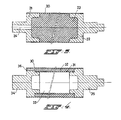
- Fig. 4 shows an alternative form of a roller which can be obtained by the method according to the invention, with a roller casing 30 and an inner casing 31, the space 32 between the two casings being filled with a set foam product.
- the set foam product is fed in through the inflow aperture 36 in the journal 34, which is a special shape for this instance.
- the free space 33 can, if desired, be used for the provision of possibly light support structures which contribute to the rigidity of the roller.
- the space 33 in Figure 4 can also be filled with a plastic foam product.
- a foam product of higher density than the density of the foam product in space 32 is preferably used for this.
- H450 R of Voss Chemie with a density of 450 kg/m3 is used for the foam product in space 33.
- An alternative product for this is Baydur 600 R of BASF.
- Pressures of 5 - 6 atm. (gauge) are measured during the setting of the foam in the space 33.
- FIG. 5 shows on an enlarged scale how a journal 41 can be fixed in the end of a roller casing 40 which is previously filled with a foam plastic filling 44 using temporary sealing plugs.
- the temporary sealing plugs are removed and for the fitting of the journal 41 the journal is pushed by means of chamfers 45 over a short distance into the end of the roller casing 40 in such a way that the apertures 43 are covered.
- Medium under pressure, for example compressed air is then fed to the interior of the journal, so that air flows through the apertures 43 and a slight elastic stretch is given to the roller casing 40.
- the roller thus obtained is of particularly low weight, and a low starting couple is therefore sufficient for all the normal applications relating to the guidance of conveyed film or other such substrates.
- roller casing 40 can be covered by an adhering or non-adhering covering of, for example, rubber (adhering) or metal (non-adhering). In the latter case a seamless nickel sleeve can be fitted in a very tight-fitting manner around the roller casing 40 by means of air push-on techniques.
Landscapes
- Engineering & Computer Science (AREA)
- Mechanical Engineering (AREA)
- Rolls And Other Rotary Bodies (AREA)
- Casting Or Compression Moulding Of Plastics Or The Like (AREA)
- Registering, Tensioning, Guiding Webs, And Rollers Therefor (AREA)
- Delivering By Means Of Belts And Rollers (AREA)
Applications Claiming Priority (2)
| Application Number | Priority Date | Filing Date | Title |
|---|---|---|---|
| NL9000645 | 1990-03-20 | ||
| NL9000645A NL9000645A (nl) | 1990-03-20 | 1990-03-20 | Werkwijze voor het vervaardigen van een wals en aldus verkregen wals. |
Publications (1)
| Publication Number | Publication Date |
|---|---|
| EP0451890A1 true EP0451890A1 (de) | 1991-10-16 |
Family
ID=19856778
Family Applications (1)
| Application Number | Title | Priority Date | Filing Date |
|---|---|---|---|
| EP19910200590 Ceased EP0451890A1 (de) | 1990-03-20 | 1991-03-18 | Verfahren zum Herstellen einer Rolle und so hergestellte Rolle |
Country Status (6)
| Country | Link |
|---|---|
| US (1) | US5133125A (de) |
| EP (1) | EP0451890A1 (de) |
| JP (1) | JPH0585653A (de) |
| KR (1) | KR910016406A (de) |
| CA (1) | CA2038555A1 (de) |
| NL (1) | NL9000645A (de) |
Cited By (5)
| Publication number | Priority date | Publication date | Assignee | Title |
|---|---|---|---|---|
| EP0529809A3 (en) * | 1991-08-30 | 1995-01-04 | Xerox Corp | Composite backup roller assembly |
| EP0747310A3 (de) * | 1995-06-05 | 1997-11-05 | Heidelberger Druckmaschinen Aktiengesellschaft | Rotierender zylindrischer Körper mit geringer Massenträgheit |
| EP1078872A1 (de) * | 1999-08-27 | 2001-02-28 | Eduard Küsters Maschinenfabrik GmbH & Co. KG | Verfahren zur Herstellung eines dünnwandigen Rohrs und dafür geeignete Vorrichtung |
| EP1447361A1 (de) * | 2003-02-12 | 2004-08-18 | Kampf GmbH & Co. Maschinenfabrik | Walze für eine Wickelmaschine |
| EP3009385A3 (de) * | 2014-10-13 | 2016-06-15 | FABIO PERINI S.p.A. | Walze zur verarbeitung eines durchgehenden bahnmaterials und vorrichtung mit der besagten walze |
Families Citing this family (22)
| Publication number | Priority date | Publication date | Assignee | Title |
|---|---|---|---|---|
| MX158102A (es) * | 1980-03-24 | 1989-01-09 | Sun Chemical Corp | Procedimiento mejorado para la obtencion de una resina de eteres de poliamida |
| US5411462A (en) * | 1993-08-30 | 1995-05-02 | Link; Terry G. | Lightweight ink transfer roll |
| US5411463A (en) * | 1993-10-13 | 1995-05-02 | Albany International Corp. | Composite roll and method of making |
| US5493777A (en) * | 1994-09-09 | 1996-02-27 | Jason Incorporated | Idler roller and method of making |
| US5752144A (en) * | 1996-04-01 | 1998-05-12 | Xerox Corporation | Method of fabricating a reclaimable uniform conditioning blotter roll |
| US6071110A (en) * | 1997-09-11 | 2000-06-06 | Mikkelsen; Oeystein | Polishing roll and method for making same |
| US6074192A (en) * | 1997-09-11 | 2000-06-13 | Mikkelsen; Oeystein | Lenticular pattern forming roll and method for making the roll |
| US6676582B1 (en) | 2000-01-07 | 2004-01-13 | Ashbrook Corporation | Belt pressure roller |
| KR100408936B1 (ko) * | 2001-03-29 | 2003-12-11 | (주)예원테크 | 하이브리드형 공기 베어링을 이용한 가이드-로울러 시스템 |
| KR100404131B1 (ko) * | 2001-03-29 | 2003-10-30 | (주)예원테크 | 미세 와이어 및 섬유 제조 장치의 하이브리드형 가이드-로울러 시스템 |
| US6939279B2 (en) * | 2001-05-01 | 2005-09-06 | Ten Cate Enbi | Tire for skew reducing roller |
| JP3548138B2 (ja) * | 2001-07-11 | 2004-07-28 | ミネベア株式会社 | リニアアクチェータ用のリードスクリュー |
| KR100838721B1 (ko) * | 2001-11-30 | 2008-06-17 | 주식회사 포스코 | 벨트 컨베이어의 롤러 파손 감지 장치 |
| US7147596B2 (en) * | 2002-02-26 | 2006-12-12 | Reynolds Ronald W | Low-mass roller or pulley |
| JP3745319B2 (ja) * | 2002-08-06 | 2006-02-15 | キヤノン株式会社 | 軸部材の加工方法およびその装置 |
| US6779450B1 (en) | 2003-04-21 | 2004-08-24 | Agfa Corporation | Thin-wall drum for external drum imaging system |
| JP3915921B2 (ja) * | 2003-09-09 | 2007-05-16 | 船井電機株式会社 | 用紙搬送用のローラーの製造方法および画像形成装置 |
| KR100737243B1 (ko) * | 2006-03-02 | 2007-07-09 | (주)미래컴퍼니 | 복합재료 롤러의 제조방법 |
| JP5275051B2 (ja) * | 2009-01-07 | 2013-08-28 | 三菱重工マシナリーテクノロジー株式会社 | タイヤユニフォーミティマシン |
| US20110064509A1 (en) * | 2009-09-17 | 2011-03-17 | Goss International Americas, Inc. | Air delivery apparatus for delivering air to a moving substrate in a printing press |
| US9341213B2 (en) * | 2012-10-19 | 2016-05-17 | Frc Holding Corp. | Quick release roller sleeve mounting hub |
| JP7087838B2 (ja) * | 2018-08-30 | 2022-06-21 | 沖電気工業株式会社 | 媒体搬送装置およびそれを備えた画像形成装置 |
Citations (3)
| Publication number | Priority date | Publication date | Assignee | Title |
|---|---|---|---|---|
| US2615389A (en) * | 1948-08-06 | 1952-10-28 | Huebner Company | Universal printing process cylinder and method of making the same |
| US4062098A (en) * | 1975-12-02 | 1977-12-13 | Brugman Machinefabriek B.V. | Guide roller and a method of manufacturing such a roller |
| EP0253981A1 (de) * | 1986-07-21 | 1988-01-27 | Grapha-Holding Ag | Einrichtung zum Fördern von bahnförmigem Material |
Family Cites Families (7)
| Publication number | Priority date | Publication date | Assignee | Title |
|---|---|---|---|---|
| US3378902A (en) * | 1966-07-05 | 1968-04-23 | Mosstype Corp | Hydraulically actuated demountable printing cylinders |
| JPS4894633A (de) * | 1972-03-16 | 1973-12-05 | ||
| JPS5481904A (en) * | 1977-12-09 | 1979-06-29 | Horii & Co Ltd | Method of printing with perforated plate |
| JPS61155154A (ja) * | 1984-12-28 | 1986-07-14 | Toshiba Corp | ロ−ラ |
| JPS62108576A (ja) * | 1985-11-06 | 1987-05-19 | Mitsubishi Electric Corp | 半導体装置の製造方法 |
| JPS63252845A (ja) * | 1987-04-08 | 1988-10-19 | Hitachi Ltd | 非帯電ロ−ラおよびその製造方法 |
| DE3840951A1 (de) * | 1988-07-29 | 1990-02-01 | Stahlgruber Gruber & Co Otto | Tragrolle insbesondere fuer bandfoerderer od.dgl. |
-
1990
- 1990-03-20 NL NL9000645A patent/NL9000645A/nl not_active Application Discontinuation
-
1991
- 1991-03-15 US US07/670,052 patent/US5133125A/en not_active Expired - Fee Related
- 1991-03-18 EP EP19910200590 patent/EP0451890A1/de not_active Ceased
- 1991-03-19 CA CA002038555A patent/CA2038555A1/en not_active Abandoned
- 1991-03-20 JP JP3081766A patent/JPH0585653A/ja active Pending
- 1991-03-20 KR KR1019910004372A patent/KR910016406A/ko not_active Withdrawn
Patent Citations (3)
| Publication number | Priority date | Publication date | Assignee | Title |
|---|---|---|---|---|
| US2615389A (en) * | 1948-08-06 | 1952-10-28 | Huebner Company | Universal printing process cylinder and method of making the same |
| US4062098A (en) * | 1975-12-02 | 1977-12-13 | Brugman Machinefabriek B.V. | Guide roller and a method of manufacturing such a roller |
| EP0253981A1 (de) * | 1986-07-21 | 1988-01-27 | Grapha-Holding Ag | Einrichtung zum Fördern von bahnförmigem Material |
Cited By (7)
| Publication number | Priority date | Publication date | Assignee | Title |
|---|---|---|---|---|
| EP0529809A3 (en) * | 1991-08-30 | 1995-01-04 | Xerox Corp | Composite backup roller assembly |
| EP0747310A3 (de) * | 1995-06-05 | 1997-11-05 | Heidelberger Druckmaschinen Aktiengesellschaft | Rotierender zylindrischer Körper mit geringer Massenträgheit |
| US6086969A (en) * | 1995-06-05 | 2000-07-11 | Heidelberg Harris, Inc. | Cylindrical rotating body of low inertia |
| EP1078872A1 (de) * | 1999-08-27 | 2001-02-28 | Eduard Küsters Maschinenfabrik GmbH & Co. KG | Verfahren zur Herstellung eines dünnwandigen Rohrs und dafür geeignete Vorrichtung |
| EP1447361A1 (de) * | 2003-02-12 | 2004-08-18 | Kampf GmbH & Co. Maschinenfabrik | Walze für eine Wickelmaschine |
| DE10305699A1 (de) * | 2003-02-12 | 2004-08-26 | Kampf Gmbh & Co Maschinenfabrik | Walze für eine Wickelmaschine |
| EP3009385A3 (de) * | 2014-10-13 | 2016-06-15 | FABIO PERINI S.p.A. | Walze zur verarbeitung eines durchgehenden bahnmaterials und vorrichtung mit der besagten walze |
Also Published As
| Publication number | Publication date |
|---|---|
| KR910016406A (ko) | 1991-11-05 |
| NL9000645A (nl) | 1991-10-16 |
| JPH0585653A (ja) | 1993-04-06 |
| US5133125A (en) | 1992-07-28 |
| CA2038555A1 (en) | 1991-09-21 |
Similar Documents
| Publication | Publication Date | Title |
|---|---|---|
| EP0451890A1 (de) | Verfahren zum Herstellen einer Rolle und so hergestellte Rolle | |
| US5752444A (en) | Seamless printing sleeve and method of manufacture thereof | |
| US4288058A (en) | Composite mold for making rubber covered rolls and method for making same | |
| US10265754B2 (en) | Fixing sleeve and manufacturing method thereof | |
| EP1327522A1 (de) | Wiederverwendbare Adaptorhülse für eine Druckmaschine | |
| DE69718833D1 (de) | Verfahren zum herstellen von harzimprägnierten endlos-gurtstrukturen | |
| CN1281756A (zh) | 由金属辊芯和弹性体包层构成的辊及为辊涂覆外层的方法 | |
| EP0606140B1 (de) | Zusammengesetzte Welle mit flexiblen Merkmalen | |
| EP0799668A2 (de) | Herstellungsverfahren für nahtlosen metallischen Gurt | |
| EP0225569B1 (de) | Verfahren zum Herstellen eines Lagerteils | |
| US20050050729A1 (en) | Manufacturing method of roller of film or tape handling machine | |
| US7334336B2 (en) | Method for producing a sleeved polymer member, an image cylinder or a blanket cylinder | |
| US6742453B1 (en) | Printing sleeves and methods for producing same | |
| CN101454485A (zh) | 镍压花辊及其加工方法 | |
| TW555638B (en) | Rubber roll and making method thereof | |
| EP1115580B1 (de) | Druckhülse und herstellungsverfahren dafür | |
| KR102162483B1 (ko) | 복합 텐션 롤러 및 그 제조방법 | |
| GB1581232A (en) | Printing roll with detachable sleeve and method of fitting that sleeve | |
| EP1228870A1 (de) | Beschichteter Zylinder mit Luftkanälen und Verfahren zum Beschichten eines Zylinders | |
| JP4322143B2 (ja) | ローラクリーナーの製造方法およびそれによるローラクリーナー並びにそれを使用した電子画像形成装置 | |
| US7353605B2 (en) | Method for producing a metallic core for use in cylinder sleeves for an electrophotographic process | |
| JPH081829A (ja) | ローラの製造方法 | |
| JPH0330919A (ja) | 筒状体の製造方法 | |
| US4880590A (en) | Process for producing rollers equipped with a rubber layer | |
| JPS6225779A (ja) | 熱定着ロ−ルの製造方法 |
Legal Events
| Date | Code | Title | Description |
|---|---|---|---|
| PUAI | Public reference made under article 153(3) epc to a published international application that has entered the european phase |
Free format text: ORIGINAL CODE: 0009012 |
|
| AK | Designated contracting states |
Kind code of ref document: A1 Designated state(s): AT BE CH DE DK ES FR GB GR IT LI LU NL SE |
|
| 17P | Request for examination filed |
Effective date: 19911203 |
|
| RIN1 | Information on inventor provided before grant (corrected) |
Inventor name: VAN DER MEULEN, ANTHONIUS MARIA Inventor name: DIEBELS, BERNARD PIERRE Inventor name: EKKEL, RONALD |
|
| 17Q | First examination report despatched |
Effective date: 19931116 |
|
| STAA | Information on the status of an ep patent application or granted ep patent |
Free format text: STATUS: THE APPLICATION HAS BEEN REFUSED |
|
| 18R | Application refused |
Effective date: 19940903 |