EP0452064A2 - Gerät zur Detektion von digitalen Daten - Google Patents
Gerät zur Detektion von digitalen Daten Download PDFInfo
- Publication number
- EP0452064A2 EP0452064A2 EP91303071A EP91303071A EP0452064A2 EP 0452064 A2 EP0452064 A2 EP 0452064A2 EP 91303071 A EP91303071 A EP 91303071A EP 91303071 A EP91303071 A EP 91303071A EP 0452064 A2 EP0452064 A2 EP 0452064A2
- Authority
- EP
- European Patent Office
- Prior art keywords
- digital data
- channels
- data
- distributing
- processing
- Prior art date
- Legal status (The legal status is an assumption and is not a legal conclusion. Google has not performed a legal analysis and makes no representation as to the accuracy of the status listed.)
- Granted
Links
Images



Classifications
-
- H—ELECTRICITY
- H04—ELECTRIC COMMUNICATION TECHNIQUE
- H04N—PICTORIAL COMMUNICATION, e.g. TELEVISION
- H04N5/00—Details of television systems
- H04N5/76—Television signal recording
- H04N5/91—Television signal processing therefor
- H04N5/92—Transformation of the television signal for recording, e.g. modulation, frequency changing; Inverse transformation for playback
- H04N5/926—Transformation of the television signal for recording, e.g. modulation, frequency changing; Inverse transformation for playback by pulse code modulation
-
- G—PHYSICS
- G11—INFORMATION STORAGE
- G11B—INFORMATION STORAGE BASED ON RELATIVE MOVEMENT BETWEEN RECORD CARRIER AND TRANSDUCER
- G11B20/00—Signal processing not specific to the method of recording or reproducing; Circuits therefor
- G11B20/10—Digital recording or reproducing
- G11B20/10009—Improvement or modification of read or write signals
-
- H—ELECTRICITY
- H04—ELECTRIC COMMUNICATION TECHNIQUE
- H04N—PICTORIAL COMMUNICATION, e.g. TELEVISION
- H04N5/00—Details of television systems
- H04N5/76—Television signal recording
- H04N5/91—Television signal processing therefor
- H04N5/93—Regeneration of the television signal or of selected parts thereof
- H04N5/931—Regeneration of the television signal or of selected parts thereof for restoring the level of the reproduced signal
Definitions
- This invention relates to apparatus for detecting digital data, and more particularly but not exclusively, is directed to apparatus for detecting digital data for use in a video tape recorder which uses class IV or other partial response signalling in high density digital tape recording and reproducing.
- VTRs Digital video tape recorders
- the electromagnetic transducing system used therefor (such as a magnetic head or the like) has a differentiation characteristic so that the carrier-to-noise (C/N) ratio is degraded at lower frequencies.
- the C/N ratio will be similarly degraded due to a magnetisation characteristic of the magnetic tape itself, as shown in Figure 1 of the accompanying drawings, if the frequency is increased.
- a magnetic recording and/or reproducing system for a digitised video signal (hereinafter referred to as a digital video signal)
- the frequency band in which a satisfactory C/N ratio can be obtained is relatively narrow.
- a detection system is employed having a signal spectrum concentrated near a region in which the C/N ratio is maximised, so as to effectively avoid deterioration of the C/N ratio of the reproduced signal, and thereby ensure that the digital video signal will be recorded and/or reproduced efficiently.
- it has been proposed to utilise a class IV partial response scheme in the reproduction and detection of a digital video signal for example, as disclosed in US Patent Nos. US-A-4 504 872 and US-A-4 984 099 both assigned to the present applicants.
- the digital video signal can be recorded and/or reproduced efficiently by effectively utilising the frequency characteristic of the magnetic recording and/or reproducing system.
- the electromagnetic transducing system for example, a magnetic head
- a reproduced signal from the magnetic head has a characteristic expressed as (1 - D) with reference to the delay operator D and which is shown by the correspondingly labelled dashed line in Figure 2.
- a digital video signal having a low bit error rate can be reproduced by the application of the Viterbi decoding technique, which indicates that, as shown in Figure 2, the digital video signal can be efficiently detected by effectively utilising a frequency characteristic nearly equal to the characteristic of Figure 1 which represents the frequency characteristic of the magnetic recording and/or reproducing system.
- a Viterbi decoding circuit utilises the likelihood of correlation between data input successively thereto for detecting transit of the data, and decodes the data on the basis of the detected result.
- the bit error rate of the decoded data can be reduced as compared with a standard decoding circuit which decodes data with reference to the signal level.
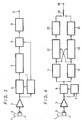
- a previously-proposed reproducing circuit of a digital VTR which incorporates class IV partial response and Viterbi decoding schemes will now be described with reference to Figure 3 of the accompanying drawings in which digital video data recorded as a binary signal in analog form on a video tape 1 is reproduced by a magnetic head 2.
- the reproduced signal is supplied through an amplifier 3 to an equaliser circuit 4, and the equalised reproduced signal from the equaliser circuit 4 is supplied to a processing circuit 5.
- the processing circuit 5 performs on this reproduced signal the calculation (1 + D) in accordance with the above-mentioned partial response scheme.
- the resulting output of the processing circuit 5 is supplied to an analog-to-digital (A/D) converter 6.
- a reproduced clock is generated from the reproduced signal by a phase-locked loop (PLL) circuit 7 also connected to the output of the amplifier 3.
- PLL phase-locked loop
- This reproduced clock is supplied to the A/D converter 6 which detects digital data from the reproduced signal level on the basis of the reproduced clock.
- Detected digital data is supplied to a Viterbi decoder circuit 8, in which the data is decoded in accordance with the Viterbi decoding scheme to provide a detected digital video signal.
- the detected digital video signal is supplied through an output terminal 9 to a reproduced signal processor circuit (not shown) in a succeeding stage.
- the transmission rate of the digital video data is very high so that the clock frequency necessary for processing reproduced data in each of the circuits must be selected to be higher than about 30 MHz.
- the circuits which are operated at such a high clock frequency require a calculation circuit of a special configuration, which cannot be readily provided in practice.
- the equaliser circuit 4 and the processing circuit 5 be fabricated as digital circuits because such digital equaliser circuits and digital processing circuits can provide excellent characteristics.
- apparatus for detecting input digital data comprising: distributing means for distributing said input digital data into at least two channels; processing means in each of said channels for processing said digital data in the respective channel in accordance with a predetermined formula; decoder means in each of said channels for decoding an output of said processing means in said respective channel in accordance with the Viterbi algorithm; and means for composing outputs of said decoder means in said channels to obtain digital data in one sequence.
- apparatus for detecting digital data from a binary signal recorded in analog form on a magnetic medium
- the apparatus comprising: playback means including a magnetic head for reproducing said signal recorded on said magnetic medium; analog-to-digital converter means for converting an output of said playback means into digital data; distributing means for distributing said digital data from said converter means into at least two channels; processing means in each of said channels for processing said digital data in the respective one of said channels in accordance with a class IV partial response; decoder means in each of said channels for decoding an output of said processing means in the respective channel in accordance with the Viterbi algorithm; and means for composing the outputs of said decoder means in said channels to obtain digital data in one sequence.
- a preferred embodiment of the invention provides an improved apparatus for detecting digital data in which the above-mentioned problems and disadvantages encountered with the previously-proposed systems can be substantially overcome.
- the signal processing speed of each of the circuits can be substantially reduced.
- the circuit arrangement can be simplified so as to be operable by a clock signal of a relatively low frequency.
- the invention is applied to a reproducing system of a digital video tape recorder (VTR) in which digital data representing a video signal are recorded as a binary signal in analog form on a magnetic tape.
- VTR digital video tape recorder
- This reproducing system is generally arranged as shown in Figure 4, in which the signal reproduced from the magnetic tape 1 by the magnetic head 2 is supplied through the playback amplifier 3 to the A/D converter 6, and digital data is derived from the reproduced signal by the A/D converter 6 on the basis of the reproduced clock signal supplied thereto from the PLL circuit 7.
- Digital data output from the A/D converter 6 are divided into an odd sequence and an even sequence which are then supplied to respective channels containing equaliser circuits 11 and 12.
- each of the equaliser circuits 11 and 12 is formed by a transversal filter.
- Outputs of the equaliser circuits 11 and 12 are supplied to processing circuits 21 and 22 in the respective channels, which perform the (1 + D) calculation on the outputs of the equaliser circuits 11 and 12, respectively, where D is a delay operator.
- the processing circuit 21 derives the resulting processed data for the odd sequence and the processing circuit 22 derives the resulting processed data for the even sequence.
- Outputs of the processing circuits 21 and 22 are supplied to Viterbi decoders 23 and 24, in the respective channels.
- the Viterbi decoder 23 is operable to Viterbi-decode data of the odd sequence and the Viterbi decoder 24 is operable to Viterbi-decode data of the even sequence.
- Outputs of the two Viterbi decoders 23 and 24 are supplied to a change-over or composing switch 25.
- the change-over switch 25 alternately switches the outputs for the odd sequence and the even sequence from the Viterbi decoders 23 and 24 to compose them into data of one sequence, and supplies this data of one sequence to an output terminal 26. Data developed at the output terminal 26 are supplied to a reproduced signal processing circuit (not shown) forming a succeeding stage.
- the A/D converter 6 detects digital data from the level of a reproduced signal developed at a terminal 6a on the basis of a reproduced clock signal supplied thereto through a terminal 6b from the PLL circuit 7 ( Figure 4).
- the frequency of the reproduced clock signal supplied to the terminal 6b is selected to be 40 MHz.
- the output digital data from the A/D converter 6 are supplied to a distributor which includes latch circuits 41 and 42.
- the latch circuits 41 and 42 latch the digital data on the basis of a clock signal having a frequency of 20 MHz and which is supplied thereto through a terminal 40.
- the clock signal supplied to the latch circuit 41 and the clock signal supplied to the latch circuit 42 are inverted in phase relative to each other by 180 degrees, so that the latch timings of the latch circuits 41 and 42 are mutually displaced, whereby data of an even sequence is latched by the latch circuit 41 and data of an odd sequence is latched by the latch circuit 42.
- Data latched by the latch circuit 41 is supplied through a latch circuit 43 functioning as a delay circuit to the equaliser circuits 11 and 12, and data latched by the latch circuit 42 is supplied through latch circuits 44 and 45 arranged in series and also functioning as delay circuits to the equaliser circuits 11 and 12.
- the 20 MHz clock signal applied to the terminal 40 is also supplied to the latch circuits 43, 44 and 45, so that data are delayed by one clock in each of the latch circuits 43, 44 and 45.
- output data from the latch circuit 43 is supplied to a series circuit of delay circuits 11a and 11b and output data from the latch circuit 45 is supplied to a delay circuit 11c. Outputs of the delay circuits 11a, 11b and 11c are supplied through respective coefficient multipliers 11d, 11e and 11f to an adder 11g.
- output data from the latch circuit 43 is supplied to a series circuit of delay circuits 12a and 12b, and output data from the latch circuit 45 is supplied to a series circuit of delay circuits 12c and 12d.
- Outputs of the delay circuits 12b, 12c and 12d are supplied through respective coefficient multipliers 12e, 12f and 12g to an adder 12h.
- the coefficient multipliers 11d, 11e and 11f and the coefficient multipliers 12e, 12f and 12g are operative to multiply the respective delayed data supplied thereto by coefficients K1, K2 and K3, respectively.
- the two equaliser circuits 11 and 12 constitute respective transversal filters and the adders 11g and 12h provide respective equalised signals.
- the equalising level is changed.
- Each of the delay circuits 11a, 11b, 11c, 12a, 12b, 12c and 12d is formed by a latch circuit which delays an input signal by a delay time of one clock having the frequency of 20 MHz.
- Outputs of the equaliser circuits 11 and 12 are supplied to the processing circuit 21 which performs the (1 + D) calculation so as to obtain the processed data of the odd sequence. More specifically, the output data of the equaliser circuit 11 is supplied through a series circuit of delay circuits 21a and 21b to one input terminal of an adder 21c, and the output of the equaliser circuit 12 is supplied through a delay circuit 22a to the other input terminal of the adder 21c. An added or sum output of the adder 21c is supplied through a delay circuit 21d to an input terminal 23a of the Viterbi decoder circuit 23 ( Figure 4) in the respective channel. In other words, the output of the delay circuit 21d is supplied to the Viterbi decoder circuit 23 which Viterbi-decodes the odd sequence data constituting the output of the processing circuit 21.
- the outputs of the equaliser circuits 11 and 12 are also supplied to the processing circuit 22 which performs the (1 + D) calculation so as to obtain the processed data of the even sequence. More specifically, the output of the delay circuit 21a in the odd sequence data processing circuit 21 is supplied to one input terminal of an adder 22b, and an output of the delay circuit 22a is supplied to the other input terminal of the adder 22b. An added or sum output of the adder 22b is supplied through a delay circuit 22c to an input terminal 24a of the Viterbi decoder circuit 24 ( Figure 4). In other words, the output of the delay circuit 22c is supplied to the Viterbi decoder circuit 24 which Viterbi-decodes the even sequence data constituting the output of the processing circuit 22.
- Each of the delay circuits 21a, 21b and 21d, and each of the delay circuits 22a and 22c in the processing circuits 21 and 22 respectively, is formed of a latch circuit which delays the input signal supplied thereto by a delay time of one clock period of the clock signal having a frequency of 20 MHz.
- the separated even sequence data and odd sequence data are then supplied to the respective transversal filter or equaliser circuits 11 and 12, thereby generating equalised data EQ which are separately equalised for the odd and even sequences. More specifically, assuming that data EQ1, EQ3, EQ5, Vietnamese obtained at a junction or point e1 corresponding to the output of the delay circuit 21a, are considered to be the output of the equaliser circuit 11, as shown in Figure 7A, then data EQ0, EQ2, EQ4, Vietnamese are obtained at a point e2, corresponding to the output of the delay circuit 22a at the same timing, and may be considered to be the output of the equaliser circuit 12, as shown in Figure 7B. Further, at the same timing, as shown in Figure 7C, data EQ ⁇ 1, EQ1, EQ3, Vietnamese will be obtained at a point e3 corresponding to the output of the delay circuit 21b.
- the added or sum output of the adder 21c in the processing circuit 21 is simply the sum of the signals at the points e2 and e3, and hence becomes the data EQ ⁇ 1 + EQ0, EQ1 + EQ2, EQ3 + EQ4, ## as shown in Figure 7D.
- This added output is supplied to the Viterbi decoder circuit 23 which decodes the odd sequence data as data processed by (1 + D).
- the added or sum output of the adder 22b in the processing circuit 22 is simply the sum of the signals at the points e1 and e2, and hence becomes the data EQ1 + EQ0, EQ3 + EQ2, EQ5 + EQ4, ## as shown in Figure 7E.
- This added output is supplied to the Viterbi decoder circuit 24 which decodes the even sequence data as data processed by (1 + D).
- the odd sequence and even sequence data are separately decoded by the two Viterbi decoder circuits 23 and 24, and are then composed into data of one sequence by operation of the switch 25.
- the reproduced signal is converted into digital data by the A/D converter 6 before being equalised so that the transversal filter or equaliser circuits 11 and 12 and the processing circuits 21 and 22, each of which performs the calculation of (1 + D), can be fabricated as digital circuits. Accordingly, the digital equaliser circuits 11 and 12 and the digital processing circuits 21 and 22 can be provided with stable characteristics which can be adjusted with ease.
- the equaliser circuits 11 and 12 and the processing circuits 21 and 22 are arranged in respective channels to divide the data into odd sequence data and even sequence data, the digital signal having a sampling frequency of 40 MHz is equalised using a clock frequency which is one-half the sampling frequency, that is, a clock frequency of 20 MHz, and the (1 + D) calculation or processing is also performed at such reduced frequency. Therefore, a simplified digital data detecting circuit which is operable by a clock signal of relatively low frequency can be employed, that is, there is no need to provide a special circuit which is operated by a clock signal of high frequency.
- the reproduced data is divided into data of two channels, that is, odd sequence data and even sequence data in the above described embodiment, it will be appreciated that the reproduced data may be divided into data of three or more channels thereby to further lower the clock frequency.
Landscapes
- Engineering & Computer Science (AREA)
- Signal Processing (AREA)
- Multimedia (AREA)
- Signal Processing For Digital Recording And Reproducing (AREA)
- Error Detection And Correction (AREA)
Applications Claiming Priority (2)
| Application Number | Priority Date | Filing Date | Title |
|---|---|---|---|
| JP2095653A JP2830352B2 (ja) | 1990-04-11 | 1990-04-11 | デジタルデータ検出装置 |
| JP95653/90 | 1990-04-11 |
Publications (3)
| Publication Number | Publication Date |
|---|---|
| EP0452064A2 true EP0452064A2 (de) | 1991-10-16 |
| EP0452064A3 EP0452064A3 (en) | 1993-11-24 |
| EP0452064B1 EP0452064B1 (de) | 1996-12-27 |
Family
ID=14143462
Family Applications (1)
| Application Number | Title | Priority Date | Filing Date |
|---|---|---|---|
| EP91303071A Expired - Lifetime EP0452064B1 (de) | 1990-04-11 | 1991-04-08 | Gerät zur Detektion von digitalen Daten |
Country Status (6)
| Country | Link |
|---|---|
| US (1) | US5255128A (de) |
| EP (1) | EP0452064B1 (de) |
| JP (1) | JP2830352B2 (de) |
| KR (1) | KR100221891B1 (de) |
| AU (1) | AU647097B2 (de) |
| DE (1) | DE69123777T2 (de) |
Cited By (2)
| Publication number | Priority date | Publication date | Assignee | Title |
|---|---|---|---|---|
| EP0595454A3 (en) * | 1992-08-27 | 1994-06-15 | Quantum Corp | Disk drive using prml class iv sampling data detection with digital adaptive equalization |
| WO1995015551A1 (en) * | 1993-12-04 | 1995-06-08 | Hewlett-Packard Limited | Retrieving data recorded at different bit densities |
Families Citing this family (13)
| Publication number | Priority date | Publication date | Assignee | Title |
|---|---|---|---|---|
| JPH05234273A (ja) * | 1990-11-30 | 1993-09-10 | Hitachi Ltd | 信号波形の評価装置および磁気ディスク装置 |
| JPH05234279A (ja) * | 1992-02-24 | 1993-09-10 | Sony Corp | 最尤復号装置及びこれを用いた再生データ復調装置 |
| JP3088844B2 (ja) * | 1992-06-03 | 2000-09-18 | パイオニア株式会社 | ディジタル信号再生装置 |
| DE69321066T2 (de) * | 1992-10-14 | 1999-03-18 | Sony Corp., Tokio/Tokyo | Magnetplattengerät |
| JP3456592B2 (ja) * | 1993-05-11 | 2003-10-14 | ソニー株式会社 | 光デイスク装置 |
| US5521767A (en) * | 1993-09-17 | 1996-05-28 | Quantum Corporation | Optimized equalizer system for data recovery and timing extraction in partial response read channels |
| JP3347468B2 (ja) * | 1994-04-20 | 2002-11-20 | キヤノン株式会社 | 情報再生装置 |
| EP0684605B1 (de) * | 1994-05-23 | 1999-10-06 | STMicroelectronics S.r.l. | In Parallelarchitektur ausgeführte PRML Vorrichtung zur Verarbeitung von Signalen während eines Leseschrittes durch einen Magnetkopf |
| EP0684608B1 (de) * | 1994-05-23 | 1999-10-06 | STMicroelectronics S.r.l. | Vorrichtung zur Verarbeitung von Servosignalen in einer in Parallelarchitektur ausgeführten Lesevorrichtung für Festplatten |
| US5657013A (en) * | 1994-05-25 | 1997-08-12 | Sony Corporation | Data recording apparatus |
| US5774290A (en) * | 1994-08-09 | 1998-06-30 | Canon Kabushiki Kaisha | Reproducing apparatus for varying clock frequencies based upon azimuth angles of a plurality of heads |
| JPH08329619A (ja) * | 1994-10-27 | 1996-12-13 | Hitachi Ltd | データ再生方法、データ再生装置、およびデータ再生用回路 |
| US7177353B2 (en) * | 2000-03-10 | 2007-02-13 | Broadcom Corporation | Architecture for very high-speed decision feedback sequence estimation |
Family Cites Families (4)
| Publication number | Priority date | Publication date | Assignee | Title |
|---|---|---|---|---|
| US4517610A (en) * | 1982-12-09 | 1985-05-14 | Magnetic Peripherals Inc. | Multichannel signal recovery circuit |
| US4979052A (en) * | 1987-09-29 | 1990-12-18 | Matsushita Electric Industrial Co., Ltd. | Digital signal magnetic recording/reproducing apparatus |
| JP2840747B2 (ja) * | 1988-05-25 | 1998-12-24 | ソニー株式会社 | ディジタル信号再生装置 |
| NL9002772A (nl) * | 1990-09-21 | 1992-04-16 | Philips Nv | Inrichting voor het optekenen van een digitaal informatiesignaal in een registratiedrager. |
-
1990
- 1990-04-11 JP JP2095653A patent/JP2830352B2/ja not_active Expired - Fee Related
-
1991
- 1991-04-04 US US07/680,361 patent/US5255128A/en not_active Expired - Lifetime
- 1991-04-08 EP EP91303071A patent/EP0452064B1/de not_active Expired - Lifetime
- 1991-04-08 DE DE69123777T patent/DE69123777T2/de not_active Expired - Fee Related
- 1991-04-10 AU AU74326/91A patent/AU647097B2/en not_active Ceased
- 1991-04-11 KR KR1019910005754A patent/KR100221891B1/ko not_active Expired - Fee Related
Cited By (3)
| Publication number | Priority date | Publication date | Assignee | Title |
|---|---|---|---|---|
| EP0595454A3 (en) * | 1992-08-27 | 1994-06-15 | Quantum Corp | Disk drive using prml class iv sampling data detection with digital adaptive equalization |
| WO1995015551A1 (en) * | 1993-12-04 | 1995-06-08 | Hewlett-Packard Limited | Retrieving data recorded at different bit densities |
| EP0731968A1 (de) * | 1993-12-04 | 1996-09-18 | Hewlett-Packard Limited | Lesen von mit unterschiedlichen schreibdichten gespeicherten daten |
Also Published As
| Publication number | Publication date |
|---|---|
| JPH03293819A (ja) | 1991-12-25 |
| JP2830352B2 (ja) | 1998-12-02 |
| AU7432691A (en) | 1991-10-17 |
| US5255128A (en) | 1993-10-19 |
| EP0452064B1 (de) | 1996-12-27 |
| EP0452064A3 (en) | 1993-11-24 |
| DE69123777D1 (de) | 1997-02-06 |
| AU647097B2 (en) | 1994-03-17 |
| KR100221891B1 (ko) | 1999-09-15 |
| DE69123777T2 (de) | 1997-04-17 |
Similar Documents
| Publication | Publication Date | Title |
|---|---|---|
| EP0452064B1 (de) | Gerät zur Detektion von digitalen Daten | |
| US5497239A (en) | Digital video signal recording/reproducing apparatus having multiple recording and reproducing paths | |
| US6307900B1 (en) | Method and apparatus for recovering digital data by employing asynchronous data sampling techniques | |
| JPH0793584B2 (ja) | 符号化装置 | |
| GB2113946A (en) | Combined data rate reduction system | |
| US5142377A (en) | Time base correction apparatus | |
| EP0385867B1 (de) | Wiedergabegerät für ein digitales Signal | |
| US5381274A (en) | Apparatus and method for recycling and reproducing a digital video signal | |
| US5377014A (en) | Apparatus and method for displaying recorded compressed digital high definition video information | |
| EP0343929B1 (de) | Anordnung zur Dekodierung eines digitalen Signals | |
| HK1002246B (en) | Video signal processing and video stores | |
| HK1002246A1 (en) | Video signal processing and video stores | |
| US4851934A (en) | Analog signal synthesizing processing circuit with periodic noise compensation | |
| US5359469A (en) | Information data recording apparatus | |
| EP0438293B1 (de) | Vorrichtung zum Aufzeichnen/Wiedergeben eines Videosignals, die eine Signalausfallfunktion enthält | |
| JP2822264B2 (ja) | 自動利得制御回路 | |
| JP2708196B2 (ja) | 多重サブサンプリング信号アダプタ装置 | |
| JP3059394B2 (ja) | 記録再生装置 | |
| US6256450B1 (en) | Progressive scanned signal processing apparatus | |
| JP4296652B2 (ja) | ディジタル信号記録装置 | |
| JP2725382B2 (ja) | Vtrの色信号ノイズ除去装置 | |
| JP3319287B2 (ja) | プリコーダ | |
| JPS6126381A (ja) | 録画装置 | |
| JP3158373B2 (ja) | 磁気再生装置 | |
| JPH0793909A (ja) | 位相検出回路 |
Legal Events
| Date | Code | Title | Description |
|---|---|---|---|
| PUAI | Public reference made under article 153(3) epc to a published international application that has entered the european phase |
Free format text: ORIGINAL CODE: 0009012 |
|
| AK | Designated contracting states |
Kind code of ref document: A2 Designated state(s): DE FR GB NL |
|
| PUAL | Search report despatched |
Free format text: ORIGINAL CODE: 0009013 |
|
| AK | Designated contracting states |
Kind code of ref document: A3 Designated state(s): DE FR GB NL |
|
| 17P | Request for examination filed |
Effective date: 19940418 |
|
| 17Q | First examination report despatched |
Effective date: 19950109 |
|
| GRAG | Despatch of communication of intention to grant |
Free format text: ORIGINAL CODE: EPIDOS AGRA |
|
| GRAH | Despatch of communication of intention to grant a patent |
Free format text: ORIGINAL CODE: EPIDOS IGRA |
|
| GRAH | Despatch of communication of intention to grant a patent |
Free format text: ORIGINAL CODE: EPIDOS IGRA |
|
| GRAA | (expected) grant |
Free format text: ORIGINAL CODE: 0009210 |
|
| AK | Designated contracting states |
Kind code of ref document: B1 Designated state(s): DE FR GB NL |
|
| REF | Corresponds to: |
Ref document number: 69123777 Country of ref document: DE Date of ref document: 19970206 |
|
| ET | Fr: translation filed | ||
| PLBE | No opposition filed within time limit |
Free format text: ORIGINAL CODE: 0009261 |
|
| STAA | Information on the status of an ep patent application or granted ep patent |
Free format text: STATUS: NO OPPOSITION FILED WITHIN TIME LIMIT |
|
| 26N | No opposition filed | ||
| REG | Reference to a national code |
Ref country code: GB Ref legal event code: IF02 |
|
| PGFP | Annual fee paid to national office [announced via postgrant information from national office to epo] |
Ref country code: FR Payment date: 20090417 Year of fee payment: 19 Ref country code: DE Payment date: 20090402 Year of fee payment: 19 Ref country code: NL Payment date: 20090405 Year of fee payment: 19 |
|
| PGFP | Annual fee paid to national office [announced via postgrant information from national office to epo] |
Ref country code: GB Payment date: 20090408 Year of fee payment: 19 |
|
| REG | Reference to a national code |
Ref country code: NL Ref legal event code: V1 Effective date: 20101101 |
|
| GBPC | Gb: european patent ceased through non-payment of renewal fee |
Effective date: 20100408 |
|
| REG | Reference to a national code |
Ref country code: FR Ref legal event code: ST Effective date: 20101230 |
|
| PG25 | Lapsed in a contracting state [announced via postgrant information from national office to epo] |
Ref country code: NL Free format text: LAPSE BECAUSE OF NON-PAYMENT OF DUE FEES Effective date: 20101101 |
|
| PG25 | Lapsed in a contracting state [announced via postgrant information from national office to epo] |
Ref country code: DE Free format text: LAPSE BECAUSE OF NON-PAYMENT OF DUE FEES Effective date: 20101103 |
|
| PG25 | Lapsed in a contracting state [announced via postgrant information from national office to epo] |
Ref country code: GB Free format text: LAPSE BECAUSE OF NON-PAYMENT OF DUE FEES Effective date: 20100408 |
|
| PG25 | Lapsed in a contracting state [announced via postgrant information from national office to epo] |
Ref country code: FR Free format text: LAPSE BECAUSE OF NON-PAYMENT OF DUE FEES Effective date: 20100430 |