EP0452497A1 - Commande de chariot d'imprimante - Google Patents
Commande de chariot d'imprimante Download PDFInfo
- Publication number
- EP0452497A1 EP0452497A1 EP90914760A EP90914760A EP0452497A1 EP 0452497 A1 EP0452497 A1 EP 0452497A1 EP 90914760 A EP90914760 A EP 90914760A EP 90914760 A EP90914760 A EP 90914760A EP 0452497 A1 EP0452497 A1 EP 0452497A1
- Authority
- EP
- European Patent Office
- Prior art keywords
- speed
- carriage motor
- value
- standard
- pwm
- Prior art date
- Legal status (The legal status is an assumption and is not a legal conclusion. Google has not performed a legal analysis and makes no representation as to the accuracy of the status listed.)
- Granted
Links
Images





Classifications
-
- H—ELECTRICITY
- H02—GENERATION; CONVERSION OR DISTRIBUTION OF ELECTRIC POWER
- H02P—CONTROL OR REGULATION OF ELECTRIC MOTORS, ELECTRIC GENERATORS OR DYNAMO-ELECTRIC CONVERTERS; CONTROLLING TRANSFORMERS, REACTORS OR CHOKE COILS
- H02P7/00—Arrangements for regulating or controlling the speed or torque of electric DC motors
- H02P7/06—Arrangements for regulating or controlling the speed or torque of electric DC motors for regulating or controlling an individual DC dynamo-electric motor by varying field or armature current
- H02P7/18—Arrangements for regulating or controlling the speed or torque of electric DC motors for regulating or controlling an individual DC dynamo-electric motor by varying field or armature current by master control with auxiliary power
- H02P7/24—Arrangements for regulating or controlling the speed or torque of electric DC motors for regulating or controlling an individual DC dynamo-electric motor by varying field or armature current by master control with auxiliary power using discharge tubes or semiconductor devices
- H02P7/28—Arrangements for regulating or controlling the speed or torque of electric DC motors for regulating or controlling an individual DC dynamo-electric motor by varying field or armature current by master control with auxiliary power using discharge tubes or semiconductor devices using semiconductor devices
- H02P7/285—Arrangements for regulating or controlling the speed or torque of electric DC motors for regulating or controlling an individual DC dynamo-electric motor by varying field or armature current by master control with auxiliary power using discharge tubes or semiconductor devices using semiconductor devices controlling armature supply only
- H02P7/29—Arrangements for regulating or controlling the speed or torque of electric DC motors for regulating or controlling an individual DC dynamo-electric motor by varying field or armature current by master control with auxiliary power using discharge tubes or semiconductor devices using semiconductor devices controlling armature supply only using pulse modulation
- H02P7/2913—Arrangements for regulating or controlling the speed or torque of electric DC motors for regulating or controlling an individual DC dynamo-electric motor by varying field or armature current by master control with auxiliary power using discharge tubes or semiconductor devices using semiconductor devices controlling armature supply only using pulse modulation whereby the speed is regulated by measuring the motor speed and comparing it with a given physical value
-
- Y—GENERAL TAGGING OF NEW TECHNOLOGICAL DEVELOPMENTS; GENERAL TAGGING OF CROSS-SECTIONAL TECHNOLOGIES SPANNING OVER SEVERAL SECTIONS OF THE IPC; TECHNICAL SUBJECTS COVERED BY FORMER USPC CROSS-REFERENCE ART COLLECTIONS [XRACs] AND DIGESTS
- Y10—TECHNICAL SUBJECTS COVERED BY FORMER USPC
- Y10S—TECHNICAL SUBJECTS COVERED BY FORMER USPC CROSS-REFERENCE ART COLLECTIONS [XRACs] AND DIGESTS
- Y10S400/00—Typewriting machines
- Y10S400/903—Stepping-motor drive for carriage feed
Definitions
- This invention relates to the control device of a printer carriage driving DC motor of the type that performs printing on recording media by driving the carriage with the DC motor as in the case of a serial printer.
- FIG. 1 shows the carriage driving mechanism of a general serial printer.
- the revolutions of the DC motor 1 called a carriage motor is converted into a linear motion of the timing belt 5 via the pulley 3. While by driving with the timing belt 5, the carriage 9 mounted with a printing head 7 is moved, printing is carried out with the printing head 7 on the recording media such as paper.
- PI control shown on FIG. 2 has been generally used.
- This control employs a compensator 19 where the proportion element 15 having a gain K1 and the integration element 17 having a gain K2 are combined in parallel.
- the compensator 19 controls the output of the motor 1 so as to bring its revolution speed in line with the standard speed.
- the printing is performed as shown in FIG. 3, after the revolution speed of the carriage motor 1 has regulated to the standard speed.
- the travel distance D1 required to regulate the revolution speed of the carriage motor 1 to the standard speed is desired to be as small as possible in order to realize a small-sized serial printer. Consequently, the revolution speed of the carriage motor 1 is required to rise to the standard speed in the shortest time possible and yet to be regulated stably with little overshoots or undershoots.
- the stability and response are determined by the characteristic of the control system composed of the compensator, DC motor and speed detector. Furthermore, in general, the stability and response are contradictory to each other, and consequently, for example, giving priority to the stability worsens the response, thus there is a limitation in satisfying the foregoing requirements.
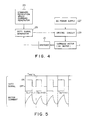
- FIG. 4 is a block diagram showing the conventional control.
- the unit 23 outputs the standard revolution speed signal and the unit 25 generates a duty signal having the duty corresponding to the standard revolution speed.
- the driving circuit 29 converts the voltage from the DC power source 27 into a pulse-shaped driving voltage for supply to the carriage motor 1.
- the 5(A) determines for each PWM standard period T WIDTH , the value of duty T DUTY[n] in each period, and outputs the duty signal.
- the value of the duty T DUTY[n] is generally determined according to the difference between the revolution speed which is detected by the rotary encoder fitted to the shaft of the carriage motor 1 and the standard revolution speed.
- the value of the PWM standard period T WIDTH is constant.
- the duty T DUTY[n] varies.
- the current shown in FIG. 5 flows in the carriage motor 1. Since the torque produced by the DC motor is proportional to the magnitude of the current, such a variation of current causes a periodic pulsation of torque. Consequently, the revolution speed agrees with the standard revolution speed on an average. In actual cases, however, as shown in FIG. 6, it varies over and below the standard revolution speed while generating a minute oscillation of the period identical to the PWM standard period.
- the majority of serial printers have plural speed modes according to the printing density.
- the standard rotation speed With increase of the printing density, the standard rotation speed becomes lower.
- the lower the standard revolution speed the smaller the torque demanded of the carriage motor 1, i.e., the value of the current flowing in the carriage motor 1.
- the counter cmf of the carriage motor 1 is small, and as a result the current peak value is liable to become large, magnifying the periodic pulsation of the torque.
- the standard revolution speed is small as above, despite the small torque as required, a torque more than necessary is produced because of the large current peak value. Such a larger torque than necessary is desired to be eliminated.
- the periodic minute oscillation due to the variation of torque of the carriage motor 1 generates a noise.
- the purpose of this invention is to raise the carriage motor revolution speed quickly up to the standard speed, and to regulate the speed stably with little overshoots and undershoots, thus realizing a further miniaturization of the printer.
- a further object of this invention is to restrict the torque generated according to the speed modes so that the PWM-controlled carriage motor does not develop a torque more than necessary.
- Still a further object of the invention is to reduce the noise caused by the PWM control of the carriage motor, thus realizing a printer of a further low noise.
- This invention provides a control device of the printer carriage motor revolution speed which comprises: means for detecting a revolution speed of the carriage motor; means for generating a standard speed; means for integrating the difference between the detected revolution speed and the standard speed; means responsive to an output value of the integratiomeans for generating a first control signal for controlling the revolution speed to lessen the difference; means for holding, as an optimum integration value, an output value of the integration means at the time when the revolution speed is regulated to the standard speed; means for generating a second control signal having a predetermined value; means for selecting either one of the first and the second control signals; means for controlling the selecting means during an accelerating time of the carriage motor so that the second control signal is selected until the detected revolution speed reaches a predetermined transfer speed, and the first control speed is selected after the transfer speed has been reached; means for loading the held optimum integration value into the integration means so that the output value of the integration means at the time when the detected revolution speed has reached the transfer speed during the carriage motor accelerating time agrees with the held optimum integration value; and
- the carriage motor is accelerated, during the interval from its start to the time when the predetermined transfer speed is reached, according to the secondary control signal having the predetermined value.
- This secondary control signal is desired to have a value that permits acceleration of the carriage motor at a maximum acceleration speed.
- the speed control is performed according to the primary control signal based on the difference between the standard speed and current speed. Since in this control the optimum integration value to make the current speed agree with the standard value is set in the integration means as the initial value, overshoots or undershoots can be suppressed to a small value.
- the optimum integration value is measured in this embodiment by carrying out a trial run at the time of switching the power ON or the time of transferring the speed mode. However, it is also possible to predetermine the optimum integration value in the stage of the printer production and store the value in a non-volatile memory.
- this invention provides a control device comprising: means of detecting the amount of supply current to the carriage motor; and means of limiting the current to be supplied to the motor so that the amount of the detected supply current does not exceed the current limiting value.
- the motor current can be suppressed below the predetermined current limiting value with reference to the standard speed.
- the current limiting value appropriately according to the speed standard, the occurrence of larger torque than necessary can be prevented.
- this invention provides a carriage control device comprising: means generating a fixed fundamental period; means creating a varying period by applying successively variables to the fundamental period; and means performing PWM control of the supply current by using the varying period as the PWM standard period.
- the frequency characteristic of the noise caused by the PWM control takes a form distributed over the variation range of the PWM standard frequency without the appearance of a marked peak in a fixed frequency.
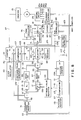
- the standard speed register 31 holds a plurality of standard speeds corresponding to each of a plurality of speed modes and outputs the corresponding standard speed 35 on receipt of a speed mode selecting data 33.
- the standard speed 35 is applied to one of the input terminals of the subtracter 37.
- To the other input terminal of the subtracter 37 the output data 41 of the counter 39 is applied.
- This counter 39 receives clock pulses 45 of a predetermined frequency at its clock terminals CK from the clock oscillator 43, and a pulse signal 47 having a frequency corresponding to the motor revolution speed at its clear terminals from the rotary encoder 13.
- the frequency of the clock pulse 45 is sufficiently high as compared with that of the pulse signal 47.
- the counter 39 counts the number of the clock pulses 45 included in each period of the pulse signals 47 i.e., the current speed of the carriage motor 1, and sends this current speed 41 to the subtracter 37.
- the deviation 49 of the current speed 41 from the standard speed 35 is computed.
- This deviation 49 is sent to the proportional arithmetic unit 15 and integrator 17.
- the proportional arithmetic operation unit 15 performs a proportional operation of gain K1 for the deviation 49, and stores the operation result 51 in the register 53.
- the integrator 17 performs an integration operation of gain K2 for the deviation 49, and stores the operation result 55 in the register 47.
- the output data of the adder 59 shows the duty (corresponds to T DUTY in FIG. 5A) computed by the PI control on the basis of the deviation 49.
- the thus computed duty 61 is applied to one of the input terminals of the selector 63.
- a predetermined duty stored in the duty register 65 is applied to the other input terminal of this selector 63.
- the predetermined duty means, for example, the value corresponding to the duty ratio of 100%, i.e., a value equal to the PWM standard period (equivalent to the PWM standard period (equivalent to the T WIDTH in FIG. 5A).
- the selector 63 selects either one of the duty 61 computed according to the logical value of the output signal of the AND gate 69 and the predetermined duty 67 and sends it to the counter 73.
- the selected duty 71 is applied to the preset terminal P of the counter 73.
- the PWM standard pulse 77 is applied, which is generated from the PWM oscillator 75 for each PWM standard period.
- the count value of the counter 73 is preset to the selected duty 71, and the count-down from the preset duty 71 is carried out in synchronism with the clock pulses 45 from the clock oscillator 43.
- the carry signal 79 is output from the carry-out terminals CO of the counter 73.
- the flip-flop 81 is reset by the PWM standard pulse 77 sent from the PWM oscillator 75. Therefore, the output signal 83 of the flip-flop 81 forms the duty signal 83 having the duty equal to the PWM standard period and the selected duty 71.
- the waveform of the duty signal 81 output from the flip-flop 81 shows a high level during the selected duty 71 alone and a low level during the remaining time within each PWM standard period.
- the duty signal 81 is applied to the distributor 85.
- the distributor 85 distributes the duty signal 81 to the first paired pulses 91a, 91d or 2nd paired pulses 91b, 91c among the 4 driving pulses 91a-91d.
- These driving pulses 91a-91d are sent to the current controller 93, where they are corrected according to the speed mode.
- the corrected driving pulses 95a-95d are applied to the driving circuit 29.
- the driving circuit 29, as shown in FIG. 9, includes the paired switching transistors 97a, 97d which control the current for the positive revolution of the carriage motor 1 and the paired switching transistors 97b, 97c which control the current for the reverse revolution of the carriage motor 1.
- the switching transistors 97a, 97d, 97b, 97c control the amount of current supplied to the motor 1, thereby controlling the revolution speed of the carriage motor 1.
- the selector 63 selects either one of the duty 61 computed by the PI control method or the duty 67 of a fixed value.
- the output signal 70 of the AND gate 69 is determined by the value of the output signal 70 of the AND gate 69.
- the output signal 101 is applied from the flip-flop 99 and the control signal 105 from the initializing controller 103.
- the initializing controller 103 turns the control signal to the low level and also make the carriage run in the predetermined direction for the predetermined interval (for example, the direction of normal revolution of motor 1) by instructing the travel controller 89.
- the run at this time is called a trial run in this specification.
- the output signal 70 of the AND gate 69 is at the low level, and at this time, the selector 63 selects the PI control duty 61. That is, in this trial run, the speed of the carriage motor 1 is controlled by the PI control.
- the position counter 108 counts the position pulse 47 coming from the encoder 13 and detects the current position 111 of the carriage.
- the detected current position 111 of the carriage is input to the comparator 113, where it is compared with the predetermined position 117 from the position register 115.
- the predetermined position 117 the position where the motor speed in the trial run has reached and has been regulated securely to the standard speed is selected.
- a high level signal 119 is applied from the comparator 113 to the strobe terminal ST of the optimum-value register 121.
- the optimum value register 121 accepts the integrated value 55 from the integration circuit 17, and holds it thereafter.
- the integrated value held in the optimum value register 121 is called the optimal integrated value hereunder.
- This optimal integrated value is, in short, the integrated value when the control has become stable in the case of the carriage speed control performed by the PI control method.
- the initializing controller 103 turns the control signal 105 to high level.
- the run controller 89 controls the start, stop and turning direction of the carriage motor 1 according to the instructions 123 from the external host computer.
- the carriage run at this time is called an actual run hereunder. This actual run means the carriage run when the printing is performed following the directions from the host computer.
- the duty selection in the selector 63 is determined by the output signal 101 of the flip-flop 99.
- the flip-flop 99 is set by the signal 125 sent from the run controller 89 each time when printing of each line is started. Thereby the output signal 70 of the AND gate 69 becomes a high level, and the selector 63 selects the fixed duty (a value equivalent to 100% duty ratio) from the duty register 65, so that the acceleration of the carriage motor 1 will be performed with a maximum acceleration.
- the counter 39 detects the current speed, and the detected current speed 41 is sent to the comparator 127 for comparison with the transfer speed 131 sent from the transfer speed generator 129.
- the transfer speed 131 is selected an appropriate value slightly lower than the standard speed 35.
- the flip-flop 99 is reset by the output signal 133 of the comparator 127. Thereby the output signal 70 of the AND gate 69 is switched to a low level, and the selector 63 will select the duty 61 that follows the PI control.
- the output signal 133 from the comparator 127 is applied to the load terminal L of the integrator, and the optimum integrated value 135 is loaded from the optimal register 121 onto the integrator 17 as the initial integrated value. Thereafter the speed control of the carriage motor 1 will be made according to the PI control.
- FIG. 10A The acceleration condition of the carriage motor 1 in the trial run in this embodiment is shown in FIG. 10A, and the acceleration conditions of the same in the actual run is shown in FIG. 10B.
- the speed of the carriage motor 1 in the trial run is controlled by the same PI control the same as in the former case.
- the integrated value in the integrator at this time is stored as the optimum integrated value.
- the travel distance required for the trial run the short distance including that from the start to the predetermined position D2 is sufficient.
- an actual run accompanied by printing is carried out.
- the carriage motor is in the actual run, is accelerated at the maximum acceleration in the region (Area 1) until the motor reaches the transfer speed V1 a little lower than the standard speed.
- the speed control is made by the PI control taking the optimum integrated value as the initial integrated value.
- the motor revolution speed reaches the standard speed in a short time, and further, is regulated stably without overshoots and undershoots, thus contributing to the miniaturization of serial printers.
- FIG. 9 shows the configuration of the current controller 93 in FIG. 8.
- This current controller 93 includes a current limiting value selector circuit 141 and a plurality of transistors 143a-143d corresponding respectively to each speed mode that is selectively turned ON according to the results of the decoding.
- Each of the transistors 143a-143d is connected between the resistors 145a-145d, each having different resistance, and the ground.
- These resistors 145a-145d are connected to each other at the node 149, and between the node 149 and the power supply V CC , a resistor 147 is connected. Therefore, depending on the speed mode as selected, different voltages appear at the node 149.
- the voltage value at this node 149 means the current limiting value that specifies the maximum limit of the current to flow through the motor 1.
- This current limiting value is applied to the comparator 151 where it is compared with the current value of the motor 1 as detected with the resistor 153.
- the gates 155 and 157 for transmitting the driving pulses 91b and 91c to the driving circuit 29 are ON/OFF controlled.
- the output signal of the comparator 151 When the current value of the motor 1 is smaller than the current limiting value, the output signal of the comparator 151 is at a high level, and the gates 155 and 157 open and transmit the driving pulses 91a-91d to the driving circuit 29. Consequently a current is supplied to the motor 1 according to the driving pulses 91a-91d.
- the output signal of the comparator 151 becomes a low level, and the gates 155 and 157 close and obstruct the driving pulses 91b and 91c, thereby interrupting the current supply to the motor.
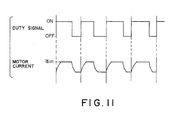
- the motor current is limited to the current limiting value I lim or less.
- the current limiting value in each speed mode is determined by the maximum torque required in each speed mode. the example of this current limiting value is shown in TABLE 1.
- the current limiting value may be changed for each predetermined standard-speed range.
- Limiting the motor current according to the standard current in this way can prevent occurrence of unnecessary torque, and alleviate the oscillation of the carriage driving mechanism caused by the torque variation.
- FIG. 12 shows the configuration of the PWM oscillator in FIG. 8
- This PWM oscillator 75 contains a register 161 that stores the predetermined value of the PWM fundamental period, and a plurality of variable-value latches 165a-165g that store the values of different periodic variables respectively.
- One of these variable-value latches 165a-165g is selected by the decoder 163, and from the selected variable-value latch the periodic variable 167 is output.
- This periodic variable 167 is input to the adder 171 where it is added to the value of the fundamental period 169 from the PWM basic register 161.
- the result of this addition is applied to the preset terminal P of the counter 175 as a value of the PWM standard period 173, and is loaded on to the counter 175 when this counter 175 outputs a carry signal 177.
- the carry signal 177 is, as the PWM standard pulse 77, applied to the counter 73 and the flip-flop 81.
- the carry signal 177 is further sent also to the clock pulse terminal CK of the counter 179, and varies the count value of the counter 179. Then, the decoder 163 selects another variable-value latch and the value of periodic variable 167 changes to another value.
- the PWM standard period is not constant but varies. Therefore, the frequency characteristic of the noise due to the variation of the motor torque in the PWM control does not take a form having a marked peak at a specific frequency, but a form having relative low gentle peaks dispersed over the variation range of the PWM standard period, and therefore its effect on the hearing sense can be alleviated.
- this invention is not to be limited to this embodiment, but includes various deformations within the limits not deviating from its substance.
Landscapes
- Engineering & Computer Science (AREA)
- Power Engineering (AREA)
- Character Spaces And Line Spaces In Printers (AREA)
- Control Of Direct Current Motors (AREA)
- Control Of Electric Motors In General (AREA)
- Control Of Ac Motors In General (AREA)
Abstract
Applications Claiming Priority (9)
| Application Number | Priority Date | Filing Date | Title |
|---|---|---|---|
| JP25820889 | 1989-10-03 | ||
| JP258208/89 | 1989-10-03 | ||
| JP1324190 | 1990-01-23 | ||
| JP13241/90 | 1990-01-23 | ||
| JP90726/90 | 1990-04-05 | ||
| JP9072690 | 1990-04-05 | ||
| JP9601790 | 1990-04-11 | ||
| JP96017/90 | 1990-04-11 | ||
| PCT/JP1990/001275 WO1991004866A1 (fr) | 1989-10-03 | 1990-10-03 | Commande de chariot d'imprimante |
Publications (3)
| Publication Number | Publication Date |
|---|---|
| EP0452497A1 true EP0452497A1 (fr) | 1991-10-23 |
| EP0452497A4 EP0452497A4 (en) | 1993-07-07 |
| EP0452497B1 EP0452497B1 (fr) | 1996-07-17 |
Family
ID=27455951
Family Applications (1)
| Application Number | Title | Priority Date | Filing Date |
|---|---|---|---|
| EP90914760A Expired - Lifetime EP0452497B1 (fr) | 1989-10-03 | 1990-10-03 | Commande de chariot d'imprimante |
Country Status (6)
| Country | Link |
|---|---|
| US (1) | US5207520A (fr) |
| EP (1) | EP0452497B1 (fr) |
| JP (1) | JP3220138B2 (fr) |
| DE (1) | DE69027848T2 (fr) |
| SG (1) | SG47894A1 (fr) |
| WO (1) | WO1991004866A1 (fr) |
Cited By (3)
| Publication number | Priority date | Publication date | Assignee | Title |
|---|---|---|---|---|
| EP0979787A1 (fr) | 1998-08-12 | 2000-02-16 | Aries Packaging | Dispositif pour la constitution de lois d'objets juxtaposés et installation comprenant un tel dispositif. |
| WO2003015255A1 (fr) * | 2001-08-10 | 2003-02-20 | Ebm-Papst St. Georgen Gmbh & Co. Kg | Procede pour commander la commutation dans un moteur a commutation electronique et moteur a commutation electronique permettant la mise en oeuvre de ce procede |
| US11188275B2 (en) | 2015-01-13 | 2021-11-30 | Hewlett-Packard Development Company, L.P. | Anticipating maintenance in a printing device |
Families Citing this family (24)
| Publication number | Priority date | Publication date | Assignee | Title |
|---|---|---|---|---|
| US5400237A (en) * | 1992-05-11 | 1995-03-21 | Simmonds Precision Products, Inc. | PWM inverter controller with waveform memory |
| JP3162486B2 (ja) * | 1992-06-25 | 2001-04-25 | キヤノン株式会社 | プリンタ装置 |
| US5433541A (en) * | 1992-12-15 | 1995-07-18 | Nec Corporation | Control device for controlling movement of a printing head carriage and control method for controlling the same |
| US5627947A (en) * | 1993-10-29 | 1997-05-06 | Hewlett-Packard Company | Variable-duration printer carriage motor acceleration method and apparatus |
| US5645202A (en) * | 1994-07-13 | 1997-07-08 | Kaloustian; John | Collapsible carrier |
| US5739658A (en) * | 1995-03-31 | 1998-04-14 | International Business Machines Corporation | Noise dithering system for transistor switched devices |
| US5997130A (en) * | 1997-05-12 | 1999-12-07 | Lexmark International, Inc. | Asymmetrical acceleration ramp area and method for print cartridge carrier of ink jet printer |
| EP0909014B1 (fr) * | 1997-10-08 | 2002-07-03 | STMicroelectronics S.r.l. | Synchronisation du pilotage en boucle fermée et en boucle ouverte des interrupteurs de phase d'un moteur à courant continu |
| JP3579274B2 (ja) * | 1998-03-09 | 2004-10-20 | 東芝テック株式会社 | シリアルプリンタ |
| JP2000197381A (ja) * | 1998-12-25 | 2000-07-14 | Seiko Epson Corp | Dcモ―タ制御装置及びdcモ―タ制御方法 |
| BR0003627A (pt) * | 1999-08-16 | 2001-04-03 | Xerox Corp | Controle de fusor sem tremulação |
| US6609781B2 (en) | 2000-12-13 | 2003-08-26 | Lexmark International, Inc. | Printer system with encoder filtering arrangement and method for high frequency error reduction |
| DE10105207B4 (de) * | 2001-01-30 | 2010-04-22 | Gebrüder Märklin & Cie. GmbH | Verfahren und Regeleinheit zur Drehzahlregelung eines Gleichstrommotors für Modellfahrzeuge |
| JP3658340B2 (ja) * | 2001-05-17 | 2005-06-08 | キヤノン株式会社 | モータの制御のための方法及び装置 |
| JP3658339B2 (ja) | 2001-05-17 | 2005-06-08 | キヤノン株式会社 | モータの制御のための方法及び装置 |
| JP3472278B2 (ja) | 2001-05-17 | 2003-12-02 | キヤノン株式会社 | 記録装置及び記録制御方法 |
| US6459443B1 (en) | 2001-06-21 | 2002-10-01 | Lexmark International, Inc | Method of minimizing print delay due to mirror motor warm-up in an electrophotographic machine |
| US7215091B2 (en) * | 2003-01-03 | 2007-05-08 | Lexmark International, Inc. | Method for controlling a DC printer motor with a motor driver |
| JP3988757B2 (ja) * | 2004-07-28 | 2007-10-10 | ブラザー工業株式会社 | モータ制御装置、モータ制御方法、及びプログラム |
| KR100599082B1 (ko) * | 2004-12-16 | 2006-07-12 | 삼성전자주식회사 | 제어대상 시스템 모델링 장치 및 그 방법과 시스템모델링을 통한 제어기 설계 시스템 및 그 방법 |
| DE102005043817A1 (de) * | 2005-09-13 | 2007-03-22 | Siemens Ag | Verfahren zum Betreiben einer Kraftstoffpumpe |
| TWI292516B (en) * | 2006-02-17 | 2008-01-11 | Primax Electronics Ltd | Actuating control device |
| US8692493B2 (en) * | 2011-07-08 | 2014-04-08 | Won-Door Corporation | Methods, apparatuses, and systems for speed control of a movable partition |
| JP6373795B2 (ja) * | 2015-05-11 | 2018-08-15 | ミネベアミツミ株式会社 | モータ駆動制御装置、電子機器及びモータ駆動制御装置の制御方法 |
Family Cites Families (14)
| Publication number | Priority date | Publication date | Assignee | Title |
|---|---|---|---|---|
| JPS54106816A (en) * | 1978-02-10 | 1979-08-22 | Toshiba Corp | Control system for ac motor |
| JPS5636678A (en) * | 1979-09-04 | 1981-04-09 | Fuji Photo Optical Co Ltd | Transmission type white color reconstructing wide visual range color hologram and its manufacture |
| GB2101355B (en) * | 1981-04-30 | 1985-01-16 | Rotork Controls | Control of valve actuator |
| US4580084A (en) * | 1981-07-10 | 1986-04-01 | Hitachi, Ltd. | Method and system for controlling speed of electric motor |
| JPS5822592A (ja) * | 1981-08-03 | 1983-02-09 | Hitachi Ltd | モ−タの速度制御方法およびその速度制御装置 |
| JPS6156715A (ja) * | 1984-08-29 | 1986-03-22 | Ishikawajima Harima Heavy Ind Co Ltd | ロ−ルペンデイング方法及び装置 |
| JPH0669311B2 (ja) * | 1984-10-30 | 1994-08-31 | 富士電機株式会社 | 電動機の加減速制御装置 |
| US4777609A (en) * | 1985-12-11 | 1988-10-11 | International Business Machines Corporation | Print head motor control system having steady state velocity compensation |
| JPS63148894A (ja) * | 1986-12-10 | 1988-06-21 | Mitsubishi Electric Corp | Pwmインバ−タの制御装置 |
| JPS63242187A (ja) * | 1987-03-27 | 1988-10-07 | Yokogawa Electric Corp | モ−タの制御装置 |
| DE3713271A1 (de) * | 1987-04-18 | 1988-11-03 | Siemens Ag | Verfahren und einrichtung zur wegregelung eines positionsantriebes |
| JPH01136572A (ja) * | 1987-11-20 | 1989-05-29 | Toyo Electric Mfg Co Ltd | Pwmインバータ |
| JPH01222681A (ja) * | 1988-03-01 | 1989-09-05 | Fujitsu Ltd | プリンタの印字ヘッド駆動制御方式 |
| JP6156715B2 (ja) | 2012-06-28 | 2017-07-05 | 大日本印刷株式会社 | 乾燥装置 |
-
1990
- 1990-10-03 DE DE69027848T patent/DE69027848T2/de not_active Expired - Fee Related
- 1990-10-03 WO PCT/JP1990/001275 patent/WO1991004866A1/fr not_active Ceased
- 1990-10-03 SG SG1996005075A patent/SG47894A1/en unknown
- 1990-10-03 JP JP51366690A patent/JP3220138B2/ja not_active Expired - Fee Related
- 1990-10-03 US US07/689,906 patent/US5207520A/en not_active Expired - Lifetime
- 1990-10-03 EP EP90914760A patent/EP0452497B1/fr not_active Expired - Lifetime
Cited By (5)
| Publication number | Priority date | Publication date | Assignee | Title |
|---|---|---|---|---|
| EP0979787A1 (fr) | 1998-08-12 | 2000-02-16 | Aries Packaging | Dispositif pour la constitution de lois d'objets juxtaposés et installation comprenant un tel dispositif. |
| FR2782312A1 (fr) | 1998-08-12 | 2000-02-18 | Artes Packaging | Dispositif pour la constitution de lots d'objets juxtaposes et installation comprenant un tel dispositif |
| WO2003015255A1 (fr) * | 2001-08-10 | 2003-02-20 | Ebm-Papst St. Georgen Gmbh & Co. Kg | Procede pour commander la commutation dans un moteur a commutation electronique et moteur a commutation electronique permettant la mise en oeuvre de ce procede |
| US6995534B2 (en) | 2001-08-10 | 2006-02-07 | Ebm-Papst St. Georgen Gmbh & Co. Kg | Method of controlling the commutation in an electronically commutated motor, and an electronically commutated motor for carrying out said method |
| US11188275B2 (en) | 2015-01-13 | 2021-11-30 | Hewlett-Packard Development Company, L.P. | Anticipating maintenance in a printing device |
Also Published As
| Publication number | Publication date |
|---|---|
| US5207520A (en) | 1993-05-04 |
| DE69027848D1 (de) | 1996-08-22 |
| WO1991004866A1 (fr) | 1991-04-18 |
| DE69027848T2 (de) | 1997-01-30 |
| JP3220138B2 (ja) | 2001-10-22 |
| EP0452497B1 (fr) | 1996-07-17 |
| SG47894A1 (en) | 1998-04-17 |
| EP0452497A4 (en) | 1993-07-07 |
Similar Documents
| Publication | Publication Date | Title |
|---|---|---|
| US5207520A (en) | Printer carriage acceleration control device | |
| JPWO1991004866A1 (ja) | プリンタのキャリッジ制御装置 | |
| US4599545A (en) | Servomotor controller | |
| DE4113732C2 (de) | Lichtmaschine für Kraftfahrzeuge | |
| US5525874A (en) | Digital slope compensation in a current controller | |
| US4459675A (en) | Printer control system with error count averaging | |
| US5008607A (en) | Driving system for stepping motor | |
| US5485070A (en) | Stepping-motor driving system | |
| CA1191388A (fr) | Regulateur d'impression, a controle d'acceleration et de deceleration | |
| US4591767A (en) | Control system for reciprocating drive motor | |
| US4910448A (en) | PWM circuit | |
| US4516060A (en) | Digital motor speed control | |
| US5034674A (en) | Motor driving voltage control device | |
| US5774626A (en) | Programmable dual-phase digital motor control with sliding proportionality | |
| JPS59185186A (ja) | 複写機の速度制御装置 | |
| US4963801A (en) | Motor driving circuit for selectivity driving different motor types | |
| US5046123A (en) | Error signal detection circuit in a servo control device | |
| JPH01264596A (ja) | ステッピングモータ制御装置 | |
| EP0099977A1 (fr) | Système d'asservissement numérique pour la commande d'un moteur | |
| JP2000108443A (ja) | ステッピングモータの制御方法およびこれを用いた画像形成装置 | |
| JPS63154087A (ja) | モ−タの制御装置 | |
| JP2508213B2 (ja) | 熱転写型プリンタのリボン巻取部駆動装置 | |
| JPS6230475Y2 (fr) | ||
| KR930003556Y1 (ko) | 추적형 더멀 프린트 헤드의 온도 보상회로 | |
| JPS6194580A (ja) | サ−ボ回路 |
Legal Events
| Date | Code | Title | Description |
|---|---|---|---|
| PUAI | Public reference made under article 153(3) epc to a published international application that has entered the european phase |
Free format text: ORIGINAL CODE: 0009012 |
|
| 17P | Request for examination filed |
Effective date: 19910620 |
|
| AK | Designated contracting states |
Kind code of ref document: A1 Designated state(s): DE FR GB IT NL |
|
| A4 | Supplementary search report drawn up and despatched |
Effective date: 19930517 |
|
| AK | Designated contracting states |
Kind code of ref document: A4 Designated state(s): DE FR GB IT NL |
|
| 17Q | First examination report despatched |
Effective date: 19941212 |
|
| GRAH | Despatch of communication of intention to grant a patent |
Free format text: ORIGINAL CODE: EPIDOS IGRA |
|
| GRAA | (expected) grant |
Free format text: ORIGINAL CODE: 0009210 |
|
| ITF | It: translation for a ep patent filed | ||
| AK | Designated contracting states |
Kind code of ref document: B1 Designated state(s): DE FR GB IT NL |
|
| REF | Corresponds to: |
Ref document number: 69027848 Country of ref document: DE Date of ref document: 19960822 |
|
| ET | Fr: translation filed | ||
| PLBE | No opposition filed within time limit |
Free format text: ORIGINAL CODE: 0009261 |
|
| STAA | Information on the status of an ep patent application or granted ep patent |
Free format text: STATUS: NO OPPOSITION FILED WITHIN TIME LIMIT |
|
| 26N | No opposition filed | ||
| REG | Reference to a national code |
Ref country code: GB Ref legal event code: IF02 |
|
| PGFP | Annual fee paid to national office [announced via postgrant information from national office to epo] |
Ref country code: NL Payment date: 20081015 Year of fee payment: 19 Ref country code: DE Payment date: 20081014 Year of fee payment: 19 |
|
| PGFP | Annual fee paid to national office [announced via postgrant information from national office to epo] |
Ref country code: IT Payment date: 20081028 Year of fee payment: 19 |
|
| PGFP | Annual fee paid to national office [announced via postgrant information from national office to epo] |
Ref country code: FR Payment date: 20081014 Year of fee payment: 19 |
|
| PGFP | Annual fee paid to national office [announced via postgrant information from national office to epo] |
Ref country code: GB Payment date: 20081001 Year of fee payment: 19 |
|
| REG | Reference to a national code |
Ref country code: NL Ref legal event code: V1 Effective date: 20100501 |
|
| REG | Reference to a national code |
Ref country code: FR Ref legal event code: ST Effective date: 20100630 |
|
| PG25 | Lapsed in a contracting state [announced via postgrant information from national office to epo] |
Ref country code: NL Free format text: LAPSE BECAUSE OF NON-PAYMENT OF DUE FEES Effective date: 20100501 Ref country code: DE Free format text: LAPSE BECAUSE OF NON-PAYMENT OF DUE FEES Effective date: 20100501 Ref country code: FR Free format text: LAPSE BECAUSE OF NON-PAYMENT OF DUE FEES Effective date: 20091102 |
|
| PG25 | Lapsed in a contracting state [announced via postgrant information from national office to epo] |
Ref country code: GB Free format text: LAPSE BECAUSE OF NON-PAYMENT OF DUE FEES Effective date: 20091003 |
|
| PG25 | Lapsed in a contracting state [announced via postgrant information from national office to epo] |
Ref country code: IT Free format text: LAPSE BECAUSE OF NON-PAYMENT OF DUE FEES Effective date: 20091003 |