EP0452580A1 - Aimant à liant résineux et son procédé de fabrication - Google Patents
Aimant à liant résineux et son procédé de fabrication Download PDFInfo
- Publication number
- EP0452580A1 EP0452580A1 EP90304268A EP90304268A EP0452580A1 EP 0452580 A1 EP0452580 A1 EP 0452580A1 EP 90304268 A EP90304268 A EP 90304268A EP 90304268 A EP90304268 A EP 90304268A EP 0452580 A1 EP0452580 A1 EP 0452580A1
- Authority
- EP
- European Patent Office
- Prior art keywords
- magnet
- resin
- moulding
- magnetic powder
- die
- Prior art date
- Legal status (The legal status is an assumption and is not a legal conclusion. Google has not performed a legal analysis and makes no representation as to the accuracy of the status listed.)
- Granted
Links
Images


Classifications
-
- H—ELECTRICITY
- H01—ELECTRIC ELEMENTS
- H01F—MAGNETS; INDUCTANCES; TRANSFORMERS; SELECTION OF MATERIALS FOR THEIR MAGNETIC PROPERTIES
- H01F41/00—Apparatus or processes specially adapted for manufacturing or assembling magnets, inductances or transformers; Apparatus or processes specially adapted for manufacturing materials characterised by their magnetic properties
- H01F41/02—Apparatus or processes specially adapted for manufacturing or assembling magnets, inductances or transformers; Apparatus or processes specially adapted for manufacturing materials characterised by their magnetic properties for manufacturing cores, coils, or magnets
- H01F41/0253—Apparatus or processes specially adapted for manufacturing or assembling magnets, inductances or transformers; Apparatus or processes specially adapted for manufacturing materials characterised by their magnetic properties for manufacturing cores, coils, or magnets for manufacturing permanent magnets
- H01F41/0273—Imparting anisotropy
-
- Y—GENERAL TAGGING OF NEW TECHNOLOGICAL DEVELOPMENTS; GENERAL TAGGING OF CROSS-SECTIONAL TECHNOLOGIES SPANNING OVER SEVERAL SECTIONS OF THE IPC; TECHNICAL SUBJECTS COVERED BY FORMER USPC CROSS-REFERENCE ART COLLECTIONS [XRACs] AND DIGESTS
- Y10—TECHNICAL SUBJECTS COVERED BY FORMER USPC
- Y10S—TECHNICAL SUBJECTS COVERED BY FORMER USPC CROSS-REFERENCE ART COLLECTIONS [XRACs] AND DIGESTS
- Y10S428/00—Stock material or miscellaneous articles
- Y10S428/90—Magnetic feature
-
- Y—GENERAL TAGGING OF NEW TECHNOLOGICAL DEVELOPMENTS; GENERAL TAGGING OF CROSS-SECTIONAL TECHNOLOGIES SPANNING OVER SEVERAL SECTIONS OF THE IPC; TECHNICAL SUBJECTS COVERED BY FORMER USPC CROSS-REFERENCE ART COLLECTIONS [XRACs] AND DIGESTS
- Y10—TECHNICAL SUBJECTS COVERED BY FORMER USPC
- Y10T—TECHNICAL SUBJECTS COVERED BY FORMER US CLASSIFICATION
- Y10T428/00—Stock material or miscellaneous articles
- Y10T428/13—Hollow or container type article [e.g., tube, vase, etc.]
- Y10T428/1352—Polymer or resin containing [i.e., natural or synthetic]
- Y10T428/1355—Elemental metal containing [e.g., substrate, foil, film, coating, etc.]
-
- Y—GENERAL TAGGING OF NEW TECHNOLOGICAL DEVELOPMENTS; GENERAL TAGGING OF CROSS-SECTIONAL TECHNOLOGIES SPANNING OVER SEVERAL SECTIONS OF THE IPC; TECHNICAL SUBJECTS COVERED BY FORMER USPC CROSS-REFERENCE ART COLLECTIONS [XRACs] AND DIGESTS
- Y10—TECHNICAL SUBJECTS COVERED BY FORMER USPC
- Y10T—TECHNICAL SUBJECTS COVERED BY FORMER US CLASSIFICATION
- Y10T428/00—Stock material or miscellaneous articles
- Y10T428/13—Hollow or container type article [e.g., tube, vase, etc.]
- Y10T428/1352—Polymer or resin containing [i.e., natural or synthetic]
- Y10T428/139—Open-ended, self-supporting conduit, cylinder, or tube-type article
Definitions
- This invention relates to a resin bound type magnet which is used for a miniature motor, an encoder, a linear actuator, etc. which are applied for electronics instruments, etc. and its production process, especially for a cylindrical or a thin plate resin bound type magnet, and its production process by using an extrusion moulding method.
- the resin bound type magnet is generally produced by (1) an injection moulding method, (2) a press moulding method and (3) an extrusion moulding process.
- the injection moulding method is to mould a predetermined shape by packing a magnet composition comprising a magnetic powder and a thermoplastic resin into a die by heating it at a temperature at which a sufficient fluidity is attained.
- the press moulding method is a moulding method by pressing after packing a magnet composition comprising a magnetic powder and a thermosetting resin into a die of a press machine.
- the extrusion moulding method is a moulding method by charging a magnetic composition in a fluidized state by heating a mixture of a magnetic powder and a resin to make it in a molten state by a screw, a ram or a plunger into a die, and by converging it there.
- the injection moulding and the press moulding can mould a magnet having an anisotropy by applying a magnetic field in the die at the moulding step.
- the injection moulding method and a press moulding method for a moulding of a long sized magnet of which demand is recently being increased in case of the injection moulding method because of an impossibility of packing of a magnet composition in a cavity and of taking out a moulded article, etc and in case of the press moulding method since a length of a moulded article is determined by a stroke of a moulding punch, they have a defect that the length of the moulded article is limited.
- the extrusion moulding method which has a very high productivity due to an ability of a continuous operation from a supply of a raw material to a receipt of a moulded article, and is able to easily mould a long sized magnet, becomes popular.
- Both of these methods were to form a magnet by orientating an anix of easy magnetization of a magnetic powder to a direction of a magnetic field by charging a magnetic field in a die of an extrusion machine while a magnet composition was being passed through the die.
- a cylindrical magnet magnetized and orientated in a die was cooled by a cooling unit outside the die, a direction of the anisotropy was only formed in one direction and a moulded article having a radiated anisotropy in a diameter direction could not be obtained.
- thermoplastic resin used as a resin in the aforementioned extrusion moulding method
- the moulding is carried out by a solidification with cooling of a molten mixture after orientating at the front end of the die.
- thermosetting resin used as a resin
- thermosetting resin In case of a method with the solidification with cooling by using the thermosetting resin, it is necessary to heat it to cure the resin after the moulding. Anyhow even if the moulding is done by either methods, a magnet moulded is extruded continuously, and it is necessary to cut the magnet moulded in a predetermined length. For the cut, mechanical cutting methods namely a guillotine cutter system or a rotary saw-tooth system were utilized in the conventional method.
- a force and a vibration are charged to a magnet to be cut.
- a force and a vibration are charged to a magnet to be cut.
- an uncured resin bound type magnet moulded by a solidification with cooling by using a thermosetting resin is cut and a thin thickness magnet characterized by an extrusion moulding is cut, a crack, a breakage and/or a deformation of the magnet are taken place during the cutting because of a brittleness and a weakness of the magnet to be cut.
- a volume ratio of the magnetic powder in a resin bound type magnet is increased in order to improve a performance of the magnet, the volume ratio of the resin decreases and the aforementioned problems tends to happen further easily because of a reduction of bonding force of the resin with the magnetic powder.
- a cut dust is unavoidably produced.
- a treatment of the cut dust is extremely important because cobalt has a bad effect to a human body, and it requires a recovery unit of the cut dust.
- thermosetting resin a press moulding was a general, but an injection moulding and an extrusion moulding were not widely used and a thermoplastic resin was commonly used.
- thermoplastic resin for moulding a magnet by an injection moulding and the extrusion moulding.
- its moulding temperature has to be at 200°C or more. Therefore a magnetic powder blended with the resin is exposed at such a temperature.
- thermoplastic resin has problems on heat resistance and solvent resistance when compared with a thermosetting resin.
- thermosetting resin For a moulding by using the thermosetting resin, it requires that the resin possesses a thermoplastic property in a certain temperature region. Novertheless this temperature region is lower or higher than the thermosetting temperature, it is necessary to secure the shape once moulded in order to cure it.
- the particle size of a magnetic powder gives a large influence to the thickness of a moulded article of an anisotropic resin bound type magnet. Namely if the average particle size of a magnetic powder does not change, an orientation of one magnetic particle affects more to a degree of the orientation of the magnet by thinning the thickness of the moulded article. For example, when an anisotropic magnet with a thickness of 0.5mm is moulded, if the average particle size of the magnetic powder is 50 ⁇ m, the influence that one magnetic particle gives to the orientation is around 10%. Although the influence is reduced if the thickness of the moulded article becomes 0.5mm or more, the influence is enlarged if the thickness becomes thinner. Accordingly as to the average particle size of the magnet, a problem is generated that it should relate to the thickness of the magnet moulded article.
- a rare earth magnet especially a rare earth-iron-boron type magnet was easily oxidized, and there was a problem of a formation of a rust during its service.
- the former method in which a resin is coated on a magnet moulded does not have an effect to an oxidization of the magnetic powder during the moulding.
- the magnetic powder is exposed under a high temperature during kneading of the magnetic powder and the resin or moulding, and the magnetic powder can be oxidized at this stage resulting an impossibility of the moulding and a deterioration of a magnet performance.
- a slight pin hole is present in a coating film after the moulding, there is a problem that the magnet inside it is oxidized from it.
- the latter method in which a metal plating or a coating with a ceramic, a resin, etc on the magnetic powder may be a method to solve the aforementioned problems.
- the average particle size of a magnetic powder is several ten microns, if a film is coated on it, its thickness has to be 1 micron or less, and therefore there is a problem that the film coated has to be extremely tough and strongly adhesive or it has to establish a production process not to remove the film coated.
- a thin plate state resin bound type magnet was mainly produced by a calendar moulding method, an extrusion moulding method and an injection moulding method.
- a mixture kneaded of a magnetic powder and a thermoplastic resin is used and in case of the calendar moulding method, the aforedescribed magnet raw material is made in a thin plate state by rolling with hot rollers.
- This invention is to solve the above-discusssd problems, and its objective is to provide a resin bound type magnet with a high magnet performance, especially a long sized cylindrical resin bound type magnet having a radiated anistropy, and to provide a production process of the magnet with a good productivity.
- the objective is to provide a production process of a magnet with a simple cutting method without a crack, a breakage and a deformation.
- this invention aims to provide a production process with simplifying the production process and with reducing a cost, by improving a magnet performance of a magnet moulded by means of establishing a relation between a magnetic powder and a thickness of the magnet, and by moulding a magnet by an extrusion with superior oxidation resistance and weather resistance.
- this invention aims to provide a production process with a good productivity for a high performance thin plate state resin bound type rare earth magnet.
- Figure 1 is a sketch of an extrusion moulding machine used in Example of this invention.
- Figure 2 is a sketch of a die structure for an extrusion moulding in a magnetic field of a cylindrical resin bound type magnet used in Example of this invention.
- Figure 3 is a sketch of an extrusion moulding machine used in Example of this invention.
- Figure 4 is a sketch of a pulse magnetization unit used in Example of this invention.
- Figure 5 is a graph showing a relation between a magnetic field for the moulding and a residual magnetic flux density of the moulded article for cases with and without a magnetization of a magnetic powder prior to the moulding.
- Figure 6 is a sketch of a die structure for an extrusion moulding in a magnetic field of a thin plate state resin bound type magnet used in Example of this invention.
- Figure 7 is a graph showing a relation between a magnetic field for magnetization before the moulding and a resudial magnetic flux density of the moulded article.
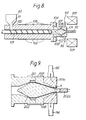
- Figure 8 is a sketch of an extrusion moulding machine used in Example of this invention.
- Figure 9 is a sketch of a die structure for an extrusion moulding in a magnetic field of a cylindrical resin bound type magnet used in Example of this invention.
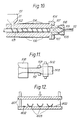
- Figure 10 is a sketch of an extrusion moulding machine used in Example 16 and 17 of this invention.
- Figure 11 is a sketch of Example to cut and to make a thin plate state of a cylindrical resin bound type magnet moulded by an extrusion in Example 16.
- Figure 12 is a sketch of a press unit for moulding of a thin plate state magnet used in Example 17 of this invention.
- This invention is a resin bound type magnet and its production process as described below.
- a ferrite family magnetic powder and a so-called rare earth magnetic powder such as a magnetic powder composing of a rare earth metal and transition metals mainly constituting cobalt and iron as a basic composition, or a magnetic powder composing of a rare earth metal, transition metals mainly constituting iron and boron as a basic composition, etc are enumerated.
- an organic resin which can be applied in this invention, it can be either a thermoplastic resin or a thermosetting resin, and as for the thermoplastic resin, for example, a plastic such as polyamide, polypropylene, polycarbonate, polyphenylenesulphide (PPS), etc, an elastomer such as chlorinated polyethlene, ethylene vinylacetate copolymer (EVA), etc and synthetic rubber are enumerated.
- a plastic such as polyamide, polypropylene, polycarbonate, polyphenylenesulphide (PPS), etc
- PPS polyphenylenesulphide
- EVA ethylene vinylacetate copolymer
- synthetic rubber synthetic rubber
- thermosetting resin for example, ethylene family unsaturated polyester resin, epoxy resin, etc are enumerated.
- a lubricant to reduce an extrusion resistance at the moulding such as a metal soap (zinc stearate, calcium stearate), wax, etc can be used, and as for the aforementioned closslinkable thermosetting resin, an additive such as peroxides which accelerates the closslinking reaction can also be used.
- the magnetic powder is sufficiently mixed with the organic resin and the additive if it is necessary. Then the mixture is sufficiently kneaded in a kneading machine with heating above a temperature at which the organic resin is molten, and it is granulated.
- the magnetic composition granulated is charged in an extrusion machine, it is heated in a cylinder to make it in a fluidized state and is sent into a die by a screw or a plunger.
- the magnetic composition injected in the die is moulded by uniforming (orientating) an axis of easy magnetization of the magnetic powder in the raw material to a direction of a magnetic field by passing through a die in which a magnetic field is charged.
- the magnetic composition is solidified with cooling while it is in the magnetic field formed in the die, and it is extruded.
- the moulded article is then cut into a suitable length.
- a closslinkable organic resin is used as a binder, after a demagnetization of the moulded article cut, a closslinking of the organic resin is achieved by heating or an irradiation (r ray, electron beam, etc). A resin bound type magnet is thus produced.
- the moulded article extruded from the die is demagnetized by charging a magnetic field of a reverse direction to the magnetic field charged in the die at the moulding at a front end of the mandrel.
- the strength of the magnetic field is adjusted by a distance between the mandrel and a yoke of the electromagnetic coil.
- the moulded article extruded from the die is also demagnetized by charging a magnetic field for an attenuation by passing it through an electromagnetic coil for the demagnetization. A cylindrical resin bound magnet is thus produced.
- this invention is useful to facilitate an orientation of a magnetic powder, to improve the magnetic property and to reduce an extrusion resistance at the moulding, and is also beneficial to increase the moulding rate by an application of a ultrasonic osillator or a mechanical vibration such as a vibrator, etc.
- this invention has effects to prevent a delamination of a coated film on the surface of a magnetic powder and to improve an oxidation resistance of the magnet moulded by kneading a mixture of the magnetic powder and a resin after heating it to make a viscosity of the mixture at 300 Kpoise or less prior to the kneading to absorb the molten state resin on the surface of the magnetic powder resulting a relief of a mechanical stress.
- one or plural points on the circumference of the moulded article in a cylindrical form is cut in parallel with the central axis of the moulded article. Then the aforementioned moulded article cut is made in a thin plate state by using, for example, 2 rollers, etc. The moulded article is then solidified with cooling, and is cut into a suitable length.
- one or plural points on the circumference of the moulded article is cut in parallel with the central axis of the moulded article.
- the moulded article cut is heated and it is spread when a viscosity of the moulding article drops to make a thin plate state.
- a magnet of this invention is superior to a conventional magnet, in which plural magnets are sticked, from a viewpoint of a reliability. Furthermore by an application of a production process of this invention,
- the average particle size of the magnetic powder by the thickness of the anisotropic resin bound type magnet moulded article and by moulding the magnet by an extrusion, it is possible to mould a thin thickness anisotropic magnet without a postfabrication, and it is also possible to mould a magnet with a high performance.
- the resin in a molten state is absorbed on the surface of the magnetic powder, and thus it has effects to prevent the coated film on the surface of the magnetic powder by relieving a mechanical stress and to improve an oxidation resistance of the magnet moulded.
- Raw materials were molten to make a composition as Sm (Co 0.672 Cu 0.08 Fe 0.22 Zr 0.028) 8.35, after casting, an ingot produced was magnetically cured by a heat treatment, and then a magnetic powder of its average particle size 10 ⁇ m was prepared by crushing the said ingot.
- the magnetic powder, nylon 12 powder and zinc stearate powder were mixed to make a ratio of 92 wt%, 7.9 wt% and 0.1 wt% respectively.
- the mixture was kneaded by an 2 axes extrusion kneading machine at 260°C.
- the kneaded material was granulated to make granules of an outer diameter 1 - 10mm, they were used as a raw material compound 111, and a cylindrical magnet was produced by an extrusion machine.
- the moulding method is explained in accordance with Figure 1.
- the moulding machine consists of a hopper ie a raw material charging section 101, a cylinder 102, a screw 103, an adapter plate 104 to equip a die at the cylinder 102, a die 105 and a driving motor of the screw (which is not shown in Figure), and further an electromagnetic coil 109 to charge a magnetic field in the die is positioned at the outside of the die 105.
- a yoke 110 comprising a magnetic material is installed around the electromagnetic coil 109.
- the aforementioned granulated raw material compound was charged in the extrusion machine.
- the raw material compound 111 was heated at 260°C in the cylinder 102 to make it in a fluilized state, and it was passed through the die 105.
- the die structure is shown in Figure 2.
- the die is constituted by an outer die 201 and a mandrel 202.
- the outer die is made of a non-magnetic material, a ring shaped outer die section magnetic material 201a to induce a magnetic flux is installed at the front end.
- the mandrel 201 is also made of a non-magnetic material, and further a mandrel section magnetic material 202a is installed at its front end.
- the magnetic field for moulding was 15 KOe
- the temperature of the die at the moulding was 250°C
- the cooling was performed by a forced air cooling at the outlet section of the die.
- an orientated raw material compound was moulded by an extrusion with a solidification with cooling at the outlet of the die.
- the size of the moulded article was the outer diameter 32mm, the inner diameter 30mm, and the length was cut into 22mm.
- the magnets thus produced were assembled in 25 units of DC motor, and a continuous operation test for 500 hours Test 1 was carried out.
- the raw material having the same composition was moulded by an injection in a magnetic field and a cylindrical magnet of the outer diameter 32.5mm, the inner diameter 30mm and the length 6mm was moulded.
- the magnets were assembled in 25 units of DC motor and the 500 hour continuous operation was carried out as same as Test 1. The test results were shown in Table 1.
- Raw materials to make a composition Nd 13 Fe 82.7 B 4.3 were molten, were casted and a quenched ribbon was prepared in an argon atmosphere by using a quenching and a ribbon rolling machine from the ingot obtained.
- the quenched ribbon was coarsely crushed, was charged in a mould and a high temperature press moulding was performed by applying a pressure of 20 Kg/mm2 for a short time at 700 - 800°C in an argon atmosphere.
- a density of the consolidated article was almost 100%.
- the consolidated article was again processed with a high temperature press moulding in a vertical direction to the first pressing direction with a pressure of 10 Kg/mm2 at 700 - 800°C in an argon atmosphere. (namely it was treated with a die upset)
- a bulk magnet obtained was crushed to make a magnetic powder of an average particle size of 20 ⁇ m.
- the magnetic powder was mixed with a resin powder comprising bisphenol A type epoxy, novolak type epoxy and vinylbutyral-vinylalcohol copolymer, calcium stearate powder and silica powder as additives.
- the ratio in the mixture was the magnetic powder 90.3 wt%, the resin powder 9.1 wt% and the additive 0.6 wt%.
- the mixture was kneaded by a 2 roller type mill at 90°C.
- the kneaded mixture was granulated to an outer diamter of 1 - 10mm granules to make a raw material compound and was moulded in a cylindrical magnet by an extrusion machine as same as Example 1, and it was cut and was fired after a demagnetization.
- the size of the moulded article was the outer diameter 22mm and the inner diameter 21mm, and the magnetic field for the moulding was 14 KOe.
- a magnetic powder of an average particle size of 10 ⁇ m was prepared by the same composition and procedure as Example 1.
- a coercive force iHc of this powder was 8 KOe. This is called as Powder A.
- a magnetic powder of an average particle size of 20 ⁇ m was prepared by the same composition and procedure as Example 2.
- a coercive force iHc of this powder was 12 KOe. This is called as Powder B.
- Powder A nylon 12 powder and zinc stearate powder were mixed to make a ratio of 92 wt%, 7.9 wt% and 0.1 wt% respectively.
- Further Powder B was also mixed with the aforementioned resin powder and the additive to make a ratio of 91 wt%, 8.8 wt% and 0.2 wt%.
- the moulding method was the same method as Example 1 and the die structure was also the same to Figure 2 as explained in Example 1.
- the orientation section which is a space between a magnetic material 202a of the mandrel and a magnetic material ring 20/a installed on the outer die. Therefore when a magnetic composition is passing through the orientation section, it is being moulded with a progress of an orientation of the magnetic powder.
- a magnetic field with a reverse direction to the magnetic field in the orientation section is generated in a space between the front end of the mandrel and the yoke 110 of the coil. Therefore a demagnetization of the moulded article can be achieved by making the magnetic field of this space at a suitable strength with an adjustment of a distance between the mandrel and the yoke 110.
- the magnetic field for moulding was 14 KOe
- the temperature of the die at the moulding was 250°C
- the cooling was applied by a forced air cooling to the outlet section of the die.
- the orientated raw material compound 111 was moulded by an extrusion with a solidification with cooling at the outlet of the die. A strength of the demagnetization magnetic field was adjusted to almost the same to the coercive force iHc of the magnetic powder in the moulded article.
- the size of the moulded article was the outer diameter 30mm and the inner diameter 29mm.
- Table 2 surface magnetic flux densities for cases Test 3 and 4 in which the demagnetization was performed, and for cases Test 5 and 6 without the demagnetization and shown.
- a magnetic powder of an average particle size 10 ⁇ m and iHc 8 KOe was prepared by the same composition and procedure as Example 1. This powder is called as Powder A.
- a magnetic powder of an average particle size 20 ⁇ m and a coercive force iHc 12 KOe was prepared by the same composition and procedure as Example 2. This powder is called as Powder B.
- the Powder A was mixed with nylon 12 powder and zinc stearate powder to make a ratio of 92 wt%, 7.9 wt% and 0.1 wt% respectively.
- Powder B was also mixed with the aforementioned resin powder and additive to make a ratio of 91 wt%, 8.8 wt% and 0.2 wt% respectively.
- An extrusion moulding machine of Figure 3 is composed of a similar constitution to an extrusion moulding machine of Figure 1, and an electromagnetic coil 109 is positioned outside a die to charge a magnetic field in the die, but there is a difference ie an electromagnetic coil for demagnetization is installed in front of it.
- the aforementioned granulated raw material compound 111 was charged in the extrusion moulding machine.
- the raw material compound 111 was heated at 260°C in the cylinder 102 to make it in a fluidized state, and it was passed through the die 105.
- the die structure was the same as explained in Example 1. According to this invention, when the magnetic composition is passed through the orientation section, it is moulded with a progress of an orientation of the magnetic powder as same to Example 3.
- the magnetic field for moulding was also 14 KOe
- the temperature of the die at the moulding was 250°C
- the cooling was given by a forced air cooling to the outlet section of the die.
- the orientated raw material compound 111 was moulded by an extrusion by a solidification with cooling at the outlet of the die.
- the demagnetization was carried out by generating a magnetic field for the demagnetization by turning on an attenuated pulse current in the electromagnetic coil 113.
- the strength of the magnetic field for the demagnetization was 30 KOe, and it was attenuated with 800m sec.
- the magnetic field was generated in the electromagnetic coil 113 in every 15 sec, and the demagnetization was carried out continuously.
- the size of the moulded article was the outer diameter 30mm and the inner diameter 29mm.
- Surface magnetic flux densities of the moulded articles for cases in which the demagnetization was performed (Test 7 and 8) and for cases without the demagnetization (Test 9 and 10) are shown in Table 3.
- a magnetic Powder A or Powder B as the same compositions to Example 1 and 2, and Resin a (a thermosetting epoxy resin) or Resin b (a thermoplastic resin nylon 12) were weighed to make a desired volume ratio, were mixed and a sheet state compound was prepared by kneading the mixture by passing it through a gap of a twin roller mill repeatedly after charging it in the mill.
- the kneading temperature of the mixture was at 90°C when Resin a was used and at 250°C when Resin b was used.
- the compound was crushed into particles and was moulded by an extrusion by passing through a cylindrical die by charging it in a screw type extrusion moulding machine.
- a barrel temperature of the extrusion moulding machine was at 130°C for Resin a and at 250°C for Resin b and the die temperature was the moulding temperature for the each case.
- the extrusion rate was 1 mm/sec.
- the outlet temperature of the die was set at a solidification temperature of the composition moulded. This temperature differed by the processes.
- Resin a was used for Process 1 and Process 2
- Process 1 was a process to make the solidification with cooling at the outlet of the die
- Process 2 was a process to make the cure by heating at the front end of the die
- Process 3 was a process to solidify with cooling at the outlet of the die using Resin b.
- the magnets thus produced were cut by method shown in Table 4.
- cutting Method 1 was a cutting method of this invention wherein a current is turned on in a nickrome wire of a diameter of 0.2mm, it is contacted with a magnet when it is heated by the resistance and the magnet is cut by melting with heating.
- the magnet cut was a cylindrical magnet with the outer diameter 30mm and the inner diameter 29mm, and the volume ratio of the magnetic powder was 60 vol %.
- the magnet of Process 1 was the most difficult sample to cut among the magnets of Process 1 - 3 because it was the most brittle. As it is clear from Table 5, the cutting method 1 and the cutting method 3 can be practiced for cutting those magnets, and it is not possible to cut it by the cutting method 2.
- the magnets this time has an outer diameter of 30mm, was a cylindrical magnet and the magnet prepared by Process 1 was used.
- the results of either the magnetic Powder A or B were the same.
- the magnet cut this time had the outer diameter of 30mm and the inner diameter of 29mm, was a cylindrical magnet prepared by Process 1.
- the magnetic powder used was the magnetic Powder A
- the volume ratio of the magnetic powder increases, the volume ratio of the resin decreases accordingly, and the binding strength of the resin to the magnetic powder drops.
- the magnet moulded becomes brittle as the magnetic powder increases. This trend is remarkable in a case of an uncured magnet produced by Process 1. As the volume ratio of the magnetic powder increases, the magnet performance of the magnet is improved, and therefore it is important that the cutting can be carried out even in a case of a large volume ratio of the magnetic powder.
- Cutting Method 1 is a superior method for the cutting of a magnet of the extrusion.
- An uncured cylindrical magnet was produced in accordance with followings to use it for a curing unit of this invention.
- the epoxy resin used had a thermoplastic region of 100 - 150°C in which its viscosity suddenly dropped, and it was cured at a temperature of 200°C.
- the compound prepared was then coarsely crushed and it was charged in a moulding machine.
- the moulding machine an injection moulding machine and an extrusion moulding machine could be used, but the extrusion moulding machine was used here.
- the charged compound was heated at 100 - 150°C in the moulding machine to make it in a molten state, the magnetic powder was orientated in a die, the molten mixture was solidified with cooling as its state and an uncured cylindrical magnet was prepared after a demagnetization.
- the size of the magnet was the outer diameter 32.8mm and the inner diameter 31.8mm, and it was cut to make its length at 100mm.
- Test 11 is the results of the curing process of this invention for a cylindrical magnet. Namely the outer circumference of the uncured cylindrical magnet is fixed by a jig, and the inner circumference is fixed by an elastic material, in this case it was a silicone rubber (hereinafter called as an inner body) expanded with a gas (in this case it was air), and it is cured by heating in an oven.
- an elastic material in this case it was a silicone rubber (hereinafter called as an inner body) expanded with a gas (in this case it was air), and it is cured by heating in an oven.
- Test 12 is a conventional process in which the outer circumference is fixed with a jig, a rotation unit is attached to the jig, and it is cured by heating with a rotation in the circumferential direction.
- Test 13 is a process to cure the cylindrical magnet by heating by placing it in an oven as it is without the fixing.
- thermocuring condition here was at 200°C for one hours in N2 atmosphere.
- the shape in Table was the shape of the magnet after the cure.
- the operability means on easiness of the operation of the unit and its capability for processing a large amount of the sample.
- Test 12 it takes more time for an operation to connect the jig with the rotation unit than an operation of Test 11 to insert the inner body when compared with Test 11 of this invention. Furthermore from a viewpoint of cost, Test 12 is more costy because of the requirement of the rotation unit. Consequently the Test 11 process is a superior process to Test 12 and 13.
- the rotation rate of Test 12 here was 500 rpm. This is the maximum rate which can be practiced by taking the cost into consideration.
- the airpressure of the inner body of Test 11 was 1 atm.
- the magnet before the cure was prepared by somewhat decreasing its dimension accuracy in order to check a correction ability on the dimension by the curing process by heating.
- the powder was mixed with nylon 12 powder and zinc stearate powder to make a ratio of 92 wt%, 7.9 wt% and 0.1 wt% as same to Example 3.
- the mixture was magnetized by a pulse magnetization unit shown in Figure 4 with using a magnetic field of 25 KOe, and it was then kneaded by a two axes extrusion kneading machine at 260°C.
- 301 is an electromagnetic coil
- 322 is a pulse current generation power source
- 303 is a table to adjust a hight of a sample
- 305 is a raw material magnetic powder.
- the kneaded mixture was granulated to particles of the outer diameter of 1 - 10mm to make a raw material compound, and a cylindrical magnet was moulded by using the extrusion moulding machine shown in Figure 1 and the die shown in Figure 2 with a same procedure described above.
- the die temperature at the moulding was 250°C, and a cooling was carried out by a forced air cooling at the outlet of the die.
- an orientated raw material compound was moulded by an extrusion by a solidification with cooling at the outlet of the die.
- the size of the moulded article was the outer diameter 33mm and the inner diameter 32mm.
- Raw materials were molten to make a composition of Sm 0.5 Pr 0.5 (Co 0.672 Cu 0.08 Fe 0.22 Zr 0.028) 8.35, an ingot produced was magnetically cured by a heat treatment after casting, and magnetic powders having an average particle size of 10 ⁇ m were obtained by crushing the said ingot.
- These magnetic powders were magnetized by using a direct current electromagnet unit, and then they were kneaded by a two axes extrusion kneading machine at 260°C.
- the kneaded mixtures were granulated to particles of the outer diameter 1 - 10mm to make a raw material compound, and were moulded by an extrusion into thin plate state magnets by using a die shown in Figure 6.
- the size of the moulded article was the width of 60mm and the thickness of 1mm, and the strength of the magnetic field at the moulding was 12 KOe.
- Raw materials were molten to make a composition of Nd 13 Fe 82.7 B 4.3, were casted, and a quenched ribbon was prepared in argon atmosphere by using a quenching and ribbon rolling machine for the ingot produced.
- the quenched ribbon was coarsely crushed, it was filled in a mould and a high temperature press moulding was carried out in argon atmosphere at 700 - 800°C with a pressure of 20 Kg/mm2 for a short time.
- the consolidated article obtained had a density almost 100%.
- the consolidated article obtained was moulded again by the high temperature press moulding in a vertical direction to the initial pressing direction in argon atmosphere at 700 - 800°C with a 10 Kg/mm2 pressure (Namely, a die upset was carried out).
- a bulk state magnet obtained was crushed and a magnetic powder of an average particle size of 20 ⁇ m was obtained.
- the coercive force of the magnetic powder was 12 KOe.
- the magnetic powder was mixed with a resining powder comprising bisphenol A type epoxy, novolak type epoxy and vinylbutyral-vinylalcohol copolymer, calcium stearate powder and silica powder as additives to make a ratio the magnetic powder 90.3 wt%, the resin powder 9.1 wt% and the additive 0.6 wt% respectively.
- a resining powder comprising bisphenol A type epoxy, novolak type epoxy and vinylbutyral-vinylalcohol copolymer, calcium stearate powder and silica powder as additives to make a ratio the magnetic powder 90.3 wt%, the resin powder 9.1 wt% and the additive 0.6 wt% respectively.
- the mixture was magnetized with a 35 KOe magnetic field by using a pulse magnetization unit and it was kneaded by a 2 roller type mill at 90°C.
- the kneaded mixture was granulated to an outer diameter of 1 - 10mm granules to make a raw material compound and was moulded in a cylindrical magnet by an extrusion machine as same as Example 9.
- the die temperature at the moulding was 140°C, and the strength of the magnetic field for the moulding was 8 KOe,
- the size of the moulded article was the outer diameter 8mm and the inner diameter 6mm.
- the moulded article was cut in a suitable length, was demagnetized and was fired in conditions of 200°C x 45 minutes.
- Test 14 - 15 The magnetic property of the moulded articles obtained in Test 13 - 15 is shown in Table 10.
- Test 14 - 15 the comparative examples were a magnetic property of sample moulded with the magnetic field for the moulding at 8 KOe without the magnetization prior to the moulding (Test 14) and a sample magnetic property moulded with the magnetic field for the moulding at 15 KOe and a die of which the orientation section at the front end was shortened (Test 15).
- a moulding process of this invention is a very effective process for a case in which a high magnetic field for moulding is not attained because of a limitation of a moulded article or a structual problem of a die.
- Powder A and B were prepared by the same composition and procedure to Example 4, they were kneaded with the resin, and cylindrical magnets were moulded by an extrusion moulding machine after granulating the kneaded mixture to particles having the outer diameter 1 - 10mm to make a raw material compound.
- the moulding process is briefed by using Figure 8.
- An extrusion moulding machine of Figure 8 has a similar composition to the extrusion moulding machine of Figure 1. However, at the front end of the die, 4 pieces of ultrasonic oscillator (Langevin type) 114 are installed to generate a slight vibration.
- Langevin type ultrasonic oscillator
- the aforementioned granulated raw material compound 111 was charged to the extrusion moulding machine of Figure 8.
- the raw material compound was heated in the cylinder 102 at 260°C to make it in a fluidized state and it was passed through the die 105.
- the die structure was the same as Figure 2 explained in Example 1.
- the magnetic powder is moulded while it is being orientated when the magnetic composition passes through the orientation section.
- the slight vibration from the ultrasonic oscillator was transmitted to the front end of the die.
- the magnetic field for the moulding was 10 KOe
- the die temperature at the moulding was 205°C
- the cooling was applied by a forced air cooling to the outlet of the die.
- the orientated raw material compound was solidified with cooling at the outlet of the die and was moulded by an extrusion.
- the size of the moulded article was the outer diameter of 25mm and the inner diameter of 23mm.
- Test 16 and 17 are the cases with the slight vibration and Test 18 and 19 are the cases without it.
- the moulding rate is improved by a reduction of the extrusion resistance by the slight vibration.
- the reason of the low magnetic property in comparative examples was that the magnetic powder did not sufficiently orientated because the magnetic field for the moulding which was able to charge was only 10 KOe.
- the moulding process of this invention is a particularly effective process for the case in which a high magnetic field for the moulding can not be attained due to shapes of the die or the moulded article.
- Table 12 shows how much degree of the thickness is mouldable without a post fabrication in each moulding method of an extrusion moulding method, a press moulding method and an injection moulding method.
- Magnets prepared here was ring shaped with the outer diameter of 30mm, and the mouldings were performed with the thickness shown in Table 12.
- the magnetic powder used was Sm - Co family rare earth magnetic powder and as for the resin, nylon 12 was used for the extrusion moulding method and the injection moulding method, and an epoxy resin was used for the press moulding method.
- the mixing ratio of the magnetic powder and the resin was 90 wt% : 10 wt% for the extrusion moulding method and the injection moulding method, and 98 wt% : 2 wt% for the press moulding method.
- the moulding was not be able to perform if the thickness of the magnetic moulded article became thin for the press moulding method and the injection moulding method. This was due to a difficulty to fill the magnetic powder in a cavity if the thickness became thin for a case of the press moulding method, and is case of the injection moulding method, it could also not be moulded because of a difficulty to inject a molten mixture of the magnetic powder and the resin in a cavity.
- a thin thickness magnet can be moulded because it is moulded by continuously flowing a molten mixture of the magnetic powder and the resin and by gradually converging the molten mixture. According it is clear that the extrusion moulding method is an effective method to mould a thin thickness magnet having the thickness of 1mm or less.
- the magnet moulded was a ring shaped magnet of the outer diameter 32.8mm, the inner diameter 31.8mm and the thickness 0.5mm, and it was moulded by an extrusion.
- the compound used comprised 60 vol % of a magnetic powder and 40 vol % of a resin and nylon 12 was used for the resin.
- a rare earth magnet having a composition of Sm (Co 0.672 Cu 0.08 Fe 0.22 Zr 0.028) 8.35 was used, it was adjusted to make the average particle size r for each test of Test 20 - 24 and for comparative examples Test 25 - 27, and the results are shown in Table 13.
- the magnet performance is low.
- the effect of the layer where the said orientation is disordered becomes significant, the thickness of the layer is related with the particle size of the magnetic powder as well, and as the results the average particle size gives an influence to the magnet performance of the magnet.
- the average particle size r of the magnetic powder is 1/10 or less of the thickness of the magnetic moulded article.
- An alloy having a composition of Nd 14 Fe 81 B 5 was molten in a crucible, it was cooled rapidly by a meltspan method and a thin piece was prepared.
- the thin piece was crushed till it had an average particle size of 35 ⁇ m, and treatments shown in Table 14 were processed thereafter.
- Treatment 1 was that after crushing the magnetic powder, a cobalt-phosphorus plating was carried out in a sodium hypophosphite reduced ammonia, alkaline cobalt plating bath, then a chromate treatment was performed by putting the magnetic powder in a potassium dichromate solution and a cobalt plating layer was formed on the magnetic powder.
- Treatment 2 was that pure water adjusted its pH with hydrochloric acid was mixed with tetramethoxysilane to make an approximate molar ratio of 4:1, and a hydrolysis was carried out by adding ethanol to it. After the decomposition and an addition of a surfactant, the magnetic powder was added and was stirred for a predetermined time.
- the magnetic powder was separated from the solution, was dryed and a heat treatment was performed to form SiO2 film on the magnetic powder.
- the magnetic powder and the resin to make a ratio of 60 vol % and 40 vol % were weighed and were mixed, and after the mixing, it was charged in a kneading machine to knead it and a compound was prepared.
- the kneading machine herewith used was a roller mill. Further as for the resin used, 2 kinds of resin were used. One was Resin a which was copolymer mainly comprising a thermosetting type epoxy resin, and the other Resin b was a thermoplastic polyamide resin (nylon 12).
- the moulded article was heated to cure the resin after the moulding.
- a coverage rate was determined by taking a sample before and after each step in the total process.
- the magnetic powder used here was a plating-treated one with the plating thickness of 1 ⁇ m, and the moulding was carried out by an extrusion moulding machine. The results are shown in Table 15.
- the solid resin and magnetic powder are merely mixed, the resin does not give the protection for the coated film, and therefore the coated film is removed by a strong stress to the magnetic powder applied during the kneading.
- the magnetic powders herewith used were that plating-treated of the plating thickness of 1 ⁇ m for Test 28 - 33, and Test 34 thereafter were SiO2 coated.
- Resin a of a thermosetting resin was used for the resin.
- the coverage rate after the kneading was calculated setting the coverage rate before the kneading (after mixing) as 100, and the viscosity was a viscosity at a shear rate 1000 sec ⁇ 1 when the mixture was heated at the temperature indicated.
- the mixture may have the viscosity by heating it. It is clear that the coverage rate is improved when the kneading is performed after heating the mixture to make it in a state in which it has the viscosity. Although the coverage rate of the plated one becomes worse than it of the SiO2 coated one when compared in the same condition because of its weak adhesion of the film, an improvement is seen when the viscosity reaches 300 kpoise, and below it, the coated film was sufficiently protected.
- Test 41 and 42 of the comparative examples were the cases in which the kneading was carried out without heating before the kneading, and Test 39 and 40 of Examles were carried out by heating at 100 kpoise.
- the oxidation resistance was a result after storing the sample in a constant temperature and constant humidity oven at 80°C x 95% for 100 hours.
- Raw materials to make a composition of Sm (Co 0.672 Cu 0.08 Fe 0.22 Zr 0.028) 8.35 were molten, were casted, an ingot produced was magnetically cured by a heat treatment, and then a magnetic powder having an average particle size of 10 ⁇ m was obtained by crushing it.
- the powder was mixed with nylon 12 powder and zinc stearate powder to make a ratio of 92 wt%, 7.8 wt% and 0.1 wt%, respectively.
- the mixture was then kneaded by a two axes extrusion kneading machine at 260°C.
- the kneaded mixture was granulated to particles of the outer diameter of 1 - 10mm to make a raw material compound, and a cylindrical magnet was moulded by an extrusion moulding machine.
- the extrusion moulding machine is constituted by a hopper 101 which is a section of charging material, a cylinder 102, a screw 103, an adaptor plate 104 to install a die to the cylinder section 102, a die 105 and a driving motor for the screw (which is not shown in Figure).
- the aforementioned granulated raw material compound 111 was charged in the extrusion moulding machine.
- the raw material compound 111 was heated in the cylinder 102 at 260°C to make it in a fluidized state, and it was passed through the die 105.
- the die temperature at the moulding was 250°C, and the cooling was carried out by a forced air cooling at the outlet section of the die.
- the size of the moulded article produced was the outer diameter of 33mm and the inner diameter of 32mm.
- the moulded article was made in a thin plate state by a unit shown in Figure 11.
- Figure 11 was a drawing viewed from upside, the cylindrical moulded article 112 extruded from the die 105 was split into two equal sections of the upside and the downside by the cutter 501 installed in front of the die 105, and the bisected moulded articles were moulded into thin plate state magnet by passing between 2 sets of 2 rollers 502 positioned in the rearward of the cutter 501.
- the size of the moulded article was the width of 50mm and the thickness of 1mm.
- the magnetic property of the moulded article obtained is shown in Table 18.
- a thin plate state moulded article was moulded by an extrusion by using a die which was generally used for an extrusion moulding of a thin plate state plastic, and its magnetic property is shown as Test 44.
- the same magnetic powder, nylon 12 powder and zinc stearate powder as Test 43 of Example were mixed to make a ratio of 91.5 wt%, 8.3 wt% and 0.2 wt% respectively, they were kneaded, were granulated, and were moulded for the determination of the magnetic property.
- the size of the moulded article was the same as Test 43.
- the quenched ribbon was crushed and a magnetic powder of an average particle size of 20 ⁇ m was obtained.
- This magnetic powder was mixed with a resin powder comprising bisphenol A type epoxy, novolak type epoxy and vinylbutyral-vinylalcohol copolymer, calcium stearate powder and silica powder as additives to make a ratio of 90.3 wt%, 9.1 wt%, 0.4 wt% and 0.2 wt% respectively.
- the mixture was kneaded by a 2 roller type mill at 90°C.
- the kneaded mixture was granulated to outer diameter of 1 - 10mm particles to make a raw material compound and was moulded in a cylindrical magnet by using the extrusion moulding machine shown in Figure 10 of the aforementioned Example 16.
- one point on the circumference of the moulded article was also cut in parallel with its central axis.
- the moulded article was fired at 200°C for 45 minutes while it was being pressed to make a thin plate state by a press unit shown in Figure 12.
- the press unit shown in Figure 12 is to press a moulded article by moving the press plate 601 located in upper position downward as shown by an arrow.
- the thickness of the moulded article 603 is adjusted by a spacer 602.
- the press unit was placed in a firing furnace, was heated and the aforementioned moulded article was set on the press plate 601.
- a press was carried out to make a thin plate state when the viscosity of the moulded article dropped, and it was further heated to crosslink the organic resin in the moulded article.
- the "Bad" mark in the surface condition means that it is not usable as a magnet because of a formation of cracks on the surface.
- Raw materials to make a composition of Sm (Co 0.672 Cu 0.08 Fe 0.22 Zr 0.028) 8.35 were molten, were casted, an ingot produced was magnetically cured by a heat treatment, and then a magnetic powder having the average particle size of 10 ⁇ m was prepared by crushing the ingot.
- This powder was mixed with nylon 12 powder and zinc stearate powder to make a ratio of 92 wt%, 7.8 wt% and 0.2 wt% respectively.
- the mixture was kneaded by a two axes extrusion kneading machine at 260°C.
- the kneaded mixture was granulated to particles having the outer diameter of 1 - 10mm to make a raw material compound, and a cylindrical magnet was moulded by an extrusion moulding machine shown in Figure 1.
- the moulding method was the same method to Example 1.
- the extrusion moulding machine consists of a hopper 101 ie a raw material charging section, a cylinder 102, a screw 103, an adaptor plate 104 to equip a die at the cylinder, the die 105 and a driving motor for the screw (which is not shown in Figure), and further an electromagnetic coil 109 to charge a magnetic field in the die 105 is positioned at the outside of the die 105.
- 106, 107 and 108 are heaters.
- the aforementioned granulated raw material compound 111 was charged in the extrusion moulding machine.
- the raw material compound was heated in the cylinder 102 at 260°C to make it in a fluidized state, and was passed through the die 105 of which structure was shown in Figure 2.
- the die is constituted by an outer die 201 and a mandrel 202.
- the outer die is made of a non-magnetic material, but a ring shaped magnetic material 201a is installed at the front end to induce a magnetic flux.
- the mandrel 202 is also made of a non-magnetic material, and at its front end a magnetic material 202a is installed as well.
- the magnetic field for the moulding was 15 kOe
- the die temperature at the moulding was 250°C
- the cooling was carried out by a forced air cooling at the outlet section of the die.
- the orientated raw material compound 111 was moulded by an extrusion by a solidification with cooling at the outlet of the die.
- the size of the cylindrical moulded article was the outer diameter of 33mm and the inner diameter of 32mm.
- the moulded article was cut into a suitable length, was demagnetized, and further it was devided into two equal sections in parallel with the central axis of the moulded article.
- the moulded article was then made in a thin plate state by heating at 180°C with a press unit shown in Figure 12.
- the press unit is to press a moulded article 603 by moving the press plate 601 located in upper position downward as shown by an arrow.
- the thickness of the moulded article is adjusted by a spacer 602.
- the press unit was placed in a firing furnace as same as Example 17, was heated and the moulded article was set on the press plate.
- a press was carried out to make a thin plate state when the viscosity of the moulded article dropped, the edges were cut, and finally a thin plate state magnet with the desired size was obtained.
- the size of the moulded article was the width of 50mm and the thickness of 1mm.
- the magnetic property of the moulded article obtained in Test 54 is shown in Table 20.
- Test 55 was carried out by an extrusion moulding by using a die shown in Figure 6, and the magnetic property of the moulded article in a thin plate state is also shown.
- a mouldability is also shown in Table 20 with the magnetic property.
- the comparative example Test 55 showed lower magnetic property. It was considered that it was due to an impossibility to enlarge the magnetic field for the moulding because of the structural problem of the die in case of the comparative example Test 55 resulting an insufficient orientation of the magnetic powder.
- Raw materials to make a composition of Nd 13 Fe 82.7 B 4.3 were molten as similar to Example 17, were casted and a quenched ribbon was prepared in an argon atmosphere by using a quenching and ribbon rolling machine from the ingot obtained.
- the quenched ribbon was coarsely crushed, it was transfered to a mould, and a high pressure press moulding was carried out in an argon atmosphere at 700 - 800°C with a 20 Kg/mm2 pressure for a short time.
- the consolidated article obtained had a density almost 100%.
- the consolidated article obtained was moulded again by the high temperature press moulding in a vertical direction to the first pressing direction in an argon atmosphere at 700 - 800°C with a 10 Kg/mm2 pressure (Namely a die upset was carried out).
- the bulk state magnet was crushed and a magnetic powder of an average particle size of 20 ⁇ m was obtained.
- the magnetic powder was mixed with a resin powder comprising a mixture of bisphenol A type epoxy, novolak type epoxy and vinylbutyral-vinylalcohol copolymer, calcium stearate powder and silica powder as additives to make a ratio of 90.3 wt%, 9.1 wt% and 0.4 wt% and 0.2 wt% respectively.
- the mixture was kneaded by a 2 roller type mill at 90°C.
- the kneaded mixture was granulated to particles of the outer diameter of 1 - 10mm to make a raw material compound, and a cylindrical magnet was moulded by using an extrusion moulding machine shown in Figure 1 and a die shown in Figure 2 as similar to Example 18.
- the moulded article was cut into a suitable length, were demagnetized, and further one point on the circumference parallel to the central axis of the moulded article was cut.
- the moulded article was fired at 200°C for 45 minutes while it was being made in a thin plate state by a press unit similar to Example 18 to crosslink the organic resin in the moulded article.
Landscapes
- Engineering & Computer Science (AREA)
- Power Engineering (AREA)
- Manufacturing & Machinery (AREA)
- Manufacturing Cores, Coils, And Magnets (AREA)
- Hard Magnetic Materials (AREA)
Priority Applications (7)
| Application Number | Priority Date | Filing Date | Title |
|---|---|---|---|
| CA002014975A CA2014975A1 (fr) | 1989-03-24 | 1990-04-19 | Aimant a la resine et procede de fabrication |
| SG1996002596A SG55020A1 (en) | 1990-04-20 | 1990-04-20 | A resin bound type magnet and its production process |
| DE1990633178 DE69033178T2 (de) | 1990-04-20 | 1990-04-20 | Kunstharzgebundener Magnet und dessen Herstellungsverfahren |
| EP90304268A EP0452580B1 (fr) | 1990-04-19 | 1990-04-20 | Aimant à liant résineux et son procédé de fabrication |
| AT90304268T ATE181616T1 (de) | 1990-04-20 | 1990-04-20 | Kunstharzgebundener magnet und dessen herstellungsverfahren |
| CN90102636A CN1056369A (zh) | 1990-04-19 | 1990-05-07 | 树脂粘合型磁体及其生产方法 |
| US08/188,733 US5464670A (en) | 1990-04-13 | 1994-01-31 | Resin bound magnet and its production process |
Applications Claiming Priority (5)
| Application Number | Priority Date | Filing Date | Title |
|---|---|---|---|
| CA002014975A CA2014975A1 (fr) | 1989-03-24 | 1990-04-19 | Aimant a la resine et procede de fabrication |
| SG1996002596A SG55020A1 (en) | 1990-04-20 | 1990-04-20 | A resin bound type magnet and its production process |
| EP90304268A EP0452580B1 (fr) | 1990-04-19 | 1990-04-20 | Aimant à liant résineux et son procédé de fabrication |
| CN90102636A CN1056369A (zh) | 1990-04-19 | 1990-05-07 | 树脂粘合型磁体及其生产方法 |
| US08/188,733 US5464670A (en) | 1990-04-13 | 1994-01-31 | Resin bound magnet and its production process |
Publications (2)
| Publication Number | Publication Date |
|---|---|
| EP0452580A1 true EP0452580A1 (fr) | 1991-10-23 |
| EP0452580B1 EP0452580B1 (fr) | 1999-06-23 |
Family
ID=27508410
Family Applications (1)
| Application Number | Title | Priority Date | Filing Date |
|---|---|---|---|
| EP90304268A Expired - Lifetime EP0452580B1 (fr) | 1989-03-24 | 1990-04-20 | Aimant à liant résineux et son procédé de fabrication |
Country Status (3)
| Country | Link |
|---|---|
| US (1) | US5464670A (fr) |
| EP (1) | EP0452580B1 (fr) |
| CN (1) | CN1056369A (fr) |
Cited By (3)
| Publication number | Priority date | Publication date | Assignee | Title |
|---|---|---|---|---|
| DE19937206A1 (de) * | 1999-06-11 | 2000-12-21 | Siemens Ag | Positionsbestimmungseinrichtung sowie Airbageinrichtung in einem Kraftfahrzeug und Verfahren zum Herstellen eines Magnetstabes für eine solche Einrichtung |
| DE19945619A1 (de) * | 1999-09-23 | 2001-04-19 | Bosch Gmbh Robert | Preßmasse und Verfahren zur Herstellung eines weichmagnetischen Verbundwerkstoffes mit der Preßmasse |
| CN114023551A (zh) * | 2021-10-12 | 2022-02-08 | 横店集团东磁股份有限公司 | 一种各向异性橡胶复合稀土永磁取向成型工艺 |
Families Citing this family (24)
| Publication number | Priority date | Publication date | Assignee | Title |
|---|---|---|---|---|
| US5716461A (en) * | 1996-09-30 | 1998-02-10 | Eastman Kodak Company | Functionally gradient permanent magnet actuators |
| JP4019522B2 (ja) * | 1998-10-13 | 2007-12-12 | セイコーエプソン株式会社 | 焼結体の製造方法 |
| KR100420541B1 (ko) * | 1998-12-07 | 2004-03-02 | 스미토모 긴조쿠 고잔 가부시키가이샤 | 수지 결합형 자석 |
| US6710693B2 (en) * | 2001-03-23 | 2004-03-23 | Nec Tokin Corporation | Inductor component containing permanent magnet for magnetic bias and method of manufacturing the same |
| JP2002359126A (ja) * | 2001-05-30 | 2002-12-13 | Nec Tokin Corp | インダクタンス部品 |
| JP4279757B2 (ja) * | 2004-09-22 | 2009-06-17 | 三菱電機株式会社 | リング型磁石成形体の製造装置およびリング型焼結磁石の製造方法 |
| CN100487830C (zh) * | 2005-01-18 | 2009-05-13 | 横店集团东磁有限公司 | 注塑铁氧体永磁材料配方 |
| CN100483571C (zh) * | 2005-01-20 | 2009-04-29 | 横店集团东磁有限公司 | 复合粘结磁体的配方 |
| US20070069172A1 (en) * | 2005-04-26 | 2007-03-29 | Parker-Hannifin Corporation | Magnetic repulsion actuator and method |
| US7883662B2 (en) * | 2007-11-15 | 2011-02-08 | Viper Technologies | Metal injection molding methods and feedstocks |
| WO2011031473A2 (fr) * | 2009-08-25 | 2011-03-17 | Access Business Group International Llc | Concentrateur de flux et procédé de réalisation d'un concentrateur de flux magnétique |
| US8124187B2 (en) | 2009-09-08 | 2012-02-28 | Viper Technologies | Methods of forming porous coatings on substrates |
| JP2011156664A (ja) * | 2010-01-29 | 2011-08-18 | Showa Corp | 動力伝達系成形品の製造方法及び装置 |
| WO2012057961A2 (fr) | 2010-10-27 | 2012-05-03 | Kraft Foods Global Brands Llc | Paquet contenant des produits et pouvant se fermer magnétiquement |
| DE102011089999A1 (de) * | 2011-12-27 | 2013-06-27 | Robert Bosch Gmbh | Magnetventil, insbesondere Mengensteuerventil einer Kraftstoff-Hochdruckpumpe |
| JP5949051B2 (ja) * | 2012-03-29 | 2016-07-06 | セイコーエプソン株式会社 | 射出成形用組成物および焼結体の製造方法 |
| CN102662075B (zh) * | 2012-04-27 | 2016-01-20 | 安徽中鼎密封件股份有限公司 | 一种多极磁性塑料编码器及其生产工艺 |
| DE102013213494A1 (de) | 2013-07-10 | 2015-01-29 | Volkswagen Aktiengesellschaft | Verfahren zur Herstellung eines Permanentmagneten sowie Permanentmagnet und elektrische Maschine mit einem solchen |
| CN103480839B (zh) * | 2013-10-08 | 2015-12-23 | 镇江宝纳电磁新材料有限公司 | 磁性金属粉末的定向装置 |
| CN106449075A (zh) * | 2016-11-30 | 2017-02-22 | 宁德市星宇科技有限公司 | 一种一次成型钕铁硼辐射环挤压机 |
| JP2018182161A (ja) | 2017-04-18 | 2018-11-15 | Tdk株式会社 | 磁石、磁石構造体、及び、回転角度検出器 |
| CN109830367A (zh) * | 2017-11-23 | 2019-05-31 | 财团法人金属工业研究发展中心 | 磁性线材制造方法及其装置 |
| CN110763568B (zh) * | 2019-11-28 | 2021-05-07 | 大连理工大学 | 一种管材任意方向厚向异性系数的确定方法 |
| CN120190352B (zh) * | 2025-04-01 | 2025-09-23 | 山东大学 | 一种离心辅助固化的径向梯度磁粉分布的粘结磁体的制备方法 |
Citations (7)
| Publication number | Priority date | Publication date | Assignee | Title |
|---|---|---|---|---|
| US3732617A (en) * | 1967-11-21 | 1973-05-15 | R Rowe | Method of producing a tubular magnet |
| GB1373019A (en) * | 1972-07-28 | 1974-11-06 | Johnson R E | Cobalt-based sintered permanent magnets |
| FR2449957A1 (fr) * | 1979-02-23 | 1980-09-19 | Inoue Japax Res | Procede de fabrication d'un elastomere magnetique, et produit ainsi obtenu |
| US4457851A (en) * | 1981-12-29 | 1984-07-03 | Hitachi Metals, Ltd. | Ferrite magnet and method of producing same |
| US4601224A (en) * | 1984-10-05 | 1986-07-22 | Clark Iii William T | Hot wire cutting system |
| EP0255816A2 (fr) * | 1986-08-04 | 1988-02-10 | Treibacher Chemische Werke Aktiengesellschaft | Procédé de préparation de poudre magnétiquement dure, résistant à la corrosion, pour la fabrication d'aimants; aimants fabriqués à partir de poudre magnétiquement dure et leur procédé de fabrication |
| EP0318251A2 (fr) * | 1987-11-27 | 1989-05-31 | Imperial Chemical Industries Plc | Compositions pour la production d'aimants et aimants ainsi produits |
Family Cites Families (11)
| Publication number | Priority date | Publication date | Assignee | Title |
|---|---|---|---|---|
| JPS5980902A (ja) * | 1982-11-01 | 1984-05-10 | Hitachi Metals Ltd | ポンド磁石の製造方法 |
| JPS60217617A (ja) * | 1984-04-13 | 1985-10-31 | Seiko Epson Corp | 円筒状永久磁石の製造方法 |
| JPS60220918A (ja) * | 1984-04-18 | 1985-11-05 | Seiko Epson Corp | 永久磁石の製造方法 |
| JPS61158118A (ja) * | 1984-12-28 | 1986-07-17 | Yamauchi Rubber Ind Co Ltd | マグネツトロ−ルの製造方法 |
| JPS61272914A (ja) * | 1985-05-28 | 1986-12-03 | Seiko Epson Corp | 熱硬化性樹脂結合磁石の製造方法 |
| JPS62273708A (ja) * | 1986-05-21 | 1987-11-27 | Seiko Epson Corp | マグネツトロ−ルの製造方法 |
| JPH0622183B2 (ja) * | 1986-10-28 | 1994-03-23 | 鐘淵化学工業株式会社 | マグネツトロ−ルの製法 |
| JPS63120407A (ja) * | 1986-11-10 | 1988-05-24 | Shin Etsu Chem Co Ltd | プラスチツク磁石の製造方法 |
| JPS63216318A (ja) * | 1987-03-05 | 1988-09-08 | Seiko Epson Corp | 樹脂結合型希土類コバルト磁石の製造方法 |
| JPS6455814A (en) * | 1987-08-26 | 1989-03-02 | Fuji Electrochemical Co Ltd | Manufacture of anisotropic bonding magnet |
| JPH0294411A (ja) * | 1988-09-29 | 1990-04-05 | Tokin Corp | プラスチック磁石の製造方法 |
-
1990
- 1990-04-20 EP EP90304268A patent/EP0452580B1/fr not_active Expired - Lifetime
- 1990-05-07 CN CN90102636A patent/CN1056369A/zh active Pending
-
1994
- 1994-01-31 US US08/188,733 patent/US5464670A/en not_active Expired - Lifetime
Patent Citations (7)
| Publication number | Priority date | Publication date | Assignee | Title |
|---|---|---|---|---|
| US3732617A (en) * | 1967-11-21 | 1973-05-15 | R Rowe | Method of producing a tubular magnet |
| GB1373019A (en) * | 1972-07-28 | 1974-11-06 | Johnson R E | Cobalt-based sintered permanent magnets |
| FR2449957A1 (fr) * | 1979-02-23 | 1980-09-19 | Inoue Japax Res | Procede de fabrication d'un elastomere magnetique, et produit ainsi obtenu |
| US4457851A (en) * | 1981-12-29 | 1984-07-03 | Hitachi Metals, Ltd. | Ferrite magnet and method of producing same |
| US4601224A (en) * | 1984-10-05 | 1986-07-22 | Clark Iii William T | Hot wire cutting system |
| EP0255816A2 (fr) * | 1986-08-04 | 1988-02-10 | Treibacher Chemische Werke Aktiengesellschaft | Procédé de préparation de poudre magnétiquement dure, résistant à la corrosion, pour la fabrication d'aimants; aimants fabriqués à partir de poudre magnétiquement dure et leur procédé de fabrication |
| EP0318251A2 (fr) * | 1987-11-27 | 1989-05-31 | Imperial Chemical Industries Plc | Compositions pour la production d'aimants et aimants ainsi produits |
Non-Patent Citations (11)
| Title |
|---|
| PATENT ABSTRACTS OF JAPAN, vol. 10, no. 359 (E-460)[2416] 03 December 1986; & JP-A-61 158 118 (YAMAUCHI RUBBER IND CO LTD.,) * |
| PATENT ABSTRACTS OF JAPAN, vol. 10, no. 65 (E-388)[2122] 14 March 1986; & JP-A-60 217 617 (SUWA SEIKOSHA K.K.) * |
| PATENT ABSTRACTS OF JAPAN, vol. 10, no. 75 (E-390)[2132] 25 March 1986; & JP-A-60 220 918 (SUWA SEIKOSHA K.K.) * |
| PATENT ABSTRACTS OF JAPAN, vol. 11, no. 127 (E-501)[2574] 21 April 1987; & JP-A-61 272 914 (SEIKO EPSON CORP.,) * |
| PATENT ABSTRACTS OF JAPAN, vol. 12, no. 162 (E-609)[3009] 17 May 1988, & JP-A-62 273 708 (SEIKO EPSON CORP.,) * |
| PATENT ABSTRACTS OF JAPAN, vol. 12, no. 355 (E-661)[3202] 22 September 1988; & JP-A-63 110 616 (KANEGAFUCHI CHEM IND CO LTD.,) * |
| PATENT ABSTRACTS OF JAPAN, vol. 12, no. 367 (E-664)[3214] 30 September 1988; & JP-A-63 120 407 (SHIN ETSU CHEM CO LTD.,) * |
| PATENT ABSTRACTS OF JAPAN, vol. 13, no. 264 (E-774)[3612] 19 June 1989; & JP-A-01 055 814 (FUJI ELECTROCHEM CO LTD.,) * |
| PATENT ABSTRACTS OF JAPAN, vol. 13, no. 5 (E-701)[3353] 09 January 1989; & JP-A-63 216 318 (SEIKO EPSON CORP.,) * |
| PATENT ABSTRACTS OF JAPAN, vol. 14, no. 292 (E-944)[4235] 25 June 1990; & JP-A-02 094 411 (TOKIN CORP.,) 05 April 1990, * |
| PATENT ABSTRACTS OF JAPAN, vol. 8, no. 194 (E-264)[1631] 06 September 1984; & JP-A-59 080 902 (HITACHI KINZOKU K.K.) * |
Cited By (4)
| Publication number | Priority date | Publication date | Assignee | Title |
|---|---|---|---|---|
| DE19937206A1 (de) * | 1999-06-11 | 2000-12-21 | Siemens Ag | Positionsbestimmungseinrichtung sowie Airbageinrichtung in einem Kraftfahrzeug und Verfahren zum Herstellen eines Magnetstabes für eine solche Einrichtung |
| DE19937206C2 (de) * | 1999-06-11 | 2003-05-08 | Siemens Ag | Positionsbestimmungseinrichtung sowie Verwendung einer Positionsbestimmungseinrichtung und Verfahren zum Herstellen eines Maßstabes für eine solche Einrichtung |
| DE19945619A1 (de) * | 1999-09-23 | 2001-04-19 | Bosch Gmbh Robert | Preßmasse und Verfahren zur Herstellung eines weichmagnetischen Verbundwerkstoffes mit der Preßmasse |
| CN114023551A (zh) * | 2021-10-12 | 2022-02-08 | 横店集团东磁股份有限公司 | 一种各向异性橡胶复合稀土永磁取向成型工艺 |
Also Published As
| Publication number | Publication date |
|---|---|
| US5464670A (en) | 1995-11-07 |
| EP0452580B1 (fr) | 1999-06-23 |
| CN1056369A (zh) | 1991-11-20 |
Similar Documents
| Publication | Publication Date | Title |
|---|---|---|
| US5464670A (en) | Resin bound magnet and its production process | |
| EP0831501B1 (fr) | Procede de formation d'aimant a liaison de terres rares | |
| JP2816668B2 (ja) | 磁気異方性樹脂結合型磁石の製造方法 | |
| KR100435610B1 (ko) | 희토류본드자석의제조방법및희토류본드자석 | |
| EP0772211B1 (fr) | Aimant de terre rare à liant, composition magnétique à base de terre rare, et méthode pour produire celui-ci | |
| EP3288043A1 (fr) | Aimant fritté complexe anisotrope contenant du bismuth de manganèse et son procédé de frittage sans pression | |
| JPH11176682A (ja) | ボンド(登録商標)磁石の製造方法 | |
| JP3883138B2 (ja) | 樹脂ボンド磁石の製造方法 | |
| IE901261A1 (en) | A resin bound magnet and its production process | |
| JPH0831677A (ja) | 磁気異方性樹脂結合型磁石の製造方法および磁気異方性樹脂結合型磁石 | |
| JPH09232132A (ja) | 希土類ボンド磁石、希土類ボンド磁石用組成物および希土類ボンド磁石の製造方法 | |
| JP3658868B2 (ja) | 希土類ボンド磁石の製造方法および希土類ボンド磁石 | |
| JP2002237406A (ja) | 磁気異方性樹脂結合型磁石の製造方法 | |
| JPH10189320A (ja) | 異方性磁石合金粉末およびその製造方法 | |
| JP3728924B2 (ja) | ボンド磁石の製造方法 | |
| JPH09186012A (ja) | 磁気異方性樹脂結合型磁石 | |
| JP2002367820A (ja) | 磁石廃材を再利用した希土類ボンド磁石 | |
| Ohmori | Bonded Rare Earth Permanent Magnets | |
| JP7640843B2 (ja) | 圧縮ボンド磁石の製造方法 | |
| JP2001267162A (ja) | 希土類ボンド磁石の製造方法および希土類ボンド磁石 | |
| JPH09129427A (ja) | 希土類ボンド磁石、希土類ボンド磁石用組成物および希土類ボンド磁石の製造方法 | |
| JPH02251111A (ja) | 樹脂結合型希土類磁石の製造方法 | |
| JPH1167567A (ja) | ボンド磁石の製造方法 | |
| JPH1167568A (ja) | ボンド磁石の製造方法 | |
| JP2000348921A (ja) | 等方性ボンド磁石 |
Legal Events
| Date | Code | Title | Description |
|---|---|---|---|
| PUAI | Public reference made under article 153(3) epc to a published international application that has entered the european phase |
Free format text: ORIGINAL CODE: 0009012 |
|
| AK | Designated contracting states |
Kind code of ref document: A1 Designated state(s): AT BE CH DE DK ES FR GB GR IT LI LU NL SE |
|
| 17P | Request for examination filed |
Effective date: 19920208 |
|
| 17Q | First examination report despatched |
Effective date: 19921216 |
|
| RAP1 | Party data changed (applicant data changed or rights of an application transferred) |
Owner name: SEIKO EPSON CORPORATION |
|
| GRAG | Despatch of communication of intention to grant |
Free format text: ORIGINAL CODE: EPIDOS AGRA |
|
| GRAG | Despatch of communication of intention to grant |
Free format text: ORIGINAL CODE: EPIDOS AGRA |
|
| GRAH | Despatch of communication of intention to grant a patent |
Free format text: ORIGINAL CODE: EPIDOS IGRA |
|
| GRAH | Despatch of communication of intention to grant a patent |
Free format text: ORIGINAL CODE: EPIDOS IGRA |
|
| GRAA | (expected) grant |
Free format text: ORIGINAL CODE: 0009210 |
|
| AK | Designated contracting states |
Kind code of ref document: B1 Designated state(s): AT BE CH DE DK ES FR GB GR IT LI LU NL SE |
|
| PG25 | Lapsed in a contracting state [announced via postgrant information from national office to epo] |
Ref country code: IT Free format text: LAPSE BECAUSE OF FAILURE TO SUBMIT A TRANSLATION OF THE DESCRIPTION OR TO PAY THE FEE WITHIN THE PRESCRIBED TIME-LIMIT;WARNING: LAPSES OF ITALIAN PATENTS WITH EFFECTIVE DATE BEFORE 2007 MAY HAVE OCCURRED AT ANY TIME BEFORE 2007. THE CORRECT EFFECTIVE DATE MAY BE DIFFERENT FROM THE ONE RECORDED. Effective date: 19990623 Ref country code: GR Free format text: LAPSE BECAUSE OF NON-PAYMENT OF DUE FEES Effective date: 19990623 Ref country code: SE Free format text: THE PATENT HAS BEEN ANNULLED BY A DECISION OF A NATIONAL AUTHORITY Effective date: 19990623 Ref country code: ES Free format text: THE PATENT HAS BEEN ANNULLED BY A DECISION OF A NATIONAL AUTHORITY Effective date: 19990623 Ref country code: BE Free format text: LAPSE BECAUSE OF FAILURE TO SUBMIT A TRANSLATION OF THE DESCRIPTION OR TO PAY THE FEE WITHIN THE PRESCRIBED TIME-LIMIT Effective date: 19990623 |
|
| REF | Corresponds to: |
Ref document number: 181616 Country of ref document: AT Date of ref document: 19990715 Kind code of ref document: T |
|
| REG | Reference to a national code |
Ref country code: CH Ref legal event code: EP |
|
| REF | Corresponds to: |
Ref document number: 69033178 Country of ref document: DE Date of ref document: 19990729 |
|
| ET | Fr: translation filed | ||
| PG25 | Lapsed in a contracting state [announced via postgrant information from national office to epo] |
Ref country code: DK Free format text: LAPSE BECAUSE OF FAILURE TO SUBMIT A TRANSLATION OF THE DESCRIPTION OR TO PAY THE FEE WITHIN THE PRESCRIBED TIME-LIMIT Effective date: 19990923 |
|
| REG | Reference to a national code |
Ref country code: CH Ref legal event code: NV Representative=s name: PATENTANWAELTE SCHAAD, BALASS, MENZL & PARTNER AG |
|
| PG25 | Lapsed in a contracting state [announced via postgrant information from national office to epo] |
Ref country code: LU Free format text: LAPSE BECAUSE OF NON-PAYMENT OF DUE FEES Effective date: 20000420 |
|
| PLBE | No opposition filed within time limit |
Free format text: ORIGINAL CODE: 0009261 |
|
| STAA | Information on the status of an ep patent application or granted ep patent |
Free format text: STATUS: NO OPPOSITION FILED WITHIN TIME LIMIT |
|
| 26N | No opposition filed | ||
| REG | Reference to a national code |
Ref country code: GB Ref legal event code: IF02 |
|
| PGFP | Annual fee paid to national office [announced via postgrant information from national office to epo] |
Ref country code: DE Payment date: 20070412 Year of fee payment: 18 |
|
| PGFP | Annual fee paid to national office [announced via postgrant information from national office to epo] |
Ref country code: FR Payment date: 20070411 Year of fee payment: 18 |
|
| PG25 | Lapsed in a contracting state [announced via postgrant information from national office to epo] |
Ref country code: DE Free format text: LAPSE BECAUSE OF NON-PAYMENT OF DUE FEES Effective date: 20081101 |
|
| REG | Reference to a national code |
Ref country code: FR Ref legal event code: ST Effective date: 20081231 |
|
| PG25 | Lapsed in a contracting state [announced via postgrant information from national office to epo] |
Ref country code: FR Free format text: LAPSE BECAUSE OF NON-PAYMENT OF DUE FEES Effective date: 20080430 |
|
| PGFP | Annual fee paid to national office [announced via postgrant information from national office to epo] |
Ref country code: NL Payment date: 20090427 Year of fee payment: 20 Ref country code: AT Payment date: 20090415 Year of fee payment: 20 |
|
| PGFP | Annual fee paid to national office [announced via postgrant information from national office to epo] |
Ref country code: CH Payment date: 20090416 Year of fee payment: 20 |
|
| PGFP | Annual fee paid to national office [announced via postgrant information from national office to epo] |
Ref country code: GB Payment date: 20090415 Year of fee payment: 20 |
|
| REG | Reference to a national code |
Ref country code: NL Ref legal event code: V4 Effective date: 20100420 |
|
| REG | Reference to a national code |
Ref country code: CH Ref legal event code: PL |
|
| REG | Reference to a national code |
Ref country code: GB Ref legal event code: PE20 Expiry date: 20100419 |
|
| PG25 | Lapsed in a contracting state [announced via postgrant information from national office to epo] |
Ref country code: NL Free format text: LAPSE BECAUSE OF EXPIRATION OF PROTECTION Effective date: 20100420 |
|
| PG25 | Lapsed in a contracting state [announced via postgrant information from national office to epo] |
Ref country code: GB Free format text: LAPSE BECAUSE OF EXPIRATION OF PROTECTION Effective date: 20100419 |