EP0452676A1 - Champ d'identification de nettoyage - Google Patents
Champ d'identification de nettoyage Download PDFInfo
- Publication number
- EP0452676A1 EP0452676A1 EP91103936A EP91103936A EP0452676A1 EP 0452676 A1 EP0452676 A1 EP 0452676A1 EP 91103936 A EP91103936 A EP 91103936A EP 91103936 A EP91103936 A EP 91103936A EP 0452676 A1 EP0452676 A1 EP 0452676A1
- Authority
- EP
- European Patent Office
- Prior art keywords
- setting
- machine
- elements
- cleaning
- group
- Prior art date
- Legal status (The legal status is an assumption and is not a legal conclusion. Google has not performed a legal analysis and makes no representation as to the accuracy of the status listed.)
- Granted
Links
Images


Classifications
-
- D—TEXTILES; PAPER
- D01—NATURAL OR MAN-MADE THREADS OR FIBRES; SPINNING
- D01G—PRELIMINARY TREATMENT OF FIBRES, e.g. FOR SPINNING
- D01G9/00—Opening or cleaning fibres, e.g. scutching cotton
- D01G9/14—Details of machines or apparatus
- D01G9/18—Arrangements for discharging fibres
-
- D—TEXTILES; PAPER
- D01—NATURAL OR MAN-MADE THREADS OR FIBRES; SPINNING
- D01G—PRELIMINARY TREATMENT OF FIBRES, e.g. FOR SPINNING
- D01G15/00—Carding machines or accessories; Card clothing; Burr-crushing or removing arrangements associated with carding or other preliminary-treatment machines
- D01G15/02—Carding machines
- D01G15/12—Details
- D01G15/36—Driving or speed control arrangements
-
- D—TEXTILES; PAPER
- D01—NATURAL OR MAN-MADE THREADS OR FIBRES; SPINNING
- D01G—PRELIMINARY TREATMENT OF FIBRES, e.g. FOR SPINNING
- D01G7/00—Breaking or opening fibre bales
- D01G7/06—Details of apparatus or machines
- D01G7/10—Arrangements for discharging fibres
Definitions
- the invention is in the field of textile technology and relates to a method for jointly controlling setting means on one or more interrelated flock opening and fiber cleaning machines, and an apparatus for carrying out the method.
- the flake dissolving and fiber cleaning functions in textile cleaning machines are controlled by means of variable parameters, according to the values of which appropriate setting means are set during operation of the machine, if possible in such a way that no machine parts (tools) need to be replaced.
- Such settings according to the parameter values can either be made manually and remotely via a corresponding actuator (e.g. a dial), showing the position of a value or value related to the setting, or automatically using a suitable actuator.
- the parameters for the bale hardness are, for example, the depth of penetration of the removal roller per pass, the protrusion of the individual toothed discs of the removal roller from the associated grate, the speed and Removal devices with two rollers, the penetration depth of the individual roller, that is, all "setting values" for realizing any or more of these mechanical means.
- these parameters concern For example, the distance of the individual grate bar to the imaginary outermost circumferential surface of the firing pin on the cleaning roller, the angular setting of the individual grate bars and the distances to the circumference of the firing pin and the angular position of the grate bars relative to one another, the speed of the cleaning roller and the suction intensity of the amount of air extracted by the screen plates .
- the parameters of a fine cleaning machine, in which intensive flake dissolution takes place are, for example, the distance between the clamping point and the takeover point on the feed roller, the distance from the knife edge to the impact circle, the displacement of the guide plate to the knife, and the speed of the opening roller and, if necessary, the tip density, if this exists Tips can be changed by adjusting (and not only by replacing).
- a fine cleaning machine In the case of a fine cleaning machine, for example, it has settings on machine elements which mainly affect the intensity of the cleaning, and therefore also the mechanical stress on the fibers.
- This is, for example, the distance P4 in Fig. 6, i.e. the distance between the clamping line on the feed trough and the take-over line of the clothing of the opening roller, which distance P4 is set depending on the fiber provenance.
- the distance d (FIG. 5, designated P7 in FIG. 6) of the separating means (knife) to the impact circle of the clothing of the opening roller.
- the tip density z of the carding element and the speed n of the opening roller This means cleaning under stress on the fibers with as little loss of fiber as possible.
- these two groups of parameters differ in the following characteristics.
- the majority of one parameter influences the mechanical load on the fiber, which is proportional to the cleaning intensity. The more intensively cleaning is carried out, the more fiber damage occurs. This gives you the choice between fiber load and degree of purity.
- the majority of the other parameters influence the output from the fiber material, which is proportional to fiber losses (even if recuperation should take place later in another cleaning cycle). This results in the compromise between the degree of purity with fiber loss and the degree of purity with fiber stress.
- the operator Before the cleaning process begins, the operator has the choice of achieving the desired degree of purity with more fiber loss or with more mechanical damage, and during the process, depending on the result, he can use only two, control elements controlling the overall actuation can be changed at any time. In a further expansion stage, these two operating elements can also be activated via a computer control, the computer also selecting the "tables" from the library, fetching them and setting the operating elements. As already mentioned, this makes it possible to easily master very complex, machine-functional relationships through such pre-networking.
- the adjustable functions on a machine or a networked machine group can be manipulated in a higher-level manner as follows: Groups of setting means are combined according to a "jointly acting" function.
- the setting variables of these setting means are entered as parameters in a table, for example in the column of a table.
- Vectors are formed from the rows of the table (or columns), which are given reference numbers. This gives you a number of Indicators, which are arranged according to the effectiveness of the common function.
- These tables (with their vector set) can be linked together to form a higher-level function depending on their respective function.
- a function formed from two tables defines a two-dimensional parameter field, with three tables it is three-dimensional.
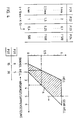
- Fig. 1 shows such an abstract representation of two tables T1 and T2, which represent two parameter groups M1, M2, M3 with one characteristic and P1, P2, P3 with the other characteristic.
- the parameters are arranged in the table column.
- the table rows, each with a value x of all parameters involved in a table, form the parameter vectors, which, in the order in which they appear in the table, are mapped onto an axis of a diagram f 1 and f 2. Since it is a networked system (either a machine or a machine group), these axes can be understood as variables or better as functions that are functionally dependent on each other.
- this is symbolically represented by a group of parameters f2 (f1).
- the crossing points of the parameter vectors of both axes form a matrix of operating points of the machine or machine group and thus define a parameter field or operating point field within which any position can be selected with the aid of a setting of f 1 and f 2.
- This with the setting of only two sizes, namely the vector parameters of one and the other group or table. No other working points can be set outside the given working point field; the field delimits all sensible or possible settings in connection with the tables used.
- Such parameter groupings i.e. the determination of the values x, are determined once (for example at the very beginning of a task for the machine) by means of test series on the machine or a machine type or a machine group.
- the results of the different parameters i.e. the setting parameters on the machine, are defined once so that a cleaning program can be created from them, by means of which the brightness (the lighter the more good fibers in the outlet) of the outlet composition and the cleaning intensity (the more intensive the more fiber damage possible) is primarily selectable.
- the tables in FIGS. 2 and 3 show such an example. This is a proposal for the grouping of group parameters and finally for the formation of a two-dimensional map which frames the adjustable operating conditions, it being irrelevant whether the setting is manual or by means of an actuator system is performed.
- the tendency of the changes in the discharge quantity and their composition and a rough relative change factor of the discharge quantity are known as empirical values. However, this does not say about the absolutely excreted amount (it can vary by factors up to 40 and more), nor about the change factor the composition (which is highly dependent on the material) and the absolute composition of the waste quantity.
- the criterion for forming a first group of setting parameters is the cleaning intensity (table Fig. 2).
- the values of the higher intensity are at the top of the column, the intensity becomes weaker at the bottom.
- the criterion for forming a second group of setting parameters is the exit (table from FIG. 3).
- the table shows two columns with the boundary values of two different parameters P31, P32: displacement s (mm) from guide plate to knife from 0 to 5 (P31); Length l (mm) of the Elimination gap from 15 to 30 (P32).
- the line assignments from 1 to 6 correspond to outgoing vectors with two parameter values. They can be called outgoing vectors, the outgoing vector with the assignment 6 having the largest outgoing value and that with the assignment O having the smallest.
- the two group parameters then each form a group of setting parameters (setting process) with which the cleaning intensity is influenced and with which the finish can be influenced.
- Each group has a set of adjustment vectors, which are determined in test series. The arbitrary assignment of two setting vectors from one group each gives a working point within the entire cleaning program, which can be set with only two setting devices.
- Such a "cleaning program” is shown here in the diagram of FIG. 4.
- Such a diagram can be created either for a machine, or for a machine group, or for an entire system, whereby the complexity will not increase linearly with increasing networking of the individual machine types.
- the indicators or setting elements networked with one another and shown in FIG. 5 are shown.
- the diagram shown here is defined by two group parameters, namely the group of cleaning-intensive adjustment variables and the group of waste-intensive adjustment variables, which variables are divided into vectors of different strengths.
- Crossing points correspond to working points and the hatched area describes a field of all possible working points that can be set on the machine. Working points outside the field cannot be reached because there is at least one setting limit for the machine and this value simply cannot be set.
- the procedure for selecting and using such a cleaning program could then proceed as follows.
- the user of the machine or the system selects the table on the basis of the previously determined average value of the classifying stack (BW fibers, for example, from 7 ⁇ 8 "to 11 ⁇ 2" in 1 ⁇ 2 "steps, which corresponds to a fiber length of 22 mm to 38 mm)
- BW fibers for example, from 7 ⁇ 8 "to 11 ⁇ 2" in 1 ⁇ 2 "steps, which corresponds to a fiber length of 22 mm to 38 mm
- the degree of soiling of the cotton to be cleaned he selects a degree of cleaning intensity within the hatched program field that is considered correct for the fibers to be cleaned (mechanical stress on the fibers) and then selects the relative number for the finish based on the cross-linked tables, a working point is set within the hatched area that meets these conditions.
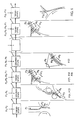
- Figures 5 and 6 show the adjustable individual functions on a fine cleaning machine.
- An opening roller with a number of peripherally arranged cleaning elements which can be viewed as cleaning stages over time, can be seen schematically. This is shown again in a clear linear representation in FIG. 6.
- Each of the parameters P1 to P11 relates to an adjustable machine element within the cleaning stage (see also the CH patent application 3452 / 89-8).
- a light arrow for the outlet and a dark arrow for the material passage are shown at each cleaning stage.
- the parameters which act "intensely" on the fibers are e.g. in levels 2, 3, 4, 6 and the parameters with an "intensive" effect on the exit are e.g. in levels 3, 7. It can be seen that both parameter types can be present in the same cleaning level and that it is important to combine the settings of the same (desired) function type and not the cleaning levels.
- the setting parameters are summarized in two groups and shown as tables.
- the group of cleaning intensity includes a parameter P71, namely the drum speed in rpm from 600 to 1000.
- the group of the discharge quantity also includes a parameter P72, namely the grate bar angle ⁇ ° from 0 to 20.
- Networking with three function types also remains manageable if one of these three is designed in such a way that it only requires a choice and no setting.
- An example would be a table stating provenances. This three-dimensional parameter map (provenance / intensity / departure) would be recorded on a provenance and the other two parameters, which define a two-dimensional field with the working points, would be set via an operating element. But it could be quickly and safely switched to another provenance and the associated tables for the other two controls or indicators would be assigned accordingly.
- This example shows that the procedure for forming and applying group parameters can also be used consistently in simpler systems. This is not insignificant, because in groups of machine groups (and no longer just individual machines) machines of a simple type, that is machines with little to no parameter networking, and above all, can be included in the higher-level system.
- the example of the coarse cleaning machine shows that even criteria as to how a machine works in relation to another machine can be taken into account, and that the table formation and the elimination of parameter vectors are also valid for a single parameter and thus each machine is included in the concept can.
- the control of entire systems is done with optimization by a higher-level computer program, from which no system part then has to be specially treated.
- bale opener An example of a bale opener
- bale opener although assigned to the blow room in terms of process technology, is not a cleaning machine, but a disintegrating machine.
- the card (not shown here) can be displayed with the help of a three-dimensional parameter field, i.e. with the same table technique as for the machines discussed above (also valid for machine groups) in a "room” with working points in which the cleaning intensity, the relative amount of waste and the Card intensity represents a property group with the associated parameter vectors.
- the cleaning intensity is given, for example, by a clamping distance analogous to the clamping distance denoted by P4 in FIG. 6 and / or by the speed of the beater roller, while the delivery quantity is given, for example, by the position of the cleaning knives set on the beater roller and the carding intensity, for example by the distance between the carding elements and the drum set, as well as, where changeable, by changing the tooth density of the carding elements.
- These setting options in the three groups are only to be understood as an example; Of course, much more of these can be summarized. In this way, for example, the nit level can be predefined and the cleaning intensity or the discharge can then be selected analogously to the procedure for a two-dimensional parameter field. Despite the possible variety of setting sizes, such settings are simple and manageable. Here, too, a complex process can be optimally operated using simple means.
- the manufacturing process can be "tabulated" down to the card sliver, whereby further tables with parameter vectors can be derived from tables, for example a summarized optimized cleaning intensity and discharge for the entire system in addition to the tables for bale hardness and nit level.
- This procedure is ideally suited for computer-controlled operation with table libraries (the indicators are set automatically). However, it is also suitable for manual operation (the indicators are set on controls), which would no longer be possible in a tabular form.
- the tabulated form is understood to mean the machine or system setting based on parameter vectors derived from the tables.
Landscapes
- Engineering & Computer Science (AREA)
- Textile Engineering (AREA)
- Preliminary Treatment Of Fibers (AREA)
Applications Claiming Priority (2)
| Application Number | Priority Date | Filing Date | Title |
|---|---|---|---|
| CH95790 | 1990-03-22 | ||
| CH957/90 | 1990-03-22 |
Publications (2)
| Publication Number | Publication Date |
|---|---|
| EP0452676A1 true EP0452676A1 (fr) | 1991-10-23 |
| EP0452676B1 EP0452676B1 (fr) | 1998-12-16 |
Family
ID=4199109
Family Applications (1)
| Application Number | Title | Priority Date | Filing Date |
|---|---|---|---|
| EP91103936A Expired - Lifetime EP0452676B1 (fr) | 1990-03-22 | 1991-03-14 | Champ d'identification de nettoyage |
Country Status (3)
| Country | Link |
|---|---|
| US (2) | US5181295A (fr) |
| EP (1) | EP0452676B1 (fr) |
| DE (1) | DE59109076D1 (fr) |
Cited By (2)
| Publication number | Priority date | Publication date | Assignee | Title |
|---|---|---|---|---|
| US5181295A (en) * | 1990-03-22 | 1993-01-26 | Maschinenfabrik Rieter Ag | Method of controlling machines for cleaning of fibers |
| DE19630018A1 (de) * | 1996-07-25 | 1998-01-29 | Rieter Ag Maschf | Anlage zum Verarbeiten von Fasern |
Families Citing this family (14)
| Publication number | Priority date | Publication date | Assignee | Title |
|---|---|---|---|---|
| WO1996011292A2 (fr) * | 1994-10-10 | 1996-04-18 | Carding Specialists (Canada) Limited | Systeme de controle de dechets de cardage |
| DE59710155D1 (de) * | 1996-04-12 | 2003-07-03 | Rieter Ag Maschf | Sensor für den Kardierspalt bzw. Nachstellen des Kardierspaltes |
| EP0810309B1 (fr) | 1996-05-20 | 2004-09-29 | Maschinenfabrik Rieter Ag | Installation pour le traitement de fibres |
| DE19651893B4 (de) * | 1996-12-13 | 2006-10-05 | TRüTZSCHLER GMBH & CO. KG | Verfahren und Vorrichtung an einer Karde zur Verarbeitung von Textilfasern z. B. Baumwolle, Chemiefasern u. dgl. |
| US6145166A (en) * | 1997-07-30 | 2000-11-14 | Maschinenfabrik Rieter Ag | Trash elimination apparatuses for fiber cleaning aggregates |
| EP0894878A3 (fr) | 1997-07-30 | 2000-04-19 | Maschinenfabrik Rieter Ag | Nettoyeur de flocons |
| DE50005500D1 (de) | 1999-11-24 | 2004-04-08 | Rieter Ag Maschf | Selektive Reinigungslinie |
| EP1167590A3 (fr) * | 2000-06-23 | 2002-09-11 | Maschinenfabrik Rieter Ag | Mesure de la longeur de fibres |
| DE10230603B4 (de) * | 2002-07-08 | 2017-06-14 | Trützschler GmbH & Co Kommanditgesellschaft | Verfahren und Vorrichtung an einer Spinnereivorbereitungsmaschine, z.B. Reiniger, Öffner, Karde o. dgl., zur Reinigung von Fasergut |
| DE10231829B4 (de) * | 2002-07-15 | 2019-12-12 | Trützschler GmbH & Co Kommanditgesellschaft | Vorrichtung an einer Karde, Krempel, Reinigungsmaschine o. dgl. für Baumwolle mit mindestens einem Abscheidemesser |
| CH697063A5 (de) * | 2003-04-03 | 2008-04-15 | Truetzschler Gmbh & Co Kg | Vorrichtung an einer Spinnereivorbereitungsmaschine, z.B. Reiniger, Öffner oder Karde, zur Erfassung von aus Fasermaterial, z. B. Baumwolle, ausgeschiedenem, aus Fremdstoffen und Gutfasern b |
| WO2005087994A1 (fr) * | 2004-03-18 | 2005-09-22 | Maschinenfabrik Rieter Ag | Cuve de nettoyage |
| US20050217076A1 (en) * | 2004-04-02 | 2005-10-06 | Gvili Michael E | Apparatus and method for controlling the amount of trash in lint |
| ITUB20160392A1 (it) * | 2016-01-26 | 2017-07-26 | Saldarini 1882 S R L | Metodo di riempimento di un capo di abbigliamento imbottito e giubbotto imbottito |
Citations (4)
| Publication number | Priority date | Publication date | Assignee | Title |
|---|---|---|---|---|
| FR2612206A1 (fr) * | 1987-03-13 | 1988-09-16 | Truetzschler & Co | Dispositif et procede de mise en oeuvre pour ameliorer le processus de cardage d'une carde |
| GB2210907A (en) * | 1987-10-09 | 1989-06-21 | Hollingsworth Gmbh | Controlling cleaning and opening fibres |
| EP0331039A2 (fr) * | 1988-03-02 | 1989-09-06 | Gebrüder Loepfe Ag | Dispositif pour la détection de boulochage dans un matériau textile fibreux cardé |
| DE3906508A1 (de) * | 1988-03-01 | 1989-09-14 | Murata Machinery Ltd | Qualitaetssteuervorrichtung fuer eine spinnerei |
Family Cites Families (5)
| Publication number | Priority date | Publication date | Assignee | Title |
|---|---|---|---|---|
| DE2944428C2 (de) * | 1979-11-03 | 1984-08-30 | Trützschler GmbH & Co KG, 4050 Mönchengladbach | Vorrichtung zur Produktionssteuerung und Bandregulierung einer Karde |
| AU636884B2 (en) * | 1989-05-23 | 1993-05-13 | Maschinenfabrik Rieter A.G. | Optimisation of cleaning |
| EP0409772A1 (fr) * | 1989-07-18 | 1991-01-23 | Maschinenfabrik Rieter Ag | Procédé de traitement optimal des fibres textiles d'une provenance différente |
| DD299322A5 (de) * | 1989-09-21 | 1992-04-09 | Maschinenfabrik Rieter Ag,Ch | Verfahren und vorrichtung zur feinreinigung von textilfasern |
| EP0452676B1 (fr) * | 1990-03-22 | 1998-12-16 | Maschinenfabrik Rieter Ag | Champ d'identification de nettoyage |
-
1991
- 1991-03-14 EP EP91103936A patent/EP0452676B1/fr not_active Expired - Lifetime
- 1991-03-14 DE DE59109076T patent/DE59109076D1/de not_active Expired - Fee Related
- 1991-03-22 US US07/673,418 patent/US5181295A/en not_active Expired - Lifetime
-
1992
- 1992-11-12 US US07/974,936 patent/US5361458A/en not_active Expired - Fee Related
Patent Citations (4)
| Publication number | Priority date | Publication date | Assignee | Title |
|---|---|---|---|---|
| FR2612206A1 (fr) * | 1987-03-13 | 1988-09-16 | Truetzschler & Co | Dispositif et procede de mise en oeuvre pour ameliorer le processus de cardage d'une carde |
| GB2210907A (en) * | 1987-10-09 | 1989-06-21 | Hollingsworth Gmbh | Controlling cleaning and opening fibres |
| DE3906508A1 (de) * | 1988-03-01 | 1989-09-14 | Murata Machinery Ltd | Qualitaetssteuervorrichtung fuer eine spinnerei |
| EP0331039A2 (fr) * | 1988-03-02 | 1989-09-06 | Gebrüder Loepfe Ag | Dispositif pour la détection de boulochage dans un matériau textile fibreux cardé |
Cited By (3)
| Publication number | Priority date | Publication date | Assignee | Title |
|---|---|---|---|---|
| US5181295A (en) * | 1990-03-22 | 1993-01-26 | Maschinenfabrik Rieter Ag | Method of controlling machines for cleaning of fibers |
| US5361458A (en) * | 1990-03-22 | 1994-11-08 | Maschinenfabrik Rieter Ag | Apparatus for controlling machines for cleaning of fibers |
| DE19630018A1 (de) * | 1996-07-25 | 1998-01-29 | Rieter Ag Maschf | Anlage zum Verarbeiten von Fasern |
Also Published As
| Publication number | Publication date |
|---|---|
| DE59109076D1 (de) | 1999-01-28 |
| US5361458A (en) | 1994-11-08 |
| US5181295A (en) | 1993-01-26 |
| EP0452676B1 (fr) | 1998-12-16 |
Similar Documents
| Publication | Publication Date | Title |
|---|---|---|
| EP0452676B1 (fr) | Champ d'identification de nettoyage | |
| DE19822886B4 (de) | Regulierstreckwerk für einen Faserverband, z. B. Baumwolle, Chemiefasern o. dgl. mit mindestens einem Verzugsfeld | |
| EP0399315B1 (fr) | Opération de nettoyage optimal | |
| CH659663A5 (de) | Verfahren und vorrichtung zur steuerung und regelung der maschinen einer spinnereivorbereitungsanlage. | |
| EP0099482A1 (fr) | Machine de cardage | |
| DD297463A5 (de) | Verfahren zum mischen von textilfasern | |
| DE2426320A1 (de) | Verfahren zur regelung einer variablen in einem fertigungsprozess sowie eine vorrichtung zur durchfuehrung dieses verfahrens, insbesondere bei der glasherstellung | |
| DE10230603B4 (de) | Verfahren und Vorrichtung an einer Spinnereivorbereitungsmaschine, z.B. Reiniger, Öffner, Karde o. dgl., zur Reinigung von Fasergut | |
| EP0481302A2 (fr) | Grille pour un cylindre d'ouverture d'un métier à filer | |
| DE4321332C2 (de) | Verfahren und Vorrichtung zum kontinuierlichen Einfärben von Textilfäden | |
| DE19923802B4 (de) | Rundstrickmaschine zur Herstellung von Strickwaren mit wahlweise unterschiedlichen Eigenschaften und Verfahren zu ihrer Einstellung | |
| DE3244619C2 (de) | Vorrichtung zur Regelung einer aus mehreren Teilbereichen bestehenden Spinnereivorbereitungsanlage | |
| EP0431379A1 (fr) | Procédé et appareil pour le nettoyage ou cardage des fibres textiles | |
| EP0662538A1 (fr) | Etoffe de distance, procédé pour sa fabrication et métier à tricoter à la chaîne pour la mise en oeuvre de ce procédé | |
| DE68921613T2 (de) | Vorrichtung zum Öffnen und Mischen von Baumwollfasern. | |
| EP3460113B1 (fr) | Procédé de fonctionnement d'un métier à mailles jetées et métier à mailles jetées | |
| DE10327370A1 (de) | Verfahren und Vorrichtung zum Anspinnen eines Fadens in einer Offenend-Spinnvorrichtung | |
| CH711685A1 (de) | Wanderdeckelkarde. | |
| DE60109712T2 (de) | Deckelkard mit Mehrfachzufuhr von Fasern | |
| EP0312805A1 (fr) | Commande de production | |
| DE3904853C2 (fr) | ||
| DE4417222C2 (de) | Vorrichtung zur kontinuierlichen Einstellung der Fühlerempfindlichkeit bei der Steuerung des Schußeintrags in einer Webmaschine | |
| DE3047017C2 (de) | Verfahren zur Erhöhung des spezifischen Volumens bei der Aufbereitung von Altpapierstoff | |
| WO2007022658A1 (fr) | Systeme d'alimentation en flocons | |
| DE69805152T2 (de) | Speisevorrichtung für Fasermatten in Deckelkarden |
Legal Events
| Date | Code | Title | Description |
|---|---|---|---|
| PUAI | Public reference made under article 153(3) epc to a published international application that has entered the european phase |
Free format text: ORIGINAL CODE: 0009012 |
|
| 17P | Request for examination filed |
Effective date: 19910819 |
|
| AK | Designated contracting states |
Kind code of ref document: A1 Designated state(s): CH DE FR GB IT LI |
|
| 17Q | First examination report despatched |
Effective date: 19930826 |
|
| GRAG | Despatch of communication of intention to grant |
Free format text: ORIGINAL CODE: EPIDOS AGRA |
|
| GRAH | Despatch of communication of intention to grant a patent |
Free format text: ORIGINAL CODE: EPIDOS IGRA |
|
| GRAH | Despatch of communication of intention to grant a patent |
Free format text: ORIGINAL CODE: EPIDOS IGRA |
|
| GRAA | (expected) grant |
Free format text: ORIGINAL CODE: 0009210 |
|
| AK | Designated contracting states |
Kind code of ref document: B1 Designated state(s): CH DE FR GB IT LI |
|
| PG25 | Lapsed in a contracting state [announced via postgrant information from national office to epo] |
Ref country code: FR Free format text: LAPSE BECAUSE OF FAILURE TO SUBMIT A TRANSLATION OF THE DESCRIPTION OR TO PAY THE FEE WITHIN THE PRESCRIBED TIME-LIMIT Effective date: 19981216 |
|
| REG | Reference to a national code |
Ref country code: CH Ref legal event code: EP |
|
| REF | Corresponds to: |
Ref document number: 59109076 Country of ref document: DE Date of ref document: 19990128 |
|
| ITF | It: translation for a ep patent filed | ||
| GBT | Gb: translation of ep patent filed (gb section 77(6)(a)/1977) |
Effective date: 19990225 |
|
| EN | Fr: translation not filed | ||
| PLBE | No opposition filed within time limit |
Free format text: ORIGINAL CODE: 0009261 |
|
| STAA | Information on the status of an ep patent application or granted ep patent |
Free format text: STATUS: NO OPPOSITION FILED WITHIN TIME LIMIT |
|
| 26N | No opposition filed | ||
| PGFP | Annual fee paid to national office [announced via postgrant information from national office to epo] |
Ref country code: GB Payment date: 20010222 Year of fee payment: 11 |
|
| REG | Reference to a national code |
Ref country code: GB Ref legal event code: IF02 |
|
| PG25 | Lapsed in a contracting state [announced via postgrant information from national office to epo] |
Ref country code: GB Free format text: LAPSE BECAUSE OF NON-PAYMENT OF DUE FEES Effective date: 20020314 |
|
| GBPC | Gb: european patent ceased through non-payment of renewal fee |
Effective date: 20020314 |
|
| REG | Reference to a national code |
Ref country code: FR Ref legal event code: RN |
|
| PGFP | Annual fee paid to national office [announced via postgrant information from national office to epo] |
Ref country code: CH Payment date: 20070314 Year of fee payment: 17 |
|
| REG | Reference to a national code |
Ref country code: CH Ref legal event code: PL |
|
| PG25 | Lapsed in a contracting state [announced via postgrant information from national office to epo] |
Ref country code: CH Free format text: LAPSE BECAUSE OF NON-PAYMENT OF DUE FEES Effective date: 20080331 Ref country code: LI Free format text: LAPSE BECAUSE OF NON-PAYMENT OF DUE FEES Effective date: 20080331 |
|
| PGFP | Annual fee paid to national office [announced via postgrant information from national office to epo] |
Ref country code: DE Payment date: 20090320 Year of fee payment: 19 Ref country code: IT Payment date: 20090325 Year of fee payment: 19 |
|
| PG25 | Lapsed in a contracting state [announced via postgrant information from national office to epo] |
Ref country code: DE Free format text: LAPSE BECAUSE OF NON-PAYMENT OF DUE FEES Effective date: 20101001 |
|
| PG25 | Lapsed in a contracting state [announced via postgrant information from national office to epo] |
Ref country code: IT Free format text: LAPSE BECAUSE OF NON-PAYMENT OF DUE FEES Effective date: 20100314 |