EP0453310B1 - Masque pour photolithographie - Google Patents
Masque pour photolithographie Download PDFInfo
- Publication number
- EP0453310B1 EP0453310B1 EP91303545A EP91303545A EP0453310B1 EP 0453310 B1 EP0453310 B1 EP 0453310B1 EP 91303545 A EP91303545 A EP 91303545A EP 91303545 A EP91303545 A EP 91303545A EP 0453310 B1 EP0453310 B1 EP 0453310B1
- Authority
- EP
- European Patent Office
- Prior art keywords
- transparent
- substrate
- mask
- pattern
- film
- Prior art date
- Legal status (The legal status is an assumption and is not a legal conclusion. Google has not performed a legal analysis and makes no representation as to the accuracy of the status listed.)
- Expired - Lifetime
Links
Images
Classifications
-
- G—PHYSICS
- G03—PHOTOGRAPHY; CINEMATOGRAPHY; ANALOGOUS TECHNIQUES USING WAVES OTHER THAN OPTICAL WAVES; ELECTROGRAPHY; HOLOGRAPHY
- G03F—PHOTOMECHANICAL PRODUCTION OF TEXTURED OR PATTERNED SURFACES, e.g. FOR PRINTING, FOR PROCESSING OF SEMICONDUCTOR DEVICES; MATERIALS THEREFOR; ORIGINALS THEREFOR; APPARATUS SPECIALLY ADAPTED THEREFOR
- G03F1/00—Originals for photomechanical production of textured or patterned surfaces, e.g., masks, photo-masks, reticles; Mask blanks or pellicles therefor; Containers specially adapted therefor; Preparation thereof
- G03F1/26—Phase shift masks [PSM]; PSM blanks; Preparation thereof
- G03F1/29—Rim PSM or outrigger PSM; Preparation thereof
Definitions
- the present invention relates to a mask used in a photolithographic system in fabrication of semiconductor devices and the like.
- ULSI semiconductor devices which have been produced in recent years assemble a large number of transistors and wirings in micron on a single silicon substrate.
- a photolithographic technology such as stepper (step and repeat photolithographic system with demagnification), transferring a mask's pattern in a reduced size (usually to one fifth) onto a photosensitive resin (resist) layer formed on the silicon substrate of the semiconductor devices.
- the photolithographic system (the stepper) which is now applied to mass production of 1MB and 4MB DRAM devices uses the mask patterns having the respective minimum line widths of 1.2 and 0.8 ⁇ m for each DRAM device, and generally adopts emission lines called g-light of 436nm emitted by and ultra high-pressure mercury-vapor lamp, while emission lines called i-light of 365nm emitted by the same lamp has been locally used.
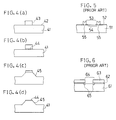
- the phase shifting mask also has an opening 54 provided as conventionally and fine apertures 55 adjacent to the opening 54. The fine apertures 55, 55' do not themselves dissect the projected image and are aligned with the phase shifting film 53.
- Light from the opening 54 is shifted by 180° relative to light from the apertures 55, so that light waves diffracted from the opening 54 to its adjacent area are antiphase with light wave from the apertures 55. Accordingly, light on the projection area is restrained from spreading from the opening 54 to its adjacent area, thereby improving contrast of the projected image.
- the phase shifting mask improves contrast of an image projected on the resist layer so as to greatly improve the practical resolution.
- a first resist image for a chromium pattern is first drawn by use of an electron beam lithographic system, and a second resist image is then drawn for defining a phase shifting film.
- the system must twice conduct electron beam drawing, which takes longer time, and also must accurately align the first pattern with the second pattern, which leads to a complex and expensive technology for preparation of the mask.
- phase shifting mask shown in Fig. 6 which comprises a transparent quartz substrate 61 to admit applied light of any wavelength, a chromium film 62 obstructing the applied light and a phase shifting film 63 whose thickness satisfies the relationship of the foregoing formula (1).
- an opening 64 is first formed in a resist film (not shown) by use of an electron beam lithographic system and the chromium film 62 is then etched and removed at the part of the opening 64, while the resist film is also removed.
- a resist film for forming the phase shifting film 63 is formed and ultraviolet light is applied from the back of the substrate to the resist film at the opening 64; the resist film is then developed and removed.
- the chromium film 62 is etched partially under the resist film to have an opening larger than the opening 64 and having a region 65 over which the resist film hangs.
- Light passing through the region 65 and light passing through the opening 64 are different in phase by 180° from each other, so that they are antiphase with each other when they are overlapped in a projected image, thereby preventing the light from spreading from the region 64 to its adjacent part.
- dispersion of photo-intensity on an image formation surface is sharp so tat the practical resolution of photolithography is improved.
- the preparation method for this phase shifting mask does not involve an increase in the number of times of drawing by the electron beam lithographic system, nor in turn, the number of steps for preparation of the mask.
- the resist film which is kept for forming the phase shifting film is fragile, it is hard to wash and remove foreign particles on the mask. Thus, the method is not practical.
- phase shifting masks as discussed above or similar thereto are disclosed in e.g.,
- phase shifting mask has certain problems in practical use, and there has been a need for a phase shifting mask which is simple in fabrication and has sufficient durability.
- the present invention provides a mask for photolithography comprising: a substrate which is transparent to light having a predetermined wavelength;
- the present invention also provides a process for manufacturing a mask for photolithography including a substrate which is transparent to light having a predetermined wavelength, said process comprising the steps;
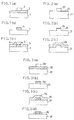
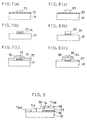
- Figs. 1 (a) to (c), Figs. 2 (a) to (c), Figs. 3 (a) to (d), Figs. 4 (a) to (d), Figs. 7 (a) to (c) and Figs. 8 (a) to (c) are schematic diagrams showing the fabrication processes of the mask in six examples of the present invention.
- Figs. 5 and 6 are schematic diagrams showing the problematic points in the conventional phase shifting masks.
- Fig. 9 is a schematic diagram showing the thickness of the SOG film.
- a step portion having an inclined area is formed to a height substantially defined by the foregoing formula (1).
- a transparent film is formed to a thickness approaching the height of the step portion on an opaque pattern of relatively larger thickness in accordance with vapor phase CVD process, or by spin coating.
- the opaque pattern may be a thin film of single phase or a multi-layer of a thin opaque film and a transparent film or a resist pattern.
- the opaque pattern may be provided on the transparent substrate or by etching the transparent substrate.
- the step portion having the inclined area can be formed by depositing or applying a transparent film of a thickness approaching the foregoing formula (1) on an opaque pattern of relatively larger thickness in accordance with vapor phase CVD process, or by spin coating followed by anisotropic etching to leave the transparent film on the side wall of the opaque pattern.
- the opaque pattern may be a thin film of single phase or a multi-layer of a thin opaque film and a transparent film.
- the opaque pattern may be provided on the transparent substrate or by etching the transparent substrate.
- the step portion having the inclined area may be formed by etching the opaque film of the opaque pattern and then tapering the surface of the transparent substrate to the thickness approaching the foregoing formula (1).
- phase shifting region comprises a film deposited by CVD process or formed by spin coating, or by the transparent substrate itself, so that the region will be not damaged by, for example, washing the mask.
- the mask described herein provides an inclined area at the border between the transparent region and the opaque region so as to allow phase shifting of the light passing through the phase shifting region to increase continuously from the transparent region to the opaque region. Hence, when the phase shifting at the edge of the transparent region is set to a value approaching 180°, the light passing through the transparent region does not decay unexpectedly, and thus sharp shaping up can be confined to the edge of the light flux passing through the transparent region.
- a shield film 2 was deposited on a substrate 1 made of quartz, on which a resist layer to electron beam was formed followed by drawing thereon a predetermined pattern by use of an electron beam lithographic apparatus before development to obtain a resist pattern 3 (see Fig. 1(a)).
- the shield film 2 was then etched by anisotropic etching using the resist pattern 3 as a mask to form an opaque pattern 4 followed by removing the resist layer (see Fig. 1(b)).
- the method in this example shapes the end of the opaque pattern 4 at an angle as extending almost vertically and the CVD film deposited on the stepped side wall portion by CVD process is used as the phase shifting film.
- the profile of the CVD film is a quarter arc as seen in Fig. 1(c) and the portion of the CVD film denoted by 6 is a step portion serving as the phase shifting region.
- an effective thickness of the phase shifting region at the edge of the opaque pattern is almost equal to that of the opaque pattern.
- the thickness of the shield film 2 was set in accordance with the foregoing formula (1).
- the length of the phase shifting region is related to the thickness of the transparent film 5 deposited on the side wall and may therefore be selectively set corresponding to such thickness of the transparent film 5.
- An important factor is the thickness of the step portion 6 of the transparent film 5, which is likely to be thinner than the flat portion or varies depending on various CVD processes or systems applied.
- a double-layered metal film made of molybdenum(Mo)/Titanium(Ti) of 400nm in total thickness was used as the shield film.
- Etching was conducted by use of a reactive ion-etching system having parallel plate electrodes using reaction gas of carbon tetrachloride (CCl 4 ) + oxygen (O 2 ).
- Applied as the transparent CVD film was silicon oxide film (SiO 2 ) of 400nm thickness, formed by normal pressure CVD process using material gas of silane (SiH 4 ) + oxygen (O 2 ).
- the thickness of oxide film on the side wall portion was about 300nm.
- Exposure test was conducted by use of the stepper with i-light of 0.45 of NA and using the phase shifting mask fabricated with the above materials and steps.
- the phase shifting mask obtained in the present example had a line/space resolution of 0.35 ⁇ m, an improvement of more than 10% over the conventional mask exhibiting a resolution of 0.4 ⁇ m.
- the shield film may be a metal film made of tungsten, chromium, cobalt, nickel, aluminum or the like, a silicon metal compound made of tungsten silicide (WSi 2 ), molybdenum silicide (MoSi 2 y) or the like, or a semiconductor film made of silicon alloy, silicon or the like. Any suitable etching techniques other than reactive ion etching may be applied depending on the material of the shield film.
- the shield film when using a metal such as molybdenum or the like may provide a pattern with the edge being inclined almost at 90° by use of liquid phase etching.
- the transparent film may be a thin transparent film made of silicon-phosphorus glass, silicon-phosphorus-boron glass, silicon nitride or the like. Deposition may be conducted by reduced pressure CVD process, plasma CVD process or the like other than normal pressure CVD process. Furthermore, the transparent film may be a thin transparent film made of silicon-phosphorus glass, silicon-phosphorus-boron glass or the like formed by spin coating.
- the shield film is not limited to a single opaque film and may be multi-layered with a transparent film and an opaque film.
- the transparent film is not limited to a single layer and may be multi-layered.
- a shield film 72 was deposited on a substrate 71 made of quartz, on which a resist layer to electron beam was formed followed by drawing thereon a predetermined pattern by use of electron beam lithographic system before development to obtain a resist pattern 73 (see Fig. 7(a)).
- the shield film 72 was then etched by normal liquid phase etching using the resist pattern 73 as a mask to form an opaque pattern 74 (see Fig. 7(b)).
- the second example had the same result as that of Example 1.
- the transparent film may be a thin transparent film made of silicon-phosphorus glass, silicon-phosphorus-boron glass, silicon nitride or the like other than the above SiO 2 .
- Deposition may be conducted by reduced pressure CVD process, plasma CVD process or the like other than normal pressure CVD process.
- the shield film may be formed by selectively using various materials, fabrication techniques and processing, as in Example 1.
- a shield film 82 was deposited on a substrate 81 made of quartz, on which a resist layer to electron beam was formed followed by drawing thereon a predetermined pattern by use of electron beam lithographic system before development to obtain a resist pattern 83 (see Fig. 8(a)).
- the shield film 82 was then etched by normal liquid phase etching using the resist pattern 83 as a mask to form an opaque pattern 84 (see Fig. 8(b)).
- the edge of the resist pattern 83 and the opaque pattern 84 form a step having preferably an angle extending almost vertically.
- the combination of the material for resist layer and SOG solution must be such that the resist layer is not dissolved upon coating of SOG solution.
- the SOG film at the step has an inclined feature as seen in Fig. 8(c), and the step portion of the SOG film denoted by 86 serves as the phase shifting region.
- the maximum thickness Ts of the phase shifting region formed by spin coating of transparent SOG has a relationship with respect to the difference of height Td between the opaque pattern part and the transparent part, the thickness of SOG film T top on the opaque pattern part and the thickness of SOG film T bot on the transparent part (see Fig.
- Ts Td + T top - T bot
- the maximum thickness Ts of the phase shifting region is preferably substantially equal to the thickness Ts of phase shifting film shown in the foregoing formula (1).
- a phase shifting mask for the stepper with i-light (365nm) in this example a posi-type resist of 500nm was used for a resist layer forming the pattern of the shield film, and a double-layered metal film of chromium oxide/chromium (Cr) of 100nm of total thickness was applied for the shield film. Etching of the shield film was conducted by normal liquid phase etching.
- Transparent SOG film of 1.46 of refractivity was applied by spin coating to obtain a phase shifting region having thickness values of 300nm for T bot , 400nm for Ts and 100nm for T top .
- the specific techniques for these processes are known in the art of fabrication of IC.
- An exposure test was conducted by use of the stepper with 0.45 of NA using the phase shifting mask fabricated with the above materials and the steps.
- the phase shifting mask obtained in the present example had a line/space resolution of 0.35 ⁇ m, an improvement of more than 10% over the conventional mask exhibiting a resolution of 0.4 ⁇ m.
- the shield film may be a metal film made of molybdenum, tungsten, chromium, cobalt, nickel, aluminum or the like, a silicon metal compound made of tungsten silicide (WSi 2 ), molybdenum silicide (MoSi 2 ) or the like, or a semiconductor film made of silicon alloy, silicon or the like. Any suitable etching techniques other than normal liquid phase etching may be applied depending on the material of the shielding film.
- the shield film when using a metal such as molybdenum or the like may provide a pattern with the edge being inclined almost at 90° by use of reactive ion etching.
- the transparent film may be a thin transparent film made of silicon-phosphorus glass, silicon-phosphorus-boron glass, or the like.
- the shield film is not limited to a single opaque film and may be multi-layered with a transparent film and an opaque film.
- the transparent film is not limited to a single layer and may be multi-layered.
- the fourth example is different from Example 1 in that the surface of the substrate is etched to form a step portion.
- a shield film 22 was deposited on a substrate 21 made of quartz, on which a resist layer to electron beam was formed followed by drawing thereon a predetermined pattern by use of electron beam lithographic system before development to obtain a resist pattern 23 (see Fig. 2(a)).
- the shield film 22 was then etched by normal liquid phase etching using the resist pattern 23 as a mask to form an opaque pattern 24. Also, the quartz substrate 21 was etched by reactive etching using the resist pattern 23 as a mask to form a pattern 25 and this was followed by removing the resist pattern 23 (see Fig. 2(b)).
- the effective thickness of the phase shifting region on the edge of the opaque pattern is substantially equal to the height of the opaque pattern part, so that an amount of etching on the substrate was set to that obtained by deducting the thickness of the shield film 22 from the height of phase shifting region determined by the foregoing formula (1).
- the length of the phase shifting region depends on the thickness of the transparent film 26 deposited on the side wall portion, and is adjusted corresponding to the thickness of the transparent film 26.
- the fifth example is different from Example 1 in that the transparent film is first deposited followed by etching the transparent film at the flat portion using anisotropic etching to leave the transparent film only on the side wall part of the opaque pattern.
- a shield film 32 was deposited on a substrate 31 made of quartz, on which a resist layer to electron beam was formed followed by drawing thereon a predetermined pattern by use of electron beam lithographic system before development to obtain a resist pattern 33 (see Fig. 3(a)).
- the shield film 32 was then etched by normal liquid phase etching using the resist pattern 33 as a mask to form an opaque pattern 34 followed by removing the resist pattern 33 (see Fig. 3(b)).
- the transparent film 35 was etched back by reactive etching to leave the transparent film only on the side wall part to form a step portion 36 serving as a phase shifting region before completion of the mask fabrication process (see Fig. 3(d)).
- the sixth example is different from Example 1 in that an inclined area is formed on the border between the transparent part and the opaque part in the step of etching of the opaque pattern.
- a shield film 42 was deposited on a substrate 41 made of quartz, on which a resist layer to electron beam was formed followed by drawing thereon a predetermined pattern by use of electron beam lithographic system before development to obtain a resist pattern 43 (see Fig. 4(a)).
- the shield film 42 was then etched by normal liquid phase etching using the resist pattern 43 as a mask to form an opaque pattern 44 (see Fig. 4(b)).
- the quartz substrate 41 was etched by reactive etching using the resist pattern 43 as a mask to form a pattern 45.
- the pattern must become larger as etching proceeds.
- Etching of silicon dioxide is conducted generally by using reaction gas mainly made of CF 4 + H 2 or CHF 3 .
- the gas is likely to form polymer in vapor phase.
- polymer is deposited on the side wall part to make thicker the resultant pattern and taper the etched part during etching.
- the known etching technique forms the inclined area 45 on the quartz substrate adjacent to the opaque region. (see Fig. 4(c)).
- the embodiments of the present invention each provide a mask for photolithography which comprises a transparent substrate to admit visible light or ultraviolet for transferring a mask pattern which is opaque to the light and formed on the substrate, wherein a step portion having an inclined area is provided on the transparent part adjacent to the opaque pattern, so that drawing of the pattern by electron beam lithography is required only once, thereby allowing formation of a self-aligned phase shifting region.
- the phase shifting part is made of a SOG film, a CVD deposition film or the transparent substrate itself, thereby having little fear of being damaged in washing process or the like.
- the inclined area formed on the border between the transparent part and the opaque part allows phase shifting of light passing through the phase shifting part to be continuously increased from the transparent part to the opaque part.
- phase shifting at the edge of the transparent part is set to a value approaching 180°, sharp shaping up can be confined to the edge part of light flux passing through the transparent part without unexpectedly decaying the applied light as a whole, leading to a remarkable improvement of the resolution of photolithography in comparison with the conventional phase shifting mask.
Landscapes
- Physics & Mathematics (AREA)
- General Physics & Mathematics (AREA)
- Preparing Plates And Mask In Photomechanical Process (AREA)
Claims (16)
- Masque pour photolithographie comprenant :un substrat (1 ; 21; 31 ; 41 ; 71 ; 81 ; 91) transparent pour une lumière de longueur d'onde prédéterminée ;un motif opaque (4 ; 24 ; 34 ; 44 ; 74 ; 84 ; 94) implanté sur ledit substrat afin d'empêcher la lumière de le traverser ; etun moyen de décalage de phase (5 ; 26 ; 36 ; 45 ; 75 ; 85 ; 95) transparent à ladite lumière et implanté de manière adjacente à la bordure dudit motif opaque sur ledit substrat, caractérisé en ce que ledit moyen de décalage de phase comprend une partie en gradin (6 ; 26 ; 36 ; 45 ; 76 ; 86 ; 96) ayant une surface inclinée relativement au substrat, la partie la plus épaisse de ladite partie en gradin transparente se situant à proximité de ladite bordure dudit motif opaque et ayant une hauteur pratiquement égale à λ {2 (n-1)} où λ représente la longueur d'onde de la lumière utilisée dans ladite photolithographie et n représente l'indice de réfraction du matériau formant ledit moyen de décalage de phase de sorte que la quantité de décalage de phase introduite dans la lumière traversant ladite partie la plus épaisse de ladite partie en gradin soit d'environ 180°.
- Masque selon la revendication 1 dans lequel un film transparent (36) implanté sur ledit substrat (31) forme ladite partie en gradin transparente (36), ledit film transparent n'étant présent que dans la région attenante à ladite bordure dudit motif opaque (34).
- Masque selon la revendication 1 dans lequel ladite bordure dudit film opaque (4 ; 24 ; 34 ; 74 ; 84 ; 94) forme une paroi latérale qui est pratiquement verticale par rapport audit substrat (1 ; 21 ; 31 ; 71 ; 81 ; 91) afin de constituer un gradin pratiquement vertical et dans lequel ladite partie en gradin transparente est formée d'un film transparent formé de telle manière sur au moins ladite paroi latérale que ladite surface inclinée soit approximativement en forme d'arc de secteur.
- Masque selon la revendication 1 dans lequel un film transparent (5 ; 26 ; 75 ; 85 ; 95) implanté sur ledit substrat (1 ; 21 ; 71 ; 81 ; 91) forme ladite partie en gradin transparente et se prolonge sur le motif opaque (4 ; 24 ; 74 ; 84 ; 94).
- Masque selon la revendication 1 dans lequel ladite bordure dudit motif opaque (4 ; 24 ; 74 ; 84 ; 94) forme une paroi latérale pratiquement verticale par rapport audit substrat (1 ; 21 ; 71 ; 81 ; 91) afin de former un gradin pratiquement vertical et dans lequel un film transparent (5 ; 26 ; 75 ; 85 ; 95) implanté sur ledit substrat se prolonge sur le motif opaque et forme ladite partie en gradin transparente (6 ; 26 ; 76 ; 86 ; 96) sur la bordure dudit motif opaque en prenant approximativement une forme d'arc de secteur.
- Masque selon la revendication 1 dans lequel ledit substrat (21 ; 41) inclut une partie gravée au niveau de ou adjacente à la bordure dudit motif opaque (24 ; 44), et dans lequel ladite partie en gradin transparente est formée sur ou par ladite partie gravée dudit substrat.
- Masque selon la revendication 6 dans lequel la partie gravée du substrat (21) est une face de bordure pratiquement verticale formant avec la bordure de recouvrement dudit motif opaque un gradin pratiquement vertical, ladite partie en gradin transparente comprenant un film transparent (26) formé sur au moins ledit gradin pratiquement vertical de telle sorte que ladite surface inclinée est en forme d'arc de secteur.
- Masque selon l'une quelconque des revendications 3, 5 et 7 dans lequel ledit gradin pratiquement vertical a une hauteur pratiquement égale à λ {2 (n-1)}.
- Masque selon la revendication 6 dans lequel la partie gravée du substrat (41) forme la partie en gradin transparente et inclut ladite surface inclinée (45).
- Masque selon la revendication 1 dans lequel des parties d'une couche de résist (73 ; 83 ; 93) utilisées pour la gravure du motif opaque (74 ; 84 ; 94) recouvrent ledit motif opaque.
- Procédé de fabrication d'un masque de photolithographie comportant un substrat transparent à une lumière de longueur d'onde prédéterminée, ledit processus comprenant les étapes consistant à :(1) former un film de protection opaque à ladite lumière sur ledit substrat ;(2) former un film de résist pour le faisceau électronique sur ledit film de protection et former un motif de résist sur ledit film de résist en dessinant un motif prédéterminé avec un dispositif lithographique à faisceau électronique, puis développer le motif ainsi formé ;(3) graver ledit film de protection par gravure anisotropique en utilisant ledit motif de résist sous la forme d'un masque afin de former un motif opaque sur ledit substrat ; et(4) déposer un film transparent sur ledit substrat incluant ledit motif opaque, en éliminant ou sans éliminer ledit motif de résist, ce par quoi on constitue un moyen de décalage de phase comprenant une partie en gradin transparente formée de manière adjacente à la bordure du motif opaque, ladite partie en gradin transparente ayant une surface inclinée relativement au substrat et la partie la plus épaisse de ladite partie en gradin transparente se trouvant à proximité de ladite bordure dudit motif opaque et ayant une hauteur pratiquement égale à λ {2 (n-1)} où λ représente la longueur d'onde de la lumière à utiliser dans ladite photolithographie et n représente l'indice de réfraction du matériau formant ledit film transparent.
- Procédé de fabrication d'un masque de photolithographie selon la revendication 11 dans lequel ledit film transparent déposé à l'étape (4) est éliminé sauf en ce qui concerne la partie périphérique dudit motif opaque, ladite partie périphérique constituant ladite partie en gradin transparente.
- Procédé de fabrication d'un masque de photolithographie selon la revendication 11 dans lequel ladite étape de gravure (3) comprend la gravure dudit substrat à l'aide du motif de résist constituant masque après gravure dudit film de protection, ce par quoi la partie gravée du substrat et la bordure recouvrante du motif opaque forme un gradin sur lequel ledit film transparent est déposé à l'étape (4).
- Procédé de fabrication d'un masque de photolithographie selon la revendication 11 dans lequel des parties du motif de résist demeurent sur les parties correspondantes du motif opaque de sorte que lorsque l'étape (4) est effectuée, le film transparent soit déposé sur un gradin comprenant la bordure du motif opaque et la bordure recouvrante du motif de résist préservé.
- Procédé de fabrication d'un masque de photolithographie selon la revendication 11 dans lequel la différence de hauteur (Td) entre les niveaux des surfaces respectives au-dessus du motif opaque (84 ; 94) d'une part et du substrat (81 ; 91) d'autre part, sur lequel le film transparent (85 ; 95) est placé, est
- Procédé de fabrication d'un masque de photolithographie selon la revendication 11 dans lequel la hauteur d'un gradin au niveau de et incluant ladite bordure du motif opaque à laquelle est adjacente la partie en gradin transparente formée à l'étape (4) est pratiquement égale à λ {2 (n-1)}.
Applications Claiming Priority (6)
| Application Number | Priority Date | Filing Date | Title |
|---|---|---|---|
| JP10583290 | 1990-04-19 | ||
| JP105832/90 | 1990-04-19 | ||
| JP10583290 | 1990-04-19 | ||
| JP17192090 | 1990-06-28 | ||
| JP17192090A JP2566048B2 (ja) | 1990-04-19 | 1990-06-28 | 光露光用マスク及びその製造方法 |
| JP171920/90 | 1991-06-18 |
Publications (2)
| Publication Number | Publication Date |
|---|---|
| EP0453310A1 EP0453310A1 (fr) | 1991-10-23 |
| EP0453310B1 true EP0453310B1 (fr) | 2000-07-12 |
Family
ID=26446055
Family Applications (1)
| Application Number | Title | Priority Date | Filing Date |
|---|---|---|---|
| EP91303545A Expired - Lifetime EP0453310B1 (fr) | 1990-04-19 | 1991-04-19 | Masque pour photolithographie |
Country Status (5)
| Country | Link |
|---|---|
| US (1) | US5389474A (fr) |
| EP (1) | EP0453310B1 (fr) |
| JP (1) | JP2566048B2 (fr) |
| KR (1) | KR940007788B1 (fr) |
| DE (1) | DE69132303T2 (fr) |
Cited By (1)
| Publication number | Priority date | Publication date | Assignee | Title |
|---|---|---|---|---|
| CN106154743A (zh) * | 2015-03-24 | 2016-11-23 | 中芯国际集成电路制造(上海)有限公司 | 掩模及其形成方法 |
Families Citing this family (24)
| Publication number | Priority date | Publication date | Assignee | Title |
|---|---|---|---|---|
| EP0843217A3 (fr) * | 1990-09-10 | 1998-12-16 | Fujitsu Limited | Masque optique utilisant le décalage de phase et méthode de fabrication |
| EP0524741A1 (fr) * | 1991-07-12 | 1993-01-27 | Motorola, Inc. | Méthode pour améliorer la résolution d'un masque servant à la fabrication de semi-conducteurs |
| US5281500A (en) * | 1991-09-04 | 1994-01-25 | Micron Technology, Inc. | Method of preventing null formation in phase shifted photomasks |
| JP2759582B2 (ja) * | 1991-09-05 | 1998-05-28 | 三菱電機株式会社 | フォトマスクおよびその製造方法 |
| US5382483A (en) * | 1992-01-13 | 1995-01-17 | International Business Machines Corporation | Self-aligned phase-shifting mask |
| EP0553543B1 (fr) * | 1992-01-31 | 1997-12-29 | Mitsubishi Denki Kabushiki Kaisha | Masque à décalage de phase et méthode pour former un motif dans une photoréserve en utilisant ce masque |
| KR100263900B1 (ko) * | 1993-03-04 | 2000-09-01 | 윤종용 | 마스크 및 그 제조방법 |
| US5642183A (en) * | 1993-08-27 | 1997-06-24 | Sharp Kabushiki Kaisha | Spatial filter used in a reduction-type projection printing apparatus |
| US5532089A (en) * | 1993-12-23 | 1996-07-02 | International Business Machines Corporation | Simplified fabrication methods for rim phase-shift masks |
| TW270219B (fr) * | 1994-05-31 | 1996-02-11 | Advanced Micro Devices Inc | |
| US5566011A (en) * | 1994-12-08 | 1996-10-15 | Luncent Technologies Inc. | Antiflector black matrix having successively a chromium oxide layer, a molybdenum layer and a second chromium oxide layer |
| US5989752A (en) * | 1996-05-29 | 1999-11-23 | Chiu; Tzu-Yin | Reconfigurable mask |
| KR100230376B1 (ko) * | 1996-10-16 | 1999-11-15 | 윤종용 | 위상 시프트 마스크 및 그 제조방법 |
| JP3080023B2 (ja) * | 1997-02-20 | 2000-08-21 | 日本電気株式会社 | 露光用フォトマスク |
| TW497165B (en) * | 1999-06-30 | 2002-08-01 | Hitachi Ltd | Method for manufacturing semiconductor integrated circuit device, optical mask used therefor, method for manufacturing the same, and mask blanks used therefor |
| JP3760086B2 (ja) * | 2000-07-07 | 2006-03-29 | 株式会社ルネサステクノロジ | フォトマスクの製造方法 |
| TW541605B (en) * | 2000-07-07 | 2003-07-11 | Hitachi Ltd | Fabrication method of semiconductor integrated circuit device |
| JP2002184669A (ja) | 2000-12-14 | 2002-06-28 | Hitachi Ltd | 半導体集積回路装置の製造方法 |
| JP2002196470A (ja) | 2000-12-26 | 2002-07-12 | Hitachi Ltd | フォトマスクの製造方法および半導体集積回路装置の製造方法 |
| JP2002202585A (ja) | 2000-12-27 | 2002-07-19 | Hitachi Ltd | フォトマスクの製造方法および半導体集積回路装置の製造方法 |
| JP3827544B2 (ja) | 2001-08-31 | 2006-09-27 | 株式会社ルネサステクノロジ | 半導体集積回路装置の製造方法 |
| JP2003121977A (ja) * | 2001-10-12 | 2003-04-23 | Hitachi Ltd | 半導体集積回路装置の製造方法およびマスク |
| JP2003287875A (ja) * | 2002-01-24 | 2003-10-10 | Hitachi Ltd | マスクの製造方法および半導体集積回路装置の製造方法 |
| JP3754378B2 (ja) * | 2002-02-14 | 2006-03-08 | 株式会社ルネサステクノロジ | 半導体集積回路装置の製造方法 |
Family Cites Families (13)
| Publication number | Priority date | Publication date | Assignee | Title |
|---|---|---|---|---|
| US3986876A (en) * | 1974-05-24 | 1976-10-19 | The United States Of America As Represented By The Secretary Of The Navy | Method for making a mask having a sloped relief |
| JPS55163539A (en) * | 1979-06-06 | 1980-12-19 | Nec Kyushu Ltd | Photo mask |
| DE3015142A1 (de) * | 1980-04-19 | 1981-12-03 | Deutsche Itt Industries Gmbh, 7800 Freiburg | Photomaske, verfahren zur herstellung sowie deren verwendung zur erzeugung kleiner halbleiterstrukturen |
| JPS576849A (en) * | 1980-06-13 | 1982-01-13 | Matsushita Electric Ind Co Ltd | Photomask and its preparation |
| JPS5741639A (en) * | 1980-08-25 | 1982-03-08 | Fujitsu Ltd | Treatment of photomask to provide electric conductivity |
| JPS5760335A (en) * | 1980-09-29 | 1982-04-12 | Hitachi Ltd | Exposure mask |
| JPS59143156A (ja) * | 1983-02-07 | 1984-08-16 | Seiko Epson Corp | ガラス・マスク |
| JPS60128447A (ja) * | 1983-12-14 | 1985-07-09 | Fujitsu Ltd | フオトマスク |
| JP2710967B2 (ja) * | 1988-11-22 | 1998-02-10 | 株式会社日立製作所 | 集積回路装置の製造方法 |
| EP0653679B1 (fr) * | 1989-04-28 | 2002-08-21 | Fujitsu Limited | Masque, méthode de fabrication de masque et méthode pour former des motifs en utilisant le masque |
| JPH03172848A (ja) * | 1989-12-01 | 1991-07-26 | Mitsubishi Electric Corp | ホトマスクの製造方法 |
| JPH03172847A (ja) * | 1989-12-01 | 1991-07-26 | Mitsubishi Electric Corp | ホトマスクの製造方法 |
| JPH03211554A (ja) * | 1990-01-17 | 1991-09-17 | Fujitsu Ltd | 位相シフトマスクの製造方法 |
-
1990
- 1990-06-28 JP JP17192090A patent/JP2566048B2/ja not_active Expired - Fee Related
-
1991
- 1991-04-19 KR KR1019910006311A patent/KR940007788B1/ko not_active Expired - Lifetime
- 1991-04-19 EP EP91303545A patent/EP0453310B1/fr not_active Expired - Lifetime
- 1991-04-19 DE DE69132303T patent/DE69132303T2/de not_active Expired - Lifetime
-
1993
- 1993-04-12 US US08/047,056 patent/US5389474A/en not_active Expired - Lifetime
Cited By (1)
| Publication number | Priority date | Publication date | Assignee | Title |
|---|---|---|---|---|
| CN106154743A (zh) * | 2015-03-24 | 2016-11-23 | 中芯国际集成电路制造(上海)有限公司 | 掩模及其形成方法 |
Also Published As
| Publication number | Publication date |
|---|---|
| US5389474A (en) | 1995-02-14 |
| JP2566048B2 (ja) | 1996-12-25 |
| EP0453310A1 (fr) | 1991-10-23 |
| JPH043412A (ja) | 1992-01-08 |
| DE69132303T2 (de) | 2000-12-21 |
| KR940007788B1 (ko) | 1994-08-25 |
| DE69132303D1 (de) | 2000-08-17 |
Similar Documents
| Publication | Publication Date | Title |
|---|---|---|
| EP0453310B1 (fr) | Masque pour photolithographie | |
| US5750290A (en) | Photo mask and fabrication process therefor | |
| US6562522B1 (en) | Photomasking | |
| JP3262302B2 (ja) | 位相シフトフォトマスク、位相シフトフォトマスク用ブランクス及びそれらの製造方法 | |
| US7838183B2 (en) | Multi-layer, attenuated phase-shifting mask | |
| EP0585872B1 (fr) | Procédé pous fabriquer un masque à décolage de phase ou un masque à décolage de phase vierge | |
| JP3368947B2 (ja) | レティクル及びレティクル・ブランク | |
| JPH07209851A (ja) | リソグラフィ露光マスクおよびその製造方法 | |
| US5902702A (en) | Phase shift mask, blank for phase shift mask, and method of manufacturing phase shift mask | |
| JPH08272071A (ja) | 位相シフトマスクとその製造方法、ならびにマスクブランク | |
| JPH0876353A (ja) | 位相シフトマスクの製造方法 | |
| US5849438A (en) | Phase shift mask and method for fabricating the same | |
| US7745842B2 (en) | Graytone mask and method thereof | |
| JP3312702B2 (ja) | 位相シフトフォトマスク及び位相シフトフォトマスク用ブランクス | |
| JPH0566554A (ja) | フオトマスク | |
| JP2002268201A (ja) | 位相シフトフォトマスク及び位相シフトフォトマスク用ブランクスの製造方法 | |
| JPH05142745A (ja) | 位相シフトマスク及びマスクの製造方法 | |
| JPH04368947A (ja) | 位相シフトマスクの作成方法 | |
| JP3241068B2 (ja) | 光露光用マスク及びその形成方法 | |
| JP3173314B2 (ja) | 位相シフトマスクの製造方法 | |
| JPH06347993A (ja) | 位相シフトマスクおよびその製造方法 | |
| JP3046631B2 (ja) | 位相シフトフォトマスクの製造方法 | |
| JPH07159971A (ja) | 光学マスクブランクと光学マスクおよびそれらの製造方法 | |
| JPH05281702A (ja) | 位相シフトマスクの製造方法 | |
| EP0590627A2 (fr) | Masque pour la fabrication de semi-conducteurs |
Legal Events
| Date | Code | Title | Description |
|---|---|---|---|
| PUAI | Public reference made under article 153(3) epc to a published international application that has entered the european phase |
Free format text: ORIGINAL CODE: 0009012 |
|
| 17P | Request for examination filed |
Effective date: 19910510 |
|
| AK | Designated contracting states |
Kind code of ref document: A1 Designated state(s): DE FR GB |
|
| 17Q | First examination report despatched |
Effective date: 19940701 |
|
| GRAG | Despatch of communication of intention to grant |
Free format text: ORIGINAL CODE: EPIDOS AGRA |
|
| GRAG | Despatch of communication of intention to grant |
Free format text: ORIGINAL CODE: EPIDOS AGRA |
|
| GRAH | Despatch of communication of intention to grant a patent |
Free format text: ORIGINAL CODE: EPIDOS IGRA |
|
| GRAH | Despatch of communication of intention to grant a patent |
Free format text: ORIGINAL CODE: EPIDOS IGRA |
|
| GRAA | (expected) grant |
Free format text: ORIGINAL CODE: 0009210 |
|
| AK | Designated contracting states |
Kind code of ref document: B1 Designated state(s): DE FR GB |
|
| REF | Corresponds to: |
Ref document number: 69132303 Country of ref document: DE Date of ref document: 20000817 |
|
| ET | Fr: translation filed | ||
| PLBE | No opposition filed within time limit |
Free format text: ORIGINAL CODE: 0009261 |
|
| STAA | Information on the status of an ep patent application or granted ep patent |
Free format text: STATUS: NO OPPOSITION FILED WITHIN TIME LIMIT |
|
| 26N | No opposition filed | ||
| REG | Reference to a national code |
Ref country code: GB Ref legal event code: IF02 |
|
| PGFP | Annual fee paid to national office [announced via postgrant information from national office to epo] |
Ref country code: GB Payment date: 20100325 Year of fee payment: 20 |
|
| PGFP | Annual fee paid to national office [announced via postgrant information from national office to epo] |
Ref country code: FR Payment date: 20100521 Year of fee payment: 20 |
|
| PGFP | Annual fee paid to national office [announced via postgrant information from national office to epo] |
Ref country code: DE Payment date: 20100430 Year of fee payment: 20 |
|
| REG | Reference to a national code |
Ref country code: DE Ref legal event code: R071 Ref document number: 69132303 Country of ref document: DE |
|
| REG | Reference to a national code |
Ref country code: GB Ref legal event code: PE20 Expiry date: 20110418 |
|
| PG25 | Lapsed in a contracting state [announced via postgrant information from national office to epo] |
Ref country code: GB Free format text: LAPSE BECAUSE OF EXPIRATION OF PROTECTION Effective date: 20110418 |
|
| PG25 | Lapsed in a contracting state [announced via postgrant information from national office to epo] |
Ref country code: DE Free format text: LAPSE BECAUSE OF EXPIRATION OF PROTECTION Effective date: 20110419 |