EP0453954A1 - Brosse avec des soies artificielles, en particulier une brosse à dents - Google Patents
Brosse avec des soies artificielles, en particulier une brosse à dents Download PDFInfo
- Publication number
- EP0453954A1 EP0453954A1 EP91106189A EP91106189A EP0453954A1 EP 0453954 A1 EP0453954 A1 EP 0453954A1 EP 91106189 A EP91106189 A EP 91106189A EP 91106189 A EP91106189 A EP 91106189A EP 0453954 A1 EP0453954 A1 EP 0453954A1
- Authority
- EP
- European Patent Office
- Prior art keywords
- bristles
- bristle
- individual
- tuft
- brush according
- Prior art date
- Legal status (The legal status is an assumption and is not a legal conclusion. Google has not performed a legal analysis and makes no representation as to the accuracy of the status listed.)
- Granted
Links
- 230000001154 acute effect Effects 0.000 claims description 4
- 230000000694 effects Effects 0.000 abstract description 10
- 238000004140 cleaning Methods 0.000 description 26
- 238000000034 method Methods 0.000 description 6
- 210000003739 neck Anatomy 0.000 description 5
- 238000005299 abrasion Methods 0.000 description 2
- 238000009826 distribution Methods 0.000 description 2
- 238000002347 injection Methods 0.000 description 2
- 239000007924 injection Substances 0.000 description 2
- 238000003825 pressing Methods 0.000 description 2
- 238000004080 punching Methods 0.000 description 2
- 241000904500 Oxyspora paniculata Species 0.000 description 1
- 238000004873 anchoring Methods 0.000 description 1
- 230000001680 brushing effect Effects 0.000 description 1
- 230000008094 contradictory effect Effects 0.000 description 1
- 230000006378 damage Effects 0.000 description 1
- 210000003298 dental enamel Anatomy 0.000 description 1
- 238000004519 manufacturing process Methods 0.000 description 1
- 238000000465 moulding Methods 0.000 description 1
- 230000002028 premature Effects 0.000 description 1
- 239000000243 solution Substances 0.000 description 1
- PQTBTIFWAXVEPB-UHFFFAOYSA-N sulcotrione Chemical compound ClC1=CC(S(=O)(=O)C)=CC=C1C(=O)C1C(=O)CCCC1=O PQTBTIFWAXVEPB-UHFFFAOYSA-N 0.000 description 1
- 238000009827 uniform distribution Methods 0.000 description 1
Images

Classifications
-
- A—HUMAN NECESSITIES
- A46—BRUSHWARE
- A46B—BRUSHES
- A46B3/00—Brushes characterised by the way in which the bristles are fixed or joined in or on the brush body or carrier
- A46B3/02—Brushes characterised by the way in which the bristles are fixed or joined in or on the brush body or carrier by pitch, resin, cement, or other adhesives
-
- A—HUMAN NECESSITIES
- A46—BRUSHWARE
- A46B—BRUSHES
- A46B3/00—Brushes characterised by the way in which the bristles are fixed or joined in or on the brush body or carrier
- A46B3/06—Brushes characterised by the way in which the bristles are fixed or joined in or on the brush body or carrier by welding together bristles made of metal wires or plastic materials
-
- A—HUMAN NECESSITIES
- A46—BRUSHWARE
- A46B—BRUSHES
- A46B9/00—Arrangements of the bristles in the brush body
- A46B9/02—Position or arrangement of bristles in relation to surface of the brush body, e.g. inclined, in rows, in groups
- A46B9/04—Arranged like in or for toothbrushes
-
- A—HUMAN NECESSITIES
- A46—BRUSHWARE
- A46B—BRUSHES
- A46B2200/00—Brushes characterized by their functions, uses or applications
- A46B2200/10—For human or animal care
- A46B2200/1066—Toothbrush for cleaning the teeth or dentures
Definitions
- the invention relates to a brush with plastic bristles, preferably a toothbrush, the bristles of which are arranged in individual bristle bundles or tufts and attached to the end of the bristle tufts with one another and / or on the brush body, in particular fused, glued or welded, the bristle tufts being over their from the brush body starting height have a substantially constant circumference, cross-section or a constant envelope curve, in particular an envelope circle.
- the high injection pressure means that the plastic gets into the bristle spaces and they are encapsulated in such a way that they lose their necessary suppleness.
- the bristle tufts fastened with anchors particularly in the case of toothbrushes, result in the bristles being pressed together in the bundle by pressing and punching the anchor, and the bundle thus becomes relatively stiff overall.
- a stiff and hard form of the bristle tuft is required and required in many areas of application, this is usually undesirable for a toothbrush. This is because there is a risk that the tooth neck with the relatively soft tooth enamel will be attacked and damaged by the cleaning movement and application of such a hard brush.
- the object is therefore to create a brush of the type mentioned at the outset which, with a satisfactory service life, nevertheless has an improved cleaning action and in which the individual bristles of the tufts of bristles, despite their arrangement within a bundle, can act largely independently of one another.
- the object to be cleaned for example teeth and sensitive tooth necks as well as the gums, should be less stressed, i.e. more gently applied to the individual bristles, so especially with toothbrushes the gums and tooth neck and the entire tooth should be thoroughly cleaned , but not injured or overloaded.
- each individual bristle is arranged obliquely within their tufts of bristles against one another and with respect to the plane formed by the bristle field and / or the brush body holding them.
- the entire bristle bundle can thus continue to protrude approximately perpendicularly from the brush body - but could also be inclined overall - however, the individual bristles are inclined within this bundle, so that they can dodge a little at a pressure acting in the axial direction of the bristle tuft and not with their kink resistance press against the body to be cleaned.
- each individual bristle can exert its cleaning action without, for example, an increased contact pressure, for example, of a thorough user being harmful.
- the imaginary circles arranged adjacent to one another on an imaginary circle concentric to the central axis of the tufts of bristles each in the same direction as this circle stand at an angle and preferably have an approximately matching helix angle with respect to the imaginary circular line.
- These inclined bristles may well lie approximately on the imaginary cylindrical envelope surface of a cylinder or be arranged tangentially thereto and, despite their oblique position, which approximately coincides in the circumferential direction of such an imaginary circle, form a largely regular bristle tuft with an approximately constant cross section over its height.
- the helix angle can be more acute with respect to a - imaginary - circular line located on the bristle base, the larger the circle diameter, and the bristles closer to the center of this tuft of bristles can, for example, be at an obtuse helix angle, for example one accidentally exactly in the center of the Büschels bristle could even be vertical. This is especially true when the bristle bundle formed from inclined bristles is oriented approximately perpendicular to its attachment point or the bristle field level at the free working ends of the bristles.
- An embodiment of the invention can consist in that the bristles which are inclined in the circumferential direction of the bristle tufts, preferably the bristles located in the interior of the bristle tufts, optionally partially also run obliquely outwards from the center of the bristle tufts. If the outer bristles of the bristle tuft are not only oriented obliquely in the circumferential direction of an imaginary circle, but also outwards, this results in a bristle tuft that has a largely constant cross-sectional shape over its height, but with a cross section somewhat towards the free working ends increases.
- a further embodiment of the invention can consist in that individual bristles are so inclined to each other that they cross in the course of the bristle bundle.
- individual bristles are so inclined to each other that they cross in the course of the bristle bundle.
- they could be arranged obliquely to an imaginary circular line, but otherwise they could initially be inclined inwards in such a way that, like tent poles, they in turn are directed outwards at their free working ends.
- a distance can be provided between the individual tufts of bristles, in which a part of the bristles located in particular on the outer edge of a tuft of bristles can escape under pressure on the bristle field.
- the inclined position of the bristles leads more quickly to a flexible yielding of the individual bristles under a pressure load, so that they can take advantage of the space between the bristle tufts, as a result of which the bristle tufts are dissolved to a certain extent at their working ends.
- the cleaning pressure can be distributed much better and the individual bristles of the entire bristle field can be optimally distributed over the entire bristle field surface, so that the previous gaps during the cleaning process are eliminated and thus the cleaning pressure is also better distributed.
- the entire bristle field surface can be more or less evenly occupied by bristle tips during cleaning, so that under certain circumstances the number of tufts of bristles could be reduced without reducing the cleaning effect, but at the same time the surface to be cleaned is treated gently even at high pressure.
- the bristles of a tuft of bristles arranged approximately on a circular surface can each extend obliquely from their starting point on the brush body to their free end and there an analog - imaginary - circle with a preferably matching diameter on one in the circumferential direction cut the offset point.
- the entire bristle tuft has a certain twist, which is already predetermined at the anchoring of the bristles on the bristle body, but the individual inclined bristle is nevertheless straight. In this way, it can avoid excessive cleaning pressure and still exert its cleaning effect.
- a modified embodiment can consist in that at least some of the bristles of a tuft of bristles are twisted and preferably run on a helix with a large pitch.
- An embodiment of the invention of very considerable importance which reinforces the advantages of the inclination of the bristles and can be particularly effective in combination with this inclination, may consist in the individual bristles of a tuft of bristles having at least two different lengths, the difference in length being a fraction of the Total bristle length is.
- the number of longer and shorter bristles can be approximately the same and the bristles of different lengths within each bristle tuft are preferably distributed approximately evenly mixed with one another.
- the longer bristles can be 0.2 to 1 millimeter in particular approximately 1/2 millimeter longer than the shorter bristles.
- the individual bristles can be rounded at their working ends before being connected to one another and / or to the brush body.
- the individual bristle has a correspondingly gentle effect on sensitive surfaces, and when used with toothbrushes on the gums and tooth necks. Since the individual bristles dodge when the cleaning pressure is too high, a good massage and cleaning effect results in any case without fear of premature wear.
- a further embodiment of the invention can consist in that the bristles of a bristle tuft are inclined in the circumferential direction thereof with the same oblique direction, but the taper direction of adjacent bristle tufts changes in each case, so that the bristles of a bristle tuft, viewed in their projection, rotate clockwise and those of another bristle tuft run counter-clockwise from bottom to top. This is for some compressive strength when pressing the brush overall advantageous, although the individual bristles evade an excessive pressure load individually.
- the reaction forces resulting from the inclination of the bristles can in this way at least largely cancel each other out on the brush body.
- a combination of one or more of the features and measures described above results in a brush that can have a good cleaning and massage effect, especially as a toothbrush, but also gently acts on the surface to be cleaned even when the cleaning pressure is excessive, since the individual bristles evade the increased cleaning pressure and at the same time experience a better distribution under the cleaning pressure and no longer become effective in bundles or bundles.
- bristles of different lengths and inclined bristles also result in evasive movements of different strengths, the shorter bristles opposing somewhat more resistance to increasing cleaning pressure, so that the brush nevertheless has a long service life.
- the better distribution of the individual bristles in terms of area during the cleaning process means that such a toothbrush is perceived as softer, although a better cleaning effect can be expected.
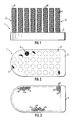
- a brush generally designated 1, for example a toothbrush, in which, however, the handle is not shown, has individual bristle tufts 3 made of plastic bristles 4 that stand approximately vertically upright on a brush body 2.
- the bristles 4 can be fused, glued or welded together at the end of the bristle tufts 3 and / or on the brush body 2.
- the bristle tufts 3 have a substantially constant circumference or cross section or enveloping circle 5 over their height starting from the brush body 2.
- the working ends 6 of the bristles 4 form an approximately flat bristle field.
- Fig. 1 is indicated, in Fig. 4 in a schematic and diagrammatic representation - albeit somewhat exaggerated - that the individual bristles 4 are arranged within their tufts of bristles 3 with respect to the plane formed by the bristle field and also with respect to the brush body 2 holding them, and also in relation to one another.
- the mutual inclination of the individual bristles 4 of a bristle tuft 3 is not recognizable in the schematic representation of FIG. 1, but is explained and described in more detail with reference to FIG. 4.
- Fig. 4 it can be seen that the imaginary circle 5 or 7 arranged on a concentric to the central axis of the bristle tuft 3 (only two such imaginary circles are shown in Fig. 4, although according to Fig. 2, of course, significantly more such circles within the Circumference of a tuft of bristles 3 could be drawn) adjacent bristles 4 are each inclined in the corresponding direction with respect to this circle 5 or 7, but then each have an approximately identical helix angle with respect to the imaginary circular line. This results in a somewhat regular arrangement of adjacent bristles on each circle 5 or 7, but it is clear that the bristles opposite one another on such a circle 5 or 7 are also inclined relative to one another.
- the helix angle 8 can be more acute with respect to the circular line 5 or 7 located on the bristle base, the larger the circular diameter.
- the bristles closer to the center of the tufts of bristles can thus be at an obtuse helix angle 9, as is indicated in FIG. 4, where the helix angle 8 on the larger circle 5 is somewhat more acute, but the helix angle 9 on the more inner circle 7 is more so right angle is approximated.
- a bristle 4 theoretically arranged in the center of the bristle tuft 3 would expediently not run obliquely, but to a certain extent as the axis of the entire bristle tuft in its main direction, in the exemplary embodiment So perpendicular to the brush body 2 or the bristle field.
- the bristle bundle 3 formed from inclined bristles 4 is expediently oriented approximately perpendicularly to its attachment point on the brush body 2 or to the bristle field plane.
- the bristle bundle 3 shown in FIG. 4 could also be slightly tilted overall, that is to say be inclined, if this were desirable for certain cleaning processes.
- Fig. 4 thus shows that the bristles 4 of a bristle tuft 3 arranged approximately on a circular surface each run obliquely from their starting point on the brush body 2 to their free end 6 and there there is an analog circle 5a or 7a with a preferably matching diameter to the circles 5 and 7 cut at a point offset in the circumferential direction.
- the bristles 4 which are inclined in the circumferential direction of the bristle tuft 3, are also provided would also partially run obliquely outwards or inwards.
- the entire bristle bundle 3 could also have a frustoconical outer contour.
- the individual bristle 4a is also inclined outwards in this way, because it starts at the lower end from the circle 7 and at its free end 6 crosses the circle 5a which is further out. In this way, however, this bristle 4a remains within of the approximately cylindrical bristle tuft 3.
- FIGS. 1 and 2 there is a spacing between the individual bristle tufts 3, in which a part of the bristles 4 located, in particular, on the outer edge of a bristle tuft 3, is viewed in a manner that is customary per se, considering the circles 5 and 5a of FIG as the outermost boundary of a tuft of bristles 3, that is to say the bristles 4 connecting the circles - can dodge under pressure on the bristle field.
- FIG. 3 shows how the individual bristles 4 can escape into the spaces between the individual bristle tufts 3 when pressure is exerted on the bristle field, which can still be seen in FIG. 2 in the unloaded state. This then results in a practically uniform distribution of the originally strongly bundled bristles 4 over the entire bristle field and even somewhat beyond its original outer circumference. This evasive movement is particularly favored by the inclination of the bristles 4.
- the individual bristles 4 of a bristle tuft 3 have at least two different lengths, the difference in length being only a fraction of the total bristle length. It can be seen above all in FIG. 1 and also in FIG. 4 that some of the free ends 6 of bristles 4 protrude somewhat from the others, the longer bristles being able to protrude about half a millimeter compared to the shorter bristles.
- the number of longer and shorter bristles 4 is approximately the same size and the bristles of different lengths are approximately evenly distributed within each bristle tuft 3 and mixed with one another. However, especially in the outside area - considering the simplified and schematic representation of FIG.
- the inclination and the evasive movement which may increase the inclination, is harmless because the individual bristles 4 - before connection to each other and / or with the brush body 2 - may have been rounded at their working ends 6, so that they gentle contact with gums, tooth necks and similar sensitive areas even in an inclined position.
- Fig. 1 it is shown that all bristles of all bristle tufts are inclined in the same direction in the circumferential direction of a bristle tuft.
- the bristles 4 of a bristle tuft 3 it would also be possible for the bristles 4 of a bristle tuft 3 to be arranged in the circumferential direction with a corresponding inclined position, as shown in FIG 4, so that the bristles 4 of a bristle tuft 3, seen in their projection (approximately according to FIG. 2), run clockwise and that of another bristle tuft counterclockwise from bottom to top.
- the reaction forces generated by pressure on the bristle field, which emanate from the individual inclined bristles 4 could largely be offset against one another.
- the brush 1 with plastic bristles which is particularly suitable as a toothbrush, has bristle tufts 3 composed of the individual bristles 4, to which the individual bristles 4 can be fused, glued or welded.
- the individual bristles 4 are arranged obliquely within their bristle tuft 3 against each other and with respect to the plane formed by the bristle field and / or with respect to the brush body 2 holding them, so that when they are perpendicular to the entire bristle tuft 3 they individually escape somewhat sideways and so this pressure give way while increasing the effective area. This effect can be improved or increased by individual bristles 4 of different lengths within a bristle tuft 3.
Landscapes
- Brushes (AREA)
- Polishing Bodies And Polishing Tools (AREA)
Applications Claiming Priority (2)
| Application Number | Priority Date | Filing Date | Title |
|---|---|---|---|
| DE4013564A DE4013564C1 (fr) | 1990-04-27 | 1990-04-27 | |
| DE4013564 | 1990-04-27 |
Publications (2)
| Publication Number | Publication Date |
|---|---|
| EP0453954A1 true EP0453954A1 (fr) | 1991-10-30 |
| EP0453954B1 EP0453954B1 (fr) | 1994-05-18 |
Family
ID=6405275
Family Applications (1)
| Application Number | Title | Priority Date | Filing Date |
|---|---|---|---|
| EP91106189A Expired - Lifetime EP0453954B1 (fr) | 1990-04-27 | 1991-04-18 | Brosse avec des soies artificielles, en particulier une brosse à dents |
Country Status (7)
| Country | Link |
|---|---|
| EP (1) | EP0453954B1 (fr) |
| JP (1) | JPH05123219A (fr) |
| AT (1) | ATE105681T1 (fr) |
| AU (1) | AU7418091A (fr) |
| CA (1) | CA2041404A1 (fr) |
| DE (2) | DE4013564C1 (fr) |
| ES (1) | ES2055939T3 (fr) |
Cited By (2)
| Publication number | Priority date | Publication date | Assignee | Title |
|---|---|---|---|---|
| EP2910143A1 (fr) * | 2014-02-21 | 2015-08-26 | The Procter and Gamble Company | Tête pour un instrument de soin buccal |
| EP3058844A1 (fr) * | 2015-02-19 | 2016-08-24 | The Procter and Gamble Company | Tête pour un instrument de soins buccaux et instrument pour soins buccaux |
Families Citing this family (3)
| Publication number | Priority date | Publication date | Assignee | Title |
|---|---|---|---|---|
| DE19645224A1 (de) * | 1996-11-02 | 1998-05-07 | Hans Raab | Reinigungswerkzeug |
| JP4076400B2 (ja) * | 2002-08-28 | 2008-04-16 | 花王株式会社 | 歯ブラシ |
| US20110030160A1 (en) * | 2009-08-06 | 2011-02-10 | Mcneil-Ppc, Inc. | Bristle configuration |
Citations (3)
| Publication number | Priority date | Publication date | Assignee | Title |
|---|---|---|---|---|
| US3263258A (en) * | 1965-04-01 | 1966-08-02 | Lever Brothers Ltd | Toothbrush |
| DE8202897U1 (de) * | 1982-02-04 | 1982-06-16 | Fa. M. U. C. Schiffer, 5466 Neustadt | Zahnbuerste mit schraeg gegeneinander gestellten borstenbloecken |
| US4884311A (en) * | 1988-05-27 | 1989-12-05 | Harbert S Gergory | Dental appliance |
Family Cites Families (1)
| Publication number | Priority date | Publication date | Assignee | Title |
|---|---|---|---|---|
| DE1273482B (de) * | 1964-05-15 | 1968-07-25 | Sunbeam Corp | Zahnbuerste |
-
1990
- 1990-04-27 DE DE4013564A patent/DE4013564C1/de not_active Expired - Lifetime
-
1991
- 1991-04-09 AU AU74180/91A patent/AU7418091A/en not_active Abandoned
- 1991-04-18 EP EP91106189A patent/EP0453954B1/fr not_active Expired - Lifetime
- 1991-04-18 AT AT91106189T patent/ATE105681T1/de not_active IP Right Cessation
- 1991-04-18 ES ES91106189T patent/ES2055939T3/es not_active Expired - Lifetime
- 1991-04-18 DE DE59101639T patent/DE59101639D1/de not_active Expired - Fee Related
- 1991-04-25 JP JP3095076A patent/JPH05123219A/ja active Pending
- 1991-04-26 CA CA002041404A patent/CA2041404A1/fr not_active Abandoned
Patent Citations (3)
| Publication number | Priority date | Publication date | Assignee | Title |
|---|---|---|---|---|
| US3263258A (en) * | 1965-04-01 | 1966-08-02 | Lever Brothers Ltd | Toothbrush |
| DE8202897U1 (de) * | 1982-02-04 | 1982-06-16 | Fa. M. U. C. Schiffer, 5466 Neustadt | Zahnbuerste mit schraeg gegeneinander gestellten borstenbloecken |
| US4884311A (en) * | 1988-05-27 | 1989-12-05 | Harbert S Gergory | Dental appliance |
Cited By (11)
| Publication number | Priority date | Publication date | Assignee | Title |
|---|---|---|---|---|
| EP2910143A1 (fr) * | 2014-02-21 | 2015-08-26 | The Procter and Gamble Company | Tête pour un instrument de soin buccal |
| WO2015126909A1 (fr) * | 2014-02-21 | 2015-08-27 | The Procter & Gamble Company | Tête pour un instrument de soin buccal |
| US9402461B2 (en) | 2014-02-21 | 2016-08-02 | Braun Gmbh | Head for an oral care implement |
| CN106028869A (zh) * | 2014-02-21 | 2016-10-12 | 宝洁公司 | 用于口腔护理工具的头部 |
| AU2015219149B2 (en) * | 2014-02-21 | 2017-11-09 | The Procter & Gamble Company | Head for an oral care implement |
| CN106028869B (zh) * | 2014-02-21 | 2018-10-26 | 宝洁公司 | 用于口腔护理工具的头部 |
| AU2015219149C1 (en) * | 2014-02-21 | 2019-06-20 | The Procter & Gamble Company | Head for an oral care implement |
| EP3058844A1 (fr) * | 2015-02-19 | 2016-08-24 | The Procter and Gamble Company | Tête pour un instrument de soins buccaux et instrument pour soins buccaux |
| WO2016134089A1 (fr) * | 2015-02-19 | 2016-08-25 | The Procter & Gamble Company | Tête pour instrument de soin buccal et instrument de soin buccal |
| AU2016220003B2 (en) * | 2015-02-19 | 2018-10-11 | The Procter & Gamble Company | Head for an oral care implement and oral care implement |
| US10219611B2 (en) | 2015-02-19 | 2019-03-05 | The Procter & Gamble Company | Head for an oral-care implement and oral-care implement |
Also Published As
| Publication number | Publication date |
|---|---|
| CA2041404A1 (fr) | 1991-10-28 |
| DE59101639D1 (de) | 1994-06-23 |
| DE4013564C1 (fr) | 1991-07-11 |
| ATE105681T1 (de) | 1994-06-15 |
| JPH05123219A (ja) | 1993-05-21 |
| AU7418091A (en) | 1991-11-07 |
| EP0453954B1 (fr) | 1994-05-18 |
| ES2055939T3 (es) | 1994-09-01 |
Similar Documents
| Publication | Publication Date | Title |
|---|---|---|
| EP1646299B1 (fr) | Brosse a dents manuelle | |
| EP0269665B1 (fr) | Brosse a dents | |
| EP1423029B2 (fr) | Brosse a dents comportant un champ de poils | |
| DE69629062T3 (de) | Zahnbürste | |
| DE10331369B4 (de) | Zahnbürste | |
| WO1997008973A1 (fr) | Brosse a dents | |
| DE19919196C1 (de) | Zahnbürste | |
| EP2449918A2 (fr) | Tête de brosse pour brosse à dents électrique | |
| EP1993398B1 (fr) | Brosse à dents et tête de brosse à dents pour celle-ci | |
| EP2186434A1 (fr) | Brosse à dent, brosse et tête de brosse pour une brosse à dent | |
| EP2184033A1 (fr) | Brosse à dents électrique et sa brosse | |
| DE69628347T2 (de) | Zahnbürste | |
| EP0453954B1 (fr) | Brosse avec des soies artificielles, en particulier une brosse à dents | |
| DE102005045279A1 (de) | Zahnbürstenkopf | |
| DE20213325U1 (de) | Bürstenkopf mit im wesentlichen rundem Borstenfeld | |
| DE3618823C2 (de) | Zahnbürste | |
| DE9303673U1 (de) | Zahnbürste | |
| DE9016467U1 (de) | Bürste mit Kunststoffborsten, insbesondere Zahnbürste | |
| DE19616154A1 (de) | Zahnbürste | |
| EP1239752B1 (fr) | Procede de fabrication de brosses et dispositif de mise en oeuvre de ce procede | |
| DE69804910T2 (de) | Zahnbürste | |
| EP0516675B1 (fr) | Brosse a dents | |
| DE10047699B4 (de) | Hybridzahnbürste mit einem Borstenfeld aus Borstenbüscheln und in Kunststoffspritzgußtechnik hergestellten Borsten | |
| EP1774924A1 (fr) | Tête de brosse pour brosse à dents électrique | |
| DE20212945U1 (de) | Zahnbürste mit Borstenfeld |
Legal Events
| Date | Code | Title | Description |
|---|---|---|---|
| PUAI | Public reference made under article 153(3) epc to a published international application that has entered the european phase |
Free format text: ORIGINAL CODE: 0009012 |
|
| AK | Designated contracting states |
Kind code of ref document: A1 Designated state(s): AT BE CH DE DK ES FR GB GR IT LI NL SE |
|
| 17P | Request for examination filed |
Effective date: 19910911 |
|
| 17Q | First examination report despatched |
Effective date: 19930519 |
|
| GRAA | (expected) grant |
Free format text: ORIGINAL CODE: 0009210 |
|
| AK | Designated contracting states |
Kind code of ref document: B1 Designated state(s): AT BE CH DE DK ES FR GB GR IT LI NL SE |
|
| PG25 | Lapsed in a contracting state [announced via postgrant information from national office to epo] |
Ref country code: GR Free format text: LAPSE BECAUSE OF FAILURE TO SUBMIT A TRANSLATION OF THE DESCRIPTION OR TO PAY THE FEE WITHIN THE PRESCRIBED TIME-LIMIT Effective date: 19940518 Ref country code: BE Effective date: 19940518 Ref country code: DK Effective date: 19940518 |
|
| REF | Corresponds to: |
Ref document number: 105681 Country of ref document: AT Date of ref document: 19940615 Kind code of ref document: T |
|
| RAP4 | Party data changed (patent owner data changed or rights of a patent transferred) |
Owner name: FRISETTA GMBH KUNSTSTOFFWERKE |
|
| REF | Corresponds to: |
Ref document number: 59101639 Country of ref document: DE Date of ref document: 19940623 |
|
| ITF | It: translation for a ep patent filed | ||
| REG | Reference to a national code |
Ref country code: ES Ref legal event code: FG2A Ref document number: 2055939 Country of ref document: ES Kind code of ref document: T3 |
|
| GBT | Gb: translation of ep patent filed (gb section 77(6)(a)/1977) |
Effective date: 19940826 |
|
| ET | Fr: translation filed | ||
| EAL | Se: european patent in force in sweden |
Ref document number: 91106189.3 |
|
| PLBE | No opposition filed within time limit |
Free format text: ORIGINAL CODE: 0009261 |
|
| STAA | Information on the status of an ep patent application or granted ep patent |
Free format text: STATUS: NO OPPOSITION FILED WITHIN TIME LIMIT |
|
| 26N | No opposition filed | ||
| REG | Reference to a national code |
Ref country code: GB Ref legal event code: IF02 |
|
| PGFP | Annual fee paid to national office [announced via postgrant information from national office to epo] |
Ref country code: FR Payment date: 20040316 Year of fee payment: 14 Ref country code: SE Payment date: 20040316 Year of fee payment: 14 |
|
| PGFP | Annual fee paid to national office [announced via postgrant information from national office to epo] |
Ref country code: ES Payment date: 20040323 Year of fee payment: 14 |
|
| PGFP | Annual fee paid to national office [announced via postgrant information from national office to epo] |
Ref country code: NL Payment date: 20040415 Year of fee payment: 14 Ref country code: GB Payment date: 20040415 Year of fee payment: 14 |
|
| PGFP | Annual fee paid to national office [announced via postgrant information from national office to epo] |
Ref country code: AT Payment date: 20040429 Year of fee payment: 14 |
|
| PG25 | Lapsed in a contracting state [announced via postgrant information from national office to epo] |
Ref country code: IT Free format text: LAPSE BECAUSE OF NON-PAYMENT OF DUE FEES Effective date: 20050418 Ref country code: AT Free format text: LAPSE BECAUSE OF NON-PAYMENT OF DUE FEES Effective date: 20050418 |
|
| PG25 | Lapsed in a contracting state [announced via postgrant information from national office to epo] |
Ref country code: SE Free format text: LAPSE BECAUSE OF NON-PAYMENT OF DUE FEES Effective date: 20050419 Ref country code: ES Free format text: LAPSE BECAUSE OF NON-PAYMENT OF DUE FEES Effective date: 20050419 |
|
| PG25 | Lapsed in a contracting state [announced via postgrant information from national office to epo] |
Ref country code: NL Free format text: LAPSE BECAUSE OF NON-PAYMENT OF DUE FEES Effective date: 20051101 |
|
| EUG | Se: european patent has lapsed | ||
| GBPC | Gb: european patent ceased through non-payment of renewal fee |
Effective date: 20050418 |
|
| PG25 | Lapsed in a contracting state [announced via postgrant information from national office to epo] |
Ref country code: FR Free format text: LAPSE BECAUSE OF NON-PAYMENT OF DUE FEES Effective date: 20051230 |
|
| NLV4 | Nl: lapsed or anulled due to non-payment of the annual fee |
Effective date: 20051101 |
|
| REG | Reference to a national code |
Ref country code: FR Ref legal event code: ST Effective date: 20051230 |
|
| PGFP | Annual fee paid to national office [announced via postgrant information from national office to epo] |
Ref country code: DE Payment date: 20060317 Year of fee payment: 16 |
|
| REG | Reference to a national code |
Ref country code: ES Ref legal event code: FD2A Effective date: 20050419 |
|
| PG25 | Lapsed in a contracting state [announced via postgrant information from national office to epo] |
Ref country code: DE Free format text: LAPSE BECAUSE OF NON-PAYMENT OF DUE FEES Effective date: 20071101 |
|
| PGFP | Annual fee paid to national office [announced via postgrant information from national office to epo] |
Ref country code: CH Payment date: 20080425 Year of fee payment: 18 |
|
| REG | Reference to a national code |
Ref country code: CH Ref legal event code: PL |
|
| PG25 | Lapsed in a contracting state [announced via postgrant information from national office to epo] |
Ref country code: LI Free format text: LAPSE BECAUSE OF NON-PAYMENT OF DUE FEES Effective date: 20090430 Ref country code: CH Free format text: LAPSE BECAUSE OF NON-PAYMENT OF DUE FEES Effective date: 20090430 |