EP0455831A1 - Gekräuseltes multifilament und verfahren zur herstellung eines solchen filaments - Google Patents
Gekräuseltes multifilament und verfahren zur herstellung eines solchen filaments Download PDFInfo
- Publication number
- EP0455831A1 EP0455831A1 EP90917689A EP90917689A EP0455831A1 EP 0455831 A1 EP0455831 A1 EP 0455831A1 EP 90917689 A EP90917689 A EP 90917689A EP 90917689 A EP90917689 A EP 90917689A EP 0455831 A1 EP0455831 A1 EP 0455831A1
- Authority
- EP
- European Patent Office
- Prior art keywords
- multifilament
- filament
- crimped
- measured
- spinning
- Prior art date
- Legal status (The legal status is an assumption and is not a legal conclusion. Google has not performed a legal analysis and makes no representation as to the accuracy of the status listed.)
- Granted
Links
Images





Classifications
-
- D—TEXTILES; PAPER
- D01—NATURAL OR MAN-MADE THREADS OR FIBRES; SPINNING
- D01F—CHEMICAL FEATURES IN THE MANUFACTURE OF ARTIFICIAL FILAMENTS, THREADS, FIBRES, BRISTLES OR RIBBONS; APPARATUS SPECIALLY ADAPTED FOR THE MANUFACTURE OF CARBON FILAMENTS
- D01F6/00—Monocomponent artificial filaments or the like of synthetic polymers; Manufacture thereof
- D01F6/58—Monocomponent artificial filaments or the like of synthetic polymers; Manufacture thereof from homopolycondensation products
- D01F6/62—Monocomponent artificial filaments or the like of synthetic polymers; Manufacture thereof from homopolycondensation products from polyesters
-
- D—TEXTILES; PAPER
- D01—NATURAL OR MAN-MADE THREADS OR FIBRES; SPINNING
- D01D—MECHANICAL METHODS OR APPARATUS IN THE MANUFACTURE OF ARTIFICIAL FILAMENTS, THREADS, FIBRES, BRISTLES OR RIBBONS
- D01D5/00—Formation of filaments, threads, or the like
- D01D5/22—Formation of filaments, threads, or the like with a crimped or curled structure; with a special structure to simulate wool
- D01D5/23—Formation of filaments, threads, or the like with a crimped or curled structure; with a special structure to simulate wool by asymmetrical cooling of filaments, threads, or the like, leaving the spinnerettes
-
- D—TEXTILES; PAPER
- D01—NATURAL OR MAN-MADE THREADS OR FIBRES; SPINNING
- D01F—CHEMICAL FEATURES IN THE MANUFACTURE OF ARTIFICIAL FILAMENTS, THREADS, FIBRES, BRISTLES OR RIBBONS; APPARATUS SPECIALLY ADAPTED FOR THE MANUFACTURE OF CARBON FILAMENTS
- D01F6/00—Monocomponent artificial filaments or the like of synthetic polymers; Manufacture thereof
- D01F6/58—Monocomponent artificial filaments or the like of synthetic polymers; Manufacture thereof from homopolycondensation products
- D01F6/60—Monocomponent artificial filaments or the like of synthetic polymers; Manufacture thereof from homopolycondensation products from polyamides
-
- D—TEXTILES; PAPER
- D02—YARNS; MECHANICAL FINISHING OF YARNS OR ROPES; WARPING OR BEAMING
- D02G—CRIMPING OR CURLING FIBRES, FILAMENTS, THREADS, OR YARNS; YARNS OR THREADS
- D02G1/00—Producing crimped or curled fibres, filaments, yarns, or threads, giving them latent characteristics
- D02G1/004—Producing crimped or curled fibres, filaments, yarns, or threads, giving them latent characteristics by heating fibres, filaments, yarns or threads so as to create a temperature gradient across their diameter, thereby imparting them latent asymmetrical shrinkage properties
Definitions
- This invention relates to a crimped multifilament having a crimp a shape of which is random (hereafter referred to a random crimp) and a method for manufacturing the same.
- the crimped multifilament in accordance with the present invention may be included a tow to be used for manufacturing a staple fiber.
- this invention relates to a random crimped multifilament not obtained by a mechanical treatment such as a falsetwist treatment, but can be obtained by a method based on a high speed spinning method, and which can usefully use as a multifilament or a staple fiber, and a method for manufacturing the same at a lower cost.
- a crimped filament obtained by applying a fiber of a thermoplastic polymer with a mechanical treatment such as a falsetwist treatment, a stuffing box type crimping treatment or the like has been broadly used in a form of a multifilament or a spun yarn for a carpet.
- a production speed of the crimped multifilament in the mechanical treatment is between several hundreds m/min and 3,000 m/min at most, accordingly the manufacture of the crimped multifilament performed by the mechanical treatment has a high production cost and requires excessive energy and a manual operation and results in an extremely high cost of the obtained crimped multifilament.
- U.S. Patents No. 4,542,063 corresponding to Japanese Examined Patent Publication No. 64-6282 and No. 4,415,726 corresponding to Japanese Examined Patent Publication No. 64-8086 disclosed a matter that when a polyamide polymer or a polyester polymer is spun by a high speed spinning method, a molecular orientation and a crystallization increase with an increase of a spinning speed, and a multifilament just after spinning has sufficient mechanical properties which is substantially equal to those of an conventional multifilament manufactured by a low speed spinning and drawing method, and a woven fabric and a knitted fabric can be manufactured from this multifilament without applying a drawing treatment.
- Japanese Unexamined Patent Publication (Kokai) No. 55-107511 and The Society of Fiber Science and Technology, Vol. 37, No. 4 (1981) T135 - T142 disclosed a method of obtaining a crimped multifilament by applying a biased cooling to a polyester multifilament with an air having a low temperature in a high speed spinning process of 8000 m/min or more.
- a filament constituting the polyester multifilament disclosed in the above publication has a structure having a difference of a birefringence between an outside layer and an inside layer in a cross section, and an eccentric distribution of the birefringence biased from a fiber axis of the filament, and then a weak spiral crimp appears in the filament just after spinning.
- the filament obtained in accordance with this publication has also an excess growth of crystal, as apparently shown in a crystal structure obtained by a wide-angle X-ray diffractometry. Accordingly even if a heat treatment is further applied to the filament, it is impossible to obtain a random crimp and the spiral crimp is retained, and thus a useful crimped multifilament could not be obtained. Further when a method disclosed in U.S. Patents No. 4,238,439 and No. 4,619,803 is used for spinning a polyamide at a high speed, the obtained result is the same as that of the above case.
- U.S Patents No. 4,038,357 and No. 4,301,102 and Japanese Unexamined Patent Publication (Kokai) No. 62-23816 disclosed a method of "Spin Texturing" in which a crimped multifilament is obtained by applying an aqueous liquid to multifilament before setting to a solid. A distribution of birefringence index having substantially eccentric state is generated in those methods of applying a crimp, and a crimped multifilament having a spiral shape can be obtained.
- U.S. Patents No. 4,038,357 and No. 4,301,102 relate to a polyamide multifilament and only disclosed one using a spinning and taking speed of 2,300 m/min at most.
- a distribution of the birefringence having an eccentric state in this case is caused by asymmetrical cooling using a crossing air current and is substantially the same as that in the above-mentioned U.S. Patent No. 4,238,439.
- the application of the aqueous liquid in this case intend only to sufficiently impregnate the filament in the aqueous liquid, and then the crimped multifilament obtained by the methods disclosed in those publications have a spiral crimp having a tendency of turning in a reverse direction, even if a liquid injecting treatment is applied. Accordingly, the obtained multifilament has a weak crimp elasticity and when the multifilament is used in a carpet or the like, it is impossible to obtain sufficient bulkiness.
- the Japanese Unexamined Patent Publication (Kokai) 62-23816 relates to a polyester multifilament and discloses a method of cooling a multifilament extruded at a spinning speed of 6,000 m/min or more at a vicinity of a point where slenderization of the extruded filament is completed by on a liquid. Also in the above method, a spiral crimp is generated due to a remarkably grown crystal caused by the high-speed spinning. Accordingly it is impossible to apply a random crimp to the filament even if a subsequent heat treatment is applied.
- known methods for manufacturing a crimped multifilament which are based on a high-speed spinning at a spinning speed of around 4000 m/min or more, provide a spiral crimped filament having a lower bulkiness and resiliency, but fails to provide a crimped filament having a random shape sufficient for practical used due to the excess growth of the crystal, even if the subsequent heat treatment such as liquid injecting treatment is applied. Namely, in case that the multifilament having a spiral crimp is used for a carpet yarn, it is easily allowed to extend the spiral crimp during a tufting process and hence a covering property of the carpet falls short.
- a primary object of the present invention is to provide a crimped multifilament of a thermoplastic synthetic fiber having a random crimp a fastness of which is superior.
- a second object of the present invention is to provide a polyamide crimped multifilament having a random crimp a fastness of which is superior and a smooth surface.
- a third object of the present invention is to provide a polyester crimped multifilament having a random crimp a fastness of which is superior.
- a fourth object of the present invention is to provide a polyester staple fiber having a random crimp a fastness of which is superior.
- a fifth object of the present invention is to provide a method for manufacturing a polyamide crimped multifilament having a random crimp a fastness of which is superior and a smooth surface.
- a sixth object of the present invention is to provide a method for manufacturing a polyester crimped multifilament having a random crimp a fastness of which is superior.
- the present inventors have investigated energetically to find that although a crystal growth is suppressed in the filament spun at a high-speed under a specified cooling condition, a subsequent heat-treatment allows a crystal structure to grow up to a size equal to that of a filament spun at a higher speed of 4000 m/min or more in general.
- the obtained random crimped filament has a smooth surface, and a superior fastness to crimp due to, a highly groan crystal structure which is a specific feature of the filament spun at the higher speed and a specific distribution of a birefringence index, thus the present invention is completed.
- the primary object of the present invention can be attained by a crimped multifilament composed of a thermoplastic polymer, wherein a birefringence index measured at an outer layer of a filament constituting the multifilament is larger than that of a birefringence index measured at a central portion of the filament, and said filament has a distribution in which a position having a smallest value of the birefringence index deviates from the center axis of the filament and random crimps of 10 per inch or more.
- the second object of the present invention can be attained by a polyamide crimped multifilament composed of a polyamide polymer, wherein a birefringence index measured at an outer layer of a filament constituting said multifilament is larger than that of a birefringence index measured at a central portion of the filament, and said filament has a distribution in which a position having a smallest value of the birefringence index deviates from a central axis of the filament, a crystal growth rate of 0.2 or more which is measured by a wide-angle X-ray diffractometry, and random crimps of 10 per inch or more.
- the third object of the present invention can be attained by a polyester crimped multifilament composed of a polyester polymer, wherein a birefringence index measured at an outer layer of a filament constituting said multifilament is larger than that of a birefringence index measured at a central portion of the filament, and said filament has a distribution in which a position having the smallest value of the birefringence index deviates from a central axis of the filament, a crystal growth rate of 0.4 or more which is measured by a wide-angle X-ray diffractometry, and random crimps of 10 per inch or more.
- the fourth object of the present invention can be attained by a polyester staple fiber composed of a polyester polymer, wherein a birefringence index measured at an outer layers of a filament constituting said multifilament is larger than that of a birefringence index measured at a central portion of the filament, and said filament has a distribution in which a position having a smallest value of the birefringence index deviates from a central axis of the filament, a crystal growth rate of 0.4 or more which is measured by a wide-angle X-ray diffractometry, and random crimps of 10 per inch or more.
- the fifth object of the present invention can be attained a method for manufacturing a polyamide crimped multifilament by melt spinning a polyamide, characterized is that a multifilament extruded from a spinneret is asymmetrically cooled by applying an aqueous liquid to one side of the multifilament up to a state that a temperature of a filament constituting said multifilament becomes 100°C, and then is taken out at the spinning rate of 4000 m/min or more, and a taken multifilament is drawn at the drawing ratio between 1.0 and 1.5 and then is applied with a liquid injecting treatment at a temperature of 150°C or more.
- the sixth object of the present invention can be attained by a method for manufacturing a polyester crimped multifilament by melt spinning a polyester, characterized in that a multifilament extruded from a spinneret is asymmetrically cooled by applying an aqueous liquid to one side of the multifilament up to a state that a temperature of a filament constituting said multifilament becomes 150°C, and then is taken out at the spinning rate of 5000 m/min or more, and the taken multifilament is drawn at the drawing ratio between 1.0 and 1.5 and then is applied with a heat treatment under relaxation at a temperature of 150°C or more.
- An essential feature of a crimped multifilament in accordance with the present invention is that a filament constituting the multifilament has a random shaped crimp.
- the random crimp in the present invention means a three-dimensional crimp having no torque and in which each crimp is irregularly generated, and thus the random crimp is clearly distinguished from torque type crimp obtained by a false-twist treatment and a spiral crimp obtained by a composite spinning or a mechanically rubbing method.
- Figure 1(A) shows a photograph of the random crimp in accordance with the present invention
- Fig 1(B) is a view of schematically showing the photograph of Fig. 1(A).
- Fig. 2 is a view illustrating schematically a spiral crimp to compare the random crimp shown in Fig. 1(B).
- the random shape of the crimp is a factor applying sufficient resilience for a stretching operation and a compressing operation to the filament. It is unsuitable to use the spiral crimp for a carpet or the like due to an inferior compression properties and a lack of rigidity.
- an extensibility of the crimp should be 10% or more as well as the appropriate number of crimps.
- the crimped filament in accordance with the present invention has a extensibility of 10% or more providing the number of crimps is 10 per inch or more, which satisfies the foregoing requirements.
- the crimp has the number of crimps of 15 per inch or more, and an extensibility of about 20% to 50%.
- the crimped multifilament in accordance with the present invention has a specific distribution of a birefringence index that a birefringence index measured at an outer layer of the filament constituting the multifilament is larger than that of a birefringence index measured at a central portion of the filament, and a position having a smallest value of the birefringence index deviates from the center axis of the filament.
- the distribution and the eccentricity of the birefringence index can be observed according to a method using a transmission interference microscope and which is described in detail latter.
- the distribution of birefringence index can be measured from U-letter type or V-letter type interference bands as shown in Fig. 3(A) and Fig. 3(B).
- a lower point LP of an interference band removes from a central axis X-X of the filament.
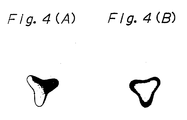
- Fig. 4(A) is a photo of the cross section of the dyed filament in accordance with the present invention. As shown in Fig. 4(A), a permeating area of the dyestuff is greatly deviated from a geometrical center in the cross section.
- Fig. 4(B) shows a microphotograph of a cross section of a dyed filament of a conventional crimped multifilament.
- the fastness to crimp of the multifilament in accordance with the present invention becomes superior due to the above-mentioned specific distribution of birefringence index.
- thermoplastic polymer in the present invention means a polyamide such as a nylon 66, a nylon 6, a nylon 12, a nylon 46 or the like, a polyester such as a polyethylene terephthalate, a polybutylene terephthalate, a polyethylene isophthalate or the like as well as a fiber formable polymer such as a polypropylene, a polyethylene or the like. If necessary, an additive such as an antistat, a delustering agent, a flame retarder or the like may be included.
- the present invention presents superior effects in particular when applied to a polyamide or a polyester.
- the birefringence indexes of the filament have preferably a difference of 5 x 10 ⁇ 3 to 45 x 10 ⁇ 3 between the outer layer and an internal layer and a distribution deviated from a center of the filament.
- the difference ⁇ ( ⁇ n) of the birefringence indexes in the cross section is less than 5 x 10 ⁇ 3, the number of crimp become insufficient and thus the object of the present invention cannot be attained.
- a crystal growth rate of the filament obtained by a wide-angle X-ray diffractometry is preferably 0.2 or more.
- a crystal perfection index is 70% or more.
- the crystal growth rate and the crystal perfection index can be measured by a latterly described method using a wide-angle X-ray diffractometry.
- the crystal growth rate is an indication expressing a degree of crystal growth. The nearer to 1 the value of the crystal growth rate comes, the bigger the crystal growth is. It is apparent that the crystal in the crimped multifilament in accordance with the present invention is extremely grown, by the fact that a value of the crystal growth rate of a conventional filament manufactured by a lower speed spinning and drawing process is 0.15 or less. A preferable crystal growth rate is 0.25 or more.
- the crystal perfection index means an indication expressing mainly a size of crystal and the nearer to 100% the value of the crystal perfection index, the heighest perfection of the crystal is. It is apparent that the crimped multifilament is accordance with the present invention has an extremely higher crystal perfection index by the fact that a polyamide multifilament manufactured by a lower speed spinning and drawing process has the crystal perfection index of 40% to 60%.
- the polyamide crimped multifilament in accordance with the present invention have not completely a spherulite and thus a smoothness on a surface of the filament is superior.
- a lot of spherulites are generated or the surface of filaments due to high crystallization speed, and thus the smoothness of the surface of filament is impaired, and the filament is devitrificated. Accordingly, it is impossible to have a clearer color development and a superior luster from the dyed filament.
- the smoothness of a filament surface can be easily observed by a conventional electromicroscope having a magnification of around 500 to around 2000.
- Fig. 5 shows an electro micrograph of a nylon 66 crimped filament, with no spherulites in the crimped filament in accordance with the present invention as shown in Fig. 5(A), and generation of the spherulites is confirmed in a conventional crimped filament as shown in Fig. 5(B).
- thermoplastic polymer A case using a polyester represented by a polyethylene terephthalate and a polybutylene terephthalate as the thermoplastic polymer will be explained hereafter.
- the birefringence indexes of the filament have preferably a difference of 20 x 10 ⁇ 3 to 100 x 10 ⁇ 3 between the outer layer and the inner layer and a distribution deviated from a center of the filament.
- the difference of the birefringence index is 30 x 10 ⁇ 3 or more, a superior crimp can be generated.
- the obtained crimp has a superior fastness to crimp.
- the crystal growth rate of the polyester can be measured by latterly described method, the nearer to 1 the value of crystal growth rate comes, the bigger the crystal growth is. It is apparent that the crystal in the crimped multifilament in accordance with the present invention is extremely grown by the fact that a value of the crystal growth rate of a conventional filament manufactured by a lower speed spinning and drawing process is 0.3 or less. A preferable crystal growth rate is 0.5 or more.
- the crimped multifilament in accordance with the present invention can be obtained by simultaneously satisfying the three following factors.
- the crimped multifilament in accordance with the present invention can show superior bulkiness and fastness to crimp or the basis of the above structure.
- the fastness to crimp is expressed as a resistance against a stretching stress applied to the filament and a recovering force of the crimp under a load.
- the crimped multifilament is used as a state of a bulked continuous filaments, i.e., B.C.F. to a carpet, even if excess stretching stress is applied to the filament during a twisting process and a tufting process, there is little lowering of the crimp and superior bulkiness is remained.
- the recovery force of the crimp is also superior.
- the crimped multifilament becomes to a mutually crowded state and then the crimped multifilament is applied with restriction caused by a load corresponding to 0.2 m/g.
- B.C.F. is supplied from a wound package and B.C.F. is rewound from the package and tufted.
- the crimp in B.C.F. decreases greatly due to creep generated in the package. Accordingly, when the recovery force of crimp is weak, the crimp do not sufficiently recover due to the restriction after the tufting process and thus properties of the carpet becomes remarkably inferior.
- the crimped multifilament in accordance with the present invention can recover again the crimp thereof by a boiling water treatment and even if the multifilament is under the restriction, the crimped multifilament in accordance with the present invention has superior recovery force of the crimp over that of the conventional B.C.F.
- the crimped multifilament in this case, mentioned as a tow
- stretch of the crimp is very small and thus a good carding processability can be expected.
- a cross section of the crimped multifilament in accordance with the present invention is not limited to a circle, a yarn having an odd cross section such as a trilobate, a square or the like, or a hollow yarn can be used.
- a denier of a filament is not particularly specified either, subject to around 50 d or less.
- an entanglement may be applied to the crimped filament.
- Fig. 6 shows an example of a spinning and heat-treating apparatus of implementing a manufacturing method in accordance with the present invention.
- Filaments 13 extruded from a spinneret 2 mounted on a spinhead 1 are cooled by a cooling air chamber 4.
- the filaments are asymmetrically cooled by applying an aqueous liquid from an aqueous liquid applicator 50 to one side of the filaments. In this case, the aqueous liquid is applied to the filaments which are separated each other.
- the filaments 13 are converged and oiled by an oiling nozzle 6, and then taken up by a high-speed take-up roll 7. Subsequently, the filaments 13 are relaxation-heat treated by a heat-treating apparatus 8 to obtain a random crimp, imparted an entanglement by means of a cooling drum 9 and an entangling nozzle 10, and through a tension control roll 11 wound up to a package 12.
- a liquid injecting nozzle is used as the heat-treating apparatus 8.
- Fig. 6 schematically shows the apparatus in Fig. 5 further provided with a drawing means, in which the filaments 13 are drawn between a take-up roll 7 and a drawing roll 7'.
- Figs. 8 and 9 are schematic drawings of carrying out the water applying operation in accordance with the present invention.
- Fig. 8(A) is a schematic front view of a separating nozzle separating the filaments from each other
- Fig. 8(B) is a sectional view taken at the line E-E' in Fig. 8(A)
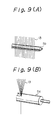
- Fig. 9(A) shows an example of a roll method in which filaments are aligned in a plane and then the aqueous liquid is applied to one side of the plane of filaments
- Fig. 9(B) shows an example of a nozzle method applying the liquid water to converged filaments from one side thereof.
- the filaments extruded from the spinneret should be air-cooled, should be supplied with aqueous liquid in the region where the filaments are cooled down to a temperature of 100°C, to thereby cool asymmetrically, and should be spun at a spinning rate of 4000 m/min or more.
- the difference ⁇ ( ⁇ n ) in the birefringence indexes between the outer layer and the inner layer of the filament section is not allowed to enlarge which is the object of the present invention, and the difference ⁇ ( ⁇ n ) in the birefringence indexes which has once occurred may be caused to disappear by the subsequent drawing or the like. Further, in the filament after heat-treating, the crystal is prevented from fully growing, resulting in the shortage of fastness to crimp of the obtained crimped filaments.
- the spinning speed at which the object of the present invention can be achieved is within the range of 5000 m/min to 8000 m/min. In case of the spinning speed of 8000 m/min or more, it is possible to obtain multifilaments of the invention by subjecting to an extremely great volume of aqueous liquid, whereas plenty of aqueous liquid must be required to adjust the crystal growth rate of the filament, bringing about a scattering of the aqueous or other trouble.
- the most desirable spinning speed is 5500 to 7500 m/min.
- the remarkable feature of the present invention lies in the fact that the filaments extruded from the spinneret are air-cooled, and supplied with aqueous liquid before the temperature of the filaments reaches 100°C or below, thus conducting an asymmetrical cooling.
- the object of the present invention is not to be achieved regardless of the volume of water to be applied or other conditions.
- the temperature of the filaments is higher than 100°C at the time of applying the aqueous liquid, so the difference ⁇ ( ⁇ n ) in the birefringent indexes enlarges. Nevertheless, the temperature above 250°C of the filaments causes trouble such as a breakage of the filaments during the application of the aqueous liquid. Therefore, the preferred temperature of the filaments is within the range of 250°C to 100°C.
- a polymer In a melt spinning, a polymer is generally extruded from the spinneret at a temperature of 260°C to 320°C.
- cooling of the filament previous to the application of an aqueous liquid is carried out through a cooling air, which is generally employed in the melt extrusion.
- the position of the filaments relative to the spinneret where the filaments have a temperature of 100°C or more which is suitable for executing the present invention differs depending on the spinning speed and fineness of the filament. Supposing the spinning speed is 4000 m/min or more, and the fineness is 1 to 5 denier which is normally used for clothing, it is within about 100 cm below the spinneret.
- the aqueous liquid of the present invention is therefore within the above range.
- a temperature of the filament applied with the aqueous liquid is 100°C or more, preferably 130°C or more.
- a filament having a fineness of about 10 to 30 denier is used for carpets.
- the application of the aqueous liquid is carried out at a position within about 300 cm below the spinneret.
- polyester in the case of polyamide there is not generally seen a rapid slenderizing of the yarn diameter during the spinning process at the high-speed spinning under the condition free from any application of aqueous liquid.
- a distinctive slenderizing was observed at the applying point of the aqueous liquid. in other words, it has been definitely shown by the present invention for the first time that the application of the aqueous liquid to the filament under a high-temperature causes compulsive appearance of the slenderizing point.
- a temperature of the filament applied with the aqueous liquid is 150°C or more, when the spinning speed is above around 6000 m/min, it is known that there is observed a rapid slenderizing of the yarn diameter during the spinning process (Journal of Textile Society, pp. 499-507, No. 11 (1982), Vol. 38).
- the aqueous liquid of the present invention is applied at a position of about 5 cm or more above the slenderizing position as a reference point (neck point), preferably, at about 5 cm or more preferably 10 cm or more above it.
- the aqueous liquid is applied at a position within 65 cm (at this position, a temperature of filament is around 150°C or more) below the surface of the spinneret, preferably, within 60 cm (at this point, a temperature of filament is around 200°C or more) below it.
- aqueous liquid for cooling filaments in the present invention water, a normal spinning lubricant emulsion, or the like is available.
- water may be used.
- the lower the temperature of the aqueous liquid the better. Nevertheless, the present invention can be accomplished without cooling below the normal temperature in particular.
- a method of applying the aqueous liquid in a state that the filaments are separated from each other, a method of applying the aqueous liquid in a state that the filaments are arranged in a plane, or a method of applying the aqueous liquid in a state that several or ten several filaments are converged can be used for the application of the aqueous liquid.
- the method of applying the aqueous liquid in the state that the filaments are separated from each other can be preferably used for the polyamide multifilament constituted with filaments having a denier of around 10 denier or more.
- this method is referred to as the "separated nozzle method".
- Fig. 8(A) shows an example of the separated nozzle method.
- Each filament is independently applied with the aqueous liquid by a group of nozzles 5a arranged in a mutually separated state.
- FIG. 8(B) which is a sectional view taken along the line E-E' of Fig. 8(A) is shown.
- a top end of the nozzle is formed to a sharp shape and this shape is a suitable shape to make a resistance caused by contact with the filaments to small and to cool asymmetrically the filaments.
- the method of applying the aqueous liquid in the state that the filaments are arranged in the plane can be preferably used for the polyester multifilament constituted with a filament having a denier of around 10 denier or less.
- this method is referred to as the "Roll method”.
- Fig. 9(A) shows an example of the roll method. It is preferable that a resistance caused by contact with the filament is small. Accordingly a diameter of the roll may be determined in a range of 10 mm to 50 mm.
- a method of applying the aqueous liquid in a state that several or ten several filaments are converged can be preferably used for the multifilament constituted with filaments having a denier of 1 d to 5 d.
- this method is referred to as the "Nozzle method”.
- the quantity of the aqueous liquid applied to the filament is represented by weight percentage relative to the filament.
- the filaments are asymmetrically cooled and the crystal growth rate is suppressed by applying the aqueous liquid to the filaments having a higher temperature.
- An application of the aqueous liquid of about 10 wt% or more is required to achieve the object of the present invention. In case the application of the aqueous liquid reaches 500 wt% or more, it is necessary to prevent an excess aqueous liquid from scattering.
- the preferable quantity of the aqueous liquid is 20 to 300 wt%. And the quantity of the aqueous liquid of 20 to 50 wt% is used in the separated nozzle method and the roll method.
- the filaments tend to cause troubles such as a breakage of the filaments arising from a mutual fusing and the like, due to its high-temperature of 100°C or more. It is a remarkable discovery of the present invention that the above-mentioned fusing phenomenon completely ravels out to obtain an extremely stable spinning by applying an aqueous.
- the asymmetrical cooling in accordance with the present invention can be attained by combination of the high-speed spinning process a sinning speed of which is 4000 m/min or more and the process of applying the aqueous liquid on one side of the filaments.
- the asymmetrical cooling is attained by that, when the filaments is in contact with the aqueous liquid applied to the one side of the filaments, a membrane of the aqueous liquid, i.e., a surface tension of liquid is broken by a high speed running of the filaments and results in application of the aqueous liquid on only one side of the filaments. This technical fact can be confirmed by observing a contacting portion between the filaments and the aqueous liquid.
- a drawing operation a drawing ratio of which is between 1.0 and 1.5
- a heat treatment a temperature of which is 150°C or more
- a spinning speed of around 4000 to 5000 m/min
- a spinning speed of around 5,000 m/min or more a crimped multifilament having mechanical properties useful for practical use can be obtained with the application of the drawing operation.
- a multifilament is spun at the spinning speed of 5,000 m/min or more to make a crimped multifilament without the application of a drawing operation in view of obtaining high productivity with simple process.
- the drawing be carried out by heat-drawing at the glass transition temperature of the polymer or more.
- the heat-treating needs to be conducted at a temperature of around 150°C or more, preferably under a substantially relaxed condition.
- the present invention is characterized in that the filaments previous to the heat-treatment have a lower crystal growth rate whereas the filaments subjected to the heat-treatment are permitted to grow larger. This is a remarkable change which has not been anticipated so far, of which reason is not yet cleared up. It is guessed however that a higher crystal growth rate peculiar to the high-speed spinning and potentialized into a freeze by an application of aqueous liquid, is actualized by a high-temperature heat-treatment.
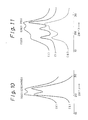
- Figs. 10 and 11 schematically show the growth of a crystal subjected to a heat-treatment.
- Fig. 10 shows an example using nylon 66 as a polymer, in which reference numeral (I) represents a wide-angle X-ray diffraction pattern of the filament previous to the heat treatment, and (2) represents a wide-angle X-ray diffraction pattern of the filament subjected to the heat-treatment.
- Fig. 11 shows an example using polyethylene terephthalate as a polymer, in which in the same manner as Fig.
- reference numeral (I) stands for a wide-angle X-ray diffraction pattern of the crimped filament previous to the heat-treatment
- (II) stands for that subjected to the heat treatment
- (III) stands for that of a conventional filament manufactured by a lower spinning speed and drawing method.
- a multifilament having only a spiral crimp can be manufactured from a multifilament obtained by using the high-speed spinning herebefore, but the random crimped multifilament can be first obtained on the basis of discovery of the above technical concept.
- a temperature of the heat-treating is less than around 150°C, the crystal is not allowed to fully grow and hence it is difficult to obtain crimped yarns having a superior fastness to crimp which the present invention aims to provide.
- the temperature of the heat-treatment is preferably around 180°C or more.
- the heat-treating be carried out substantially under a relaxation, preferably under the relaxation of the order of 5% or more.
- a relaxation preferably under the relaxation of the order of 5% or more.
- a relaxation heat-treating apparatus of this kind for example, a fluid nozzle which is disclosed in Japanese Unexamined Patent Publication (Kokai) No. 59-71440, a jet processing apparatus disclosed in Japanese Examined Patent Publication (Kokoku) No. 58-30423, or other means may be appropriately selected.
- a high temperature air, a saturated vapor or a unsaturated vapor can be generally used as a heated fluid used in the jet processing method.
- the jet processing method using a fluid nozzle may be adapted.
- a random crimped multifilament having a superior fastness to crimp can be obtained by a combination of the fiber structure formed by the asymmetric cooling and an effect caused by the jet processing method.
- the polyester crimped multifilament is used as a staple fiber, it is not always to use the jet processing method, and, for example, it is possible to accumulate the fibers on a running net and apply the heat treatment under the relaxation of the fibers.
- the fibers before the application of the heat treatment are not crimped, but the crimped multifilament having a sufficient crimped shape can be obtained by the above heat treatment under the relaxation in place of the use of the jet processing method. This is a remarkable matter compared with a fact that a crimped multifilament having a spiral shape have been only obtained by a method disclosed in Japanese Unexamined Patent Publication (Kokai) No. 62-23816.
- the high-speed spinning and the heat treatment or the high-speed spinning, the heat treatment and the drawing.
- the most effective one is that the high-speed spinning and crimping treatment in which the high-speed spinning is first conducted and the heat treatment is applied to the filament without drawing.
- a nylon 66 composed substantially of a polyhexamethylene adipamide having a relative viscosity ⁇ rel of 2.9 is spun by using a spinning and crimping apparatus shown in Fig. 6.
- the relative viscosity is measured by using 1% solution of 95% H2SO4.
- a rectangle spinneret having 68 holes a shape of which is a trilobate equally spaced with three slits having a length of 0.70 mm and a width of 0.15 mm is used as the spinneret.
- Nylon 66 is extruded by an extrusion rate of 9.8 g/min ⁇ hole at a spinning temperature of 300°C, and taken out at a speed of 600 m/min as a multifilament of 1000 d.
- a non-heated type heat insulating tube having a length 20 cm is arranged in a state sealed with a spinning face of the spinneret on a lower portion of the spinneret.
- the multifilament is cooled by a cool air blown from an air chamber and having a temperature of 20°C at a speed of 0.3 m/sec.
- Water is applied to one side of the filaments from a direction opposite the blowing direction of the cool air by a separating nozzle shown in Fig. 6 to perform asymmetrical cooling.
- a quantity of the water applied to the filament is around 30 wt%
- an oil is applied to the filament by an oil feeding nozzle and then the multifilament are continuously fed through a taking roll having a circumferential speed of 6,000 m/min and a temperature of 200°C to a jet stuffer nozzle, to apply a crimping treatment to the filaments.
- the multifilament is not applied with a drawing operation.
- a heated and compressed gas having a temperature of 250°C and a pressure of 5 kg/cm2 is used in the crimping treatment.
- the crimped multifilament is cooled and then wound to a cheese-like package at a winding speed of 5,100 m/min, and a relaxation ratio of the multifilament of around 15% is used.
- Table 1 Properties of the various crimped multifilaments having a random crimp obtained by changing a position of a water applying roll from the spinning face of the spinneret are shown in Table 1.
- properties of multifilament before applying the crimping treatment can be obtained by measuring a multifilament wound directly from the taking roll on a cheese-like package.
- the multifilaments of 1150 d/68 f in Examples 1 to 6 are applied with a S-twist of 40 T/meter, respectively, three twisted multifilaments are plied and the plied multifilaments are applied with a twist of 40 T/meter to have a tuft yarn, respectively.
- Loop carpets having a weight per unit area of 750 g/m2 are manufactured by piercing the tuft yarn under conditions of a pile length of 6 mm and 7.4 stitch/inch.
- the obtained carpets are dyed with a ready-made three primary color dyestuff, i.e., a dyestuff blended with Tectilon Yellow 4R, Tectilon Red 2B and Tectilon Blue 4G supplied from Ciba Geigy.
- a dyestuff blended with Tectilon Yellow 4R, Tectilon Red 2B and Tectilon Blue 4G supplied from Ciba Geigy a ready-made three primary color dyestuff, i.e., a dyestuff blended with Tectilon Yellow 4R, Tectilon Red 2B and Tectilon Blue 4G supplied from Ciba Geigy.
- a carpet manufactured from the crimped multifilament No. 6 has a disorder of pile raws, inferior bulkiness and lack of useability of a commercial product.
- Carpets manufactured from the crimped multi-filaments No. 1 to 5 have a good alignment of the piles and a superior bulkiness
- the carpets of the cramped multifilaments No. 1 to No. 5 have a compression ratio of 41 to 42%, a compressive modulus of 90 to 91% and a thickness reduction ratio under a dynamic loading operations of 10000 times of 14 to 15%, respectively, and result in a sufficient performance as a carpet.
- Fig. 12 shows a relationship between the crimp generating ratio and a load applied to the multifilament for the both multifilaments.
- the crimped multifilament in accordance with the present invention has an extremely higher crimp generation ration compared with that of the conventional crimp multifilament.
- This Embodiment 2 aims to measure a distribution of a birefringence index of a crimped multifilament obtained in the Embodiment 1.
- Various crimped multifilaments are manufactured by the same method as that of Embodiment 1, except that a nylon 66 having a relative viscosity ⁇ rel of 2.6 is spun at a temperature of 295°C by using a spinneret including spinning holes having a diameter of 0.35 mm ⁇ .
- a multifilament of a nylon 66 and constituted with filaments of 20 d is manufactured by a high speed spinning method which is the same as that of the Embodiment 1.
- a relationship between the spinning speed and an extrusion rate per a hole are as follows.
- a water is applied to the multifilament on a position below 200 cm from a spinneret by the separate nozzle system.
- a water applying roll is arranged on a position blow from a surface of the spinneret.
- a spinning speed is changed from 3,000 m/min to 7,000 m/min.
- a temperature of the filament applied with water during the above range of the spinning speed may be around 170°C to 180°C.
- an oil is applied to the filament by an oil feeding nozzle, and the multifilament is not applied with drawing operation, but directly fed into a jet stuffer apparatus shown in Fig. 6, and the multifilament is applied with the same crimping treatment as that of Embodiment 1 but this relaxation ratio of the multifilament is around 15.
- a roll 7 in Fig. 6 is heated at 150°C, and the multifilament are drawn at a drawing ratio of 1.8 and 1.4, respectively.
- the drawing operation is not applied to cases using the spinning speeds of 5,000 m/min, 6,000 m/min and 7,000 m/min.
- Examples No. 6 to 8 in Table 3 are comparative examples obtained without an asymmetrically cooling operation applying an aqueous liquid, and the filament of the examples No. 2 to No. 5 have a distribution in which a birefringence index is deviated.
- a degree of odd shapes of a cross section of each filament in this embodiment is between 1.7 and 1.8, and thus a cross sectional shape of each filament is a trilobate.
- the crimped multifilament obtained by applying an aqueous liquid at a spinning speed of 4,000 m/min or more in accordance with the present invention has superior generation and fastness of the crimp, and the filament has no irregular surface thereon and has superior transparency.
- This Embodiment 4 aims to measure a distribution of a birefringence index of a crimped multifilament obtained in the Embodiment 3.
- Various crimped multifilaments are manufactured by the same method as that of Embodiment 3, except that a nylon 66 having a relative viscosity ⁇ rel of 2.6 is spun at a temperature of 295°C by using a spinneret including spinning holes having a diameter of 0.35 mm ⁇ .
- the crimped multifilament obtained by applying an aqueous liquid at a spinning speed of 4,000 m/min or more in accordance with the present invention has superior crimp and fastness thereof, and the filament has completely no irregular surface thereon.
- a nylon 6 composed substantially of a polycaproamide having a relative viscosity ⁇ rel of 3.2 is spun by using a spinning and crimping apparatus shown in Fig. 6.
- the relative viscosity is measured by using 1% solution of 95% H2SO4.
- the nylon 6 is extruded from a spinneret having 68 holes a diameter of which is 0.35 mm ⁇ , at a temperature of 290°C, and a multifilament of 1000 d is spun and taken out at a speed of 6,000 m/min.
- Another example of multifilaments are spun and taken out by using, a spinneret having 68 holes of trilobate shape constituted with three slits having a same length of 0.70 mm and a same width of 0.15 mm.
- An extrusion rate of the nylon 6 is 9.8 g/min.hole.
- a heat tube having a length of 20 cm and an inner temperature of which is 200°C are arranged on a lower portion of the spinneret, and the multifilament is cooled by an cool air having a temperature of 20°C and a speed of 0.3 m/sec and blown from a cool air chamber.
- Water is applied to one side of the filaments having a temperature of 155°C at a position below 250 cm from the spinneret by a separating nozzle shown in Fig. 6 to perform asymmetrical cooling.
- a quantity of the water applied to the filament is around 20 wt%.
- an oil is applied to the filament by an oil feeding nozzle and then the multifilament are continuously fed through a taking roll having a circumferential speed of 6,000 m/min and a temperature of 180°C to a jet stuffer nozzle, to apply a crimping treatment to the filaments.
- the multifilament is not applied with a drawing operation.
- the treatment conditions in this case are a temperature of 230°C, a pressure of 5 kg/cm2 and a relaxation ratio of 9%.
- the obtained crimped multifilament has a random crimp.
- a polyethyleneterephthalate having an intrinsic viscosity ⁇ of 0.62 is spun by a spinning machine as shown in Fig. 6 using a spinneret having 24 holes a diameter of which is 0.35 mm ⁇ at a temperature of 300°C.
- a heating tube of an aluminum body in which a heater is embedded and having an inner diameter of 12 cm and a length of 25 cm is in a state such that a gap between a spinning face of the spinneret and the heating tube is not made on a lower portion of the spinneret, and a temperature of the heater is determined at 250°C.
- the multifilament coming out from the heating tube is cooled by cool air having a temperature of 20°C and a speed of 0.30 m/sec blown from a laterally blown cool air chamber, and a water of a room temperature is applied to the multifilament by 40 wt% for a weight of the multifilament to perform asymmetrical cooling.
- a position of the asymmetrical cooling caused by the application of the water is 50 cm below the spinning face of the spinneret.
- a temperature of the multifilament in this position is around 180°C to 190°C in a range of the spinning speed as shown in Table 7.
- the multifilament applied with the asymmetrical cooling is further applied with an oil, to make the multifilament of 50 d/24 f without drawing, and is wound.
- different spinning speeds are used in this embodiment as shown in Table 7.
- a position of a neck point appearing in a Spinning operation and measured from the spinneret is a value measured when the water is not applied.
- the measurements are performed by a diameter instrument type 460 ⁇ /2 supplied from ZIMMER GmbH and observation with the naked eye, and values obtained by the both methods are identical.
- those multifilaments are applied with a crimping treatment without drawing by an apparatus shown in Fig. 7.
- Rolls 7 and 7' are not heated and has a constant circumferential speed of 3,000 m/min in this case.
- a heated and compressed air having a temperature of 240°C and a pressure of 2 kg/cm2 is supplied from a jet stuffer nozzle.
- a relationship between the roll 7' and a roll 11 is determined in such a manner that a boiling shrinkage ratio of the obtained crimped multifilament becomes to around 1% or less.
- IWR of the multifilament before applying the crimping treatment and properties of the crimped multifilament are shown in Table 7.
- the polyester crimped multifilament in accordance with the present invention has a superior crimp and fastness thereto in accordance with a presence of the eccentricity.
- This embodiment is a case that a polyester crimped multifilament is cut to have a staple fiber and a spun yarn is manufactured of the staple fiber.
- a rectangle spinneret having 250 holes constituted by aligning 50 holes spaced with a pitch of 6 mm to a hole line and arranging 5 hole lines with a distance of 6 mm between them is used.
- a heating tube having a lengthwise length of 35 cm and a lateral length of 15 cm in a cross section and a length of 25 cm is arranged on a position below the spinning face of the spinneret.
- Non-crimped multifilament of 500 d/250 f is spun under the same condition as those appeared in No. 2 using a spinning speed of 6,000 m/min and No. 6 in Table 7 corresponding the embodiment 7.
- non-crimped multifilament is applied with the same heat treatment as that used in the embodiment 7 to have a crimped multifilament.
- the obtained two crimped multifilaments are cut to staple fibers having a biased cut staple diagram of fiber lengths between 80 m and 110 mm.
- Those staple fibers are supplied to a roller card having a diameter of 60 inch to perform a carding test of the obtained staple fibers.
- a carding operation is performed without trouble for the staple fiber corresponding No. 2 of the embodiment 7 and a sliver in which neps are not generated can be obtained.
- a spun yarn of 1/40 Nm is spun from this sliver.
- the staple fiber corresponding to No. 6 of the embodiment 7 cannot be processed in a card due to a greatly generation of an opener waste at an exit of a press cylinder of the card.
- This embodiment corresponds to the embodiment 7 except that a fiber having an odd shaped cross section is used.
- a spinneret having 24 holes a shape of which is a trilobate constituted with three same slots having a length of 0.28 mm and a width of 0.06 mm.
- the polyethylene terephthalate is spun under the same conditions as those in the embodiment 7, an asymmetrical cooling and an oil applying is applied, and then a multifilament is taken at a spinning speed of 6,500 m/min without drawing.
- a water application is applied by a nozzle system shown in Fig. 9(B) and the water of a room temperature is applied to the fiber by 100 wt% thereof.
- a position where the asymmetrical cooling is applied is determined to different positions for examples.
- Diameter of a filament is changed at a position applied with a water in the all examples and thus generation of the neck is confirmed.
- the multifilament applied with the water has an eccentric distribution of the birefringence index and has no the crimp.
- the multifilament is continuously applied with a crimping treatment by using a treating apparatus shown in Fig. 6 without a taking operation to have a crimped multifilament of 50 d/24 f.
- a temperature of 250°C and a constant pressure of 4 kg/cm2 are used, and a relaxation ratio is determined in such a manner that a boiling shrinkage ratio of the crimped multifilament becomes to around 1% or less.
- IWR of the multifilament before applying the crimping treatment and properties of the crimped multifilament are shown in Fig. 9.
- the polyester crimped multifilament in accordance with the present invention has a superior crimp and fastness thereto. Further this polyester crimped multifilament has a feature that an initial modulus thereof is small. Soft and bulky handling can be obtained in a knitted fabric of this polyester crimped multifilament due to the above feature.
- a crimped multifilament is manufactured by the same conditions as those of No. 2 in Table 9 corresponding the example 10, except that a quantity of the water applying to the filament is changed as shown in Table 10.
- the water is applied to the filament a temperature of which is 200°C.
- a crimped multifilament in accordance with the present invention has superior transparency and bulkiness as a continuous filament and when the crimped multifilament are used to a carpet or a raised fabric, a product having a fastness and high-class feeling can be obtained.
- the crimped multifilament is used as a staple fiber, there is no trouble in a card processability and a spinningability and thus it is possible to blend this staple fiber with another material, such as a wool, a cotton or the like.
- a manufacturing method in accordance with the present invention has no trouble in a spinning process and crimping process of the crimped multifilament and thus the crimped multifilament can be easily manufactured at a high speed, accordingly the manufacturing method in accordance with the present invention has a high productivity and an extremely high industrial value.
Landscapes
- Engineering & Computer Science (AREA)
- Textile Engineering (AREA)
- Mechanical Engineering (AREA)
- Chemical & Material Sciences (AREA)
- Chemical Kinetics & Catalysis (AREA)
- General Chemical & Material Sciences (AREA)
- Yarns And Mechanical Finishing Of Yarns Or Ropes (AREA)
- Spinning Methods And Devices For Manufacturing Artificial Fibers (AREA)
- Artificial Filaments (AREA)
Applications Claiming Priority (3)
| Application Number | Priority Date | Filing Date | Title |
|---|---|---|---|
| JP309009/89 | 1989-11-30 | ||
| JP30900989 | 1989-11-30 | ||
| PCT/JP1990/001549 WO1991008330A1 (fr) | 1989-11-30 | 1990-11-29 | Multifilament crepe et procede de production d'un tel filament |
Publications (3)
| Publication Number | Publication Date |
|---|---|
| EP0455831A1 true EP0455831A1 (de) | 1991-11-13 |
| EP0455831A4 EP0455831A4 (en) | 1992-05-20 |
| EP0455831B1 EP0455831B1 (de) | 1997-09-03 |
Family
ID=17987796
Family Applications (1)
| Application Number | Title | Priority Date | Filing Date |
|---|---|---|---|
| EP90917689A Expired - Lifetime EP0455831B1 (de) | 1989-11-30 | 1990-11-29 | Gekräuseltes multifilament und verfahren zur herstellung eines solchen filaments |
Country Status (3)
| Country | Link |
|---|---|
| EP (1) | EP0455831B1 (de) |
| DE (1) | DE69031383T2 (de) |
| WO (1) | WO1991008330A1 (de) |
Family Cites Families (11)
| Publication number | Priority date | Publication date | Assignee | Title |
|---|---|---|---|---|
| FR1517632A (fr) * | 1966-04-06 | 1968-03-15 | Toyo Boseki | Fibres frisées creuses à trois dimensions en polyester et leur procédé de fabrication |
| JPS5611762B2 (de) * | 1973-10-24 | 1981-03-17 | ||
| JPS5727204B2 (de) * | 1973-12-14 | 1982-06-09 | ||
| JPS5512832A (en) * | 1978-07-05 | 1980-01-29 | Toyobo Co Ltd | Production of hollow crimped fiber |
| JPS55107511A (en) * | 1979-02-09 | 1980-08-18 | Jiro Shimizu | High-speed spinning of polyethylene terephthalate having double cross-sectional structure |
| US4301102A (en) * | 1979-07-16 | 1981-11-17 | E. I. Du Pont De Nemours And Company | Self-crimping polyamide fibers |
| JPS59216918A (ja) * | 1983-05-26 | 1984-12-07 | Toyobo Co Ltd | 捩れを有するポリエステル繊維 |
| JPS61194209A (ja) * | 1985-02-20 | 1986-08-28 | Toyobo Co Ltd | 高強力ポリアミド繊維及びその製造法 |
| IN167096B (de) * | 1985-04-04 | 1990-09-01 | Akzo Nv | |
| JP2702128B2 (ja) * | 1987-10-09 | 1998-01-21 | 東レ株式会社 | 立毛布帛用パイル糸 |
| JPH02127534A (ja) * | 1988-11-01 | 1990-05-16 | Asahi Chem Ind Co Ltd | ポリアミド捲縮糸 |
-
1990
- 1990-11-29 DE DE69031383T patent/DE69031383T2/de not_active Expired - Lifetime
- 1990-11-29 EP EP90917689A patent/EP0455831B1/de not_active Expired - Lifetime
- 1990-11-29 WO PCT/JP1990/001549 patent/WO1991008330A1/ja not_active Ceased
Also Published As
| Publication number | Publication date |
|---|---|
| EP0455831A4 (en) | 1992-05-20 |
| WO1991008330A1 (fr) | 1991-06-13 |
| DE69031383D1 (de) | 1997-10-09 |
| DE69031383T2 (de) | 1998-02-19 |
| EP0455831B1 (de) | 1997-09-03 |
Similar Documents
| Publication | Publication Date | Title |
|---|---|---|
| US5439626A (en) | Process for making hollow nylon filaments | |
| US5459991A (en) | Composite crimped yarn and woven fabric | |
| US8153253B2 (en) | Conjugate fiber-containing yarn | |
| US3854177A (en) | Process and apparatus for texturing yarn | |
| EP0095712B2 (de) | Einfach färbbare Polyäthylenterephthalatfasern und Verfahren zur Herstellung derselben | |
| US4237187A (en) | Highly oriented, partially drawn, untwisted, compact poly(ε-caproamide) yarn | |
| US3967441A (en) | Yarns and process for production thereof | |
| EP0028844B1 (de) | Polypropylen-Filamentgarn und Verfahren zu dessen Herstellung | |
| US4113821A (en) | Process for preparing high strength polyamide and polyester filamentary yarn | |
| US7029611B2 (en) | Process of making poly(trimethylene terephthalate) bulked continuous filament carpet yarn | |
| US5281476A (en) | Crimped multifilament and method for manufacturing the same | |
| EP0455831B1 (de) | Gekräuseltes multifilament und verfahren zur herstellung eines solchen filaments | |
| JPH03180529A (ja) | 捲縮糸 | |
| JP2877512B2 (ja) | 捲縮マルチフィラメントとその製造方法 | |
| KR930003939B1 (ko) | 권축 멀티 필라멘트 및 그의 제조방법 | |
| EP0067385B1 (de) | Texturiertes Nylon-6 Filament | |
| IE45829B1 (en) | Yarn processing | |
| CA1157637A (en) | Gear crimped jaspe yarns and processes for their manufacture | |
| JPWO1991008330A1 (ja) | 捲縮マルチフィラメントとその製造方法 | |
| JPS595688B2 (ja) | スパンライクカ−ペツトヤ−ン及びその製造法 | |
| JPH0299630A (ja) | 絹紡糸調嵩高加工糸の製造方法 | |
| JPS5847488B2 (ja) | 製編織用マルチフイラメントヤ−ン | |
| JPH02307923A (ja) | 複合構造加工糸 | |
| JPS6240447B2 (de) | ||
| JPH11172524A (ja) | ポリエステル繊維の製造方法 |
Legal Events
| Date | Code | Title | Description |
|---|---|---|---|
| PUAI | Public reference made under article 153(3) epc to a published international application that has entered the european phase |
Free format text: ORIGINAL CODE: 0009012 |
|
| 17P | Request for examination filed |
Effective date: 19910729 |
|
| AK | Designated contracting states |
Kind code of ref document: A1 Designated state(s): DE FR GB NL |
|
| A4 | Supplementary search report drawn up and despatched |
Effective date: 19920401 |
|
| AK | Designated contracting states |
Kind code of ref document: A4 Designated state(s): DE FR GB NL |
|
| 17Q | First examination report despatched |
Effective date: 19931102 |
|
| GRAG | Despatch of communication of intention to grant |
Free format text: ORIGINAL CODE: EPIDOS AGRA |
|
| GRAH | Despatch of communication of intention to grant a patent |
Free format text: ORIGINAL CODE: EPIDOS IGRA |
|
| GRAH | Despatch of communication of intention to grant a patent |
Free format text: ORIGINAL CODE: EPIDOS IGRA |
|
| GRAA | (expected) grant |
Free format text: ORIGINAL CODE: 0009210 |
|
| AK | Designated contracting states |
Kind code of ref document: B1 Designated state(s): DE FR GB NL |
|
| REF | Corresponds to: |
Ref document number: 69031383 Country of ref document: DE Date of ref document: 19971009 |
|
| ET | Fr: translation filed | ||
| PLBE | No opposition filed within time limit |
Free format text: ORIGINAL CODE: 0009261 |
|
| STAA | Information on the status of an ep patent application or granted ep patent |
Free format text: STATUS: NO OPPOSITION FILED WITHIN TIME LIMIT |
|
| 26N | No opposition filed | ||
| REG | Reference to a national code |
Ref country code: GB Ref legal event code: IF02 |
|
| PGFP | Annual fee paid to national office [announced via postgrant information from national office to epo] |
Ref country code: DE Payment date: 20091126 Year of fee payment: 20 |
|
| PGFP | Annual fee paid to national office [announced via postgrant information from national office to epo] |
Ref country code: NL Payment date: 20091114 Year of fee payment: 20 |
|
| PGFP | Annual fee paid to national office [announced via postgrant information from national office to epo] |
Ref country code: FR Payment date: 20091123 Year of fee payment: 20 Ref country code: GB Payment date: 20091125 Year of fee payment: 20 |
|
| REG | Reference to a national code |
Ref country code: NL Ref legal event code: V4 Effective date: 20101129 |
|
| REG | Reference to a national code |
Ref country code: GB Ref legal event code: PE20 Expiry date: 20101128 |
|
| PG25 | Lapsed in a contracting state [announced via postgrant information from national office to epo] |
Ref country code: NL Free format text: LAPSE BECAUSE OF EXPIRATION OF PROTECTION Effective date: 20101129 |
|
| PG25 | Lapsed in a contracting state [announced via postgrant information from national office to epo] |
Ref country code: GB Free format text: LAPSE BECAUSE OF EXPIRATION OF PROTECTION Effective date: 20101128 |
|
| PG25 | Lapsed in a contracting state [announced via postgrant information from national office to epo] |
Ref country code: DE Free format text: LAPSE BECAUSE OF EXPIRATION OF PROTECTION Effective date: 20101129 |