EP0455879A2 - Synthèse de poudres sous-microniques sous pression d'oxygène réduite - Google Patents
Synthèse de poudres sous-microniques sous pression d'oxygène réduite Download PDFInfo
- Publication number
- EP0455879A2 EP0455879A2 EP90124349A EP90124349A EP0455879A2 EP 0455879 A2 EP0455879 A2 EP 0455879A2 EP 90124349 A EP90124349 A EP 90124349A EP 90124349 A EP90124349 A EP 90124349A EP 0455879 A2 EP0455879 A2 EP 0455879A2
- Authority
- EP
- European Patent Office
- Prior art keywords
- carbonate
- hours
- oxygen
- temperature
- spray
- Prior art date
- Legal status (The legal status is an assumption and is not a legal conclusion. Google has not performed a legal analysis and makes no representation as to the accuracy of the status listed.)
- Withdrawn
Links
Images
Classifications
-
- C—CHEMISTRY; METALLURGY
- C01—INORGANIC CHEMISTRY
- C01G—COMPOUNDS CONTAINING METALS NOT COVERED BY SUBCLASSES C01D OR C01F
- C01G3/00—Compounds of copper
- C01G3/006—Compounds containing copper, with or without oxygen or hydrogen, and containing two or more other elements
-
- C—CHEMISTRY; METALLURGY
- C01—INORGANIC CHEMISTRY
- C01B—NON-METALLIC ELEMENTS; COMPOUNDS THEREOF; METALLOIDS OR COMPOUNDS THEREOF NOT COVERED BY SUBCLASS C01C
- C01B13/00—Oxygen; Ozone; Oxides or hydroxides in general
- C01B13/14—Methods for preparing oxides or hydroxides in general
- C01B13/18—Methods for preparing oxides or hydroxides in general by thermal decomposition of compounds, e.g. of salts or hydroxides
- C01B13/185—Preparing mixtures of oxides
-
- C—CHEMISTRY; METALLURGY
- C01—INORGANIC CHEMISTRY
- C01P—INDEXING SCHEME RELATING TO STRUCTURAL AND PHYSICAL ASPECTS OF SOLID INORGANIC COMPOUNDS
- C01P2004/00—Particle morphology
- C01P2004/51—Particles with a specific particle size distribution
-
- C—CHEMISTRY; METALLURGY
- C01—INORGANIC CHEMISTRY
- C01P—INDEXING SCHEME RELATING TO STRUCTURAL AND PHYSICAL ASPECTS OF SOLID INORGANIC COMPOUNDS
- C01P2004/00—Particle morphology
- C01P2004/60—Particles characterised by their size
- C01P2004/61—Micrometer sized, i.e. from 1-100 micrometer
-
- C—CHEMISTRY; METALLURGY
- C01—INORGANIC CHEMISTRY
- C01P—INDEXING SCHEME RELATING TO STRUCTURAL AND PHYSICAL ASPECTS OF SOLID INORGANIC COMPOUNDS
- C01P2006/00—Physical properties of inorganic compounds
- C01P2006/12—Surface area
-
- Y—GENERAL TAGGING OF NEW TECHNOLOGICAL DEVELOPMENTS; GENERAL TAGGING OF CROSS-SECTIONAL TECHNOLOGIES SPANNING OVER SEVERAL SECTIONS OF THE IPC; TECHNICAL SUBJECTS COVERED BY FORMER USPC CROSS-REFERENCE ART COLLECTIONS [XRACs] AND DIGESTS
- Y10—TECHNICAL SUBJECTS COVERED BY FORMER USPC
- Y10S—TECHNICAL SUBJECTS COVERED BY FORMER USPC CROSS-REFERENCE ART COLLECTIONS [XRACs] AND DIGESTS
- Y10S505/00—Superconductor technology: apparatus, material, process
- Y10S505/725—Process of making or treating high tc, above 30 k, superconducting shaped material, article, or device
- Y10S505/737—From inorganic salt precursors, e.g. nitrates
-
- Y—GENERAL TAGGING OF NEW TECHNOLOGICAL DEVELOPMENTS; GENERAL TAGGING OF CROSS-SECTIONAL TECHNOLOGIES SPANNING OVER SEVERAL SECTIONS OF THE IPC; TECHNICAL SUBJECTS COVERED BY FORMER USPC CROSS-REFERENCE ART COLLECTIONS [XRACs] AND DIGESTS
- Y10—TECHNICAL SUBJECTS COVERED BY FORMER USPC
- Y10S—TECHNICAL SUBJECTS COVERED BY FORMER USPC CROSS-REFERENCE ART COLLECTIONS [XRACs] AND DIGESTS
- Y10S505/00—Superconductor technology: apparatus, material, process
- Y10S505/725—Process of making or treating high tc, above 30 k, superconducting shaped material, article, or device
- Y10S505/737—From inorganic salt precursors, e.g. nitrates
- Y10S505/738—From inorganic salt precursors, e.g. nitrates by precipitating
Definitions
- the invention relates to improvements in the preparation of metal oxides.
- Metal oxides having a mean particle size less than 1 micron are made by steps including (1) reacting an aqueous solution of a metal salt (or salts) that form insoluble carbonate, thereby to form a carbonate precipitate, followed by (b) recovering the precipitate, e.g., by filtration; (c) redispersing the precipitate in water to form a dilute second slurry; (d) spray-drying said dilute second slurry; (e) calcining the spray-dried product at a low temperature (e.g., 540°C), followed by a final calcination in an atmosphere consisting of flowing oxygen under reduced pressure (e.g., 2 Torr), at a temperature (suitably 750°C) sufficiently high to form YBa2Cu3O x where x is above 6, but not so high as to cause the product to agglomerate into particles that have a mean particle size about 1 micron.
- a low temperature e.g., 540°C
- the product of steps (d) and (e) has a mean particle size less than 1 micron, typically averaging about 0.75 micron.
- Y-Ba-Cu oxides where the Y:Ba:Cu atomic ratio is 1:2:3 or 1:2:4 made with the new submicron materials provide higher current densities (J c ) than most similar prior products.
- the submicron powders of the invention are useful in making ceramics and superconductors, including superconducting thin films and in screen printing superconducting applications.
- mean particle size means that half the particles by volume have sizes below the stated size, and the other half above that size.
- Submicron particle means that the particle measures less than 1 micron in its largest dimension.
- Similar powders made by the process of the instant invention provide densities at least as high as those of Balachandran, but made at considerably lower temperatures (typically, 700-750°C).
- the ability to achieve YBa2Cu3O x at lower temperatures is believed to result both from the much smaller mean particle size (i.e., submicron versus 1-4 microns for the Balachandran product), and the much greater homogeneity of products of the invention process.
- particle size distribution was determined by laser-light scattering. Percentages are by volume.
- the graphics were computer-generated, based on the raw data obtained.
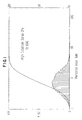
- Fig. 1 shows particle size distribution of the Y-Ba-Cu oxide product made in Example 1 (the invention).
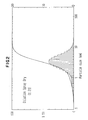
- Fig. 2 shows particle size distribution of a Y-Ba-Cu oxide product made by the same process as in Example 1, except that the ratio of carbonate:water in the re-slurry step was about 1:21, and the product was precalcined for 5 hours at 540°C in air, then calcined on a tray for 36 hours under 1 atmosphere of oxygen at 890°C.
- the mean particle size was about 3.28 micron.
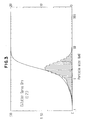
- Fig. 3 shows particle size distribution for spray-dried Y1Ba2Cu3 carbonate reslurried and processed substantially as described in Example 1, except that on reslurrying, the g:ml ratio of theoretical carbonate:water was 1:21. Volume of submicron particles was about 15%. Specific surface area was 4.0235 m2/cm3. Mean particle size was about 2.09 microns.
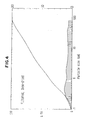
- Fig. 4 shows distribution for product prepared as in Example 1, except that, after filtering, the product was not reslurried, but was oven-dried and the cake was broken and particle size distribution determined at that stage.
- the volume of particles below 1 micron was found to be about 24%, and specific surface area 5.34 m2/cm3. Calcination was the same as in Fig. 2.
- the bars show amount of a given particle size and the curve (left hand scale) shows accumulative percents.
- the fraction of "0.93 micron" material is seen to be about 5%; and total material of 0.93 micron size and below is 61.4%.
- Total volume of particles 1 micron and below is seen to be about 66%.
- one or more water-soluble salts of the carbonate-forming metal or metals are dissolved in water, and a quaternary ammonium carbonate is added, while maintaining the pH of the reaction mixture at about 7.5-12.
- the pH is conveniently maintained by the addition of a quaternary ammonium hydroxide.
- the resulting precipitate may contain some hydroxide; the hydroxide is not an impurity and does not interfere with the precipitation or the subsequent steps. This type of precipitation is described in more detail in, e.g., USSN 155,340, filed Feb. 12, 1988, above referenced.
- Example 1 below is similar to Example 1 of USSN 155,340 as regards formation of the carbonate precipitate, except that USSN 155,340 uses tetraethylammonium carbonate as the precipitant.
- An analogous precipitation technique is described in U.S. Patent No. 4,839,339, Bunker et al, June 13, 1989, and gives a precipitate suitable for use in this invention.
- a solution of quaternary ammonium carbonate is conveniently prepared by bubbling CO2, through an aqueous solution of a quaternary ammonium hydroxide until the quaternary carbonate is stoichiometrically formed and CO2 is dissolved in excess.
- the preferred quaternary ammonium hydroxides have the formula: where R, R', R'', R'' are the same or different members of the group
- the invention process is a general one and is applicable to any metals (a) that provide water-soluble salts (nitrates, acetates, etc.) and (b) which form water-insoluble carbonates.
- the carbonates in various instances are actually the basic carbonates, subcarbonates, etc. It makes no difference, the important thing being water-insolubility.
- all carbonates are to some extent water-soluble. Those that are very sparingly soluble are intended for use in this invention, e.g., those having solubilities roughly comparable to the carbonates of the alkaline earth metals.
- metal salts An aqueous solution of metal salts is made up by dissolving their nitrates or other water-soluble salts in water.
- the metal atomic ratios will depend on the end use intended. Typically, any given metal may be present in an atomic ratio of 1-100, suitably 1-10, with respect to any other metal. However, when it is desired to introduce very small amounts of a given metal, this ratio will vary accordingly.
- a preferred aqueous solution of the metal salts is made up by dissolving their nitrates or other water-soluble salts in water, so as to provide a predetermined atomic ratio (e.g., if aiming at a superconductor, yttrium nitrate, barium nitrate, and copper nitrate may be dissolved in water so that yttrium, barium, and copper ions are present in the solution in a ratio of substantially 1:2:3 or 1:2:4).
- a predetermined atomic ratio e.g., if aiming at a superconductor, yttrium nitrate, barium nitrate, and copper nitrate may be dissolved in water so that yttrium, barium, and copper ions are present in the solution in a ratio of substantially 1:2:3 or 1:2:4.
- trivalent metal i.e. valence of +3
- yttrium or bismuth preferably selected from yttrium, scandium, and the other rare earth group elements (elements with atomic numbers 57-71
- at least one bivalent metal i.e. valence of +2
- Ba or Sr is preferably selected from the group Ba, Be, Mg, Ca, and Sr
- the solutions of quaternary ammonium carbonate and metal salt or salts are now added slowly, simultaneously, at constant rates, with stirring, to a pool ("heel") of deionized water.
- This pool is the reaction medium for the carbonate co-precipitation reaction, and the eventual result is a carbonate slurry.
- the two solutions and the heel are suitably each about the same starting volume.
- the pH should be maintained at about 7.5 or above, suitably between 7.5 and 12, during co-precipitation.
- the pH of the reaction mass may be maintained at about 9 by drip-wise addition of a quaternary ammonium hydroxide.
- the precipitated carbonates can be recovered from the slurry using various techniques. On a laboratory scale simple filtration followed by air drying the precipitate is adequate for good homogeneity.
- the resulting slurry consists essentially of
- the filtered precipitate recovered from this slurry is generally friable and easily crumbled.
- the carbonate precipitate is recovered by filtration or the equivalent.
- simple filtration through filter paper, with or without reduced pressure is appropriate.
- various commercial filters are available, e.g., rotary drum filters, rotary disk filters, traveling belt filters, leaf filters, etc. These filters typically provide a cake easily washed, and which may contain a few percent of water. This residual water is not harmful and may actually facilitate reslurrying the cake in the next step. Instead of filtration, centrifugation may be used.
- the filter cake in many cases may not be pure carbonate; minor amounts of hydroxides may be present, together with water of hydration as well as adherent water.
- the filter cake product at this point for Y-Ba-Cu carbonate is well known in the art. It has a submicron mean particle size and can be precalcined (e.g., at 540°C) and fired (e.g., at 900°C+) to make a superconductor, but mean particle size of the fired particles will be greater than 1 micron. To maintain mean particle size below one micron the filter cake must be processed as further described herein, starting with reslurrying the cake.
- the amount of water in which the filter cake is reslurried is important.
- the ratio in g. of theoretical Y-Ba-Cu carbonate to ml of water should be about 1:300-1500, and preferably about 1:500-700.
- theoretical carbonate I mean the product obtained as if all the dissolved metal ions were precipitated as carbonate. This is a theoretical value, since some of the materials do not precipitate exclusively as pure carbonate, as above explained. However, the amount of theoretical carbonate is very useful in determining the amount of water to be used in reslurrying the precipitate.
- Example 2 shows calculations for determining theoretical carbonate for Example 1. Similar calculations can be used for other solutions that yield carbonate precipitates, e.g., Y1Ba2Cu4 carbonates, La1Ba2Cu3 carbonates, etc. As noted, theoretical carbonate in Example 1 was 11.805 g, and the g:ml ratio for the reslurrying liquid was 11.804:7,500, or 1:635.
- a bench scale spray dryer a Yamato Model GS 21 with a GF-31 attachment, made by Yamato USA, Inc., Northbrook, IL was used.
- the atomizer operated with compressed nitrogen, and air preheated to about 140-165°C was used in the drying chamber.
- the collecting pot which operated on a cyclone principle, vented to the hood.
- an ultrasonic device can be used in order to obtain smaller droplets and, therefore, finer spray-dried particles.
- the spray-dried product as such is considered to have a mean particle size below 1 micron.
- Spray-drying aqueous solutions of metal salts is known. See, e.g., Y-Ba-Cu monocarboxylates in U.S. Patent No. 4,863,521 issued Sept. 5, 1989, Block, and Y-Ba-Cu nitrates in USSN 095,084, filed Sept. 11, 1987, Spencer et al.
- Y-Ba-Cu monocarboxylates in U.S. Patent No. 4,863,521 issued Sept. 5, 1989, Block
- Y-Ba-Cu nitrates in USSN 095,084, filed Sept. 11, 1987, Spencer et al.
- mini-spheroids consisting of clusters of carbonate particles wherein the particles have a mean particle size less than one micron.
- Residual water and quaternary ammonium compounds are preferably removed by pre-calcining the filter cake at a temperature in the range of about 500-600°C in air for about 3-10 hours. This temperature range is high enough to produce an intimate mixture of Y2O3, BaCO3, and CuO. An ordinary electric furnace can be used. I prefer precalcining at about 540°C for about 5 hours.
- a furnace was assembled from readily available "off-the-shelf" items. Basically it included an inlet with an oxygen source (an O2 tank), a flow controller, and an electrically-heated quartz tube furnace exiting to a down-stream mechanical pump. Between furnace exit and pump were, in sequence a pressure gauge to monitor oxygen pressure, a valve permitting venting to air, a variable conductance valve, a line valve, another pressure gauge, and, just before the pump, a flow trap (molecular sieves). The pump fluid should be inert to oxygen. A material commercially available as "Krytox" was used. A platinum collar was painted around the outside middle of the furnace to stop direct radiation of the heating element onto the charge.
- the powders to be heated were placed in an alumina boat and (1) heated in an atmosphere consisting of oxygen at about 0.2-20 Torr, preferably about 2 Torr, from the room temperature to a temperature of about 650-750°C (preferably about 700°C) over a period of about 5-10 (preferably about 7) hours.
- (2) heating is continued under reduced pressure of oxygen, i.e., about 0.2-20 Torr (preferably about 2 Torr), while increasing the temperature by about 25-100°C over a period of about 3-8 hours (preferably about 5 hours), up to a temperature (suitably 750°C) sufficiently high to form YBa2Cu3O x where x is about 6, but not so high as to cause the product to agglomerate into particles that have a mean particle size above 1 micron.
- reduced pressure of oxygen i.e., about 0.2-20 Torr (preferably about 2 Torr)
- a temperature suitably 750°C
- the furnace is held at this upper temperature (which is preferably about 750°C) under about 0.2-20 Torr oxygen, for about 2-8 (preferably about 4 hours), after which (4) it is allowed to cool in oxygen at atmospheric pressure down to about 300-400°C (preferably about 350°C) over a period of about 5-15 (preferably about 6 hours), and (5) thereafter allowed to cool to room temperature under 1 atmosphere of oxygen.
- the mean particle size of the particles so made is less than 1 micron, and the specific area of the product as determined by laser light scattering is at least about 10 m2/cm3.
- the nitrate solution and the tetramethylammonium carbonate solution were added slowly over a thirty-minute period into a 250 ml heel of deionized water.
- Reaction mixture pH was maintained at about 9 by addition of neat tetramethylammonium hydroxide (30 ml required).
- the slurry was aged an additional 30 minutes, then filtered using two No. 5 Whatman filter papers. The filter cake, a Y-Ba-Cu co-carbonate, was not washed.
- the semi-wet filter cake was reslurried in 7500 ml deionized water.
- the pH of the new slurry was 8.6.
- the weight of the filter cake, dry basis, and calculating all the nitrates as carbonates, would be about 12.2 g, and the ratio of g. of theoretical carbonates to water to make the new slurry would be about 1:(7500/11.804), or 1:635.
- the new slurry was spray dried in Yamato unit above described, as follows:
- the slurry was royal purple in color; the spray-dried powder was light blue.
- the spray dried material was pre-calcined at 540°C for 5 hours. A portion, of this pre-calcined material was then calcined in the oxygen furnace described above, using the following schedule, starting at room temperature:
- the powder was phase-pure as shown by x-ray diffraction tests, and was superconducting at a temperature at least as high as 77°K. A pellet pressed from the powder and submerged in liquid nitrogen levitated a small rare earth magnet. (Meissner effect.)
Landscapes
- Chemical & Material Sciences (AREA)
- Organic Chemistry (AREA)
- Inorganic Chemistry (AREA)
- Compositions Of Oxide Ceramics (AREA)
- Inorganic Compounds Of Heavy Metals (AREA)
- Glanulating (AREA)
- Oxygen, Ozone, And Oxides In General (AREA)
Applications Claiming Priority (2)
| Application Number | Priority Date | Filing Date | Title |
|---|---|---|---|
| US520695 | 1983-08-05 | ||
| US07/520,695 US5152973A (en) | 1990-05-08 | 1990-05-08 | Synthesis of submicron powders under reduced oxygen pressure |
Publications (2)
| Publication Number | Publication Date |
|---|---|
| EP0455879A2 true EP0455879A2 (fr) | 1991-11-13 |
| EP0455879A3 EP0455879A3 (en) | 1992-09-02 |
Family
ID=24073707
Family Applications (1)
| Application Number | Title | Priority Date | Filing Date |
|---|---|---|---|
| EP19900124349 Withdrawn EP0455879A3 (en) | 1990-05-08 | 1990-12-15 | Synthesis of submicron powders under reduced oxygen pressure |
Country Status (3)
| Country | Link |
|---|---|
| US (1) | US5152973A (fr) |
| EP (1) | EP0455879A3 (fr) |
| JP (1) | JPH04254401A (fr) |
Families Citing this family (17)
| Publication number | Priority date | Publication date | Assignee | Title |
|---|---|---|---|---|
| FR2674242B1 (fr) * | 1991-03-18 | 1993-06-04 | Alsthom Cge Alcatel | Procede d'obtention de precurseurs de ceramiques supraconductrices a haute temperature critique. |
| US6311386B1 (en) | 1994-10-28 | 2001-11-06 | American Superconductor Corporation | Processing of (Bi,Pb)SCCO superconductor in wires and tapes |
| US6295716B1 (en) | 1994-10-28 | 2001-10-02 | American Superconductor Corporation | Production and processing of (Bi,Pb) SCCO superconductors |
| US5942466A (en) * | 1994-10-28 | 1999-08-24 | American Superconductor Corporation | Processing of (Bi,Pb) SCCO superconductor in wires and tapes |
| US6247224B1 (en) | 1995-06-06 | 2001-06-19 | American Superconductor Corporation | Simplified deformation-sintering process for oxide superconducting articles |
| US5929001A (en) * | 1995-10-11 | 1999-07-27 | University Of Chicago | Engineered flux-pinning centers in BSCCO TBCCO and YBCO superconductors |
| US6209190B1 (en) * | 1996-05-03 | 2001-04-03 | The Korea Institute Of Machinery & Materials | Production of MgO dispersed Bi-2223 superconductor |
| US7132783B1 (en) * | 1997-10-31 | 2006-11-07 | Nanogram Corporation | Phosphor particles having specific distribution of average diameters |
| US6506493B1 (en) | 1998-11-09 | 2003-01-14 | Nanogram Corporation | Metal oxide particles |
| US6849334B2 (en) | 2001-08-17 | 2005-02-01 | Neophotonics Corporation | Optical materials and optical devices |
| US7384680B2 (en) * | 1997-07-21 | 2008-06-10 | Nanogram Corporation | Nanoparticle-based power coatings and corresponding structures |
| US6692660B2 (en) | 2001-04-26 | 2004-02-17 | Nanogram Corporation | High luminescence phosphor particles and related particle compositions |
| US7423512B1 (en) | 1997-10-31 | 2008-09-09 | Nanogram Corporation | Zinc oxide particles |
| US6069116A (en) | 1997-09-10 | 2000-05-30 | American Superconductor Corp. | Method of forming BSCCO superconducting composite articles |
| KR20020004959A (ko) | 1999-03-10 | 2002-01-16 | 캠베 노부유키 | 산화 아연 입자 |
| JP4148635B2 (ja) * | 2000-06-12 | 2008-09-10 | 国立大学法人 奈良先端科学技術大学院大学 | ナノサイズの希土類酸化物、及びその光化学反応を用いた製法 |
| CN113860349A (zh) * | 2021-10-27 | 2021-12-31 | 福建省长汀金龙稀土有限公司 | 一种短流程绿色化制备稀土氧化物粉的方法 |
Family Cites Families (14)
| Publication number | Priority date | Publication date | Assignee | Title |
|---|---|---|---|---|
| CA669388A (en) * | 1963-08-27 | W. Sietsema Jacob | Spray drying | |
| US3582266A (en) * | 1968-09-24 | 1971-06-01 | Merck & Co Inc | Process for producing barium ferrite |
| US4163735A (en) * | 1977-07-25 | 1979-08-07 | American Cyanamid Company | Catalyst preparation method |
| US4693986A (en) * | 1985-06-25 | 1987-09-15 | Orthomatrix, Inc. | Ceramic process and products |
| US4764357A (en) * | 1987-03-09 | 1988-08-16 | Akzo America Inc. | Process for producing finely divided powdery metal oxide compositions |
| US4898851A (en) * | 1987-06-22 | 1990-02-06 | E. I. Du Pont De Nemours And Company | Process for making 90 k superconductors using a spray dried oxalate precursor |
| JPH01126204A (ja) * | 1987-09-11 | 1989-05-18 | W R Grace & Co | 混合酸化物合成方法 |
| BR8804615A (pt) * | 1987-09-11 | 1989-04-18 | Grace W R & Co | Processo de producao de um solido ceramico supercondutor constituido por oxidos metalicos;composicao oxido metalica; e particulas esferoidais |
| US5002926A (en) * | 1988-02-12 | 1991-03-26 | W. R. Grace & Co.- Conn. | Ceramic composition |
| US4839339A (en) * | 1988-02-25 | 1989-06-13 | The United States Of America As Represented By The United States Department Of Energy | Superconductor precursor mixtures made by precipitation method |
| FR2628415A1 (fr) * | 1988-03-09 | 1989-09-15 | Rhone Poulenc Chimie | Procede de fabrication de materiaux supraconducteurs et produits ainsi obtenus |
| FR2628733A1 (fr) * | 1988-03-16 | 1989-09-22 | Rhone Poulenc Chimie | Poudres ceramiques supraconductrices ultrafines et leur procede d'obtention |
| US4863521A (en) * | 1988-07-07 | 1989-09-05 | W. R. Grace & Co.-Conn. | Spray drying monocarboxylate mixtures |
| US5001109A (en) * | 1988-06-03 | 1991-03-19 | W. R. Grace & Co.-Conn. | Ceramic composition |
-
1990
- 1990-05-08 US US07/520,695 patent/US5152973A/en not_active Expired - Fee Related
- 1990-12-15 EP EP19900124349 patent/EP0455879A3/en not_active Withdrawn
-
1991
- 1991-04-08 JP JP3101732A patent/JPH04254401A/ja active Pending
Also Published As
| Publication number | Publication date |
|---|---|
| EP0455879A3 (en) | 1992-09-02 |
| JPH04254401A (ja) | 1992-09-09 |
| US5152973A (en) | 1992-10-06 |
Similar Documents
| Publication | Publication Date | Title |
|---|---|---|
| EP0455879A2 (fr) | Synthèse de poudres sous-microniques sous pression d'oxygène réduite | |
| EP0363435B1 (fr) | Procede ameliore de fabrication de supraconducteurs | |
| EP0313148A1 (fr) | Procédé de précipitation d'oxalate en milieu alcalin pour la production de supraconducteurs d'oxydes métalliques | |
| JPH0345025B2 (fr) | ||
| US4898851A (en) | Process for making 90 k superconductors using a spray dried oxalate precursor | |
| US7014881B2 (en) | Synthesis of multi-element oxides useful for inert anode applications | |
| US5001109A (en) | Ceramic composition | |
| US5200390A (en) | Co-precipitation process for preparing superconductor powder | |
| US5006504A (en) | Preparing superconducting ceramic materials | |
| US5002926A (en) | Ceramic composition | |
| US5077265A (en) | Co-precipitation synthesis of precursors to bismuth-containing superconductors | |
| JPH0714814B2 (ja) | 蓚酸稀土類アンモニウム複塩の製造方法及びそれらの稀土類酸化物製造への利用、及び得られた稀土類酸化物 | |
| EP0452423B1 (fr) | Preparation d'un oxyde metallique melange uniforme | |
| US5001107A (en) | Method for the preparation of thallium-containing superconducting materials by precipitation | |
| EP0387625A2 (fr) | Composition céramique | |
| WO1988010515A1 (fr) | Procede ameliore de fabrication de supraconducteurs 90 k | |
| US5304536A (en) | Process for making superconductor powder | |
| Bunker et al. | Precipitation of Superconductor Precursor | |
| JPH07196304A (ja) | 高い臨界温度を有する超伝導セラミック前駆物質の獲得方法 | |
| Pathak et al. | A Versatile Coprecipitation Route for the Preparation of Mixed Oxide Powders | |
| JPH0556287B2 (fr) | ||
| JPS63285149A (ja) | サマリウムを含む誘電体セラミックスの製造方法 | |
| JPH0784350B2 (ja) | ペロブスカイトセラミックスの製造方法 | |
| Yoshizawa et al. | Preparation of Precursor Powders | |
| Hallock et al. | Polyfunctional carboxylic acids as coprecipitating agents for barium, yttrium, and copper |
Legal Events
| Date | Code | Title | Description |
|---|---|---|---|
| PUAI | Public reference made under article 153(3) epc to a published international application that has entered the european phase |
Free format text: ORIGINAL CODE: 0009012 |
|
| AK | Designated contracting states |
Kind code of ref document: A2 Designated state(s): AT BE CH DE DK ES FR GB GR IT LI LU NL SE |
|
| PUAL | Search report despatched |
Free format text: ORIGINAL CODE: 0009013 |
|
| AK | Designated contracting states |
Kind code of ref document: A3 Designated state(s): AT BE CH DE DK ES FR GB GR IT LI LU NL SE |
|
| 17P | Request for examination filed |
Effective date: 19930204 |
|
| 17Q | First examination report despatched |
Effective date: 19940131 |
|
| STAA | Information on the status of an ep patent application or granted ep patent |
Free format text: STATUS: THE APPLICATION IS DEEMED TO BE WITHDRAWN |
|
| 18D | Application deemed to be withdrawn |
Effective date: 19940614 |