EP0456667B1 - Verfahren zum nachweis von quecksilber mit hilfe von durch quecksilber zu erhöhter biolumineszenz angeregter mikroorganismen - Google Patents
Verfahren zum nachweis von quecksilber mit hilfe von durch quecksilber zu erhöhter biolumineszenz angeregter mikroorganismen Download PDFInfo
- Publication number
- EP0456667B1 EP0456667B1 EP90902150A EP90902150A EP0456667B1 EP 0456667 B1 EP0456667 B1 EP 0456667B1 EP 90902150 A EP90902150 A EP 90902150A EP 90902150 A EP90902150 A EP 90902150A EP 0456667 B1 EP0456667 B1 EP 0456667B1
- Authority
- EP
- European Patent Office
- Prior art keywords
- mercury
- bioluminescence
- microorganisms
- gene
- plasmid
- Prior art date
- Legal status (The legal status is an assumption and is not a legal conclusion. Google has not performed a legal analysis and makes no representation as to the accuracy of the status listed.)
- Expired - Lifetime
Links
- 229910052753 mercury Inorganic materials 0.000 title claims abstract description 63
- 230000029918 bioluminescence Effects 0.000 title claims abstract description 41
- 238000005415 bioluminescence Methods 0.000 title claims abstract description 41
- QSHDDOUJBYECFT-UHFFFAOYSA-N mercury Chemical compound [Hg] QSHDDOUJBYECFT-UHFFFAOYSA-N 0.000 title claims abstract description 33
- 238000000034 method Methods 0.000 title claims abstract description 31
- 244000005700 microbiome Species 0.000 title claims abstract description 30
- -1 mercury ions Chemical class 0.000 claims abstract description 31
- 238000005259 measurement Methods 0.000 claims abstract description 21
- 239000013612 plasmid Substances 0.000 claims abstract description 21
- 108090000623 proteins and genes Proteins 0.000 claims abstract description 19
- 238000001514 detection method Methods 0.000 claims abstract description 18
- 108060001084 Luciferase Proteins 0.000 claims abstract description 7
- 150000002731 mercury compounds Chemical class 0.000 claims abstract description 7
- 241000607618 Vibrio harveyi Species 0.000 claims abstract description 6
- 238000013518 transcription Methods 0.000 claims abstract description 6
- 230000035897 transcription Effects 0.000 claims abstract description 6
- 239000000203 mixture Substances 0.000 claims description 8
- 101150096873 LUX gene Proteins 0.000 claims description 7
- 230000035945 sensitivity Effects 0.000 claims description 6
- 230000001939 inductive effect Effects 0.000 claims description 5
- 229930027917 kanamycin Natural products 0.000 claims description 5
- SBUJHOSQTJFQJX-NOAMYHISSA-N kanamycin Chemical compound O[C@@H]1[C@@H](O)[C@H](O)[C@@H](CN)O[C@@H]1O[C@H]1[C@H](O)[C@@H](O[C@@H]2[C@@H]([C@@H](N)[C@H](O)[C@@H](CO)O2)O)[C@H](N)C[C@@H]1N SBUJHOSQTJFQJX-NOAMYHISSA-N 0.000 claims description 5
- 229960000318 kanamycin Drugs 0.000 claims description 5
- 229930182823 kanamycin A Natural products 0.000 claims description 5
- 238000010367 cloning Methods 0.000 claims description 4
- 239000013598 vector Substances 0.000 claims description 4
- 230000000694 effects Effects 0.000 claims description 3
- 108020004999 messenger RNA Proteins 0.000 claims description 3
- 230000003115 biocidal effect Effects 0.000 claims description 2
- 230000015572 biosynthetic process Effects 0.000 claims description 2
- 239000007788 liquid Substances 0.000 claims description 2
- 238000012544 monitoring process Methods 0.000 claims description 2
- 231100000614 poison Toxicity 0.000 claims description 2
- 238000003786 synthesis reaction Methods 0.000 claims description 2
- 239000003440 toxic substance Substances 0.000 claims description 2
- 102000004169 proteins and genes Human genes 0.000 claims 2
- 108091032973 (ribonucleotides)n+m Proteins 0.000 claims 1
- 108090000363 Bacterial Luciferases Proteins 0.000 claims 1
- 230000001419 dependent effect Effects 0.000 claims 1
- 230000001404 mediated effect Effects 0.000 claims 1
- BQPIGGFYSBELGY-UHFFFAOYSA-N mercury(2+) Chemical compound [Hg+2] BQPIGGFYSBELGY-UHFFFAOYSA-N 0.000 claims 1
- 230000000638 stimulation Effects 0.000 claims 1
- 238000012546 transfer Methods 0.000 claims 1
- 230000001965 increasing effect Effects 0.000 abstract description 9
- 239000013600 plasmid vector Substances 0.000 abstract description 6
- 238000001479 atomic absorption spectroscopy Methods 0.000 abstract description 4
- 238000010369 molecular cloning Methods 0.000 abstract description 4
- 239000005089 Luciferase Substances 0.000 abstract description 3
- 238000003199 nucleic acid amplification method Methods 0.000 abstract description 2
- 230000001105 regulatory effect Effects 0.000 abstract 1
- LWJROJCJINYWOX-UHFFFAOYSA-L mercury dichloride Chemical compound Cl[Hg]Cl LWJROJCJINYWOX-UHFFFAOYSA-L 0.000 description 12
- 229910001385 heavy metal Inorganic materials 0.000 description 7
- 108090000854 Oxidoreductases Proteins 0.000 description 6
- 239000012634 fragment Substances 0.000 description 6
- 230000006698 induction Effects 0.000 description 6
- 150000001875 compounds Chemical class 0.000 description 5
- 239000002609 medium Substances 0.000 description 5
- 206010020751 Hypersensitivity Diseases 0.000 description 4
- 238000002474 experimental method Methods 0.000 description 4
- 229920001184 polypeptide Polymers 0.000 description 4
- 102000004196 processed proteins & peptides Human genes 0.000 description 4
- 108090000765 processed proteins & peptides Proteins 0.000 description 4
- 241000894006 Bacteria Species 0.000 description 3
- 108090000790 Enzymes Proteins 0.000 description 3
- 102000004190 Enzymes Human genes 0.000 description 3
- 239000006137 Luria-Bertani broth Substances 0.000 description 3
- 102000004316 Oxidoreductases Human genes 0.000 description 3
- 230000001580 bacterial effect Effects 0.000 description 3
- 238000010276 construction Methods 0.000 description 3
- 238000011156 evaluation Methods 0.000 description 3
- 239000001963 growth medium Substances 0.000 description 3
- 239000000126 substance Substances 0.000 description 3
- 238000012360 testing method Methods 0.000 description 3
- KFZMGEQAYNKOFK-UHFFFAOYSA-N Isopropanol Chemical compound CC(C)O KFZMGEQAYNKOFK-UHFFFAOYSA-N 0.000 description 2
- TWRXJAOTZQYOKJ-UHFFFAOYSA-L Magnesium chloride Chemical compound [Mg+2].[Cl-].[Cl-] TWRXJAOTZQYOKJ-UHFFFAOYSA-L 0.000 description 2
- 108091034117 Oligonucleotide Proteins 0.000 description 2
- YKYOUMDCQGMQQO-UHFFFAOYSA-L cadmium dichloride Chemical compound Cl[Cd]Cl YKYOUMDCQGMQQO-UHFFFAOYSA-L 0.000 description 2
- 210000004027 cell Anatomy 0.000 description 2
- 238000006243 chemical reaction Methods 0.000 description 2
- 238000003776 cleavage reaction Methods 0.000 description 2
- KSMVZQYAVGTKIV-UHFFFAOYSA-N decanal Chemical compound CCCCCCCCCC=O KSMVZQYAVGTKIV-UHFFFAOYSA-N 0.000 description 2
- 239000003651 drinking water Substances 0.000 description 2
- 235000020188 drinking water Nutrition 0.000 description 2
- 238000011534 incubation Methods 0.000 description 2
- 150000002500 ions Chemical class 0.000 description 2
- 230000003647 oxidation Effects 0.000 description 2
- 238000007254 oxidation reaction Methods 0.000 description 2
- 230000007017 scission Effects 0.000 description 2
- 239000000243 solution Substances 0.000 description 2
- 239000000725 suspension Substances 0.000 description 2
- 231100000419 toxicity Toxicity 0.000 description 2
- 230000001988 toxicity Effects 0.000 description 2
- 239000002351 wastewater Substances 0.000 description 2
- HBZBAMXERPYTFS-SECBINFHSA-N (4S)-2-(6,7-dihydro-5H-pyrrolo[3,2-f][1,3]benzothiazol-2-yl)-4,5-dihydro-1,3-thiazole-4-carboxylic acid Chemical compound OC(=O)[C@H]1CSC(=N1)c1nc2cc3CCNc3cc2s1 HBZBAMXERPYTFS-SECBINFHSA-N 0.000 description 1
- 101100148606 Caenorhabditis elegans pst-1 gene Proteins 0.000 description 1
- UXVMQQNJUSDDNG-UHFFFAOYSA-L Calcium chloride Chemical compound [Cl-].[Cl-].[Ca+2] UXVMQQNJUSDDNG-UHFFFAOYSA-L 0.000 description 1
- 102000014914 Carrier Proteins Human genes 0.000 description 1
- 108010078791 Carrier Proteins Proteins 0.000 description 1
- 241000588724 Escherichia coli Species 0.000 description 1
- 101000740205 Homo sapiens Sal-like protein 1 Proteins 0.000 description 1
- 102100037204 Sal-like protein 1 Human genes 0.000 description 1
- 230000007059 acute toxicity Effects 0.000 description 1
- 231100000403 acute toxicity Toxicity 0.000 description 1
- 230000003321 amplification Effects 0.000 description 1
- 238000004458 analytical method Methods 0.000 description 1
- 239000007864 aqueous solution Substances 0.000 description 1
- 238000010170 biological method Methods 0.000 description 1
- 230000005540 biological transmission Effects 0.000 description 1
- 239000001110 calcium chloride Substances 0.000 description 1
- 229910001628 calcium chloride Inorganic materials 0.000 description 1
- 235000011148 calcium chloride Nutrition 0.000 description 1
- 238000012512 characterization method Methods 0.000 description 1
- 239000013599 cloning vector Substances 0.000 description 1
- 235000018417 cysteine Nutrition 0.000 description 1
- 150000001945 cysteines Chemical class 0.000 description 1
- 210000000805 cytoplasm Anatomy 0.000 description 1
- 230000034994 death Effects 0.000 description 1
- 238000012217 deletion Methods 0.000 description 1
- 230000037430 deletion Effects 0.000 description 1
- 238000013461 design Methods 0.000 description 1
- 238000001784 detoxification Methods 0.000 description 1
- 238000011161 development Methods 0.000 description 1
- 239000012895 dilution Substances 0.000 description 1
- 238000010790 dilution Methods 0.000 description 1
- 238000005516 engineering process Methods 0.000 description 1
- 230000004034 genetic regulation Effects 0.000 description 1
- 230000012010 growth Effects 0.000 description 1
- 230000001771 impaired effect Effects 0.000 description 1
- 230000003993 interaction Effects 0.000 description 1
- 238000011835 investigation Methods 0.000 description 1
- 230000002427 irreversible effect Effects 0.000 description 1
- 229910001629 magnesium chloride Inorganic materials 0.000 description 1
- 238000004949 mass spectrometry Methods 0.000 description 1
- 230000035772 mutation Effects 0.000 description 1
- 239000013642 negative control Substances 0.000 description 1
- 239000013641 positive control Substances 0.000 description 1
- 238000004313 potentiometry Methods 0.000 description 1
- 108091008146 restriction endonucleases Proteins 0.000 description 1
- 239000010865 sewage Substances 0.000 description 1
- 238000011895 specific detection Methods 0.000 description 1
- 230000002123 temporal effect Effects 0.000 description 1
- 125000003396 thiol group Chemical group [H]S* 0.000 description 1
- 231100000331 toxic Toxicity 0.000 description 1
- 230000002588 toxic effect Effects 0.000 description 1
- 239000003053 toxin Substances 0.000 description 1
- 231100000765 toxin Toxicity 0.000 description 1
- 235000013619 trace mineral Nutrition 0.000 description 1
- 239000011573 trace mineral Substances 0.000 description 1
- 230000009466 transformation Effects 0.000 description 1
- 230000003313 weakening effect Effects 0.000 description 1
- 239000011592 zinc chloride Substances 0.000 description 1
- 235000005074 zinc chloride Nutrition 0.000 description 1
- JIAARYAFYJHUJI-UHFFFAOYSA-L zinc dichloride Chemical compound [Cl-].[Cl-].[Zn+2] JIAARYAFYJHUJI-UHFFFAOYSA-L 0.000 description 1
Images



Classifications
-
- C—CHEMISTRY; METALLURGY
- C12—BIOCHEMISTRY; BEER; SPIRITS; WINE; VINEGAR; MICROBIOLOGY; ENZYMOLOGY; MUTATION OR GENETIC ENGINEERING
- C12N—MICROORGANISMS OR ENZYMES; COMPOSITIONS THEREOF; PROPAGATING, PRESERVING, OR MAINTAINING MICROORGANISMS; MUTATION OR GENETIC ENGINEERING; CULTURE MEDIA
- C12N9/00—Enzymes; Proenzymes; Compositions thereof; Processes for preparing, activating, inhibiting, separating or purifying enzymes
- C12N9/0004—Oxidoreductases (1.)
- C12N9/0071—Oxidoreductases (1.) acting on paired donors with incorporation of molecular oxygen (1.14)
-
- C—CHEMISTRY; METALLURGY
- C07—ORGANIC CHEMISTRY
- C07K—PEPTIDES
- C07K14/00—Peptides having more than 20 amino acids; Gastrins; Somatostatins; Melanotropins; Derivatives thereof
- C07K14/195—Peptides having more than 20 amino acids; Gastrins; Somatostatins; Melanotropins; Derivatives thereof from bacteria
-
- C—CHEMISTRY; METALLURGY
- C12—BIOCHEMISTRY; BEER; SPIRITS; WINE; VINEGAR; MICROBIOLOGY; ENZYMOLOGY; MUTATION OR GENETIC ENGINEERING
- C12N—MICROORGANISMS OR ENZYMES; COMPOSITIONS THEREOF; PROPAGATING, PRESERVING, OR MAINTAINING MICROORGANISMS; MUTATION OR GENETIC ENGINEERING; CULTURE MEDIA
- C12N15/00—Mutation or genetic engineering; DNA or RNA concerning genetic engineering, vectors, e.g. plasmids, or their isolation, preparation or purification; Use of hosts therefor
- C12N15/09—Recombinant DNA-technology
- C12N15/63—Introduction of foreign genetic material using vectors; Vectors; Use of hosts therefor; Regulation of expression
- C12N15/70—Vectors or expression systems specially adapted for E. coli
-
- C—CHEMISTRY; METALLURGY
- C12—BIOCHEMISTRY; BEER; SPIRITS; WINE; VINEGAR; MICROBIOLOGY; ENZYMOLOGY; MUTATION OR GENETIC ENGINEERING
- C12N—MICROORGANISMS OR ENZYMES; COMPOSITIONS THEREOF; PROPAGATING, PRESERVING, OR MAINTAINING MICROORGANISMS; MUTATION OR GENETIC ENGINEERING; CULTURE MEDIA
- C12N15/00—Mutation or genetic engineering; DNA or RNA concerning genetic engineering, vectors, e.g. plasmids, or their isolation, preparation or purification; Use of hosts therefor
- C12N15/09—Recombinant DNA-technology
- C12N15/63—Introduction of foreign genetic material using vectors; Vectors; Use of hosts therefor; Regulation of expression
- C12N15/74—Vectors or expression systems specially adapted for prokaryotic hosts other than E. coli, e.g. Lactobacillus, Micromonospora
-
- C—CHEMISTRY; METALLURGY
- C12—BIOCHEMISTRY; BEER; SPIRITS; WINE; VINEGAR; MICROBIOLOGY; ENZYMOLOGY; MUTATION OR GENETIC ENGINEERING
- C12Q—MEASURING OR TESTING PROCESSES INVOLVING ENZYMES, NUCLEIC ACIDS OR MICROORGANISMS; COMPOSITIONS OR TEST PAPERS THEREFOR; PROCESSES OF PREPARING SUCH COMPOSITIONS; CONDITION-RESPONSIVE CONTROL IN MICROBIOLOGICAL OR ENZYMOLOGICAL PROCESSES
- C12Q1/00—Measuring or testing processes involving enzymes, nucleic acids or microorganisms; Compositions therefor; Processes of preparing such compositions
- C12Q1/68—Measuring or testing processes involving enzymes, nucleic acids or microorganisms; Compositions therefor; Processes of preparing such compositions involving nucleic acids
- C12Q1/6897—Measuring or testing processes involving enzymes, nucleic acids or microorganisms; Compositions therefor; Processes of preparing such compositions involving nucleic acids involving reporter genes operably linked to promoters
-
- C—CHEMISTRY; METALLURGY
- C12—BIOCHEMISTRY; BEER; SPIRITS; WINE; VINEGAR; MICROBIOLOGY; ENZYMOLOGY; MUTATION OR GENETIC ENGINEERING
- C12Y—ENZYMES
- C12Y114/00—Oxidoreductases acting on paired donors, with incorporation or reduction of molecular oxygen (1.14)
- C12Y114/14—Oxidoreductases acting on paired donors, with incorporation or reduction of molecular oxygen (1.14) with reduced flavin or flavoprotein as one donor, and incorporation of one atom of oxygen (1.14.14)
- C12Y114/14003—Alkanal monooxygenase FMN (1.14.14.3), i.e. bacterial-luciferase
-
- G—PHYSICS
- G01—MEASURING; TESTING
- G01N—INVESTIGATING OR ANALYSING MATERIALS BY DETERMINING THEIR CHEMICAL OR PHYSICAL PROPERTIES
- G01N2520/00—Use of whole organisms as detectors of pollution
Definitions
- the content of the invention described here is a detection method for mercury compounds using microorganisms as biosensors.
- the measured parameter on the basis of which different mercury concentrations can be detected sensitively and without a time delay, is the intensity of the bioluminescence signal emitted by the organisms.
- the basis of the invention is the combination of a gene complex inducible by mercury ions with the luciferase gene from Vibrio Harveyi using the technique of molecular cloning.
- the resulting plasmid vector, pGL4 is constructed in such a way that microorganisms transformed with it react to increased mercury concentrations in the growth medium with an increased bioluminescence. With the plasmid system described here, pGL4, it is possible to convert a wide variety of microorganisms into biosensors that are specific and sensitive to mercury ions.
- Heavy metals such as mercury have so far been detected by methods such as i) potentiometry, ii) mass spectrometry, iii) atomic absorption spectrometry. These established detection methods are generally more accurate, i.e. lower detection threshold, associated with higher equipment and time expenditure.
- the content of the invention described below is a method in which suitably equipped microorganisms react to increasing mercury concentrations in their surrounding medium with an increased bioluminescence signal instead of a constant or slowly weakening as in the prior art in the case of resistance.
- the centerpiece of the development is a plasmid vector created using the methods of molecular cloning, in which parts of an operon that can be induced by mercury are linked to the luciferase (LUX) gene complex from Vibrio Harveyi in such a way that the LUX responsible for the bioluminescence of the microorganisms
- the gene is subject to positive control by mercury ions.
- This gene system which can be induced by mercury is the so-called mer -operon from plasmid R100 (Jackson, WJ and Summers, AO (1982) J. Bacteriol. 149, 479-487), which has the property of resistance to mercury compounds up to its carrier organism to a concentration of 50 ⁇ mol / l.
- the phenomenon of resistance is based on the interaction of three polypeptides encoded by a polycistronic messenger RNA. After induction of the mer operator by mercury, the messenger RNA is increasingly formed, transported to the cytoplasm and translated there into the three polypeptides encoded by it: i) mer -R, a regulator which has a positive overall effect on the transcription of the mer operator -Protein, ii) mer -TPC, a polypeptide that complexes mercury ions and accomplishes their transport into the cell interior and iii) mer -A, a reductase that (by transferring two electrons) Hg++ ions into the volatile and harmless Oxidation form Hg ° transferred.
- the reductase encoded by mer -A plays a crucial role in the functioning detoxification of mercury ions: microorganisms whose mer -operon is intact overall, but which have a mutation in the mercury reductase gene, are no longer resistant to mercury (Hg R ), but are characterized by a hypersensitive phenotype towards mercury (Hg ss ).
- Hg R mercury
- Hg ss hypersensitive phenotype towards mercury
- plasmid pDG106 (Gambill, BD and Summers, AO, (1985) GENE, 39, 293-297), which was intact besides one , ie resistance to mercury-mediating mer operon additionally has a kanamycin resistance gene.
- a 2.1 kilobase pair (KB) restriction fragment (EcoR1-BamH1) was removed from pDG106 using established molecular biological techniques, so that a 5.7 KB vector plasmid resulted.
- This manipulation partially deletes the mer -A gene, which - due to the lack of functional mercury reductase - results in the hypersensitive Hg ss phenotype; the kanamycin resistance remains intact and can therefore be used for selection in the subsequent cloning.
- the Vibrux Harveyi LUX gene complex to be cloned into the plasmid vector described above was isolated from a standard LUX plasmid as a 3.1 KB Sal1-BamH1 restriction fragment which contains no promoter sequences.
- an additional cloning offered itself as an intermediate step.
- the 45 base pair (BP) long Sal1-BamH1 restriction fragment from the polylinker region of the commercially available cloning vector pBluescript (STRATAGENE, La Jolla, CA, USA) was preparatively isolated and ligated to the LUX fragment as an adapter oligonucleotide.
- the ligation mixture is finally cleaved with the restriction endonuclease BamH1 and finally cloned into a plasmid vector of the pBR family (pUC18).
- the LUX gene complex can now be isolated as an EcoR1-BamH1 fragment from the plasmid cloned as an intermediate;
- a partial restriction cleavage was carried out with the enzyme EcoR1 in this case, while the subsequent BamH1 restriction was incubated to completion.
- the 3.15 KB long EcoR1-BamH1 fragment thus generated was finally isolated and cloned into the 5.7 KB pDG106 vector derivative described above. After transformation into competent bacteria (E. coli, C600) it was found that all kanamycin-resistant colonies contained the desired 8.85 KB target plasmid, pGL4, in a stable form.
- the main design features and a partial restriction map of the mercury indicator plasmid, pGL4, are summarized in Fig. 1.
- the plasmid is shown in linearized form (Pst1) and has a size of 8.85 KB. It carries the three genes of the mer operator R, TPC and A, the partial deletion of the mer A reductase gene being taken into account as "( ⁇ ) A”.
- the Hg ion-induced promoter of the mer -Regulon is shown as a hatched area at the 1 KB mark.
- LUX-A or -B stands for the gene segments encoding the two luciferase subunits, which were cloned into the 3 'end of the mer -A gene without their own promoter sequences.
- This construction method in plasmid pGL4 brings the transcription of the LUX genes and thus the synthesis of the luciferase-enzyme complex under the control of the mer operator: in the presence of mercury ions in the growth medium of microorganisms equipped with pGL4, an increased bioluminescence rate is measured, which ultimately for identification and concentration estimation of that heavy metal can be used.
- a measurement device from BERTHOLD, Biolumat LB 9500C with the following setting was used to carry out all the measurements described below: - Measurement type: peak, - Measurement time: 10 s, - Temperature: 25 ° C, - Setting: manual.
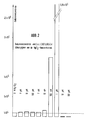
- the cultures were diluted in steps of ten down to 1 pmol / l with HgCl2 and incubated for 35 min with shaking at 30 ° C, including shaking, to determine the background bioluminescence signal. After the incubation had ended, 0.1 ml from each dilution stage was transferred to a bioluminescence measuring vessel, 1 ⁇ l of a 10% solution of the decanal luciferase substrate in isopropanol was added and the mixture was immediately analyzed using a bioluminescence measuring device (see above). The results - mean values from three independent individual measurements - are shown graphically in Fig. 2 in the form of a histogram.
- HgCl2 concentration of 10 nmol / l relative to the background bioluminescence leads to a significant increase in the measured signal; at 100 nmol / l HgCl2 an approximately 15-fold increase, with 1 ⁇ mol / l an over 30-fold increase in the bioluminescence rate relative to non-induced control cultures.
- the heavy metal concentration is increased to 10 ⁇ mol / l and above, the phenotype which is hypersensitive to mercury cations becomes noticeable: the organisms induced to maximum transcription of the mercury regulon and thus to maximum bioluminescence die as a result of the acute toxicity of HgCl2 .
- Microorganisms equipped with pGL4, as this experiment shows, are highly specific as biosensors for mercury compounds and therefore provide reliable results even in solutions with unknown composition.
- the essential properties of the biosensors described here emerge: i) the extremely high detection sensitivity for mercury cations, ii) the selectivity of the biosensors for mercury, which is not impaired by the presence of other, for example heavy metal ions, in the mixture, and iii) the possibility of being able to detect critical concentrations of mercury cations without physical contact between the biosensor and the signal detection or amplification unit, thus without interruptions due to measurement.
- the experiments carried out above to characterize microorganisms equipped with pGL4 represent examples of possible applications of the method.
- the detection of mercury in concentrations below the detection limit that exist with established analysis methods is possible down to the range ⁇ 0.5 ppb.
Landscapes
- Health & Medical Sciences (AREA)
- Chemical & Material Sciences (AREA)
- Genetics & Genomics (AREA)
- Life Sciences & Earth Sciences (AREA)
- Organic Chemistry (AREA)
- Engineering & Computer Science (AREA)
- Wood Science & Technology (AREA)
- Zoology (AREA)
- Bioinformatics & Cheminformatics (AREA)
- General Engineering & Computer Science (AREA)
- General Health & Medical Sciences (AREA)
- Biochemistry (AREA)
- Biotechnology (AREA)
- Molecular Biology (AREA)
- Biomedical Technology (AREA)
- Biophysics (AREA)
- Microbiology (AREA)
- Proteomics, Peptides & Aminoacids (AREA)
- Physics & Mathematics (AREA)
- Plant Pathology (AREA)
- Medicinal Chemistry (AREA)
- Immunology (AREA)
- Analytical Chemistry (AREA)
- Gastroenterology & Hepatology (AREA)
- Measuring Or Testing Involving Enzymes Or Micro-Organisms (AREA)
- Investigating Or Analysing Materials By The Use Of Chemical Reactions (AREA)
- Micro-Organisms Or Cultivation Processes Thereof (AREA)
- Preparation Of Compounds By Using Micro-Organisms (AREA)
- Nitrogen And Oxygen Or Sulfur-Condensed Heterocyclic Ring Systems (AREA)
Applications Claiming Priority (2)
| Application Number | Priority Date | Filing Date | Title |
|---|---|---|---|
| DE3902982A DE3902982A1 (de) | 1989-02-01 | 1989-02-01 | Verfahren zum nachweis von quecksilber mit hilfe von durch quecksilber zu erhoehter biolumineszenz angeregter mikroorganismen |
| DE3902982 | 1989-02-01 |
Publications (2)
| Publication Number | Publication Date |
|---|---|
| EP0456667A1 EP0456667A1 (de) | 1991-11-21 |
| EP0456667B1 true EP0456667B1 (de) | 1993-07-21 |
Family
ID=6373229
Family Applications (1)
| Application Number | Title | Priority Date | Filing Date |
|---|---|---|---|
| EP90902150A Expired - Lifetime EP0456667B1 (de) | 1989-02-01 | 1990-02-01 | Verfahren zum nachweis von quecksilber mit hilfe von durch quecksilber zu erhöhter biolumineszenz angeregter mikroorganismen |
Country Status (9)
| Country | Link |
|---|---|
| EP (1) | EP0456667B1 (da) |
| JP (1) | JPH04503003A (da) |
| AT (1) | ATE91723T1 (da) |
| AU (1) | AU644354B2 (da) |
| DE (1) | DE3902982A1 (da) |
| DK (1) | DK0456667T3 (da) |
| ES (1) | ES2060142T3 (da) |
| FI (1) | FI913611A7 (da) |
| WO (1) | WO1990008836A1 (da) |
Families Citing this family (11)
| Publication number | Priority date | Publication date | Assignee | Title |
|---|---|---|---|---|
| EP0573500B2 (en) * | 1991-03-01 | 2002-05-02 | Vito | Fused genes and their use for determining the presence of metals or of xenobiotic compounds |
| WO1993003179A1 (en) * | 1991-07-30 | 1993-02-18 | Bio-Technical Resources | Device for detecting aqueous contaminants |
| IL107815A (en) * | 1992-12-04 | 2003-12-10 | Du Pont | Genetic constructs comprising a stress-responsive promoter linked to a lux reporter operon and methods of use in environmental testing |
| FI95484C (fi) * | 1994-01-17 | 1996-02-12 | Marko Virta | Menetelmä näytteessä olevan metallin määrittämiseksi |
| JPH10509049A (ja) * | 1994-11-23 | 1998-09-08 | イー・アイ・デユポン・ドウ・ヌムール・アンド・カンパニー | 毒物検出のための凍結乾燥生物発光細菌試薬 |
| US6025131A (en) | 1996-10-23 | 2000-02-15 | E. I. Du Pont De Namours And Company | Facile method for identifying regulated promoters |
| US7132247B1 (en) | 1998-09-17 | 2006-11-07 | Regents Of The University Of Minnesota | Composite devices incorporating biological material and methods |
| JP4578597B2 (ja) * | 1999-10-01 | 2010-11-10 | 株式会社間組 | 水銀の気化方法、及び汚染土壌又は汚染水の浄化方法、並びに水銀の検出方法 |
| US20030108980A1 (en) * | 2000-08-14 | 2003-06-12 | Sayler Gary S. | Bioluminescent methods for direct visual detection of environmental compounds |
| WO2005014805A1 (en) | 2003-08-08 | 2005-02-17 | Regents Of The University Of Minnesota | A structured material for the production of hydrogen |
| CN114152601B (zh) * | 2021-12-28 | 2023-09-15 | 军事科学院军事医学研究院环境医学与作业医学研究所 | 一种现场快速检测水中汞离子的方法、试剂盒及其应用 |
Family Cites Families (5)
| Publication number | Priority date | Publication date | Assignee | Title |
|---|---|---|---|---|
| US4581335A (en) * | 1982-12-01 | 1986-04-08 | Texas A&M University System | Process for producing a cloned luciferase-synthesizing microorganism |
| EP0153366A1 (en) * | 1983-08-16 | 1985-09-04 | Battelle Development Corporation | Bioluminescent chemical system and method for detecting the presence of chemical agents in a medium |
| CA1277931C (en) * | 1984-06-05 | 1990-12-18 | Shimon Ulitzur | Detection and/or identification of microorganisms in a test sample usingbioluminescence or other exogenous genetically-introduced marker |
| AU7751687A (en) * | 1986-07-22 | 1988-02-10 | Boyce Thompson Institute For Plant Research Inc. | Use of bacterial luciferase structural genes for cloning and monitoring gene expression in microorganisms and for tagging and identification of genetically engineered organisms |
| DE3714612A1 (de) * | 1987-04-16 | 1988-10-27 | Bayer Ag | Mikroorganismus-stamm und seine verwendung |
-
1989
- 1989-02-01 DE DE3902982A patent/DE3902982A1/de not_active Withdrawn
-
1990
- 1990-02-01 ES ES90902150T patent/ES2060142T3/es not_active Expired - Lifetime
- 1990-02-01 DK DK90902150.3T patent/DK0456667T3/da active
- 1990-02-01 AU AU49660/90A patent/AU644354B2/en not_active Ceased
- 1990-02-01 JP JP2502530A patent/JPH04503003A/ja active Pending
- 1990-02-01 AT AT90902150T patent/ATE91723T1/de not_active IP Right Cessation
- 1990-02-01 EP EP90902150A patent/EP0456667B1/de not_active Expired - Lifetime
- 1990-02-01 FI FI913611A patent/FI913611A7/fi not_active Application Discontinuation
- 1990-02-01 WO PCT/DE1990/000063 patent/WO1990008836A1/de not_active Ceased
Also Published As
| Publication number | Publication date |
|---|---|
| ES2060142T3 (es) | 1994-11-16 |
| AU644354B2 (en) | 1993-12-09 |
| FI913611A0 (fi) | 1991-07-29 |
| EP0456667A1 (de) | 1991-11-21 |
| WO1990008836A1 (de) | 1990-08-09 |
| JPH04503003A (ja) | 1992-06-04 |
| DK0456667T3 (da) | 1993-12-27 |
| FI913611A7 (fi) | 1991-07-29 |
| AU4966090A (en) | 1990-08-24 |
| ATE91723T1 (de) | 1993-08-15 |
| DE3902982A1 (de) | 1990-08-02 |
Similar Documents
| Publication | Publication Date | Title |
|---|---|---|
| DE69310207T2 (de) | Methode zum Nachweis von unweltbedingten Vergehen | |
| EP0456667B1 (de) | Verfahren zum nachweis von quecksilber mit hilfe von durch quecksilber zu erhöhter biolumineszenz angeregter mikroorganismen | |
| DE69316368T2 (de) | Verfahren und diagnostische kits zur bestimmung der toxizität einer verbindung unter verwendung von an bakterielle stresspromotoren fusionierten reportergenen | |
| DE3833628A1 (de) | Verfahren zum nachweis und zur identifikation toxischer substanzen mit hilfe klonierter mikroorganismen | |
| DE69734204T2 (de) | Lichtproduzierender biosensor | |
| EP0069697A2 (de) | Herstellung und Anwendung von Plasmiden mit Genen für die Biosynthese von L-Prolin | |
| DE69225221T2 (de) | Fusionierte Gene sowie deren Verwendungzur Bestimmung von Metall- und Xenobiotikagehalten | |
| EP0334841A1 (de) | Microorganismen and plasmide für die 2,4-dichlorphenoxyessigsäure (2,4-d)-monooxigenase - bildung und verfahren zur herstellung dieser plasmide und stämme. | |
| Jiang et al. | A chemotaxis receptor modulates nodulation during the Azorhizobium caulinodans-Sesbania rostrata symbiosis | |
| DE3789766T2 (de) | Verwendung von bakteriellen luciferase strukturellen genen zum klonieren und zur steuerung der genexpression in mikroorganismen, sowie zur etikettierung und identifizierung von genetisch gebildeten organismen. | |
| Thaler et al. | Light-dependent changes of the cytoplasmic H+ and Cl− activity in the green alga Eremosphaera viridis | |
| FRANCIS et al. | Chemorepellents in Paramecium and Tetrahymena | |
| DE69413491T2 (de) | Verfahren zum Nachweis von Mutagenen unter Verwendung eines Lumineszensgens | |
| DE4406379A1 (de) | Bilirubinoxidase aus Alfalfa und Verwendung des Enzyms | |
| DE69433112T2 (de) | Gene, die verzweigte-alpha-ketosäure-dehydrogenasekomplexe von streptomyces avermitius kodieren | |
| DE60309589T2 (de) | Verfahren zum nachweis von arsenionen durch indikatorbakterien | |
| EP0664450A1 (de) | Biotest | |
| Grant et al. | Luminescence based detection of Erwinia carotovora subsp. carotovora in soil | |
| DE60305933T2 (de) | Prokaryotische expressionskassetten, die durch zink reguliert werden | |
| DE102007027619B4 (de) | Biosensor | |
| DE69934847T2 (de) | Diagnosesystem und verfahren zur bestimmung des vorhandenseins einer genotoxischen verbindung in einer probe | |
| DE102005048828A1 (de) | Fluoreszenzmarker und dessen Verwendung | |
| DE60038613T2 (de) | Verfahren zur Bestimmung des Gehalts von Hydrogensulfid in einer Probe und Verfahren zur Identifizierung einer Sequenz, welche eine Homocysteinase mit einem gewünschten Grad an Spezifität kodiert | |
| DE69232114T2 (de) | Für ein Enzym mit flavinreduzierender und Nitroreduktase-Aktivität kodierendes Gen | |
| EP0797669A1 (de) | Screening model |
Legal Events
| Date | Code | Title | Description |
|---|---|---|---|
| PUAI | Public reference made under article 153(3) epc to a published international application that has entered the european phase |
Free format text: ORIGINAL CODE: 0009012 |
|
| 17P | Request for examination filed |
Effective date: 19910829 |
|
| AK | Designated contracting states |
Kind code of ref document: A1 Designated state(s): AT BE CH DK ES FR GB IT LI LU NL SE |
|
| 17Q | First examination report despatched |
Effective date: 19920630 |
|
| GRAA | (expected) grant |
Free format text: ORIGINAL CODE: 0009210 |
|
| RIN1 | Information on inventor provided before grant (corrected) |
Inventor name: MOELDERS, HORST |
|
| AK | Designated contracting states |
Kind code of ref document: B1 Designated state(s): AT BE CH DK ES FR GB IT LI LU NL SE |
|
| REF | Corresponds to: |
Ref document number: 91723 Country of ref document: AT Date of ref document: 19930815 Kind code of ref document: T |
|
| ITF | It: translation for a ep patent filed | ||
| GBT | Gb: translation of ep patent filed (gb section 77(6)(a)/1977) |
Effective date: 19931008 |
|
| ET | Fr: translation filed | ||
| REG | Reference to a national code |
Ref country code: DK Ref legal event code: T3 |
|
| PGFP | Annual fee paid to national office [announced via postgrant information from national office to epo] |
Ref country code: CH Payment date: 19940127 Year of fee payment: 5 |
|
| PGFP | Annual fee paid to national office [announced via postgrant information from national office to epo] |
Ref country code: ES Payment date: 19940207 Year of fee payment: 5 |
|
| PGFP | Annual fee paid to national office [announced via postgrant information from national office to epo] |
Ref country code: SE Payment date: 19940211 Year of fee payment: 5 |
|
| PGFP | Annual fee paid to national office [announced via postgrant information from national office to epo] |
Ref country code: AT Payment date: 19940221 Year of fee payment: 5 |
|
| PGFP | Annual fee paid to national office [announced via postgrant information from national office to epo] |
Ref country code: NL Payment date: 19940228 Year of fee payment: 5 Ref country code: LU Payment date: 19940228 Year of fee payment: 5 |
|
| PGFP | Annual fee paid to national office [announced via postgrant information from national office to epo] |
Ref country code: BE Payment date: 19940307 Year of fee payment: 5 |
|
| EPTA | Lu: last paid annual fee | ||
| PGFP | Annual fee paid to national office [announced via postgrant information from national office to epo] |
Ref country code: DK Payment date: 19940331 Year of fee payment: 5 |
|
| PLBE | No opposition filed within time limit |
Free format text: ORIGINAL CODE: 0009261 |
|
| STAA | Information on the status of an ep patent application or granted ep patent |
Free format text: STATUS: NO OPPOSITION FILED WITHIN TIME LIMIT |
|
| 26N | No opposition filed | ||
| REG | Reference to a national code |
Ref country code: ES Ref legal event code: FG2A Ref document number: 2060142 Country of ref document: ES Kind code of ref document: T3 |
|
| EAL | Se: european patent in force in sweden |
Ref document number: 90902150.3 |
|
| PG25 | Lapsed in a contracting state [announced via postgrant information from national office to epo] |
Ref country code: LU Free format text: LAPSE BECAUSE OF NON-PAYMENT OF DUE FEES Effective date: 19950201 Ref country code: DK Effective date: 19950201 Ref country code: AT Effective date: 19950201 |
|
| REG | Reference to a national code |
Ref country code: DK Ref legal event code: EBP |
|
| PG25 | Lapsed in a contracting state [announced via postgrant information from national office to epo] |
Ref country code: SE Effective date: 19950202 Ref country code: ES Free format text: LAPSE BECAUSE OF NON-PAYMENT OF DUE FEES Effective date: 19950202 |
|
| ITTA | It: last paid annual fee | ||
| PG25 | Lapsed in a contracting state [announced via postgrant information from national office to epo] |
Ref country code: LI Effective date: 19950228 Ref country code: CH Effective date: 19950228 Ref country code: BE Effective date: 19950228 |
|
| BERE | Be: lapsed |
Owner name: GENLUX FORSCHUNGSG.- FUR BIOLOGISCHE VERFAHREN M. Effective date: 19950228 |
|
| PG25 | Lapsed in a contracting state [announced via postgrant information from national office to epo] |
Ref country code: NL Effective date: 19950901 |
|
| NLV4 | Nl: lapsed or anulled due to non-payment of the annual fee |
Effective date: 19950901 |
|
| EUG | Se: european patent has lapsed |
Ref document number: 90902150.3 |
|
| PGFP | Annual fee paid to national office [announced via postgrant information from national office to epo] |
Ref country code: FR Payment date: 19960118 Year of fee payment: 7 |
|
| PGFP | Annual fee paid to national office [announced via postgrant information from national office to epo] |
Ref country code: GB Payment date: 19960123 Year of fee payment: 7 |
|
| PG25 | Lapsed in a contracting state [announced via postgrant information from national office to epo] |
Ref country code: GB Effective date: 19970201 |
|
| GBPC | Gb: european patent ceased through non-payment of renewal fee |
Effective date: 19970201 |
|
| PG25 | Lapsed in a contracting state [announced via postgrant information from national office to epo] |
Ref country code: FR Effective date: 19971030 |
|
| REG | Reference to a national code |
Ref country code: FR Ref legal event code: ST |
|
| REG | Reference to a national code |
Ref country code: ES Ref legal event code: FD2A Effective date: 19990301 |
|
| PG25 | Lapsed in a contracting state [announced via postgrant information from national office to epo] |
Ref country code: IT Free format text: LAPSE BECAUSE OF NON-PAYMENT OF DUE FEES;WARNING: LAPSES OF ITALIAN PATENTS WITH EFFECTIVE DATE BEFORE 2007 MAY HAVE OCCURRED AT ANY TIME BEFORE 2007. THE CORRECT EFFECTIVE DATE MAY BE DIFFERENT FROM THE ONE RECORDED. Effective date: 20050201 |