EP0457141A2 - Reaktivfarbstoffe - Google Patents
Reaktivfarbstoffe Download PDFInfo
- Publication number
- EP0457141A2 EP0457141A2 EP91107257A EP91107257A EP0457141A2 EP 0457141 A2 EP0457141 A2 EP 0457141A2 EP 91107257 A EP91107257 A EP 91107257A EP 91107257 A EP91107257 A EP 91107257A EP 0457141 A2 EP0457141 A2 EP 0457141A2
- Authority
- EP
- European Patent Office
- Prior art keywords
- acid
- amino
- dyes
- formula
- meaning given
- Prior art date
- Legal status (The legal status is an assumption and is not a legal conclusion. Google has not performed a legal analysis and makes no representation as to the accuracy of the status listed.)
- Withdrawn
Links
Classifications
-
- C—CHEMISTRY; METALLURGY
- C09—DYES; PAINTS; POLISHES; NATURAL RESINS; ADHESIVES; COMPOSITIONS NOT OTHERWISE PROVIDED FOR; APPLICATIONS OF MATERIALS NOT OTHERWISE PROVIDED FOR
- C09B—ORGANIC DYES OR CLOSELY-RELATED COMPOUNDS FOR PRODUCING DYES, e.g. PIGMENTS; MORDANTS; LAKES
- C09B62/00—Reactive dyes, i.e. dyes which form covalent bonds with the substrates or which polymerise with themselves
- C09B62/02—Reactive dyes, i.e. dyes which form covalent bonds with the substrates or which polymerise with themselves with the reactive group directly attached to a heterocyclic ring
- C09B62/20—Reactive dyes, i.e. dyes which form covalent bonds with the substrates or which polymerise with themselves with the reactive group directly attached to a heterocyclic ring to a pyrimidine ring
- C09B62/24—Azo dyes
- C09B62/255—Metal complex azo dyes
Definitions
- the dyes of the formulas are particularly preferred and in which B, m, n and p have the meaning given above.
- the dyes of the formulas are of particular interest and in which m and n have the meaning given above.
- acylation with e.g. First convert acetic anhydride, acetyl chloride or maleic anhydride into the corresponding amides; the acyl radicals are then optionally split off selectively hydrolytically again after the reaction with the copper salts and oxidizing agents.
- o-aminonaphtholsulfonic acids of the formula (X) are: 4-amino-3-hydroxy-1-naphthalenesulfonic acid, 3-amino-4-hydroxy-1-naphthalenesulfonic acid, 5-amino-6-hydroxy-2-naphthalenesulfonic acid, 8-amino-7-hydroxy-2-naphthalenesulfonic acid, 6-amino-7-hydroxy-2-naphthalenesulfonic acid, 7-amino-6-hydroxy-1,3-naphthalenedisulfonic acid, 4-amino-3-hydroxy-1,7-naphthalenedisulfonic acid, 3-amino-4-hydroxy-1,7-naphthalenedisulfonic acid.
- aminonaphtholsulfonic acids of the formula (XI) are: 7-amino-4-hydroxy-naphthalene-2-sulfonic acid (I-acid), N-methyl-I-acid, N- (2-hydroxyethyl) -I-acid, 6-amin-4-hydroxy-naphthalene-2-sulfonic acid (gamma acid), N-methylgamma acid, N- (2-hydroxyethyl) gamma acid, 6-amino-4-hydroxy-naphthalene-2,7-disulfonic acid (RR acid), N-methyl-RR acid, 5-amino-4-hydroxy-naphthalene-2,7-disulfonic acid (H-acid), 4-amino-5-hydroxy-naphthalene-1,7-disulfonic acid (K acid), 3-amino-8-hydroxy-1,6-naphthalenedisulfonic acid, 8-amino-4-hydroxy-naphthalene-2-sulf
- aminonaphthalenesulfonic acids of the formula (XII) are: 5-, 6- or 7-amino-1-naphthalenesulfonic acid, 4-, 5-, 6-, 7- or 8-amino-2-naphthalenesulfonic acid, 3- or 4-amino-1,5-naphthalenedisulfonic acid, 5-, 6- or 7-amino-1,3-naphthalenedisulfonic acid, 4-amino-1,6- or -1,7-naphthalenedisulfonic acid, 7- or 8-amino-1,3,5-naphthalenetrisulfonic acid.
- the compounds of the general formula (IX) are obtained by reacting compounds of the general formula (XIII) with 5-chloro-4,6-difluoropyrimidine.
- reaction with 5-chloro-4,6-difluoropyrimidine takes place in an aqueous medium at temperatures between 20 and 100 ° C and at pH values between 4 and 10.
- the reactive dyes of the formula (I) can be isolated and processed into dry dyeing preparations.
- the isolation is preferably carried out at the lowest possible temperatures by salting out and filtering.
- the filtered dyes can optionally be added after the addition of couping agents and / or buffering agents, e.g. after adding a mixture of equal parts mono- and disodium phosphate are dried; drying is preferably carried out at temperatures which are not too high and under reduced pressure.
- the dry preparations according to the invention can be spray dried directly by atomization of the entire preparation mixture, i.e. without intermediate insulation of the dyes.
- the reactive dyes of the formula (I) are notable for high reactivity and give dyeings with good wet and light fastness. It is particularly noteworthy that the dyes have good solubility and electrolyte solubility with good extraction properties and high dye fixation, and that the non-fixed portions can be removed easily.
- the reactive dyes of the formula (I) are suitable for dyeing and printing the various substrates which contain, for example, hydroxyl groups or amide groups, such as silk, leather, wool, superpolyamide fibers and superpolyamide urethanes, but in particular cellulosic materials having a fibrous structure, such as linen, cellulose, regenerated cellulose and above all Cotton. They are suitable both for the exhaust process and for dyeing according to the pad dyeing process, after which the goods are impregnated with aqueous and optionally also salt-containing dye solutions and the dyes are fixed after an alkali treatment or in the presence of alkali, if appropriate with the action of heat. They are also suitable for printing, in particular on cotton, but also for printing nitrogen-containing fibers, for example blended fabrics containing wool, silk or wool.
- the formulas given are those of the free acids.
- the salts are generally obtained in the preparation, in particular the alkali salts such as sodium, potassium or lithium salts.
- the dyes can also be used as concentrated solutions.
- the suspension of the diazonium compound is added dropwise to the solution of the condensation product cooled to 10 ° C., the pH being kept constant with soda solution.
- the coupling product is precipitated by adding 250 g of salt, isolated and dissolved in 1000 ml of water at pH 6 and 40 ° C. 25 g of copper (II) sulfate ⁇ 5H2O are added and 70 ml of 10% strength hydrogen peroxide solution are slowly added dropwise, the pH being kept at 6 with soda solution.
- the dye is precipitated by adding 200 g of salt, isolated and dried. It dyes cotton blue.
- Blue reactive dyes are also obtained if, instead of H acid, the aminonaphtholsulfonic acids used in Examples 2 to 7 are used.
- diazoamidolic acid diazonium compound from 4-amino-3-hydroxy-1-naphthalenesulfonic acid
- sodium hydroxide 20 ° C.
- zinc sulfate ⁇ H2O zinc sulfate
- 15 ml of conc. Ammonia solution and then mixed with a neutral solution of 31.9 g of H acid in 500 ml of water.
- the pH is kept at 7 to 7.5 with dilute sodium hydroxide solution.
- the mixture is heated to 40 ° C. and 18 g of 5-chloro-4,6-difluoropyrimidine are added.
- the condensation is completed at pH 9.
- the dye is precipitated by adding 140 g of salt, isolated and dried. You get blue prints on cotton.
- Example 14 equimolar amounts are used 4-antino-3-hydroxy-1,7-naphthalenedisulfonic acid, 3-amino-4-hydroxy-1-naphthalenesulfonic acid or 3-amino-4-hydroxy-1,7-naphthalenedisulfonic acid, this also gives reactive dyes that give blue prints on cotton.
- the suspension of the diazonium compound is added dropwise to the solution of the condensation product cooled to 10 ° C., the pH being kept constant with soda solution.
- the coupling product is precipitated by adding 250 g of salt, isolated and dissolved in 1000 ml of water at pH 6 and 40 ° C. 25 g of copper (II) sulfate ⁇ 5H2O are added and 70 ml of 10% strength hydrogen peroxide solution are slowly added dropwise, the pH being kept at 6 with soda solution.
- the dye is precipitated by adding 200 g of salt, isolated and dried. It dyes cotton blue.
- Example 23 If, instead of the diazo component used in Example 23, equimolar amounts of 6-amino-1,3-naphthalene disulfonic acid, 7-amino-1,3-naphthalenedisulfonic acid, 4-amino-1,6-naphthalenedisulfonic acid, 4-amino-1,7-naphthalenedisulfonic acid, 7-amino-1,3,5-naphthalenetrisulfonic acid or 6-amino-2-naphthalenesulfonic acid, this also gives reactive dyes that dye cotton blue.
- Blue reactive dyes are also obtained if, instead of H acid, the aminonaphtholsulfonic acids used in Examples 2 to 7 are used.
Landscapes
- Chemical & Material Sciences (AREA)
- Organic Chemistry (AREA)
- Coloring (AREA)
Abstract

in welcher die Substituenten und Indices die in der Bescheibung angegebene Bedeutung haben, eignen sich hervorragend zum Färben oder Bedrucken von natürlichen oder synthetischen, hydroxyl- oder amidgruppenhaltigen Materialien.
Description
- Gegenstand der Erfindung sind neue Reaktivfarbstoffe der Formel,

in welcher - B
- für

- R₁ und R₂
- unabhängig voneinander jeweils für Wasserstoff, C₁-C₄-Alkyl oder C₂-C₄-Hydroxyalkyl stehen,
- m
- für 1,2 oder 3 steht,
- n
- für 0 oder 1 steht und
- p
- für 0 der 1 steht, mit der Maßgabe, daß
- p
- für 1 steht, wenn n für 1 steht und gleichzeitig die Substituenten

- Bevorzugt sind Farbstoffe der Formel (I), in welcher
R₁ und R₂ unabhängig voneinander jeweils für Wasserstoff, Methyl oder 2-Hydroxyethyl stehen und
B, m, n und p die oben angegebene Bedeutung haben. - Besonders bevorzugt sind die Farbstoffe der Formeln


und
in welchen
B, m, n und p die oben angegebene Bedeutung haben. - Von besonderem Interesse sind die Farbstoffe der Formeln

und
in welchen
m und n die oben angegebene Bedeutung haben. - Die neuen Farbstoffe der Formel (I) können hergestellt werden, indem man entweder
- a) Verbindungen der Formel

B, R₁, R₂, m, n und p die oben angegebene Bedeutung haben, mit der Maßgabe, daß
p für 1 steht, wenn n für 1 steht
und gleichzeitig die Substituenten
mit 5-Chlor-4,6-difluorpyrimidin umsetzt, oder - b) Verbindungen der Formel

B, R₁, R₂, m, n und p die oben angegebene Bedeutung haben, mit der Maßgabe, daß
p für 1 steht, wenn n für 1 steht
und die Substituenten
mit Kupfersalzen und Oxidationsmitteln behandelt.
Die Verbindungen der Formel (VIII) erhält man, indem man entweder - b) o-Aminonaphtholsulfonsäuren der Formel
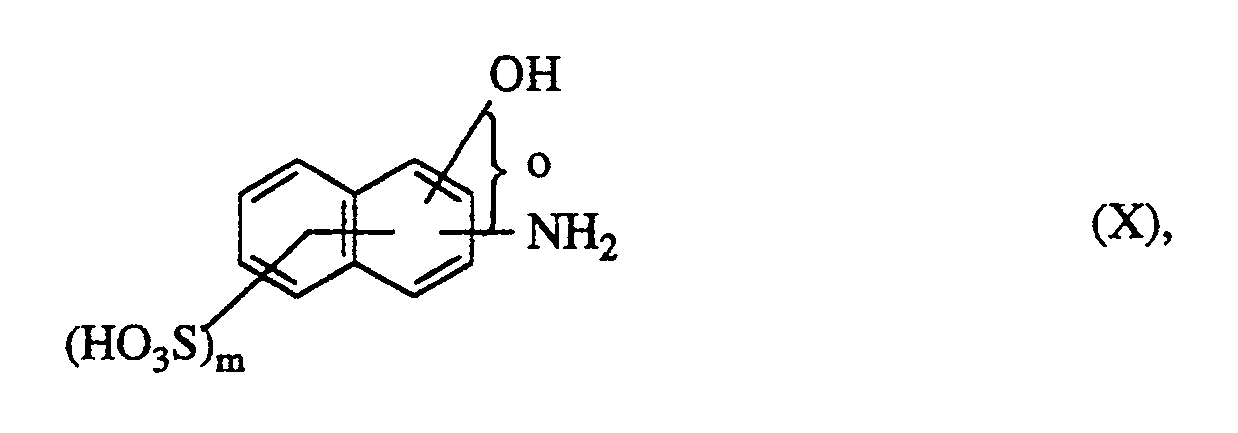
m die oben angegebene Bedeutung hat,
diazotiert und mit Aminonaphtholsulfonsäuren der Formel
R₁ und n die oben angegebene Bedeutung haben,
kuppelt und die Kupplungsprodukte in die Kupfer-(II)-Komplexe überführt, gegebenenfalls nachdem man sie in die entsprechenden N-Aminobenzoyl-Derivate umgewandelt hat, beispielsweise durch Umsetzung mit m- oder p-Nitrobenzoylchlorid, und anschließender Reduktion der Nitrogruppe mit Natriumsulfid oder durch Umsetzung mit Isatosäureanhydrid, oder indem man - c) Aminonaphthalinsulfonsäuren der Formel

m die oben angegebene Bedeutung hat,
diazotiert und mit Aminonaphtholsäuren der Formel (XI) oder deren N-Aminobenzoyl-Derivaten zu Verbindungen der Formel
B, R₁, R₂, m, n und p die oben angegebene Bedeutung haben, mit der Maßgabe, daß p für 1 steht, wenn n für 1 steht
und gleichzeitig die Substituenten
umsetzt, und diese in an sich bekannter Weise mit Kupfersalzen und Oxidationsmitteln, beispielsweise mit Kupfer-(II)-sulfat oder Kupfer-(II)-acetat und Wasserstoffperoxid in die Kupfer-(II)-Komplexe überführt. - Dabei kann es vorteilhaft sein, die Aminogruppen -NHR₁ bzw. -NHR₂ durch Acylierung mit z.B. Acetanhydrid, Acetylchlorid oder Maleinsäureanhydrid zunächst in die entsprechenden Amide zu überführen; die Acylreste werden dann nach der Umsetzung mit den Kupfersalzen und Oxidationsmitteln gegebenenfalls selektiv hydrolytisch wieder abgespalten.
- Beispiele für o-Aminonaphtholsulfonsäuren der Formel (X) sind: 4-Amino-3-hydroxy-1-naphthalinsulfonsäure,
3-Amino-4-hydroxy-1-naphthalinsulfonsäure,
5-Amino-6-hydroxy-2-naphthalinsulfonsäure,
8-Amino-7-hydroxy-2-naphthalinsulfonsäure,
6-Amino-7-hydroxy-2-naphthalinsulfonsäure,
7-Amino-6-hydroxy-1,3-naphthalindisulfonsäure,
4-Amino-3-hydroxy-1,7-naphthalindisulfonsäure,
3-Amino-4-hydroxy-1,7-naphthalindisulfonsäure. - Beispiele für Aminonaphtholsulfonsäuren der Formel (XI) sind:
7-Amino-4-hydroxy-naphthalin-2-sulfonsäure (I-Säure),
N-Methyl-I-Säure, N-(2-Hydroxyethyl)-I-Säure,
6-Amin-4-hydroxy-naphthalin-2-sulfonsäure (Gammasäure),
N-Methylgammasäure, N-(2-Hydroxyethyl)-gammasäure,
6-Amino-4-hydroxy-naphthalin-2,7-disulfonsäure (RR-Säure),
N-Methyl-RR-Säure,
5-Amino-4-hydroxy-naphthalin-2,7-disulfonsäure (H-Säure),
4-Amino-5-hydroxy-naphthalin-1,7-disulfonsäure (K-Säure),
3-Amino-8-hydroxy-1,6-naphthalindisulfonsäure,
8-Amino-4-hydroxy-naphthalin-2-sulfonsäure (M-Säure),
2-Amino-5-hydroxy-1,7-naphthalindisulfonsäure,
5-Amino-4-hydroxy-2-naphthalinsulfonsäure. - Beispiele für Aminonaphthalinsulfonsäuren der Formel (XII) sind:
5-,6- oder 7-Amino-1-naphthalinsulfonsäure,
4-,5-,6-,7- oder 8-Amino-2-naphthalinsulfonsäure,
3- oder 4-Amino-1,5-naphthalindisulfonsäure,
5-,6- oder 7-Amino-1,3-naphthalindisulfonsäure,
4-Amino-1,6- oder -1,7-naphthalindisulfonsäure,
7- oder 8-Amino-1,3,5-naphthalintrisulfonsäure. - Die Verbindungen der allgemeinen Formel (IX) erhält man, indem man Verbindungen der allgeminen Formel (XIII) mit 5-Chlor-4,6-difluorpyrimidin umsetzt.
- Die Umsetzung mit 5-Chlor-4,6-difluorpyrimidin erfolgt in wäßrigem Medium bei Temperaturen zwischen 20 und 100°C und bei pH-Werten zwischen 4 und 10.
- Die Reaktivfarbstoffe der Formel (I) können isoliert und zu trockenen Färbepräparationen verarbeitet werden. Die Isolierung erfolgt vorzugsweise bei möglichst niedrigen Temperaturen durch Aussalzen und Filtrieren. Die filtrierten Farbstoffe können gegebenenfalls nach Zugabe von Coupagemitteln und/oder Puffermitteln, z.B. nach Zugabe eines Gemisches gleicher Teile Mono- und Dinatriumphosphat getrocknet werden; vorzugsweise wird die Trocknung bei nicht zu hohen Temperaturen und unter vermindertem Druck vorgenommen. Durch Zerstäubungstrocknung des ganzen Herstellungsgemisches kann man in gewissen Fällen die erfindungsgemäßen trockenen Präparate direkt, d.h. ohne Zwischenisolierung der Farbstoffe, herstellen.
- Die Reaktivfarbstoffe der Formel (I) zeichnen sich durch hohe Reaktivität aus und sie ergeben Färbungen mit guten Naß- und Lichtechtheiten. Besonders hervorzuheben ist es, daß die Farbstoffe eine gute Löslichkeit und Elektrolytlöslichkeit bei guten Auszieheigenschaften und hoher Farbstoff-Fixierung aufweisen, und daß sich die nicht fixierten Anteile leicht entfernen lassen.
- Die Reaktivfarbstoffe der Formel (I) eignen sich zum Färben und Bedrucken der verschiedenen beispielsweise Hydroxylgruppen oder Amidgruppen enthaltenden Substrate, wie Seide, Leder, Wolle, Superpolyamidfasern und Superpolyamidurethanen, insbesondere aber cellulosehaltiger Materialien faseriger struktur, wie Leinen, Zellstoff, regenerierte Cellulose und vor allem Baumwolle. Sie eignen sich sowohl für das Ausziehverfahren als auch zum Färben nach dem Foulardfärbeverfahren, wonach die Ware mit wäßrigen und gegebenenfalls auch salzhaltigen Farbstofflösungen imprägniert wird und die Farbstoffe nach einer Alkalibehandlung oder in Gegenwart von Alkali gegebenenfalls unter Wärmeeinwirkung fixiert werden. Sie eignen sich auch zum Druck, insbesondere auf Baumwolle, ebenso aber auch zum Bedrucken von stickstoffhaltigen Fasern, z.B. von Wolle, Seide oder Wolle enthaltenden Mischgeweben.
- Es empfiehlt sich, die Färbungen und Drucke einem gründlichen Spülen mit kaltem und heißem Wasser, gegebenenfalls unter Zusatz eines dispergierend wirkenden und die Diffusion der nicht fixierten Anteile Fordernden Mittels zu unterwerfen.
- Die angegebenen Formeln sind die der freien Säuren. Bei der Herstellung werden im allgemeinen die Salze erhalten, insbesondere die Alkalisalze wie Natrium-, Kalium- oder Lithiumsalze. Die Farstoffe können aber auch als konzentrierte Lösungen eingesetzt werden.
- 31,9 g H-Säure werden mit Soda-Lösung bei pH 8 in 500 ml Wasser gelöst und auf 40°C erwärmt. Man gibt 18 g 5-Chlor-4,6-difluorpyrimidin zu und rührt bei dieser Temperatur, bis die Kondensation beendet ist, wobei der pH-Wert mit Soda-Lösung konstant gehalten wird. 30,3 g 3-Amino-1,5-naphthalindisulfonsäure werden bei 20°C in 500 ml Wasser gelöst. Man gibt 100 g Eis und 30 ml konz. Salzsäure zu und diazotiert mit 6,9 g Natriumnitrit. Die Suspension der Diazoniumverbindung läßt man zur auf 10°C gekühlten Lösung des Kondensationsproduktes zutropfen, wobei der pH-Wert mit Soda-Lösung konstant gehalten wird. Das Kupplungsprodukt wird durch Zugabe von 250 g Salz ausgefällt, isoliert und bei pH 6 und 40°C in 1000 ml Wasser gelöst. Man gibt 25 g Kupfer-(II)-sulfat·5H₂O zu und tropft langsam 70 ml 10 %ige Wasserstoffperoxid-Lösung ein, wobei man den pH-Wert mit Soda-Lösung auf 6 hält. Nach Beendigung der Komplexbildung wird der Farbstoff durch Zugabe von 200 g Salz ausgefällt, isoliert und getrocknet. Er färbt Baumwolle blau.
- Verwendet man statt der in Beispiel 1 eingesetzten Kupplungskomponente äquimolare Mengen der Kondensationsprodukte aus 5-Chlor-4,6-difluorpyrimidin und K-Säure, I-Säure, Gammasäure, M-Säure, 3-Amino-8-hydroxy-1,6-naphthalindisulfonsäure oder 5-Amino-4-hydroxy-2-naphthalinsulfonsäure, so erhält man ebenfalls Reaktivfarbstoffe, die Baumwolle blau färben.
- Verwendet man statt der in Beispiel 1 eingesetzten Diazokomponente äquimolare Mengen von 6-Amino-1,3-naphthalindisulfonsäure,
7-Amino-1,3-naphthalindisulfonsäure,
4-Amino-1,6-naphthalindisulfonsäure,
4-Amino-1,7-naphthalindisulfonsäure,
7-Amino-1,3,5-naphthalintrisulfonsäure oder
6-Amino-2-naphthalinsulfonsäure,
so erhält man ebenfalls Reaktivfarbstoffe, die Baumwolle blau färben. - Man erhält ebenfalls blaue Reaktivfarbstoffe, wenn man statt H-Säure die in den Beispielen 2 bis 7 eingesetzten Aminonaphtholsulfonsäuren verwendet.
- 25 g Diazoamidolsäure (Diazoniumverbindung aus 4-Amino-3-hydroxy-1-naphthalinsulfonsäure) werden in 200 ml Wasser mit 4 g Natriumhydroxid bei 20°C gelöst. Man gibt 9 g Zinksulfat·H₂O und 15 ml konz. Ammoniak-Lösung zu und versetzt dann mit einer neutralen Lösung von 31,9 g H-Säure in 500 ml Wasser. Bis zum Ende der Kupplung wird der pH-Wert mit verd. Natronlauge bei 7 bis 7,5 gehalten. Man erwärmt auf 40°C und gibt 18 g 5-Chlor-4,6-difluorpyrimidin zu. Die Kondensation wird bei pH 9 zu Ende geführt. Der Farbstoff wird durch Zugabe von 140 g Salz ausgefällt, isoliert und getrocknet. Man erhält damit auf Baumwolle blaue Drucke.
- Verwendet man statt der in Beispiel 14 eingesetzten Kupplungskomponente äquimolare Mengen K-Säure, I-Säure, 3-Amino-8-hydroxy-naphthalin-1,6-disulfonsäure (W-Säure), M-Säure oder 5-Amino-4-hydroxy-2-naphthalinsulfonsäure, so erhält man ebenfalls Reaktivfarbsotffe, die auf Baumwolle blaue Drucke ergeben.
- Verwendet man statt der in Beispiel 14 eingesetzten Diazokomponente äquimolare Mengen
4-Antino-3-hydroxy-1,7-naphthalindisulfonsäure,
3-Amino-4-hydroxy-1-naphthalinsulfonsäure oder
3-Amino-4-hydroxy-1,7-naphthalindisulfonsäure,
so erhält man ebenfalls Reaktivfarbstoffe, die auf Baumwolle blaue Drucke ergeben. - 43,8 g N-(4-Aminobenzoyl)-H-Säure werden mit Soda-Lösung bei pH 7 in 500 ml Wasser gelöst und auf 40°C erwärmt. Man gibt 18 g 5-Chlor-4,6-difluorpyrimidin zu und rührt bei dieser Temperatur, bis die Kondensation beendet ist, wobei der pH-Wert mit Soda-Lösung konstant gehalten wird. 30,3 g 3-Amino-1,5-naphthalindisulfonsäure werden bei 20°C in 500 ml Wasser gelöst. Man gibt 100 g Eis und 30 ml konzentrierte Salzsäure zu und diazotiert mit 6,9 g Natriumnitrit. Die Suspension der Diazoniumverbindung läßt man zur auf 10°C gekühlten Lösung des Kondensationsproduktes zutropfen, wobei der pH-Wert mit Soda-Lösung konstant gehalten wird. Das Kupplungsprodukt wird durch Zugabe von 250 g Salz ausgefällt, isoliert und bei pH 6 und 40°C in 1000 ml Wasser gelöst. Man gibt 25 g Kupfer-(II)-sulfat·5H₂O zu und tropft langsam 70 ml 10 %ige Wasserstoffperoxid-Lösung ein, wobei man den pH-Wert mit Soda-Lösung auf 6 hält. Nach Beendigung der Komplexbildung wird der Farbstoff durch Zugabe von 200 g Salz ausgefällt, isoliert und getrocknet. Er färbt Baumwolle blau.
- Verwendet man statt der in Beispiel 23 eingesetzten Kupplungskomponente äquimolare Mengen der Kondensationsprodukte von 5-Chlor-4,6-difluorpyrimidin mit den N-(4-Aminobenzoyl)-derivaten von K-Säure, W-Säure, RR-Säure, 2-Amino-5-hydroxy-1,7-naphthalindisulfonsäure, I-Säure, Gammasäure oder 5-Amino-4-hydroxy-2-naphthalinsulfonsäure, so erhält man ebenfalls Reaktivfarbstoffe, die Baumwolle blau färben.
- Verwendet man statt der in Beispiel 23 eingesetzten Diazokomponente äquimolare Mengen von
6-Amino-1,3-naphthalin-disulfonsäure,
7-Amino-1,3-naphthalindisulfonsäure,
4-Amino-1,6-naphthalindisulfonsäure,
4-Amino-1,7-naphthalindisulfonsäure,
7-Amino-1,3,5-naphthalintrisulfonsäure oder
6-Amino-2-naphthalinsulfonsäure,
so erhält man ebenfalls Reaktivfarbstoffe, die Baumwolle blau färben. - Man erhält ebenfalls blaue Reaktivfarbstoffe, wenn man statt H-Säure die in den Beispielen 2 bis 7 eingesetzten Aminonaphtholsulfonsäuren verwendet.
Claims (10)
- Reaktivfarbstoffe der Formel
 B für
B für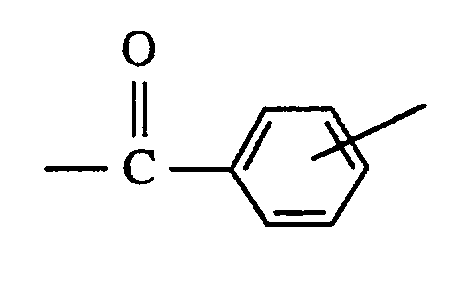 R₁ und R₂ unabhängig voneinander jeweils für Wasserstoff, C₁-C₄-Alkyl oder C₂-C₄-Hydroxyalkyl stehen,m für 1,2 oder 3 steht,n für 0 oder 1 steht undp für 0 oder 1 steht, mit der Maßgabe, daßp für 1 steht, wenn n für 1 steht und gleichzeitig die Substituenten
- Farbstoffe des Anspruchs 1, in welchen R₁ und R₂ unabhängig voneinander für Wasserstoff, Methyl oder 2-Hydroxyethyl stehen.
- Farbstoffe der Ansprüche 1 und 2 der Formel

B, m, n und p die in Anspruch 1 angegebene Bedeutung haben. - Farbstoffe der Ansprüche 1 und 2 der Formel

B, m, n und p die in Anspruch 1 angegebene Bedeutung haben. - Farbstoffe der Ansprüche 1 und 2 der Formel

B, m, n und p die in Anspruch 1 angegebene Bedeutung haben. - Farbstoffe der Ansprüche 1 bis 3 der Formel

m und n die in Anspruch 1 angegebene Bedeutung haben. - Farbstoffe der Ansprüche 1 bis 3 der Formel

m die in Anspruch 1 angegebene Bedeutung hat. - Farbstoffe der Ansprüche 1, 2 und 5 der Formel

m die in Anspruch 1 angegebene Bedeutung hat. - Verwendung der Farbstoffe der Ansprüche 1 bis 8 zum Färben oder Bedrucken von hydroxyl- oder amidgruppenhaltigen, natürlichen oder synthetischen Materialien.
- Mit Farbstoffen der Ansprüche 1 bis 8 gefärbte natürliche oder synthetische, hydroxyl- oder amidgruppenhaltige Materialien.
Applications Claiming Priority (2)
| Application Number | Priority Date | Filing Date | Title |
|---|---|---|---|
| DE4016058 | 1990-05-18 | ||
| DE19904016058 DE4016058A1 (de) | 1990-05-18 | 1990-05-18 | Reaktivfarbstoffe |
Publications (2)
| Publication Number | Publication Date |
|---|---|
| EP0457141A2 true EP0457141A2 (de) | 1991-11-21 |
| EP0457141A3 EP0457141A3 (en) | 1992-10-28 |
Family
ID=6406743
Family Applications (1)
| Application Number | Title | Priority Date | Filing Date |
|---|---|---|---|
| EP19910107257 Withdrawn EP0457141A3 (en) | 1990-05-18 | 1991-05-04 | Reactive dyes |
Country Status (3)
| Country | Link |
|---|---|
| EP (1) | EP0457141A3 (de) |
| JP (1) | JPH04227971A (de) |
| DE (1) | DE4016058A1 (de) |
Cited By (2)
| Publication number | Priority date | Publication date | Assignee | Title |
|---|---|---|---|---|
| US5583207A (en) * | 1992-09-24 | 1996-12-10 | Sandoz Ltd. | Fibre-reactive monoazo copper complexes containing a halo substituted pyrimidine substituent |
| CN119061710A (zh) * | 2024-08-02 | 2024-12-03 | 浙江理工大学 | 基于偶合显色的黑色蛋白质纤维反应性染色方法 |
Family Cites Families (4)
| Publication number | Priority date | Publication date | Assignee | Title |
|---|---|---|---|---|
| FR1275623A (fr) * | 1960-12-03 | 1961-11-10 | Geigy Ag J R | Procédé de préparation de colorants azoïques réactifs |
| DE1419826A1 (de) * | 1961-06-22 | 1969-04-30 | Bayer Ag | Reaktivfarbstoffe und Verfahren zu deren Herstellung |
| DE1644203B2 (de) * | 1967-03-25 | 1977-11-17 | Bayer Ag, 5090 Leverkusen | Reaktivfarbstoffe |
| DE3835725A1 (de) * | 1988-10-20 | 1990-04-26 | Sandoz Ag | Faserreaktive metallisierte monoazoverbindungen |
-
1990
- 1990-05-18 DE DE19904016058 patent/DE4016058A1/de not_active Withdrawn
-
1991
- 1991-05-04 EP EP19910107257 patent/EP0457141A3/de not_active Withdrawn
- 1991-05-14 JP JP3136933A patent/JPH04227971A/ja active Pending
Cited By (3)
| Publication number | Priority date | Publication date | Assignee | Title |
|---|---|---|---|---|
| US5583207A (en) * | 1992-09-24 | 1996-12-10 | Sandoz Ltd. | Fibre-reactive monoazo copper complexes containing a halo substituted pyrimidine substituent |
| CN119061710A (zh) * | 2024-08-02 | 2024-12-03 | 浙江理工大学 | 基于偶合显色的黑色蛋白质纤维反应性染色方法 |
| CN119061710B (zh) * | 2024-08-02 | 2025-10-28 | 浙江理工大学 | 基于偶合显色的黑色蛋白质纤维反应性染色方法 |
Also Published As
| Publication number | Publication date |
|---|---|
| EP0457141A3 (en) | 1992-10-28 |
| JPH04227971A (ja) | 1992-08-18 |
| DE4016058A1 (de) | 1991-11-21 |
Similar Documents
| Publication | Publication Date | Title |
|---|---|---|
| DE2560422C2 (de) | Reaktivfarbstoffe, deren Herstellung und Verwendung | |
| DE2500062C2 (de) | Faserreaktive Tetrazofarbstoffe und ihre Verwendung | |
| EP0028788B1 (de) | Kupferkomplex-Formazanverbindungen, Verfahren zu ihrer Herstellung und ihre Verwendung als Farbstoffe | |
| EP0013765A1 (de) | Reaktivazofarbstoffe sowie deren Herstellung und Verwendung zum Färben von OH- und N-haltigen Materialien | |
| EP0028787B1 (de) | Kupfer-Formazanverbindungen, Verfahren zu ihrer Herstellung und ihre Verwendung als Farbstoffe | |
| EP0292825A2 (de) | Reaktivfarbstoffe | |
| DE2924228C2 (de) | ||
| DE2601043A1 (de) | Tetrareaktive disazofarbstoffe, deren herstellung und verwendung | |
| DE2729240C2 (de) | Azo-Reaktivfarbstoffe | |
| DE3879476T2 (de) | Faserreaktiv-azofarbstoffe, verfahren zu ihrer herstellung und ihre verwendung zum faerben von hydroxy und/oder carboxamidgruppen enthaltendem fasermaterial. | |
| EP0189081B1 (de) | Azo-Reaktivfarbstoffe | |
| DE4016058A1 (de) | Reaktivfarbstoffe | |
| EP0501266B1 (de) | Bifunktionelle Reaktivfarbstoffe | |
| EP0210331B1 (de) | Wasserlösliche Mono- und Disazoverbindungen, Verfahren zu deren Herstellung und ihre Verwendung als Farbstoffe | |
| EP0595768A1 (de) | Azofarbstoffe, Verfahren zu deren Herstellung und deren Verwendung | |
| EP0603116A1 (de) | Azoreaktivfarbstoffe | |
| DE2757681C2 (de) | Phenylazopyridon-Verbindung, Verfahren zu deren Herstellung, ihre Verwendung zum Färben oder Bedrucken von Fasermaterial aus natürlicher oder regenerierter Cellulose oder aus natürlichen, regenerierten oder synthetischen Polyamiden | |
| CH649571A5 (de) | Anthrachinon-azoverbindungen und ihre herstellung. | |
| EP0134197B1 (de) | Reaktivfarbstoffe der Disazoreihe, deren Herstellung und Verwendung | |
| DE3151959A1 (de) | Bisazoreaktivfarbstoffe, verfahren zu ihrer herstellung und ihre verwendung zum faerben und bedrucken von hydroxylgruppen- oder stickstoffhaltigem fasermaterial | |
| EP0012716B1 (de) | Monochlortriazinfarbstoffe der Azopyrazolonreihe, deren Herstellung und Verwendung zum Färben und Bedrucken von Textilmaterial | |
| AT220742B (de) | Verfahren zur Herstellung von neuen Azofarbstoffen | |
| DE4013115A1 (de) | Reaktivfarbstoffe | |
| DE3843135A1 (de) | Kupferkomplex-formazan-verbindungen, verfahren zu ihrer herstellung und ihre verwendung als farbstoffe | |
| CH635858A5 (de) | Faserreaktive azofarbstoffe, sowie deren herstellung. |
Legal Events
| Date | Code | Title | Description |
|---|---|---|---|
| PUAI | Public reference made under article 153(3) epc to a published international application that has entered the european phase |
Free format text: ORIGINAL CODE: 0009012 |
|
| AK | Designated contracting states |
Kind code of ref document: A2 Designated state(s): CH DE FR GB LI |
|
| PUAL | Search report despatched |
Free format text: ORIGINAL CODE: 0009013 |
|
| AK | Designated contracting states |
Kind code of ref document: A3 Designated state(s): CH DE FR GB LI |
|
| 17P | Request for examination filed |
Effective date: 19921111 |
|
| 17Q | First examination report despatched |
Effective date: 19950118 |
|
| STAA | Information on the status of an ep patent application or granted ep patent |
Free format text: STATUS: THE APPLICATION HAS BEEN WITHDRAWN |
|
| 18W | Application withdrawn |
Withdrawal date: 19950807 |