EP0457562A1 - Steuerungsdatentabelleveränderung - Google Patents
Steuerungsdatentabelleveränderung Download PDFInfo
- Publication number
- EP0457562A1 EP0457562A1 EP91304348A EP91304348A EP0457562A1 EP 0457562 A1 EP0457562 A1 EP 0457562A1 EP 91304348 A EP91304348 A EP 91304348A EP 91304348 A EP91304348 A EP 91304348A EP 0457562 A1 EP0457562 A1 EP 0457562A1
- Authority
- EP
- European Patent Office
- Prior art keywords
- border
- values
- window
- pixel
- pixels
- Prior art date
- Legal status (The legal status is an assumption and is not a legal conclusion. Google has not performed a legal analysis and makes no representation as to the accuracy of the status listed.)
- Withdrawn
Links
Images

Classifications
-
- G—PHYSICS
- G06—COMPUTING OR CALCULATING; COUNTING
- G06T—IMAGE DATA PROCESSING OR GENERATION, IN GENERAL
- G06T7/00—Image analysis
- G06T7/0002—Inspection of images, e.g. flaw detection
- G06T7/0004—Industrial image inspection
-
- G—PHYSICS
- G06—COMPUTING OR CALCULATING; COUNTING
- G06T—IMAGE DATA PROCESSING OR GENERATION, IN GENERAL
- G06T5/00—Image enhancement or restoration
- G06T5/20—Image enhancement or restoration using local operators
-
- G—PHYSICS
- G06—COMPUTING OR CALCULATING; COUNTING
- G06T—IMAGE DATA PROCESSING OR GENERATION, IN GENERAL
- G06T2207/00—Indexing scheme for image analysis or image enhancement
- G06T2207/30—Subject of image; Context of image processing
- G06T2207/30108—Industrial image inspection
Definitions
- This invention relates to modification of control data arrays in particular to correct wrong decisions made during their formation.
- Binary control data arrays are used for example in defining areas of images to be assembled into a composite image.
- the binary control data array allocates one bit to each pixel of an image; the bit will be either 0 or 1 showing that the pixel marked should be included in one class or another for processing.
- the decision as to which value the bit will have, will depend upon criteria chosen by the operator.
- Binary control data arrays produced from images by applying algorithms of this type can produce a control data array with occasional single pixel values out of keeping with the surrounding region. The result can be to produce a pin-hole effect within an area.
- Present techniques for rectifying this situation rely on manually operable systems and the human eye. This is time consuming and subject to errors.
- a method of modifying a binary data array defining a region of an image comprises scanning the binary data array with a window which is in the form of a border surrounding a central region of at least one pixel; and, at each scanning position,scanning the pixel values or special values representing the pixel values in the border, and if all pixel values in the border are the same, causing the or each binary data array pixel value in the corresponding central region to have a predefined value, wherein the border pixels are scanned in sections , the resultant values from tests of each section being combined to ascertain whether there is any difference from the predefined value; and wherein special values are stored representative of groups of pixels for use at subsequent window positions.
- This method allows flaws resulting from the production of a control data array to be corrected automatically by replacement with a pixel value in keeping with the surrounding pixel values so that a better image is produced using the control data array.
- This approach may be used to modify binary images or hard masks.
- apparatus for modifying a binary data array for use in defining a region of an image comprises scanning means to scan the binary data array with a window in the form of a border surrounding a central region of at least one pixel and to scan the pixel values or special values representing the pixel values in the border, and modifying means operable at each scanning position to cause the or each binary data array pixel value in the corresponding central region to have a predefined value if all the pixel values in the border are the same, wherein the border pixels are scanned in sections; and means to combine the resultant values from tests of each section to ascertain whether there is any difference from the predefined value, and storage means to store special values representative of groups of pixels for use at subsequent window positions.
- scanning of the border values may take place over separate horizontal and vertical sections of the border, the resultant values of each section being compared to ascertain whether there is any difference and scanning of the border terminated as soon as a difference in border values is measured. If the values in each section of the border are the same, then these values are compared to see if all border values are equal.
- the central region is from one to four pixels in size.
- the window will usually be square or rectangular in shape although non standard border shapes can be accommodated.
- the number of pixels thickness of the border may be greater than one and could vary around the window.
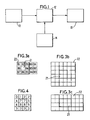
- Figure 1 is a block diagram of apparatus for scanning a window across a previously generated control data array.
- a central processing unit 12 is connected to a control data array memory 13, window coordinate input means 14 and an optional control data array output memory 11 if the corrections for pinholes are not to be done in-place to the control data array memory 13.
- a control data array, or mask is generated initially by an operator outlining areas of an image to be coded 1 or 0, or alternatively a colour selective masking technique may be used as described above and in more detail in copending European Patent Application No. 91300862.9.
- the array is stored in the memory 13.
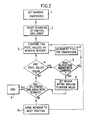
- the window coordinates are set (step 1, Figure 2) by an operator via the input means 14.
- the processor 12 is initiated (step 2) to simulate the window defined by the input means 14 so as to scan the image stored in the memory 13 by accessing at each scan position successive locations defined by the window coordinates.
- a representation of a window is shown in Figure 3a.
- Each control data array pixel 22, B1 ⁇ Bn, falling within the window border has a particular value.
- the processor 12 initially obtains the value of pixel B1 and compares this with that of B2 (step 3). If the values are found to be the same (step 4) the processor 12 compares B1 with B3 and so on.
- the border 22 is of two pixel thickness with four central area pixels 21. If all of the pixels in the border 22 have the same value then the pixels in the central area 21 are all given that value.
- each side of the border need not be the same as is shown, for example, by the rectangular border in Figure 3c.
- all the border pixels 22 in Figure 3c must have the same value if the values of the central area pixels 21 are to be changed to that value.
- Figure 4 illustrates the application of one example of an algorithm in which the numbers refer to steps in the code.
- a mask parameter M(x,y) is set to the values 0 for mask off, and 1 for mask on.
- a filter is applied to determine whether all the values were set to 1 on the perimeter, and if so then sets the values within it to 1. The algorithm would be...
- M(x,y) represents the original array data.
- M′(x+n,y+m) and M′′ (x,y) represent scratch arrays the same size as the original image, but being addressed with an offset of ( n, m) where each of the stages (1) ⁇ (9) is performed for the whole array (i.e. all x, all y) before the next one is started.
- This algorithm allows intermediate values to be used more than once. E.g. each side of a square appears in two borders as a left and a right or a top and a bottom side. If all the intermediate values are stored it is not necessary to calculate them twice.
- conditional jumps are used. Eg. if the border has a 'set' value throughout, then all bits may be set within the border, and thereafter left alone. The algorithm described above continues to test whether any of the other possible borders are 'set' whether it needs to or not.
- Testing for pin holes is generally carried out over a full screen to modify e.g. light pin holes surrounded by a dark border to give the pin hole the same colour as the border. If it is desired to modify both light in dark and dark in light over a single screen an additional bit is required in the data.
- FIG. 5 a window of non standard shape is shown.
- the edge is divided into non-linear sections 22a-d for comparison. Initially, the pixels within each section 22a-d are examined separately. If within any section they are the same, a special value is allocated to that section. The special values are then compared and if they each represent pixels having the same value, then all pixels in the central region 21 are changed to that value.
- the windows need not be only square or rectangular.
- Figure 6 shows how a border of side length eight pixels may be tested in three operations. Initially pairs of neighbouring pixels 23 are compared and if the pixel values are the same a first special value 24 is recorded for that pair. Neighbouring pairs of the first special values 24 are then compared to produce second special values 25 if the values 24 are the same, and then these are compared to produce a single representative special value 26 for the row if the values 25 are the same.
- the window is initially positioned to include pixels B1 ⁇ B8 in its border surrounding a single pixel B9.
- a comparison of border pixels begins by comparing B1 with B2. If they have the same value a single special value is allocated to represent B1 and B2. If they are different the comparisons at that window position cease and the window moves a single pixel to the right and new comparisons begin. Assuming the pixels B1 and B2 are the same B2 is compared with B3. If these are the same they are allocated their own special value. B1, B2 and B3 together, will also be allocated a special value if they all have the same pixel value.
- B3 is compared with B4 and the combination allocated a special value if they are the same.
- B4 is compared with B5 and a special value is allocated if they are the same.
- B9 is set to that value and the window is moved to cover a new set of pixels with its left hand edge lying on the border between pixels B3-B5 and B10, B15, B14.
- the window now defines a border comprising pixels B2, B3, B10, B15, B14, B5, B6 and B9, surrounding pixel B4. It is known that B2 and B3 are the same from their previously stored special value so this can now simply be combined with B10 to see if B10 has the same value and if so a new special value representing B2, B3 and B10 is stored. B10 is compared with B5 and B15 with B14. The next comparison is of B14 with the special value for B5 and B6. If these are the same a new special value for the combination of B14, B5 and B6 is stored. B6 is compared with B9 and then B9 with B2 and respective special values are stored for each pair when the compared values are the same.
- B3, B4 and B5 are already represented by a stored special value as are B3 and B10 so the special values reduce the amount of recalculation needed at each subsequent window position.
Landscapes
- Engineering & Computer Science (AREA)
- Physics & Mathematics (AREA)
- General Physics & Mathematics (AREA)
- Theoretical Computer Science (AREA)
- Quality & Reliability (AREA)
- Computer Vision & Pattern Recognition (AREA)
- Facsimile Image Signal Circuits (AREA)
- Image Processing (AREA)
- Image Analysis (AREA)
Applications Claiming Priority (2)
| Application Number | Priority Date | Filing Date | Title |
|---|---|---|---|
| GB909011048A GB9011048D0 (en) | 1990-05-17 | 1990-05-17 | Control data array modification |
| GB9011048 | 1990-05-17 |
Publications (1)
| Publication Number | Publication Date |
|---|---|
| EP0457562A1 true EP0457562A1 (de) | 1991-11-21 |
Family
ID=10676132
Family Applications (1)
| Application Number | Title | Priority Date | Filing Date |
|---|---|---|---|
| EP91304348A Withdrawn EP0457562A1 (de) | 1990-05-17 | 1991-05-15 | Steuerungsdatentabelleveränderung |
Country Status (3)
| Country | Link |
|---|---|
| EP (1) | EP0457562A1 (de) |
| JP (1) | JPH04232576A (de) |
| GB (1) | GB9011048D0 (de) |
Cited By (1)
| Publication number | Priority date | Publication date | Assignee | Title |
|---|---|---|---|---|
| EP0768621A3 (de) * | 1995-10-16 | 1998-07-15 | Eastman Kodak Company | Verfahren und Vorrichtung zum Korrigieren von Pixelwerten eines digitalen Bildes |
Citations (3)
| Publication number | Priority date | Publication date | Assignee | Title |
|---|---|---|---|---|
| EP0018861A1 (de) * | 1979-04-11 | 1980-11-12 | Service D'exploitation Industrielle Des Tabacs Et Des Allumettes | Verfahren und Vorrichtung zur numerischen Erfassung von Videosignalen die von einem blattförmigen Produkt gewonnen wurden |
| EP0165734A2 (de) * | 1984-06-22 | 1985-12-27 | The Governor And Company Of The Bank Of England | Herstellung eines Bildmusters und Überprüfung einer Pixeldarstellung eines Bildes |
| DE3838032A1 (de) * | 1987-11-09 | 1989-05-24 | Hitachi Ltd | Verfahren und einrichtung zur strukturpruefung |
-
1990
- 1990-05-17 GB GB909011048A patent/GB9011048D0/en active Pending
-
1991
- 1991-05-15 EP EP91304348A patent/EP0457562A1/de not_active Withdrawn
- 1991-05-17 JP JP3113005A patent/JPH04232576A/ja active Pending
Patent Citations (3)
| Publication number | Priority date | Publication date | Assignee | Title |
|---|---|---|---|---|
| EP0018861A1 (de) * | 1979-04-11 | 1980-11-12 | Service D'exploitation Industrielle Des Tabacs Et Des Allumettes | Verfahren und Vorrichtung zur numerischen Erfassung von Videosignalen die von einem blattförmigen Produkt gewonnen wurden |
| EP0165734A2 (de) * | 1984-06-22 | 1985-12-27 | The Governor And Company Of The Bank Of England | Herstellung eines Bildmusters und Überprüfung einer Pixeldarstellung eines Bildes |
| DE3838032A1 (de) * | 1987-11-09 | 1989-05-24 | Hitachi Ltd | Verfahren und einrichtung zur strukturpruefung |
Non-Patent Citations (1)
| Title |
|---|
| IBM TECHNICAL DISCLOSURE BULLETIN. vol. 31, no. 9, February 1989, NEW YORK US pages 235 - 236; 'Image system quality and data compression enhancement by excision of isolated single pixels and quad pel groups ' * |
Cited By (2)
| Publication number | Priority date | Publication date | Assignee | Title |
|---|---|---|---|---|
| EP0768621A3 (de) * | 1995-10-16 | 1998-07-15 | Eastman Kodak Company | Verfahren und Vorrichtung zum Korrigieren von Pixelwerten eines digitalen Bildes |
| US6104839A (en) * | 1995-10-16 | 2000-08-15 | Eastman Kodak Company | Method and apparatus for correcting pixel values in a digital image |
Also Published As
| Publication number | Publication date |
|---|---|
| GB9011048D0 (en) | 1990-07-04 |
| JPH04232576A (ja) | 1992-08-20 |
Similar Documents
| Publication | Publication Date | Title |
|---|---|---|
| CA2104294C (en) | Method and apparatus for generating digital, angled halftone screens | |
| US5048107A (en) | Table region identification method | |
| JPS62125292U (de) | ||
| EP0841636A3 (de) | Verfahren und Vorrichtung zur Eingabe und Ausgabe von Farb- und Grantonbildern | |
| JPH04192671A (ja) | ピンホール消去方法 | |
| JPS6255137B2 (de) | ||
| US3997912A (en) | Method and apparatus for automatic patterning correction | |
| US4484230A (en) | Image reproduction method and apparatus | |
| EP0503606B1 (de) | Verfahren und Vorrichtung zum Einfärben einer Bildfläche | |
| NO852520L (no) | Tilvirkning av en bildemodell og inspeksjon av en bildeelement representasjon av et bilde. | |
| EP0207548A1 (de) | Verfahren zur Rekonstruktion eines Grautonbildes aus einem Halbtonbild | |
| JPS641992B2 (de) | ||
| US4656468A (en) | Pattern data processing apparatus | |
| US5668896A (en) | Method of and apparatus for processing image having a plurality of image areas | |
| US4605960A (en) | Method for avoiding identifying perimeter variations as blemishes in a CCD image | |
| JPH04232576A (ja) | 制御データ配列の修正方法及び装置 | |
| EP0999430A1 (de) | Messapparat für dreidimensionale Konturen | |
| JP6901334B2 (ja) | 光学的数字読取り方法及び装置 | |
| EP0369596B1 (de) | Unterscheidung von Bildbereichen | |
| JPH0439789A (ja) | 読取り装置 | |
| JP2888349B2 (ja) | 画像処理装置 | |
| KR100263609B1 (ko) | 오차를 허용하는 화면 이미지 비교방법 | |
| WO2000057358A1 (en) | A method for identifying closed areas and defining masks in a digital image | |
| JPH10255045A (ja) | パターン種判別装置 | |
| JPH0341578A (ja) | カラー画像読取装置 |
Legal Events
| Date | Code | Title | Description |
|---|---|---|---|
| PUAI | Public reference made under article 153(3) epc to a published international application that has entered the european phase |
Free format text: ORIGINAL CODE: 0009012 |
|
| AK | Designated contracting states |
Kind code of ref document: A1 Designated state(s): DE GB |
|
| 17P | Request for examination filed |
Effective date: 19920508 |
|
| RAP1 | Party data changed (applicant data changed or rights of an application transferred) |
Owner name: CROSFIELD ELECTRONICS LIMITED |
|
| STAA | Information on the status of an ep patent application or granted ep patent |
Free format text: STATUS: THE APPLICATION HAS BEEN WITHDRAWN |
|
| 18W | Application withdrawn |
Withdrawal date: 19950406 |