EP0462330A1 - Procédé et matériau pour la protection d'images - Google Patents
Procédé et matériau pour la protection d'images Download PDFInfo
- Publication number
- EP0462330A1 EP0462330A1 EP90201630A EP90201630A EP0462330A1 EP 0462330 A1 EP0462330 A1 EP 0462330A1 EP 90201630 A EP90201630 A EP 90201630A EP 90201630 A EP90201630 A EP 90201630A EP 0462330 A1 EP0462330 A1 EP 0462330A1
- Authority
- EP
- European Patent Office
- Prior art keywords
- layer
- gelatin
- nitrocellulose
- image
- iii
- Prior art date
- Legal status (The legal status is an assumption and is not a legal conclusion. Google has not performed a legal analysis and makes no representation as to the accuracy of the status listed.)
- Withdrawn
Links
- 239000000463 material Substances 0.000 title claims abstract description 34
- 238000000034 method Methods 0.000 title claims abstract description 28
- 108010010803 Gelatin Proteins 0.000 claims abstract description 43
- 229920000159 gelatin Polymers 0.000 claims abstract description 43
- 239000008273 gelatin Substances 0.000 claims abstract description 43
- 235000019322 gelatine Nutrition 0.000 claims abstract description 43
- 235000011852 gelatine desserts Nutrition 0.000 claims abstract description 43
- 239000000084 colloidal system Substances 0.000 claims abstract description 33
- 239000000020 Nitrocellulose Substances 0.000 claims abstract description 25
- 229920001220 nitrocellulos Polymers 0.000 claims abstract description 25
- 239000002245 particle Substances 0.000 claims abstract description 21
- 239000000203 mixture Substances 0.000 claims abstract description 19
- XLYOFNOQVPJJNP-UHFFFAOYSA-N water Substances O XLYOFNOQVPJJNP-UHFFFAOYSA-N 0.000 claims abstract description 14
- 239000001856 Ethyl cellulose Substances 0.000 claims abstract description 10
- ZZSNKZQZMQGXPY-UHFFFAOYSA-N Ethyl cellulose Chemical compound CCOCC1OC(OC)C(OCC)C(OCC)C1OC1C(O)C(O)C(OC)C(CO)O1 ZZSNKZQZMQGXPY-UHFFFAOYSA-N 0.000 claims abstract description 10
- 239000008186 active pharmaceutical agent Substances 0.000 claims abstract description 10
- 229920001249 ethyl cellulose Polymers 0.000 claims abstract description 10
- 235000019325 ethyl cellulose Nutrition 0.000 claims abstract description 10
- OFOBLEOULBTSOW-UHFFFAOYSA-N Propanedioic acid Natural products OC(=O)CC(O)=O OFOBLEOULBTSOW-UHFFFAOYSA-N 0.000 claims abstract description 9
- VZCYOOQTPOCHFL-UPHRSURJSA-N maleic acid Chemical compound OC(=O)\C=C/C(O)=O VZCYOOQTPOCHFL-UPHRSURJSA-N 0.000 claims abstract description 9
- 239000011976 maleic acid Substances 0.000 claims abstract description 9
- 229920000642 polymer Polymers 0.000 claims abstract description 9
- VZCYOOQTPOCHFL-UHFFFAOYSA-N trans-butenedioic acid Natural products OC(=O)C=CC(O)=O VZCYOOQTPOCHFL-UHFFFAOYSA-N 0.000 claims abstract description 9
- 238000006467 substitution reaction Methods 0.000 claims abstract description 8
- 238000012546 transfer Methods 0.000 claims abstract description 8
- 230000000007 visual effect Effects 0.000 claims abstract description 7
- 230000009477 glass transition Effects 0.000 claims abstract description 6
- 239000000853 adhesive Substances 0.000 claims abstract description 3
- 230000001070 adhesive effect Effects 0.000 claims abstract description 3
- 239000010410 layer Substances 0.000 claims description 132
- 239000000839 emulsion Substances 0.000 claims description 35
- -1 silver halide Chemical class 0.000 claims description 32
- 229910052709 silver Inorganic materials 0.000 claims description 29
- 239000004332 silver Substances 0.000 claims description 29
- 238000005299 abrasion Methods 0.000 claims description 19
- 239000000049 pigment Substances 0.000 claims description 14
- 238000012545 processing Methods 0.000 claims description 13
- 238000011161 development Methods 0.000 claims description 8
- 229920002284 Cellulose triacetate Polymers 0.000 claims description 6
- NNLVGZFZQQXQNW-ADJNRHBOSA-N [(2r,3r,4s,5r,6s)-4,5-diacetyloxy-3-[(2s,3r,4s,5r,6r)-3,4,5-triacetyloxy-6-(acetyloxymethyl)oxan-2-yl]oxy-6-[(2r,3r,4s,5r,6s)-4,5,6-triacetyloxy-2-(acetyloxymethyl)oxan-3-yl]oxyoxan-2-yl]methyl acetate Chemical compound O([C@@H]1O[C@@H]([C@H]([C@H](OC(C)=O)[C@H]1OC(C)=O)O[C@H]1[C@@H]([C@@H](OC(C)=O)[C@H](OC(C)=O)[C@@H](COC(C)=O)O1)OC(C)=O)COC(=O)C)[C@@H]1[C@@H](COC(C)=O)O[C@@H](OC(C)=O)[C@H](OC(C)=O)[C@H]1OC(C)=O NNLVGZFZQQXQNW-ADJNRHBOSA-N 0.000 claims description 6
- 238000003825 pressing Methods 0.000 claims description 4
- 239000002253 acid Substances 0.000 claims description 3
- 239000012790 adhesive layer Substances 0.000 claims description 3
- 238000009736 wetting Methods 0.000 claims description 3
- 229920001577 copolymer Chemical compound 0.000 claims description 2
- 238000003384 imaging method Methods 0.000 claims description 2
- 239000001023 inorganic pigment Substances 0.000 claims description 2
- 238000010030 laminating Methods 0.000 claims description 2
- 229920000620 organic polymer Polymers 0.000 claims description 2
- 239000003795 chemical substances by application Substances 0.000 description 19
- GWEVSGVZZGPLCZ-UHFFFAOYSA-N Titan oxide Chemical compound O=[Ti]=O GWEVSGVZZGPLCZ-UHFFFAOYSA-N 0.000 description 10
- 238000000576 coating method Methods 0.000 description 10
- 238000004519 manufacturing process Methods 0.000 description 10
- OKKJLVBELUTLKV-UHFFFAOYSA-N Methanol Chemical compound OC OKKJLVBELUTLKV-UHFFFAOYSA-N 0.000 description 9
- HEMHJVSKTPXQMS-UHFFFAOYSA-M Sodium hydroxide Chemical compound [OH-].[Na+] HEMHJVSKTPXQMS-UHFFFAOYSA-M 0.000 description 9
- 239000008199 coating composition Substances 0.000 description 9
- 238000007639 printing Methods 0.000 description 9
- QIGBRXMKCJKVMJ-UHFFFAOYSA-N Hydroquinone Chemical compound OC1=CC=C(O)C=C1 QIGBRXMKCJKVMJ-UHFFFAOYSA-N 0.000 description 8
- 239000011248 coating agent Substances 0.000 description 7
- 230000003287 optical effect Effects 0.000 description 7
- KWYUFKZDYYNOTN-UHFFFAOYSA-M Potassium hydroxide Chemical compound [OH-].[K+] KWYUFKZDYYNOTN-UHFFFAOYSA-M 0.000 description 6
- VYPSYNLAJGMNEJ-UHFFFAOYSA-N Silicium dioxide Chemical compound O=[Si]=O VYPSYNLAJGMNEJ-UHFFFAOYSA-N 0.000 description 6
- 239000006224 matting agent Substances 0.000 description 6
- GEHJYWRUCIMESM-UHFFFAOYSA-L sodium sulfite Chemical compound [Na+].[Na+].[O-]S([O-])=O GEHJYWRUCIMESM-UHFFFAOYSA-L 0.000 description 6
- 239000000243 solution Substances 0.000 description 6
- 239000000126 substance Substances 0.000 description 6
- BQCADISMDOOEFD-UHFFFAOYSA-N Silver Chemical compound [Ag] BQCADISMDOOEFD-UHFFFAOYSA-N 0.000 description 5
- 239000012190 activator Substances 0.000 description 5
- 239000011230 binding agent Substances 0.000 description 5
- 239000000975 dye Substances 0.000 description 5
- 239000007788 liquid Substances 0.000 description 5
- 238000002360 preparation method Methods 0.000 description 5
- LFQSCWFLJHTTHZ-UHFFFAOYSA-N Ethanol Chemical compound CCO LFQSCWFLJHTTHZ-UHFFFAOYSA-N 0.000 description 4
- 239000000976 ink Substances 0.000 description 4
- BWHMMNNQKKPAPP-UHFFFAOYSA-L potassium carbonate Chemical compound [K+].[K+].[O-]C([O-])=O BWHMMNNQKKPAPP-UHFFFAOYSA-L 0.000 description 4
- 238000000926 separation method Methods 0.000 description 4
- 230000003595 spectral effect Effects 0.000 description 4
- 239000000080 wetting agent Substances 0.000 description 4
- RTZKZFJDLAIYFH-UHFFFAOYSA-N Diethyl ether Chemical compound CCOCC RTZKZFJDLAIYFH-UHFFFAOYSA-N 0.000 description 3
- WSFSSNUMVMOOMR-UHFFFAOYSA-N Formaldehyde Chemical compound O=C WSFSSNUMVMOOMR-UHFFFAOYSA-N 0.000 description 3
- 239000002131 composite material Substances 0.000 description 3
- 150000001875 compounds Chemical class 0.000 description 3
- 239000006185 dispersion Substances 0.000 description 3
- 239000004816 latex Substances 0.000 description 3
- 229920000126 latex Polymers 0.000 description 3
- 239000000047 product Substances 0.000 description 3
- 235000010265 sodium sulphite Nutrition 0.000 description 3
- 239000003381 stabilizer Substances 0.000 description 3
- 239000000758 substrate Substances 0.000 description 3
- 239000004408 titanium dioxide Substances 0.000 description 3
- LRHPLDYGYMQRHN-UHFFFAOYSA-N N-Butanol Chemical compound CCCCO LRHPLDYGYMQRHN-UHFFFAOYSA-N 0.000 description 2
- KDLHZDBZIXYQEI-UHFFFAOYSA-N Palladium Chemical compound [Pd] KDLHZDBZIXYQEI-UHFFFAOYSA-N 0.000 description 2
- 239000004698 Polyethylene Substances 0.000 description 2
- 206010070834 Sensitisation Diseases 0.000 description 2
- KEAYESYHFKHZAL-UHFFFAOYSA-N Sodium Chemical class [Na] KEAYESYHFKHZAL-UHFFFAOYSA-N 0.000 description 2
- CDBYLPFSWZWCQE-UHFFFAOYSA-L Sodium Carbonate Chemical compound [Na+].[Na+].[O-]C([O-])=O CDBYLPFSWZWCQE-UHFFFAOYSA-L 0.000 description 2
- 239000004133 Sodium thiosulphate Substances 0.000 description 2
- XLOMVQKBTHCTTD-UHFFFAOYSA-N Zinc monoxide Chemical compound [Zn]=O XLOMVQKBTHCTTD-UHFFFAOYSA-N 0.000 description 2
- ZOJBYZNEUISWFT-UHFFFAOYSA-N allyl isothiocyanate Chemical compound C=CCN=C=S ZOJBYZNEUISWFT-UHFFFAOYSA-N 0.000 description 2
- XKRFYHLGVUSROY-UHFFFAOYSA-N argon Substances [Ar] XKRFYHLGVUSROY-UHFFFAOYSA-N 0.000 description 2
- 229910052786 argon Inorganic materials 0.000 description 2
- TZCXTZWJZNENPQ-UHFFFAOYSA-L barium sulfate Chemical compound [Ba+2].[O-]S([O-])(=O)=O TZCXTZWJZNENPQ-UHFFFAOYSA-L 0.000 description 2
- 235000019646 color tone Nutrition 0.000 description 2
- 239000007859 condensation product Substances 0.000 description 2
- 238000009792 diffusion process Methods 0.000 description 2
- 238000009826 distribution Methods 0.000 description 2
- 238000001035 drying Methods 0.000 description 2
- 229960001484 edetic acid Drugs 0.000 description 2
- 230000006870 function Effects 0.000 description 2
- 229910000510 noble metal Inorganic materials 0.000 description 2
- BASFCYQUMIYNBI-UHFFFAOYSA-N platinum Chemical compound [Pt] BASFCYQUMIYNBI-UHFFFAOYSA-N 0.000 description 2
- 229920000573 polyethylene Polymers 0.000 description 2
- IOLCXVTUBQKXJR-UHFFFAOYSA-M potassium bromide Chemical compound [K+].[Br-] IOLCXVTUBQKXJR-UHFFFAOYSA-M 0.000 description 2
- 229910000027 potassium carbonate Inorganic materials 0.000 description 2
- BDERNNFJNOPAEC-UHFFFAOYSA-N propan-1-ol Chemical compound CCCO BDERNNFJNOPAEC-UHFFFAOYSA-N 0.000 description 2
- 230000033458 reproduction Effects 0.000 description 2
- 229920005989 resin Polymers 0.000 description 2
- 239000011347 resin Substances 0.000 description 2
- 230000008313 sensitization Effects 0.000 description 2
- AKHNMLFCWUSKQB-UHFFFAOYSA-L sodium thiosulfate Chemical compound [Na+].[Na+].[O-]S([O-])(=O)=S AKHNMLFCWUSKQB-UHFFFAOYSA-L 0.000 description 2
- 235000019345 sodium thiosulphate Nutrition 0.000 description 2
- 239000007787 solid Substances 0.000 description 2
- TXUICONDJPYNPY-UHFFFAOYSA-N (1,10,13-trimethyl-3-oxo-4,5,6,7,8,9,11,12,14,15,16,17-dodecahydrocyclopenta[a]phenanthren-17-yl) heptanoate Chemical compound C1CC2CC(=O)C=C(C)C2(C)C2C1C1CCC(OC(=O)CCCCCC)C1(C)CC2 TXUICONDJPYNPY-UHFFFAOYSA-N 0.000 description 1
- QGKMIGUHVLGJBR-UHFFFAOYSA-M (4z)-1-(3-methylbutyl)-4-[[1-(3-methylbutyl)quinolin-1-ium-4-yl]methylidene]quinoline;iodide Chemical compound [I-].C12=CC=CC=C2N(CCC(C)C)C=CC1=CC1=CC=[N+](CCC(C)C)C2=CC=CC=C12 QGKMIGUHVLGJBR-UHFFFAOYSA-M 0.000 description 1
- 150000005208 1,4-dihydroxybenzenes Chemical class 0.000 description 1
- GGZHVNZHFYCSEV-UHFFFAOYSA-N 1-Phenyl-5-mercaptotetrazole Chemical compound SC1=NN=NN1C1=CC=CC=C1 GGZHVNZHFYCSEV-UHFFFAOYSA-N 0.000 description 1
- LLCOQBODWBFTDD-UHFFFAOYSA-N 1h-triazol-1-ium-4-thiolate Chemical group SC1=CNN=N1 LLCOQBODWBFTDD-UHFFFAOYSA-N 0.000 description 1
- IKQCSJBQLWJEPU-UHFFFAOYSA-N 2,5-dihydroxybenzenesulfonic acid Chemical compound OC1=CC=C(O)C(S(O)(=O)=O)=C1 IKQCSJBQLWJEPU-UHFFFAOYSA-N 0.000 description 1
- ZWEHNKRNPOVVGH-UHFFFAOYSA-N 2-Butanone Chemical compound CCC(C)=O ZWEHNKRNPOVVGH-UHFFFAOYSA-N 0.000 description 1
- REFDOIWRJDGBHY-UHFFFAOYSA-N 2-bromobenzene-1,4-diol Chemical compound OC1=CC=C(O)C(Br)=C1 REFDOIWRJDGBHY-UHFFFAOYSA-N 0.000 description 1
- CBHTTYDJRXOHHL-UHFFFAOYSA-N 2h-triazolo[4,5-c]pyridazine Chemical class N1=NC=CC2=C1N=NN2 CBHTTYDJRXOHHL-UHFFFAOYSA-N 0.000 description 1
- NYYSPVRERVXMLJ-UHFFFAOYSA-N 4,4-difluorocyclohexan-1-one Chemical compound FC1(F)CCC(=O)CC1 NYYSPVRERVXMLJ-UHFFFAOYSA-N 0.000 description 1
- SJSJAWHHGDPBOC-UHFFFAOYSA-N 4,4-dimethyl-1-phenylpyrazolidin-3-one Chemical compound N1C(=O)C(C)(C)CN1C1=CC=CC=C1 SJSJAWHHGDPBOC-UHFFFAOYSA-N 0.000 description 1
- DSVIHYOAKPVFEH-UHFFFAOYSA-N 4-(hydroxymethyl)-4-methyl-1-phenylpyrazolidin-3-one Chemical compound N1C(=O)C(C)(CO)CN1C1=CC=CC=C1 DSVIHYOAKPVFEH-UHFFFAOYSA-N 0.000 description 1
- VYZAMTAEIAYCRO-UHFFFAOYSA-N Chromium Chemical compound [Cr] VYZAMTAEIAYCRO-UHFFFAOYSA-N 0.000 description 1
- 229920002307 Dextran Polymers 0.000 description 1
- RPNUMPOLZDHAAY-UHFFFAOYSA-N Diethylenetriamine Chemical compound NCCNCCN RPNUMPOLZDHAAY-UHFFFAOYSA-N 0.000 description 1
- QXNVGIXVLWOKEQ-UHFFFAOYSA-N Disodium Chemical class [Na][Na] QXNVGIXVLWOKEQ-UHFFFAOYSA-N 0.000 description 1
- KCXVZYZYPLLWCC-UHFFFAOYSA-N EDTA Chemical compound OC(=O)CN(CC(O)=O)CCN(CC(O)=O)CC(O)=O KCXVZYZYPLLWCC-UHFFFAOYSA-N 0.000 description 1
- VTLYFUHAOXGGBS-UHFFFAOYSA-N Fe3+ Chemical class [Fe+3] VTLYFUHAOXGGBS-UHFFFAOYSA-N 0.000 description 1
- 229920002153 Hydroxypropyl cellulose Polymers 0.000 description 1
- 206010034960 Photophobia Diseases 0.000 description 1
- 206010034972 Photosensitivity reaction Diseases 0.000 description 1
- 229920003171 Poly (ethylene oxide) Polymers 0.000 description 1
- 239000004372 Polyvinyl alcohol Substances 0.000 description 1
- KJTLSVCANCCWHF-UHFFFAOYSA-N Ruthenium Chemical compound [Ru] KJTLSVCANCCWHF-UHFFFAOYSA-N 0.000 description 1
- 229910021607 Silver chloride Inorganic materials 0.000 description 1
- NINIDFKCEFEMDL-UHFFFAOYSA-N Sulfur Chemical compound [S] NINIDFKCEFEMDL-UHFFFAOYSA-N 0.000 description 1
- 239000005864 Sulphur Substances 0.000 description 1
- 229910021626 Tin(II) chloride Inorganic materials 0.000 description 1
- GSEJCLTVZPLZKY-UHFFFAOYSA-N Triethanolamine Chemical compound OCCN(CCO)CCO GSEJCLTVZPLZKY-UHFFFAOYSA-N 0.000 description 1
- 229920001807 Urea-formaldehyde Polymers 0.000 description 1
- QMJDEXCUIQJLGO-UHFFFAOYSA-N [4-(methylamino)phenyl] hydrogen sulfate Chemical compound CNC1=CC=C(OS(O)(=O)=O)C=C1 QMJDEXCUIQJLGO-UHFFFAOYSA-N 0.000 description 1
- 230000002378 acidificating effect Effects 0.000 description 1
- GZCGUPFRVQAUEE-SLPGGIOYSA-N aldehydo-D-glucose Chemical compound OC[C@@H](O)[C@@H](O)[C@H](O)[C@@H](O)C=O GZCGUPFRVQAUEE-SLPGGIOYSA-N 0.000 description 1
- 150000007933 aliphatic carboxylic acids Chemical class 0.000 description 1
- 125000002947 alkylene group Chemical group 0.000 description 1
- 235000016720 allyl isothiocyanate Nutrition 0.000 description 1
- HTKFORQRBXIQHD-UHFFFAOYSA-N allylthiourea Chemical compound NC(=S)NCC=C HTKFORQRBXIQHD-UHFFFAOYSA-N 0.000 description 1
- 229960001748 allylthiourea Drugs 0.000 description 1
- 229940037003 alum Drugs 0.000 description 1
- 150000001408 amides Chemical class 0.000 description 1
- 125000003277 amino group Chemical group 0.000 description 1
- OBESRABRARNZJB-UHFFFAOYSA-N aminomethanesulfonic acid Chemical class NCS(O)(=O)=O OBESRABRARNZJB-UHFFFAOYSA-N 0.000 description 1
- 239000007864 aqueous solution Substances 0.000 description 1
- 125000003118 aryl group Chemical group 0.000 description 1
- IOJUPLGTWVMSFF-UHFFFAOYSA-N benzothiazole Chemical group C1=CC=C2SC=NC2=C1 IOJUPLGTWVMSFF-UHFFFAOYSA-N 0.000 description 1
- QRUDEWIWKLJBPS-UHFFFAOYSA-N benzotriazole Chemical group C1=CC=C2N[N][N]C2=C1 QRUDEWIWKLJBPS-UHFFFAOYSA-N 0.000 description 1
- 239000012964 benzotriazole Chemical group 0.000 description 1
- 230000005540 biological transmission Effects 0.000 description 1
- 230000015572 biosynthetic process Effects 0.000 description 1
- 239000006229 carbon black Substances 0.000 description 1
- 125000002843 carboxylic acid group Chemical group 0.000 description 1
- 239000000919 ceramic Substances 0.000 description 1
- 239000003638 chemical reducing agent Substances 0.000 description 1
- AJPXTSMULZANCB-UHFFFAOYSA-N chlorohydroquinone Chemical compound OC1=CC=C(O)C(Cl)=C1 AJPXTSMULZANCB-UHFFFAOYSA-N 0.000 description 1
- 239000008119 colloidal silica Substances 0.000 description 1
- 239000003086 colorant Substances 0.000 description 1
- 125000004122 cyclic group Chemical group 0.000 description 1
- 230000018044 dehydration Effects 0.000 description 1
- 238000006297 dehydration reaction Methods 0.000 description 1
- 238000013461 design Methods 0.000 description 1
- 238000010586 diagram Methods 0.000 description 1
- 230000000694 effects Effects 0.000 description 1
- 239000011521 glass Substances 0.000 description 1
- 150000002334 glycols Chemical class 0.000 description 1
- PCHJSUWPFVWCPO-UHFFFAOYSA-N gold Chemical compound [Au] PCHJSUWPFVWCPO-UHFFFAOYSA-N 0.000 description 1
- 229910052737 gold Inorganic materials 0.000 description 1
- 239000010931 gold Substances 0.000 description 1
- 125000000623 heterocyclic group Chemical group 0.000 description 1
- 125000002887 hydroxy group Chemical group [H]O* 0.000 description 1
- 239000001863 hydroxypropyl cellulose Substances 0.000 description 1
- 235000010977 hydroxypropyl cellulose Nutrition 0.000 description 1
- 229910010272 inorganic material Inorganic materials 0.000 description 1
- 239000011147 inorganic material Substances 0.000 description 1
- 229910052741 iridium Inorganic materials 0.000 description 1
- GKOZUEZYRPOHIO-UHFFFAOYSA-N iridium atom Chemical compound [Ir] GKOZUEZYRPOHIO-UHFFFAOYSA-N 0.000 description 1
- 208000013469 light sensitivity Diseases 0.000 description 1
- 150000002730 mercury Chemical class 0.000 description 1
- QSHDDOUJBYECFT-UHFFFAOYSA-N mercury Chemical compound [Hg] QSHDDOUJBYECFT-UHFFFAOYSA-N 0.000 description 1
- 229910052753 mercury Inorganic materials 0.000 description 1
- 150000002731 mercury compounds Chemical class 0.000 description 1
- XCGQJCSSCTYHDV-UHFFFAOYSA-N mercury(1+);sulfane Chemical compound S.[Hg+] XCGQJCSSCTYHDV-UHFFFAOYSA-N 0.000 description 1
- 229910052751 metal Inorganic materials 0.000 description 1
- 239000002184 metal Substances 0.000 description 1
- 150000002736 metal compounds Chemical class 0.000 description 1
- 125000001434 methanylylidene group Chemical group [H]C#[*] 0.000 description 1
- 239000000178 monomer Substances 0.000 description 1
- SYXUBXTYGFJFEH-UHFFFAOYSA-N oat triterpenoid saponin Chemical compound CNC1=CC=CC=C1C(=O)OC1C(C=O)(C)CC2C3(C(O3)CC3C4(CCC5C(C)(CO)C(OC6C(C(O)C(OC7C(C(O)C(O)C(CO)O7)O)CO6)OC6C(C(O)C(O)C(CO)O6)O)CCC53C)C)C4(C)CC(O)C2(C)C1 SYXUBXTYGFJFEH-UHFFFAOYSA-N 0.000 description 1
- 238000007645 offset printing Methods 0.000 description 1
- 230000003647 oxidation Effects 0.000 description 1
- 238000007254 oxidation reaction Methods 0.000 description 1
- 229910052763 palladium Inorganic materials 0.000 description 1
- CMCWWLVWPDLCRM-UHFFFAOYSA-N phenidone Chemical compound N1C(=O)CCN1C1=CC=CC=C1 CMCWWLVWPDLCRM-UHFFFAOYSA-N 0.000 description 1
- 150000002989 phenols Chemical class 0.000 description 1
- 230000036211 photosensitivity Effects 0.000 description 1
- 229910052697 platinum Inorganic materials 0.000 description 1
- 229920000191 poly(N-vinyl pyrrolidone) Polymers 0.000 description 1
- 229920000233 poly(alkylene oxides) Polymers 0.000 description 1
- 229920003229 poly(methyl methacrylate) Polymers 0.000 description 1
- 229920013639 polyalphaolefin Polymers 0.000 description 1
- 229920000768 polyamine Polymers 0.000 description 1
- 229920000120 polyethyl acrylate Polymers 0.000 description 1
- 239000004926 polymethyl methacrylate Substances 0.000 description 1
- 229920000098 polyolefin Polymers 0.000 description 1
- 229920002451 polyvinyl alcohol Polymers 0.000 description 1
- NDGRWYRVNANFNB-UHFFFAOYSA-N pyrazolidin-3-one Chemical compound O=C1CCNN1 NDGRWYRVNANFNB-UHFFFAOYSA-N 0.000 description 1
- 238000003908 quality control method Methods 0.000 description 1
- 238000011160 research Methods 0.000 description 1
- 229910052703 rhodium Inorganic materials 0.000 description 1
- 239000010948 rhodium Substances 0.000 description 1
- MHOVAHRLVXNVSD-UHFFFAOYSA-N rhodium atom Chemical compound [Rh] MHOVAHRLVXNVSD-UHFFFAOYSA-N 0.000 description 1
- 230000005070 ripening Effects 0.000 description 1
- 229910052707 ruthenium Inorganic materials 0.000 description 1
- 150000003839 salts Chemical class 0.000 description 1
- 239000000377 silicon dioxide Substances 0.000 description 1
- ADZWSOLPGZMUMY-UHFFFAOYSA-M silver bromide Chemical compound [Ag]Br ADZWSOLPGZMUMY-UHFFFAOYSA-M 0.000 description 1
- ZUNKMNLKJXRCDM-UHFFFAOYSA-N silver bromoiodide Chemical compound [Ag].IBr ZUNKMNLKJXRCDM-UHFFFAOYSA-N 0.000 description 1
- HKZLPVFGJNLROG-UHFFFAOYSA-M silver monochloride Chemical compound [Cl-].[Ag+] HKZLPVFGJNLROG-UHFFFAOYSA-M 0.000 description 1
- 238000002791 soaking Methods 0.000 description 1
- 229910000029 sodium carbonate Inorganic materials 0.000 description 1
- 239000007921 spray Substances 0.000 description 1
- 239000001119 stannous chloride Substances 0.000 description 1
- 235000011150 stannous chloride Nutrition 0.000 description 1
- 125000005504 styryl group Chemical group 0.000 description 1
- 150000003606 tin compounds Chemical class 0.000 description 1
- CNHDIAIOKMXOLK-UHFFFAOYSA-N toluquinol Chemical compound CC1=CC(O)=CC=C1O CNHDIAIOKMXOLK-UHFFFAOYSA-N 0.000 description 1
- 238000009816 wet lamination Methods 0.000 description 1
- 239000001052 yellow pigment Substances 0.000 description 1
- 239000011787 zinc oxide Substances 0.000 description 1
- 229910021489 α-quartz Inorganic materials 0.000 description 1
Images


Classifications
-
- G—PHYSICS
- G03—PHOTOGRAPHY; CINEMATOGRAPHY; ANALOGOUS TECHNIQUES USING WAVES OTHER THAN OPTICAL WAVES; ELECTROGRAPHY; HOLOGRAPHY
- G03C—PHOTOSENSITIVE MATERIALS FOR PHOTOGRAPHIC PURPOSES; PHOTOGRAPHIC PROCESSES, e.g. CINE, X-RAY, COLOUR, STEREO-PHOTOGRAPHIC PROCESSES; AUXILIARY PROCESSES IN PHOTOGRAPHY
- G03C1/00—Photosensitive materials
- G03C1/76—Photosensitive materials characterised by the base or auxiliary layers
- G03C1/805—Photosensitive materials characterised by the base or auxiliary layers characterised by stripping layers or stripping means
-
- G—PHYSICS
- G03—PHOTOGRAPHY; CINEMATOGRAPHY; ANALOGOUS TECHNIQUES USING WAVES OTHER THAN OPTICAL WAVES; ELECTROGRAPHY; HOLOGRAPHY
- G03C—PHOTOSENSITIVE MATERIALS FOR PHOTOGRAPHIC PURPOSES; PHOTOGRAPHIC PROCESSES, e.g. CINE, X-RAY, COLOUR, STEREO-PHOTOGRAPHIC PROCESSES; AUXILIARY PROCESSES IN PHOTOGRAPHY
- G03C11/00—Auxiliary processes in photography
- G03C11/12—Stripping or transferring intact photographic layers
-
- G—PHYSICS
- G03—PHOTOGRAPHY; CINEMATOGRAPHY; ANALOGOUS TECHNIQUES USING WAVES OTHER THAN OPTICAL WAVES; ELECTROGRAPHY; HOLOGRAPHY
- G03F—PHOTOMECHANICAL PRODUCTION OF TEXTURED OR PATTERNED SURFACES, e.g. FOR PRINTING, FOR PROCESSING OF SEMICONDUCTOR DEVICES; MATERIALS THEREFOR; ORIGINALS THEREFOR; APPARATUS SPECIALLY ADAPTED THEREFOR
- G03F3/00—Colour separation; Correction of tonal value
- G03F3/10—Checking the colour or tonal value of separation negatives or positives
Definitions
- the present invention relates to a process and materials for protecting images formed by or present in a hydrophilic colloid medium wherein the protection of said images is associated with the controlling of their visible appearance.
- the visual aspect of images obtained in hydrophilic colloid media such as in a developed and fixed gelatin silver halide emulsion layer is largely affected by background colour and light-reflectance of the support carrying the image layer.
- Photographs to be inspected by reflection usually have a paper support.
- the surface structure of the paper and its colour tone largely determine the visual appearance of the image, e.g. its gloss.
- a glossy appearance adds to the contrast and gives a better rendition of fine detail.
- Glossy photographic paper as supplied by the manufacturer dries with a shiny surface, which can further be improved by "glazing".
- a wet print can be glazed by squeegeeing it onto a clean polished surface that optionally is heated. Hot-glazing requires the use of gelatin layers that are hardened otherwise they would melt and stick to the glazing plate.
- Normally photographic silver halide emulsion materials have an outermost layer acting as a gloss improving anti-abrasion layer.
- Known anti-abrasion layers are generally layers of gelatin a few microns thick optionally containing a hardening agent for gelatin such as chrom alum or some colloidal inorganic material such as silica as described e.g. by P. Glafkidés in the book Photographic Chemistry, Vol. I, Fountain Press - London (1985) p. 474 and in French Patent specification No. 1,551,591.
- a thin anti-abrasion layer acting also as a gloss improving layer by coating from a liquid composition requires a cumbersome and sophisticated coating equipment which in practice is only available in factories producing photographic materials.
- colour relief images representing linework or halftone multicolour colloid patterns is of interest in the field of design, e.g. in the production of colour decorative patterns, colour wiring and circuit diagrams, cartography, colour proofing and the preparation of transparencies for transmission projection or production of images on a reflective base for overhead projection.
- Photographically produced colour proofs are a substitute for multicolour halftone reproductions as are produced by successive printing in registration of images formed by separate standard inks, i.e. magenta, yellow, cyan and black, on a conventional printing press known as "press proofing".
- Press proofing for the production of colour proofs by preparing a printing plate and running the plate on the press to produce only a few copies as proof of the quality of the halftone separation transparencies used in the plate production is a very expensive and time consuming procedure and therefore photographic processes not requiring press printing have been developed to obtain a similar result by means of which the appearance of a print obtained from particular colour separation negatives or positives can be judged by the printer and client.
- the multicolour pattern is formed by superposed relief paterns obtained by wash-off processing of imagewise exposed layers.
- the optical dot area (ODA) is a measure of the total dot area that takes into account both physical and optical dot gain.
- the optical dot area (ODA) is the total amount of light absorbed by the halftone dot pattern printed on a substrate. It is expressed as the percentage of the substrate that would have to be covered with halftone dots to achieve a certain density, provided there was no dot spread or "gain” and the substrate reflected 100 percent of the light impinged on the surface (ref. the article "Dot Gain: Causes and Cures” - "The Quality Control Scanner” published monthly by Graphic Arts Publishing Co., 3100 Bronson Hill Road, Livonia NY 14487. (1982) Volume 2, Number 9, p. 5).
- Dot gain is made up of two components, physical and optical dot gain.
- Physical dot gain is an actual enlargement of mechanical dot size which occurs during the printing process wherein individual ink dots are spread or expanded on the printing paper.
- Optical dot gain results when light penetrates the printing paper in the clear areas, becomes internally scattered therein and partially absorbed in the ink dots making the dots visually appear larger.
- Optical dot gain can be influenced by changing the paper stock (see the article "Gaining on Dot Gain” by Johan Strashun in Graphic Arts Montly, January 1985, p. 69).
- EP-A 0 324 192 relates to a process for controlling the visual appearance of an image present on a permanent support in a hydrophilic colloid layer, layer system or relief pattern.
- said process is characterized by the step of transferring a non-photosensitive continuous hydrophilic colloid covering layer from a temporary support onto said permanent support on top of said image after said image has been formed on the permanent support.
- the transfer proceeds by pre-wetting the permanent support which carries already said image and by contacting it in pre-wetted state with said covering layer that is stripped off from the temporary support to leave said covering layer on said permanent support.
- the covering layer contains hardened gelatin applied at a coverage of at most 20 g/m2 and the hardening of the gelatin corresponds with a hardening stemming from the addition of at least 0.001 g of formaldehyde per gram of gelatin.
- the gelatin of said covering layer is mixed e.g. with poly-N-vinylpyrrolidone, dextran, polyvinyl alcohol, hydroxypropyl cellulose or colloidal silica.
- said covering layer is satisfactory it gives no adequate protection against mechanical damage, i.e. abrasion, of the image material.
- the present invention provides a process for improving the resistance to mechanical damage of an image formed by coloured hydrophilic colloid layer relief parts on a permanent support or of an image present in a hydrophilic colloid layer on a permanent support and controlling the visual appearance of said image, which comprises the following steps :
- the above defined layer (i) consisting of or containing a nitrocellulose as defined above provides a very good resistance to abrasion and a high gloss.
- Layer (ii) serves as a kind of subbing layer through which layer (i) strongly adheres in wet and dry state to adhesive layer (iii).
- a graph illustrates the percent reflectance (R) measured according to DIN standard No. 67 530 - November 1972, (with measuring angle 20°) as a function of the thickness ( ⁇ m) of the anti-abrasion layer (i), the thickness of layers (ii) and (iii) in the layer assemblage being kept constant.
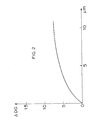
- a graph illustrates the increase in dot gain ( ⁇ DG) as a function of the thickness ( ⁇ m) of the anti-abrasion layer keeping constant the thickness of the layers (ii) and (iii).
- the dot gain was measured at 50 percent dot value at 150 lines per 2.54 cm (inch). The determination of dot gain is given at the end of Example 1.
- Figure 3 represents a schematic cross-sectional drawing of an apparatus for carrying out the transfer onto image sheet materials of said layer assemblage providing an outermost anti-abrasion layer with gloss improving properties.
- a preferred temporary support of the stripping film material is a cellulose triacetate support.
- the sticking power of layer (iii) to wet hydrophilic colloid relief parts or an integral hydrophilic colloid layer is improved substantially by incorporating the dispersed polymer particles having a Tg below 0 °C, preferably below minus 10 °C.
- Such latex polymer is sold under the registered trade mark DARATAK 74L by GRACE ORGANIC CHEMICAL DIVISION - Lexington, U.S.A.
- the gloss of the protected image can be controlled by incorporating a certain amount of matting agent, e.g. in the form of finely divided organic polymer particles and/or inorganic pigment particles, e.g. titanium dioxide particles, in the coating composition of anti-abrasion layer (i).
- matting agent e.g. in the form of finely divided organic polymer particles and/or inorganic pigment particles, e.g. titanium dioxide particles
- the colour tone of the image on the permanent support can be controlled by incorporating diffusion-resistant dyes or pigments in layer (i), (ii) and/or (iii), hereby simulating according to one embodiment the somewhat yellowish-brown tone of antique photographs or parchment base documents.
- the present process gives very satisfactory results for controlling gloss and improving abrasion resistance of hydrophilic colloid layers of an image that is obtained as superposed hydrophilic coloured colloid relief patterns by wash-off processing of coloured imagewise hardened hydrophilic colloid layers.
- the present process is applied for improving the abrasion resistance, controlling gloss and optical dot area of multicolour halftone images obtained by a wash-off processing.
- the permanent support is transparent or opaque and may be made of metal, glass, ceramics, organic resin or paper.
- Transparent resin supports can be matted or made opaque in the bulk.
- the matting may be effected by pigments known therefor in the art, e.g. titanium dioxide, zinc oxide, and barium sulphate. Matting can also be obtained by applying a matting layer or producing a "blushcoat" as described e.g. in United Kingdom Patent Specification 943,681.
- Suitable supports can be used as described e.g. in published European Patent Application No. 0 305 599. These supports are paper supports coated with a polyolefin layer and a hardened hydrophilic colloid binder layer containing titanium dioxide pigment particles, which particles have an average grain size in the range of 200 to 450 nm, are present for at most 300 % by weight with respect to the total binder content and are applied at a coverage of at least 0.5 g per m2. By varying the binder/pigment ratio these supports are suited to control the dot gain and to simulate the dot gain in halftone prints obtained by printing with ink on different paper stock.
- a permanent paper support may be composed of poly-Alpha-olefin coated paper to reduce the take up of moisture and to speed up the drying.
- the photosensitive silver halide used in said wash-off image forming process may comprise silver chloride, silver bromide, silver bromoiodide, silver chlorobromoiodide and the like, or mixtures thereof.
- the silver halide emulsions may be coarse or fine grain and can be prepared by any of the well known procedures, e.g., single jet emulsions, double jet emulsions, such as Lippmann emulsions, ammoniacal emulsions, thiocyanate-or thioether-ripened emulsions such as those described in U.S. Patent Specifications 2,222,264 of Adolph H. Nietz and Frederick J. Russell, issued November 19, 1940, 3,320,069 of Bernard D.
- direct positive silver halide emulsions may be used that produce a positive silver image and a corresponding imagewise distribution of developing agent oxidation products during their development.
- those direct positive silver halide emulsions are considered wherein by exposure or by a chemical treatment a developable fog has been produced, which is destroyed imagewise during the imagewise exposure when certain conditions are fulfilled.
- the fog is maintained so that during the subsequent development a direct positive silver image is obtained and in correspondence therewith an imagewise distribution of oxidized hardening developing agent.
- direct positive emulsions of the type described in P.J.Hillson, U.S. Patent 3,062,651 may be utilized to obtain direct positive images.
- a non-hardening fogging agent such as stannous chloride, formamidine sulfinic acid, or the like is used.
- compositions, preparation and coating of silver halide emulsions are described, e.g., in Product Licensing Index, Vol. 92, December 1971, publication 9232, p. 107-109 and Research Discl. Nov. (1989) No. 307105, p. 863-885.
- the emulsions can be chemically sensitized, e.g. by adding sulphur-containing compounds, e.g. allyl isothiocyanate, allyl thiourea, sodium thiosulphate and the like, during the chemical ripening stage.
- sulphur-containing compounds e.g. allyl isothiocyanate, allyl thiourea, sodium thiosulphate and the like
- reducing agents e.g. the tin compounds described in the Belgian Patent Specifications 493,464 and 568,687
- polyamines such as diethylenetriamine or derivatives of aminomethane-sulphonic acid, e.g. according to the Belgian Patent Specification 547,323, can be used as chemical sensitizers.
- Suitable chemical sensitizers are noble metals and noble metal compounds such as gold, platinum, palladium, iridium, ruthenium and rhodium. This method of chemical sensitization has been described in the article of R.KOSLOWSKY, Z. Hiss. Photogr. Photophys. Photochem. 46, 65-72 (1951).
- polyalkylene oxide derivatives e.g. with polyethylene oxide having a molecular weight between 1000 and 20,000, or with condensation products of alkylene oxides and aliphatic alcohols, glycols, cyclic dehydration products of hexitols, alkylsubstituted phenols, aliphatic carboxylic acids, aliphatic amines, aliphatic diamines and amides.
- the condensation products have a molecular weight of at least 700, preferably of more than 1000.
- these sensitizers of course can be combined with each other as described in Belgian Patent Specification 537,278 filed April 12, 1955 and UK Patent Specification 727,982.
- the spectral photosensitivity of the silver halide has to comply with the spectral composition of the exposure light used in the exposure.
- the usual mono- or polymethine dyes such as acidic or basic cyanines, hemicyanines, oxonols, hemioxonols, styryl dyes or others, also tri- or polynuclear methine dyes, e.g. rhodacyanines or neocyanines may be used.
- Such spectral sensitizers are described, e.g., by F.M.HAMER in "The Cyanine Dyes and Related Compunds" (1964) Interscience Publishers, John Wiley & Sons, New York.
- the silver halide emulsions may contain the usual stabilizers, e.g. homopolar or salt-like compounds of mercury with aromatic or heterocyclic rings such as mercaptotriazoles, simple mercury salts, sulphonium mercury double salts and other mercury compounds.
- Other suitable stabilizers are azaindenes, preferably tetra- or penta-azaindenes, especially those substituted with hydroxyl or amino groups. Compounds of this kind are described by BIRR in Z. Wiss. Photogr. Photophys. Photochem. 47,, 2-27 (1952).
- Still other suitable stabilizers are amongst others heterocyclic mercapto compounds, e.g. phenylmercaptotetrazole, quaternary benzothiazole derivatives, benzotriazole and the like.
- the hardening development proceeds with commonly used hardening developing agents, also called tanning developing agents for effecting the development of the silver halide and producing oxidized developing agent acting as hardening agent for the hydrophilic colloid binder such as gelatin.
- suitable hardening developing agents are : 1,4-dihydroxy benzene compounds such as hydroquinone, chlorohydroquinone, bromohydroquinone, toluhydroquinone, morpholinemethyl hydroquinone, sulfohydroquinone and the like.
- the developing agent may be incorporated in an aqueous alkaline processing liquid.
- an aqueous alkaline processing liquid When incorporated in the silver halide emulsion layer, and/or in a non-silver halide containing layer adjacent thereto the development can be obtained by applying an alkaline aqueous activator liquid originally free from developing agent.
- said silver halide emulsion layer is combined with an underlying additional hardenable hydrophilic colloid layer containing an auxiliary developing agent forming a superadditive developing system with the hardening developing agent contained in the coloured silver halide emulsion layer.
- Typical activator baths for a hardening developable photographic silver halide emulsion material comprise, for example, an aqueous solution of an alkaline material, such as sodium carbonate, sodium hydroxide, potassium carbonate, potassium hydroxide, mixtures of sodium hydroxide and sodium sulfite, hydroxyalkylamines, e.g. triethanolamine, etc.
- a suitable activator bath comprises e.g. about 2 percent by weight of sodium hydroxide and 0.5 percent by weight of sodium sulfite.
- auxiliary developing agent can be used along with a hydroquinone developing agent in order to improve the speed without disadvantageously affecting the wash-off processing of the invention.
- Typical auxiliary developing agents include 3-pyrazolidinone developing agents, e.g. 1-phenyl-3-pyrazolidinone, 1-phenyl-4,4-dimethyl-3-pyrazolidinone, 1-phenyl-4-methyl-4'-hydroxymethyl-3-pyrazolidinone and N-methyl-p-aminophenol sulphate.
- Said auxiliary developing agents or a mixture thereof may be incorporated in the photographic material and/or in the developing liquid in which the hardening developing agent may be absent when using an alkaline activator bath.
- the magenta pigment coating was prepared starting with a paste sold under the name HELIOECHTCARMIN BB TEIG (Colour Index Nr. 12,485) and the yellow pigment caoting was prepared starting with a paste sold under the name HELIOECHTGELB GRN 7476 Feinlessness (Colour Index Nr. 21,100). Said pigment-pastes were used in an amount of 14.5 g and 17.6 g respectively per liter of coating composition.
- a carbon black paste was incorporated in admixture with the above mentioned FLEXONYL BLUE-paste in an amount of 15.75 g and 1.26 g respectively per liter of coating composition.
- a double-side polyethylene coated paper with paper weight of 180 g/m2 and a polyethylene layer weight of 30 g per m2 was air-knife coated at a wet coverage of 55 g per m2 with the following coating composition :
- Matting agent A is an aqueous dispersion containing 10.7 % of amorphous silica, 6.4 % of gelatin and 4.3 % of polyethylacrylate latex particles.
- Matting agent B is an aqueous dispersion containing 41.8 % of Alpha-quartz and 4.2 % of gelatin.
- the weight % of TiO2 with respect to the total layer composition was 29.5 in the dried layer.
- the coverage of TiO2 was 1.54 g/m2.
- the photographic layers on their temporary support were scanningwise halftone exposed on a commercial argon ion laser scanner operating with electronic dot generation.
- the cyan pigment containing multilayer structure was transferred onto the permanent support as described hereinbefore by soaking the permanent support in water for 10 s and then pressing it into contact with layer (2). By stripping apart the temporary support the composite layer structure of layers (1) and (2) was left on the permanent support and the transferred composite layer was dried.
- the transferred composite coating was hardening developed by dipping it for 30 s in an aqueous liquid, called activator bath, having following composition : potassium hydroxide 25 g potassium carbonate 150 g potassium bromide 0.5 g sodium sulphite 2.0 g 4(hydroxymethyl)4-methyl-1-phenyl-3-pyrazolidinone 5.0 g mono sodium salt of ethylenediaminetetra-acetic acid 1.0 g
- the developed material was led through a bleach-fix bath containing sodium thiosulphate and the mono sodium,iron(III) salt of ethylenediamine tetra-acetic acid.
- a cellulose triacetate support having a thickness of 190 ⁇ m was coated at a wet coating thickness of 150 g/m2 the following coating composition for forming anti-abrasion, gloss improving layer (i) : nitrocellulose (DS : 2.25) 26 g methanol 335 ml ethanol 365 ml diethyl ether 250 ml n-propanol 50 ml
- the following coating composition for forming subbing layer (ii) was coated at a coverage sufficient to form a dry layer having a thickness of 0.7 ⁇ m : water 30 ml gelatin 12 g maleic acid 1 g butanol 200 ml methyl ethyl keton 370 ml ethanol 400 ml nitrocellulose (DS : 2.25) 7.5 g
- an adhesive layer (iii) was applied at a wet coverage of 50g/m2 from the following coating composition : water 800 ml gelatin 40 g matting agent A 10 g DARATAK 74L (registered trade name) 50 ml wetting agent solution W1 15 ml wetting agent solution W2 30 ml water up to 1000 ml
- Matting agent A is an aqueous dispersion containing 3 % of polymethylmethacrylate particles of average particle size 4 ⁇ m and 10 % of gelatin.
- Wetting agent solution W1 is a 10 % solution of saponine in methanol/water (1/1 by volume).
- Wetting agent solution W2 is a 2 % solution of ULTRAVON W (registered trade mark of CIBA A.G. -Switzerland) [disodium salt of heptadecylbenzimidazole disulphonic acid] in a mixture methanol/water (1/2 by volume).
- the wetted multicolour relief image was brought into contact with the dry stripping film material and conveyed through the nip of a pair of pressure rollers 3 and 4 pressing the wetted relief image parts against layer (iii) of the stripping film material. After being pressed together the materials were left in contact for 2 minutes in a hot air stream of 55 °C. From the layer assemblage of layers (i), (ii) and (iii) the temporary cellulose triacetate support was stripped off. Such proceeded by making first at one border side an incision in the temporary support which on plying was fractured and easily peeled off from said layer assemblage. As a result of said procedure the multicolour relief image was covered with an outermost anti-abrasion, gloss improving layer.
- the reflectance in the white portions of the image covered by said gloss improving layer was measured according to DIN standard No. 67 530 (November 1972) (measuring angle 20°) and corresponded with 68 % reflectance. In the absence of said gloss improving layer the reflectance reached only 11 %.
- ⁇ DG dot gain
- the halftone dot area percentage was calculated with the Murray-Davies equation (ref. Murray A., “Monochrome Reproduction in Photoengraving", J. Franklin Institute, vol. 221, p. 721-744, reading as follows : wherein : D t represents the density of the halftone tint, D s represents the density of the solid, and a represents the halftone dot area percentage.
- the dot gain is obtained by subtracting the dot area percentage of the original halftone separation image from the above calculated one obtained on the colour proof material provided with gloss improving anti-abrasion layer.
Landscapes
- Physics & Mathematics (AREA)
- General Physics & Mathematics (AREA)
- Chemical & Material Sciences (AREA)
- Engineering & Computer Science (AREA)
- Materials Engineering (AREA)
- Ink Jet Recording Methods And Recording Media Thereof (AREA)
- Laminated Bodies (AREA)
Priority Applications (2)
| Application Number | Priority Date | Filing Date | Title |
|---|---|---|---|
| EP90201630A EP0462330A1 (fr) | 1990-06-21 | 1990-06-21 | Procédé et matériau pour la protection d'images |
| JP3176056A JPH04233545A (ja) | 1990-06-21 | 1991-06-19 | 像を保護する方法及び材料 |
Applications Claiming Priority (1)
| Application Number | Priority Date | Filing Date | Title |
|---|---|---|---|
| EP90201630A EP0462330A1 (fr) | 1990-06-21 | 1990-06-21 | Procédé et matériau pour la protection d'images |
Publications (1)
| Publication Number | Publication Date |
|---|---|
| EP0462330A1 true EP0462330A1 (fr) | 1991-12-27 |
Family
ID=8205039
Family Applications (1)
| Application Number | Title | Priority Date | Filing Date |
|---|---|---|---|
| EP90201630A Withdrawn EP0462330A1 (fr) | 1990-06-21 | 1990-06-21 | Procédé et matériau pour la protection d'images |
Country Status (2)
| Country | Link |
|---|---|
| EP (1) | EP0462330A1 (fr) |
| JP (1) | JPH04233545A (fr) |
Cited By (2)
| Publication number | Priority date | Publication date | Assignee | Title |
|---|---|---|---|---|
| EP0600534A1 (fr) * | 1992-12-01 | 1994-06-08 | Agfa-Gevaert N.V. | Procédé et matériaux pour contrôler l'aspect visuel des images |
| EP0962829A1 (fr) * | 1998-06-05 | 1999-12-08 | E.I. Du Pont De Nemours And Company | Couche protectrice pour des épreuves en couleur |
Citations (4)
| Publication number | Priority date | Publication date | Assignee | Title |
|---|---|---|---|---|
| FR989032A (fr) * | 1949-04-15 | 1951-09-04 | Pellicules améliorées, en particulier pour la cinématographie et procédé permettant leur obtention | |
| GB1047701A (en) * | 1961-05-08 | 1966-11-09 | Gevaert Photo Prod Nv | Photographic stripping films |
| DE3709818A1 (de) * | 1987-03-25 | 1988-10-06 | Du Pont Deutschland | Verfahren zur herstellung mattierter photographischer aufzeichnungsmaterialien |
| EP0324192A1 (fr) * | 1988-01-12 | 1989-07-19 | Agfa-Gevaert N.V. | Méthode pour régler le brillant |
-
1990
- 1990-06-21 EP EP90201630A patent/EP0462330A1/fr not_active Withdrawn
-
1991
- 1991-06-19 JP JP3176056A patent/JPH04233545A/ja active Pending
Patent Citations (4)
| Publication number | Priority date | Publication date | Assignee | Title |
|---|---|---|---|---|
| FR989032A (fr) * | 1949-04-15 | 1951-09-04 | Pellicules améliorées, en particulier pour la cinématographie et procédé permettant leur obtention | |
| GB1047701A (en) * | 1961-05-08 | 1966-11-09 | Gevaert Photo Prod Nv | Photographic stripping films |
| DE3709818A1 (de) * | 1987-03-25 | 1988-10-06 | Du Pont Deutschland | Verfahren zur herstellung mattierter photographischer aufzeichnungsmaterialien |
| EP0324192A1 (fr) * | 1988-01-12 | 1989-07-19 | Agfa-Gevaert N.V. | Méthode pour régler le brillant |
Cited By (3)
| Publication number | Priority date | Publication date | Assignee | Title |
|---|---|---|---|---|
| EP0600534A1 (fr) * | 1992-12-01 | 1994-06-08 | Agfa-Gevaert N.V. | Procédé et matériaux pour contrôler l'aspect visuel des images |
| EP0962829A1 (fr) * | 1998-06-05 | 1999-12-08 | E.I. Du Pont De Nemours And Company | Couche protectrice pour des épreuves en couleur |
| US6210844B1 (en) | 1998-06-05 | 2001-04-03 | E. I. Du Pont De Nemours And Company | Protective layer for color proofs |
Also Published As
| Publication number | Publication date |
|---|---|
| JPH04233545A (ja) | 1992-08-21 |
Similar Documents
| Publication | Publication Date | Title |
|---|---|---|
| US4925767A (en) | Gloss controlling process | |
| EP0305599B1 (fr) | Procédé pour obtenir des images demi-teintes | |
| EP0185410B1 (fr) | Procédé pour la formation d'un modèle multicolore au trait ou à demi-ton à base de colloides | |
| US4710444A (en) | Process for the formation of linework or halftone multicolor colloid patterns | |
| EP0462330A1 (fr) | Procédé et matériau pour la protection d'images | |
| JPS58196548A (ja) | 平版印刷版 | |
| EP0306561B1 (fr) | Matériau récepteur d'image | |
| US5270147A (en) | Stripping film material | |
| US5043247A (en) | Process for the formation of multicolor colloid patterns | |
| US4211561A (en) | Method of producing cross-linked polymeric images | |
| EP0529697B1 (fr) | Matériau sous forme de film pelliculable | |
| EP0625224B1 (fr) | Support d'images pour image reprographique | |
| US3639124A (en) | Pretransferred silver deposit receiving element | |
| EP0487790A1 (fr) | Méthode pour réguler la blancheur et film pelliculable | |
| EP0181968A1 (fr) | Procédé pour la production d'images photographiques en relief par développement tannant et traitement wash-off de matériaux à base d'émulsions aux halogénures d'argent | |
| EP0600534B1 (fr) | Procédé et matériaux pour contrôler l'aspect visuel des images | |
| WO1994010610A1 (fr) | Procede pour former des epreuves numeriques en couleur directement sur le materiau standard d'impression | |
| US5385805A (en) | Process and materials for controlling the visual aspect of images | |
| JPH0342466B2 (fr) | ||
| Kingsley | Identification by inspection: An introduction to photographic papers | |
| EP0723192A1 (fr) | Matériau photographique couleur à l'halogénure d'argent sensible à la lumière et procédé de préparation d'épreuve en couleurs | |
| JPS6041044A (ja) | 平版印刷材料の製法 |
Legal Events
| Date | Code | Title | Description |
|---|---|---|---|
| PUAI | Public reference made under article 153(3) epc to a published international application that has entered the european phase |
Free format text: ORIGINAL CODE: 0009012 |
|
| AK | Designated contracting states |
Kind code of ref document: A1 Designated state(s): AT BE CH DE DK ES FR GB GR IT LI LU NL SE |
|
| RBV | Designated contracting states (corrected) |
Designated state(s): BE DE FR GB |
|
| 17P | Request for examination filed |
Effective date: 19920518 |
|
| 17Q | First examination report despatched |
Effective date: 19950608 |
|
| STAA | Information on the status of an ep patent application or granted ep patent |
Free format text: STATUS: THE APPLICATION HAS BEEN WITHDRAWN |
|
| 18W | Application withdrawn |
Withdrawal date: 19950812 |