EP0466512B1 - Procédé d'opérer un moteur à combustion interne - Google Patents
Procédé d'opérer un moteur à combustion interne Download PDFInfo
- Publication number
- EP0466512B1 EP0466512B1 EP91306360A EP91306360A EP0466512B1 EP 0466512 B1 EP0466512 B1 EP 0466512B1 EP 91306360 A EP91306360 A EP 91306360A EP 91306360 A EP91306360 A EP 91306360A EP 0466512 B1 EP0466512 B1 EP 0466512B1
- Authority
- EP
- European Patent Office
- Prior art keywords
- gasoline
- hydrocarbons
- volume
- fuel
- boiling range
- Prior art date
- Legal status (The legal status is an assumption and is not a legal conclusion. Google has not performed a legal analysis and makes no representation as to the accuracy of the status listed.)
- Expired - Lifetime
Links
Images

Classifications
-
- C—CHEMISTRY; METALLURGY
- C10—PETROLEUM, GAS OR COKE INDUSTRIES; TECHNICAL GASES CONTAINING CARBON MONOXIDE; FUELS; LUBRICANTS; PEAT
- C10L—FUELS NOT OTHERWISE PROVIDED FOR; NATURAL GAS; SYNTHETIC NATURAL GAS OBTAINED BY PROCESSES NOT COVERED BY SUBCLASSES C10G OR C10K; LIQUIFIED PETROLEUM GAS; USE OF ADDITIVES TO FUELS OR FIRES; FIRE-LIGHTERS
- C10L10/00—Use of additives to fuels or fires for particular purposes
- C10L10/02—Use of additives to fuels or fires for particular purposes for reducing smoke development
-
- C—CHEMISTRY; METALLURGY
- C10—PETROLEUM, GAS OR COKE INDUSTRIES; TECHNICAL GASES CONTAINING CARBON MONOXIDE; FUELS; LUBRICANTS; PEAT
- C10L—FUELS NOT OTHERWISE PROVIDED FOR; NATURAL GAS; SYNTHETIC NATURAL GAS OBTAINED BY PROCESSES NOT COVERED BY SUBCLASSES C10G OR C10K; LIQUIFIED PETROLEUM GAS; USE OF ADDITIVES TO FUELS OR FIRES; FIRE-LIGHTERS
- C10L1/00—Liquid carbonaceous fuels
- C10L1/02—Liquid carbonaceous fuels essentially based on components consisting of carbon, hydrogen, and oxygen only
- C10L1/023—Liquid carbonaceous fuels essentially based on components consisting of carbon, hydrogen, and oxygen only for spark ignition
-
- C—CHEMISTRY; METALLURGY
- C10—PETROLEUM, GAS OR COKE INDUSTRIES; TECHNICAL GASES CONTAINING CARBON MONOXIDE; FUELS; LUBRICANTS; PEAT
- C10L—FUELS NOT OTHERWISE PROVIDED FOR; NATURAL GAS; SYNTHETIC NATURAL GAS OBTAINED BY PROCESSES NOT COVERED BY SUBCLASSES C10G OR C10K; LIQUIFIED PETROLEUM GAS; USE OF ADDITIVES TO FUELS OR FIRES; FIRE-LIGHTERS
- C10L1/00—Liquid carbonaceous fuels
- C10L1/10—Liquid carbonaceous fuels containing additives
- C10L1/14—Organic compounds
- C10L1/30—Organic compounds compounds not mentioned before (complexes)
- C10L1/305—Organic compounds compounds not mentioned before (complexes) organo-metallic compounds (containing a metal to carbon bond)
-
- C—CHEMISTRY; METALLURGY
- C10—PETROLEUM, GAS OR COKE INDUSTRIES; TECHNICAL GASES CONTAINING CARBON MONOXIDE; FUELS; LUBRICANTS; PEAT
- C10L—FUELS NOT OTHERWISE PROVIDED FOR; NATURAL GAS; SYNTHETIC NATURAL GAS OBTAINED BY PROCESSES NOT COVERED BY SUBCLASSES C10G OR C10K; LIQUIFIED PETROLEUM GAS; USE OF ADDITIVES TO FUELS OR FIRES; FIRE-LIGHTERS
- C10L10/00—Use of additives to fuels or fires for particular purposes
- C10L10/04—Use of additives to fuels or fires for particular purposes for minimising corrosion or incrustation
-
- C—CHEMISTRY; METALLURGY
- C10—PETROLEUM, GAS OR COKE INDUSTRIES; TECHNICAL GASES CONTAINING CARBON MONOXIDE; FUELS; LUBRICANTS; PEAT
- C10L—FUELS NOT OTHERWISE PROVIDED FOR; NATURAL GAS; SYNTHETIC NATURAL GAS OBTAINED BY PROCESSES NOT COVERED BY SUBCLASSES C10G OR C10K; LIQUIFIED PETROLEUM GAS; USE OF ADDITIVES TO FUELS OR FIRES; FIRE-LIGHTERS
- C10L10/00—Use of additives to fuels or fires for particular purposes
- C10L10/10—Use of additives to fuels or fires for particular purposes for improving the octane number
Definitions
- This invention relates to a process of operating a spark ignition internal combustion engine, i.e. a gasoline engine, with gasoline fuels having superior environmental and performance properties in use.
- United States Patent No. 4139349 describes lead-free gasoline compositions comprising a synergistic combination of dicyclopentadienyl iron and cyclopentadienyl manganese tricarbonyl anti-knocks.
- the invention is believed to provide a most effective and efficient way of using gasolines of suitable octane values while concomitantly reducing the potential for ground ozone formation, smog formation, and other grievous consequences of atmospheric pollution by reducing the maximum reactivity of exhaust products emitted by spark-ignition internal combustion engines.
- this invention provides a process of operating a spark-ignition internal combustion engine with reduced reactivity of the tailpipe exhaust products which comprises using as the gasoline fuel for said engine a formulated lead-free gasoline comprising (i) a plurality of hydrocarbons of the gasoline boiling range containing not more than 30 volume % of aromatics and (ii) at least one cyclopentadienyl manganese tricarbonyl compound in an amount equivalent to up to 1/32 gram of manganese per gallon (3.78 litres).
- the invention also provides the use of a said manganese compound (ii) in a said lead-free gasoline to reduce the reactivity of tailpipe exhaust products produced on combustion of said gasoline in a spark-ignition internal combustion engine.
- the gasoline-type hydrocarbon fuels used in forming the gasoline will generally comprise saturates, olefins and aromatics; and they may also contain oxygenated fuel blending components, such as hydrocarbyl ethers.
- the fuels contain a limitation on the content of aromatic gasoline hydrocarbons, inasmuch as aromatics are capable of providing exhaust product species of relatively high reactivity.
- aromatic gasoline hydrocarbons in the base blends.
- aromatic hydrocarbons such as benzene
- carcinogens are regarded as carcinogens.
- aromatic hydrocarbons and also olefinic hydrocarbons
- exhaust products containing relatively reactive species which are deemed to participate in the formation of ground level ozone, smog, and other forms of atmospheric pollution.
- This invention overcomes this dilemma by utilizing an antiknock compound of such potency that as little as 1/32 of a gram or less per gallon (3.78 litres) manganese in the fuel gives rise to significant increases in octane quality.
- the refiner is able to provide a gasoline having the desired octane quality while at the same time maintaining or even reducing the quantity of aromatics in the base fuel.
- the hydrocarbon tailpipe emissions resulting from use of the fuels of this invention have lower maximum reactivity than the hydrocarbon emissions of the same fuel would have if the antiknock agent were replaced by an amount of aromatic hydrocarbons necessary to achieve the same octane quality.
- the fuels of this invention produce hydrocarbon emissions having substantially lower total maximum reactivities than the hydrocarbon emissions from the same base fuel devoid of the cyclopentadienyl manganese tricarbonyl additive(s).
- This especially preferred embodiment of the invention is illustrated in Example 4 hereinafter.
- the amount of olefinic hydrocarbons in the fuel composition can be controlled so as to be less than about 10% by volume (preferably less than 5% by volume) and, in addition, oxygenated fuel-blending components (e.g., hydrocarbyl ethers) of suitable distillation characteristics can be included in the fuel.
- oxygenated fuel-blending components e.g., hydrocarbyl ethers
- the fuel composition should be blended from components such that the Reid vapor pressure (ASTM test method D-323) is 62.1 kPa (9.0 psi) or less and most preferably 55.2 kPa (8.0 psi) or less. In this way the evaporative losses of the fuel into the atmosphere during storage and fueling operations can be effectively reduced.
- Reid vapor pressures are determined at 100°F (37.8°C).
- the gasolines of this invention are lead-free in the sense that no organolead antiknock agent is blended into the fuel. If any trace amounts of lead are present, such amounts are due exclusively to contamination in the system in which the fuels are formed, blended, stored, transported or dispensed.
- the hydrocarbonaceous gasoline base stocks that can be used in forming the gasoline blends include straight run stocks, light naphtha fractions, cracked gasoline stocks obtained from thermal or catalytic cracking, hydrocracking, or similar methods, reformate obtained by catalgic reformation or like processes, polymer gasolines formed via polymerization or olefins, alkylates obtained by addition of olefins to isobutane or other hydrocarbons by alkylation processes, isomerates formed by isomerization of lower straight chain paraffins such as a n-hexane, n-heptane, and the like, and other hydrocarbons of the gasoline boiling range formed by suitable refinery processing operations.
- Suitable amounts of appropriate hydrocarbons formed by other methods such as production from coal, shale ortarsands can be included, if desired.
- reformates based on liquid fuels formed by the Fischer-Tropsch process can be included in the blends.
- the resultant gasoline must satisfy the reduced maximum reactivity tailpipe hydrocarbon emission requirements of this invention and additionally will possess the distillation characteristics typical of conventional regular, midgrade, premium, or super-premium unleaded gasolines.
- the motor gasolines are generally within the parameters of ASTM D 4814 and typically have initial boiling points in the range of 21-46°C (70-115°F) and final boiling points in the range of 188-227°C (370-440°F) as measured by the standard ASTM distillation procedure (ASTM D 86).
- the hydrocarbon composition of gasolines according to volume percentages of saturates, olefins, and aromatics is typically determined by ASTM test procedure D 1319.
- the base gasoline will be a blend of stocks obtained from several refinery processes.
- the final blend may also contain hydrocarbons made by other procedures such as alkylates made by the reaction of C, olefins and butanes using an acid catalyst such as sulfuric acid or hydrofluoric acid, and aromatics made from a reformer.
- the saturated gasoline components comprise paraffins and naphthenates. These saturates are generally obtained from: (1) virgin gasoline by distillation (straight run gasoline), (2) alkylation processes (alkylates), and (3) isomerization procedures (conversion of normal paraffins to branched chain paraffins of greater octane quality). Saturated gasoline components also occur in so-called natural gasolines. In addition to the foregoing, thermally cracked stocks, catalgically cracked stocks and catalgic reformates contain some quantities of saturated components. In accordance with preferred embodiments of this invention, the base gasoline blend contains a major proportion of saturated gasoline components. Generally speaking, the higher the content of saturates consistent with producing a fuel of requisite octane quality and distillation characteristics, the better.
- Olefinic gasoline components are usually formed by use of such procedures as thermal cracking, and catalgic cracking. Dehydrogenation of paraffins to olefins can supplement the gaseous olefins occurring in the refinery to produce feed material foreither polymerization or alkylation processes.
- the olefins if used in the fuel blends, should be substantially straight chain 1-oiefins such as 1-heptene, 1-octene, 1-nonene, and 1-decene. Olefins of this type are known to exhibit excellent antiknock response to cyclopentadienyl manganese tricarbonyls -- see Brown and Lovell, Industrial and Engineering Chemistry, Volume 50, No. 10, October 1958, pages 1547-50.
- the gasoline base stock blends with which the cyclopentadienyl manganese tricarbonyl additive is blended pursuant to this invention will generally contain 40-90 volume % of saturates, up to 30 (and preferably less than 10 and more preferably less than 5) volume % olefins, and up to 30% by volume of aromatics, still more preferably no more than 28% by volume of aromatics, and most preferably no more than 25% by volume of aromatics.
- the overall fuel blend will contain no more than 1% by volume and most preferably no more than 0.8% by volume of benzene.
- Particularly preferred unleaded gasolines produced and/or utilized in the practice of this invention not only meet the emission reactivity criteria of this invention, but in addition, are characterized by having (1) a maximum sulfur content of 300 ppm, (2) a maximum bromine number of 20, (3) a maximum aromatic content of 20% by volume, (4) a maximum content of benzene of 1% by volume, and (5) a minimum content of contained oxygen of 1% by weight in the form of at least one monoether or polyether, such gasoline having dissolved therein up to 1/32 gram of manganese per gallon (3.78 litres) as methylcyclopentadienyl manganese tricarbonyl.
- Gasolines of this type not containing the manganese additive are sometimes referred to as reformulated gasolines. See for example Oil & Gas Journal, April 9, 1990, pages 43-48.
- the preferred gasoline base stock blends are those having an octane rating of (R + M)/2 ranging from 78-95.
- any of a variety of cyclopentadienyl manganese tricarbonyl compounds can be used in the practice of this invention.
- Illustrative examples of the manganese compounds which can be utilized in accordance with this invention include cyclopentadienyl manganese tricarbonyl, methyl-cyclopentadienyl manganese tricarbonyl, dimethylcyclopentadienyl manganese tricarbonyl, trimethylcyclopentadienyl manganese tricarbonyl, tetramethylcyclopentadienyl manganese tricarbonyl, pentamethylcyclopentadienyl manganese tricarbonyl, ethylcyclopentadienyl manganese tricarbonyl, diethylcyclopentadienyl manganese tricarbonyl, propylcyclopentadie- nyl manganese tricarbonyl, isopropylcyclopentadienyl manganese tricarbonyl,
- the preferred compounds or mixtures of compounds are those which are in the liquid state of aggregation at ordinary ambient temperatures, such as methylcyclopentadienyl manganese tricarbonyl, ethylcyclopentadienyl manganese tricarbonyl, liquid mixtures of cyclopentadienyl manganese tricarbonyl and methylcyclopentadienyl manganese tricarbonyl, and mixtures of methylcyclopentadienyl manganese tricarbonyl and ethylcyclopentadienyl manganese tricarbonyl.
- the most preferred compound because of its commercial availability and its excellent combination of properties and effectiveness is methylcyclopentadienyl manganese tricarbonyl.
- the maximum reactivity of the C l -C lo hydrocarbon species emitted from an operating engine is determined utilizing the ozone reactivity values developed by William P. L. Carter of the Air Pollution Research Center, University of California, at Riverside, California.
- the methodology involves operating the vehicle on a chassis dynamometer (e.g., a Clayton Model ECE-50 with a direct-drive variable-inertia flywheel system which simulates equivalent weight of vehicles from 454 to 4026 kg (1000 to 8875 pounds) in 57 kg (125-pound) increments) in accordance with the Federal Test Procedure (United States Code of Federal Regulations, Title 40, Part 86, Subparts A and B, sections applicable to light-duty gasoline vehicles).
- a chassis dynamometer e.g., a Clayton Model ECE-50 with a direct-drive variable-inertia flywheel system which simulates equivalent weight of vehicles from 454 to 4026 kg (1000 to 8875 pounds) in 57 kg (125-pound) increments
- the Federal Test Procedure United States Code of Federal Regulations, Title 40, Part 86, Subparts A and B, sections applicable to light-duty gasoline vehicles.
- the exhaust from the vehicle is passed into a stainless steel dilution tunnel wherein it is mixed with filtered
- Samples of regulated emissions and samples for speciation of C l -C lo hydrocarbons are sampled from the diluted exhaust by means of a constant volume sampler (CVS) and are collected in bags (e.g., bags made from Tedlar resin) in the customary fashion.
- CVS constant volume sampler
- the Federal Test Procedure utilizes an urban dynamometer driving schedule which is 1372 seconds in duration. This schedule, in turn, is divided into two segments; a first sequent of 505 seconds (a transient phase) and a second segment of 867 seconds (a stabilized phase). The procedure calls for a cold-start 505 segment and stabilized 867 segment, followed by a ten-minute soak then a hot-start 505 segment. In the methodology used herein, separate samples for regulated emissions and for C l -C lo hydrocarbon speciation are collected during the cold-start 505 segment, the stabilized 867 segment, and the hot-start 505 segment.
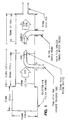
- the sampling system will include an impinger collection system (note Figure 2) enabling collection of exhaust samples continuously during the desired test cycles.
- the air-diluted exhaust is bubbled at a rate of four liters per minute through chilled glass impingers containing an acetonitrile solution of 2,4-dinitrophenylhydrazine and perchloric acid.
- the Federal Test Procedure cycle is extended to include a four-cycle procedure for sampling the aldehydes and ketones.
- the sampling schedule when sampling for (a) regulated emissions, (b) hydrocarbon speciation, and (c) aldehydes and ketones involves collecting samples for (a) during the cold-start 505 segment, the stabilized 867 segment, and the hot-start 505 segment. Samples for (b) are also separately collected during these three segments. However, a sample for (c) is collected continuously during the cold-start 505 segment plus the stabilized 867 segment, and another sampling is started at the beginning of the hot-start 505 segment and is extended through the ensuing stabilized 867 segment. If it is only desired to sample for (a) and for (b), the impinger system and sampling procedure associated therewith are not used.
- Example 1 The analytical procedures used to conduct the hydrocarbon speciation are described in Example 1 hereinafter.
- MMT Fuel methylcyclopentadienyl manganese tricarbonyl
- the constant volume sampler (CVS) used for the valuations was employed in conjunction with an 18-inch (45.7 cm) diameter by 16-foot (4.9 m) long stainless steel dilution tunnel (note Figure 1) and was run at a nominal 320 scfm (9062 I/min). This flow rate generally provided tunnel sampling zone temperatures not exceeding 110°F (43°C) during the Federal Test Procedures.
- a cooling fan of 5000 cfm (142 m 3 /min) capacity was used in front of the vehicle during all test cycles. The hood was maintained fully open during all cycles and was closed during the soak periods. Exhaust sampling was conducted employing a system used in accordance with the guidelines established in the studies reported in the following papers and reports:
- Table 3 summarizes the hydrocarbon speciation procedures in these tests.
- Dilute exhaust emissions were sampled in Tedlar bags and analyzed by gas chromatography (GC) with a flame ionization detector (FID).
- the compounds that were analyzed included methane, ethane, ethylene, acetylene, propane, propylene, benzene, and toluene.
- the GC system was,equipped with four separate packed columns which are used to resolve the individual compounds.
- a system of timers, solenoid valves, and gas sampling valves direct the flow of the sample through the system.
- the carrier gas is helium. Peak areas are compared to an external calibration blend and the hydrocarbon concentrations are obtained using a Hewlett-Packard 3353 computer system.
- Minimum detection limits for C 1 to C 3 compounds, benzene, and toluene are 0.05. ppmC.
- the procedure used provides separations and concentration data for seven C 4 compounds, namely: isobutane, butane, 1-butene, isobutene, cis-2-butene, trans-2-butene and 1,3-butadiene.
- Standard constant volume sampler (CVS) bag samples and evaporative emission bag samples were analyzed for the C 4 compounds using a GC equipped with an FID.
- the GC system utilized a Perkin-Elmer Model 3920B GC with an FID, two pneumatically-operated and electrically-controlled Seiscorvalves, and an analytical column. This column is a 9 ft x 1/8-in.
- the GC system utilizes a Perkin-Elmer Model 3920B GC equipped with subambient capabilities, a capillary column, and an FID.
- the capillary column used in the system is a Perkin-Elmer F-50 Versilube, 150-ft x 0.02-in (46m x 0.5 mm) WCOT stainless steel column.
- the column is initially cooled to - 139°F (-95°C) for sample injection. Upon injection, the temperature is programmed at a 7°F (4°C) increase per minute to 185°F (85°C).
- the column temperature is held at 185°F (85°C) for approximately 15 minutes to complete column flushing.
- a flow controller is used to maintain a 1.5 mL/min helium carrier flow rate. The 10 mL sample volume permits determination of 0.1 ppmC with the flame ionization detector.
- Table 4 summarizes the total maximum reactivity data so determined.
- Example 1 The procedure of Example 1 was repeated using as the base fuel a commercially-available unleaded regular gasoline from a different domestic oil company.
- Table 5 summarizes the principal inspection data for the two test fuels blended therefrom - i.e., the MMT Fuel and the XY Fuel.
- Example 1 The procedure of Example 1 was again repeated, this time using a commercially-available unleaded regular gasoline from a different domestic oil company containing 1 % by weight of contained oxygen in the form of an ether blending agent (believed to be methyl tert-butyl ether).
- an ether blending agent (believed to be methyl tert-butyl ether).
- the principal inspection data for the two test fuels blended from this base gasoline -- i.e., the MMT Fuel and the XY Fuel -- are summarized in Table 7.
- the vehicle operated on the MMT Fuels emitted lower levels of hydrocarbons, carbon monoxide, and oxides of nitrogen than did the vehicle operated under the same test conditions on the XY Fuels.
- the total maximum reactivities of the hydrocarbons emitted by the vehicle using the MMT Fuels was substantially lower than the total maximum reactivities of the hydrocarbons emitted by the vehicle which used the XY Fuels. It was also observed from the tests conducted as per Examples 1-3 above that the vehicle operated on the MMT Fuel generally produced lower emissions of aldehydes such as formaldehyde, acetaldehyde, and benzaldehyde than the vehicle operated on the XY Fuels. Fuel economies were slightly lower (1-2%) for the MMT-fueled vehicle.
- Example 9 presents the averaged results obtained in these runs.
- the MMT Fuel of this invention not only produced less total hydrocarbon tailpipe emissions but even more importantly, the total maximum reactivity of the speciated hydrocarbon emissions from the MMT-fuel vehicle was substantially lower (28% lower) than the speciated hydrocarbon emissions from the clear (manganese-free) base fuel. Note also from Table 2 that the octane quality of the MMT Fuel was significantly higher than that of the clear base fuel, i.e., (R + M)/2 of 92.9 v. 92.2.
- the fuels of this invention can contain one or more other additives provided such other additive or combination of additives does not excessively detract from the performance -- especially the improved exhaust emission performance such as is illustrated by Examples 1-4 -- exhibited by the same base fuel containing up to 1/32 of a gram of manganese per gallon when devoid of such other additive or additives.
- Antioxidants, deposit-control additives e.g., induction system cleanliness additives, carburetor detergents, and ORI-control additives
- corrosion inhibitors e.g., metal deactivators
- oxygenated blending materials such as dihydrocarbyl ethers and polyethers, typify additives commonly utilized in gasolines, and which may be used in the fuels of this invention subject to the foregoing proviso.
- this invention contemplates the inclusion in the fuel of any ancillary additive or combination of additives which contributes an improvement to the fuel or its performance and which does not destroy or seriously impair the performance benefits made possible by this invention.
- Preferred oxygenated materials that can be blended into the fuels of this invention are ethers of suitable low volatility such as methyl tert-butyl ether, ethyl tert-butyl ether, tert-amyl methyl ether, and 2,2-diethyl-1,3-propanediol.
- ethers of suitable low volatility such as methyl tert-butyl ether, ethyl tert-butyl ether, tert-amyl methyl ether, and 2,2-diethyl-1,3-propanediol.
- mixtures of methyl hydrocarbyl ethers formed by catalytic methoxylation of olefin components in gasoline can be effectively utilized. Processes for producing such mixtures are known and reported in the literature. See for example U. S. Pat. No. 4,746,761, and WO 8911463, and references cited therein.
- fuel-soluble esters and alcohols of suitably low volatility such as tert-butyl acetate, 1-hexanol, 2-hexanol, 3-hexanol, and polyethoxyethanols.
- oxygenated compounds are employed in amounts sufficient to provide up to 3 to 4 weight % oxygen in the fuel, provided such usage is consistent with existing or proposed legislation.
- suitable oxygen-containing blending agents include p-cresol, 2,4-xylene, 3-methoxyphenol, 2-methylfuran, cyclopentanone, isovaleraldehyde, 2,4-pentanedione and si mi lar oxygen-containing substances.
- Preferred antioxidants for the fuels of this invention are hindered phenolic antioxidants, such as 2,6-di-tert-butyl-phenol, 2,4-dimethyl-6-tert-butylphenol, 4-methyi-2,6-di-tert-butyiphenoi, 4-ethyl-2,6-di-tert-butylphenol, 4-butyl-2,6-di-tert-butylphenol, tert-butylphenol, and mixtures of tertiary butylated phenols predominating in 2,6-di-tert-butylphenol.
- aromatic amine antioxidants can prove useful either alone or in combination with a phenolic antioxidant.
- Antioxidants are usually employed in amounts of up to 25 pounds per thousand barrels (0.07 kg per m 3 ), the amount used in any given case being dependent upon the stability (e.g. olefin content) of the gasoline.
- additives preferably utilized in the fuels of this invention are ashless detergents such as polyether amines, polyalkenyl amines, alkenyl succini mides, and polyether amide amines.
- ashless detergents such as polyether amines, polyalkenyl amines, alkenyl succini mides, and polyether amide amines.
- Such materials can be used at treat levels of 50 to 500 pounds per thousand barrels (0.14 to 1.4 kg per m 3 ), and more usually in the range of 100 to 200 pounds per thousand barrels (0.28 to 0.55 kg per m 3 ).
- cyclopentadienyl manganese tricarbonyl compounds as well as the other supplemental additives or blending agents can be blended with the base fuels according to well known procedures utilizing conventional mixing equipment.
Landscapes
- Chemical & Material Sciences (AREA)
- Oil, Petroleum & Natural Gas (AREA)
- Engineering & Computer Science (AREA)
- Organic Chemistry (AREA)
- Combustion & Propulsion (AREA)
- Chemical Kinetics & Catalysis (AREA)
- General Chemical & Material Sciences (AREA)
- Liquid Carbonaceous Fuels (AREA)
- Solid Fuels And Fuel-Associated Substances (AREA)
Claims (12)
Applications Claiming Priority (2)
| Application Number | Priority Date | Filing Date | Title |
|---|---|---|---|
| US55209090A | 1990-07-13 | 1990-07-13 | |
| US552090 | 1990-07-13 |
Publications (3)
| Publication Number | Publication Date |
|---|---|
| EP0466512A1 EP0466512A1 (fr) | 1992-01-15 |
| EP0466512B1 true EP0466512B1 (fr) | 1994-06-29 |
| EP0466512B2 EP0466512B2 (fr) | 2003-07-02 |
Family
ID=24203896
Family Applications (1)
| Application Number | Title | Priority Date | Filing Date |
|---|---|---|---|
| EP91306360A Expired - Lifetime EP0466512B2 (fr) | 1990-07-13 | 1991-07-12 | Utilisation d'au moins un composé du type cyclopentadiényl-manganèse-tricarbonyle dans un carburant formulé sans plomb. |
Country Status (6)
| Country | Link |
|---|---|
| EP (1) | EP0466512B2 (fr) |
| JP (1) | JP3112990B2 (fr) |
| AU (1) | AU651116B2 (fr) |
| CA (1) | CA2045706C (fr) |
| DE (1) | DE69102683T3 (fr) |
| ES (1) | ES2055964T5 (fr) |
Cited By (10)
| Publication number | Priority date | Publication date | Assignee | Title |
|---|---|---|---|---|
| EP1528097A3 (fr) * | 2003-10-29 | 2005-07-13 | Afton Chemical Corporation | Procédé pour diminuer l'écaillage des dépôts de la chambre de combustion. |
| US6941743B2 (en) | 2000-12-12 | 2005-09-13 | Ethyl Corporation | Lean burn emissions system protectant composition and method |
| US6971337B2 (en) | 2002-10-16 | 2005-12-06 | Ethyl Corporation | Emissions control system for diesel fuel combustion after treatment system |
| US7101493B2 (en) | 2003-08-28 | 2006-09-05 | Afton Chemical Corporation | Method and composition for suppressing coal dust |
| US7111591B2 (en) | 2003-12-10 | 2006-09-26 | Afton Chemical Corporation | Method of improving the operation of combustion particulate filters |
| US7276094B2 (en) | 2003-11-25 | 2007-10-02 | Ethyl Petroleum Additives, Inc. | Mixed metal catalyst additive and method for use in hydrocarbonaceous fuel combustion system |
| US7332001B2 (en) | 2003-10-02 | 2008-02-19 | Afton Chemical Corporation | Method of enhancing the operation of diesel fuel combustion systems |
| EP2014745A1 (fr) | 2007-07-10 | 2009-01-14 | Afton Chemical Corporation | Composition de combustible comprenant un composé à base de nitrogène |
| US8852299B2 (en) | 2006-06-30 | 2014-10-07 | Afton Chemical Corporation | Fuel composition |
| US8852298B2 (en) | 2006-06-29 | 2014-10-07 | Afton Chemical Corporation | Fuel composition containing iron and manganese to reduce spark plug fouling |
Families Citing this family (6)
| Publication number | Priority date | Publication date | Assignee | Title |
|---|---|---|---|---|
| CA2076302C (fr) * | 1991-08-23 | 2003-05-27 | Thomas Albert Leeper | Carburants a proprietes ameliorees |
| US5551957A (en) * | 1992-05-06 | 1996-09-03 | Ethyl Corporation | Compostions for control of induction system deposits |
| US6242147B1 (en) | 1997-09-03 | 2001-06-05 | Minolta Co., Ltd. | Negatively chargeable toner and developing device using thereof |
| JP5773220B2 (ja) * | 2012-08-07 | 2015-09-02 | トヨタ自動車株式会社 | 排ガスセンサ |
| JP5787180B2 (ja) * | 2012-08-07 | 2015-09-30 | トヨタ自動車株式会社 | 排ガスセンサ |
| US20170198229A1 (en) * | 2016-01-13 | 2017-07-13 | Afton Chemical Corporation | Method and composition for improving the combustion of aviation fuels |
Family Cites Families (5)
| Publication number | Priority date | Publication date | Assignee | Title |
|---|---|---|---|---|
| US3127351A (en) * | 1964-03-31 | Xxvii | ||
| US2818417A (en) * | 1955-07-11 | 1957-12-31 | Ethyl Corp | Cyclomatic compounds |
| GB1145930A (en) * | 1967-12-22 | 1969-03-19 | Exxon Research Engineering Co | Liquid fuel composition |
| US4437436A (en) * | 1982-10-04 | 1984-03-20 | Shell Oil Company | Antiknock additive compositions and unleaded gasoline containing same |
| ATE69462T1 (de) * | 1985-08-28 | 1991-11-15 | William C Orr | Bleifreie brennstoffzusammensetzung. |
-
1991
- 1991-06-26 CA CA002045706A patent/CA2045706C/fr not_active Expired - Lifetime
- 1991-07-04 AU AU80166/91A patent/AU651116B2/en not_active Ceased
- 1991-07-11 JP JP03196024A patent/JP3112990B2/ja not_active Expired - Fee Related
- 1991-07-12 DE DE69102683T patent/DE69102683T3/de not_active Expired - Fee Related
- 1991-07-12 EP EP91306360A patent/EP0466512B2/fr not_active Expired - Lifetime
- 1991-07-12 ES ES91306360T patent/ES2055964T5/es not_active Expired - Lifetime
Cited By (14)
| Publication number | Priority date | Publication date | Assignee | Title |
|---|---|---|---|---|
| US6941743B2 (en) | 2000-12-12 | 2005-09-13 | Ethyl Corporation | Lean burn emissions system protectant composition and method |
| US8006652B2 (en) | 2002-10-16 | 2011-08-30 | Afton Chemical Intangibles Llc | Emissions control system for diesel fuel combustion after treatment system |
| US6971337B2 (en) | 2002-10-16 | 2005-12-06 | Ethyl Corporation | Emissions control system for diesel fuel combustion after treatment system |
| US7101493B2 (en) | 2003-08-28 | 2006-09-05 | Afton Chemical Corporation | Method and composition for suppressing coal dust |
| US7332001B2 (en) | 2003-10-02 | 2008-02-19 | Afton Chemical Corporation | Method of enhancing the operation of diesel fuel combustion systems |
| EP1528097A3 (fr) * | 2003-10-29 | 2005-07-13 | Afton Chemical Corporation | Procédé pour diminuer l'écaillage des dépôts de la chambre de combustion. |
| US7276094B2 (en) | 2003-11-25 | 2007-10-02 | Ethyl Petroleum Additives, Inc. | Mixed metal catalyst additive and method for use in hydrocarbonaceous fuel combustion system |
| US7111591B2 (en) | 2003-12-10 | 2006-09-26 | Afton Chemical Corporation | Method of improving the operation of combustion particulate filters |
| US8852298B2 (en) | 2006-06-29 | 2014-10-07 | Afton Chemical Corporation | Fuel composition containing iron and manganese to reduce spark plug fouling |
| US8852299B2 (en) | 2006-06-30 | 2014-10-07 | Afton Chemical Corporation | Fuel composition |
| EP2014745A1 (fr) | 2007-07-10 | 2009-01-14 | Afton Chemical Corporation | Composition de combustible comprenant un composé à base de nitrogène |
| EP2363450A1 (fr) | 2007-07-10 | 2011-09-07 | Afton Chemical Corporation | Composition de combustible comprenant un composé contenant de l'azote. |
| US8715373B2 (en) | 2007-07-10 | 2014-05-06 | Afton Chemical Corporation | Fuel composition comprising a nitrogen-containing compound |
| US8734540B2 (en) | 2007-07-10 | 2014-05-27 | Afton Chemical Corporation | Fuel composition comprising a nitrogen-containing compound |
Also Published As
| Publication number | Publication date |
|---|---|
| ES2055964T3 (es) | 1994-09-01 |
| CA2045706C (fr) | 2002-09-17 |
| CA2045706A1 (fr) | 1992-01-14 |
| AU8016691A (en) | 1992-01-16 |
| JP3112990B2 (ja) | 2000-11-27 |
| ES2055964T5 (es) | 2003-12-16 |
| JPH04226597A (ja) | 1992-08-17 |
| EP0466512A1 (fr) | 1992-01-15 |
| DE69102683D1 (de) | 1994-08-04 |
| DE69102683T2 (de) | 1994-10-20 |
| AU651116B2 (en) | 1994-07-14 |
| EP0466512B2 (fr) | 2003-07-02 |
| DE69102683T3 (de) | 2004-04-08 |
Similar Documents
| Publication | Publication Date | Title |
|---|---|---|
| US5599357A (en) | Method of operating a refinery to reduce atmospheric pollution | |
| EP0466512B1 (fr) | Procédé d'opérer un moteur à combustion interne | |
| US5113803A (en) | Reduction of Nox emissions from gasoline engines | |
| USH1305H (en) | Reformulated gasolines and methods of producing reformulated gasolines | |
| EP0466511B1 (fr) | Carburants à propriétés augmentées | |
| US5511517A (en) | Reducing exhaust emissions from otto-cycle engines | |
| CA2076302C (fr) | Carburants a proprietes ameliorees | |
| JP5367149B2 (ja) | 無鉛高オクタン価ガソリン | |
| JP4429940B2 (ja) | 無鉛ガソリン | |
| McGinty et al. | A review of the effect of petrol composition on unregulated motor vehicle emissions with particular emphasis on non-catalyst vehicles | |
| JP5173697B2 (ja) | 無鉛高オクタン価ガソリン及び無鉛高オクタン価ガソリンの製造方法 | |
| JP4856991B2 (ja) | 無鉛高オクタン価ガソリン | |
| JP3946276B2 (ja) | ガソリン基材及び該基材を用いた無鉛ガソリン | |
| JP5005989B2 (ja) | 無鉛ガソリン | |
| JP5117020B2 (ja) | 無鉛ガソリン | |
| JP4974618B2 (ja) | 無鉛ガソリン | |
| JP5173696B2 (ja) | 無鉛高オクタン価ガソリン及び無鉛高オクタン価ガソリンの製造方法 | |
| Ufuk | EFFECT OF OXYGENATE ADDITIVES INTO GASOLINE FOR IMPROVED FUEL PROPERTIES |
Legal Events
| Date | Code | Title | Description |
|---|---|---|---|
| PUAI | Public reference made under article 153(3) epc to a published international application that has entered the european phase |
Free format text: ORIGINAL CODE: 0009012 |
|
| AK | Designated contracting states |
Kind code of ref document: A1 Designated state(s): BE DE ES FR GB IT |
|
| 17P | Request for examination filed |
Effective date: 19920629 |
|
| 17Q | First examination report despatched |
Effective date: 19921211 |
|
| GRAA | (expected) grant |
Free format text: ORIGINAL CODE: 0009210 |
|
| AK | Designated contracting states |
Kind code of ref document: B1 Designated state(s): BE DE ES FR GB IT |
|
| ITF | It: translation for a ep patent filed | ||
| REF | Corresponds to: |
Ref document number: 69102683 Country of ref document: DE Date of ref document: 19940804 |
|
| ET | Fr: translation filed | ||
| REG | Reference to a national code |
Ref country code: ES Ref legal event code: FG2A Ref document number: 2055964 Country of ref document: ES Kind code of ref document: T3 |
|
| PLBI | Opposition filed |
Free format text: ORIGINAL CODE: 0009260 |
|
| 26 | Opposition filed |
Opponent name: MR. BILL ORR Effective date: 19950323 |
|
| PLBF | Reply of patent proprietor to notice(s) of opposition |
Free format text: ORIGINAL CODE: EPIDOS OBSO |
|
| PLBQ | Unpublished change to opponent data |
Free format text: ORIGINAL CODE: EPIDOS OPPO |
|
| PLAB | Opposition data, opponent's data or that of the opponent's representative modified |
Free format text: ORIGINAL CODE: 0009299OPPO |
|
| R26 | Opposition filed (corrected) |
Opponent name: MR. BILL ORR Effective date: 19950323 |
|
| PLAW | Interlocutory decision in opposition |
Free format text: ORIGINAL CODE: EPIDOS IDOP |
|
| APAC | Appeal dossier modified |
Free format text: ORIGINAL CODE: EPIDOS NOAPO |
|
| APAE | Appeal reference modified |
Free format text: ORIGINAL CODE: EPIDOS REFNO |
|
| APAC | Appeal dossier modified |
Free format text: ORIGINAL CODE: EPIDOS NOAPO |
|
| APAE | Appeal reference modified |
Free format text: ORIGINAL CODE: EPIDOS REFNO |
|
| REG | Reference to a national code |
Ref country code: GB Ref legal event code: IF02 |
|
| APAC | Appeal dossier modified |
Free format text: ORIGINAL CODE: EPIDOS NOAPO |
|
| PLAW | Interlocutory decision in opposition |
Free format text: ORIGINAL CODE: EPIDOS IDOP |
|
| RTI2 | Title (correction) |
Free format text: THE USE OF AT LEAST ONE CYLOPENTADIENYLMANGANESE TRICARBONYL COMPOUND IN A FORMULATED LEAD FRE GASOLINE FUEL. |
|
| PUAH | Patent maintained in amended form |
Free format text: ORIGINAL CODE: 0009272 |
|
| STAA | Information on the status of an ep patent application or granted ep patent |
Free format text: STATUS: PATENT MAINTAINED AS AMENDED |
|
| 27A | Patent maintained in amended form |
Effective date: 20030702 |
|
| AK | Designated contracting states |
Designated state(s): BE DE ES FR GB IT |
|
| REG | Reference to a national code |
Ref country code: ES Ref legal event code: DC2A Date of ref document: 20030708 Kind code of ref document: T5 |
|
| ET3 | Fr: translation filed ** decision concerning opposition | ||
| APAH | Appeal reference modified |
Free format text: ORIGINAL CODE: EPIDOSCREFNO |
|
| REG | Reference to a national code |
Ref country code: GB Ref legal event code: 732E |
|
| REG | Reference to a national code |
Ref country code: ES Ref legal event code: PC2A |
|
| REG | Reference to a national code |
Ref country code: FR Ref legal event code: TP |
|
| PGFP | Annual fee paid to national office [announced via postgrant information from national office to epo] |
Ref country code: ES Payment date: 20070726 Year of fee payment: 17 |
|
| PGFP | Annual fee paid to national office [announced via postgrant information from national office to epo] |
Ref country code: DE Payment date: 20070831 Year of fee payment: 17 |
|
| BECA | Be: change of holder's address |
Owner name: *AFTON CHEMICAL INTANGIBLES LLC330 SOUTH FOURTH ST Effective date: 20060131 |
|
| PGFP | Annual fee paid to national office [announced via postgrant information from national office to epo] |
Ref country code: GB Payment date: 20070727 Year of fee payment: 17 |
|
| PGFP | Annual fee paid to national office [announced via postgrant information from national office to epo] |
Ref country code: IT Payment date: 20070730 Year of fee payment: 17 |
|
| PGFP | Annual fee paid to national office [announced via postgrant information from national office to epo] |
Ref country code: FR Payment date: 20070717 Year of fee payment: 17 |
|
| GBPC | Gb: european patent ceased through non-payment of renewal fee |
Effective date: 20080712 |
|
| PG25 | Lapsed in a contracting state [announced via postgrant information from national office to epo] |
Ref country code: DE Free format text: LAPSE BECAUSE OF NON-PAYMENT OF DUE FEES Effective date: 20090203 |
|
| REG | Reference to a national code |
Ref country code: FR Ref legal event code: ST Effective date: 20090331 |
|
| PG25 | Lapsed in a contracting state [announced via postgrant information from national office to epo] |
Ref country code: GB Free format text: LAPSE BECAUSE OF NON-PAYMENT OF DUE FEES Effective date: 20080712 |
|
| PG25 | Lapsed in a contracting state [announced via postgrant information from national office to epo] |
Ref country code: IT Free format text: LAPSE BECAUSE OF NON-PAYMENT OF DUE FEES Effective date: 20080712 Ref country code: FR Free format text: LAPSE BECAUSE OF NON-PAYMENT OF DUE FEES Effective date: 20080731 |
|
| REG | Reference to a national code |
Ref country code: ES Ref legal event code: FD2A Effective date: 20080714 |
|
| PG25 | Lapsed in a contracting state [announced via postgrant information from national office to epo] |
Ref country code: ES Free format text: LAPSE BECAUSE OF NON-PAYMENT OF DUE FEES Effective date: 20080714 |
|
| PGFP | Annual fee paid to national office [announced via postgrant information from national office to epo] |
Ref country code: BE Payment date: 20100728 Year of fee payment: 20 |
|
| BE20 | Be: patent expired |
Owner name: *AFTON CHEMICAL INTANGIBLES LLC Effective date: 20110712 |