EP0468417A2 - Tube d'un copolymère de sulfure de polyphénylène et de sulfure de polybiphénylène - Google Patents
Tube d'un copolymère de sulfure de polyphénylène et de sulfure de polybiphénylène Download PDFInfo
- Publication number
- EP0468417A2 EP0468417A2 EP91112261A EP91112261A EP0468417A2 EP 0468417 A2 EP0468417 A2 EP 0468417A2 EP 91112261 A EP91112261 A EP 91112261A EP 91112261 A EP91112261 A EP 91112261A EP 0468417 A2 EP0468417 A2 EP 0468417A2
- Authority
- EP
- European Patent Office
- Prior art keywords
- pipe
- range
- accordance
- copolymer
- dibromobiphenyl
- Prior art date
- Legal status (The legal status is an assumption and is not a legal conclusion. Google has not performed a legal analysis and makes no representation as to the accuracy of the status listed.)
- Withdrawn
Links
- 229920001577 copolymer Polymers 0.000 title claims abstract description 50
- ODPYDILFQYARBK-UHFFFAOYSA-N 7-thiabicyclo[4.1.0]hepta-1,3,5-triene Chemical compound C1=CC=C2SC2=C1 ODPYDILFQYARBK-UHFFFAOYSA-N 0.000 title claims abstract description 29
- 238000001125 extrusion Methods 0.000 claims abstract description 61
- 238000000034 method Methods 0.000 claims abstract description 30
- 238000002425 crystallisation Methods 0.000 claims abstract description 10
- 230000008025 crystallization Effects 0.000 claims abstract description 10
- 238000010791 quenching Methods 0.000 claims abstract description 10
- PBKONEOXTCPAFI-UHFFFAOYSA-N 1,2,4-trichlorobenzene Chemical compound ClC1=CC=C(Cl)C(Cl)=C1 PBKONEOXTCPAFI-UHFFFAOYSA-N 0.000 claims description 40
- OCJBOOLMMGQPQU-UHFFFAOYSA-N 1,4-dichlorobenzene Chemical compound ClC1=CC=C(Cl)C=C1 OCJBOOLMMGQPQU-UHFFFAOYSA-N 0.000 claims description 26
- HQJQYILBCQPYBI-UHFFFAOYSA-N 1-bromo-4-(4-bromophenyl)benzene Chemical group C1=CC(Br)=CC=C1C1=CC=C(Br)C=C1 HQJQYILBCQPYBI-UHFFFAOYSA-N 0.000 claims description 23
- 238000006116 polymerization reaction Methods 0.000 claims description 18
- 239000000178 monomer Substances 0.000 claims description 8
- 238000001816 cooling Methods 0.000 claims description 4
- 230000009477 glass transition Effects 0.000 claims description 4
- 238000005453 pelletization Methods 0.000 claims description 2
- HXROKIMWMCMCOF-UHFFFAOYSA-N 10-thiatetracyclo[6.5.0.02,7.09,11]trideca-1,3,5,7,12-pentaene Chemical compound C12=CC=CC=C2C2=C1C1SC1C=C2 HXROKIMWMCMCOF-UHFFFAOYSA-N 0.000 claims 1
- 238000001035 drying Methods 0.000 claims 1
- 238000010438 heat treatment Methods 0.000 claims 1
- 229920005989 resin Polymers 0.000 abstract description 6
- 239000011347 resin Substances 0.000 abstract description 6
- 229920000642 polymer Polymers 0.000 description 63
- XLYOFNOQVPJJNP-UHFFFAOYSA-N water Substances O XLYOFNOQVPJJNP-UHFFFAOYSA-N 0.000 description 21
- ZPQOPVIELGIULI-UHFFFAOYSA-N 1,3-dichlorobenzene Chemical compound ClC1=CC=CC(Cl)=C1 ZPQOPVIELGIULI-UHFFFAOYSA-N 0.000 description 13
- 229920000069 polyphenylene sulfide Polymers 0.000 description 12
- -1 biphenylene sulfide Chemical compound 0.000 description 7
- 239000000203 mixture Substances 0.000 description 7
- SECXISVLQFMRJM-UHFFFAOYSA-N N-Methylpyrrolidone Chemical compound CN1CCCC1=O SECXISVLQFMRJM-UHFFFAOYSA-N 0.000 description 6
- HEMHJVSKTPXQMS-UHFFFAOYSA-M Sodium hydroxide Chemical compound [OH-].[Na+] HEMHJVSKTPXQMS-UHFFFAOYSA-M 0.000 description 6
- 239000008367 deionised water Substances 0.000 description 6
- 229910021641 deionized water Inorganic materials 0.000 description 6
- 238000004519 manufacturing process Methods 0.000 description 5
- 239000008188 pellet Substances 0.000 description 5
- NINIDFKCEFEMDL-UHFFFAOYSA-N Sulfur Chemical compound [S] NINIDFKCEFEMDL-UHFFFAOYSA-N 0.000 description 4
- 238000000113 differential scanning calorimetry Methods 0.000 description 4
- 239000000243 solution Substances 0.000 description 4
- 239000011593 sulfur Substances 0.000 description 4
- 229910052717 sulfur Inorganic materials 0.000 description 4
- 229910052783 alkali metal Inorganic materials 0.000 description 3
- 238000000137 annealing Methods 0.000 description 3
- 238000012360 testing method Methods 0.000 description 3
- VMHLLURERBWHNL-UHFFFAOYSA-M Sodium acetate Chemical compound [Na+].CC([O-])=O VMHLLURERBWHNL-UHFFFAOYSA-M 0.000 description 2
- 239000002585 base Substances 0.000 description 2
- 230000015572 biosynthetic process Effects 0.000 description 2
- 150000003857 carboxamides Chemical class 0.000 description 2
- 238000007796 conventional method Methods 0.000 description 2
- 238000010586 diagram Methods 0.000 description 2
- 230000000694 effects Effects 0.000 description 2
- 238000001914 filtration Methods 0.000 description 2
- IHYNKGRWCDKNEG-UHFFFAOYSA-N n-(4-bromophenyl)-2,6-dihydroxybenzamide Chemical compound OC1=CC=CC(O)=C1C(=O)NC1=CC=C(Br)C=C1 IHYNKGRWCDKNEG-UHFFFAOYSA-N 0.000 description 2
- 230000000704 physical effect Effects 0.000 description 2
- 230000000171 quenching effect Effects 0.000 description 2
- 239000011541 reaction mixture Substances 0.000 description 2
- 238000007493 shaping process Methods 0.000 description 2
- 239000002002 slurry Substances 0.000 description 2
- 239000001632 sodium acetate Substances 0.000 description 2
- 235000017281 sodium acetate Nutrition 0.000 description 2
- 239000007921 spray Substances 0.000 description 2
- 239000000126 substance Substances 0.000 description 2
- 238000005406 washing Methods 0.000 description 2
- KTADSLDAUJLZGL-UHFFFAOYSA-N 1-bromo-2-phenylbenzene Chemical group BrC1=CC=CC=C1C1=CC=CC=C1 KTADSLDAUJLZGL-UHFFFAOYSA-N 0.000 description 1
- ZAMOUSCENKQFHK-UHFFFAOYSA-N Chlorine atom Chemical compound [Cl] ZAMOUSCENKQFHK-UHFFFAOYSA-N 0.000 description 1
- 239000000654 additive Substances 0.000 description 1
- 229910052977 alkali metal sulfide Inorganic materials 0.000 description 1
- 239000003963 antioxidant agent Substances 0.000 description 1
- 239000006229 carbon black Substances 0.000 description 1
- 239000000460 chlorine Substances 0.000 description 1
- 229910052801 chlorine Inorganic materials 0.000 description 1
- 238000007334 copolymerization reaction Methods 0.000 description 1
- 238000005520 cutting process Methods 0.000 description 1
- 230000003247 decreasing effect Effects 0.000 description 1
- 238000010790 dilution Methods 0.000 description 1
- 239000012895 dilution Substances 0.000 description 1
- 238000009429 electrical wiring Methods 0.000 description 1
- 235000012438 extruded product Nutrition 0.000 description 1
- 229920001519 homopolymer Polymers 0.000 description 1
- 239000007791 liquid phase Substances 0.000 description 1
- 239000000463 material Substances 0.000 description 1
- 239000000155 melt Substances 0.000 description 1
- 238000002844 melting Methods 0.000 description 1
- 230000008018 melting Effects 0.000 description 1
- 238000002156 mixing Methods 0.000 description 1
- 239000000049 pigment Substances 0.000 description 1
- 239000002243 precursor Substances 0.000 description 1
- 238000002360 preparation method Methods 0.000 description 1
- 230000035484 reaction time Effects 0.000 description 1
- 238000003303 reheating Methods 0.000 description 1
- 239000002904 solvent Substances 0.000 description 1
- 239000003381 stabilizer Substances 0.000 description 1
Images
Classifications
-
- F—MECHANICAL ENGINEERING; LIGHTING; HEATING; WEAPONS; BLASTING
- F16—ENGINEERING ELEMENTS AND UNITS; GENERAL MEASURES FOR PRODUCING AND MAINTAINING EFFECTIVE FUNCTIONING OF MACHINES OR INSTALLATIONS; THERMAL INSULATION IN GENERAL
- F16L—PIPES; JOINTS OR FITTINGS FOR PIPES; SUPPORTS FOR PIPES, CABLES OR PROTECTIVE TUBING; MEANS FOR THERMAL INSULATION IN GENERAL
- F16L11/00—Hoses, i.e. flexible pipes
- F16L11/04—Hoses, i.e. flexible pipes made of rubber or flexible plastics
- F16L11/06—Hoses, i.e. flexible pipes made of rubber or flexible plastics with homogeneous wall
-
- B—PERFORMING OPERATIONS; TRANSPORTING
- B29—WORKING OF PLASTICS; WORKING OF SUBSTANCES IN A PLASTIC STATE IN GENERAL
- B29C—SHAPING OR JOINING OF PLASTICS; SHAPING OF MATERIAL IN A PLASTIC STATE, NOT OTHERWISE PROVIDED FOR; AFTER-TREATMENT OF THE SHAPED PRODUCTS, e.g. REPAIRING
- B29C48/00—Extrusion moulding, i.e. expressing the moulding material through a die or nozzle which imparts the desired form; Apparatus therefor
- B29C48/03—Extrusion moulding, i.e. expressing the moulding material through a die or nozzle which imparts the desired form; Apparatus therefor characterised by the shape of the extruded material at extrusion
- B29C48/09—Articles with cross-sections having partially or fully enclosed cavities, e.g. pipes or channels
-
- B—PERFORMING OPERATIONS; TRANSPORTING
- B29—WORKING OF PLASTICS; WORKING OF SUBSTANCES IN A PLASTIC STATE IN GENERAL
- B29C—SHAPING OR JOINING OF PLASTICS; SHAPING OF MATERIAL IN A PLASTIC STATE, NOT OTHERWISE PROVIDED FOR; AFTER-TREATMENT OF THE SHAPED PRODUCTS, e.g. REPAIRING
- B29C55/00—Shaping by stretching, e.g. drawing through a die; Apparatus therefor
- B29C55/22—Shaping by stretching, e.g. drawing through a die; Apparatus therefor of tubes
- B29C55/26—Shaping by stretching, e.g. drawing through a die; Apparatus therefor of tubes biaxial
-
- B—PERFORMING OPERATIONS; TRANSPORTING
- B29—WORKING OF PLASTICS; WORKING OF SUBSTANCES IN A PLASTIC STATE IN GENERAL
- B29C—SHAPING OR JOINING OF PLASTICS; SHAPING OF MATERIAL IN A PLASTIC STATE, NOT OTHERWISE PROVIDED FOR; AFTER-TREATMENT OF THE SHAPED PRODUCTS, e.g. REPAIRING
- B29C63/00—Lining or sheathing, i.e. applying preformed layers or sheathings of plastics; Apparatus therefor
- B29C63/0065—Heat treatment
- B29C63/0069—Heat treatment of tubular articles
-
- B—PERFORMING OPERATIONS; TRANSPORTING
- B29—WORKING OF PLASTICS; WORKING OF SUBSTANCES IN A PLASTIC STATE IN GENERAL
- B29C—SHAPING OR JOINING OF PLASTICS; SHAPING OF MATERIAL IN A PLASTIC STATE, NOT OTHERWISE PROVIDED FOR; AFTER-TREATMENT OF THE SHAPED PRODUCTS, e.g. REPAIRING
- B29C70/00—Shaping composites, i.e. plastics material comprising reinforcements, fillers or preformed parts, e.g. inserts
- B29C70/04—Shaping composites, i.e. plastics material comprising reinforcements, fillers or preformed parts, e.g. inserts comprising reinforcements only, e.g. self-reinforcing plastics
- B29C70/28—Shaping operations therefor
- B29C70/40—Shaping or impregnating by compression not applied
- B29C70/50—Shaping or impregnating by compression not applied for producing articles of indefinite length, e.g. prepregs, sheet moulding compounds [SMC] or cross moulding compounds [XMC]
- B29C70/52—Pultrusion, i.e. forming and compressing by continuously pulling through a die
-
- B—PERFORMING OPERATIONS; TRANSPORTING
- B29—WORKING OF PLASTICS; WORKING OF SUBSTANCES IN A PLASTIC STATE IN GENERAL
- B29D—PRODUCING PARTICULAR ARTICLES FROM PLASTICS OR FROM SUBSTANCES IN A PLASTIC STATE
- B29D23/00—Producing tubular articles
- B29D23/001—Pipes; Pipe joints
-
- C—CHEMISTRY; METALLURGY
- C08—ORGANIC MACROMOLECULAR COMPOUNDS; THEIR PREPARATION OR CHEMICAL WORKING-UP; COMPOSITIONS BASED THEREON
- C08G—MACROMOLECULAR COMPOUNDS OBTAINED OTHERWISE THAN BY REACTIONS ONLY INVOLVING UNSATURATED CARBON-TO-CARBON BONDS
- C08G75/00—Macromolecular compounds obtained by reactions forming a linkage containing sulfur with or without nitrogen, oxygen, or carbon in the main chain of the macromolecule
- C08G75/02—Polythioethers
- C08G75/0204—Polyarylenethioethers
- C08G75/0227—Polyarylenethioethers derived from monomers containing two or more aromatic rings
-
- Y—GENERAL TAGGING OF NEW TECHNOLOGICAL DEVELOPMENTS; GENERAL TAGGING OF CROSS-SECTIONAL TECHNOLOGIES SPANNING OVER SEVERAL SECTIONS OF THE IPC; TECHNICAL SUBJECTS COVERED BY FORMER USPC CROSS-REFERENCE ART COLLECTIONS [XRACs] AND DIGESTS
- Y10—TECHNICAL SUBJECTS COVERED BY FORMER USPC
- Y10T—TECHNICAL SUBJECTS COVERED BY FORMER US CLASSIFICATION
- Y10T428/00—Stock material or miscellaneous articles
- Y10T428/13—Hollow or container type article [e.g., tube, vase, etc.]
- Y10T428/1352—Polymer or resin containing [i.e., natural or synthetic]
- Y10T428/139—Open-ended, self-supporting conduit, cylinder, or tube-type article
-
- Y—GENERAL TAGGING OF NEW TECHNOLOGICAL DEVELOPMENTS; GENERAL TAGGING OF CROSS-SECTIONAL TECHNOLOGIES SPANNING OVER SEVERAL SECTIONS OF THE IPC; TECHNICAL SUBJECTS COVERED BY FORMER USPC CROSS-REFERENCE ART COLLECTIONS [XRACs] AND DIGESTS
- Y10—TECHNICAL SUBJECTS COVERED BY FORMER USPC
- Y10T—TECHNICAL SUBJECTS COVERED BY FORMER US CLASSIFICATION
- Y10T428/00—Stock material or miscellaneous articles
- Y10T428/13—Hollow or container type article [e.g., tube, vase, etc.]
- Y10T428/1352—Polymer or resin containing [i.e., natural or synthetic]
- Y10T428/1397—Single layer [continuous layer]
Definitions
- This invention relates to a phenylene sulfide (PS)/biphenylene sulfide (BPS) copolymer and the production thereof. In another aspect, it relates to an amorphous pipe.
- PS phenylene sulfide
- BPS biphenylene sulfide
- PPS resin poly(phenylene sulfide) resins
- a further object is to produce a pipe which is flexible after orienting.
- a pipe comprised of phenylene sulfide/biphenylene sulfide copolymer.
- an amorphous pipe comprised of PS/BPS copolymer is oriented by die extrusion to produce a an oriented pipe that is flexible.
- the PS/BPS copolymer may be produced by the conventional methods.
- the copolymerization can be carried out as broadly disclosed in Campbell, U.S. 3,919,177 and Edmonds and Scoggins, U.S. 4,116,947, the disclosures of which are hereby incorporated of reference.
- a phenylene sulfide/biphenylene sulfide copolymer is prepared by, first, mixing at least one suitable source of sulfur with at least one alkali metal carboxylate and at least one organic amide.
- suitable sulfur sources other than alkali metal sulfides and alkali metal bisulfides, at least one base is also required. Also, it is preferable to use a base when the alkali metal bisulfides are employed as sulfur sources.
- the mixture is heated, dehydrated, and then combined with two or more halogenated aromatics for the polymerization.
- an aqueous sodium hydroxide solution is first mixed with an aqueous sodium bisulfide (NaSH) solution, sodium acetate, and N-methyl-2-pyrrolidone (NMP).
- NaSH aqueous sodium bisulfide
- NMP N-methyl-2-pyrrolidone
- the mixture is heated, dehydrated, and then combined with para-dichlorobenzene (p-DCB), 1,2,4-trichlorobenzene (TCB), and 4,4'-dibromobiphenyl.
- the amount of 4,4'-dibromobiphenyl used in the polymerization is in the range of 1 to 15 mole percent (based on the p-DCB and 4,4'-dibromobiphenyl charge). Preferably, this amount is in the range of 3 to 10 mole percent, and more preferably, this amount is about 4 to 8 mole percent.
- the amount of 1,2,4-trichlorobenzene used in the polymerization is in the range of 0.05-0.8 mole percent (based on the p-DCB and 4,4'dibromobiphenyl charge). Preferably, this amount is in the range of 0.1-0.6 mole percent, and more preferably, this amount is in the range of 0.2 to 0.4 mole percent.
- the temperature at which the polymerization can be conducted can vary over a wide range and will generally be within the range of from about 230 C to about 450 C.
- the reaction time will be within the range of from about 10 minutes to about 3 days and preferably about 1 hour to about 8 hours.
- the pressure need be only sufficient to maintain the halogenated aromatics and the organic amide substantially in the liquid phase, and to retain the sulfur source therein.
- the polymerization mixture is heated to about 230 C and held for about 2 hours and then heated to about 265 C and held for about 3 hours.
- the phenylene sulfide/biphenylene sulfide copolymer produced for use in this invention can be separated from the reaction mixture by conventional procedures, for example, by filtration of the polymer followed by washing with water, or by dilution of the reaction mixture with water, followed by filtration and water washing of the polymer.
- deionized water is added to the reactor at the end of the polymerization time and the contents are cooled to about 100°C and filtered.
- the polymers are then slurried with ambient deionized water, filtered, slurried twice with hot (175°C) deionized water and dried.
- the copolymers produced for use in this invention will have melt viscosities, as measured as melt flows according to ASTM D-1238 at 316°C with a 5 kg weight, suitable for extruding amorphous pipe.
- suitable melt flows will be between about 10 and about 100 g/10 min., preferably between 30 and 70 g/10 min.
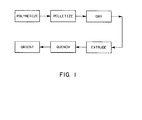
- the resulting polymers are then prepared to be extruded into pipe.
- the resulting polymers are pelletized using any extrusion equipment capable of reaching extrusion temperatures, then dried before being extruded into pipe.
- the pelletization is performed using extrusion equipment with a die temperature in the range of from about 280 C to about 340 C.
- the die temperature is in the range of from about 300 C to about 320 C.
- the pellets are dried at about 150°C for about 2 hours before being extruded into pipe.
- the PS/BPS copolymer is extruded into pipe. It is essential that the profile being formed be nearly cylindrical and preferably essentially cylindrical.
- the PS/BPS copolymers are extruded into pipe using any extruders, dies, quenching equipment, and takeoffs suitable for producing the amorphous pipe product of this invention.
- This equipment should be capable of reaching extrusion temperatures in the range of from about 280 C to about 340°C and capable of rapid and uniform quench of the extruded pipe to avoid polymer crystallization.
- the equipment is capable of reaching extrusion temperatures in the range of from about 300 C to about 310°C.
- the pipe is quenched by either water spray from around the die opening or by means of a water bath.
- quenching is done by extruding hot pipe directly from the pipe die into a water bath containing cool water.
- the pulloff rate speed will vary widely depending on the equipment used, pipe diameter, and wall thickness desired. This rate can be between 25 cm/min to 100 cm/min or higher.
- the pipe wall thickness can vary depending on ability of the quench system to cool the pipe to prevent crystallization and on the desired final oriented pipe wall thickness. In general, the amorphous pipe wall thickness will be about 2 mm to about 6 mm.
- a pipe outside diameter will be selected based on available pipe die sizes, die extrusion sizes, and the requirements for the oriented pipe.
- the pipe of the present invention is essentially amorphous.
- the density of the pipe is preferably in the range of from about 1.30 g/cc to about 1.32 g/cc. More preferably, the density is about 1.31-1.32 g/cc.
- additives such as carbon black, antioxidants, u.v. stabilizers or pigments may be present at levels which may effect the density of the pipe while not deletariously affecting pipe formation or orientation.
- the amorphous pipe is then molecularly oriented.
- molecular orientation is meant a preferred arrangement of certain axis or planes of molecules with respect to a given axis or plane. This molecular orientation can result in vastly altered strength, elongation, modulus, impact, and other values.
- the amorphous pipe is oriented by subsequent die extrusion.
- This subsequent die extrusion is performed by any die extrusion equipment capable of drawing or stretching the polymer uniaxially or biaxially at elevated temperatures.
- die extrusion broadly involves a die, including the formation of the pipe precursor for the oriented PS/BPS copolymer pipe of this invention.
- die extrusion is meant a subsequent die shaping in which the copolymer pipe at orientation temperature is stretched radially and/or longitudinally and is distinguished from the general term extrusion". Preferably, it is simultaneously stretched both radially and longitudinally to give biaxial orientation.
- orientation temperature is meant that temperature, on reheating, at which the amorphous pipe will orient. Generally, this temperature is around or above the glass transition temperature (Tg).
- the die extrusion equipment is operated at temperatures in the range of from about 80°C to about 115°C. More preferably, the die extrusion temperature is in the range of from about 85 °C to about 110°C.
- the takeoff rate for the die extrusion equipment is in the range of from about 0.1 cm/minute to about 100 cm/minute.
- the takeoff rate is in the range of from about 0.5 cm/minute to about 50 cm/minute.
- the draw ratios in the longitudinal or machine direction are in the range of from about 1.5X to about 8X.
- they are in the range of from about 2X to about 7X.
- the draw ratios in the hoop or transverse directions are in the range of from about 1.5X to about 4X.
- they are in the range of from about 2X to about 3X.
- no significant amount of crystallization occurs during this die extrusion process.
- the wall thickness of the oriented copolymer pipe of this invention will vary widely depending on the wall thickness of the starting amorphous pipe and on the draw ratios chosen for the orientation, they will generally be from about 0.1 to about 3 mm, preferably 0.2 to 2 mm.
- the amorphous copolymer pipe of this invention is translucent and non-brittle. It can be used for transporting chemicals and slurries at moderate temperatures (below the crystallization temperatures) where good chemical resistance is needed and where it is useful to be able to observe the flow of materials to locate flow problems or plugs.
- the oriented pipe is flexible and can be used as a non-flammable, insulating wrapper or support for electrical wiring. It can be slit after orientation and opened to form an oriented film for use in electrical and electronic applications.
- melt flow (MF) values were determined by the method of ASTM D-1238, condition 3160 C/5 kg modified to use a 5 minute preheat, the value of the polymer melt flow being expressed as g/10 min.
- Density values were determined with a gradient density column and are expressed as g/cc.
- Annealed samples for density determination were prepared by breaking a small piece of the pipe (including the entire cross-section) and annealing it in a forced air oven at 200 C for 15 minutes.
- Differential scanning calorimetry (DSC) values of glass transition temperature (Tg) and crystalline melting point (Tm) peak were determined from premelted and quenched samples on a Perkin-Elmer DSC-2C differential scanning calorimeter equipped with a data station.
- Pipe samples were cut to the desired length and tested as prepared or annealed at 200 C for 30 minutes in a forced air oven. Quick burst pressure values in psig were determined on 48 cm long pipe samples plugged at both ends by increasing the internal pipe pressure until pipe failure occurred or until the maximum pressure (about 1500 psi) of the testing unit was reached.
- 4,4'-Dibromobiphenyl monomer purchased from American Hoechst Corp., was 98.5% pure and the remainder of the monomer was monobromobiphenyl.
- Meta-dichlorobenzene (meta-DCB) was purchased from Standard Chlorine Chemical Co., Inc. and contained 42.8 wt. % meta-DCB, 47.2 wt. % para-DCB, and 7.7 wt. % ortho-DCB.
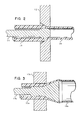
- the die extrusion apparatus comprised an electrically heated die 12A with the same die diameter as the pipe 10A.
- a mandrel 14A was supported inside the pipe 10A and increased in diameter downstream of and immediately after the die diameter.
- the longitudinal (machine) draw was controlled by the speed at which the oriented pipe 16A was pulled from the die 12A.
- the transverse (hoop) draw was controlled by the diameter of the mandrel 14A after the die 12A.
- a heated chamber surrounded the die extrusion apparatus.
- Pipe die extrusion was started by shaping the pipe end to the mandrel size in a heated oil bath. The pipe was pulled at slow speed through the die until some orientation had occurred and then the speed was increased to the desired speed.
- Polymers used in the following examples were polymerized as described here.
- An aqueous sodium hydroxide solution was mixed with an aqueous sodium bisulfide (NaSH) solution, sodium acetate, and NMP. This mixture was heated, dehydrated, and then combined with two or more halogenated aromatics for the polymerization.
- All polymers were prepared with para-dichlorobenzene (p-DCB) and 1,2,4-trichlorobenzene (TCB). In some runs, part of the P-DCB was replaced with other monomers to study the effect of various comonomers.
- p-DCB para-dichlorobenzene
- TCB 1,2,4-trichlorobenzene
- Polymers 5, 6, and 7 were prepared with 4,4'-dibromobiphenyl (6 mole percent of the total p-DCB and 4,4'-dibromobiphenyl charge).
- Polymers 8, 9, and 10 were prepared with meta-dichlorobenzene (m-DCB) (8 mole percent of the m-DCB and p-DCB charge).
- m-DCB meta-dichlorobenzene
- a sufficient amount of the m-DCB/P-DCB monomer mixture was used to give the indicated m-DCB monomer content.
- Each polymerization mixture was heated to about 230 °C and held for about two hours and then heated to about 265 °C and held for about three hours.
- the polymerization mixture was concentrated by partial solvent flashing at about 265 C.
- the concentrated PPS slurry was further flashed at about 240 C, washed with ambient temperature water, and filtered. After the polymer had been slurried with hot (190°C) water and filtered, it was dried to yield polymer 1.
- deionized water was added to the reactor and the contents were cooled to about 100°C and filtered.
- Polymers 2-10 were slurried with ambient deionized water, filtered, slurried twice with hot (175°C) deionized water, and dried.
- the four polymers were pelletized using melt temperatures of about 300-330°C and 325 mesh screens for Polymers 1 and 4, a 200 mesh screen for Polymer 3, and no screens for Polymer 2.
- the pellets were dried at 125-150°C for several hours and extruded into pipe using a 38 mm diameter Davis-Standard extruder equipped with a pipe die.
- the 33 mm outside diameter pipe was extruded using internal air pressure (14-22 psig) and a plug in the pipe open end.
- a water spray from around the die opening was used for cooling pipe from Polymers 1 and 2.
- a water bath was added for pipe from polymers 3 and 4 to improve pipe cooling.
- the pipe samples are described in Table 2.
- Polymer 1 was extruded at a die temperature of about 305°C and a takeoff rate of about 580 mm/min to produce pipe with a wall thickness of about 3 mm.
- a similar pipe produced later under similar conditions had a density of 1.360 g/cc and a density of 1.366 g/cc after annealing at 200 C for 15 minutes.
- the relatively small change in density on annealing and the original opaque pipe appearance indicate that the extruded pipe was already largely crystalline.
- the pipe burst strength was high. Attempts to orient the pipe from Polymer 1 by subsequent die extrusion were unsuccessful.
- Polymer 2 was extruded into pipe with a takeoff speed of about 152 cm/min to produce pipe with a wall thickness of about 1 mm and a density of 1.327 g/cc.
- the density, transparency, and flexibility of the pipe indicate an essentially amorphous pipe.
- This pipe could be easily die extruded at temperatures of about 86-90 C and rates up to about 40 cm/min.
- the die extruded pipe wall thickness was only about 0.2-0.4 mm at longitudinal draw ratios of up to about 1.8X and transverse draw ratios of up to about 2.1X.
- Pipe extrusions from Polymers 3 and 4 were carried out using a water bath about 152 cm long containing cool (about 24 C) water. The hot pipe was extruded directly from the pipe die into the water bath. Pipe from Polymer 3 was extruded using a takeoff speed of 47 cm/minute and had a density of 1.346 g/cc (Table 2) and wall thickness of 3.9 mm. Polymer 4 was extruded with a takeoff speed of 58 cm/min into pipe with a wall thickness of 3 mm and a density of 1.336 g/cc. From their densities and opaque appearances, these pipe samples were appreciably crystalline and would not be suitable for die extrusion.
- Polymers 6 and 7 were pelletized on a 38 mm diameter single screw extruder using a 200 mesh screen in the breaker plate and a die temperature of 316°C. Pellets from Polymers 6 and 7 were dried at 150°C for two hours and extruded into pipe using the extruder and pipe die described in Example I along with the pipe quench bath. Polymer 6 was extruded into pipe with a die temperature of 313°C and 13 psig internal air pressure. Polymer 7 was extruded into pipe with a die temperature of 293 C and 16 psig internal air pressure. In both extrusions a pipe pulloff rate of 58 cm/min. was used and a pipe wall thickness of about 3 mm was obtained.
- Pipe products from Polymers 6 and 7 are described in Table IV.
- Pipe from Polymer 6 had a slightly higher density than pipe from Polymer 7 and had indications of a crystalline region in the center of the pipe cross-section.
- the bath temperature increased to allow traces of crystallization to occur in the center of the pipe wall from slower cooling.
- Annealed pipe from Polymer 7 had a slightly decreased burst strength compared with the as-extruded pipe.
- Polymer 7 pipe was die extruded using the extruder and pipe die described in Example I at die temperatures of 86-110 C and takeoff rates between 0.5 and 42 cm/min. Longitudinal or machine direction draw ratios as high as 6.3X and hoop or transverse draw ratio up to about 2.4X were obtained. Test results on several of the die extruded pipe samples of Polymer 7 are shown in Table 5. A variety of physical properties were obtained depending on the drawing conditions. The die extruded samples had densities of 1.316-1.317 g/cc, indicating that no significant amount of crystallization occurred during the die extrusion process.
- This example illustrates another copolymer made with meta-dichlorobenzene (meta-DCB) and para-dichlorobenzene (para-DCB). These copolymers are outside the scope of the present invention and are not suitable for extrusion into relatively thick, amorphous pipe that can be die extruded.
- Polymers 8, 9 and 10 Three copolymers, Polymers 8, 9 and 10, were prepared using 8 mole percent meta-DCB, based on the total m-DCB plus p-DCB charge, and the level of 1,2,4-trichlorobenzene shown in Table 6.
- the melt flow values for Polymers 8, 9, and 10 ranged from 17 to 84 g/10 min.
- the DSC Tg and Tm values (Table 6) for polymers 8, 9, and 10 are lower than for a PPS similar to Polymer 1 (94 C for Tg and 273 C for Tm).
- Polymers 8, 9, and 10 wore pelletized on a 38 mm diameter single screw extruder using a 200 mesh screen in the breaker plate and die temperatures of 320, 316, and 304°C, respectively.
- Pellets from Polymers 8, 9, and 10 were dried at 150°C for two hours and extruded into pipe using the extruder and pipe die described in Example I along with the pipe water bath.
- Pipe was extruded from Polymers 8, 9, and 10 using 16 psig internal air pressure and die temperatures of 310, 299, and 304°C, respectively. In all extrusions, a takeoff rate of 58 cm/min. was used and a pipe wall thickness of about 3 mm was obtained.
- the pipe products from Polymers 8, 9, and 10 are described in Table 7. Although the pipe samples as extruded have nearly the same density (1.329-1.331 g/cc), pipe from Polymer 8 had indications of crystallinity in the center of the pipe wall, whereas the other two pipe samples from Polymers 9 and 10 had clear cross-sections. Annealed samples of the pipe from Polymers 8, 9 and 10 had about the same density (1.361-1.362 g/cc) and exhibited lower burst strengths than the original pipe samples from Polymers 8, 9 and 10. Attempts to die extrude the pipe products of this example were unsuccessful due to pipe splitting in the machine direction.
- phenylene sulfide/biphenylene sulfide copolymers are suitable for the production of extruded pipe which is non-brittle and is more flexible and ductile than pipe extruded from other arylene sulfide homopolymers and copolymers.
Landscapes
- Engineering & Computer Science (AREA)
- Chemical & Material Sciences (AREA)
- Mechanical Engineering (AREA)
- General Engineering & Computer Science (AREA)
- Organic Chemistry (AREA)
- Chemical Kinetics & Catalysis (AREA)
- Medicinal Chemistry (AREA)
- Polymers & Plastics (AREA)
- Health & Medical Sciences (AREA)
- Physics & Mathematics (AREA)
- Thermal Sciences (AREA)
- Manufacturing & Machinery (AREA)
- Composite Materials (AREA)
- Extrusion Moulding Of Plastics Or The Like (AREA)
- Shaping By String And By Release Of Stress In Plastics And The Like (AREA)
- Polymers With Sulfur, Phosphorus Or Metals In The Main Chain (AREA)
Applications Claiming Priority (2)
| Application Number | Priority Date | Filing Date | Title |
|---|---|---|---|
| US07/556,685 US5151235A (en) | 1990-07-23 | 1990-07-23 | Process of making phenylene sulfide/biphenylene sulfide copolymer pipe |
| US556685 | 1990-07-23 |
Publications (2)
| Publication Number | Publication Date |
|---|---|
| EP0468417A2 true EP0468417A2 (fr) | 1992-01-29 |
| EP0468417A3 EP0468417A3 (en) | 1992-05-20 |
Family
ID=24222417
Family Applications (1)
| Application Number | Title | Priority Date | Filing Date |
|---|---|---|---|
| EP19910112261 Withdrawn EP0468417A3 (en) | 1990-07-23 | 1991-07-22 | Phenylene sulfide/biphenylene sulfide copolymer pipe |
Country Status (4)
| Country | Link |
|---|---|
| US (2) | US5151235A (fr) |
| EP (1) | EP0468417A3 (fr) |
| JP (1) | JPH04226736A (fr) |
| KR (1) | KR920002670A (fr) |
Cited By (3)
| Publication number | Priority date | Publication date | Assignee | Title |
|---|---|---|---|---|
| WO1997010096A1 (fr) * | 1995-09-15 | 1997-03-20 | Vinidex Tubemakers Pty. Limited | Etirement biaxial de tubes en plastique |
| FR2753649A1 (fr) * | 1996-09-26 | 1998-03-27 | Alphacan Sa | Procede et installation de traitement de tubes en matiere plastique avec etirage bi-axial |
| CN104530457A (zh) * | 2014-12-22 | 2015-04-22 | 江苏中冶能源设备制造有限公司 | 一种抗co2腐蚀的石油开采用油套管 |
Families Citing this family (5)
| Publication number | Priority date | Publication date | Assignee | Title |
|---|---|---|---|---|
| US5151235A (en) * | 1990-07-23 | 1992-09-29 | Phillips Petroleum Company | Process of making phenylene sulfide/biphenylene sulfide copolymer pipe |
| DE69613298T2 (de) * | 1995-10-06 | 2001-09-20 | Teiyo Ltd., Kure | Wärmeschrumpfschlauch, Verfahren zu seiner Herstellung sowie seine Anwendung |
| US20040084801A1 (en) * | 2002-11-04 | 2004-05-06 | Floyd Gregory S. | Method of manufacturing risers for shelving units |
| JP4060242B2 (ja) * | 2003-06-24 | 2008-03-12 | ニチハ株式会社 | 木質成形体の製造方法 |
| US20090000168A1 (en) * | 2007-06-29 | 2009-01-01 | Cambridge Canvas Centre Ltd. | Printable banners with thin-grommet construction |
Family Cites Families (11)
| Publication number | Priority date | Publication date | Assignee | Title |
|---|---|---|---|---|
| US3354129A (en) * | 1963-11-27 | 1967-11-21 | Phillips Petroleum Co | Production of polymers from aromatic compounds |
| US3966688A (en) * | 1974-12-03 | 1976-06-29 | Phillips Petroleum Company | Arylene sulfide copolymer production |
| FR2427350B1 (fr) * | 1978-05-30 | 1986-08-14 | Asahi Glass Co Ltd | Poly(sulfure de phenylene) moulable |
| US4490522A (en) * | 1982-08-04 | 1984-12-25 | Dainippon Ink & Chemicals, Inc. | Process for producing polyphenylene sulfide |
| JPH0655400B2 (ja) * | 1985-10-17 | 1994-07-27 | 呉羽化学工業株式会社 | 管状押出成形物およびその製造法 |
| JPH0649761B2 (ja) * | 1985-12-18 | 1994-06-29 | 東ソー株式会社 | ポリフエニレンサルフアイドの製造方法 |
| JPS62242517A (ja) * | 1986-04-14 | 1987-10-23 | Kureha Chem Ind Co Ltd | ポリパラフェニレンスルフィド2軸延伸フィルム及びその製造方法 |
| JP2505454B2 (ja) * | 1987-04-17 | 1996-06-12 | 呉羽化学工業株式会社 | ポリアリ−レンチオエ−テル組成物 |
| US5268451A (en) * | 1988-05-26 | 1993-12-07 | Kureha Kagaku Kogyo Kabushiki Kaisha | Process for the preparation of cross-linked polyarylene sulfide |
| DE3942416A1 (de) * | 1989-09-14 | 1991-03-28 | Bayer Ag | Hochmolekulare copolyarylensulfide und ihre verwendungen |
| US5151235A (en) * | 1990-07-23 | 1992-09-29 | Phillips Petroleum Company | Process of making phenylene sulfide/biphenylene sulfide copolymer pipe |
-
1990
- 1990-07-23 US US07/556,685 patent/US5151235A/en not_active Expired - Fee Related
-
1991
- 1991-07-16 KR KR1019910012133A patent/KR920002670A/ko not_active Withdrawn
- 1991-07-18 JP JP3178358A patent/JPH04226736A/ja active Pending
- 1991-07-22 EP EP19910112261 patent/EP0468417A3/en not_active Withdrawn
-
1992
- 1992-06-30 US US07/906,639 patent/US5573823A/en not_active Expired - Fee Related
Cited By (6)
| Publication number | Priority date | Publication date | Assignee | Title |
|---|---|---|---|---|
| WO1997010096A1 (fr) * | 1995-09-15 | 1997-03-20 | Vinidex Tubemakers Pty. Limited | Etirement biaxial de tubes en plastique |
| CN1064588C (zh) * | 1995-09-15 | 2001-04-18 | 温尼德斯制管商有限公司 | 塑料管的双轴向拉伸 |
| FR2753649A1 (fr) * | 1996-09-26 | 1998-03-27 | Alphacan Sa | Procede et installation de traitement de tubes en matiere plastique avec etirage bi-axial |
| WO1998013182A1 (fr) * | 1996-09-26 | 1998-04-02 | Alphacan | Procede et installation de traitement de tubes en matiere plastique avec etirage bi-axial |
| US6358463B1 (en) | 1996-09-26 | 2002-03-19 | Alphacan | Method and installation for treating plastic tubes with bi-axial drawing |
| CN104530457A (zh) * | 2014-12-22 | 2015-04-22 | 江苏中冶能源设备制造有限公司 | 一种抗co2腐蚀的石油开采用油套管 |
Also Published As
| Publication number | Publication date |
|---|---|
| JPH04226736A (ja) | 1992-08-17 |
| US5573823A (en) | 1996-11-12 |
| EP0468417A3 (en) | 1992-05-20 |
| US5151235A (en) | 1992-09-29 |
| KR920002670A (ko) | 1992-02-28 |
Similar Documents
| Publication | Publication Date | Title |
|---|---|---|
| US4362844A (en) | Biaxially stretched polypropylene-based plastic products, and process for making such products | |
| US4659789A (en) | Phenylene sulfide resin compositions | |
| EP0151343B1 (fr) | Polyoléfines orientées | |
| Aharoni et al. | Crystalline transitions and the solid‐state extrusion of polymers | |
| US5151235A (en) | Process of making phenylene sulfide/biphenylene sulfide copolymer pipe | |
| US4305990A (en) | Thermoplastic rubber film | |
| JPH07102413A (ja) | ポリテトラフルオロエチレン糸状物 | |
| AU616557B2 (en) | Process for the preparation of fibers of stereoregular polystyrene | |
| US4519969A (en) | Stretched fluorine type film and method for manufacture thereof | |
| KR910005206B1 (ko) | 폴리부틸렌 테레프탈레이트 수지 필름을 제조하는 방법 | |
| US4173612A (en) | Extrusion process for thermoplastic rubber film | |
| JPS61215715A (ja) | 高物性ポリアリ−レンチオエ−テル繊維およびその製造法 | |
| EP0358135B1 (fr) | Composition de sulfure de polyarylène | |
| JP2538634B2 (ja) | 2軸配向ポリ−p−フェニレンスルフィドフィルム | |
| JPS63245464A (ja) | ポリ−p−フエニレンスルフイド樹脂組成物 | |
| US4385022A (en) | Process for preparing biaxially oriented films of butene-1 homopolymer and copolymers | |
| US5256743A (en) | Poly(arylene thioether) resin compositions and extruded products thereof | |
| EP0158488B1 (fr) | Feuille de résine de fluorure de vinylidène, procédé pour sa fabrication et feuille métallisée à partir de celle-ci | |
| JPH0250817A (ja) | プラスチック連続体の製造方法および装置 | |
| JPH0253909A (ja) | 立体規則性ポリスチレンの高強度繊維 | |
| CA2040368A1 (fr) | Tuyau en copolymere de sulfure de phenylene et de sulfure de biphenylene | |
| Appelt et al. | Ultradrawing of polystyrene by solid‐state coextrusion: Shear‐induced crystallization in isotactic polystyrene | |
| US4551514A (en) | Biaxially oriented films of butene-1 homopolymer and copolymers | |
| JPH089667B2 (ja) | 高引張強さおよびモジュラスおよび低クリープのポリエチレン製品の製造方法ならびにかくして得られた製品 | |
| JPS6330560A (ja) | ポリフエニレンスルフイド樹脂組成物 |
Legal Events
| Date | Code | Title | Description |
|---|---|---|---|
| PUAI | Public reference made under article 153(3) epc to a published international application that has entered the european phase |
Free format text: ORIGINAL CODE: 0009012 |
|
| AK | Designated contracting states |
Kind code of ref document: A2 Designated state(s): AT BE CH DE ES FR GB IT LI NL |
|
| PUAL | Search report despatched |
Free format text: ORIGINAL CODE: 0009013 |
|
| AK | Designated contracting states |
Kind code of ref document: A3 Designated state(s): AT BE CH DE ES FR GB IT LI NL |
|
| 17P | Request for examination filed |
Effective date: 19920918 |
|
| 17Q | First examination report despatched |
Effective date: 19950130 |
|
| STAA | Information on the status of an ep patent application or granted ep patent |
Free format text: STATUS: THE APPLICATION IS DEEMED TO BE WITHDRAWN |
|
| 18D | Application deemed to be withdrawn |
Effective date: 19950613 |