EP0468467B1 - Procédé pour la production des pièces métalliques de précision par moulage de poudre - Google Patents
Procédé pour la production des pièces métalliques de précision par moulage de poudre Download PDFInfo
- Publication number
- EP0468467B1 EP0468467B1 EP91112358A EP91112358A EP0468467B1 EP 0468467 B1 EP0468467 B1 EP 0468467B1 EP 91112358 A EP91112358 A EP 91112358A EP 91112358 A EP91112358 A EP 91112358A EP 0468467 B1 EP0468467 B1 EP 0468467B1
- Authority
- EP
- European Patent Office
- Prior art keywords
- iron
- powder
- molded body
- organic binder
- alloy powder
- Prior art date
- Legal status (The legal status is an assumption and is not a legal conclusion. Google has not performed a legal analysis and makes no representation as to the accuracy of the status listed.)
- Expired - Lifetime
Links
- 239000000843 powder Substances 0.000 title claims description 100
- 238000000034 method Methods 0.000 title claims description 85
- 239000002184 metal Substances 0.000 title claims description 57
- 229910052751 metal Inorganic materials 0.000 title claims description 57
- 238000000465 moulding Methods 0.000 title claims description 15
- XEEYBQQBJWHFJM-UHFFFAOYSA-N Iron Chemical group [Fe] XEEYBQQBJWHFJM-UHFFFAOYSA-N 0.000 claims description 66
- 239000011230 binding agent Substances 0.000 claims description 38
- QVGXLLKOCUKJST-UHFFFAOYSA-N atomic oxygen Chemical compound [O] QVGXLLKOCUKJST-UHFFFAOYSA-N 0.000 claims description 37
- 239000001301 oxygen Substances 0.000 claims description 37
- 229910052760 oxygen Inorganic materials 0.000 claims description 37
- 239000002245 particle Substances 0.000 claims description 31
- 238000005245 sintering Methods 0.000 claims description 28
- UFHFLCQGNIYNRP-UHFFFAOYSA-N Hydrogen Chemical compound [H][H] UFHFLCQGNIYNRP-UHFFFAOYSA-N 0.000 claims description 22
- 229910052742 iron Inorganic materials 0.000 claims description 22
- 239000001257 hydrogen Substances 0.000 claims description 20
- 229910052739 hydrogen Inorganic materials 0.000 claims description 20
- 239000000203 mixture Substances 0.000 claims description 16
- 229910000640 Fe alloy Chemical group 0.000 claims description 13
- IJGRMHOSHXDMSA-UHFFFAOYSA-N Atomic nitrogen Chemical compound N#N IJGRMHOSHXDMSA-UHFFFAOYSA-N 0.000 claims description 7
- 238000010438 heat treatment Methods 0.000 claims description 6
- 238000009826 distribution Methods 0.000 claims description 5
- 230000008602 contraction Effects 0.000 claims description 4
- 239000008240 homogeneous mixture Substances 0.000 claims description 4
- 229910052757 nitrogen Inorganic materials 0.000 claims description 3
- 239000012798 spherical particle Substances 0.000 claims description 3
- XLYOFNOQVPJJNP-UHFFFAOYSA-N water Substances O XLYOFNOQVPJJNP-UHFFFAOYSA-N 0.000 claims description 3
- 238000001746 injection moulding Methods 0.000 description 13
- 238000002156 mixing Methods 0.000 description 9
- 230000000052 comparative effect Effects 0.000 description 7
- 238000004519 manufacturing process Methods 0.000 description 6
- 239000000047 product Substances 0.000 description 6
- 239000006185 dispersion Substances 0.000 description 5
- 238000002347 injection Methods 0.000 description 5
- 239000007924 injection Substances 0.000 description 5
- RYGMFSIKBFXOCR-UHFFFAOYSA-N Copper Chemical compound [Cu] RYGMFSIKBFXOCR-UHFFFAOYSA-N 0.000 description 4
- 229910052802 copper Inorganic materials 0.000 description 4
- 239000010949 copper Substances 0.000 description 4
- 238000010586 diagram Methods 0.000 description 4
- DOIRQSBPFJWKBE-UHFFFAOYSA-N dibutyl phthalate Chemical compound CCCCOC(=O)C1=CC=CC=C1C(=O)OCCCC DOIRQSBPFJWKBE-UHFFFAOYSA-N 0.000 description 4
- 230000001788 irregular Effects 0.000 description 4
- 239000000463 material Substances 0.000 description 4
- 238000012545 processing Methods 0.000 description 4
- 239000002994 raw material Substances 0.000 description 4
- 229920005989 resin Polymers 0.000 description 4
- 239000011347 resin Substances 0.000 description 4
- 239000011265 semifinished product Substances 0.000 description 4
- OKTJSMMVPCPJKN-UHFFFAOYSA-N Carbon Chemical compound [C] OKTJSMMVPCPJKN-UHFFFAOYSA-N 0.000 description 3
- 239000004793 Polystyrene Substances 0.000 description 3
- 229910052799 carbon Inorganic materials 0.000 description 3
- 239000000919 ceramic Substances 0.000 description 3
- 239000005038 ethylene vinyl acetate Substances 0.000 description 3
- 229920001490 poly(butyl methacrylate) polymer Polymers 0.000 description 3
- 229920001200 poly(ethylene-vinyl acetate) Polymers 0.000 description 3
- 229920002223 polystyrene Polymers 0.000 description 3
- 238000011946 reduction process Methods 0.000 description 3
- 239000010935 stainless steel Substances 0.000 description 3
- 229910001220 stainless steel Inorganic materials 0.000 description 3
- 229910000531 Co alloy Inorganic materials 0.000 description 2
- PXHVJJICTQNCMI-UHFFFAOYSA-N Nickel Chemical compound [Ni] PXHVJJICTQNCMI-UHFFFAOYSA-N 0.000 description 2
- 238000005054 agglomeration Methods 0.000 description 2
- 230000002776 aggregation Effects 0.000 description 2
- 238000001354 calcination Methods 0.000 description 2
- 125000002915 carbonyl group Chemical group [*:2]C([*:1])=O 0.000 description 2
- 238000005260 corrosion Methods 0.000 description 2
- 230000007797 corrosion Effects 0.000 description 2
- 238000009689 gas atomisation Methods 0.000 description 2
- 150000002736 metal compounds Chemical class 0.000 description 2
- 238000007747 plating Methods 0.000 description 2
- -1 polyethylene Polymers 0.000 description 2
- 238000003825 pressing Methods 0.000 description 2
- 230000003746 surface roughness Effects 0.000 description 2
- 238000009692 water atomization Methods 0.000 description 2
- 239000001993 wax Substances 0.000 description 2
- 229910000952 Be alloy Inorganic materials 0.000 description 1
- 229910001369 Brass Inorganic materials 0.000 description 1
- 239000005749 Copper compound Substances 0.000 description 1
- PMVSDNDAUGGCCE-TYYBGVCCSA-L Ferrous fumarate Chemical compound [Fe+2].[O-]C(=O)\C=C\C([O-])=O PMVSDNDAUGGCCE-TYYBGVCCSA-L 0.000 description 1
- 239000004698 Polyethylene Substances 0.000 description 1
- 239000004743 Polypropylene Substances 0.000 description 1
- 238000000137 annealing Methods 0.000 description 1
- FFBHFFJDDLITSX-UHFFFAOYSA-N benzyl N-[2-hydroxy-4-(3-oxomorpholin-4-yl)phenyl]carbamate Chemical compound OC1=C(NC(=O)OCC2=CC=CC=C2)C=CC(=C1)N1CCOCC1=O FFBHFFJDDLITSX-UHFFFAOYSA-N 0.000 description 1
- 239000010951 brass Substances 0.000 description 1
- 239000004203 carnauba wax Substances 0.000 description 1
- 235000013869 carnauba wax Nutrition 0.000 description 1
- 238000009833 condensation Methods 0.000 description 1
- 230000005494 condensation Effects 0.000 description 1
- 238000007796 conventional method Methods 0.000 description 1
- 238000009770 conventional sintering Methods 0.000 description 1
- 150000001880 copper compounds Chemical class 0.000 description 1
- 238000005520 cutting process Methods 0.000 description 1
- 238000000354 decomposition reaction Methods 0.000 description 1
- 230000001419 dependent effect Effects 0.000 description 1
- 238000011161 development Methods 0.000 description 1
- 229910001873 dinitrogen Inorganic materials 0.000 description 1
- 238000005868 electrolysis reaction Methods 0.000 description 1
- 238000000921 elemental analysis Methods 0.000 description 1
- 229920006351 engineering plastic Polymers 0.000 description 1
- 238000000227 grinding Methods 0.000 description 1
- 230000001939 inductive effect Effects 0.000 description 1
- 239000012770 industrial material Substances 0.000 description 1
- 238000011835 investigation Methods 0.000 description 1
- 238000004898 kneading Methods 0.000 description 1
- 239000012803 melt mixture Substances 0.000 description 1
- 238000002844 melting Methods 0.000 description 1
- 230000008018 melting Effects 0.000 description 1
- 239000002923 metal particle Substances 0.000 description 1
- 239000012188 paraffin wax Substances 0.000 description 1
- 239000008188 pellet Substances 0.000 description 1
- 229920000573 polyethylene Polymers 0.000 description 1
- 229920001155 polypropylene Polymers 0.000 description 1
- 238000009877 rendering Methods 0.000 description 1
- 238000005204 segregation Methods 0.000 description 1
- 239000007921 spray Substances 0.000 description 1
- 238000012360 testing method Methods 0.000 description 1
- 238000005979 thermal decomposition reaction Methods 0.000 description 1
- 238000011282 treatment Methods 0.000 description 1
Images




Classifications
-
- B—PERFORMING OPERATIONS; TRANSPORTING
- B22—CASTING; POWDER METALLURGY
- B22F—WORKING METALLIC POWDER; MANUFACTURE OF ARTICLES FROM METALLIC POWDER; MAKING METALLIC POWDER; APPARATUS OR DEVICES SPECIALLY ADAPTED FOR METALLIC POWDER
- B22F3/00—Manufacture of workpieces or articles from metallic powder characterised by the manner of compacting or sintering; Apparatus specially adapted therefor ; Presses and furnaces
- B22F3/22—Manufacture of workpieces or articles from metallic powder characterised by the manner of compacting or sintering; Apparatus specially adapted therefor ; Presses and furnaces for producing castings from a slip
- B22F3/225—Manufacture of workpieces or articles from metallic powder characterised by the manner of compacting or sintering; Apparatus specially adapted therefor ; Presses and furnaces for producing castings from a slip by injection molding
-
- B—PERFORMING OPERATIONS; TRANSPORTING
- B22—CASTING; POWDER METALLURGY
- B22F—WORKING METALLIC POWDER; MANUFACTURE OF ARTICLES FROM METALLIC POWDER; MAKING METALLIC POWDER; APPARATUS OR DEVICES SPECIALLY ADAPTED FOR METALLIC POWDER
- B22F3/00—Manufacture of workpieces or articles from metallic powder characterised by the manner of compacting or sintering; Apparatus specially adapted therefor ; Presses and furnaces
- B22F3/001—Starting from powder comprising reducible metal compounds
-
- B—PERFORMING OPERATIONS; TRANSPORTING
- B22—CASTING; POWDER METALLURGY
- B22F—WORKING METALLIC POWDER; MANUFACTURE OF ARTICLES FROM METALLIC POWDER; MAKING METALLIC POWDER; APPARATUS OR DEVICES SPECIALLY ADAPTED FOR METALLIC POWDER
- B22F3/00—Manufacture of workpieces or articles from metallic powder characterised by the manner of compacting or sintering; Apparatus specially adapted therefor ; Presses and furnaces
- B22F3/10—Sintering only
- B22F3/1017—Multiple heating or additional steps
-
- B—PERFORMING OPERATIONS; TRANSPORTING
- B22—CASTING; POWDER METALLURGY
- B22F—WORKING METALLIC POWDER; MANUFACTURE OF ARTICLES FROM METALLIC POWDER; MAKING METALLIC POWDER; APPARATUS OR DEVICES SPECIALLY ADAPTED FOR METALLIC POWDER
- B22F3/00—Manufacture of workpieces or articles from metallic powder characterised by the manner of compacting or sintering; Apparatus specially adapted therefor ; Presses and furnaces
- B22F3/22—Manufacture of workpieces or articles from metallic powder characterised by the manner of compacting or sintering; Apparatus specially adapted therefor ; Presses and furnaces for producing castings from a slip
-
- B—PERFORMING OPERATIONS; TRANSPORTING
- B22—CASTING; POWDER METALLURGY
- B22F—WORKING METALLIC POWDER; MANUFACTURE OF ARTICLES FROM METALLIC POWDER; MAKING METALLIC POWDER; APPARATUS OR DEVICES SPECIALLY ADAPTED FOR METALLIC POWDER
- B22F2998/00—Supplementary information concerning processes or compositions relating to powder metallurgy
Definitions
- This invention relates to a process for producing a precision metal part, such as a part of a watch, being a sintered body having a high density near the true density.
- FR-A-2 370 104 discloses a process for manufacturing iron based powder to be used for powder metallurgical manufacturing of precision components having good size accuracy and high strength, comprising providing an iron powder of a suitable particle size range, providing a copper or a reducible copper compound powder also of a suitable particle size range, mixing said powder to give the desired composition of iron and copper in the mixture, annealing the powder mixture in the reducing atmosphere at a temperature between 700°C and 950°C for a period of between 15 minutes and ten hours, so that the copper adheres to the iron particle without subsequent segregation therefrom, making a powder from the annealed mixture, and then mixing said annealed mixture powder with pure iron powder to provide a final desired iron based powder mixture composition including an intended copper content.
- the iron powder is prepared from iron sponge so as to have a large specific surface in order to provide for an effective adhesion, which naturally contains a large content of oxygen. It is furthermore outlined to reduce the oxygen by placing the powder under reducing atmosphere and points out that less oxygen content is more appropriate.
- the mixing of pure iron powder is conducted in order not to adjust the oxygen content, but to adjust the cup content.
- patent abstracts of Japan, volume 14, Number 247 (M-978) (4190), 1990 describes a method of forming a product from a metal powder of a known oxygen content and a binder, forming an initial body by molding, and removing the binder during heating. More precisely, the cited prior art discloses a debinding process and a method of producing a part by the injection molding method of a metal powder which comprises using stainless steel powder obtained by the atomising method as the powder, conducting the injection molding after kneading with an organic binder, and debinding the molded body obtained, the debinding process which comprises using a fixed amount of carbon according to the amount of oxygen contained in the powder by controlling the holding temperature and holding time at atmospheric pressure without streaming air compulsorily.
- the part as described is made of stainless steel, the stainless steel powder obtained is not reduced prior to mixing with the organic binder and debinding is conducted in air so as to release a sixth amount of carbon according to the amount of oxygen contained in the powder.
- the carbon is produced by the decomposition of the organic binders.
- the precision part of the present invention is made of iron or an iron alloy, the iron or iron alloy powder is reduced prior to mixing with the organic binder and the organic binder is removed in an inert atmosphere.
- some methods comprising imparting plasticity to metal powder or ceramic powder by adding a suitable resin, molding it by the injection molding process, removing the resin in the molded body through thermal decomposition, and then sintering to obtain a desired metal or ceramic powder injection molded part (e.g., Japanese Patent KOKOKU No. 51-29170, Japanese KOKAI Nos. 55-113510, 55-113511, etc.).
- the above methods are noted as to remove the organic binder being a resin from the molded body in a short period without inducing crack, blister and deformation as well as not to generate crack in the molded body during the injection molding.
- the oxygen content of metal powder increases by rendering the mean particle size smaller.
- the mean particle size tends to increase due to the condensationor the agglomeration of particles.
- the purity of metal powder is regarded as important, and low oxygen content metal powder is used which is not spherical but irregular.
- a conventional gear illustrated in Figure 6 is a minute wheel 21 which transmits the rotation of the center wheel moving the minute hand to the hour wheel moving the watch with deceleration, and consists of two parts, i.e. a minute gear 22 and a minute pinion 23.
- the minute gear 22 has a hollow disc shape having a teeth form engaging the pinion of the central wheel on the circumference
- the minute pinion 23 has a teeth form on the circumference engaging the teeth of the hour wheel on the reverse side to the above portion engaging the minute gear 22.
- the conventional minute gear is produced according to the flow diagram shown in Figure 7. In the figure, the left side flow indicates the process of producing the minute gear, and the right side flow indicates the process of producing the minute pinion.
- a strip material made of brass (hereinafter referred to as BS) (Process A) is punched into disc-shaped (process B). Several pieces of the disc are superposed, and milled to form a gear (process C).
- an iron bar material (process D) is pressed (process E), carburized (process F), hardened (process G), and then tempered (process H). The bar material is cut into a desired form (process I).
- barrel glazing (process J) and plating (process K) are conducted to complete the minute pinion 23.
- the minute pinion 23 is incorporated into the minute gear (process L) to complete the minute wheel 21.
- the above conventional process has various problems, such as many processing processes reuiring a long time and many processing machines. Moreover, assembling of plural parts is also necessary which causes assembling troubles. Accordingly, to produce a more complex part or a smaller part of watches is difficult by the above manufacturing process.
- An object of the invention is to provide a process capable of producing a precision metal part of a sintered body by the powder molding having a density near the true density with a high dimentional accuracy.
- Another object of the invention is to provide a process capable of producing a precision metal part of a sintered body by the powder molding at a low sintering temperature.
- Another object of the invention is to provide a process capable of producing a part of a watch in a simple process with a high reliability.
- Still another object of the invention is to provide a process capable of producing a part of a watch having a complex form or a small size with a high dimensional accuracy in a simple process.
- the present invention provides a process for producing a precision iron or iron alloy part of a sintered body having a density near true density formed by powder molding, said process comprising the steps of forming a homogeneous mixture consisting essentially of an iron or iron alloy powder having an oxygen content of 0.5 to 6 wt. % and hydrogen reduction loss, which is the loss in weight in the case of heating the metal powder in a hydrogen reducing atmosphere and includes nitrogen, absorbed water and the like as well as oxygen, of 1 to 7 wt.
- % by controlling the reduction of the iron or iron alloy powder, and an organic binder, forming the mixture into a molded body having a prescribed form, removing the organic binder from the molded body in an inert atmosphere, reducing said iron or iron alloy powder contained in the molded body to remove oxygen therefrom and form a reduced molded body and sintering the reduced molded body.
- Figure 1 is a graph indicating a correlation between the relative density of sintered body and the sintering temperature obtained in an example of the invention in comparison with a comparative example.
- Figure 2 is a bar graph indicating a dispersion of the outside diameter of 1000 sintered bodies produced in a repeated production test in an example of the invention
- Figure 3 is a bar graph of a comparative example.
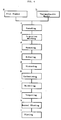
- Figure 4 is a flow diagram for producing a minute wheel employed in an example of the invention.
- Figure 5 is a sectional view of a minute wheel produced in an example of the invention
- Figure 6 a sectional view of a conventional minute wheel.
- Figure 7 is a flow diagram of a conventional process for producing a minute wheel.
- Metal powders used for the powder molding are produced by the mechanical grinding method, the reduction method, the electrolysis method, the carbonyl method, the gas atomizing method, the water atomizing method or the like.
- the metal powders produced by the gas atomizing method, the water atomizing method are spherical.
- actual metal particles used in the powder molding are condensed or agglomerated, and they are not spherical on the appearance.
- Inco type 123 nickel powder particles shown in Example 1 of Japanese Patent KOKAI No. 57-16103 are substantially not spheres but spike-form agglomerates. That is, since the oxygen content is less than 0.15 wt.
- the particle surface of the metal powder is active, and respective unit particles are condensed or agglomerated. It is difficult to stabilize the flowability and the dimentional accuracy of the sintered body by using the above powder and to obtain a sintered body having a density near the true density by the powder molding.
- the metal compound composed of metal and oxygen shown in Japanese Patent KOKAI No. 58-153702 since the oxygen content is great and the oxygen also exists on the inside of the metal compound powder, the reduction prior to sintering takes a lot of time. Moreover, it is difficult to obtain a sintered body having a density near the true density by the powder molding.
- the metal powder composed of spherical particles without condensation and agglomeration is obtained by using a metal powder composed of spherical particles as the unit particles by using the metal powder of which the oxygen content and the hydrogen reduction loss are controlled.
- the metal powder used as a raw material of the invention has an oxygen content of 0.5 wt. %-6 wt. %, preferably 1 wt. %-3 wt. %, and a hydrogen reduction loss of 1 wt. %-7 wt. %, preferably 2 wt. %-3 wt. %.
- the oxygen content is a value of elemental analysis, and indicates the total oxygen content of the metal powder.
- the hydrogen reduction loss is the loss in weight in the case of heating the metal powder in a hydrogen reducing atmosphere, and includes nitrogen adsorbed water and the like as well as oxygen.
- the metal powder is a simplex composed of uniform spheres having a uniform particle distribution.
- the metal may be alloy, and the metal powder may be a plurality of metal kinds.
- the mean particle size of the metal powder is not more than 10 ⁇ m, usually 10 ⁇ m-0.1 ⁇ m, preferably not more than 3 ⁇ m.
- the metal powder can be produced through a method of producing spherical metal powder wherein the reduction amount is controlled.
- the organic binder may be a known one, and more than 90 wt. % of the organic binder is removed under the sintering temperature, preferably calcining temperature.
- the organic binder can be selected from ethylene-vinyl acetate copolymer, polyethylene, atactic polypropylene, polystyrene, polybutyl methacrylate, paraffin wax, carnauba wax, etc.
- the mixing of the metal powder and the organic binder may be conducted according to a known method.
- the metal powder and the organic binder are mixed and kneaded by a pressure type kneader in a melted state to obtain a homogeneous mixture efficiently, and the mixture has a constant flowability, weight and density.
- the mixture is molded into a prescribed form by a known method such as using a injection moldling machine. It is possible to conduct a stable molding by using a homogeneous mixture of the metal powder which is a simplex composed of uniform particle distrubtion and the organic binder.
- the organic binder is removed from the molded body by a known method.
- the removal of the organic binder is preferably more than 90 wt. %, and more than 95 wt. % is particularly preferred.
- the atmosphere for the removal of the organic binder is preferably inert atmosphere. However, it may be hydrogen atmosphere or a combination of inert atmosphere with hydrogen atmosphere.
- the metal powder contained in the molded body is reduced under the sintering temperature, preferably under the calcining temperature in a reducing atmosphere oven.
- more than 90 wt. % of the organic binder covering the surface of the metal powder is removed to increase the voil content of the molded body.
- the surface of the metal powder irrespective of located on the surface or on the inside, is exposed substantially to the reducing atmosphere, and to conduct positive reduction is possible.
- the metal powder becomes substantially pure metal powder.
- the reduction process may be combined with the removal process of the organic binder.
- the sintering is conducted at a prescribed temperature under a prescribed atmosphere according to the metal powder.
- the sintering temperature can be lower than that in the conventional process by 1300°C or more.
- the sintered body thus produced is excellent in dimensional accuracy and has a density near the true density, in the range of 99.0 %-99.9 %, particularly 99.5 %-99.9 % of the true density.
- the surface maybe hardened for improving the surface hardness and plated for improving the corrosion resistance.
- the flowability in the molding process is stable, and a sintered body near the true density is easily obtained.
- the dimentioanl accuracy of the sintered body is high.
- the sintering temperature can be lowered resulting to reduce the manufacturing cost.
- the mixture of the metal powder and the organic binder is excellent in injection moldability, two or three parts can be integrated, and a part having a complex form can easily be produced.
- Utilizing the great contraction rate, i.e. 15-20 %, of the powder injection molding small parts which is difficult to be processed by the conventional process can be produced accurately, easily and inexpensively.
- the shortage of the strength due to the miniaturization may be compensated by changing the raw material.
- a precision metal part can be produced stably in a high density and a high dimensional accuracy.
- the metal powder used was simplex iron powder composed of uniform spheres having a uniform particle distribution, a powder density of 7.604 g/cm 3 and a mean patticle size of 1.34 ⁇ m of which the oxygen content was controlled to 0.7 wt. % and the hydrogen reduction loss was controlled to 2.62 wt. % (at 1000°C for 30 min.).
- the organic binder used was a mixture of ethylene-vinyl acetate copolymer, polybutyl methacrylate, polystyrene, wax and dibutyl phthalate.
- the meltmixture was pelletized.
- the pellets were molded into a cylindrical body having a size of 10 mm in diameter and 2 mm in thickness by an injection molding machine at a nozzle temperature of 150°C, an injection pressure of 1 t/cm 2 and a mold temperature of 30°C.
- the molded body was heated from room temperature to 450°C taking 8 hours according to a prescribed temperature rise program to remove the organic binder. The removal of the organic binder was 95 %.
- the surface of the molded body was obserbed after the removal of the organic binder, and no crack, blister nor deformation was found.
- the molded body was sintered.
- the molded body was heated from room temperature to 600°C taking 1 hour in a hydrogen-reducing atmosphere to remove the residual organic binder completely as well as to reduce the iron powder.
- the temperature was elevated from 600°C to 1300°C taking one hour, and the iron powder was reduced to substantially pure iron at a temperature lower than the sintering temperature during the temperature rise.
- the molded body was sintered at 1400°C for 3 hours.
- the relative density, i.e. the ratio to the theoretical density, of the sintered body was 99.5 % which was much higher than those of conventional products.
- the reproducibility was investigated using a flow tester, and the flow value was stable without a great deflection.
- the metal powder used was a conventional iron powder composed of irregular particles containing sintered powder and agglomerates having a powder density of 7.824 g/cm 3 and a mean particle size of 4.40 ⁇ m of which the oxygen content was controlled to 0.04 wt. % and the hydrogen reduction loss was controlled to 0.17 wt. % (at 1000°C for 30 min.).
- the organic binder was the same as Example 1, and all processes from blending to sintering were also the same as Example 1.
- the relative density of the sintered body was 90.3 %, and a great deflection occurred in the investigation of the reproducibility of the flow characteristics.
- the correlation of the relative density of the sintered body with the sintering temperature was investigated using two kinds of iron powder different in the oxygen content and the hydrogen reduction loss.
- One iron powder was the same as employed in Example 1 being simplex composed of uniform spheres having a uniform particle distribution, a powder density of 7.604 g/cm 3 and a mean particle size of 1.34 ⁇ m of which the oxygen content was controlled to 0.7 wt. % and the hydrogen reduction loss was controlled to 2.62 wt. % (at 1000°C for 30 min.).
- the other iron powder was the same as employed in Comparative Example 1 being a conventional one composed of irregular particles containing sintered powder and agglomerates having a powder density of 7.824 g/cm 3 and a mean particle size of 4.40 ⁇ m of which the oxygen content was controlled to 0.04 wt. % (at 1000°C for 30 min.).
- sintered bodies were prepared in the same process as Example 1 except of varying the sintering temperature.
- sintered bodies in a stable state having a relative density of more than 99 % can be produced at a sintering temperature lower than the conventional temperature and moreover in a wide sintering temperature range. That is, the process of the invention is very effective for producing a metal part of a precision instrument having a high desity in a good reproducibility and in a good dimensional accuracy. In an industrial viewpoint, the sintering at a low temperature reduces the manufacuturing cost of parts.
- Example 1 The metal powder used was shown in Example 1 which was simplex iron powder composed of uniform spheres having a uniform particle distribution, a powder density of 7.604 g/cm 3 and a mean particle size of 1.34 ⁇ m of which the oxygen content was controlled to 0.7 wt. % and the hydrogen reduction loss was controlled to 2.62 wt. % (at 1000°C for 30 min.). 1000 pieces of the sintered body were produced using the above iron powder similar to Example 1. Each outside diameter of 1000 sintered bodies was measured, and the dispersion around the set value was shown in Figure 2. As shown in the figure, the dispersion of the outside diameters was small, and the sintered bodies were excellent in the reproducibility and the dimensional accuracy.
- Comparative Example 1 was a conventional iron powder composed of irregular particles containing sintered powder and agglomerates having a powder density of 7.824 g/cm 3 and a mean particle size of 4.40 ⁇ m of which the oxygen content was controlled to 0.04 wt. % and the hydrogen reduction loss was controlled to 0.17 wt. % (at 1000°C for 30 min.). 1000 pieces of the sintered body were produced using the above iron powder similar to Example 1. Each outside diameter of 1000 sintered bodies was measured, and the dispersion around the set value was shown in Figure 3. Compared with Figure 2, the dispersion of the outside diameters was great, and the sintered bodies were inferior in the reproducibility and the dimensional accuracy.
- the metal powder used was simplex Fe-50 wt. % Co alloy powder composed of uniform spheres having a uniform particle distrubtion, a powder density of 7.603 g/cm 3 a mean particle size of 12.4 ⁇ m of which the oxygen content was controlled to 1.96 wt. % and the hydrogen reduction loss was controlled to 3.90 wt. % (at 500°C for 3 hurs.).
- the organic binder was the same as Example 1, and all processes from blending to reducing were also the same as Example 1.
- the sintering was conducted in a hydrogen-reducing atmosphere and temperature was elevated from room temperature to 600°C for 1 hour, from 600°C to 700°C for 1 hour and from 700°C to 1400°C for 3 hours, kept at 1400°C for 3 hours, and then cooled to room temperature for 2 hours.
- the relative density of the sintered body thus obtained was 95.5 %.
- the metal powder used was simplex Fe-50 wt. % Co alloy powder composed of uniform spheres having a uniform particle distrubution, a powder density of 8.15 g/cm 3 and a mean particle size of 11.37 ⁇ m of which the oxygen content was controlled to 0.26 wt. % and the hydrogen reduction loss was controlled to 0.16 wt. % (at 500°C for 3 hrs.).
- the organic binder was the same as Example 4, and all processes from blending to sintering were also the same as Example 4.
- the relative density of the sintered body thus obtained was 87.5 % which was lower than Example 4.
- a minute wheel produced was a part of a watch having a form shown in Figure 5.
- the minute wheel 11 was produced according to the process of the invention, and provided with a gear 13 engaged with pinion (not illustrated) of the central wheel and pinion 14 located at the edge portion on the reverse side of the gear 13 and engaged with a hour wheel (not illustrated).
- a gate portion 12 which corresponded to the gate for injection molding was provided on the recess 15 at the center of the gear formed so as not to project the gate portion 12 to the outside.
- the outside diameter of the gate portion 12 was ⁇ 0.5 mm.
- FIG. 4 A flow diagram of the production of the above minute wheel is shown in Figure 4.
- Unreduced fine iron powder being almost spherical and having a mean particle size of about 1.5 ⁇ m was prepared by the carbonyl method (process a). 100 parts by weight of the iron powder was mixed and kneaded homogeneously with 9 parts by weight of a mixture of ethylene-vinyl acetate copolymer, polybutyl methacrylate, polystyrene, wax and dibutyl phthalate as the binder (process b) by a mixer (process c) to produced the raw material for injection molding.
- the raw material was injection-molded in a mold which was precisely prepared by using an injection molding machine (process d) to produce a pattern of the minute wheel (hereinafter referred to as semi-fabricated product) in a prescribed form.
- Injection molding was conducted at an injection molding pressure of 720 kgf/cm 2 -1260 kgf/cm 2 , an injection speed of 30 mm/sec-85 mm/sec, a heating cylinder temperature of 140°C-170°C, and a mold temperature of 20°C-50°C.
- the contraction rate of the molded body was about 0.5 %.
- the semi-fabricated product was dewaxed by heating from ordinary temperature to 450°C at a temperature elevation rate of 50°C/hr in a nitrogen gas atmosphere in order to remove the resin used as the binder (process e), followed by conducting the reduction at 450°C-600°C in a hydrogen gas atmosphere (process f). Then, the semi-fabricated product was sintered at 1370°C for 3 hours in a hydrogen gas atmosphere or in vacuo to form a semifinished product which was finished in the form (process g). The semifinished product thus formed had no crack, deformation nor the like, and was excellent in appearance. The contraction rate of the semifinished product was about 18 % to the semi-fabricated product.
- the semifinished product was carburized at 840°C-860°C (process h), hardened at 800°C-900°C (process i) and then tempered at 200°C-300°C (process j).
- the surface hardness was controlled to Hv 650 by the above treatments.
- the minute wheel thus produced was constructed by one part.
- the surface roughness was less than 1 ⁇ m, and the precision was sufficient as a part for watches. Moreover, since a desired hardness was obtained, it can be used as a part for wristwatches.
Landscapes
- Engineering & Computer Science (AREA)
- Manufacturing & Machinery (AREA)
- Mechanical Engineering (AREA)
- Powder Metallurgy (AREA)
- Gears, Cams (AREA)
Claims (7)
- Procédé de production d'une pièce de fer ou d'alliage de fer de précision à partir d'une pièce frittée d'une densité proche de la densité vraie, formée par moulage d'une poudre, ledit procédé comportant les étapes consistant à former un mélange homogène essentiellement constitué d'une poudre de fer ou d'alliage de fer présentant une teneur en oxygène de 0,5 à 6% en poids et une perte résultant de la réduction par l'hydrogène, ce qui est la perte en poids dans le cas où l'on chauffe la poudre métallique dans une atmosphère réductrice d'hydrogène et inclut l'azote, l'eau absorbée et analogue ainsi que l'oxygène, de 1 à 7% en poids en commandant la réduction de la poudre de fer ou de la poudre d'alliage de fer, et d'un liant organique, en formant le mélange en une pièce moulée d'une forme prescrite, en éliminant de cette pièce moulée le liant organique sous atmosphère inerte, en réduisant ladite poudre de fer ou d'alliage de fer contenue dans la pièce moulée pour en éliminer l'oxygène et pour former une pièce moulée réduite et à fritter la pièce moulée réduite.
- Procédé de la revendication 1, dans lequel la poudre de fer ou d'alliage de fer est composée de particules sphériques.
- Procédé de la revendication 1, dans lequel la poudre de fer ou d'alliage de fer est un ensemble homogène composé de sphères uniformes de distribution de particules uniforme.
- Procédé de la revendication 1, dans lequel la dimension moyenne des particules de la poudre de fer ou d'alliage de fer est 0,1 à 10 µm.
- Procédé de la revendication 1, dans lequel on élimine de la pièce moulée plus de 90% en poids du liant organique avant le processus de réduction.
- Procédé de la revendication 1, dans lequel les poudres métalliques ont, avant la réduction, une teneur en oxygène de 0,5% en poids à 6% en poids et une perte résultant de la réduction par l'hydrogène de 1% en poids à 7% en poids.
- Procédé de la revendication 1, comportant l'étape consistant à ajuster la dimension des pièces en gérant la perte, résultant de la réduction par l'hydrogène, de la poudre de matière première, ainsi que la contraction par frittage.
Applications Claiming Priority (2)
| Application Number | Priority Date | Filing Date | Title |
|---|---|---|---|
| JP19383790A JP3167313B2 (ja) | 1990-07-24 | 1990-07-24 | 部品の製造方法 |
| JP193837/90 | 1990-07-24 |
Publications (3)
| Publication Number | Publication Date |
|---|---|
| EP0468467A2 EP0468467A2 (fr) | 1992-01-29 |
| EP0468467A3 EP0468467A3 (en) | 1992-04-01 |
| EP0468467B1 true EP0468467B1 (fr) | 1997-04-09 |
Family
ID=16314566
Family Applications (1)
| Application Number | Title | Priority Date | Filing Date |
|---|---|---|---|
| EP91112358A Expired - Lifetime EP0468467B1 (fr) | 1990-07-24 | 1991-07-23 | Procédé pour la production des pièces métalliques de précision par moulage de poudre |
Country Status (4)
| Country | Link |
|---|---|
| US (1) | US5283031A (fr) |
| EP (1) | EP0468467B1 (fr) |
| JP (1) | JP3167313B2 (fr) |
| DE (1) | DE69125539T2 (fr) |
Families Citing this family (13)
| Publication number | Priority date | Publication date | Assignee | Title |
|---|---|---|---|---|
| US5468193A (en) * | 1990-10-25 | 1995-11-21 | Sumitomo Heavy Industries, Ltd. | Inscribed planetary gear device having powder injection molded external gear |
| BE1009811A3 (fr) * | 1995-12-08 | 1997-08-05 | Union Miniere Sa | Poudre prealliee et son utilisation dans la fabrication d'outils diamantes. |
| DE19916870C1 (de) * | 1999-04-14 | 2000-07-27 | Tigra Hartstoff Gmbh | Hartmetall-Schneidrädchen und Verfahren zu dessen Herstellung |
| DE10014403A1 (de) | 2000-03-24 | 2001-09-27 | Wolfgang Kochanek | Verfahren zur Fertigung von Metallteilen |
| DE102004056880B4 (de) * | 2004-09-07 | 2009-10-08 | Damasko, Petra | Verfahren zum Herstellen eines Funktionselementes für Armbanduhren |
| FR2913900B1 (fr) | 2007-03-22 | 2009-04-24 | Commissariat Energie Atomique | Procede de fabrication de pieces par pim ou micropim |
| EP2061078B1 (fr) | 2007-11-16 | 2015-07-15 | IQ evolution GmbH | Corps de refroidissement |
| PT2468436E (pt) * | 2010-12-16 | 2013-07-10 | Helmholtz Zentrum Geesthacht | Processo para fabricação de corpos metálicos moldados com superfície texturada |
| CN102335745B (zh) * | 2011-10-26 | 2013-09-11 | 湖南瀚德微创医疗科技有限公司 | 一种一次性微创手术剪刀片的制备方法 |
| EP2752261B1 (fr) * | 2012-10-16 | 2015-07-01 | Cartier Création Studio S.A. | Procédé de production de pièces de montre |
| EP3078436B1 (fr) | 2015-04-10 | 2024-06-12 | Richemont International Sa | Procédé de fabrication d'un composant horloger |
| EP3323530A1 (fr) * | 2016-11-16 | 2018-05-23 | Montfort Watches SA | Cadran de montre imprimé 3d |
| EP3674817A1 (fr) * | 2018-12-24 | 2020-07-01 | Meco S.A. | Procede de fabrication d'un article decoratif |
Family Cites Families (20)
| Publication number | Priority date | Publication date | Assignee | Title |
|---|---|---|---|---|
| US3821036A (en) * | 1972-05-15 | 1974-06-28 | Us Interior | Oxyreaction strengthening of metals |
| JPS5536696B2 (fr) * | 1972-08-02 | 1980-09-22 | ||
| US4190490A (en) * | 1974-04-03 | 1980-02-26 | Domtar Inc. | Impregnation and digestion of wood chips |
| JPS5196711A (ja) * | 1975-02-24 | 1976-08-25 | Kinzokushoketsutaihenometsukishoriho | |
| SE408435B (sv) * | 1976-11-03 | 1979-06-11 | Hoeganaes Ab | Sett att framstella ett kopparhaltigt jernpulver |
| JPS5420909A (en) * | 1977-07-17 | 1979-02-16 | Sumitomo Electric Ind Ltd | Method of apparatus for sintering supper hard alloy |
| US4165243A (en) * | 1978-05-31 | 1979-08-21 | Federal-Mogul Corporation | Method of making selectively carburized forged powder metal parts |
| US4314849A (en) * | 1979-02-09 | 1982-02-09 | Scm Corporation | Maximizing the corrosion resistance of tin containing stainless steel powder compacts |
| US4415528A (en) * | 1981-03-20 | 1983-11-15 | Witec Cayman Patents, Limited | Method of forming shaped metal alloy parts from metal or compound particles of the metal alloy components and compositions |
| JPS57198201A (en) * | 1981-05-30 | 1982-12-04 | Daido Steel Co Ltd | Steel powder for sintering, its manufacture and sintered steel |
| JPS5845374A (ja) * | 1981-09-11 | 1983-03-16 | Seiko Instr & Electronics Ltd | 時計部品 |
| US4867439A (en) * | 1986-04-15 | 1989-09-19 | The Coach And Company Incorporated | Locomotion exercise enhancement equipment |
| FR2598641B1 (fr) * | 1986-05-16 | 1988-08-26 | Air Liquide | Procede de frittage dans un four continu de materiau en poudre |
| JPS62290803A (ja) * | 1986-06-09 | 1987-12-17 | Seiko Instr & Electronics Ltd | 腕時計用外装部品の製造方法 |
| US4722826A (en) * | 1986-09-15 | 1988-02-02 | Inco Alloys International, Inc. | Production of water atomized powder metallurgy products |
| JPS63183103A (ja) * | 1987-01-26 | 1988-07-28 | Chugai Ro Kogyo Kaisha Ltd | 射出成形体の焼結方法 |
| US4921665A (en) * | 1988-03-11 | 1990-05-01 | Scm Metal Products, Inc. | Process for preparing powder metal parts with dynamic properties |
| JPH0270006A (ja) * | 1988-09-06 | 1990-03-08 | Seiko Instr Inc | 射出成形用バインダーの除去方法 |
| US4927461A (en) * | 1988-11-02 | 1990-05-22 | Quebec Metal Powders, Ltd. | Machinable-grade, ferrous powder blend containing boron nitride and method thereof |
| US5152847A (en) * | 1991-02-01 | 1992-10-06 | Phoenix Metals Corp. | Method of decarburization annealing ferrous metal powders without sintering |
-
1990
- 1990-07-24 JP JP19383790A patent/JP3167313B2/ja not_active Expired - Fee Related
-
1991
- 1991-07-23 DE DE69125539T patent/DE69125539T2/de not_active Expired - Fee Related
- 1991-07-23 EP EP91112358A patent/EP0468467B1/fr not_active Expired - Lifetime
- 1991-07-23 US US07/734,509 patent/US5283031A/en not_active Expired - Lifetime
Also Published As
| Publication number | Publication date |
|---|---|
| US5283031A (en) | 1994-02-01 |
| EP0468467A2 (fr) | 1992-01-29 |
| DE69125539D1 (de) | 1997-05-15 |
| EP0468467A3 (en) | 1992-04-01 |
| JPH0480688A (ja) | 1992-03-13 |
| JP3167313B2 (ja) | 2001-05-21 |
| DE69125539T2 (de) | 1997-07-17 |
Similar Documents
| Publication | Publication Date | Title |
|---|---|---|
| US4721599A (en) | Method for producing metal or alloy articles | |
| CA2424733C (fr) | Procede de production de pieces metalliques | |
| US5283031A (en) | Process for producing precision metal part by powder molding wherein the hydrogen reduction loss is controlled | |
| KR20050051528A (ko) | 소결용 원료 분말 또는 소결용 과립 분말, 및 이의 소결체 | |
| EP0379777B1 (fr) | Procédé d'élimination du liant d'objets moulés par injection | |
| US6045601A (en) | Non-magnetic, high density alloy | |
| EP1268868B1 (fr) | Procede de metallurgie des poudres en vue de la production de pieces faconnees de haute densite | |
| US4415528A (en) | Method of forming shaped metal alloy parts from metal or compound particles of the metal alloy components and compositions | |
| US5689796A (en) | Method of manufacturing molded copper-chromium family metal alloy article | |
| EP3536421B1 (fr) | Poudre de métal pour métallurgie des poudres, composé, poudre granulée et corps fritté | |
| JP2001123267A (ja) | Ge−Sb−Te系スパッタリングターゲット材の製造方法 | |
| EP0523658B1 (fr) | Procédé de moulage par injection de matériau magnétique doux | |
| CA1233679A (fr) | Procede de fabrication d'un prealliage en poudre pouvant etre utilise en metallurgie | |
| EP0409646B1 (fr) | Composé pour moulage à injection | |
| EP0354666B1 (fr) | Poudres d'alliages d'acier pour moulage par injection, leurs composés, et procédé de fabrication des pièces frittées | |
| US4707332A (en) | Sintering process for prealloyed powders | |
| KR100421722B1 (ko) | 이온분산법에 의한 철계 부분확산 합금분말의 제조방법 | |
| JP3073217B2 (ja) | 粉末成形による精密金属部品の製造方法 | |
| JP2980209B2 (ja) | 貴金属焼結体及びその製造方法 | |
| JPH0689363B2 (ja) | 粉末治金用高強度合金鋼粉 | |
| JPH02194104A (ja) | 金属粉末成形焼結用バインダーと同バインダーを使用した焼結体の製造法 | |
| JPH02263901A (ja) | 金属射出成形用粉末およびその製造法 | |
| JPH02290901A (ja) | 成形用金属微粉およびその焼結体の製造方法 | |
| US20210069780A1 (en) | Precipitation hardening stainless steel powder, compound, granulated powder, precipitation hardening stainless steel sintered body, and method for producing precipitation hardening stainless steel sintered body | |
| JP2745889B2 (ja) | 射出成形法による高強度鋼部材の製造方法 |
Legal Events
| Date | Code | Title | Description |
|---|---|---|---|
| PUAI | Public reference made under article 153(3) epc to a published international application that has entered the european phase |
Free format text: ORIGINAL CODE: 0009012 |
|
| AK | Designated contracting states |
Kind code of ref document: A2 Designated state(s): CH DE FR LI |
|
| PUAL | Search report despatched |
Free format text: ORIGINAL CODE: 0009013 |
|
| AK | Designated contracting states |
Kind code of ref document: A3 Designated state(s): CH DE FR LI |
|
| 17P | Request for examination filed |
Effective date: 19920526 |
|
| 17Q | First examination report despatched |
Effective date: 19940406 |
|
| GRAG | Despatch of communication of intention to grant |
Free format text: ORIGINAL CODE: EPIDOS AGRA |
|
| GRAH | Despatch of communication of intention to grant a patent |
Free format text: ORIGINAL CODE: EPIDOS IGRA |
|
| GRAH | Despatch of communication of intention to grant a patent |
Free format text: ORIGINAL CODE: EPIDOS IGRA |
|
| GRAA | (expected) grant |
Free format text: ORIGINAL CODE: 0009210 |
|
| AK | Designated contracting states |
Kind code of ref document: B1 Designated state(s): CH DE FR LI |
|
| REG | Reference to a national code |
Ref country code: CH Ref legal event code: EP |
|
| REF | Corresponds to: |
Ref document number: 69125539 Country of ref document: DE Date of ref document: 19970515 |
|
| REG | Reference to a national code |
Ref country code: CH Ref legal event code: NV Representative=s name: BOVARD AG PATENTANWAELTE |
|
| ET | Fr: translation filed | ||
| PLBE | No opposition filed within time limit |
Free format text: ORIGINAL CODE: 0009261 |
|
| STAA | Information on the status of an ep patent application or granted ep patent |
Free format text: STATUS: NO OPPOSITION FILED WITHIN TIME LIMIT |
|
| 26N | No opposition filed | ||
| PGFP | Annual fee paid to national office [announced via postgrant information from national office to epo] |
Ref country code: CH Payment date: 20060727 Year of fee payment: 16 |
|
| REG | Reference to a national code |
Ref country code: CH Ref legal event code: PL |
|
| REG | Reference to a national code |
Ref country code: FR Ref legal event code: CD |
|
| PG25 | Lapsed in a contracting state [announced via postgrant information from national office to epo] |
Ref country code: CH Free format text: LAPSE BECAUSE OF NON-PAYMENT OF DUE FEES Effective date: 20070731 Ref country code: LI Free format text: LAPSE BECAUSE OF NON-PAYMENT OF DUE FEES Effective date: 20070731 |
|
| PGFP | Annual fee paid to national office [announced via postgrant information from national office to epo] |
Ref country code: DE Payment date: 20080807 Year of fee payment: 18 |
|
| PGFP | Annual fee paid to national office [announced via postgrant information from national office to epo] |
Ref country code: FR Payment date: 20080718 Year of fee payment: 18 |
|
| REG | Reference to a national code |
Ref country code: FR Ref legal event code: ST Effective date: 20100331 |
|
| PG25 | Lapsed in a contracting state [announced via postgrant information from national office to epo] |
Ref country code: FR Free format text: LAPSE BECAUSE OF NON-PAYMENT OF DUE FEES Effective date: 20090731 |
|
| PG25 | Lapsed in a contracting state [announced via postgrant information from national office to epo] |
Ref country code: DE Free format text: LAPSE BECAUSE OF NON-PAYMENT OF DUE FEES Effective date: 20100202 |