EP0468774A2 - Verfahren zum Mahlen von Weizen und entsprechendes Produkt - Google Patents
Verfahren zum Mahlen von Weizen und entsprechendes Produkt Download PDFInfo
- Publication number
- EP0468774A2 EP0468774A2 EP91306761A EP91306761A EP0468774A2 EP 0468774 A2 EP0468774 A2 EP 0468774A2 EP 91306761 A EP91306761 A EP 91306761A EP 91306761 A EP91306761 A EP 91306761A EP 0468774 A2 EP0468774 A2 EP 0468774A2
- Authority
- EP
- European Patent Office
- Prior art keywords
- wheat
- ash content
- product
- finely divided
- aleurone
- Prior art date
- Legal status (The legal status is an assumption and is not a legal conclusion. Google has not performed a legal analysis and makes no representation as to the accuracy of the status listed.)
- Withdrawn
Links
Images




Classifications
-
- B—PERFORMING OPERATIONS; TRANSPORTING
- B02—CRUSHING, PULVERISING, OR DISINTEGRATING; PREPARATORY TREATMENT OF GRAIN FOR MILLING
- B02C—CRUSHING, PULVERISING, OR DISINTEGRATING IN GENERAL; MILLING GRAIN
- B02C9/00—Other milling methods or mills specially adapted for grain
- B02C9/04—Systems or sequences of operations; Plant
-
- B—PERFORMING OPERATIONS; TRANSPORTING
- B02—CRUSHING, PULVERISING, OR DISINTEGRATING; PREPARATORY TREATMENT OF GRAIN FOR MILLING
- B02B—PREPARING GRAIN FOR MILLING; REFINING GRANULAR FRUIT TO COMMERCIAL PRODUCTS BY WORKING THE SURFACE
- B02B5/00—Grain treatment not otherwise provided for
- B02B5/02—Combined processes
Definitions
- This invention relates to an improved wheat milling process for converting wheat into a finely divided milled product such as flour, semolina and/or farina, and to the improved milled wheat product produced thereby.
- roller mills which simultaneously (1) remove outer bran layers and germ from the wheat kernel or berry and (2) reduce the size of the starchy endosperm.
- a typical roller mill will include a sequence of counter-rotating opposed rollers which progressively break the wheat into smaller and smaller sizes.
- the output from each pair of rollers is sorted into multiple streams, typically by means of sifters and purifiers, to separate the bran and germ from the endosperm, and to direct coarser and finer fractions of the endosperm to appropriate rollers.
- Principles of Cereal Science and Technology R. Carl Hoseney (The American Association of Cereal Chemists, Inc., 1986), describes the operation of a conventional roller mill at pages 139-143.
- Such conventional roller mills reduce the size of the bran and germ simultaneously as they reduce the size of the endosperm. For this reason, the bran, germ and endosperm fragments are intimately mixed together, and portions of the endosperm inevitably remain with the bran and germ when the bran and germ are removed. This of course reduces milling efficiency and increases the cost of the final milled product.
- Bran is also conventionally removed from cereal grains such as rice, barley and wheat by means of pearling machines.
- Salete U.S. Patent 3,960,068 and Salete-Garces U.S. Patents 4,292,890 and 4,583,455 describe grain polishing and whitening machines which are indicated as being particularly suitable for polishing and whitening rice.
- These devices process dehusked rice to remove outer bran layers from the rice without breaking the endosperm by forcing the rice upwardly in an annular column between two sets of opposed abrasive elements.
- the inner set of abrasive elements rotates with respect to the outer, and rice in the region of the abrasive elements is fluidized by a radially outwardly directed air flow.
- Bran and removed flour from the rice pass radially outwardly and are thereby separated from the polished endosperm.
- Pearling has been used to improve the flour obtained from germinated wheat. See “A Technique to Improve Functionality of Flour from Sprouted Wheat,” R. Liu, et al., Cereal Foods World, Vol. 31, No. 7, pp. 471-476 (July, 1986). This article describes a process for pearling germinated wheat or a blend of germinated and sound wheat in a Strong Scott Laboratory Barley Pearler before the pearled wheat is milled in a roller mill to produce flour. Pearling was used to remove damaged tissue resulting from germination, thereby improving flour quality. As discussed at page 474, pearling removed the germ from about one half of the germinated kernels but from only 3% of the sound kernels in a blend of germinated and sound wheat.
- a quantity of milling quality wheat having an endosperm and a germ surrounded by a plurality of bran layers is milled. At least 5% of the initial weight of the wheat is removed from the wheat without substantially reducing the average size of the endosperm by passing the wheat between two sets of abrasive elements while flowing a gas through the wheat and moving the two sets of abrasive elements with respect to one another, thereby forming a reduced bran pearled wheat. The average Size of the pearled wheat is then progressively reduced by passing it through a sequence of mills to form a finely divided final product at a plurality of mills in the sequence. Additional portions of the remaining bran layers are removed during this size reducing step.
- the wheat is tempered for at least about one hour prior to completion of the bran removal step.
- the wheat is caused to move vertically between the two sets of abrasive elements.
- the finely divided milled wheat product has been found to provide an unusually high yield for product of a given ash content.
- the vertically oriented bran removal machines described below provide high throughput, which is important for a commercially feasible operation. These bran removal machines may be used with other approaches to water addition, such as those of the Satake patent discussed above.
- Another aspect of this invention is that the milling process described above can be used with durum wheat to insure that the finely divided final product (1) constitutes at least 65 weight percent of the initial quantity of wheat and (2) has an ash content of no more than about 0.75 weight percent. Those skilled in the art will recognize that this represents an unusually high yield.
- Another aspect of this invention is that the milling process described above can be used with soft wheat to cause the ratio of (1) the weight of the soft wheat short patent stream to (2) the weight of the soft wheat total food grade stream to exceed 50%.
- the ratio of the weight of the hard wheat medium patent stream to the weight of the hard wheat total food grade stream can be made to exceed 85%. Once again, this represents an unusually high fraction of low ash product.
- the process of this invention can be used to produce an improved finely divided food grade durum wheat product having an ash content no greater than about 1.0 weight percent, a measured aleurone fluorescence area of at least 4.0 percent, and an average particle size no greater than that of semolina.
- this food grade wheat product exhibits a surprising combination of a relatively low ash content and a relatively high measured aleurone fluorescence area.
- the process of this invention can also be used to produce an improved finely divided food grade soft or hard wheat product having an unusually high ratio of measured aleurone fluorescence area to ash content. This is because the outer bran layers have been removed while leaving an unusually large fraction of the aleurone layer with the endosperm.
- the milling process and product of this invention provide significant advantages.
- the milling process described below provides an improved yield for a given ash content of the final product. This is believed to be at least in part because (1) a larger fraction of the aleurone layer remains with the endosperm and is not removed with the outer bran layers and (2) the removed bran carries with it less flour.
- the milling process described below also reduces the energy costs per unit output as well as the capital coats per unit output. All of these advantages are achieved without reducing the quality of the resulting milled wheat product.
- food tests show that wheat flour made with the process described below is equal or auperior to wheat flour milled in the conventional manner, and bacteria counts have been found to be lower.
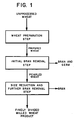
- Figure 1 is a flow chart of first and second presently preferred embodiments of the milling process of this invention.
- Figure 2 is a mill flow diagram of a first embodiment of the wheat preparation and initial bran removal steps of Figure 1.
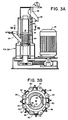
- Figure 3A is a partial sectional view of one of the bran removal machines of Figure 2, in which the orientation of the outlet chute has been changed for clarity of illustration.
- Figure 3B is a cross-sectional view taken along line 3B-3B of Figure 3A.
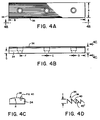
- Figures 4A through 4J are detailed views of the abrasive elements shown in Figure 3B.
- Figures 5A through 5H define the roller mills, sifters, purifiers and product flows used in the first embodiment of size reduction and further bran removal step of Figure 1.
- Figure 6 is a mill flow diagram of the wheat cleaning and initial bran removal step of the second embodiment.
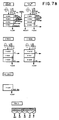
- Figures 7A through 7C define the roller mills, sifters, purifiers and product flows used in the size reduction and further bran removal step of the second embodiment.
- Figure 8 is a graph of the cumulative ash data of Tables VI(a) and VI(b) below.
- Figure 9 is a graph of the cumulative ash data of Tables VIII(a) and VIII(b) below.
- the term wheat is intended to include the species and varieties of wheat commonly grown for cereal grain, including durum, red durum, hard red, white and soft red wheat, including both spring wheat and winter wheat.
- the wheat kernel or berry is commonly defined as having a seed surrounded by a pericarp.
- the seed in turn includes a germ, an endosperm and a seed coat.
- the endosperm includes a starchy endosperm which makes up the large body of the kernel and an aleurone layer which surrounds the starchy endosperm.
- the seed coat in turn surrounds the aleurone layer. In conventional milling the aleurone layer is removed with the seed coat and the pericarp in what is commonly termed bran. Nevertheless, the aleurone layer is classified from the botanical standpoint as a part of the endosperm. Further details regarding wheat structure can be found in standard reference books, as for example at pages 1-14 of Principles of Cereal Science and Technology identified above.
- Milling Quality Wheat A wheat characterized by a small fraction of germinated or otherwise damaged kernels and classified as US #2 or better in the classification scheme of 7 CFR ⁇ 810 will be referred to as milling quality wheat.
- Durum Wheat - Durum wheat encompasses all durum wheats, including hard amber durum, amber durum, and durum wheat.
- Hard Wheat - Hard wheat encompasses all hard wheats, including hard red winter and hard red spring wheat.
- Soft Wheat- Soft wheat encompasses all soft wheats, including soft red and soft white wheat.
- Ash Content typically has an ash or mineral content which is not distributed evenly in the grain.
- the inner endosperm is relatively low in ash while the outer bran layers are relatively high in ash.
- ash content is a convenient assay for the presence of bran in flour, and ash is commonly measured as an assay of flour quality. Generally speaking, this is done by heating a measured weight of milled wheat product in the presence of oxygen and weighing the resulting ash as set forth in AACC Methods No. 08-01 and 08-02.
- Durum Wheat streams or Products - Finely divided milled durum wheat products such as flour and semolina will be identified as follows depending on ash content:
- Soft Wheat Stream or Products - Finely divided milled soft wheat products such as flour and farina will be identified as follows depending on ash content:
- the soft wheat total food grade stream or product represents the total mill output of food grade, finely divided milled wheat product, and may have an ash content less than .45 ⁇ .02 wt%, depending on the milling process.
- Hard Wheat Streams or Products - Finely divided milled hard wheat products such as flour and farina will be identified as follows depending on ash content.
- the hard wheat total food grade stream or product represents the total mill output of food grade, finely divided milled wheat product, and may have an ash content less than .50 ⁇ .02 wt%, depending on the milling process.
- the aleurone layer has distinctive fluorescence properties as compared with other portions of the wheat kernel. These fluorescence properties can be used to determine the amount of aleurone in a sample of finely divided wheat product. This is done by microscopically scanning a sample of wheat product in reflected light, (for example using an NIR sample holder) using illumination at 365 nanometers which excites aleurone cell wall fragments to fluoresce distinctively.
- the area to be scanned is preferably about 1 centimeter by 1 centimeter and the fluorescence monitoring system is standardized against a stable fluorophore such as uranyl glass.
- the percentage of the total scanned area which exhibits fluorescence characteristic of aleurone is then determined, preferably using automated scanning techniques. In this way the measured aleurone fluorescence area is determined as a percentage of the total scanned area. Further details are set out below.
- FIG. 1 shows a general overview of the presently preferred milling process of this invention.
- unprocessed wheat is first prepared for milling in substantially the conventional manner.
- the prepared wheat is then passed through bran removal machines to remove most of the bran and germ without reducing the size of the endosperm, thereby forming pearled wheat.
- the pearled wheat is then applied as a feedstock to a roller mill that removes additional bran and reduces the size of the endosperm to form a finely divided milled wheat product such as flour, semolina and/or farina.
- FIG. 2 A first presently preferred mill flow for the first two steps of Figure 1 is shown in Figure 2.
- incoming durum wheat (so called "dirty wheat") is raised by a bucket lift 80, 80a into a holding bin 82, from which it passes via a scale 84 and a second holding bin 86 to a second bucket lift 88, 88a and a milling separator 90.
- the separator 90 utilizes reciprocating screens to remove foreign material such as stones and sticks.
- Wheat which has passed through the separator 90 proceeds via a third bucket lift 92,92a to a gravity selector 94 where additional stones are removed, and then to a magnetic separator 96 which removes iron or steel articles.
- the wheat then passes to a disc separator 98 and a precision sizer 100 which remove barley, oats, cockle and other foreign materials. At this point the wheat has been cleaned of most foreign material, and it is held in a clean wheat tank 102.
- wheat is carried by a fourth bucket lift 104, 104a to a tumbling conveyor 106, where water is added and the wheat is tempered in tempering bins 108 for about four hours to a moisture level of about 16.4 weight percent.
- This initial wheat preparation step of the process is substantially conventional with two exceptions.
- the wheat After the wheat leaves the wheat preparation step shown in Figure 1, it then enters an initial bran removal step, in which most of the outer bran layers and the germ are removed from the wheat without substantially reducing the size of the endosperm.
- tempered wheat from the bins 108 is carried by a fifth bucket lift 110, 110a past another magnetic separator 112 to a first set of bran removal machines 10A.
- Partially pearled wheat from the machines 10A passes to a second set of bran removal machines 10B, which produce pearled wheat.
- This pearled wheat is then passed through a turbo aspirator 114 and then via a sixth bucket lift 116, 116a to the first break rolls of the roller mill described below.
- the bran removal machines 10A, 10B are preferably of the general type described in above-referenced U.S. Patent 4,583,455.
- the wheat is passed upwardly in a fluidized annular stream between two sets of relatively moving abrasive elements. Friction between the wheat and these abrasive elements, between adjacent grains, and between grains of wheat and screens situated between the abrasive elements removes bran from the wheat without substantially reducing the size of the endosperm.
- An alternative preferred embodiment of this step eliminates the need for the disc separator 98 and the precision sizer 100 and reduces the required tempering time for the wheat.
- wheat from the gravity selector 94 is passed to the bran removal machines 10B (with the light wheat fraction going to one of the machines 10B and the heavy wheat fraction going to the remaining four machines 10B).
- the machines 10B are operated to remove outer bran layers and germ amounting to about 5 wt%. Additionally, the machines 10B perform the separation function previously performed by the separator 98 and sizer 100.
- the partially pearled wheat from the machines 10B is lifted to the clean wheat tank 102, from which it is lifted to the tumbling conveyor. After an appropriate amount of water has been added, the wheat is tempered in the tempering bins for 1-3 hours. Because the outer bran layers have been removed, the tempering time is substantially reduced as compared with the mill flow of Figure 2. After the wheat is tempered, it is then passed through the bran removal machines 10A to remove a further 2-4 wt% of bran and germ. The resulting fully pearled wheat is then transported via the turbo aspirator 114 and the bucket lift 116, 116a to the roller mill of Figures 5A-5H.
- the initial bran removal step produces a pearled wheat which is then applied as a feed stock to a size reduction and further bran removal step.
- this step employs conventional roller mills, sifters and purifiers to reduce the size of the pearled wheat to the desired range as appropriate for flour, semolina or other finely divided milled wheat products.
- the resulting finely divided milled wheat product can then be further processed in any suitable manner, for example to enrich the product.
- the present invention is not concerned with such further processing steps, which may be selected as appropriate for the specific application.
- each of the bran removal machines 10A, 10B includes a central rotor 12 which is mounted for rotation about a vertical axis driven by an electric motor 14.
- the rotor 12 is hollow and defines a central passageway 16.
- the upper part of the rotor 12 is surrounded by a basket 18, and an annular treatment chamber 20 is formed between the rotor 12 and the basket 18.
- the basket 18 is in turn surrounded by a housing to define a bran removal passageway 22 immediately around the basket 18.
- the lower end of the rotor 12 defines helical conveyor screws 24 which convey wheat upwardly into the treatment chamber 20 when the rotor 12 is rotated.
- the upper end of the rotor 12 defines an array of openings 26 interconnecting the central passageway 16 and the treatment chamber 20 ( Figure 3B).
- the upper portion of the treatment chamber 20 communicates with an outlet gate 28 that is biased to the closed position shown in Figure 3A by weights 30. Wheat which has been moved upwardly through the treatment chamber 20 lifts the outlet gate 28 and exits the bran removal machine via an outlet chute 32.
- the upper portion of the rotor 12 supports two radially opposed inner abrasive elements 34.
- Figures 4A-4D provide further details of the inner abrasive elements 34, which define an array of teeth 36 on the outermost portion situated to contact the wheat being treated.
- the teeth 36 are sawtooth in configuration as shown in Figure 4D, and each tooth defines a sharp face 38 and a dull face 40, with an included angle of 45°.
- the crest to crest spacing between adjacent teeth is in this embodiment approximately 1/16 inch.
- the inner abrasive elements 34 on the rotor 12 are rotated within the basket 18 by the motor 14.
- the basket 18 mounts an array of outer abrasive elements 42, which can be formed as shown in Figures 4E-4H or in Figures 4I-4J.
- the outer abrasive elements 42 define teeth 44 having a sharp face 46 and a dull face 48 as shown in Figure 4H.
- the teeth 44 are preferably identical in configuration to the teeth 36 described above.
- the teeth 44 are arranged in a helix which advances circumferentially about 1/4 of an inch over a length of 12 inches.
- the teeth in the outer abrasive elements 42 can be double cut at 45° as shown in Figures 4I and 4J.
- the abrasive elements 38, 42 can be formed of a steel such as RYCROME 4140 or equivalent, case hardened to a Rockwell hardness of 48 on the C scale in a layer 1/8-3/16 inch thick.
- a suitable hardening process is to heat the abrasive elements 34, 42 to a temperature of 800-900°F and then to quench them in oil at a temperature of 200°F.
- Table 1 provides presently preferred dimensions for the abrasive elements 34, 42.
- screens 50 are interposed between the outer abrasive elements 42, and the screens 50 define diagonally situated slots 52.
- the screens 50 are formed of a material such as 20 gauge carbon steel, and the slots 52 are oriented at an angle of 45° and have a size of about 1 millimeter by 12 millimeters.
- the bran removal machines 10A, 10B described above operate as follows. Wheat is introduced into the machine 10A, 10B via an input chute inlet 54 into the annular region around the conveyor screws 24.
- the rotor 12 is rotated by the motor 14 and the conveyor screws 24 advance the wheat upwardly into the treatment chamber 20, where the wheat is abraded between the inner and outer abrasive elements 34, 42 and against the screens 50.
- the elements 34, 42 are oriented such that the sharp faces 38 approach the dull faces 48 as the rotor 12 is rotated.
- a suction is drawn on the bran removal passageway 22 causing a substantial air flow through the openings 26 and the treatment chamber 20 out the screens 50 into the bran removal passageway 22. This air flow fluidizes the wheat in the treatment chamber 20 and removes bran particles from the flow of wheat. Other gases may be substituted for air if desired.
- the wheat moves upwardly out of the treatment chamber 20, opens the outlet gate and then falls out the outlet chute 32.
- the prepared wheat is introduced into the inlet 54 of the first bran removal machine 10A, and the wheat leaving the outlet chute 32 of this first bran removal machine 10A then falls directly into the inlet 54 of the second bran removal machine 10B.
- bran removal machine sold by Refacciffi de Molinas, S.A., Mexico City, Mexico under the trade name REMO Vertijet Model VJIII has been found suitable for use in this process.
- this bran removal machine has been operated at a rotor speed between 800 and 1800 rpm and preferably about 1300 rpm using a 40 horsepower motor.
- the minimum separation between the inner and outer abrasive elements 34, 42 is preferably adjusted to 7 mm.
- the airflow through the bran removal machine is 500-600 SCFM and the weights 30 total 15 pounds.
- the preferred bran removal machine 10 is a modified version of the Vertijet device described above in that the original equipment screens and the abrasive elements have been replaced with the elements 50, 34, 42 described above. Additionally, a ground strap has been provided between the upper and lower housings to reduce problems associated with static electricity in the area of the outlet chute 32. Further details on the Vertijet bran removal machine can be found in U.S. Patent 4,583,455.
- the weights 30 are selected to cause the machines 10A,10B to remove as much bran and germ as possible without reducing the size of the wheat endosperm. Generally at least 5%, and generally 9-10% of the wheat supplied to the bran removal machines 10A, 10B is removed. Microscopic examination at 30x reveals that the large majority of bran and germ is removed from the wheat in the initial bran removal step. Generally visual inspection shows that the germ is removed from more than 50% (and often about 75%) of the grains of wheat.
- the machines 10A, 10B have a high capacity, and throughput rates of 90-100 bushels per machine per hour for each of the machines 10A and each of the machines 10B have been achieved. Throughput rates of 120 bushels or more per machine per hour may be possible.
- Output from the second bran removal machine 10B is a pearled wheat which is applied as an input feedstock to the size reduction and further bran removal step described below.
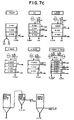
- FIGS 5A-5H define the presently preferred size reduction and further bran removal step in complete detail understandable to one of ordinary skill in the art. These figures represent the primary disclosure of this step, and the following comments are intended merely to clarify the symbols used in those figures.
- the size reduction and further bran removal step employs roller mills, sifters and purifiers.
- the pearled wheat product produced by five sets of bran removal machines 10A, 10B is supplied as an input feedstock to a first break roll shown in Figure 5A and identified as 1 BK.
- the first break roll includes six pairs of rolls, each 10 inch in diameter and 36 inches long. These rolls are provided with deep Getchel (DGH) teeth spaced at 12 teeth per inch and arranged to face one another dull to dull (D:D). The rolls are operated at a differential rotational speed of 2.5 to 1, and the teeth are cut at a 1.25 inch spiral cut.
- DGH deep Getchel
- S:S indicates the teeth face each other sharp to sharp.
- the output from the first break rolls 1 BK is applied as an input to a turbo aspirator which separates bran from endosperm.
- the endosperm fraction is applied to a sifter shown at reference numeral 60.
- This is a conventional sifter having up to 27 horizontal sieves or screens arranged one above the other.
- the sieves are formed of grids of cloth of the type identified in the drawings.
- the codes used here to define the size of the sieves are the standard codes, as defined for example in "Comparative Table of Industrial Screen Fabrics" published by H. R. Williams Mill Supply Company, Kansas City, Mo.
- the screens in the sifter 60 are identified by a first number which indicates the number of layers in the sifter made up of the indicated screen, a dash, and a second number which defines the screen.
- a first number which indicates the number of layers in the sifter made up of the indicated screen
- a dash which defines the screen.
- the upper four layers are of screen type 14TMW, having screen openings of 0.062 inches.
- the next five layers of screen in the sifter 60 are type 22W having screen openings of 0.038 inches.
- symbols such as those on the right indicate where the "overs" which fail to pass through the respective screens are directed. For example, overs which fail to pass through the 14TMW screens are passed to the second break coarse rolls (2 BK CR). Symbols such as those used in sifter 60 in connection with BK RDST indicate where the troughs which pass through the sieves are directed. For example, in the sifter 60 the troughs which pass through all of the screens including the finest 72W screens are directed to BK RDST, the sifter 62 shown in Figure 5B.
- the size reduction and further bran removal step shown in Figures 5A-5H includes a set of purifiers P1A-P18B.
- Purifiers such as those shown in these figures are generally conventional and well known to those skilled in the art. The following comments will define the symbols used in describing each of the purifiers, using purifier P1A of Figure 5E by way of example.
- Purifier P1A receives its feedstock from the sifter 60, and in particular the overs from the 32W screens.
- the purifier P1A includes two decks of screens which slope downwardly from left to right and which have screen openings (measured in microns) as shown at 64.
- the upper set of screens on the purifier P1A has a screen opening size of 950 microns at the left and 1180 microns at the right.
- the milled wheat is introduced onto the right hand end of the upper screen, which is moved in a cyclical fashion.
- the overs which do not pass through the upper screen are directed to the third break chunk rolls (3 BK CH R) of Figure 5A.
- the fraction of the incoming stream which passes through the upper deck of screens but not the lower deck of screens (the overs from the lower deck of screens) is directed to the second break fine rolls (2 BK FN R) shown in Figure 5A, or alternately (as indicated by the valve -V-) to the first size reduction coarse rolls (1 SIZ CR R) shown in Figure 5C.
- the troughs which pass through both of the screen decks are directed as shown at 66.
- the adjacent symbols indicate the rolls to which the corresponding fraction is directed.
- the fraction that falls through the open areas 66A and 66B is directed to the first size reduction coarse rolls (1 SIZ CR R) as shown in Figure 5C.
- the fraction that falls through the open area 66C is directed to the first size reduction fine rolls (1 SIZ FN R) of Figure 5C.
- the diagram 64 is best understood as a schematic elevation view and the diagram 66 as a schematic plan view.
- roller mills can be any conventional roller mills, such as those manufactured by OCRIM as Model No. LAM-CVA or equivalent.
- the turbo aspirators can be of the type distributed by OCRIM as Model No. TTC/450.
- the sifters can be any conventional sifters such as free swinging sifters distributed by Great Western Manufacturing. If desired, the sieves of the sifters may be backed with a layer of 1/2 inch by 1/2 inch intercrimped wire mesh mounted about 3/4 inch below the sieve. Five hard rubber balls 5/8 inch in diameter may be placed in each quadrant on the respective wire mesh to bounce against the overlying sieve and keep it clean.
- the purifiers are preferably slightly modified versions of the Simon Mark IV purifier distributed by Robinson Manufacturing of the United Kingdom operated at 2000 cubic feet per minute of air and a screen rotational speed of 450 rpm.
- the modification of these purifiers relates to the addition of a tray of expanded metal mounted below each deck of screen to move with the respective deck.
- Each of these expanded metal trays defines diamonds dimensioned approximately .5 inch along the direction of product movement and 1 inch perpendicular to the direction of product movement.
- the tray is preferably about 7/8 of an inch below the level of the deck to form a confined area between the expanded metal tray and the overlying deck of screen.
- This area is divided into three sections along the length of the purifier, and each section confines 27 brown rubber balls about 5/8 of an inch in diameter, such as those supplied by H. R. Williams. These confined balls bounce between the expanded metal tray and the overlying screen in order to keep the screen clear.
- the separations between the rolls of the roller mills are set to provide the roll extractions set out in Table II.
- the second column indicates the weight percent of the output of the indicated roller mill that passes through a sieve of the size indicated in the respective row of the third column.
- Table III presents yield data for this example in comparison with yield data for a conventional roller mill.
- yields are expressed as weight percent of the designated stream as a fraction of the incoming dirty wheat.
- the yield data of Table III for the conventional roller mill are one-year average values for milling quality hard amber durum wheat milled at the same location, before it was converted to the process of Figures 1-5H.
- Table III shows that the average yields for the patent stream and the total food grade stream were significantly higher for Example 1 than for the conventional mill. This yield improvement was obtained without any offsetting decrease in the quality of the milled wheat product. As discussed below in Example 2, chemical analysis and food tests have shown that wheat products milled in accordance with this invention are equal or better to conventionally milled wheat products.
- a quantity of hard amber durum wheat was divided into two batches.
- Batch A was milled as described above in connection with Figures 1-5H and Batch B was milled in a conventional roller mill.
- Aleurone cell wall fragments in flour, expressed as percent of measured area, and ash content were measured for Batches A and B, and the results are shown in Table IV.
- straight flour is a combination of patent and clear flour and corresponds to the total food grade flour of the mill. The following measurement protocol was used to obtain the measured aleurone fluorescence areas of Table IV.
- Table IV shows that wheat milled in accordance with the presently preferred embodiment of this invention (Batch A) has a higher content of aleurone cell wall fragments for a given ash content.
- Batch A has a measured aleurone fluorescence area which is about 30-40% greater than that of Batch B within a grade. Increased retention of the aleurone layer is believed to be a factor in the yield improvements discussed in Example 1 above.
- Batches A and B were chemically analyzed in the conventional manner for moisture content, ash content, protein, brightness and yellowness. Additionally, comparative food tests were performed to assess color, absorption of water, cooking losses, firmness and rheologic characteristics. These tests confirmed that in general the flour of Batch A was equal to or better than the flour of Batch B, and that each could be substituted for the other within a grade without any significant difference. Though Example 2 utilized flour, similar results are expected for semolina.
- the second preferred embodiment has been adapted for use with hard and soft wheat. Though the second embodiment differs in detail from the first embodiment described above, the second embodiment also implements the flow chart of Figure 1 above.
- the initial cleaning step is essentially a trash removal step. As shown in Figure 6, incoming wheat from the elevator is passed through a Carter milling separator that operates in the conventional manner to remove trash from the incoming wheat. The cleaned wheat is then passed to the initial bran removal and tempering step.
- FIG. 6 shows in block diagram form the principal steps of the initial bran removal and tempering step.
- the wheat is first passed through a first bran removal machine 10A, which operates to remove initial bran layers.
- the partially pearled wheat from the first bran removal machine 10A is then transported via a tumbling conveyor to a tempering bin. Water is added to the wheat in the conveyor and the wheat is tempered preferably for about 4 hours until it reaches a moisture content of about 14.5 wt% (soft wheat) or 15.0 wt% (hard wheat). This short tempering time is possible because outer bran layers are removed by the machine 10A prior to tempering.
- the partially pearled wheat After the partially pearled wheat has been tempered it is then transferred via a lift to a stock hopper, and from the stock hopper to a second bran removal machine 10B.
- the two bran removal machines 10A, 10B are identical to those described above, and the output of the second bran removal machine 10B is the fully pearled, tempered wheat which is then applied as a feedstock to a size reduction and further bran removal step.
- this step employs conventional roller mills, sifters and purifiers to reduce the size of the pearled wheat to the desired range as appropriate for flour, farina and other finely divided milled wheat products.
- the resulting finely divided milled wheat product can then be further processed in any suitable manner, for example to enrich the product.
- the present invention is not concerned with such further processing steps, which may be selected as appropriate for the specific application. .
- the cleaned wheat is passed in sequence through two bran removal machines 10A, 10B, which are of the type described above in conjunction with Figures 3A-4I.
- the weights 30 are selected to cause the machines 10A,10B to remove as much bran and germ as possible without reducing the size of the wheat endosperm. Generally at least about 5 wt%, and generally 6 wt% of the hard or soft wheat supplied to the bran removal machines 10A, 10B is removed. Microscopic examination at 30x reveals that the large majority of bran and germ is removed from the wheat in the initial bran removal step. Visual inspection shows that the germ is generally removed from more than 50% (and often about 75%) of the grains of wheat.
- the machines 10A, 10B have a high capacity, and throughput rates of 80-180 bushels per machine per hour for each of the machines 10A and each of the machines 10B have been achieved with hard and soft wheat.
- the machines 10A, 10B may be further modified to further improve performance.
- all but two of the screens 50 may be replaced with imperforate plates or further abrasive elements and the air flow through the machine 10A, 10B may be reduced by two-thirds.
- This approach increases the amount of separated bran that remains with the pearled wheat, and a conventional turbo aspirator such as an OCRIM 600 can be used to separate bran from the pearled wheat downstream of the machine 10A, 10B.
- the machines 10A, 10B have been found to remove garlic bulbs effectively from soft wheat, thereby reducing the need to clean the roller mills frequently to remove garlic bulbs.
- Output from the second bran removal machine 10B is a pearled wheat which is applied as an input feedstock to the size reduction and further bran removal step described below.
- FIGS 7A-7C define the presently preferred size reduction and further bran removal step in complete detail understandable to one of ordinary skill in the art. These figures represent the primary disclosure of this step, and the following comments are intended merely to clarify the symbols used in those figures.
- the size reduction and further bran removal step employs roller mills, sifters and purifiers.
- the pearled wheat product produced by one set of bran removal machines 10A, 10B is supplied at a rate of 180 bushels/hour as an input feedstock to a first break roll shown in Figure 7A and identified as 1ST BK.
- the first break roll includes one pair of rolls, each 9 inch in diameter and 36 inches long. These rolls are provided with Modified Dawson (MD) flutes spaced at 10 flutes per inch on the faster roll and 12 flutes per inch on the slower roll.
- the flutes on the rolls are oriented dull to dull (D:D) and they are arranged in a 1/2 inch spiral cut.
- the rolls are operated at a differential rotational speed of 2.5 to 1.
- the remaining roller mills are defined in similar terms in the figures.
- the symbol "SRT" is used to indicate Stevens Round Top as opposed to Modified Dawson flutes.
- the output from the first break rolls 1ST BK is applied to a sifter shown at reference numeral 160.
- This is a conventional sifter having up to 27 horizontal sieves or screens arranged one above the other.
- the sieves are formed of grids of cloth of the type identified in the drawings.
- the codes used here to define the size of the sieves are the standard codes, as defined for example in "Comparative Table of Industrial Screen Fabrics" published by H. R. Williams Mill Supply Company, Kansas City, Mo.
- the screens in the sifter 160 are identified by a first number which indicates the number of layers in the sifter made up of the indicated screen, a dash, and a second number which defines the screen. For example, in sifter 160 the upper four layers of screen are type 16W. The next four layers of screen in the sifter 160 are type 36W.
- symbols such as those on the right indicate where the "overs" which fail to pass through the respective screens are directed. For example, overs which fail to pass through the 16W screens are passed to the second break rolls (2ND BK). Symbols such as those used in sifter 160 in connection- with FLOUR indicate where the throughs which pass through the screens are directed. For example, in the sifter 60 the throughs which pass through all of the screens including the finest 9XX screens are directed to FLOUR, the roller mill flour output stream.
- the size reduction and further bran removal step shown in Figures 7A-7C includes a set of purifiers PUR1-PUR3.
- Purifiers such as those shown in these figures are generally conventional and well known to those skilled in the art. The following comments will define the symbols used in describing each of the purifiers, using purifier PUR1 of Figure 7A by way of example.
- Purifier PUR1 receives its feedstock from the sifter 160 (the overs from the 36W screens) and the sifter 162 (the overs from the 42W screens).
- the purifier PUR1 includes a deck of screens which slope downwardly from left to right and which have screen material as shown. Thus, the screens on the purifier PUR1 have a 38SS screen material at the left and a 18SS screen material at the right. Milled wheat is introduced onto the right hand end of the screen, which is moved in a cyclical fashion. The overs which do not pass through the screen are directed to the fourth break coarse rolls (4TH BK COARSE) of Figure 7B.
- the fraction of the incoming stream which passes through the screens is directed to the indicated rolls, depending on the point where the incoming stream passes through the screen.
- the lower symbols indicate the rolls to which the corresponding fractions are directed.
- the fraction that falls through the open area 164 is directed to the first midds coarse rolls (1 MIDDS COARSE) as shown in Figure 7C.
- the fraction that falls through the open area 166 is directed to the sizing rolls (SIZ) of Figure 7C.
- roller mills can be any conventional roller mills, such as those manufactured by Allis Chalmers as Type A or equivalent.
- the sifters can be of the type described above.
- the purifiers are preferably slightly modified versions of the Allis Chalmers Type 106 purifier operated at 2,000 cubic feet per minute of air and a screen rotational speed of 450 rpm. The modification of these purifiers relates to the addition of a tray of expanded metal mounted below the deck of screen to move with the deck, as described above.
- the bran and shorts dusters can for example be of the type distributed by Buhler as the Model MKL duster.
- the size reduction and further bran removal step of Figures 7A-7C can easily be adjusted for use with either hard or soft wheat.
- the three valves 168a, 168b, 168c are set to the upper position, and when soft wheat is being milled the three valves 168a, 168b, 168c are set to the lower position.
- the overs from the 36W screen in the sifter 160 are directed to the first purifier PUR1 by the valve 168a when hard wheat is being milled, and to the sizing rolls SIZ when soft wheat is being milled.
- the separations between the rolls of the roller mills are set to provide the roll extractions set out in Tables V(a) and V(b) for hard and soft wheat, respectively.
- the second column indicates the weight percent of 100 grams of the output of the indicated roller mill that passes through a Great Western test sifter of the screen size indicated in the respective row of the third column, when sifted for one minute.
- Tables VI(a) and VI(b) present cumulative ash data for this example in comparison with cumulative ash data for a conventional roller mill.
- cumulative streams are expressed as weight percent of the soft wheat total food grade stream of the mill.
- Figure 8 graphs the cumulative ash data of Tables VI(a) and VI(b).
- Tables VI(a) and VI(b) are the result of a comparative test.
- Soft wheat in a bin was divided into two quantities.
- One (Table VI(a)) was milled using the preferred embodiment described above, with the machines 10A, 10B adjusted to remove 6 wt% of the incoming wheat and the valves 168a-168c in the roller mill set for soft wheat.
- the other (Table VI(b)) was milled in the same mill set up in the conventional manner (without pearling machines) to mill soft wheat using the same operating conditions as those previously used to mill soft wheat in routine commercial operations.
- Figure 8 shows that the process of Figures 6-7c produces a lower cumulative ash curve than does the conventional process, with a higher fraction of the soft wheat total food grade product classified as soft wheat short patent flour. Additionally, the yield of soft wheat total food grade product (expressed as a fraction of incoming dirty wheat) is higher. Table VII summarizes these results. Total yield of Example 3 was over 2 wt% greater than the conventional roller mill, and the percentage of soft wheat short patent product in the soft wheat total food grade stream was increased by over 60%.
- Tables VIII(a) and VIII(b) present cumulative ash data for this example in comparison with cumulative ash data for a conventional roller mill.
- cumulative streams are expressed as weight percent of the hard wheat total food grade stream of the mill.
- Figure 9 graphs the cumulative ash data of Tables VIII(a) and VIII(b).
- Tables VIII(a) and VIII(b) are the result of a full scale test using hard wheat of the same crop year.
- Example 4 (Table VIII(a)) was milled using the preferred embodiment described above, with the machines 10A, 10B adjusted to remove 6 wt% of the incoming wheat and the valves in the roller mill set for hard wheat.
- Other hard wheat of the same crop year (Table VIII(b)) was milled in the same mill set up in the conventional manner (without pearling machines) to mill hard wheat using the same operating conditions as those previously used to mill hard wheat in routine commercial operations.
- Figure 9 shows that the process of Figures 6-7C produces a lower cumulative ash curve than does the conventional process, with a higher fraction of the hard wheat total food grade product classified as hard wheat medium patent flour. Additionally, the yield of hard wheat total food grade product (expressed as a fraction of incoming dirty wheat) is higher. Table IX summarizes these results. Total yield of Example 4 was over 2 wt% greater than the conventional roller mill, and the percentage of hard wheat medium patent product in the hard wheat total food grade stream was increased by almost 17%. It should be noted that, when carefully adjusted, the conventional mill used for the data of Table VIII(b) has produced yields as high as 74.49% in processing hard wheat of the same crop year as the wheat of Tables VIII(a) and VIII(b).
- a quantity of milling quality soft red winter wheat was divided into two batches.
- Batch 5A was milled as described above in connection with Figures 6-7C, and Batch 5B was milled in a conventional roller mill.
- Aleurone cell wall fragments and pericarp in flour, expressed as percent of measured area, and ash content were measured for Batches 5A and 5B, and the results are shown in Table X.
- straight flour is a combination of patent and clear flour and corresponds to the total food grade flour of the mill. The measurement protocol described above was used to obtain the measured aleurone fluorescence areas of Table X.
- Table X shows that soft wheat milled in accordance with the presently preferred embodiment of this invention (Batch 5A) has a higher content of aleurone cell wall fragments for a given ash content.
- Batch 5A has a measured aleurone fluorescence area which is about 10-20% greater than that of Batch 5B for each of the two grades. Increased retention of the aleurone layer is believed to be a factor in the yield improvements discussed in Example 3 above. Additionally, Batch 5A shows a higher ratio of measured aleurone fluorescence area to measured pericarp fluorescence area than does Batch 5B.
- Batches 5A and 5B were chemically analyzed in the conventional manner for moisture content, ash content, protein, brightness, and rheological properties. Additionally, comparative food tests were performed to assess cookie and cake baking properties. These tests confirmed that in general the flour of Batch 5A was comparable to the flour of Batch 5B, and that each could be substituted for the other within a grade without any significant difference.
- a quantity of milling quality hard wheat (a mixture of hard red wheat and a small amount of hard red spring wheat) was divided into two batches.
- Batch 6A was milled as described above in connection with Figures 6-7C, and Batch 6B was milled in a conventional roller mill.
- Aleurone cell wall fragments and pericarp in flour, expressed as a percent of measured area, and ash content were measured for Batches 6A and 6B (using the procedures discussed above), and the results are shown in Table XI.
- straight flour is a combination of patent and clear flour and corresponds to the total food grade flour of the mill.
- Table XI shows that hard wheat milled in accordance with the presently preferred embodiment of this invention (Batch 6A) has a higher content of aleurone cell wall fragments for a given ash content.
- Batch 6A has a measured aleurone fluorescence area which is about 40-50% greater than that of Batch 6B for each of the two grades. Increased retention of the aleurone layer is believed to be a factor in the yield improvements discussed in Example 4 above. Additionally, Batch 6A shows a higher ratio of measured aleurone fluorescence area to measured pericarp fluorescence area than does Batch 6B.
Landscapes
- Engineering & Computer Science (AREA)
- Food Science & Technology (AREA)
- Cereal-Derived Products (AREA)
- Adjustment And Processing Of Grains (AREA)
- Disintegrating Or Milling (AREA)
Applications Claiming Priority (4)
| Application Number | Priority Date | Filing Date | Title |
|---|---|---|---|
| US557631 | 1983-12-02 | ||
| US07/557,631 US5089282A (en) | 1990-07-24 | 1990-07-24 | Wheat milling process |
| US07/610,819 US5104671A (en) | 1990-07-24 | 1990-11-08 | Wheat milling process |
| US610819 | 1990-11-08 |
Publications (2)
| Publication Number | Publication Date |
|---|---|
| EP0468774A2 true EP0468774A2 (de) | 1992-01-29 |
| EP0468774A3 EP0468774A3 (en) | 1992-04-08 |
Family
ID=27071486
Family Applications (1)
| Application Number | Title | Priority Date | Filing Date |
|---|---|---|---|
| EP19910306761 Withdrawn EP0468774A3 (en) | 1990-07-24 | 1991-07-24 | Improved wheat milling process and milled wheat product |
Country Status (6)
| Country | Link |
|---|---|
| US (1) | US5104671A (de) |
| EP (1) | EP0468774A3 (de) |
| JP (1) | JPH07841A (de) |
| AU (1) | AU634668B2 (de) |
| CA (1) | CA2047610A1 (de) |
| MX (1) | MX9100136A (de) |
Cited By (8)
| Publication number | Priority date | Publication date | Assignee | Title |
|---|---|---|---|---|
| WO2002013626A1 (en) * | 2000-08-15 | 2002-02-21 | Maldonado, Alfonso | Mineral-enhanced bakery products |
| US6495191B1 (en) | 1998-12-28 | 2002-12-17 | Alfonso Maldonado | Wheat flour for mineral-enhanced bakery products |
| DE102004031052A1 (de) * | 2004-06-25 | 2006-01-12 | Bühler AG | System und Verfahren zur Mahlgut-Charakterisierung in einem Walzenstuhl |
| US20110186661A1 (en) * | 2008-07-02 | 2011-08-04 | Bühler AG | Apparatus and Method for Producing Flour and/or Semolina |
| CN102553668A (zh) * | 2012-01-18 | 2012-07-11 | 杭州恒天面粉集团有限公司 | 一种高效清洁小麦清理、分级制粉工艺 |
| CN106423398A (zh) * | 2016-11-29 | 2017-02-22 | 新疆德天利农业发展有限责任公司 | 一种小麦粉低温加工方法及其采用的系统装置和应用 |
| CN107377097A (zh) * | 2017-09-04 | 2017-11-24 | 太仓市绿苗农场专业合作社 | 一种小麦利用率高的小麦加工方法 |
| US12382975B1 (en) | 2022-05-06 | 2025-08-12 | Alfonso Maldonado-Perez | Method of preparing a first break wheat which maintains wheat germ intact and surrounded in a protected state by endosperm |
Families Citing this family (15)
| Publication number | Priority date | Publication date | Assignee | Title |
|---|---|---|---|---|
| US5164013A (en) * | 1990-08-22 | 1992-11-17 | Kansas State Univ. Research Foundation | Process for dry milling of wheat to obtain gluten and starch |
| JP3506441B2 (ja) * | 1991-08-29 | 2004-03-15 | 株式会社サタケ | 精麦製粉装置 |
| US5186968A (en) * | 1991-09-09 | 1993-02-16 | Conagra, Inc. | Process for milling cereal grains |
| US5211343A (en) * | 1991-09-09 | 1993-05-18 | Conagra, Inc. | Cereal grain milling system with disc mill and improved bran removal machine |
| US6372281B1 (en) | 2000-02-25 | 2002-04-16 | General Mills, Inc. | Process of milling hard white wheat and products thereof |
| US6899907B1 (en) * | 2000-09-18 | 2005-05-31 | General Mills, Inc. | Bleach bran and bran products |
| US8053010B2 (en) * | 2001-12-04 | 2011-11-08 | General Mills, Inc. | Bran and bran containing products of improved flavor and methods of preparation |
| US6887509B2 (en) * | 2002-05-03 | 2005-05-03 | General Mills, Inc. | Process for tempering and milling grain |
| CA2492884A1 (en) * | 2005-01-13 | 2006-07-13 | Stephane Chevigny | A high efficiency process for particle size reduction of glass-like polysaccharides |
| EP1879699A2 (de) | 2005-05-11 | 2008-01-23 | Pulsewave LLC. | Verarbeitung von körnern und ähnlichem |
| US8133527B2 (en) | 2006-06-16 | 2012-03-13 | Kraft Foods Global Brands Llc | Production of stabilized whole grain wheat flour and products thereof |
| US20090186136A1 (en) * | 2008-01-18 | 2009-07-23 | Saponin Inc. | Process for seed and grain fractionation and recovery of bio-products |
| CN104772178B (zh) * | 2015-04-15 | 2017-03-22 | 云南红河卧龙米业有限责任公司 | 一种优质稻米精加工工艺 |
| CN114570465B (zh) * | 2022-05-06 | 2023-04-25 | 李培瑞 | 一种玉米淀粉生产的脱水破碎系统 |
| CN119897187B (zh) * | 2025-01-14 | 2025-10-03 | 江南大学 | 一种低菌小麦粉的加工工艺 |
Family Cites Families (31)
| Publication number | Priority date | Publication date | Assignee | Title |
|---|---|---|---|---|
| US503889A (en) * | 1893-08-22 | Grain scouring and polishing machine | ||
| US421575A (en) * | 1890-02-18 | Edwin l | ||
| US677587A (en) * | 1901-04-03 | 1901-07-02 | John D Nagel | Oat stock-feed and process of producing same. |
| US721649A (en) * | 1901-07-09 | 1903-02-24 | Pendleton Tapscott Company | Machine for scouring grain, &c. |
| FR778710A (fr) * | 1933-12-08 | 1935-03-22 | Procédé, machine et installation pour décortiquer et conditionner le blé et autres céréales ou graines | |
| FR834755A (fr) * | 1937-03-04 | 1938-12-01 | Procédé et installation pour la production de farine | |
| US2379677A (en) * | 1941-04-30 | 1945-07-03 | Borsakovsky Voldemar | Method of milling grain |
| US2392365A (en) * | 1942-05-11 | 1946-01-08 | Pillsbury Mills Inc | Milling process |
| US2651470A (en) * | 1949-05-26 | 1953-09-08 | Safety Car Heating & Lighting | Method for milling wheat |
| US2867256A (en) * | 1955-08-08 | 1959-01-06 | Earle Theodore | Method of stripping epidermal material from grains |
| DE1938328C3 (de) * | 1969-07-28 | 1974-07-25 | Leslie Don Mills Ontario Palyi (Kanada) | Vorrichtung zum Schälen und Reinigen von Körnerfrüchten |
| US3667523A (en) * | 1969-12-29 | 1972-06-06 | Food Eng Intern Inc | Apparatus and process for the removal of the germ and bran coat from cereal grains |
| SU515524A1 (ru) * | 1973-12-19 | 1976-05-30 | Красноярский Политехнический Институт | Устройство дл сн ти оболочек зерна, его шлифовани и полировани |
| US4052518A (en) * | 1973-12-19 | 1977-10-04 | Vasily Nikolaevich Borisov | Method for separating seed cover from endosperm of grain of various cereal crops |
| US3979375A (en) * | 1974-05-07 | 1976-09-07 | Far-Mar-Co., Inc. | Fractionation of the whole wheat kernel by pin milling |
| US3960068A (en) * | 1975-01-29 | 1976-06-01 | Felipe Salete | Machine for whitening, polishing or pearling grains and cereals and more particularly rice |
| JPS6044014B2 (ja) * | 1977-04-01 | 1985-10-01 | 株式会社 サタケ | 精米装置 |
| SE439545B (sv) * | 1978-11-01 | 1985-06-17 | Forenede Bryggerier As | Sett for styrning av en separationsprocess utford pa fron eller kernor |
| MX147108A (es) * | 1979-01-24 | 1982-10-06 | Felipe Salete Garces | Mejoras a maquina pulidora y blanqueadora de granos |
| CH640750A5 (en) * | 1979-03-29 | 1984-01-31 | Buehler Ag Geb | Method for preparing and roller-milling cereal, and device for carrying out the method |
| US4426921A (en) * | 1981-01-23 | 1984-01-24 | Riviana Foods, Inc. | Apparatus for removal of bran from rice and like cereal grains |
| US4505196A (en) * | 1984-03-28 | 1985-03-19 | Beisel Victor A | Sonic seed dehulling system |
| MX159213A (es) * | 1984-05-14 | 1989-04-20 | Felipe Salete Garces | Ensamble de criba y rotor para maquinas descascaradoras,descortezadoras,pulidoras y blanqueadoras de granos |
| CA1251428A (en) * | 1985-09-30 | 1989-03-21 | Toshihiko Satake | Wheat flouring pretreatment system and wheat flouring process and system therefor |
| CA1313330C (en) * | 1988-12-16 | 1993-02-02 | Joseph Tkac | Process for removing bran layers from wheat kernels |
| CA1321525C (en) * | 1987-06-18 | 1993-08-24 | Joseph John Tkac | Process for use in milling flour |
| JPH0822389B2 (ja) * | 1987-07-27 | 1996-03-06 | 株式会社佐竹製作所 | 竪軸型摩擦切削式精米機 |
| JPH0767540B2 (ja) * | 1988-03-31 | 1995-07-26 | 株式会社佐竹製作所 | 堅軸型摩擦切削式精穀機 |
| AU605690B2 (en) * | 1988-04-26 | 1991-01-17 | Satake Engineering Co. Ltd. | Process of and system for flouring grains |
| JPH0777618B2 (ja) * | 1988-06-16 | 1995-08-23 | 株式会社佐竹製作所 | 製粉方法及びその装置 |
| AU599505B2 (en) * | 1988-08-04 | 1990-07-19 | Satake Engineering Co. Ltd. | Cereal-grain polishing apparatus |
-
1990
- 1990-11-08 US US07/610,819 patent/US5104671A/en not_active Expired - Fee Related
-
1991
- 1991-07-09 MX MX9100136A patent/MX9100136A/es not_active IP Right Cessation
- 1991-07-17 AU AU81156/91A patent/AU634668B2/en not_active Ceased
- 1991-07-23 CA CA002047610A patent/CA2047610A1/en not_active Abandoned
- 1991-07-24 EP EP19910306761 patent/EP0468774A3/en not_active Withdrawn
- 1991-07-24 JP JP3274479A patent/JPH07841A/ja active Pending
Cited By (10)
| Publication number | Priority date | Publication date | Assignee | Title |
|---|---|---|---|---|
| US6495191B1 (en) | 1998-12-28 | 2002-12-17 | Alfonso Maldonado | Wheat flour for mineral-enhanced bakery products |
| WO2002013626A1 (en) * | 2000-08-15 | 2002-02-21 | Maldonado, Alfonso | Mineral-enhanced bakery products |
| DE102004031052A1 (de) * | 2004-06-25 | 2006-01-12 | Bühler AG | System und Verfahren zur Mahlgut-Charakterisierung in einem Walzenstuhl |
| US20110186661A1 (en) * | 2008-07-02 | 2011-08-04 | Bühler AG | Apparatus and Method for Producing Flour and/or Semolina |
| US9067213B2 (en) * | 2008-07-02 | 2015-06-30 | Buhler Ag | Method for producing flour and/or semolina |
| US10981177B2 (en) | 2008-07-02 | 2021-04-20 | Bühler AG | Apparatus and method for producing flour and/or semolina |
| CN102553668A (zh) * | 2012-01-18 | 2012-07-11 | 杭州恒天面粉集团有限公司 | 一种高效清洁小麦清理、分级制粉工艺 |
| CN106423398A (zh) * | 2016-11-29 | 2017-02-22 | 新疆德天利农业发展有限责任公司 | 一种小麦粉低温加工方法及其采用的系统装置和应用 |
| CN107377097A (zh) * | 2017-09-04 | 2017-11-24 | 太仓市绿苗农场专业合作社 | 一种小麦利用率高的小麦加工方法 |
| US12382975B1 (en) | 2022-05-06 | 2025-08-12 | Alfonso Maldonado-Perez | Method of preparing a first break wheat which maintains wheat germ intact and surrounded in a protected state by endosperm |
Also Published As
| Publication number | Publication date |
|---|---|
| AU8115691A (en) | 1992-01-30 |
| CA2047610A1 (en) | 1992-01-25 |
| US5104671A (en) | 1992-04-14 |
| AU634668B2 (en) | 1993-02-25 |
| JPH07841A (ja) | 1995-01-06 |
| MX9100136A (es) | 1992-02-28 |
| EP0468774A3 (en) | 1992-04-08 |
Similar Documents
| Publication | Publication Date | Title |
|---|---|---|
| EP0468774A2 (de) | Verfahren zum Mahlen von Weizen und entsprechendes Produkt | |
| US5089282A (en) | Wheat milling process | |
| Posner | Wheat | |
| Dziki et al. | Wheat kernel physical properties and milling process | |
| CN105149035B (zh) | 一种籼米加工方法及加工系统 | |
| RU2498854C2 (ru) | Способ получения муки из зерна, вальцовая мельница, применение вальцовой мельницы, зигзагообразная просеивающая машина, применение зигзагообразной просеивающей машины | |
| CN1191885C (zh) | 具有原麦粒筛选工序的面粉碾磨方法和其面粉碾磨系统 | |
| Dexter et al. | Recent applications of debranning of wheat before milling | |
| Inamdar et al. | Application of color sorter in wheat milling | |
| Delwiche et al. | High-speed optical sorting of soft wheat for reduction of deoxynivalenol | |
| CN1524019A (zh) | 包含有机材料的对象的拣选方法 | |
| Dziki | The latest innovations in wheat flour milling: A review | |
| US5211982A (en) | Wheat milling process and milled wheat product | |
| US5194287A (en) | Wheat milling process and milled wheat product | |
| Campbell et al. | Milling and flour quality | |
| Devaux et al. | Particle size distribution of break, sizing and middling wheat flours by laser diffraction | |
| US4133899A (en) | Farina milling process | |
| Fang et al. | On predicting roller milling performance IV: Effect of roll disposition on the particle size distribution from first break milling of wheat | |
| Kiryluk et al. | Milling of barley to obtain β‐glucan enriched products | |
| US5141764A (en) | Wheat milling process | |
| CN102834177B (zh) | 标准小麦粉的简化生产方法和设备 | |
| CA2357147C (en) | Corn milling process | |
| Magyar et al. | Examination of milling technological properties of different wheat varieties | |
| UA130500C2 (uk) | Спосіб помелу матеріалів рослинного походження, зокрема зернових культур | |
| Munck et al. | Milling processes and products related to kernel morphology |
Legal Events
| Date | Code | Title | Description |
|---|---|---|---|
| PUAI | Public reference made under article 153(3) epc to a published international application that has entered the european phase |
Free format text: ORIGINAL CODE: 0009012 |
|
| AK | Designated contracting states |
Kind code of ref document: A2 Designated state(s): AT BE CH DE DK ES FR GB GR IT LI LU NL SE |
|
| PUAL | Search report despatched |
Free format text: ORIGINAL CODE: 0009013 |
|
| AK | Designated contracting states |
Kind code of ref document: A3 Designated state(s): AT BE CH DE DK ES FR GB GR IT LI LU NL SE |
|
| 17P | Request for examination filed |
Effective date: 19920604 |
|
| 17Q | First examination report despatched |
Effective date: 19930705 |
|
| STAA | Information on the status of an ep patent application or granted ep patent |
Free format text: STATUS: THE APPLICATION IS DEEMED TO BE WITHDRAWN |
|
| 18D | Application deemed to be withdrawn |
Effective date: 19950225 |