EP0469794A2 - Gerät und Verfahren zur Identifikation von Bildbereichen - Google Patents
Gerät und Verfahren zur Identifikation von Bildbereichen Download PDFInfo
- Publication number
- EP0469794A2 EP0469794A2 EP91306815A EP91306815A EP0469794A2 EP 0469794 A2 EP0469794 A2 EP 0469794A2 EP 91306815 A EP91306815 A EP 91306815A EP 91306815 A EP91306815 A EP 91306815A EP 0469794 A2 EP0469794 A2 EP 0469794A2
- Authority
- EP
- European Patent Office
- Prior art keywords
- candidate
- image
- markings
- fiducial
- marking
- Prior art date
- Legal status (The legal status is an assumption and is not a legal conclusion. Google has not performed a legal analysis and makes no representation as to the accuracy of the status listed.)
- Granted
Links
Images



Classifications
-
- H—ELECTRICITY
- H04—ELECTRIC COMMUNICATION TECHNIQUE
- H04N—PICTORIAL COMMUNICATION, e.g. TELEVISION
- H04N1/00—Scanning, transmission or reproduction of documents or the like, e.g. facsimile transmission; Details thereof
- H04N1/40—Picture signal circuits
-
- H—ELECTRICITY
- H04—ELECTRIC COMMUNICATION TECHNIQUE
- H04N—PICTORIAL COMMUNICATION, e.g. TELEVISION
- H04N1/00—Scanning, transmission or reproduction of documents or the like, e.g. facsimile transmission; Details thereof
- H04N1/387—Composing, repositioning or otherwise geometrically modifying originals
-
- G—PHYSICS
- G06—COMPUTING OR CALCULATING; COUNTING
- G06V—IMAGE OR VIDEO RECOGNITION OR UNDERSTANDING
- G06V10/00—Arrangements for image or video recognition or understanding
- G06V10/20—Image preprocessing
- G06V10/24—Aligning, centring, orientation detection or correction of the image
- G06V10/245—Aligning, centring, orientation detection or correction of the image by locating a pattern; Special marks for positioning
-
- H—ELECTRICITY
- H04—ELECTRIC COMMUNICATION TECHNIQUE
- H04N—PICTORIAL COMMUNICATION, e.g. TELEVISION
- H04N1/00—Scanning, transmission or reproduction of documents or the like, e.g. facsimile transmission; Details thereof
- H04N1/38—Circuits or arrangements for blanking or otherwise eliminating unwanted parts of pictures
Definitions
- This invention relates to image processing and, more particularly, to accurately locating predefined areas within an image.
- Prior image area identification systems were typically designed to function with fiducial markings that were clearly delineated and easily distinguishable from other image information. These fiducial markings are typically regular patterns places along the edges or in the corners of the image being scanned and suffer the disadvantage of obtrusiveness. Also, these prior systems perform registration of an image under the assumption that the scanned image will be largely undistorted and free of noise. However, distortions and modifications to a scanned image are common. In some instances, distortions to the scanned image are non-linear. A single skew and offset correction is insufficient to correct for such a distortion.
- FIG. 1 Shown in FIG. 1, in simplified block diagram form, is an exemplary system for locating areas of an image and extracting information therefrom; Shown in FIG. 2, in flow chart form, is an exemplary implementation of a method for locating areas of an image and extracting information therefrom; FIG. 3 shows an exemplary method for calculating overall image skew; and Shown in flow chart form, in FIG. 4 is an exemplary method for computing overall image offset.
- FIG. 1 Shown in FIG. 1, in simplified block diagram form, is an exemplary system for locating areas of an image and extracting information therefrom.
- the system includes a computer equipped with a fascimile (FAX) board and a mechanism for obtaining images.
- the computer is AT&T 6386 Work Group System (WGS) 101, which is further comprised of processing unit 102, memory 103 and disk storage unit (DISK) 104.
- FAX board 105 includes an AT&T Fax Connection (FAX CON-20).
- FAX board 105 is connected over direct dial network (DDD) 107, i.e., the public telephone network, to fascimile (FAX) machine 106.
- FAX board 105 can receive images scanned and transmitted by FAX machine 106.
- DDD direct dial network
- FAX fascimile
- FAX board 105 can receive images scanned and transmitted by FAX machine 106.
- WSS AT&T 6386 Work Group System
- WSS work Group System
- All the above mentioned components are known
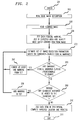
- FIG. 2 Shown in FIG. 2, in flow chart form, is an exemplary implementation of the fiducial marking location and utilization routine.
- the routine is entered in step 201 when it is determined that the registration of an image is to be determined. Typically, this is for purposes of determining the locations of particular predetermined areas of the image. Such a determination may be made automatically, e.g., upon reception of a fascimile transmission by FAX board 105 (FIG. 1). Alternatively, a user could manually make such a determination by entering an appropriate command line at the keyboard of AT&T 6386 Work Group System (WGS) 101 (FIG. 1).
- step 202 a description of the ideally registered image is read into memory 103 (FIG. 1). This description contains at least the positions of the expected fiducial markings and the positions of other areas on the image to be identified. Typically, this description will be stored on DISK 104 (FIG. 1).
- each marking in an image is describable by a set of characteristics that define a marking style.
- Each marking has a predetermined style and the styles for each marking in the image need not be identical.
- One such style might be a bullet, i.e., a filled circle.
- Another such style might be a cross-hair. Therefore, a description of the characteristics of each marking to be found at each location may also be included in the description of an ideally registered image so that different markings of different styles can be employed within one image.
- the data comprising a scanned image is read into memory 103 (FIG. 1) in step 203.
- Data comprising the scanned image may originate from several sources, including without limitation: DISK 104 (FIG. 1), FAX board 105, and optional document scanner 108 (FIG. 1).
- An image for which the locations of particular predetermined areas are to be identified may be supplied from any of several sources.
- an image may be scanned directly into memory, a scanned image may be received via a communications system or an image may be retrieved from a medium of mass storage.
- a predetermined area of the scanned image is searched, in step 204.
- the objective of the search is to find the marking most closely approximating the fiducial marking expected in that area based on a set of predefined characteristics. These characteristics typically include the shape of the expected marking and the expected location.
- the search area is centered on the expected location of the fiducial marking in the ideally registered image.
- the search area is then expanded from this center location by a predetermined amount. Within this search area all markings consisting of connected pixels of a predetermined type are identified. In this example, markings are comprised of black pixels. Thereafter, a candidate marking is selected based on a set of predetermined criteria.
- the marking selected is the marking most closely approximating the expected fiducial marking.
- the determination of the marking most closely approximating the expected fiducial marking makes use of the aspect ratio of the collection of pixels, which should be approximately square, as well as the location of their center of gravity, which should be close to the center of the marking.
- the selected candidate fiducial marking is added to a set of candidate fiducial markings.
- an estimate of a set of image distortion factors relative to the ideally registered image is determined.
- the set of image distortion factors comprises overall image skew, scaling and rotation. Each image distortion factor may be calculated in a subroutine. Such subroutines are invoked in step 205. Routines for computing the overall image skew, scaling and rotation are described below.
- conditional branch point 206 tests if any of the candidate fiducial markings are outside a predetermined tolerance of their expected locations. If the test result in step 206 is YES, control is passed to step 207 which removes at least one marking from the set of candidate fiducial markings. In one implementation, the marking that is furthest from its expected location is removed from the set. Thus, a new current set of candidate fiducial markings is formed. Control is then passed back to step 205 which computes a new set of image distortion factors utilizing the new current set of candidate fiducial markings. If the test result in step 206 is NO, each of the candidate fiducial markings in the current set is within the predetermined tolerance of its expected location. No further elimination of candidate markings need take place. Control is passed to optional step 208 which tests, based on predetermined criteria, if any additional candidate markings should be added to the set of candidate fiducial markings. The test criteria for step 208 are implementation dependent.
- Exemplary test criteria are the exceeding of a predetermined number of passes though the loop including step 208 or achieving a predetermined difference between the ideally registered image and the predicted image.
- These additional candidate markings may be markings that had a probability of being a fiducial marking but were not added to the set of candidate fiducial markings in step 204 or they may be previously rejected markings. Only markings from areas of the image for which there is currently no marking in the set of candidate fiducial markings are considered.
- markings that were previously members of the set of candidate fiducial markings and were removed may be added back to the set of candidate fiducial markings at this step, it is the implementor's responsibility to ensure that the method chosen for selection of the markings to be added and the criteria for determining if markings should be added do not result in an endless loop.
- markings that were previously considered and were removed from the set of candidate fiducial markings are not reconsidered and the number of times step 208 can be executed is limited to the number of expected fiducial markings in the ideally registered image.
- step 208 If the test result in step 208 is YES, control is passed to step 209 which actually adds the selected new candidate fiducial markings to the set of candidate fiducial markings. Control is then passed back to step 205 to calculate a new set of values for the set of image distortion factors. If the test result in step 208 is NO, control is then passed to step 210 in which the location of each area to be determined is computed using the current values of the set of image distortion factors. The routine is then exited via step 211.
- the image scaling relative to the ideally registered image, is computed in a preferred embodiment as follows. Initially, the outermost four (4) located fiducial markings are identified. It is especially important to note that the placement of these markings is not limited to the corners of the image. Rather, wherever the set of fiducial markings are placed on the image, so as to be unobtrusive, the four outermost markings in the scanned image will be identified. These outermost recognized markings are referred to as UPPERLEFT, UPPERRIGHT, LOWERLEFT and LOWERRIGHT. The corresponding locations of the outermost markings in the scanned image are UL, UR, LL and LR.
- IUL corresponding positions of each marking in the ideally registered image
- IUR corresponding positions of each marking in the ideally registered image
- the X coordinate of a point is represented by a ".X” suffix and the Y coordinate of a point is represented by a ".Y” suffix.
- Overall image skew is computed according to an exemplary method outlined in flow chart form in FIG. 3.
- the routine is entered via step 301 from step 205 when it is necessary to compute overall image skew.
- step 302 all the markings in the candidate set of fudicial markings are grouped into a set of pairs comprised of all unique pairings of markings.
- the routine iterates over each pair of markings remaining in the set of pairs.
- IF1 and IF2 refer to each marking of a pair of fiducial markings in the ideal image and SF1 and SF2 refer to each marking of the corresponding pair of fiducial markings in the scanned image.
- Step 303 obtains a first pair to begin calculations with.
- the computed angle difference is added to an angle difference running total in step 305.
- conditional branch point 306 tests to determine if the angle difference has been computed for the last pair of markings from the set of pairs. If the test result in step 306 is NO, control is passed to step 307 which obtains the next pair of markings from the set of pairs and passes control back to step 304.
- step 306 If the test result in step 306 is YES, control is passed to step 308 which computes the overall skew as the average of the angle differences by dividing the running total of angle differences by the number of pairs of markings originally in the set of pairs. The routine is then exited via step 309.
- FIG. 4 Shown, in flow chart form, in FIG. 4 is an exemplary method for computing overall image offset.
- the routine is entered via step 401 from step 205 when it is necessary to compute overall image offset.
- Step 402 obtains a first marking from the set of candidate markings.
- step 403 the X and Y components of the distance from the marking in the set of candidate markings to its corresponding marking in the ideally registered image is computed. Methods for the computation of distance and the components thereof are well known.
- the computed distance components are added to a running total of the X and Y distance components in step 404. Thereafter, conditional branch point 405 tests to determine if the marking just processed is the last marking in the set of candidate markings.
- step 405 If the test result in step 405 is YES, control is passed to step 406 which obtains the next marking from the set of candidate markings and passes control back to step 403. If the test result in step 405 is YES, control is passed to step 407 which computes the average of the offsets by dividing the X and Y running totals by the number of markings in the set of candidate markings. The routine is then exited via step 408.
- the distortion parameters consist of the overall skewing, scaling and offset of the image, as previously described, the X coordinate of the predicted point PP, is computed from the ideal point, IP, according to the following equation in which CENTER is the center point of the scanned image, AO is the overall offset and TMP is a temporary variable to simplify notation.
- TMP.X (AO.X+IP.X*FXATY(IP.Y))
- TMP.Y (AO.Y+IP.Y*FXATY(IP.X))
- PP.X CENTER.X+cos(-SK)*(TMP.X-CENTER.X)-sin(-SK)*(TMP.Y-CENTER.Y)
- the Y coordinate of the predicted point is computed in a similar manner.
- the average offset AO.X can be replaced with a computed offset value CO.X that takes into account a weighted sum of the local variations in the offset values for the fiducial markings.
- CO.X can be computed in accordance with the pseudocode shown in Table 1.
- SUMDIST, DD, TOTDD and TOT.X are temporary variables.
- the Y coordinate of the predicted point is computed in a similar manner.
- One advantage of the invention is the ability to provide robust handling of distortion and noise.
- Another advantage of the invention is that area identification can be accurately performed with any number of fiducial markings at arbitrary but predetermined locations. Consequently, area identification is accurately realized even in situations in which fiducial markings are missing or are unrecognizable
- the preferred minimum number of located fiducial markings is four (4), the method can be employed, using appropriate methods for deriving the set of image distortion parameters, if at least two fiducial markings are located in approximately diagonally opposing areas of the image. In some instances, it is also possible that areas of the image will be similar in appearance to a fiducial marking and therefore any be falsely identified as a fiducial marking.
- One application where this may occur is when a preprinted form is written on by a user to indicate particular selections or to provide user information.
- small fiducial markings are used, so as to be non-obtrusive to the user, the probability of such similarities and false identifications increases. This is especially, so when the fiducial markings are distributed near areas of the surface which are to be marked by the user. Additionally, an advantage of this system is that falsely identified fiducial markings can be eliminated so that processing of the image can continue.
- a further advantage of the invention is that scanned images which contain non-linear distortions that can not be corrected by a single skew and offset correction can be processed correctly by utilizing the localized difference between detected and ideal fiducial marking locations so as to improve the predicted location accuracy in the area of each marking.
Landscapes
- Engineering & Computer Science (AREA)
- Multimedia (AREA)
- Signal Processing (AREA)
- General Physics & Mathematics (AREA)
- Theoretical Computer Science (AREA)
- Physics & Mathematics (AREA)
- Image Processing (AREA)
- Image Input (AREA)
- Facsimile Image Signal Circuits (AREA)
- Editing Of Facsimile Originals (AREA)
- Eye Examination Apparatus (AREA)
- Image Analysis (AREA)
- Length-Measuring Devices Using Wave Or Particle Radiation (AREA)
- Radar Systems Or Details Thereof (AREA)
Applications Claiming Priority (2)
| Application Number | Priority Date | Filing Date | Title |
|---|---|---|---|
| US07/562,292 US5020123A (en) | 1990-08-03 | 1990-08-03 | Apparatus and method for image area identification |
| US562292 | 1995-11-22 |
Publications (3)
| Publication Number | Publication Date |
|---|---|
| EP0469794A2 true EP0469794A2 (de) | 1992-02-05 |
| EP0469794A3 EP0469794A3 (en) | 1992-08-12 |
| EP0469794B1 EP0469794B1 (de) | 1997-03-12 |
Family
ID=24245658
Family Applications (1)
| Application Number | Title | Priority Date | Filing Date |
|---|---|---|---|
| EP91306815A Expired - Lifetime EP0469794B1 (de) | 1990-08-03 | 1991-07-25 | Gerät und Verfahren zur Identifikation von Bildbereichen |
Country Status (8)
| Country | Link |
|---|---|
| US (1) | US5020123A (de) |
| EP (1) | EP0469794B1 (de) |
| JP (1) | JPH07112237B2 (de) |
| KR (1) | KR950006034B1 (de) |
| CA (1) | CA2046258C (de) |
| DE (1) | DE69125067T2 (de) |
| FI (1) | FI913695A7 (de) |
| NO (1) | NO913012L (de) |
Cited By (3)
| Publication number | Priority date | Publication date | Assignee | Title |
|---|---|---|---|---|
| EP0800148A3 (de) * | 1996-04-04 | 1998-11-25 | Hewlett-Packard Company | Bildverarbeitungssystem |
| US7318808B2 (en) | 2001-12-14 | 2008-01-15 | Isis Innovation Limited | Combining measurements from breathing rate sensors |
| US7647185B2 (en) | 2000-06-16 | 2010-01-12 | Oxford Biosignals Limited | Combining measurements from different sensors |
Families Citing this family (15)
| Publication number | Priority date | Publication date | Assignee | Title |
|---|---|---|---|---|
| US5287199A (en) * | 1992-02-27 | 1994-02-15 | At&T Bell Laboratories | Facsimile message processing and routing system |
| US5394483A (en) * | 1992-06-30 | 1995-02-28 | Eastman Kodak Co | Method and apparatus for determining visually perceptible differences between images |
| JP3184630B2 (ja) | 1992-10-21 | 2001-07-09 | キヤノン株式会社 | 画像処理装置 |
| US5748780A (en) * | 1994-04-07 | 1998-05-05 | Stolfo; Salvatore J. | Method and apparatus for imaging, image processing and data compression |
| US5692073A (en) * | 1996-05-03 | 1997-11-25 | Xerox Corporation | Formless forms and paper web using a reference-based mark extraction technique |
| US6741738B2 (en) | 2000-03-13 | 2004-05-25 | Tms, Inc. | Method of optical mark recognition |
| WO2004084139A2 (en) * | 2003-03-14 | 2004-09-30 | Applied Precision, Llc | System and method of non-linear grid fitting and coordinate system mapping |
| US20090015875A1 (en) * | 2007-06-20 | 2009-01-15 | Ctb/Mcgraw-Hill Companies, Inc. | Image manipulation of digitized images of documents |
| US7970228B2 (en) * | 2007-08-30 | 2011-06-28 | Himax Technologies Limited | Image enhancement methods with consideration of the smooth region of the image and image processing apparatuses utilizing the same |
| US20140136962A1 (en) * | 2012-11-12 | 2014-05-15 | Vistaprint Technologies Limited | Method and System for Detecting and Removing Printer Control Marks from Rasterized Image for Placement in Image Container of Document Template |
| CN112782140A (zh) * | 2014-12-03 | 2021-05-11 | 伊索普莱西斯公司 | 细胞分泌特征的分析和筛选 |
| US20200166518A1 (en) | 2016-09-12 | 2020-05-28 | IsoPlexis Corporation | System and methods for multiplexed analysis of cellular and other immunotherapeutics |
| EP4036578A1 (de) | 2016-11-11 | 2022-08-03 | Isoplexis Corporation | Zusammensetzungen und verfahren zur gleichzeitigen genomischen, transkriptomischen und proteomischen analyse von einzelzellen |
| CN110298386B (zh) * | 2019-06-10 | 2023-07-28 | 成都积微物联集团股份有限公司 | 一种基于图像内容的标签自动化定义方法 |
| CN120354869B (zh) * | 2025-03-24 | 2026-01-23 | 广州宇派自动化设备有限公司 | 一种基于图像特征识别的标签位置异常识别方法及系统 |
Family Cites Families (11)
| Publication number | Priority date | Publication date | Assignee | Title |
|---|---|---|---|---|
| US3885229A (en) * | 1972-10-28 | 1975-05-20 | Nippon Electric Co | Document scanning apparatus |
| JPS6033332B2 (ja) * | 1980-07-28 | 1985-08-02 | 日本電信電話株式会社 | フアクシミリを用いた情報入力方式 |
| JPS5887652A (ja) * | 1981-11-19 | 1983-05-25 | Ricoh Co Ltd | 画像処理装置 |
| JPS58103266A (ja) * | 1981-12-15 | 1983-06-20 | Toshiba Corp | 文字画像処理装置 |
| JP2607457B2 (ja) * | 1984-09-17 | 1997-05-07 | 株式会社東芝 | パターン認識装置 |
| EP0195161B1 (de) * | 1985-03-14 | 1993-09-15 | Nikon Corporation | Gerät und Verfahren zum selbsttätigen Inspizieren von Objekten und zum Identifizieren oder Erkennen bekannter und unbekannter Teile davon, einschliesslich Fehler und dergleichen |
| US4668982A (en) * | 1985-06-17 | 1987-05-26 | The Perkin-Elmer Corporation | Misregistration/distortion correction scheme |
| US4773099A (en) * | 1985-10-10 | 1988-09-20 | The Palantir Corporation | Pattern classification means for use in a pattern recognition system |
| US4842370A (en) * | 1986-07-14 | 1989-06-27 | American Telephone And Telegraph Company, At&T Bell Laboratories | Optical spatial logic arrangement |
| US4790028A (en) * | 1986-09-12 | 1988-12-06 | Westinghouse Electric Corp. | Method and apparatus for generating variably scaled displays |
| JP2636866B2 (ja) * | 1988-01-30 | 1997-07-30 | キヤノン株式会社 | 情報処理方法 |
-
1990
- 1990-08-03 US US07/562,292 patent/US5020123A/en not_active Expired - Lifetime
-
1991
- 1991-07-04 CA CA002046258A patent/CA2046258C/en not_active Expired - Fee Related
- 1991-07-25 DE DE69125067T patent/DE69125067T2/de not_active Expired - Fee Related
- 1991-07-25 EP EP91306815A patent/EP0469794B1/de not_active Expired - Lifetime
- 1991-07-31 KR KR1019910013159A patent/KR950006034B1/ko not_active Expired - Fee Related
- 1991-08-02 NO NO91913012A patent/NO913012L/no unknown
- 1991-08-02 JP JP3216456A patent/JPH07112237B2/ja not_active Expired - Fee Related
- 1991-08-02 FI FI913695A patent/FI913695A7/fi unknown
Cited By (4)
| Publication number | Priority date | Publication date | Assignee | Title |
|---|---|---|---|---|
| EP0800148A3 (de) * | 1996-04-04 | 1998-11-25 | Hewlett-Packard Company | Bildverarbeitungssystem |
| US5901253A (en) * | 1996-04-04 | 1999-05-04 | Hewlett-Packard Company | Image processing system with image cropping and skew correction |
| US7647185B2 (en) | 2000-06-16 | 2010-01-12 | Oxford Biosignals Limited | Combining measurements from different sensors |
| US7318808B2 (en) | 2001-12-14 | 2008-01-15 | Isis Innovation Limited | Combining measurements from breathing rate sensors |
Also Published As
| Publication number | Publication date |
|---|---|
| NO913012D0 (no) | 1991-08-02 |
| DE69125067T2 (de) | 1997-10-09 |
| DE69125067D1 (de) | 1997-04-17 |
| FI913695A0 (fi) | 1991-08-02 |
| CA2046258C (en) | 1996-04-30 |
| KR920005593A (ko) | 1992-03-28 |
| FI913695A7 (fi) | 1992-02-04 |
| JPH04306067A (ja) | 1992-10-28 |
| JPH07112237B2 (ja) | 1995-11-29 |
| EP0469794B1 (de) | 1997-03-12 |
| KR950006034B1 (ko) | 1995-06-07 |
| EP0469794A3 (en) | 1992-08-12 |
| CA2046258A1 (en) | 1992-02-06 |
| NO913012L (no) | 1992-02-04 |
| US5020123A (en) | 1991-05-28 |
Similar Documents
| Publication | Publication Date | Title |
|---|---|---|
| EP0469794B1 (de) | Gerät und Verfahren zur Identifikation von Bildbereichen | |
| EP0582548B1 (de) | Verfahren und Vorrichtung zur Bestimmung einer Fehlregistrierung | |
| US4878124A (en) | Image inclination detecting method and apparatus | |
| US6917720B1 (en) | Reference mark, method for recognizing reference marks and method for object measuring | |
| US20010055425A1 (en) | Method and apparatus for monitoring an analog meter | |
| US6721465B1 (en) | Non-contact image reader and system using the same | |
| US5719386A (en) | High efficiency multi-image scan method | |
| WO2001073585A3 (en) | System and method for performing flood zone certifications | |
| US6584224B2 (en) | Template matching using correlative auto-predicative search | |
| KR19990067567A (ko) | 영상에 패턴을 자동으로 위치시키기 위한 벡터상관 시스템 | |
| US5566245A (en) | The performance of a printer or an imaging system using transform-based quality measures | |
| JP2002516440A (ja) | 画像認識および相関システム | |
| US20060126889A1 (en) | Electronic watermark embedding device, electronic watermark detection device, method thereof, and program | |
| KR20170010753A (ko) | 부호의 광학적 검출 방법 | |
| EP0712116A3 (de) | Robustes Verfahren zur Grundfrequenzschätzung und dieses für telefonische Sprache benutzende Vorrichtung | |
| EP0989748A3 (de) | Bildinformationsumwandlung und Videoverarbeitungseinheit | |
| US6115506A (en) | Character recognition method, character recognition apparatus and recording medium on which a character recognition program is recorded | |
| US6734991B1 (en) | Method and apparatus for determining halftone line frequency estimates using MIN/MAX detection | |
| US4242734A (en) | Image corner detector using Haar coefficients | |
| EP1537519B1 (de) | Verfahren und anordnung zur bewertung der qualität von hautabdruckbildern | |
| US6351560B1 (en) | Apparatus, method, and program for locating an objective on a form and a recording medium for recording the program for locating the objective on the form | |
| JP3780181B2 (ja) | 画像処理装置及びデータ処理装置とその方法及び記憶媒体 | |
| US6580805B1 (en) | Method and recognizing music and computer-readable recording medium having music-recognizing program recorded therein | |
| US7386172B2 (en) | Image recognition method | |
| JPH06168331A (ja) | パターンマッチング方法 |
Legal Events
| Date | Code | Title | Description |
|---|---|---|---|
| PUAI | Public reference made under article 153(3) epc to a published international application that has entered the european phase |
Free format text: ORIGINAL CODE: 0009012 |
|
| AK | Designated contracting states |
Kind code of ref document: A2 Designated state(s): DE FR GB IT NL |
|
| PUAL | Search report despatched |
Free format text: ORIGINAL CODE: 0009013 |
|
| AK | Designated contracting states |
Kind code of ref document: A3 Designated state(s): DE FR GB IT NL |
|
| 17P | Request for examination filed |
Effective date: 19930129 |
|
| RAP3 | Party data changed (applicant data changed or rights of an application transferred) |
Owner name: AT&T CORP. |
|
| 17Q | First examination report despatched |
Effective date: 19950221 |
|
| GRAG | Despatch of communication of intention to grant |
Free format text: ORIGINAL CODE: EPIDOS AGRA |
|
| GRAH | Despatch of communication of intention to grant a patent |
Free format text: ORIGINAL CODE: EPIDOS IGRA |
|
| GRAH | Despatch of communication of intention to grant a patent |
Free format text: ORIGINAL CODE: EPIDOS IGRA |
|
| GRAA | (expected) grant |
Free format text: ORIGINAL CODE: 0009210 |
|
| RAP1 | Party data changed (applicant data changed or rights of an application transferred) |
Owner name: NCR INTERNATIONAL INC. |
|
| AK | Designated contracting states |
Kind code of ref document: B1 Designated state(s): DE FR GB IT NL |
|
| ITF | It: translation for a ep patent filed | ||
| REF | Corresponds to: |
Ref document number: 69125067 Country of ref document: DE Date of ref document: 19970417 |
|
| ET | Fr: translation filed | ||
| PLBE | No opposition filed within time limit |
Free format text: ORIGINAL CODE: 0009261 |
|
| STAA | Information on the status of an ep patent application or granted ep patent |
Free format text: STATUS: NO OPPOSITION FILED WITHIN TIME LIMIT |
|
| 26N | No opposition filed | ||
| PGFP | Annual fee paid to national office [announced via postgrant information from national office to epo] |
Ref country code: NL Payment date: 19980731 Year of fee payment: 8 |
|
| PG25 | Lapsed in a contracting state [announced via postgrant information from national office to epo] |
Ref country code: NL Free format text: LAPSE BECAUSE OF NON-PAYMENT OF DUE FEES Effective date: 20000201 |
|
| NLV4 | Nl: lapsed or anulled due to non-payment of the annual fee |
Effective date: 20000201 |
|
| REG | Reference to a national code |
Ref country code: GB Ref legal event code: IF02 |
|
| REG | Reference to a national code |
Ref country code: GB Ref legal event code: 746 Effective date: 20030624 |
|
| REG | Reference to a national code |
Ref country code: FR Ref legal event code: D6 |
|
| PGFP | Annual fee paid to national office [announced via postgrant information from national office to epo] |
Ref country code: GB Payment date: 20040625 Year of fee payment: 14 |
|
| PGFP | Annual fee paid to national office [announced via postgrant information from national office to epo] |
Ref country code: FR Payment date: 20040723 Year of fee payment: 14 |
|
| PG25 | Lapsed in a contracting state [announced via postgrant information from national office to epo] |
Ref country code: IT Free format text: LAPSE BECAUSE OF NON-PAYMENT OF DUE FEES;WARNING: LAPSES OF ITALIAN PATENTS WITH EFFECTIVE DATE BEFORE 2007 MAY HAVE OCCURRED AT ANY TIME BEFORE 2007. THE CORRECT EFFECTIVE DATE MAY BE DIFFERENT FROM THE ONE RECORDED. Effective date: 20050725 Ref country code: GB Free format text: LAPSE BECAUSE OF NON-PAYMENT OF DUE FEES Effective date: 20050725 |
|
| PGFP | Annual fee paid to national office [announced via postgrant information from national office to epo] |
Ref country code: DE Payment date: 20060111 Year of fee payment: 15 |
|
| GBPC | Gb: european patent ceased through non-payment of renewal fee |
Effective date: 20050725 |
|
| PG25 | Lapsed in a contracting state [announced via postgrant information from national office to epo] |
Ref country code: FR Free format text: LAPSE BECAUSE OF NON-PAYMENT OF DUE FEES Effective date: 20060331 |
|
| REG | Reference to a national code |
Ref country code: FR Ref legal event code: ST Effective date: 20060331 |
|
| PG25 | Lapsed in a contracting state [announced via postgrant information from national office to epo] |
Ref country code: DE Free format text: LAPSE BECAUSE OF NON-PAYMENT OF DUE FEES Effective date: 20070201 |