EP0471589A2 - Hartbäre Polysiloxankautschukzusammensetzungen und gehärtete Produkte - Google Patents
Hartbäre Polysiloxankautschukzusammensetzungen und gehärtete Produkte Download PDFInfo
- Publication number
- EP0471589A2 EP0471589A2 EP91307590A EP91307590A EP0471589A2 EP 0471589 A2 EP0471589 A2 EP 0471589A2 EP 91307590 A EP91307590 A EP 91307590A EP 91307590 A EP91307590 A EP 91307590A EP 0471589 A2 EP0471589 A2 EP 0471589A2
- Authority
- EP
- European Patent Office
- Prior art keywords
- composition
- mol
- parts
- units
- group
- Prior art date
- Legal status (The legal status is an assumption and is not a legal conclusion. Google has not performed a legal analysis and makes no representation as to the accuracy of the status listed.)
- Granted
Links
Images
Classifications
-
- C—CHEMISTRY; METALLURGY
- C08—ORGANIC MACROMOLECULAR COMPOUNDS; THEIR PREPARATION OR CHEMICAL WORKING-UP; COMPOSITIONS BASED THEREON
- C08L—COMPOSITIONS OF MACROMOLECULAR COMPOUNDS
- C08L83/00—Compositions of macromolecular compounds obtained by reactions forming in the main chain of the macromolecule a linkage containing silicon with or without sulfur, nitrogen, oxygen or carbon only; Compositions of derivatives of such polymers
- C08L83/04—Polysiloxanes
-
- C—CHEMISTRY; METALLURGY
- C08—ORGANIC MACROMOLECULAR COMPOUNDS; THEIR PREPARATION OR CHEMICAL WORKING-UP; COMPOSITIONS BASED THEREON
- C08G—MACROMOLECULAR COMPOUNDS OBTAINED OTHERWISE THAN BY REACTIONS ONLY INVOLVING UNSATURATED CARBON-TO-CARBON BONDS
- C08G77/00—Macromolecular compounds obtained by reactions forming a linkage containing silicon with or without sulfur, nitrogen, oxygen or carbon in the main chain of the macromolecule
- C08G77/04—Polysiloxanes
- C08G77/12—Polysiloxanes containing silicon bound to hydrogen
-
- C—CHEMISTRY; METALLURGY
- C08—ORGANIC MACROMOLECULAR COMPOUNDS; THEIR PREPARATION OR CHEMICAL WORKING-UP; COMPOSITIONS BASED THEREON
- C08G—MACROMOLECULAR COMPOUNDS OBTAINED OTHERWISE THAN BY REACTIONS ONLY INVOLVING UNSATURATED CARBON-TO-CARBON BONDS
- C08G77/00—Macromolecular compounds obtained by reactions forming a linkage containing silicon with or without sulfur, nitrogen, oxygen or carbon in the main chain of the macromolecule
- C08G77/04—Polysiloxanes
- C08G77/20—Polysiloxanes containing silicon bound to unsaturated aliphatic groups
-
- C—CHEMISTRY; METALLURGY
- C08—ORGANIC MACROMOLECULAR COMPOUNDS; THEIR PREPARATION OR CHEMICAL WORKING-UP; COMPOSITIONS BASED THEREON
- C08G—MACROMOLECULAR COMPOUNDS OBTAINED OTHERWISE THAN BY REACTIONS ONLY INVOLVING UNSATURATED CARBON-TO-CARBON BONDS
- C08G77/00—Macromolecular compounds obtained by reactions forming a linkage containing silicon with or without sulfur, nitrogen, oxygen or carbon in the main chain of the macromolecule
- C08G77/04—Polysiloxanes
- C08G77/22—Polysiloxanes containing silicon bound to organic groups containing atoms other than carbon, hydrogen and oxygen
- C08G77/24—Polysiloxanes containing silicon bound to organic groups containing atoms other than carbon, hydrogen and oxygen halogen-containing groups
-
- C—CHEMISTRY; METALLURGY
- C08—ORGANIC MACROMOLECULAR COMPOUNDS; THEIR PREPARATION OR CHEMICAL WORKING-UP; COMPOSITIONS BASED THEREON
- C08G—MACROMOLECULAR COMPOUNDS OBTAINED OTHERWISE THAN BY REACTIONS ONLY INVOLVING UNSATURATED CARBON-TO-CARBON BONDS
- C08G77/00—Macromolecular compounds obtained by reactions forming a linkage containing silicon with or without sulfur, nitrogen, oxygen or carbon in the main chain of the macromolecule
- C08G77/70—Siloxanes defined by use of the MDTQ nomenclature
Definitions
- This invention relates to curable silicone rubber compositions and cured products thereof. More particularly, it relates to curable silicone rubber compositions containing a novel silicone powder which are amenable to rolling and extrusion and preferably cure into products having improved mechanical properties and a low coefficient of friction or improved sliding on the surface.
- Silicone rubbers have many advantages including heat resistance, weathering resistance, durability, mold release, and electrical properties. They have been molded into different shapes for use in a wide variety of applications as building materials, electric and electronic parts, automobile parts, and business machine parts. In response to the widespread use of automobiles and business machines, silicone rubbers having weathering resistance, heat resistance, mold release, low compression set, and other excellent properties have been used extensively as automobile part materials and business machine (copying machines, printers, etc.) part materials. At present silicone rubbers are essential in these fields of industry. More particularly, silicone rubbers are used in fixing rolls and paper feed rolls in copying and facsimile machines by taking advantage of their nature that they are generally low in surface adherence as compared with other organic rubbers. Also attempts have been made to use silicone rubbers as automobile wipers and weather strips to take advantage of their weatherability.
- Silicone polymers (raw rubbers) are generally loaded with large amounts of silica fillers to provide silicone rubber compositions having good physical properties. With increased silica filler loadings, however, cured silicone rubbers become poor in compression set. Further, since a low molecular organopolysiloxane having a silanol group at either end must be used in a sufficiently large amount to allow much silica filler to be blended, the silicone rubber composition presents a somewhat tacky surface prior to curing so that it is low in roll and extrusion processability.
- the problem addressed herein is to provide novel silicone rubber compositions and methods of making them, and preferably to provide a silicone rubber composition which has improved rolling and extruding properties and cures into products having improved mechanical properties, a low coefficient of friction or smooth sliding on the surface as well as cured products thereof.
- a silicone rubber composition comprising, in admixture,
- a cured product obtained by curing the curable silicone rubber composition is also contemplated.
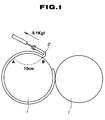
- FIG. 1 schematically illustrates a roll release test in which a silicone rubber compound is drawn from one of two rolls.
- a first essential component (A) in the curable silicone rubber composition of the invention is an organopolysiloxane of the general formula (I). R a SiO (4-a)/2 (I)
- R is a monovalent substituted or unsubstituted hydrocarbon group, preferably having 1 to 10 carbon atoms, more preferably 1 to 8 carbon atoms, provided that 0.0001 to 0.5 mol%, preferably 0.001 to 0.5 mol%, more preferably 0.01 to 0.3 mol% of the entire R groups being an alkenyl group.
- An alkenyl content of less than 0.0001 mol% would cause the organopolysiloxane to cure poorly whereas an alkenyl content of more than 0.5 mol% would result in unsatisfactory cured products.
- hydrocarbon group represented by R examples include alkenyl groups such as vinyl, allyl, butenyl, and hexenyl groups; alkyl groups such as methyl, ethyl, propyl, butyl, pentyl, hexyl, octyl and decyl groups; aryl groups such as phenyl and tolyl groups; aralkyl groups such as benzyl and ⁇ -phenylethyl groups; and substituted ones of these groups in which some or all of the hydrogen atoms attached to backbone carbon atoms are replaced by halogen atoms (e.g., fluorine) and cyano groups, such as 3,3,3-trifluoropropyl and cyanoethyl groups.
- alkenyl groups such as vinyl, allyl, butenyl, and hexenyl groups
- alkyl groups such as methyl, ethyl, propyl, butyl, pentyl,
- the non-alkenyl R group is alkyl group, particularly methyl group. Where low-temperature resistance, radiation resistance and transparency are required, it is preferred to introduce up to 20 mol% of a phenyl group based on the entire R groups. To meet the requirements of oil and gasoline resistance, inclusion of a cyanoethyl and/or 3,3,3-trifluoropropyl group as the R group is recommended.
- letter a is a number of from 1.95 to 2.05. With a values of less than 1.95, it is difficult to synthesize an organopolysiloxane having a degree of polymerization of at least 3,000. With a values of more than 2.05, it is difficult to consistently synthesize an organopolysiloxane having a degree of polymerization of at least 3,000 in a reproducible manner.
- the organopolysiloxane of formula (I) has an average degree of polymerization of at least 3,000, preferably 3,000 to 10,000, more preferably 5,000 to 10,000.
- the organopolysiloxane used herein is usually a linear diorganopolysiloxane consisting essentially of diorganosiloxane units while it may contain minor amounts of triorganosiloxy, monoorganosiloxy, and SiO2 units and be blocked with a hydroxyl or triorganosiloxy unit at its molecular chain end.
- a second essential component (B) of the present composition is a silicone powder containing R13SiOSiO 3/2 and R2SiO 3/2 units.
- R1 and R2 which may be the same or different, are independently selected from a monovalent substituted or unsubstituted hydrocarbon group having 1 to 10 carbon atoms, preferably 1 to 6 carbon atoms, for example, methyl, vinyl, phenyl, and 3,3,3-trifluoropropyl groups.
- the silicone powder contains 80 to 3 mol%, preferably 50 to 5 mol% of R13SiOSiO 3/2 units and 20 to 97 mol%, preferably 50 to 95 mol% of R2SiO 3/2 units based on the entire silicone powder. If more than 80 mol% of R13SiOSiO 3/2 units is present, the resulting silicone powder loses sphericity and provides cured silicone rubber having an increased coefficient of friction. If the R13SiOSiO 3/2 unit content is less than 3 mol%, the resulting silicone powder loses some affinity with the base siloxane and scarcely improves rolling and extruding amenability.
- the silicone powder has a mean particle size of 0.05 to 20 ⁇ m, preferably 0.05 to 10 ⁇ m. Particles with a size of less than 0.05 ⁇ m are difficult to manufacture whereas particles of more than 20 ⁇ m in size are less effective for reinforcement and surface friction reduction.
- the silicone powder used herein may be obtained by slowly adding dropwise silicon reactants R13, SiOSi(OR3)3 and R2Si(OR3)3 wherein R1 and R2 are as defined above, and R3 is an alkyl group having 1 to 4 carbon atoms or an alkoxysubstituted alkyl group having 2 to 6 carbon atoms to an aqueous ammonia, thereby causing hydrolysis and condensation.
- more hydrophobic and more spherical particles are obtained by reacting the silicon reactants with an aqueous solution of an organic carboxylic acid to form a homogeneous solution, and then adding the solution dropwise to an aqueous solution of ammonia or amine (monoethylamine, diethylamine, triethylamine, ethylenediamine, tetramethylethylenediamine, etc.) or an aqueous solution of an alkaline earth metal hydroxide (calcium hydroxide, barium hydroxide, etc.) or alkali metal carbonate (potassium carbonate, sodium carbonate, etc.), thereby causing hydrolysis and condensation.
- the resulting particles have a smaller particle size, a narrower size distribution, and higher hydrophobic nature so that they may impart greater aggregation to the silicone rubber composition to further improve rolling and extruding operations.
- silicone powder (B) 0.5 to 500 parts, especially 1 to 200 parts by weight of silicone powder (B) is blended with 100 parts by weight of organopolysiloxane (A). Less than 0.5 parts by weight of silicone powder (B) would be too small to improve the surface frictional and release properties of silicone rubber whereas in excess of 500 parts by weight of silicone powder (B), the resulting silicone rubber would experience a loss of mechanical strength.
- the silicone rubber compositions of the present invention may be cured in the presence of an organic peroxide catalyst or by utilizing hydrosilation reaction. Therefore, a curing catalyst suitable for a particular curing method should be blended.
- the organic peroxide catalyst system is first described.
- 0.05 to 15 parts by weight of an organic peroxide catalyst is blended per 100 parts by weight of the organopolysiloxane and the composition is heated at 100 to 300°C for 1 minute to 5 hours for curing.
- the organic peroxide catalyst may be any desired one of such catalysts commonly used for peroxide curing type silicone rubbers, for example, benzoyl peroxide, bis(2,4-dichlorobenzoyl) peroxide, di-t-butyl peroxide, 2,5-dimethyl-di-t-butylperoxyhexane, t-butylperbenzoate, t-butylperoxyisopropylcarbonate, and dicumyl peroxide alone or in admixture of two or more.
- benzoyl peroxide bis(2,4-dichlorobenzoyl) peroxide
- di-t-butyl peroxide 2,5-dimethyl-di-t-butylperoxyhexane
- t-butylperbenzoate 2,5-dimethyl-di-t-butylperoxyhexane
- t-butylperbenzoate t-butylperoxyisopropyl
- the preferred curing agent is a combination of an organohydrogenpolysiloxane and a platinum group metal catalyst.
- the organohydrogenpolysiloxane may be selected from linear, cyclic and branched organopolysiloxanes having two or more SiH groups in a molecule.
- the preferred organohydrogenpolysiloxane may have the following general formula: wherein R3 represents a substituted or unsubstituted monovalent hydrocarbon group having 1 to 10 carbon atoms such as an alkyl group and an aryl group, and 0 ⁇ b ⁇ 3, 0.005 ⁇ c ⁇ 1.0 and 0.8 ⁇ b + c ⁇ 3.
- the SiH groups may be attached to the polysiloxane chain at its terminal or at any intermediate positions.
- the organohydrogenpolysiloxane is preferably used in such amounts to give 0.5 to 5 mol, especially 1 to 3 mol of SiH group per mol of the alkenyl group of organopolysiloxane (A).
- the platinum group metal catalyst used at the same time is to catalyze the hydrosilation of an alkenyl group in organopolysiloxane (A) with an SiH group in the organohydrogenpolysiloxane.
- the catalyst is used in an amount of 0.1 to 1,000 parts, especially 1 to 100 parts by weight per million parts by weight of the organopolysiloxane (A) and the organohydrogenpolysiloxane combined, calculated as elemental platinum.
- Suitable platinum group metal catalysts are powder metallic platinum catalysts as disclosed in U.S. Patent No. 2,970,150 (Bailey), chloroplatinic acid catalysts as disclosed in U.S. Patent No. 2,823,218 (Sperier et al.), platinum-hydrocarbon complexes as disclosed in U.S. Patent Nos. 3,159,601 (Ashby) and 3,159,662, chloroplatinic acid-olefin complexes as disclosed in U.S. Patent No. 3,516,946, platinum-vinyl siloxane complexes as disclosed in U.S. Patent Nos. 3,775,452 (Karstedt) and 3,814,780, and the like.
- a reaction control agent such as methylvinylcyclotetrasiloxane and acetylene alcohol may be added for maintaining shelf stability at room temperature and obtaining an appropriate pot life.
- hydrosilation curing is accomplished by heating at a temperature of 60 to 400°C for 1 minute to 5 hours.
- compositions may further contain additives and fillers commonly used in silicone rubbers.
- fillers include fumed silica, precipitated silica, ground silica, diatomaceous earth, iron oxide, zinc oxide, titanium oxide, carbon black, barium oxide, magnesium oxide, cerium hydroxide, calcium carbonate, magnesium carbonate, zinc carbonate, asbestos, glass wool, pulverized mica, and fused silica powder.
- Other useful additives are pigments, dyes, antioxidants, antistatic agents, flame retardants (e.g., antimony oxide and chlorinated paraffin), heat conduction modifiers (e.g., boron nitride and aluminum oxide), reaction control agents, mold release agents, and filler dispersants.
- Exemplary of the filler dispersants are diphenylsilane diol, various alkoxysilanes, carbon functional silanes, and silanol-containing monomeric siloxanes.
- curable silicone rubber compositions which cure into products having improved mechanical properties, smooth surface release, and a low coefficient of friction on the surface so that they are best suited in applications where release and low friction features are required, for example, fixing and paper feed rollers in copying and facsimile machines, wipers and weather strips in automobiles, and the like. Due to increased aggregating force, the silicone rubber compositions were found to be amenable to rolling and extruding operations so that they are useful as extrusion molded parts such as building gaskets, facsimile machine rolls, medical tubes and the like. The compositions will also find applications as rubber contacts, nipples, even speed joint boots, plug boots, anode caps, electrical cables, and the like.
- a silicone rubber composition II was obtained by the same procedure as above, but using instead of silicone powder I, 30 parts a silicone powder II consisting of 100 mol% of CH3SiO 3/2 units and having a mean particle size of 1.0 ⁇ m.
- compositions I and II were examined for roll release by the following test.
- a twin roll mill is shown in FIG. 1 as comprising two rolls 1 and 1 having a diameter of 6 inches and spaced 2 mm from each other.
- Each of compositions I and II 100 grams, was milled for 3 minutes between the rolls, deaerated for 1 minute, and then kept there for 3 minutes while rotating the rolls. After the rolls ceased to rotate, a milled compound layer 2 was drawn with a force of 0.1 kgf in a tangential direction to the roll surface. The time taken to peel the compound layer over an arc A-B of 10 cm was measured. The shorter the peeling time, the greater is the roll release.
- compositions I and II 100 grams, was blended with 0.5 grams of 2,5-dimethyl-2,5-di-t-butylperoxyhexane by means of a twin roll mill at room temperature, dispensed, press cured at 165°C for 10 minutes, and post cured at 200°C for 4 hours, obtaining a rolled sheet.
- the sheet was measured for coefficient of dynamic friction on the surface according to ASTM D-1894-78 and for mechanical properties according to JIS K-6301.
- Example 1 a silicone rubber composition having an organopolysiloxane of formula (I) blended with a specific silicone powder within the scope of the invention (Example 1) is smoothly released from the milling rolls and cures into a product having good mechanical properties and a low coefficient of friction as compared with a silicone rubber composition having a different silicone powder blended (Comparative Example 1).
- Silicone rubber compositions III to VI were obtained by adding 20 parts of different silicone fine powders to 100 parts of base compound A and milling the mixtures by means of a kneader.
- Silicone rubber composition VII was obtained by adding 20 parts of silicone powder VII to 100 parts of base compound A and milling the mixture by means of a kneader.
- compositions III to VII To 100 parts of each of compositions III to VII were added 0.03 parts of an octyl alcohol modified solution of chloroplatinic acid (platinum 1 wt%), 0.25 parts of 1,3,5,7-tetramethyl-1,3,5,7-tetravinylcyclotrisiloxane, and 1.20 parts of a crosslinking agent of the following average structural formula.
- the blends were press vulcanized at 170°C for 10 minutes, post vulcanized at 200°C for 4 hours, and then measured for coefficient of dynamic friction on the surface according to ASTM D-1894-78 and for mechanical properties according to JIS K-6301.
- Each of the compounds III to VII having the vulcanizing agents added thereto was fed to an extruder equipped with a cylinder having a diameter of 40 mm and a length-to-diameter L/D ratio of 12 and a die having an orifice diameter of 10 mm and continuously extruded at room temperature (15-30°C) into a rod having an outer diameter of 8 mm at a rate of 1 m/min.
- the extruded silicone rubber rod was passed at a rate of 1 m/min. through a heating oven having an overall length of 2 m where hot air at 300°C was circulated.
- Extrusion moldability was evaluated "Pass" when the extrudate maintained its shape so that a cylindrical molded rod was obtained and "Rejected" when the extrudate could not maintain its shape, failing to produce a molded rod.
Landscapes
- Chemical & Material Sciences (AREA)
- Health & Medical Sciences (AREA)
- Chemical Kinetics & Catalysis (AREA)
- Medicinal Chemistry (AREA)
- Polymers & Plastics (AREA)
- Organic Chemistry (AREA)
- Compositions Of Macromolecular Compounds (AREA)
Applications Claiming Priority (2)
| Application Number | Priority Date | Filing Date | Title |
|---|---|---|---|
| JP21576390A JPH0791473B2 (ja) | 1990-08-17 | 1990-08-17 | 硬化性シリコーンゴム組成物及び硬化物 |
| JP215763/90 | 1990-08-17 |
Publications (3)
| Publication Number | Publication Date |
|---|---|
| EP0471589A2 true EP0471589A2 (de) | 1992-02-19 |
| EP0471589A3 EP0471589A3 (en) | 1992-06-03 |
| EP0471589B1 EP0471589B1 (de) | 1995-11-15 |
Family
ID=16677827
Family Applications (1)
| Application Number | Title | Priority Date | Filing Date |
|---|---|---|---|
| EP19910307590 Expired - Lifetime EP0471589B1 (de) | 1990-08-17 | 1991-08-16 | Hartbäre Polysiloxankautschukzusammensetzungen und gehärtete Produkte |
Country Status (3)
| Country | Link |
|---|---|
| EP (1) | EP0471589B1 (de) |
| JP (1) | JPH0791473B2 (de) |
| DE (1) | DE69114604T2 (de) |
Cited By (2)
| Publication number | Priority date | Publication date | Assignee | Title |
|---|---|---|---|---|
| EP0903385A1 (de) * | 1997-09-19 | 1999-03-24 | General Electric Company | Silikontrennschichtformulierungen mit niedrigem Reibungskoeffizienten |
| EP1384765A1 (de) * | 2002-07-25 | 2004-01-28 | Shin-Etsu Chemical Co., Ltd. | Silikonbeschichtungszusammensetzung und Trennfolie |
Families Citing this family (8)
| Publication number | Priority date | Publication date | Assignee | Title |
|---|---|---|---|---|
| US5283927A (en) * | 1991-05-31 | 1994-02-08 | Jmk International, Inc. | Silicon rubber wiper blade with low coefficient of friction |
| GB9114526D0 (en) * | 1991-07-05 | 1991-08-21 | Dow Corning Sa | Compositions and use thereof |
| JP2748215B2 (ja) * | 1993-05-20 | 1998-05-06 | 信越化学工業株式会社 | シリコーンゴムロール |
| US6423417B1 (en) | 2000-05-24 | 2002-07-23 | Reynolds Metals Company | Non-stick polymer coated aluminum foil |
| US6544658B2 (en) | 2000-05-24 | 2003-04-08 | Reynolds Metals Company | Non-stick polymer coated aluminum foil |
| JP4553562B2 (ja) * | 2003-06-30 | 2010-09-29 | モメンティブ・パフォーマンス・マテリアルズ・ジャパン合同会社 | 接着性ポリオルガノシロキサン組成物 |
| JP4660182B2 (ja) * | 2004-12-20 | 2011-03-30 | 東レ・ダウコーニング株式会社 | 活性化エネルギー線硬化性シリコーン組成物及びそれを用いたネガ型パターン形成方法 |
| KR101505069B1 (ko) * | 2014-01-29 | 2015-03-23 | 주식회사 아이넴 | 치아 교정 장치용 고무 조성물 및 이를 이용한 치아 교정 장치용 고무 제조방법 |
Family Cites Families (4)
| Publication number | Priority date | Publication date | Assignee | Title |
|---|---|---|---|---|
| US3832420A (en) * | 1973-09-20 | 1974-08-27 | Dow Corning | Silicone elastomer containing polymonomethylsiloxane |
| JPH01185367A (ja) * | 1988-01-18 | 1989-07-24 | Toshiba Silicone Co Ltd | 表面処理されたポリメチルシルセスキオキサン粉末の製造方法 |
| JPH0655828B2 (ja) * | 1988-12-15 | 1994-07-27 | 信越化学工業株式会社 | 表面変性ポリメチルシルセスキオキサン球状微粒子及びその製造方法 |
| JPH0699634B2 (ja) * | 1989-09-28 | 1994-12-07 | 信越化学工業株式会社 | 熱硬化型シリコーンゴム組成物 |
-
1990
- 1990-08-17 JP JP21576390A patent/JPH0791473B2/ja not_active Expired - Fee Related
-
1991
- 1991-08-16 EP EP19910307590 patent/EP0471589B1/de not_active Expired - Lifetime
- 1991-08-16 DE DE1991614604 patent/DE69114604T2/de not_active Expired - Fee Related
Cited By (3)
| Publication number | Priority date | Publication date | Assignee | Title |
|---|---|---|---|---|
| EP0903385A1 (de) * | 1997-09-19 | 1999-03-24 | General Electric Company | Silikontrennschichtformulierungen mit niedrigem Reibungskoeffizienten |
| US5942557A (en) * | 1997-09-19 | 1999-08-24 | General Electric Company | Low coefficient of friction silicone release formulations |
| EP1384765A1 (de) * | 2002-07-25 | 2004-01-28 | Shin-Etsu Chemical Co., Ltd. | Silikonbeschichtungszusammensetzung und Trennfolie |
Also Published As
| Publication number | Publication date |
|---|---|
| DE69114604D1 (de) | 1995-12-21 |
| JPH0791473B2 (ja) | 1995-10-04 |
| EP0471589A3 (en) | 1992-06-03 |
| DE69114604T2 (de) | 1996-06-20 |
| EP0471589B1 (de) | 1995-11-15 |
| JPH04100861A (ja) | 1992-04-02 |
Similar Documents
| Publication | Publication Date | Title |
|---|---|---|
| US5519082A (en) | Curable silicone rubber composition and method for preparing silicone rubber | |
| JP3106901B2 (ja) | 硬化性シリコーンゴム組成物及びシリコーンゴムの製造方法 | |
| JPH0514742B2 (de) | ||
| JP3109404B2 (ja) | シリコーンゴムコンパウンドの製造方法 | |
| EP0618271B1 (de) | Siloxankautschukzusammensetzung | |
| US5925709A (en) | Method for the preparation of silicone rubber | |
| JPH0420569A (ja) | シリコーンゴム組成物およびその製造方法 | |
| EP0471589B1 (de) | Hartbäre Polysiloxankautschukzusammensetzungen und gehärtete Produkte | |
| JP3077496B2 (ja) | シリコーンゴム組成物 | |
| JP2000248183A (ja) | シリコーンゴム組成物 | |
| JP2697523B2 (ja) | オイルブリード性シリコーンゴム組成物及びその硬化物 | |
| JP2001342347A (ja) | 押出成形用シリコーンゴム組成物およびシリコーンゴム押出成形品の製造方法 | |
| JPH0791474B2 (ja) | シリコーンゴム組成物及び硬化物 | |
| US5306766A (en) | Low hardness silicone rubber compositions | |
| JP2630169B2 (ja) | シリコーンゴム組成物及びその硬化物 | |
| JP3482834B2 (ja) | シリコーンゴムの製造方法 | |
| JP2853539B2 (ja) | シリコーンゴム組成物 | |
| JP2515857B2 (ja) | ロ―ル用ポリオルガノシロキサン組成物 | |
| US5563203A (en) | Silicone rubber compositions and cured products thereof | |
| JP2004075813A (ja) | オイルブリード性シリコーンゴム組成物及びその製造方法 | |
| JPH0525393A (ja) | 導電性シリコーンゴム組成物及び導電性シリコーンゴム | |
| JP3198835B2 (ja) | 押出し成型用シリコーンゴム組成物 | |
| JP4528392B2 (ja) | シリコーンゴム組成物およびその製造方法 | |
| JP2002129017A (ja) | 押出成形用シリコーンゴム組成物およびシリコーンゴム押出成形品の製造方法 | |
| JPH06256658A (ja) | シリコーンゴム組成物及びその硬化物 |
Legal Events
| Date | Code | Title | Description |
|---|---|---|---|
| PUAI | Public reference made under article 153(3) epc to a published international application that has entered the european phase |
Free format text: ORIGINAL CODE: 0009012 |
|
| AK | Designated contracting states |
Kind code of ref document: A2 Designated state(s): DE FR GB |
|
| PUAL | Search report despatched |
Free format text: ORIGINAL CODE: 0009013 |
|
| AK | Designated contracting states |
Kind code of ref document: A3 Designated state(s): DE FR GB |
|
| 17P | Request for examination filed |
Effective date: 19920709 |
|
| 17Q | First examination report despatched |
Effective date: 19940126 |
|
| GRAA | (expected) grant |
Free format text: ORIGINAL CODE: 0009210 |
|
| AK | Designated contracting states |
Kind code of ref document: B1 Designated state(s): DE FR GB |
|
| REF | Corresponds to: |
Ref document number: 69114604 Country of ref document: DE Date of ref document: 19951221 |
|
| ET | Fr: translation filed | ||
| PG25 | Lapsed in a contracting state [announced via postgrant information from national office to epo] |
Ref country code: GB Effective date: 19960816 |
|
| PLBE | No opposition filed within time limit |
Free format text: ORIGINAL CODE: 0009261 |
|
| STAA | Information on the status of an ep patent application or granted ep patent |
Free format text: STATUS: NO OPPOSITION FILED WITHIN TIME LIMIT |
|
| 26N | No opposition filed | ||
| GBPC | Gb: european patent ceased through non-payment of renewal fee |
Effective date: 19960816 |
|
| PG25 | Lapsed in a contracting state [announced via postgrant information from national office to epo] |
Ref country code: FR Effective date: 19970430 |
|
| PG25 | Lapsed in a contracting state [announced via postgrant information from national office to epo] |
Ref country code: DE Effective date: 19970501 |
|
| REG | Reference to a national code |
Ref country code: FR Ref legal event code: ST |