EP0474596B1 - Colorants réactifs, procédé de leur préparation et leur utilisation - Google Patents
Colorants réactifs, procédé de leur préparation et leur utilisation Download PDFInfo
- Publication number
- EP0474596B1 EP0474596B1 EP91810683A EP91810683A EP0474596B1 EP 0474596 B1 EP0474596 B1 EP 0474596B1 EP 91810683 A EP91810683 A EP 91810683A EP 91810683 A EP91810683 A EP 91810683A EP 0474596 B1 EP0474596 B1 EP 0474596B1
- Authority
- EP
- European Patent Office
- Prior art keywords
- formula
- radical
- substituted
- sulfo
- hydroxyl
- Prior art date
- Legal status (The legal status is an assumption and is not a legal conclusion. Google has not performed a legal analysis and makes no representation as to the accuracy of the status listed.)
- Expired - Lifetime
Links
- 0 CNc1nc(*)nc(N)n1 Chemical compound CNc1nc(*)nc(N)n1 0.000 description 14
Classifications
-
- C—CHEMISTRY; METALLURGY
- C09—DYES; PAINTS; POLISHES; NATURAL RESINS; ADHESIVES; COMPOSITIONS NOT OTHERWISE PROVIDED FOR; APPLICATIONS OF MATERIALS NOT OTHERWISE PROVIDED FOR
- C09B—ORGANIC DYES OR CLOSELY-RELATED COMPOUNDS FOR PRODUCING DYES, e.g. PIGMENTS; MORDANTS; LAKES
- C09B62/00—Reactive dyes, i.e. dyes which form covalent bonds with the substrates or which polymerise with themselves
- C09B62/44—Reactive dyes, i.e. dyes which form covalent bonds with the substrates or which polymerise with themselves with the reactive group not directly attached to a heterocyclic ring
- C09B62/503—Reactive dyes, i.e. dyes which form covalent bonds with the substrates or which polymerise with themselves with the reactive group not directly attached to a heterocyclic ring the reactive group being an esterified or non-esterified hydroxyalkyl sulfonyl or mercaptoalkyl sulfonyl group, a quaternised or non-quaternised aminoalkyl sulfonyl group, a heterylmercapto alkyl sulfonyl group, a vinyl sulfonyl or a substituted vinyl sulfonyl group, or a thiophene-dioxide group
- C09B62/5033—Dioxazine dyes
Definitions
- Reactive dyes have long been used extensively for dyeing and printing textiles made from fiber materials, and today there is a large number of useful reactive dyes with different properties and for different areas of application; see e.g. EP-A-0 179 019, EP-A-0 309 406 and DE-A-39 35 583.
- EP-A-0 179 019 EP-A-0 309 406
- DE-A-39 35 583 the technical status achieved is often not fully satisfactory.
- the present invention had for its object to find new improved reactive dyes which have a high reactivity and good build-up ability, which can be dyed with a high fixation yield, which are particularly suitable for the dyeing process, and which are wet and lightfast on cellulose-containing fiber material Colorings result.
- the invention relates to reactive dyes of the formula wherein R1 and R2 are hydrogen, chlorine, bromine, C1-C4-alkyl, C1-C4-alkoxy or optionally substituted phenyl or optionally substituted phenoxy, (R) n represents n substituents R which are independently C1-C4-alkyl, C1-C4 alkoxy, halogen, sulfo, carboxy, carbamoyl, N-C1-C4-alkylcarbamoyl, N, N-di-C1-C4-alkylcarbamoyl, C1-C4-alkylsulfonyl, sulfamoyl, N-C1-C4-alkylsulfamoyl or N, N-Di-C1-C4-alkylsulfamoyl can be, W hydroxy or C1-C6-alkyl, which is substituted by hydroxy, carboxy, s
- Similar dyes are known from DE-A 39 35 583, which differ characteristically from the dyes according to the invention in that the radical A is an amine containing a fiber-reactive group.
- C1-C4 alkyl examples include: Methyl, ethyl, n-propyl, isopropyl, n-butyl, sec-butyl, isobutyl and tert-butyl.
- C1-C6 alkyl for W comes e.g. into consideration: methyl, ethyl, propyl, isopropyl, butyl, n-pentyl and n-hexyl, where the radicals can be substituted as indicated.
- Examples of suitable C1-C4 alkoxy for R1 and R2 are: methoxy, ethoxy, n-propoxy, Isopropoxy, n-butoxy, sec-butoxy, isobutoxy and tert-butoxy.
- R1 and R2 represent a phenyl radical or a phenoxy radical
- this radical can be further substituted, e.g. by halogen, such as fluorine, chlorine or bromine, C1-C4-alkyl, such as methyl, ethyl, propyl, isopropyl or butyl, C1-C4-alkoxy, such as methoxy or ethoxy, nitro, carboxy and sulfo.
- halogen such as fluorine, chlorine or bromine
- C1-C4-alkyl such as methyl, ethyl, propyl, isopropyl or butyl
- C1-C4-alkoxy such as methoxy or ethoxy, nitro, carboxy and sulfo.
- Possible substituents R are e.g. Methyl, ethyl, propyl, isopropyl, butyl, isobutyl, sec-butyl, tert-butyl, methoxy, ethoxy, propyloxy, isopropyloxy, butyloxy, isobutyloxy, sec-butyloxy, tert-butyloxy, fluorine, chlorine, bromine, Carboxy, carbamoyl, N-methylcarbamoyl, N-ethylcarbamoyl, N, N-dimethylcarbamoyl, N, N-diethylcarbamoyl, methylsulfonyl, ethylsulfonyl, sulfamoyl, N-methylsulfamoyl, N-ethylsulfamoyl, N-dimethylsulfamoyloyl and N.
- a C1-C4-alkyl for B1, B2 and R3 independently of one another is a straight-chain or branched alkyl radical, which can also be substituted, e.g. by halogen, hydroxy, cyan, sulfo or sulfato.
- Examples include: methyl, ethyl, propyl, isopropyl, butyl, isobutyl, sec-butyl, tert-butyl, ⁇ -chloroethyl, ⁇ -hydroxyethyl, ⁇ -hydroxybutyl, ⁇ -cyanoethyl, sulfomethyl, ⁇ -sulfoethyl and ⁇ -Sulfatoethyl.
- the bridge link E can be straight-chain or branched and, as indicated above, can be further substituted.
- Examples of E are: ethylene, 1,2- and 1,3-propylene, 2-hydroxy-1,3-propylene, 1- and 2-phenyl-1,3-propylene, 2- (4'-sulfophenyl ) -1,3-propylene, 1,4-, 2,3- and 2,4-butylene, 2-methyl-1,3-propylene, 1-chloro-2,3-propylene, 2,3-diphenyl- 1,4-butylene, 1,3-cyclohexylene, 1,4-cyclohexylene, 4-methyl-1,3-cyclohexylene, 2-methyl-1,3-cyclohexylene, 5,5-dimethyl-1,3-cyclohexylene, 2-methyl-1,4-cyclohexylene, 4,6-dimethyl-1,3-cyclohexylene, 4-methyl-1,2-cyclohexylene; or the radical -N
- amino groups A are: -NH2, alkylamino, N, N-dialkylamino, cycloalkylamino, N, N-dicycloalkylamino, aralkylamino, arylamino groups, mixed substituted amino groups, such as N-alkyl-N-cyclohexylamino and N-alkyl-N-arylamino groups, furthermore amino groups which contain heterocyclic radicals which may have further fused-on carbocyclic rings, and amino groups in which the amino nitrogen atom is a member of an N-heterocyclic ring which optionally contains further heteroatoms.
- alkyl radicals mentioned above can be straight-chain or be branched, low molecular weight or higher molecular weight, alkyl radicals having 1 to 6 carbon atoms are preferred; suitable cycloalkyl, aralkyl and aryl radicals are, in particular, cyclohexyl, benzyl, phenethyl, phenyl and naphthyl radicals; heterocyclic radicals are especially furan, thiophene, pyrazole, pyridine, pyrimidine, quinoline, benzimidazole, benzothiazole and benzoxazole; and as amino groups in which the amino nitrogen atom is a member of an N-heterocyclic ring, preference is given to residues of six-membered N-heterocyclic compounds which may contain nitrogen, oxygen and sulfur as further heteroatoms.
- alkyl, cycloalkyl, aralkyl and aryl radicals, the heterocyclic radicals and the N-heterocyclic rings can be further substituted, for example by: halogen, such as fluorine, chlorine and bromine, nitro, cyano, trifluoromethyl, sulfamoyl, carbamoyl, C1 -C4 alkyl, C1-C4 alkoxy, acylamino groups such as acetylamino, ureido, hydroxy, carboxy, sulfomethyl, sulfo and sulfato.
- halogen such as fluorine, chlorine and bromine, nitro, cyano, trifluoromethyl
- sulfamoyl carbamoyl
- C1 -C4 alkyl C1-C4 alkoxy
- acylamino groups such as acetylamino, ureido, hydroxy, carboxy, sulf
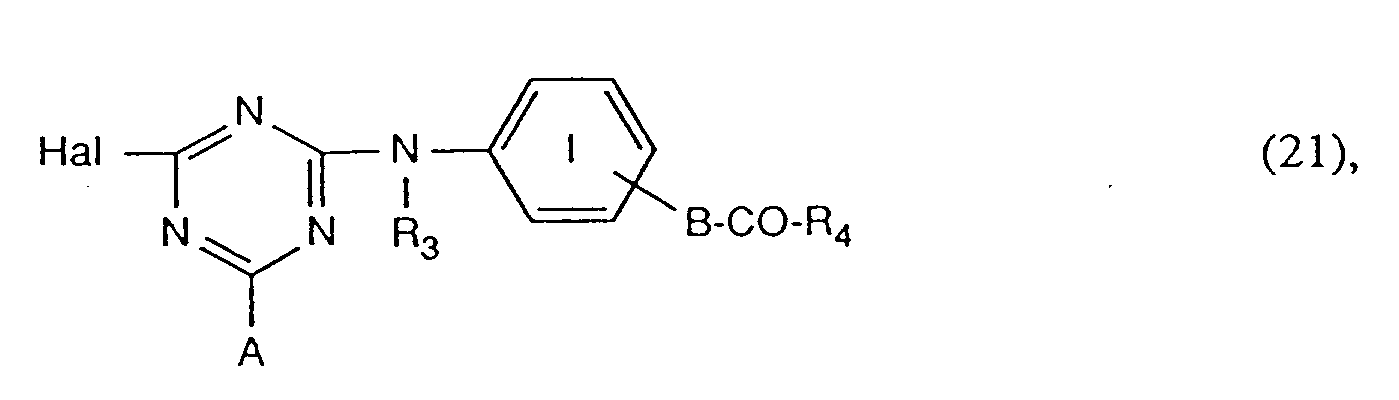
- amines A1 which are the rest of the formula or one of the radicals of the formulas (2a) to (2f), in which R3, B, R4 and Z have the meanings given under the formulas (2) and (3), and in which the benzene ring I and the benzene or Naphthalene ring II may contain other substituents.
- amino radical A examples include: -NH2, methylamino, ethylamino, propylamino, isopropylamino, butylamino, hexylamino, ⁇ -methoxyethylamino, ⁇ -methoxypropylamino, ⁇ -ethoxyethylamino, N, N-dimethylamino, N, N-diethylamino, ⁇ - Chloroethylamino, ⁇ -cyanoethylamino, ⁇ -cyanopropylamino, ⁇ -carboxyethylamino, sulfomethylamino, ⁇ -sulfoethylamino, ⁇ -hydroxyethylamino, N, N-di- ⁇ -hydroxyethylamino, ⁇ -hydroxypropylamino, benzylamino, phenethylamino, cyclohexylamino, N-methyl-N
- the radical B contains 1 to 6, preferably 1 to 4, carbon atoms; Examples of B are: methylene, ethylene, propylene, butylene, methyleneoxy, ethyleneoxy, propyleneoxy and butyleneoxy. If B is a remainder represents, B is bonded to the benzene ring through the oxygen atom. B is preferably the direct bond.
- the ⁇ -halogenoethyl for Z is in particular the ⁇ -chloroethyl radical and the ⁇ -acyloxyethyl in particular the ⁇ -acetoxyethyl radical.
- the alkylene radical alk is preferably methylene, ethylene, methylmethylene, propylene or butylene.
- the substituent T is in particular acetyloxy, propionyloxy or butyryloxy, and as an alkoxycarbonyl radical in particular methoxycarbonyl, ethoxycarbonyl or propyloxycarbonyl.
- V is an alkyl radical, this can be methyl, ethyl, propyl, isopropyl, butyl, isobutyl, sec-butyl or tert-butyl.
- Derivatives of the carboxy or sulfo group are, for example, carbamoyl, N-methyl, N-ethyl, N, N-dimethyl and N, N-diethylcarbamoyl, cyano, acetyl, propionyl, butyryl, methoxycarbonyl, ethoxycarbonyl, propyloxycarbonyl, sulfamoyl, N.
- the radical R3 is, for example, methyl, ethyl, propyl, isopropyl, butyl, isobutyl, sec-butyl, tert-butyl, pentyl or hexyl, or preferably hydrogen.
- the polymethylene residues alk ' are preferably ethylene, propylene or butylene.
- the indices p, q and t are independent of one another and preferably 2, 3 or 4.
- the indices r and s are independent of one another preferably 2.
- the radical of the formula (2b) preferably has the formula wherein Z and Z 'independently of one another are ⁇ -sulfoethyl, ⁇ -thiosulfatoethyl, ⁇ -phosphatoethyl, ⁇ -acyloxyethyl, ⁇ -halogenoethyl or vinyl.
- Z Z '
- Z or Z' has the meaning given above; in particular Z or Z 'is ⁇ -sulfoethyl, ⁇ -chloroethyl or vinyl.
- the benzene ring 1 and the benzene or naphthalene ring II can contain further substituents.
- alkyl groups with 1 to 4 carbon atoms such as methyl, ethyl, propyl, isopropyl or butyl
- alkoxy groups with 1 to 4 carbon atoms such as methoxy, ethoxy, propoxy, isopropoxy or butoxy
- acylamino groups with 1 to 8 carbon atoms in particular alkanoylamino groups, such as acetylamino, propionylamino or benzoylamino, phenylamino, N, N-di- ⁇ -hydroxyethylamino, N, N-di- ⁇ -sulfatoethylamino, sulfobenzylamino, N, N-disulfobenzylamino, alkoxycarbonyl having 1 to 4 carbon atoms in the alkoxy radical such as methoxycarbonyl or ethoxycarbonyl, alkylsulfonyl having 1 to 4 carbon atom
- Preferred substituents are especially methyl, ethyl, methoxy, ethoxy, acetylamino, benzoylamino, amino, chlorine, bromine, ureido, hydroxy, carboxy, sulfomethyl or sulfo.
- X1 is a radical of the formula (2) or (3)
- A1 is a radical of the formula wherein R3, B, R4 and Z have the meanings given under the formulas (2) and (3)
- the radicals of the formulas (4) and (5) being independent of the analogous radicals in the formulas (2) and (3) are
- the benzene ring 1 and the benzene or naphthalene ring II may contain further substituents
- X2 is the group -NH2.
- the reactive dyes of the formula (1) in which X1 and X2 are each independently a radical of the formula (2), and in which A is a radical of the formula (4), in which R3, B and R4 are those of the formula ( 2) have the meanings given and the benzene ring I may contain further substituents, the rest of the formula (4) being independent of the analogue rest of the formula (2).
- X1 is a radical of the formula (2), A -NH2, C1-C4-alkylamino, which can be substituted by C1-C4-alkoxy, hydroxy, sulfo or sulfato, N , N-Di-C1-C4-alkylamino, which may be substituted by hydroxy, phenylamino, which may be substituted by C1-C4-alkyl, C1-C4-alkoxy, halogen, hydroxy, ureido, acetylamino, carboxy, sulfo or sulfomethyl , N-C1-C4-alkyl-N-phenylamino, which in the alkyl radical by halogen, cyano, hydroxy, carboxy, sulfo or sulfato and in the phenyl radical by C1-C4-alkyl, C1-C4-alk
- X1 is a radical of the formula (3a)
- B1, B2, E and Y have the meanings given under formula (3a) and A -NH2
- C1-C4-alkylamino which can be substituted by C1-C4-alkoxy, hydroxy, sulfo or sulfato
- N, N-di-C1-C4-alkylamino which can be substituted by hydroxy
- phenylamino which is substituted by C1-C4-alkyl
- halogen, hydroxy, ureido, acetylamino, carboxy, sulfo or sulfomethyl may be substituted, N-C1-C4-alkyl-N-phenylamino, which in the alkyl radical by halogen, cyano, hydroxy, carboxy, sulfo or sulfato and in the phenyl radical
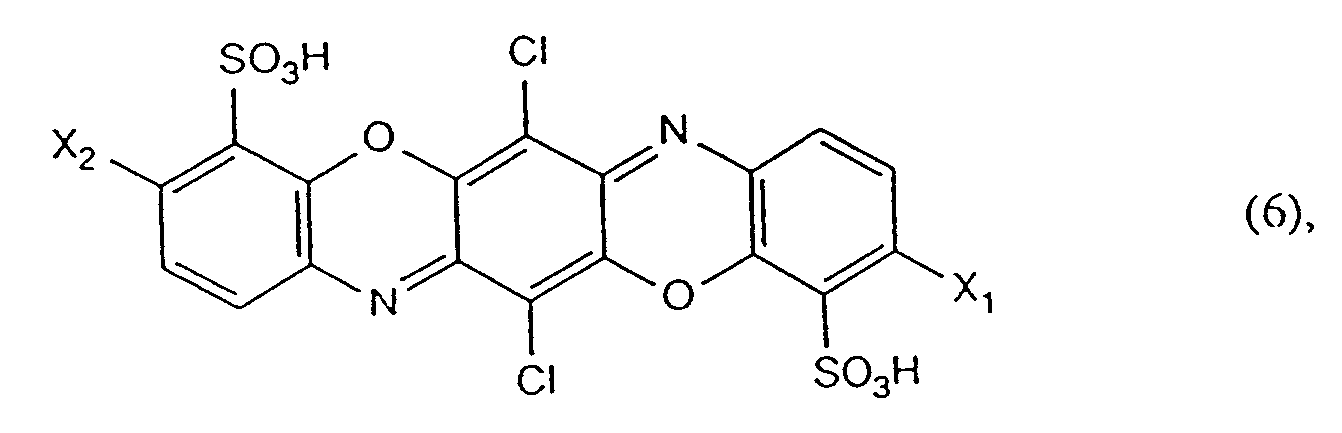
- the reactive dyes of the formula are very particularly preferred wherein X1 and X2 have the meanings given under formula (1), in particular wherein X1 and X2 have the meanings given as preferred and as particularly preferred.
- X1 is a radical of the formula A -NH2, C1-C4-alkylamino, which may be substituted by C1-C4-alkoxy, hydroxy, sulfato or sulfo, N, N-Di-C1-C4-alkylamino, which may be substituted by hydroxy, phenylamino by C1-C4-alkyl, C1-C4-alkoxy, halogen, hydroxy, ureido, acetylamino, carboxy, sulfo or sulfomethyl may be substituted, N-C1-C4-alkyl-N-phenylamino, which can be substituted in the alkyl radical by halogen, cyano, hydroxy, carboxy, sulfo or sulfato and in the phenyl radical by C1-C4-alkyl, C1-C4-alkoxy, hal
- X1 and X2 are each a radical of the formula A -NH2, C1-C4-alkylamino, which may be substituted by C1-C4-alkoxy, hydroxy, sulfato or sulfo, N, N-Di-C1-C4-alkylamino, which may be substituted by hydroxy, phenylamino by C1-C4-alkyl, C1-C4-alkoxy, halogen, hydroxy, ureido, acetylamino, carboxy, sulfo or sulfomethyl may be substituted, N-C1-C4-alkyl-N-phenylamino, which is in the alkyl radical by halogen, cyano, hydroxy , Carboxy, sulfo or sulfato and in the phenyl radical by C1-C4-alkyl, C1-C4-al
- X1 or X1 and X2 are each a radical of the formula wherein R7 and R8 are sulfo or R7 is hydrogen and R8 sulfo, or R7 sulfo and R8 is hydrogen, and Y is a radical and Z is vinyl, ⁇ -chloroethyl or ⁇ -sulfatoethyl.
- Examples are the reactive dyes of the formula (6a), in which X1 is a radical of the formula is where Z 'is ⁇ -sulfatoethyl, ⁇ -chloroethyl or vinyl, and the reactive dyes of the formula (9), in which X1 and X2 are each a radical of the formulas (10) to (25), and Z' ⁇ -sulfatoethyl, is ⁇ -chloroethyl or vinyl.
- the reactive dye of the formula is particularly important where Z 'has the meaning given.
- the invention further relates to a process for the preparation of the reactive dyes of the formula (1), which is characterized in that dioxazine compounds of the formula wherein R, R1, R2, W and n have the meanings given under formula (1), and X1 'is a radical of the formula wherein B1, B2, E and m have the meaning given under formula (2), X2 '-NH2 or a radical of formula (17), with one or two equivalents of 2,4,6-trihalogen-s-triazine, with one or two equivalents of one of the amines of the formula (18), (19) or (20) HY (20) and one or two equivalents of an amine of the formula HA or H-A1 are reacted with one another in any order, R3, A, A1, B, R4, Z, Y, I and II being those under the formulas (2), (3) and (3a) have the meanings given.
- the individual process steps can be carried out in a different order, and in some cases also simultaneously. Different process variants are possible. In general, the implementation is carried out step by step.
- the condensation of the 2,4,6-trifluoro-s-triazine with the dioxazine compounds of the formula (16) is preferably carried out in aqueous solution or suspension, at low temperatures, preferably between 0 ° and 5 ° C. and in the case of weakly acidic, neutral to weak alkaline pH.
- the hydrogen halide liberated in the condensation is advantageously continuously neutralized by adding aqueous alkali metal hydroxides, carbonates or bicarbonates.
- the free amines or their salts, preferably in the form of the hydrochloride, are used for the further reaction of the halotriazine dyes thus obtained or for the reaction of the 2,4,6-trihalogen-s-triazine with amines.
- the reaction is carried out at temperatures between about 0 and 40 ° C., preferably between 5 and 25 ° C, with the addition of acid-binding agents, preferably sodium carbonate, in a pH range from 2 to 8, preferably 5 to 6.5.
- the condensation of the halotriazine with an amine can take place before or after the condensation of the halotriazine with a dioxazine of the formula (1).
- the condensation of the halotriazine with an amine is preferably carried out in aqueous solution or suspension, at low temperature and at a weakly acidic to neutral pH.
- the hydrogen halide liberated during the condensation is advantageously neutralized by the continuous addition of aqueous alkali metal hydroxides, carbonates or bicarbonates.
- the dioxazine compounds of the formula (16) used as starting materials are obtained in the usual way by ring closure from the anil of the formula manufactured.
- the reactive dyes of the formula (1) can be isolated and processed into useful, dry dye preparations.
- the isolation is preferably carried out at the lowest possible temperatures by salting out and filtering.
- the filtered dyes can optionally be added after adding couping agents and / or buffering agents, e.g. after adding a mixture of equal parts of mono- and disodium phosphate, dried; drying is preferably carried out at temperatures which are not too high and under reduced pressure.
- the dry preparations according to the invention can be spray-dried directly by spray-drying the entire preparation mixture, i.e. Manufacture without intermediate insulation of the dyes.
- the reactive dyes of the formula (1) are suitable for dyeing and printing a wide variety of materials, such as silk, leather, wool, polyamide fibers and polyurethanes, and in particular cellulose-containing fiber materials of all kinds.
- Such fiber materials are, for example, natural cellulose fiber, such as cotton, linen and hemp, such as Pulp and regenerated cellulose.
- the reactive dyes of the formula (1) are also suitable for dyeing or printing fibers containing hydroxyl groups which are contained in blended fabrics, for example mixtures of cotton with polyester fibers or polyamide fibers.
- the dyes according to the invention can be applied to the fiber material and fixed on the fiber in various ways, in particular in the form of aqueous dye solutions and printing pastes.
- They are suitable both for the exhaust process and for dyeing according to the pad dyeing process, according to which the goods are impregnated with aqueous, optionally salt-containing dye solutions, and the dyes are fixed after an alkali treatment or in the presence of alkali, if appropriate with the action of heat. They are particularly suitable for the so-called cold residence process, after which the dye is applied to the foulard together with the alkali and is then fixed by storage at room temperature for several hours. After fixation, the dyeings and prints are thoroughly rinsed with cold and hot water, if appropriate with the addition of a dispersing agent which promotes the diffusion of the unfixed portions.
- the reactive dyes of the formula (1) are notable for high reactivity and good fixing power. They can therefore be used at low dyeing temperatures using the pull-out dyeing process and only require short steaming times with the pad-steam process. The degrees of fixation are high and the unfixed portions can be easily washed out, the difference between the degree of exhaustion and the degree of fixation being remarkably small, i.e. the soap loss is very low.
- the reactive dyes of formula (1) are also suitable for printing, especially on cotton, but also for printing nitrogen-containing fibers, e.g. of blended fabrics containing wool, silk or wool.
- the dyeings and prints on cellulose fiber materials produced with the dyes according to the invention have high color strength and high fiber-dye binding stability, both in the acidic and in the alkaline range, furthermore good light fastness and very good wet fastness properties, such as washing, water, sea water, Over-dyeing and perspiration fastness, as well as good pleating fastness, ironing fastness and rubbing fastness.
- Example 1 17.3 parts of 1-aminobenzene-2-sulfonic acid are condensed in aqueous solution with 18.3 parts of cyanuric chloride at 0 ° C. and pH 6-7.
- the monocondensation product obtained is condensed with 27.5 parts of 2- ( ⁇ -aminopropylamino) -5-nitrobenzenesulfonic acid at room temperature to about 30 ° C. and pH 7-9.
- 55.9 parts of the compound thus obtained are reacted with 13.0 parts of ⁇ - ( ⁇ '-aminoethylthio) ethanol at 30 to 60 ° C and pH 7-9.
- the thioether compound formed is oxidized to the sulfone in the same solution.
- reaction mixture is adjusted to pH 5.0 with glacial acetic acid and 0.04 g of tungstic acid is added.
- 10.6 parts by volume of hydrogen peroxide (35%) are added dropwise within 30 minutes, the temperature being allowed to rise without cooling.
- the reaction temperature is then set to 85 ° C., and another 10.6 parts by volume of hydrogen peroxide are added dropwise within 2 hours. Finally, stirring is continued at 85 ° C. for 6 hours.
- the subsequent nitro compound of the formula is then reduced to Béchamp by adding the product in portions to a boiling mixture of 200 parts water, 25 parts iron powder and 2 parts glacial acetic acid.
- the reaction mixture is adjusted to pH 12 to 13 with about 16 parts of 10N sodium hydroxide solution and filtered hot from the iron sludge.
- the filtrate is decolorized with a little hydrosulfite and adjusted to pH 7 with about 11 parts of 10N hydrochloric acid.
- the reduction can also be carried out by catalytic hydrogenation with Pd / carbon in ethanol, ethyl acetate or tetrahydrofuran at room temperature up to about 40 ° C.
- 80 parts of the anil thus obtained are introduced into 1600 parts of 24% oleum in the course of about 40 minutes.
- the temperature rises to approx. 40 ° C and an olive-brown solution is formed.
- the reaction mixture is heated to 65 ° C. within about 15 minutes and kept at this temperature for about 1 hour. This creates a deep blue solution. It is cooled to room temperature and the oleum solution is poured onto 4000 parts of ice with stirring. With ice cooling, 2500 parts of 10N sodium hydroxide solution are then added dropwise within about 1 hour.
- a clear solution is formed from which the finished dye is isolated with 300 parts of NaCl.
- the dye paste is buffered with a saturated solution of disodium hydrogen phosphate and dried in vacuo at 50 ° C.
- the dye thus obtained corresponds in the form of the free acid to the formula It dyes cotton in pure blue tones with good fastness properties using the dyeing processes customary for reaction dyes.
- Example 2 parts of the dye obtained in Example 1 are dissolved with the addition of 5 to 20 parts of urea and 2 parts of anhydrous Na2CO3 in 100 parts of water at 20 to 50 ° C.
- a cotton fabric is impregnated with the solution obtained, squeezed to 60 to 80% weight gain, and then dried.
- the mixture is then heat-set at 140 to 210 ° C. for 1/2 to 5 minutes, then soaped in a 0.1% boiling solution of an ion-free detergent for a quarter of an hour, rinsed and dried.
- Example 2 2 parts of the dye obtained in Example 1 are dissolved in 100 parts of water with the addition of 0.5 part of sodium m-nitrobenzenesulfonate. A cotton fabric is impregnated with the solution obtained, and squeezed to 75% weight gain, and then dried.
- the fabric is impregnated with a 20 ° warm solution, which contains 5 grams of sodium hydroxide and 300 grams of sodium chloride per liter, squeezed to 75% weight gain, the dyeing is dampened at 100 to 101 ° for 30 seconds, and soaped in a 0 for a quarter of an hour , 3% boiling solution of an ion-free detergent, rinses and dries.
- Coloring instructions 3 2 parts of the dye obtainable according to Example 1 are dissolved in 100 parts of water.
- the solution is added to 1900 parts of cold water, 60 parts of sodium chloride are added and 100 parts of a cotton fabric are added to this dye bath.
- the temperature is raised to 60 ° C., after 40 minutes 40 parts of anhydrous Na2CO3 and another 60 parts of sodium chloride are added.
- the temperature is kept at 60 ° C. for 30 minutes, rinsed and the soap is then soaped for 15 minutes in a 0.3% boiling solution of an ion-free detergent, rinsed and dried.
- Example 2 4 parts of the reactive dye prepared in Example 1 are dissolved in 50 parts of water. To this are added 50 parts of a solution containing 5 g of sodium hydroxide and 10 g of anhydrous Na2CO3 per liter. A cotton fabric is padded with the solution obtained, squeezed to a weight gain of 70%, and then winds the cotton fabric on a ball. The cotton fabric is stored for 3 to 12 hours at room temperature. The dyed goods are then rinsed, soaped at the boil with a nonionic detergent for a quarter of an hour, rinsed again and dried. A blue color is obtained with good fastness properties.
Landscapes
- Chemical & Material Sciences (AREA)
- Organic Chemistry (AREA)
- Coloring (AREA)
- Cosmetics (AREA)
Claims (14)
- Procédé pour la préparation de clorants réactifs de formule

(R)n représente n substituants R qui peuvent être, indépendamment les uns des autres, un atome d'halogène ou un groupe alkyle en C₁-C₄, alcoxy en C₁-C₄, sulfo, carboxy, carbamoyle, N-alkyl(C₁-C₄)-carbamoyle, N,N-dialkyl(C₁-C₄)-carbamoyle, alkyl(C₁-C₄)sulfonyle, sulfamoyle, N-alkyl(C₁-C₄)sulfamoyle ou N,N-dialkyl(C₁-C₄)sulfamoyle;
W représente le groupe hydroxy ou un groupe alkyle en C₁-C₆ qui peut être substitué par l'atome de chlore ou par des radicaux hydroxy, carboxy, sulfo, sulfato, alcoxy en carbamoyle, sulfamoyle ou par un radical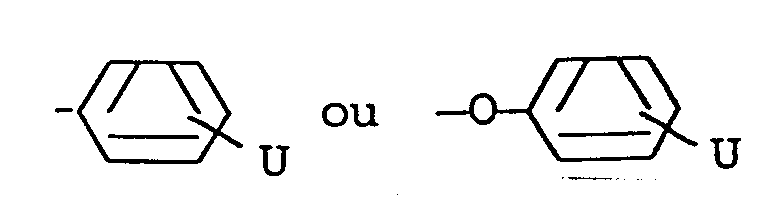
n = 0, 1 ou 2;
X₁ est un radical de formule
E est un radical alkylène en C₂-C₄ qui peut être substitué par des substituants halogène, hydroxy, carboxy, sulfo, phényle, sulfophényle ou alcoxy(C₁-C₄)carbonyle, ou un radical cyclohexylène qui peut être substitué par un groupe alkyle en C₁-C₄;
ou dans laquelle le groupe -N(B₁)-E-N(B₂)- est le groupe 1,4-pipérazinediyle;
m = 0 ou 1;
A représente le reste d'une amine;
R₃ représente un atome d'hydrogène ou un groupe alkyle en C₁-C₄ éventuellement substitué;
B représente la liaison directe ou un radical
R₄ représente un radical de formule
alk représente un radical alkylène ayant de 1 à 7 atomes de carbone,
t représente un atome d'hydrogène ou d'halogène ou un groupe hydroxy, sulfato, carboxy, cyano, alcanoyloxy en C₁-C₄, alcoxy(C₁-C₄)carbonyle, carbamoyle ou un radical -SO₂-Z, V représente un atome d'hydrogène ou un groupe alkyle en C₁-C₄ éventuellement substitué ou un radical de formule
Z représente un groupe β-sulfatoéthyle, β-thiosulfatoéthyle, β-phosphatoéthyle, β-acyloxyéthyle, β-halogénoéthyle ou vinyle;
p, q, r et t représentent chacun, indépendamment les uns des autres, le nombre 1, 2, 3, 4, 5 ou 6;
s est le nombre 2, 3, 4, 5 ou 6, et
X₂ est le groupe -NH₂;
ou dans laquelle X₁ représente un radical de formule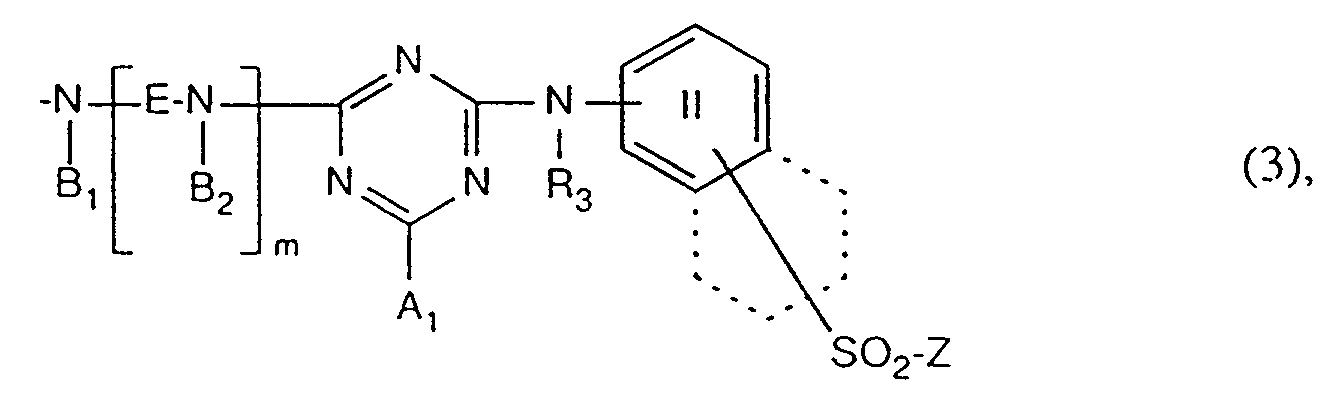

ou dans laquelle X₁ est un radical de formule (2) et X₂, indépendamment de X₁ est également un radical de formule (2);
ou dans laquelle X₁ est un radical de formule




- Procédé selon la revendication 1, caractérisé en ce que l'on prépare un composé de type dioxazine de formule (1) dans lequel X₁ est un radical de formule (2) ou (3),
et A₁ est un radical de formule

- Procédé selon la revendication 1, caractérisé en ce que l'on prépare un composé de type dioxazine dans lequel X₁ est un radical de formule (2), A est le groupe -NH₂, un radical alkyl(C₁-C₄)amino qui peut être substitué par un groupe alcoxy en C₁-C₄, hydroxy, sulfo ou sulfato, un radical N,N-dialkyl(C₁-C₄)amino qui peut être substitué par le groupe hydroxy, un radical phénylamino qui peut être substitué par des substituants halogène, alkyle en C₁-C₄, alcoxy en C₁-C₄, hydroxy, uréido, acétylamino, carboxy, sulfo ou sulfométhyle, un radical N-alkyl(C₁-C₄)-N-phényl-amino qui peut être substitué sur le fragment alkyle par des substituants halogène, cyano, hydroxy, carboxy, sulfo ou sulfato et sur le fragment phényle par des substituants alkyle en C₁-C₄, alcoxy en C₁-C₄, halogène, hydroxy, uréido, acétylamino, carboxy, sulfo ou sulfométhyle, le radical sulfonaphtylamino ou morpholino, et X₂ le groupe -NH₂.
- Procédé selon la revendication 1, caractérisé en ce que l'on prépare un composé de type dioxazine de formule (1) dans lequel X₁ et et X₂ représentent chacun, indépendamment l'un de l'autre, un radical de formule (2), et A est le groupe -NH₂, un radical alkyl(C₁-C₄)amino qui peut être substitué par un groupe alcoxy en C₁-C₄, hydroxy, sulfo ou sulfato, un radical N,N-dialkyl(C₁-C₄)amino qui peut être substitué par le groupe hydroxy, un radical phénylamino qui peut être substitué par des substituants alkyle en C₁-C₄, alcoxy en C₁-C₄, halogène, hydroxy, uréido, acétylamino, carboxy, sulfo ou sulfométhyle, un radical N-alkyl(C₁-C₄)-N-phénylamino qui peut être substitué sur le fragment alkyle par des substituants halogène, cyano, hydroxy, carboxy, sulfo ou sulfato et sur le fragment phényle par des substituants alkyle en C₁-C₄, alcoxy en C₁-C₄, halogène, hydroxy, uréido, acétylamino, carboxy, sulfo ou sulfométhyle, le radical sulfonaphtylamino ou morpholino.
- Procédé selon l'une des revendications 1 à 4, caractérisé en ce que l'on prépare un composé de type dioxazine de formule (1) dans lequel X₁ est un radical de formule (3a), B₁, B₂, E et Y ont les significations données à propos de la formule (3) et A est le groupe -NH₂, un radical alkyl(C₁-C₄)amino qui peut être substitué par un groupe alcoxy en C₁-C₄, hydroxy, sulfo ou sulfato, un radical N,N-dialkyl(C₁-C₄)amino qui peut être substitué par le groupe hydroxy, un radical phénylamino qui peut être substitué par des substituants alkyle en C₁-C₄, alcoxy en C₁-C₄, halogène, hydroxy, uréido, acétylamino, carboxy, sulfo ou sulfométhyle, un radical N-alkyl(C₁-C₄)-N-phénylamino qui peut être substitué sur le fragment alkyle par des substituants halogène, cyano, hydroxy, carboxy, sulfo ou sulfato ou sur le fragment phényle par des substituants alkyle en C₁-C₄, alcoxy en C₁-C₄, halogène, hydroxy, uréido, acétylamino, carboxy, sulfo ou sulfométhyle, un radical naphtylamino, le noyau naphtalène pouvant être substitué comme indiqué pour le cycle phényle, ou le radical morpholino, et X₂ est le groupe -NH₂, ou dans lesquels X₁ et X₂ représentent chacun, indépendamment l'un de l'autre, un radical de formule (2), et A est le groupe -NH₂, un radical alkyl(C₁-C₄)amino qui peut être substitué par un groupe alcoxy en C₁-C₄, hydroxy, sulfo ou sulfato, un radical N,N-dialkyl(C₁-C₄)amino qui peut être substitué par le groupe hydroxy, un radical phénylamino qui peut être substitué par des substituants alkyle en C₁-C₄, alcoxy en C₁-C₄, halogène, hydroxy, uréido, acétylamino, carboxy, sulfo ou sulfométhyle, un radical N-alkyl(C₁-C₄)-N-phénylamino qui peut être substitué sur le fragment alkyle par un atome d'halogène ou par le groupe cyano, hydroxy, carboxy, sulfo ou sulfato et, sur le fragment phényle, par des substituants alkyle en C₁-C₄, alcoxy en C₁-C₄, halogène, hydroxy, uréido, acétylamino, carboxy, sulfo ou sulfométhyle, un radical naphtylamino, le noyau naphtalénique pouvant être substitué comme indiqué pour le cycle phényle, ou le radical morpholino.
- Procédé selon l'une des revendications 1 à 5, caractérisé en ce que l'on prépare un composé de type dioxazine de formule
- Procédé selon l'une des revendications 1, 2 et 3, caractérisé en ce que l'on prépare un composé de type dioxazine de formule


- Procédé selon l'une des revendications 1 et 4, caractérisé en ce que l'on prépare un composé de type dioxazine de formule


- Procédé selon la revendication 5, caractérisé en ce que l'on prépare un composé de type dioxazine de formule


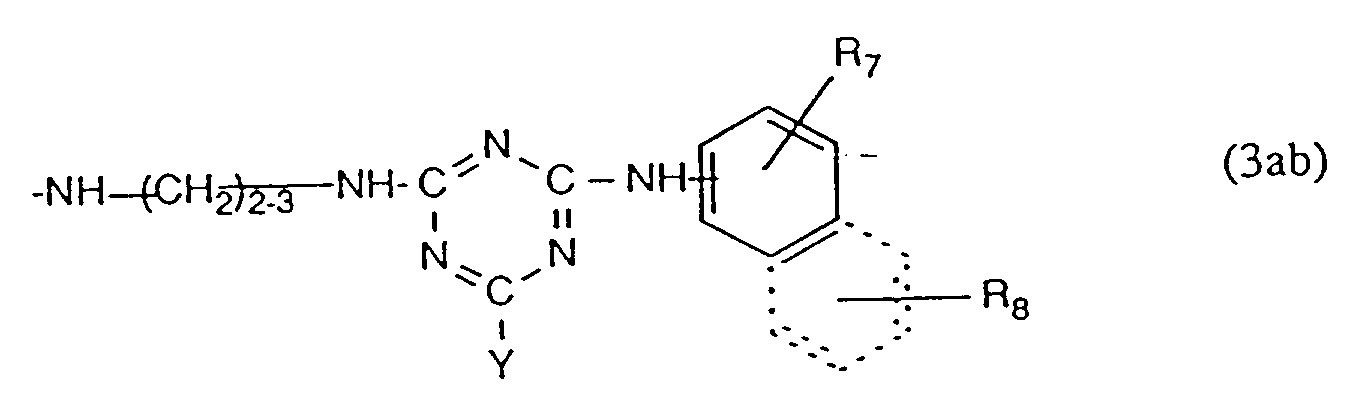
- Procédé selon la revendication 9, caractérisé en ce que l'on prépare un composé de type dioxazine de formule (1) dans lequel X₁ ou X₁ et X₂ représentent chacun un radical de formule

- Procédé pour la préparation des colorants réactifs selon la revendication 1, caractérisé en ce que l'on fait réagir 1 équivalent d'une 2,4,6-trihalogénotriazine s avec 1 équivalent d'une amine de formule

H-Y (20)
et avec 1 équivalent d'une amine de formule H-A ou H-A₁ et avec 1 équivalent d'une amine de formule

- Utilisation des colorants réactifs selon la revendication 1, pour la teinture et l'impression de matériaux fibreux contenant de la cellulose.
- Utilisation selon la revendication 12, pour la teinture et l'impression du coton.
Applications Claiming Priority (2)
| Application Number | Priority Date | Filing Date | Title |
|---|---|---|---|
| CH2891/90 | 1990-09-06 | ||
| CH289190 | 1990-09-06 |
Publications (2)
| Publication Number | Publication Date |
|---|---|
| EP0474596A1 EP0474596A1 (fr) | 1992-03-11 |
| EP0474596B1 true EP0474596B1 (fr) | 1995-11-15 |
Family
ID=4243926
Family Applications (1)
| Application Number | Title | Priority Date | Filing Date |
|---|---|---|---|
| EP91810683A Expired - Lifetime EP0474596B1 (fr) | 1990-09-06 | 1991-08-27 | Colorants réactifs, procédé de leur préparation et leur utilisation |
Country Status (4)
| Country | Link |
|---|---|
| EP (1) | EP0474596B1 (fr) |
| JP (1) | JPH04255762A (fr) |
| DE (1) | DE59106903D1 (fr) |
| ES (1) | ES2079628T3 (fr) |
Families Citing this family (6)
| Publication number | Priority date | Publication date | Assignee | Title |
|---|---|---|---|---|
| DE4415780A1 (de) * | 1994-05-05 | 1995-11-09 | Bayer Ag | Triphendioxazin-Reaktivfarbstoffe |
| DE4428906A1 (de) * | 1994-08-16 | 1996-02-22 | Hoechst Ag | Triphendioxazin-Reaktivfarbstoffe |
| US8933239B1 (en) | 2013-07-16 | 2015-01-13 | Dow Global Technologies Llc | Bis(aryl)acetal compounds |
| US9410016B2 (en) | 2013-07-16 | 2016-08-09 | Dow Global Technologies Llc | Aromatic polyacetals and articles comprising them |
| US9063420B2 (en) | 2013-07-16 | 2015-06-23 | Rohm And Haas Electronic Materials Llc | Photoresist composition, coated substrate, and method of forming electronic device |
| US8962779B2 (en) | 2013-07-16 | 2015-02-24 | Dow Global Technologies Llc | Method of forming polyaryl polymers |
Citations (1)
| Publication number | Priority date | Publication date | Assignee | Title |
|---|---|---|---|---|
| DE3935583A1 (de) * | 1988-10-28 | 1990-05-03 | Ciba Geigy Ag | Reaktivfarbstoffe, deren herstellung und verwendung |
Family Cites Families (2)
| Publication number | Priority date | Publication date | Assignee | Title |
|---|---|---|---|---|
| DE3577719D1 (de) * | 1984-10-15 | 1990-06-21 | Ciba Geigy Ag | Reaktivfarbstoffe, deren herstellung und verwendung. |
| EP0309406B2 (fr) * | 1987-09-24 | 2000-07-12 | Ciba SC Holding AG | Colorants réactifs, leur préparation et leur emploi |
-
1991
- 1991-08-27 ES ES91810683T patent/ES2079628T3/es not_active Expired - Lifetime
- 1991-08-27 DE DE59106903T patent/DE59106903D1/de not_active Expired - Fee Related
- 1991-08-27 EP EP91810683A patent/EP0474596B1/fr not_active Expired - Lifetime
- 1991-09-06 JP JP3227276A patent/JPH04255762A/ja active Pending
Patent Citations (1)
| Publication number | Priority date | Publication date | Assignee | Title |
|---|---|---|---|---|
| DE3935583A1 (de) * | 1988-10-28 | 1990-05-03 | Ciba Geigy Ag | Reaktivfarbstoffe, deren herstellung und verwendung |
Also Published As
| Publication number | Publication date |
|---|---|
| JPH04255762A (ja) | 1992-09-10 |
| DE59106903D1 (de) | 1995-12-21 |
| EP0474596A1 (fr) | 1992-03-11 |
| ES2079628T3 (es) | 1996-01-16 |
Similar Documents
| Publication | Publication Date | Title |
|---|---|---|
| EP0076782B1 (fr) | Colorants réactifs, leur préparation et leur utilisation | |
| EP0070807B1 (fr) | Colorants réactifs, leur préparation et leur utilisation | |
| EP0260227B1 (fr) | Colorants réactifs de la série des dioxazines, leur préparation et leur emploi | |
| EP0210951B1 (fr) | Colorants réactifs, leur préparation et leur utilisation | |
| EP0101665A2 (fr) | Colorants réactifs de la série des dioxazines, leur préparation et leur utilisation | |
| EP0168751B1 (fr) | Composés triphénodioxazine solubles dans l'eau, procédé pour les préparer et leur utilisation comme colorants | |
| EP0675172B1 (fr) | Composés azoiques solables dans l'eau, procédé pour leur préparation et leur utilisation comme colorants | |
| EP0132223B1 (fr) | Colorants réactifs, leur préparation et leur utilisation | |
| EP0458743A2 (fr) | Colorants réactifs, procédés de leur préparation et leur utilisation | |
| EP0625551A1 (fr) | Mélanges de colorants, procédé pour leur préparation et leur utilisation | |
| EP0177445B1 (fr) | Colorants réactifs, leur préparation et leur utilisation | |
| EP0474596A1 (fr) | Colorants réactifs, procédé de leur préparation et leur utilisation | |
| EP0489692B1 (fr) | Colorants réactifs, procédé pour leur préparation et leur utilisation | |
| EP0309406B1 (fr) | Colorants réactifs, leur préparation et leur emploi | |
| EP0282443B1 (fr) | Colorants réactifs, leur préparation et leur emploi | |
| EP0233139A2 (fr) | Colorants réactifs, leur préparation et leur utilisation | |
| EP0365478B1 (fr) | Colorants reactifs, leur préparation et leur emploi | |
| DE4428906A1 (de) | Triphendioxazin-Reaktivfarbstoffe | |
| EP0333656B1 (fr) | Colorants réactifs, procédé pour leur préparation et leur utilisation | |
| EP0284568B1 (fr) | Colorants réactifs, leur préparation et leur utilisation | |
| US5023325A (en) | Fibre-reactive dyes containing a substituted aminocarbonyl-phenylamino or naphthylamino reactive moiety | |
| EP0278903B1 (fr) | Colorants réactifs, leur préparation et leur utilisation | |
| EP0069376B1 (fr) | Complexes de cuivre de composés monoazoiques, procédé pour leur préparation et leur utilisation comme colorants | |
| EP0688832A2 (fr) | Colorants réactifs, leur préparation et utilisation | |
| EP0485336A1 (fr) | Mélanges de colorants réactifs, procédé pour leur préparation et leur utilisation |
Legal Events
| Date | Code | Title | Description |
|---|---|---|---|
| PUAI | Public reference made under article 153(3) epc to a published international application that has entered the european phase |
Free format text: ORIGINAL CODE: 0009012 |
|
| AK | Designated contracting states |
Kind code of ref document: A1 Designated state(s): BE CH DE ES FR GB IT LI |
|
| 17P | Request for examination filed |
Effective date: 19910831 |
|
| 17Q | First examination report despatched |
Effective date: 19940428 |
|
| GRAA | (expected) grant |
Free format text: ORIGINAL CODE: 0009210 |
|
| AK | Designated contracting states |
Kind code of ref document: B1 Designated state(s): BE CH DE ES FR GB IT LI |
|
| ET | Fr: translation filed | ||
| REF | Corresponds to: |
Ref document number: 59106903 Country of ref document: DE Date of ref document: 19951221 |
|
| REG | Reference to a national code |
Ref country code: ES Ref legal event code: FG2A Ref document number: 2079628 Country of ref document: ES Kind code of ref document: T3 |
|
| ITF | It: translation for a ep patent filed | ||
| GBT | Gb: translation of ep patent filed (gb section 77(6)(a)/1977) |
Effective date: 19960109 |
|
| PLBE | No opposition filed within time limit |
Free format text: ORIGINAL CODE: 0009261 |
|
| STAA | Information on the status of an ep patent application or granted ep patent |
Free format text: STATUS: NO OPPOSITION FILED WITHIN TIME LIMIT |
|
| REG | Reference to a national code |
Ref country code: CH Ref legal event code: PUE Owner name: CIBA-GEIGY AG TRANSFER- CIBA SC HOLDING AG |
|
| 26N | No opposition filed | ||
| BECN | Be: change of holder's name |
Effective date: 19961129 |
|
| REG | Reference to a national code |
Ref country code: FR Ref legal event code: TP |
|
| REG | Reference to a national code |
Ref country code: CH Ref legal event code: PFA Free format text: CIBA SC HOLDING AG TRANSFER- CIBA SPECIALTY CHEMICALS HOLDING INC. |
|
| REG | Reference to a national code |
Ref country code: GB Ref legal event code: 732E |
|
| REG | Reference to a national code |
Ref country code: FR Ref legal event code: CD |
|
| REG | Reference to a national code |
Ref country code: ES Ref legal event code: PC2A |
|
| PGFP | Annual fee paid to national office [announced via postgrant information from national office to epo] |
Ref country code: FR Payment date: 19990628 Year of fee payment: 9 Ref country code: CH Payment date: 19990628 Year of fee payment: 9 |
|
| PGFP | Annual fee paid to national office [announced via postgrant information from national office to epo] |
Ref country code: DE Payment date: 19990709 Year of fee payment: 9 |
|
| PGFP | Annual fee paid to national office [announced via postgrant information from national office to epo] |
Ref country code: GB Payment date: 19990720 Year of fee payment: 9 |
|
| PGFP | Annual fee paid to national office [announced via postgrant information from national office to epo] |
Ref country code: ES Payment date: 19990804 Year of fee payment: 9 |
|
| PGFP | Annual fee paid to national office [announced via postgrant information from national office to epo] |
Ref country code: BE Payment date: 19991013 Year of fee payment: 9 |
|
| PG25 | Lapsed in a contracting state [announced via postgrant information from national office to epo] |
Ref country code: GB Free format text: LAPSE BECAUSE OF NON-PAYMENT OF DUE FEES Effective date: 20000827 |
|
| PG25 | Lapsed in a contracting state [announced via postgrant information from national office to epo] |
Ref country code: ES Free format text: LAPSE BECAUSE OF NON-PAYMENT OF DUE FEES Effective date: 20000828 |
|
| PG25 | Lapsed in a contracting state [announced via postgrant information from national office to epo] |
Ref country code: LI Free format text: LAPSE BECAUSE OF NON-PAYMENT OF DUE FEES Effective date: 20000831 Ref country code: CH Free format text: LAPSE BECAUSE OF NON-PAYMENT OF DUE FEES Effective date: 20000831 Ref country code: BE Free format text: LAPSE BECAUSE OF NON-PAYMENT OF DUE FEES Effective date: 20000831 |
|
| BERE | Be: lapsed |
Owner name: CIBA SPECIALTY CHEMICALS HOLDING INC. Effective date: 20000831 |
|
| REG | Reference to a national code |
Ref country code: CH Ref legal event code: PL |
|
| GBPC | Gb: european patent ceased through non-payment of renewal fee |
Effective date: 20000827 |
|
| PG25 | Lapsed in a contracting state [announced via postgrant information from national office to epo] |
Ref country code: FR Free format text: LAPSE BECAUSE OF NON-PAYMENT OF DUE FEES Effective date: 20010430 |
|
| PG25 | Lapsed in a contracting state [announced via postgrant information from national office to epo] |
Ref country code: DE Free format text: LAPSE BECAUSE OF NON-PAYMENT OF DUE FEES Effective date: 20010501 |
|
| REG | Reference to a national code |
Ref country code: FR Ref legal event code: ST |
|
| REG | Reference to a national code |
Ref country code: ES Ref legal event code: FD2A Effective date: 20010911 |
|
| PG25 | Lapsed in a contracting state [announced via postgrant information from national office to epo] |
Ref country code: IT Free format text: LAPSE BECAUSE OF NON-PAYMENT OF DUE FEES;WARNING: LAPSES OF ITALIAN PATENTS WITH EFFECTIVE DATE BEFORE 2007 MAY HAVE OCCURRED AT ANY TIME BEFORE 2007. THE CORRECT EFFECTIVE DATE MAY BE DIFFERENT FROM THE ONE RECORDED. Effective date: 20050827 |