EP0475457A1 - Verfahren zur Trennung von Tierzellen aus Tierzellen enthaltenden Suspensionen mittels eines Zentrigugalseparators und Verfahren zur Züchtung von Tierzellen in Suspension - Google Patents
Verfahren zur Trennung von Tierzellen aus Tierzellen enthaltenden Suspensionen mittels eines Zentrigugalseparators und Verfahren zur Züchtung von Tierzellen in Suspension Download PDFInfo
- Publication number
- EP0475457A1 EP0475457A1 EP91117364A EP91117364A EP0475457A1 EP 0475457 A1 EP0475457 A1 EP 0475457A1 EP 91117364 A EP91117364 A EP 91117364A EP 91117364 A EP91117364 A EP 91117364A EP 0475457 A1 EP0475457 A1 EP 0475457A1
- Authority
- EP
- European Patent Office
- Prior art keywords
- animal cells
- centrifugal separator
- fluid
- suspension
- liquid
- Prior art date
- Legal status (The legal status is an assumption and is not a legal conclusion. Google has not performed a legal analysis and makes no representation as to the accuracy of the status listed.)
- Withdrawn
Links
- 210000004102 animal cell Anatomy 0.000 title claims abstract description 121
- 238000000034 method Methods 0.000 title claims abstract description 47
- 238000012258 culturing Methods 0.000 title claims description 35
- 239000000725 suspension Substances 0.000 title claims description 22
- 239000007788 liquid Substances 0.000 claims abstract description 77
- 239000012530 fluid Substances 0.000 claims abstract description 35
- 230000012010 growth Effects 0.000 claims abstract description 15
- 239000007864 aqueous solution Substances 0.000 claims abstract description 13
- 239000007900 aqueous suspension Substances 0.000 claims abstract description 9
- XLYOFNOQVPJJNP-UHFFFAOYSA-N water Substances O XLYOFNOQVPJJNP-UHFFFAOYSA-N 0.000 claims abstract description 9
- 230000002401 inhibitory effect Effects 0.000 claims abstract description 7
- 239000000243 solution Substances 0.000 claims abstract description 4
- 239000012531 culture fluid Substances 0.000 claims description 57
- 210000004027 cell Anatomy 0.000 claims description 44
- 238000004114 suspension culture Methods 0.000 claims description 31
- 238000000926 separation method Methods 0.000 claims description 9
- 230000000694 effects Effects 0.000 claims description 8
- 238000004062 sedimentation Methods 0.000 claims description 8
- 210000004408 hybridoma Anatomy 0.000 claims description 4
- 241000124008 Mammalia Species 0.000 claims description 3
- 210000004369 blood Anatomy 0.000 claims description 3
- 239000008280 blood Substances 0.000 claims description 2
- NBVXSUQYWXRMNV-UHFFFAOYSA-N fluoromethane Chemical group FC NBVXSUQYWXRMNV-UHFFFAOYSA-N 0.000 claims 2
- 230000035611 feeding Effects 0.000 description 15
- 239000001963 growth medium Substances 0.000 description 11
- 239000002609 medium Substances 0.000 description 9
- 239000012452 mother liquor Substances 0.000 description 6
- 230000002093 peripheral effect Effects 0.000 description 6
- 125000004432 carbon atom Chemical group C* 0.000 description 4
- 239000000126 substance Substances 0.000 description 4
- 230000004083 survival effect Effects 0.000 description 4
- TXEYQDLBPFQVAA-UHFFFAOYSA-N tetrafluoromethane Chemical compound FC(F)(F)F TXEYQDLBPFQVAA-UHFFFAOYSA-N 0.000 description 4
- 125000000217 alkyl group Chemical group 0.000 description 3
- 239000012736 aqueous medium Substances 0.000 description 3
- 230000005484 gravity Effects 0.000 description 3
- 239000002207 metabolite Substances 0.000 description 3
- 230000010412 perfusion Effects 0.000 description 3
- HZAXFHJVJLSVMW-UHFFFAOYSA-N 2-Aminoethan-1-ol Chemical compound NCCO HZAXFHJVJLSVMW-UHFFFAOYSA-N 0.000 description 2
- CURLTUGMZLYLDI-UHFFFAOYSA-N Carbon dioxide Chemical compound O=C=O CURLTUGMZLYLDI-UHFFFAOYSA-N 0.000 description 2
- 102000014150 Interferons Human genes 0.000 description 2
- 108010050904 Interferons Proteins 0.000 description 2
- QVGXLLKOCUKJST-UHFFFAOYSA-N atomic oxygen Chemical compound [O] QVGXLLKOCUKJST-UHFFFAOYSA-N 0.000 description 2
- 230000007423 decrease Effects 0.000 description 2
- NOESYZHRGYRDHS-UHFFFAOYSA-N insulin Chemical compound N1C(=O)C(NC(=O)C(CCC(N)=O)NC(=O)C(CCC(O)=O)NC(=O)C(C(C)C)NC(=O)C(NC(=O)CN)C(C)CC)CSSCC(C(NC(CO)C(=O)NC(CC(C)C)C(=O)NC(CC=2C=CC(O)=CC=2)C(=O)NC(CCC(N)=O)C(=O)NC(CC(C)C)C(=O)NC(CCC(O)=O)C(=O)NC(CC(N)=O)C(=O)NC(CC=2C=CC(O)=CC=2)C(=O)NC(CSSCC(NC(=O)C(C(C)C)NC(=O)C(CC(C)C)NC(=O)C(CC=2C=CC(O)=CC=2)NC(=O)C(CC(C)C)NC(=O)C(C)NC(=O)C(CCC(O)=O)NC(=O)C(C(C)C)NC(=O)C(CC(C)C)NC(=O)C(CC=2NC=NC=2)NC(=O)C(CO)NC(=O)CNC2=O)C(=O)NCC(=O)NC(CCC(O)=O)C(=O)NC(CCCNC(N)=N)C(=O)NCC(=O)NC(CC=3C=CC=CC=3)C(=O)NC(CC=3C=CC=CC=3)C(=O)NC(CC=3C=CC(O)=CC=3)C(=O)NC(C(C)O)C(=O)N3C(CCC3)C(=O)NC(CCCCN)C(=O)NC(C)C(O)=O)C(=O)NC(CC(N)=O)C(O)=O)=O)NC(=O)C(C(C)CC)NC(=O)C(CO)NC(=O)C(C(C)O)NC(=O)C1CSSCC2NC(=O)C(CC(C)C)NC(=O)C(NC(=O)C(CCC(N)=O)NC(=O)C(CC(N)=O)NC(=O)C(NC(=O)C(N)CC=1C=CC=CC=1)C(C)C)CC1=CN=CN1 NOESYZHRGYRDHS-UHFFFAOYSA-N 0.000 description 2
- 229940079322 interferon Drugs 0.000 description 2
- 229910052760 oxygen Inorganic materials 0.000 description 2
- 239000001301 oxygen Substances 0.000 description 2
- FRZFEPXEUZSBLA-UHFFFAOYSA-N perfluoroadamantane Chemical class FC1(F)C(C2(F)F)(F)C(F)(F)C3(F)C(F)(F)C1(F)C(F)(F)C2(F)C3(F)F FRZFEPXEUZSBLA-UHFFFAOYSA-N 0.000 description 2
- 108090000623 proteins and genes Proteins 0.000 description 2
- 239000004017 serum-free culture medium Substances 0.000 description 2
- 238000003756 stirring Methods 0.000 description 2
- LWRNQOBXRHWPGE-UHFFFAOYSA-N 1,1,2,2,3,3,4,4,4a,5,5,6,6,7,7,8,8a-heptadecafluoro-8-(trifluoromethyl)naphthalene Chemical compound FC1(F)C(F)(F)C(F)(F)C(F)(F)C2(F)C(C(F)(F)F)(F)C(F)(F)C(F)(F)C(F)(F)C21F LWRNQOBXRHWPGE-UHFFFAOYSA-N 0.000 description 1
- UWOZRVOOYWEOFL-UHFFFAOYSA-N 1,2,2,3,4,4,5,6,6,8,8,9,9,10-tetradecafluoro-7,10-bis(1,1,2,2,2-pentafluoroethyl)adamantane Chemical compound FC1(F)C(C2(F)F)(F)C(F)(F)C3(F)C(F)(F)C1(F)C(C(F)(F)C(F)(F)F)(F)C2(C(F)(F)C(F)(F)F)C3(F)F UWOZRVOOYWEOFL-UHFFFAOYSA-N 0.000 description 1
- VMMSGIYBHOQQPC-UHFFFAOYSA-N 1,2,2,3,4,4,5,6,6,8,8,9,9,10-tetradecafluoro-7-(1,1,2,2,2-pentafluoroethyl)-10-(trifluoromethyl)adamantane Chemical compound FC1(F)C(C2(F)F)(F)C(F)(F)C3(F)C(F)(F)C2(F)C(C(F)(F)F)(F)C1(C(F)(F)C(F)(F)F)C3(F)F VMMSGIYBHOQQPC-UHFFFAOYSA-N 0.000 description 1
- MYMOFIZGZYHOMD-UHFFFAOYSA-N Dioxygen Chemical compound O=O MYMOFIZGZYHOMD-UHFFFAOYSA-N 0.000 description 1
- YCKRFDGAMUMZLT-UHFFFAOYSA-N Fluorine atom Chemical compound [F] YCKRFDGAMUMZLT-UHFFFAOYSA-N 0.000 description 1
- WQZGKKKJIJFFOK-GASJEMHNSA-N Glucose Natural products OC[C@H]1OC(O)[C@H](O)[C@@H](O)[C@@H]1O WQZGKKKJIJFFOK-GASJEMHNSA-N 0.000 description 1
- 102000004877 Insulin Human genes 0.000 description 1
- 108090001061 Insulin Proteins 0.000 description 1
- 241001465754 Metazoa Species 0.000 description 1
- 206010035226 Plasma cell myeloma Diseases 0.000 description 1
- 239000012980 RPMI-1640 medium Substances 0.000 description 1
- 102000004338 Transferrin Human genes 0.000 description 1
- 108090000901 Transferrin Proteins 0.000 description 1
- 230000001133 acceleration Effects 0.000 description 1
- 230000009471 action Effects 0.000 description 1
- 239000013543 active substance Substances 0.000 description 1
- 239000000654 additive Substances 0.000 description 1
- 230000002411 adverse Effects 0.000 description 1
- 150000001413 amino acids Chemical class 0.000 description 1
- 239000003242 anti bacterial agent Substances 0.000 description 1
- 229940088710 antibiotic agent Drugs 0.000 description 1
- 210000000628 antibody-producing cell Anatomy 0.000 description 1
- 239000002473 artificial blood Substances 0.000 description 1
- 210000003719 b-lymphocyte Anatomy 0.000 description 1
- WQZGKKKJIJFFOK-VFUOTHLCSA-N beta-D-glucose Chemical compound OC[C@H]1O[C@@H](O)[C@H](O)[C@@H](O)[C@@H]1O WQZGKKKJIJFFOK-VFUOTHLCSA-N 0.000 description 1
- 210000001124 body fluid Anatomy 0.000 description 1
- 239000010839 body fluid Substances 0.000 description 1
- 229910002092 carbon dioxide Inorganic materials 0.000 description 1
- 239000001569 carbon dioxide Substances 0.000 description 1
- 230000010261 cell growth Effects 0.000 description 1
- 239000011248 coating agent Substances 0.000 description 1
- 238000000576 coating method Methods 0.000 description 1
- 239000005515 coenzyme Substances 0.000 description 1
- 238000005056 compaction Methods 0.000 description 1
- 238000010276 construction Methods 0.000 description 1
- 238000011437 continuous method Methods 0.000 description 1
- 230000007812 deficiency Effects 0.000 description 1
- 229910001882 dioxygen Inorganic materials 0.000 description 1
- 210000001840 diploid cell Anatomy 0.000 description 1
- 238000007599 discharging Methods 0.000 description 1
- 239000012777 electrically insulating material Substances 0.000 description 1
- 238000005516 engineering process Methods 0.000 description 1
- 238000000855 fermentation Methods 0.000 description 1
- 230000004151 fermentation Effects 0.000 description 1
- 238000001914 filtration Methods 0.000 description 1
- 229910052731 fluorine Inorganic materials 0.000 description 1
- 239000011737 fluorine Substances 0.000 description 1
- 239000012737 fresh medium Substances 0.000 description 1
- 239000011521 glass Substances 0.000 description 1
- 239000008103 glucose Substances 0.000 description 1
- 230000002209 hydrophobic effect Effects 0.000 description 1
- 229940125396 insulin Drugs 0.000 description 1
- 230000001926 lymphatic effect Effects 0.000 description 1
- 239000000203 mixture Substances 0.000 description 1
- 201000000050 myeloid neoplasm Diseases 0.000 description 1
- 238000010899 nucleation Methods 0.000 description 1
- 229950011087 perflunafene Drugs 0.000 description 1
- LRMQIJUOLGKFKS-UHFFFAOYSA-N perfluoro-1,3-dimethyladamantane Chemical compound FC1(F)C(C2(F)F)(F)C(F)(F)C3(F)C(F)(F)C1(C(F)(F)F)C(F)(F)C2(C(F)(F)F)C3(F)F LRMQIJUOLGKFKS-UHFFFAOYSA-N 0.000 description 1
- WKHMXCIUCCIPOU-UHFFFAOYSA-N perfluoro-1-methyladamantane Chemical compound FC1(F)C(C2(F)F)(F)C(F)(F)C3(F)C(F)(F)C2(F)C(F)(F)C1(C(F)(F)F)C3(F)F WKHMXCIUCCIPOU-UHFFFAOYSA-N 0.000 description 1
- UWEYRJFJVCLAGH-IJWZVTFUSA-N perfluorodecalin Chemical compound FC1(F)C(F)(F)C(F)(F)C(F)(F)[C@@]2(F)C(F)(F)C(F)(F)C(F)(F)C(F)(F)[C@@]21F UWEYRJFJVCLAGH-IJWZVTFUSA-N 0.000 description 1
- RVZRBWKZFJCCIB-UHFFFAOYSA-N perfluorotributylamine Chemical compound FC(F)(F)C(F)(F)C(F)(F)C(F)(F)N(C(F)(F)C(F)(F)C(F)(F)C(F)(F)F)C(F)(F)C(F)(F)C(F)(F)C(F)(F)F RVZRBWKZFJCCIB-UHFFFAOYSA-N 0.000 description 1
- 230000002572 peristaltic effect Effects 0.000 description 1
- -1 polytetrafluoroethylene Polymers 0.000 description 1
- 229920001343 polytetrafluoroethylene Polymers 0.000 description 1
- 239000004810 polytetrafluoroethylene Substances 0.000 description 1
- 230000001737 promoting effect Effects 0.000 description 1
- 102000004169 proteins and genes Human genes 0.000 description 1
- 238000004064 recycling Methods 0.000 description 1
- 239000011347 resin Substances 0.000 description 1
- 229920005989 resin Polymers 0.000 description 1
- 150000003839 salts Chemical class 0.000 description 1
- MCAHWIHFGHIESP-UHFFFAOYSA-N selenous acid Chemical compound O[Se](O)=O MCAHWIHFGHIESP-UHFFFAOYSA-N 0.000 description 1
- 210000002966 serum Anatomy 0.000 description 1
- 125000001302 tertiary amino group Chemical group 0.000 description 1
- 239000012581 transferrin Substances 0.000 description 1
- 239000011782 vitamin Substances 0.000 description 1
- 229940088594 vitamin Drugs 0.000 description 1
- 229930003231 vitamin Natural products 0.000 description 1
- 235000013343 vitamin Nutrition 0.000 description 1
- 238000005406 washing Methods 0.000 description 1
Images
Classifications
-
- C—CHEMISTRY; METALLURGY
- C12—BIOCHEMISTRY; BEER; SPIRITS; WINE; VINEGAR; MICROBIOLOGY; ENZYMOLOGY; MUTATION OR GENETIC ENGINEERING
- C12M—APPARATUS FOR ENZYMOLOGY OR MICROBIOLOGY; APPARATUS FOR CULTURING MICROORGANISMS FOR PRODUCING BIOMASS, FOR GROWING CELLS OR FOR OBTAINING FERMENTATION OR METABOLIC PRODUCTS, i.e. BIOREACTORS OR FERMENTERS
- C12M47/00—Means for after-treatment of the produced biomass or of the fermentation or metabolic products, e.g. storage of biomass
- C12M47/02—Separating microorganisms from the culture medium; Concentration of biomass
-
- B—PERFORMING OPERATIONS; TRANSPORTING
- B04—CENTRIFUGAL APPARATUS OR MACHINES FOR CARRYING-OUT PHYSICAL OR CHEMICAL PROCESSES
- B04B—CENTRIFUGES
- B04B5/00—Other centrifuges
- B04B5/04—Radial chamber apparatus for separating predominantly liquid mixtures, e.g. butyrometers
-
- B—PERFORMING OPERATIONS; TRANSPORTING
- B04—CENTRIFUGAL APPARATUS OR MACHINES FOR CARRYING-OUT PHYSICAL OR CHEMICAL PROCESSES
- B04B—CENTRIFUGES
- B04B5/00—Other centrifuges
- B04B5/04—Radial chamber apparatus for separating predominantly liquid mixtures, e.g. butyrometers
- B04B5/0442—Radial chamber apparatus for separating predominantly liquid mixtures, e.g. butyrometers with means for adding or withdrawing liquid substances during the centrifugation, e.g. continuous centrifugation
- B04B2005/0457—Radial chamber apparatus for separating predominantly liquid mixtures, e.g. butyrometers with means for adding or withdrawing liquid substances during the centrifugation, e.g. continuous centrifugation having three-dimensional spirally wound separation channels
Definitions
- This invention relates to a method of separating animal cells from an animal cell-containing suspension using a centrifugal separator, and a method of culturing animal cells in suspension using centrifugal separator.
- centrifugal separating device since only part of centrifugal separating device can be utilized in the above proposal, the volumetric efficiency is low and the device is therefore not suited to separate large quantities of animal cells within a fixed period of time.
- the separation of the animal cells from the animal cell-containing suspension is widely utilized in not only the aforesaid suspension culture but also the separation of cells from bloods of mammals, and is therefore an important technology.
- a first object of this invention is to provide a method of driving and operating a centrifugal separator for separating animal cells from the suspension.
- a second object of this invention is to provide an industrially advantageous method of culturing animal cells in suspension using the centrifugal separator.
- a third object of this invention is to provide a method of culturing animal cells in suspension at a high density using the centrifugal separator for obtaining useful active proteins produced from the animal cells.
- a method (I) of separating animal cells and an aqueous solution from a living animal cell-containing aqueous suspension which comprises
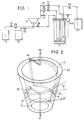
- Figure 1 is a rough view of a series of devices suitable for practicing a method of culturing animal cells in suspension in accordance with this invention.
- an inside peripheral wall 21 and an outside peripheral wall 22 form a peripheral slit 23.
- Shown at 24 is an opening for feeding the suspension culture fluid and also for withdrawing the liquid having a higher density.
- Shown at 25 is an opening for withdrawing the cell-free mother liquor and the culture fluid containing the separated cells.
- Nozzles 26 and 27 are also provided for feeding into the rotor and/or withdrawal from the rotor.
- the angle ⁇ between the slit surface and the centrifugal direction in Figure 2 is preferably 50 to 90°, and the depth d of the peripheral slit is preferably 3 to 5 mm.
- the surface of the inside surface of the peripheral slit is desirably treated so as to render it hydrophobic. This treatment may be suitably carried out by coating it with a fluorine-containing resin such as polytetrafluoroethylene.
- the angle ⁇ ' between the upper side of the peripheral slit 23 and the centrifugal direction in Figure 2 is preferably 5 to 10°, and the angle ⁇ '' between the lower side of the slit and the centrifugal direction is preferably 0 to 5°.
- the "living animal cell-containing aqueous suspension" being separated can be any solution containing the animal cells in suspension, and its origin is not limited in particular. It may be a suspension withdrawn from a culture tank in suspension culture of animal cells, or body fluids of mammals, especially blood.
- steps (c), (d) and (f) in the method [II] correspond to steps (A), (B) and (C) in the method [I].
- the method [II] of culturing animal cells in accordance with this invention is applicable to the culturing of animal cells in suspension (suspension culture).
- the suspension culture denotes a method whereby animal cells are cultured while they are suspended in an aqueous medium.
- the animal cells to which the culturing method of this invention can be applied are those which can grow or proliferate in suspension. They include not only natural animal cells, but also cells modified artificially or by gene manipulation such as hybridoma cells. Or they may be cells derived from lymphatic cells which produce lymphokine, diploid cells producing biologically active substances such as interferon (IFN), or cells producing various monoclonal antibodies.
- IFN interferon
- the present invention is especially suitable for obtaining monoclonal antibodies at high densities by culturing monoclonal antibody-producing cells.
- the animal cells are cultured in suspension in a culture tank.
- the culture medium used in the suspension culture is an aqueous medium consisting substantially of water.
- the aqueous medium contains various additives ordinarily used in the culturing of animal cells, for example inorganic salts, vitamins, coenzymes, glucose, amino acids, antibiotics, and growth promoting factors.
- Serum may be added to the culture fluid. But a serum-free culture medium may also be used as the culture fluid. The use of the serum-free culture medium is economically advantageous, and therefore desirable.
- the culture tank that can be used in this invention at least comprises an opening for feeding animal cells, an opening for introducing a fresh culture medium, a tube for introduction of air, an agitator, and a conduit for withdrawing the suspension culture fluid.
- a culture tank may be an ordinary culture tank.
- step (b) a portion of the suspension culture fluid containing animal cells is withdrawn from the culture tank, for example through a culture fluid withdrawal conduit.
- the withdrawal of the suspension culture fluid can be carried out continuously or intermittently.
- a fresh supply of the makeup culture medium is introduced into the culture tank continuously or intermittently in an amount corresponding to the amount of the withdrawn suspension culture fluid containing animal cells.
- the amount of useful metabolites produced with the growth of the animal cells can be increased by an amount corresponding to the increased density of the grown animal cells.
- the culturing can be continued while maintaining an increased density of the grown animal cells over an extended period of time, and the useful metabolites can be produced in increased amounts.
- the above culturing method is characterized by accumulating the living animal cells in the centrifuging space of the centrifugal separator in step (c), and then pushing and withdrawing the accumulated living animal cells together with the mother liquor by the liquid medium immiscible with water, having a higher density than the animal cells and the culture fluid and not hindering the growth of the animal cells in step (d).
- step (c) to accumulate the living animal cells, it is necessary to continuously feed the suspension culture fluid withdrawn in step (b) into the centrifuging space of the centrifugal separator for a certain period of time and to continuously withdraw the mother liquor separated from the living animal cells for a certain period of time. Specifically, since the suspension culture fluid withdrawn in step (b) has a low concentration of the animal cells, it is fed into the centrifuging space until the animal cells are accumulated in a desired amount. The following operating conditions for the centrifugal separator are desirable.
- the average residence time ( ⁇ , minutes) of the animal cells in the centrifugal separator should be limited to not more than 300 minutes. If the residence time exceeds 300 minutes, the survival rate of the animal cells becomes markedly low owing, for example, to the deficiency of oxygen.
- the average residence time ( ⁇ ) is not more than 150 minutes, especially not more than 60 minutes. Most preferable is not more than 30 minutes but not less than 5 minutes.
- the average residence ime ( ⁇ ) of the animal cells in the centrifugal separator is obtained as a quotient of the volume (V, cm3) of the space in which the animal cells in the fed suspension culture fluid can exist under centrifugal conditions, divided by the rate (Q C , cm3/min.) of withdrawing components containing the separated animal cells from the centrifugal separator.
- Z ⁇ is the centrifugal effect in the centrifugal separator, and is represented by r ⁇ 2/g in which r is the distance (cm) from the axis of rotation, ⁇ is the rotating angular speed (radians/sec.), and g is the acceleration of gravity (cm/sec2).
- the centrifuging effect represents the magnitude of e centrifugal force exerted on the animal cells, and is therefore determined by the position (distance r from the axis of rotation) of the culture fluid feed opening for feeding the suspension culture fluid to be fed to the centrifugal separator for separation.
- Z ⁇ is in the range of 5 to 2,000. If it is lower than 5, the separating operation is difficult to perform.
- the centrifuging effect ( Z ⁇ ) should be maintained in the range of 10 to 1,000, especially preferably 20 to 300.
- the Z ⁇ x ⁇ should be maintained at not more than 3 x 10⁴. If the centrifuging operation is carried out while the Z ⁇ x ⁇ value is above the above-specified range, the survival rate of the animal cells decreases gradually by the compaction of the cells themselves. Especially preferably, the Z ⁇ x ⁇ value is not more than 2 x 10⁴.
- S (cm2) is the sedimentation area (cm2) under the action of a centrifugal force.
- S (cm2) is defined as an effective area involved in separation at the site (r cm from the axis of rotation) of the opening for feeding the suspension culture fluid into the centrifugal separator for separation.
- a phantom circle at the site of the feed opening at a distance of r from the axis of rotation does not cross the sedimentation surface, it is obtained as a value of 2 rh by the site (r) of the feed opening and the height (h) of the liquid surface of the suspension culture fluid at the position of the feed opening.
- the effective area decreases to the area of that portion which ranges to the site where the phantom circle crosses the sedimentation surface, and is obtained by multiplying 2 rh by the ratio of the angle to the point of crossing.
- the height (h) of the liquid surface mentioned above is a vertical distance from the deepest position of the separating tank of the centrifugal separator.
- the value S. Z ⁇ obtained by multiplying the effective area S and the centrifuging effect Z ⁇ is a parameter that shows the separating ability of the centrifugal separator.
- a value obtained by dividing the amount Q (ml/min.) of the suspension culture fluid supplied to the centrifugal separator per unit time by this parameter, i.e. Q/S. Z ⁇ should be limited to not more than 0.3, preferably not more than 0.2, especially preferably not more than 0.1.
- step (C) of the method of this invention makes it possible to separate living animal cells efficiently at a very high survival rate from the suspension culture fluid.
- the living animal cells separated by the centrifugal separator and accumulated in the centrifuging space is then, in step (d) according to the above method of this invention, pushed out from the discharge opening together with the mother liquor by feeding a liquid carrier immiscible with water, having a higher density than the animal cells and the culture fluid and not inhibiting the growth of the animal cells to the centrifugal separator in operation from the feed opening instead of the suspension culture fluid.
- Perfluorocarbons for example, can be suitably used as the liquid carrier.
- the fluorocarbons are liquid at room temperatures, and commercially available fluorocarbons can be widely utilized.
- fluorocarbons used as heat media or an electrically insulating material, and various fluorocarbons used as artificial blood may be used.
- perfluoroalkanes having at least 8 carbon atoms include perfluorocycloalkanes (such as perfluorodecalin, perfluoromethyldecalin, and perfluoroalkylcyclohexane, and perfluoroalkylcyclohexanes having 3 to 5 carbon atoms in the alkyl moiety), perfluoroalkyltetrahydrofurans having 5 to 7 carbon atoms in the alkyl moiety, perfluoroalkyltetrahydropyrans having 4 to 6 carbon atoms in the alkyl moiety, and perfluoroadamantanes (such as perfluoroadamantane, perfluoromethyladamantane, perfluorodimethyladamantane, perfluoromethylethyladamantane and perfluorodiethyladamantane).
- perfluorocarbons may contain various groups, for example a tertiary amino group. They may be used either
- steps (c) and (d) enables the animal cells to be separated while they are alive. Moreover, since the centrifuging space incessantly undergoes washing with the liquid carrier, the centrifuging space can always be maintained in an environment suited for the growth of the living animal cells and for an industrially advantageous continuous operation.
- step (d) At least a portion of the living animal cells having the ability to proliferate which have been withdrawn in step (d) are then, in step (e) according to the culturing method of this invention, returned to the culture tank for step (a).
- step (f) the fresh culture fluid or the culture fluid withdrawn in step (c) is fed from the feed opening of the liquid fluid of the rotating centrifugal separator, and the liquid carrier is withdrawn from the discharge opening of the liquid fluid to recover it from the centrifugal separator by separation.
- the culturing method of this invention is an industrially profitable method that exhibits the aforesaid advantages by repeating steps (b) to (f).
- Figure 1 is an outline view of an apparaatus suitable for practicing the culturing method of this invention.
- an animal cell-containing suspension culture fluid withdrawn from a culture tank T1 by means of a pump P1 is continuously fed in a centrifugal separator S from a feed opening provided at a site under a higher centrifugal force.
- the centrifugal force the animal cells are separated from the suspension fluid, and the mother liquor separated from the animal cells is withdrawn continuously and aseptically from a discharge opening provided at a site under a lower centrifugal force.
- a liquid carrier which has no affinity for either the cells or the culture fluid and has a higher density than these is withdrawn by a pump P2, and fed in a fixed amount from the feed opening provided at that site of the centrifugal separator S which is under a higher centrifugal force.
- the culture fluid containing the separated animal cells is aseptically withdrawn from the discharge opening of the centrifugal separator which is at a site under a lower centrifugal force, and returned to the culture tank T1.
- a tank T4 contains a cell-free fresh culture medium which is continuously or intermittently fed into the tank T1 by means of a pump P4 so that the liquid level in the culture tank T1 becomes constant.
- valves V1 to V6 require an opening-closing operation suitable for the above operation.
- the culturing method of this invention is said to be a method which employs the centrifugal separator and uses the liquid carrier immiscible with water, having a higher density than the animal cells and the aqueous solution and not inhibiting the growth of the animal cells, to thereby exhibit the functions thereof most effectively.
- the liquid carrier in the bottom portion of the culture tank is introduced into the centrifugal separator S via the pump P2, the living animal cells accumulated in the centrifugal separator S are thereby pushed out and returned to the culture tank together with the cells.
- the liquid carrier stays in the centrifugal separator, and the cells which have so far resided therein are spontaneously discharged owing to difference in specific gravity.
- part or the whole of the liquid carrier is sometimes introduced into the culture tank T1, and therefore the liquid carrier phase is formed at the bottom portion of the culture tank. It will be seen that the above recycling use of the liquid carrier phase formed in the bottom portion of the culture tank is quite advantageous to industrial-scale culturing.
- the time during which the animal cells pass through the liquid carrier can be reduced to zero or to a very short one.
- the damage to the animal cells is little if the pressure substantially exerted on the animal cells is 0.2 kgf/cm2 or less.
- the animal cells are therefore allowed to pass through a liquid carrier having a pressure within this pressure range.
- the concentration of substances which inhibit the growth of the animal cells accumulated successively within the culture tank as the culturing proceeds can be maintained at low levels.
- the culture tank T1 was a stirred culture tank of glass having a total capacity of 15 liters and designed to receive 10 liters as a net volume of the culture medium.
- the centrifugal separator was one equipped with a rotor having a sedimentation area S of 130 cm2, an effective volume of 75 ml and a rotation radius of 10 cm, as shown in Figure 2.
- Pumps P1, P2 and P3 were peristaltic pumps.
- a medium obtained by adding 9 micrograms/ml of insulin, 10 micrograms/ml of transferrin, 10 micrograms/ml of ethanolamine and 2 x 10 ⁇ 6 mole/liter of selenous acid to a base medium was used.
- the culture system was sterilized in advance by autoclaving. Then, 10 liters of the culture medium sterilized by filtration was fed into the culture tank, and mouse-human hybridoma X87 cells obtained by fusing mouse myeloma P3Ul cells and human B cells were seeded so that the cell density became 6.2 x 10⁵ cells/ml. These hybridoma cells produce IgG. Oxygen gas containing 5 % of carbon dioxide was introduced into the culture tank through a blow nozzle while the concentration of dissolved oxygen in the culture medium was automatically controlled to 3 ppm. The culture fluid in the culture tank was maintained at 37°C. A marine-type stirring vane was attached to the cultivation tank, and operated at a stirring speed of 30 rpm.
- the culturing was carried out batchwise. As shown in Table 1, the cell density reached 9.8 x 10⁵ cells/ml on the second day after the start of culturing (after the lapse of 24 hours). This density was determined to be the highest in batchwise culture, and perfusion culture using the centrifugal separator was started. Specifically, the centrifugal separator charged with the filtration-sterilized culture fluid was driven, and the rotation speed of the centrifugal separator was adjusted so that the centrifuging effect became 80G.
- pump P-2 was driven to send 120 ml of the perfluorocarbon at the bottom of the culture tank T1 at a rate of 30 ml/min.
- pump P-2 was driven to send 120 ml of the perfluorocarbon at the bottom of the culture tank T1 at a rate of 30 ml/min.
- all the cells residing in the centrifugal rotor were discharged from the centrifugal separator together with the perfluorocarbon, and returned to the culture tank T1.
- the pressure exerted on the cells within the centrifugal rotor was 0.05 kgf/cm2 at the highest.
- pumps P1 and P2 were stopped, and pump P3 was driven to send the fresh medium in T3 to the centrifugal separator S and return the perfluorocarbon in the centrifugal separator to the culture tank T1.
- the culturing was continued by automatically performing this operation once every period of time shown in Table 1.
- a fresh supply of the culture medium was fed continuously into the culture tank so that the liquid level in the culture tank became constant on an average.
- Table 16 The experimental results are shown in Table 16 together with some of the experimental conditions.
- Table 1 Culturing time (days) Time interval for feeding to the centrifugal separator (hours) Number of feedings of the makeup medium per day Density of living cells (cells/ml) Concentration of the antibody in the culture fluid ( ⁇ g/ml) 0 - 0 6.2 x 10⁵ 0 1 1.2 1.0 9.8 x 10⁵ 11 2 1.2 1.0 1.6 x 10⁶ 8 3 1.2 1.0 2.3 x 10⁶ 8 4 1.2 1.0 3.4 x 10⁶ 12 5 0.6 2.0 4.8 x 10⁶ 10 6 0.6 2.0 6.8 x 10⁶ 14 7 0.6 2.0 8.9 x 10⁶ 22 8 0.6 2.0 9.8 x 10⁶ 29 9 0.6 2.0 1.1 x 10⁷ 38 10 0.6 2.0 1.0 x 10⁷ 45 11 0.6 2.0 1.2 x 10⁷ 48 12 0.6 2.0 1.1 x 10⁷ 54 13 0.6 2.0 1.2 x 10⁷ 53 14 0.6 2.0 1.2
Landscapes
- Life Sciences & Earth Sciences (AREA)
- Engineering & Computer Science (AREA)
- Wood Science & Technology (AREA)
- Zoology (AREA)
- Bioinformatics & Cheminformatics (AREA)
- Organic Chemistry (AREA)
- Health & Medical Sciences (AREA)
- Chemical & Material Sciences (AREA)
- Biotechnology (AREA)
- Microbiology (AREA)
- Sustainable Development (AREA)
- Biochemistry (AREA)
- General Engineering & Computer Science (AREA)
- General Health & Medical Sciences (AREA)
- Genetics & Genomics (AREA)
- Biomedical Technology (AREA)
- Apparatus Associated With Microorganisms And Enzymes (AREA)
- Micro-Organisms Or Cultivation Processes Thereof (AREA)
Applications Claiming Priority (4)
| Application Number | Priority Date | Filing Date | Title |
|---|---|---|---|
| JP24926989 | 1989-09-27 | ||
| JP249269/89 | 1989-09-27 | ||
| JP106444/90 | 1990-04-24 | ||
| JP2106444A JPH078236B2 (ja) | 1989-04-24 | 1990-04-24 | 動物細胞の培養方法および遠心分離装置 |
Related Parent Applications (1)
| Application Number | Title | Priority Date | Filing Date |
|---|---|---|---|
| EP90118402.8 Division | 1990-09-25 |
Publications (1)
| Publication Number | Publication Date |
|---|---|
| EP0475457A1 true EP0475457A1 (de) | 1992-03-18 |
Family
ID=26446553
Family Applications (2)
| Application Number | Title | Priority Date | Filing Date |
|---|---|---|---|
| EP19900118402 Expired - Lifetime EP0420153B1 (de) | 1989-09-27 | 1990-09-25 | Zentrifugalseparator, Verfahren zur Trennung von Tierzellen aus Tierzellen enthaltender Suspension mittels dieses Separators und Verfahren zur Züchtung von Tierzellen in Suspension mittels dieses Separators |
| EP91117364A Withdrawn EP0475457A1 (de) | 1989-09-27 | 1990-09-25 | Verfahren zur Trennung von Tierzellen aus Tierzellen enthaltenden Suspensionen mittels eines Zentrigugalseparators und Verfahren zur Züchtung von Tierzellen in Suspension |
Family Applications Before (1)
| Application Number | Title | Priority Date | Filing Date |
|---|---|---|---|
| EP19900118402 Expired - Lifetime EP0420153B1 (de) | 1989-09-27 | 1990-09-25 | Zentrifugalseparator, Verfahren zur Trennung von Tierzellen aus Tierzellen enthaltender Suspension mittels dieses Separators und Verfahren zur Züchtung von Tierzellen in Suspension mittels dieses Separators |
Country Status (2)
| Country | Link |
|---|---|
| EP (2) | EP0420153B1 (de) |
| DE (1) | DE69029887T2 (de) |
Cited By (1)
| Publication number | Priority date | Publication date | Assignee | Title |
|---|---|---|---|---|
| WO1999023471A1 (en) * | 1997-10-31 | 1999-05-14 | Giammaria Sitar | Device and method for the separation of human or animal cells of different densities from cellular dispersions which contain them |
Families Citing this family (4)
| Publication number | Priority date | Publication date | Assignee | Title |
|---|---|---|---|---|
| US5846439A (en) * | 1996-02-28 | 1998-12-08 | Marshfield Medical Research & Education Foundation, A Division Of Marshfield Clinic | Method of concentrating waterborne protozoan parasites |
| US6500107B2 (en) | 2001-06-05 | 2002-12-31 | Baxter International, Inc. | Method for the concentration of fluid-borne pathogens |
| TW200607567A (en) * | 2004-08-05 | 2006-03-01 | Filtra Ltd | A low shear centrifugal separator |
| CN112175827B (zh) * | 2020-09-25 | 2023-09-12 | 深圳赛桥生物创新技术有限公司 | 一种细胞自动离心清洗换液方法及装置 |
Citations (2)
| Publication number | Priority date | Publication date | Assignee | Title |
|---|---|---|---|---|
| EP0229289A2 (de) * | 1985-12-06 | 1987-07-22 | Teijin Limited | Verfahren zur Züchtung von Tierzellen |
| JPS63240783A (ja) * | 1986-11-26 | 1988-10-06 | Teijin Ltd | 動物細胞の培養方法 |
Family Cites Families (1)
| Publication number | Priority date | Publication date | Assignee | Title |
|---|---|---|---|---|
| GB873494A (en) * | 1957-03-08 | 1961-07-26 | Selahaddin Rastgeldi | Method and means for centrifuging |
-
1990
- 1990-09-25 EP EP19900118402 patent/EP0420153B1/de not_active Expired - Lifetime
- 1990-09-25 DE DE1990629887 patent/DE69029887T2/de not_active Expired - Fee Related
- 1990-09-25 EP EP91117364A patent/EP0475457A1/de not_active Withdrawn
Patent Citations (2)
| Publication number | Priority date | Publication date | Assignee | Title |
|---|---|---|---|---|
| EP0229289A2 (de) * | 1985-12-06 | 1987-07-22 | Teijin Limited | Verfahren zur Züchtung von Tierzellen |
| JPS63240783A (ja) * | 1986-11-26 | 1988-10-06 | Teijin Ltd | 動物細胞の培養方法 |
Non-Patent Citations (1)
| Title |
|---|
| PATENT ABSTRACTS OF JAPAN, Vol. 13, No. 42 (C-564)[3390] 30 January 1989; & JP-A-63 240 783 (TEIJIN LTD) 6 October 1988, Abstract. * |
Cited By (2)
| Publication number | Priority date | Publication date | Assignee | Title |
|---|---|---|---|---|
| WO1999023471A1 (en) * | 1997-10-31 | 1999-05-14 | Giammaria Sitar | Device and method for the separation of human or animal cells of different densities from cellular dispersions which contain them |
| US6309606B1 (en) | 1997-10-31 | 2001-10-30 | Giammaria Sitar | Device and method for the separation of human or animal cells of different densities from cellular dispersions which contain them |
Also Published As
| Publication number | Publication date |
|---|---|
| DE69029887D1 (de) | 1997-03-20 |
| DE69029887T2 (de) | 1997-05-22 |
| EP0420153A1 (de) | 1991-04-03 |
| EP0420153B1 (de) | 1997-02-05 |
Similar Documents
| Publication | Publication Date | Title |
|---|---|---|
| JP3328287B2 (ja) | 細胞培養に使用される粒子沈降タンク | |
| US6544788B2 (en) | Disposable perfusion bioreactor for cell culture | |
| US4621052A (en) | Process for the production of human epidermal growth factor | |
| EP0201086B1 (de) | Verfahren zur Herstellung von nützlichen Hochmolekulargewichtssubstanzen durch Kultur von vermehrungsfähigen Tierzellen und dazu geeignetes Kultursystem | |
| EP0475457A1 (de) | Verfahren zur Trennung von Tierzellen aus Tierzellen enthaltenden Suspensionen mittels eines Zentrigugalseparators und Verfahren zur Züchtung von Tierzellen in Suspension | |
| EP0229289B1 (de) | Verfahren zur Züchtung von Tierzellen | |
| EP0191356B1 (de) | Vorrichtung für Zellkulturen und Verfahren | |
| US5250432A (en) | Method of culturing animal cells | |
| JPH0375154B2 (de) | ||
| JPH0428352B2 (de) | ||
| JPH0738954B2 (ja) | 遠心分離機、動物細胞の分離方法及び動物細胞のサスペンジョン培養方法 | |
| JPS6265681A (ja) | 付着性細胞の連続大量培養法 | |
| JPH078236B2 (ja) | 動物細胞の培養方法および遠心分離装置 | |
| JPH0364104B2 (de) | ||
| JPH0665296B2 (ja) | 動物細胞の培養方法 | |
| JPH0728729B2 (ja) | 動物細胞の培養方法 | |
| JPS61280270A (ja) | 細胞培養装置 | |
| JPH074226B2 (ja) | 細胞培養装置及び細胞培養方法 | |
| JPS63123379A (ja) | 動物細胞の培養方法 | |
| JPS62289169A (ja) | 細胞培養装置 | |
| JPH0398572A (ja) | 細胞培養装置および方法 | |
| JPS63160579A (ja) | 懸濁培養における哺乳動物の細胞の培養方法、前記方法を実施する装置、および蛋白質の調製のための使用 | |
| JPH03266979A (ja) | 細胞の培養方法 | |
| JPS63252558A (ja) | 細胞分離装置及び細胞培養方法 | |
| JPS62289170A (ja) | 細胞の培養装置および方法 |
Legal Events
| Date | Code | Title | Description |
|---|---|---|---|
| PUAI | Public reference made under article 153(3) epc to a published international application that has entered the european phase |
Free format text: ORIGINAL CODE: 0009012 |
|
| AC | Divisional application: reference to earlier application |
Ref document number: 420153 Country of ref document: EP |
|
| AK | Designated contracting states |
Kind code of ref document: A1 Designated state(s): CH DE FR GB LI |
|
| 17P | Request for examination filed |
Effective date: 19920427 |
|
| 17Q | First examination report despatched |
Effective date: 19940713 |
|
| STAA | Information on the status of an ep patent application or granted ep patent |
Free format text: STATUS: THE APPLICATION IS DEEMED TO BE WITHDRAWN |
|
| 18D | Application deemed to be withdrawn |
Effective date: 19941124 |