EP0477717A2 - Neue 3-substituierte Cephalosporine, Verfahren zu ihrer Herstellung und ihre Verwendung als Arzneimittel - Google Patents
Neue 3-substituierte Cephalosporine, Verfahren zu ihrer Herstellung und ihre Verwendung als Arzneimittel Download PDFInfo
- Publication number
- EP0477717A2 EP0477717A2 EP91115689A EP91115689A EP0477717A2 EP 0477717 A2 EP0477717 A2 EP 0477717A2 EP 91115689 A EP91115689 A EP 91115689A EP 91115689 A EP91115689 A EP 91115689A EP 0477717 A2 EP0477717 A2 EP 0477717A2
- Authority
- EP
- European Patent Office
- Prior art keywords
- carbon atoms
- chain
- straight
- hydrogen
- compounds
- Prior art date
- Legal status (The legal status is an assumption and is not a legal conclusion. Google has not performed a legal analysis and makes no representation as to the accuracy of the status listed.)
- Withdrawn
Links
- 238000000034 method Methods 0.000 title claims abstract description 38
- 238000002360 preparation method Methods 0.000 title claims abstract description 10
- 229930186147 Cephalosporin Natural products 0.000 title abstract description 5
- 229940124587 cephalosporin Drugs 0.000 title abstract description 5
- 150000001780 cephalosporins Chemical class 0.000 title abstract description 5
- 239000003814 drug Substances 0.000 claims abstract description 9
- -1 cyano, carboxy Chemical group 0.000 claims description 96
- 150000001875 compounds Chemical class 0.000 claims description 86
- 125000000217 alkyl group Chemical group 0.000 claims description 45
- 125000004432 carbon atom Chemical group C* 0.000 claims description 39
- 125000003545 alkoxy group Chemical group 0.000 claims description 30
- 125000003178 carboxy group Chemical group [H]OC(*)=O 0.000 claims description 27
- 239000001257 hydrogen Substances 0.000 claims description 26
- 229910052739 hydrogen Inorganic materials 0.000 claims description 26
- UFHFLCQGNIYNRP-UHFFFAOYSA-N Hydrogen Chemical compound [H][H] UFHFLCQGNIYNRP-UHFFFAOYSA-N 0.000 claims description 23
- 125000001997 phenyl group Chemical group [H]C1=C([H])C([H])=C(*)C([H])=C1[H] 0.000 claims description 19
- ZAMOUSCENKQFHK-UHFFFAOYSA-N Chlorine atom Chemical group [Cl] ZAMOUSCENKQFHK-UHFFFAOYSA-N 0.000 claims description 17
- 239000000460 chlorine Chemical group 0.000 claims description 16
- 229910052801 chlorine Inorganic materials 0.000 claims description 16
- 150000002431 hydrogen Chemical class 0.000 claims description 16
- 125000004453 alkoxycarbonyl group Chemical group 0.000 claims description 15
- 229910052736 halogen Inorganic materials 0.000 claims description 15
- 150000002367 halogens Chemical group 0.000 claims description 15
- 125000002496 methyl group Chemical group [H]C([H])([H])* 0.000 claims description 15
- 229910052757 nitrogen Inorganic materials 0.000 claims description 14
- 125000002924 primary amino group Chemical group [H]N([H])* 0.000 claims description 14
- 150000003839 salts Chemical class 0.000 claims description 14
- PXGOKWXKJXAPGV-UHFFFAOYSA-N Fluorine Chemical compound FF PXGOKWXKJXAPGV-UHFFFAOYSA-N 0.000 claims description 13
- 229910052731 fluorine Inorganic materials 0.000 claims description 12
- 239000011737 fluorine Substances 0.000 claims description 12
- WKBOTKDWSSQWDR-UHFFFAOYSA-N Bromine atom Chemical group [Br] WKBOTKDWSSQWDR-UHFFFAOYSA-N 0.000 claims description 10
- GDTBXPJZTBHREO-UHFFFAOYSA-N bromine Chemical group BrBr GDTBXPJZTBHREO-UHFFFAOYSA-N 0.000 claims description 10
- 229910052794 bromium Inorganic materials 0.000 claims description 10
- 125000006239 protecting group Chemical group 0.000 claims description 10
- 125000002541 furyl group Chemical group 0.000 claims description 9
- 125000002887 hydroxy group Chemical group [H]O* 0.000 claims description 9
- 125000001544 thienyl group Chemical group 0.000 claims description 9
- 238000001727 in vivo Methods 0.000 claims description 8
- 125000003342 alkenyl group Chemical group 0.000 claims description 6
- 125000004433 nitrogen atom Chemical group N* 0.000 claims description 6
- 239000002253 acid Substances 0.000 claims description 5
- 125000000999 tert-butyl group Chemical group [H]C([H])([H])C(*)(C([H])([H])[H])C([H])([H])[H] 0.000 claims description 5
- 125000002221 trityl group Chemical group [H]C1=C([H])C([H])=C([H])C([H])=C1C([*])(C1=C(C(=C(C(=C1[H])[H])[H])[H])[H])C1=C([H])C([H])=C([H])C([H])=C1[H] 0.000 claims description 5
- 125000006022 2-methyl-2-propenyl group Chemical group 0.000 claims description 4
- 125000003903 2-propenyl group Chemical group [H]C([*])([H])C([H])=C([H])[H] 0.000 claims description 4
- 125000004217 4-methoxybenzyl group Chemical group [H]C1=C([H])C(=C([H])C([H])=C1OC([H])([H])[H])C([H])([H])* 0.000 claims description 4
- 230000004913 activation Effects 0.000 claims description 4
- 125000001797 benzyl group Chemical group [H]C1=C([H])C([H])=C(C([H])=C1[H])C([H])([H])* 0.000 claims description 4
- 125000005982 diphenylmethyl group Chemical group [H]C1=C([H])C([H])=C(C([H])=C1[H])C([H])(*)C1=C([H])C([H])=C([H])C([H])=C1[H] 0.000 claims description 4
- 125000001153 fluoro group Chemical group F* 0.000 claims description 4
- LOTBYPQQWICYBB-UHFFFAOYSA-N methyl n-hexyl-n-[2-(hexylamino)ethyl]carbamate Chemical compound CCCCCCNCCN(C(=O)OC)CCCCCC LOTBYPQQWICYBB-UHFFFAOYSA-N 0.000 claims description 4
- 125000006503 p-nitrobenzyl group Chemical group [H]C1=C([H])C(=C([H])C([H])=C1[N+]([O-])=O)C([H])([H])* 0.000 claims description 4
- OHSJPLSEQNCRLW-UHFFFAOYSA-N triphenylmethyl radical Chemical compound C1=CC=CC=C1[C](C=1C=CC=CC=1)C1=CC=CC=C1 OHSJPLSEQNCRLW-UHFFFAOYSA-N 0.000 claims description 4
- 125000000453 2,2,2-trichloroethyl group Chemical group [H]C([H])(*)C(Cl)(Cl)Cl 0.000 claims description 3
- 125000001731 2-cyanoethyl group Chemical group [H]C([H])(*)C([H])([H])C#N 0.000 claims description 3
- 150000007513 acids Chemical class 0.000 claims description 3
- 125000003118 aryl group Chemical group 0.000 claims description 3
- 125000000113 cyclohexyl group Chemical group [H]C1([H])C([H])([H])C([H])([H])C([H])(*)C([H])([H])C1([H])[H] 0.000 claims description 3
- 125000004185 ester group Chemical group 0.000 claims description 3
- 125000001301 ethoxy group Chemical group [H]C([H])([H])C([H])([H])O* 0.000 claims description 3
- 125000001495 ethyl group Chemical group [H]C([H])([H])C([H])([H])* 0.000 claims description 3
- 150000002923 oximes Chemical group 0.000 claims description 3
- 125000002572 propoxy group Chemical group [*]OC([H])([H])C(C([H])([H])[H])([H])[H] 0.000 claims description 3
- 150000003254 radicals Chemical class 0.000 claims description 3
- 125000002023 trifluoromethyl group Chemical group FC(F)(F)* 0.000 claims description 3
- 125000001340 2-chloroethyl group Chemical group [H]C([H])(Cl)C([H])([H])* 0.000 claims description 2
- 125000000304 alkynyl group Chemical group 0.000 claims description 2
- ABDBNWQRPYOPDF-UHFFFAOYSA-N carbonofluoridic acid Chemical compound OC(F)=O ABDBNWQRPYOPDF-UHFFFAOYSA-N 0.000 claims description 2
- 201000010099 disease Diseases 0.000 claims description 2
- 208000037265 diseases, disorders, signs and symptoms Diseases 0.000 claims description 2
- AQYSYJUIMQTRMV-UHFFFAOYSA-N hypofluorous acid Chemical compound FO AQYSYJUIMQTRMV-UHFFFAOYSA-N 0.000 claims description 2
- 239000012442 inert solvent Substances 0.000 claims description 2
- 238000004519 manufacturing process Methods 0.000 claims description 2
- 125000000956 methoxy group Chemical group [H]C([H])([H])O* 0.000 claims description 2
- 125000000449 nitro group Chemical group [O-][N+](*)=O 0.000 claims description 2
- 230000000844 anti-bacterial effect Effects 0.000 abstract description 3
- YMWUJEATGCHHMB-UHFFFAOYSA-N Dichloromethane Chemical compound ClCCl YMWUJEATGCHHMB-UHFFFAOYSA-N 0.000 description 27
- WEVYAHXRMPXWCK-UHFFFAOYSA-N Acetonitrile Chemical compound CC#N WEVYAHXRMPXWCK-UHFFFAOYSA-N 0.000 description 18
- YXFVVABEGXRONW-UHFFFAOYSA-N Toluene Chemical compound CC1=CC=CC=C1 YXFVVABEGXRONW-UHFFFAOYSA-N 0.000 description 18
- 239000000203 mixture Substances 0.000 description 18
- XEKOWRVHYACXOJ-UHFFFAOYSA-N Ethyl acetate Chemical compound CCOC(C)=O XEKOWRVHYACXOJ-UHFFFAOYSA-N 0.000 description 15
- RTZKZFJDLAIYFH-UHFFFAOYSA-N Diethyl ether Chemical compound CCOCC RTZKZFJDLAIYFH-UHFFFAOYSA-N 0.000 description 13
- 239000000243 solution Substances 0.000 description 11
- XLYOFNOQVPJJNP-UHFFFAOYSA-N water Substances O XLYOFNOQVPJJNP-UHFFFAOYSA-N 0.000 description 10
- ZMXDDKWLCZADIW-UHFFFAOYSA-N N,N-Dimethylformamide Chemical compound CN(C)C=O ZMXDDKWLCZADIW-UHFFFAOYSA-N 0.000 description 9
- 239000002904 solvent Substances 0.000 description 9
- 0 COCc1c([*-])cc[s]1 Chemical compound COCc1c([*-])cc[s]1 0.000 description 8
- VYPSYNLAJGMNEJ-UHFFFAOYSA-N Silicium dioxide Chemical compound O=[Si]=O VYPSYNLAJGMNEJ-UHFFFAOYSA-N 0.000 description 8
- DTQVDTLACAAQTR-UHFFFAOYSA-N Trifluoroacetic acid Chemical compound OC(=O)C(F)(F)F DTQVDTLACAAQTR-UHFFFAOYSA-N 0.000 description 8
- 238000006243 chemical reaction Methods 0.000 description 8
- BDAGIHXWWSANSR-UHFFFAOYSA-N methanoic acid Natural products OC=O BDAGIHXWWSANSR-UHFFFAOYSA-N 0.000 description 8
- 239000000741 silica gel Substances 0.000 description 8
- 229910002027 silica gel Inorganic materials 0.000 description 8
- KDLHZDBZIXYQEI-UHFFFAOYSA-N palladium Substances [Pd] KDLHZDBZIXYQEI-UHFFFAOYSA-N 0.000 description 7
- QOSSAOTZNIDXMA-UHFFFAOYSA-N Dicylcohexylcarbodiimide Chemical compound C1CCCCC1N=C=NC1CCCCC1 QOSSAOTZNIDXMA-UHFFFAOYSA-N 0.000 description 6
- VEXZGXHMUGYJMC-UHFFFAOYSA-N Hydrochloric acid Chemical compound Cl VEXZGXHMUGYJMC-UHFFFAOYSA-N 0.000 description 6
- OKKJLVBELUTLKV-UHFFFAOYSA-N Methanol Chemical compound OC OKKJLVBELUTLKV-UHFFFAOYSA-N 0.000 description 6
- WYURNTSHIVDZCO-UHFFFAOYSA-N Tetrahydrofuran Chemical compound C1CCOC1 WYURNTSHIVDZCO-UHFFFAOYSA-N 0.000 description 6
- 150000002148 esters Chemical group 0.000 description 6
- 229920001817 Agar Polymers 0.000 description 5
- UIIMBOGNXHQVGW-UHFFFAOYSA-M Sodium bicarbonate Chemical class [Na+].OC([O-])=O UIIMBOGNXHQVGW-UHFFFAOYSA-M 0.000 description 5
- 239000008272 agar Substances 0.000 description 5
- OSWFIVFLDKOXQC-UHFFFAOYSA-N 4-(3-methoxyphenyl)aniline Chemical compound COC1=CC=CC(C=2C=CC(N)=CC=2)=C1 OSWFIVFLDKOXQC-UHFFFAOYSA-N 0.000 description 4
- CSCPPACGZOOCGX-UHFFFAOYSA-N Acetone Chemical compound CC(C)=O CSCPPACGZOOCGX-UHFFFAOYSA-N 0.000 description 4
- XKRFYHLGVUSROY-UHFFFAOYSA-N Argon Chemical compound [Ar] XKRFYHLGVUSROY-UHFFFAOYSA-N 0.000 description 4
- IAZDPXIOMUYVGZ-UHFFFAOYSA-N Dimethylsulphoxide Chemical compound CS(C)=O IAZDPXIOMUYVGZ-UHFFFAOYSA-N 0.000 description 4
- MZRVEZGGRBJDDB-UHFFFAOYSA-N N-Butyllithium Chemical compound [Li]CCCC MZRVEZGGRBJDDB-UHFFFAOYSA-N 0.000 description 4
- SECXISVLQFMRJM-UHFFFAOYSA-N N-Methylpyrrolidone Chemical compound CN1CCCC1=O SECXISVLQFMRJM-UHFFFAOYSA-N 0.000 description 4
- PMZURENOXWZQFD-UHFFFAOYSA-L Sodium Sulfate Chemical compound [Na+].[Na+].[O-]S([O-])(=O)=O PMZURENOXWZQFD-UHFFFAOYSA-L 0.000 description 4
- 239000004480 active ingredient Substances 0.000 description 4
- 125000003277 amino group Chemical group 0.000 description 4
- RDOXTESZEPMUJZ-UHFFFAOYSA-N anisole Chemical compound COC1=CC=CC=C1 RDOXTESZEPMUJZ-UHFFFAOYSA-N 0.000 description 4
- 235000019253 formic acid Nutrition 0.000 description 4
- 239000012074 organic phase Substances 0.000 description 4
- 229910052938 sodium sulfate Inorganic materials 0.000 description 4
- 235000011152 sodium sulphate Nutrition 0.000 description 4
- ZMANZCXQSJIPKH-UHFFFAOYSA-N Triethylamine Chemical compound CCN(CC)CC ZMANZCXQSJIPKH-UHFFFAOYSA-N 0.000 description 3
- DTQVDTLACAAQTR-UHFFFAOYSA-M Trifluoroacetate Chemical compound [O-]C(=O)C(F)(F)F DTQVDTLACAAQTR-UHFFFAOYSA-M 0.000 description 3
- 150000008064 anhydrides Chemical class 0.000 description 3
- 244000005700 microbiome Species 0.000 description 3
- 231100000252 nontoxic Toxicity 0.000 description 3
- 230000003000 nontoxic effect Effects 0.000 description 3
- 244000052769 pathogen Species 0.000 description 3
- 239000003208 petroleum Substances 0.000 description 3
- 239000000825 pharmaceutical preparation Substances 0.000 description 3
- DLQYXUGCCKQSRJ-UHFFFAOYSA-N tris(furan-2-yl)phosphane Chemical compound C1=COC(P(C=2OC=CC=2)C=2OC=CC=2)=C1 DLQYXUGCCKQSRJ-UHFFFAOYSA-N 0.000 description 3
- 150000003952 β-lactams Chemical class 0.000 description 3
- RYHBNJHYFVUHQT-UHFFFAOYSA-N 1,4-Dioxane Chemical compound C1COCCO1 RYHBNJHYFVUHQT-UHFFFAOYSA-N 0.000 description 2
- PAMIQIKDUOTOBW-UHFFFAOYSA-N 1-methylpiperidine Chemical compound CN1CCCCC1 PAMIQIKDUOTOBW-UHFFFAOYSA-N 0.000 description 2
- YOETUEMZNOLGDB-UHFFFAOYSA-N 2-methylpropyl carbonochloridate Chemical compound CC(C)COC(Cl)=O YOETUEMZNOLGDB-UHFFFAOYSA-N 0.000 description 2
- HVCNXQOWACZAFN-UHFFFAOYSA-N 4-ethylmorpholine Chemical compound CCN1CCOCC1 HVCNXQOWACZAFN-UHFFFAOYSA-N 0.000 description 2
- NLXLAEXVIDQMFP-UHFFFAOYSA-N Ammonia chloride Chemical class [NH4+].[Cl-] NLXLAEXVIDQMFP-UHFFFAOYSA-N 0.000 description 2
- BVKZGUZCCUSVTD-UHFFFAOYSA-M Bicarbonate Chemical compound OC([O-])=O BVKZGUZCCUSVTD-UHFFFAOYSA-M 0.000 description 2
- HEDRZPFGACZZDS-UHFFFAOYSA-N Chloroform Chemical compound ClC(Cl)Cl HEDRZPFGACZZDS-UHFFFAOYSA-N 0.000 description 2
- DGAQECJNVWCQMB-PUAWFVPOSA-M Ilexoside XXIX Chemical group C[C@@H]1CC[C@@]2(CC[C@@]3(C(=CC[C@H]4[C@]3(CC[C@@H]5[C@@]4(CC[C@@H](C5(C)C)OS(=O)(=O)[O-])C)C)[C@@H]2[C@]1(C)O)C)C(=O)O[C@H]6[C@@H]([C@H]([C@@H]([C@H](O6)CO)O)O)O.[Na+] DGAQECJNVWCQMB-PUAWFVPOSA-M 0.000 description 2
- 238000005481 NMR spectroscopy Methods 0.000 description 2
- 229930182555 Penicillin Natural products 0.000 description 2
- JUJWROOIHBZHMG-UHFFFAOYSA-N Pyridine Chemical compound C1=CC=NC=C1 JUJWROOIHBZHMG-UHFFFAOYSA-N 0.000 description 2
- GCTFWCDSFPMHHS-UHFFFAOYSA-M Tributyltin chloride Chemical compound CCCC[Sn](Cl)(CCCC)CCCC GCTFWCDSFPMHHS-UHFFFAOYSA-M 0.000 description 2
- 150000001412 amines Chemical class 0.000 description 2
- 229910052786 argon Inorganic materials 0.000 description 2
- 239000002585 base Substances 0.000 description 2
- 230000037396 body weight Effects 0.000 description 2
- CODNYICXDISAEA-UHFFFAOYSA-N bromine monochloride Chemical compound BrCl CODNYICXDISAEA-UHFFFAOYSA-N 0.000 description 2
- 239000003054 catalyst Substances 0.000 description 2
- 239000003795 chemical substances by application Substances 0.000 description 2
- 238000004587 chromatography analysis Methods 0.000 description 2
- 238000009833 condensation Methods 0.000 description 2
- 230000005494 condensation Effects 0.000 description 2
- 238000001816 cooling Methods 0.000 description 2
- 150000002170 ethers Chemical class 0.000 description 2
- RIFGWPKJUGCATF-UHFFFAOYSA-N ethyl chloroformate Chemical compound CCOC(Cl)=O RIFGWPKJUGCATF-UHFFFAOYSA-N 0.000 description 2
- BDAGIHXWWSANSR-PFUFQJKNSA-N formic acid-d2 Chemical compound [2H]OC([2H])=O BDAGIHXWWSANSR-PFUFQJKNSA-N 0.000 description 2
- GNOIPBMMFNIUFM-UHFFFAOYSA-N hexamethylphosphoric triamide Chemical compound CN(C)P(=O)(N(C)C)N(C)C GNOIPBMMFNIUFM-UHFFFAOYSA-N 0.000 description 2
- 238000011081 inoculation Methods 0.000 description 2
- 125000001449 isopropyl group Chemical group [H]C([H])([H])C([H])(*)C([H])([H])[H] 0.000 description 2
- AMXOYNBUYSYVKV-UHFFFAOYSA-M lithium bromide Chemical compound [Li+].[Br-] AMXOYNBUYSYVKV-UHFFFAOYSA-M 0.000 description 2
- 239000011777 magnesium Substances 0.000 description 2
- 229910052749 magnesium Inorganic materials 0.000 description 2
- 229910001507 metal halide Inorganic materials 0.000 description 2
- 150000005309 metal halides Chemical class 0.000 description 2
- QARBMVPHQWIHKH-UHFFFAOYSA-N methanesulfonyl chloride Chemical compound CS(Cl)(=O)=O QARBMVPHQWIHKH-UHFFFAOYSA-N 0.000 description 2
- UZKWTJUDCOPSNM-UHFFFAOYSA-N methoxybenzene Substances CCCCOC=C UZKWTJUDCOPSNM-UHFFFAOYSA-N 0.000 description 2
- 150000007524 organic acids Chemical group 0.000 description 2
- 150000002960 penicillins Chemical class 0.000 description 2
- 150000003003 phosphines Chemical class 0.000 description 2
- 239000002798 polar solvent Substances 0.000 description 2
- BWHMMNNQKKPAPP-UHFFFAOYSA-L potassium carbonate Chemical compound [K+].[K+].[O-]C([O-])=O BWHMMNNQKKPAPP-UHFFFAOYSA-L 0.000 description 2
- 229910000030 sodium bicarbonate Inorganic materials 0.000 description 2
- 235000017557 sodium bicarbonate Nutrition 0.000 description 2
- 159000000000 sodium salts Chemical class 0.000 description 2
- 239000000126 substance Substances 0.000 description 2
- VZGDMQKNWNREIO-UHFFFAOYSA-N tetrachloromethane Chemical compound ClC(Cl)(Cl)Cl VZGDMQKNWNREIO-UHFFFAOYSA-N 0.000 description 2
- VZCYOOQTPOCHFL-UHFFFAOYSA-N trans-butenedioic acid Natural products OC(=O)C=CC(O)=O VZCYOOQTPOCHFL-UHFFFAOYSA-N 0.000 description 2
- DBGVGMSCBYYSLD-UHFFFAOYSA-N tributylstannane Chemical compound CCCC[SnH](CCCC)CCCC DBGVGMSCBYYSLD-UHFFFAOYSA-N 0.000 description 2
- RIOQSEWOXXDEQQ-UHFFFAOYSA-N triphenylphosphine Chemical compound C1=CC=CC=C1P(C=1C=CC=CC=1)C1=CC=CC=C1 RIOQSEWOXXDEQQ-UHFFFAOYSA-N 0.000 description 2
- JIAARYAFYJHUJI-UHFFFAOYSA-L zinc dichloride Chemical compound [Cl-].[Cl-].[Zn+2] JIAARYAFYJHUJI-UHFFFAOYSA-L 0.000 description 2
- JVVXZOOGOGPDRZ-UHFFFAOYSA-N (1,4a-dimethyl-7-propan-2-yl-2,3,4,9,10,10a-hexahydrophenanthren-1-yl)methanamine Chemical compound NCC1(C)CCCC2(C)C3=CC=C(C(C)C)C=C3CCC21 JVVXZOOGOGPDRZ-UHFFFAOYSA-N 0.000 description 1
- PXZNJHHUYJRFPZ-UHFFFAOYSA-N (4-bromothiophen-2-yl)methanol Chemical compound OCC1=CC(Br)=CS1 PXZNJHHUYJRFPZ-UHFFFAOYSA-N 0.000 description 1
- MASDFXZJIDNRTR-UHFFFAOYSA-N 1,3-bis(trimethylsilyl)urea Chemical compound C[Si](C)(C)NC(=O)N[Si](C)(C)C MASDFXZJIDNRTR-UHFFFAOYSA-N 0.000 description 1
- ASOKPJOREAFHNY-UHFFFAOYSA-N 1-Hydroxybenzotriazole Chemical compound C1=CC=C2N(O)N=NC2=C1 ASOKPJOREAFHNY-UHFFFAOYSA-N 0.000 description 1
- 238000005160 1H NMR spectroscopy Methods 0.000 description 1
- BMZQEYGEQALEIO-UHFFFAOYSA-N 2-(methoxymethyl)thiophene Chemical compound COCC1=CC=CS1 BMZQEYGEQALEIO-UHFFFAOYSA-N 0.000 description 1
- CRPFKUKPDCBUIX-UHFFFAOYSA-N 2-ethyl-5-phenyl-1,2-oxazol-2-ium-3-sulfonate Chemical compound [O-]S(=O)(=O)C1=[N+](CC)OC(C=2C=CC=CC=2)=C1 CRPFKUKPDCBUIX-UHFFFAOYSA-N 0.000 description 1
- LBLYYCQCTBFVLH-UHFFFAOYSA-M 2-methylbenzenesulfonate Chemical compound CC1=CC=CC=C1S([O-])(=O)=O LBLYYCQCTBFVLH-UHFFFAOYSA-M 0.000 description 1
- MPSXGPCFLAGJOM-UHFFFAOYSA-M 2-tert-butyl-5-methyl-1,2-oxazol-2-ium;perchlorate Chemical compound [O-]Cl(=O)(=O)=O.CC1=CC=[N+](C(C)(C)C)O1 MPSXGPCFLAGJOM-UHFFFAOYSA-M 0.000 description 1
- 125000000175 2-thienyl group Chemical group S1C([*])=C([H])C([H])=C1[H] 0.000 description 1
- 125000001541 3-thienyl group Chemical group S1C([H])=C([*])C([H])=C1[H] 0.000 description 1
- QAOVKNAMURILRG-UHFFFAOYSA-N 4-bromo-2-(methoxymethyl)thiophene Chemical compound COCC1=CC(Br)=CS1 QAOVKNAMURILRG-UHFFFAOYSA-N 0.000 description 1
- 125000004172 4-methoxyphenyl group Chemical group [H]C1=C([H])C(OC([H])([H])[H])=C([H])C([H])=C1* 0.000 description 1
- XVMSFILGAMDHEY-UHFFFAOYSA-N 6-(4-aminophenyl)sulfonylpyridin-3-amine Chemical compound C1=CC(N)=CC=C1S(=O)(=O)C1=CC=C(N)C=N1 XVMSFILGAMDHEY-UHFFFAOYSA-N 0.000 description 1
- QTBSBXVTEAMEQO-UHFFFAOYSA-M Acetate Chemical compound CC([O-])=O QTBSBXVTEAMEQO-UHFFFAOYSA-M 0.000 description 1
- 241000894006 Bacteria Species 0.000 description 1
- CPELXLSAUQHCOX-UHFFFAOYSA-M Bromide Chemical compound [Br-] CPELXLSAUQHCOX-UHFFFAOYSA-M 0.000 description 1
- BGLUXFNVVSVEET-UHFFFAOYSA-N CC(C=C1)OC1=O Chemical compound CC(C=C1)OC1=O BGLUXFNVVSVEET-UHFFFAOYSA-N 0.000 description 1
- GAEKPEKOJKCEMS-UHFFFAOYSA-N CC(CC1)OC1=O Chemical compound CC(CC1)OC1=O GAEKPEKOJKCEMS-UHFFFAOYSA-N 0.000 description 1
- XJVDIMLQFRPIMP-UHFFFAOYSA-N CC(c1c2cccc1)OC2=O Chemical compound CC(c1c2cccc1)OC2=O XJVDIMLQFRPIMP-UHFFFAOYSA-N 0.000 description 1
- OYPRJOBELJOOCE-UHFFFAOYSA-N Calcium Chemical compound [Ca] OYPRJOBELJOOCE-UHFFFAOYSA-N 0.000 description 1
- BVKZGUZCCUSVTD-UHFFFAOYSA-L Carbonate Chemical compound [O-]C([O-])=O BVKZGUZCCUSVTD-UHFFFAOYSA-L 0.000 description 1
- VEXZGXHMUGYJMC-UHFFFAOYSA-M Chloride anion Chemical compound [Cl-] VEXZGXHMUGYJMC-UHFFFAOYSA-M 0.000 description 1
- KRKNYBCHXYNGOX-UHFFFAOYSA-K Citrate Chemical compound [O-]C(=O)CC(O)(CC([O-])=O)C([O-])=O KRKNYBCHXYNGOX-UHFFFAOYSA-K 0.000 description 1
- HZZVJAQRINQKSD-UHFFFAOYSA-N Clavulanic acid Natural products OC(=O)C1C(=CCO)OC2CC(=O)N21 HZZVJAQRINQKSD-UHFFFAOYSA-N 0.000 description 1
- FEWJPZIEWOKRBE-JCYAYHJZSA-N Dextrotartaric acid Chemical compound OC(=O)[C@H](O)[C@@H](O)C(O)=O FEWJPZIEWOKRBE-JCYAYHJZSA-N 0.000 description 1
- BWLUMTFWVZZZND-UHFFFAOYSA-N Dibenzylamine Chemical compound C=1C=CC=CC=1CNCC1=CC=CC=C1 BWLUMTFWVZZZND-UHFFFAOYSA-N 0.000 description 1
- ZAFNJMIOTHYJRJ-UHFFFAOYSA-N Diisopropyl ether Chemical compound CC(C)OC(C)C ZAFNJMIOTHYJRJ-UHFFFAOYSA-N 0.000 description 1
- XTHFKEDIFFGKHM-UHFFFAOYSA-N Dimethoxyethane Chemical compound COCCOC XTHFKEDIFFGKHM-UHFFFAOYSA-N 0.000 description 1
- GKQLYSROISKDLL-UHFFFAOYSA-N EEDQ Chemical compound C1=CC=C2N(C(=O)OCC)C(OCC)C=CC2=C1 GKQLYSROISKDLL-UHFFFAOYSA-N 0.000 description 1
- 241000192125 Firmicutes Species 0.000 description 1
- BDAGIHXWWSANSR-UHFFFAOYSA-M Formate Chemical compound [O-]C=O BDAGIHXWWSANSR-UHFFFAOYSA-M 0.000 description 1
- VZCYOOQTPOCHFL-OWOJBTEDSA-N Fumaric acid Chemical compound OC(=O)\C=C\C(O)=O VZCYOOQTPOCHFL-OWOJBTEDSA-N 0.000 description 1
- CEAZRRDELHUEMR-URQXQFDESA-N Gentamicin Chemical compound O1[C@H](C(C)NC)CC[C@@H](N)[C@H]1O[C@H]1[C@H](O)[C@@H](O[C@@H]2[C@@H]([C@@H](NC)[C@@](C)(O)CO2)O)[C@H](N)C[C@@H]1N CEAZRRDELHUEMR-URQXQFDESA-N 0.000 description 1
- 229930182566 Gentamicin Natural products 0.000 description 1
- 238000002768 Kirby-Bauer method Methods 0.000 description 1
- JVTAAEKCZFNVCJ-UHFFFAOYSA-M Lactate Chemical compound CC(O)C([O-])=O JVTAAEKCZFNVCJ-UHFFFAOYSA-M 0.000 description 1
- WHXSMMKQMYFTQS-UHFFFAOYSA-N Lithium Chemical compound [Li] WHXSMMKQMYFTQS-UHFFFAOYSA-N 0.000 description 1
- FYYHWMGAXLPEAU-UHFFFAOYSA-N Magnesium Chemical compound [Mg] FYYHWMGAXLPEAU-UHFFFAOYSA-N 0.000 description 1
- AFVFQIVMOAPDHO-UHFFFAOYSA-M Methanesulfonate Chemical compound CS([O-])(=O)=O AFVFQIVMOAPDHO-UHFFFAOYSA-M 0.000 description 1
- 241000699670 Mus sp. Species 0.000 description 1
- SJRJJKPEHAURKC-UHFFFAOYSA-N N-Methylmorpholine Chemical group CN1CCOCC1 SJRJJKPEHAURKC-UHFFFAOYSA-N 0.000 description 1
- JCXJVPUVTGWSNB-UHFFFAOYSA-N Nitrogen dioxide Chemical class O=[N]=O JCXJVPUVTGWSNB-UHFFFAOYSA-N 0.000 description 1
- FAPVBPRVMURJKM-UHFFFAOYSA-N O[Cl]F Chemical compound O[Cl]F FAPVBPRVMURJKM-UHFFFAOYSA-N 0.000 description 1
- MUBZPKHOEPUJKR-UHFFFAOYSA-N Oxalic acid Chemical compound OC(=O)C(O)=O MUBZPKHOEPUJKR-UHFFFAOYSA-N 0.000 description 1
- 229910019142 PO4 Inorganic materials 0.000 description 1
- 108010087702 Penicillinase Proteins 0.000 description 1
- ZLMJMSJWJFRBEC-UHFFFAOYSA-N Potassium Chemical compound [K] ZLMJMSJWJFRBEC-UHFFFAOYSA-N 0.000 description 1
- URWAJWIAIPFPJE-UHFFFAOYSA-N Rickamicin Natural products O1CC(O)(C)C(NC)C(O)C1OC1C(O)C(OC2C(CC=C(CN)O2)N)C(N)CC1N URWAJWIAIPFPJE-UHFFFAOYSA-N 0.000 description 1
- 229930192786 Sisomicin Natural products 0.000 description 1
- KEAYESYHFKHZAL-UHFFFAOYSA-N Sodium Chemical compound [Na] KEAYESYHFKHZAL-UHFFFAOYSA-N 0.000 description 1
- 239000007983 Tris buffer Substances 0.000 description 1
- HCHKCACWOHOZIP-UHFFFAOYSA-N Zinc Chemical compound [Zn] HCHKCACWOHOZIP-UHFFFAOYSA-N 0.000 description 1
- 238000010521 absorption reaction Methods 0.000 description 1
- QTBSBXVTEAMEQO-UHFFFAOYSA-N acetic acid Substances CC(O)=O QTBSBXVTEAMEQO-UHFFFAOYSA-N 0.000 description 1
- 125000001539 acetonyl group Chemical group [H]C([H])([H])C(=O)C([H])([H])* 0.000 description 1
- 230000002378 acidificating effect Effects 0.000 description 1
- 239000008186 active pharmaceutical agent Substances 0.000 description 1
- 239000013543 active substance Substances 0.000 description 1
- 125000004442 acylamino group Chemical group 0.000 description 1
- 238000002814 agar dilution Methods 0.000 description 1
- 229910000288 alkali metal carbonate Inorganic materials 0.000 description 1
- 150000008041 alkali metal carbonates Chemical class 0.000 description 1
- 125000006193 alkinyl group Chemical group 0.000 description 1
- 150000003973 alkyl amines Chemical class 0.000 description 1
- 229910052782 aluminium Inorganic materials 0.000 description 1
- XAGFODPZIPBFFR-UHFFFAOYSA-N aluminium Chemical compound [Al] XAGFODPZIPBFFR-UHFFFAOYSA-N 0.000 description 1
- 150000001408 amides Chemical class 0.000 description 1
- 229960004821 amikacin Drugs 0.000 description 1
- LKCWBDHBTVXHDL-RMDFUYIESA-N amikacin Chemical compound O([C@@H]1[C@@H](N)C[C@H]([C@@H]([C@H]1O)O[C@@H]1[C@@H]([C@@H](N)[C@H](O)[C@@H](CO)O1)O)NC(=O)[C@@H](O)CCN)[C@H]1O[C@H](CN)[C@@H](O)[C@H](O)[C@H]1O LKCWBDHBTVXHDL-RMDFUYIESA-N 0.000 description 1
- 125000006242 amine protecting group Chemical group 0.000 description 1
- 239000002647 aminoglycoside antibiotic agent Substances 0.000 description 1
- 150000003863 ammonium salts Chemical class 0.000 description 1
- 239000002246 antineoplastic agent Substances 0.000 description 1
- 125000004429 atom Chemical group 0.000 description 1
- 208000022362 bacterial infectious disease Diseases 0.000 description 1
- 244000052616 bacterial pathogen Species 0.000 description 1
- JUHORIMYRDESRB-UHFFFAOYSA-N benzathine Chemical compound C=1C=CC=CC=1CNCCNCC1=CC=CC=C1 JUHORIMYRDESRB-UHFFFAOYSA-N 0.000 description 1
- SRSXLGNVWSONIS-UHFFFAOYSA-M benzenesulfonate Chemical compound [O-]S(=O)(=O)C1=CC=CC=C1 SRSXLGNVWSONIS-UHFFFAOYSA-M 0.000 description 1
- 229940077388 benzenesulfonate Drugs 0.000 description 1
- WPYMKLBDIGXBTP-UHFFFAOYSA-N benzoic acid Chemical compound OC(=O)C1=CC=CC=C1 WPYMKLBDIGXBTP-UHFFFAOYSA-N 0.000 description 1
- 125000001584 benzyloxycarbonyl group Chemical group C(=O)(OCC1=CC=CC=C1)* 0.000 description 1
- SIOVKLKJSOKLIF-UHFFFAOYSA-N bis(trimethylsilyl)acetamide Chemical compound C[Si](C)(C)OC(C)=N[Si](C)(C)C SIOVKLKJSOKLIF-UHFFFAOYSA-N 0.000 description 1
- 125000000484 butyl group Chemical group [H]C([*])([H])C([H])([H])C([H])([H])C([H])([H])[H] 0.000 description 1
- 239000011575 calcium Substances 0.000 description 1
- 229910052791 calcium Inorganic materials 0.000 description 1
- 150000001718 carbodiimides Chemical class 0.000 description 1
- 150000001728 carbonyl compounds Chemical class 0.000 description 1
- PFKFTWBEEFSNDU-UHFFFAOYSA-N carbonyldiimidazole Chemical compound C1=CN=CN1C(=O)N1C=CN=C1 PFKFTWBEEFSNDU-UHFFFAOYSA-N 0.000 description 1
- 150000007942 carboxylates Chemical class 0.000 description 1
- 150000001735 carboxylic acids Chemical class 0.000 description 1
- 239000000969 carrier Substances 0.000 description 1
- 238000002512 chemotherapy Methods 0.000 description 1
- 150000008280 chlorinated hydrocarbons Chemical class 0.000 description 1
- AOGYCOYQMAVAFD-UHFFFAOYSA-N chlorocarbonic acid Chemical class OC(Cl)=O AOGYCOYQMAVAFD-UHFFFAOYSA-N 0.000 description 1
- LNAMMBFJMYMQTO-FNEBRGMMSA-N chloroform;(1e,4e)-1,5-diphenylpenta-1,4-dien-3-one;palladium Chemical compound [Pd].[Pd].ClC(Cl)Cl.C=1C=CC=CC=1\C=C\C(=O)\C=C\C1=CC=CC=C1.C=1C=CC=CC=1\C=C\C(=O)\C=C\C1=CC=CC=C1.C=1C=CC=CC=1\C=C\C(=O)\C=C\C1=CC=CC=C1 LNAMMBFJMYMQTO-FNEBRGMMSA-N 0.000 description 1
- HZZVJAQRINQKSD-PBFISZAISA-N clavulanic acid Chemical compound OC(=O)[C@H]1C(=C/CO)/O[C@@H]2CC(=O)N21 HZZVJAQRINQKSD-PBFISZAISA-N 0.000 description 1
- 229960003324 clavulanic acid Drugs 0.000 description 1
- 238000003776 cleavage reaction Methods 0.000 description 1
- 230000001332 colony forming effect Effects 0.000 description 1
- 229940127089 cytotoxic agent Drugs 0.000 description 1
- 230000003247 decreasing effect Effects 0.000 description 1
- YFAGHNZHGGCZAX-JKIFEVAISA-N dicloxacillin Chemical compound N([C@@H]1C(N2[C@H](C(C)(C)S[C@@H]21)C(O)=O)=O)C(=O)C1=C(C)ON=C1C1=C(Cl)C=CC=C1Cl YFAGHNZHGGCZAX-JKIFEVAISA-N 0.000 description 1
- 229960001585 dicloxacillin Drugs 0.000 description 1
- HPNMFZURTQLUMO-UHFFFAOYSA-N diethylamine Chemical compound CCNCC HPNMFZURTQLUMO-UHFFFAOYSA-N 0.000 description 1
- 238000010790 dilution Methods 0.000 description 1
- 239000012895 dilution Substances 0.000 description 1
- CCIVGXIOQKPBKL-UHFFFAOYSA-M ethanesulfonate Chemical compound CCS([O-])(=O)=O CCIVGXIOQKPBKL-UHFFFAOYSA-M 0.000 description 1
- 239000000706 filtrate Substances 0.000 description 1
- 239000012634 fragment Substances 0.000 description 1
- 229960002518 gentamicin Drugs 0.000 description 1
- 150000004820 halides Chemical class 0.000 description 1
- XMBWDFGMSWQBCA-UHFFFAOYSA-N hydrogen iodide Chemical compound I XMBWDFGMSWQBCA-UHFFFAOYSA-N 0.000 description 1
- QAOWNCQODCNURD-UHFFFAOYSA-M hydrogensulfate Chemical compound OS([O-])(=O)=O QAOWNCQODCNURD-UHFFFAOYSA-M 0.000 description 1
- 208000015181 infectious disease Diseases 0.000 description 1
- 239000003112 inhibitor Substances 0.000 description 1
- 230000002401 inhibitory effect Effects 0.000 description 1
- INQOMBQAUSQDDS-UHFFFAOYSA-N iodomethane Chemical compound IC INQOMBQAUSQDDS-UHFFFAOYSA-N 0.000 description 1
- CTAPFRYPJLPFDF-UHFFFAOYSA-N isoxazole Chemical class C=1C=NOC=1 CTAPFRYPJLPFDF-UHFFFAOYSA-N 0.000 description 1
- 229930182823 kanamycin A Natural products 0.000 description 1
- 229910052744 lithium Inorganic materials 0.000 description 1
- 231100000053 low toxicity Toxicity 0.000 description 1
- VZCYOOQTPOCHFL-UPHRSURJSA-N maleic acid Chemical compound OC(=O)\C=C/C(O)=O VZCYOOQTPOCHFL-UPHRSURJSA-N 0.000 description 1
- UJNZOIKQAUQOCN-UHFFFAOYSA-N methyl(diphenyl)phosphane Chemical compound C=1C=CC=CC=1P(C)C1=CC=CC=C1 UJNZOIKQAUQOCN-UHFFFAOYSA-N 0.000 description 1
- 150000007522 mineralic acids Chemical class 0.000 description 1
- SYSQUGFVNFXIIT-UHFFFAOYSA-N n-[4-(1,3-benzoxazol-2-yl)phenyl]-4-nitrobenzenesulfonamide Chemical class C1=CC([N+](=O)[O-])=CC=C1S(=O)(=O)NC1=CC=C(C=2OC3=CC=CC=C3N=2)C=C1 SYSQUGFVNFXIIT-UHFFFAOYSA-N 0.000 description 1
- LWFWUJCJKPUZLV-UHFFFAOYSA-N n-trimethylsilylacetamide Chemical compound CC(=O)N[Si](C)(C)C LWFWUJCJKPUZLV-UHFFFAOYSA-N 0.000 description 1
- YZMHQCWXYHARLS-UHFFFAOYSA-N naphthalene-1,2-disulfonic acid Chemical compound C1=CC=CC2=C(S(O)(=O)=O)C(S(=O)(=O)O)=CC=C21 YZMHQCWXYHARLS-UHFFFAOYSA-N 0.000 description 1
- 235000005985 organic acids Nutrition 0.000 description 1
- 150000007530 organic bases Chemical class 0.000 description 1
- 125000001181 organosilyl group Chemical group [SiH3]* 0.000 description 1
- UWYHMGVUTGAWSP-JKIFEVAISA-N oxacillin Chemical compound N([C@@H]1C(N2[C@H](C(C)(C)S[C@@H]21)C(O)=O)=O)C(=O)C1=C(C)ON=C1C1=CC=CC=C1 UWYHMGVUTGAWSP-JKIFEVAISA-N 0.000 description 1
- 229960001019 oxacillin Drugs 0.000 description 1
- 125000005646 oximino group Chemical group 0.000 description 1
- 229910052763 palladium Inorganic materials 0.000 description 1
- 239000002245 particle Substances 0.000 description 1
- 229950009506 penicillinase Drugs 0.000 description 1
- 239000000546 pharmaceutical excipient Substances 0.000 description 1
- UYWQUFXKFGHYNT-UHFFFAOYSA-N phenylmethyl ester of formic acid Natural products O=COCC1=CC=CC=C1 UYWQUFXKFGHYNT-UHFFFAOYSA-N 0.000 description 1
- NBIIXXVUZAFLBC-UHFFFAOYSA-K phosphate Chemical compound [O-]P([O-])([O-])=O NBIIXXVUZAFLBC-UHFFFAOYSA-K 0.000 description 1
- 239000010452 phosphate Substances 0.000 description 1
- UHZYTMXLRWXGPK-UHFFFAOYSA-N phosphorus pentachloride Chemical compound ClP(Cl)(Cl)(Cl)Cl UHZYTMXLRWXGPK-UHFFFAOYSA-N 0.000 description 1
- 239000002504 physiological saline solution Substances 0.000 description 1
- 229910052700 potassium Inorganic materials 0.000 description 1
- 239000011591 potassium Substances 0.000 description 1
- 235000015497 potassium bicarbonate Nutrition 0.000 description 1
- 229910000027 potassium carbonate Inorganic materials 0.000 description 1
- 235000011181 potassium carbonates Nutrition 0.000 description 1
- 239000002244 precipitate Substances 0.000 description 1
- MFDFERRIHVXMIY-UHFFFAOYSA-N procaine Chemical compound CCN(CC)CCOC(=O)C1=CC=C(N)C=C1 MFDFERRIHVXMIY-UHFFFAOYSA-N 0.000 description 1
- 229960004919 procaine Drugs 0.000 description 1
- 238000011321 prophylaxis Methods 0.000 description 1
- UMJSCPRVCHMLSP-UHFFFAOYSA-N pyridine Natural products COC1=CC=CN=C1 UMJSCPRVCHMLSP-UHFFFAOYSA-N 0.000 description 1
- 230000002829 reductive effect Effects 0.000 description 1
- 239000012898 sample dilution Substances 0.000 description 1
- 230000007017 scission Effects 0.000 description 1
- 238000013207 serial dilution Methods 0.000 description 1
- 229960005456 sisomicin Drugs 0.000 description 1
- URWAJWIAIPFPJE-YFMIWBNJSA-N sisomycin Chemical compound O1C[C@@](O)(C)[C@H](NC)[C@@H](O)[C@H]1O[C@@H]1[C@@H](O)[C@H](O[C@@H]2[C@@H](CC=C(CN)O2)N)[C@@H](N)C[C@H]1N URWAJWIAIPFPJE-YFMIWBNJSA-N 0.000 description 1
- 229910052708 sodium Inorganic materials 0.000 description 1
- 239000011734 sodium Substances 0.000 description 1
- 235000015424 sodium Nutrition 0.000 description 1
- CDBYLPFSWZWCQE-UHFFFAOYSA-L sodium carbonate Substances [Na+].[Na+].[O-]C([O-])=O CDBYLPFSWZWCQE-UHFFFAOYSA-L 0.000 description 1
- 229910000029 sodium carbonate Inorganic materials 0.000 description 1
- 239000012312 sodium hydride Substances 0.000 description 1
- 229910000104 sodium hydride Inorganic materials 0.000 description 1
- 238000001228 spectrum Methods 0.000 description 1
- KDYFGRWQOYBRFD-UHFFFAOYSA-L succinate(2-) Chemical compound [O-]C(=O)CCC([O-])=O KDYFGRWQOYBRFD-UHFFFAOYSA-L 0.000 description 1
- 150000003871 sulfonates Chemical class 0.000 description 1
- 150000003458 sulfonic acid derivatives Chemical class 0.000 description 1
- 239000000725 suspension Substances 0.000 description 1
- 230000009885 systemic effect Effects 0.000 description 1
- 229940095064 tartrate Drugs 0.000 description 1
- 125000001981 tert-butyldimethylsilyl group Chemical group [H]C([H])([H])[Si]([H])(C([H])([H])[H])[*]C(C([H])([H])[H])(C([H])([H])[H])C([H])([H])[H] 0.000 description 1
- 125000005931 tert-butyloxycarbonyl group Chemical group [H]C([H])([H])C(OC(*)=O)(C([H])([H])[H])C([H])([H])[H] 0.000 description 1
- NYBWUHOMYZZKOR-UHFFFAOYSA-N tes-adt Chemical class C1=C2C(C#C[Si](CC)(CC)CC)=C(C=C3C(SC=C3)=C3)C3=C(C#C[Si](CC)(CC)CC)C2=CC2=C1SC=C2 NYBWUHOMYZZKOR-UHFFFAOYSA-N 0.000 description 1
- YLQBMQCUIZJEEH-UHFFFAOYSA-N tetrahydrofuran Natural products C=1C=COC=1 YLQBMQCUIZJEEH-UHFFFAOYSA-N 0.000 description 1
- NQRYJNQNLNOLGT-UHFFFAOYSA-N tetrahydropyridine hydrochloride Natural products C1CCNCC1 NQRYJNQNLNOLGT-UHFFFAOYSA-N 0.000 description 1
- 229960000707 tobramycin Drugs 0.000 description 1
- NLVFBUXFDBBNBW-PBSUHMDJSA-N tobramycin Chemical compound N[C@@H]1C[C@H](O)[C@@H](CN)O[C@@H]1O[C@H]1[C@H](O)[C@@H](O[C@@H]2[C@@H]([C@@H](N)[C@H](O)[C@@H](CO)O2)O)[C@H](N)C[C@@H]1N NLVFBUXFDBBNBW-PBSUHMDJSA-N 0.000 description 1
- 238000011282 treatment Methods 0.000 description 1
- 125000005270 trialkylamine group Chemical group 0.000 description 1
- BCAFYQWNCAXPRR-UHFFFAOYSA-N tributyl(thiophen-3-yl)stannane Chemical compound CCCC[Sn](CCCC)(CCCC)C=1C=CSC=1 BCAFYQWNCAXPRR-UHFFFAOYSA-N 0.000 description 1
- TUQOTMZNTHZOKS-UHFFFAOYSA-N tributylphosphine Chemical compound CCCCP(CCCC)CCCC TUQOTMZNTHZOKS-UHFFFAOYSA-N 0.000 description 1
- CPRPKIMXLHBUGA-UHFFFAOYSA-N triethyltin Chemical group CC[Sn](CC)CC CPRPKIMXLHBUGA-UHFFFAOYSA-N 0.000 description 1
- 125000000876 trifluoromethoxy group Chemical group FC(F)(F)O* 0.000 description 1
- 125000000026 trimethylsilyl group Chemical group [H]C([H])([H])[Si]([*])(C([H])([H])[H])C([H])([H])[H] 0.000 description 1
- CUTRINLXFPIWQB-UHFFFAOYSA-N tris(3-fluorophenyl)phosphane Chemical compound FC1=CC=CC(P(C=2C=C(F)C=CC=2)C=2C=C(F)C=CC=2)=C1 CUTRINLXFPIWQB-UHFFFAOYSA-N 0.000 description 1
- KUCPTMZJPDVWJL-UHFFFAOYSA-N trithiophen-2-ylphosphane Chemical compound C1=CSC(P(C=2SC=CC=2)C=2SC=CC=2)=C1 KUCPTMZJPDVWJL-UHFFFAOYSA-N 0.000 description 1
- 239000013026 undiluted sample Substances 0.000 description 1
- 229910052725 zinc Inorganic materials 0.000 description 1
- 239000011701 zinc Substances 0.000 description 1
- 235000005074 zinc chloride Nutrition 0.000 description 1
- 239000011592 zinc chloride Substances 0.000 description 1
Classifications
-
- C—CHEMISTRY; METALLURGY
- C07—ORGANIC CHEMISTRY
- C07D—HETEROCYCLIC COMPOUNDS
- C07D501/00—Heterocyclic compounds containing 5-thia-1-azabicyclo [4.2.0] octane ring systems, i.e. compounds containing a ring system of the formula:, e.g. cephalosporins; Such ring systems being further condensed, e.g. 2,3-condensed with an oxygen-, nitrogen- or sulfur-containing hetero ring
-
- A—HUMAN NECESSITIES
- A61—MEDICAL OR VETERINARY SCIENCE; HYGIENE
- A61P—SPECIFIC THERAPEUTIC ACTIVITY OF CHEMICAL COMPOUNDS OR MEDICINAL PREPARATIONS
- A61P31/00—Antiinfectives, i.e. antibiotics, antiseptics, chemotherapeutics
- A61P31/04—Antibacterial agents
Definitions
- the invention relates to new 3-substituted cephalosporins, processes for their preparation and their use as pharmaceuticals, in particular as antibacterial pharmaceuticals.
- the publication JP 56 10 48 12 covers cephalosporins, the 7-position of which can be substituted by an oximino function and the 3-position can also be substituted by a phenyl ring, no specific substance representative being mentioned.
- the compounds of the general formula (I) according to the invention can occur as pure syn or anti isomers or as mixtures of isomers.
- the syn isomers of the compounds of the general formula (I) according to the invention are preferred.
- Both the isomer mixtures and the syn and anti form of the compounds according to the invention can be used for the treatment of bacterial infectious diseases.
- the compounds of general formula (I) can be used as free acids, esters, as internal salts or as non-toxic pharmaceutically acceptable salts of the acidic carboxyl groups such as sodium, potassium, magnesium, calcium, aluminum or ammonium salts, with amines such as Di-, tri-lower alkylamines, procaine, dibenzylamine, N, N'-dibenzylethylenediamine, N-benzyl-ß-phenyl-ethylamine, N-methyl- and N-ethylmorpholine, 1-ephenamine, dihydroabietylamine, N, N'-bis- dehydroabietylethylenediamine, N-lower alkyl piperidine and other amines which can be used to form salts of penicillins and cephalosporins.
- amines such as Di-, tri-lower alkylamines, procaine, dibenzylamine, N, N'-dibenzylethylenediamine, N-benzyl-
- non-toxic, pharmaceutically acceptable salts of the basic amino groups with inorganic or organic acid residues are chloride, bromide, iodide, sulfate, hydrogen sulfate, phosphate, Carbonate, bicarbonate, or sulfonates such as methyl sulfonate, ethanesulfonate, toluenesulfonate, benzenesulfonate, naphthalene disulfonate, or carboxylates such as acetate, formate, oxalate, tartrate, citrate, maleate, fumarate, benzoate, succinate or lactate are preferred.
- Amino or oxime protective group in the context of the definition given above generally represents a protective group from the series which is customary in ⁇ -lactam chemistry: tert-butoxycarbonyl, benzyloxycarbonyl, 2-nitrobenzyloxycarbonyl, 4-nitrobenzyloxycarbonyl, phenylacetyl, allyloxycarbonyl, 2,4- Dimethoxybenzyloxycarbonyl, allyloxymethyl, bis (4-methoxyphenyl) methyl, 2- (methylthiomethoxy) ethoxycarbonyl, trimethyl, triethyl, triphenylsilyl, trityl, tert.butyldimethylsilyl, tert.butyldiphenylsilyl, [2- (trimethylsilyl) -ethyl , 1-methyl-2-benzoyl-vinyl, 1-methyl-2-methoxy-vinyl, 1-methyl-2-acetyl-vinyl, 1-methyl
- Carboxy protecting group in the context of the definition given above stands for the carboxy protecting group customary in ⁇ -lactam chemistry. Easily cleavable groups are preferred, for example: tert-butyl, 2,2,2-trichloroethyl, diphenylmethyl, triphenylmethyl, acetoxymethyl, allyl, benzyl, 4-methoxyphenyl, 4-nitrobenzyl, 2-nitrobenzyl, 4-methoxybenzyl, 2,4-dimethoxybenzyl, trimethylsilylethyl, trimethylsilyl, tert-butyldimethylsilyl, acetonyl, 1-phenoxyethyl or 2-methyl-2-propenyl.
- ester residues are well known in the ⁇ -lactam field. In most cases, they improve the absorption properties of the ⁇ -lactam compounds.
- the radical R 2 should be of a type such that it imparts pharmaceutically acceptable properties to a compound of the formula (I) and releases pharmaceutically acceptable fragments when cleaved in vivo.
- the protective group R 2 ' , R 3' , R 4 ' (Y') and R 13 is split off by a customary method, if appropriate in 2 steps, and the desired salts or the free acids are prepared from the salts.
- solvents which do not change under the reaction conditions are suitable as solvents.
- solvents preferably include ethers such as diethyl ether, dioxane or tetrahydrofuran, or chlorinated hydrocarbons such as methylene chloride, chloroform or carbon tetrachloride, or amides such as dimethylformamide or hexamethylphosphoric triamide, or acetonitrile or acetone. It is also possible to use mixtures of the solvents mentioned. Methylene chloride is preferred.
- the condensation generally takes place in a temperature range from 0 ° C. to + 60 ° C., preferably at room temperature under normal pressure.
- the activation of the carboxyl group in the compounds of the general formula (III) is generally carried out by conversion into a mixed anhydride with chloroformic acid esters or sulfonic acid derivatives, such as, for example, ethyl chloroformate, isobutyl chloroformate or methanesulfonic acid chloride, by conversion into the corresponding acid halide, or by conversion into an activated ester, for example with N-hydroxybenztriazole or dicyclohexylcarbodiimide.
- chloroformic acid esters or sulfonic acid derivatives such as, for example, ethyl chloroformate, isobutyl chloroformate or methanesulfonic acid chloride
- an activated ester for example with N-hydroxybenztriazole or dicyclohexylcarbodiimide.
- the reaction with ethyl chloroformate or methanesulfonic acid chloride is preferred.
- the amine function of the compounds of the general formula (11) is activated by a customary method, for example by conversion into the corresponding silyl derivatives by reaction with bis (trimethylsilyl) acetamide, N-trimethylsilylacetamide or bis (trimethylsilyl) urea.
- Condensation agents which can also be bases, are preferably used as auxiliaries, in particular if, for example, the carboxyl group is activated as the anhydride.
- the usual condensing agents such as carbodiimides, e.g. N, N'-diethyl, N, N'-dipropyl, N, N'-diisopropyl, N, N'-dicyclohexylcarbodiimide, N- (3-dimethylaminoisopropyl) -N'-ethylcarbodiimide hydrochloride, or carbonyl compounds such as carbonyldiimidazole, or 1,2-oxazolium compounds such as 2-ethyl-5-phenyl-1,2-oxazolium-3-sulfonate or 2-tert-butyl-5-methyl-isoxazolium perchlorate, or acylamino compounds such as 2-ethoxy-1-ethoxycarbonyl -1,2-dihydr
- the protective groups are split off by the customary method, in the case of the oximes, if appropriate successively, either with organic acids, such as, for example, formic acid, if appropriate in the presence of water, or in the presence of water and a protonic acid, such as, for example, hydrochloric acid, preferably with formic acid and water or formic acid , Water and hydrochloric acid.
- organic acids such as, for example, formic acid
- a protonic acid such as, for example, hydrochloric acid, preferably with formic acid and water or formic acid , Water and hydrochloric acid.
- R 3 it is also possible to split off the amine protecting groups (R 13 ), the carboxy protecting groups (R 2 ' ) and the protecting groups R 3 ' and R 4 ', if necessary in one step, with trifluoroacetic acid.
- the protective groups are generally split off in a temperature range from 0 ° C. to + 80 ° C., preferably at room temperature.
- the cleavages can be carried out both at normal pressure and at elevated or reduced pressure (e.g. 0.5 to 5 bar), preferably at normal pressure.
- Suitable tin organyls (Z) are, for example, trimethylstannyl, triethylstannyl or tributylstannyl. Tri-n-butylstannyl is preferred.
- Zinc, lithium and magnesium halides such as ZnC1 2 , ZnBr 2 , LiCI, LiBr, MgCl 2 or MgBr 2 are suitable as metal halides. ZnCl 2 is preferred.
- Suitable catalysts are Pd (O) and (II) complexes, such as, for example, bis (dibenzylidene-acetonyl) palladium [(Pd / dba) 2] , Pd 2 dba 3 x CHCl 3 or Pd (OAc) 2 is Pd 2 dba 3 x CHCl 3 .
- Suitable aprotic, polar solvents are, for example, acetonitrile, dimethyl sulfoxide (DMSO), dimethylformamide (DMF), or ethers such as glyme, dioxane or THF, or acetone, hexamethylphosphoramide, or N-methylpyrrolidone or 1-methyl-2-pyrrolidone. N-methylpyrrolidone is preferred.
- Triphenylphosphine tri- (3-fluorophenyl) phosphine, diphenylmethylphosphine, tributylphosphine, tri (2-thienyl) phosphine or tri- (2-furyl) phosphine can be used as phosphines, for example. Tri- (2-furyl) phosphine is preferred.
- the reaction is carried out in a temperature range from -30 ° C to + 90 ° C, preferably at room temperature and normal pressure.
- the compounds of the general formula (III) are known per se or can be prepared by a customary method [cf. Tetrahedron, vol. 34, 2233-2243].
- the compounds of the general formula (I) according to the invention have a broad antibacterial spectrum against gram-positive and gram-negative germs. These properties enable their use as chemotherapeutic agents in human and veterinary medicine.
- the compounds according to the invention are active against a very broad spectrum of microorganisms. With their help, gram-negative and gram-positive bacteria and bacterial-like microorganisms can be combated and the diseases caused by these pathogens can be prevented, improved and / or cured.
- the compounds according to the invention are particularly effective against bacteria and bacterial-like microorganisms. They are therefore particularly well suited for the prophylaxis and chemotherapy of local and systemic infections in human and veterinary medicine, which are caused by such pathogens.
- the minimum inhibitory concentrations were determined by serial dilution on Iso-Sensitest Agar (Oxoid). A series of agar plates were prepared for each test substance, which contained decreasing concentrations of the active ingredient at twice the dilution. The agar plates were inoculated with a multipoint inoculator (Denley). Overnight cultures of the pathogens were used for inoculation, which had previously been diluted so that each inoculation point contained approximately 10 4 colony-forming particles. The inoculated agar plates were incubated at 37 ° C and the germ growth was read after about 20 hours. The MIC value ( ⁇ g / ml) indicates the lowest active substance concentration at which no germ growth could be seen with the naked eye.
- the preparation concentrations were determined using the agar diffusion test (hole test) by comparing undiluted sample and sample dilution (in buffered physiological saline) with a standard curve. Staph. epidermidis 25185 used on isosensitest agar.
- the present invention includes pharmaceutical preparations which, in addition to non-toxic, inert pharmaceutically suitable excipients, contain one or more compounds according to the invention or which consist of one or more active compounds according to the invention, and processes for the preparation of these preparations.
- the active ingredient (s) can, if appropriate, also be present in microencapsulated form in one or more of the above-mentioned carriers.
- the therapeutically active compounds should preferably be present in the pharmaceutical preparations listed above in a concentration of about 0.1 to 99.5, preferably of about 0.5 to 95% by weight of the total mixture.
- the pharmaceutical preparations listed above can also contain further active pharmaceutical ingredients.
- the active ingredient (s) according to the invention in a total amount of from about 0.5 to about 500. preferably 5 to 100 mg / kg body weight per 24 hours, optionally in the form of several individual doses, to achieve the desired results.
- a single dose contains the active ingredient (s) according to the invention preferably in amounts of about 1 to about 80, in particular 3 to 30 mg / kg of body weight.
- the new compounds can be used in the usual concentrations and preparations together with the feed or lactamase inhibitors e.g. with penicillins that are particularly resistant to penicillinase and that combine clavulanic acid. Such a combination would be e.g. those with oxacillin or dicloxacillin.
- the compounds of the invention can also be used with aminoglycoside antibiotics, e.g. Gentamicin, Sisomicin, Kanamicin, Amikacin or Tobramicin can be combined.
- aminoglycoside antibiotics e.g. Gentamicin, Sisomicin, Kanamicin, Amikacin or Tobramicin can be combined.
- Example 59 Analogously to the procedure of Example XIII, 28 mg (7% of theory) of the title compound are obtained from 700 mg (0.64 mmol) of the compound from Example 59.
Landscapes
- Chemical & Material Sciences (AREA)
- Organic Chemistry (AREA)
- Health & Medical Sciences (AREA)
- Chemical Kinetics & Catalysis (AREA)
- Life Sciences & Earth Sciences (AREA)
- General Chemical & Material Sciences (AREA)
- Medicinal Chemistry (AREA)
- Nuclear Medicine, Radiotherapy & Molecular Imaging (AREA)
- Communicable Diseases (AREA)
- Pharmacology & Pharmacy (AREA)
- Oncology (AREA)
- Animal Behavior & Ethology (AREA)
- General Health & Medical Sciences (AREA)
- Public Health (AREA)
- Veterinary Medicine (AREA)
- Cephalosporin Compounds (AREA)
- Pharmaceuticals Containing Other Organic And Inorganic Compounds (AREA)
Abstract

Description
- Die Erfindung betrifft neue 3-substituierte Cephalosporine, Verfahren zu ihrer Herstellung und ihre Verwendung als Arzneimittel, insbesondere als antibakteriell wirksame Arzneimittel.
- Aus der EP 192 210 A2 sind antibakteriell wirksame 7-substituierte-Cyclopropyloximino-acetamidocephem-carbonsäuren bekannt.
- In der Publikation JP 56 10 48 12 werden von der Anspruchsbreite Cephalosporine erfaßt, deren 7-Position durch eine Oximinofunktion und die 3-Position auch durch einen Phenylring substituiert sein können, wobei kein konkreter Stoffvertreter genannt wird.
- Die Erfindung betrifft Verbindungen der allgemeinen Formel (I),

- X für ein Stickstoffatom oder für die -CH-Gruppe steht,
- Y für eine Gruppe der Formel N-OR3 oder CHR4 steht, worin
- R3 Wasserstoff, geradkettiges oder verzweigtes Alkenyl, Alkinyl oder Alkyl mit jeweils bis zu 8 Kohlenstoffatomen bedeutet, wobei letzteres gegebenenfalls durch Halogen oder durch geschütztes oder ungeschütztes Carboxy oder Amino substituiert sein kann,
- R4 Wasserstoff, Aryl mit 6 bis 10 Kohlenstoffatomen, geschütztes oder ungeschütztes Carboxy, Halogen oder geradkettiges oder verzweigtes Alkoxycarbonyl, Alkoxy, Alkenyl oder Alkyl mit jeweils bis zu 8 Kohlenstoffatomen bedeutet, wobei letzteres durch Halogen, Hydroxy, Nitro, Cyano, Carboxy oder durch geradkettiges oder verzweigtes Alkoxy oder Alkoxycarbonyl mit jeweils bis zu 6 Kohlenstoffatomen substituiert sein kann,
- R1 für Thienyl, Furyl oder Phenyl steht, die gegebenenfalls bis zu 3-fach gleich oder verschieden durch Halogen, Trifluormethyl, Trifluormethoxy, Hydroxy, oder durch eine Gruppe der Formel -NR5 R6 substituiert sind worin
- R5 und R6 gleich oder verschieden sind und Wasserstoff, geradkettiges oder verzweigtes Alkyl mit bis zu 8 Kohlenstoffatomen oder Phenyl bedeuten,
oder durch geradkettiges oder verzweigtes Alkoxy oder Alkyl mit jeweils bis zu 8 Kohlenstoffatomen substituiert sind, wobei letzteres durch Hydroxy, Halogen oder durch geradkettiges oder verzweigtes Alkoxy mit bis zu 6 Kohlenstoffatomen substituiert sein kann, - R2 für Wasserstoff, oder für eine Carboxyschutzgruppe oder für einen in vivo spaltbaren Esterrest steht
- Wegen der Anwesenheit der Doppelbindungen (=Y) können die erfindungsgemäßen Verbindungen der allgemeinen Formel (I) als reine syn- oder anti-Isomere oder als Gemische von Isomeren auftreten. Bevorzugt sind die syn-Isomere der erfindungsgemäßen Verbindungen der allgemeinen Formel (I).
- Sowohl die Isomerengemische als auch die syn- und anti-Form der erfindungsgemäßen Verbindungen können zur Behandlung bakterieller Infektionskrankheiten eingesetzt werden.
- Die Verbindungen der allgemeinen Formel (I) können als freie Säuren, Ester, als innere Salze oder als nicht-toxische pharmazeutisch verträgliche Salze der sauren Carboxylgruppen wie Natrium-, Kalium-, Magnesium-, Calcium-, Aluminium- oder Ammoniumsalze, mit Aminen wie Di-, Tri-niedrigalkylaminen, Procain, Dibenzylamin, N,N'-Dibenzylethylendiamin, N-Benzyl-ß-phenyl-ethylamin, N-Methyl- und N-Ethylmorpholin, 1-Ephenamin, Dihydroabietylamin, N,N'-Bis-dehydroabietylethylendiamin, N-Niedrigalkylpiperidin und anderen Aminen, die zur Bildung von Salzen von Penicillinen und Cephalosporinen verwendet werden können, vorliegen.
- Als nicht-toxische, pharmazeutisch verträgliche Salze der basischen Aminogruppen mit anorganischen oder organischen Säureresten sind beispielsweise Chlorid, Bromid, lodid, Sulfat, Hyrogensulfat, Phosphat, Carbonat, Hydrogencarbonat, oder Sulfonate wie Methylsulfonat, Ethansulfonat, Toluolsulfonat, Benzolsulfonat, Naphthalindisulfonat, oder Carboxylate wie Acetat, Formiat, Oxalat, Tartrat, Citrat, Maleat, Fumarat, Benzoat, Succinat oder Lactat bevorzugt zu nennen.
- Amino- oder Oximschutzgruppe im Rahmen der oben angegebenen Definition steht im allgemeinen für eine in der ß-Lactam-Chemie üblichen Schutzgruppe aus der Reihe: tert.Butoxycarbonyl, Benzyloxycarbonyl, 2-Nitrobenzyloxycarbonyl, 4-Nitrobenzyloxycarbonyl, Phenylacetyl, Allyloxycarbonyl, 2,4-Dimethoxybenzyloxycarbonyl, Allyloxymethyl, Bis-(4-methoxyphenyl)methyl, 2-(Methylthiomethoxy)ethoxycarbonyl, Trimethyl-, Triethyl-, Triphenylsilyl, Trityl, tert.Butyl-dimethylsilyl, tert.Butyldiphenylsilyl, [2-(Trimethylsilyl)-ethoxy]methyl, 1-Methyl-2-benzoyl-vinyl, 1-Methyl-2-methoxy-vinyl, 1-Methyl-2-acetyl-vinyl, 1-Methyl-2-(methoxybenzoyl)-vinyl, 1-Methyl-2-(2,6-dimethoxybenzoyl)vinyl, 1-Methyl-2-ethoxycarbonyl-vinyl.
- Carboxyschutzgruppe im Rahmen der oben angegebenen Definition steht für die in der ß-Lactam-Chemie üblichen Carboxyschutzgruppe. Bevorzugt sind leicht abspaltbare Gruppen zu nennen, wie zum Beispiel: tert.Butyl, 2,2,2-Trichlorethyl, Diphenylmethyl, Triphenylmethyl, Acetoxymethyl, Allyl, Benzyl, 4-Methoxyphenyl, 4-Nitrobenzyl, 2-Nitrobenzyl, 4-Methoxybenzyl, 2,4-Dimethoxybenzyl, Trimethylsilylethyl, Trimethylsilyl, tert.Butyl-dimethylsilyl, Acetonyl, 1-Phenoxyethyl oder 2-Methyl-2-propenyl.
- Steht R2 für einen in vivo leicht abspaltbaren Esterrest, so sind hiermit pharmazeutisch verträgliche Esterreste gemeint, die in vivo leicht zu freien Carboxylgruppen (R2 = H) hydrolysiert werden.
- Solche Esterreste sind aufdem ß-Lactam-Gebiet gut bekannt. In den meisten Fällen bessern sie die Absorptionseigenschaften der β-Lactam-Verbindungen. Außerdem sollte der Rest R2 von solcher Art sein, daß er einer Verbindung der Formel (I) pharmazeutisch annehmbare Eigenschaften verleiht und bei Spaltung in vivo pharmazeutisch annehmbare Fragmente freisetzt.
- Beispiele für solche Gruppen befinden sich in der DE-OS 2 517 316. Bevorzugte in vivo abspaltbare Estergruppen sind die der folgenden Formeln:

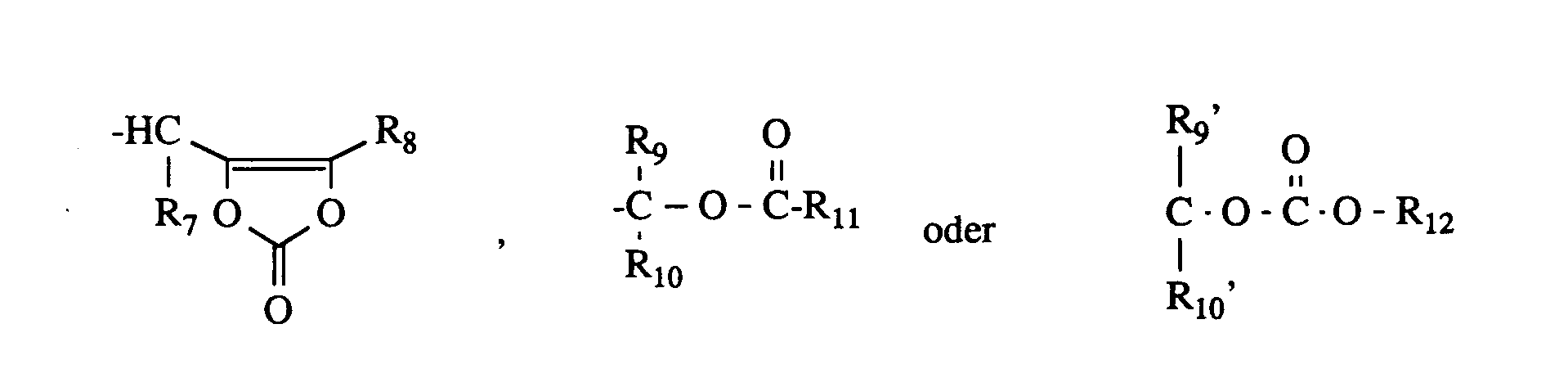
- R7 und R8 gleich oder verschieden sind und Wasserstoff, Phenyl oder geradkettiges oder verzweigtes Alkyl mit bis zu 4 Kohlenstoffatomen bedeuten,
- R9, R9', R10 und R10 gleich oder verschieden sind und Wasserstoff oder geradkettiges oder verzweigtes Alkyl mit bis zu 4 Kohlenstoffatomen bedeuten,
- R11 geradkettiges oder verzweigtes Alkyl mit bis zu 6 Kohlenstoffatomen bedeutet,
- R12 geradkettiges oder verzweigtes Alkyl mit bis zu 6 Kohlenstoffatomen oder Cyclohexyl bedeutet.
- Bevorzugt sind Verbindungen der allgemeinen Formel (I),
- X für ein Stickstoffatom oder für die -CH-Gruppe steht,
- Y für eine Gruppe der Formel N-OR3 oder CH-R4 steht, worin
- R3 Wasserstoff oder geradkettiges oder verzweigtes Alkyl mit bis zu 6 Kohlenstoffatomen bedeutet, das gegebenenfalls durch Fluor, Chlor, Brom oder geschütztes oder ungeschütztes Carboxy oder Amino substituiert ist,
- R4 Wasserstoff, Phenyl, Carboxy, Fluor, Chlor, Brom oder geradkettiges oder verzweigtes Alkoxy, Alkoxycarbonyl oder Alkyl mit jeweils bis zu 6 Kohlenstoffatomen bedeutet, wobei letzteres durch Fluor, Chlor, Brom, Hydroxy, Carboxy oder durch geradkettiges oder verzweigtes Alkoxy oder Alkoxycarbonyl mit jeweils bis zu 4 Kohlenstoffatomen substituiert sein kann,
- R1 für Thienyl, Furyl oder Phenyl steht, die gegebenenfalls bis zu 2-fach gleich oder verschieden durch Fluor, Chlor, Brom, oder durch eine Gruppe der Formel -NR5R6 substituiert sind, worin
- R5 und R6 gleich oder verschieden sind und Wasserstoff oder geradkettiges oder verzweigtes Alkyl mit bis zu 6 Kohlenstoffatomen bedeuten,
oder durch geradkettiges oder verzweigtes Alkoxy oder Alkyl mit jeweils bis zu 6 Kohlenstoffatomen substituiert sind, wobei letzteres durch Hydroxy, Fluor, Chlor oder durch geradkettiges oder verzweigtes Alkoxy mit bis zu 4 Kohlenstoffatomen substituiert sein kann, - R 2 für Wasserstoff steht, oder
für Methyl, Ethyl, tert.Butyl, 2-Chlorethyl, 2,2,2-Trichlorethyl, Cyanoethyl, Diphenylmethyl, Triphenylmethyl, Acetoxymethyl, Allyl, Benzyl, 4-Methoxybenzyl, 2,4-Dimethoxybenzyl, 1-Phenoxyethyl, 2-Methyl-2-propenyl, 4-Nitrobenzyl, 2-Nitrobenzyl, Trimethylsilylethyl oder tert.Butyl-dimethylsilylethyl steht, oder
für einen Rest der Formel

- -CH2-OCO-C(CH3)3 ,
- -CH(CH3)-OCOOC2H5,
- -CH2-OCOCH3 ,
- -CH-(CH3)-O-CO-CH3 ,
- -CH(CH3)-O-COO-CH3 , -CH(CH3)-O-COO-CH(CH3)2 ,
- -CH(CH3)-O-COO-C6H11 oder-CH(C02C2H5)-OC2H5 steht
- und deren pharmazeutisch verträgliche Salze. Besonders bevorzugt sind Verbindungen der allgemeinen Formel (I)
- in welcher
- X für ein Stickstoffatom oder für die -CH-Gruppe steht,
- Y für eine Gruppe der Formel N-OR3 oder -CHR4 steht, worin
- R3 Wasserstoff oder geradkettiges oder verzweigtes Alkyl mit bis zu 4 Kohlenstoffatomen bedeutet, das gegebenenfalls durch Fluor, Chlor oder durch geschütztes oder ungeschütztes Carboxy oder Amino substituiert ist,
- R4 Wasserstoff oder geradkettiges oder verzweigtes Alkoxy oder Alkyl mit jeweils bis zu 4 Kohlenstoffatomen bedeutet, wobei letzteres durch Hydroxy, Carboxy, Methoxy, Ethoxy oder Propoxy substituiert sein kann,
- R1 für Thienyl, Furyl oder Phenyl steht, die gegebenenfalls bis zu 2-fach gleich oder verschieden durch Fluor, Chlor, Brom, Amino oder durch geradkettiges oder verzweigtes Alkoxy, Alkoxycarbonyl oder Alkyl mit jeweils bis zu 4 Kohlenstoffatomen substituiert sind, wobei letzteres durch Hydroxy, Fluor, Chlor, Methoxy oder Ethoxy substituiert sein kann,
- R2 für Wasserstoff steht, oder
für einen Rest der Formel

- -CH2-OCO-C(CH3)3,
- -CH(CH3)-OCOOC2H5,
- -CH2-OCOCH3 ,
- -CH-(CH3)-O-CO-CH3 ,
- -CH(CH3)-O-COO-CH3 , -CH(CH3)-O-COO-CH(CH3)2 ,
- -CH(CH3)-O-COO-C6H11 oder-CH(CO2C2H5)-OC2H5 steht
und deren pharmazeutische verträgliche Salze. - Ganz besonders bevorzugt sind die Natriumsalze.
- Weiterhin wurde ein Verfahren zur Herstellung der erfindungsgemäßen Verbindungen der allgemeinen Formel (I) gefunden, dadurch gekennzeichnet, daß man
Verbindungen der allgemeinen Formel (11),
in welcher - R1 die oben angegebene Bedeutung hat
und - R2' für eine der oben angegebenen Carboxyschutzgruppen, insbesondere für p-Methoxybenzyl steht, gegebenenfalls auch unter Aktivierung der Aminfunktion, mit Verbindungen der allgemeinen Formel (III),

- Y' für eine der oben aufgeführten Gruppen N-OR3' oder CHR4' steht, worin
- R3' die oben angegebene Bedeutung von R3 hat oder für eine der oben aufgeführten Oximschutzgruppen, insbesondere für den Tritylrest steht,
- R4' die oben angegebene Bedeutung von R4 hat oder für geschütztes Carboxy steht und
- R13 ebenfalls für eine der oben aufgeführten Aminoschutzgruppen, vorzugsweise für Boc oder für den Tritylrest steht,
- in inerten Lösemitteln, gegebenenfalls unter Aktivierung der Carboxylgruppe in Anwesenheit eines Hilfsstoffes,
- zunächst zu den Verbindungen der allgemeinen Formel (IV),

- R1, R2', R13 und Y' die oben angegebene Bedeutung haben,
- umsetzt und anschließend die Schutzgruppe R2', R3', R4' (Y') und R13 nach üblicher Methode, gegebenenfalls in 2 Schritten abspaltet und die gewünschten Salze oder aus den Salzen die freien Säuren herstellt.
- Das erfindungsgemäße Verfahren kann durch folgendes Formelschema beispielhaft erläutert werden:

- Als Lösemittel eignen sich alle Solventien, die sich unter den Reaktionsbedingungen nicht verändern. Hierzu gehören bevorzugt Ether wie beispielsweise Diethylether, Dioxan oder Tetrahydrofuran, oder Chlorkohlenwasserstoffe wie Methylenchlorid, Chloroform oder Tetrachlormethan, oder Amide wie Dimethylformamid oder Hexamethylphosphorsäuretriamid, oder Acetonitril oder Aceton. Ebenso ist es möglich, Gemische der genannten Lösemittel einzusetzen. Bevorzugt ist Methylenchlorid.
- Die Kondensation erfolgt im allgemeinen in einem Temperaturbereich von 0°C bis + 60 ° C, vorzugsweise bei Raumtemperatur bei Normaldruck.
- Die Aktivierung der Carboxylgruppe in den Verbindungen der allgemeinen Formel (111) erfolgt im allgemeinen durch Überführen in ein gemischtes Anhydrid mit Chlorameisensäureestern oder Sulfonsäurederivaten, wie beispielsweise Chlorameisensäureethylester, Chlorameisensäureisobutylester oder Methansulfonsäurechlorid, durch Überführen in das entsprechende Säurehalogenid, oder durch Überführen in einen aktivierten Ester, beispielsweise mit N-Hydroxybenztriazol oder Dicyclohexylcarbodiimid. Bevorzugt ist die Umsetzung mit Chlorameisensäureethylester oder Methansulfonsäurechlorid.
- Die Aktivierung der Aminfunktion der Verbindungen der allgemeinen Formel (11) erfolgt nach üblicher Methode, beispielsweise durch Überführung in die entsprechenden Silylderivate durch Umsetzung mit Bis-(trimethylsilyl)acetamid, N-trimethylsilylacetamid oder Bis(trimethylsilyl)harnstoff.
- Als Hilfsstoffe werden bevorzugt Kondensationsmittel eingesetzt, die auch Basen sein können, insbesondere wenn beispielsweise die Carboxylgruppe als Anhydrid aktiviert vorliegt. Bevorzugt werden hier die üblichen Kondensationsmittel wie Carbodiimide z.B. N,N'-Diethyl-, N,N'-Dipropyl-, N,N'-Diisopropyl-, N,N'-Dicyclohexylcarbodiimid, N-(3-Dimethylaminoisopropyl)-N'-ethylcarbodiimid Hydrochlorid, oder Carbonylverbindungen wie Carbonyldiimidazol, oder 1,2-Oxazoliumverbindungen wie 2-Ethyl-5-phenyl-1,2-oxazolium-3-sulfonat oder 2-tert.-Butyl-5-methyl-isoxazolium-perchlorat, oder Acylaminoverbindungen wie 2-Ethoxy-1- ethoxycarbonyl-1,2-dihydrochinolin, oder Propanphosphonsäureanhydrid, oder Isobutylchloroformat, oder Benzotriazolyloxy-tris(dimethylamlno)phosphonium-hexafluorophosphat, oder als Basen Alkalicarbonate z.B. Natrium- oder Kaliumcarbonat oder -hydrogencarbonat, oder organische Basen wie Trialkylamine z.B. Triethylamin, N-Ethylmorpholin oder N-Methylpiperidin eingesetzt.
- Die Abspaltung der Schutzgruppen erfolgt nach üblicher Methode, im Fall der Oxime gegebenenfalls sukzessive, entweder mit organischen Säuren, wie beispielsweise Ameisensäure, gegebenenfalls in Anwesenheit von Wasser oder in Anwesenheit von Wasser und einer Protonensäure, wie beispielsweise Salzsäure, bevorzugt mit Ameisensäure und Wasser oder Ameisensäure, Wasser und Salzsäure.
- Im Fall, daß R3 ≠H, ist es außerdem möglich, die Aminschutzgrupppe (R13), die Carboxyschutzgruppen (R2') und die Schutzgruppen R3' und R4', gegebenenfalls in einem Schritt, mit Trifluoressigsäure abzuspalten.
- Die Abspaltung der Schutzgruppen wird im allgemeinen in einem Temperaturbereich von 0°C bis +80°C, vorzugsweise bei Raumtemperatur durchgeführt.
- Die Abspaltungen können sowohl bei Normaldruck, als auch bei erhöhtem oder erniedrigtem Druck (z.B. 0,5 bis 5 bar), vorzugsweise bei Normaldruck, durchgeführt werden.
- Die Verbindungen der allgemeinen Formel (11) werden teilweise von der Anspruchsbreite anderer Publikationen, wie beispielsweise in EP 192 210 A2 erfaßt und können in Analogie zum literaturbekannten Verfahren [vgl. US 48 554 18; Tetrahedron Lett., Vol. 29, Nr. 47,6043-6046, 1988] hergestellt werden, indem man beispielsweise 7-Phenacetylamino-3-trifluormethansulfonyl-3-cephem-4-carbonsäure-p-methoxybenzy- lester der Formel (V),

- R2' die oben angegebene Bedeutung hat,
- mit Verbindungen der allgemeinen Formel (VI),
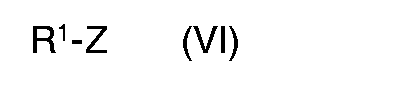
- in welcher
- R1 die oben angegebene Bedeutung hat und
- Z für einen im folgenden definierten Zinn-organyl-Rest steht,
- in aprotisch, polaren Lösemitteln, in Anwesenheit von Metallhalogeniden, Phosphinen und einem Katalysator zu Verbindungen der allgemeinen Formel (VII),

- R1 und R2' die oben angegebene Bedeutung haben,
- und in einem letzten Schritt die Aminfunktion nach üblicher Methode, beispielsweise durch Einwirkung der Systems 1.) PCl5/Pyridin/Methylenchlorid und 2.)HN(C2Hs)2/Methanol deblockiert.
- Als Zinnorganyle (Z) eignen sich beispielsweise Trimethylstannyl, Triethylstannyl oder Tributylstannyl. Bevorzugt ist Tri-n-butylstannyl.
- Als Metallhalogenide eignen sich Zink, Lithium- und Magnesiumhalogenide, wie beispielsweise ZnC12, ZnBr2, LiCI, LiBr, MgCl2 oder MgBr2. Bevorzugt ist ZnCI2.
- Als Katalysatoren eignen sich Pd(O)- und (II)-Komplexe, wie beispielsweise Bis(dibenzyliden-acetonyl)-palladium [(Pd/dba)2], Pd2dba3 x CHCl3 oder Pd(OAc)2.Bevorzugt ist Pd2dba3 x CHCl3.
- Als aprotische, polare Lösemittel eignen sich beispielsweise Acetonitril, Dimethylsulfoxid (DMSO), Dimethylformamid (DMF), oder Ether wie Glyme, Dioxan oder THF, oder Aceton, Hexamethylphosphoramid, oder N-Methylpyrrolidon oder 1-Methyl-2-pyrrolidon. Bevorzugt ist N-Methylpyrrolidon.
- Als Phosphine können beispielsweise Triphenylphosphin, Tri-(3-fluorphenyl)-phosphin, Diphenylmethylphosphin, Tributylphosphin, Tri(2-thienyl)-phosphin oder Tri-(2-furyl)phosphin eingesetzt werden. Bevorzugt ist Tri-(2-furyl)phosphin.
- Die Reaktion wird in einem Temperaturbereich von -30 ° C bis + 90 ° C, vorzugsweise bei Raumtemperatur und Normaldruck durchgeführt.
- Die Verbindung der allgemeinen Formel (V) ist an sich bekannt [J. Org. Chem. 1989,54,4962-4966].
- Die Verbindungen der allgemeinen Formel (VI) sind an sich bekannt und können nach literaturbekannten Verfahren hergestellt und eingesetzt werden [vgl. EP 343 277 A1 ].
- Die Verbindungen der allgemeinen Formel (VII) sind unter Berücksichtigung der oben angegebenen Definition für R1 neu, können aber in Analogie zu bekannten Verfahren hergestellt werden [vgl. J. Org. Chem., Vol. 54, Nr. 20, 1989].
- Die Verbindungen der allgemeinen Formel (III) sind an sich bekannt oder können nach üblicher Methode hergestellt werden [vgl. Tetrahedron, Vol. 34, 2233-2243].
- Die Verbindungen der allgemeinen Formel (IV) sind neu und können nach dem oben angegebenen Verfahren hergestellt werden.
- Die erfindungsgemäßen Verbindungen der allgemeinen Formel (I) weisen bei geringer Toxizität ein breites antibakterielles Spektrum gegen gram-positive und gram-negative Keime auf. Diese Eigenschaften ermöglichen ihre Verwendung als chemotherapeutische Wirkstoffe in der Human- und Tiermedizin.
- Die erfindungsgemäßen Verbindungen sind gegen ein sehr breites Spektrum von Mikroorganismen wirksam. Mit ihrer Hilfe können gram-negative und gram-positive Bakterien und bakterienähnliche Mikroorganismen bekämpft sowie die durch diese Erreger hervorgerufenen Erkrankungen verhindert, gebessert und/oder geheilt werden.
- Besonders wirksam sind die erfindungsgemäßen Verbindungen gegen Bakterien und bakterienähnliche Mikroorganismen. Sie sind daher besonders gut zur Prophylaxe und Chemotherapie von lokalen und systemischen Infektionen in der Human- und Tiermedizin geeignet, die durch solche Erreger hervorgerufen werden.
- Die minimalen Hemmkonzentrationen (MHK) wurden per Reihenverdünnungsverfahren auf Iso-Sensitest Agar (Oxoid) bestimmt. Für jede Prüfsubstanz wurde eine Reihe von Agarplatten hergestellt, die bei jeweils doppelter Verdünnung abfallende Konzentrationen des Wirkstoffes enthielten. Die Agarplatten wurden mit einem Multipoint-Inokulator (Denley) beimpft. Zum Beimpfen wurden Übernachtkulturen der Erreger verwandt,die zuvor so verdünnt wurden, daß jeder Impfpunkt ca. 104 kolonienbildende Partikel enthielt. Die beimpften Agarplatten wurden bei 37 °C bebrütet, und das Keimwachstum wurde nach ca. 20 Stunden abgelesen. Der MHK-Wert (µg/ml) gibt die niedrigste Wirkstoffkonzentration an, bei der mit bloßem Auge kein Keimwachstum zu erkennen war.
- MHK-Werte: Agarverdünnung/Multipoint

- Für die Konzentrationsbestimmung wurden Mischseren von 3 Mäusen eingesetzt. Die Präparatkonzentrationen wurden mit Hilfe des Agardiffusionstests (Lochtest) durch Vergleich von unverdünnter Probe und Probenverdünnungen (in gepufferter physiologischer Kochsalzlösung) mit einer Standardkurve ermittelt. Als Nachweiskeim wurde Staph. epidermidis 25185 auf Isosensitest-Agar benutzt.
- Zur vorliegenden Erfindung gehören pharmazeutische Zubereitungen, die neben nicht-toxischen, inerten pharmazeutisch geeigneten Trägerstoffen eine oder mehrere erfindungsgemäße Verbindungen enthalten oder die aus einem oder mehreren erfindungsgemäßen Wirkstoffen bestehen, sowie Verfahren zur Herstellung dieser Zubereitungen.
- Der oder die Wirkstoffe können gegebenenfalls in einem oder mehreren der oben angegebenen Trägerstoffe auch in mikroverkapselter Form vorliegen.
- Die therapeutisch wirksamen Verbindungen sollen in den oben aufgeführten pharmazeutischen Zubereitungen vorzugsweise in einer Konzentration von etwa 0,1 bis 99,5, vorzugsweise von etwa 0,5 bis 95 Gew.- %, der Gesamtmischung vorhanden sein.
- Die oben aufgeführten pharmazeutischen Zubereitungen können außer den erfindungsgemäßen Verbindungen auch weitere pharmazeutische Wirkstoffe enthalten.
- Im allgemeinen hat es sich sowohl in der Human- als auch in der Veterinärmedizin als vorteilhaft erwiesen, den oder die erfindungsgemäßen Wirkstoffe in Gesamtmengen von etwa 0,5 bis etwa 500, vorzugsweise 5 bis 100 mg/kg Körpergewicht je 24 Stunden, gegebenenfalls in Form mehrerer Einzelgaben, zur Erzielung der gewünschten Ergebnisse zu verabreichen. Eine Einzelgabe enthält den oder die erfindungsgemäßen Wirkstoffe vorzugsweise in Mengen von etwa 1 bis etwa 80, insbesondere 3 bis 30mg/kg Körpergewicht.
- Die neuen Verbindungen können in den üblichen Konzentrationen und Zubereitungen zusammen mit dem Futter bzw. Lactamaseinhibitoren z.B. mit Penicillinen, die besonders penicillinasefest sind und Clavulansäure kombiniert werden. Eine solche Kombination wäre z.B. die mit Oxacillin oder Dicloxacillin.
- Die erfindungsgemäßen Verbindungen können zum Zweck der Erweiterung des Wirkungsspektrums und um eine Wirkungssteigerung zu erreichen auch mit Aminoglykosidantibiotika, wie z.B. Gentamicin, Sisomicin, Kanamicin, Amikacin oder Tobramicin kombiniert werden.
- Zu allen Verbindungen liegen 1H-NMR-Daten vor.
- (2-Methoxymethyl-3-thienyl)-tri-n-butyl-stannan

- Zu einer Lösung von 150 mmol n-Butyllithium in 500 ml THF tropft man bei -78 °C 19,2 g (150 mmol) 2-Methoxymethyl-thiophen. Man läßt auf 0°C erwärmen, kühlt nach 5 min wieder auf -78 C ab und gibt 43,4 ml (160 mmol) Tributylzinnchlorid zu. Man entfernt das Kältebad und läßt über Nacht bei Raumtemperatur rühren. Zur Aufarbeitung werden 500 ml gesättigte Ammoniumchlorid-Lösung zugegeben. Man extrahiert mit Ether, trocknet die vereinigten organischen Phasen und entfernt das Lösemittel. Nach Chromatographie an Kieselgel mit Petrolether erhält man 17,7 g (28% der Theorie) der Titelverbindung.
- 4-Brom-2-methoxymethyl-thiophen

- Zu einer Suspension von 7,5 g (0,25 mol) 80%igem Natriumhydrid wird eine Mischung aus 48,2 g (0,25 mol) 4-Brom-2-hydroxymethyl-thiophen und 15,7 ml (0,25 mol) Methyliodid getropft. Man rührt über Nacht, zieht das Lösemittel ab, verteilt zwischen Methylenchlorid und Wasser (je 1,0 1), trennt die organische Phase ab und trocknet mit Natriumsulfat. Nach dem Entfernen des Lösemittels wird an Kieselgel mit Toluol/Petrolether (1:1) chromatographiert.
- Ausbeute: 48,2g (93% der Theorie)
- (4-Brom-2-methoxymethyl-3-thienyl)-tri-n-butyl-stannan

- Zu einer Lösung von 150 mmol n-Butyllithium tropft man bei -78 °C unter Argon 31,1 g (150 mmol) der Verbindung aus Beispiel 2. Man läßt auf -40 ° C erwärmen, kühlt nach 20 min wieder auf -78 °C und gibt 43,4 ml (160 mmol) Tributylzinnchlorid dazu. Die Lösung wird über Nacht bei Raumtemperatur gerührt und mit gesättigter Ammoniumchlorid-Lösung und Methylenchlorid versetz. Die organische Phase wird abgetrennt und mit Natriumsulfat getrocknet. Nach dem Abdestillieren des Lösemittels wird an Kieselgel mit Petrolether chromatographiert. Ausbeute: 19,5 g (26% der Theorie)
- 7ß-Phenacetylamino-3-(2-thienyl)-3-cephem-4-carbonsäure-p-methoxybenzylester

- Man läßt 4,68 g (8,0 mmol) 7-Phenacetylamino-3-trifluormethansulfonyl-3-cephem-4-carbonsäure-p-me- thoxybenzylester mit 2,98 g (8,0 mmol) 2-Thienyl-tri-n-butyl-stannan, 1,90 g (13,9 mmol) Zinkchlorid, 0,34 g (1,46 mmol) Tri-2-furyl-phosphin und 0,35 g (0,34 mmol) Tris-(dibenzylidenaceton)-dipalladium-chloroform in 130 ml wasserfreiem N-Methylpyrrolidon unter Argon bei Raumtemperatur über Nacht reagieren. Anschließend wird auf 400 ml Wasser gegossen und der ausgefallene Niederschlag wird abgesaugt. Der Rückstand, gelöst in 400 ml Methylenchlorid, wird mit Natriumsulfat getrocknet und nach dem Entfernen des Lösemittels an Kieselgel mit Toluol/Essigester (5:1) chromatographiert.
- Ausbeute: 2,52 g (61 % der Theorie)
- In Analogie zur Vorschrift des Beispiels 4 werden folgende Verbindungen hergestellt:


- 7β-Phenacetylamino-3-(3-thienyl)-3-cephem-4-carbonsäure-p-methoxybenzylester

- In Analogie zur Vorschrift des Beispiels 4 werden aus 2,98 g (8,0 mmol) 3-Thienyl-tri-n-butyl-stannan 2,69 g (65% der Theorie) der Titelverbindung hergestellt.
- 3-(2-Methoxymethyl-3-thienyl)-7ß-phenacetyl-amino-3-cephem-4-carbonsäure-p-methoxybenzylester

- In Analogie zur Vorschrift des Beispiels 4 werden aus 3,3 g (8,0 mmol) der Verbindung aus Beispiel 1 1,9 g (42% der Theorie) der Titelverbindung hergestellt.
- 3-(4-Brom-2-methoxymethyl-3-thienyl)-7ß-phenacetyl-amino-3-cephem-carbonsäure-p-methoxybenzylester

- In Analogie zur Vorschrift des Beispiels 4 werden aus 3,34 g (8,0 mmol) der Verbindung aus Beispiel 3 1,20 g (27% der Theorie) der Titelverbindung hergestellt.
- 7β-Amino-3-(2-thienyl)-3-cephem-4-carbonsäure-p-methoxybenzylester
-

- Zu einer Lösung von 2,5 g (4,8 mmol) der Verbindung aus Beispiel 4 und 1,0 ml (12,4 mmol) Pyridin in 55 ml wasserfreiem Methylenchlorid gibt man bei -20 °C 2,0 g (9,7 mmol) Phosphorpentachlorid. Man rührt 5 min bei -20 °C, 10 min bei 0°C, 1 h bei 15°C und kühlt anschließend auf -78 °C ab. 42 ml auf -78 °C gekühltes Methanol werden schnell zugegeben. Die Lösung wird 5 min bei -78 °C, 10 min bei 0°C und 25 min bei 15°C gerührt. Nach dem Abkühlen auf -15°C gibt man 0,56 ml (5,4 mmol) Diethylamin zu und hält 10 min bei dieser Temperatur. Zur Aufarbeitung gießt man auf 150 ml gesättigte Natriumhydrogencarbonat-Lösung und extrahiert mit Methylenchlorid. Die vereinigten organischen Phasen werden mit Natriumhydrogencarbonat-Lösung und Wasser gewaschen, mit Natriumsulfat getrocknet und eingeengt. Der Rückstand wird an Kieselgel mit Toluol/Essigester chromatographiert.
- Ausbeute: 1,6 g (86% der Theorie)
- In Analogie zur Vorschrift des Beispiels 19 wurden folgende Verbindungen hergestellt:


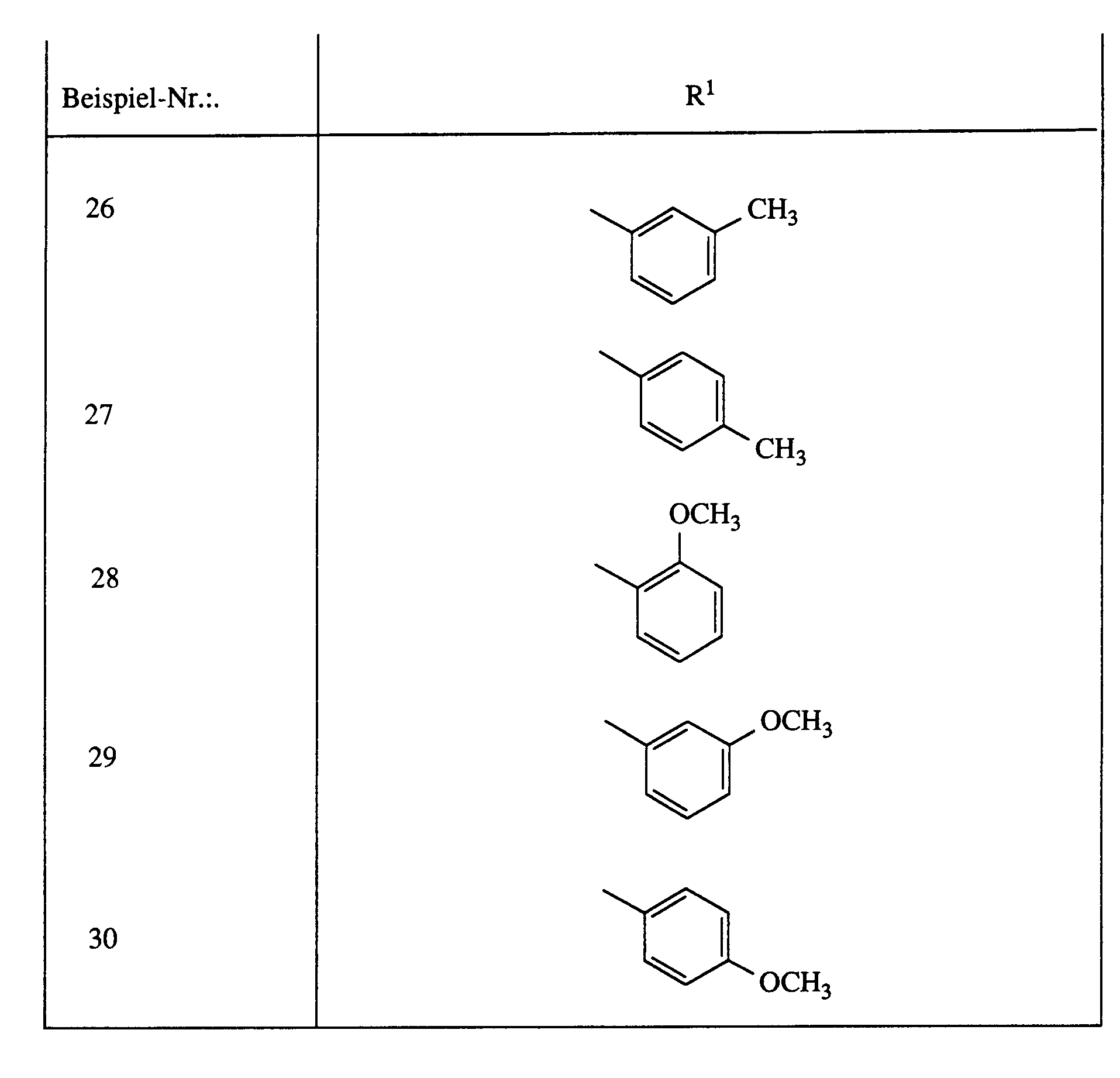
- 7β-Amino-3-(3-thienyl)-3-cephem-4-carbonsäure-p-methoxybenzylester

- In Analogie zur Vorschrift des Beispiels 19 werden aus 2,65 g (5,1 mmol) der Verbindung aus Beispiel 16 1,65 g (80% der Theorie) der Titelverbindung hergestellt.
- 7ß-Amino-3-(2-methoxymethyl-3-thienyl)-3-cephem-4-carbonsäure-p-methoxybenzylester

- In Analogie zur Vorschrift des Beispiels 19 erhält man aus 1,9 g (3,4 mmol) der Verbindung aus Beispiel 17 1,1 g (73% der Theorie) der Titelverbindung.
- 7ß-Amino-3-(4-brom-2-methoxymethyl-3-thienyl)-3-cephem-4-carbonsäure-p-methoxybenzylester
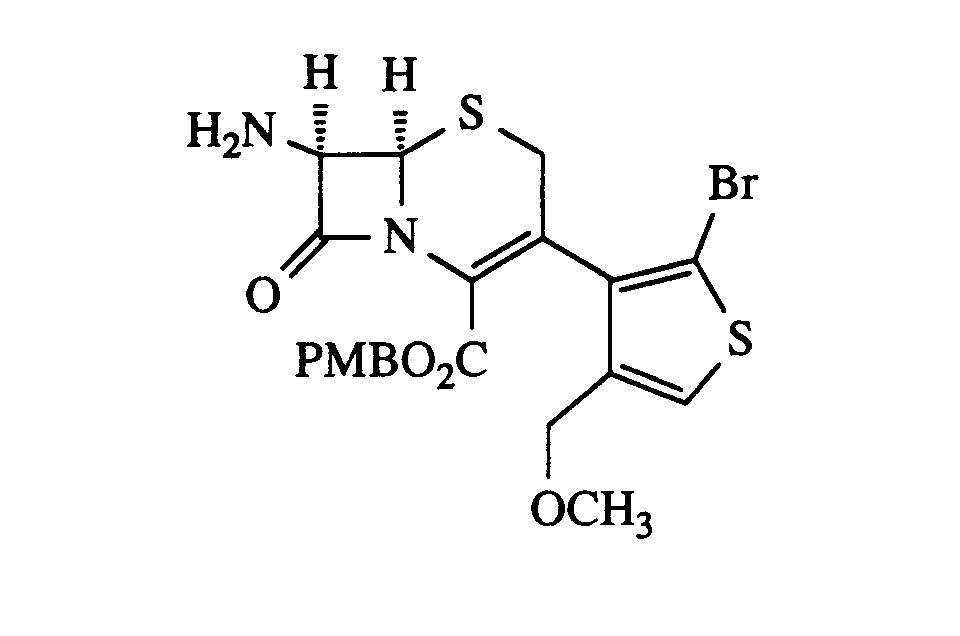
- In Analogie zur Vorschrift des Beispiels 19 erhält man aus 1,55 g (2,4 mmol) der Verbindung aus Beispiel 18 0,89 g (70% der Theorie) der Titelverbindung.
- 7β-[2-(2-t-Butyloxycarbonylamino-4-thiazolyl)-2-syn-methoxyimino-acetylamino]-3-(2-thienyl)-3-cephem-4-carbonsäure-p-methoxybenzylester

- Eine Lösung von 0,50 g (1,2 mmol) der Verbindung aus Beispiel 19, 1,14 g (3,8 mmol) 2-(2-t-Butyloxycarbonylamino-4-thiazolyl)-syn-2-methoxyiminoessigsäure und 0,85 g (4,1 mmol) Dicyclohexylcarbodiimid in 40 ml Acetonitril wird über Nacht gerührt. Man engt ein und chromatographiert an Kieselgel mit Toluol/Essigester (8:1).
- Ausbeute: 430 mg (51 % der Theorie)
- In Analogie zur Vorschrift des Beispiels 34 wurden folgende Verbindungen hergestellt:

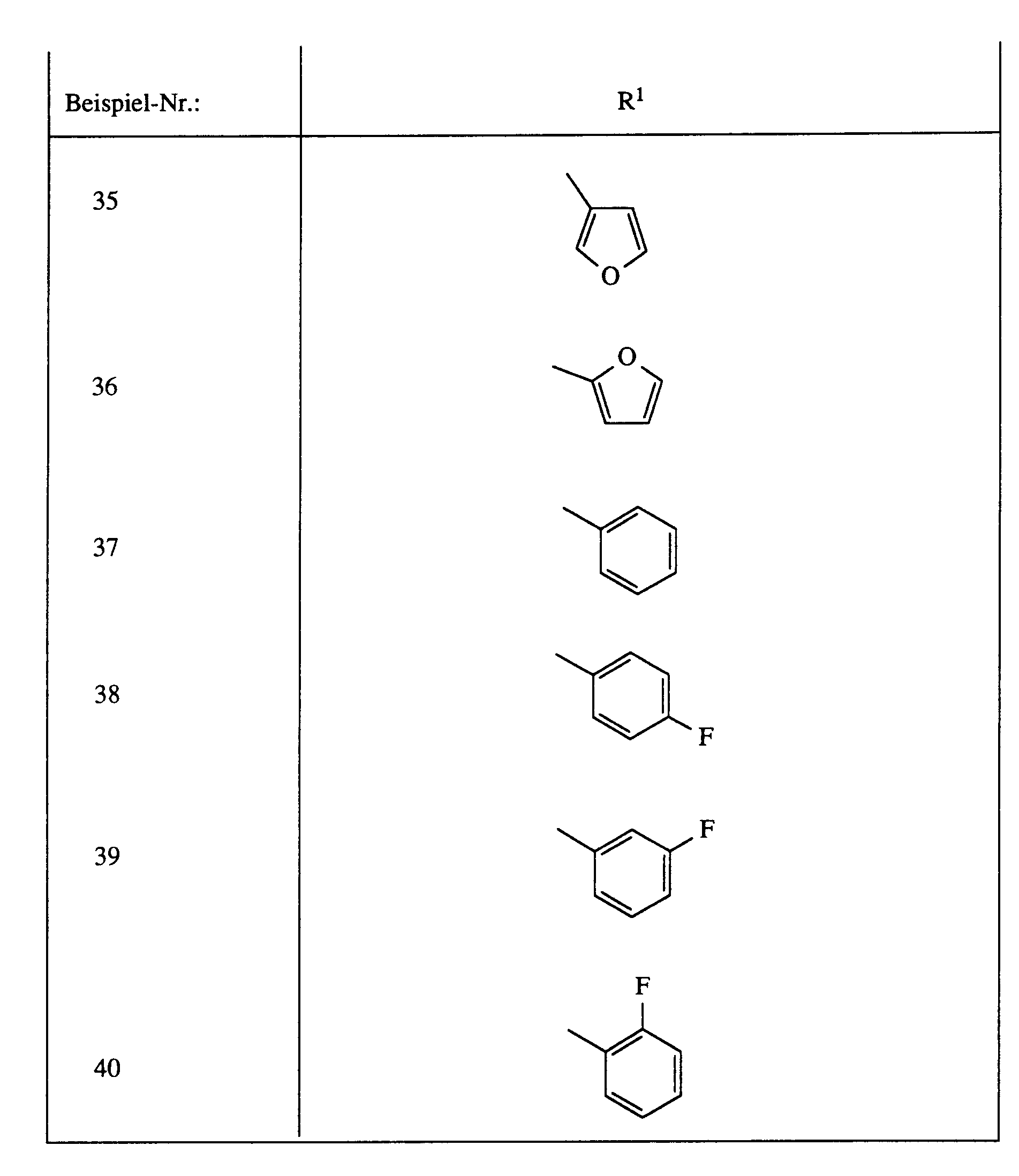

- 7ß-[2-(2-t-Butyloxycarbonylamino-4-thiazolyl)-2-syn-methoxyimino-acetylamino]-3-(3-thienyl)-3-cephem-4-carbonsäure-p-methoxybenzylester

- In Analogie zur Vorschrift des Beispiels 34 erhält man aus 1,00 g (2,5 mmol) der Verbindung aus Beispiel 31 0,75 g (44% der Theorie) der Titelverbindung.
- 7β-[2-(2-t-Butyloxycarbonylamino-4-thiazolyl)-2-syn-methoxyimino-acetylamino]-3-(2-methoxymethyl-3-thienyl)-3-cephem-4-carbonsäure-p-methoxybenzylester

- In Analogie zur Vorschrift des Beispiels 34 erhält man aus 220 mg (0,49 mmol) der Verbindung aus Beispiel 32 132 mg (37% der Theorie) der Titelverbindung.
- 3-(2-Thienyl)-7ß-[2-(2-tritylamino-4-thiazolyl)-2-syn-trityloxyimino-acetylamino]-3-cephem-4-carbonsäure-p-methoxybenzylester

- Eine Lösung von 3,36 g (5,0 mmol) 2-(2-Tritylamino-4-thiazolyl)-2-syn-trityloxyimino-essigsäure in 50 ml Methylenchlorid wird mit 1,33 g (6,5 mmol) Dicyclohexylcarbodiimid 2 h bei Raumtemperatur gerührt. Man fügt 1,00 g (2,5 mmol) der Verbindung aus Beispiel 19 zu und rührt über Nacht bei Raumtemperatur. Nach dem Abdestillieren des Lösemittels wird an Kieselgel mit Toluol/Essigester (99:1) chromatographiert. Ausbeute: 1,12 g (45% der Theorie)
- In Analogie zur Vorschrift des Beispiels 46 wurden folgende Verbindungen hergestellt:


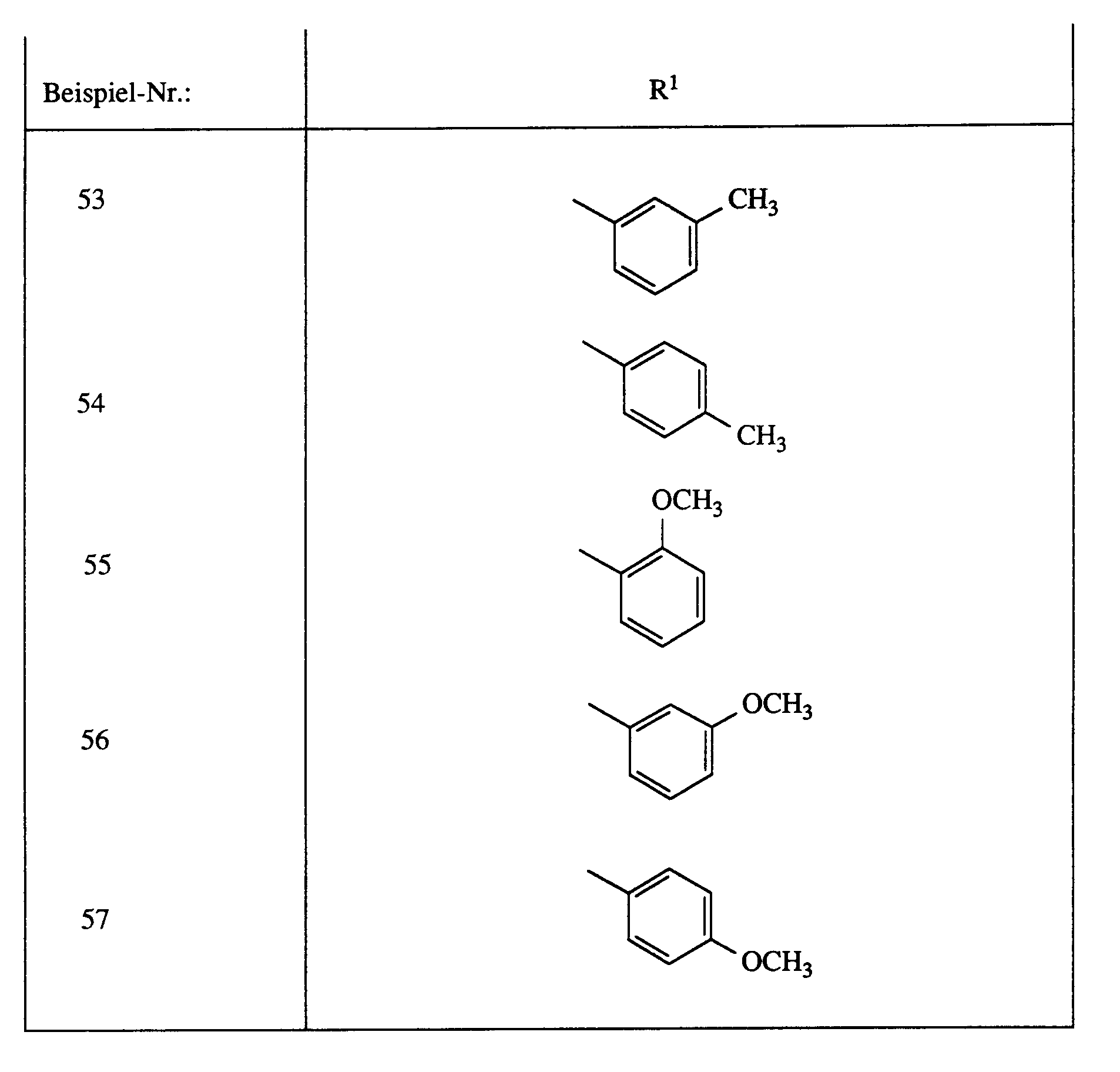
- 3-(3-Thienyl)-7β-[2-(2-tritylamino-4-thiazoyl)-2-syn-trityloxyimino-acetylamino]-3-cephem-4-carbonsäure-p-methoxybenzylester

- In Analogie zur Vorschrift des Beispiels 46 werden aus 1,00 g (2,5 mmol) der Verbindung aus Beispiel 31 1,53 g (58% der Theorie) der Titelverbindung hergestellt.
- 3-(2-Methoxymethyl-3-thienyl)-7ß-[2-(2-tritylamino-4-thiazolyl)-2-syn-trityloxyimino-acetylamino]-3-cephem-4-carbonsäure-p-methoxybenzylester

- In Analogie zur Vorschrift des Beispiels 46 werden aus 870 mg (1,95 mmol) der Verbindung aus Beispiel 32 708 mg (33% der Theorie) der Titelverbindung hergestellt.
- 3-(4-Brom-2-methoxymethyl-3-thienyl)-7ß-[2-(2-trityloxyamino-4-thiazolyl)-2-syn-tritylimino-acetylamino]-3-cephem-4-carbonsäure-p-methoxybenzylester

- In Analogie zur Vorschrift des Beispiels 46 erhält man aus 0,85 g (1,6 mmol) der Verbindung aus Beispiel 39 1,18 g (63% der Theorie) der Titelverbindung.
- 7β-[2-(2-Amino-4-thiazolyl)-Z-2-butenoylamino]-3-(3-thienyl)-3-cephem-4-carbonsäure-p-methoxybenzylester

- 600 mg (1,5 mmol) der Verbindung aus Beispiel 31 und 550 mg (3,0 mmol) 2-(2-Amino-4-thiazolyl)-Z-2-propen-carbonsäure werden zusammen mit 620 mg (3,0 mmol) Dicyclohexylcarbodiimid in 40 ml Acetonitril über Nacht bei Raumtemperatur gerührt. Man saugt ab, engt das Filtrat ein und chromatographiert den Rückstand an Kieselgel mit Toluol/Essigester (1:1).
- Ausbeute: 590 mg (69% der Theorie)
- 7ß-[2-(2-Amino-4-thiazolyl)-2-syn-methoxyimino-acetylamino]-3-(2-thienyl)-3-cephem-4-carbonsäure (Trifluoracetat)

- 420 mg (0,61 mmol) der Verbindung aus Beispiel 34 werden mit einer Mischung aus 1 ml Anisol und 50 ml Trifluoressigsäure 1 h bei Raumtemperatur behandelt. Anschließend wird die Trifluoressigsäure im Vakuum abgezogen und der Rückstand mit Ether verrührt.
- Ausbeute: 324 mg (92% der Theorie)
- In Analogie zur Vorschrift des Beispiels I werden folgende Verbindungen hergestellt:

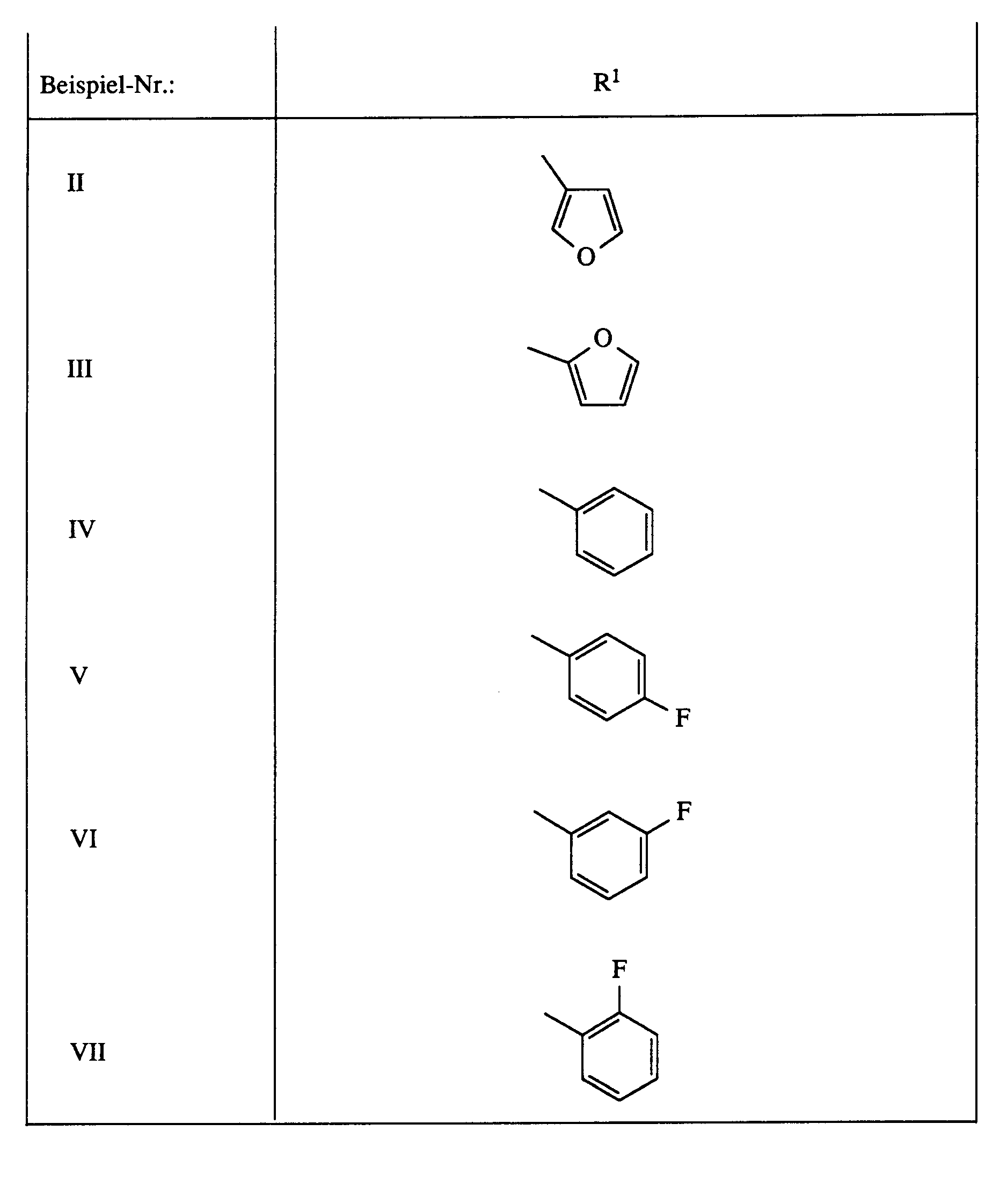

- 7β-2-(2-Amino-4-thiazolyl)-2-syn-methoxyimino-acetylamino]-3-(3-thienyl)-3-cephem-4-carbonsäure (Trifluoracetat)

- In Analogie zur Vorschrift des Beispiels I erhält man aus 700 mg (1,0 mmol) der Verbindung aus Beispiel 44 383 mg (66% der Theorie) der Titelverbindung.
- 7β-[2-(2-Amino-4-thiazoyl)-2-syn-methoxyimino-acetylamino]-3-(2-methoxymethyl-3-thienyl)-3-cephem-4-carbonsäure (Trifluoracetat)

- In Analogie zur Vorschrift des Beispiels I erhält man aus 125 mg (0,17 mmol) der Verbindung aus Beispiel 45 30 mg (28% der Theorie) der Titelverbindung.
- 7ß-[2-(2-Amino-4-thiazolyl)-2-syn-hydroxyimino-acetylamino]-3-(2-thienyl)-3-cephem-4-carbonsäure

- 1,1 g (1,0 mmol) der Verbindung aus Beispiel 46 werden mit 20 ml 90%iger Ameisensäure 1 h bei Raumtemperatur gerührt. Anschließend gibt man 1 ml konzentrierte Salzsäure zu und rührt weitere 2 h bei Raumtemperatur. Man engt im Vakuum zur Trockne ein und chromatographiert an HP-20 mit Wasser/Acetonitril.
- Ausbeute: 126 mg (28% der Theorie)
- 1H-NMR (DCOOD): δ = 3,90 (s, 2H, 2-H); 5,41 (d, J = 5 Hz, 1 H, 6-H); 6,08 (d, J = 5 Hz, 1 H, 7-H); 7,10 (dd, J = 5 Hz, J = 5 Hz, 1 H, 3'-H); 7,20(d, J = 5 Hz, 1 H, 3'-H); 7,39 (s, 1 H, 7'-Aryl-H); 7,54 (d, J = 5 Hz, 1 H, 3'-H).
- In Analogie zur Vorschrift des Beispiels XIII werden hergestellt:


- 7β-[2-(2-Amino-4-thiazolyl)-2-syn-hydroxyimino-acetylamino]-3-(2-thienyl)-3-cephem-4-carbonsäure

- In Analogie zur Vorschrift des Beispiels XXIII werden aus 1,50 g (1,42 mmol) der Verbindung aus Beispiel 16 572 mg (89% der Theorie) der Titelverbindung erhalten.
- 7β-[-2-(2-Amino-4-thiazolyl)-2-syn-hydroxyimino-acetylamino]-3-(2-methoxymeth yl-3-thienyl)-3-cephem-4-carbonsäure

- In Analogie zur Vorschrift des Beispiels XIII erhält man aus 700 mg (0,64 mmol) der Verbindung aus Beispiel 59 28 mg (7% der Theorie) der Titelverbindung.
- 7ß-[2-(2-Amino-4-thiazolyl)-2-syn-hydroxyimino-acetylamino]-3-(4-brom-2-metho xymethyl-3-thienyl)-3-cephem-4-carbonsäure

- In Analogie zur Vorschrift des Beispiels XIII werden aus 1,10 g (0,93 mmol) der Verbindung aus Beispiel 60 580 mg (91 % der Theorie) der Titelverbindung erhalten.
- 7β-[2-(2-Amino-4-thiazolyl)-Z-2-butenoylamino]-3-(3-thienyl)-3-cephem-4-carbonsäure (Natrium-Salz)

- 550 mg (0,97 mmol) der Verbindung aus Beispiel 61 werden 1 h bei Raumtemperatur mit einem Gemisch aus 50 ml Trifluoressigsäure und 1 ml Anisol behandelt. Man engt ein und verrührt den Rückstand mit Diisopropylether. Dieser Rückstand (570 mg) wird in Wasser suspendiert und mit 570 mg Natriumhydrogencarbonat versetzt. Nach Chromatographie an RP-8 mit Wasser/Acetonitril (95:5) erhält man 190 mg (42% der Theorie) der Titelverbindung.
- 1H-NMR (DCOOD): 0 = 2,10 (d, J = 7 Hz, 3H, CH3); 3,83 und 3,91 (2d, J = 18 Hz, je 1H, 2-H); 5,40 (d, J = 6 Hz, 1 H, 6-H); 6,04 (d, J = 6 Hz, 1 H, 7-H); 6,60 (q, J = 7 Hz, 1 H, 7'-CH); 6,86 (s, 1 H, 7'-Aryl-H); 7,14 (m, 1 H, 3'-H); 7,48 (m, 2H, 3'-H).
und deren pharmazeutisch verträglichen Salze.
in welcher
umsetzt
Claims (8)

für eine Carboxyschutzgruppe oder
für einen in vivo spaltbaren Esterrest steht
und deren pharmazeutisch verträglichen Salze.


oder durch geradkettiges oder verzweigtes Alkoxy oder Alkyl mit jeweils bis zu 6 Kohlenstoffatomen substituiert sind, wobei letzteres durch Hydroxy, Fluor, Chlor oder durch geradkettiges oder verzweigtes Alkoxy mit bis zu 4 Kohlenstoffatomen substituiert sein kann,
für Methyl, Ethyl, tert.Butyl, 2-Chlorethyl, 2,2,2-Trichlorethyl, Cyanoethyl, Diphenylmethyl, Triphenylmethyl, Acetoxymethyl, Allyl, Benzyl, 4-Methoxybenzyl, 2,4-Dimethoxybenzyl, 1-Phenoxyethyl, 2-Methyl-2-propenyl, 4-Nitrobenzyl, 2-Nitrobenzyl, Trimethylsilylethyl oder tert.Butyl-dimethylsilylethyl steht, oder für einen Rest der Formel


und deren pharmazeutisch verträgliche Salze.


und deren pharmazeutische verträgliche Salze.

mit Verbindungen der allgemeinen Formel (III),

in inerten Lösemitteln, gegebenenfalls unter Aktivierung der Carboxylgruppe in Anwesenheit eines Hilfsstoffes,
zunächst zu den Verbindungen der allgemeinen Formel (IV),

umsetzt und anschließend die Schutzgruppe R2', R3', R4' (Y') und R13 nach üblicher Methode, gegebenenfalls in 2 Schritten abspaltet und die gewünschten Salze oder aus den Salzen die freien Säuren herstellt.
Applications Claiming Priority (2)
| Application Number | Priority Date | Filing Date | Title |
|---|---|---|---|
| DE4030706A DE4030706A1 (de) | 1990-09-28 | 1990-09-28 | Neue 3-substituierte cephalosporine, verfahren zu ihrer herstellung und ihre verwendung als arzneimittel |
| DE4030706 | 1990-09-28 |
Publications (2)
| Publication Number | Publication Date |
|---|---|
| EP0477717A2 true EP0477717A2 (de) | 1992-04-01 |
| EP0477717A3 EP0477717A3 (en) | 1992-06-10 |
Family
ID=6415171
Family Applications (1)
| Application Number | Title | Priority Date | Filing Date |
|---|---|---|---|
| EP19910115689 Withdrawn EP0477717A3 (en) | 1990-09-28 | 1991-09-16 | New 3-substituted cephalosporins, process for their preparation and their use as medicinal preparations |
Country Status (5)
| Country | Link |
|---|---|
| US (1) | US5324721A (de) |
| EP (1) | EP0477717A3 (de) |
| JP (1) | JPH04273882A (de) |
| CA (1) | CA2052305A1 (de) |
| DE (1) | DE4030706A1 (de) |
Cited By (3)
| Publication number | Priority date | Publication date | Assignee | Title |
|---|---|---|---|---|
| WO1994000457A1 (en) * | 1992-06-26 | 1994-01-06 | Smithkline Beecham P.L.C. | Alphalosporins and 1-carba-1-dethia cephalosporins |
| EP2968352A4 (de) * | 2013-03-12 | 2016-09-07 | Gladius Pharmaceuticals Corp | Derivatisierte 3-styryl-cephalosporine |
| US10239890B2 (en) | 2007-10-09 | 2019-03-26 | Gladius Pharmaceuticals Corporation | Broad spectrum beta-lactamase inhibitors |
Family Cites Families (10)
| Publication number | Priority date | Publication date | Assignee | Title |
|---|---|---|---|---|
| IE41109B1 (en) * | 1974-04-20 | 1979-10-24 | Beecham Group Ltd | Novel -lactam antibiotic from streptomyces clavuligerus |
| US4110165A (en) * | 1974-04-20 | 1978-08-29 | Beecham Group Limited | Process for the production of clavulanic acid |
| JPS56104812A (en) * | 1980-01-23 | 1981-08-20 | Sankyo Co Ltd | Production of cephalosporin compound preparation for rectal infusion |
| EP0061234A3 (de) * | 1981-03-05 | 1983-11-16 | Beecham Group Plc | Cephalosporin derivate, Verfahren zu ihrer Herstellung und sie enthaltende pharmazeutische Präparate |
| GB8504072D0 (en) * | 1985-02-18 | 1985-03-20 | Fujisawa Pharmaceutical Co | Cephem compounds |
| US4870168A (en) * | 1987-02-26 | 1989-09-26 | Bristol-Myers Company | 3-Unsaturated alkyl cephems from 3-triflyl cephems |
| US4983732A (en) * | 1987-07-31 | 1991-01-08 | Eli Lilly And Company | Method of deprotection of 3-amino azetidinones |
| US4855418A (en) * | 1988-03-23 | 1989-08-08 | Eli Lilly And Company | Process for production of ceophalosporins |
| JPH0347187A (ja) * | 1989-04-12 | 1991-02-28 | Yamanouchi Pharmaceut Co Ltd | 新規なセファロスポリン誘導体 |
| TW209223B (de) * | 1989-09-26 | 1993-07-11 | Yamanouchi Pharma Co Ltd |
-
1990
- 1990-09-28 DE DE4030706A patent/DE4030706A1/de not_active Withdrawn
-
1991
- 1991-09-16 EP EP19910115689 patent/EP0477717A3/de not_active Withdrawn
- 1991-09-19 US US07/762,706 patent/US5324721A/en not_active Expired - Fee Related
- 1991-09-25 JP JP3271784A patent/JPH04273882A/ja active Pending
- 1991-09-26 CA CA002052305A patent/CA2052305A1/en not_active Abandoned
Cited By (7)
| Publication number | Priority date | Publication date | Assignee | Title |
|---|---|---|---|---|
| WO1994000457A1 (en) * | 1992-06-26 | 1994-01-06 | Smithkline Beecham P.L.C. | Alphalosporins and 1-carba-1-dethia cephalosporins |
| US5635501A (en) * | 1992-06-26 | 1997-06-03 | Pfizer Inc. | Alphalosporins and 1-carba-1-dethia cephalosporins |
| US10239890B2 (en) | 2007-10-09 | 2019-03-26 | Gladius Pharmaceuticals Corporation | Broad spectrum beta-lactamase inhibitors |
| EP2968352A4 (de) * | 2013-03-12 | 2016-09-07 | Gladius Pharmaceuticals Corp | Derivatisierte 3-styryl-cephalosporine |
| US9975905B2 (en) | 2013-03-12 | 2018-05-22 | Gladius Pharmaceuticals Corporation | Derivatized 3-styryl-cephalosporins |
| EP3441071A1 (de) * | 2013-03-12 | 2019-02-13 | Gladius Pharmaceuticals Corporation | Derivatisierte cephalosporine |
| US11028103B2 (en) | 2013-03-12 | 2021-06-08 | Gladius Pharmaceuticals Corporation | Derivatized 3-styryl-cephalosporins |
Also Published As
| Publication number | Publication date |
|---|---|
| JPH04273882A (ja) | 1992-09-30 |
| DE4030706A1 (de) | 1992-04-02 |
| US5324721A (en) | 1994-06-28 |
| EP0477717A3 (en) | 1992-06-10 |
| CA2052305A1 (en) | 1992-03-29 |
Similar Documents
| Publication | Publication Date | Title |
|---|---|---|
| EP0049448A2 (de) | Beta-Lactamantibiotika, Verfahren zu deren Herstellung sowie sie enthaltende Mittel | |
| DD154542A5 (de) | Verfahren zur herstellung von 6 beta-hydroxyalkylpenicillansaeuren | |
| DD280533A5 (de) | Verfahren zur herstellung von 3-trifluormethan-sulfonyloxy-3-cephem-zwischenverbindungen | |
| DE1795188B2 (de) | 3-Alkoxymethylcephalosporine, Verfahren zu deren Herstellung und die diese enthaltenden pharmazeutischen Zusammensetzungen | |
| DE2356388A1 (de) | Cephalosporine und verfahren zu ihrer herstellung | |
| DE2155081C3 (de) | ||
| DE3789720T2 (de) | Cephalosporinverbindungen. | |
| DE2754743A1 (de) | Thiooximcephalosporin- und -penicillin- derivate, verfahren zu ihrer herstellung und ihre verwendung als arzneistoffe | |
| AT395590B (de) | 2-methoxymethylpenemverbindungen, verfahren zu deren herstellung und sie enthaltende pharmazeutische zusammensetzungen | |
| EP0487996A2 (de) | Neue 3-substituierte Cephalosporine, Verfahren zu ihrer Herstellung und ihre Verwendung als Arzneimittel | |
| CH632508A5 (de) | Verfahren zur herstellung von neuen estern des n-acylierten thienamycins. | |
| CH648850A5 (de) | Penicillansaeure-derivate, verfahren zu ihrer herstellung und solche derivate enthaltende arzneimittel. | |
| DE2412513C2 (de) | 2-Methyl-2- oder -3-cephem-4-carbonsäurederivate, Verfahren zu ihrer Herstellung und ihre Verwendung bei der Bekämpfung bakterieller Infektionen | |
| DE2364192A1 (de) | Verfahren zur herstellung antibakterieller mittel | |
| DE4030706A1 (de) | Neue 3-substituierte cephalosporine, verfahren zu ihrer herstellung und ihre verwendung als arzneimittel | |
| DD247677A5 (de) | Verfahren zur herstellung von 6-(subst.)-methylenpenicillan- und 6-(subst.)-hydroxymehtylpenicillansaeure und deren derivaten | |
| DE69816057T2 (de) | Antibakterielle substituierte 7-acylamino-3-(methylhydrazono)methyl-cephalosporine und zwischenprodukte | |
| DE3231596A1 (de) | Penem-3-carbonsaeurederivate, verfahren zu deren herstellung und diese enthaltende pharmazeutische zusammensetzungen | |
| CH633800A5 (en) | Process for the preparation of guanidines | |
| DE2747350A1 (de) | Clavulansaeureanaloge, deren salze und ester und verfahren zu deren herstellung | |
| DE2652680A1 (de) | O-, n- und carboxylderivate von thienamycin, verfahren zu deren herstellung und diese enthaltende arzneimittel | |
| US4743598A (en) | Antibacterial 2-(azacycloalkyl) penems | |
| DE2546503A1 (de) | Verfahren zur herstellung von 3-methyl-4-(5-tetrazolyl)-delta hoch 3 cephem-verbindungen | |
| EP0373388A2 (de) | Penemderivate und Verfahren zu ihrer Herstellung | |
| CH632509A5 (en) | Process for preparing N-acyl derivatives and phosphorus-containing N-acyl derivatives of the antibiotic thienamycin |
Legal Events
| Date | Code | Title | Description |
|---|---|---|---|
| PUAI | Public reference made under article 153(3) epc to a published international application that has entered the european phase |
Free format text: ORIGINAL CODE: 0009012 |
|
| AK | Designated contracting states |
Kind code of ref document: A2 Designated state(s): AT BE CH DE DK ES FR GB GR IT LI LU NL SE |
|
| PUAL | Search report despatched |
Free format text: ORIGINAL CODE: 0009013 |
|
| AK | Designated contracting states |
Kind code of ref document: A3 Designated state(s): AT BE CH DE DK ES FR GB GR IT LI LU NL SE |
|
| RHK1 | Main classification (correction) |
Ipc: C07D501/20 |
|
| 17P | Request for examination filed |
Effective date: 19920710 |
|
| 17Q | First examination report despatched |
Effective date: 19941028 |
|
| GRAG | Despatch of communication of intention to grant |
Free format text: ORIGINAL CODE: EPIDOS AGRA |
|
| GRAG | Despatch of communication of intention to grant |
Free format text: ORIGINAL CODE: EPIDOS AGRA |
|
| GRAH | Despatch of communication of intention to grant a patent |
Free format text: ORIGINAL CODE: EPIDOS IGRA |
|
| GRAG | Despatch of communication of intention to grant |
Free format text: ORIGINAL CODE: EPIDOS AGRA |
|
| GRAH | Despatch of communication of intention to grant a patent |
Free format text: ORIGINAL CODE: EPIDOS IGRA |
|
| GRAG | Despatch of communication of intention to grant |
Free format text: ORIGINAL CODE: EPIDOS AGRA |
|
| GRAG | Despatch of communication of intention to grant |
Free format text: ORIGINAL CODE: EPIDOS AGRA |
|
| GRAH | Despatch of communication of intention to grant a patent |
Free format text: ORIGINAL CODE: EPIDOS IGRA |
|
| STAA | Information on the status of an ep patent application or granted ep patent |
Free format text: STATUS: THE APPLICATION HAS BEEN WITHDRAWN |
|
| GRAH | Despatch of communication of intention to grant a patent |
Free format text: ORIGINAL CODE: EPIDOS IGRA |
|
| 18W | Application withdrawn |
Withdrawal date: 19980604 |