EP0481267A2 - Circuit d'alignement de trame - Google Patents
Circuit d'alignement de trame Download PDFInfo
- Publication number
- EP0481267A2 EP0481267A2 EP91116488A EP91116488A EP0481267A2 EP 0481267 A2 EP0481267 A2 EP 0481267A2 EP 91116488 A EP91116488 A EP 91116488A EP 91116488 A EP91116488 A EP 91116488A EP 0481267 A2 EP0481267 A2 EP 0481267A2
- Authority
- EP
- European Patent Office
- Prior art keywords
- circuit
- shift
- clock signal
- pulse
- frame alignment
- Prior art date
- Legal status (The legal status is an assumption and is not a legal conclusion. Google has not performed a legal analysis and makes no representation as to the accuracy of the status listed.)
- Granted
Links
Images


Classifications
-
- H—ELECTRICITY
- H04—ELECTRIC COMMUNICATION TECHNIQUE
- H04J—MULTIPLEX COMMUNICATION
- H04J3/00—Time-division multiplex systems
- H04J3/02—Details
- H04J3/06—Synchronising arrangements
- H04J3/0602—Systems characterised by the synchronising information used
- H04J3/0605—Special codes used as synchronising signal
- H04J3/0608—Detectors therefor, e.g. correlators, state machines
Definitions
- the present invention relates generally to a frame alignment circuit and , more specifically, to a frame alignment circuit for a high speed digital transmission.
- FIG. 3 show a block diagram of a prior art frame alignment circuit as disclosed in the Japanese laid-open publication No. 2-186850, by Tokkai (1990).
- frame alignment circuit comprises a bit synchronous circuit 1 regenerating a clock pulse from multiplex coded signal.
- the circuit also includes a line demultiplexing circuit 2, which generates a demultiplex pulse, a low rate demultiplexing line clock pulse, and a synchronous line selecting pulse. These three pulses are generated using the clock pulse which is regenerated in the bit synchronous circuit 1.
- the frame alignment circuit further includes a decoding circuit 3 for decoding the multiplexed coded signal and forwarding the decoded signal to respective line using the demultiplexed pulse generated in the line demultiplexing circuit 2.
- the frame alignment circuit has a first AND gate 4 which serves the function of synchronizing the timing between the synchronous line selecting pulse (which is generated by the line demultiplexing circuit 2) and the low rate demultiplexing line clock pulse.
- the frame alignment circuit further includes a second AND gate 5 which logically multiplies the data of the specified channel of the demultiplexed coded signal by the synchronous line selecting pulse, and a synchronous pattern generator 6, which generates a synchronous pattern using an output of the first AND gate 4.
- the frame alignment circuit includes a mismatch circuit 7 for comparing an output of the AND gate 5 with an output of the synchronous pattern generator 6 to generate a shift pulse if the comparison reveals a mismatch.
- FIG. 4 shows a detailed block diagram of the line demultiplexing circuit 2 of the prior art frame alignment circuit.
- the line demultiplexing circuit 2 comprises, D flip-flops 9a-9d. There as many flip-flops as there are multiplexed lines.
- the flip-flops 9a-9d are connected in cascade fashion.
- a NOR gate 8 having its input terminals connected to the respected output of the D flip-flop 9a-9c, the output of the NOR gate 8 is connected to a D terminal of the D flip-flop 9a.
- the circuit 2 also has a demultiplexing line clock generating circuit 10 which generates a line clock by using the output of the D flip-flops 9a-9d.
- a counter circuit 11 is provided to output a synchronous line selecting pulse showing a position of the frame synchronous pulse by using the demultiplexing pulse generated in the demultiplexing line clock generating circuit 10.
- the multiplexed coded signal is input to the bit synchronous circuit 1.
- the bit synchronous circuit 1 generates a clock pulse by bit synchronization.
- the clock pulse passes as input to the line demultiplexing circuit 2, and the line demultiplexing circuit 2 generates the demultiplexing pulse and an accompanying shift pulse.
- the decoding circuit 3 converts the multiplexed coded signal to a parallel signal and demultiplexes the multiplexed coded signal to a number of line signal.
- the line demultiplexing circuit 2 generates the synchronous line selecting pulse (one bit width of the demultiplexing clock pulse) at the position of the frame synchronous pulse by the counter circuit 11.
- the first AND gate 4 (FIG. 3) synchronizes the synchronous line selecting pulse with the demultiplexing line clock and outputs a pulse to the synchronous pattern generator 6.
- the synchronous pattern generator 6 generates a synchronous pattern according to the output of the first AND gate 4.
- a second AND gate 5 logically multiplies the data of the specified channel of the demultiplexed coded signal by the synchronous line selecting pulse. The outputs of the first AND gate 5 and the output of the synchronous pattern generator 6 are compared in the mismatch circuit 7.
- the mismatch circuit 7 generates a shift pulse having a width of one bit width which is forwarded as input to line demultiplexing circuit 2 if the comparison results indicates a mismatch.
- the line demultiplexing circuit 2 shifts the demultiplexing pulse by one bit which is output to the decoding circuit 3. This shifting is repeated until the normal frame synchronous bit is at the proper position so that the synchronization is achieved.
- the one bit shift is executed by applying the shift pulse to the reset terminal R of the D flip-flop 9c. Namely the one bit shift is realized by the shift pulse other than the clock pulse regenerated from the serial multiplexed coded data..
- the frame alignment circuit of the present invention comprises a first dividing counter for regenerating a first dividing clock by dividing the clock signal.
- the frame alignment circuit also includes a second dividing counter for dividing the first divided clock signal and for generating a second divided clock.
- the circuit further has a first shift register & latch circuit for shifting the multiplexed coded signal which is received from the transmission line, for latching the multiplexed coded signal and for generating n-parallel signals using the first divided clock.
- the circuit includes second shift resisters & latch circuits shifting the n-parallel signal output from the first shift register & latch circuit and for latching the n-parallel signal by the second divided clock and generating (n x m) parallel signal.
- the circuit has a pattern detecting portion for detecting the frame pattern of said multiplexed coded signal and a framing portion for controlling the phase differences of the frame pattern detected by the pattern detecting portion and for generating shift pulses equal to the number of the phase differences by the second divided clock.
- the circuit has a shift pulse width conversion circuit for converting the width of the second divided clock pulse to the width of the first divided clock pulse.
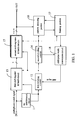
- FIG. 1 is a block diagram of an embodiment of a frame alignment circuit in accordance with the present invention.
- a bit synchronous circuit 1 regenerates a clock pulse from a multiplexed coded signal.
- a first dividing counter 12 regenerates a first dividing clock from the clock pulse.
- a shift register & latch circuit 13 shifts the multiplexed coded signal which is received from the transmission line and latches the multiplexed coded signal and generates n-parallel output signal by using the first divided clock signal generated in the first dividing counter 12.
- a second dividing counter 14 divides the first divided clock signal by m to produce a second divided clock signal.
- Shift resisters & latch circuits 15 shift the n-parallel signals by the first divided clock signal, latch the n-parallel signals output in accordance with the second divided clock signal and generate (n x m) parallel signals as outputs.
- a pattern detecting portion 16 detects the frame pattern of the (n x m) parallel signals.
- a framing portion 17 controls the phase differences of the frame pattern detected by the pattern detecting portion 16 and generates a shift pulse which is equal to the number of the phase differences by using the second divided clock signal.
- the framing portion 17 contains, for example, a frame counter and a frame alignment circuit.
- a shift pulse width conversion circuit 18 converts the width of the second divided clock pulse to the width of the first divided pulse. The converted pulse is input to the first dividing counter 12.
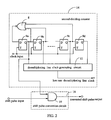
- FIG. 2 shows a detailed block diagram of the second dividing counter 14 and the shift pulse width conversion circuit 18 of FIG. 1.
- the second dividing counter 14 comprises, D flip-flops 9a-9d which are installed in the same number to the multiplexed lines and are connected in cascade fashion.
- NOR gate 8 has input terminals which are connected to the respective outputs of the D flip-flop 9a-9c. The output terminal of the NOR gate 8 is connected to a D terminal of the D flip-flop 9a.
- a demultiplexing line clock generating circuit 10 generates a low rate demultiplexing line clock signal using the output of the D flip-flops 9a-9d.
- the output of the first D flip-flops 9a are input to a shift pulse width conversion circuit 18.
- the shift pulse width conversion circuit 18 generates a converted shift pulse by multiplying the shift pulse and the output of the first D flip-flops 9a using an AND gate 19.
- the multiplexed coded signal received from the transmission line is passed as inputs to the bit synchronous circuit 1.
- the bit synchronous circuit 1 regenerates a clock pulse.
- the dividing circuit is divided into two stages : the first dividing counter 12 and the second dividing counter 14.
- a shift register & latch circuit 13 generates n-parallel signals by shifting the multiplexed coded signal and latching the multiplexed coded signal in accordance with the first divided clock received from the first dividing counter 12. Then, the n shift resisters & latch circuits 15 shift the n-parallel signals using the first divided clock signal to latch the n-parallel signals using the second divided clock and generate (n x m) signals as the outputs.
- the outputs from the shift registers & latch circuits 15 are input to the pattern detecting portion 16.
- the pattern detecting portion 16 detects the frame pattern of the multiplexed coded signal .
- the results detected by the pattern detecting portion 16 are sent to the framing portion 17.
- the framing portion 17 adjusts the timing of the detected frame pattern position by comparing with the inside frame counter (not shown).
- the framing portion 17 establishes synchronization by shifting the frame pattern forward or backward using well known synchronizing techniques.
- the framing portion 17 determines the number of pulses to be shifted. As the framing portion 17 is operated by the second divided lock signal, the pulse width of the output shift pulse is equal to that of the second divided pulse. The width of the shift pulse generated by the framing portion 17 is converted by multiplying the second divided clock signal and the shifted first divided clock signal in the shift pulse width conversion circuit 18.
- the converted shift pulse having the width of the first divided clock pulse, shifts the first divided clock in the first dividing counter 12 using a well known counter shift circuit. Accordingly the phase of the second divided pulse is shifted in the second dividing counter 14. As a result, the (n x m ) output signal is obtained from the shift resisters & latch circuits 15.
- the dividing counter is constructed in two stages , but may be constructed in more than two stages. In that case, the shift pulse width conversion circuit 18 is constructed in more than two stages.
- the shift pulse width conversion circuit 18 is constructed by using AND gate, but it may be constructed by using another type of the circuit which converts the pulse width by detecting the edge of the shift pulse.
Landscapes
- Engineering & Computer Science (AREA)
- Computer Networks & Wireless Communication (AREA)
- Signal Processing (AREA)
- Synchronisation In Digital Transmission Systems (AREA)
- Time-Division Multiplex Systems (AREA)
Applications Claiming Priority (2)
| Application Number | Priority Date | Filing Date | Title |
|---|---|---|---|
| JP275980/90 | 1990-10-15 | ||
| JP2275980A JP2744690B2 (ja) | 1990-10-15 | 1990-10-15 | フレーム同期回路 |
Publications (3)
| Publication Number | Publication Date |
|---|---|
| EP0481267A2 true EP0481267A2 (fr) | 1992-04-22 |
| EP0481267A3 EP0481267A3 (en) | 1992-10-28 |
| EP0481267B1 EP0481267B1 (fr) | 1996-01-17 |
Family
ID=17563101
Family Applications (1)
| Application Number | Title | Priority Date | Filing Date |
|---|---|---|---|
| EP91116488A Expired - Lifetime EP0481267B1 (fr) | 1990-10-15 | 1991-09-26 | Circuit d'alignement de trame |
Country Status (4)
| Country | Link |
|---|---|
| US (1) | US5287389A (fr) |
| EP (1) | EP0481267B1 (fr) |
| JP (1) | JP2744690B2 (fr) |
| DE (1) | DE69116494T2 (fr) |
Cited By (1)
| Publication number | Priority date | Publication date | Assignee | Title |
|---|---|---|---|---|
| WO2005064483A1 (fr) * | 2003-12-30 | 2005-07-14 | Intel Corporation | Verification de debit sur sequence d'alignement seriel entrante |
Families Citing this family (10)
| Publication number | Priority date | Publication date | Assignee | Title |
|---|---|---|---|---|
| US5452323A (en) * | 1993-12-06 | 1995-09-19 | Hughes Aircraft Company | Simple asynchronous data synchronizer to a faster clock |
| GB2285201B (en) * | 1993-12-22 | 1997-12-10 | Roke Manor Research | Timing recovery apparatus |
| US5974104A (en) * | 1997-02-13 | 1999-10-26 | Lsi Logic Corporation | Data frame synchronizer for serial communication system |
| US6370158B1 (en) | 1997-11-14 | 2002-04-09 | Wireless Facilities, Inc. | Wireless T/E Transceiver frame signaling subcontroller |
| JPH11331140A (ja) * | 1998-05-15 | 1999-11-30 | Nec Eng Ltd | フレーム同期回路 |
| CN1729639B (zh) * | 2002-12-19 | 2010-10-06 | Nxp股份有限公司 | 帧同步设备和方法 |
| WO2008035428A1 (fr) * | 2006-09-21 | 2008-03-27 | Fujitsu Limited | Terminal de communication, et procédé de réception du signal |
| TWI332320B (en) * | 2007-03-20 | 2010-10-21 | Etron Technology Inc | Spread spectrum clock generator |
| JP2009094891A (ja) * | 2007-10-10 | 2009-04-30 | Toshiba Corp | 半導体集積回路装置及びパターン検出方法 |
| CN108494433B (zh) * | 2018-05-29 | 2024-05-03 | 深圳市力生美半导体股份有限公司 | 一种单线通信方法及其电路实现 |
Family Cites Families (6)
| Publication number | Priority date | Publication date | Assignee | Title |
|---|---|---|---|---|
| CA1253639A (fr) * | 1986-01-22 | 1989-05-02 | Alan F. Graves | Verrouillage de trame des tribulaires d'un train binaire mrt |
| GB8609499D0 (en) * | 1986-04-18 | 1986-05-21 | Gen Electric Co Plc | Digital transmission system |
| JPS6330034A (ja) * | 1986-07-23 | 1988-02-08 | Nec Corp | 多重化回路 |
| US4956854A (en) * | 1988-09-09 | 1990-09-11 | Motorola, Inc. | Digital pattern decoder |
| JPH0720087B2 (ja) * | 1989-01-13 | 1995-03-06 | 三菱電機株式会社 | フレーム同期回路 |
| US4965884A (en) * | 1989-11-22 | 1990-10-23 | Northern Telecom Limited | Data alignment method and apparatus |
-
1990
- 1990-10-15 JP JP2275980A patent/JP2744690B2/ja not_active Expired - Lifetime
-
1991
- 1991-09-25 US US07/765,149 patent/US5287389A/en not_active Expired - Lifetime
- 1991-09-26 DE DE69116494T patent/DE69116494T2/de not_active Expired - Fee Related
- 1991-09-26 EP EP91116488A patent/EP0481267B1/fr not_active Expired - Lifetime
Cited By (3)
| Publication number | Priority date | Publication date | Assignee | Title |
|---|---|---|---|---|
| WO2005064483A1 (fr) * | 2003-12-30 | 2005-07-14 | Intel Corporation | Verification de debit sur sequence d'alignement seriel entrante |
| US7934112B2 (en) | 2003-12-30 | 2011-04-26 | Intel Corporation | Rate verification of an incoming serial alignment sequence |
| US8595536B2 (en) | 2003-12-30 | 2013-11-26 | Intel Corporation | Rate verification of an incoming serial alignment sequence |
Also Published As
| Publication number | Publication date |
|---|---|
| JP2744690B2 (ja) | 1998-04-28 |
| US5287389A (en) | 1994-02-15 |
| JPH04170116A (ja) | 1992-06-17 |
| DE69116494T2 (de) | 1996-09-12 |
| EP0481267B1 (fr) | 1996-01-17 |
| DE69116494D1 (de) | 1996-02-29 |
| EP0481267A3 (en) | 1992-10-28 |
Similar Documents
| Publication | Publication Date | Title |
|---|---|---|
| US5327434A (en) | Frame alignment circuit | |
| EP0481267B1 (fr) | Circuit d'alignement de trame | |
| EP1579612B1 (fr) | Dispositif et procede de synchronisation de trames | |
| EP0379384B1 (fr) | Circuit d'ajustement de phase | |
| GB2250896A (en) | A word synchronous system for a word interleave method In a digital communication system | |
| EP0302112B1 (fr) | Dispositif diviseur multiplex dans un systeme de multiplexage synchrone | |
| JPH0748725B2 (ja) | フレーム同期回路 | |
| US6539034B1 (en) | Method and apparatus for time-division multiplexing and demultiplexing | |
| KR950020649A (ko) | 디지탈오디오신호의 복조장치 | |
| US4498167A (en) | TDM Communication system | |
| EP0450148A2 (fr) | Circuit de décodage pour empêcher les erreurs de propagation | |
| JP2692476B2 (ja) | フレーム同期システム | |
| KR100204062B1 (ko) | 저속 데이타 프레임 위상 정렬기 | |
| JPH01212935A (ja) | 多重化符号変換方法 | |
| JP3072494B2 (ja) | 並列形フレーム同期回路のチャネル選択状態のモニタ回路 | |
| KR950005611B1 (ko) | 비트 인터리빙 다중화된 신호에 대한 채널 번호와 스킵 펄스를 이용한 리프레임 회로 | |
| JPH0244424B2 (fr) | ||
| JPS61140241A (ja) | フレ−ム同期復帰方式 | |
| KR100318938B1 (ko) | 동기식 전송 네트웍 시스템에서의 에이유-3 단위 스위칭회로 | |
| JPS60158746A (ja) | 同期装置 | |
| JPH0611133B2 (ja) | フレ−ム位相制御回路 | |
| JPH01138831A (ja) | フレーム同期回路 | |
| JPH06125356A (ja) | 同期回路 | |
| JPH04227141A (ja) | 時分割多重化信号分離回路 | |
| JPH02186850A (ja) | フレーム同期回路 |
Legal Events
| Date | Code | Title | Description |
|---|---|---|---|
| PUAI | Public reference made under article 153(3) epc to a published international application that has entered the european phase |
Free format text: ORIGINAL CODE: 0009012 |
|
| AK | Designated contracting states |
Kind code of ref document: A2 Designated state(s): DE FR GB |
|
| PUAL | Search report despatched |
Free format text: ORIGINAL CODE: 0009013 |
|
| AK | Designated contracting states |
Kind code of ref document: A3 Designated state(s): DE FR GB |
|
| 17P | Request for examination filed |
Effective date: 19930127 |
|
| 17Q | First examination report despatched |
Effective date: 19950421 |
|
| GRAA | (expected) grant |
Free format text: ORIGINAL CODE: 0009210 |
|
| AK | Designated contracting states |
Kind code of ref document: B1 Designated state(s): DE FR GB |
|
| REF | Corresponds to: |
Ref document number: 69116494 Country of ref document: DE Date of ref document: 19960229 |
|
| ET | Fr: translation filed | ||
| PLBE | No opposition filed within time limit |
Free format text: ORIGINAL CODE: 0009261 |
|
| STAA | Information on the status of an ep patent application or granted ep patent |
Free format text: STATUS: NO OPPOSITION FILED WITHIN TIME LIMIT |
|
| 26N | No opposition filed | ||
| REG | Reference to a national code |
Ref country code: GB Ref legal event code: 746 Effective date: 19971202 |
|
| REG | Reference to a national code |
Ref country code: FR Ref legal event code: D6 |
|
| REG | Reference to a national code |
Ref country code: GB Ref legal event code: IF02 |
|
| PGFP | Annual fee paid to national office [announced via postgrant information from national office to epo] |
Ref country code: FR Payment date: 20080915 Year of fee payment: 18 |
|
| PGFP | Annual fee paid to national office [announced via postgrant information from national office to epo] |
Ref country code: DE Payment date: 20081002 Year of fee payment: 18 |
|
| PGFP | Annual fee paid to national office [announced via postgrant information from national office to epo] |
Ref country code: GB Payment date: 20081001 Year of fee payment: 18 |
|
| REG | Reference to a national code |
Ref country code: FR Ref legal event code: ST Effective date: 20090529 |
|
| PG25 | Lapsed in a contracting state [announced via postgrant information from national office to epo] |
Ref country code: FR Free format text: LAPSE BECAUSE OF NON-PAYMENT OF DUE FEES Effective date: 20080930 |
|
| GBPC | Gb: european patent ceased through non-payment of renewal fee |
Effective date: 20090926 |
|
| PG25 | Lapsed in a contracting state [announced via postgrant information from national office to epo] |
Ref country code: DE Free format text: LAPSE BECAUSE OF NON-PAYMENT OF DUE FEES Effective date: 20100401 |
|
| PG25 | Lapsed in a contracting state [announced via postgrant information from national office to epo] |
Ref country code: GB Free format text: LAPSE BECAUSE OF NON-PAYMENT OF DUE FEES Effective date: 20090926 |