EP0483377A1 - Materiau de masquage - Google Patents
Materiau de masquage Download PDFInfo
- Publication number
- EP0483377A1 EP0483377A1 EP91909144A EP91909144A EP0483377A1 EP 0483377 A1 EP0483377 A1 EP 0483377A1 EP 91909144 A EP91909144 A EP 91909144A EP 91909144 A EP91909144 A EP 91909144A EP 0483377 A1 EP0483377 A1 EP 0483377A1
- Authority
- EP
- European Patent Office
- Prior art keywords
- masking member
- masking
- adhesive layer
- article
- masking material
- Prior art date
- Legal status (The legal status is an assumption and is not a legal conclusion. Google has not performed a legal analysis and makes no representation as to the accuracy of the status listed.)
- Ceased
Links
Images


Classifications
-
- B—PERFORMING OPERATIONS; TRANSPORTING
- B05—SPRAYING OR ATOMISING IN GENERAL; APPLYING FLUENT MATERIALS TO SURFACES, IN GENERAL
- B05B—SPRAYING APPARATUS; ATOMISING APPARATUS; NOZZLES
- B05B12/00—Arrangements for controlling delivery; Arrangements for controlling the spray area
- B05B12/16—Arrangements for controlling delivery; Arrangements for controlling the spray area for controlling the spray area
- B05B12/20—Masking elements, i.e. elements defining uncoated areas on an object to be coated
Definitions
- the present invention relates to a masking member used to protect a part of the surface of an article from a surface treatment such as coating, plating and the like when said surface treatment is effected on said surface of said article.
- polyvinyl-chloride sol, tar-urethane, and the like have been coated on the underside of the floor of cars, however, said underside of the floor of cars has many holes such as bolt holes, cable holes, drainage holes, shaft holes and the like, and has places where parts of brackets and the like are attached, and the masking member is attached to said holes and said parts before coating to protect them so that the paint does not go into said holes and coating film is not formed on said parts to which parts are attached which would decrease the fastening strength of said parts.
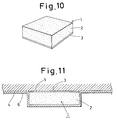
- a masking member consisting of a panel (2) of a polystyrene foam wherein an adhesive layer (3) is formed on one side of said panel (2) has been provided as shown in Fig. 10 (Jikkai Sho 62-5852).
- Said masking member (1) is attached to a part (5) of an article (4) to be protected by said adhesive layer (3) as shown in Fig. 11 and after coating, said masking member (1) is removed from said part (5).
- said masking member (1) is easily stabbed by a hook (7) and the like, when said masking member (1) is stabbed by said hook (7) to remove from said part (5), said coating film (6) around said masking member (1) is broken so as to be delaminated from the surface of said article (4).
- the present invention provides a masking member consisting of a panel (12) wherein an adhesive layer (13) is formed on one side of said panel (12) and a lacking part (12)A is formed around the circumference of said side as a means to solve said prior problem.
- Said masking member (11) of the present invention is attached to a part of an article to be protected by said adhesive layer (13) and a film of a surface treatment formed on the surface of said article is cut by said lacking part (12)A formed around the circumference of said side of said masking member (11) in which said adhesive layer (13) is formed. Accordingly, as said film around said masking member is cut, said masking member is easily removed from said part after a surface treatment.
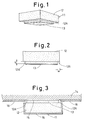
- Figs. 1 to 5 each show an embodiment of the present invention.
- Fig. 1 is a perspective view
- Fig. 2 is a side view
- Fig. 3 is a side sectional view when said masking member is used
- Fig. 4 is a side sectional view when said masking member is contracted by heating and is removed
- Fig. 5 is a side sectional view when said masking member is removed by a hook
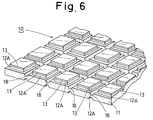
- Fig. 6 is a partial perspective view of assembled masking members
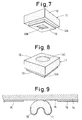
- Fig. 7 is a perspective view of another embodiment of the present invention
- Figs. 8 and 9 each show a further embodiment
- Fig. 8 is a perspective view
- Fig. 9 is a side sectional view of a masking member contracted by heating
- Fig. 10 to 13 each show a prior embodiment; Fig. 10 is a perspective view, Fig. 11 is a side sectional view when said masking member is used, Fig. 12 is a side sectional view of said masking member contracted by heating, Fig. 13 is a side sectional view when said masking member is removed by a hook.
- Fig. 10 is a perspective view
- Fig. 11 is a side sectional view when said masking member is used
- Fig. 12 is a side sectional view of said masking member contracted by heating
- Fig. 13 is a side sectional view when said masking member is removed by a hook.
- a masking member (11) consists of a panel (12) and an adhesive layer (13) formed on one side of said panel (12) wherein a lacking part (12)A is formed around the circumference of said side.
- the width W of said lacking part (12)A is more than 1 mm and the height h is in the range between 0.2 and 10 mm, more preferably 0.5 and 5 mm.
- a masking member (11) of the present invention is made of a plastic such as polystyrene, polyethylene, polypropylene, polyvinyl-chloride, polyurethane, melamine resin, urea resin, phenol resin and the like, a reinforced plastic wherein an inorganic filler such as calcium carbonate, talc, bentonite and the like is mixed in said plastic, a foamed plastic of said plastic, a synthetic rubber such as styrene-butadiene rubber, acrylonitrile-butadiene rubber and the like, a natural rubber, a molded fiber material wherein wood fiber, synthetic fiber, natural fiber, inorganic fiber etc. is bound by a binder to mold wood, paper, reclaimed paper, corrugated card-board, metal, and a complex or a laminate of two or more of said materials.
- a plastic such as polystyrene, polyethylene, polypropylene, polyvinyl-chloride, polyurethane, melamine resin
- said masking member (11) is attached to a part (15) of an article (14) to be protected by said adhesive layer (13), and a surface treatment such as a coating by using a paint such as polyvinyl-chloride sol and the like is effected on the surface of said article (14).
- a film (16) of said surface treatment is formed on the surface of said article (14), and said film (16) is cut around the circumference of said masking member (11) by said lacking part (12)A of said masking member (11).
- the width W of said lacking part (12)A of said masking member (11) is less than 1 mm and the height h of said lacking part (12)A is less than 0.2 mm, it may be difficult to smoothly cut said film (16) by said lacking part (12)A, and if the height h of said lacking part (12)A is higher than 10 mm, said film (16) may be formed in the inside of said lacking part (12)A and it may be difficult to smoothly cut around the circumference of said masking member (11).
- said masking member (11) is removed from said part (15) of said article (14) and in a case where said masking member (11) consists of a material which can be contracted by heating such as a plastic foam, said masking member (11) is contracted by heating at a higher temperature than the contracting temperature of said masking member as shown in Fig. 4. Said contracted masking member (11)A may drop automatically from said part (15) without any obstruction of said film (16). Further, said masking member (11) may be removed from said part (15) by a hook (17) as shown in Fig. 5.
- said hook (17) may be easily engaged at said lacking part (12)A and the removing work of the masking member is easily performed. And since said film (16) is already cut around the circumference of said masking member (11), when said masking member (11) is removed, said film (16) may not be broken and delaminated from said part (15).
- a plural number of said masking members (11) may be assembled intermediating a plural number of snapping grooves (18) to form an assembled masking member (10).
- said assembled masking member (10) is used, one masking member (11) is snapped out along said snapping grooves (18).
- a piece consisting of a plural number of masking members (11) such as 1 ⁇ 2, 2 ⁇ 2, 1 ⁇ 3, 2 ⁇ 3, 3 ⁇ 3 and the like may be snapped out according to the shape and the size of said part (15) of said article (14) to be protected.
- Fig. 7 shows another embodiment of the present invention.
- a cut-away open space (12)B is formed in the center of one side of a masking member (11) around which an adhesive layer (13) is formed. Accordingly, in said masking member (11), the area of said adhesive layer (13) is reduced by said cut-away open space (12)B and as a result, the bonding strength of said masking member (11) to said part (15) may be reduced so as to remove said masking member (11) easily from said part (15).
- Fig. 8 shows further embodiment of the present invention.
- a dent (12)C having a crater shape is formed in the center of one side of a masking member (11) wherein an adhesive layer (13) is formed on the other side of said masking member (11).
- an adhesive layer (13) is formed on the other side of said masking member (11).
- a finger is put in said dent (12)C.
- said masking member (11) may be easily contracted and deformed by said dent (12)C as shown in Fig. 9 when said masking member (11) is heated to be softened, said masking member (11) may be more easily removed from said part (15) of said article1(14).
Landscapes
- Details Or Accessories Of Spraying Plant Or Apparatus (AREA)
- Coating Apparatus (AREA)
Abstract
La présente invention a pour but de faciliter le décollement d'un matériau de masquage, à la fin d'une opération de traitement de surface. A cet effet, on forme une partie en gradin sur le bord périphérique du matériau de masquage comportant une couche adhésive déposée sur une surface d'un corps en forme de plaque. Dès lors que le film de traitement de surface est coupé par cette partie en gradin au niveau du bord périphérique du matériau de masquage, celui-ci peut être décollé sans être gêné par le film de traitement de surface.
Applications Claiming Priority (2)
| Application Number | Priority Date | Filing Date | Title |
|---|---|---|---|
| JP52729/90U | 1990-05-21 | ||
| JP1990052729U JPH0414157U (fr) | 1990-05-21 | 1990-05-21 |
Publications (2)
| Publication Number | Publication Date |
|---|---|
| EP0483377A1 true EP0483377A1 (fr) | 1992-05-06 |
| EP0483377A4 EP0483377A4 (en) | 1992-11-04 |
Family
ID=12923015
Family Applications (1)
| Application Number | Title | Priority Date | Filing Date |
|---|---|---|---|
| EP19910909144 Ceased EP0483377A4 (en) | 1990-05-21 | 1991-05-20 | Masking material |
Country Status (4)
| Country | Link |
|---|---|
| EP (1) | EP0483377A4 (fr) |
| JP (1) | JPH0414157U (fr) |
| CA (1) | CA2064089A1 (fr) |
| WO (1) | WO1991017837A1 (fr) |
Cited By (3)
| Publication number | Priority date | Publication date | Assignee | Title |
|---|---|---|---|---|
| EP0606694A1 (fr) * | 1993-01-14 | 1994-07-20 | Nagoya Oilchemical Co., Ltd. | Masque |
| US5786028A (en) * | 1996-09-05 | 1998-07-28 | Cantwell; Jay S. | Masking tape and method |
| US5902642A (en) * | 1997-05-12 | 1999-05-11 | Nayoya Oilchemcial Co., Ltd. | Masking member made of engineering plastic |
Families Citing this family (2)
| Publication number | Priority date | Publication date | Assignee | Title |
|---|---|---|---|---|
| JP2570540Y2 (ja) * | 1993-04-02 | 1998-05-06 | 株式会社増田屋コーポレーション | 遊泳玩具魚体 |
| JP2570539Y2 (ja) * | 1993-04-05 | 1998-05-06 | 株式会社増田屋コーポレーション | 遊泳玩具魚体 |
Family Cites Families (6)
| Publication number | Priority date | Publication date | Assignee | Title |
|---|---|---|---|---|
| JPH051340Y2 (fr) * | 1985-09-26 | 1993-01-13 | ||
| JPS6217372U (fr) * | 1985-07-18 | 1987-02-02 | ||
| JPS62199174U (fr) * | 1986-06-09 | 1987-12-18 | ||
| JPH0612876Y2 (ja) * | 1987-02-20 | 1994-04-06 | 名古屋油化株式会社 | マスキング材 |
| JPH0525748Y2 (fr) * | 1986-08-06 | 1993-06-29 | ||
| JPH0612874Y2 (ja) * | 1987-02-20 | 1994-04-06 | 名古屋油化株式会社 | マスキング材 |
-
1990
- 1990-05-21 JP JP1990052729U patent/JPH0414157U/ja active Pending
-
1991
- 1991-05-20 WO PCT/JP1991/000674 patent/WO1991017837A1/fr not_active Ceased
- 1991-05-20 EP EP19910909144 patent/EP0483377A4/en not_active Ceased
- 1991-05-20 CA CA002064089A patent/CA2064089A1/fr not_active Abandoned
Non-Patent Citations (1)
| Title |
|---|
| See references of WO9117837A1 * |
Cited By (3)
| Publication number | Priority date | Publication date | Assignee | Title |
|---|---|---|---|---|
| EP0606694A1 (fr) * | 1993-01-14 | 1994-07-20 | Nagoya Oilchemical Co., Ltd. | Masque |
| US5786028A (en) * | 1996-09-05 | 1998-07-28 | Cantwell; Jay S. | Masking tape and method |
| US5902642A (en) * | 1997-05-12 | 1999-05-11 | Nayoya Oilchemcial Co., Ltd. | Masking member made of engineering plastic |
Also Published As
| Publication number | Publication date |
|---|---|
| CA2064089A1 (fr) | 1991-11-22 |
| JPH0414157U (fr) | 1992-02-05 |
| WO1991017837A1 (fr) | 1991-11-28 |
| EP0483377A4 (en) | 1992-11-04 |
Similar Documents
| Publication | Publication Date | Title |
|---|---|---|
| US4822650A (en) | Masking member | |
| EP0368615B1 (fr) | Masque | |
| EP0207720B1 (fr) | Elément de masquage | |
| EP0249444B1 (fr) | Procédé insonorisant, amortissant et rendant des structures métalliques résistantes à la corrosion | |
| CA2332742A1 (fr) | Feuille superieure pour articles absorbants, et methode de fabrication connexe | |
| KR930001191Y1 (ko) | 마스킹재 | |
| US8251010B2 (en) | Masking material for painting | |
| US20100215900A1 (en) | Wallboard tape | |
| EP0162655A1 (fr) | Baguette de protection décorative et procédé pour sa fabrication | |
| CA2064089A1 (fr) | Element de masquage | |
| EP0203677A1 (fr) | Tapis de sol pour véhicules | |
| EP0303268A1 (fr) | Méthode pour faire des structures en métal anticorrosif insonore et résistant aux vibrations | |
| EP0384695B1 (fr) | Elément de cache | |
| EP0367260A2 (fr) | Cache | |
| JP2536762Y2 (ja) | マスキング材 | |
| EP0606694A1 (fr) | Masque | |
| EP0676246A1 (fr) | Element de masquage | |
| JPH0740480A (ja) | ダンボールおよび内装基材 | |
| JP2882847B2 (ja) | 溝目地形成方法 | |
| EP0484560A1 (fr) | Materiau de masquage | |
| JPH0646531Y2 (ja) | マスキング材 | |
| JP3910238B2 (ja) | 中空成形品の製造方法 | |
| EP0370796A1 (fr) | Procédé d'insonorisation et d'isolation contre la corrosion et les vibrations de structures métalliques | |
| JP2612241B2 (ja) | 金属構造物の防錆防音防振処理方法 | |
| JP2687200B2 (ja) | 加飾部材付内装材および該内装材の製造方法 |
Legal Events
| Date | Code | Title | Description |
|---|---|---|---|
| PUAI | Public reference made under article 153(3) epc to a published international application that has entered the european phase |
Free format text: ORIGINAL CODE: 0009012 |
|
| 17P | Request for examination filed |
Effective date: 19920124 |
|
| AK | Designated contracting states |
Kind code of ref document: A1 Designated state(s): DE FR GB IT SE |
|
| A4 | Supplementary search report drawn up and despatched |
Effective date: 19920914 |
|
| AK | Designated contracting states |
Kind code of ref document: A4 Designated state(s): DE FR GB IT SE |
|
| 17Q | First examination report despatched |
Effective date: 19940504 |
|
| STAA | Information on the status of an ep patent application or granted ep patent |
Free format text: STATUS: THE APPLICATION HAS BEEN REFUSED |
|
| 18R | Application refused |
Effective date: 19950616 |