EP0483761B1 - Dispositif de contrÔle TTL pour flash à éclairs multiples - Google Patents
Dispositif de contrÔle TTL pour flash à éclairs multiples Download PDFInfo
- Publication number
- EP0483761B1 EP0483761B1 EP91118429A EP91118429A EP0483761B1 EP 0483761 B1 EP0483761 B1 EP 0483761B1 EP 91118429 A EP91118429 A EP 91118429A EP 91118429 A EP91118429 A EP 91118429A EP 0483761 B1 EP0483761 B1 EP 0483761B1
- Authority
- EP
- European Patent Office
- Prior art keywords
- flashing
- light
- photoelectric converting
- output signals
- converting means
- Prior art date
- Legal status (The legal status is an assumption and is not a legal conclusion. Google has not performed a legal analysis and makes no representation as to the accuracy of the status listed.)
- Expired - Lifetime
Links
- 238000009826 distribution Methods 0.000 claims description 10
- 230000001131 transforming effect Effects 0.000 claims description 9
- 238000005375 photometry Methods 0.000 description 21
- 239000003990 capacitor Substances 0.000 description 16
- 230000009466 transformation Effects 0.000 description 10
- 238000006243 chemical reaction Methods 0.000 description 7
- 230000003287 optical effect Effects 0.000 description 7
- 230000010354 integration Effects 0.000 description 4
- 230000003247 decreasing effect Effects 0.000 description 3
- 238000010586 diagram Methods 0.000 description 3
- 238000000034 method Methods 0.000 description 3
- 238000001514 detection method Methods 0.000 description 2
- 230000006835 compression Effects 0.000 description 1
- 238000007906 compression Methods 0.000 description 1
- 230000002093 peripheral effect Effects 0.000 description 1
- 230000035945 sensitivity Effects 0.000 description 1
Images




Classifications
-
- G—PHYSICS
- G03—PHOTOGRAPHY; CINEMATOGRAPHY; ANALOGOUS TECHNIQUES USING WAVES OTHER THAN OPTICAL WAVES; ELECTROGRAPHY; HOLOGRAPHY
- G03B—APPARATUS OR ARRANGEMENTS FOR TAKING PHOTOGRAPHS OR FOR PROJECTING OR VIEWING THEM; APPARATUS OR ARRANGEMENTS EMPLOYING ANALOGOUS TECHNIQUES USING WAVES OTHER THAN OPTICAL WAVES; ACCESSORIES THEREFOR
- G03B15/00—Special procedures for taking photographs; Apparatus therefor
- G03B15/02—Illuminating scene
- G03B15/03—Combinations of cameras with lighting apparatus; Flash units
- G03B15/05—Combinations of cameras with electronic flash apparatus; Electronic flash units
-
- G—PHYSICS
- G03—PHOTOGRAPHY; CINEMATOGRAPHY; ANALOGOUS TECHNIQUES USING WAVES OTHER THAN OPTICAL WAVES; ELECTROGRAPHY; HOLOGRAPHY
- G03B—APPARATUS OR ARRANGEMENTS FOR TAKING PHOTOGRAPHS OR FOR PROJECTING OR VIEWING THEM; APPARATUS OR ARRANGEMENTS EMPLOYING ANALOGOUS TECHNIQUES USING WAVES OTHER THAN OPTICAL WAVES; ACCESSORIES THEREFOR
- G03B7/00—Control of exposure by setting shutters, diaphragms or filters, separately or conjointly
- G03B7/08—Control effected solely on the basis of the response, to the intensity of the light received by the camera, of a built-in light-sensitive device
- G03B7/099—Arrangement of photoelectric elements in or on the camera
- G03B7/0993—Arrangement of photoelectric elements in or on the camera in the camera
- G03B7/0997—Through the lens [TTL] measuring
- G03B7/09971—Through the lens [TTL] measuring in mirror-reflex cameras
- G03B7/09974—Through the lens [TTL] measuring in mirror-reflex cameras using the film or shutter as sensor light reflecting member
-
- G—PHYSICS
- G03—PHOTOGRAPHY; CINEMATOGRAPHY; ANALOGOUS TECHNIQUES USING WAVES OTHER THAN OPTICAL WAVES; ELECTROGRAPHY; HOLOGRAPHY
- G03B—APPARATUS OR ARRANGEMENTS FOR TAKING PHOTOGRAPHS OR FOR PROJECTING OR VIEWING THEM; APPARATUS OR ARRANGEMENTS EMPLOYING ANALOGOUS TECHNIQUES USING WAVES OTHER THAN OPTICAL WAVES; ACCESSORIES THEREFOR
- G03B7/00—Control of exposure by setting shutters, diaphragms or filters, separately or conjointly
- G03B7/08—Control effected solely on the basis of the response, to the intensity of the light received by the camera, of a built-in light-sensitive device
- G03B7/099—Arrangement of photoelectric elements in or on the camera
- G03B7/0993—Arrangement of photoelectric elements in or on the camera in the camera
- G03B7/0997—Through the lens [TTL] measuring
- G03B7/09979—Multi-zone light measuring
Definitions
- the present invention relates to an automatic flash control device for a photographic operation using an electronic flash in a camera having a focal plane shutter and, more particularly, to a TTL multiple flash control device based on a concept of multiple pattern photometry.
- a conventional camera having a TTL automatic flash control function includes one light-receiving element for performing a photometric operation of the entire film surface or a major portion thereof.
- an electronic flash emits light, and object image light reflected by the film surface is photoelectrically converted by a light-receiving element.
- a signal corresponding to an integrated value of the quantity of light of the light-receiving element is compared with a predetermined value.
- the amount of light from the electronic flash is controlled so that the film surface has a predetermined brightness level.
- This scheme has a disadvantage in that various conditions in the field of view cannot be sufficiently satisfied because a detection area of the field of view is one-dimensional. As a result, an optimal exposure value of the principal object cannot be obtained.
- JP-A-3 068 928 proposes the following system by employing the concept of so-called multiple pattern photometry in TTL automatic flash control.
- a plurality of photoelectric converting means capable of performing photometry of a plurality of areas constituting the field of view are arranged at a position where the quantity of light on the film surface is measured, and an electronic flash is caused to preliminarily emit light immediately before a focal plane shutter is opened.
- the light from the electronic flash is reflected by the object image, and the reflected light is reflected in turn by the surface of a shutter curtain.
- the resultant light is received by the plurality of photoelectric converting means, and outputs from these photoelectric converting means are independently integrated.
- the integrated values are detected as field reflection distributions of the areas upon flashing.
- the detected field reflection distribution information of each area is arithmetically operated in accordance with a predetermined multiple pattern algorithm. Therefore, the degrees of weighting of the respective divided areas are determined to optimize exposure for the principal object.
- the electronic flash emits light, and light reflected by the film surface is received by the same plurality of photoelectric converting means.
- the weighted outputs are added and integrated.
- the resultant value is compared with the predetermined value to stop flashing of the electronic flash at a timing determined by this comparison, thereby completing automatic flash control.
- TTL automatic flash control scheme is called "TTL multiple flash control”.
- This TTL multiple flash control is characterized in that the plurality of photoelectric converting means are located at a position where light reflected by the shutter surface capable of performing photometry in each of the plurality of divided areas constituting the field is received, and that each of independent integrated values of the values output from the plurality of photoelectric converting means is defined as field reflection distribution information of each area, and this information is arithmetically operated in accordance with the predetermined multiple pattern algorithm.
- the quantity of light is decreased with respect to the quantity of light corresponding to a full A/D conversion scale such that a quantity of light corresponding to a one-stopped-down value (1 EV) is 1/2 the full scale, a quantity of light corresponding to a two-stopped-down value is 1/4 the full scale, a quantity of light corresponding to a three-stopped-down value is 1/8 the full scale, and the like. Therefore, the A/D conversion resolution is undesirably decreased.
- a photoelectric conversion value allowing data read at a resolution of about 8 LSB/stop is a maximum of a 5-stopped-down value of the quantity of light corresponding to the full scale.
- a multiple flash control device for a camera having electronic flash means for performing main flashing and preliminary flashing for obtaining information used to limit a quantity of light of the main flashing comprising:
- a plurality of photoelectric converting means for receiving light beams corresponding to a plurality of photometric areas constituting a field of view during the preliminary flashing and main flashing, converting the light beams into photocurrents, respectively, and outputting electric signals corresponding to the photocurrents, respectively;
- logarithmic transforming means for logarithmically transforming outputs from the plurality of photoelectric converting means
- arithmetic means for obtaining a field reflection distribution on the basis of outputs from the peak holding means and determining weighting coefficients of the photometric areas during the main flashing on the basis of the field reflection distribution;
- flashing limiting means for weighting the outputs from the plurality of photoelectric converting means in accordance with the weighting coefficients determined by the arithmetic means, adding and integrating the weighted outputs, and limiting a quantity of light during the main flashing on the basis of a sum of the weighted outputs.
- the outputs from the photoelectric converting means are larger than the conventional values.
- the dynamic range can be widened.
- the position of the principal object can be predicted with a high probability, thereby calculating an optimal exposure value for the principal object.
- the field reflection distribution information can be extremely accurately obtained by a single preliminary flashing cycle which does not require flash control and free from consideration of a detection range. Therefore, photography having minimum variations in exposure of the principal object can be performed in correspondence with various object conditions.
- Figs. 1 to 6 show an embodiment of the present invention, in which:
- Fig. 1 is a block diagram showing an embodiment of the present invention.
- This embodiment exemplifies a circuit arrangement including a camera body 1 and an electronic flash 101.
- the camera body 1 is connected to the electronic flash 101 through contacts B1 and B2 and contacts S1 and S2.
- the electronic flash 101 comprises a flash unit 111 and a flash control circuit 112 including a booster circuit, a main capacitor, and a flash control SCR. Basically, a flashing start signal from the contact S2 and a flashing stop signal from the contact S1 control the start and end of flashing of the flash unit 111 through the flash control circuit 112.
- the camera body 1 comprises a photometry and quantity of light control circuit 11 and a microcomputer 12 and constitutes a TTL multiple flash control circuit of the present invention.
- Five photodiodes PDll to PD51 are photoelectric converting means assigned to five flash control areas shown in Figs. 4 and 5, respectively.
- the photodiodes PDll to PD51 output photocurrents proportional to illuminances, respectively. The peaks of these photocurrents are held and serve as voltages at output terminals VO1 to VO5.
- the photocurrent output from the photodiode PD11 is logarithmically transformed using a reference power source El as a base by an OP amplifier All feed-back controlled by a diode D11, so that the range of the photocurrent is converted into a compressed voltage output (logarithmic transforming means).
- a transistor Q11 receives the voltage compressed through logarithmic transformation as its emitter potential and an input voltage from a gain input terminal VG1 as its base potential.
- the transistor all outputs a collector current whose range is expanded by reverse logarithmic transformation with a gain determined by a potential difference between the emitter and base potentials.
- an FET Q12 When an integration control signal input terminal ITG is set at H level, an FET Q12 is kept on, and a capacitor C11 is kept charged by an application voltage VCC. When a signal at the input terminal ITG goes to L level, the FET Q12 is turned off, and the capacitor C11 is discharged to a voltage higher than a peak voltage of the voltage compressed through logarithmic transformation by a forward cutoff voltage VF of a diode D12.
- the charge voltage of the capacitor C11 is fixed to the voltage obtained by logarithmically transforming the peak of the quantity of light.
- the peak-held voltage is held through a follower amplifier A12 and is output to the output terminal VO1 (peak holding means).
- the four remaining circuit units which output the voltages VO2 to VO5 operate similarly, and collector currents from the transistor Q11 and transistors Q21 to Q51 are added to charge the capacitor C1.
- the voltage stored in the capacitor C1 is compared with a reference voltage E2 by a comparator CP1.
- a comparator CP1 When the voltage charged by the capacitor C1 is higher than the reference voltage E2, an output from the comparator CP1 goes from L level to H level in accordance with the characteristics of the level detector.
- An output terminal STOP goes from H level to L level by an inverter G2.
- the inverted signal is input to the integration control signal input terminal ITG through the microcomputer 12 and is inverted by an inverter G11.
- This inverted signal serves as an ON signal for an FET Q1.
- the FET Q1 When the FET Q1 is turned on, the capacitor C1 is completely discharged.
- the microcomputer 12 processes data from the photometry and quantity of light control circuit 11, thereby controlling the photometry and quantity of light control circuit 11.
- the microcomputer 12 sets output voltages of D/A converters 21 to 25 in accordance with data supplied from an 8-bit output port PO(8) to the D/A converters 21 to 25 through a data bus 41 and selection signals from the five terminals, i.e., output ports P07 to POB for selecting a D/A converter.
- the set values are input to the gain input terminal VG1 and gain input terminals VG2 to VG5 of the photometry and quantity of light control circuit 11 as reference voltages during compression through logarithmic transformation.
- the five peak-held voltage output terminals VO1 to VO5 of the photometry and quantity of light control circuit 11 are respectively connected to A/D conversion input terminals AD1 to AD5 of the microcomputer 12, and an output port PO1 is connected to the integration control signal input terminal ITG.
- the arrangement in Fig. 1 includes magnets 31 and 32 for holding states of preceding and following shutter curtains in accordance with signals to be described later.
- the magnets 31 and 32 are controlled in accordance with signals from output ports PO5 and PO6 of the microcomputer 12 through interfaces 33 and 34, respectively.
- Mechanical switches 35 and 36 are operated in accordance with a drive sequence of the camera.
- a mirror-up switch 35 is turned on when a mirror-up operation is completed.
- a synchronizing switch 36 is turned on when the shutter is fully opened.
- a release start switch 37 is turned on when a user depresses a shutter release button. Signals from the mirror-up switch 35, the synchronizing switch 36, and the release start switch 37 are respectively connected to input ports PI1 to PI3 with pull-up resistors of the microcomputer 12.
- the output terminal STOP of the photometry and quantity of light control circuit 11 is electrically connected to the flash control circuit 112 in the electronic flash 101 through the contact B1 with the flash unit 101.
- the output terminal STOP serves as a flashing stop signal terminal.
- An output port PO3 of the microcomputer 12 is connected to the flash unit 101 through the contact B2.
- the output port PO3 serves as a flashing start signal terminal.
- Fig. 3 is a sectional view showing an optical layout of the photoelectric converting means in this embodiment.
- An electronic flash 181 is connected to a camera body 81.
- a movable mirror 83 is retracted from an optical path, and a film 86 is fixed by inner rails 84a and 84b and a press plate 85 at a focusing position of a beam passing through a photographic lens 82.
- a preceding shutter curtain 87 of the focal plane shutter is located in front of the film 86 so as to prevent exposure of the film to the light except for a photographic operation. Therefore, the preceding shutter curtain 87 shields light in front of the film 86.
- a beam L from the object is refracted by the photographic lens 82 and is focused on the surface of the film 86.
- the light incident on the surface of the film 86 is partially reflected and reaches a photoelectric converting means 91 through a condenser lens 92.
- the beam L from the object is refracted by the photographic lens 82 and is focused on the surface of the preceding shutter curtain 87 in a state almost the same as the state on the film surface.
- the beam incident on the surface of the preceding shutter curtain 87 is partially reflected and reaches the photoelectric converting means 91 through the condenser lens 92 in the same manner as described above.
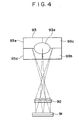
- Figs. 4 and 5 show the structure of the main part of the photoelectric converting means of the present invention.
- Fig. 4 is a view showing a relationship between optical positions of an opening area 93 of a film surface, the photoelectric converting means 91, and the condenser lens 92 when viewed from a direction indicated by an arrow A in Fig. 3.
- Fig. 5 is a view showing the structure of the photoelectric converting means 91 and the condenser lens 92.
- the opening area 93 of the film surface is divided into five areas, i.e., a central circular portion 93a and four peripheral portions 93b, 93c, 93d, and 93e by the photoelectric converting means 91 and the condenser lens 92, as will be described in detail with reference to Fig. 5.
- the photoelectric converting means 91 comprises a circular light-receiving area PDll and four rectangular light-receiving areas PD21, PD31, PD41, and PD51 each of which is arcuatedly notched to correspond to the 1/4 arc of the circular light-receiving portion PDll.
- the condenser lens 92 is an optical member having three lens portions 92a, 92b, and 92c on its upper surface so as to correspond to three blocks, i.e., central, left, and right blocks of the light-receiving areas.
- An image reflected by the film surface or the shutter surface is divided by the condenser lens 92 into portions corresponding to the five light-receiving areas PDll, PD21, PD31, PD41, and PD51 of the photoelectric converting means 91, as shown in Fig. 5. More specifically, the five light-receiving areas PDll, PD21, PD31, PD41, and PD51 respectively correspond to the areas 93a, 93b, 93c, 93d, and 93e of the opening portion of the film surface shown in Fig. 4, so that the photoelectric converting means separately performs photometry for measuring the brightness levels of the five divided areas.
- optical paths are indicated by broken lines, alternate long and short dashed lines, and alternate long and two short dashed lines, and beams from the object area (i.e., beams reflected by the central, left half, and right half portions of the opening portion 93 of the film surface) pass through the lens portions 92a to 92c of the condenser lens 92, respectively.
- the three transmitted beams are mostly focused on the three blocks, i.e., the central, left, and right blocks consisting of the five light-receiving areas PDll to PD51 of the photoelectric converting means 91.
- the quantities of beams are converted into photocurrents by the photoelectric converting means 91. These photocurrents are input to the photometry and quantity of light control circuit 11.
- the photocurrents are then converted into digital signals, and the digital signals are processed by the microcomputer 12, thereby controlling the system.
- the release start switch 37 is turned on at time a in Fig. 6.
- the magnets 31 and 32 of the preceding and following shutter curtains are energized, and at the same time, a mirror-up operation is started at time b in Fig. 6, thereby starting a release operation.
- the microcomputer 12 waits until the switch 35 is turned on so as to indicate that the mirror-up operation is completed.
- the microcomputer 12 sends predetermined common data to the D/A converters 21 to 25 in accordance with a control signal from the microcomputer 12, thereby performing D/A conversion.
- the A/D-converted voltages having the same potential are applied to the gain voltage input terminals VG1 to VG5 of the photometry and quantity of light control circuit 11.
- a signal of L level is input to the input terminal ITG of the photometry and quantity of light control circuit 11.
- a control signal goes to L level through the contact B2 for the electronic flash 101 so as to start preliminary flashing. Therefore, the quantity of light of the electronic flash 101 is increased as indicated by a waveform of flashing (time e to time f in Fig. 6) of the timing chart.
- the photodiodes PD11 to PD51 which have received the field reflection beams output photocurrents having amplitudes proportional to the magnitudes of the field reflection beams. These photocurrents are transformed into voltages compressed through logarithmic transformation.
- the capacitor C11 and capacitors C21 to C51 are discharged to voltages higher than the minimum voltages compressed through logarithmic transformation by the forward cutoff voltages VF, respectively.
- the voltages at the output terminals VO1 to VO5 fall as indicated by the waveforms shown in Fig. 6.
- the voltages shown in Fig. 6 are obtained such that voltages obtained by amplifying the photocurrents with predetermined gains are compressed through logarithmic transformation.
- the quantity of light need not be subjected to automatic flash control during preliminary flashing.
- flashing may be stopped for a predetermined short period of time (e.g., 10 ⁇ sec) upon flashing under the control of the microcomputer 12.
- the contact B1 can be wired-OR to L level, thereby controlling the electronic flash.
- the electronic flash 101 stops flashing for a short period of time in accordance with this control signal. Therefore, since the photocurrents of the photodiodes PD11 to PD51 then disappear, the peak hold capacitors C11 to C51 stop discharge, thereby holding the voltages at the output terminals VO1 to VO5.
- the voltages peak-held by the capacitors C11 to C51 and the FETs Q12 to Q52 are converted into voltage outputs of low impedances by the follower amplifier A12 and follower amplifiers A22 to A52.
- the peak-held voltages are A/D-converted by A/D converters incorporated in the microcomputer 12, and the conversion results are used to determine weighting coefficients of the division areas during main flashing for photography in accordance with the predetermined multiple pattern arithmetic algorithm.
- A/D conversion is performed in the five channel D/A converters 21 to 25 while the weighting coefficients of the division areas obtained during preliminary flashing are reflected and the gains for the film sensitivity are adjusted.
- the gain set voltages of the respective channels are output to the output terminals VG1 to VG5.
- the current is amplified with a higher gain to obtain data compressed through logarithmic transformation.
- the magnet 31 for the preceding shutter curtain is deenergized to start an actual shutter release operation, thereby running the preceding shutter curtain.
- the electronic flash 101 performs flashing, as indicated by the waveform of flashing in Fig. 6 to charge the integrating capacitor C1 in the photometry and quantity of light control circuit 11 in accordance with a total sum of weighted currents whose ranges are expanded through reverse logarithmic transformation.
- the magnet of the preceding shutter curtain is deenergized in accordance with the program of the microcomputer 12.
- the magnet 32 of the following shutter curtain is deenergized.
- the mirror-up switch 35 is turned off.
- the synchronization switch 36 which is turned on in a fully open state of the shutter goes to H level. All the switches associated with each sequence return to the original OFF states. Therefore, the shutter release operations are completed.
Landscapes
- Physics & Mathematics (AREA)
- General Physics & Mathematics (AREA)
- Stroboscope Apparatuses (AREA)
- Exposure Control For Cameras (AREA)
- Photometry And Measurement Of Optical Pulse Characteristics (AREA)
Claims (1)
- Dispositif de commande d'éclairs multiples pour une caméra comportant un moyen (101) formant éclair électronique pour réaliser un éclair principal afin d'éclairer une scène photographique et un éclair préliminaire pour obtenir une information de luminance destinée à être utilisée pour limiter la quantité de lumière de l'éclair principal, comprenant:une pluralité de moyens de conversion photoélectrique (PD11, PD21, PD31, PD41, PD51) pour recevoir des faisceaux lumineux correspondant à une pluralité de zones photométriques (93a à 93e) constituant un champ de vision au cours de l'éclair préliminaire et de l'éclair principal, convertissant l'intensité des faisceaux reçus en courants photoélectriques respectifs, et émettant des signaux électriques correspondant aux courants photoélectriques respectifs;des moyens de transformation logarithmique (A11, A21, A31, A41, A51) pour transformer de manière logarithmique les signaux de sortie respectifs de ladite pluralité de moyens de conversion photoélectrique;des moyens de maintien de crête (C11, C21, C31, C41, C51) pour détecter des valeurs maximum respectives des signaux de sortie en provenance desdits moyens de transformation logarithmique et pour maintenir lesdites valeurs de sortie maximum;des moyens arithmétiques (12) pour obtenir une répartition de la réflexion du champ sur la base des signaux de sortie en provenance desdits moyens de maintien de crête et pour déterminer, sur la base de la répartition de la réflexion du champ, des coefficients de pondération des zones photométriques à utiliser au cours de l'éclair principal; etdes moyens de limitation de l'éclair comprenant des moyens (21-25) pour pondérer les signaux de sortie de ladite pluralité de moyens de conversion photoélectrique en fonction des coefficients de pondération déterminés par lesdits moyens arithmétiques (12), des moyens (C1, Q11, Q21, Q31, Q41, Q51) pour additionner et intégrer lesdits signaux de sortie pondérés, et des moyens (E2, CP1) pour limiter la quantité de lumière de l'éclair principal sur la base de la somme des intégrales desdits signaux de sortie pondérés.
Applications Claiming Priority (2)
| Application Number | Priority Date | Filing Date | Title |
|---|---|---|---|
| JP2292422A JPH04165335A (ja) | 1990-10-30 | 1990-10-30 | Ttlマルチ調光制御回路 |
| JP292422/90 | 1990-10-30 |
Publications (3)
| Publication Number | Publication Date |
|---|---|
| EP0483761A2 EP0483761A2 (fr) | 1992-05-06 |
| EP0483761A3 EP0483761A3 (en) | 1992-07-22 |
| EP0483761B1 true EP0483761B1 (fr) | 1996-01-03 |
Family
ID=17781585
Family Applications (1)
| Application Number | Title | Priority Date | Filing Date |
|---|---|---|---|
| EP91118429A Expired - Lifetime EP0483761B1 (fr) | 1990-10-30 | 1991-10-29 | Dispositif de contrÔle TTL pour flash à éclairs multiples |
Country Status (4)
| Country | Link |
|---|---|
| US (1) | US5221941A (fr) |
| EP (1) | EP0483761B1 (fr) |
| JP (1) | JPH04165335A (fr) |
| DE (1) | DE69116088T2 (fr) |
Families Citing this family (10)
| Publication number | Priority date | Publication date | Assignee | Title |
|---|---|---|---|---|
| JPH04371935A (ja) * | 1991-06-20 | 1992-12-24 | Nikon Corp | カメラの自動調光装置 |
| US5442417A (en) * | 1992-07-22 | 1995-08-15 | Nikon Corporation | Automatic flash amount control apparatus of camera |
| JPH0688984A (ja) * | 1992-07-22 | 1994-03-29 | Nikon Corp | カメラの自動調光装置 |
| JPH0667257A (ja) * | 1992-08-18 | 1994-03-11 | Nikon Corp | Ttl自動調光制御装置 |
| JP3591009B2 (ja) * | 1994-11-01 | 2004-11-17 | 株式会社ニコン | Ttl自動調光制御装置 |
| JP3586365B2 (ja) | 1997-10-29 | 2004-11-10 | ペンタックス株式会社 | 測光装置 |
| JP4455037B2 (ja) * | 2003-12-11 | 2010-04-21 | キヤノン株式会社 | カメラ、閃光装置及び閃光撮影システム |
| JP2007020125A (ja) * | 2005-07-11 | 2007-01-25 | Canon Inc | 撮像装置 |
| US8287195B2 (en) * | 2009-11-10 | 2012-10-16 | Dezeeuw Paul | Motor controlled macro rail for close-up focus-stacking photography |
| CN102854711A (zh) * | 2011-06-30 | 2013-01-02 | 株式会社尼康 | 附件、相机、附件插座、及连接器 |
Family Cites Families (6)
| Publication number | Priority date | Publication date | Assignee | Title |
|---|---|---|---|---|
| JPS4888934A (fr) * | 1972-02-23 | 1973-11-21 | ||
| JPS55110231A (en) * | 1979-02-19 | 1980-08-25 | Asahi Optical Co Ltd | Automatic focus indicator of camera |
| US4549801A (en) * | 1983-03-21 | 1985-10-29 | W. Haking Enterprises Limited | Automatic focussing camera with automatic aperture setting |
| DE3524375A1 (de) * | 1984-07-09 | 1986-02-06 | Canon K.K., Tokio/Tokyo | Lichtmessschaltung |
| JP2814498B2 (ja) * | 1988-09-26 | 1998-10-22 | 株式会社ニコン | カメラ |
| JP2926597B2 (ja) * | 1989-08-08 | 1999-07-28 | 株式会社ニコン | カメラの自動調光制御装置 |
-
1990
- 1990-10-30 JP JP2292422A patent/JPH04165335A/ja active Pending
-
1991
- 1991-10-21 US US07/779,630 patent/US5221941A/en not_active Expired - Fee Related
- 1991-10-29 DE DE69116088T patent/DE69116088T2/de not_active Expired - Fee Related
- 1991-10-29 EP EP91118429A patent/EP0483761B1/fr not_active Expired - Lifetime
Non-Patent Citations (1)
| Title |
|---|
| PATENT ABSTRACTS OF JAPAN vol. 14, no. 286 (P-1064) 20 June 1990 ; & JP-A-2 087 127 ; & US-A-5 006 879 * |
Also Published As
| Publication number | Publication date |
|---|---|
| DE69116088D1 (de) | 1996-02-15 |
| DE69116088T2 (de) | 1996-05-15 |
| EP0483761A3 (en) | 1992-07-22 |
| JPH04165335A (ja) | 1992-06-11 |
| EP0483761A2 (fr) | 1992-05-06 |
| US5221941A (en) | 1993-06-22 |
Similar Documents
| Publication | Publication Date | Title |
|---|---|---|
| EP0469322B1 (fr) | Appareil photographique avec commande automatique TTL d'une lampe flash | |
| EP0483761B1 (fr) | Dispositif de contrÔle TTL pour flash à éclairs multiples | |
| JPH0379684B2 (fr) | ||
| US5148211A (en) | Stabilized range finder for use with an electronically controlled camera | |
| US5168300A (en) | TTL automatic flash control device | |
| US5227836A (en) | TTL automatic light controlling camera system | |
| US4789777A (en) | Photelectric amplifier having plural actuable feedback paths | |
| US4349255A (en) | Photographing apparatus for an endoscope | |
| JP2926597B2 (ja) | カメラの自動調光制御装置 | |
| JPS58132733A (ja) | カメラ | |
| EP0585723B1 (fr) | Dispositif de commande automatique TTL pour flash | |
| JPS62261932A (ja) | 測光装置 | |
| JP3591009B2 (ja) | Ttl自動調光制御装置 | |
| US4385817A (en) | Focusing detecting device | |
| EP0662629B1 (fr) | TTL-système automatique de contrôle de lumière pour caméra | |
| JPS6010569B2 (ja) | 写真撮影装置の測光回路 | |
| JPS60144725A (ja) | カメラの測光補正装置 | |
| JPS5981519A (ja) | 測光領域の切換可能な測光装置 | |
| JP3670860B2 (ja) | 受光位置検出回路 | |
| JPH0715544B2 (ja) | カメラの測光装置 | |
| JP3163405B2 (ja) | カメラ用測距装置 | |
| JP3015099B2 (ja) | 測距装置 | |
| JPH0651378A (ja) | カメラ | |
| JPH10254035A (ja) | カメラおよびカメラシステム | |
| JP2000089093A (ja) | 受光位置検出回路 |
Legal Events
| Date | Code | Title | Description |
|---|---|---|---|
| PUAI | Public reference made under article 153(3) epc to a published international application that has entered the european phase |
Free format text: ORIGINAL CODE: 0009012 |
|
| AK | Designated contracting states |
Kind code of ref document: A2 Designated state(s): DE FR GB |
|
| PUAL | Search report despatched |
Free format text: ORIGINAL CODE: 0009013 |
|
| AK | Designated contracting states |
Kind code of ref document: A3 Designated state(s): DE FR GB |
|
| 17P | Request for examination filed |
Effective date: 19930113 |
|
| 17Q | First examination report despatched |
Effective date: 19950208 |
|
| GRAA | (expected) grant |
Free format text: ORIGINAL CODE: 0009210 |
|
| AK | Designated contracting states |
Kind code of ref document: B1 Designated state(s): DE FR GB |
|
| REF | Corresponds to: |
Ref document number: 69116088 Country of ref document: DE Date of ref document: 19960215 |
|
| ET | Fr: translation filed | ||
| PLBE | No opposition filed within time limit |
Free format text: ORIGINAL CODE: 0009261 |
|
| STAA | Information on the status of an ep patent application or granted ep patent |
Free format text: STATUS: NO OPPOSITION FILED WITHIN TIME LIMIT |
|
| 26N | No opposition filed | ||
| REG | Reference to a national code |
Ref country code: GB Ref legal event code: IF02 |
|
| PGFP | Annual fee paid to national office [announced via postgrant information from national office to epo] |
Ref country code: FR Payment date: 20021008 Year of fee payment: 12 |
|
| PGFP | Annual fee paid to national office [announced via postgrant information from national office to epo] |
Ref country code: GB Payment date: 20021023 Year of fee payment: 12 |
|
| PGFP | Annual fee paid to national office [announced via postgrant information from national office to epo] |
Ref country code: DE Payment date: 20021031 Year of fee payment: 12 |
|
| PG25 | Lapsed in a contracting state [announced via postgrant information from national office to epo] |
Ref country code: GB Free format text: LAPSE BECAUSE OF NON-PAYMENT OF DUE FEES Effective date: 20031029 |
|
| PG25 | Lapsed in a contracting state [announced via postgrant information from national office to epo] |
Ref country code: DE Free format text: LAPSE BECAUSE OF NON-PAYMENT OF DUE FEES Effective date: 20040501 |
|
| GBPC | Gb: european patent ceased through non-payment of renewal fee |
Effective date: 20031029 |
|
| PG25 | Lapsed in a contracting state [announced via postgrant information from national office to epo] |
Ref country code: FR Free format text: LAPSE BECAUSE OF NON-PAYMENT OF DUE FEES Effective date: 20040630 |
|
| REG | Reference to a national code |
Ref country code: FR Ref legal event code: ST |