EP0489418B1 - Neue Mehrkomponenten-Fluidabtrennungsmembrane - Google Patents
Neue Mehrkomponenten-Fluidabtrennungsmembrane Download PDFInfo
- Publication number
- EP0489418B1 EP0489418B1 EP91120830A EP91120830A EP0489418B1 EP 0489418 B1 EP0489418 B1 EP 0489418B1 EP 91120830 A EP91120830 A EP 91120830A EP 91120830 A EP91120830 A EP 91120830A EP 0489418 B1 EP0489418 B1 EP 0489418B1
- Authority
- EP
- European Patent Office
- Prior art keywords
- membranes
- membrane
- polymer
- solution
- hours
- Prior art date
- Legal status (The legal status is an assumption and is not a legal conclusion. Google has not performed a legal analysis and makes no representation as to the accuracy of the status listed.)
- Expired - Lifetime
Links
- 239000012528 membrane Substances 0.000 title claims description 434
- 238000000926 separation method Methods 0.000 title claims description 72
- 239000012530 fluid Substances 0.000 title description 11
- 229920000642 polymer Polymers 0.000 claims description 257
- 239000007789 gas Substances 0.000 claims description 130
- 238000001035 drying Methods 0.000 claims description 88
- 239000000203 mixture Substances 0.000 claims description 86
- 239000000835 fiber Substances 0.000 claims description 83
- 238000000034 method Methods 0.000 claims description 72
- 229920006393 polyether sulfone Polymers 0.000 claims description 70
- 239000000758 substrate Substances 0.000 claims description 60
- 238000004519 manufacturing process Methods 0.000 claims description 45
- 230000008569 process Effects 0.000 claims description 41
- 239000004642 Polyimide Substances 0.000 claims description 34
- 229920001721 polyimide Polymers 0.000 claims description 34
- 239000004952 Polyamide Substances 0.000 claims description 32
- 229920002647 polyamide Polymers 0.000 claims description 32
- 239000012510 hollow fiber Substances 0.000 claims description 31
- 239000002904 solvent Substances 0.000 claims description 22
- 125000004432 carbon atom Chemical group C* 0.000 claims description 21
- 229920001601 polyetherimide Polymers 0.000 claims description 17
- 229920002492 poly(sulfone) Polymers 0.000 claims description 15
- 239000011203 carbon fibre reinforced carbon Substances 0.000 claims description 12
- 239000001257 hydrogen Substances 0.000 claims description 11
- 229910052739 hydrogen Inorganic materials 0.000 claims description 11
- 125000000217 alkyl group Chemical group 0.000 claims description 9
- 125000003118 aryl group Chemical group 0.000 claims description 9
- 230000001112 coagulating effect Effects 0.000 claims description 8
- 125000003545 alkoxy group Chemical group 0.000 claims description 6
- 125000002947 alkylene group Chemical group 0.000 claims description 6
- 229910052736 halogen Inorganic materials 0.000 claims description 6
- 150000002367 halogens Chemical class 0.000 claims description 6
- 125000000951 phenoxy group Chemical group [H]C1=C([H])C([H])=C(O*)C([H])=C1[H] 0.000 claims description 6
- 125000001997 phenyl group Chemical group [H]C1=C([H])C([H])=C(*)C([H])=C1[H] 0.000 claims description 6
- 229920000728 polyester Polymers 0.000 claims description 5
- 229920001577 copolymer Polymers 0.000 claims description 3
- CREMABGTGYGIQB-UHFFFAOYSA-N carbon carbon Chemical compound C.C CREMABGTGYGIQB-UHFFFAOYSA-N 0.000 claims 8
- 125000004435 hydrogen atom Chemical class [H]* 0.000 claims 4
- 239000000243 solution Substances 0.000 description 262
- OKKJLVBELUTLKV-UHFFFAOYSA-N Methanol Chemical compound OC OKKJLVBELUTLKV-UHFFFAOYSA-N 0.000 description 195
- 239000010410 layer Substances 0.000 description 161
- SECXISVLQFMRJM-UHFFFAOYSA-N N-Methylpyrrolidone Chemical compound CN1CCCC1=O SECXISVLQFMRJM-UHFFFAOYSA-N 0.000 description 131
- XLYOFNOQVPJJNP-UHFFFAOYSA-N water Substances O XLYOFNOQVPJJNP-UHFFFAOYSA-N 0.000 description 123
- QSHDDOUJBYECFT-UHFFFAOYSA-N mercury Chemical compound [Hg] QSHDDOUJBYECFT-UHFFFAOYSA-N 0.000 description 113
- 229910052753 mercury Inorganic materials 0.000 description 113
- IJGRMHOSHXDMSA-UHFFFAOYSA-N Atomic nitrogen Chemical compound N#N IJGRMHOSHXDMSA-UHFFFAOYSA-N 0.000 description 82
- 239000004695 Polyether sulfone Substances 0.000 description 62
- 239000007787 solid Substances 0.000 description 58
- 229920004695 VICTREX™ PEEK Polymers 0.000 description 57
- 239000011521 glass Substances 0.000 description 55
- 239000000463 material Substances 0.000 description 54
- 239000000047 product Substances 0.000 description 52
- 238000006243 chemical reaction Methods 0.000 description 48
- 230000035699 permeability Effects 0.000 description 43
- IAZDPXIOMUYVGZ-UHFFFAOYSA-N Dimethylsulphoxide Chemical compound CS(C)=O IAZDPXIOMUYVGZ-UHFFFAOYSA-N 0.000 description 40
- FXHOOIRPVKKKFG-UHFFFAOYSA-N N,N-Dimethylacetamide Chemical compound CN(C)C(C)=O FXHOOIRPVKKKFG-UHFFFAOYSA-N 0.000 description 40
- 229910052757 nitrogen Inorganic materials 0.000 description 40
- IIPYXGDZVMZOAP-UHFFFAOYSA-N lithium nitrate Chemical compound [Li+].[O-][N+]([O-])=O IIPYXGDZVMZOAP-UHFFFAOYSA-N 0.000 description 38
- 229920000036 polyvinylpyrrolidone Polymers 0.000 description 30
- 239000001267 polyvinylpyrrolidone Substances 0.000 description 30
- 235000013855 polyvinylpyrrolidone Nutrition 0.000 description 30
- 0 C[N+](*([N+](C)[O-])[N+](C)[O-])[O-] Chemical compound C[N+](*([N+](C)[O-])[N+](C)[O-])[O-] 0.000 description 29
- 239000012298 atmosphere Substances 0.000 description 28
- WFDIJRYMOXRFFG-UHFFFAOYSA-N Acetic anhydride Chemical compound CC(=O)OC(C)=O WFDIJRYMOXRFFG-UHFFFAOYSA-N 0.000 description 27
- 229920006362 Teflon® Polymers 0.000 description 27
- ZMANZCXQSJIPKH-UHFFFAOYSA-N Triethylamine Chemical compound CCN(CC)CC ZMANZCXQSJIPKH-UHFFFAOYSA-N 0.000 description 27
- 239000002131 composite material Substances 0.000 description 27
- 239000000314 lubricant Substances 0.000 description 27
- QVGXLLKOCUKJST-UHFFFAOYSA-N atomic oxygen Chemical compound [O] QVGXLLKOCUKJST-UHFFFAOYSA-N 0.000 description 26
- 239000001301 oxygen Substances 0.000 description 26
- 229910052760 oxygen Inorganic materials 0.000 description 26
- 238000005336 cracking Methods 0.000 description 24
- 238000005345 coagulation Methods 0.000 description 23
- 230000015271 coagulation Effects 0.000 description 23
- RLSSMJSEOOYNOY-UHFFFAOYSA-N m-cresol Chemical compound CC1=CC=CC(O)=C1 RLSSMJSEOOYNOY-UHFFFAOYSA-N 0.000 description 22
- 238000003756 stirring Methods 0.000 description 21
- YMWUJEATGCHHMB-UHFFFAOYSA-N Dichloromethane Chemical compound ClCCl YMWUJEATGCHHMB-UHFFFAOYSA-N 0.000 description 18
- WMFOQBRAJBCJND-UHFFFAOYSA-M Lithium hydroxide Chemical compound [Li+].[OH-] WMFOQBRAJBCJND-UHFFFAOYSA-M 0.000 description 18
- FDQSRULYDNDXQB-UHFFFAOYSA-N benzene-1,3-dicarbonyl chloride Chemical compound ClC(=O)C1=CC=CC(C(Cl)=O)=C1 FDQSRULYDNDXQB-UHFFFAOYSA-N 0.000 description 18
- 239000001307 helium Substances 0.000 description 16
- 229910052734 helium Inorganic materials 0.000 description 16
- SWQJXJOGLNCZEY-UHFFFAOYSA-N helium atom Chemical compound [He] SWQJXJOGLNCZEY-UHFFFAOYSA-N 0.000 description 16
- 239000011541 reaction mixture Substances 0.000 description 16
- LXEJRKJRKIFVNY-UHFFFAOYSA-N terephthaloyl chloride Chemical compound ClC(=O)C1=CC=C(C(Cl)=O)C=C1 LXEJRKJRKIFVNY-UHFFFAOYSA-N 0.000 description 16
- CURLTUGMZLYLDI-UHFFFAOYSA-N Carbon dioxide Chemical compound O=C=O CURLTUGMZLYLDI-UHFFFAOYSA-N 0.000 description 14
- CSCPPACGZOOCGX-UHFFFAOYSA-N Acetone Chemical compound CC(C)=O CSCPPACGZOOCGX-UHFFFAOYSA-N 0.000 description 11
- XDTMQSROBMDMFD-UHFFFAOYSA-N Cyclohexane Chemical compound C1CCCCC1 XDTMQSROBMDMFD-UHFFFAOYSA-N 0.000 description 10
- JUJWROOIHBZHMG-UHFFFAOYSA-N Pyridine Chemical compound C1=CC=NC=C1 JUJWROOIHBZHMG-UHFFFAOYSA-N 0.000 description 10
- 230000007547 defect Effects 0.000 description 9
- PQVSTLUFSYVLTO-UHFFFAOYSA-N ethyl n-ethoxycarbonylcarbamate Chemical compound CCOC(=O)NC(=O)OCC PQVSTLUFSYVLTO-UHFFFAOYSA-N 0.000 description 9
- 229940040692 lithium hydroxide monohydrate Drugs 0.000 description 9
- GLXDVVHUTZTUQK-UHFFFAOYSA-M lithium hydroxide monohydrate Substances [Li+].O.[OH-] GLXDVVHUTZTUQK-UHFFFAOYSA-M 0.000 description 9
- VNWKTOKETHGBQD-UHFFFAOYSA-N methane Chemical compound C VNWKTOKETHGBQD-UHFFFAOYSA-N 0.000 description 9
- SVNVHGHDXCGYEQ-UHFFFAOYSA-N 4-[4-(4-aminophenoxy)-4-phenylcyclohexa-1,5-dien-1-yl]oxyaniline Chemical group C1=CC(N)=CC=C1OC(C=C1)=CCC1(C=1C=CC=CC=1)OC1=CC=C(N)C=C1 SVNVHGHDXCGYEQ-UHFFFAOYSA-N 0.000 description 8
- OFBQJSOFQDEBGM-UHFFFAOYSA-N Pentane Chemical compound CCCCC OFBQJSOFQDEBGM-UHFFFAOYSA-N 0.000 description 8
- 239000004697 Polyetherimide Substances 0.000 description 8
- 229910002092 carbon dioxide Inorganic materials 0.000 description 8
- 125000000219 ethylidene group Chemical group [H]C(=[*])C([H])([H])[H] 0.000 description 7
- HESXPOICBNWMPI-UHFFFAOYSA-N 4-[2-[4-[2-(4-aminophenyl)propan-2-yl]phenyl]propan-2-yl]aniline Chemical compound C=1C=C(C(C)(C)C=2C=CC(N)=CC=2)C=CC=1C(C)(C)C1=CC=C(N)C=C1 HESXPOICBNWMPI-UHFFFAOYSA-N 0.000 description 6
- 239000001569 carbon dioxide Substances 0.000 description 6
- 238000002360 preparation method Methods 0.000 description 6
- 229920004747 ULTEM® 1000 Polymers 0.000 description 5
- -1 poly(silylacetylene) Polymers 0.000 description 5
- 238000006068 polycondensation reaction Methods 0.000 description 5
- UMJSCPRVCHMLSP-UHFFFAOYSA-N pyridine Natural products COC1=CC=CN=C1 UMJSCPRVCHMLSP-UHFFFAOYSA-N 0.000 description 5
- ZVDSMYGTJDFNHN-UHFFFAOYSA-N 2,4,6-trimethylbenzene-1,3-diamine Chemical compound CC1=CC(C)=C(N)C(C)=C1N ZVDSMYGTJDFNHN-UHFFFAOYSA-N 0.000 description 4
- QGZKDVFQNNGYKY-UHFFFAOYSA-N Ammonia Chemical compound N QGZKDVFQNNGYKY-UHFFFAOYSA-N 0.000 description 4
- UFHFLCQGNIYNRP-UHFFFAOYSA-N Hydrogen Chemical compound [H][H] UFHFLCQGNIYNRP-UHFFFAOYSA-N 0.000 description 4
- 239000002253 acid Substances 0.000 description 4
- 239000004760 aramid Substances 0.000 description 4
- 229920003235 aromatic polyamide Polymers 0.000 description 4
- 230000008901 benefit Effects 0.000 description 4
- 238000005266 casting Methods 0.000 description 4
- 239000011248 coating agent Substances 0.000 description 4
- 238000000576 coating method Methods 0.000 description 4
- 239000013065 commercial product Substances 0.000 description 4
- 229930195733 hydrocarbon Natural products 0.000 description 4
- 150000002430 hydrocarbons Chemical class 0.000 description 4
- 238000009987 spinning Methods 0.000 description 4
- IVSZLXZYQVIEFR-UHFFFAOYSA-N Cc1cccc(C)c1 Chemical compound Cc1cccc(C)c1 IVSZLXZYQVIEFR-UHFFFAOYSA-N 0.000 description 3
- ZMXDDKWLCZADIW-UHFFFAOYSA-N N,N-Dimethylformamide Chemical compound CN(C)C=O ZMXDDKWLCZADIW-UHFFFAOYSA-N 0.000 description 3
- MHABMANUFPZXEB-UHFFFAOYSA-N O-demethyl-aloesaponarin I Natural products O=C1C2=CC=CC(O)=C2C(=O)C2=C1C=C(O)C(C(O)=O)=C2C MHABMANUFPZXEB-UHFFFAOYSA-N 0.000 description 3
- 238000007605 air drying Methods 0.000 description 3
- 125000001495 ethyl group Chemical group [H]C([H])([H])C([H])([H])* 0.000 description 3
- 150000002431 hydrogen Chemical class 0.000 description 3
- 230000000670 limiting effect Effects 0.000 description 3
- SYSQUGFVNFXIIT-UHFFFAOYSA-N n-[4-(1,3-benzoxazol-2-yl)phenyl]-4-nitrobenzenesulfonamide Chemical class C1=CC([N+](=O)[O-])=CC=C1S(=O)(=O)NC1=CC=C(C=2OC3=CC=CC=C3N=2)C=C1 SYSQUGFVNFXIIT-UHFFFAOYSA-N 0.000 description 3
- 239000011877 solvent mixture Substances 0.000 description 3
- 238000000108 ultra-filtration Methods 0.000 description 3
- ZYEDGEXYGKWJPB-UHFFFAOYSA-N 4-[2-(4-aminophenyl)propan-2-yl]aniline Chemical compound C=1C=C(N)C=CC=1C(C)(C)C1=CC=C(N)C=C1 ZYEDGEXYGKWJPB-UHFFFAOYSA-N 0.000 description 2
- JCRRFJIVUPSNTA-UHFFFAOYSA-N 4-[4-(4-aminophenoxy)phenoxy]aniline Chemical compound C1=CC(N)=CC=C1OC(C=C1)=CC=C1OC1=CC=C(N)C=C1 JCRRFJIVUPSNTA-UHFFFAOYSA-N 0.000 description 2
- KMKWGXGSGPYISJ-UHFFFAOYSA-N 4-[4-[2-[4-(4-aminophenoxy)phenyl]propan-2-yl]phenoxy]aniline Chemical compound C=1C=C(OC=2C=CC(N)=CC=2)C=CC=1C(C)(C)C(C=C1)=CC=C1OC1=CC=C(N)C=C1 KMKWGXGSGPYISJ-UHFFFAOYSA-N 0.000 description 2
- NGHVXWLOTSZENC-UHFFFAOYSA-N 4-[7-(4-aminophenoxy)naphthalen-2-yl]oxyaniline Chemical compound C1=CC(N)=CC=C1OC1=CC=C(C=CC(OC=2C=CC(N)=CC=2)=C2)C2=C1 NGHVXWLOTSZENC-UHFFFAOYSA-N 0.000 description 2
- WSSSPWUEQFSQQG-UHFFFAOYSA-N 4-methyl-1-pentene Chemical compound CC(C)CC=C WSSSPWUEQFSQQG-UHFFFAOYSA-N 0.000 description 2
- QHHKLPCQTTWFSS-UHFFFAOYSA-N 5-[2-(1,3-dioxo-2-benzofuran-5-yl)-1,1,1,3,3,3-hexafluoropropan-2-yl]-2-benzofuran-1,3-dione Chemical compound C1=C2C(=O)OC(=O)C2=CC(C(C=2C=C3C(=O)OC(=O)C3=CC=2)(C(F)(F)F)C(F)(F)F)=C1 QHHKLPCQTTWFSS-UHFFFAOYSA-N 0.000 description 2
- FKKUBWJMVRHWRM-UHFFFAOYSA-N CCc(c(C)c1CC)cc(C)c1Cl Chemical compound CCc(c(C)c1CC)cc(C)c1Cl FKKUBWJMVRHWRM-UHFFFAOYSA-N 0.000 description 2
- 239000004215 Carbon black (E152) Substances 0.000 description 2
- ZHNUHDYFZUAESO-UHFFFAOYSA-N Formamide Chemical compound NC=O ZHNUHDYFZUAESO-UHFFFAOYSA-N 0.000 description 2
- 239000002318 adhesion promoter Substances 0.000 description 2
- 229910021529 ammonia Inorganic materials 0.000 description 2
- 230000032798 delamination Effects 0.000 description 2
- 238000013461 design Methods 0.000 description 2
- 229940113088 dimethylacetamide Drugs 0.000 description 2
- 238000003618 dip coating Methods 0.000 description 2
- 230000007613 environmental effect Effects 0.000 description 2
- 229940100630 metacresol Drugs 0.000 description 2
- 238000012986 modification Methods 0.000 description 2
- 230000004048 modification Effects 0.000 description 2
- JCXJVPUVTGWSNB-UHFFFAOYSA-N nitrogen dioxide Inorganic materials O=[N]=O JCXJVPUVTGWSNB-UHFFFAOYSA-N 0.000 description 2
- 239000012466 permeate Substances 0.000 description 2
- 229920001296 polysiloxane Polymers 0.000 description 2
- 238000001556 precipitation Methods 0.000 description 2
- 238000010992 reflux Methods 0.000 description 2
- 238000002411 thermogravimetry Methods 0.000 description 2
- 230000004580 weight loss Effects 0.000 description 2
- AJDIZQLSFPQPEY-UHFFFAOYSA-N 1,1,2-Trichlorotrifluoroethane Chemical compound FC(F)(Cl)C(F)(Cl)Cl AJDIZQLSFPQPEY-UHFFFAOYSA-N 0.000 description 1
- WCZNKVPCIFMXEQ-UHFFFAOYSA-N 2,3,5,6-tetramethylbenzene-1,4-diamine Chemical compound CC1=C(C)C(N)=C(C)C(C)=C1N WCZNKVPCIFMXEQ-UHFFFAOYSA-N 0.000 description 1
- FFRBMBIXVSCUFS-UHFFFAOYSA-N 2,4-dinitro-1-naphthol Chemical compound C1=CC=C2C(O)=C([N+]([O-])=O)C=C([N+]([O-])=O)C2=C1 FFRBMBIXVSCUFS-UHFFFAOYSA-N 0.000 description 1
- HLBLWEWZXPIGSM-UHFFFAOYSA-N 4-Aminophenyl ether Chemical compound C1=CC(N)=CC=C1OC1=CC=C(N)C=C1 HLBLWEWZXPIGSM-UHFFFAOYSA-N 0.000 description 1
- VIOMIGLBMQVNLY-UHFFFAOYSA-N 4-[(4-amino-2-chloro-3,5-diethylphenyl)methyl]-3-chloro-2,6-diethylaniline Chemical compound CCC1=C(N)C(CC)=CC(CC=2C(=C(CC)C(N)=C(CC)C=2)Cl)=C1Cl VIOMIGLBMQVNLY-UHFFFAOYSA-N 0.000 description 1
- KWOIWTRRPFHBSI-UHFFFAOYSA-N 4-[2-[3-[2-(4-aminophenyl)propan-2-yl]phenyl]propan-2-yl]aniline Chemical compound C=1C=CC(C(C)(C)C=2C=CC(N)=CC=2)=CC=1C(C)(C)C1=CC=C(N)C=C1 KWOIWTRRPFHBSI-UHFFFAOYSA-N 0.000 description 1
- WUPRYUDHUFLKFL-UHFFFAOYSA-N 4-[3-(4-aminophenoxy)phenoxy]aniline Chemical compound C1=CC(N)=CC=C1OC1=CC=CC(OC=2C=CC(N)=CC=2)=C1 WUPRYUDHUFLKFL-UHFFFAOYSA-N 0.000 description 1
- URUOZJKXQGKJQQ-UHFFFAOYSA-N 4-[4-(4-aminophenoxy)-3-tert-butylphenoxy]aniline Chemical compound C=1C=C(OC=2C=CC(N)=CC=2)C(C(C)(C)C)=CC=1OC1=CC=C(N)C=C1 URUOZJKXQGKJQQ-UHFFFAOYSA-N 0.000 description 1
- HYDATEKARGDBKU-UHFFFAOYSA-N 4-[4-[4-(4-aminophenoxy)phenyl]phenoxy]aniline Chemical group C1=CC(N)=CC=C1OC1=CC=C(C=2C=CC(OC=3C=CC(N)=CC=3)=CC=2)C=C1 HYDATEKARGDBKU-UHFFFAOYSA-N 0.000 description 1
- UTDAGHZGKXPRQI-UHFFFAOYSA-N 4-[4-[4-(4-aminophenoxy)phenyl]sulfonylphenoxy]aniline Chemical compound C1=CC(N)=CC=C1OC1=CC=C(S(=O)(=O)C=2C=CC(OC=3C=CC(N)=CC=3)=CC=2)C=C1 UTDAGHZGKXPRQI-UHFFFAOYSA-N 0.000 description 1
- KZTROCYBPMKGAW-UHFFFAOYSA-N 4-[[4-amino-3,5-di(propan-2-yl)phenyl]methyl]-2,6-di(propan-2-yl)aniline Chemical compound CC(C)C1=C(N)C(C(C)C)=CC(CC=2C=C(C(N)=C(C(C)C)C=2)C(C)C)=C1 KZTROCYBPMKGAW-UHFFFAOYSA-N 0.000 description 1
- VQVIHDPBMFABCQ-UHFFFAOYSA-N 5-(1,3-dioxo-2-benzofuran-5-carbonyl)-2-benzofuran-1,3-dione Chemical compound C1=C2C(=O)OC(=O)C2=CC(C(C=2C=C3C(=O)OC(=O)C3=CC=2)=O)=C1 VQVIHDPBMFABCQ-UHFFFAOYSA-N 0.000 description 1
- 238000006418 Brown reaction Methods 0.000 description 1
- HRYZDHBRDVCJGE-UHFFFAOYSA-N CC(C)(c1ccc(C)cc1)c(ccc(C)c1)c1N Chemical compound CC(C)(c1ccc(C)cc1)c(ccc(C)c1)c1N HRYZDHBRDVCJGE-UHFFFAOYSA-N 0.000 description 1
- XIAHSJTUQAWUAW-UHFFFAOYSA-N CC(C)(c1ccc(C)cc1)c1ccc(C)cc1 Chemical compound CC(C)(c1ccc(C)cc1)c1ccc(C)cc1 XIAHSJTUQAWUAW-UHFFFAOYSA-N 0.000 description 1
- JCCXFWGBZJLHSN-UHFFFAOYSA-N CC(CC1)C=CC(C(C)(C2)c3ccc(C)cc3)=C1C2(C)C1=[IH]=C1 Chemical compound CC(CC1)C=CC(C(C)(C2)c3ccc(C)cc3)=C1C2(C)C1=[IH]=C1 JCCXFWGBZJLHSN-UHFFFAOYSA-N 0.000 description 1
- RJRLXFYDXLAAQB-UHFFFAOYSA-N CC1C=CC(C(C)(C=[IH])c2ccc(C)cc2)=CC1 Chemical compound CC1C=CC(C(C)(C=[IH])c2ccc(C)cc2)=CC1 RJRLXFYDXLAAQB-UHFFFAOYSA-N 0.000 description 1
- DZKORGAKEDXLID-UHFFFAOYSA-N CC1C=CC(C(C)(CC2(C)C)c3ccc(C)cc3)=C2C=C1 Chemical compound CC1C=CC(C(C)(CC2(C)C)c3ccc(C)cc3)=C2C=C1 DZKORGAKEDXLID-UHFFFAOYSA-N 0.000 description 1
- PHVRWAIPFFZKDF-UHFFFAOYSA-N CCC1C(C)C(C)=C(C)C(C)C1 Chemical compound CCC1C(C)C(C)=C(C)C(C)C1 PHVRWAIPFFZKDF-UHFFFAOYSA-N 0.000 description 1
- UGFAIRIUMAVXCW-UHFFFAOYSA-N Carbon monoxide Chemical compound [O+]#[C-] UGFAIRIUMAVXCW-UHFFFAOYSA-N 0.000 description 1
- GLFKFHJEFMLTOB-UHFFFAOYSA-N Cc1c(C)cc(C(C(F)(F)F)(C(F)(F)F)c2cc(C)c(C)cc2)cc1 Chemical compound Cc1c(C)cc(C(C(F)(F)F)(C(F)(F)F)c2cc(C)c(C)cc2)cc1 GLFKFHJEFMLTOB-UHFFFAOYSA-N 0.000 description 1
- RWSOTUBLDIXVET-UHFFFAOYSA-N Dihydrogen sulfide Chemical compound S RWSOTUBLDIXVET-UHFFFAOYSA-N 0.000 description 1
- 239000001856 Ethyl cellulose Substances 0.000 description 1
- ZZSNKZQZMQGXPY-UHFFFAOYSA-N Ethyl cellulose Chemical compound CCOCC1OC(OC)C(OCC)C(OCC)C1OC1C(O)C(O)C(OC)C(CO)O1 ZZSNKZQZMQGXPY-UHFFFAOYSA-N 0.000 description 1
- 229920003295 Radel® Polymers 0.000 description 1
- 229920004738 ULTEM® Polymers 0.000 description 1
- 230000002411 adverse Effects 0.000 description 1
- HSFWRNGVRCDJHI-UHFFFAOYSA-N alpha-acetylene Natural products C#C HSFWRNGVRCDJHI-UHFFFAOYSA-N 0.000 description 1
- 238000010420 art technique Methods 0.000 description 1
- 230000004888 barrier function Effects 0.000 description 1
- UWCPYKQBIPYOLX-UHFFFAOYSA-N benzene-1,3,5-tricarbonyl chloride Chemical compound ClC(=O)C1=CC(C(Cl)=O)=CC(C(Cl)=O)=C1 UWCPYKQBIPYOLX-UHFFFAOYSA-N 0.000 description 1
- 229910002091 carbon monoxide Inorganic materials 0.000 description 1
- 229920002301 cellulose acetate Polymers 0.000 description 1
- 229920006217 cellulose acetate butyrate Polymers 0.000 description 1
- 239000003795 chemical substances by application Substances 0.000 description 1
- 238000002485 combustion reaction Methods 0.000 description 1
- 238000005056 compaction Methods 0.000 description 1
- 230000001419 dependent effect Effects 0.000 description 1
- 238000000113 differential scanning calorimetry Methods 0.000 description 1
- 238000009792 diffusion process Methods 0.000 description 1
- 238000010790 dilution Methods 0.000 description 1
- 239000012895 dilution Substances 0.000 description 1
- 230000008030 elimination Effects 0.000 description 1
- 238000003379 elimination reaction Methods 0.000 description 1
- 229920001249 ethyl cellulose Polymers 0.000 description 1
- 235000019325 ethyl cellulose Nutrition 0.000 description 1
- 238000001125 extrusion Methods 0.000 description 1
- 239000004744 fabric Substances 0.000 description 1
- NBVXSUQYWXRMNV-UHFFFAOYSA-N fluoromethane Chemical compound FC NBVXSUQYWXRMNV-UHFFFAOYSA-N 0.000 description 1
- 238000001879 gelation Methods 0.000 description 1
- PCHJSUWPFVWCPO-UHFFFAOYSA-N gold Chemical compound [Au] PCHJSUWPFVWCPO-UHFFFAOYSA-N 0.000 description 1
- 229910052737 gold Inorganic materials 0.000 description 1
- 239000010931 gold Substances 0.000 description 1
- 238000010438 heat treatment Methods 0.000 description 1
- 229910000037 hydrogen sulfide Inorganic materials 0.000 description 1
- 238000010030 laminating Methods 0.000 description 1
- 239000007788 liquid Substances 0.000 description 1
- 244000005700 microbiome Species 0.000 description 1
- 238000002156 mixing Methods 0.000 description 1
- 239000003607 modifier Substances 0.000 description 1
- 239000012299 nitrogen atmosphere Substances 0.000 description 1
- 239000003960 organic solvent Substances 0.000 description 1
- 238000012856 packing Methods 0.000 description 1
- 230000036961 partial effect Effects 0.000 description 1
- 239000002245 particle Substances 0.000 description 1
- 229920003023 plastic Polymers 0.000 description 1
- 239000004033 plastic Substances 0.000 description 1
- 229920001197 polyacetylene Polymers 0.000 description 1
- 229920002239 polyacrylonitrile Polymers 0.000 description 1
- 239000004417 polycarbonate Substances 0.000 description 1
- 229920000515 polycarbonate Polymers 0.000 description 1
- 239000002861 polymer material Substances 0.000 description 1
- 239000011148 porous material Substances 0.000 description 1
- 230000001376 precipitating effect Effects 0.000 description 1
- 238000012545 processing Methods 0.000 description 1
- 238000010791 quenching Methods 0.000 description 1
- 238000011084 recovery Methods 0.000 description 1
- 230000002829 reductive effect Effects 0.000 description 1
- 150000003839 salts Chemical class 0.000 description 1
- 239000002356 single layer Substances 0.000 description 1
- 238000007614 solvation Methods 0.000 description 1
- 238000001179 sorption measurement Methods 0.000 description 1
- 239000000126 substance Substances 0.000 description 1
- 239000002344 surface layer Substances 0.000 description 1
- 230000008961 swelling Effects 0.000 description 1
- 230000036962 time dependent Effects 0.000 description 1
- 230000007704 transition Effects 0.000 description 1
- 239000011800 void material Substances 0.000 description 1
Classifications
-
- C—CHEMISTRY; METALLURGY
- C08—ORGANIC MACROMOLECULAR COMPOUNDS; THEIR PREPARATION OR CHEMICAL WORKING-UP; COMPOSITIONS BASED THEREON
- C08L—COMPOSITIONS OF MACROMOLECULAR COMPOUNDS
- C08L77/00—Compositions of polyamides obtained by reactions forming a carboxylic amide link in the main chain; Compositions of derivatives of such polymers
-
- B—PERFORMING OPERATIONS; TRANSPORTING
- B01—PHYSICAL OR CHEMICAL PROCESSES OR APPARATUS IN GENERAL
- B01D—SEPARATION
- B01D69/00—Semi-permeable membranes for separation processes or apparatus characterised by their form, structure or properties; Manufacturing processes specially adapted therefor
- B01D69/08—Hollow fibre membranes
-
- B—PERFORMING OPERATIONS; TRANSPORTING
- B01—PHYSICAL OR CHEMICAL PROCESSES OR APPARATUS IN GENERAL
- B01D—SEPARATION
- B01D69/00—Semi-permeable membranes for separation processes or apparatus characterised by their form, structure or properties; Manufacturing processes specially adapted therefor
- B01D69/12—Composite membranes; Ultra-thin membranes
- B01D69/1212—Coextruded layers
-
- B—PERFORMING OPERATIONS; TRANSPORTING
- B01—PHYSICAL OR CHEMICAL PROCESSES OR APPARATUS IN GENERAL
- B01D—SEPARATION
- B01D71/00—Semi-permeable membranes for separation processes or apparatus characterised by the material; Manufacturing processes specially adapted therefor
- B01D71/06—Organic material
- B01D71/56—Polyamides, e.g. polyester-amides
-
- B—PERFORMING OPERATIONS; TRANSPORTING
- B01—PHYSICAL OR CHEMICAL PROCESSES OR APPARATUS IN GENERAL
- B01D—SEPARATION
- B01D71/00—Semi-permeable membranes for separation processes or apparatus characterised by the material; Manufacturing processes specially adapted therefor
- B01D71/06—Organic material
- B01D71/58—Other polymers having nitrogen in the main chain, with or without oxygen or carbon only
- B01D71/62—Polycondensates having nitrogen-containing heterocyclic rings in the main chain
- B01D71/64—Polyimides; Polyamide-imides; Polyester-imides; Polyamide acids or similar polyimide precursors
- B01D71/641—Polyamide-imides
-
- B—PERFORMING OPERATIONS; TRANSPORTING
- B01—PHYSICAL OR CHEMICAL PROCESSES OR APPARATUS IN GENERAL
- B01D—SEPARATION
- B01D71/00—Semi-permeable membranes for separation processes or apparatus characterised by the material; Manufacturing processes specially adapted therefor
- B01D71/06—Organic material
- B01D71/58—Other polymers having nitrogen in the main chain, with or without oxygen or carbon only
- B01D71/62—Polycondensates having nitrogen-containing heterocyclic rings in the main chain
- B01D71/64—Polyimides; Polyamide-imides; Polyester-imides; Polyamide acids or similar polyimide precursors
- B01D71/643—Polyether-imides
Definitions
- the present invention relates to fabrication of composite gas separation membranes.
- one side of the gas separation membrane is contacted with a complex multicomponent gas mixture and certain of the gases of the mixture permeate through the membrane faster than the other gases.
- Gas separation membranes thereby allow some gases to permeate through them while serving as a barrier to other gases in a relative sense.
- the relative gas permeation rate through the membrane is a property of the membrane material composition. It has been suggested in the prior art that the intrinsic membrane material selectivity is a combination of gas diffusion through the membrane, controlled in part by the packing and molecular free volume of the material, and gas solubility within the material. It is highly desirable to form defect free dense separating layers in order to retain high gas selectivity.
- Asymmetric membranes are prepared by the precipitation of polymer solutions in solvent-miscible nonsolvents. Such membranes are typified by a dense separating layer supported on an anisotropic substrate of a graded porosity and are generally prepared in one step. Examples of such membranes and their methods of manufacture are shown in US-A-4,113,628; 4,378,324; 4,460,526; 4,474,662; 4,485,056; and 4,512,893. US-A-4,717,394 shows preparation of asymmetric separation membranes from selected polyimides.
- a shortcoming of asymmetric gas separation membranes concerns the stability of these membranes under end use environmental conditions because asymmetric membranes are typically composed of homogeneous materials. That is to say, the dense separating layer and the porous substrate layer of the membrane are compositionally the same.
- separating membranes comprising materials which have high intrinsic acid gas solubility.
- asymmetric membranes prepared from materials with high acid gas solubilities tend to plasticize and undergo compaction under acid gas separation end use conditions.
- asymmetric membranes may be plasticized and compacted due to components such as water which may be in the gas mixtures to be separated.
- asymmetric gas separation membranes prepared from hydrophilic materials may be adversely affected under such conditions.
- Composite gas separation membranes typically have a dense separating layer on a preformed microporous substrate.
- the separating layer and the substrate are usually different in composition. Examples of such membranes and their methods of manufacture are shown in US-A-4,664,669; 4,689,267; 4,741,829; 2,947,687; 2,953,502; 3,616,607; 4,714,481; 4,602,922; 2,970,106; 2,960,462; and 4,713,292, as well as in JP-A-63-218213.
- US-A- discloses hollow fiber composite membranes of a dense, polyorganosilane polymer and an ultra-microporous layer supported on a porous substrate.
- US-A- and 4,714,481 show hollow fiber composite membranes that include a dense coating of a poly(silylacetylene) on a porous hollow fiber support.
- US-A-4,741,829 shows bicomponent, melt-spun hollow fiber membranes.
- US-A-4,826,599 shows forming hollow fiber composite membranes by coating a porous hollow fiber substrate with a solution of membrane forming material, and coagulating the membrane forming material.
- JP-A-63-218,213, published September 12, 1988, shows coextruding two solutions of polysulfone to form a composite membrane.
- US-A-2,947,687 shows composite membranes that include a thin layer of ethyl cellulose.
- US-A-2,953,502 shows thin, nonporous plastic membranes.
- US-A-2,970,106 shows composite membranes that include modified cellulose acetate-butyrate.
- US-A-3,616,607 shows dense polyacrylonitrile film onto a nonporous preforms.
- US-A-4,602,922 shows a polyorganosiloxane layer between a porous substrate and the dense separation layer of a composite membrane.
- US-A-4,713,292 melt-spun, multi-layer composite hollow fiber membranes.
- US-A-2,960,462 shows a non-porous selective film laminated onto a thicker, non-porous permeable film.
- Composite gas separation membranes have evolved to a structure of an ultrathin, dense separating layer supported on an anisotropic, microporous substrate. These composite membrane structures can be prepared by laminating a preformed ultrathin dense separating layer on top of a preformed anisotropic support membrane by a multistep process. Examples of such membranes and their methods of manufacture are shown in US-A- patents 4,689,267; 4,741,829; 2,947,687; 2,953,502; 2,970,106; 4,086,310; 4,132,824; 4,192,824; 4,155,793; and 4,156,597.
- US-A-4,086,310 shows preparation of composite membranes from supported, ultra-thin, dense polycarbonate.
- US-A-4,132,824 and 4,192,842 show ultra-thin dense 4-methylpentene film composite membranes.
- US-A-4,155,793 shows composite membranes that include a ultra-thin, dense film on a porous substrate.
- US-A-4,156,597 shows a composite membrane that includes an ultra-thin, dense polyetherimide separation layer.
- Composite gas separation membranes are generally prepared by multistep fabrication processes. Typically, the preparation of composite gas separation membrane requires first forming an anisotropic, porous substrate. This is followed by contacting the substrate with a membrane-forming solution. Examples of such methods are shown in US-A- patent 4,826,599; 3,648,845; and 3,508,994.
- US-A-3,508,994 shows contacting a porous substrate with a membrane forming solution.
- US-A-3,648,845 shows coating a porous substrate with a buffer layer followed by solution casting a separating layer of'cellulose acetate. Dip coating a polymer solution onto the substrate also may be employed. Examples of such methods are shown in US-A-4,260,652; 4,440,643; 4,474,858; 4,528,004; 4,714,481; and 4,756,932.
- US-A-4,260,652 dip coats a polymer onto a substrate.
- US-A-4,440,643; 4,474,858; and 4,528,004 show composite polyimide membranes formed by coating a substrate.
- US-A-4,714,481 dipcoats polyacetylene onto a substrate to form a composite membrane.
- US-A-4,756,932 shows forming composite hollow fiber membranes by dip coating.
- EP-A-0,390,992 describes an aromatic polyimide double layered hollow filamentary membrane having an excellent heat resistance, chemical resistance, pressure-resistance, and gas-permeating and separating properties and comprising (A) an aromatic imide polymer hollow filamentary microporous inner layer and (B) an aromatic imide polymer tubular filamentary asymmetric outer layer composed of (a) tubular filamentary microporous intermediate layer covering and united with the outside surface of the inner layer (A) and (b) a thin dense outside surface layer covering and united with the intermediate layer (a).
- aromatic polyimide double layered hollow filamentary membrane having an excellent heat resistance, chemical resistance, pressure-resistance, and gas-permeating and separating properties and comprising (A) an aromatic imide polymer hollow filamentary microporous inner layer and (B) an aromatic imide polymer tubular filamentary asymmetric outer layer composed of (a) tubular filamentary microporous intermediate layer covering and united with the outside surface of the inner layer (A) and (b) a
- EP-A-0,219,878 describes an asymmetric polyaramide mono layer membrane useful in separating mixtures of gases.
- Patent Abstracts of Japan, vol. 11, no 193(C-430)(2640) 20. June 1987 & JP-A-62 001 925 (NOK CORP.), 28 January 1987 & WPI/Derwent, AN87-067507, JP-A-62 019 205 describe composite membranes formed from a combination of high molecular polymer without polar groups and high molecular polymer with polar groups, and desirably from a combination of polysulfone and sulfonated polysulfone.
- the sulfonated polysulfone serves as the gas separation layer while the polysulfone serves as the support.
- Those bicomponent membranes are used as ultrafiltration membranes for the elimination of trace oil components, microorganisms and other minute particles dispersed in liquids, and other fields where ultrafiltration membranes may be used and where the membrane strength in water is reduced during an ultrafiltration process.
- the invention provides a process for manufacture of a multicomponent gas separation membrane, comprising
- the invention provides a multicomponent gas separation membrane prepared by novel process of simultaneously coextruding at least two film forming polymer solutions to form a nascent membrane, followed by precipitation to form a composite multicomponent membrane comprised of a dense or asymmetric gas separating layer and a microporous layer which structurally supports the separating layer.
- the nascent membrane can be optionally partially dried prior to coagulating of the membrane in a fluid bath.
- the nascent membrane is quenched and then the remainder of the solvent is removed to form the gas separation membrane.
- the polymer solutions can be coextruded to form a multicomponent membrane with either of the polymer solutions forming the separating or support portion of the fiber.
- the multicomponent membrane may be formed into hollow fibers as well as shapes such as films.
- the multicomponent membranes have at least two components comprising a first layer material for supporting a second, separating layer for separating gases.
- the second layer can be in the form of an asymmetric membrane which contains a dense gas separating layer on the exterior surface of the membrane.
- the present invention allows for ease of manufacture of multicomponent gas separation membranes.
- the gas separating layer membrane materials are selected from the group consisting of polyetherimides, polyimides, polyamides, polyesters and mixtures thereof.
- Preferred materials for the dense gas separating laye include aromatic polyamide and aromatic polyimide compositions.
- the preferred aromatic polyimides for the gas separating layer have the formula wherein R and R' are selected from the group of and where Z is a carbon-carbon bond, or alkylene groups of 1 to 5 carbon atoms; where Ar is one of either or mixtures thereof where Z', Z'', Z''' independently are a carbon-carbon bond, or alkylene groups of 1 to 5 carbon atoms; X, X 1 , X 2 , and X 3 independently are hydrogen, alkyl groups of 1 to 5 carbon atoms, alkoxy groups of 1 to 5 carbon atoms, phenyl or phenoxy groups; Y, Y 1 , Y 2 , Y 3 , Y 4 , Y 5 , Y 6 , Y 7 , Y 8 , Y 9 , Y 10 , Y 11 , Y 12 , Y 13 , Y 14 , and Y 15 independently are X, X 1 , X 2 , X 3 or halogen,
- the preferred aromatic polyamides useful as the dense separating layer have the formula: where R is one of either where Z', Z", Z''' independently are a carbon-carbon bond, or mixtures thereof; Ar is one of either where Z is a carbon-carbon bond, or mixtures thereof, n is an integer such that the polymer is of film forming molecular weight, X, X 1 , X 2 , and X 3 are independently, hydrogen, alkyl groups of 1 to 6 carbon atoms, alkoxy groups of 1 to 5 carbon atoms, phenyl or phenoxy groups; and Y, Y 1 , Y 2 , Y 3 , Y 4 , Y 5 , Y 6 Y 7 , Y 8 , Y 9 , Y 10 , Y 11 , Y 12 , Y 13 , Y 14 , and Y 15 independently are X, X 1 , X 2 , X 3 , halogen, or alkyl groups of 1 to 6
- Suitable substrate layer materials for the membranes of the present invention are selected from the group consisting of polysulfones, polyethersulfones, polyetherimides, polyimides, polyamides, copolymeres thereof and blends thereof.
- the preferred polyethersulfones are aromatic polysulfones of the formula: which is available under the trade name "Victrex" from ICI Corp.
- the preferred polyethersulfones have the formula: which are available from Amoco Corp. under the tradename "Udel”.
- the preferred polyetherimides have the formula: available from the General Electric Company under the tradename "Ultem”.
- the polymers for both the substrate or gas separating layer have a sufficiently high molecular weight to be film forming.
- multicomponent membranes with two components, that is, a gas separating component and a substrate component.
- a gas separating component and a substrate component.
- the additional layers may function as gas separating layers, structural layers, substrate layers, layers which reduce environmental concerns, or combinations thereof. These additional layers may contain the materials employed in the gas separating layer and the substrate layer.
- each layer are sufficiently compatible to ensure integrity of the composite membrane during processing or when employed in fluid separations such as gas separations.
- Multicomponent gas separation membranes of the present invention may be in the form of various shapes such as flat membranes or hollow fiber membranes.
- the membrane is preferably in the form of a hollow fiber due to the surface area advantages available.
- the flat film membranes are prepared through coextrusion of the polymer solutions for the separating and support layers to form a nascent multilayer membrane.
- the nascent multilayer membrane is optionally dried under specified conditions and then precipitated in a coagulating bath that is a non-solvent for the film forming polymer but is a solvent of the polymer solvent.
- Coextrusion may be performed by use of well known multiple slit dies. For example, a bicomponent film membrane can be coextruded through a two-slit die.
- the nascent bicomponent film membrane can be supported on a plate, continuous roller, or fabric backing.
- a nascent bicomponent film can be optionally dried at from 10 ⁇ C to 200 ⁇ C, preferably 25 ⁇ C to 100 ⁇ C, for 0.01 to 10 minutes, preferably for 0.05 to 1.0 minutes, by passing the nascent bicomponent film through an oven. The nascent bicomponent film is then precipitated in the coagulating bath.
- Multicomponent hollow fiber membranes in the form of hollow fibers are formed by coextrusion of the support polymer and separating polymer solutions.
- polymer solutions for the layers may be coextruded through a multiple channel spinneret while maintaining a gas pressure or a bore fluid in the nascent hollow fiber bore to maintain the fiber's structural integrity.
- multiple channel spinnerets have been described in the prior art for use in melt extrusion of multicomponent fibers.
- the nascent coextruded hollow fiber membrane optionally may be dried by passing the nascent fiber through an air gap of from 0.1 cm to 6 m, preferably from 0.1 cm to 20 cm, at a temperature of from 10°C to 250°C, preferably from 20°C to 100°C, for a time dependent on the coextrusion rate and the fiber takeup speed, generally between 10 -6 to 5 minutes, preferably between 0.001 to 1 minute.
- the nascent fiber is then drawn into a coagulating bath.
- the thus formed multicomponent hollow fiber membranes are wound onto a drum or other suitable collection device.
- the separating layer is preferably formed on the outside surface of the fiber to maximize the membrane surface area exposed to the gas.
- the separating layer also may be formed as the inner layer of the fiber.
- the multicomponent hollow fiber membrane of the present invention may have an outside diameter of about 75 to 1,000 microns, preferably 100 to 350 microns, and a wall thickness of about 25 to 300 microns, preferably 25 to 75 microns.
- the diameter of the bore of the fiber is about one-half to three-quarters of the outside diameter of the fiber.
- the porosity of the resultant membrane is sufficient so that the void volume of the membrane is within the range of 10 to 90 percent, preferably about 30 to 70 percent, based on the volume contained within the gross dimensions of the overall multicomponent membrane.
- Coextrusion, and the apparatus and processes therein, of polymers is well known in the art.
- Use of solution coextrusion techniques as in the present invention for the fabrication of multicomponent gas separation membranes wherein the components are of the same polymer type is also known.
- the optional drying step and the coagulation processes described above also are well known in the prior art for manufacture of monolithic asymmetric membranes.
- a two step process for the fabrication of bicomponent membranes may be employed. This process entails casting a polymer solution onto a glass plate at a specified temperature with a casting knife, for example, a knife gap of 15 mils (3.8 x 10 -4 m) to form a nascent substrate layer. After drying on the plate for a specified time, the separating layer polymer solution is cast on top of the substrate layer through use of a larger knife gap, for example, a knife gap of 20 mils (5.1 x 10 -4 m).
- the resultant nascent bicomponent film is coagulated in a bath that is a nonsolvent for the polymers but which is a solvent for the solvents of the polymeric solutions employed to form the separating and substrate layers.
- polymer solutions for use in the production of the various layers of the multicomponent membrane may be made depending on, for example, the solubility characteristics of the polymer and the desired end use of the layer. Typically, such polymer solutions are similar to those described in the prior art for asymmetric membranes.
- the amount of polymer in each solution independently may vary from about 1 to 60 weight percent, preferably 15 to 35 weight percent.
- Typical solvents for the polymer solutions include solvents such as dimethyl formamide, N,N-dimethylacetamide, N-methylpyrrolidone, dimethyl sulfoxide and the like. These solvents are useful with the preferred polymer materials of the present invention, that is polysulfone, polyethersulfone, polyamide, polyimide and polyetherimide. These solvents, however, are merely illustrative and should not be considered limiting.
- solvents also may be used in the polymer solutions employed to form the layers of the membrane.
- the specific mixture of solvents may vary depending on the solubility parameters of the polymer and the desired use of the layer.
- two or more solvents may be used which vary in volatility or solvation power.
- Specific examples of polymer solutions which include mixtures of solvents for use with a variety of polymeric materials are exemplified herein.
- the solvent mixture also may contain additional components such as polymer swelling agents, and nonsolvent components. These added components may be useful, for example, to achieve a desired anisotropy in a layer by moving the polymer solution closer to its point of incipient gelation. These additional components may be characterized as extractable or nonextractable in the coagulation bath. Extractable components, that is, materials which are extractable in an aqueous-based coagulation bath, may be useful, for example, as pore formers in a layer. Examples of extractable components include inorganic salts, and polymers such as polyvinyl pyrrolidone. Nonextractable components may find utility as, for example, membrane permeation modifiers.
- Nonextractable materials vary in composition dependent on the end use desired for the layer and the composition of the polymer, solvent mixture and coagulation bath.
- additional components which may be employed include, for example, discrete monomeric materials which are insoluble in the composition of the coagulation bath, polymerizable materials such as moisture-curable siloxanes, and compatible or non-compatible polymers.
- discrete monomeric materials which are insoluble in the composition of the coagulation bath
- polymerizable materials such as moisture-curable siloxanes
- compatible or non-compatible polymers compatible or non-compatible polymers.
- Suitable coagulation baths for the nascent multicomponent membranes vary depending on the composition of the polymer solutions employed and the results desired. Generally, the coagulation bath is miscible with the solvent of the solvent mixture, but is a non solvent for the polymers of each layer. However, the coagulation bath may be varied to achieve desired properties in the layer. This may be desirable depending on the solubility parameters of the separating layer polymer, or when specialized membrane configurations are desired. For example, the solvent of the separating layer polymer solution may be immiscible in the coagulation bath whereas the solvent of the substrate layer polymer solution may be miscible in the coagulation bath. A coagulation bath therefore may be a multicomponent mixture of water and an organic solvent that is miscible with water and the solvent to be removed from the polymer. The temperature and composition of the bath also may be controlled to affect the extent and rate of coagulation.
- the Nascent multicomponent membranes can be dried by air drying or other prior art processes.
- water-wet monolithic asymmetric hollow fiber membranes can be dehydrated by the methods shown in U.S. 4,080,743, U.S. 4,080,744, U.S. 4,120,098, and EPO-219,878.
- a surprising advantage provided by the present invention is its ability to produce multicomponent membranes of a wide range of compositions and configurations.
- the invention can produce bicomponent membranes of a separating layer and a porous substrate layer.
- the separating layer may be dense or asymmetric.
- the present invention offers the advantage of forming separating materials which are otherwise impossible or very difficult to fabricate by prior art techniques into commercially useful membranes.
- the present invention also surprisingly enables the use of other membrane materials which have not been easily fabricated into useful commercial membranes due to solubility, solution viscosity or other rheological problems.
- the fabrication processes employed to form the multicomponent membranes of the present invention depend on the major component of the membrane. For example, in manufacture of bicomponent hollow fiber membranes, selection of the spinning parameters depends on the spinnability of the substrate layer solution. This means that bicomponent membranes formed by the present invention readily can be spun essentially under the same conditions as the underlying substrate layer. However, the preferred spinning conditions are selected to optimize the morphology of the separating layer.
- the multicomponent fiber membranes formed in the present invention possess the superior gas separation properties of the separating layer while maintaining the ease of fabrication of the substrate layer.
- This ease of fabrication allows for simplified membrane production. For example, one can start by spinning the bicomponent hollow fiber membranes under conditions already established for spinning of the substrate layer. Process modifications then may be made to provide the desired combination of properties for the multicomponent membrane.
- Another surprising benefit of the present invention is the improved adhesion achieved between the layers of the membrane.
- a major drawback of prior art composite membranes has been delamination of the dense separating layer from the porous support under end use operating conditions.
- This shortcoming has been overcome, in part, in the prior art through addition of adhesion promoters between the separating and support layers. This, however, complicates fabrication of these membranes.
- the material layers of the present multicomponent membranes do not require the use of adhesion promoters and do not delaminate under end use conditions.
- novel membranes of the invention have use in a wide variety of gas separations.
- the membranes of the present invention are useful for the separation of oxygen from air to provide enriched oxygen to provide enhanced combustion, and for the separation of nitrogen from air to provide inerting systems; in recovery of hydrogen from hydrocarbon gas in refinery and ammonia plants; separation of carbon monoxide from hydrogen in syngas systems; for separation of nitrogen from ammonia; and separation of carbon dioxide or hydrogen sulfide from hydrocarbons.
- An aromatic polyamide is prepared by polycondensation of 1,4-bis(4-aminophenoxy)-2-tertbutylbenzene (122.0g, 0.35 mole) and a mixture of isophthaloyl dichloride:terephthaloyl dichloride (7:3, molar), in dimethylacetamide (DMAc) 69.63g, 0.343 mol under an inert atmosphere.
- the reaction temperature is maintained at under 50°C by control of the addition rate.
- lithium hydroxide 25g
- the reaction solution is precipitated in water.
- the resulting solid is collected and washed three times with water, washed twice with methanol, washed once with acetone and allowed to air dry overnight.
- the resulting light tan solid is further dried in a vacuum oven at 20 inches (0.51m) mercury and 110°C overnight to yield 163.5g of polyamide product.
- Films of the polyamide prepared above are cast from a 15% polymer solution (based on weight) in N,N-dimethylacetamide onto a glass plate treated with Du Pont Teflon® dry lubricant at 90°C ⁇ 2°C with a 15-mil (3.8 x 10 -4 m) (38.4 x 10 -5 m) knife gap.
- Du Pont Teflon® dry lubricant contains a fluorocarbon telomer which reduces the adhesion of the membrane to the glass plate.
- the films After drying on the plate at 90°C ⁇ 2°C for 0.25 hour, the films are further dried in a vacuum oven at 20 inches (0.51m) mercury and room temperature overnight. The films are stripped off the plate and dried in a vacuum oven at 20 inches (0.51m) mercury and 200°C for 48 hours.
- the films are tough and flexible and can be creased without cracking.
- a hollow-fiber composite membrane is prepared from polyether sulfone as the first substrate layer and the above polyamide as the second separating layer.
- a solution is prepared of 37.5% (weight) VICTREX 600P polyether sulfone (ICI corporation), 15% (weight) polyvinylpyrrolidone (average MW: 10,000, AIDRICH) and 47.5% (weight) DMAC as the solvent.
- a solution of 20 weight % of the polyamide, 6% (weight) lithium nitrate, 74% DMAc as the solvent is prepared.
- a third solution of 80% (volume) of DMAC in 20% water is prepared as the bore solution.
- the hollow fiber spinneret consisted of a needle with dimensions of 16 mils (4.1 x 10 -4 )m OD and 10 mils (2.5 x 10 -4 m) ID inserted in an annulus with dimensions of outer diameter of 33 mils (8.4 x 10 -4 m) and inner diameter of 16 mils (4.1 x 10 -4 m).
- the spinneret temperature is maintained at 91°C.
- the first substrate polymer solution is extruded at a rate of 263 cc/hr through the annulus.
- the bore of the fiber is maintained by means of supply of the DMAC solution into the needle at a rate of 60 cc/hr.
- the second separating layer polymer solution is simultaneously applied at a rate of 32 cc/hr over the first substrate polymer solution using the mesa metering technique described in U.S. patent 2,861,319.
- the spun bicomponent fiber is passed through an air gap length of 8.0 cm at room temperature first into a water coagulation bath followed by a methanol bath.
- the water bath is at 18°C and the methanol bath is at 18°C.
- the fiber is wound onto a drum at the rate of 43 meters per minute. The fiber is further washed with methanol and then allowed to air dry.
- the resulting bicomponent fiber membrane contains about 5% by weight of the polyamide separating layer is treated as taught in U.S. 4,230,463 to seal any defects in the polyamide dense separating layer.
- Treatment involves contacting the outer surfaces of the fiber with a 5.0% (weight) SYLGARD® 184 solution in FREON® 113 (1,1,2-trichloro-1,2,2-trifluoroethane), decanting the solution and drying the fiber in a vacuum oven at 20 inches (0.51m) mercury and room temperature overnight.
- SYLGARD® 184 (Dow Corning Corporation) is an elastomeric silicone material which thermally cures to a crosslinked silicone material.
- the outer surfaces of the fiber can be contacted sequentially with a 0.1% (weight) 2,4,6-diethyltoluene-1,3-diamine (mixture of isomers, a commercial product of Ethyl Corporation) solution in FREON® 113 and a 0.1% (weight) 1,3,5-benzenetricarboxylic acid chloride solution in FREON® 113. After the final solution is decanted, the fiber is dried in a vacuum oven at 20 inches (0.51m) mercury and room temperature overnight.
- a multicomponent, hollow fiber gas separation membrane can be prepared in essentially one step.
- the multicomponent hollow fiber membrane that is formed combines a gas separating layer, prepared from the separating polymer solution, on the outside surface of an anisotropic substrate membrane prepared from the substrate polymer solution.
- the separating polymer and the substrate polymer may differ compositionally, the multicomponent hollow fiber membrane does not suffer from delamination problems often encountered in the prior art membranes.
- the separating polymer although it is the minor component of the membrane, compositionally incorporates the dense gas-separating layer.
- the separating polymer although it is the minor component of the membrane, compositionally incorporates the dense gas-separating layer.
- the separating polymer component has a relatively high O 2 /N 2 selectivity of 6.6 whereas the substrate polymer component has a substantially lower O 2 /N 2 selectivity.
- the O 2 /N 2 selectivity of the final multicomponent membrane more closely approximates the selectivity of the outer polymer than the selectivity of the substrate polymer layer.
- gas separations such as hydrogen separations from hydrocarbons, helium separations, air separations and carbon dioxide separations from hydrocarbon streams, in which the present multicomponent membranes find utility.
- the resulting solid is collected and washed twice with water and twice with methanol. After air-drying overnight, the solid is dried in a vacuum oven at 20 inches (0.51m) mercury and 120°C for 4 hours and at 250°C for 4 hours to yield 506.7g product.
- the polyamide prepared above is found to be soluble in dimethylsulfoxide, m-cresol, N,N-dimethylacetamide and N-methylpyrrolidone.
- Films of the polymer prepared above are cast from a 15% polymer solution (based on weight) in N-methylpyrrolidone onto a glass plate treated with Du Pont TEFLON® dry lubricant at 100°C ⁇ 2°C with a 15-mil (38.4 x 10 -5 m) knife gap. After drying on the plate at 100°C ⁇ 2°C for 0.5 hour, the films are further dried in a vacuum oven at 20 inches (0.51m) mercury and room temperature overnight. The films are stripped off the plate and dried in a vacuum oven at 20 inches (0.51m) mercury and 120°C for 4 hours. The films are tough and flexible and can be creased without cracking.
- Multicomponent membranes are prepared from a dense separating layer of the polyamide prepared above on top of a substrate of VICTREX 600P polyether sulfone (a product of ICI).
- VICTREX 600P polyethersulfone a product of ICI.
- the resulting membranes are washed in water for 24 hours, washed in methanol for 2 hours and washed in FREON® 113 for 2 hours.
- the membranes are dried in a vacuum oven at 20 inches (0.51m) mercury and room temperature overnight and at 100°C for 4 hours. All dry membranes exhibit excellent adhesion between the component layers. The only distinction between the layers is coloration.
- the top polyamide layer is light tan while the polyethersulfone substrate layer is white.
- the membrane fabrication procedure employed above demonstrates the applicability of the simplified sequential casting process for the rapid assessment of the utility of materials for multicomponent membranes.
- the viscous golden-yellow solution is precipitated in water and the resulting solid is washed four times with 3 L water and twice with 2 L methanol.
- the white solid is air dried and then dried in a vacuum oven at 20 inches (0.51m) mercury and room temperature for 4 hours and at 150°C for 4 hours to give 66.0g product.
- DSC Differential Scanning Calorimetry
- Thermogravimetric Analysis is performed on the polymer using a Du Pont Thermogravimetric Analyzer Model 99 with a Du Pont cell in an air atmosphere at 10°C/minute progress rate. A 5% weight loss is observed at 400°C and a 40% weight loss is observed at 550°C.
- Films are cast from a 15% polymer solution (weight) in N-methylpyrrolidone onto a glass plate treated with Du Pont TEFLON® dry lubricant at 85°C with a 15 mil (3.8 x 10 -4 m) knife gap. The films are dried on the plate at 85°C for 35 minutes, cooled to room temperature and dried in a vacuum oven at 20 inches (0.51m) mercury and room temperature overnight. The films are stripped off the plate and dried in a vacuum oven at 20 inches (0.51m) mercury and 120°C for 4 h.
- Multicomponent membranes are prepared from the polymer prepared above on top of VICTREX 600P polyether sulfone (a product of ICI).
- VICTREX 600P polyether sulfone a product of ICI.
- a 25% VICTREX polyether sulfone solution (based on a weight) with 7.5% polyvinylpyrrolidone (M.W. 10,000, based on weight) in N-methylpyrrolidone is cast onto a glass plate with a 15-mil (3.8 x 10 -4 m) knife gap at 100°C.
- the resulting membranes are washed in water for 24 hours, washed in methanol for 2 hours and washed in FREON® 113 for 2 hours.
- the membranes are dried in a vacuum oven at 20 inches (0.51m) mercury and room temperature overnight and at 100°C for 4 hours. All dry membranes exhibit excellent adhesion between the component layers.
- An aromatic polyamide is prepared by polycondensation reaction of (344 grams, 1 mol) 4,4'-[1,4-phenylenebis(1-methylethylidene)] bisaniline and a mixture of isophthaloyl dichloride:terephthaloyl dichloride (7:3, molar, 203.02g, 1 mol) under an inert atmosphere in N-methylpyrrolidone.
- the reaction temperature is maintained at under 50°C by control of the addition rate.
- the resulting very viscous, clear, tan solution is stirred for 2.5 hours after the final addition.
- To the stirred reaction solution is added lithium hydroxide monohydrate (92.31g, 2.2 mol) and the resulting reaction mixture is stirred overnight at room temperature.
- reaction solution is diluted with additional N-methylpyrrolidone and precipitated in water.
- the resulting white solid is collected, washed twice with water, washed twice with methanol and air-dried overnight. The solid is then further dried in a vacuum oven at 20 inches (0.51m) mercury and 120'C for 6 hours to yield 497.7g product.
- a separating polymer solution is prepared with 25% (weight) solids of the polyamide prepared above and 7.5% (weight) of lithium nitrate in 67.5 weight percent N,N-dimethylacetamide.
- a substrate polymer solution is prepared with 37.5% (weight) UDEL polysulfone (a product of Amoco Corporation) and 3.8% (weight) formamide in 58.7% by weight of N,N-dimethylacetamide.
- the first substrate solution is supplied at a rate of 140 cc/hour and the second separating layer is supplied at the rate of 16 cc/hour.
- the needle of the spinneret has a 2.5 x 10 -4 m outer diameter and 1.1 x 10 -4 m inner diameter, and an annulus of 5.59 x 10 -4 m outer diameter.
- a solution of 80% (weight) N,N-dimethylacetamide in water is injected into the fiber bore at a rate of 67.5 cc/hour.
- the spinneret temperature is 115 ⁇ C.
- the spun bicomponent fiber is passed through an air gap length of 5.0 cm at room temperature into an aqueous coagulation bath at 18 ⁇ C.
- the fiber is wound onto a cylindrical drum at 100 m/minute.
- the fiber is further washed with water and then allowed to air dry.
- the results are reported below: O 2 Productivity 19 GPU O 2 /N 2 Selectivity 5.1
- An aromatic polyimide is prepared by polycondensation of a mixture of 2,3,5,6-tetramethyl-1,4-phenylene diamine and 4,4'-[1,4-phenylenebis(1-methyl-ethylidene)]bisaniline with 5,5'-[2,2,2-trifluoro-1-(trifluoromethyl)-ethylidene]-1,3-isobenzofurandione (135.86g, 0.306 mol) under an inert atmosphere at room temperature. The reaction solution became a very viscous light yellow solution.
- Films of the polymer prepared above are cast from a 15% polymer solution (based on weight) in N-methylpyrrolidone onto a glass plate treated with Du Pont TEFLON® dry lubricant at 85°C ⁇ 2°C with a 15-mil (3.8 x 10 -4 m) (38.4 x 10 -5 m) knife gap. After drying on the plate at 85 ⁇ C ⁇ 2 ⁇ C for 20 minutes, the films are further dried in a vacuum oven at 20 inches (0.51m) mercury and room temperature overnight. The films are stripped off the plate and dried in a vacuum oven at 20 inches mercury and 120 ⁇ C for 4 hours. The films are tough and flexible and can be creased without cracking.
- a separating polymer solution is prepared with 25% (weight) solids of the polyimide prepared as above in N,N-dimethylacetamide.
- Hollow fiber membranes are prepared by extruding the above polymer solutions through a hollow fiber spinneret as described in Example 1. The separating polymer solution is extruded at a rate of 48 cc/hour and the substrate solution is extruded at a rate of 140 cc/hour.
- a bore fluid of a solution of 80% (volume) N,N-dimethylacetamide in water is injected into the fiber bore at a rate of 72 cc/hour.
- the spinneret temperature is 60 ⁇ C.
- the spun bicomponent fiber is passed through an air gap length of 8.0 cm at room temperature into an aqueous coagulation bath at 23 ⁇ C.
- the fiber is wound up on a drum at the rate of 34 meters per minute. The fiber is further washed in water and then allowed to air dry.
- the fiber membrane is tested for mixed gas oxygen/nitrogen (21/79, mole) permeabilities at 100 psig (689kPa), 25°C. The results are reported below: O 2 Productivity 43 GPU O 2 /N 2 Selectivity 3.5
- a bicomponent fiber membrane is prepared as in Example 5 except the aqueous coagulation bath temperature is 36°C. The fiber is then treated as in Example 5.
- the fiber membrane is tested for mixed gas oxygen/nitrogen (21/79, mole) permeabilities at 100 psig (689kPa), 25°C. The results are reported below: O 2 Productivity 40 GPU O 2 /N 2 Selectivity 3.0
- a bicomponent fiber membrane is prepared as in Example 5 except the aqueous coagulation bath temperature is 15°C and the fiber is wound up on the drum at a rate of 35 meters per minute. The fiber is then treated as in Example 5.
- the fiber is tested for mixed gas oxygen/nitrogen (21/79, mole) permeabilities at 100 psig (689kPa), 25°C. The results are reported below: O 2 Productivity 43 GPU O 2 /N 2 Selectivity 3.5
- a bicomponent fiber membrane is prepared as in Example 5 except the separating polymer solution is extruded at the rate of 24 cc/hour and the bore fluid is injected at a rate of 68 cc/hour. Further, the water-wet fiber is washed for 2 hours in methanol and then washed in pentane for 2 hours. The fiber then is allowed to air dry.
- the fiber is tested for mixed gas oxygen/nitrogen (21/79, mole) permeabilities at 100 psig (689kPa), 25 ⁇ C. The results are reported below: O 2 Productivity 260 GPU O 2 /N 2 Selectivity 2.8
- a bicomponent fiber membrane is prepared as in Example 5 except for the following changes.
- the separating polymer solution is extruded at a rate of 24 cc/hour and the bore fluid is injected at a rate of 68 cc/hour.
- the aqueous coagulation bath temperature is 14'C. Further, the water-wet fiber is washed for 2 hours in methanol and then washed for 2 hours in pentane. The fiber is then allowed to air dry.
- the fiber is tested for mixed gas oxygen/nitrogen (21/79, mole) permeabilities at 100 psig (689kPa), 25 ⁇ C. The results are reported below: O 2 Productivity 200 GPU O 2 /N 2 Selectivity 3.0
- Example 5 The same separating polymer solution, substrate polymer solution, and bore fluid compositions are used as described in Example 5. Further, the same spinneret design is used as in Example 5.
- the separating polymer solution is extruded at a rate of 32 cc/hour and the substrate solution is extruded at a rate of 263 cc/hour.
- the bore fluid is injected into the fiber bore at a rate of 80 cc/hour.
- the spinneret temperature is 60 ⁇ C.
- the spun bicomponent fiber is passed through an air gap length of 5.0 cm at room temperature into an aqueous coagulation bath at 13 ⁇ C.
- the fiber is wound up on a drum at the rate of 50 meters per minute.
- the water-wet fiber is consecutively washed in methanol and pentane and then allowed to air dry.
- the fiber is tested for mixed gas oxygen/nitrogen (21/79, mole) permeabilities at 100 psig (689kPa), 25'C. The results are reported below: O 2 Productivity 330 GPU O 2 /N 2 Selectivity 2.5
- Bicomponent fiber membranes are prepared as in Example 10 except the separating polymer solution is extruded at a rate of 15 cc/hour and the aqueous coagulation bath temperature is 6'C. The fiber is treated as in Example 9.
- the fiber is tested for mixed gas oxygen/nitrogen (21/79, mole) permeabilities at 100 psig (689kPa), 25 ⁇ C. The results are reported below: O 2 Productivity 120 GPU O 2 /N 2 Selectivity 3.2
- Example 5 The same separating polymer solution, substrate polymer solution, and bore fluid compositions are used as described in Example 5. Further, the same spinneret design is used as in Example 5.
- the separating polymer solution is extruded at a rate of 40 cc/hour and the substrate solution is extruded at a rate of 350 cc/hour.
- the bore fluid is injected into the fiber bore at a rate of 120 cc/hour.
- the spinneret temperature is 90 ⁇ C.
- the spun bicomponent fiber is passed through an air gap length of 8.0 cm at room temperature into a quench bath composed of 20% (weight) N,N-dimethylacetamide in water at 10 ⁇ C.
- the fiber is wound up on a drum at the rate of 56 meters per minute.
- the water-wet fiber is consecutively washed in methanol and pentane and then allowed to air dry.
- the fiber is tested for mixed gas oxygen/nitrogen (21/79, mole) permeabilities at 100 psig (689kPa), 25°C. The results are reported below: O 2 Productivity 215 GPU O 2 /N 2 Selectivity 3.0
- Bicomponent fiber membranes are prepared as in Example 12 except the separating polymer solution is extruded at a rate of 20 cc/hour. The fiber is then treated as in Example 12.
- the fiber is tested for mixed gas oxygen/nitrogen (21/79,mole) permeabilities at 100 psig (689kPa), 25°C. The results are reported below: O 2 Productivity 140 GPU O 2 Selectivity 3.4 and O 2 Productivity 170 GPU O 2 /N 2 Selectivity 3.3
- a polyimide is prepared through the polycondensation of 2,4,6-trimethyl-1,3-phenylene diamine with 5,5'-[2,2,2-trifluoro-1-(trifluoromethyl) ethylidene]-1,3-isobenzofurandione.
- a process for the preparation of this polyimide is taught in U.S. 4,705,540 and is incorporated herein by reference. Dense film gas permeation properties of the polyimide are also disclosed therein.
- a polyamide is prepared through the polycondensation of 2,4,6-diethyltoluene-1,3-diamine (a mixture of isomers, a commercial product of the Ethyl Corporation) and a 7:3 molar mixture of isophthaloyl dichloride: terephthaloyl dichloride.
- the process for the preparation of this polyamide is similar to such processes as described in European Patent Number 219,878.
- a separating polymer solution is prepared with 24% (weight) solids of the polyimide prepared as above and 7.2% (weight) lithium nitrate in N,N-dimethylacetamide.
- a substrate polymer solution is prepared with 27% (weight) solids of the polyamide prepared as above and 8.1%. (weight) lithium nitrate in N,N-dimethylacetamide.
- the above polymer solutions are extruded through a hollow fiber spinneret with fiber channel dimensions as set forth in Example 1.
- the separating polymer solution is extruded at a rate of 22 cc/hour and the substrate solution is extruded at a rate of 100 cc/hour.
- a solution of 70% (volume) N,N-dimethylacetamide in water is injected into the fiber bore at a rate of 40 cc/hour.
- the spinneret temperature is 80°C.
- the spun bicomponent fiber is passed through an air gap length of 6.0 cm at room temperature into a coagulation bath composed of a 1:1 water:methanol (weight) solution at 20°C.
- the fiber is wound up on a drum at the rate of 34 meters per minute.
- the fiber is further washed in methanol and then allowed to air dry.
- the fiber is tested for mixed gas oxygen/nitrogen (21/79, mole) permeabilities at 100 psig (689kPa), 26°C. The results are reported below: O 2 Productivity 44 GPU O 2 /N 2 Selectivity 2.5
- a bicomponent fiber membrane is prepared as in Example 14 with the following changes.
- the separating polymer solution is extruded at a rate of 12 cc/hour.
- the spinneret temperature is 75°C.
- the spun bicomponent fiber is passed through an air gap length of 7.0 cm at room temperature into the previous coagulation bath and wound onto a drum at the rate of 20 meters per minute.
- the fiber is treated as before in Example 14.
- the fiber is tested for mixed gas oxygen/nitrogen (21/79, mole) permeabilities at 100 psig (689kPa), 26 ⁇ C. The results are reported below: O 2 Productivity 68 GPU O 2 /N 2 Selectivity 2.4
- a bicomponent fiber membrane is prepared as in Example 14 with the following changes.
- the separating polymer solution is extruded at a rate of 12 cc/hour.
- the spinneret temperature is 71 ⁇ C.
- the spun bicomponent fiber is passed through an air gap length of 8.0 cm at room temperature into an aqueous coagulation bath at 25 ⁇ C.
- the fiber is wound up on a drum at the rate of 30 meters per minute. The fiber is further washed with water and then allowed to air dry.
- the bicomponent fiber is tested for mixed gas oxygen/nitrogen (21/79, mole) permeabilities at 100 psig (689kPa), 25 ⁇ C. The results are reported below: O 2 Productivity 25 GPU O 2 /N 2 Selectivity 4.2
- Multicomponent membranes are prepared from the polyimide prepared in Example 14 on top of VICTREX 600P polyethersulfone (a product of ICI).
- VICTREX 600P polyethersulfone a product of ICI.
- the resulting membranes are washed in water for 24 hours, washed in methanol for 2 hours and washed in FREON® 113 for 2 hours.
- the membranes are dried in a vacuum oven at 20 inches (0.51m) mercury and room temperature overnight and at 100°C for 4 hours. All dry membranes exhibit poor to moderate adhesion between the component layers. The dry membranes curled slightly and the layers can be pulled apart.
- This example demonstrates the importance in matching of the properties of the materials employed to form the present multicomponent membranes.
- the poor to moderate adhesion found in this example is possibly due to the greater hydrophilicity of the polyimide material which forms the separating layer over the polyether sulfone substrate material. Greater adhesion of this polyimide separating material is found when the substrate material is matched more closely as in Examples 14, 15, and 16.
- Bicomponent membranes are prepared from ULTEM®1000 polyetherimide (a commercial product of G. E. Corporation) on top of VICTREX 600P polyethersulfone.
- ULTEM®1000 is believed to have the structure shown below: A 25% VICTREX 600P polyethersulfone solution (based on weight) with 7.5% polyvinylpyrrolidone (M.W.
- the resulting bicomponent membranes are washed in water for 24 hours, washed in methanol for 2 hours and washed in FREON® 113 for 2 hours.
- the membranes are dried in a vacuum oven at 20 inches (0.51m) mercury and room temperature overnight and at 100°C for 4 hours.
- the dry bicomponent membranes exhibit good adhesion between the layers.
- the bicomponent membranes prepared as above are treated as taught in U.S. 4,230,463 to seal defects in the polyetherimide dense separating layer. This involves contacting the membrane with a 5.0% (weight) SYLGARD 184 (available from Dow Corning Corp.) solution in cyclohexane, removing the membrane from the solution and drying the membrane in a vacuum oven (20 inches mercury) at 55°C ⁇ 5°C overnight.
- SYLGARD 184 available from Dow Corning Corp.
- Bicomponent membranes are prepared from ULTEM 1000 polyetherimide (a commercial product of G. E. Corporation) on top of VICTREX 600P polyethersulfone.
- the resulting bicomponent membranes are washed in water for 24 hours, washed in methanol for 2 hours, and washed in FREON® 113 for 2 hours.
- the membranes are dried in a vacuum oven at 20 inches (0.51m) mercury and room temperature overnight and at 100°C for 4 hours.
- the dry bicomponent membranes exhibit good adhesion between the layers.
- the bicomponent membranes prepared as above are treated as taught in U.S. 4,230,463 to seal defects in the polyetherimide dense separating layer. This involves contacting the membrane with a 5.0% (weight) SYLGARD 184 solution in cyclohexane, removing the membrane from the solution and drying the membrane in a vacuum oven at 20 inches (0.51m) mercury and 55°C ⁇ 5°C overnight.
- This bicomponent membrane is further tested for mixed gas oxygen/ nitrogen (21/79, mole) permeabilities at 100 psig (689kPa), 23°C. The results are reported below: O 2 Productivity 7 GPU O 2 /N 2 Selectivity 4.5
- the resulting solid is soaked in water overnight, washed with water, washed twice with methanol, and allowed to air dry overnight.
- the solid is further dried in a vacuum oven at 20 inches (0.51m) mercury and 120°C for 6 hours to yield 67.0g of polymer product.
- Multicomponent membranes are prepared from the polymer prepared above on top of VICTREX 600P polyethersulfone (a product of ICI).
- VICTREX 600P polyethersulfone a product of ICI.
- the resulting bicomponent membranes are washed in water for 24 hours, washed in methanol for 2 hours and washed in FREON® 113 for 2 hours.
- the membranes are dried in a vacuum oven at 20 inches (0.51m) mercury and room temperature overnight and at 100°C for 4 hours.
- the dry bicomponent membranes exhibit good adhesion between the layers.
- the bicomponent membranes prepared as above are treated as taught in U.S. 4,230,463 to seal defects in the polyamide dense separating layer. This involves contacting the membrane with 5.0% (weight) SYLGARD 184 solution in cyclohexane, removing the membrane from the solution and drying the membrane in a vacuum oven at 20 inches (0.51m) mercury and 55°C ⁇ 5°C overnight.
- the resulting solid is collected and washed 3 times with water, washed 3 times with methanol and allowed to air dry overnight. The solid is further dried in a vacuum oven at 20 inches (0.51m) mercury and 120°C for 6 hours to yield 50.9g of polymer product.
- the polymer prepared above is found to be soluble in m-cresol, dimethylsulfoxide, N,N-dimethylacetamide and N-methylpyrrolidone.
- Films of the polymer prepared above are cast from 15% polymer solution (based on weight) in N-methylpyrrolidone onto a glass plate treated with Du Pont TEFLON® dry lubricant at 100°C ⁇ 2°C with a 15-mil (3.8 x 10 -4 m) knife gap. After drying on the plate at 100°C ⁇ 2°C for 0.5 hour, the films are further dried in a vacuum oven at 20 inches (0.51m) mercury and room temperature overnight. The films are stripped off the plate and dried in a vacuum oven at 20 inches (0.51m) mercury and 120°C for 4 hours. The films are tough and flexible and can be creased without cracking.
- Multicomponent membranes are prepared from the polymer prepared above on top of VICTREX 600P polyethersulfone (a product of ICI).
- VICTREX 600P polyethersulfone a product of ICI.
- the resulting bicomponent membranes are washed in water for 24 hours, washed in methanol for 2 hours and washed in FREON® 113 for 2 hours.
- the membranes are dried in a vacuum oven at 20 inches (0.51m) mercury and room temperature overnight and at 100°C for 4 hours.
- the dry bicomponent membranes exhibit good adhesion between the layers.
- the resulting white solid is collected and washed four times with water, washed twice with methanol, and allowed to air dry overnight. The solid is further dried in a vacuum oven at 20 inches (0.51m) mercury and room temperature overnight and at 150°C for 4 hours to yield 66.9g of polymer product.
- Films of the polymer prepared above are cast from 10% polymer solution (based on weight) in N-methylpyrrolidone onto a glass plate treated with Du Pont TEFLON® dry lubricant at 85°C ⁇ 2°C with a 15-mil (3.8 x 10 -4 m) knife gap. After drying on the plate at 85°C ⁇ 2°C for 0.5 hour, the films are further dried in a vacuum oven at 20 inches (0.51m) mercury and room temperature overnight. The films are stripped off the plate and dried in a vacuum oven at 20 inches (0.51m) mercury and 120°C for 4 hours. The films are tough and flexible and can be creased without cracking.
- Films are cast from a 15% polymer solution (weight) in N-methylpyrrolidone onto a glass plate treated with Du Pont TEFLON® dry lubricant at 80°C with a 15-mil (3.8 x 10 -4 m) knife gap. The films are dried on the plate at 80°C for 30 minutes, cooled to room temperature and dried in a vacuum oven at 20 inches (0.51m) mercury and room temperature overnight. The films are stripped off the plate and dried in a vacuum oven at 20 inches (0.51m) mercury and 120°C for 4 hours.
- Multicomponent membranes are prepared from the polymer prepared above on top of VICTREX 600P polyethersulfone (a product of ICI).
- VICTREX 600P polyethersulfone a product of ICI.
- the resulting bicomponent membranes are washed in water for 24 hours, washed in methanol for 2 hours and washed in FREON® 113 for 2 hours.
- the membranes are dried in a vacuum oven at 20 inches (0.51m) mercury and room temperature overnight and at 100°C for 4 hours.
- the dry bicomponent membranes exhibit good adhesion between the layers.
- the resulting very viscous light brown solution is stirred for 4.5 hours and then lithium hydroxide monohydrate (21g, 0.5 mol) is added.
- the resulting reaction mixture is stirred at room temperature overnight.
- the reaction solution is precipitated in water.
- the resulting solid is collected and soaked in water overnight, washed three times with water, washed three times with methanol and allowed to air dry overnight.
- the polymer is further dried in a vacuum oven at 20 inches (0.51m) mercury and 120°C for 6 hours to yield 106.2g product.
- the polymer prepared above is soluble in dimethyl sulfoxide, m-cresol, N,N-dimethylacetamide and N-methylpyrrolidone.
- Films of the polymer prepared above are cast from 15% polymer solution (based on weight) in N-methylpyrrolidone onto a glass plate treated with Du Pont TEFLON® dry lubricant at 100°C ⁇ 2°C with a 15-mil (3.8 x 10 -4 m) knife gap. After drying on the plate at 100°C ⁇ 2°C for 0.5 hour, the films are further dried in a vacuum oven at 20 inches (0.51m) mercury and room temperature overnight. The films are stripped off the plate and dried in a vacuum oven at 20 inches (0.51m) mercury and 120°C for 4 hours. The films are tough and flexible and can be creased without cracking.
- Multicomponent membranes are prepared from the polymer prepared above on top of VICTREX 600P polyethersulfone (a product of ICI).
- VICTREX 600P polyethersulfone a product of ICI.
- the resulting bicomponent membranes are washed in water for 24 hours, washed in methanol for 2 hours and washed in FREON® 113 for 2 hours.
- the membranes are dried in a vacuum oven at 20 inches (0.51m) mercury and room temperature overnight and at 100°C for 4 hours.
- the dry bicomponent membranes exhibit good adhesion between the layers.
- the resulting very viscous solution is stirred 2.0 hours at 42°C and then lithium hydroxide monohydrate (92.3g, 2.2 mol) is added.
- the resulting reaction mixture is stirred at room temperature overnight and then precipitated in water.
- the resulting solid is collected, washed twice with water, washed twice with methanol and air-dried overnight. The solid is further dried in a vacuum oven at 20 inches (0.51m) mercury and 120°C for 7 hours to yield 502.6g product.
- the polymer prepared above is soluble in dimethylsulfoxide, m-cresol, N,N-dimethyl acetamide, and N-methylpyrrolidone.
- Films of the polymer prepared above are cast from 15% polymer solution (based on weight) in N-methylpyrrolidone onto a glass plate treated with Du Pont TEFLON® dry lubricant at 100°C ⁇ 2°C with a 15-mil (3.8 x 10 -4 m) (38.4 x 10 -5 m) knife gap. After drying on the plate at 100°C ⁇ 2°C for 0.5 hour, the films are further dried in a vacuum oven at 20 inches (0.51m) mercury and room temperature overnight. The films are stripped off the plate and dried in a vacuum oven at 20 inches (0.51m) mercury and 120°C for 4 hours. The films are tough and flexible and can be creased without cracking.
- Multicomponent membranes are prepared from the polymer prepared above on top of VICTREX 600P polyethersulfone (a product of ICI).
- VICTREX 600P polyethersulfone a product of ICI.
- the resulting membranes are washed in water for 24 hours, washed in methanol for 2 hours and washed in FREON® 113 for 2 hours.
- the membranes are dried in a vacuum oven at 20 inches (0.51m) mercury and room temperature overnight and at 100°C for 4 hours. All dry membranes exhibit excellent adhesion between the layers.
- the resulting reaction mixture is stirred at room temperature overnight and then precipitated in water.
- the resulting solid is collected, washed twice with water, washed twice with methanol and air-dried overnight.
- the solid is further dried in a vacuum oven at 20 inches (0.51m) mercury and 120°C for 5 hours to yield 424.2g of polymer product.
- the polymer prepared above is soluble in dimethyl sulfoxide, N,N-dimethylacetamide and N-methylpyrrolidone.
- Films of the polymer prepared above are cast from 10% polymer solution (based on weight) in N-methylpyrrolidone onto a glass plate treated with Du Pont TEFLON® dry lubricant at 100°C ⁇ 2°C with a 20-mil (5.1 x 10 -4 m) knife gap. After drying on the plate at 100°C ⁇ 2°C for 0.5 hour, the films are further dried in a vacuum oven at 20 inches (0.51m) mercury and room temperature overnight. The films are stripped off the plate and dried in a vacuum oven at 20 inches (0.51m) mercury and 120°C for 4 hours. The films are tough and flexible and can be creased without cracking.
- Multicomponent membranes are prepared from the polymer prepared above on top of VICTREX 600P polyethersulfone (a product of ICI).
- VICTREX 600P polyethersulfone a product of ICI.
- the resulting bicomponent membranes are washed in water for 24 hours, washed in methanol for 2 hours and washed in FREON® 113 for 2 hours.
- the membranes are dried in a vacuum oven at 20 inches (0.51m) mercury and room temperature overnight and at 100°C for 4 hours.
- the dry bicomponent membranes exhibit good adhesion between the layers.
- a solution of acetic anhydride (40.84g, 0.40 mol) and triethylamine (40.48g, 0.40 mol) in N-methylpyrrolidone (200 ml) is added with rapid stirring at room temperature. After stirring over the weekend (48 hours) at room temperature, the very viscous reaction solution is diluted with additional N-methylpyrrolidone and precipitated in water. The resulting solid is collected and washed twice with water, washed twice with methanol and allowed to air dry overnight. The solid is further dried in a vacuum oven at 20 inches (0.51m) mercury and 145°C for 4 hours and at 225°C for 3 hours to yield 88.6g product.
- the polymer prepared above is soluble in dichloromethane, m-cresol, dimethylsulfoxide, N,N-dimethylacetamide and N-methylpyrrolidone.
- Films of the polymer prepared above are cast from 15% polymer solution (based on weight) in N-methylpyrrolidone onto a glass plate treated with Du Pont TEFLON® dry lubricant at 100°C ⁇ 2°C with a 15-mil (3.8 x 10 -4 m) (38.4 x 10 -5 m) knife gap. After drying on the plate at 100°C ⁇ 2°C for 0.5 hour, the films are further dried in a vacuum oven at 20 inches (0.51m) mercury and room temperature overnight. The films are stripped off the plate and dried in a vacuum oven at 20 inches (0.51m) mercury and 120°C for 4 hours. The films are tough and flexible and can be creased without cracking.
- Multicomponent membranes are prepared from the polymer prepared above on top of VICTREX 600P polyethersulfone (a product of ICI).
- VICTREX 600P polyethersulfone a product of ICI.
- the resulting membranes are washed-in water for 24 hours, washed in methanol for 2 hours and washed in FREON® 113 for 2 hours.
- the membranes are dried in a vacuum oven at 20 inches (0.51m) mercury and room temperature overnight and at 100°C for 4 hours. All dry membranes exhibit excellent adhesion between the layers.
- the membrane fabrication procedure of this example demonstrates the applicability of the materials described therein for gas separation membranes.
- the very viscous reaction solution is diluted with additional N-methylpyrrolidone and precipitated in water.
- the resulting solid is collected and washed three times with water, washed twice with methanol and allowed to air dry overnight.
- the solid is further dried in a vacuum oven (20 inches mercury) at 120°C for 4 hours and at 250°C for 4 hours.
- the polymer prepared above is soluble in dichloromethane, dimethylsulfoxide, meta-cresol, N,N-dimethylacetamide, and N-methylpyrrolidone.
- Films of the polymer prepared above are cast from a 15% polymer solution (based on weight) in N-methylpyrrolidone onto a glass plate treated with Du Pont TEFLON® dry lubricant at 100°C ⁇ 2°C with a 15-mil (3.8 x 10 -4 m) knife gap. After drying on the plate at 100°C ⁇ 2°C for 0.5 hour, the films are further dried in a vacuum oven at 20 inches (0.51m) mercury and room temperature overnight. The films are stripped off the plate and dried in a vacuum oven at 20 inches (0.51m) mercury and 120°C for 4 hours. The films are tough and flexible and can be creased without cracking.
- Multicomponent membranes are prepared from the polymer prepared above on top of VICTREX 600P polyethersulfone (a product of ICI).
- a 24% polymer solution (based on weight) of the polymer prepared above in N-methylpyrrolidone is cast on top of the above film at 100°C with a 20-mil (5.1 x 10 -4 m) knife gap.
- the membranes are coagulated in a water bath at 25°C ⁇ 1°C. All membranes exhibit excellent adhesion between the layers.
- the resulting membranes are washed in water for 24 hours, washed in methanol for 2 hours and washed in FREON® 113 for 2 hours.
- the membranes are dried in a vacuum oven at 20 inches (0.51m) mercury and room temperature overnight and at 100°C for 4 hours.
- the membranes exhibit excellent adhesion between layers.
- the bicomponent membranes prepared as above are treated as taught in U.S. 4,230,463 to seal defects in the polyimide dense separating layer. This involves contacting the membrane with a 5.0% (weight) SYLGARD 184 solution in cyclohexane, removing the membrane from the solution and drying the membrane in a vacuum oven (20 inches mercury at 55°C ⁇ 5°C overnight.
- the treated bicomponent membrane of Example 31 is tested for pure gas helium and nitrogen permeabilities at 100 psig (689kPa), 24°C.
- the treated bicomponent membrane of Example 32 is tested for mixed gas oxygen/nitrogen (21/79, mole) permeabilities at 100 psig (689kPa), 23°C.
- the treated bicomponent membrane of Example 35 is tested for pure gas carbon dioxide permeability at 100 psig (689kPa), 25°C.
- the results are reported in Table 3.
- a solution of acetic anhydride (75.5 ml, 0.80 mol) and triethylamine (111.5 ml, 0.80 mol) is added with rapid stirring at room temperature. After stirring for 7 hours at room temperature, the viscous, orange reaction solution is precipitated in water. The resulting solid is washed three times with water and two times with methanol. The polymer is air-dried overnight and then dried in a vacuum oven at 20 inches (0.51m) mercury and 120°C for 4 hours and at 250°C for 4 hours to yield 134.8g of polymer product.
- Films of the polymer prepared above are cast from a 15% polymer solution (based on weight) in N-methylpyrrolidone onto a glass plate treated with Du Pont TEFLON® dry lubricant at 100°C ⁇ 2°C with a 15-mil (3.8 x 10 -4 m) knife gap. After drying on the plate at 100°C ⁇ 2°C for 0.5 hour, the films are further dried in a vacuum oven at 20 inches (0.51m) mercury and room temperature overnight. The films are stripped off the plate and dried in a vacuum oven at 20 inches (0.51m) mercury and 120°C for 4 hours. The films are tough and flexible and can be creased without cracking.
- Multicomponent membranes are prepared from the polymer prepared above on top of VICTREX 600P polyethersulfone (a product of ICI).
- VICTREX 600P polyethersulfone a product of ICI.
- the membranes After drying at 100°C ⁇ 3°C for the times noted below, the membranes are coagulated in a water bath at 25°C ⁇ 1°C. Three membranes are prepared with dry times of 0.05 minute, 0.50 minute, and 1.00 minute, as described above. All membranes exhibit good adhesion between the layers.
- the resulting membranes are washed in water for 24 hours, washed in methanol for 2 hours and washed in FREON® 113 for 2 hours.
- the membranes are dried in a vacuum oven at 20 inches (0.51m) mercury and room temperature overnight at at 100°C for 4 hours. All dry membranes exhibit good adhesion between the component layers.
- the resulting solid is collected and washed twice with methanol. After air-drying overnight, the solid is dried in a vacuum oven at 20 inches (0.51m) mercury and 120°C for 3 hours and at 210°C for 4 hours to yield 139.4g of polymer product.
- Films of the polymer prepared above are cast from a 15% polymer solution (based on weight) in N-methylpyrrolidone onto a glass plate treated with Du Pont TEFLON® dry lubricant at 100°C ⁇ 2°C with a 15-mil (3.8 x 10 -4 m) knife gap. After drying on the plate at 100°C ⁇ 2°C for 0.5 hour, the films are further dried in a vacuum oven at 20 inches (0.51m) mercury and room temperature overnight. The films are stripped off the plate and dried in a vacuum oven at 20 inches (0.51m) mercury and 120°C for 4 hours. The films are tough and flexible and can be creased without cracking.
- Multicomponent membranes are prepared from the polymer prepared above on top of VICTREX 600P polyethersulfone (a product of ICI).
- VICTREX 600P polyethersulfone a product of ICI.
- the membranes After drying at 100°C ⁇ 3°C for the times noted below, the membranes are coagulated in a water bath at 28°C ⁇ 1°C. Three membranes are prepared with dry times of 0.05 minute, 0.50 minute, and 1.00 minute, as described above. All membranes exhibit good adhesion between the layers.
- the resulting membranes are washed in water for 24 hours, washed in methanol for 2 hours and washed in FREON® 113 for 2 hours.
- the membranes are dried in a vacuum oven at 20 inches (0.51m) mercury and room temperature overnight at 100°C for 4 hours. All dry membranes exhibit good adhesion between the component layers.
- the membrane fabrication procedure of this example demonstrates the applicability of the materials described therein for gas separation membranes.
- the very viscous reaction solution is diluted with additional N-methylpyrrolidone and precipitated in water.
- the resulting solid is collected and washed three times with water, washed twice with methanol and allowed to air dry overnight.
- the solid is further dried in a vacuum oven at 20 inches (0.51m) mercury and 130°C for 5 hours an at 240°C for 3 hours to yield 278.06g product.
- the polymer prepared above is found to be soluble in dimethylsulfoxide, meta-cresol, N,N-dimethylacetamide and N-methylpyrrolidone.
- Films of the polymer prepared above are cast from a 15% polymer solution (based on weight) in N-methylpyrrolidone onto a glass plate treated with Du Pont TEFLON® dry lubricant at 100°C ⁇ 2°C with a 15-mil (3.8 x 10 -4 m) knife gap. After drying on the plate at 100°C ⁇ 2°C for 0.5 hour, the films are further dried in a vacuum oven at 20 inches (0.51m) mercury and room temperature overnight. The films are stripped off the plate and dried in a vacuum oven at 20 inches (0.51m) mercury and 120°C for 4 hours. The films are tough and flexible and can be creased without cracking.
- Multicomponent membranes are prepared from the polymer prepared above on top of VICTREX 600P polyethersulfone (a product of ICI).
- a 24% polymer solution (based on weight) of the polymer prepared above in N-methylpyrrolidone is cast on top of the above film at 100°C with a 20-mil (5.1 x 10 -4 m) knife gap.
- the membranes are coagulated in a water bath at 24°C ⁇ 1°C. All membranes exhibit good adhesion between the layers.
- the resulting membranes are washed in water for 24 hours, washed in methanol for 2 hours and washed in FREON® 113 for 2 hours.
- the membranes are dried in a vacuum oven at 20 inches (0.51m) mercury and room temperatures overnight at 100°C for 4 hours. All dry membranes exhibit good adhesion between the component layers.
- Example 46 is further tested for mixed gas oxygen/nitrogen (21/79, mole) permeabilities at 100 psig (689kPa), 25°C. The results are reported below: O 2 Productivity 8 GPU O 2 /N 2 Selectivity 3.2
- the bicomponent membranes of Examples 42, 43, and 44 prepared as above are treated as taught in U.S. 4,230,463 to seal defects in the polyimide dense separating layer. This involves contacting the membrane with 5.0% (weight) SYLGARD 184 solution in cyclohexane, removing the membrane from said solution and drying the membrane in a vacuum oven at 20 inches (0.51m) mercury and 55°C ⁇ 5°C overnight.
- Example 42 The treated bicomponent membrane of Example 42 is tested for pure gas helium and nitrogen permeabilities at 100 psig (689kPa), 23°C. The results are reported below: He Productivity 141 GPU He/N 2 Selectivity 78.3
- Example 43 The treated bicomponent membrane of Example 43 is tested for pure gas helium and nitrogen permeabilities at 100 psig (689kPa), 23°C. The results are reported below: He Productivity 98 GPU He/N 2 Selectivity 54
- Example 45 The treated bicomponent membrane of Example 45 is tested for pure gas helium and nitrogen permeabilities at 100 psig (689kPa), 23°C. The results are reported below: He Productivity 66 GPU He/N 2 Selectivity 39
- the membrane fabrication procedure of this example demonstrates the applicability of the materials described therein for gas separation membranes.
- Films of the polymer prepared above are cast from a 15% polymer solution (based on weight) in N-methylpyrrolidone onto a glass plate treated with Du Pont TEFLON® dry lubricant at 100°C ⁇ 2°C with a 15-mil (3.8 x 10 -4 m) knife gap. After drying on the plate at 100°C ⁇ 2°C for 0.5 hour, the films are further dried in a vacuum oven at 20 inches (0.51m) mercury and room temperature overnight. The films are stripped off the plate and dried in a vacuum oven at 20 inches (0.51m) mercury and 120°C for 4 hours. The films are tough and flexible and can be creased without cracking.
- Multicomponent membranes are prepared from the polymer prepared above on top of VICTREX 600P polyethersulfone (a product of ICI).
- a 22% polymer solution (based on weight) of the polymer prepared above in N-methylpyrrolidone is cast on top of the above film at 95°C with a 20-mil (5.1 x 10 -4 m) knife gap.
- the membrane is coagulated in a water bath at 18°C. The membrane exhibits good adhesion between the polymer layers.
- the resulting membrane is washed in water for 24 hours, washed in methanol for 2 hours and washed in FREON® 113 for 2 hours.
- the membrane is dried in a vacuum oven at 20 inches (0.51m) mercury and room temperature overnight and at 100°C for 4 hours.
- Example 47 is tested for pure gas helium and nitrogen permeabilities at 100 psig (689kPa), 25°C. Results are reported in Table 5.
- the reaction solution is diluted with additional N-methylpyrrolidone and precipitated in water.
- the resulting solid is collected and soaked in water overnight, washed three times with water, washed three times with methanol and allowed to air dry overnight.
- the solid is further dried in a vacuum oven at 20 inches (0.51m) mercury and 120°C for 6 hours to yield 76.0g product.
- the polymer prepared above is found to be soluble in dimethylsulfoxide, N-methylpyrrolidone, m-cresol, and dimethylacetamide.
- Films of the polymer prepared above are cast from a 15% polymer solution (based on weight) in N-methylpyrrolidone onto a glass plate treated with Du Pont TEFLON® dry lubricant at 100°C ⁇ 2°C with a 15-mil (3.8 x 10 -4 m) (38.4 x 10 m) knife gap. After drying on the plate at 100°C ⁇ 2°C for 0.5 hour, the films are further dried in a vacuum oven at 20 inches (0.51m) mercury and room temperature overnight. The films are stripped off the plate and dried in a vacuum oven at 20 inches (0.51m) mercury and 120°C for 4 hours. The films are tough and flexible and can be creased without cracking.
- Multicomponent membranes are prepared from the polymer prepared above on top of VICTREX 600P polyethersulfone (a product of ICI).
- VICTREX 600P polyethersulfone a product of ICI.
- the resulting membranes are washed in water for 24 hours, washed in methanol for 2 hours and washed in FREON® 113 for 2 hours.
- the membranes are dried in a vacuum oven at 20 inches (0.51m) mercury and room temperature overnight and at 100°C for 4 hours.
- the membranes exhibit excellent adhesion between layers.
- the membrane fabrication procedure of this example demonstrates the applicability of the material described therein for gas separation membranes.
- the resulting solid is washed three times with water, washed twice with methanol, and allowed to air dry overnight.
- the solid is further dried in a vacuum oven at 20 inches (0.51m) mercury and 120°C for 5 hours.
- the polymer prepared above is found to be soluble in dimethylsulfoxide, N,N-dimethylacetamide, and N-methylpyrrolidone.
- Films of the polymer prepared above are cast from a 15% polymer solution (based on weight) in N-methylpyrrolidone onto a glass plate treated with Du Pont TEFLON® dry lubricant at 100°C ⁇ 2°C with a 15-mil (3.8 x 10 -4 m) knife gap. After drying on the plate at 100°C ⁇ 2°C for 0.5 hour, the films are further dried in a vacuum oven at 20 inches (0.51m) mercury and room temperature overnight. The films are stripped off the plate and dried in a vacuum oven at 20 inches (0.51m) mercury and 120°C for 4 hours. The films are tough and flexible and can be creased without cracking.
- Multicomponent membranes are prepared from the polymer prepared above on top of VICTREX 600P polyethersulfone (a product of ICI).
- VICTREX 600P polyethersulfone a product of ICI.
- the resulting membranes are washed in water for 24 hours, washed in methanol for 2 hours and washed in FREON® 113 for 2 hours.
- the membranes are dried in a vacuum oven at 20 inches (0.51m) mercury and room temperature overnight and at 100°C for 4 hours. The membranes exhibit good adhesion between layers.
- the membrane fabrication procedure of this example demonstrates the applicability of the material described therein for gas separation membranes.
- the very viscous,light orange reaction solution is stirred at room temperature for 1.25 hours and then a solution of acetic anhydride (81.67g, 0.80 mol) and triethylamine (80.95g, 0.80 mol) is added with rapid stirring at room temperature. After stirring at room temperature overnight, the reaction solution is precipitated in water. The resulting solid is collected and washed twice with water, washed twice with methanol and allowed to air dry. The solid is further dried in a vacuum oven at 20 inches (0.51m) mercury and 120°C for 3 hours and at 250°C for 5 hours to yield 122.6g product.
- the polymer prepared above is soluble in acetone, dichloromethane, dimethylsulfoxide, N,N-dimethylacetamide and N-methylpyrrolidone.
- Films of the polymer prepared above are cast from a 15% polymer solution (based on weight) in N-methylpyrrolidone onto a glass plate treated with Du Pont TEFLON® dry lubricant at 100°C ⁇ 2°C with a 15-mil (3.8 x 10 -4 m) knife gap. After drying on the plate at 100°C ⁇ 2°C for 0.5 hour, the films are further dried in a vacuum oven at 20 inches (0.51m) mercury and room temperature overnight. The films are stripped off the plate and dried in a vacuum oven at 20 inches (0.51m) mercury and 120°C for 4 hours. The films are tough and flexible and can be creased without cracking.
- Multicomponent membranes are prepared from the polymer prepared above on top of VICTREX 600P polyethersulfone (a product of ICI).
- VICTREX 600P polyethersulfone a product of ICI
- a 25% VICTREX 600P polyethersulfone solution (based on weight) with 7.5% polyvinylpyrrolidone (M.W. 10,000) in N-methylpyrrolidone is cast onto a glass plate with a 15-mil (3.8 x 10 -4 m) knife gap at 100°C.
- a 22% polymer solution (based on weight) of the polymer prepared above in N-methylpyrrolidone is cast on top of the above film at 100°C with a 20-mil (5.1 x 10 -4 m) knife. gap.
- the membranes After drying at 100°C for the time noted in Table 6, the membranes are coagulated in a water bath at 21°C. The resulting membranes are washed in water for 24 hours, washed in methanol for 2 hours and washed in FREON® 113 for 2 hours. The membranes are dried in a vacuum oven at 20 inches (0.51m) mercury and room temperature overnight and at 100°C for 4 hours.
- Examples 50 and 51 are tested for pure gas helium, nitrogen, and carbon dioxide permeabilities at 100 psig (689kPa), room temperature. The results are reported in Table 6.
- Example 50 is tested for mixed gas oxygen/nitrogen (21/ 79, mole) permeabilities at 100 psig (689kPa), 23°C. Results are reported in Table 6.
- Example Dry Time (min) PHe (GPU) PHe/ PN 2 PCO (GPU) PCO 2 / PN 2 PO 2 (GPU) PO 2 / PN 2 50 0.5 323 36 155 17.3 36 3.3 51 1.0 400 13.6 196 6.7
- the very viscous reaction solution is stirred at room temperature for 3.5 hours and then a solution of acetic anhydride (81.67g, 0.80 mol) and triethylamine (80.95g, 0.80 mol) is added with rapid stirring at room temperature. After stirring overnight at room temperature, the reaction solution is precipitated in water. The resulting solid is collected and washed twice with water, washed twice with methanol, and allowed to air dry overnight. The solid is further dried in a vacuum oven at 20 inches (0.51m) mercury and 120°C for 3 hours and at 250°C for 5 hours to yield 123.1g of polymer product.
- the polymer prepared above is soluble in acetone, dichloromethane, dimethylsulfoxide, N,N-dimethylacetamide, and N-methylpyrrolidone.
- Films of the polymer prepared above are cast from a 15% polymer solution (based on weight) in N-methylpyrrolidone onto a glass plate treated with Du Pont TEFLON® dry lubricant at 100°C ⁇ 2°C with a 15-mil (3.8 x 10 -4 m) knife gap. After drying on the plate at 100°C ⁇ 21C for 0.5 hour, the films are further dried in a vacuum oven at 20 inches (0.51m) mercury and room temperature overnight. The films are stripped off the plate and dried in a vacuum oven at 20 inches (0.51m) mercury and 120°C for 4 hours. The films are tough and flexible and can be creased without cracking.
- Multicomponent membranes are prepared from the above polymer on top of VICTREX 600P polyethersulfone (a product of ICI).
- VICTREX 600P polyethersulfone a product of ICI.
- the resulting membrane is washed in water for 24 hours, washed in methanol for 2 hours and washed in FREON® 113 for 2 hours.
- the membrane is dried in a vacuum oven at 20 inches (0.51m) mercury and room temperature overnight and at 100°C for 4 hours.
- the membranes exhibit good adhesion between the polymer layers.
- the membrane fabrication procedure of this example demonstrates the applicability of the materials described therein for gas separation membranes.
- the resulting solid is collected and washed twice with water, washed twice with methanol and allowed to air dry overnight.
- the solid is further dried in a vacuum oven at 20 inches (0.51m) mercury and 120°C for 4 hours and at 250°C for 4 hours to yield 130.4g product.
- the polymer prepared above is soluble in acetone, dichloromethane, m-cresol, dimethylsulfoxide, N,N-dimethylacetamide and N-methylpyrrolidone.
- Films of the polymer prepared above are cast from a 15% polymer solution (based on weight) in N-methylpyrrolidone onto a glass plate treated with Du Pont TEFLON® dry lubricant at 100°C ⁇ 2°C with a 15-mil (3.8 x 10 -4 m) knife gap. After drying on the plate at 100°C ⁇ 2°C for 0.5 hour, the films are further dried in a vacuum oven at 20 inches (0.51m) mercury and room temperature overnight. The films are stripped off the plate and dried in a vacuum oven at 20 inches (0.51m) mercury and 120°C for 4 hours. The films are tough and flexible and can be creased without cracking.
- Multicomponent membranes are prepared from the above polymer on top of VICTREX 600P polyethersulfone (a product of ICI).
- a 25% VICTREX 600P polyethersulfone solution (based on weight) with 7.5% polyvinylpyrrolidone (M.W. 10,000) in N-methylpyrrolidone is cast on a glass plate with a 15-mil (3.8 x 10 -4 m) knife gap at 100°C. After drying on the plate for 0.5 minutes at 100°C, a 22% polymer solution (based on weight) of the polymer prepared above in N-methylpyrrolidone is cast on top of the above film at 100°C with a 20-mil (5.1 x 10 -4 m) knife gap.
- the membranes After drying at 100°C ⁇ 3°C for the time noted below, the membranes are coagulated in a water bath at 15°C ⁇ 1°C. Three membranes are prepared with dry times of 0.05 minute, 0.50 minute and 1.00 minute, as described above. All membranes exhibit excellent adhesion between the polymer layers.
- the resulting membranes are washed in water for 24 hours, washed in methanol for 2 hours and washed in FREON® 113 for 2 hours.
- the membranes are dried in a vacuum oven at 20 inches (0.51m) mercury and room temperature overnight and at 100°C for 4 hours.
- the membranes exhibit excellent adhesion between the component layers.
- the membrane fabrication procedure of this example demonstrates the applicability of the materials described therein for gas separation membranes.
- the resulting reaction mixture is stirred overnight and then diluted with additional N-methylpyrrolidoneand precipitated in water.
- the resulting solid is collected and washed three times with water, washed twice with methanol and allowed to air dry overnight.
- the solid is further dried in a vacuum oven at 20 inches (0.51m) mercury and 117°C ⁇ 2°C for 6 hours to yield 85.5g product.
- the polymer prepared above is soluble in dimethylsulfoxide, m-cresol, N,N-dimethylacetamide and N-methylpyrrolidone.
- Films of the polymer prepared above are cast from a 15% polymer solution (based on weight) in N-methylpyrrolidone onto a glass plate treated with Du Pont TEFLON® dry lubricant at 100°C ⁇ 2°C with a 15-mil (3.8 x 10 -4 m) knife gap. After drying on the plate at 100°C ⁇ 2°C for 0.5 hour, the films are further dried in a vacuum oven at 20 inches (0.51m) mercury and room temperature overnight. The films are stripped off the plate and dried in a vacuum oven at 20 inches (0.51m) mercury and 120°C for 4 hours. The films are tough and flexible and can be creased without cracking.
- Multicomponent membranes are prepared from the above polymer on top of VICTREX 600P polyethersulfone (a product of ICI).
- VICTREX 600P polyethersulfone a product of ICI.
- the resulting membranes are washed in water for 24 hours, washed in methanol for 2 hours and washed in FREON® 113 for 2 hours.
- the membranes are dried in a vacuum oven at 20 inches (0.51m) mercury and room temperature overnight and at 100°C for 4 hours.
- the membranes exhibit excellent adhesion between the component layers.
- the membrane fabrication procedure of this example demonstrates the applicability of the materials described therein for gas separation membranes.
- the resulting white solid is collected and washed three times with water and twice with methanol.
- the resulting solid is air-dried overnight and then dried in a vacuum oven at 20 inches (0.51m) mercury and 120°C for 5 h to yield 34.64g product.
- the polymer prepared above is soluble in N,N-dimethylacetamide and N-methylpyrrolidone.
- Films of the polymer prepared above are cast from a 15% polymer solution (based on weight) in N-methylpyrrolidone onto a glass plate treated with Du Pont TEFLON® dry lubricant at 100°C ⁇ 2°C with a 15-mil (3.8 x 10 -4 m) knife gap. After drying on the plate at 100°C ⁇ 2°C for 0.5 hour, the films are further dried in a vacuum oven at 20 inches (0.51m) mercury and room temperature overnight. The films are stripped off the plate and dried in a vacuum oven at 20 inches (0.51m) mercury and 120°C for 4 hours. The films are tough and flexible and can be creased without cracking.
- Multicomponent membranes are prepared from the above polymer on top of VICTREX 600P polyethersulfone (a product of ICI).
- VICTREX 600P polyethersulfone a product of ICI.
- the resulting membranes are washed in water for 24 hours, washed in methanol for 2 hours and washed in FREON® 113 for 2 hours.
- the membranes are dried in a vacuum oven at 20 inches (0.51m) mercury and room temperature overnight and at 100°C for 4 hours. All dry membranes exhibit excellent adhesion between the component layers.
- the membrane fabrication procedure of this example demonstrates the applicability of the materials described therein for gas separation membranes.
- N,N-dimethylacetamide (2600 ml) is dropwise added a melted mixture of isophthaloyl dichloride: terephthaloyl dichloride (7:3, molar, 203.0g, 1.0 mol) under an inert atmosphere.
- the reaction temperature is maintained at under 50°C by control of the addition rate.
- the resulting very viscous dark solution is stirred 3.5 hours and then lithium hydroxide (88.1g, 3.7 mol) is added.
- the resulting reaction mixture is stirred overnight at room temperature.
- the reaction solution is precipitated in water and the resulting solid is collected, washed twice with water, washed twice with methanol and allowed to air dry overnight.
- the solid is further dried in a vacuum oven at 20 inches (0.51m) mercury and 120°C for 5 hours to yield 457.2g product.
- the polyamide prepared above is found to be soluble in dimethylsulfoxide, N,N-dimethylacetamide, and N-methylpyrrolidone.
- Films of the polymer prepared above are cast from a 10% polymer solution (based on weight) in N-methylpyrrolidone onto a glass plate treated with Du Pont TEFLON® dry lubricant at 100°C ⁇ 2°C with a 20-mil (5.1 x 10 4 m) knife gap. After drying on the plate at 100°C ⁇ 2°C for 0.5 hour, the films are further dried in a vacuum oven at 20 inches (0.51m) mercury and room temperature overnight. The films are stripped off the plate and dried in a vacuum oven at 20 inches (0.51m) mercury and 120°C for 4 hours. The films are tough and flexible and can be creased without cracking.
- Multicomponent membranes are prepared from the above polymer on top of VICTREX 600P polyethersulfone (a product of ICI).
- VICTREX 600P polyethersulfone a product of ICI.
- the resulting membranes are washed in water for 24 hours, washed in methanol for 2 hours and washed in FREON® 113 for 2 hours.
- the membranes are dried in a vacuum oven at 20 inches (0.51m) mercury and room temperature overnight and at 100°C for 4 hours. All dry membranes exhibit good adhesion between the component layers.
- the membrane fabrication procedure of this example demonstrates the applicability of the materials described therein for gas separation membranes.
- the resulting very viscous reaction solution is stirred 2.5 hours and then lithium hydroxide (88.14g, 3.7 mol) is added.
- the resulting reaction mixture is mixed overnight at room temperature.
- the reaction solution is diluted with N-methylpyrrolidone and precipitated in water.
- the resulting solid is collected, washed twice with water, washed twice with methanol and allowed to air dry overnight.
- the solid is further dried in a vacuum oven at 20 inches (0.51m) mercury and 120°C for 5 hours to yield 448.4g product.
- This polymer is found to be soluble in dimethylsulfoxide, N-methylpyrrolidone and N,N-dimethylacetamide.
- Films of the polymer prepared above are cast from a 10% polymer solution (based on weight) in N-methylpyrrolidone onto a glass plate treated with Du Pont TEFLON® dry lubricant at 100°C ⁇ 2°C with a 20-mil (5.1 x 10 -4 m) knife gap. After drying on the plate at 100°C ⁇ 2°C for 0.5 hour, the films are further dried in a vacuum oven at 20 inches (0.51m) mercury and room temperature overnight. The films are stripped off the plate and dried in a vacuum oven at 20 inches (0.51m) mercury and 120°C for 4 hours. The films are tough and flexible and can be creased without cracking.
- Multicomponent membranes are prepared from the above polymer on top of VICTREX 600P polyethersulfone (a product of ICI).
- VICTREX 600P polyethersulfone a product of ICI.
- the resulting membranes are washed in water for 24 hours, washed in methanol for 2 hours and washed in FREON® 113 for 2 hours.
- the membranes are dried in a vacuum oven at 20 inches (0.51m) mercury and room temperature overnight and at 100°C for 4 hours.
- the membranes exhibit good adhesion between. the component layers.
- the membrane fabrication procedure of this example demonstrates the applicability of the materials described therein for gas separation membranes.
- the resulting reaction solution is stirred for 5.0 hours and then lithium hydroxide (88.14g, 3.7 mol) is added.
- the resulting reaction mixture is stirred overnight at room temperature and then precipitated in water.
- the resulting solid is collected, washed twice with water, washed twice with methanol and allowed to air dry overnight.
- the solid is further dried in a vacuum oven at 20 inches (0.51m) mercury and 120°C for 5 hours to yield 452.6g product.
- the polyamide prepared above is found to be soluble in m-cresol, dimethylsulfoxide, N,N-dimethylacetamide and N-methylpyrrolidone.
- Films of the polymer prepared above are cast from a 15% polymer solution (based on weight) in N-methylpyrrolidone onto a glass plate treated with Du Pont TEFLON® dry lubricant at 100°C ⁇ 2°C with a 15-mil (3.8 x 10 -4 m) knife gap. After drying on the plate at 100°C ⁇ 2°C for 0.5 hour, the films are further dried in a vacuum oven at 20 inches (0.51m) mercury and room temperature overnight. The films are stripped off the plate and dried in a vacuum oven at 20 inches (0.51m) mercury and 120°C for 4 hours. The films are tough and flexible and can be creased without cracking.
- Multicomponent membranes are prepared from the above polymer on top of VICTREX 600P polyethersulfone (a product of ICI).
- VICTREX 600P polyethersulfone a product of ICI.
- the resulting membranes are washed in water for 24 hours, washed in methanol for 2 hours and washed in FREON® 113 for 2 hours.
- the membranes are dried in a vacuum oven at 20 inches (0.51m) mercury and room temperature overnight and at 100°C for 4 hours.
- the membranes exhibit good adhesion between the component layers.
- the membrane fabrication procedure of this example demonstrates the applicability of the materials described therein for gas separation membranes.
Landscapes
- Chemical & Material Sciences (AREA)
- Chemical Kinetics & Catalysis (AREA)
- Health & Medical Sciences (AREA)
- Medicinal Chemistry (AREA)
- Polymers & Plastics (AREA)
- Organic Chemistry (AREA)
- Separation Using Semi-Permeable Membranes (AREA)
Claims (27)
- Verfahren zur Herstellung einer Mehrkomponenten-Gastrennmembrane, umfassendwobei das Bereitstellen der ersten Schicht und das Aufbringen der zweiten Lösung durch Co-Extrudieren der ersten Lösung und der zweiten Lösung erfolgt,das Bereitstellen einer Lösung, umfassend ein filmbildendes Polymer I als eine erste Trägerschicht, wobei das Polymer I ausgewählt ist aus der Gruppe, bestehend aus Polysulfonen, Polyethersulfonen, Polyetherimiden, Polyimiden, Polyamiden, Copolymeren davon und Mischungen davon,das Aufbringen einer zweiten Lösung, umfassend ein filmbildendes Polymer II, auf eine Oberfläche der ersten Trägerschicht, um eine Trennschicht bereitzustellen unter Bildung einer im Entstehen begriffenen Membrane aus wenigstens zwei Schichten, wobei das Polymer I und das Polymer II unterschiedliche Polymere sind, und das Polymer II ausgewählt ist aus der Gruppe, bestehend aus Polyetherimiden, Polyimiden, Polyamiden, Polyestern und Mischungen davon,das Koagulieren der im Entstehen begriffenen Membrane unddas Trocknen der im Entstehen begriffenen Membrane unter Bildung einer Mehrkomponenten-Gastrennmembrane.
- Verfahren nach Anspruch 1, bei welchem das Co-Extrudieren eine Membran in Form einer Hohlfaser ergibt, bei der sich die Trennschicht auf der Aussenseite der Faser befindet.
- Verfahren nach Anspruch 2, bei welchem die Trennschicht in Form einer asymmetrischen Membrane vorliegt.
- Verfahren nach Anspruch 1, bei welchem die im Entstehen begriffene Membrane getrocknet wird, um vor dem Coagulieren Lösungsmittel aus der Trennschicht zu entfernen.
- Verfahren nach Anspruch 2, bei welchem die erste Schicht eine Dicke von etwa 25 bis etwa 300 Mikron aufweist.
- Verfahren nach Anspruch 5, bei welchem die Trennschicht eine Dicke von etwa 0,05 bis etwa 150 µm, vorzugsweise eine Dicke von etwa 0,05 bis etwa 25 µm, aufweist.
- Verfahren nach Anspruch 1, bei welchem die zweite Lösung etwa 5 bis etwa 50 Gew.% filmbildendes Polymer enthält.
- Verfahren nach Anspruch 1, bei welchem die erste Lösung etwa 15 bis etwa 50 Gew.% filmbildendes Polymer enthält.
- Verfahren nach Anspruch 1, bei welchem das filmbildende Polymer der ersten Lösung ausgewählt ist aus der Gruppe von Polyethersulfonen, Polysulfonen, Polyimiden und Mischungen davon,
und das filmbildende Polymer der zweiten Lösung ein Polyamid ist. - Verfahren nach Anspruch 9, bei welchem das Polyamid die folgende Formel besitzt:in welcher R einen der folgenden Reste


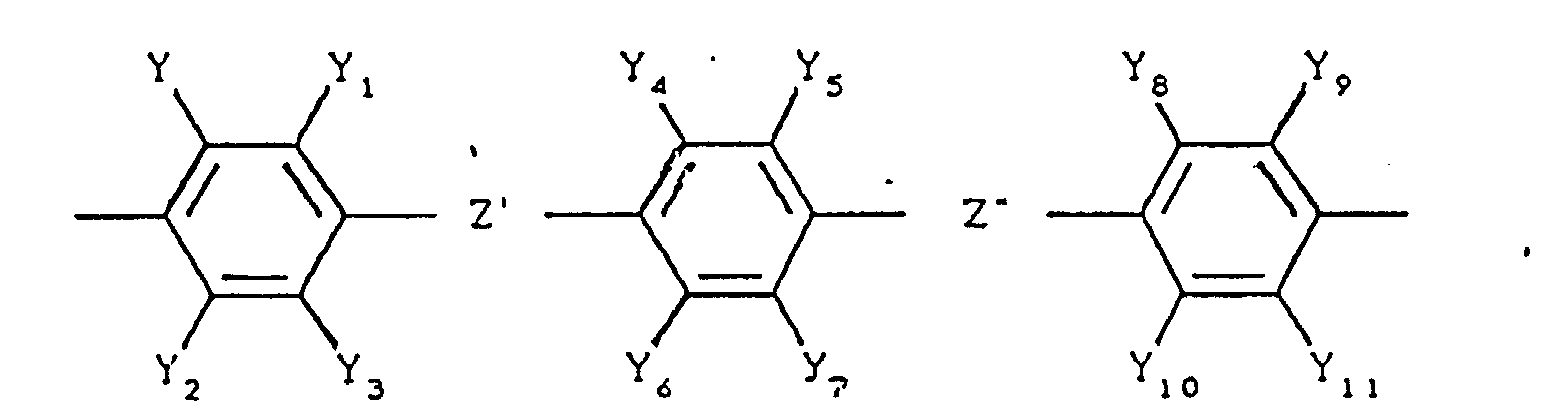
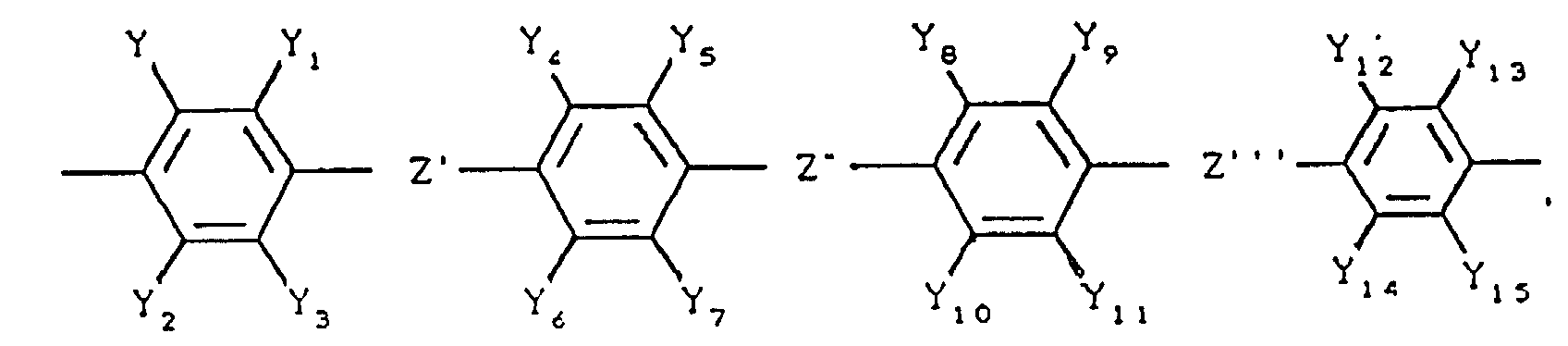
 oder Mischungen von diesen bedeutet, wobei Z', Z'', Z''' unabhängig voneinander eine Kohlenstoff-Kohlenstoff-Einfachbindung,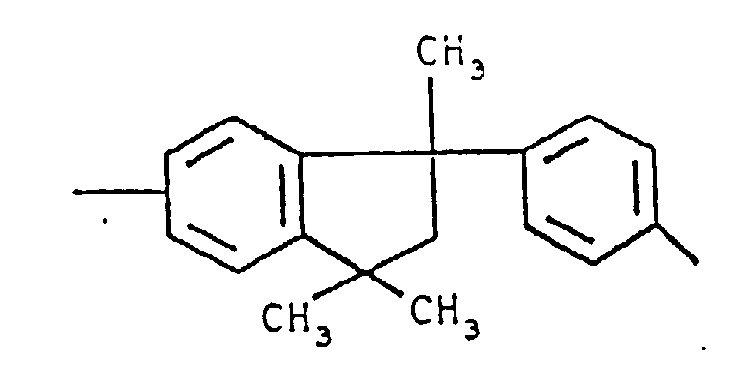
 oder Mischungen von diesen bedeutet,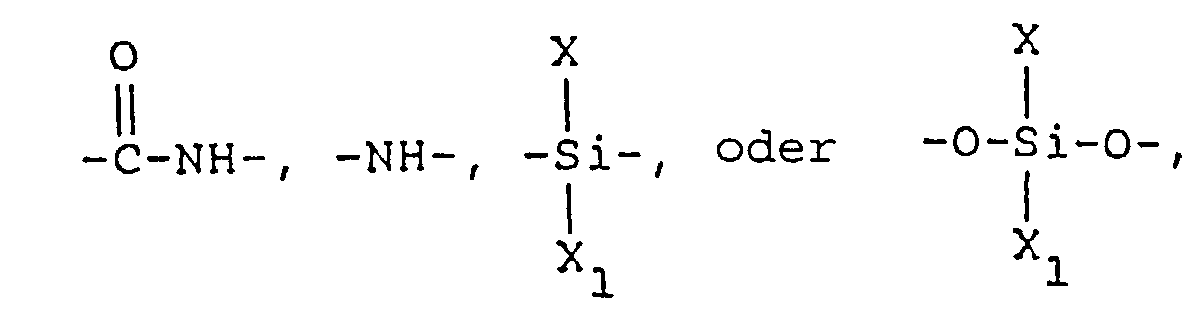
Arbedeutet, wobei Z eine Kohlenstoff-Kohlenstoff-Einfachbindung,
 oder Mischungen von diesen bedeutet,
n eine solche Zahl ist, dass das Polymer von filmbildendem Molekulargewicht ist, -X, -X1, -X2 und -X3 unabhängig voneinander Wasserstoff, Alkylgrupen mit 1 bis 6 Kohlenstoffatomen, Alkoxygruppen mit 1 bis 5 Kohlenstoffatomen, Phenyl- oder Phenoxygruppen und -Y, -Y1, -Y2, -Y3, -Y4, -Y5, -Y6, -Y7, -Y8, -Y9, -Y10, -Y11, -Y12, -Y13, -Y14, -Y15 unabhängig voneinander X, X1, X2, X3, Halogen oder Alkylgruppen mit 1 bis 6 Kohlenstoffatomen bedeuten. - Verfahren nach Anspruch 10, worin Aroder Mischungen von diesen bedeutet.
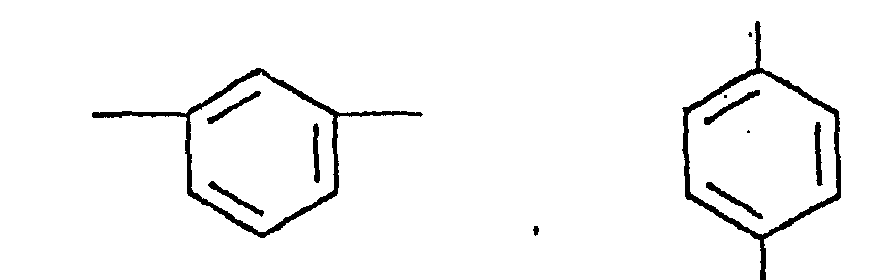
- Verfahren nach Anspruch 11, worin Roder
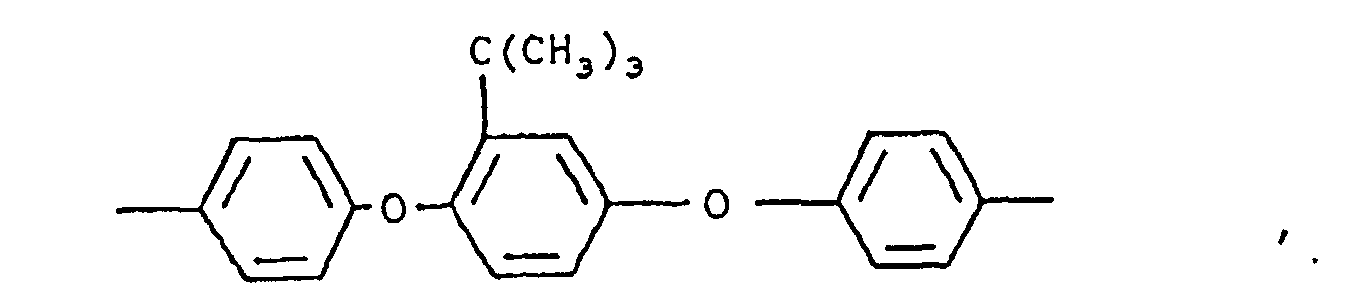 oder
oder oder
oder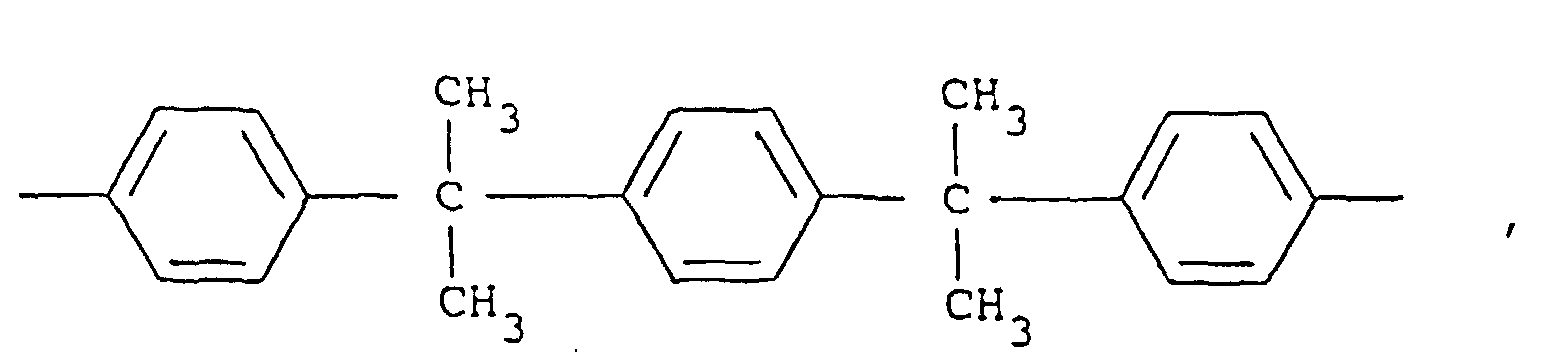 oder
oder oder
oder oder eine Mischung von
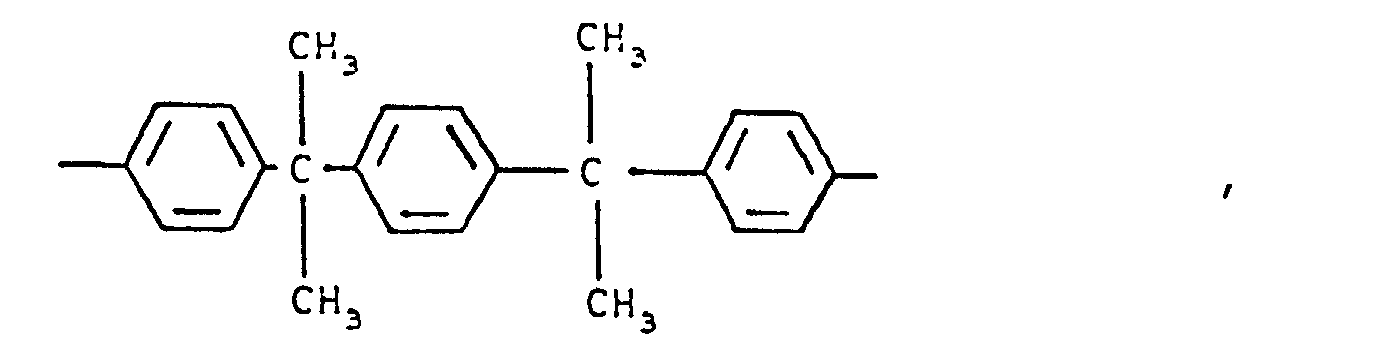 und
und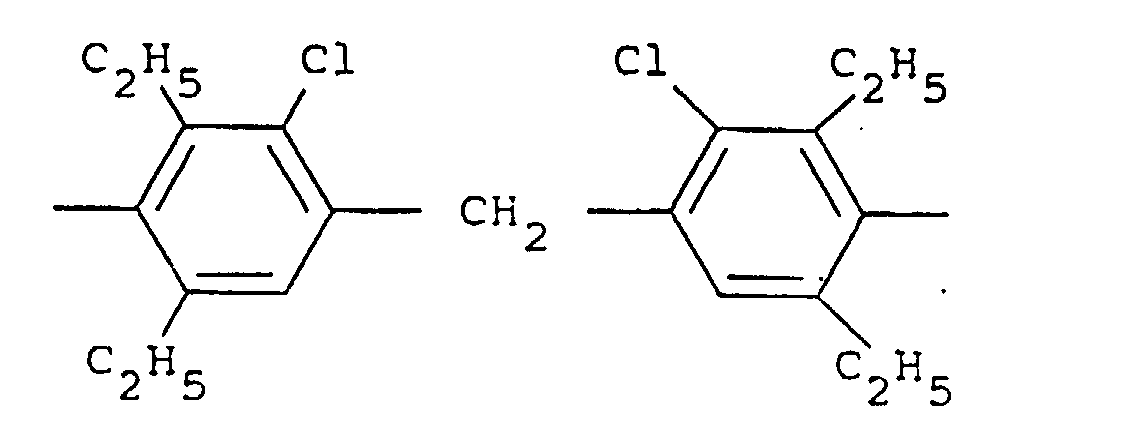 oder eine Mischung von
 und
und oder eine Mischung von
 und
und oder
oder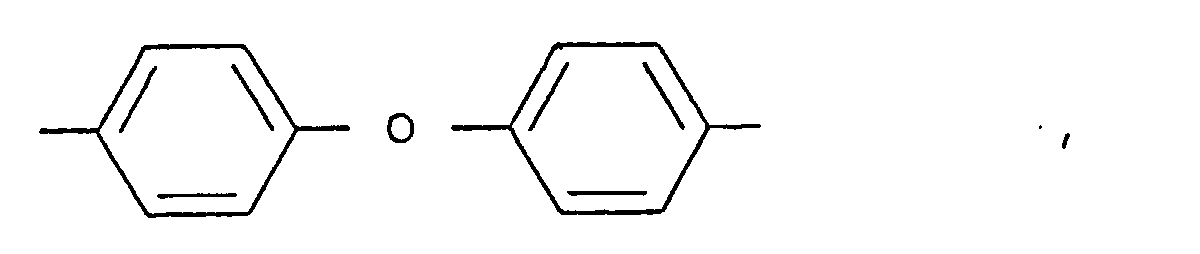 oder eine Mischung von
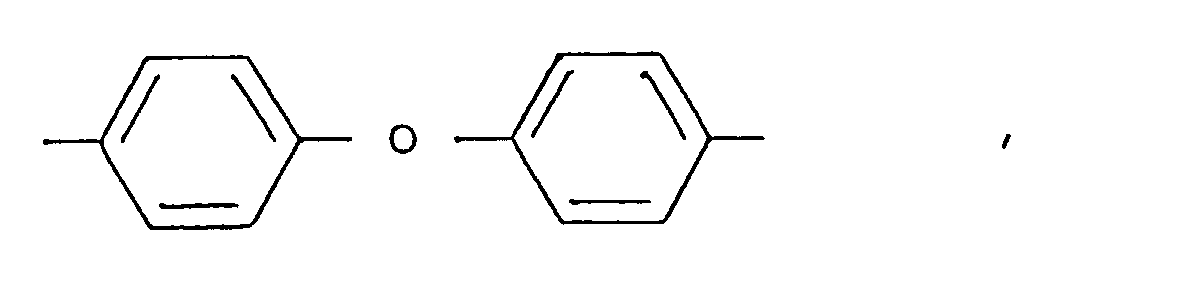 und
und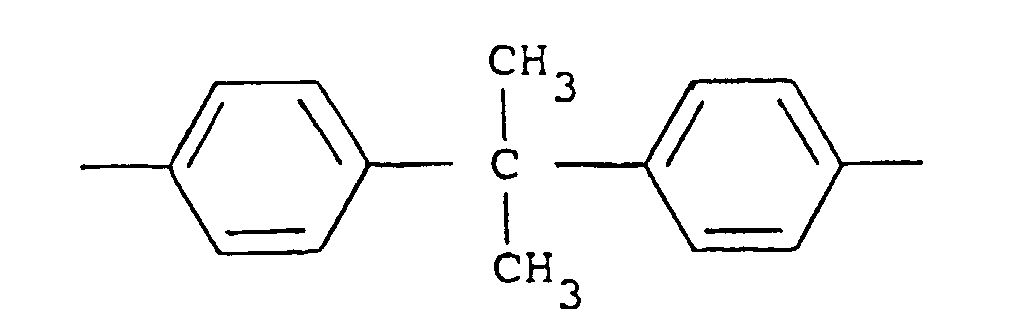 oder
oder oder eine Mischung von
 und
und oder eine Mischung von
 und
und oder eine Mischung von
 und
und bedeutet.
- Verfahren nach Anspruch 1, bei welchem das Polyimid ein aromatisches Polyimid ist, umfassend Wiederholungseinheiten der Formelworin R und R' ausgewählt sind aus der Gruppe
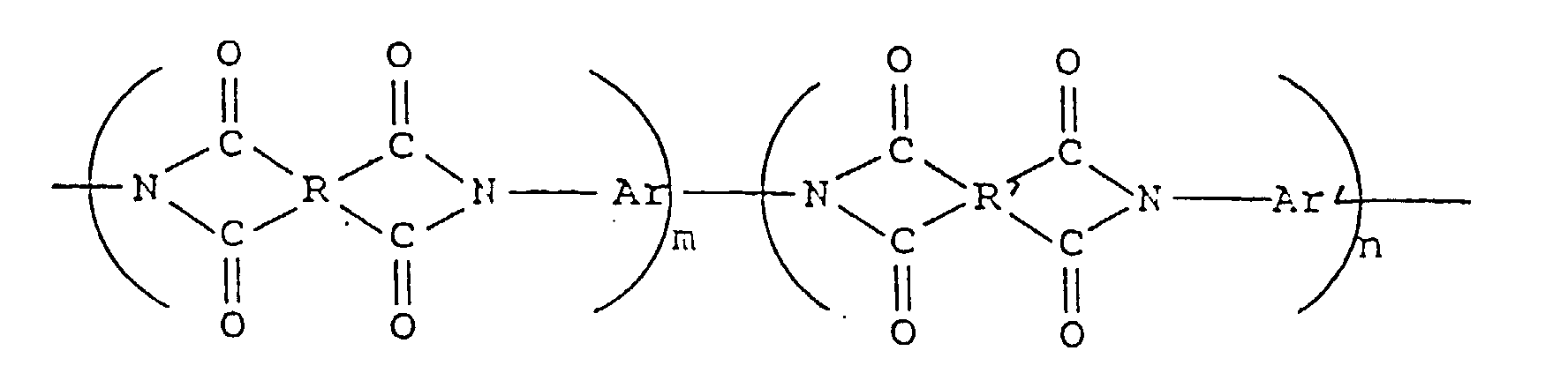
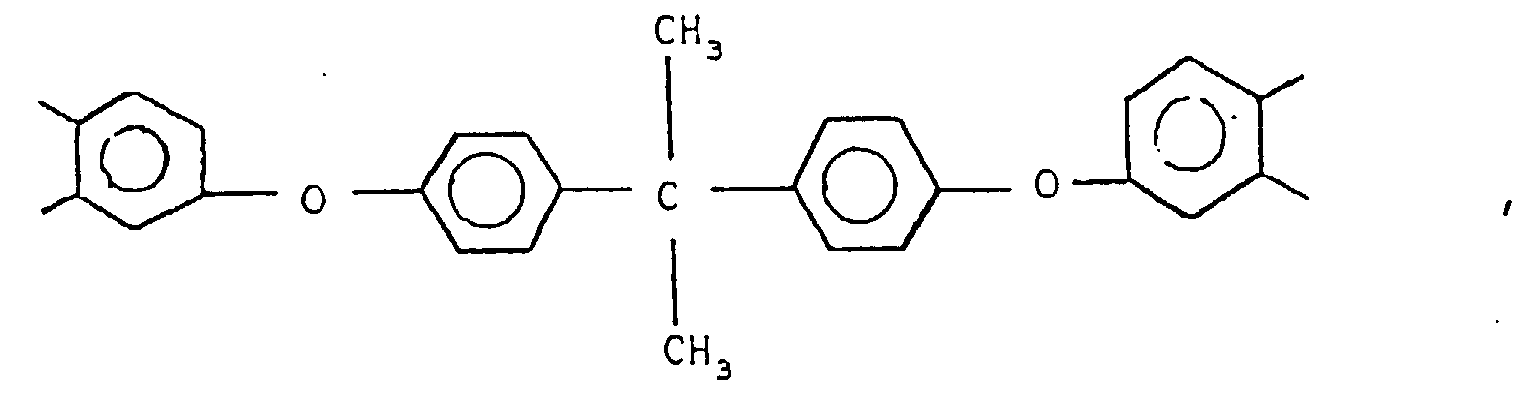
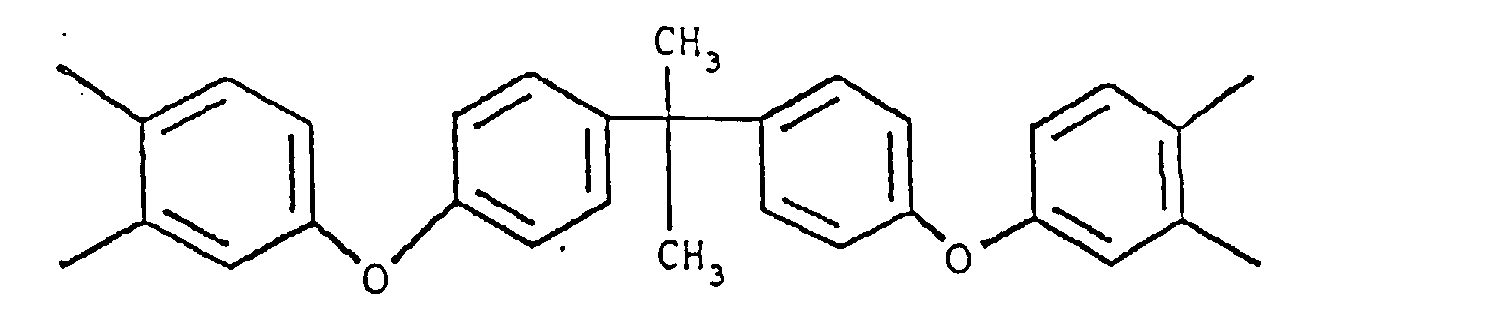 und
und wobei -Z-
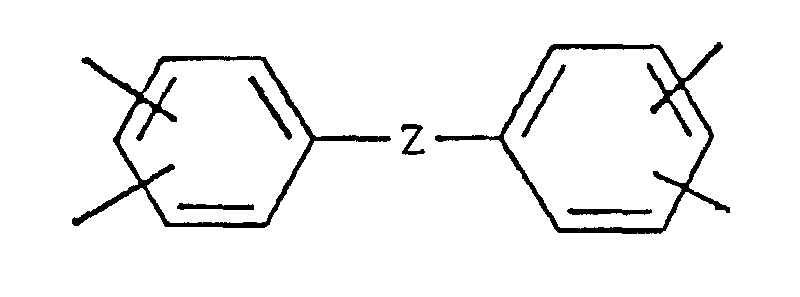 eine Kohlenstoff-Kohlenstoff-Einfachbindung oder Alkylengruppen mit 1 bis 5 Kohlenstoffatomen bedeutet, -Ar- einer der folgenden Reste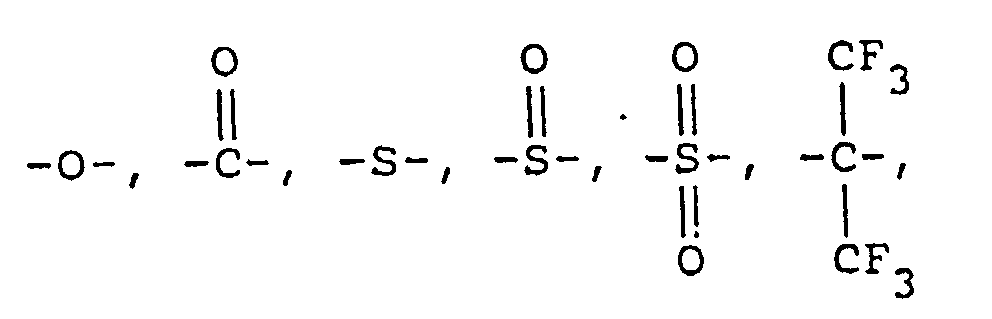
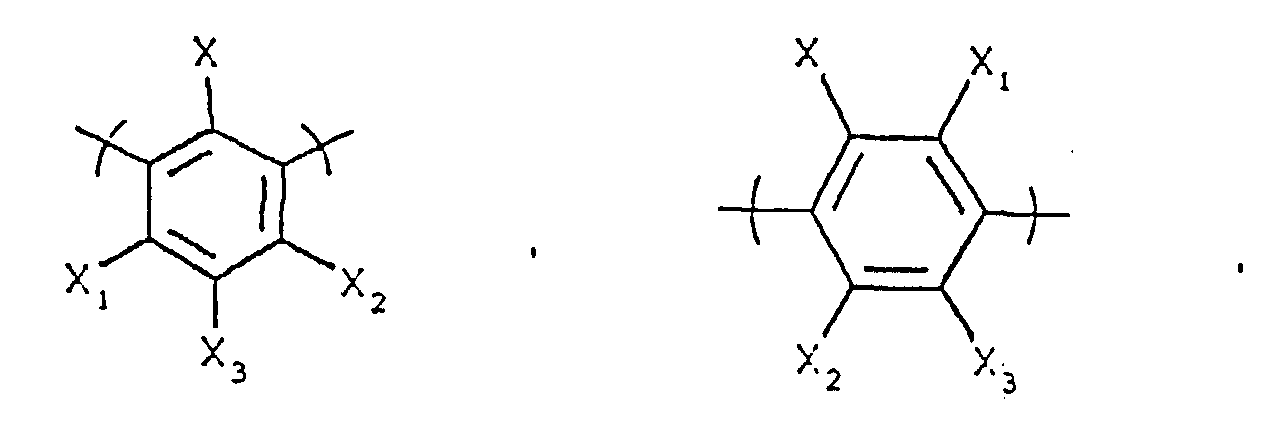

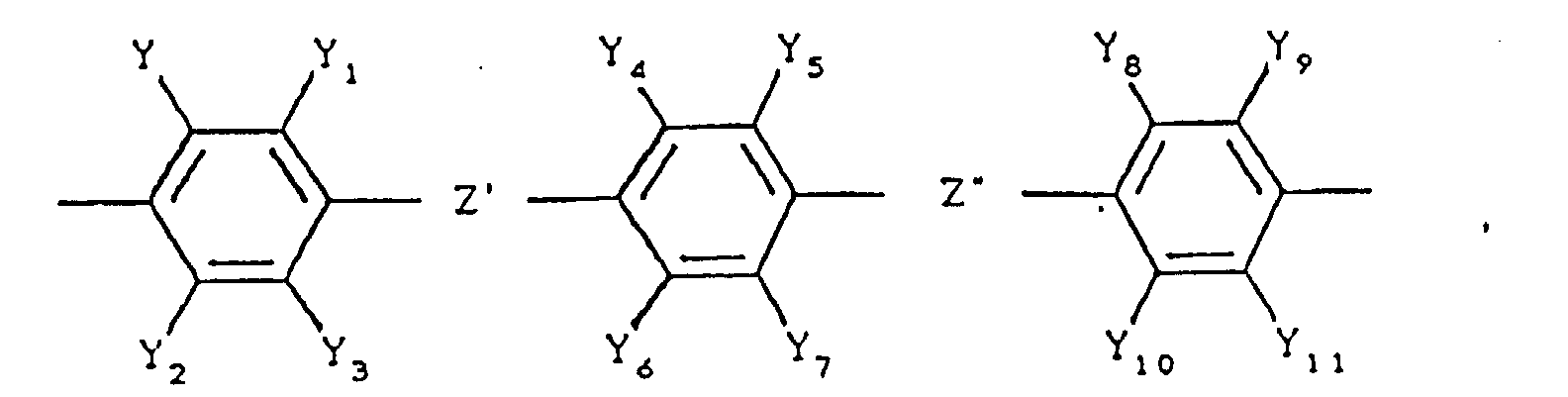
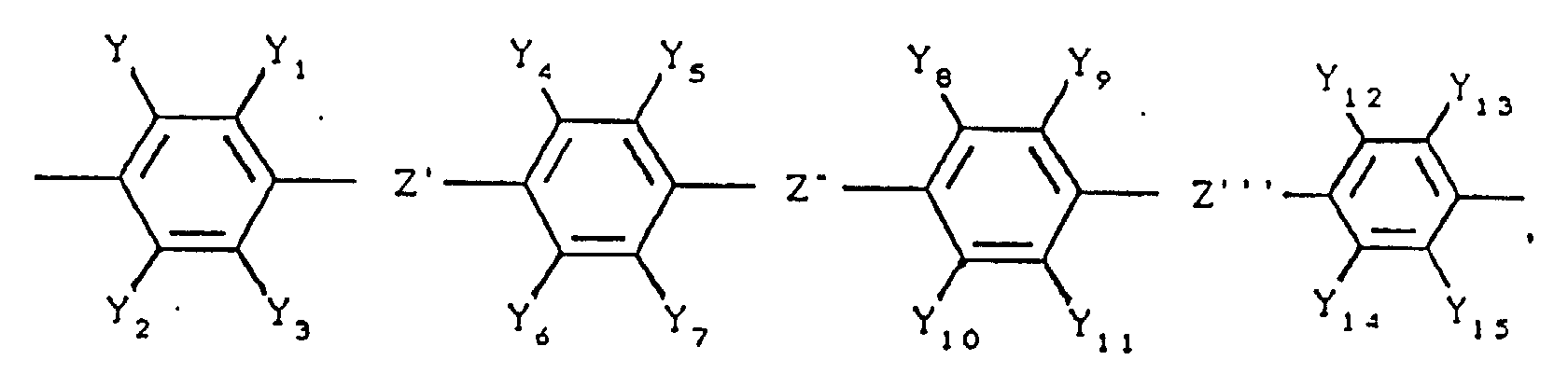
 oder Mischungen von diesen bedeutet, wobei Z', Z'', Z''' unabhängig voneinander eine Kohlenstoff-Kohlenstoff-Einfachbindung,
 oder Alkylengruppen mit 1 bis 5 Kohlenstoffatomen, X, X1, X2 und X3 unabhängig voneinander Wasserstoff, Alkylgruppen mit 1 bis 5 Kohlenstoffatomen, Alkoxygruppen mit 1 bis 5 Kohlenstoffatomen, Phenyl- oder Phenoxygruppen, -Y, -Y1, -Y2, -Y3, -Y4, -Y5, -Y6, -Y7, -Y8, -Y9, -Y10, -Y11, -Y12, -Y13, -Y14 und -Y15 unabhängig voneinander -X, -X1, -X2, -X3 oder Halogen bedeuten, -Ar'-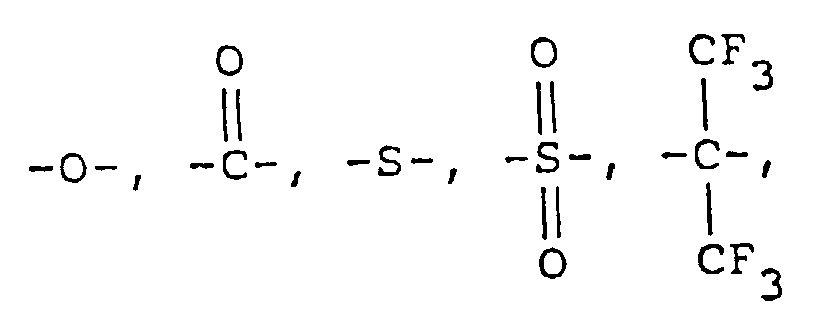
 oder Mischungen von diesen bedeutet, wobei Z' die oben beschriebene Bedeutung hat, m 0 bis 100 Mol%, n 0 bis 100 Mol% und (m + n) = 100 % bedeuten.
- Verfahren nach Anspruch 13, bei welchem n 0 bis 20 % und m 0 bis 80-100 % bedeuten.
- Verfahren nach Anspruch 13, bei welchem Rist.

- Verfahren nach Anspruch 15, worin -Ar- eine Mischung vonund
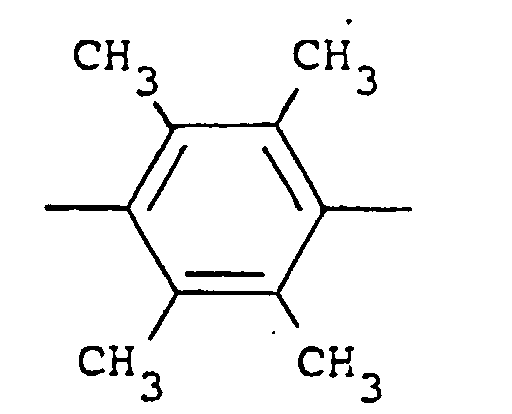 oder
oder oder
oder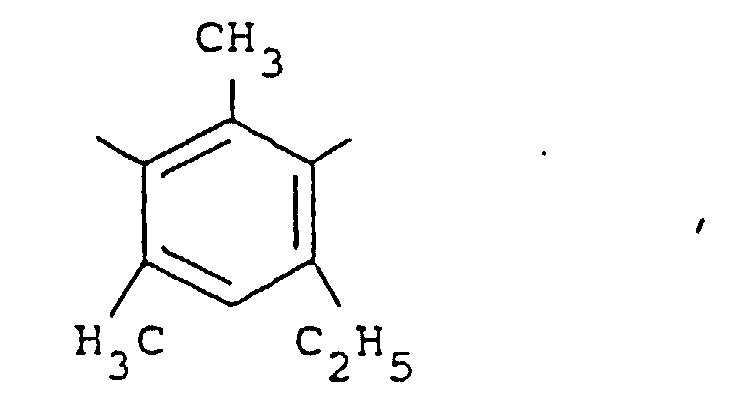 oder
oder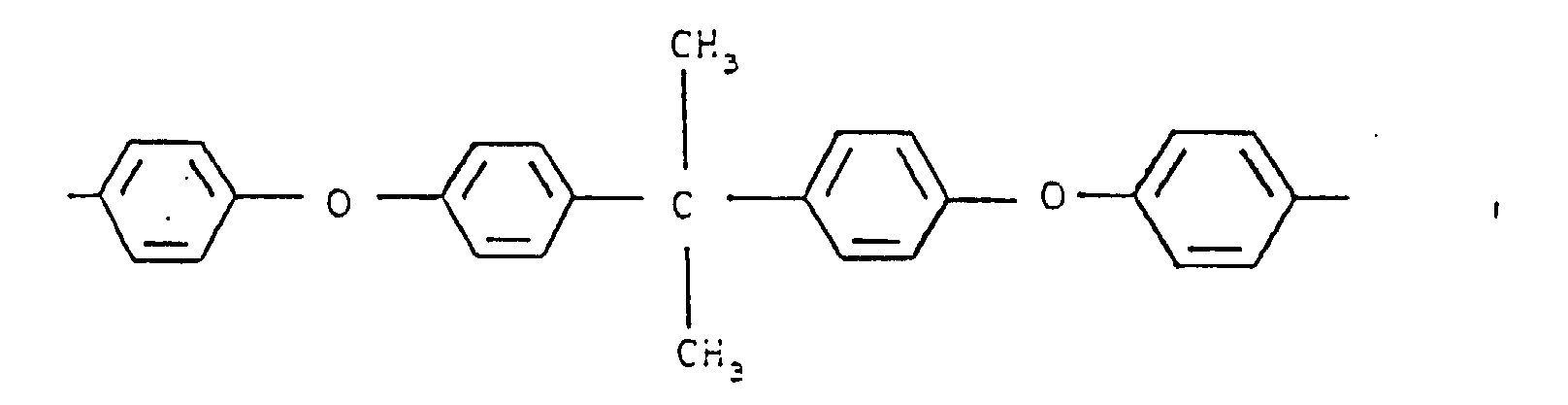 oder
oder oder
oder oder
oder oder
oder oder eine Mischung von
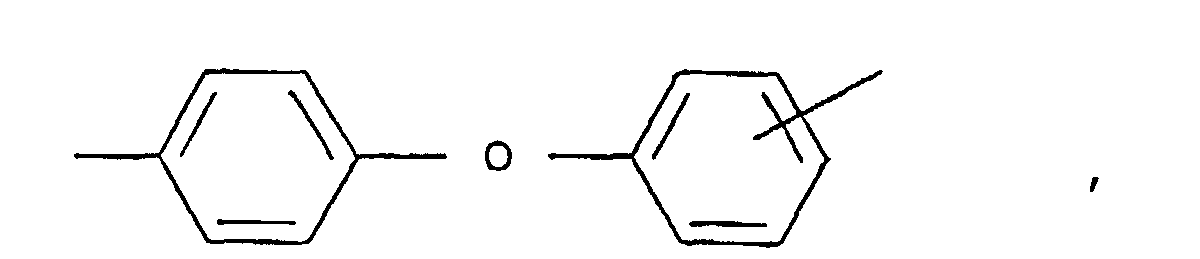 und
und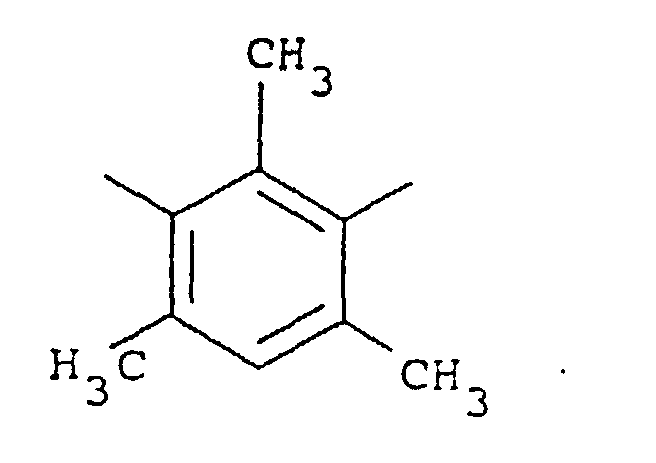 bedeutet.
- Verfahren nach Anspruch 13, bei welchem Rist.

- Verfahren nach Anspruch 17, bei welchem -Ar- eine Mischung vonund
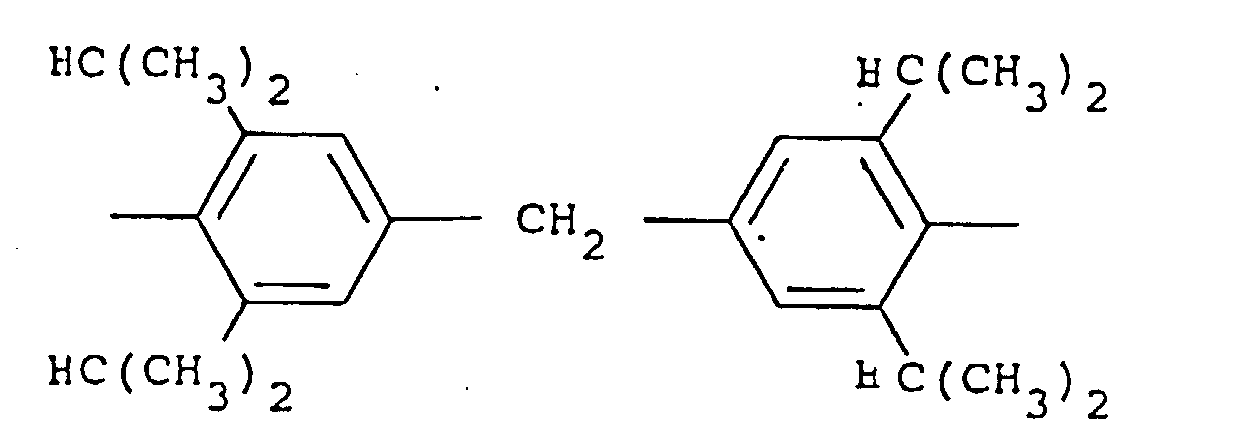 oder worin -Ar-
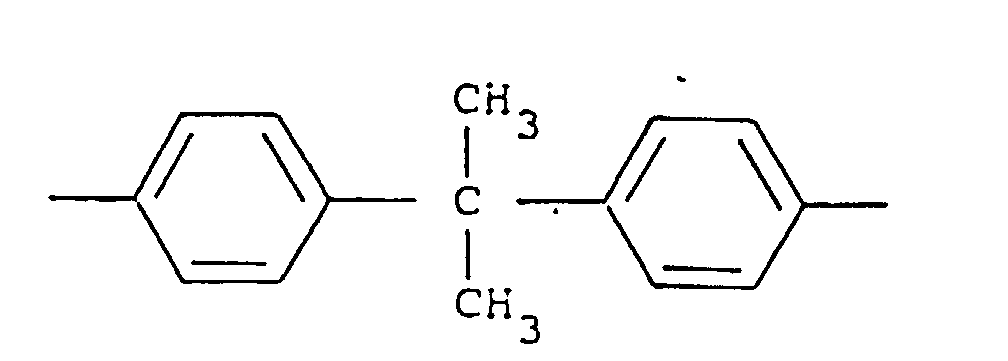 ist.
ist.
- Multikomponenten-Membrane, erhältlich nach dem Verfahren von Anspruch 1, umfassend
ein poröses polymeres Substrat, wobei das Substrat ausgewählt ist aus der Gruppe von Polysulfonen, Polyethersulfonen, Polyetherimiden, Polyimiden, Polyamiden, Polyestern oder Mischungen von diesen, und eine Polyamidtrennschicht zum Trennen von Gasen, wobei das Polyamid die Formelbesitzt, worin R einer der folgenden Reste


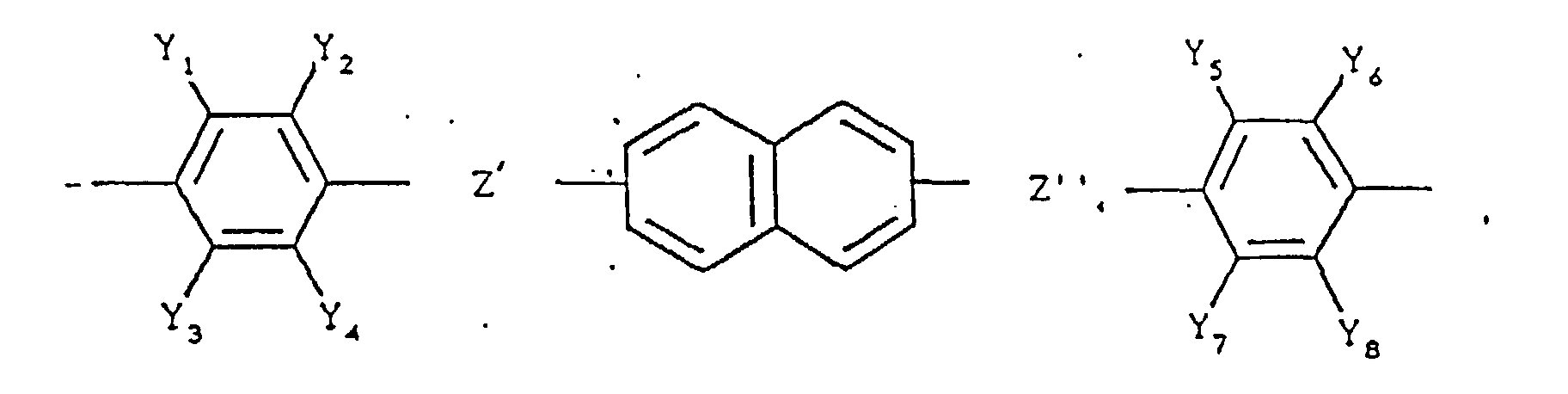 oder Mischungen von diesen bedeutet, wobei Z', Z'' und Z''' unabhängig voneinander eine Kohlenstoff-Kohlenstoff-Einfachbindung,
 oder Mischungen von diesen bedeuten,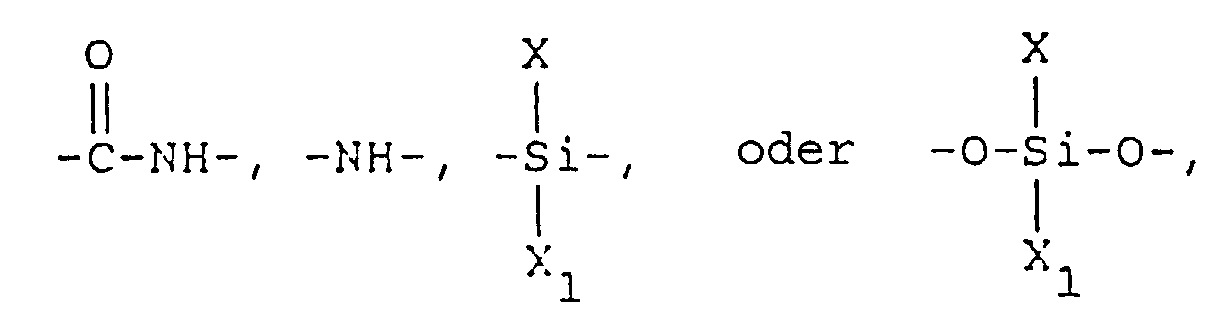
Arist, worin Z eine Kohlenstoff-Kohlenstoff-Einfachbindung,
 oder Mischungen von diesen bedeutet.
n eine solche Zahl ist, dass das Polymere von filmbildendem Molekulargewicht ist, -X, -X1, -X2 und -X3 unabhängig voneinander Wasserstoff, Alkylgruppen mit 1 bis 6 Kohlenstoffatomen, Alkoxygruppen mit 1 bis 5 Kohlenstoffatomen, Phenyl- oder Phenoxygruppen und -Y, -Y1, -Y2, -Y3, -Y4, -Y5, -Y6, -Y7, -Y8, -Y9, -Y10, -Y11, -Y12, -Y13, -Y14, -Y15 unabhängig voneinander X, X1, X2, X3, Halogen oder Alkylgruppen mit 1 bis 6 Kohlenstoffatomen bedeuten. - Multikomponenten-Membrane nach Anspruch 19, worin Aroder Mischungen von diesen bedeutet.
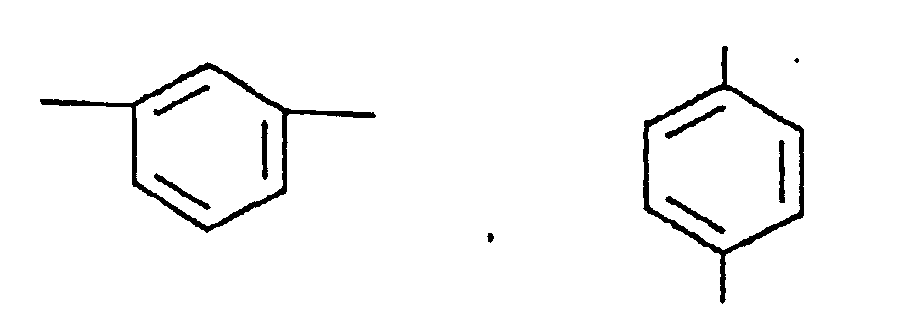
- Multikomponenten-Membrane nach Anspruch 19, worin Roder
 oder
oder oder
oder oder
oder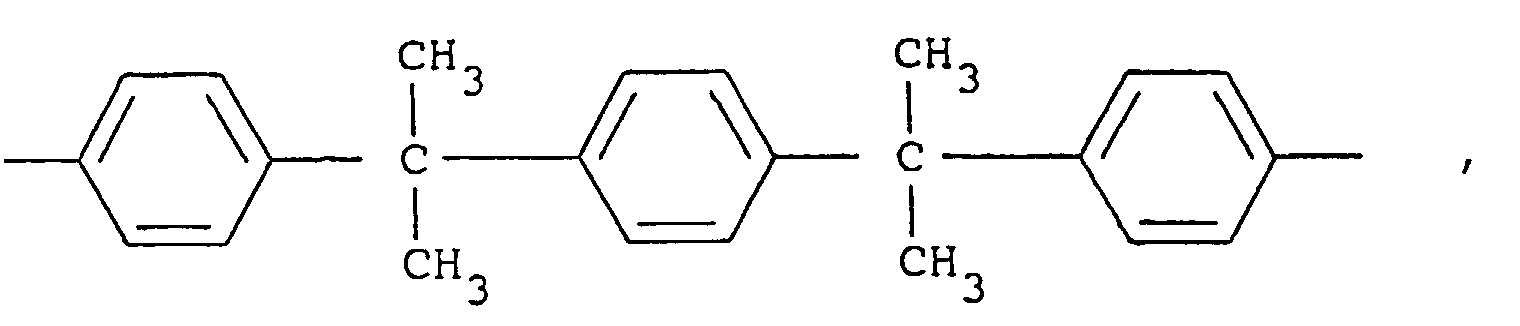 oder
oder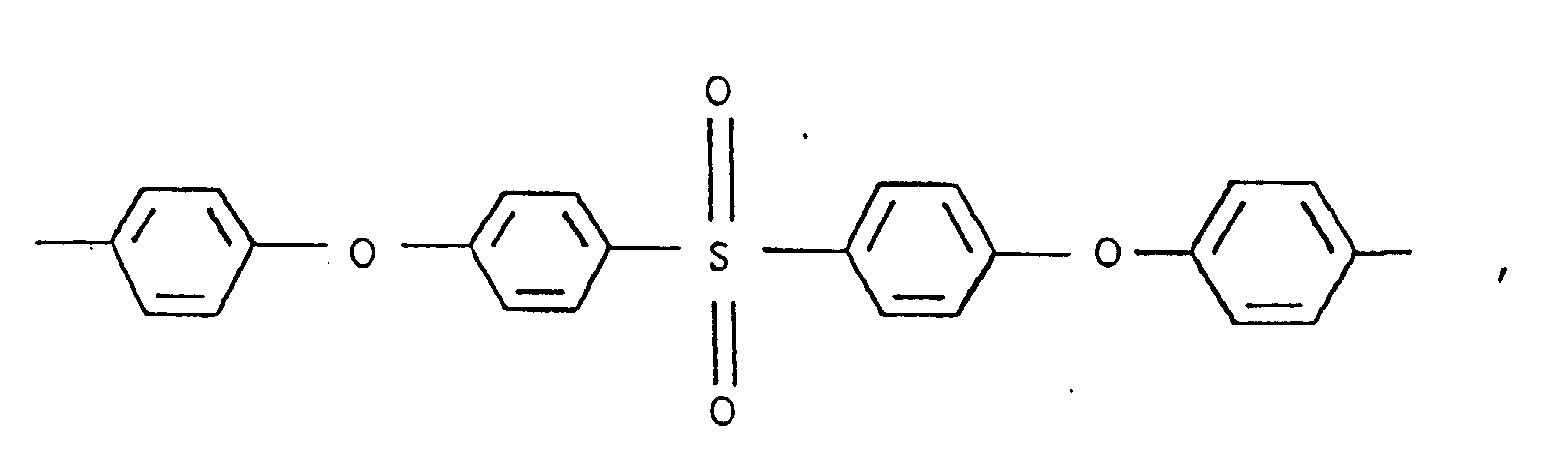 oder
oder oder eine Mischung von
 und
und oder eine Mischung von
 und
und oder eine Mischung von
 und
und oder
oder oder eine Mischung von
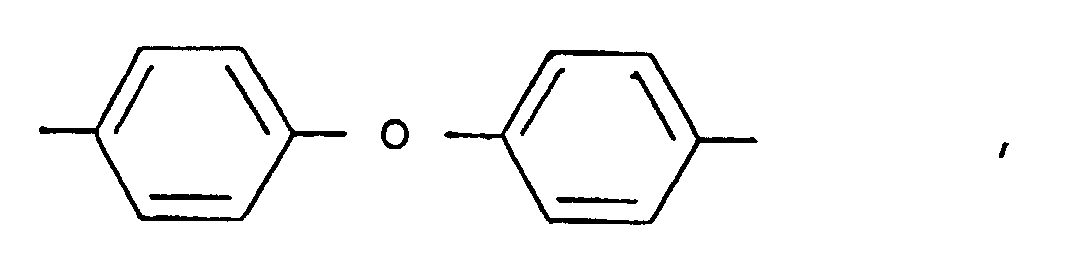 und
und oder
oder oder eine Mischung von
 und
und oder eine Mischung von
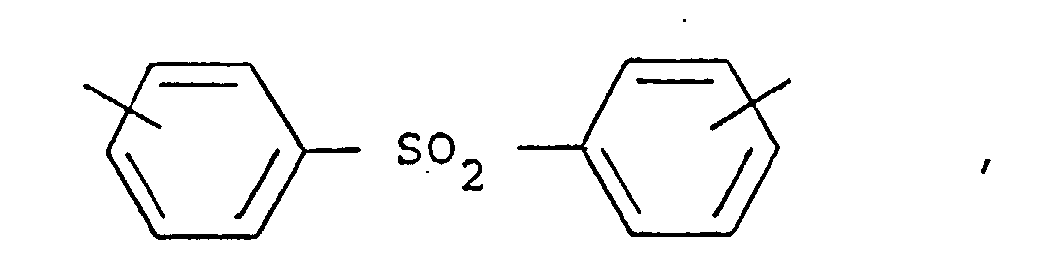 und
und oder eine Mischung von
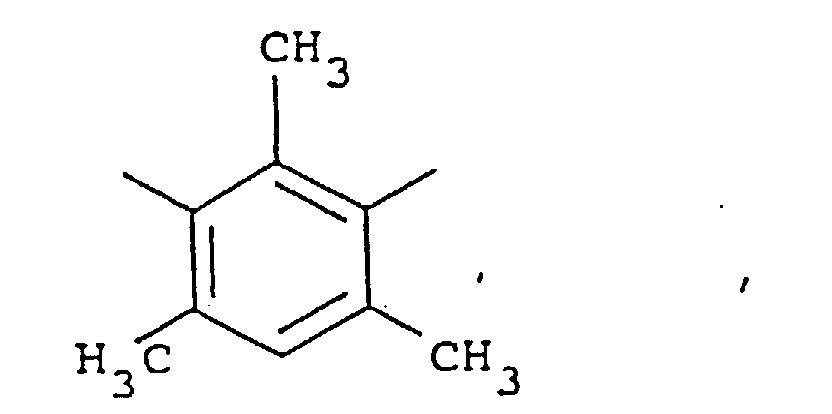 und
und bedeutet.
- Multikomponenten-Membrane, erhältlich nach dem Verfahren von Anspruch 1, umfassend ein poröses polymeres Substrat, welches aus einer mehrheitlichen Menge eines Polymers gebildet ist, welches kein aromatisches Polyimid ist und ausgewählt ist aus der Gruppe von Polysulfonen, Polyethersulfonen, Polyetherimiden, Polyimiden, Polyamiden, Polyestern oder Mischungen von diesen, und eine Polyimid-Trennschicht zum Trennen von Gasen, wobei das Polyimid ein aromatisches Polyimid ist, umfassend Wiederholungseinheiten der Formelworin R und R' ausgewählt sind aus der Gruppe
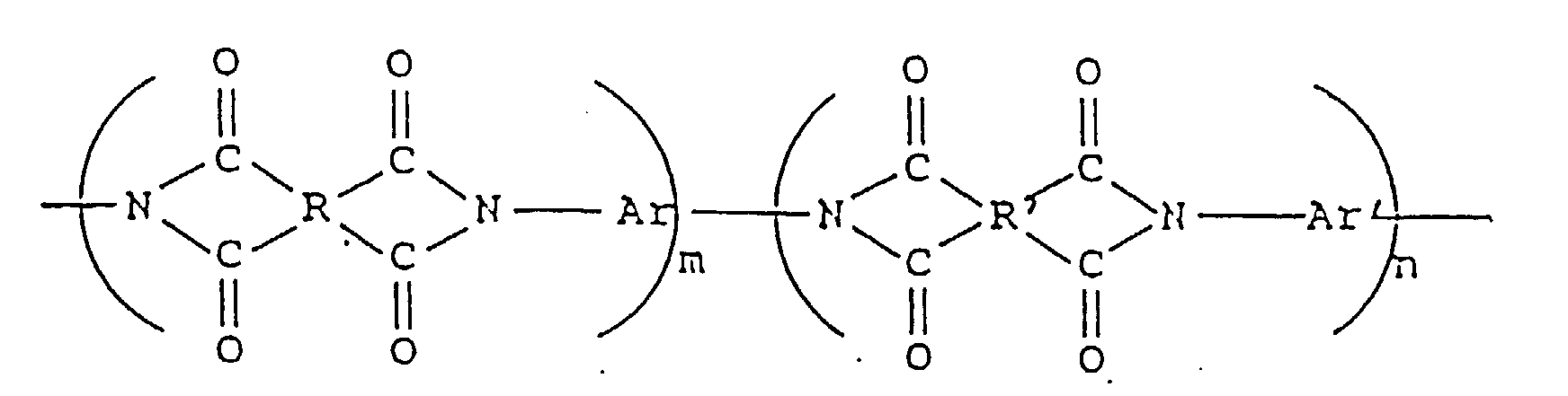
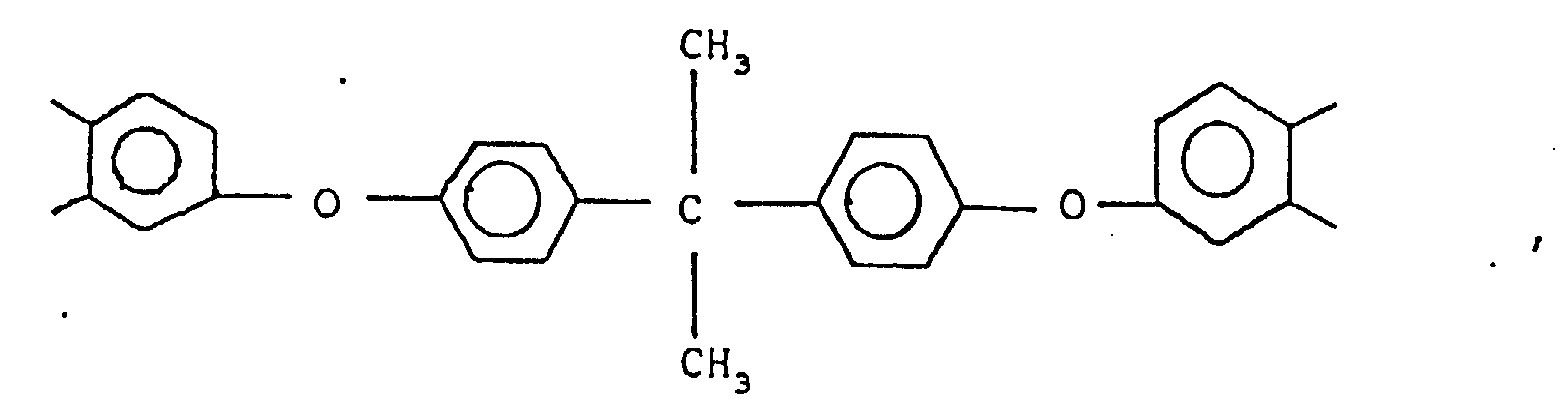 und
und worin -Z- eine Kohlenstoff-Kohlenstoff-Einfachbindung,
 oder Alkylengruppen mit 1 bis 5 Kohlenstoffatomen bedeutet, -Ar-


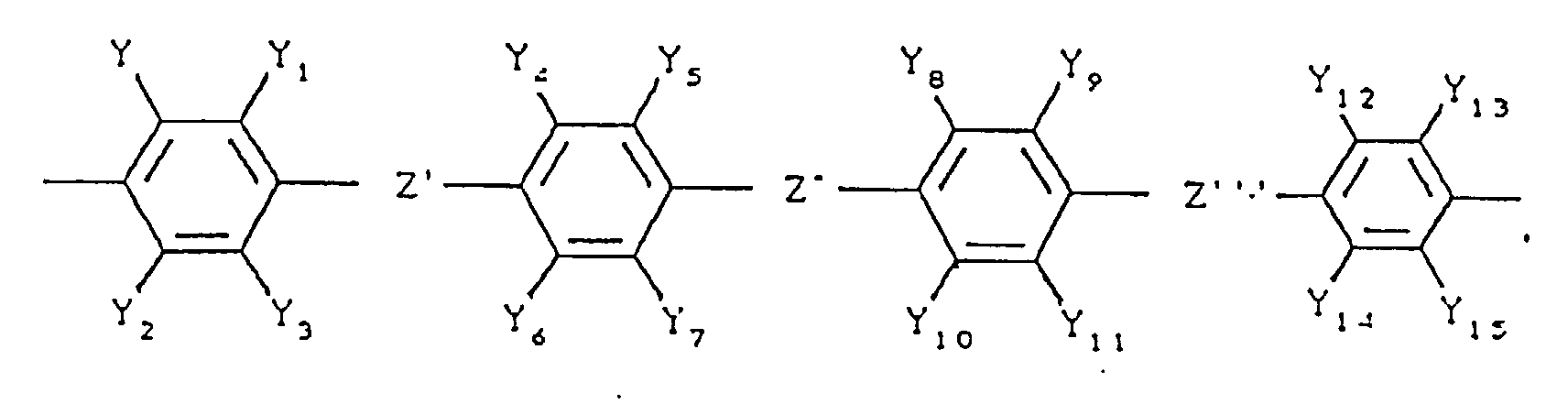
 oder Mischungen von diesen bedeutet, wobei Z', Z'', Z''' unabhängig voneinander eine Kohlenstoff-Kohlenstoff-Einfachbindung,
 oder Alkylengruppen mit 1 bis 5 Kohlenstoffatomen bedeuten, X, X1, X2 und X3 unabhängig voneinander Wasserstoff, Alkylgruppen mit 1 bis 5 Kohlenstoffatomen, Alkoxygruppen mit 1 bis 5 Kohlenstoffatomen, Phenyl- oder Phenoxygruppen, bedeuten, -Y, -Y1, -Y2, -Y3, -Y4, -Y5, -Y6, -Y7, -Y8, -Y9, -Y10, -Y11, -Y12, -Y13, -Y14 und -Y15 unabhängig voneinander -X, -X1, -X2, -X3 oder Halogen bedeuten, -Ar'-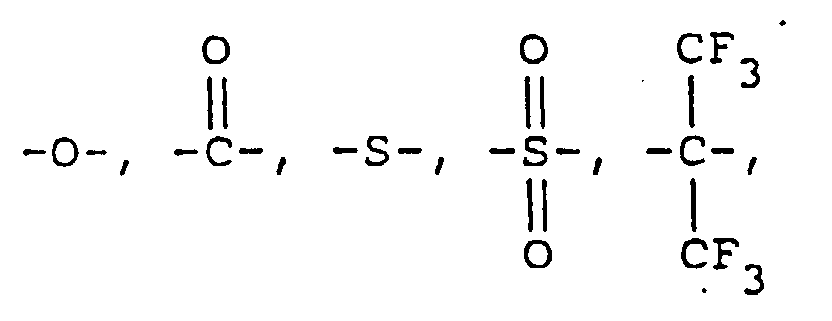
 oder Mischungen von diesen bedeutet, wobei Z' die obenangegebene Bedeutung besitzt, m 0 bis 100 Mol%, n 0 bis 100 Mol% und (m + n) = 100 % bedeuten.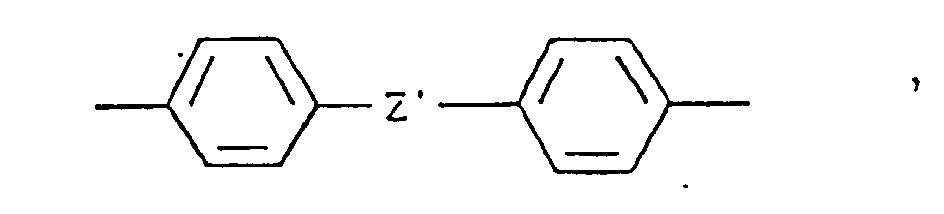
- Membrane nach Anspruch 22, bei welcher m 20 bis 100 Mol% und n 20 bis 100 Mol% bedeuten.
- Membrane nach Anspruch 22, bei welcher Rist.
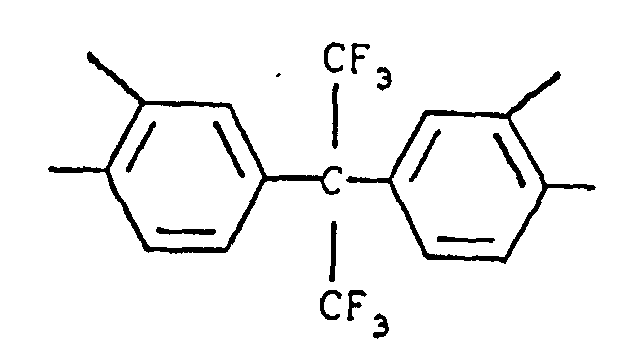
- Membrane nach Anspruch 22, bei welcher -Ar- eine Mischung ausund
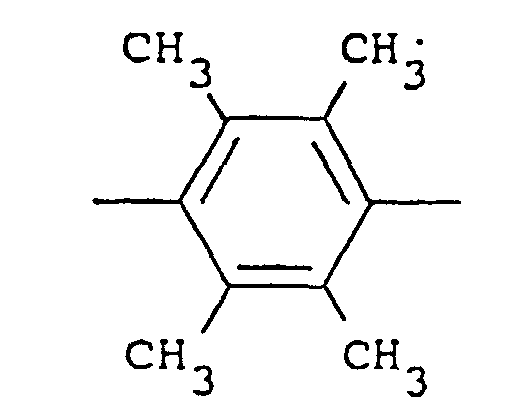 ist,
ist,
oder worin -Ar-oder Mischungen von diesen bedeutet,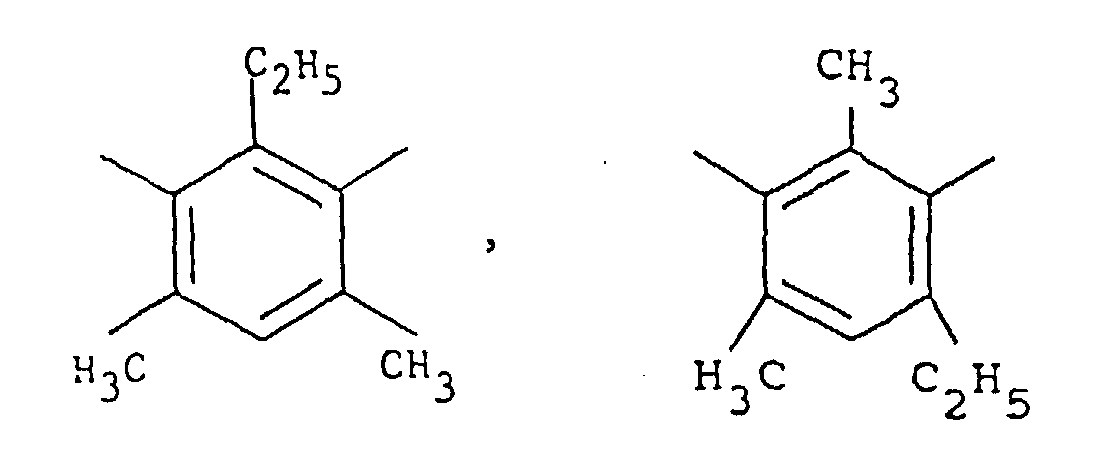
oder worin -Ar-oder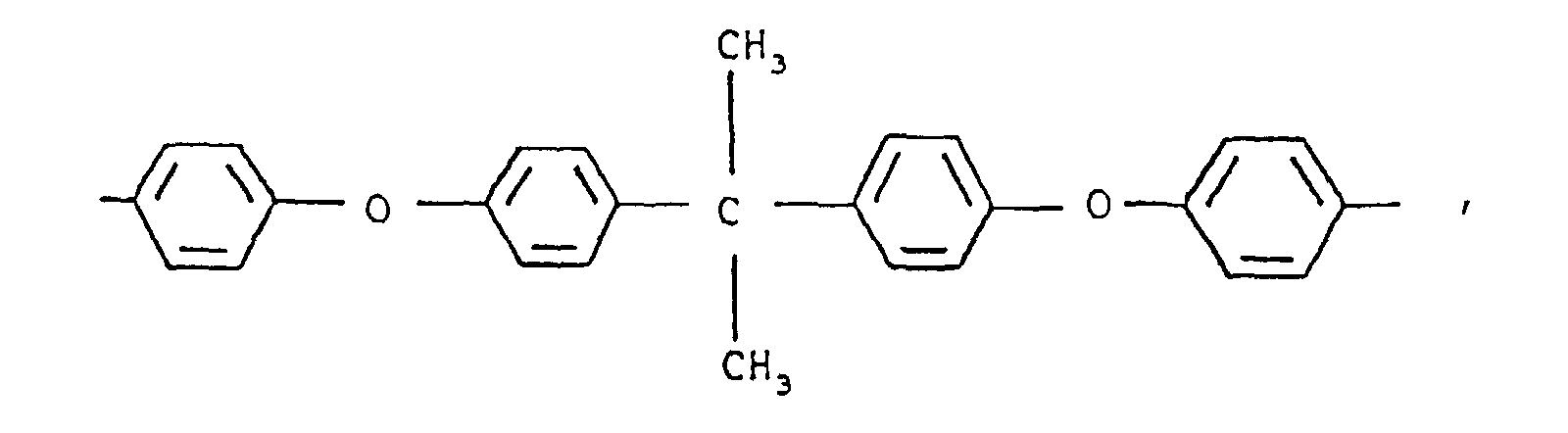 oder
oder oder
oder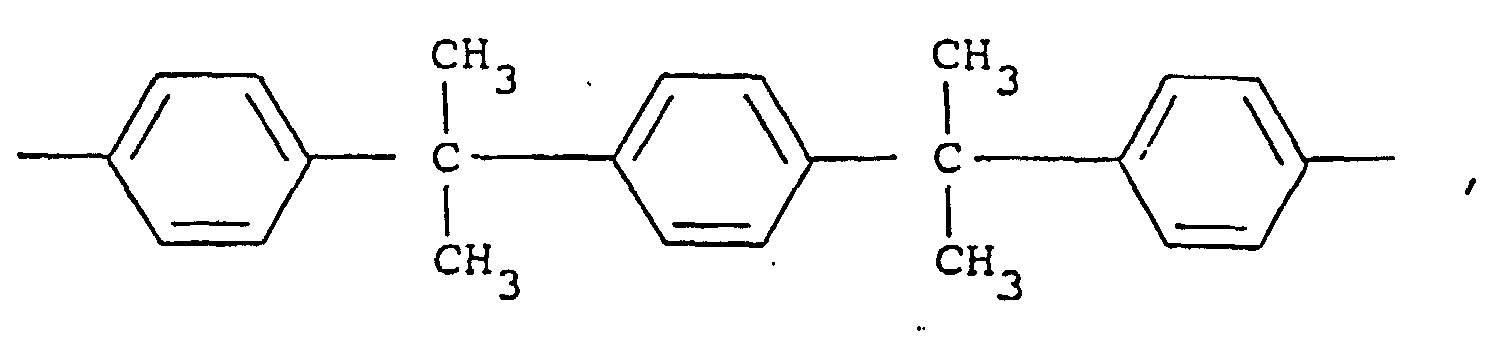 oder
oder oder
oder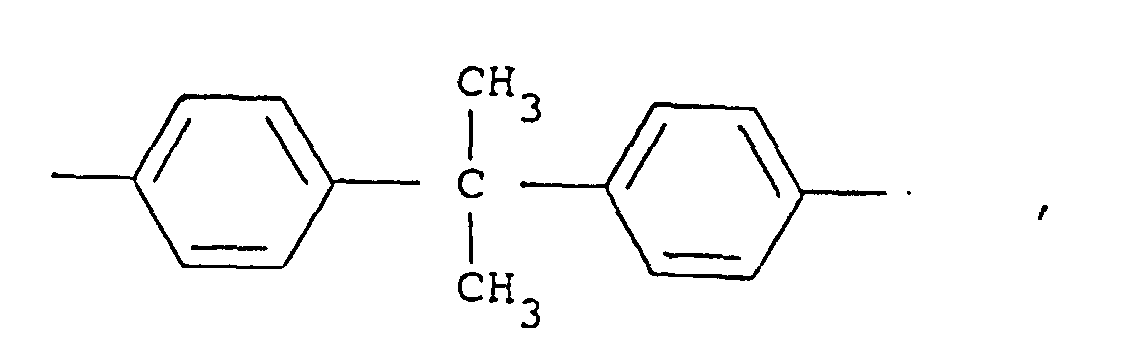 oder eine Mischung von
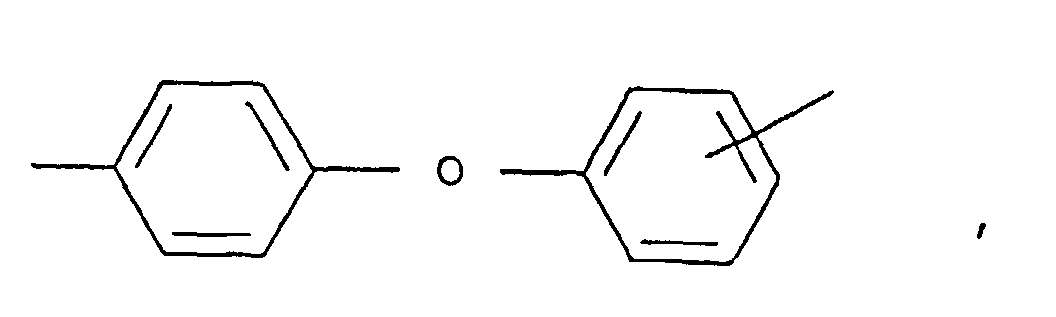 und
und ist.
ist.
- Membrane nach Anspruch 22, bei welcher Rist.

- Membrane nach Anspruch 26, bei welcher -Ar- eine Mischung ausund
 ist
ist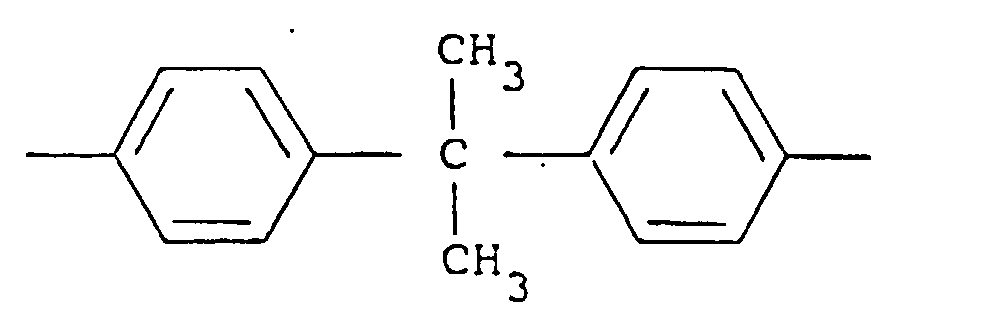
oder worin -Ar-ist.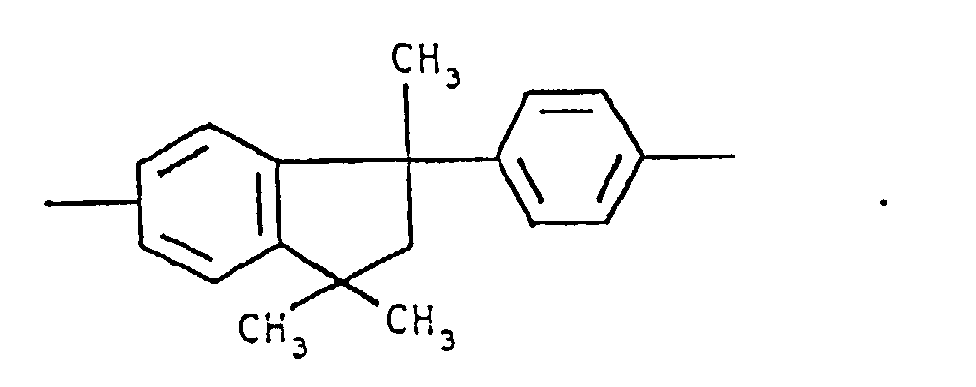
Applications Claiming Priority (2)
| Application Number | Priority Date | Filing Date | Title |
|---|---|---|---|
| US07/622,419 US5085676A (en) | 1990-12-04 | 1990-12-04 | Novel multicomponent fluid separation membranes |
| US622419 | 1990-12-04 |
Publications (2)
| Publication Number | Publication Date |
|---|---|
| EP0489418A1 EP0489418A1 (de) | 1992-06-10 |
| EP0489418B1 true EP0489418B1 (de) | 2001-03-14 |
Family
ID=24494104
Family Applications (1)
| Application Number | Title | Priority Date | Filing Date |
|---|---|---|---|
| EP91120830A Expired - Lifetime EP0489418B1 (de) | 1990-12-04 | 1991-12-04 | Neue Mehrkomponenten-Fluidabtrennungsmembrane |
Country Status (5)
| Country | Link |
|---|---|
| US (1) | US5085676A (de) |
| EP (1) | EP0489418B1 (de) |
| JP (1) | JPH04277019A (de) |
| CA (1) | CA2056921A1 (de) |
| DE (1) | DE69132554T2 (de) |
Families Citing this family (144)
| Publication number | Priority date | Publication date | Assignee | Title |
|---|---|---|---|---|
| DE4037817A1 (de) * | 1990-11-28 | 1992-06-04 | Akzo Gmbh | Gasmembrankapillarherstellung |
| US5762798A (en) * | 1991-04-12 | 1998-06-09 | Minntech Corporation | Hollow fiber membranes and method of manufacture |
| US5391219A (en) * | 1991-04-15 | 1995-02-21 | Nitto Denko Corporation | Method for the separation and concentration of gas using a composite or asymmetric fluorine-containing polyimide membrane |
| US5562826A (en) * | 1991-10-26 | 1996-10-08 | Hoechst Aktiengesellschaft | Semipermeable, porous, asymmetric polyether amide membranes |
| DE59208013D1 (de) * | 1991-10-26 | 1997-03-20 | Hoechst Ag | Semipermeable, poröse, asymmetrische Polyetheramidmembranen |
| JP3232117B2 (ja) * | 1991-11-19 | 2001-11-26 | 鐘淵化学工業株式会社 | ポリスルホン多孔質中空糸 |
| US5520809A (en) * | 1992-07-27 | 1996-05-28 | Nippon Steel Corporation | Separation membranes |
| US5248319A (en) * | 1992-09-02 | 1993-09-28 | E. I. Du Pont De Nemours And Company | Gas separation membranes made from blends of aromatic polyamide, polymide or polyamide-imide polymers |
| US5266100A (en) * | 1992-09-02 | 1993-11-30 | E. I. Du Pont De Nemours And Company | Alkyl substituted polyimide, polyamide and polyamide-imide gas separation membranes |
| US5605627A (en) * | 1992-10-07 | 1997-02-25 | Minntech Corporation | Dialysate filter including an asymmetric microporous, hollow fiber membrane incorporating a polyimide |
| USRE36914E (en) * | 1992-10-07 | 2000-10-17 | Minntech Corp | Dialysate filter including an asymmetric microporous, hollow fiber membrane incorporating a polyimide |
| US5232472A (en) * | 1992-11-03 | 1993-08-03 | E. I. Du Pont De Nemours And Company | Polyimide and polyamide-imide gas separation membranes |
| US5286280A (en) * | 1992-12-31 | 1994-02-15 | Hoechst Celanese Corporation | Composite gas separation membrane having a gutter layer comprising a crosslinked polar phenyl-containing - organopolysiloxane, and method for making the same - |
| US5352273A (en) * | 1993-04-14 | 1994-10-04 | E. I. Du Pont De Nemours And Company | Alkyl substituted aromatic polyester gas separation membranes |
| US5378795A (en) * | 1993-07-30 | 1995-01-03 | The United States Of America As Represented By The Administrator Of The National Aeronautics And Space Administration | Polyazomethines containing trifluoromethylbenzene units |
| US5591250A (en) * | 1993-08-09 | 1997-01-07 | Gas Research Institute | Material and process for separating carbon dioxide from methane |
| US5917137A (en) * | 1993-10-19 | 1999-06-29 | L'air Liquide, Societe Anonyme Pour L'etude Et L'exploitation Des Procedes Georges Claude | Gas separation membranes of blends of polyethersulfones with aromatic polyimides |
| DE69433127T2 (de) * | 1993-10-19 | 2004-07-08 | L'Air Liquide, S.A. a Directoire et Conseil de Surveillance pour l'Etude et l'Exploitation des Procédés Georges Claude | Mischungen aus Polyethersulfonen und aromatischen Polyimiden, Polyamiden oder Polyamid-imiden und daraus hergestellte Gastrennmembranen |
| US5393323A (en) * | 1993-11-05 | 1995-02-28 | L'air Liquide S.A. | Aromatic polyethersulfone gas separation membranes |
| US5393324A (en) * | 1993-11-05 | 1995-02-28 | L'air Liquide S.A. | Aromatic polyetherketone gas separation membranes |
| US5514413A (en) * | 1994-03-31 | 1996-05-07 | Air Products And Chemicals, Inc. | Process for producing composite membranes |
| US5443728A (en) * | 1994-04-28 | 1995-08-22 | Praxair Technology, Inc. | Method of preparing membranes from blends of polyetherimide and polyimide polymers |
| US5468430A (en) * | 1994-05-19 | 1995-11-21 | L'air Liquide S.A. | Process of making multicomponent or asymmetric gas separation membranes |
| EP0682977A3 (de) * | 1994-05-20 | 2000-01-12 | L'air Liquide, Societe Anonyme Pour L'etude Et L'exploitation Des Procedes Georges Claude | Polymer-Membran |
| DE4418843A1 (de) | 1994-05-30 | 1995-12-07 | Hoechst Ag | Poröse Membrane aus aromatischem Polyamid |
| US5474596A (en) * | 1994-08-18 | 1995-12-12 | L'air Liquide S.A. | Aromatic polyetherketone gas separation membranes |
| US5733657A (en) * | 1994-10-11 | 1998-03-31 | Praxair Technology, Inc. | Method of preparing membranes from blends of polymers |
| US5635067A (en) | 1995-03-14 | 1997-06-03 | Praxair Technology, Inc. | Fluid separation membranes prepared from blends of polyimide polymers |
| JPH08332363A (ja) * | 1995-06-01 | 1996-12-17 | Air Prod And Chem Inc | 反復単位を有する重合体形成の半透過性膜 |
| US5817165A (en) * | 1995-06-15 | 1998-10-06 | Nitto Denko Corporation | Fluorine-containing polyimide gas separation membrane and method of manufacturing the same |
| US5858065A (en) * | 1995-07-17 | 1999-01-12 | American Air Liquide | Process and system for separation and recovery of perfluorocompound gases |
| US5785741A (en) | 1995-07-17 | 1998-07-28 | L'air Liquide, Societe Anonyme Pour L'etude Et L'exploitation Des Procedes Georges, Claude | Process and system for separation and recovery of perfluorocompound gases |
| JPH0929002A (ja) | 1995-07-17 | 1997-02-04 | Teisan Kk | ガス回収装置 |
| DE19528706A1 (de) * | 1995-08-04 | 1997-02-06 | Hoechst Ag | Polyetherimidmembran |
| JPH09122461A (ja) * | 1995-10-31 | 1997-05-13 | Nitto Denko Corp | ポリイミド系半透膜 |
| DE19549001A1 (de) * | 1995-12-28 | 1997-07-03 | Hoechst Ag | Verfahren zur Herstellung von Polyetheramidlösungen, unter Verwendung der Polyetheramidlösungen erhältliche dampfsterilisierbare Dialysemembranen sowie Verfahren zur Herstellung dieser Membranen |
| US5700310A (en) | 1995-12-29 | 1997-12-23 | Mg Generon, Inc. | Removal of oil from compressed gas with macroporous polymeric adsorbent |
| JPH09225273A (ja) * | 1996-02-23 | 1997-09-02 | Nitto Denko Corp | 積層非対称膜及びその製造方法 |
| JP3077020B2 (ja) * | 1996-04-25 | 2000-08-14 | 株式会社キッツ | 中空糸型分離膜モジュール |
| IE80909B1 (en) * | 1996-06-14 | 1999-06-16 | Air Liquide | An improved process and system for separation and recovery of perfluorocompound gases |
| US5759237A (en) * | 1996-06-14 | 1998-06-02 | L'air Liquide Societe Anonyme Pour L'etude Et, L'exploitation Des Procedes Georges Claude | Process and system for selective abatement of reactive gases and recovery of perfluorocompound gases |
| US5814127A (en) * | 1996-12-23 | 1998-09-29 | American Air Liquide Inc. | Process for recovering CF4 and C2 F6 from a gas |
| DE69823182T2 (de) * | 1997-05-02 | 2005-04-21 | Du Pont | Entfernung von co2 aus fluorkohlenwasserstoffen durch semipermeable membrane |
| US6123749A (en) * | 1997-05-02 | 2000-09-26 | E. I. Du Pont De Nemours And Company | Separation of CO2 from unsaturated fluorinated compounds by semipermeable membrane |
| US5855647A (en) * | 1997-05-15 | 1999-01-05 | American Air Liquide, Inc. | Process for recovering SF6 from a gas |
| US5922791A (en) | 1997-12-19 | 1999-07-13 | L'air Liquide Societe Anonyme Pour L'etude Et L'exploitation Des Procedes Georges Claude | Polymer blend membranes with improved mechanical properties |
| US6187077B1 (en) | 1998-04-17 | 2001-02-13 | American Air Liquide Inc. | Separation of CF4 and C2F6 from a perfluorocompound mixture |
| US8245978B1 (en) | 1998-06-30 | 2012-08-21 | L'air Liquide Societe Anonyme Pour L'etude Et L'exploitation Des Procedes Georges Claude | Multiple ASM OBIGGS with different permeability and selectivity membranes |
| US6180008B1 (en) | 1998-07-30 | 2001-01-30 | W. R. Grace & Co.-Conn. | Polyimide membranes for hyperfiltration recovery of aromatic solvents |
| ES2204513T3 (es) * | 1999-01-21 | 2004-05-01 | Membrana Gmbh | Membrana de poliolefina integral asimetrica. |
| ES2154230B1 (es) * | 1999-07-22 | 2001-12-01 | David Systems Tecnology S L | Membrana de polimero para la separacion de mezclas de gases. |
| US6610398B1 (en) * | 2000-06-02 | 2003-08-26 | Biogeneral, Inc. | Haptic materials and process for preparation |
| US6503295B1 (en) * | 2000-09-20 | 2003-01-07 | Chevron U.S.A. Inc. | Gas separations using mixed matrix membranes |
| US7011694B1 (en) | 2001-05-14 | 2006-03-14 | University Of Kentucky Research Foundation | CO2-selective membranes containing amino groups |
| SG108269A1 (en) | 2001-08-15 | 2005-01-28 | Inst Materials Research & Eng | Chemical modification of polyimides |
| US20030131731A1 (en) | 2001-12-20 | 2003-07-17 | Koros William J. | Crosslinked and crosslinkable hollow fiber mixed matrix membrane and method of making same |
| US20030126990A1 (en) | 2001-12-20 | 2003-07-10 | Koros William J. | Crosslinked and crosslinkable hollow fiber membrane and method of making same |
| US6746513B2 (en) | 2002-02-19 | 2004-06-08 | L'air Liquide Societe Anonyme A Directoire Et Conseil De Surveillance Pour L'etude Et L'exploitations Des Procedes Georges Claude | Integrated membrane filter |
| DE10211051A1 (de) * | 2002-03-13 | 2003-10-02 | Fresenius Medical Care De Gmbh | Kapillarmembran und Vorrichtung zur Herstellung derselben |
| US6843829B2 (en) * | 2002-03-27 | 2005-01-18 | L'air Liquide-Societe Anonyme A'directoire Et Conseil De Surveillance Pour L'etude Et L'exploitation Des Procedures Georges Claude | Block polyurethane-ether and polyurea-ether gas separation membranes |
| US6860920B2 (en) * | 2002-03-28 | 2005-03-01 | L'air Liquide-Societe Anoyme A Directoire Et Conseil De Surveillance Pour L'etude Et L'exploitation Des Procedes George Claude | Block polyester-ether gas separation membranes |
| US6997970B2 (en) | 2002-06-25 | 2006-02-14 | Carleton Life Support Systems, Inc. | Oxygen/inert gas generator |
| US6663805B1 (en) | 2002-09-20 | 2003-12-16 | L'air Liquide Societe Anonyme A Directoire Et Conseil De Surveillance Pour L'etude Et L'exploitation Des Procedes Georges Claude | Process for making hollow fiber mixed matrix membranes |
| US20040099138A1 (en) * | 2002-11-21 | 2004-05-27 | L'air Liquide, Societe Anonyme A Directoire Et Conseil De Surveillance Pour L'etude Et | Membrane separation process |
| US7025804B2 (en) * | 2002-12-02 | 2006-04-11 | L'air Liquide, Societe Anonyme A Directoire Et Conseil De Surveillance Pour L'etude Et L'exploitation Des Procedes Georges Claude | Method for separating hydrocarbon-containing gas mixtures using hydrocarbon-resistant membranes |
| US7025803B2 (en) * | 2002-12-02 | 2006-04-11 | L'Air Liquide Societe Anonyme A Directoire et Counsel de Surveillance Pour L'Etude et L'Exploration des Procedes Georges Claude | Methane recovery process |
| US7018445B2 (en) * | 2002-12-02 | 2006-03-28 | L'air Liquide, Societe Anonyme A Directoire Et Conseil De Surveillance Pour L'etude Et L'exploitation Des Procedes Georges Claude | Polyimide blends for gas separation membranes |
| JP4563039B2 (ja) * | 2003-02-21 | 2010-10-13 | パナソニック株式会社 | リチウムイオン二次電池 |
| US7172075B1 (en) * | 2003-08-08 | 2007-02-06 | Accord Partner Limited | Defect free composite membranes, method for producing said membranes and use of the same |
| US7268094B2 (en) * | 2003-08-18 | 2007-09-11 | Chevron U.S.A. Inc. | Mixed matrix membrane with super water washed silica containing molecular sieves and methods for making and using the same |
| US20050230305A1 (en) * | 2004-03-26 | 2005-10-20 | Kulkarni Sudhir S | Novel method for forming a mixed matrix composite membrane using washed molecular sieve particles |
| US7527673B2 (en) * | 2004-03-26 | 2009-05-05 | L'air Liquide, Societe Anonyme A Directoire Et Conseil De Surveillance Pour L'etude Et L'exploitation Des Procedes Georges Claude | Polyimide based mixed matrix composite membranes |
| US20050268782A1 (en) * | 2004-03-26 | 2005-12-08 | Kulkarni Sudhir S | Novel polyimide based mixed matrix membranes |
| US7306647B2 (en) * | 2004-11-19 | 2007-12-11 | Chevron U.S.A. Inc. | Mixed matrix membrane with mesoporous particles and methods for making and using the same |
| US7476636B2 (en) * | 2004-12-03 | 2009-01-13 | L'air Liquide, Societe Anonyme A Directoire Et Conseil De Surveillance Pour L'etude Et L'exploration Des Procedes Georges Claude | Method of making mixed matrix membranes using electrostatically stabilized suspensions |
| US7393383B2 (en) * | 2005-01-14 | 2008-07-01 | L'air Liquide, Societe Anonyme A Directoire Et Conseil De Surveillance Pour L'etude Et L'exploitation Des Procedes Georges Claude | Separation membrane made from blends of polyimide with polyamide or polyimide-amide polymers |
| US7422623B2 (en) | 2005-03-02 | 2008-09-09 | L'air Liquide, Societe Anonyme A Directoire Et Conseil De Surveillance Pour L'etude Et L'exploitation Des Procedes Georges Claude | Separation membrane by controlled annealing of polyimide polymers |
| US8101009B2 (en) | 2005-03-02 | 2012-01-24 | L'air Liquide Societe Anonyme Pour L'etude Et L'exploitation Des Procedes Georges Claude | Separation membrane by controlled annealing of polyimide polymers |
| US7485173B1 (en) | 2005-12-15 | 2009-02-03 | Uop Llc | Cross-linkable and cross-linked mixed matrix membranes and methods of making the same |
| US20070209505A1 (en) * | 2006-03-10 | 2007-09-13 | Chunqing Liu | High Flux Mixed Matrix Membranes for Separations |
| US7846496B2 (en) * | 2006-03-10 | 2010-12-07 | Uop Llc | Mixed matrix membranes incorporating surface-functionalized molecular sieve nanoparticles and methods for making the same |
| US7897207B2 (en) * | 2006-03-10 | 2011-03-01 | Uop Llc | Nano-molecular sieve-polymer mixed matrix membranes with significantly improved gas separation performance |
| US8083833B2 (en) * | 2006-03-10 | 2011-12-27 | Uop Llc | Flexible template-directed microporous partially pyrolyzed polymeric membranes |
| US7637983B1 (en) | 2006-06-30 | 2009-12-29 | Uop Llc | Metal organic framework—polymer mixed matrix membranes |
| US7785471B2 (en) * | 2006-08-08 | 2010-08-31 | Exxonmobil Research And Engineering Company | Chromatographic membrane separation |
| US8083946B2 (en) * | 2006-08-08 | 2011-12-27 | Exxonmobil Research And Engineering Company | Chemically cross-linked polymeric membranes and method of use |
| US7758751B1 (en) | 2006-11-29 | 2010-07-20 | Uop Llc | UV-cross-linked membranes from polymers of intrinsic microporosity for liquid separations |
| US20080142440A1 (en) * | 2006-12-18 | 2008-06-19 | Chunqing Liu | Liquid Separations Using High Performance Mixed Matrix Membranes |
| US20080143014A1 (en) * | 2006-12-18 | 2008-06-19 | Man-Wing Tang | Asymmetric Gas Separation Membranes with Superior Capabilities for Gas Separation |
| US7815712B2 (en) * | 2006-12-18 | 2010-10-19 | Uop Llc | Method of making high performance mixed matrix membranes using suspensions containing polymers and polymer stabilized molecular sieves |
| US7998246B2 (en) * | 2006-12-18 | 2011-08-16 | Uop Llc | Gas separations using high performance mixed matrix membranes |
| US20080296527A1 (en) * | 2007-06-01 | 2008-12-04 | Chunqing Liu | Uv cross-linked polymer functionalized molecular sieve/polymer mixed matrix membranes |
| US20080295692A1 (en) * | 2007-06-01 | 2008-12-04 | Chunqing Liu | Uv cross-linked polymer functionalized molecular sieve/polymer mixed matrix membranes for sulfur reduction |
| US20080295691A1 (en) * | 2007-06-01 | 2008-12-04 | Chunqing Liu | Uv cross-linked polymer functionalized molecular sieve/polymer mixed matrix membranes |
| US20080300336A1 (en) * | 2007-06-01 | 2008-12-04 | Chunqing Liu | Uv cross-linked polymer functionalized molecular sieve/polymer mixed matrix membranes |
| US8221531B2 (en) | 2007-12-31 | 2012-07-17 | Chevron U.S.A. Inc. | Crosslinked polyimide membrane, method for making the same using organic titanate catalysts to facilitate crosslinking and method of using the membrane for fluid separation |
| DE102008003090A1 (de) * | 2008-01-03 | 2009-07-16 | Fresenius Medical Care Deutschland Gmbh | Hohlfasermembran |
| US8066799B2 (en) | 2008-01-10 | 2011-11-29 | Chevron U.S.A. Inc. | Method of making a crosslinked fiber membrane from a high molecular weight, monoesterified polyimide polymer |
| US7981974B2 (en) * | 2008-01-10 | 2011-07-19 | Chevron U.S.A. Inc. | Method of making a high molecular weight, monoesterified polyimide polymer |
| US7950529B2 (en) * | 2008-09-30 | 2011-05-31 | L'air Liquide Societe Anonyme Pour L'etude Et L'exploitation Des Procedes Georges Claude | Separation membrane made from blends of polyimides with polyimidazoles |
| WO2010045430A2 (en) * | 2008-10-15 | 2010-04-22 | National University Of Singapore | Dual-layer hollow fibers with enhanced flux as forward osmosis membranes for water reuses and protein enrichment |
| US8192524B2 (en) * | 2009-01-29 | 2012-06-05 | Chevron U.S.A. Inc. | Process for upgrading natural gas with improved management of CO2 |
| US20110138999A1 (en) * | 2009-12-15 | 2011-06-16 | Uop Llc | Metal organic framework polymer mixed matrix membranes |
| US8663364B2 (en) * | 2009-12-15 | 2014-03-04 | L'Air Liquide, Société Anonyme pour l'Étude et l'Éxploitation des Procédés Georges Claude | Method of obtaining carbon dioxide from carbon dioxide-containing gas mixture |
| US8734569B2 (en) | 2009-12-15 | 2014-05-27 | L'air Liquide, Societe Anonyme Pour L'etude Et L'exploitation Des Procedes Georges Claude | Method of obtaining carbon dioxide from carbon dioxide-containing gas mixture |
| US8617292B2 (en) * | 2009-12-15 | 2013-12-31 | L'Air Liquide, Société Anonyme pour l'Etude et l'Exploitation des Procédés Georges Claude | Method of obtaining carbon dioxide from carbon dioxide-containing gas mixture |
| JP5763752B2 (ja) | 2010-05-13 | 2015-08-12 | エア プロダクツ アンド ケミカルズ インコーポレイテッドAir Products And Chemicals Incorporated | ポリマー、ポリマー膜及びその製造方法 |
| US8449651B2 (en) | 2010-08-25 | 2013-05-28 | Chevron U.S.A. Inc. | Methods of preparing a crosslinked fiber membrane |
| EP2624935A1 (de) | 2010-10-06 | 2013-08-14 | L'Air Liquide Société Anonyme pour l'Etude et l'Exploitation des Procédés Georges Claude | Verfahren zur beseitigung von kohlendioxid |
| JP2014014728A (ja) * | 2010-11-02 | 2014-01-30 | Research Institute Of Innovative Technology For The Earth | 二酸化炭素の濃縮方法 |
| US8747525B2 (en) | 2011-06-30 | 2014-06-10 | L'air Liquide, Societe Anonyme Pour L'etude Et L'exploitation Des Procedes Georges Claude | Composite hollow ceramic fibers, precursors for, methods of making the same, and methods of using the same |
| US8771404B2 (en) | 2011-07-31 | 2014-07-08 | L'air Liquide, Societe Anonyme Pour L'etude Et L'exploitation Des Procedes Georges Claude | Hollow ceramic fibers, precursors for manufacture thereof utilizing nanoparticles, methods of making the same, and methods of using the same |
| US9321015B2 (en) * | 2011-09-06 | 2016-04-26 | Sri International | Process for fabricating PBI hollow fiber asymmetric membranes for gas separation and liquid separation |
| US9162208B2 (en) | 2011-10-04 | 2015-10-20 | Chevron U.S.A. Inc. | Process and system for producing synthetic crude oil from offshore produced fluids containing high CO2 content |
| US9381472B2 (en) * | 2012-05-30 | 2016-07-05 | Toray Industries, Inc. | Carbon-dioxide-separating membrane |
| GB201211309D0 (en) | 2012-06-26 | 2012-08-08 | Fujifilm Mfg Europe Bv | Process for preparing membranes |
| US9586183B2 (en) | 2012-06-26 | 2017-03-07 | Fujifilm Manufacturing Europe Bv | Membranes |
| US8753426B2 (en) | 2012-08-03 | 2014-06-17 | Air Products And Chemicals, Inc. | Polymers, polymer membranes and methods of producing the same |
| US9327243B2 (en) * | 2012-08-24 | 2016-05-03 | The Boeing Company | Aircraft fuel tank flammability reduction methods and systems |
| JP2015013257A (ja) * | 2013-07-05 | 2015-01-22 | 住友ベークライト株式会社 | 浸透気化膜およびフェノール濃縮方法 |
| US9718031B2 (en) * | 2013-07-05 | 2017-08-01 | Chevron U.S.A. Inc. | Composite hollow fiber membranes useful for CO2 removal from natural gas |
| GB201317519D0 (en) | 2013-10-03 | 2013-11-20 | Fujifilm Mfg Europe Bv | Gas separation moduals |
| GB201317521D0 (en) | 2013-10-03 | 2013-11-20 | Fujifilm Mfg Europe Bv | Membranes |
| GB201317516D0 (en) | 2013-10-03 | 2013-11-20 | Fujifilm Mfg Europe Bv | Gas separation moduals |
| GB201317514D0 (en) | 2013-10-03 | 2013-11-20 | Fujifilm Mfg Europe Bv | Spiral wound gas filtration moduals and components thereof |
| US20150183175A1 (en) * | 2013-12-26 | 2015-07-02 | American Air Liquide, Inc. | Membranes made from 6fda, detda, and daba-based polymers |
| MX375573B (es) * | 2014-04-30 | 2025-03-05 | Mexicano Inst Petrol | Membranas para la separacion de gases preparadas de polimidas de alto peso molecular. |
| US9308487B1 (en) * | 2014-09-25 | 2016-04-12 | Uop Llc | Polyimide blend membranes for gas separations |
| US9308499B1 (en) * | 2014-09-25 | 2016-04-12 | Uop Llc | Polyimide blend membranes for gas separations |
| US9308502B1 (en) * | 2014-09-26 | 2016-04-12 | Uop Llc | High permeability polyimide membranes: gas selectivity enhancement through UV treatment |
| US9308488B1 (en) * | 2014-09-26 | 2016-04-12 | Uop Llc | High permeability polyimide membranes: gas selectivity enhancement through UV treatment |
| US9327248B1 (en) * | 2014-12-04 | 2016-05-03 | Uop Llc | Copolyimide membranes with high permeability and selectivity for olefin/paraffin separations |
| US20160184771A1 (en) * | 2014-12-31 | 2016-06-30 | L'air Liquide, Societe Anonyme Pour L'etude Et L'exploitation Des Procedes Georges Claude | Polyimide membrane for h2s removal |
| US20160184770A1 (en) * | 2014-12-31 | 2016-06-30 | L'air Liquide, Societe Anonyme Pour L'etude Et L'exploitation Des Procedes Georges Claude | Polyimide membrane for h2s removal |
| US10335734B2 (en) * | 2015-09-21 | 2019-07-02 | Fujifilm Manufacturing Europe B.V. | Gas separation process |
| US10335733B2 (en) * | 2015-09-21 | 2019-07-02 | Fujifilm Manufacturing Europe B.V. | Gas separation process |
| CN106861458B (zh) * | 2017-03-07 | 2019-06-07 | 南京膜材料产业技术研究院有限公司 | 一种提高层间结合力的多层聚合物膜的制备方法 |
| CN110548416B (zh) * | 2018-06-04 | 2021-11-12 | 宁波蓝盾新材料科技有限公司 | 一种荷负电杂化正渗透中空纤维膜及其制备方法 |
| US11007491B2 (en) * | 2019-02-27 | 2021-05-18 | Saudi Arabian Oil Company | Aromatic co-polyimide gas separation membranes derived from 6FDA-6FpDA-type homo-polyimides |
| US11007492B2 (en) * | 2019-02-27 | 2021-05-18 | Saudi Arabian Oil Company | Aromatic co-polyimide gas separation membranes derived from 6FDA-DAM-type homo-polyimides |
| US12116326B2 (en) | 2021-11-22 | 2024-10-15 | Saudi Arabian Oil Company | Conversion of hydrogen sulfide and carbon dioxide into hydrocarbons using non-thermal plasma and a catalyst |
| US12083474B2 (en) | 2021-12-15 | 2024-09-10 | Saudi Arabian Oil Company | Stacked membranes and their use in gas separation |
| GB202204427D0 (en) | 2022-03-29 | 2022-05-11 | Fujifilm Mfg Europe Bv | Gas separation membranes |
| CN117123061B (zh) * | 2023-10-26 | 2024-10-22 | 江苏关怀医疗科技有限公司 | 一种分离膜、分离膜的制备方法及使用分离膜的过滤装置 |
Family Cites Families (48)
| Publication number | Priority date | Publication date | Assignee | Title |
|---|---|---|---|---|
| US3172741A (en) * | 1965-03-09 | Separation of gases by diffusion | ||
| US2947687A (en) * | 1954-10-29 | 1960-08-02 | American Oil Co | Separation of hydrocarbons by permeation membrane |
| US2953502A (en) * | 1955-05-24 | 1960-09-20 | American Oil Co | Separation of azeotropic mixtures |
| US2960462A (en) * | 1957-09-30 | 1960-11-15 | American Oil Co | Dual film combinations for membrane permeation |
| US2970106A (en) * | 1958-01-31 | 1961-01-31 | American Oil Co | Aromatic separation process |
| US2966235A (en) * | 1958-09-24 | 1960-12-27 | Selas Corp Of America | Separation of gases by diffusion through silicone rubber |
| US3508994A (en) * | 1966-07-07 | 1970-04-28 | Dorr Oliver Inc | Method for producing membrane separation devices |
| US3648845A (en) * | 1969-09-02 | 1972-03-14 | Us Interior | Thin film separation membranes and processes for making same |
| US3657113A (en) * | 1970-02-03 | 1972-04-18 | Mobil Oil Corp | Separating fluids with selective membranes |
| US3616607A (en) * | 1970-04-06 | 1971-11-02 | Northern Natural Gas Co | Separation of nitrogen and methane containing gas mixtures |
| DE2248818C2 (de) * | 1972-10-05 | 1981-10-15 | Bayer Ag, 5090 Leverkusen | Dünne porenfreie Polycarbonatfolien und -filme |
| US4113628A (en) * | 1974-06-05 | 1978-09-12 | E. I. Du Pont De Nemours And Company | Asymmetric polyimide membranes |
| US4071590A (en) * | 1974-11-02 | 1978-01-31 | Forschungsinstitute Bergof Gmbh | Composite asymmetrical membranes |
| IL52259A (en) * | 1976-06-22 | 1981-02-27 | Akzo Nv | Dialysis membrane and its manufacture |
| US4260652A (en) * | 1977-06-08 | 1981-04-07 | Teijin Limited | Preparation of permselective composite membrane |
| US4192842A (en) * | 1977-07-21 | 1980-03-11 | General Electric Company | Method for casting ultrathin methylpentene polymer membranes |
| US4132824A (en) * | 1977-07-21 | 1979-01-02 | General Electric Company | Method for casting ultrathin methylpentene polymer membranes |
| US4156597A (en) * | 1977-09-23 | 1979-05-29 | General Electric Company | Ultrathin polyetherimide membrane and gas separation process |
| US4155793A (en) * | 1977-11-21 | 1979-05-22 | General Electric Company | Continuous preparation of ultrathin polymeric membrane laminates |
| DE3062739D1 (en) * | 1979-07-26 | 1983-05-19 | Ube Industries | Process for preparing aromatic polyimide semipermeable membranes |
| JPS57167414A (en) * | 1981-04-03 | 1982-10-15 | Ube Ind Ltd | Production of polyimide hollow fiber |
| JPS57170936A (en) * | 1981-04-14 | 1982-10-21 | Ube Ind Ltd | Preparation of porous polyimide film |
| GB2101137B (en) * | 1981-04-14 | 1984-09-26 | Ube Industries | Producing porous aromatic imide polymer membranes |
| JPS57209607A (en) * | 1981-06-22 | 1982-12-23 | Ube Ind Ltd | Preparation of polyimide separation film |
| JPS57209608A (en) * | 1981-06-22 | 1982-12-23 | Ube Ind Ltd | Preparation of composite polyimide separation film |
| GB2104411B (en) * | 1981-07-08 | 1985-02-20 | Ube Industries | Aromatic polyimide composite separating membrane |
| JPS5811003A (ja) * | 1981-07-10 | 1983-01-21 | Ube Ind Ltd | ポリイミド系気体分離膜 |
| JPS5895541A (ja) * | 1981-11-30 | 1983-06-07 | Mitsubishi Chem Ind Ltd | 気体分離膜 |
| DE3149976A1 (de) * | 1981-12-17 | 1983-06-30 | Hoechst Ag, 6230 Frankfurt | Makroporoese asymmetrische hydrophile membran aus synthetischem polymerisat |
| CH656626A5 (fr) * | 1982-02-05 | 1986-07-15 | Pall Corp | Membrane en polyamide, presentant des proprietes de surface controlees, son utilisation et son procede de preparation. |
| JPS59160506A (ja) * | 1983-02-28 | 1984-09-11 | Kuraray Co Ltd | 複合中空糸分離膜およびその製造法 |
| JPS6119813A (ja) * | 1984-06-20 | 1986-01-28 | Agency Of Ind Science & Technol | ポリイミド中空糸の製造法 |
| JPS6135803A (ja) * | 1984-07-26 | 1986-02-20 | Shin Etsu Chem Co Ltd | 複合中空糸 |
| US4529646A (en) * | 1984-07-30 | 1985-07-16 | E. I. Du Pont De Nemours And Company | Production of composite membranes |
| US4602922A (en) * | 1984-11-09 | 1986-07-29 | Research Foundation Of State University Of New York | Method of making membranes for gas separation and the composite membranes |
| US4741829A (en) * | 1985-06-27 | 1988-05-03 | Mitsubishi Rayon Co., Ltd. | Composite hollow fibers and method of making same |
| JPS621404A (ja) * | 1985-06-27 | 1987-01-07 | Mitsubishi Rayon Co Ltd | 多層複合中空繊維状膜及びその製造法 |
| JPS6297624A (ja) * | 1985-10-24 | 1987-05-07 | イ−・アイ・デユポン・デ・ニモアス・アンド・カンパニ− | ガス分離法及びその膜 |
| JPS62253785A (ja) * | 1986-04-28 | 1987-11-05 | Tokyo Univ | 間欠的エツチング方法 |
| US4717394A (en) * | 1986-10-27 | 1988-01-05 | E. I. Du Pont De Nemours And Company | Polyimide gas separation membranes |
| US4756932A (en) * | 1987-06-11 | 1988-07-12 | Air Products And Chemicals, Inc. | Process for making highly permeable coated composite hollow fiber membranes |
| US4826599A (en) * | 1987-07-10 | 1989-05-02 | Union Carbide Corporation | Composite membranes and their manufacture and use |
| JPH0673616B2 (ja) * | 1987-10-09 | 1994-09-21 | 宇部興産株式会社 | ポリイミド二層中空糸膜の製造法 |
| US4772392A (en) * | 1987-11-06 | 1988-09-20 | The Dow Chemical Company | Process for preparing POWADIR membranes from tetrahalobisphenol A polycarbonates |
| US4955993A (en) * | 1987-12-07 | 1990-09-11 | The Dow Chemical Company | Semi-permeable hollow fiber gas separation membranes possessing a non-external discriminating region |
| US4975228A (en) * | 1988-07-29 | 1990-12-04 | The Dow Chemical Company | Process for preparing membranes from tetrahalobisphenol polycarbonates |
| US5011637A (en) * | 1989-01-23 | 1991-04-30 | The Dow Chemical Company | Preparing cellulose ester membranes for gas separation |
| US4980063A (en) * | 1989-01-27 | 1990-12-25 | The Dow Chemical Company | Compositions useful for preparing cellulose ester membranes for liquid separations |
-
1990
- 1990-12-04 US US07/622,419 patent/US5085676A/en not_active Expired - Lifetime
-
1991
- 1991-11-28 JP JP3339937A patent/JPH04277019A/ja active Pending
- 1991-12-04 CA CA002056921A patent/CA2056921A1/en not_active Abandoned
- 1991-12-04 DE DE69132554T patent/DE69132554T2/de not_active Expired - Fee Related
- 1991-12-04 EP EP91120830A patent/EP0489418B1/de not_active Expired - Lifetime
Also Published As
| Publication number | Publication date |
|---|---|
| DE69132554T2 (de) | 2001-10-18 |
| CA2056921A1 (en) | 1992-06-05 |
| EP0489418A1 (de) | 1992-06-10 |
| US5085676A (en) | 1992-02-04 |
| DE69132554D1 (de) | 2001-04-19 |
| JPH04277019A (ja) | 1992-10-02 |
Similar Documents
| Publication | Publication Date | Title |
|---|---|---|
| EP0489418B1 (de) | Neue Mehrkomponenten-Fluidabtrennungsmembrane | |
| US5468430A (en) | Process of making multicomponent or asymmetric gas separation membranes | |
| EP0820805B1 (de) | Verwendung einer Polyhydrazidimidmembran zum Trennen von Luft | |
| JP4249138B2 (ja) | ガス分離膜用のポリイミドブレンド | |
| EP0422886B1 (de) | Herstellung von Membranen auf der Basis von aromatischen Polyimiden | |
| US5635067A (en) | Fluid separation membranes prepared from blends of polyimide polymers | |
| US4933083A (en) | Polybenzimidazole thin film composite membranes | |
| Chung et al. | Asymmetric hollow fiber membranes prepared from miscible polybenzimidazole and polyetherimide blends | |
| US10500548B2 (en) | Composite nanoparticle stabilized core carbon molecular sieve hollow fiber membranes having improved permeance | |
| JPH0665374B2 (ja) | フエニルインダン含有ポリイミドガス分離膜 | |
| Shieh et al. | Gas separation performance of poly (4-vinylpyridine)/polyetherimide composite hollow fibers | |
| JPH09136985A (ja) | 非対称単一膜用高分子溶液、それを用いる非対称単一膜およびその製造方法 | |
| CA2027021A1 (en) | Surfactant treatment of aromatic polyimide gas separation membranes | |
| KR102047641B1 (ko) | 비대칭막 | |
| CN1112145A (zh) | 由聚醚酰亚胺和聚酰亚胺聚合物的共混料制膜的方法 | |
| Chung et al. | Fabrication of composite hollow fibers for air separation | |
| EP0703819B1 (de) | Herstellungsverfahren für gastrennungsverbundmembranen | |
| EP0437611A1 (de) | Trennmembran | |
| JPH08243367A (ja) | ポリイミド複合膜の製造方法 | |
| JPH08198964A (ja) | ポリイミド気体分離膜 | |
| JPH0924260A (ja) | ポリ(イミダゾピロロン−イミド)共重合体分離膜及びその製造方法 | |
| JPH0970523A (ja) | ポリイミド分離膜、およびポリイミド中空糸複合膜の製造方法 | |
| WO1994004253A2 (en) | Polyazole polymer-based membranes for fluid separation | |
| JPH08290046A (ja) | ポリイミダゾピロロン中空糸複合膜及びその製造方法 | |
| WO2026047440A1 (en) | Multilayer composite membranes |
Legal Events
| Date | Code | Title | Description |
|---|---|---|---|
| PUAI | Public reference made under article 153(3) epc to a published international application that has entered the european phase |
Free format text: ORIGINAL CODE: 0009012 |
|
| AK | Designated contracting states |
Kind code of ref document: A1 Designated state(s): BE CH DE ES FR GB IT LI NL SE |
|
| 17P | Request for examination filed |
Effective date: 19921209 |
|
| 17Q | First examination report despatched |
Effective date: 19940715 |
|
| RAP1 | Party data changed (applicant data changed or rights of an application transferred) |
Owner name: L'AIR LIQUIDE, SOCIETE ANONYME POUR L'ETUDE ET L'E |
|
| GRAG | Despatch of communication of intention to grant |
Free format text: ORIGINAL CODE: EPIDOS AGRA |
|
| GRAG | Despatch of communication of intention to grant |
Free format text: ORIGINAL CODE: EPIDOS AGRA |
|
| GRAH | Despatch of communication of intention to grant a patent |
Free format text: ORIGINAL CODE: EPIDOS IGRA |
|
| GRAH | Despatch of communication of intention to grant a patent |
Free format text: ORIGINAL CODE: EPIDOS IGRA |
|
| GRAA | (expected) grant |
Free format text: ORIGINAL CODE: 0009210 |
|
| AK | Designated contracting states |
Kind code of ref document: B1 Designated state(s): BE CH DE ES FR GB IT LI NL SE |
|
| PG25 | Lapsed in a contracting state [announced via postgrant information from national office to epo] |
Ref country code: BE Free format text: LAPSE BECAUSE OF FAILURE TO SUBMIT A TRANSLATION OF THE DESCRIPTION OR TO PAY THE FEE WITHIN THE PRESCRIBED TIME-LIMIT Effective date: 20010314 Ref country code: LI Free format text: LAPSE BECAUSE OF FAILURE TO SUBMIT A TRANSLATION OF THE DESCRIPTION OR TO PAY THE FEE WITHIN THE PRESCRIBED TIME-LIMIT Effective date: 20010314 Ref country code: CH Free format text: LAPSE BECAUSE OF FAILURE TO SUBMIT A TRANSLATION OF THE DESCRIPTION OR TO PAY THE FEE WITHIN THE PRESCRIBED TIME-LIMIT Effective date: 20010314 |
|
| REG | Reference to a national code |
Ref country code: CH Ref legal event code: EP |
|
| REF | Corresponds to: |
Ref document number: 69132554 Country of ref document: DE Date of ref document: 20010419 |
|
| ITF | It: translation for a ep patent filed | ||
| PG25 | Lapsed in a contracting state [announced via postgrant information from national office to epo] |
Ref country code: SE Free format text: LAPSE BECAUSE OF FAILURE TO SUBMIT A TRANSLATION OF THE DESCRIPTION OR TO PAY THE FEE WITHIN THE PRESCRIBED TIME-LIMIT Effective date: 20010614 |
|
| ET | Fr: translation filed | ||
| PG25 | Lapsed in a contracting state [announced via postgrant information from national office to epo] |
Ref country code: ES Free format text: LAPSE BECAUSE OF FAILURE TO SUBMIT A TRANSLATION OF THE DESCRIPTION OR TO PAY THE FEE WITHIN THE PRESCRIBED TIME-LIMIT Effective date: 20010927 |
|
| REG | Reference to a national code |
Ref country code: CH Ref legal event code: PL |
|
| REG | Reference to a national code |
Ref country code: GB Ref legal event code: IF02 |
|
| PLBE | No opposition filed within time limit |
Free format text: ORIGINAL CODE: 0009261 |
|
| STAA | Information on the status of an ep patent application or granted ep patent |
Free format text: STATUS: NO OPPOSITION FILED WITHIN TIME LIMIT |
|
| 26N | No opposition filed | ||
| PGFP | Annual fee paid to national office [announced via postgrant information from national office to epo] |
Ref country code: FR Payment date: 20051110 Year of fee payment: 15 |
|
| PGFP | Annual fee paid to national office [announced via postgrant information from national office to epo] |
Ref country code: GB Payment date: 20051114 Year of fee payment: 15 |
|
| PGFP | Annual fee paid to national office [announced via postgrant information from national office to epo] |
Ref country code: IT Payment date: 20061231 Year of fee payment: 16 |
|
| GBPC | Gb: european patent ceased through non-payment of renewal fee |
Effective date: 20061204 |
|
| REG | Reference to a national code |
Ref country code: FR Ref legal event code: ST Effective date: 20070831 |
|
| PG25 | Lapsed in a contracting state [announced via postgrant information from national office to epo] |
Ref country code: GB Free format text: LAPSE BECAUSE OF NON-PAYMENT OF DUE FEES Effective date: 20061204 |
|
| PG25 | Lapsed in a contracting state [announced via postgrant information from national office to epo] |
Ref country code: FR Free format text: LAPSE BECAUSE OF NON-PAYMENT OF DUE FEES Effective date: 20070102 |
|
| PGFP | Annual fee paid to national office [announced via postgrant information from national office to epo] |
Ref country code: NL Payment date: 20081118 Year of fee payment: 18 |
|
| PGFP | Annual fee paid to national office [announced via postgrant information from national office to epo] |
Ref country code: DE Payment date: 20081128 Year of fee payment: 18 |
|
| PG25 | Lapsed in a contracting state [announced via postgrant information from national office to epo] |
Ref country code: IT Free format text: LAPSE BECAUSE OF NON-PAYMENT OF DUE FEES Effective date: 20071204 |
|
| REG | Reference to a national code |
Ref country code: NL Ref legal event code: V1 Effective date: 20100701 |
|
| PG25 | Lapsed in a contracting state [announced via postgrant information from national office to epo] |
Ref country code: NL Free format text: LAPSE BECAUSE OF NON-PAYMENT OF DUE FEES Effective date: 20100701 |
|
| PG25 | Lapsed in a contracting state [announced via postgrant information from national office to epo] |
Ref country code: DE Free format text: LAPSE BECAUSE OF NON-PAYMENT OF DUE FEES Effective date: 20100701 |