EP0489724A2 - Anordnung und Verfahren zum photoelektrischen Umformen von Licht in elektrische Signale - Google Patents
Anordnung und Verfahren zum photoelektrischen Umformen von Licht in elektrische Signale Download PDFInfo
- Publication number
- EP0489724A2 EP0489724A2 EP92200671A EP92200671A EP0489724A2 EP 0489724 A2 EP0489724 A2 EP 0489724A2 EP 92200671 A EP92200671 A EP 92200671A EP 92200671 A EP92200671 A EP 92200671A EP 0489724 A2 EP0489724 A2 EP 0489724A2
- Authority
- EP
- European Patent Office
- Prior art keywords
- region
- base region
- charge carriers
- transistor
- potential
- Prior art date
- Legal status (The legal status is an assumption and is not a legal conclusion. Google has not performed a legal analysis and makes no representation as to the accuracy of the status listed.)
- Granted
Links
- 238000000034 method Methods 0.000 title claims description 21
- 239000003990 capacitor Substances 0.000 claims abstract description 62
- 239000000969 carrier Substances 0.000 claims abstract description 46
- 239000004065 semiconductor Substances 0.000 claims abstract description 26
- 239000012535 impurity Substances 0.000 claims abstract description 11
- 230000003472 neutralizing effect Effects 0.000 claims abstract description 7
- 230000005284 excitation Effects 0.000 claims abstract description 5
- 238000006386 neutralization reaction Methods 0.000 claims abstract description 3
- 239000002800 charge carrier Substances 0.000 claims 26
- 230000005670 electromagnetic radiation Effects 0.000 claims 3
- 238000010586 diagram Methods 0.000 description 17
- 238000002347 injection Methods 0.000 description 16
- 239000007924 injection Substances 0.000 description 16
- 239000000758 substrate Substances 0.000 description 6
- VYPSYNLAJGMNEJ-UHFFFAOYSA-N Silicium dioxide Chemical compound O=[Si]=O VYPSYNLAJGMNEJ-UHFFFAOYSA-N 0.000 description 4
- 230000003247 decreasing effect Effects 0.000 description 4
- 238000009792 diffusion process Methods 0.000 description 4
- 239000011159 matrix material Substances 0.000 description 4
- 230000003287 optical effect Effects 0.000 description 4
- 230000003321 amplification Effects 0.000 description 3
- 238000005468 ion implantation Methods 0.000 description 3
- 238000002955 isolation Methods 0.000 description 3
- 238000003199 nucleic acid amplification method Methods 0.000 description 3
- 229910021420 polycrystalline silicon Inorganic materials 0.000 description 3
- 229920005591 polysilicon Polymers 0.000 description 3
- 230000000630 rising effect Effects 0.000 description 3
- 229910052581 Si3N4 Inorganic materials 0.000 description 2
- XUIMIQQOPSSXEZ-UHFFFAOYSA-N Silicon Chemical compound [Si] XUIMIQQOPSSXEZ-UHFFFAOYSA-N 0.000 description 2
- 238000006243 chemical reaction Methods 0.000 description 2
- 229910052681 coesite Inorganic materials 0.000 description 2
- 229910052906 cristobalite Inorganic materials 0.000 description 2
- 229910052710 silicon Inorganic materials 0.000 description 2
- 239000010703 silicon Substances 0.000 description 2
- 239000000377 silicon dioxide Substances 0.000 description 2
- 235000012239 silicon dioxide Nutrition 0.000 description 2
- 229910052682 stishovite Inorganic materials 0.000 description 2
- 229910052905 tridymite Inorganic materials 0.000 description 2
- 238000010276 construction Methods 0.000 description 1
- 230000000881 depressing effect Effects 0.000 description 1
- 238000007254 oxidation reaction Methods 0.000 description 1
- 230000001681 protective effect Effects 0.000 description 1
- 230000005855 radiation Effects 0.000 description 1
- 230000035945 sensitivity Effects 0.000 description 1
Images






Classifications
-
- H—ELECTRICITY
- H10—SEMICONDUCTOR DEVICES; ELECTRIC SOLID-STATE DEVICES NOT OTHERWISE PROVIDED FOR
- H10F—INORGANIC SEMICONDUCTOR DEVICES SENSITIVE TO INFRARED RADIATION, LIGHT, ELECTROMAGNETIC RADIATION OF SHORTER WAVELENGTH OR CORPUSCULAR RADIATION
- H10F39/00—Integrated devices, or assemblies of multiple devices, comprising at least one element covered by group H10F30/00, e.g. radiation detectors comprising photodiode arrays
- H10F39/10—Integrated devices
- H10F39/12—Image sensors
- H10F39/197—Bipolar transistor image sensors
-
- H—ELECTRICITY
- H04—ELECTRIC COMMUNICATION TECHNIQUE
- H04N—PICTORIAL COMMUNICATION, e.g. TELEVISION
- H04N25/00—Circuitry of solid-state image sensors [SSIS]; Control thereof
- H04N25/60—Noise processing, e.g. detecting, correcting, reducing or removing noise
- H04N25/62—Detection or reduction of noise due to excess charges produced by the exposure, e.g. smear, blooming, ghost image, crosstalk or leakage between pixels
- H04N25/621—Detection or reduction of noise due to excess charges produced by the exposure, e.g. smear, blooming, ghost image, crosstalk or leakage between pixels for the control of blooming
-
- H—ELECTRICITY
- H04—ELECTRIC COMMUNICATION TECHNIQUE
- H04N—PICTORIAL COMMUNICATION, e.g. TELEVISION
- H04N25/00—Circuitry of solid-state image sensors [SSIS]; Control thereof
- H04N25/70—SSIS architectures; Circuits associated therewith
- H04N25/76—Addressed sensors, e.g. MOS or CMOS sensors
Definitions
- the present invention relates to a device and method of photoelectrically converting light into an electrical signal wherein a potential at a control electrode region of a semiconductor transistor is controlled through a capacitor to store carriers excited with light in the control electrode region, thereby controlling an output from the semiconductor transistor.
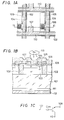
- Fig. 1A is a plan view of a photoelectric transducer device described in European Patent Provisional Publication No. 32076
- Fig. 1B is a sectional view of the device taken along the line I - I thereof
- Fig. 1C is a diagram of an equivalent circuit thereof.
- photoelectric transducer cells are arranged on an n-type silicon substrate 101.
- the photoelectric transducer cells are electrically insulated by an element isolation region 102 made of SiO2, Si3N4 or polysilicon.
- Each photoelectric transducer cell has the following construction.
- a p-type impurity is doped to form a p-type region 104 on an n ⁇ -type region 103 having a low impurity concentration formed by an epitaxial technique or the like.
- An n+-type region 105 is formed in the p-type region 104 by impurity diffusion or ion implantation.
- the p- and n+-type regions 104 and 105 serve as the base and emitter of each bipolar transistor.
- An oxide film 106 is formed on the n ⁇ -type region 103.
- a capacitor electrode 107 having a predetermined area is formed on the oxide film 106.
- the capacitor electrode 107 opposes the p-type region 104, interposing the oxide film 106 therebetween, thereby constituting a capacitor C ox .
- the potential of the p-type region 104 in the floating state is controlled.
- An emitter electrode 108 connected to the n+-type region 105, a wiring 109 for extracting the signal from the emitter electrode 108, and a wiring 110 connected to the capacitor electrode 107 are formed at the upper surface side of the substrate 101.
- An n+-type region 111 having a high impurity concentration and an electrode 112 for applying a voltage to the collector of a bipolar transistor are sequentially formed on the lower surface of the substrate 101.
- the p-type region 104 as the base region of the bipolar transistor is set in the initial state of a negative potential.
- Light 113 is incident on the p-type region 104 and carriers corresponding to the amount of light are stored in the p-type region 104 (storage operation).
- the base potential is changed by the charged carriers.
- the change in base potential control a current supplied to an emitter-collector path, and an electrical signal having a level corresponding to the amount of incident light is extracted from the floating emitter electrode 108 (read operation).
- the emitter electrode 108 is grounded and a refresh positive voltage pulse is supplied to the capacitor electrode 107.
- the p-type region 104 Upon application of this positive voltage, the p-type region 104 is forward-biased with respect to the n+-type region 105, thereby removing the charged carriers. When the refresh pulse falls, the p-type region 104 returns to the initial state of the negative potential (refresh operation). The cycle of storage, read, and refresh operations is repeated.
- the carriers generated upon reception of light are stored in the p-type region 104 as the base region, and the current supplied between the emitter and collector electrodes 108 and 112 is controlled by the stored carriers. Therefore, the stored carriers are amplified by the amplification function of each cell, and the amplified carriers are read out. Therefore, a high output with high sensitivity and low noise can be obtained.
- a potential Vp generated by the base by the carriers stored in the base upon light excitation is given by Q/C where Q is the charge of the carriers stored in the base, and C is the capacitance connected to the base.
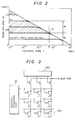
- Fig. 2 is a graph showing changes in base potential Vb during the application of the positive refresh voltage as a function of time.
- the initial base potential at the time of the application of the refresh pulse varies according to the magnitude of the storage voltage Vp.
- the negative potential in the initial state is changed in the positive direction by the storage voltage Vp upon the storage operation.
- the initial base potential is increased by the storage voltage Vp.
- the time for maintaining the initial base potential varies according to the magnitude of the initial base potential.
- the base potential Vb is decreased at a constant rate regardless of the initial base potential. If the refresh time t is sufficiently long, the base potential Vb can be controlled to be substantially 0 V regardless of the magnitude of the storage voltage Vp. Therefore, the base potential Vb returns to the predetermined negative potential of the initial state when the refresh pulse falls.
- the initial base potential of a cell receiving a large amount of light is 0.8 V and that the initial base potential of a cell receiving a small amount of light is 0.4 V.
- the base potential Vb of the cell receiving a large amount of light becomes the predetermined residual potential Vk.
- the base potential Vb of the cell receiving a small amount of light becomes a residual potential Vl lower than the predetermined residual potential Vk.
- the refresh pulse rises the base potential Vb of the cell receiving a small amount of light becomes lower than the negative potential of the initial state. From a potential lower than the initial negative potential, storage and read operations are started.
- the refresh operation is repeated in a low illuminance state, the residual potential of the base is gradually decreased. Even if a high illuminance state is obtained, the resultant output has a level lower than that corresponding to the amount of incident light. In other words, the after image phenomenon occurs due to the following reason.
- the holes in the base region are recombined to result in their shortage. If the shortage of holes cannot be compensated for a long period of time, i.e., if the low illuminance state continues for a long period of time, the after image phenomenon typically occurs.
- Fig. 3 is a schematic circuit diagram of an area sensor using a conventional photoelectric transducer device.
- conventional photoelectric transducer cells 120 of a 3 x 3 matrix are arranged in the area sensor.
- Emitter electrodes 108 of the cells 120 are connected to corresponding vertical lines in units of columns.
- Capacitor electrodes 107 are connected to horizontal lines in units of rows.
- a positive voltage from a vertical scanning unit 121 is applied to the photoelectric transducer cells 120 to perform read access or refresh operation in units of rows.
- a given photoelectric transducer cell receives a large amount of light and the potential of the base region 104 is higher than that of the corresponding emitter region 105, the potential of the vertical line connected to this emitter electrode 108 is increased although read access is not performed. If other photoelectric transducer cells, the emitter electrodes 105 of which are connected to the same vertical line, are subjected to read access, a readout signal is output to the corresponding vertical line although the given cell does not receive light. In other workds, the blooming phenomenon occurs along the vertical direction.
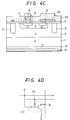
- Fig. 4A is a plan view of a photoelectric transducer device according to an embodiment of the present invention
- Fig. 4B is a sectional view of the device taken along the line A - A thereof
- Fig. 4C is a sectional view of the device taken along the line B - B thereof
- Fig. 4D is an equivalent circuit diagram of the device.
- an n ⁇ -type epitaxial layer 2 is formed on an n-type silicon substrate 1.
- Photoelectric transducer elements electrically isolated from each other by an element isolation region 3 are arranged.
- the element isolation region 3 comprises an SiO2, Si3N4, polysilicon or n+-type diffusion region.
- a p-type base region 4 of a bipolar transistor is formed on the n ⁇ -type epitaxial layer 2 by impurity diffusion or ion implantation.
- An n+-type emitter region 5 and an n-type region 6 having the same impurity concentration as that of the p-type base region 4 are formed in the p-type base region 4 by impurity diffusion or ion implantation.
- the n-type region 6 and the p-type base region 4 constitute a diode structure.
- An oxide film 7 is formed on the n ⁇ -type epitaxal layer 2, and a capacitor electrode 8 made of polysilicon or the like is formed on the oxide film 7 to supply a pulse to the p-type base region 4.
- An emitter electrode 9 connected to the n+-type emitter region 5, and an electrode 10 connected to the n-type region 6 are formed on the oxide film 7 formed on the substrate 1.
- An n+-type region 11 and a collector electrode 12 are sequentially formed on the lower surface of the substrate 1.
- a protective film 13 is formed to cover each photoelectric transducer cell.
- the diode structure constituted by the control electrode region and the semiconductor region In order to form the diode structure constituted by the control electrode region and the semiconductor region, a proper voltage is applied to the semiconductor region, and thus carriers are injected in the control electrode. For this reason, the potential of the control electrode region at the beginning of refresh operation can be kept sufficiently high. As a result, the potential of the control electrode region at the end of refresh operation can be kept at a desired value, and thus the after image phenomenon can be prevented, unlike in the conventional structure.
- the p-type base region 4 is kept at a negative potential of the initial state, the emitter region 5 is set at zero potential in the floating state, the capacitor electrode 8 is set at zero potential, and the n-type region 6 is set at zero or a negative potential with a very small magnitude. Thereafter, the collector electrode 12 is kept at the positive potential. In this state, light is incident on each photoelectric transducer element, carriers (holes in this case) corresponding to the amount of incident light are stored in the p-type base region 4.
- the diode formed by the p-type base region 4 and the n-type region 6 is forward-biased.
- the holes excessively stored in the p-type base region are eliminated outside through the electrode 10. Therefore, the potential of the n+-type emitter region 5 is not changed, and no blooming phenomenon occurs.
- the n+-type emitter region 5 and the n-type region 6 are maintained in the floating state.
- a positive read voltage pulse is applied to the capacitor electrode 8.
- an electrical signal corresponding to the amount of light incident on-the emitter electrode 9 is read out.
- the capacitor electrode 8 is set at zero potential, and the n+-type emitter region 5 is kept in the floating state.
- a proper positive potential is applied to the n-type region 6 constituting the diode to reverse-bias the diode so that a depletion layer extends up to the electrode 10.
- the extended depletion layer causes punch-through, and thus the holes are injected into the p-type base region through the n-type region 6.
- the potential of the p-type base region 4 is increased.
- the n+-type emitter region 5 and the n-type region 6 are grounded.
- the holes stored in the p-type base region 4 are eliminated through the n+-type emitter region 5 and the n-type region 6.
- the initial base potential upon application of the refresh pulse is sufficiently higher than the residual potential Vk although this cell is wholly in the dark state (Fig. 2).
- the potential at the p-type base region 4 can be kept at the predetermined potential Vk regardless of the amount of the light. In this state, if the positive refresh voltage pulse falls, the p-type base region 4 is kept at the predetermined initial negative potential.
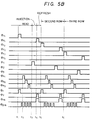
- Fig. 5 is a circuit diagram of an image pickup device having the two-dimensional configuration of photoelectric transducer devices, and Fig. 5B is a timing chart for explaining the operation thereof.
- photoelectric transducer cells 20 are arranged in a 3 x 3 matrix.
- Capacitor electrodes 8 of the cells 20 are respectively connected to horizontal lines 21, 21' and 21'' in units of rows. Each horizontal line is connected to a terminal 24 through transistors 23, 23' and 23''.
- a positive read voltage pulse ⁇ r is applied to the terminal 24.
- Each horizontal line is also connected to a terminal 26 through transistors 25, 25' and 25''.
- a positive refresh voltage pulse ⁇ f is applied to the terminal 26.
- Pulse signals ⁇ r1 to ⁇ r3 from a vertical shift register 22 are respectively supplied to the gate electrodes of the transistors 23, 23' and 23''.
- Pulse signals ⁇ f1 to ⁇ f3 from the vertical shift register 22 are respectively supplied to the gate electrodes of the transistors 25, 25' and 25''.
- Electrodes 10 of the photoelectric transducer cells 20 are commonly connected to horizontal lines 27, 27' and 27'' in units of rows. Pulse signals ⁇ 1 to ⁇ 3 from the vertical shift register 28 are respectively supplied to the horizontal lines.
- the emitter electrodes 9 of the photoelectric transducer cells 20 are commonly connected to vertical lines 29, 29' and 29'' in units of columns.
- the vertical lines are respectively connected to an output line 34 through transistors 33, 33' and 33'' for outputting serial readout signals from the photoelectric transducer cells.
- the gate electrodes of the transistors 30, 30' and 30'' are commonly connected to a terminal 31, and a pulse signal ⁇ rs is applied to the terminal 31.
- Pulse signals ⁇ h1 to ⁇ h3 from a horizontal shift register 32 are respectively applied to the gate electrodes of the transistors 33, 33' and 33''.
- the output line 34 is grounded through a refresh transistor 36 and connected to the gate electrode of a signal amplification transistor 35. An amplified signal from the transistor 35 appears at a terminal 38.
- the storage operation is performed until time t1. Holes corresponding to the amount of incident light are stored in the p-type base regions 4 of the photoelectric transducer cells 20. It should be noted that even if strong light is incident on some of the photoelectric transducer cells 20, the excessive holes are removed to the horizontal lines 27, 27' and 27'' through the corresponding electrodes 10, thereby maintaining the vertical lines 29, 29' and 29'' at zero potential in the floating state.
- the pulse signal ⁇ r1 rises, and the transistor 23 is turned on. Subsequently, the pulse ⁇ r rises to supply the positive read voltage to the horizontal line 21.
- the photoelectric transducer cells 20 of the first row start reading. In this read operation, the read signals from the cells of the first row appear on the vertical lines 29, 29' and 29''.
- the transistor 36 is turned on in response to the pulse signal ⁇ 1rs, so that the residual charge in the output line 34 is refreshed.
- the pulse signal ⁇ h1 rises to turn on the transistor 33.
- the signal generated by the photoelectric transducer cell of the first row and the first column and appearing on the vertical line 29 is input to the transistor 35 through the transistor 33 and the output line 34.
- the amplified signal appears at the terminal 38.
- the pulse signal ⁇ 1rs rises to refresh the output line 34.
- the pulse signals ⁇ h2 and ⁇ h3 sequentially rise to output signals from the photoelectric transducer cell of the first row and the second column and the cell of the first row and third column to the output terminal 38. Every time an output appears on the output line 34, it is refreshed.
- the pulse signal ⁇ 1 from the vertical shift register 28 rises at time t3.
- the positive voltage is applied to the electrodes 10 of the photoelectric transducer cells 20 of the first row. Hole injection is then performed as described above.
- the pulse signals ⁇ f1 and ⁇ rs rise to turn on the transistors 25, 30, 30' and 30'', and the respective vertical lines are grounded.
- the pulse signal ⁇ f then rises to apply the positive refresh voltage pulse to the horizontal line 21. As described above, the refresh operation is performed.
- the storage operation is started at time t5.
- the same operation as in the cells of the first row is started for the cells of the second row at time t5 and the cells of the third row at time t6. More specifically, by sequentially allowing the pulse signals ⁇ r2, ⁇ 2 and ⁇ f2 to rise, the photoelectrical transducer cells 20 of the second row are selected and subjected to the read, hole injection, and refresh operations. At time t6, upon storage operation of the cells of the second row at time t6, the pulse signals ⁇ r3, ⁇ 3 and ⁇ f3 sequentially rise, and the photoelectric transducer cells 20 of the third row sequentially rise are selected. Upon Starting of the storage operation of the cells of the third row, the cells of the first row are selected, and the subsequent operations are performed in the same manner as described.
- the image pickup device is applicable to a television video camera or the like.
- Fig. 6A is a circuit diagram of an image pickup device using the embodiment described above, and Fig. 6B is a timing chart for explaining the operation thereof.
- FIG. 6A three photoelectric transducer cells 20 are arranged one-dimensionally, and collector electrodes 12 thereof are commonly connected. A positive voltage is applied to the collector electrodes 12.
- Capacitor electrodes 8 are commonly connected to a terminal 41 through a line 40.
- a pulse signal ⁇ r is applied to the terminal 41 so as to perform read and refresh operations.
- Emitter electrodes 9 are connected to vertical lines 44, 44' and 44''. Electrodes 10 of diodes are commonly connected to a horizontal line 42.
- the horizontal line 42 is connected to a control circuit 43, and is applied with a pulse signal ⁇ i or grounded.
- the vertical lines 44, 44' and 44'' are grounded through transistors 45, 45' and 45'', respectively.
- the gate electrodes of the transistors 45, 45' and 45'' are commonly connected to a terminal 47 through a line 46.
- a signal ⁇ rs is applied to the terminal 47.
- Each of the vertical lines 44, 44' and 44'' is connected to a corresponding one of the main electrodes of the transistors 48, 48' and 48''.
- the gate electrodes of the transistors 48, 48' and 48'' are commonly connected to a terminal 50 through a line 49.
- a signal ⁇ t is applied to the terminal 50.
- the other main electrode of each of the transistors 48, 48' and 48'' is grounded through a corresponding one of charge storage capacitors 51, 51' and 51'', and is connected to an output line 54 through a corresponding one of transistors 53, 53' and 53''.
- the gate electrodes of the transistors 53, 53' and 53'' are connected to parallel output terminals of a shift register 52, respectively. Signals ⁇ h1 to ⁇ h3 appear at the parallel output terminals, respectively.
- the output line 54 is grounded through a refresh transistor 55 and connected to the gate electrode of a transistor 57 serving as an output amplifier.
- the gate electrode of the transistor 55 is connected to the terminal 56.
- a signal ⁇ 1rs is applied to the terminal 56.
- An output terminal 58 of the transistor 57 is connected to an output terminal 60 through a capacitor and an amplifier 59.
- the output terminal of the control circuit 43 is connected to a gain control terminal of the amplifier 59 so as to control a gain of the amplifier 59 in response to a signal from the horizontal line 42.
- the pulse signals ⁇ rs and ⁇ 1rs are set at high level to turn on the transistors 45, 45', 45'' and 55.
- the emitter electrodes 8 of the photoelectric transducer cells 20 and the output line 54 are grounded, and thus the residual charge of the output line 54 is removed.
- the pulse signal ⁇ t rises to turn on the transistors 48, 48' and 48''.
- the charge storage capacitors 51, 51' and 51'' are grounded to remove the residual charge.
- the signal ⁇ t and then the pulse signal ⁇ i from the control circuit 43 rise.
- a positive voltage is applied to the horizontal line 42 until time t3. Holes are injected in the p-type base regions 4 of the photoelectric transducer cells 20 (hole injection operation).
- the pulse signal ⁇ 1 falls to set the horizontal line 42 at the ground potential.
- the pulse signal ⁇ r rises to apply a positive refresh voltage to the capacitor electrode 8 of each photoelectric transducer cell 20. Since each electrode 8 is maintained at the ground potential, a refresh operation is performed, as described above.
- the signal ⁇ r rises at time t4
- the p-type base region 4 of each photoelectric transducer cell 20 is set at the initial negative potential.
- the signals ⁇ rs and ⁇ 1rs rise to turn off the transistors 45, 45', 45'' and 55.
- the holes of the electron-hole pairs excited by incident light are stored as optical information in the p-type base regions of the photoelectric transducer cells 20.
- the base potential of each photoelectric transducer cell is increased by the storage voltage component corresponding to the amount of light from the initial negative potential (storage operation).
- the horizontal line 42 is set in the floating state by the control circuit 43.
- the signal ⁇ t is set at high level to turn on the transistors 48, 48' and 48'', thereby respectively connecting the vertical lines 44, 44' and 44'' and the charge storage capacitors 51, 51' and 51''.
- the signal ⁇ r rises to supply the positive read voltage to the capacitor electrodes 8 of the photoelectric transducer cells 20.
- the read operation as previously mentioned is performed, and thus the read signals corresponding to the optical information of the photoelectric transducer cells 20 are respectively stored in the charge storage capacitors 51, 51' and 51''.
- the read signals corresponding to the optical information of the photoelectric transducer cells 20 are output to the electrodes 10 through the corresponding diodes.
- the electrodes 10 are commonly connected to the horizontal line 42 in the floating state, the read signal of the photoelectric transducer cell which has a largest amount of incident light appears as a peak voltage on the horizontal line 42.
- the control circuit 43 adjusts the gain of the amplifier 59 on the base of this peak voltage, thereby controlling the range of the read signals.
- the amplifier 59 serves as an automatic limiter.
- the gain of the amplifier 59 is controlled, the signals ⁇ r and ⁇ t fall, and the pulse of the signal ⁇ 1rs is applied to the terminal 56.
- the transistors 48, 48' and 48'' are turned off, and the output line 54 is refreshed.
- the shift register 52 is started from time t6.
- the read signals stored in the charge storage capacitors 51, 51' and 51'' are sequentially output.
- the pulse signal ⁇ hi output from the first output terminal of the shift register 52 rises to turn on the transistor 53.
- the read signal stored in the charge storage capacitor 51 is read out onto the output line 54.
- the readout signal is input to the gain-controlled amplifier 59 through the transistor 57 and is output from the terminal 60.
- the signal ⁇ h1 falls, the signal ⁇ 1rs rises to ground the output line 54 through the transistor 55, thereby removing the residual charge.
- the signals ⁇ h2 and ⁇ h3 output from the shift register 52 sequentially rise to read out the read signals from the charge storage capacitors 51, 51' and 51'' onto the output line 54. Every time a signal is read out, the pulse signal ⁇ 1rs rises to refresh the output line 54. In this manner, the read signals from the photoelectric transducer cells 20 are serially output from the gain-controlled amplifier 59. In the same manner as described above, the refresh, storage, and read operations are repeated. Every time a read operation is performed, the peak value is detected to adjust the gain of the amplifier 59.
- Fig. 7A is an equivalent circuit diagram of a third embodiment of a photoelectric transducer device according to the present invention.
- a p-type base region 703 of an npn bipolar transistor 701 is connected to a capacitor electrode 704 through a capacitor 702.
- the base region 703 is connected to the drain of a p-channel MOS transistor 707.
- the p-type base region 703 is set in the initial negative potential, the emitter electorde 705 is set at zero potential in the floating state, and the capacitor electrode 704 is set at zero potential. Therefore, the collector electrode 706 is maintained at a positive potential.
- the gate electrode 708 of the p-channel MOS transistor 707 is set at a positive potential, and the p-channel MOS transistor 707 is rendered nonconductive. In this state, upon reception of light, carriers (holes in this case) corresponding to the amount light are stored in the p-type base region 703.
- the emitter electrode 705 is set in the floating state, and a positive read voltage pulse is applied to the capacitor electrode 704. As previously mentioned, an electrical signal corresponding to the amount of incident light is read out to the emitter electrode 705.
- the capacitor electrode 704 is set at zero potential
- the emitter electrode 705 is set in the floating state or at zero potential
- a source electrode 709 of the p-channel MOS transistor 707 is set at a proper potential, e.g., the ground potential.
- a negative pulse is applied to the gate electrode 708 of the p-channel MOS transistor 707. If the potential of the p-type base region 703 is lower than that of the source electrode 709 in the dark state or a state wherein an amount of light is small, the holes are injected into the p-type base region 703 to increase its potential.
- the potential of the p-type base region 703 is set to be equal to that of the source electrode 709.
- the potential of the source electrode 709 is set such that the potential of the p-type base region 703 is sufficiently higher than the residual potential Vk even in the dark state.
- the emitter electrode 705 is grounded, the gate electrode 708 of the p-channel MOS transistor 707 is set at a positive potential, and the p-channel MOS transistor 707 is rendered nonconductive.
- the refresh pulse is applied to the capacitor electrode 704
- the holes stored in the p-type base region 703 are recombined with the electrons injected from the emitter electrode 705 to the p-type base region 703, thus eliminating the holes. Since the potential of the p-type base region 703 is sufficiently high due to the hole injection operation even in the dark state, the initial base potential upon application of the refresh pulse is sufficiently higher than the residual potential Vk regardless of the amount of incident light (Fig. 2).
- the potential of the p-type base region 703 is set at the predetermined potential Vk regardless of the amount of incident light. In this state, when the positive refresh pulse falls, the p-type base region 703 is set at the predetermined initial negative potential.
- the holes in the p-type base region 703 are not subjected to shortage even if the refresh operation is repeated. Therefore, nonlinearity of the photoelectric transducer characteristics and the after image phenomenon with a small amount of light can be completely prevented.
- the base region as the control electrode has a p conductivity type, and thus the carriers are holes.
- the base region as the main control electrode of a pnp bipolar transistor has an n conductivity type, the carriers are electrons.
- the bipolar transistor having two main electrodes and a control electrode formed between the two main electrodes is used.
- another semiconductor element such as an FET or an SIT can also be used.
- the means for injecting the carriers in the p-type base region is a p-channel MOS transistor.
- other means may be used in place of the p-channel MOS transistor.
- an n-channel MOS transistor may be used.
- an npn transistor 707'' may be used.
- a pnp transistor 707''' may be connected to the p-type base region.
- the means for injecting the carriers may be replaced with means for emitting an electromagnetic wave such as light (e.g., bias light) onto the photoelectric transducer device immediately prior to the refresh operation, thereby injecting the carriers.
- an electromagnetic wave such as light (e.g., bias light) onto the photoelectric transducer device immediately prior to the refresh operation, thereby injecting the carriers.
- the control means for controlling the potential of the control electrode region through the capacitor to dissipate the carriers (holes) stored therein is the means for grounding the emitter region, applying the refresh pulse to the capacitor electrode, and then injecting electrons from the emitter region, thereby recombining the electrons and the holes.
- Photoelectric transducer cells as still another embodiment having the similar structure and operation to the one described above are arranged in a two-dimensional manner to constitute an image pickup device, and this image pickup device will be described with reference to Figs. 8A and 8B.
- Fig. 8A is a circuit diagram of the two-dimensional image pickup device, and Fig. 8B is a timing chart for explaining the operation thereof.
- photoelectric transducer cells 810 are arranged to constitute a 3 x 3 matrix.
- Capacitor electrodes 804 of the photoelectric transducer cells 810 are commonly connected to horizontal lines 811, 811', and 811'' in units of rows.
- the horizontal lines 811, 811', and 811'' are connected to a terminal 814 through transistors 813, 813', and 813''.
- a positive read/refresh voltage pulse ⁇ R is applied to the terminal 814.
- the gate electrodes of transistors 813, 813', and 813'' respectively receive pulse signals ⁇ v1, ⁇ v2, ⁇ v3 from a vertical shift register 812.
- the gate electrodes 808 of the transistors 807 of the photoelectric transducer cells are commonly connected to horizontal lines 815, 815', and 815'' in units of rows. These horizontal lines are connected to a terminal 817 through transistors 816, 816', and 816''.
- a pulse ⁇ F to be applied to the gate electrode 808 of the transistor 807 of each cell 810 is applied to the terminal 817.
- the gate electrodes of the transistors 815, 185', and 815'' respectively receive pulse signals ⁇ c1, ⁇ c2, and ⁇ c3 from the vertical shift register 812.
- Source electrodes 809 of the transistors 807 of the photoelectric transducer cells are connected to a terminal 819 through horizontal lines 818, 818', and 818''.
- a hole injection voltage Vc is applied to the terminal 819.
- Emitter electrodes 805 of the photoelectric transducer cells 810 are commonly connected to vertical lines 820, 820', and 820'' in units of columns. These vertical lines are grounded through refresh transistors 821, 821', and 821'' and connected to an output line 825 through transistors 823, 823', and 823'' for serially outputting the read signals from the photoelectric transducer cells.
- the gate electrodes of the transistors 821, 821', and 821'' are commonly connected to a termianl 822.
- a pulse signal ⁇ vc is applied to the terminal 822.
- the gate electrodes of the transistors 823, 823', and 823'' respectively receive pulse signals ⁇ H1, ⁇ H2, and ⁇ H3 from a horizontal shift register 824.
- An output line 825 is grounded through a reset transistor 826 and connected to the gate of a signal amplification transistor 828.
- An amplified signal appears at a terminal 829.
- An output line reset pulse ⁇ Hc is applied to a gate electrode 827 of the reset transistor 826.
- the storage operation is performed until time t1.
- the holes corresponding to the amounts of incident light are respectively stored in the p-type base regions 803 of the photoelectric transducer cells 810.
- the pulse signal ⁇ v1 rises to turn on the transistor 813.
- the pulse ⁇ R rises to apply a positive read voltage to the horizontal line 811, so that the read operation of the photoelectric transducer cells 810 of the first row is started.
- the read signals from the photoelectric transducer cells of the first row appear on the vertical lines 820,' 820', and 820''.
- the transistor 826 is turned on in response to the pulse signal ⁇ Hc, and thus the residual charge of the output line 825 is refreshed.
- the pulse ⁇ H1 rises to turn on the transistor 823'.
- the signal from the photoelectric transducer cell of the first row and the first column is input to the transistor 828 through the transistor 823 and the output line 825.
- An amplified signal from the transistor 828 appears at the terminal 829.
- the pulse ⁇ Hc rises to refresh the output line 825.
- the pulse signals ⁇ H2 and ⁇ H3 sequentially rise to ouput signals from the cell of the first row and the second column and the cell of the first row and the third column. These signals appear at the terminal 829. Every time a read signal appears, the output line 825 is refreshed.
- the pulse ⁇ Hc is applied to the gate electrodes 822 of the transistors 821, 821', and 821'' to refresh the vertical lines 820, 820', and 820''. Subsequently, the pulse signal ⁇ c1 from the vertical shift register 812 and then the pulse signal ⁇ F are sequentially applied to the terminal 817. Therefore, the pulse is applied to the electrodes 808 of the transistors 807 of the cells 810 of the first row, and the hole injection operation as described above is performed.
- the pulse signals ⁇ v1 and ⁇ F rise to turn on the transistor 813 and to supply the positive refresh voltage pulse to the horizontal line 811.
- the refresh operation is performed, as described above.
- the pulse signals ⁇ V2, ⁇ R, ⁇ Hc, ⁇ H1, ⁇ Hc, ⁇ H2, ⁇ Hc, ⁇ H3, ⁇ Vc, and ⁇ c2 sequentially repeat rising/falling to select the photoelectric transducer cells 810 of the second row, and the read, hole injection, and refresh operations are performed.
- the cells of the second row are subjected to the storage operation, and at the same time, the pulse signals ⁇ v3, ⁇ R, ⁇ Hc, ⁇ H1, ⁇ Hc, ⁇ H2, ⁇ Hc, ⁇ H3, ⁇ vc, and ⁇ c3 sequentially repeat rising/falling, thereby selecting the photoelectric transducer cells 810 of the third row.
- the same operation as described above is repeated for the third row.
- the first row is selected and the above operation is repeated.
- the read signals corresponding to the amounts of light incident on all the photoelectric transducer cells 810 are serially output at the terminal 829. Since storage time of the cells 810 of each row from the refresh operation to the read operation is predetermined, the image pickup device is applicable to a television video camera or the like.
- the photoelectric transducer cells 810 are two-dimensionally arranged.
- the following embodiment will exemplify the case wherein cells are one-dimensionally arranged to constitute a line sensor.
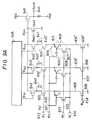
- Fig. 9A is a circuit diagram of an image pickup device having photoelectric transducer cells arranged in a one-dimensional manner
- Fig. 9B is a timing chart for explaining the operation of the image pickup device in Fig. 9A.
- collectors electrodes 809 are commonly connected and receive a positive voltage.
- Capacitor electrodes 804 are commonly connected to a terminal 831 through a horizontal line 830.
- a read/refresh pulse signal ⁇ R is applied to the terminal 831.
- Emitter electrodes 805 are respectively connected to vertical lines 835, 835', and 835''.
- a gate electrode 808 of the transistor 807 is connected to a terminal 833 through a horizontal line 832 and receives a pulse signal ⁇ c for hole injection.
- a source electrode 809 of the transistor 807 is connected to a terminal 34 for receiving a hole injection voltage Vc.
- the vertical lines 835, 835', and 835'' are respectively grounded through transistors 836, 836', and 836''.
- the gate electrodes of the transistors 836, 836', and 836'' are commonly connected to a terminal 838 through a line 837.
- a signal ⁇ vc is applied to the terminal 838.
- the vertical lines 835, 835', and 835'' are respectively connected to charge storage capacitors 840, 840', and 840'' through transistors 839, 839', and 839'' and to an output line 844 through transistors 843, 843', and 843''.
- the gate electrodes of the transistors 839, 839', and 839'' are commonly connected to a terminal 842 through a line 841.
- a signal ⁇ T is applied to the terminal 842.
- the gate electrodes of the transistors 843, 843', and 843'' are connected to the parallel output terminals of a shift register 845. Signals ⁇ H1, ⁇ H2, and ⁇ H3 respectively appear at the parallel output terminals.
- the output line 844 is grounded through a transistor 846 for refreshing the output line 844 and connected to the gate electrode of a transistor 848 serving as an output amplifier and having an output terminal 849.
- the gate electrode of the refresh transistor 846 is connected to a terminal 847.
- a signal ⁇ Hc is applied to the terminal 847.
- the pulse signals ⁇ T and ⁇ vc rise to turn on the transistors 839, 839', 839'', 836, 836', and 836''.
- the emitter electrodes 805 of the photoelectric transducer cells 810 and the vertical lines 835, 835', and 835'' are grounded, thereby removing the residual charges from the charge storage capacitors 840, 840', and 840'' and the vertical lines 835, 835', and 835''.
- the signal ⁇ c rises so that the potential Vc applied to the terminal 834 is set to be equal to the potential of the base region 803 of each photoelectric transducer cell 810.
- the holes are injected into the base region 803 of each photoelectric transducer cell 810 held in the dark state or receiving a small amount of light.
- the potentials at the base regions of the photoelectric transducer cells are set to be substantially equal to each other (hole injection operation).
- the signal ⁇ c falls and the signal ⁇ R rises to apply the positive refresh voltage to the capacitor electrodes 804 of the photoelectric transducer cells 810. Since the emitter electrodes are grounded, the refresh operation is performed in the same manner as in the previous embodiment.
- the signal ⁇ R falls at time t3
- the p-type base regions 803 of the photoelectric transducer cells 810 are reset in the initial negative potential state.
- the signal ⁇ vc falls to turn off the transistor 836, 836', and 836''.
- the signal ⁇ R rises again to apply the positive read voltage to the capacitor electrodes 804 of the photoelectric transducer cells 810.
- the holes of the electron-hole pairs excited by incident light are stored in the p-type base regions of the photoelectric transducer cells 810.
- the base potential of each cell is increased by the storage voltage component corresponding to the amount of light, and at the same time, the read operation is performed.
- the read signals corresponding to the optical information of the photoelectric transducer cells 810 are respectively stored in the charge storage capacitors 840, 840', and 840''.
- the store operation in this case is conducted under the condition that respective cells are forward-biased between base and emitter thereof.
- the signals ⁇ T and ⁇ R fall to turn off the transistors 839, 839', and 839''.
- the signal ⁇ Hc rises to remove the residual charge from the output line 844, and then the signal ⁇ Hc falls.
- the signal ⁇ H1 output from the first output terminal of the shift register 845 rises to turn on the transistor 834, so that the read signal stored in the charge storage capacitor 840 is read out onto the output line 844.
- the readout signal appears at the terminal 849 through the transistor 848. Subsequently, the signal ⁇ Hc rises, and the output line 844 is grounded through the transistor 846, thereby removing the residual charge.
- the signals 843' and 843'' output from the shift register 845 sequentially rise to read out the read signals from the charge storage capacitors 840' and 840'' onto the output line 844. Every time a read signal appears, the pulse signal ⁇ Hc rises to refresh the output line 844. In this manner, the read signals from all the photoelectric transducer cells 810 serially appear at the terminal 849 through the transistor 848.
- Fig. 9C is a timing chart for explaining another operation of the image pickup device in Fig. 9A.
- Fig. 9C shows the operation mode wherein the signal ⁇ R which rises at time t2 does not fall at time t3, and other signal timings are the same as those in Fig. 9B.
- a store operation is conducted under the condition that respective cells are forward-biased between base and emitter thereof, the signals generated by the transistors 805 of the photoelectric transducer cells are always read out onto the vertical lines 835, 835', and 835''. Such read operation can be allowed.
- a noise taken in the sensor cells responsive to the falling and rising of the pulse ⁇ R that is a fixed pattern noise due to an irregularity in configuration of cells of the capacitor electrode 4 and a random noise due to a carrier produced by depressing the interface between the oxidization film and the semiconductor under the capacitor electrode 4, is removed. Therefore, a fine signal without noise can be obtained.
- Fig. 9D is a timing chart for explaining still another operation of the embodiment as shown in Fig. 9A.
- Fig. 9D shows the operation mode wherein the signal ⁇ T which has not fallen at the time t3, falls at the time t3 and raises again at the time t4 at which the store operation is completed.
- An operation of another timings is the same as that of Fig. 9C.
- the signals produced at the transistors 805 of respective cells are readout to only the vertical lines 835, 835', and 835''.
- emitter current of the transistor 805 also is reduced.
- irregularity in operation of the cell produced in the low current region in the transistor 805 is as it is outputted as a signal to the vertical lines 835, 835', and 835''.
- the signals including the low current operation irregularity of the transistor 805 which has been read out to the vertical lines 835, 835', and 835'' are once divided between the capacitors 840, 840', and 840'' and a capacitors of wiring of the vertical lines 835, 835', and 835''. Therefore, the voltage of the signals is dropped. Since the voltage of the vertical lines 835, 835', and 835'' is dropped, the transistor 805 operates again.
- the signals stored in bases of respective cells can be read out to the capacitors 840, 840', and 840''.
- the signals including low current operation irregularity of the transistor 805 produced during the long store time are removed.
- Signals without operation irregularity of transistors of respective cells can be read out to the capacitors 840, 840', and 840''.
- the photoelectric transducer device of this embodiment as described above, a transistor and the like is formed in the control electrode region of the semiconductor transistor, and thus the potential of the control electrode is controlled. Therefore, the carriers can be injected into the control electrode at the proper time.
- the potential of the control electrode region can be kept sufficiently high at the beginning of refreshing.
- the potential of the control electrode region at the end of refreshing can be maintained at a desired predetermined value.
- the conventional nonlinearity of the characteristics and the after image phenomenon of the photoelectric transducer can be improved.
- the control electrode region has a semiconductor region having the same conductivity type as that of the main electrode region of the semiconductor transistor and having a lower impurity concentration than that to constitute a diode structure. Therefore, a proper voltage is applied to the semiconductor region, and the carriers can be properly injected into the control electrode region. For this reason, the potential of the control electrode region can be sufficiently high at the beginning of refreshing. The potential of the control electrode region at the end of refreshing can be maintained at a desired predetermined value. That is, unlike in the conventional device, the after image phenomenon can be prevented.
- the excessive carriers can be eliminated through the diode structure. Therefore, the blooming phenomenon can also be prevented.
- an image pickup device having a light metering function.
Landscapes
- Engineering & Computer Science (AREA)
- Multimedia (AREA)
- Signal Processing (AREA)
- Transforming Light Signals Into Electric Signals (AREA)
- Solid State Image Pick-Up Elements (AREA)
- Fire-Detection Mechanisms (AREA)
- Switches Operated By Changes In Physical Conditions (AREA)
- Optical Head (AREA)
- Optical Communication System (AREA)
Applications Claiming Priority (5)
| Application Number | Priority Date | Filing Date | Title |
|---|---|---|---|
| JP252654/85 | 1985-11-13 | ||
| JP60252654A JPH06101814B2 (ja) | 1985-11-13 | 1985-11-13 | 光電変換装置 |
| JP60269873A JPH0746839B2 (ja) | 1985-11-29 | 1985-11-29 | 光電変換装置 |
| JP269873/85 | 1985-11-29 | ||
| EP86308863A EP0222624B1 (de) | 1985-11-13 | 1986-11-13 | Anordnung und Verfahren zum photoelektrischen Umformen von Licht in elektrische Signale |
Related Parent Applications (2)
| Application Number | Title | Priority Date | Filing Date |
|---|---|---|---|
| EP86308863.9 Division | 1986-11-13 | ||
| EP86308863A Division EP0222624B1 (de) | 1985-11-13 | 1986-11-13 | Anordnung und Verfahren zum photoelektrischen Umformen von Licht in elektrische Signale |
Publications (3)
| Publication Number | Publication Date |
|---|---|
| EP0489724A2 true EP0489724A2 (de) | 1992-06-10 |
| EP0489724A3 EP0489724A3 (en) | 1992-12-16 |
| EP0489724B1 EP0489724B1 (de) | 1999-03-03 |
Family
ID=26540816
Family Applications (2)
| Application Number | Title | Priority Date | Filing Date |
|---|---|---|---|
| EP86308863A Expired - Lifetime EP0222624B1 (de) | 1985-11-13 | 1986-11-13 | Anordnung und Verfahren zum photoelektrischen Umformen von Licht in elektrische Signale |
| EP92200671A Expired - Lifetime EP0489724B1 (de) | 1985-11-13 | 1986-11-13 | Anordnung und Verfahren zum photoelektrischen Umformen von Licht in elektrische Signale |
Family Applications Before (1)
| Application Number | Title | Priority Date | Filing Date |
|---|---|---|---|
| EP86308863A Expired - Lifetime EP0222624B1 (de) | 1985-11-13 | 1986-11-13 | Anordnung und Verfahren zum photoelektrischen Umformen von Licht in elektrische Signale |
Country Status (5)
| Country | Link |
|---|---|
| US (1) | US4847668A (de) |
| EP (2) | EP0222624B1 (de) |
| AT (2) | ATE80964T1 (de) |
| CA (1) | CA1289242C (de) |
| DE (2) | DE3686807T2 (de) |
Cited By (3)
| Publication number | Priority date | Publication date | Assignee | Title |
|---|---|---|---|---|
| EP0627847A3 (de) * | 1993-05-28 | 1995-05-24 | Canon Kk | Photoelektrische Umwandlungsanorndung. |
| WO1997045876A1 (en) * | 1995-05-10 | 1997-12-04 | National Semiconductor Corporation | Method of manufacturing a capacitor coupled contactless imager with high resolution and wide dynamic range |
| US6510193B1 (en) | 1995-10-30 | 2003-01-21 | Canon Kabushiki Kaisha | Charge transfer device and a semiconductor circuit including the device |
Families Citing this family (24)
| Publication number | Priority date | Publication date | Assignee | Title |
|---|---|---|---|---|
| JPH084127B2 (ja) * | 1986-09-30 | 1996-01-17 | キヤノン株式会社 | 光電変換装置 |
| US5737016A (en) * | 1985-11-15 | 1998-04-07 | Canon Kabushiki Kaisha | Solid state image pickup apparatus for reducing noise |
| US4914519A (en) * | 1986-09-19 | 1990-04-03 | Canon Kabushiki Kaisha | Apparatus for eliminating noise in a solid-state image pickup device |
| US5771070A (en) * | 1985-11-15 | 1998-06-23 | Canon Kabushiki Kaisha | Solid state image pickup apparatus removing noise from the photoelectric converted signal |
| US4866293A (en) * | 1986-12-09 | 1989-09-12 | Canon Kabushiki Kaisha | Photoelectric converting apparatus to prevent the outflow of excess carriers |
| FR2638042A1 (fr) * | 1988-10-14 | 1990-04-20 | Thomson Csf | Procede pour reduire la remanence d'un phototransistor, notamment de type nipin |
| US5040041A (en) * | 1988-10-20 | 1991-08-13 | Canon Kabushiki Kaisha | Semiconductor device and signal processing device having said device provided therein |
| JPH02275670A (ja) * | 1989-01-18 | 1990-11-09 | Canon Inc | 光電変換装置および画像読取装置 |
| JP2878376B2 (ja) * | 1990-02-28 | 1999-04-05 | キヤノン株式会社 | 光電変換装置 |
| CA2056087C (en) * | 1990-11-27 | 1998-01-27 | Masakazu Morishita | Photoelectric converting device and information processing apparatus employing the same |
| US5260592A (en) * | 1991-02-19 | 1993-11-09 | Synaptics, Incorporated | Integrating photosensor and imaging system having wide dynamic range with varactors |
| US5324958A (en) * | 1991-02-19 | 1994-06-28 | Synaptics, Incorporated | Integrating imaging systgem having wide dynamic range with sample/hold circuits |
| US5406332A (en) * | 1992-03-06 | 1995-04-11 | Canon Kabushiki Kaisha | Photoelectric converting device |
| JP3774499B2 (ja) | 1996-01-24 | 2006-05-17 | キヤノン株式会社 | 光電変換装置 |
| US5838176A (en) * | 1996-07-11 | 1998-11-17 | Foveonics, Inc. | Correlated double sampling circuit |
| US5786623A (en) * | 1996-10-22 | 1998-07-28 | Foveonics, Inc. | Bipolar-based active pixel sensor cell with metal contact and increased capacitive coupling to the base region |
| US5760458A (en) * | 1996-10-22 | 1998-06-02 | Foveonics, Inc. | Bipolar-based active pixel sensor cell with poly contact and increased capacitive coupling to the base region |
| WO2002027763A2 (en) | 2000-09-25 | 2002-04-04 | Foveon, Inc. | Active pixel sensor with noise cancellation |
| JP2002289879A (ja) * | 2001-03-27 | 2002-10-04 | Toshiba Corp | ダイオード |
| US8338248B2 (en) * | 2008-12-25 | 2012-12-25 | National University Corporation Shizuoka University | Semiconductor element and solid-state imaging device |
| JP5648922B2 (ja) * | 2009-10-05 | 2015-01-07 | 国立大学法人静岡大学 | 半導体素子及び固体撮像装置 |
| JP5818455B2 (ja) | 2011-02-17 | 2015-11-18 | キヤノン株式会社 | 固体撮像装置およびその製造方法 |
| JP5893550B2 (ja) | 2012-04-12 | 2016-03-23 | キヤノン株式会社 | 撮像装置及び撮像システム |
| US10553633B2 (en) * | 2014-05-30 | 2020-02-04 | Klaus Y.J. Hsu | Phototransistor with body-strapped base |
Family Cites Families (5)
| Publication number | Priority date | Publication date | Assignee | Title |
|---|---|---|---|---|
| US3660667A (en) * | 1970-06-22 | 1972-05-02 | Rca Corp | Image sensor array in which each element employs two phototransistors one of which stores charge |
| JPS59108344A (ja) * | 1982-12-14 | 1984-06-22 | Olympus Optical Co Ltd | 固体撮像素子 |
| US4686554A (en) * | 1983-07-02 | 1987-08-11 | Canon Kabushiki Kaisha | Photoelectric converter |
| GB2170675B (en) * | 1984-12-28 | 1989-12-13 | Canon Kk | Image sensing apparatus |
| JPH0760888B2 (ja) * | 1985-06-12 | 1995-06-28 | キヤノン株式会社 | 光電変換装置 |
-
1986
- 1986-11-12 CA CA000522797A patent/CA1289242C/en not_active Expired - Lifetime
- 1986-11-13 DE DE8686308863T patent/DE3686807T2/de not_active Expired - Fee Related
- 1986-11-13 AT AT86308863T patent/ATE80964T1/de not_active IP Right Cessation
- 1986-11-13 EP EP86308863A patent/EP0222624B1/de not_active Expired - Lifetime
- 1986-11-13 EP EP92200671A patent/EP0489724B1/de not_active Expired - Lifetime
- 1986-11-13 AT AT92200671T patent/ATE177250T1/de not_active IP Right Cessation
- 1986-11-13 DE DE3650714T patent/DE3650714T2/de not_active Expired - Fee Related
-
1988
- 1988-11-23 US US07/275,673 patent/US4847668A/en not_active Expired - Lifetime
Cited By (4)
| Publication number | Priority date | Publication date | Assignee | Title |
|---|---|---|---|---|
| EP0627847A3 (de) * | 1993-05-28 | 1995-05-24 | Canon Kk | Photoelektrische Umwandlungsanorndung. |
| US6980243B2 (en) | 1993-05-28 | 2005-12-27 | Canon Kabushiki Kaisha | Photoelectric conversion device providing advantageous readout of two-dimensional array of transistors |
| WO1997045876A1 (en) * | 1995-05-10 | 1997-12-04 | National Semiconductor Corporation | Method of manufacturing a capacitor coupled contactless imager with high resolution and wide dynamic range |
| US6510193B1 (en) | 1995-10-30 | 2003-01-21 | Canon Kabushiki Kaisha | Charge transfer device and a semiconductor circuit including the device |
Also Published As
| Publication number | Publication date |
|---|---|
| DE3686807D1 (de) | 1992-10-29 |
| ATE80964T1 (de) | 1992-10-15 |
| EP0489724B1 (de) | 1999-03-03 |
| EP0489724A3 (en) | 1992-12-16 |
| DE3650714T2 (de) | 1999-09-02 |
| EP0222624B1 (de) | 1992-09-23 |
| CA1289242C (en) | 1991-09-17 |
| EP0222624A1 (de) | 1987-05-20 |
| ATE177250T1 (de) | 1999-03-15 |
| DE3650714D1 (de) | 1999-04-08 |
| DE3686807T2 (de) | 1993-04-01 |
| US4847668A (en) | 1989-07-11 |
Similar Documents
| Publication | Publication Date | Title |
|---|---|---|
| US4847668A (en) | Device and method of photoelectrically converting light into electrical signal | |
| EP0187047B1 (de) | Bildsensoranordnung | |
| USRE34309E (en) | Image sensor device having plural photoelectric converting elements | |
| EP0253678B1 (de) | Photoelektrischer Wandler | |
| CA1270058A (en) | Image sensing apparatus | |
| US4551757A (en) | Method for driving solid-state image sensor | |
| US5432551A (en) | Interline transfer image sensor | |
| EP0559207A1 (de) | Photoelektrische Umwandlungsvorrichtung | |
| US20030010897A1 (en) | Solid state imaging device and driving method thereof | |
| US6445414B1 (en) | Solid-state image pickup device having vertical overflow drain and resistive gate charge transfer device and method of controlling thereof | |
| EP0576022B1 (de) | Photoelektrischer Wandler und Steuerverfahren dafür | |
| US4712138A (en) | Low-noise apparatus for image pickup and combination of light and electric signals | |
| US6064053A (en) | Operation methods for active BiCMOS pixel for electronic shutter and image-lag elimination | |
| US4677453A (en) | Solid state image sensor | |
| JP2004221586A (ja) | デュアルゲートpmos付きcmos画素 | |
| US4682203A (en) | Solid-state image pickup device with photographic sensitivity characteristics | |
| US5304803A (en) | Infrared imaging array | |
| US20050007473A1 (en) | Reducing image sensor lag | |
| US5126814A (en) | Photoelectric converter with doped capacitor region | |
| JPH05244513A (ja) | 光電変換装置及びその駆動方法 | |
| JPS62128678A (ja) | 光電変換装置 | |
| Jespers et al. | Three-terminal charge-injection device | |
| JPH0697408A (ja) | 光電変換装置及びその製造方法 | |
| JPH06101814B2 (ja) | 光電変換装置 | |
| JPS63128665A (ja) | 光電変換装置 |
Legal Events
| Date | Code | Title | Description |
|---|---|---|---|
| PUAI | Public reference made under article 153(3) epc to a published international application that has entered the european phase |
Free format text: ORIGINAL CODE: 0009012 |
|
| AC | Divisional application: reference to earlier application |
Ref document number: 222624 Country of ref document: EP |
|
| AK | Designated contracting states |
Kind code of ref document: A2 Designated state(s): AT BE CH DE ES FR GB GR IT LI LU NL SE |
|
| PUAL | Search report despatched |
Free format text: ORIGINAL CODE: 0009013 |
|
| AK | Designated contracting states |
Kind code of ref document: A3 Designated state(s): AT BE CH DE ES FR GB GR IT LI LU NL SE |
|
| 17P | Request for examination filed |
Effective date: 19930507 |
|
| 17Q | First examination report despatched |
Effective date: 19950301 |
|
| GRAG | Despatch of communication of intention to grant |
Free format text: ORIGINAL CODE: EPIDOS AGRA |
|
| GRAG | Despatch of communication of intention to grant |
Free format text: ORIGINAL CODE: EPIDOS AGRA |
|
| GRAH | Despatch of communication of intention to grant a patent |
Free format text: ORIGINAL CODE: EPIDOS IGRA |
|
| GRAH | Despatch of communication of intention to grant a patent |
Free format text: ORIGINAL CODE: EPIDOS IGRA |
|
| GRAA | (expected) grant |
Free format text: ORIGINAL CODE: 0009210 |
|
| AC | Divisional application: reference to earlier application |
Ref document number: 222624 Country of ref document: EP |
|
| AK | Designated contracting states |
Kind code of ref document: B1 Designated state(s): AT BE CH DE ES FR GB GR IT LI LU NL SE |
|
| PG25 | Lapsed in a contracting state [announced via postgrant information from national office to epo] |
Ref country code: IT Free format text: LAPSE BECAUSE OF FAILURE TO SUBMIT A TRANSLATION OF THE DESCRIPTION OR TO PAY THE FEE WITHIN THE PRE;WARNING: LAPSES OF ITALIAN PATENTS WITH EFFECTIVE DATE BEFORE 2007 MAY HAVE OCCURRED AT ANY TIME BEFORE 2007. THE CORRECT EFFECTIVE DATE MAY BE DIFFERENT FROM THE ONE RECORDED.SCRIBED TIME-LIMIT Effective date: 19990303 Ref country code: LI Free format text: LAPSE BECAUSE OF FAILURE TO SUBMIT A TRANSLATION OF THE DESCRIPTION OR TO PAY THE FEE WITHIN THE PRESCRIBED TIME-LIMIT Effective date: 19990303 Ref country code: NL Free format text: LAPSE BECAUSE OF FAILURE TO SUBMIT A TRANSLATION OF THE DESCRIPTION OR TO PAY THE FEE WITHIN THE PRESCRIBED TIME-LIMIT Effective date: 19990303 Ref country code: SE Free format text: THE PATENT HAS BEEN ANNULLED BY A DECISION OF A NATIONAL AUTHORITY Effective date: 19990303 Ref country code: GR Free format text: LAPSE BECAUSE OF NON-PAYMENT OF DUE FEES Effective date: 19990303 Ref country code: AT Free format text: LAPSE BECAUSE OF FAILURE TO SUBMIT A TRANSLATION OF THE DESCRIPTION OR TO PAY THE FEE WITHIN THE PRESCRIBED TIME-LIMIT Effective date: 19990303 Ref country code: CH Free format text: LAPSE BECAUSE OF FAILURE TO SUBMIT A TRANSLATION OF THE DESCRIPTION OR TO PAY THE FEE WITHIN THE PRESCRIBED TIME-LIMIT Effective date: 19990303 Ref country code: BE Free format text: LAPSE BECAUSE OF FAILURE TO SUBMIT A TRANSLATION OF THE DESCRIPTION OR TO PAY THE FEE WITHIN THE PRESCRIBED TIME-LIMIT Effective date: 19990303 |
|
| REF | Corresponds to: |
Ref document number: 177250 Country of ref document: AT Date of ref document: 19990315 Kind code of ref document: T |
|
| REG | Reference to a national code |
Ref country code: CH Ref legal event code: EP |
|
| REF | Corresponds to: |
Ref document number: 3650714 Country of ref document: DE Date of ref document: 19990408 |
|
| ET | Fr: translation filed | ||
| NLV1 | Nl: lapsed or annulled due to failure to fulfill the requirements of art. 29p and 29m of the patents act | ||
| REG | Reference to a national code |
Ref country code: CH Ref legal event code: PL |
|
| PG25 | Lapsed in a contracting state [announced via postgrant information from national office to epo] |
Ref country code: ES Free format text: LAPSE BECAUSE OF FAILURE TO SUBMIT A TRANSLATION OF THE DESCRIPTION OR TO PAY THE FEE WITHIN THE PRESCRIBED TIME-LIMIT Effective date: 19990916 |
|
| PG25 | Lapsed in a contracting state [announced via postgrant information from national office to epo] |
Ref country code: LU Free format text: LAPSE BECAUSE OF NON-PAYMENT OF DUE FEES Effective date: 19991113 |
|
| PLBE | No opposition filed within time limit |
Free format text: ORIGINAL CODE: 0009261 |
|
| STAA | Information on the status of an ep patent application or granted ep patent |
Free format text: STATUS: NO OPPOSITION FILED WITHIN TIME LIMIT |
|
| 26N | No opposition filed | ||
| REG | Reference to a national code |
Ref country code: GB Ref legal event code: IF02 |
|
| PGFP | Annual fee paid to national office [announced via postgrant information from national office to epo] |
Ref country code: GB Payment date: 20031030 Year of fee payment: 18 |
|
| PGFP | Annual fee paid to national office [announced via postgrant information from national office to epo] |
Ref country code: FR Payment date: 20031125 Year of fee payment: 18 |
|
| PGFP | Annual fee paid to national office [announced via postgrant information from national office to epo] |
Ref country code: DE Payment date: 20031126 Year of fee payment: 18 |
|
| PG25 | Lapsed in a contracting state [announced via postgrant information from national office to epo] |
Ref country code: GB Free format text: LAPSE BECAUSE OF NON-PAYMENT OF DUE FEES Effective date: 20041113 |
|
| PG25 | Lapsed in a contracting state [announced via postgrant information from national office to epo] |
Ref country code: DE Free format text: LAPSE BECAUSE OF NON-PAYMENT OF DUE FEES Effective date: 20050601 |
|
| GBPC | Gb: european patent ceased through non-payment of renewal fee |
Effective date: 20041113 |
|
| PG25 | Lapsed in a contracting state [announced via postgrant information from national office to epo] |
Ref country code: FR Free format text: LAPSE BECAUSE OF NON-PAYMENT OF DUE FEES Effective date: 20050729 |
|
| REG | Reference to a national code |
Ref country code: FR Ref legal event code: ST |