EP0492629A2 - Verfahren zur Herstellung optisch aktiver Chinoxalinyloxyphenoxypropionsäureester - Google Patents
Verfahren zur Herstellung optisch aktiver Chinoxalinyloxyphenoxypropionsäureester Download PDFInfo
- Publication number
- EP0492629A2 EP0492629A2 EP91122231A EP91122231A EP0492629A2 EP 0492629 A2 EP0492629 A2 EP 0492629A2 EP 91122231 A EP91122231 A EP 91122231A EP 91122231 A EP91122231 A EP 91122231A EP 0492629 A2 EP0492629 A2 EP 0492629A2
- Authority
- EP
- European Patent Office
- Prior art keywords
- alkyl
- formula
- alkoxy
- compound
- cycloalkyl
- Prior art date
- Legal status (The legal status is an assumption and is not a legal conclusion. Google has not performed a legal analysis and makes no representation as to the accuracy of the status listed.)
- Granted
Links
- 0 *c(c(I)c1)cc2c1ncc(*)n2 Chemical compound *c(c(I)c1)cc2c1ncc(*)n2 0.000 description 4
Classifications
-
- C—CHEMISTRY; METALLURGY
- C07—ORGANIC CHEMISTRY
- C07D—HETEROCYCLIC COMPOUNDS
- C07D405/00—Heterocyclic compounds containing both one or more hetero rings having oxygen atoms as the only ring hetero atoms, and one or more rings having nitrogen as the only ring hetero atom
- C07D405/02—Heterocyclic compounds containing both one or more hetero rings having oxygen atoms as the only ring hetero atoms, and one or more rings having nitrogen as the only ring hetero atom containing two hetero rings
- C07D405/12—Heterocyclic compounds containing both one or more hetero rings having oxygen atoms as the only ring hetero atoms, and one or more rings having nitrogen as the only ring hetero atom containing two hetero rings linked by a chain containing hetero atoms as chain links
-
- C—CHEMISTRY; METALLURGY
- C07—ORGANIC CHEMISTRY
- C07D—HETEROCYCLIC COMPOUNDS
- C07D241/00—Heterocyclic compounds containing 1,4-diazine or hydrogenated 1,4-diazine rings
- C07D241/02—Heterocyclic compounds containing 1,4-diazine or hydrogenated 1,4-diazine rings not condensed with other rings
- C07D241/10—Heterocyclic compounds containing 1,4-diazine or hydrogenated 1,4-diazine rings not condensed with other rings having three double bonds between ring members or between ring members and non-ring members
- C07D241/14—Heterocyclic compounds containing 1,4-diazine or hydrogenated 1,4-diazine rings not condensed with other rings having three double bonds between ring members or between ring members and non-ring members with hetero atoms or with carbon atoms having three bonds to hetero atoms with at the most one bond to halogen, e.g. ester or nitrile radicals, directly attached to ring carbon atoms
- C07D241/18—Oxygen or sulfur atoms
-
- A—HUMAN NECESSITIES
- A01—AGRICULTURE; FORESTRY; ANIMAL HUSBANDRY; HUNTING; TRAPPING; FISHING
- A01N—PRESERVATION OF BODIES OF HUMANS OR ANIMALS OR PLANTS OR PARTS THEREOF; BIOCIDES, e.g. AS DISINFECTANTS, AS PESTICIDES OR AS HERBICIDES; PEST REPELLANTS OR ATTRACTANTS; PLANT GROWTH REGULATORS
- A01N43/00—Biocides, pest repellants or attractants, or plant growth regulators containing heterocyclic compounds
- A01N43/48—Biocides, pest repellants or attractants, or plant growth regulators containing heterocyclic compounds having rings with two nitrogen atoms as the only ring hetero atoms
- A01N43/60—1,4-Diazines; Hydrogenated 1,4-diazines
-
- C—CHEMISTRY; METALLURGY
- C07—ORGANIC CHEMISTRY
- C07D—HETEROCYCLIC COMPOUNDS
- C07D241/00—Heterocyclic compounds containing 1,4-diazine or hydrogenated 1,4-diazine rings
- C07D241/36—Heterocyclic compounds containing 1,4-diazine or hydrogenated 1,4-diazine rings condensed with carbocyclic rings or ring systems
- C07D241/38—Heterocyclic compounds containing 1,4-diazine or hydrogenated 1,4-diazine rings condensed with carbocyclic rings or ring systems with only hydrogen or carbon atoms directly attached to the ring nitrogen atoms
- C07D241/40—Benzopyrazines
- C07D241/44—Benzopyrazines with hetero atoms or with carbon atoms having three bonds to hetero atoms with at the most one bond to halogen, e.g. ester or nitrile radicals, directly attached to carbon atoms of the hetero ring
Definitions
- halogen means fluorine, chlorine, bromine or iodine
- Alkyl can be straight-chain or branched; the same applies correspondingly to the unsaturated residues alkenyl and alkynyl as well as the alkyl parts of the substituted residues; lower alkyl is C1-C6 alkyl, preferably C1-C4 alkyl.
- transesterification to be carried out in the given case following the reaction of the compounds of the formulas II and III is preferably carried out using an alcohol of the general formula V wherein R3 has the same meaning as in formula I, carried out in the presence of a catalyst.
- reaction of the compounds of general formula II with the compounds of general formula III is preferably carried out in a non-polar, organic solvent in the presence of an acid binder, optionally with the addition of a catalyst.
- Nonpolar, organic solvents are hydrocarbons which are liquid at room temperature and which may also contain halogen, such as. B. heptane, toluene, xylene, cumene, mesitylene, chlorobenzene or the isomeric dichlorobenzenes.
- organic and inorganic bases are preferably used as acid-binding agents, however inorganic bases.
- Alkali carbonates or alkali hydrogen carbonates are particularly preferred, in particular those of sodium and that of potassium.
- Alkali hydrogen carbonates split off water above approx. 90 ° C. To avoid side reactions by hydrolysis, it is therefore advantageous when using alkali metal bicarbonates above these reaction temperatures, the water of reaction by suitable measures such.
- B. Remove molecular sieve. The same measures are recommended when using alkali carbonates above approx. 90 ° C, since these result in alkali hydrogen carbonates through neutralization during the reaction.
- Quaternary ammonium or phosphonium salts, polyalkylene glycols and their lower alkyl ethers are suitable as catalysts. Catalyst systems of this type are described in detail in EP-A-105494. Crown ethers such as, for. B. 15-Crown-5 or 18-Crown-6 (Aldrich Chimica Acta 1976 (1), 3) or acyclic cryptands such as TDA-1 (J. Org. Chem. 1985, 50, 3717).
- long-chain polyalkylene glycols with molecular weights between 1000 and 3000 are preferably used in the aqueous workup.
- the catalysts are preferably used in amounts of 0.05 to 1.0 mol%, in particular in amounts of 0.1 to 0.7 mol%, based on the compound of the general formula II used.
- the process according to the invention is preferably carried out in the temperature range from 30 ° C. to 150 ° C., in particular in the range from 80 ° C. to 120 ° C.
- the order in which the reactants are added is generally not critical.
- the process is carried out, for example, in such a way that the reactants of the general formulas II and III are mixed with one another in the desired solvent, the catalyst is optionally added and the entire reaction mixture is heated to the desired reaction temperature.
- the time at which a complete turnover is reached can be done with common methods, e.g. B. by thin layer chromatography (DC) or gas chromatography (GC) examination of the reaction mixture.
- DC thin layer chromatography
- GC gas chromatography
- the excess of component III is preferably 1 to 10 mol%, in particular 1.5 to 5 mol%, and after the reaction has ended, can easily be removed by washing with dilute alkali metal hydroxide solution or a phosphate buffer solution.
- the intermediate of general formula IV is dissolved, for example, in a 2 to 100-fold excess of the alcohol of general formula V, preferably in a 2 to 50-fold excess, and heated to 80 ° C. to 120 ° C. after the addition of a catalyst. If necessary, the reaction mixture can be diluted by adding an inert solvent.
- Titanium-IV-tetraalkoxides as described in Synthesis 1982, 138 can be used as catalysts. Titanium IV ethylate, titanium IV isopropoxide and titanium IV butoxide are particularly suitable for this.
- the amount of catalyst used is, for example, 2 to 50 mol% based on the intermediate of the general Formula IV.
- the time at which a complete turnover is reached can be done using common methods, e.g. B. DC or GC, determine.
- the alcohol component of the general formula V used in excess z. B. can be recovered by distillation.
- the titanium IV alkoxides are destroyed and the product of general formula I can then be extracted by extraction into an organic solvent, e.g. B. from the group of solvents which can be used in the reaction of the compounds of the formulas II and III. If so desired, the crude product obtained in this way can be further purified by measures such as recrystallization or chromatography.
- the process according to the invention is preferably carried out under a protective gas atmosphere.
- Nitrogen or argon can be used as protective gases.
- optical yields of the compounds of the general formula I obtained by the process according to the invention, including transesterification, are generally over 85%, corresponding to about 85% enantiomeric excess.
- the toluene phase is washed once with 20 ml of saturated sodium bicarbonate solution and once with 20 ml of water. After drying over magnesium sulfate and stripping off the solvent in vacuo, 3.8 g (88.6% of theory) ( ⁇ ) -tetrahydrofurfuryl- (D) -2- [4- (6-chloro-2-quinoxalinyloxy) phenoxy] -propionate obtained as a light brown oil.
Landscapes
- Chemical & Material Sciences (AREA)
- Organic Chemistry (AREA)
- Life Sciences & Earth Sciences (AREA)
- Dentistry (AREA)
- Wood Science & Technology (AREA)
- Plant Pathology (AREA)
- Health & Medical Sciences (AREA)
- Engineering & Computer Science (AREA)
- Agronomy & Crop Science (AREA)
- General Health & Medical Sciences (AREA)
- Pest Control & Pesticides (AREA)
- Zoology (AREA)
- Environmental Sciences (AREA)
- Plural Heterocyclic Compounds (AREA)
- Organic Low-Molecular-Weight Compounds And Preparation Thereof (AREA)
- Low-Molecular Organic Synthesis Reactions Using Catalysts (AREA)
- Agricultural Chemicals And Associated Chemicals (AREA)
Abstract
worin R₁ H, Halogen, Haloalkyl, CN, NO₂, Alkyl oder Alkoxy,
R₂ H oder Halogen, R₃ C₁-C₁₈-Alkyl, Benzyl, Cycloalkyl, ggf. halogeniertes Alkenyl oder ggf. halogeniertes Alkinyl oder (CH₂)n(O)mR₄, R₄ ggf. durch Alkoxy substituiertes C₁-C₆-Alkyl oder einen 5- oder 6-gliedrigen Carbo- oder Heterocyclus oder N=CR₅R₆, R₅ und R₆ Alkyl, Cycloalkyl, Alkylcarbonyloxy-alkyl, Alkoxy, Alkylthio oder zusammen mit dem Kohlenstoffatom, an das sie geknuepft sind, einen Cycloalkylrest, n 1 oder 2 und m 0 oder 1 bedeuten,
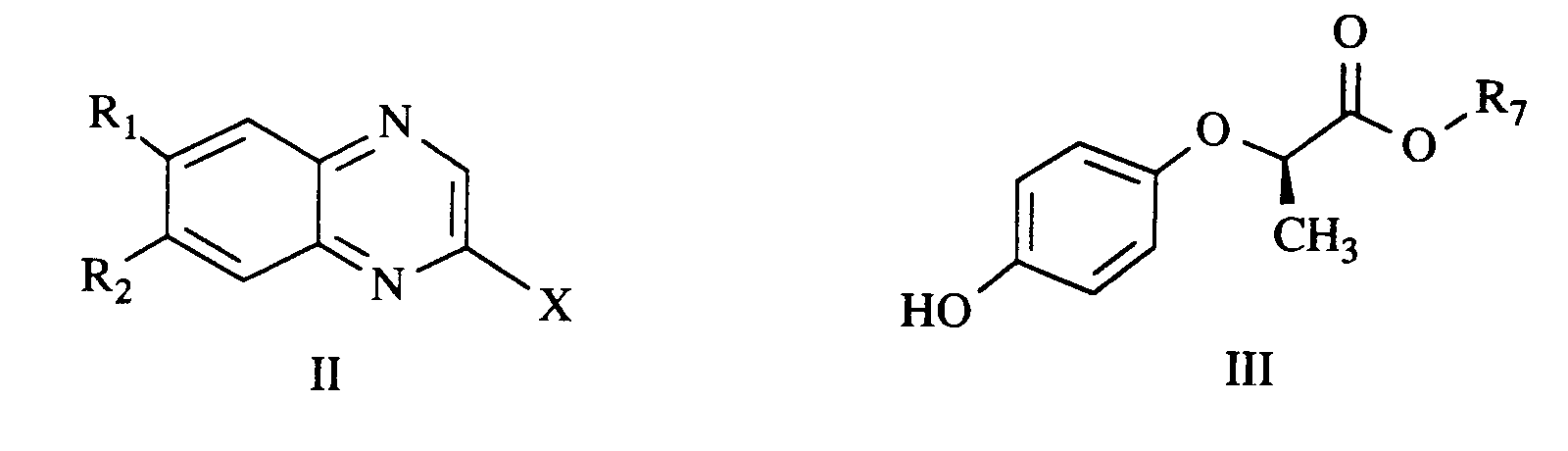
dadurch gekennzeichnet, dass man ein substituiertes Chinoxalin der Formel II,

worin X eine Abgangsgruppe ist, mit einer Verbindung der Formel III, worin R₇ C₁-C₄ Alkyl ist, umsetzt und fuer den Fall, dass R₃ ungleich R₇ sein soll, den so erhaltenen Ester der Formel I (R₃=R₇) in einen anderen Ester der Formel I weitgehend ohne Razemisierung umestert.
Description
- Gegenstand der vorliegenden Erfindung ist ein Verfahren zur Herstellung optisch aktiver D-Chinoxalinyloxyphenoxypropionsaeureester der allgemeinen Formel I

worin - R₁
- H, Halogen, vorzugsweise Chlor, C₁-C₄-Haloalkyl, vorzugsweise CF₃, CN, NO₂, C₁-C₄-Alkyl, vorzugsweise CH₃, oder C₁-C₄-Alkoxy, vorzugsweise OCH₃, insbesondere Halogen,
- R₂
- H oder Halogen, vorzugsweise H,
- R₃
- C₁-C₁₈-Alkyl, Benzyl, C₅-C₈-Cycloalkyl, C₃-C₄-Alkenyl, das unsubstituiert oder durch ein oder mehrere Halogenatome substituiert ist, C₃-C₄-Alkinyl, das unsubstituiert oder durch ein oder mehrere Halogenatome substituiert ist, oder (CH₂)n(O)mR₄,
- R₄
- C₁-C₆-Alkyl, das unsubstituiert oder durch C₁-C₆-Alkoxy substituiert ist, oder einen 5- oder 6-gliedrigen Ring, der gesaettigt oder ungesaettigt ist, carbocyclisch ist oder heterocyclisch mit 1 bis 4 Heteroatomen aus der Gruppe Sauerstoff und Stickstoff ist und unsubstituiert oder durch 1-3 Substituenten aus der Gruppe Oxo, C₁-C₃-Alkyl, C₁-C₃-Alkoxy substituiert ist, oder eine Gruppierung der allgemeinen Formel N=CR₅R₆,
- R₅
- und R₆ unabhaengig voneinander C₁-C₆-Alkyl, C₃-C₈-Cycloalkyl, C₁-C₆-Alkylcarbonyloxy-C₁-C₆-alkyl, C₁-C₆-Alkoxy, C₁-C₆-Alkylthio oder zusammen mit dem Kohlenstoffatom, an das sie geknuepft sind, einen Cycloalkylrest mit 3-8 Ringgliedern,
- n
- 1 oder 2 und
- m
- 0 oder 1
- R₁ und R₂
- die gleiche Bedeutung wie in Formel I haben und
- X
- eine Abgangsgruppe, wie z. B. Halogen, insbesondere Chlor und Brom, sowie Methansulfonyl,
- R₇
- C₁-C₄ Alkyl
- Hier und im folgenden bedeutet Halogen Fluor, Chlor, Brom oder Iod; Alkyl kann geradkettig oder verzweigt sein, entsprechendes gilt für die ungesättigten Reste Alkenyl und Alkinyl sowie die Alkylteile der substituierten Reste; niederes Alkyl ist C₁-C₆-Alkyl, vorzugsweise C₁-C₄-Alkyl.
- Von besonderem Interesse ist das erfindungsgemäße Verfahren, worin in Formel I
- R₃
- C₁-C₈-Alkyl, Benzyl, C₅-C₆-Cycloalkyl, C₃-C₄-Alkenyl, C₃-C₄-Alkinyl oder (CH₂)n(O)mR₄, vorzugsweise C₁-C₄-Alkyl, CH₂CH₂ON=C(CH₃)₂oder Tetrahydrofurfuryl,
- R₄
- C₁-C₄-Alkyl, (C₁-C₆-Alkoxy)-C₁-C₄-Alkyl, einen 5- oder 6-gliedrigen gesaettigten oder ungesaettigten Ring, der carbocyclisch oder heterocyclisch mit 0 bis 3 Sauerstoffatomen und 0 bis 2 Stickstoffatomen als Ringatomen von maximal 3 Heteroringatomen ist und unsubstituiert oder durch 1-3 Substituenten aus der Gruppe Oxo, Methyl, Ethyl, n- und i-Propyl, Methoxy, Ethoxy und n- und i-Propoxy substituiert ist, oder N=CR₅R₆,
- R₅ und R₆
- unabhaengig voneinander C₁-C₄-Alkyl, C₅-C₆-Cycloalkyl, C₁-C₄-Alkylcarbonyloxy-C₁-C₄-alkyl, C₁-C₄-Alkoxy, C₁-C₄-Alkylthio oder zusammen mit dem Kohlenstoffatom, an das sie geknuepft sind, einen Cycloalkylrest mit 5-6 Ringgliedern,
- n
- 1 oder 2 und
- m
- 0 oder 1
- Die im gegebenen Fall im Anschluß an die Umsetzung der Verbindungen der Formeln II und III durchzuführende Umeesterung wird vorzugsweise unter Verwendung eines Alkohols der allgemeinen Formel V

worin R₃ die gleiche Bedeutung wie in Formel I besitzt, in Gegenwart eines Katalysators durchgeführt. - Verbindungen der allgemeinen Formel I werden z.B. in der DE-A-3004770 (US-A-4,629,493), der EP-A-042750 (US-A-4,609,396), der EP-A-52798 (US-A-4,435,207), der EP-A-288275 (US-A-4,948,421), der EP-A-323727 (ZA-A-88/9732) sowie der EP-A-383613 beschrieben und finden als selektiv wirksame Herbizide gegeneine grosse Anzahl wirtschaftlich interessanter Unkraeuter Verwendung.
- In den meisten Faellen werden jedoch Racemate zur Anwendung gebracht, obwohl aus der EP-A-2800 bekannt ist, daß in der Klasse der substituierten Aryloxy- oder Heteroaryloxy-phenoxypropionsaueren die Enantiomeren mit D-Konfiguration eine erheblich hoehere Wirkung als die L-Enantiomeren oder die Racemate besitzen. Die dadurch moegliche Reduzierung der Aufwandmenge bei gleicher biologischer Wirkung ist sowohl aus wirtschaftlicher wie auch aus oekologischer Sicht von grossem Vorteil.
- Die Synthese optisch aktiver Verbindungen der allgemeinen Formel I ist aber bisher nur fuer R₃ = H und CH₃ (DE-A-3004770 (US-A-4,629,493)), R₃=CH₂CH₃ (J. Pesticide Sci. 1985, 10, 69), R₃ = (H₃C)₂C=N-O-(CH₂)n mit n = 1 oder 2 (EP-A-52798 (US-A-4,435,207)) sowie R₃=Tetrahydrofurfuryl (EP-A-383613) beschrieben worden.
- Optisch aktive Verbindungen der Formel I werden bisher im wesentlichen nach zwei Verfahren hergestellt, und zwar, indem man entweder 2-(4-Hydroxyphenoxy)-chinoxaline VI und die entsprechenden L-Milchsaeurederivate VII (DE-A-3004770 (US-A-4,629,493); J. Pesticide Sci. 1985,10,69; EP-A-52798 (US-A-4,435,207)) oder aber im Falle von R₃ = Tetrahydrofurfuryl (EP-A-383613) substituierte Chinoxaline der Formel II und das spezielle Tetrahydrofurfuryl-(D)-2-(4-hydroxyphenoxy)-propionat der Formel III, worin R₇=Tetrahydrofurfuryl ist, miteinander umsetzt.

- So sind zum Beispiel Verbindungen der allgemeinen Formel VI nur ueber mehrere Stufen unter Abspaltung von Schutzgruppen, wie zum Beispiel der Benzylgruppe, zugaenglich. Da bei der Umsetzung von VI mit VII teilweise Racemisierung eintritt, ist die optische Reinheit der auf diese Weise hergestellten Verbindungen der allgemeinen Formel I meist nicht hoeher als 79% (J. Pesticide Sci. 1985, 10, 69).
Die Reaktion von der Verbindungen der Formel II mit Verbindungen der Formel III, worin R₇ = Tetrahydrofurfuryl ist, fuehrt zwar zu Produkten mit hoeherer optischer Reinheit, besitzt aber den Nachteil, dass nur Verbindungen der Formel I mit R₃ = Tetrahydrofurfuryl erhalten werden koennen, also die Variationsbreite der Esterfunktion sehr gering ist. Ausserdem ist auch die Herstellung von Verbindungen der Formel III. worin R₇ = Tetrahydrofurfuryl ist, ein komplizierter, mehrstufiger Prozess (EP-OS 383613). - Verbindungen der allgemeinen Formel III mit R₇ = C₁-C₄-Alkyl sind dagegen in grossen Mengen zur Verfuegung stehende Zwischenprodukte, deren Herstellung z. B. in der JP-A-62178543 beschrieben ist.
- Wegen der Nachteile der erwähnten bekannten Verfahren stellt das erfindungsgemäße Verfahren einen erheblichen technischen Fortschritt dar. Es gestattet, Verbindungen der allgemeinen Formel I in ihrer ganzen Variationsbreite ausgehend von Verbindungen der allgemeinen Formel III ueber eine einfach zugaengliche Zwischenstufe in hoher optischer Reinheit herzustellen.
- Die Umsetzung der Verbindungen der allgemeinen Formel II mit den Verbindungen der allgemeinen Formel III erfolgt vorzugsweise in einem unpolaren, organischen Loesungsmittel in Gegenwart eines Saeurebinders, gegebenenfalls unter Zugabe eines Katalysators.
- Unter unpolaren, organischen Loesungsmitteln werden bei Raumtemperatur fluessige Kohlenwasserstoffe, die auch halogenhaltig sein koennen, verstanden, wie z. B. Heptan, Toluol, Xylol, Cumol, Mesitylen, Chlorbenzol oder die isomeren Dichlorbenzole.
- Als saeurebindende Mittel werden allgemein organische und anorganische Basen bevorzugt jedoch anorganische Basen verwendet. Besonders bevorzugt sind hierbei Alkalicarbonate oder Alkalihydrogencarbonate, insbesondere die des Natriums und die des Kaliums. Alkalihydrogencarbonate spalten oberhalb von ca. 90 °C Wasser ab. Um Nebenreaktionen durch Hydrolyse zu vermeiden, ist es daher bei Verwendung von Alkalihydrogencarbonaten oberhalb dieser Reaktionstemperaturen vorteilhaft, das Reaktionswasser durch geeignete Massnahmen, wie z. B. azeotrope Destillation oder Zugabe eines physikalisch wirkenden Trockenmittels wie z. B. Molekularsieb zu entfernen. Die gleichen Massnahmen empfehlen sich bei der Verwendung von Alkalicarbonaten oberhalb von ca. 90 °C, da aus diesen durch Neutralisation waehrend der Reaktion Alkalihydrogencarbonate entstehen.
- Um in den oben genannten unpolaren Loesungsmitteln einen vollstaendigen Umsatz zu erzielen, kann es unter Umstaenden sinnvoll sein, einen Katalysator zuzusetzen.
- Als Katalysatoren kommen quartaere Ammonium- oder Phosphoniumsalze, Polyalkylenglykole sowie deren Niederalkylether in Frage. Katalysatorsysteme dieser Art sind im einzelnen in der EP-A-105494 beschrieben. Weiterhin eignen sich als Katalysatoren Kronenether wie z. B. 15-Crown-5 oder 18-Crown-6 (Aldrich Chimica Acta 1976(1),3) oder acyclische Kryptanden wie TDA-1 (J. Org. Chem. 1985, 50, 3717).
- Vorzugsweise werden wegen der besseren Phasentrennung bei der waessrigen Aufarbeitung langkettige Polyalkylenglykole mit Molekulargewichten zwischen 1000 und 3000 eingesetzt.
- Die Katalysatoren werden vorzugsweise in Mengen von 0.05 bis 1.0 mol%, insbesondere in Mengen von 0.1 bis 0.7 mol%, bezogen auf die Verbindung der allgemeinen Formel II verwendet.
- Das erfindungsgemaesse Verfahren wird vorzugsweise im Temperaturbereich von 30 °C bis 150 °C, insbesondere im Bereich von 80 °C bis 120 °C, durchgefuehrt. Die Reihenfolge der Zugabe der Reaktionspartner ist in der Regel nicht kritisch. Das Verfahren wird beispielsweise so durchgefuehrt, dass man die Reaktionspartner der allgemeinen Formeln II und III in dem gewuenschten Loesungsmittel miteinander vermischt, gegebenenfalls den Katalysator zusetzt und die gesamte Reaktionsmischung auf die gewuenschte Reaktionstemperatur erhitzt. Der Zeitpunkt, an dem ein vollstaendiger Umsatz erreicht ist, laesst sich mit gaengigen Methoden, z. B. durch duennschichtchromatographische (DC) oder gaschromatographische (GC) Untersuchung der Reaktionsmischung feststellen.
- Um einen vollstaendigen Umsatz der Komponente der allgemeinen Formel II zu erzielen, ist es ratsam, einen geringen Ueberschuss der Komponente mit der allgemeinen Formel III zu verwenden. Der Ueberschuss an Komponente III bezogen auf Komponente II betraegt vorzugsweise 1 bis 10 mol%, insbesondere 1,5 bis 5 mol% und kann nach beendeter Reaktion leicht durch eine Waesche mit verduennter Alkalilauge oder einer Phosphatpufferloesung entfernt werden.
- Nach Abdestillieren des Loesungsmittels werden die End- bzw. Zwischenprodukte der allgemeinen Formel I mit R₃=R₇ bzw. Formel IV in der Regel in Ausbeuten von ueber 90 % der Theorie und optischen Reinheiten von 90% erhalten. Sie können gewünschtenfalls isoliert oder ohne weitere Reinigung direkt zu weiteren Verbindungen der Formel I umgeestert werden. Die möglichst racemisierungsfreie Umesterung wird vorzugsweise wie folgt durchgefuehrt:
- Das Zwischenprodukt der allgemeinen Formel IV wird beispielsweise in einem 2 bis 100-fachen Ueberschuss des Alkohols der allgemeinen Formel V, vorzugsweise in einem 2 bis 50-fachen Ueberschuss, geloest und nach Zugabe eines Katalysators auf 80 °C bis 120°C erhitzt. Gegebenenfalls kann die Reaktionsmischung durch Zugabe eines inerten Loesungsmittels verduennnt werden.
- Als Katalysatoren können dabei Titan-IV-tetraalkoxide eingesetzt werden, wie sie in Synthesis 1982, 138 beschrieben sind. Insbesondere geeignet sind dafür Titan-IV-ethylat, Titan-IV-isopropylat und Titan-IV-butylat. Die Menge an eingesetztem Katalysator betraegt beispielsweise 2 bis 50 mol% bezogen auf das Zwischenprodukt der allgemeinen Formel IV.
- Der Zeitpunkt, an dem ein vollstaendiger Umsatz erreicht ist, laesst sich mit gängigen Methoden, z. B. DC oder GC, feststellen. Vor der Aufarbeitung kann die im Ueberschuss eingesetzte Alkoholkomponente der allgemeinen Formel V z. B. durch Destillation zurueckgewonnen werden.
- Durch Aufnehmen der Reaktionsmischung nach der Umesterung in verduennter Salzsaeure werden die Titan-IV-alkoxide zerstoert und das Produkt der allgemeinen Formel I kann anschliessend durch Extraktion in ein organisches Loesungsmittel, z. B. aus der Gruppe der bei der Umsetzung der Verbindungen der Formeln II und III einsetzbaren Loesungsmittel, isoliert. Das auf diese Weise erhaltene Rohprodukt kann, falls dies gewuenscht wird, durch Massnahmen wie Umkristallisation oder Chromatographie weiter gereinigt werden.
- Zur Vermeidung von Nebenreaktionen durch Luftsauerstoff oder Feuchtigkeit wird das erfindungsgemäße Verfahren vorzugsweise unter einer Schutzgasatmosphaere durchgefuehrt. Als Schutzgase kommen Stickstoff oder Argon in Betracht.
- Die optischen Ausbeuten der nach dem erfindungsgemäßen Verfahren, inklusive Umesterung, erhaltenen Verbindungen der allgemeinen Formel I sind im allgemeinen über 85%, entsprechend etwa 85% enantiomeric excess.
- 5,00 g (25 mmol) 2,6-Dichlorchinoxalin, 5,40 g (25,8 mmol) Ethyl-(D)-2-(4-hydroxyphenoxy)-propionat (optische Reinheit: 90,2%) und 3,50 g (25 mmol) Kaliumcarbonat werden in 15 ml Xylol suspendiert und nach Zugabe von 0,3 g (0,15 mmol) Polyethylenglykol (mittl. Molekulargeweicht 2000) 6 Stunden am Wasserabscheider unter Stickstoff auf 95 °C erhitzt. Nach dieser Zeit ist im Duennschichtchromatogramm kein 2.6-Dichlorchinoxalin mehr nachweisbar. Der Ansatz wird auf Raumtemperatur abgekuehlt, filtriert und das Filtrat im Vakuum eingeengt. Man erhaelt 8,49 g (91,1% der Theorie) Ethyl-(D)-2-[4-(6-chlor-2-chinoxalinyloxy)-phenoxy]-propionat als beigen Feststoff.

- Bezogen auf

- 3,73 g (10 mmol) Ethyl-(D)-2-[4-(6-chlor-2-chinoxalinyloxy)-phenoxy]-propionat (aus Beispiel 1) und 1,14 g (4 mmol) Titan-IV-isopropylat werden in 50 g (48,9 mmol) (±)-Tetrahydrofurfurylalkohol geloest und 11 Stunden auf 105 °C erhitzt. Nach dieser Zeit kann duennschichtchromatographisch kein Ausgangsmaterial mehr nachgewiesen werden. Nach Abkuehlen auf Raumtemperatur wird die Reaktionsmischung mit 20 ml 1 N HCl versetzt und das Produkt durch Ausschuetteln mit 100 ml Toluol extrahiert. Die Toluolphase wird einmal mit 20 ml gesaettigter Natriumhydrogencarbonatloesung und einmal mit 20 ml Wasser gewaschen. Nach Trocknen ueber Magnesiumsulfat und Abziehen des Loesungsmittels im Vakuum werden 3,8 g (88,6% der Theorie) (±)-Tetrahydrofurfuryl-(D)-2-[4-(6-chlor-2-chinoxalinyloxy)-phenoxy]-propionat als hellbraunes Oel erhalten.

¹H-NMR (CDCL₃) δ 1,41-2,12 (m, 4, CHCH₂CH₂CH₂O), 1,65 (d, 3, J= 7 Hz, OCHCH₃COO), 3,61-4,01 (m, 2, OCH₂CHO), 4,01-4,40 (m, 3, OCH₂CHOCH₂CH₂CH₂), 4,82 (q, l, J = 7 Hz, OCHCH₃COO), 6,84-7,25 (m, 4, arom.), 7,48-7,77 (m, 2, arom.), 8,02 (d, l, J = 2,5 Hz, arom.), 8,65 (s, l, arom.).
ein substituiertes Chinoxalin der allgemeinen Formel II,

worin
mit einem (D)-2-(4-hydroxyphenoxy)propionat der allgemeinen Formel III, worin
umsetzt und fuer den Fall, dass R₃ ungleich R₇ sein soll, den so erhaltenen Niederalkylester der allgemeinen Formel IV bzw. der Formel I, worin R₃=R₇ ist,

ganz oder überwiegend ohne Racemisierung zur gewünschten Verbindung der Formel I umestert.
Claims (14)
- Verfahren zur Herstellung optisch aktiver D-Chinoxalinyloxy-phenoxy-propionsaeureester der Formel I
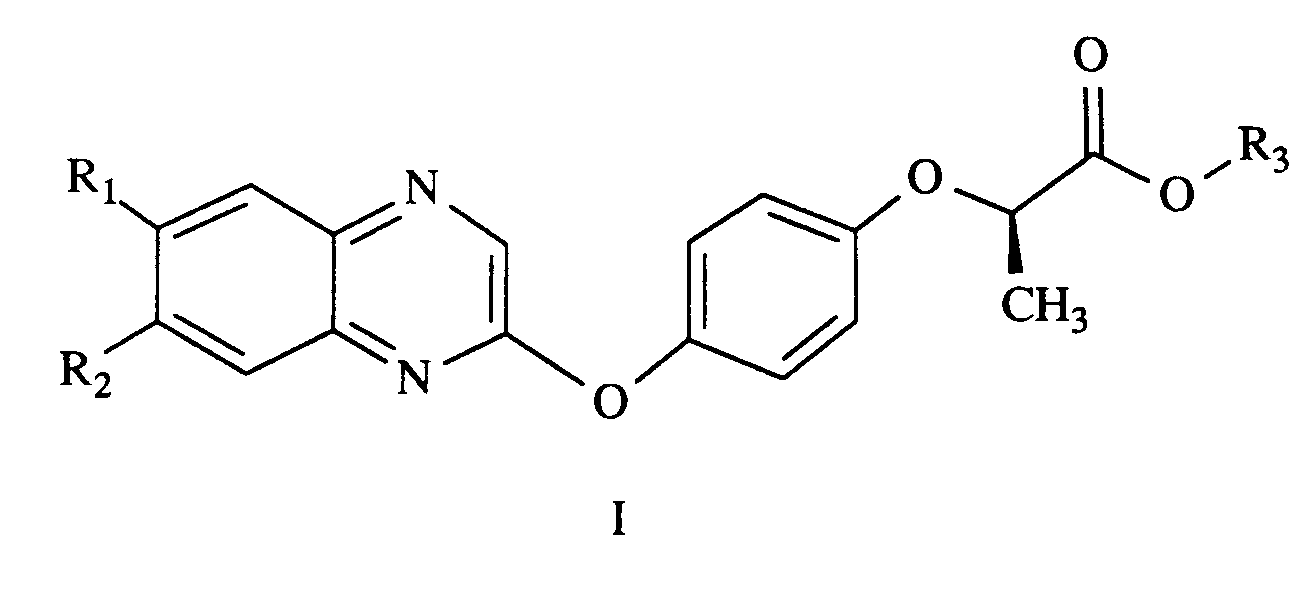 R₁ H, Halogen, C₁-C₄-Haloalkyl, CN, NO₂, C₁-C₄-Alkyl, oder C₁-C₄-Alkoxy,R₂ H oder Halogen,R₃ C₁-C₁₈-Alkyl, Benzyl, C₅-C₈-Cycloalkyl, C₃-C₄-Alkenyl, das unsubstituiert oder durch ein oder mehrere Halogenatome substituiert ist, C₃-C₄-Alkinyl, das unsubstituiert oder durch ein oder mehrere Halogenatome substituiert ist, oder (CH₂)n(O)mR₄,R₄ C₁-C₆-Alkyl, das unsubstituiert oder durch C₁-C₆-Alkoxy substituiert ist, oder einen 5- oder 6-gliedrigen Ring, der gesaettigt oder ungesaettigt ist, carbocyclisch ist oder heterocyclisch mit 1 bis 4 Heteroatomen aus der Gruppe Sauerstoff und Stickstoff ist und unsubstituiert oder durch 1-3 Substituenten aus der Gruppe Oxo, C₁-C₃-Alkyl, C₁-C₃-Alkoxy substituiert ist, oder eine Gruppe der allgemeinen Formel N=CR₅R₆,R₅ und R₆ unabhaengig voneinander C₁-C₆-Alkyl, C₃-C₈-Cycloalkyl, C₁-C₆-Alkylcarbonyloxy-C₁-C₆-alkyl, C₁-C₆-Alkoxy, C₁-C₆-Alkylthio oder zusammen mit dem Kohlenstoffatom, an das sie geknuepft sind, einen Cycloalkylrest mit 3-8 Ringgliedern,n 1 oder 2 undm 0 oder 1bedeuten,
dadurch gekennzeichnet, dass man
ein substituiertes Chinoxalin der allgemeinen Formel II, R₁ und R₂ die gleiche Bedeutung wie in Formel I haben undX eine Abgangsgruppe, wie z. B. Halogen, insbesondere Chlor und Brom, sowie Methansulfonyl,ist,
mit einem (D)-2-(4-hydroxyphenoxy)propionat der allgemeinen Formel III, worinR₇ C₁-C₄ Alkylist,
umsetzt und fuer den Fall, dass R₃ ungleich R₇ sein soll, den so erhaltenen Niederalkylester der allgemeinen Formel IV bzw. der Formel I, worin R₃=R₇ ist,
- Verfahren nach Anspruch 1, dadurch gekennzeichnet, dassR₃ C₁-C₈-Alkyl, Benzyl, C₅-C₆-Cycloalkyl, C₃-C₄-Alkenyl, C₃-C₄-Alkinyl, oder (CH₂)n(O)mR₄,R₄ C₁-C₄-Alkyl, (C₁-C₆-Alkoxy)-C₁-C₄-Alkyl, einen 5- oder 6-gliedrigen gesaettigten oder ungesaettigten Ring, der carbocyclisch oder heterocyclisch mit 0 bis 3 Sauerstoffatomen und 0 bis 2 Stickstoffatomen als Ringatomen von maximal 3 Heteroringatomen ist und unsubstituiert oder durch 1-3 Substituenten aus der Gruppe Oxo, Methyl, Ethyl, n- und i-Propyl, Methoxy, Ethoxy und n- und i-Propoxy substituiert ist, oder N=CR₅R₆,R₅ und R₆ unabhaengig voneinander C₁-C₄-Alkyl, C₅-C₆-Cycloalkyl, C₁-C₄-Alkylcarbonyloxy-C₁-C₄-alkyl, C₁-C₄-Alkoxy, C₁-C₄-Alkylthio oder zusammen mit dem Kohlenstoffatom, an das sie geknuepft sind, einen Cycloalkylrest mit 5-6 Ringgliedern,n 1 oder 2 undm 0 oder 1bedeuten.
- Verfahren nach Anspruch 1 oder 2, dadurch gekennzeichnet, dass man die Reaktion von Verbindung II mit Verbindung III in einem unpolaren, organischen Loesungsmittel durchfuehrt.
- Verfahren nach einem oder mehreren der Ansprüche 1-3, dadurch gekennzeichnet, dass man als Loesungsmittel Heptan, Toluol, Xylol, Cumol, Mesitylen, Chlorbenzol oder die isomeren Dichlorbenzole verwendet.
- Verfahren nach einem oder mehreren der Ansprüche 1-4, dadurch gekennzeichnet, dass man die Reaktion von Verbindung II mit Verbindung III in Gegenwart eines Säurebinders durchführt.
- Verfahren nach Anspruch 5, dadurch gekennzeichnet, dass man als Säurebinder Alkalicarbonate oder Alkalihydrogencarbonate verwendet.
- Verfahren nach einem oder mehreren der Ansprüche 1-6, dadurch gekennzeichnet, dass man die Reaktion von Verbindung II mit Verbindung III in Gegenwart eines Katalysators aus der Gruppe der quartaeren Ammonium- oder Phosphoniumsalze, der Polyalkylenglykole sowie ihrer Niederalkylether, der Kronenether oder der acyclischen Kryptanden durchfuehrt.
- Verfahren nach Anspruch 7, dadurch gekennzeichnet, dass man als Katalysatoren langkettige Polyethylenglykole mit einem mittleren Molekulargewicht von 1000 bis 3000 verwendet.
- Verfahren nach Anspruch 7 oder8, dadurch gekennzeichnet, dass man die Katalysatoren in Mengen von 0,05 bis 1,0 mol%, bezogen auf die Verbindung der allgemeinen Formel II, verwendet.
- Verfahren nach einem oder mehreren der Ansprüche 1-9, dadurch gekennzeichnet, dass man die Umsetzung von Verbindung der Formel II mit Verbindung der Formel III 30°C bis 150 °C durchfuehrt.
- Verfahren nach einem oder mehreren der Ansprüche 1-10, dadurch gekennzeichnet, dass man das Zwischenprodukt der genannten Formel IV mit einem 2- bis 100-fachen Ueberschuss des Alkohols der Formel R₃OH, worin R₃ die genannte Bedeutung hat, umestert.
- Verfahren nach Anspruch 11, dadurch gekennzeichnet, dass man die Umesterung in Gegenwart eines Katalysators aus der Gruppe der Titan-IV-tetraalkoxide durchfuehrt.
- Verfahren nach Anspruch 12, dadurch gekennzeichnet, dass man den Katalysator in Mengen von 2 bis 50 mol% bezogen auf die Komponente der Formel IV einsetzt.
- Verfahren nach einem oder mehreren der Ansprüche 11-13, dadurch gekennzeichnet, dass man die Umesterung bei 80 °C bis 120 °C durchfuehrt.
Applications Claiming Priority (2)
| Application Number | Priority Date | Filing Date | Title |
|---|---|---|---|
| DE4042098A DE4042098C2 (de) | 1990-12-28 | 1990-12-28 | Verfahren zur Herstellung optisch aktiver Chinoxalinyloxy-phenoxypropionsäureester |
| DE4042098 | 1990-12-28 |
Publications (3)
| Publication Number | Publication Date |
|---|---|
| EP0492629A2 true EP0492629A2 (de) | 1992-07-01 |
| EP0492629A3 EP0492629A3 (en) | 1993-01-13 |
| EP0492629B1 EP0492629B1 (de) | 1995-09-20 |
Family
ID=6421615
Family Applications (1)
| Application Number | Title | Priority Date | Filing Date |
|---|---|---|---|
| EP91122231A Expired - Lifetime EP0492629B1 (de) | 1990-12-28 | 1991-12-24 | Verfahren zur Herstellung optisch aktiver Chinoxalinyloxyphenoxypropionsäureester |
Country Status (10)
| Country | Link |
|---|---|
| EP (1) | EP0492629B1 (de) |
| JP (1) | JPH04295469A (de) |
| KR (1) | KR920012048A (de) |
| AU (1) | AU653376B2 (de) |
| BR (1) | BR9105529A (de) |
| CA (1) | CA2058320A1 (de) |
| DE (2) | DE4042098C2 (de) |
| HU (1) | HU208682B (de) |
| IL (1) | IL100531A (de) |
| ZA (1) | ZA9110055B (de) |
Cited By (1)
| Publication number | Priority date | Publication date | Assignee | Title |
|---|---|---|---|---|
| RU2174514C2 (ru) * | 1996-06-03 | 2001-10-10 | Ниссан Кемикал Индастриз, Лтд. | Способы получения производных феноксипропионовой кислоты (варианты) |
Families Citing this family (2)
| Publication number | Priority date | Publication date | Assignee | Title |
|---|---|---|---|---|
| CN102584803B (zh) * | 2012-01-19 | 2014-12-10 | 江苏丰山集团有限公司 | 一种高含量喹禾糠酯的制备方法 |
| CN105461643A (zh) * | 2015-12-18 | 2016-04-06 | 京博农化科技股份有限公司 | 一种精喹禾灵制剂的制备方法 |
Family Cites Families (10)
| Publication number | Priority date | Publication date | Assignee | Title |
|---|---|---|---|---|
| JPS6033389B2 (ja) * | 1979-02-22 | 1985-08-02 | 日産化学工業株式会社 | 複素環エ−テル系フェノシキ脂肪酸誘導体、その製造法および該誘導体を含有する除草剤 |
| CA1317299C (en) * | 1980-06-23 | 1993-05-04 | Maged Mohamed Fawzi | Quinoxalinyloxy ethers as selective weed control agents |
| ZA818027B (en) * | 1980-11-26 | 1982-10-27 | Hoffmann La Roche | Oxime esters |
| NZ199342A (en) * | 1981-01-12 | 1985-08-16 | Ici Australia Ltd | Quinoxaline derivatives and herbicides |
| JPS6183144A (ja) * | 1984-09-28 | 1986-04-26 | Nissan Chem Ind Ltd | 2−(4−ヒドロキシフエノキシ)プロピオン酸の光学分割法 |
| JPH0610154B2 (ja) * | 1984-12-28 | 1994-02-09 | 日産化学工業株式会社 | 光学活性2−(4−ヒドロキシフエノキシ)プロピオン酸の製法 |
| US4687849A (en) * | 1985-10-04 | 1987-08-18 | Hoffmann-La Roche Inc. | [(Isopropylideneamino)oxy]-ethyl-2-[[6-chloroquinoxalinyl)oxy]phenoxy]propionate postemergent herbicide |
| DE122008000064I2 (de) * | 1988-01-06 | 2011-06-16 | Chemtura Corp N D Ges D Staates Delaware | Herbizide Heterozyklisch-alkylen-Chinoxalinyloxyphenoxy Propansäureester. |
| US4897481A (en) * | 1988-05-31 | 1990-01-30 | The Dow Chemical Company | Process for the minimization of racemization in the preparation of optically active ((aryloxy)phenoxy)propionate herbicides |
| AU6540490A (en) * | 1989-10-05 | 1991-04-28 | Hoechst Aktiengesellschaft | Herbicidal, heterocyclically substituted phenoxyalkane carboxylic acid derivatives and process for preparing them |
-
1990
- 1990-12-28 DE DE4042098A patent/DE4042098C2/de not_active Expired - Fee Related
-
1991
- 1991-12-19 BR BR919105529A patent/BR9105529A/pt unknown
- 1991-12-20 ZA ZA9110055A patent/ZA9110055B/xx unknown
- 1991-12-23 CA CA002058320A patent/CA2058320A1/en not_active Abandoned
- 1991-12-24 DE DE59106542T patent/DE59106542D1/de not_active Expired - Fee Related
- 1991-12-24 EP EP91122231A patent/EP0492629B1/de not_active Expired - Lifetime
- 1991-12-24 AU AU90080/91A patent/AU653376B2/en not_active Ceased
- 1991-12-26 JP JP3345246A patent/JPH04295469A/ja active Pending
- 1991-12-26 IL IL10053191A patent/IL100531A/en not_active IP Right Cessation
- 1991-12-27 KR KR1019910024633A patent/KR920012048A/ko not_active Ceased
- 1991-12-27 HU HU914124A patent/HU208682B/hu not_active IP Right Cessation
Cited By (1)
| Publication number | Priority date | Publication date | Assignee | Title |
|---|---|---|---|---|
| RU2174514C2 (ru) * | 1996-06-03 | 2001-10-10 | Ниссан Кемикал Индастриз, Лтд. | Способы получения производных феноксипропионовой кислоты (варианты) |
Also Published As
| Publication number | Publication date |
|---|---|
| HU208682B (en) | 1993-12-28 |
| DE4042098A1 (de) | 1992-07-02 |
| HU914124D0 (en) | 1992-03-30 |
| EP0492629B1 (de) | 1995-09-20 |
| JPH04295469A (ja) | 1992-10-20 |
| AU9008091A (en) | 1992-07-02 |
| IL100531A (en) | 1996-03-31 |
| AU653376B2 (en) | 1994-09-29 |
| BR9105529A (pt) | 1992-09-01 |
| CA2058320A1 (en) | 1992-06-29 |
| ZA9110055B (en) | 1992-09-30 |
| DE4042098C2 (de) | 1993-10-07 |
| DE59106542D1 (de) | 1995-10-26 |
| IL100531A0 (en) | 1992-09-06 |
| KR920012048A (ko) | 1992-07-25 |
| HUT61291A (en) | 1992-12-28 |
| EP0492629A3 (en) | 1993-01-13 |
Similar Documents
| Publication | Publication Date | Title |
|---|---|---|
| EP0002800B1 (de) | Optisch aktive alpha-Phenoxypropionsäure Derivate | |
| WO2002002532A1 (de) | 4-alkoxy-cyclohexan-1-amino-carbonsäureester und verfahren zu ihrer herstellung | |
| EP0373464A2 (de) | Verfahren zur Herstellung von 2-Chlor-5-chlormethylpyridin | |
| EP0702003A2 (de) | Verfahren zur Herstellung von 2-Halogenpyridinaldehyden und neue 2-Halogenpyridinaldehyde | |
| EP0492629B1 (de) | Verfahren zur Herstellung optisch aktiver Chinoxalinyloxyphenoxypropionsäureester | |
| EP0678502A1 (de) | Verfahren zur Herstellung von Glykoloylaniliden | |
| CH542202A (de) | Verfahren zur Herstellung von Indolinderivaten | |
| EP0628536B1 (de) | Verfahren zur Herstellung von aromatischen Aminen | |
| DE3236730A1 (de) | Verfahren zur herstellung von benzoxazolyl- und benzthiazolyloxyphenoxypropionsaeurederivaten | |
| EP0380712A1 (de) | Verfahren zur Herstellung von 2,6-Dichlordiphenylaminessigsäurederivaten | |
| EP0089417B1 (de) | Verfahren zur Herstellung von Phthalid | |
| EP0548650A1 (de) | Verfahren zur Herstellung von substituierten 3-Alkoxy-acrylestern | |
| EP0624567B1 (de) | Derivate des 3-Fluorphenols, Verfahren zu ihrer Herstellung und ihre Verwendung | |
| EP0394644B1 (de) | Halogenbenzolderivate | |
| DE19524337C1 (de) | Verfahren zur Herstellung von beta-Amino-alpha-hydroxycarbonsäuren und deren Derivaten | |
| DE4318092C1 (de) | Verfahren zur Herstellung von (R)- oder (S)-2-(4-Alkanoylphenoxy)- und (R)- oder (S)-2-(4-Aroylphenoxy)-propionsäureestern | |
| DE602004000253T2 (de) | Verfahren zur Herstellung von Hexahydropyridazin-3-carbonsäure-Derivaten | |
| EP0678518A1 (de) | Verfahren zur Herstellung von Zwischenprodukten für die Synthese von Glucose-6-Phosphatase-Inhibitoren sowie neue Zwischenprodukte | |
| WO1997020946A1 (de) | Verfahren zur herstellung von optisch aktiven aminen | |
| EP0634411B1 (de) | Verfahren zur Herstellung von 8- 4'-[4"-(Pyrimidin-2'''-yl)-piperazin-1"-yl]-butyl -8-aza-spiro[4,5] decan-7,9-dion (= Buspiron) und dessen Hydrochloriden in hoher Reinheit | |
| EP0373463B1 (de) | Verfahren zur Herstellung von 2-Chlor-5-chlormethylpyridin | |
| DE3037086A1 (de) | 3-(m-chloranilino-)acrylsaeureaethylester und ein verfahren zu dessen herstellung | |
| EP0952150B1 (de) | Verfahren zur Herstellung von Phenoxypropinsäurepropargylestern | |
| EP0811607A1 (de) | Verfahren zur Nitrosierung von C-H-aciden Verbindungen | |
| EP0038007B1 (de) | Verfahren zur Herstellung von N-(3,5-Dichlorphenyl)-oxazolidin-2,4-dionen |
Legal Events
| Date | Code | Title | Description |
|---|---|---|---|
| PUAI | Public reference made under article 153(3) epc to a published international application that has entered the european phase |
Free format text: ORIGINAL CODE: 0009012 |
|
| AK | Designated contracting states |
Kind code of ref document: A2 Designated state(s): BE CH DE FR GB IT LI NL |
|
| PUAL | Search report despatched |
Free format text: ORIGINAL CODE: 0009013 |
|
| AK | Designated contracting states |
Kind code of ref document: A3 Designated state(s): BE CH DE FR GB IT LI NL |
|
| 17P | Request for examination filed |
Effective date: 19930707 |
|
| 17Q | First examination report despatched |
Effective date: 19930917 |
|
| RAP1 | Party data changed (applicant data changed or rights of an application transferred) |
Owner name: HOECHST SCHERING AGREVO GMBH |
|
| GRAA | (expected) grant |
Free format text: ORIGINAL CODE: 0009210 |
|
| AK | Designated contracting states |
Kind code of ref document: B1 Designated state(s): BE CH DE FR GB IT LI NL |
|
| REF | Corresponds to: |
Ref document number: 59106542 Country of ref document: DE Date of ref document: 19951026 |
|
| ITF | It: translation for a ep patent filed | ||
| GBT | Gb: translation of ep patent filed (gb section 77(6)(a)/1977) |
Effective date: 19951127 |
|
| ET | Fr: translation filed | ||
| PLBE | No opposition filed within time limit |
Free format text: ORIGINAL CODE: 0009261 |
|
| STAA | Information on the status of an ep patent application or granted ep patent |
Free format text: STATUS: NO OPPOSITION FILED WITHIN TIME LIMIT |
|
| 26N | No opposition filed | ||
| PGFP | Annual fee paid to national office [announced via postgrant information from national office to epo] |
Ref country code: FR Payment date: 19971128 Year of fee payment: 7 |
|
| PGFP | Annual fee paid to national office [announced via postgrant information from national office to epo] |
Ref country code: GB Payment date: 19971201 Year of fee payment: 7 |
|
| PGFP | Annual fee paid to national office [announced via postgrant information from national office to epo] |
Ref country code: BE Payment date: 19971204 Year of fee payment: 7 |
|
| PGFP | Annual fee paid to national office [announced via postgrant information from national office to epo] |
Ref country code: NL Payment date: 19971205 Year of fee payment: 7 |
|
| PGFP | Annual fee paid to national office [announced via postgrant information from national office to epo] |
Ref country code: CH Payment date: 19971211 Year of fee payment: 7 |
|
| PGFP | Annual fee paid to national office [announced via postgrant information from national office to epo] |
Ref country code: DE Payment date: 19980123 Year of fee payment: 7 |
|
| PG25 | Lapsed in a contracting state [announced via postgrant information from national office to epo] |
Ref country code: GB Free format text: LAPSE BECAUSE OF NON-PAYMENT OF DUE FEES Effective date: 19981224 |
|
| PG25 | Lapsed in a contracting state [announced via postgrant information from national office to epo] |
Ref country code: LI Free format text: LAPSE BECAUSE OF NON-PAYMENT OF DUE FEES Effective date: 19981231 Ref country code: CH Free format text: LAPSE BECAUSE OF NON-PAYMENT OF DUE FEES Effective date: 19981231 Ref country code: BE Free format text: LAPSE BECAUSE OF NON-PAYMENT OF DUE FEES Effective date: 19981231 |
|
| BERE | Be: lapsed |
Owner name: HOECHST SCHERING AGREVO G.M.B.H. Effective date: 19981231 |
|
| PG25 | Lapsed in a contracting state [announced via postgrant information from national office to epo] |
Ref country code: NL Free format text: LAPSE BECAUSE OF NON-PAYMENT OF DUE FEES Effective date: 19990701 |
|
| GBPC | Gb: european patent ceased through non-payment of renewal fee |
Effective date: 19981224 |
|
| REG | Reference to a national code |
Ref country code: CH Ref legal event code: PL |
|
| PG25 | Lapsed in a contracting state [announced via postgrant information from national office to epo] |
Ref country code: FR Free format text: LAPSE BECAUSE OF NON-PAYMENT OF DUE FEES Effective date: 19990831 |
|
| NLV4 | Nl: lapsed or anulled due to non-payment of the annual fee |
Effective date: 19990701 |
|
| REG | Reference to a national code |
Ref country code: FR Ref legal event code: ST |
|
| PG25 | Lapsed in a contracting state [announced via postgrant information from national office to epo] |
Ref country code: DE Free format text: LAPSE BECAUSE OF NON-PAYMENT OF DUE FEES Effective date: 19991001 |
|
| PG25 | Lapsed in a contracting state [announced via postgrant information from national office to epo] |
Ref country code: IT Free format text: LAPSE BECAUSE OF NON-PAYMENT OF DUE FEES Effective date: 20051224 |