EP0492983A2 - Système et procédé frigorifique - Google Patents
Système et procédé frigorifique Download PDFInfo
- Publication number
- EP0492983A2 EP0492983A2 EP91311795A EP91311795A EP0492983A2 EP 0492983 A2 EP0492983 A2 EP 0492983A2 EP 91311795 A EP91311795 A EP 91311795A EP 91311795 A EP91311795 A EP 91311795A EP 0492983 A2 EP0492983 A2 EP 0492983A2
- Authority
- EP
- European Patent Office
- Prior art keywords
- cooling water
- food
- cooling
- cryogenic
- vapour
- Prior art date
- Legal status (The legal status is an assumption and is not a legal conclusion. Google has not performed a legal analysis and makes no representation as to the accuracy of the status listed.)
- Withdrawn
Links
Images

Classifications
-
- A—HUMAN NECESSITIES
- A23—FOODS OR FOODSTUFFS; TREATMENT THEREOF, NOT COVERED BY OTHER CLASSES
- A23B—PRESERVATION OF FOODS, FOODSTUFFS OR NON-ALCOHOLIC BEVERAGES; CHEMICAL RIPENING OF FRUIT OR VEGETABLES
- A23B2/00—Preservation of foods or foodstuffs, in general
- A23B2/80—Freezing; Subsequent thawing; Cooling
- A23B2/803—Materials being transported through or in the apparatus, with or without shaping, e.g. in the form of powders, granules or flakes
-
- A—HUMAN NECESSITIES
- A23—FOODS OR FOODSTUFFS; TREATMENT THEREOF, NOT COVERED BY OTHER CLASSES
- A23B—PRESERVATION OF FOODS, FOODSTUFFS OR NON-ALCOHOLIC BEVERAGES; CHEMICAL RIPENING OF FRUIT OR VEGETABLES
- A23B2/00—Preservation of foods or foodstuffs, in general
- A23B2/80—Freezing; Subsequent thawing; Cooling
- A23B2/85—Freezing; Subsequent thawing; Cooling with addition of or treatment with chemicals
- A23B2/88—Freezing; Subsequent thawing; Cooling with addition of or treatment with chemicals with direct contact between the food and the chemical, e.g. liquid N2 at cryogenic temperature
-
- F—MECHANICAL ENGINEERING; LIGHTING; HEATING; WEAPONS; BLASTING
- F25—REFRIGERATION OR COOLING; COMBINED HEATING AND REFRIGERATION SYSTEMS; HEAT PUMP SYSTEMS; MANUFACTURE OR STORAGE OF ICE; LIQUEFACTION SOLIDIFICATION OF GASES
- F25D—REFRIGERATORS; COLD ROOMS; ICE-BOXES; COOLING OR FREEZING APPARATUS NOT OTHERWISE PROVIDED FOR
- F25D9/00—Devices not associated with refrigerating machinery and not covered by groups F25D1/00 - F25D7/00; Combinations of devices covered by two or more of the groups F25D1/00 - F25D7/00
Definitions
- the present invention relates to a refrigeration apparatus and method having two or more cooling stages in which food is refrigerated by transferring heat from the food to cooling water and then to a liquid cryogen causing the cryogen to boil and thereby evolve a cryogenic vapour.
- the present invention also relates to a method and apparatus for cooling articles in which cooling potential of a cryogenic vapour is recovered in the cooling water by drawing the cryogenic vapour into a mixture with cooling water through use of an eductor.
- liquid cryogen as used herein includes within its cope liquid nitrogen and liquid carbon dioxide.
- Refrigeration systems are known in which heat is extracted from the articles of food in sequential cooling stages.
- a first of the cooling stages can comprise a hydrocooler, i.e. a cooler in which water is used as a cooling medium and a second of the cooling stages can comprise a cryogenic freezer, such as a liquid nitrogen immersion freezer used, if desired, in conjunction with a liquid nitrogen immersion freezer, or a carbon dioxide spiral belt freezer.
- a third cooling stage can be formed by a mechanical freezer.
- the hydrocooler by provision of a water bath or water shower arrangement, pre-chills the food with cooling water, from a well or a tap or brine.
- cryogenic cooler freezer food is chilled by a bath or spray of cryogen to a temperature above freezing, crust frozen, or frozen throughout.
- a mechanical freezer is provided to complete the freezing of the food by transferring heat from the food to a recirculating refrigerant such as ammonia.
- a food refrigeration system used in freezing fruit may consist of, in order, a hydrocooler, a liquid nitrogen immersion freezer and post cooling tunnel, and a mechanical freezer.
- the hydrocooler is used to pre-chill the fruit
- the liquid nitrogen immersion freezer and post cooling tunnel are used to crust freeze the fruit
- the mechanical freezer is used to freeze the fruit throughout.
- the initial crust freezing of the fruit prevents the cellular damage to the fruit that would otherwise occur if the fruit were solely frozen throughout in a mechanical freezer.
- Another food refrigeration system may be formed by a hydrocooler and a liquid nitrogen immersion freezer without a post cooling tunnel; or a hydrocooler and a carbon dioxide spiral belt freezer. Such a refrigeration system could be used to freeze vegetables throughout without first crust freezing the vegetables.
- a liquid nitrogen immersion freezer may be used alone as a chiller to prevent articles of food, of a kind which in one stage of their processing are hot and sticky, from sticking to conveyor belts employed in moving the food through a food processing system.
- the term, "refrigeration" as used herein encompasses freezing, crust freezing and chilling.
- the liquid cryogen in the cryogenic freezer is continually being expended in that the heat transfer to the liquid cryogen causes the cryogen to boil and thereby evolve cryogenic vapour which is vented from the refrigeration system.
- the cryogen must be continually replenished.
- the hydrocooler reduces the operating costs involved in continually replenishing the cryogen because the initial heat transfer to the cooling water in the hydrocooler decreases the cryogen requirements in the cryogenic freezer by pre-chilling the articles of food.
- the distribution of heat transfer between a hydrocooler and a cryogenic freezer decreases the amount of heat transfer between the cryogen and the food and thus, the rate of consumption of cryogenic liquid in the cryogenic freezer. It is appropriate to point out that the hydrocooler may also serve to rinse debris and surface contaminants from the articles to be eventually frozen.
- cryogenic vapour such as is evolved in a liquid nitrogen immersion freezer
- cryogenic vapour may be used to pre-cool the articles of food prior to their immersion in the liquid cryogen and thereby to conserve the amount of liquid cryogen needed for the particular refrigeration operation.
- a problem with using cryogenic vapour in this manner is that food articles tend to become dehydrated; and such dehydration results in a loss of food flavouring.
- pre-chillers using extract heat cryogenic gas relatively inefficiently.
- refrigeration systems such as those discussed above, are operated for long periods of time.
- One major operating expense is therefore the consumption of cryogen.
- An additional expense is the water usage.
- the present invention conserves both the cryogen and water to reduce such expenses.
- the invention provides an apparatus as claimed in any one of claims 1 to 7, 11, 13 and 14, and a method as claimed in any one of claims 8 to 10, 12 and 15.
- the present invention provides a food processing system and method for refrigerating food.
- the system comprises a supply of a cryogen, a source of cooling water, and at least two sequential cooling stages for transferring an amount of heat from the food sufficient to refrigerate the articles of food.
- the cooling water has a temperature lower than that of the food to define a temperature difference between the food and the cooling water.
- means are provided, such as a hydrocooler, for transferring a portion of the amount of heat from the articles to the cooling water in proportion to the temperature difference between the food and the cooling water.
- a second of the at least two sequential cooling stages has means, such as a cryogenic freezer, for transferring a remaining portion of the amount of heat from the food to the cryogen so that a quantity of the cryogen boils off into a cryogenic vapour and is thereby expended.
- means such as a cryogenic freezer
- the degree to which the cryogen is expended is decreased over prior art hydrocooler and cryogenic freezer arrangements by means, preferably a pump connected to the source of cooling water and an eductor connected to the pump and to the second of the at least two sequential cooling stages.
- Such means transfer further heat from the cooling water to the cryogenic vapour and thereby increase the temperature difference between the food and the cooling water.
- Delivery means are provided for thereafter delivering the cooling water to the first of the at least two sequential cooling stages.
- the delivery means can comprise a phase separation tank into which the cooling water is discharged from the eductor. Cooling water may be recycled from the first of the at least two cooling stages back to the phase separation tank instead of being discharged into a municipal sewer. As a result, the rate of water usage can also be reduced over prior art refrigeration systems.
- a cryogen is supplied along with cooling water at a temperature lower than that of the food to define a temperature difference between the food and the cooling water.
- An amount of heat is transferred from the articles in at least two sequential cooling stages so that the articles are refrigerated.
- a portion of the amount of heat is transferred from the food to the cooling water in proportion to the temperature difference between the food and the cooling water
- a remaining portion of the amount of heat is transferred from the food to the cryogen so that a quantity of the cryogen boils off into a cryogenic vapour and is thereby expended.
- cooling water Further heat is also transferred from the cooling water to the cryogenic vapour to increase the temperature difference between the food and the cooling water. Thereafter the cooling water is delivered to the the first of the at least two sequential cooling stages so that the portion of heat transferred from the articles to the cooling water is increased and the regaining portion of heat transferred from the food to the cryogen is reduced along with the quantity of the cryogen expended.
- the present invention provides an apparatus and method of cooling an article with a motive fluid having a temperature lower than that of the article.
- the apparatus comprises a source of the motive fluid, a source of cryogenic vapour, heat transfer means, a pump, eductor means and delivery means.
- the heat transfer means are provided for transferring heat from the article to the motive fluid.
- the pump has an inlet connected to the source of motive fluid and an outlet.
- the eductor means is connected to the outlet of the pump and the source of cryogenic vapour for drawing the cryogenic vapour into a mixture with the motive fluid, thereby effecting further heat transfer from the motive fluid to the cryogenic vapour and lowering the temperature of the motive fluid.
- the delivery means deliver the motive fluid from the eductor means to the heat transfer means.
- the present invention provides a method of cooling an article with a motive fluid having a temperature lower than that of the article.
- the motive fluid and a cryogenic vapour are supplied and heat is transferred from the article to the motive fluid thereby to cool the article.
- the motive fluid Prior to the heat transfer from the article to the motive fluid, the motive fluid is pumped through eductor means for drawing the cryogenic vapour into a mixture with the motive fluid and thereby transferring further heat from the motive fluid to the cryogenic vapour and lowering the temperature of the motive fluid.
- the heat transfer from the article to the motive fluid and the cooling of the article are enhanced by the lower temperature of the motive fluid.
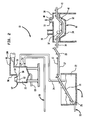
- a food refrigeration system 10 in accordance with the present invention is illustrated.
- the food refrigeration system 10 is used in the freezing of food 12 and is provided with three cooling stages formed by a hydrocooler 14, a liquid nitrogen immersion freezer 16, and a mechanical freezer 18.
- the food refrigeration system 10 is designed to be used in a seafood processing plant and food 10 comprises clams to be frozen for preservation purposes.
- the food is first loaded onto a conveyor belt 20 located within hydrocooler 14.
- the hydrocooler 14 is of tank-like construction and contains cooling water 22 that is supplied by a delivery-pipe 24 and is drained from a drain 26.
- the cooling water 22 has a temperature lower than that of the food 12. There is thus a temperature difference by which heat is transferred from the food 12 to the cooling water 22.
- liquid nitrogen immersion freezer 16 consists of a trough 32 for receiving liquid nitrogen 34.
- Liquid nitrogen 34 is supplied via an inlet pipe 36 having an opening 37.
- the trough 34 is covered by an insulated cover 38 having a vent 40.
- the conveyor 30 transfers the food 12 to a further conveyor 42 which immerses the food 2.
- the food 12 is immersed in liquid nitrogen 34 in trough 32 and then transfers the food 12 via an outlet conveyor 43 onto a shake table 44.
- immersion freezer 16 can be a CIF-300 Series Liquid Nitrogen Immersion Freezer manufactured by Koach Engineering MFG, Inc. of 8950 Glenoaks Blvd., Sun Valley, California, 91352-2059.
- the shake table 44 conducts food 12 to mechanical freezer 18 which can be a fluidised bed freezer, for example a Lewis IQF Freezer Series or a Flo-Freeze Series Freezer, manufactured by FrigoScandia Contracting, AB of Rushhallsgatan 21, S-251 09 Helsingborg, Sweden.
- mechanical freezer 18 can be a fluidised bed freezer, for example a Lewis IQF Freezer Series or a Flo-Freeze Series Freezer, manufactured by FrigoScandia Contracting, AB of Rushhallsgatan 21, S-251 09 Helsingborg, Sweden.
- the hydrocooler 14 functions to pre-chill and clean the food 12 before the food 12 is crust frozen in the liquid nitrogen immersion freezer 16. After being crust frozen in liquid the nitrogen immersion freezer 16, freezing is completed, that is food 12 is frozen throughout, in the mechanical freezer 18.
- the amount of heat required to be transferred from the food 12 in its crust freezing is distributed between the hydrocooler 14 and the liquid nitrogen immersion freezer 16. In other words, a portion of the heat is transferred to the cooling water 14 and a remaining portion of the heat is transferred to the liquid nitrogen 34 in the trough 32.
- the temperature of the cooling water 22, as supplied from a source ground water or from a source of municipal water is lower than that of the food 12 and hence, there is some degree of heat transfer between the food 12 and the cooling water 22.
- the cryogen in this case liquid nitrogen
- the cryogen is further conserved by recovering the cooling potential of the nitrogen vapour in cooling water 22.
- the cooling potential of the nitrogen vapour is recovered by transferring further heat from cooling water 22 to the nitrogen vapour prior to the reception of cooling water 22 in the hydrocooler 14.
- the temperature of cooling water 22 is lowered and thus, there exists a greater degree of heat transfer between the cooling water 22 and food 12 than in the prior art. Consequently, cryogen requirements are further reduced over hydrocooler and cryogenic freezer arrangements of the prior art.
- a major problem in recovering the cooling potential of the nitrogen vapour is that the nitrogen vapour venting from liquid the nitrogen immersion freezer 16, can have a temperature as low as 77K, low enough to freeze water.
- This problem is solved in the present invention by accomplishing the heat transfer between the cooling water 22 and the nitrogen vapour in an eductor 50.
- the eductor 50 is connected to a phase separation tank 52 in which cooling water 22 accumulates.
- Accumulated cooling water 22 is preferably gravity fed from an outlet 54 of a phase separation tank 52 to the hydrocooler 14 via a delivery line 24 connected to the outlet 54.
- cooling water 22 passes out of the hydrocooler 14 through drain 26 and is recycled to the phase separation tank 52 via a recycle line 56 having an in-line recycle pump 58 and optionally an optional filter 60, used when cooling water 22 is also used in cleaning food 12.
- Cooling water 22 is pumped through the eductor 50 by a pump 62, powered by an electric motor 64.
- the pump 62 has an inlet 66 and an outlet 68.
- a transfer pipe 69 affords communication between an inlet 66 of a pump 62 and the bottom of the phase separation tank 52.
- An outlet pipe 70 affords communication between the outlet 68 of the pump 62 and the eductor 50.
- the eductor 50 is connected to vent 40 of liquid nitrogen immersion freezer 16 by a vent duct 72.
- the pump 62 pumps cooling water 22 through the eductor 50, which in turn, draws boiled off nitrogen vapour into a mixture with cooling water 22. As a result of such mixing, heat is directly transferred from cooling water 22 to the nitrogen vapour.
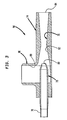
- Eductor 50 includes a body portion 74 having a central passageway 76. In one end of central passageway 76, an internal nozzle 78 is connected to body portion 74. Internal nozzle 78 is in turn connected, at one end, to outlet pipe 70. The other end of internal nozzle 78 defines nozzle orifice 80 within central passageway 76. Beyond nozzle orifice 80, central passageway 76 gradually reduces in transverse cross-sectional area to a central region 82 and then gradually increases to form a discharge opening 84.
- Body portion 74 is also provided with a gas inlet section 86 connected to vent duct 72. Gas inlet opening section 86 is provided with an inlet passage 88 in communication with central passageway 76 near restriction orifice 80.
- cooling water 22 may freeze to some degree at or near the centre of the central passageway 76, the constant flow of cooling water 22 prevents freezing from occurring throughout the entire cross-section of the central passageway 76. Any such frozen water would subsequently thaw in the phase separation tank 52.
- cooling water 22 undergoes a drop in pressure when passing through restriction orifice 80.
- the drop in pressure in turn produces a low pressure region in central passageway 76 of eductor 50 which draws the nitrogen vapour through vent duct 72 and into a mixture with pumped cooling water 22.
- the mixing of the nitrogen vapour and cooling water 22 occurs within central passageway 76, beyond nozzle orifice 80. Maximum mixing occurs in central region 82.
- a mixture of cooling water 22 and nitrogen vapour is discharged from eductor 50 through its discharge orifice 84.
- the discharge opening 84 of eductor 50 can be mounted on a suitable mounting (not illustrated) to deliver directly the cooling water from eductor 50 to hydrocooler 14.
- a suitable mounting not illustrated
- phase separation tank can be constructed so as to be open at the top thereof, preferably it is provided with a top wall 90 having two openings 92 and 94.
- the eductor 50 is connected to the top wall 90 with its discharge opening 84 aligned with the opening 92.
- a vent 96 is also connected to the top wall 90 in alignment with the other opening 94. Cooling water 22 from eductor 50 is thus discharged into the phase separation tank 52.
- nitrogen vapour separates from cooling water 22 and is vented through nitrogen conduit 96 at some distance from the work area surrounding food refrigeration system 10.
- cooling water 22 accumulated in phase separation tank 52 gradually feeds to hydrocooler 14 by provision of a delivery pipe 24 connected to the outlet 54. It is to be noted that although the cooling water 22 may be recycled through recycle pipe 56, this is entirely optional and instead, the cooling water may be drained simply into the municipal sewer system, with of course the greater concomitant expense of continually supplying cooling water.
- a nitrogen exhaust outlet 98 having a butterfly damper 100 can be connected to vent 96.
- the degree to which nitrogen vapour is sucked by eductor 50 is dependent upon a difference in pressure of the cryogenic vapour as measured between the inlet passage 88 and the discharge opening 84. The greater this difference in pressure, the greater the rate at which nitrogen vapour is sucked by the eductor 50.
- the butterfly damper 100 is operable to change the area of the exhaust outlet 98 by rotating between positions in which the exhaust outlet 98 is open and closed. As the exhaust outlet 98 is closed by the damper 100, the back pressure within the eductor 50 increases, that is the pressure at discharge opening 84. This results in nitrogen vapour being sucked into the eductor 50 to a lesser extent and thus, the temperature of cooling water 22 is lowered to a lesser degree.
- the electric motor 64 is rated at about 15.0 horsepower.
- the eductor 50 is designed to draw in nitrogen vapour at a rate of about 2,000.0 Kg/hr. and at a temperature of about 200.0K.
- Cooling water 22 is pumped through the eductor 50 at about 227.0 litres/minute.
- the recycle pump 58 is identical to pump 62 and is powered by an electric motor also rated at about 15.0 horsepower so as to pump recycle cooling water 22 at about a rate of 113.0 litres/minute.
- the entry pressure of cooling water 22 in eductor 50 is about 4.05 x 10⁵ Pascals and the mixture of cooling water and nitrogen vapour is discharged at about atmospheric pressure.
- Eductor 50 is designed with restriction orifice 80 having a diameter of about 1.50 cm.; gas inlet section 86 having an internal diameter of about 25.4 cm.; central region 82 having a diameter of about 10.16 cm.; and discharge opening 84 having a diameter of about 25.4 cm.
- Hydrocooler is designed to hold about 400.0 litres and phase separation tank 52 is designed to accumulate 340.0 litres of cooling water 22.
- the food refrigeration system is designed to freeze clams at a rate of about 2200.0 Kg/hr. with liquid nitrogen being supplied at a rate of about 2,000.0 Kg/hr.
- the cooling water is supplied to the hydrocooler 14 at a temperature of 290K.
- the cooling water can be reduced in temperature to about 275.0K.
- the increased temperature spread between the clams and cooling water 22 results in savings of liquid nitrogen of as much as 20.0%.
- the percentage reduction in the nitrogen consumption will of course decrease with increasing system thermal inefficiencies. Conversely, it will increase with decreasing temperature of the nitrogen vapour vented from the immersion freezer.
- the present invention would have equal applicability to other food refrigeration systems having two or greater number of cooling stages.
- the food refrigeration system might comprise a hydrocooler and a liquid nitrogen immersion freezer.
- the conveyor belt associated with such liquid nitrogen immersion freezers would be set to run at a rate such that the residence time of articles of food in the immersion freezer was sufficient completely to freeze food articles.
- carbon dioxide vapour venting from such a freezer would be drawn into an eductor for mixture with the cooling water flowing to the hydrocooler.
- the present invention could be adapted for use in a food processing system in which a liquid nitrogen immersion freezer was used as a chiller. In such a system, a hydrocooler and eductor arrangement would have to be added.
- a motive fluid such as water
- a motive fluid could be pumped through an eductor connected to any source of cryogenic vapour and the discharge of water could be directed against an article to be cooled with an enhanced heat transfer rate.
Landscapes
- Engineering & Computer Science (AREA)
- Life Sciences & Earth Sciences (AREA)
- Chemical & Material Sciences (AREA)
- Wood Science & Technology (AREA)
- Zoology (AREA)
- Food Science & Technology (AREA)
- Polymers & Plastics (AREA)
- Combustion & Propulsion (AREA)
- Physics & Mathematics (AREA)
- Mechanical Engineering (AREA)
- Thermal Sciences (AREA)
- General Engineering & Computer Science (AREA)
Applications Claiming Priority (2)
| Application Number | Priority Date | Filing Date | Title |
|---|---|---|---|
| US63390190A | 1990-12-26 | 1990-12-26 | |
| US633901 | 1990-12-26 |
Publications (2)
| Publication Number | Publication Date |
|---|---|
| EP0492983A2 true EP0492983A2 (fr) | 1992-07-01 |
| EP0492983A3 EP0492983A3 (en) | 1992-08-19 |
Family
ID=24541595
Family Applications (1)
| Application Number | Title | Priority Date | Filing Date |
|---|---|---|---|
| EP19910311795 Withdrawn EP0492983A3 (en) | 1990-12-26 | 1991-12-19 | Refrigeration system and method |
Country Status (11)
| Country | Link |
|---|---|
| EP (1) | EP0492983A3 (fr) |
| AU (1) | AU639165B2 (fr) |
| CA (1) | CA2056578C (fr) |
| CS (1) | CS399391A3 (fr) |
| HU (1) | HUT59483A (fr) |
| IE (1) | IE914544A1 (fr) |
| MY (1) | MY135772A (fr) |
| PL (1) | PL167873B1 (fr) |
| RU (1) | RU2066430C1 (fr) |
| TR (1) | TR26960A (fr) |
| ZA (1) | ZA919374B (fr) |
Cited By (2)
| Publication number | Priority date | Publication date | Assignee | Title |
|---|---|---|---|---|
| EP1108998A1 (fr) * | 1999-12-16 | 2001-06-20 | The Boc Group, Inc. | Méthode et appareil pour la prédiction des températures d'un produit alimentaire |
| EP1223394A1 (fr) * | 2001-01-15 | 2002-07-17 | Air Products And Chemicals, Inc. | Procédé et dispositif pour congeler des produits |
Families Citing this family (1)
| Publication number | Priority date | Publication date | Assignee | Title |
|---|---|---|---|---|
| RU2231722C2 (ru) * | 2002-12-26 | 2004-06-27 | Общество с ограниченной ответственностью "Темп-11" | Линия для холодильной обработки тушек птицы |
Family Cites Families (3)
| Publication number | Priority date | Publication date | Assignee | Title |
|---|---|---|---|---|
| US3048989A (en) * | 1960-01-14 | 1962-08-14 | Liquefreeze Company Inc | Apparatus for freezing food |
| US3297454A (en) * | 1966-02-03 | 1967-01-10 | Air Reduction | Curtailed immersion food freezing |
| US3498070A (en) * | 1969-06-30 | 1970-03-03 | Kenneth M Allen | Method and apparatus for quick freezing food products |
-
1991
- 1991-11-27 ZA ZA919374A patent/ZA919374B/xx unknown
- 1991-11-28 CA CA002056578A patent/CA2056578C/fr not_active Expired - Fee Related
- 1991-12-16 AU AU89752/91A patent/AU639165B2/en not_active Ceased
- 1991-12-19 EP EP19910311795 patent/EP0492983A3/en not_active Withdrawn
- 1991-12-20 CS CS913993A patent/CS399391A3/cs unknown
- 1991-12-23 PL PL91292940A patent/PL167873B1/pl unknown
- 1991-12-23 HU HU914104A patent/HUT59483A/hu unknown
- 1991-12-23 IE IE454491A patent/IE914544A1/en not_active Application Discontinuation
- 1991-12-23 MY MYPI91002385A patent/MY135772A/en unknown
- 1991-12-25 RU SU915010527A patent/RU2066430C1/ru active
- 1991-12-26 TR TR01203/91A patent/TR26960A/xx unknown
Cited By (3)
| Publication number | Priority date | Publication date | Assignee | Title |
|---|---|---|---|---|
| EP1108998A1 (fr) * | 1999-12-16 | 2001-06-20 | The Boc Group, Inc. | Méthode et appareil pour la prédiction des températures d'un produit alimentaire |
| US6357911B1 (en) | 1999-12-16 | 2002-03-19 | The Boc Group, Inc. | Method and apparatus for predicting the equalized temperature of a food product |
| EP1223394A1 (fr) * | 2001-01-15 | 2002-07-17 | Air Products And Chemicals, Inc. | Procédé et dispositif pour congeler des produits |
Also Published As
| Publication number | Publication date |
|---|---|
| IE914544A1 (en) | 1992-07-01 |
| EP0492983A3 (en) | 1992-08-19 |
| CA2056578C (fr) | 1998-03-31 |
| RU2066430C1 (ru) | 1996-09-10 |
| MY135772A (en) | 2008-06-30 |
| ZA919374B (en) | 1992-10-28 |
| HU914104D0 (en) | 1992-03-30 |
| CS399391A3 (en) | 1992-07-15 |
| AU8975291A (en) | 1992-07-02 |
| TR26960A (tr) | 1994-09-12 |
| CA2056578A1 (fr) | 1992-06-27 |
| PL167873B1 (pl) | 1995-11-30 |
| AU639165B2 (en) | 1993-07-15 |
| PL292940A1 (en) | 1992-08-24 |
| HUT59483A (en) | 1992-05-28 |
Similar Documents
| Publication | Publication Date | Title |
|---|---|---|
| US5218826A (en) | Food refrigeration system and method incorporating a cryogenic heat transfer apparatus and method | |
| US4403479A (en) | Quick freezing system | |
| US3427820A (en) | Cryogenic flash freezing machines | |
| CA2458406C (fr) | Congelateur par air pulse a debit continu | |
| US4401449A (en) | Slush ice maker | |
| US5454232A (en) | Freezing process and device | |
| US3805538A (en) | Steady state food freezing process | |
| EP0983729A1 (fr) | Méthode et dispoitif pour congeler des produits alimentaire | |
| US5156006A (en) | Apparatus for cooling a heat transfer fluid | |
| US3605428A (en) | Product freezing with vapor condensation | |
| US3958428A (en) | Method and apparatus for making frozen food article | |
| US4030898A (en) | Quick freezing apparatus | |
| CA2056578C (fr) | Systeme de refrigeration d'aliments et methode permettant d'incorporer un appareil cryogenique a transfert de chaleur et methode connexe | |
| EP0394267A1 (fr) | Dispositif de congelation. | |
| CA2053976C (fr) | Appareil de refrigeration et methode connexe | |
| US5682753A (en) | Nitrogen gas water chiller apparatus | |
| US5522237A (en) | Immersion freezer | |
| US4319460A (en) | High humidity food chilling system | |
| US2982109A (en) | Method and apparatus for shipboard storage and refrigeration of freshly caught fish | |
| US3605427A (en) | Method and apparatus for extracting heat from articles with an ebullient liquid freezant | |
| CN214148502U (zh) | 一种粮仓群低温储粮系统 | |
| RU2655758C1 (ru) | Установка для охлаждения рыбы на рыбодобывающих судах | |
| US20090308263A1 (en) | Device for the refrigerating and/or the freezing of substances | |
| CA1195130A (fr) | Machine a glace pour sorbets | |
| RU2144164C1 (ru) | Устройство для замораживания и транспортировки продуктов сельского хозяйства растительного и животного происхождения |
Legal Events
| Date | Code | Title | Description |
|---|---|---|---|
| PUAI | Public reference made under article 153(3) epc to a published international application that has entered the european phase |
Free format text: ORIGINAL CODE: 0009012 |
|
| AK | Designated contracting states |
Kind code of ref document: A2 Designated state(s): AT BE DE ES FR GB IT NL SE |
|
| PUAL | Search report despatched |
Free format text: ORIGINAL CODE: 0009013 |
|
| AK | Designated contracting states |
Kind code of ref document: A3 Designated state(s): AT BE DE ES FR GB IT NL SE |
|
| 16A | New documents despatched to applicant after publication of the search report | ||
| 17P | Request for examination filed |
Effective date: 19930420 |
|
| R17P | Request for examination filed (corrected) |
Effective date: 19930402 |
|
| 17Q | First examination report despatched |
Effective date: 19940407 |
|
| GRAG | Despatch of communication of intention to grant |
Free format text: ORIGINAL CODE: EPIDOS AGRA |
|
| GRAH | Despatch of communication of intention to grant a patent |
Free format text: ORIGINAL CODE: EPIDOS IGRA |
|
| STAA | Information on the status of an ep patent application or granted ep patent |
Free format text: STATUS: THE APPLICATION IS DEEMED TO BE WITHDRAWN |
|
| 18D | Application deemed to be withdrawn |
Effective date: 19961123 |