EP0497526A2 - Verfahren zur Herstellung einer Pulverbeschichtung - Google Patents
Verfahren zur Herstellung einer Pulverbeschichtung Download PDFInfo
- Publication number
- EP0497526A2 EP0497526A2 EP92300658A EP92300658A EP0497526A2 EP 0497526 A2 EP0497526 A2 EP 0497526A2 EP 92300658 A EP92300658 A EP 92300658A EP 92300658 A EP92300658 A EP 92300658A EP 0497526 A2 EP0497526 A2 EP 0497526A2
- Authority
- EP
- European Patent Office
- Prior art keywords
- rotor
- stator
- powder coating
- periphery
- pulverizing
- Prior art date
- Legal status (The legal status is an assumption and is not a legal conclusion. Google has not performed a legal analysis and makes no representation as to the accuracy of the status listed.)
- Withdrawn
Links
Images


Classifications
-
- B—PERFORMING OPERATIONS; TRANSPORTING
- B02—CRUSHING, PULVERISING, OR DISINTEGRATING; PREPARATORY TREATMENT OF GRAIN FOR MILLING
- B02C—CRUSHING, PULVERISING, OR DISINTEGRATING IN GENERAL; MILLING GRAIN
- B02C13/00—Disintegrating by mills having rotary beater elements ; Hammer mills
- B02C13/14—Disintegrating by mills having rotary beater elements ; Hammer mills with vertical rotor shaft, e.g. combined with sifting devices
-
- C—CHEMISTRY; METALLURGY
- C09—DYES; PAINTS; POLISHES; NATURAL RESINS; ADHESIVES; COMPOSITIONS NOT OTHERWISE PROVIDED FOR; APPLICATIONS OF MATERIALS NOT OTHERWISE PROVIDED FOR
- C09D—COATING COMPOSITIONS, e.g. PAINTS, VARNISHES OR LACQUERS; FILLING PASTES; CHEMICAL PAINT OR INK REMOVERS; INKS; CORRECTING FLUIDS; WOODSTAINS; PASTES OR SOLIDS FOR COLOURING OR PRINTING; USE OF MATERIALS THEREFOR
- C09D5/00—Coating compositions, e.g. paints, varnishes or lacquers, characterised by their physical nature or the effects produced; Filling pastes
-
- B—PERFORMING OPERATIONS; TRANSPORTING
- B02—CRUSHING, PULVERISING, OR DISINTEGRATING; PREPARATORY TREATMENT OF GRAIN FOR MILLING
- B02C—CRUSHING, PULVERISING, OR DISINTEGRATING IN GENERAL; MILLING GRAIN
- B02C2/00—Crushing or disintegrating by gyratory or cone crushers
- B02C2/10—Crushing or disintegrating by gyratory or cone crushers concentrically moved; Bell crushers
-
- B—PERFORMING OPERATIONS; TRANSPORTING
- B02—CRUSHING, PULVERISING, OR DISINTEGRATING; PREPARATORY TREATMENT OF GRAIN FOR MILLING
- B02C—CRUSHING, PULVERISING, OR DISINTEGRATING IN GENERAL; MILLING GRAIN
- B02C13/00—Disintegrating by mills having rotary beater elements ; Hammer mills
- B02C13/14—Disintegrating by mills having rotary beater elements ; Hammer mills with vertical rotor shaft, e.g. combined with sifting devices
- B02C2013/145—Disintegrating by mills having rotary beater elements ; Hammer mills with vertical rotor shaft, e.g. combined with sifting devices with fast rotating vanes generating vortexes effecting material on material impact
Definitions
- the present invention relates to a method for making a powder coating.
- the powder coating is usually produced by passing it through the following processes in sequence; 1) a process for premixing materials for coating under dry conditions, 2) a process for melting and kneading the materials, 3) a process for pulverizing it, and 4) a process for classifying it.
- the performance of a coated film made by using a powder coating in particular, the presence or absence of uneven irregularities on the coated film as well as the gloss are affected by the average particle diameter and particle size distribution range of the powder coating particles. That is, as the average particle diameter becomes smaller and/or the particle size distribution range becomes narrower, the surface smoothness becomes better. As a result, the irregularities on the coated film disappear and the gloss is improved.
- the average particle diameter of a powder coating is from about 20 to 30 f..lm using conventional procedures, such as, a method of pulverizing particles by a hammer mill or other currently used methods.
- the present invention provides a method for making a powder coating, which comprises introducing a solid mixture of coating materials between a rotor and a stator and comprises pulverizing the mixture finer by the rotating rotor and the stator to obtain a powder coating; wherein the rotor is supported in such a manner as to be rotating around the shaft center.
- On this rotor there are multiple convex lines that extend in the direction of the shaft and are arranged to line up along the periphery.
- the stator has a cylindric rotor-opposite face with a certain interspace between this face and the rotor periphery. It also has, on the rotor-opposite face, multiple convex lines that extend in the direction of the shaft and are lined up along the inner circumference.
- the rotor-opposite face is capable of opening in order to expose the rotor periphery.
- pulverizer A a pulverizer having a rotor and a stator as mentioned above (hereinafter, referred to as "pulverizer A") is used.
- the forementioned mixture is pulverized between the rotor and the stator.
- the rotor When the mixture is pulverized, the rotor is rotated and an air current having a temperature of (Tg - 5) °C or lower (Tg is a glass transition temperature of the mixture) may be supplied between the rotating rotor and the stator.
- Tg is a glass transition temperature of the mixture
- the air current temperature may be in the range of from (Tg - 5) to (Tg - 10) °C .
- the pulverizing In pulverizing, if an air current having a temperature of (Tg - 5) °C or lower is supplied, the pulverizing can be carried out with higher efficiency.
- the method for making a powder coating results in the powder coating having an average particle diameter smaller than that currently derived from conventional methods such as a method by a hammer mill, etc. In addtion, it has a narrower particle size distribution range being with greater efficiency. Besides, cleaning the pulverizing apparatus is easy.
- the air current temperature is set at a temperature of (Tg - 5) °C or lower during pulverizing, attachment of a coating to the pulverizing apparatus is minimal and cleaning is easy.
- the air current temperature during the pulverizing is set at a temperature in a range of from (Tg - 5) to (Tg - 10) °C , the coating particles become rounder compared with those obtained by conventional methods, so that a powder coating which shows hardness in blocking and easiness in handling is obtained.
- the powder coating is usually produced by passing it through the following processes in sequence: 1) a process for premixing materials for coating under dry conditions without using solvents, 2) a process for melting and kneading the materials, 3) a process for pulverizing it, and 4) a process for classifying it.
- the color match is important.
- conventional methods for producing a powder coating the processes of making a powder coating, coating it, and baking it is repeated many times in stages. Usually additional pigment is added until the color required of a coated film is matched. Thus, there is a problem in that color matching takes a long time and materials are wasted.
- a method for making a powder coating which comprises drying a dispersed paste, made by mixing coating materials in the presence of a solvent, and pulverizing the dried product from the paste.
- the present invention provides a method for making a powder coating being characterized in that:
- the drying time becomes longer and heat deterioration occurs.
- the NV is higher than the range, the high volume product can not be obtained.
- the thickness of a dispersed paste is 10 cm or less. If the thickness exceeds 10 cm, this is a case where the interior can not be done at a NV of 95 % or more.
- the reduced pressure condition during the drying process is higher than 10 Torr, residual from the solvent accumulate in large amounts and, as result, a pinhole on the coated film may occur. Also, it becomes necessary to set the drying temperature higher, so that the curing reaction proceeds, thereby the practical use may not become difficult.
- the obtained dried product it is necessary for the obtained dried product to have a NV of 95 % or more. This is because, if the amount of residual solvent is large, it may cause a pinhole on the coated film.
- the forementioned dried product it is necessary for the forementioned dried product to have a density of from 0.4 to 0.6 g/cm 3 . This is because, if the density deviates from this range, the pulverizing capability in the subsequent pulverizing process may decrease, for example, there occurs a problem of inferiority in the pulverizing efficiency, increase in the formation of non-pulverized products and coarse particles, and broadening particle distribution.
- a method for making a powder coating relating to the present invention it is possible to carry out color matching in a short time and also, to intend an efficient drying process, and to facilitate pulverizing.
- Fig. 1 represents one example of a method for making a powder coating of this invention.
- a material for coating 1 is placed into a premixing means 30 and, after being mixed without a solvent, the kneading is carried out by the melt kneading means 31.
- the mixture obtained is introduced to a pulverizing means 6 for pulverizing, whereby the powder coating 8 is obtained without classifying.
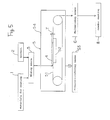
- Fig. 5 represents the other example of a method for making a powder coating of this invention.
- the material for coating 1 and a solvent 2 are placed into a mixing means 3 to carry out mixing.
- This mixture that is a dispersed paste, is introduced to a drying means 5 and heated for drying.
- the dried mixture is introduced to the pulverizing means 6 for pulverizing, whereby the powder coating 8 is obtained without classifying.
- the material for coating used in the present invention is such as being used in making an usual powder coating and it is not especially limited.
- it is a resin, a curing agent, a pigment (it is unnecessary in the case of a clear type coating), and other additives.
- a solvent used in the case where the forementioned material for coating is mixed in the presence of a solvent has not any special condition, but if a practical example is cited, there are, for example, xylene (XL), toluene, methyl ethyl ketone (MEK), etc.
- the amount of a solvent is, for example, from 20 to 40 % by weight against a total amount of the dispersed paste.
- the mixing is carried out, for example, by premixing with a Henschel mixer etc. under a dried condition having no solvent and then, by melt kneading by an extruder, etc. Conditions of the premixing and melt kneading may be the same as those in a common procedure.
- the mixing is also carried out, for example, by a solution dispersion to obtain a dispersed paste.
- Preferred mixing means used here is, for example, a SG mill, a roll mill, ATTRITOR, etc.
- the mixing conditions may be similar to those in making a common paste-type coating. In case of mixing according to a wet type, drying is carried out.
- a solid mixture of materials for a coating is pulverized by a pulverizing method of an air current-mechanical system.
- This pulverizing method comprises introducing a mixture, which has been beforehand, as occasion demands, subjected to either coarse crushing or coarse crushing and small crushing, to between a rotor and a stator having defined structures, and pulverizing finer by rotating the roto.
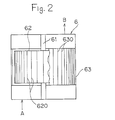
- the rotor 62 is supported so as to be capable of rotating round the shaft center and arranged with multiple convex lines 620, which extend in the direction of the shaft and are lined up along the periphery.
- the 61 is a rotating shaft.
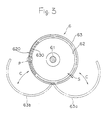
- the stator 63 has a cylindric type rotor opposite face arranged with a certain interspace S between this face and the rotor periphery and, on the rotor-opposite face of the stator, there are arranged multiple convex lines 630 extending in the direction of the shaft and are lined up along the circumference, and the rotor-opposite face is arranged in such a manner as to be capable of opening in order to expose the rotor periphery.
- the cylindric vessel of the stator 63 is lengthwise divided into two.
- the first half part 63a having a half circumference and the second half part 63b having another half circumference, and both of two half parts are made so as to open and close sideways as shown by the arrow C.
- the interspace S between the rotor 62 and the stator 63 is set, for example, at 1 mm or less and the rotor 62 is rotated at a velocity of from 6000 to 15000 rpm.
- a cooling means capable of maintaining an air current to transport the forementioned mixture at a temperature equal to or lower than that in a certain range.
- the temperature equal to or lower than that in a certain range denotes, for example, a temperature lower by 5 °C or more than a glass transition temperature (Tg) of the mixture.
- Tg glass transition temperature
- the temperature of an air current is higher than (Tg - 5) °C , there is a possibility that pulverized products are melted again and stick to each other by the pulverization heat or they attach themselves to the rotor and stator.
- the temperature of an air current is in a range of from (Tg - 5) to (Tg - 10) °C , rounder particles are obtained.
- the mixture is, as seen by the arrow A, introduced to between the rotor 62 and the stator 63 of a pulverizing means 6.
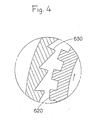
- the product pulverized is, as seen by the arrow B, introduced to outside the pulverized means 6. Further, in Figs. 2 and 3, the convex lines 620 and 630 are shown with simplicity. In Fig. 2 there is shown the stator at a rear side obtained by sectioning a part of the rotor. In Fig. 4 is shown the circle P part of Fig. 3 with enlarging. If such a pulverizer is used, a powder coating is obtainable without classifying.
- a dispersed paste obtained by the mixing may be treated according to the following.
- a solid portion concentration of the dispersed paste (hereinafter, referred to as "NV") is set in a range of from 60 to 80 % by weight.
- NV solid portion concentration of the dispersed paste
- the color match is adjusted.
- the material for coating is a paste
- a coated film is immediately made by coating the paste, so that the color match adjustment is carried out during a short time.
- the adjustment can be omitted.
- the dispersed paste is set at a thickness of 10 cm or less under a condition of one side-opening and heated for drying under a reduced pressure of 10 Torr or less.
- a pressure reducing belt dryer or a dry tray set in a pressure reducing room In order to carry out drying in such a manner, it is convenient to use, for example, such as generally called as a pressure reducing belt dryer or a dry tray set in a pressure reducing room.
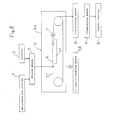
- the drying means 5 is a pressure reducing belt dryer.
- a endless belt 51 is set in the reduced pressure room 54 and arranged so as to be capable of moving by a roll.
- the pressure reducing room 54 is arranged so as to be capable of reducing the pressure to the desired pressure by a pressure reducing means 53.
- the dispersed paste 4 is introduced to on the belt 51 and dried by heat transfer and convection from the heating plate 52.
- a dried product is peeled off from the belt 51 by a scraper (not illustrated) etc. and transferred to the pulverizing means 6.
- the heating plate 52 is made, for example, in a double tube system and, in the inner tube, a heating medium such as warm water, steam, or the like is introduced in such a manner as to set at a specific heating temperature.
- Fig. 8 represents another example of a method for making a powder coating of this invention.
- the coating material 1 and the solvent 2 are placed into the mixing means 3 for mixing.
- This mixture that is a dispersed paste, is introduced to a drying means 5 for heat drying.
- the dried product is introduced to the pulverizing means 6 for pulverizing and then, to a classifying means 7 for classifying, whereby the powder coating 8 is obtained.
- pulverizing of the dried product is carried out by a conventional pulverizing method used in a common method for making a powder coating, for example, by a hammer mill method. After the pulverizing, if necessary, classifying by a vibrating sieve etc. and packing are carried out.
- pulverizing may be carried out by said hammer mill method etc., but the air current and mechanical type pulverizing method as above-mentioned may be used.
- Setting in a condition of one side-opening may be carried out by pouring or coating a dispersed paste on a base made by a material from which the dispersed paste is able to be peeled after drying.
- Preferable base may be a belt made by immersing a fluororesin such as polytetrafluoroethylene resin (PTFE) etc. in a base material such as a glass cloth etc., but it is not limited to this belt.
- PTFE polytetrafluoroethylene resin
- an usual pressure-reducing means and a pressure-reducing means being attached to a pressure reducing room or to a pressure reducing belt dryer may be used.
- heat drying may be properly selected for heat transfer, warm wind, radiation, etc.
- radiation is preferred from the viewpoints of preventing a change in quality of the material and preventing it from become attached to the belt as result of the material surface being melted by heating.
- the heating temperature is not especially limited, but it may be set in the range of from 70 to 110 °C or from 80 to 110°C.
- the heating time is not especially limited, but for example, it is during a time of from 20 to 30 minutes or from 5 to 15 minutes.
- a belt dryer it is possible to carry out the heat drying continuously, so that there is an advantage in mass production.
- Preferable examples of setting a plural zone for the heat drying are the first zone of from 90 to 110 °C (the time to pass through is, for example, from 6 to 8 minutes), the second zone is from 70 to 80°C (the time to pass through is, for example, from 5 to 25 minutes), and the third zone is from 25 to 30°C (the time to pass through is, for example, from 8 to 10 minutes).
- the dispersed paste is transformed to a condition of one side-opening and subjected to heat drying under reduced pressure, a dried product of high volume can be easily obtained.
- the dried product of high volume is easily pulverized in the subsequent pulverizing process.
- NV of the dispersed paste is lower than the forementioned range, the time for drying becomes longer and also, because of low viscosity, there is a possibility of leaking out from both ends of the belt. If the NV is higher than the forementioned range, the dried product of high volume can not be made and also, because of high viscosity, there is a possibility of that a stable supplying is difficult and that a change in quality of the dried product occurs.
- thickness of the dispersed paste exceeds 10 cm when dried, it may be difficult to adjust the inside in a condition of NV 95 % or more.
- the pressure-reduced condition in the drying process is higher than 10 Torr, the residual of a solvent becomes large in quantity and may cause a pinhole on the coated film, or it becomes necessary to arrange for a higher drying temperature and, because of this high temperature, a hardening reaction proceeds and, thereby, the practical use may become difficult.
- the obtained dried product have a NV of 95 % or more. This is because, if the remains of a solvent is a lot, it may cause a pinhole on the coated film.
- the dried product it is necessary that the dried product have a density in the range of from 0.4 to 0.6 g/cm 3 . This is because, if the density deviates from this range, there is a problem that the efficiency of pulverizing may become inferior, occurrence of unpulverized products and coarse particles becomes large, and the particle size distribution becomes broad.
- Resin solid portion is obtained by using 25 parts by weight of styrene, 29.57 parts by weight of methyl methacrylate, 30.0 parts by weight of glycidyl methacrylate, 15.43 parts by weight of n-butyl methacrylate, and 2 parts by weight of azobisisobutyronitrile to carry out the solution polymerization and then, by heating under a reduced pressure.
- the surface-conditioner used was Acronal 4F (trade name), made by BASF Co., Ltd.]
- the forementioned materials for coating was subjected to melt kneading at 90°C by using an extruder (made by BUSS AG.), then the product kneaded is coarsely crushed to pellets of about 1 cm, continuously introduced to the forementioned pulverizer A (an air current and mechanical type pulverizer, a trade name "Kryptron” KTM-X type, made by Kawasaki Heavy Industries, LTD., was used) by an air current of 12 °C (2.5 Nm 3 /minute), and pulverized to obtain a powder coating.
- the pulverizing conditions were 5 kg/hr in an amount of materials to be supplied (a coarsely-crushed product) and 12000 rpm in a rotating number of the rotor.
- the forementioned materials for coating were mixed by a SG mill (a trade name "Neograin mill", made by Asada Iron Works Co., LTD.) in the presence of a solvent (40 parts by weight of xylene), whereby a dispersed paste was obtained.
- the dispersed paste obtained had a NV of 60 % by weight. This dispersed paste was continuously supplied as the undermentioned, to carry out heat drying.
- the dispersed paste was continuously spewed out from a material-supplying nozzle onto a PTFE-immersed glass cloth belt so as to make a 10 cm thickness and the belt was transferred at a specific velocity under a condition of one side-opening to pass through the zone of 95°C temperature during 7 minutes, the zone of 80 °C temperature during 15 minutes, and the zone of 30°C temperature during 10 minutes in order for drying the paste, whereby a dried product was obtained by peeling-off by a scraper.
- the dried product obtained was of high volume such as shown by having a NV of 98 % by weight and a density of 0.6 g/cm 3 .
- a powder coating was obtained by pulverizing this dried product similarly to the case of Example A-1.
- a powder coating was obtained by pulverizing the kneaded product obtained from Example A-1 by a hammer mill (a trade name "Samplemill", K II -1 type, made by Fuji Paudaru Co., LTD.). Pulverizing conditions were an use of 6 pieces of hammers, a rotating number of 5000 rpm, and an amount 5 kg/hrof the supplying materials.
- the powder coating obtained from Comparative Example A-1 was sieved by a Tyler standard sieve to recover particles passing through a 150 mesh sieve, whereby a powder coating was obtained.
- Example A-2 A dried product obtained from Example A-2 was pulverized by a hammer mill similarly to the case of Comparative Example A-1.
- the powder coating obtained from Comparative Example A-3 was sieved by a Tyler standard sieve to recover particles passing through a 150 mesh sieve, whereby a powder coating was obtained.
- the mixtures obtained from the examples and comparative examples had Tg of about 70 °C.
- the average particle diameter, particle size distribution, and particle shape were examined.
- the particle shape was examined by a scanning electron microscope and shown by the following standard.
- Each powder coating of the examples and comparative examples were coated by electrostatic painting for cold rolled carbon steel sheets (JIS - G3141) and baked at 140 °C for 30 minutes to make a coated film having a thickness of 0.06 mm.
- the surface-smoothness of each coated film was shown by the presence or absence of uneven irregularities and the gloss.
- the presence or absence of uneven irregularities was examined by NSIC (Image Clarity Method) and by the naked eye As the NSIC value is larger, the uneven irregularities is less.
- the results by the naked eye were indicated by a circle 0 for the absence of uneven irregularities; a triangle A for the presence of a few uneven irregularities; a cross X for the presence of many uneven irregularities.
- the gloss was examined by the 60 ° specular gloss of JIS - K 5400.
- the results show properties of the coated films increased by the finer pulverizing.
- the air current temperature in pulverizing is lower than (Tg - 10) °C , angular coating particles as seen in Fig. 6 are obtained and, if the temperature is set in a range of from (Tg - 5) to (Tg - 10)°C , a powder coating of rounder particles is obtained.
- a dispersed paste was obtained by mixing the undermentioned coating materials by a SG mill (trade name "Neograin mill", made by Asada Iron Works Co., LTD.) in the presence of the undermentioned solvent.
- the obtained dispersed paste had a NV of 60 %.
- This paste was continuously supplied in the following manner, and heat drying process was carried out. That is, in a pressure-reduced room of 10 Torr, the dispersed paste was continuously spewed out from a material-supplying nozzle onto a PTFE-immersed glass cloth belt in such a manner as to make a 10 cm thickness.
- the belt travels at a specific velocity to dry the paste under a one side-opened condition, passing through the zone of 95°C during 7 minutes, the zone of 80 °C during 15 minutes, and the zone of 30°C during 10 minutes in this order, and thus, a dried product is obtained by peeling it off from the belt by using a scraper.
- the dried product is of high volume such as shown in having a NV of 98 % and a density of 0.6 g/cm 3 . This dried product was coarsely crushed into a pellet type of about 1 cm in size.
- Resin solid portion was obtained by using 25 parts by weight of styrene, 29.57 parts by weight of methyl methacrylate, 30.0 parts by weight of glycidyl methacrylate, 15.43 parts by weight of n-butyl methacrylate, and 2 parts by weight of azobisisobutyronitrile to carry out solution polymerization and then, by heating under a reduced pressure.
- the surface-conditioner used was Acronal 4F (trade name), made by BASF Co., Ltd.].
- Example B-1 The procedure of Example B-1 was repeated except that the alteration shown in Table 3 was carried out, whereby powder coatings were obtained. But, in Examples B-3 and B-4, rotating numbers of the rotor were 12000 rpm.
- Example B-1 A dried product obtained from Example B-1 was pulverized by a hammer mill (a trade name "Sample Mill” K -1 model, made by Fuji Paudaru Co., LTD.).
- the pulverizing conditions was the use of 6 hammers, a rotating number of 5000 rpm, and an amount 5 kg/hr of the supplying materials.
- the pulverized product was sieved by a Tyler standard sieve to recover particles passing through a 150 mesh sieve, whereby the powder coating was obtained.
- Tg of the dried products in the examples were about 70°C .
- Example B-1 The procedure of Example B-1 was repeated to obtain a powder coating except that NV of the dispersed paste was altered to 50 %. However, the NV of a dried product obtained was 82 %.
- Example B-1 The procedure of Example B-1 was repeated to obtain a powder coating except that NV of the dispersed paste was altered to 90 %. However, the density of a dispersed product obtained was too thick to supply the product to a drying apparatus.
- Example B-1 The procedure of Example B-1 was repeated to obtain a powder coating except that the surrounding pressure during drying is adjusted to 15 Torr. However, the surrounding pressure during drying was too high to obtain a dried product having a NV of 95 % or more.
- Example B-1 The procedure of Example B-1 was repeated to obtain a powder coating except that NV of the dried product was adjusted to 90 %. However, the NV of the dried product was so low causing pinholes in the coated film.
- the above-described coating materials were premixed without using a solvent under conditions at a rotating rate of 1000 rpm by a Henshel mixer for 30 minutes, and subjected to melting and kneading at 90 °C by using an extruder (made by Buss AG.).
- the processes after pulverizing were carried out similarly to those in Example B-2, whereby a powder coating was obtained.
- a powder coating was obtained by pulverizing the melt kneaded product prepared from Comparative Example B-5, as carried out in Example B-1.
- Table 3 are shown the conditions of drying and pulverizing.
- the average particle diameter, particle size distribution, and particle shape were examined.
- the particle shapes were examined by a scanning electron microscope and shown by the following standard.
- Each powder coating of the examples and comparative examples were coated by electrostatic painting for cold rolled carbon steel sheets (JIS - G3141) and baked at 140°C for 30 minutes to make a coated film having a thickness of 0.06 mm.
- the surface-smoothness of each coated film was shown by the presence or absence of uneven irregularities and the gloss.
Landscapes
- Engineering & Computer Science (AREA)
- Food Science & Technology (AREA)
- Chemical & Material Sciences (AREA)
- Mechanical Engineering (AREA)
- Life Sciences & Earth Sciences (AREA)
- Materials Engineering (AREA)
- Wood Science & Technology (AREA)
- Organic Chemistry (AREA)
- Paints Or Removers (AREA)
- Application Of Or Painting With Fluid Materials (AREA)
Applications Claiming Priority (4)
| Application Number | Priority Date | Filing Date | Title |
|---|---|---|---|
| JP31850/91 | 1991-01-30 | ||
| JP3185091A JPH051243A (ja) | 1991-01-30 | 1991-01-30 | 粉体塗料の製造方法 |
| JP31849/91 | 1991-01-30 | ||
| JP3184991A JPH05311096A (ja) | 1991-01-30 | 1991-01-30 | 粉体塗料の製造方法 |
Publications (2)
| Publication Number | Publication Date |
|---|---|
| EP0497526A2 true EP0497526A2 (de) | 1992-08-05 |
| EP0497526A3 EP0497526A3 (en) | 1992-10-14 |
Family
ID=26370362
Family Applications (1)
| Application Number | Title | Priority Date | Filing Date |
|---|---|---|---|
| EP19920300658 Withdrawn EP0497526A3 (en) | 1991-01-30 | 1992-01-27 | Method for making a powder coating |
Country Status (4)
| Country | Link |
|---|---|
| US (1) | US5323970A (de) |
| EP (1) | EP0497526A3 (de) |
| KR (1) | KR920014895A (de) |
| CA (1) | CA2060088A1 (de) |
Cited By (4)
| Publication number | Priority date | Publication date | Assignee | Title |
|---|---|---|---|---|
| EP0536791A1 (de) * | 1991-10-11 | 1993-04-14 | Nippon Paint Co., Ltd. | Pulverlack |
| US10858536B2 (en) | 2016-01-15 | 2020-12-08 | Ppg Industries Ohio, Inc. | Coating composition comprising a thermoset resin and a thermoplastic resin |
| US11286401B2 (en) | 2016-01-15 | 2022-03-29 | Ppg Industries Ohio, Inc. | Coating composition comprising a thermoset resin and a thermoplastic resin |
| EP4059607A1 (de) | 2021-03-18 | 2022-09-21 | Bühler AG | Kolloidmühle |
Families Citing this family (3)
| Publication number | Priority date | Publication date | Assignee | Title |
|---|---|---|---|---|
| US5722602A (en) * | 1995-12-15 | 1998-03-03 | Caterpillar Inc. | Process for making flowable powders for coating applications |
| US20090162543A1 (en) * | 2007-12-19 | 2009-06-25 | Giora Topaz | Concentrated powdered colors composition for a powder coating and method of manufacture |
| CN105363535A (zh) * | 2015-09-10 | 2016-03-02 | 江阴碳谷科技有限公司 | 一种石墨烯干态剥离装置、生产系统及生产干态石墨烯的方法 |
Family Cites Families (7)
| Publication number | Priority date | Publication date | Assignee | Title |
|---|---|---|---|---|
| US233839A (en) * | 1880-11-02 | Geoege dtrksr and eussell a | ||
| US2556641A (en) * | 1948-05-22 | 1951-06-12 | Harding F Bakewell | Grinder for pigments and other materials |
| US3880360A (en) * | 1973-12-05 | 1975-04-29 | Ford Motor Co | Method of preparing homogeneous thermosetting powder paint composition |
| US3941315A (en) * | 1974-02-06 | 1976-03-02 | Scm Corporation | Process for production of powder paints |
| US4562972A (en) * | 1983-04-13 | 1986-01-07 | Kawasaki Jukogyo Kabushiki Kaisha | Micropulverizer |
| JPS6136463A (ja) * | 1984-07-30 | 1986-02-21 | 大成建設株式会社 | ペントナイトによる静的破壊方法 |
| KR920007800B1 (ko) * | 1988-07-07 | 1992-09-17 | 호소가와 미크론 가부시끼가이샤 | 초전도체원료 및 초전도체의 제법 및 초전도체원료 |
-
1992
- 1992-01-27 CA CA002060088A patent/CA2060088A1/en not_active Abandoned
- 1992-01-27 EP EP19920300658 patent/EP0497526A3/en not_active Withdrawn
- 1992-01-28 US US07/827,120 patent/US5323970A/en not_active Expired - Fee Related
- 1992-01-29 KR KR1019920001319A patent/KR920014895A/ko not_active Withdrawn
Cited By (5)
| Publication number | Priority date | Publication date | Assignee | Title |
|---|---|---|---|---|
| EP0536791A1 (de) * | 1991-10-11 | 1993-04-14 | Nippon Paint Co., Ltd. | Pulverlack |
| US10858536B2 (en) | 2016-01-15 | 2020-12-08 | Ppg Industries Ohio, Inc. | Coating composition comprising a thermoset resin and a thermoplastic resin |
| US11286401B2 (en) | 2016-01-15 | 2022-03-29 | Ppg Industries Ohio, Inc. | Coating composition comprising a thermoset resin and a thermoplastic resin |
| EP4059607A1 (de) | 2021-03-18 | 2022-09-21 | Bühler AG | Kolloidmühle |
| WO2022194428A1 (de) | 2021-03-18 | 2022-09-22 | Bühler AG | Kolloidmühle |
Also Published As
| Publication number | Publication date |
|---|---|
| US5323970A (en) | 1994-06-28 |
| KR920014895A (ko) | 1992-08-25 |
| CA2060088A1 (en) | 1992-07-31 |
| EP0497526A3 (en) | 1992-10-14 |
Similar Documents
| Publication | Publication Date | Title |
|---|---|---|
| KR970008350B1 (ko) | 충돌식 기류분쇄기 및 토너의 제조방법 | |
| JPH04504431A (ja) | 着色粉末塗装組成物 | |
| EP0497526A2 (de) | Verfahren zur Herstellung einer Pulverbeschichtung | |
| US5435496A (en) | Collision-type gas current pulverizer and method for pulverizing powders | |
| KR100622462B1 (ko) | 불소계 중합체 분말 및 그의 제조 방법과 피복 물품 | |
| US6228981B1 (en) | Process for preparing an aqueous dispersion coating material and process for preparing a powder coating material | |
| JP2002233787A (ja) | 粉体処理装置および粉体処理方法 | |
| DE68914954T2 (de) | Vorrichtung zum kontinuierlichen Mischen von Pulver und Verfahren für die Herstellung eines Toners für die Entwicklung elektrostatischer Bilder. | |
| JPH07188586A (ja) | 粉体塗料の調色方法 | |
| JP3274311B2 (ja) | 粉体塗料の製造方法 | |
| JPH051243A (ja) | 粉体塗料の製造方法 | |
| EP1480087B1 (de) | Pulverisierungs- und Knetverfahren zur Herstellung von Tonern | |
| JPH05311096A (ja) | 粉体塗料の製造方法 | |
| CN1370106A (zh) | 树脂组合物的造粒装置 | |
| US6635207B1 (en) | Process for recycling of powder coating waste | |
| JP3110965B2 (ja) | 衝突式気流粉砕機、及びこれを用いた静電荷像現像用トナー製造方法 | |
| JP3337861B2 (ja) | 微粒子状熱硬化性樹脂の製造方法 | |
| KR100681856B1 (ko) | 폐분체도료의 재생시스템 | |
| JPH1053729A (ja) | 粉体塗料の製造方法 | |
| JPH11197527A (ja) | 機械式粉砕装置 | |
| JPH08299827A (ja) | 機械式粉砕機 | |
| JP4713821B2 (ja) | 微粒子状光硬化性樹脂の製造方法、微粒子状光硬化性樹脂および物品の表面処理方法 | |
| JPS61163939A (ja) | 表面改質粉体塗料粒子およびその懸濁液塗料組成物 | |
| JPH05249738A (ja) | カラートナーの製造方法 | |
| JPH0820762B2 (ja) | 静電荷現像用トナーの製造方法 |
Legal Events
| Date | Code | Title | Description |
|---|---|---|---|
| PUAI | Public reference made under article 153(3) epc to a published international application that has entered the european phase |
Free format text: ORIGINAL CODE: 0009012 |
|
| AK | Designated contracting states |
Kind code of ref document: A2 Designated state(s): DE FR GB |
|
| PUAL | Search report despatched |
Free format text: ORIGINAL CODE: 0009013 |
|
| AK | Designated contracting states |
Kind code of ref document: A3 Designated state(s): DE FR GB |
|
| 17P | Request for examination filed |
Effective date: 19930102 |
|
| 17Q | First examination report despatched |
Effective date: 19931118 |
|
| 18D | Application deemed to be withdrawn |
Effective date: 19940329 |