EP0500496B1 - Stabilisierte Polymere mit Heteroatomen in der Hauptkette - Google Patents
Stabilisierte Polymere mit Heteroatomen in der Hauptkette Download PDFInfo
- Publication number
- EP0500496B1 EP0500496B1 EP92810100A EP92810100A EP0500496B1 EP 0500496 B1 EP0500496 B1 EP 0500496B1 EP 92810100 A EP92810100 A EP 92810100A EP 92810100 A EP92810100 A EP 92810100A EP 0500496 B1 EP0500496 B1 EP 0500496B1
- Authority
- EP
- European Patent Office
- Prior art keywords
- tert
- butyl
- bis
- hydroxy
- polymer composition
- Prior art date
- Legal status (The legal status is an assumption and is not a legal conclusion. Google has not performed a legal analysis and makes no representation as to the accuracy of the status listed.)
- Expired - Lifetime
Links
- VCCBEIPGXKNHFW-UHFFFAOYSA-N Oc(cc1)ccc1-c(cc1)ccc1O Chemical compound Oc(cc1)ccc1-c(cc1)ccc1O VCCBEIPGXKNHFW-UHFFFAOYSA-N 0.000 description 1
- ISWSIDIOOBJBQZ-UHFFFAOYSA-N Oc1ccccc1 Chemical compound Oc1ccccc1 ISWSIDIOOBJBQZ-UHFFFAOYSA-N 0.000 description 1
Classifications
-
- C—CHEMISTRY; METALLURGY
- C08—ORGANIC MACROMOLECULAR COMPOUNDS; THEIR PREPARATION OR CHEMICAL WORKING-UP; COMPOSITIONS BASED THEREON
- C08K—Use of inorganic or non-macromolecular organic substances as compounding ingredients
- C08K5/00—Use of organic ingredients
- C08K5/16—Nitrogen-containing compounds
- C08K5/34—Heterocyclic compounds having nitrogen in the ring
- C08K5/3467—Heterocyclic compounds having nitrogen in the ring having more than two nitrogen atoms in the ring
- C08K5/3477—Six-membered rings
- C08K5/3492—Triazines
Definitions
- the invention relates to stabilized polymers with heteroatoms in the main chain, which contain a 2-hydroxyphenyl-s-triazine with certain substituents as a stabilizer.
- Triazine derivatives in which Ar is a 2,4-dimethylphenyl radical were used specifically because these compounds are relatively easily accessible. Synthetic processes have recently been developed which also make such triazines with other aryl radicals readily accessible (EP-A-395 938).
- polycarbonates polyesters, polyamides, polyacetals, polyphenylene oxides and polyphenylene sulfides, but in particular the polycarbonates.
- polycarbonates These are to be understood in particular as those polymers whose constitutional repeating unit of the formula where A represents a divalent phenolic radical. Examples of A are mentioned in US-A-4 960 863 and DE-A-3 922 496, among others.
- A can be derived, for example, from hydroquinone, resorcinol, from dihydroxybiphenylene or bisphenols in the broadest sense, such as bis (hydroxyphenyl) alkanes, cycloalkanes, sulfides, ethers, ketones, sulfones, sulfoxides, ⁇ , ⁇ '-bis - (Hydroxyphenyl) diisopropylbenzenes, for example of the compounds 2,2-bis (4-hydroxyphenyl) propane, 2,2-bis (3,5-dimethyl-4-hydroxyphenyl) propane, 2,2-bis - (3,5-dichloro-4-hydroxyphenyl) propane, 2,2-bis (3,5-dibromo-4-hydroxyphenyl) propane, 1,1-bis (4-hydroxyphenyl) cyclohexane, or of the connections of the formulas
- the polymers of component a) can be linear or branched.
- the shaping one These polymers are processed at a relatively high temperature, for example polycarbonate is injection molded at 220 - 330 ° C. At these temperatures, most of the common light stabilizers and antioxidants are unstable and start to decompose. However, the above-mentioned triazine derivatives according to the invention are extremely temperature-stable and are therefore particularly suitable for stabilizing the polymers mentioned.
- IRC is 1 -C 18 alkyl
- this can be linear or branched alkyl and can be, for example, methyl, ethyl, propyl, isopropyl, butyl, isobutyl, pentyl, hexyl, 2-ethylbutyl, heptyl, octyl, 2- Ethylhexyl, nonyl, decyl, dodecyl, tetradecyl or octadecyl.
- R as C 2 -C 6 alkyl substituted by halogen or C 1 -C 12 alkoxy can, for example, 2-chloroethyl, 2-fluoroethyl, 2-methoxyethyl, 2-ethoxyethyl, 2-isopropoxyethyl, 2-methoxypropyl, 3-butoxypropyl, 2-butoxyethyl, 2-hexyloxyethyl, 2-octyloxyethyl or 2-dodecyloxyethyl.
- R ' is preferably hydrogen.
- the compounds of the formula I are known compounds or can be prepared analogously to known compounds. In principle, they can be prepared by etherification of the corresponding 2,4-diaryl-6- (2,4-dihydroxyphenyl) -1,3,5-triazines. The etherification takes place selectively in the 4-position because the OH group in the 2-position is sterically hindered by hydrogen bonding. The preparation and etherification of the 2,4-dihydroxyphenyltriazines is e.g. described in Helv. Chim. Acta 55: 1566-95 (1972); EP-A-395 938; US-A-3118 887; US-A-3 242 175 or US-A-3 244 708.
- the amount of stabilizer to be used depends on the polymer to be stabilized and the intended use of the stabilized polymer.
- the polymer composition according to the invention contains 0.1 to 15, in particular 0.1 to 5 parts by weight of the stabilizer (component b) per 100 parts by weight of the polymer (component a).
- the addition of the stabilizer and optionally other additives to the polymer is expediently carried out before the shaping processing, for example by mixing the powdery components or by adding the stabilizer to the melt or solution of the polymer.
- the invention therefore also relates to a process for stabilizing thermoplastic polymers which contain heteroatoms in the main chain, against their damage by light, oxygen and heat, which is characterized in that at least one compound of the formula I is added as a stabilizer, and the Use of compounds of the formula I for stabilizing thermoplastic polymers which contain heteroatoms in the main chain against damage by light, oxygen and heat.
- the stabilized polymer compositions thus obtained can be prepared by the usual methods, e.g. by hot pressing, spinning, extruding or injection molding, into molded articles, e.g. in fibers, foils, tapes, plates, multi-wall sheets, vessels, pipes and other profiles.
- the invention therefore further relates to the use of the polymer composition according to the invention for the production of a shaped article.
- a polymer composition according to the invention with a relatively high content of stabilizer of the formula I, for example 5-15% by weight, is applied in a thin layer (10-100 ⁇ m) to a molded article made of a polymer which has little or no stabilizer of the formula I. contains, applied.
- the application can take place at the same time as the shape of the base body, e.g. through so-called coextrusion.
- the application can also be done on the finished molded body, e.g. by lamination with a film or by coating with a solution.
- the outer layer or the outer layers of the finished object have the function of a UV filter, which protects the inside of the object against UV light.
- the outer layer preferably contains 5-15% by weight, in particular 5-10% by weight, of at least one stabilizer of the formula I.
- the outer layer (s) having a thickness of 10-100 ⁇ m of a polymer composition according to the invention, while the inner layer consists of a polymer which may contain little or no stabilizer of the formula I, therefore represents a further subject of the invention.
- component (a) is a polycarbonate
- the polymers stabilized in this way are characterized by high weather resistance, especially by high resistance to UV light. As a result, they retain their mechanical properties as well as their color and gloss for a long time, even when used outdoors.
- Example 1 10 g of polycarbonate powder (Lexan® 115) are dissolved in 50 g of methylene chloride with stirring at room temperature, which takes several hours. In addition there are 0.1 g, 0.2 g or 0.5 g UV absorber, corresponding to 1, 2 and 5% additional concentration. Films with a thickness of 20 ⁇ m are cast from these solutions.
- the films are exposed in an Atlas Weatherometer CI 65 at a black panel temperature of 63 ° C and a relative humidity of 60%.
- the discoloration of the samples is checked at regular intervals by measuring the yellowness index (YI, method ASTM D 1925).
- Table 1 shows the exposure time up to a yellowness index of 7.
- Example 2 Films produced according to the procedure described in Example 1 are aged in a forced air oven at 140 ° C. As in Example 1, the aging time until a yellowness index of 7 and the time to embrittlement are measured.
- Example 3 Polycarbonate powder is mixed with 0.3% of different UV absorbers and processed into granules in a twin-screw extruder at a melt temperature of 275 ° C. and 25 rpm.
- the granulate is processed on an injection molding machine (240/300 ° C / 75 bar) into plates of 67x43x2 mm.
- the plates are exposed in an Atlas Weatherometer CI 65 as in Example 1.
- Table 3 shows the exposure time up to a yellowness index of 25 (YI measured according to ASTM D-1925).
- Example 4 Polycarbonate films containing 2% by weight of UV absorber are produced and exposed by the method given in Example 1. Table 4 shows the exposure time after which a yellowness index of 7 is reached.
- Example 5 Films produced according to the procedure described in Example 4 are aged in a forced air oven at 130 ° C. As in the example mentioned, the aging time until a yellowness index of 7 and the time to embrittlement are measured.
- Example 6 As described in Example 1, polycarbonate films containing 2% by weight of UV absorber are produced and exposed. The tensile strength of the films is measured at room temperature at regular intervals (tensile speed [cross-speed] 20 mm / min., Tensile weight [dumb-bell] according to DIN 53448/1, sample width 10 mm, sample thickness 20 ⁇ m). Table 6 shows the exposure time after which only 50% of the original tensile strength is achieved. Table 6 UV absorber Exposure time (h) up to 50% tensile strength none 690 2% Xy-1 1420 2% Ph-1 1670 2% To-1 1860
- Example 7 3 kg of polybutylene terephthalate powder (Crastin® S 600) are each mixed with 0.1% by weight of pentaerythrityl tetrakis (3- [3 ', 5'-di-tert-butyl-4'-hydroxyphenyl] propionate ), 0.4% by weight of tris (2,4-di-tert.butylphenyl) phosphite and 0.5% by weight of the UV absorber shown in Table 7 dry in a Henschel mixer for 2 minutes mixed and then in a Berstorff twin-screw extruder at a speed of 100 / min.
- pentaerythrityl tetrakis 3- [3 ', 5'-di-tert-butyl-4'-hydroxyphenyl] propionate
- tris (2,4-di-tert.butylphenyl) phosphite 0.5% by weight of the UV absorber shown in Table 7 dry in a Hens
- Example 8 Polyamide-6 powder (Ultramid® B3S, manufacturer BASF) is dry mixed with the stabilizers specified in Table 8 in a Henschel mixer for 2 minutes and then in a Berstorff twin-screw extruder at a speed of 95 / min. and a temperature setting of 230 ° C / 235 ° C / 240 ° C / 240 ° C.
- the amounts of stabilizer are given in% by weight, based on the amount of polyamide used.
- an injection molding machine type Arburg L, material temperature 240 ° C, tool temperature 80 ° C
- plates of 2 mm thickness are produced from each mixture.
- the plates are exposed in an Atlas Weatherometer CI 65 at a black panel temperature of 63 ° C. and a relative humidity of 60%, an irrigation cycle of 102 min. Dry / 18 min. Wet being set. The time until cracks appear on the panels is measured. The measurement results are shown in Table 8.
- AN N'-bis (3- [3 ', 5'-di-tert-butyl-4'-hydroxyphenyl] propionyl) hexamethylene diamine
- B tris (2,4-di-tert.butylphenyl) phosphite
- Table 8 Time (h) until cracks appear Stabilizers Time (h) none 1050 0.2% A + 0.2% B 2620 0.2% A + 0.2% B + 0.3% Xy-1 2950 0.2% A + 0.2% B + 0.3% To-1 3320 0.2% A + 0.2% B + 0.3% Ph-1 3930 0.2% A + 0.2% B + 0.3% Xy-1 + 0.3% C 5900 0.2% A + 0.2% B + 0.3% To-1 + 0.3% C 6200 0.2% A + 0.2% B + 0.3% Phl + 0.3% C > 6200
- Example 9 Polyoxymethylene (Hostaform® C) is in a Brabender Plasticorder with 0.3% by weight calcium stearate and 0.3% by weight of a stabilizer of the formula and kneaded 0.3% by weight of the UV absorber shown in Table 9 for 7 minutes at 190 ° C. and 30 revolutions / minute. The material is then pressed at 190 ° C under a pressure of 3000 psi into sheets of 1 mm thickness; the processing time in this step is 3 minutes. The plates are exposed at 60 ° C and a humidity of 23% with a UV-A source at a distance of 20 cm.
- the UV-A source consists of 5 fluorescent lamps TL / 09 and 5 lamps TL / 12 (wavelength range 295-400 nm).
- the yellowness index (YI, method ASTM D 1925) is measured at regular intervals, which runs through a maximum when UV-exposed to polyoxymethylene. This maximum is caused by the first appearance of microcracks that cannot yet be determined visually. With further exposure, cracks in the plates become visible at a later point in time. Table 9 shows the exposure times in weeks until the maximum of the yellowness index is reached and until visually detectable cracks occur. Table 9: Exposure time in weeks up to YI maximum or until visually detectable cracks appear on the sample plates Exposure time (weeks) to UV absorber YI maximum Cracking 0.3% Xy-5 8th 16 0.3% To-5 10th 20th 0.3% Ph-5 16 25th
- test results presented in Examples 1-9 show significantly improved properties when using the stabilizers according to the invention (diphenyl and di-p-tolyl derivatives of 1,3,5-triazine) compared to the known dixylyl derivatives.
Landscapes
- Chemical & Material Sciences (AREA)
- Health & Medical Sciences (AREA)
- Chemical Kinetics & Catalysis (AREA)
- Medicinal Chemistry (AREA)
- Polymers & Plastics (AREA)
- Organic Chemistry (AREA)
- Compositions Of Macromolecular Compounds (AREA)
- Laminated Bodies (AREA)
- Coating Of Shaped Articles Made Of Macromolecular Substances (AREA)
- Processes Of Treating Macromolecular Substances (AREA)
- Manufacture Of Macromolecular Shaped Articles (AREA)
- Furan Compounds (AREA)
- Plural Heterocyclic Compounds (AREA)
- Organic Low-Molecular-Weight Compounds And Preparation Thereof (AREA)
Description
- Die Erfindung betrifft stabilisierte Polymere mit Heteroatomen in der Hauptkette, die als Stabilisator ein 2-Hydroxyphenyl-s-triazin mit bestimmten Substituenten enthalten.
- Es ist bekannt, Polymere gegen Schädigung durch Licht, Sauerstoff und Wärme durch den Zusatz eines 2-Hydroxyphenyl-s-triazins der Formel

- Hierbei wurden konkret solche Triazinderivate verwendet, worin Ar ein 2,4-Dimethylphenylrest ist, weil diese Verbindungen relativ gut zugänglich sind. Neuerdings wurden Syntheseverfahren entwickelt, die auch solche Triazine mit anderen Arylresten gut zugänglich machen (EP-A-395 938).
- Ueberraschend wurde nun gefunden, daß solche Triazine, in denen Ar ein Phenyl- oder p-Tolylrest ist, in thermoplastischen Polymeren, die in der Hauptkette Heteroatome enthalten, eine besonders gute Stabilisatorwirkung zeigen, die diejenige von Triazinen, in denen Ar ein 2,4-Dimethylphenylrest ist, klar übertrifft.
- Die Erfindung betrifft daher eine gegen Schädigung durch Licht, Sauerstoff und Hitze stabilisierte Polymerzusammensetzung, enthaltend
- a) mindestens ein thermoplastisches Polymer, das in der Hauptkette Heteroatome enthält, und
- b) als Stabilisator mindestens eine Hydroxyphenyltriazin-Verbindung der Formel I,
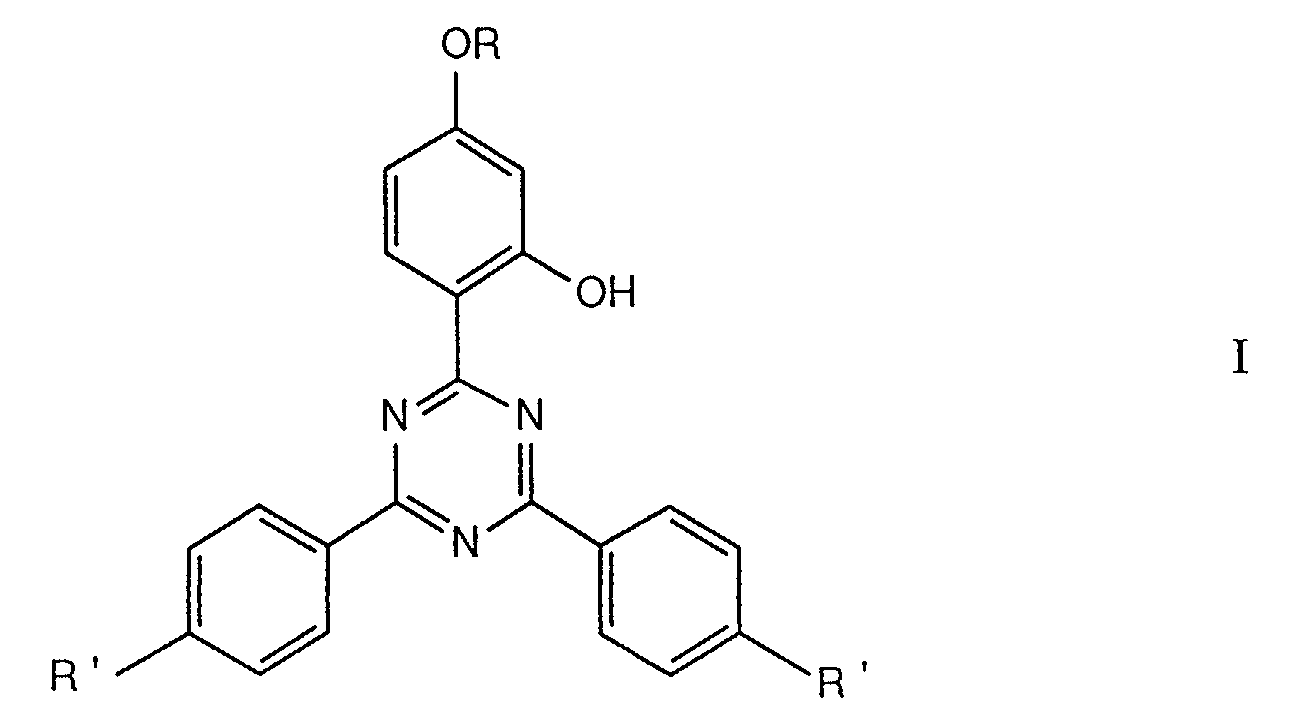
- Polymere, die Heteroatome in der Hauptkette enthalten, sind vor allem O, S und N enthaltende Polymere. Beispiele für solche Polymere sind die folgenden Klassen von thermoplastischen Polymeren:
- 1. Polyacetale, wie Polyoxymethylen, sowie solche Polyoxymethylene, die Comonomere, wie z.B. Ethylenoxid, enthalten; Polyacetale, die mit thermoplastischen Polyurethanen, Acrylaten oder MBS modifiziert sind.
- 2. Polyphenylenoxide und -sulfide und deren Mischungen mit Styrolpolymeren oder Polyamiden.
- 3. Polyamide und Copolyamide, z.B. solche, die sich von Diaminen und Dicarbonsäuren und/oder von Aminocarbonsäuren oder den entsprechenden Lactamen ableiten, wie Polyamid 4, Polyamid 6, Polyamid 6/6, 6/10, 6/9, 6/12, 4/6, Polyamid 11, Polyamid 12, aromatische Polyamide ausgehend von m-Xylol, Diamin und Adipinsäure; Polyamide, hergestellt aus Hexamethylendiamin und Iso- und/oder Terephthalsäure und gegebenenfalls einen Elastomer als Modifikator, z.B. Poly-2,4,4-trimethylhexamethylenterephthalamid, Poly-m-phenylen-isophthalamid. Block-Copolymere der vorstehend genannten Polyamide mit Polyolefinen, Olefin-Copolymeren, Ionomeren oder chemisch gebundenen oder gepfropften Elastomeren; oder mit Polyethern, wie z.B. mit Polyethylenglykol, Polypropylenglykol oder Polytetramethylenglykol. Ferner mit EPDM oder ABS modifizierte Polyamide oder Copolyamide; sowie während der Verarbeitung kondensierte Polyamide (" RIM-Polyamidsysteme ").
- 4. Polyharnstoffe, Polyimide, Polyamid-imide und Polybenzimidazole.
- 5. Polyester, z.B. solche, die sich von Dicarbonsäuren und Dialkoholen und/oder von Hydroxycarbonsäuren oder den entsprechenden Lactonen ableiten, wie Polyethylenterephthalat, Polybutylenterephthalat, Poly- 1,4-dimethylolcyclohexanterephthalat, Polyhydroxybenzoate, sowie Block-Polyether-ester, die sich von Polyethern mit Hydroxylendgruppen ableiten; ferner mit Polycarbonaten oder MBS modifizierte Polyester.
- 6. Polycarbonate und Polyestercarbonate, insbesondere aromatische Polycarbonate, wie z.B. solche basierend auf 2,2-Bis(4-hydroxyphenyl)-propan oder 1,1 -Bis(4-hydroxyphenyl)-cyclohexan.
- 7. Polysulfone, Polyethersulfone und Polyetherketone, insbesondere aromatische Polymere dieser Klasse.
- 8. Mischungen (Polyblends) solcher Polymerer untereinander oder mit anderen Polymeren, z.B. mit Polyolefinen, Polyacrylaten, Polydienen oder anderen Elastomeren als Schlagzähmodifikatoren.
- Bevorzugt sind darunter die Polycarbonate, Polyester, Polyamide, Polyacetale, Polyphenylenoxide und Polyphenylensulfide, insbesondere aber die Polycarbonate. Darunter sind insbesondere solche Polymere zu verstehen, deren konstitutionelle Repetiereinheit (constitutional repeating unit) der Formel


- Die Polymere der Komponente a) können linear oder verzweigt sein. Die formgebende Verarbeitung dieser Polymere geschieht bei relativ hoher Temperatur, z.B. wird Polycarbonat bei 220 - 330°C spritzgegossen. Bei diesen Temperaturen sind die meisten der üblichen Lichtstabilisatoren und Antioxidantien instabil und beginnen sich zu zersetzen. Die oben erwähnten erfindungsgemäßen Triazinderivate sind jedoch extrem temperaturstabil und sind daher für die Stabilisierung der genannten Polymeren besonders geeignet.
- Wenn in der Formel I R C1-C18-Alkyl ist, so kann dies lineares oder verzweigtes Alkyl sein und kann z.B. Methyl, Ethyl, Propyl, Isopropyl, Butyl, Isobutyl, Pentyl, Hexyl, 2-Ethylbutyl, Heptyl, Octyl, 2-Ethylhexyl, Nonyl, Decyl, Dodecyl, Tetradecyl oder Octadecyl sein. R als durch Halogen oder C1-C12-Alkoxy substituiertes C2-C6-Alkyl kann z.B. 2-Chlorethyl, 2-Fluorethyl, 2-Methoxyethyl, 2-Ethoxyethyl, 2-Isopropoxyethyl, 2-Methoxypropyl, 3-Butoxypropyl, 2-Butoxyethyl, 2-Hexyloxyethyl, 2-Octyloxyethyl oder 2-Dodecyloxyethyl sein.
- Bevorzugt ist R C1-C12-Alkyl oder Benzyl, insbesondere C3-C6-Alkyl, vor allem Propyl.
- In Formel I bedeutet R' bevorzugt Wasserstoff.
- Beispiele für Verbindungen der Formel I sind:
- 2,4-Diphenyl-6-(2-hydroxy-4-methoxyphenyl)-1,3,5-triazin
- 2,4-Diphenyl-6-(2-hydroxy-4-ethoxyphenyl)-1,3,5-triazin
- 2,4-Diphenyl-6-(2-hydroxy-4-propyloxyphenyl)-1,3,5-triazin
- 2,4-Diphenyl-6-(2-hydroxy-4-butoxyphenyl)-1,3,5-triazin
- 2,4-Diphenyl-6-(2-hydroxy-4-hexyloxyphenyl)-1,3,5-triazin
- 2,4-Diphenyl-6-(2-hydroxy-4-octyloxyphenyl)-1,3,5-triazin
- 2,4-Diphenyl-6-(2-hydroxy-4-dodecyloxyphenyl)-1,3,5-triazin
- 2,4-Diphenyl-6-(2-hydroxy-4-benzyloxyphenyl)-1,3,5-triazin
- 2,4-Diphenyl-6-(2-hydroxy-4-(2-butoxyethoxy)phenyl)-1,3,5-triazin
- 2,4-Di-p-tolyl-6-(2-hydroxy-4-methoxy-phenyl)-1,3,5-triazin
- 2,4-Di-p-tolyl-6-(2-hydroxy-4-propyloxyphenyl)-1,3,5-triazin
- 2,4-Di-p-tolyl-6-(2-hydroxy-4-butoxyphenyl)-1,3,5-triazin
- 2,4-Di-p-tolyl-6-(2-hydroxy-4-hexyloxyphenyl)-1,3,5-triazin
- 2,4-Di-p-tolyl-6-(2-hydroxy-4-pentoxyphenyl)-1,3,5-triazin
- 2,4-Di-p-tolyl-6-(2-hydroxy-4-octyloxyphenyl)-1,3,5-triazin
- 2,4-Di-p-tolyl-6-(2-hydroxy-4-benzyloxyphenyl)-1,3,5-triazin
- 2,4-Di-p-tolyl-6-(2-hydroxy-4-(2-hexyloxyethoxy)phenyl)-1,3,5-triazin
- Die Verbindungen der Formel I sind bekannte Verbindungen oder können in Analogie zu bekannten Verbindungen hergestellt werden. Die Herstellung kann prinzipiell durch Veretherung der entsprechenden 2,4-Diaryl-6-(2,4-dihydroxyphenyl)-1,3,5-triazine geschehen. Die Veretherung erfolgt selektiv in 4-Stellung, weil die OH-Gruppe in 2-Stellung durch Wasserstoffbrückenbindung sterisch gehindert ist. Die Herstellung der 2,4-Dihydroxyphenyltriazine und ihre Veretherung ist z.B. beschrieben in Helv. Chim. Acta 55 (1972), 1566-95; EP-A-395 938; US-A-3118 887; US-A-3 242 175 oder US-A-3 244 708.
- Die Menge des zu verwendenden Stabilisators richtet sich nach dem zu stabilisierenden Polymeren und der beabsichtigten Verwendung des stabilisierten Polymeren. Im allgemeinen enthält die erfindungsgemäße Polymerzusammensetzung auf 100 Gew.-Teile des Polymeren (Komponente a) 0,1 bis 15, besonders 0,1 bis 5 Gew.-Teile des Stabilisators (Komponente b).
- Der Stabilisator (Komponente b) kann auch ein Gemisch sein von zwei oder mehr Verbindungen der Formel I. Außer dem Stabilisator der Formel I kann die Polymer-zusammensetzung auch andere bekannte Stabilisatoren enthalten, wie z.B. Antioxidantien, Lichtschutzmittel, Metalldesaktivatoren oder Verarbeitungsstabilisatoren. Beispiele hierfür sind die folgenden Verbindungen.
- 1. Antioxidantien
- 1.1. Alkylierte Monophenole, z.B. 2,6-Di-tert.butyl-4-methylphenol, 2-Tert.butyl-4,6-dimethylphenol, 2,6-Di-tert.butyl-4-ethylphenol, 2,6-Di-tert.butyl-4-n-butylphenol, 2,6-Di-tert-butyl-4-i-butylphenol, 2,6-Di-cyclopentyl-4-methylphenol, 2-(α-Methylcyclohexyl)-4,6-dimethylphenol, 2,6-Di-octadecyl-4-methylphenol, 2,4,6-Tri-cyclohexylphenol, 2,6-Di-tert.butyl-4-methoxymethylphenol, 2,6-Di-nonyl-4-methylphenol, 2,4-Dimethyl-6-(1'-methyl-undec-1'-yl)-phenol, 2,4-Dimethyl-6-(1'-methyl-heptadec-1'-yl)-phenol, 2,4-Dimethyl-6-(1'-methyl-tridec-1'-yl)-phenol und Mischungen davon.
- 1.2 Alkylthiomethylphenole, z.B. 2,4-Di-octylthiomethyl-6-tert.-butylphenol, 2,4-Di-octylthiomethyl-6-methylphenol, 2,4-Di-octylthiomethyl-6-ethylphenol, 2,6-Di-dodecylthiomethyl-4-nonylphenol.
- 1.3. Hydrochinone und alkylierte Hydrochinone, z.B. 2,6-Di-tert.butyl-4-methoxyphenol, 2,5-Di-tert.butyl-hydrochinon, 2,5-Di-tert.amyl-hydrochinon, 2,6-Diphenyl-4-octadecyloxyphenol, 2,6-Di-tert.-butyl-hydrochinon, 2,5-Di-tert.-butyl-4-hydroxyanisol, 3,5-Di-tert.-butyl-4-hydroxyanisol, 3,5-Di-tert.-butyl-4-hydroxyphenyl-stearat, Bis-(3,5-di-tert.-butyl-4-hydroxyphenyl)adipat.
- 1.4. Hydroxylierte Thiodiphenylether, z.B. 2,2'-Thio-bis-(6-tert.-butyl-4-methylphenol), 2,2'-Thio-bis-(4-octylphenol), 4,4'-Thio-bis-(6-tert.butyl-3-methylphenol), 4,4'-Thio-bis(6-tert.butyl-2-methylphenol), 4,4'-Thio-bis-(3,6-di-sec.-amylphenol), 4,4'-Bis(2,6-dimethyl-4-hydroxyphenyl)-disulfid.
- 1.5. Alkyliden-Bisphenole, z.B. 2,2'-Methylen-bis-(6-tert.butyl-4-methylphenol), 2,2'Methylen-bis-(6-tert.butyl-4-ethylphenol), 2,2'-Methylen-bis-[4-methyl-6-(α-methylcyclohexyl)-phenol], 2,2'-Methylen-bis-(4-methyl-6-cyclohexylphenol), 2,2'-Methylenbis-(6-nonyl-4-methylphenol), 2,2'-Methylen-bis-(4,6-di-tert.butylphenol), 2,2'-Ethyliden-bis-(4,6-di-tert.butylphenol), 2,2'-Ethyliden-bis-(6-tert.butyl-4-isobutylphenol), 2,2'-Methylen-bis-[6-(α-methylbenzyl)-4-nonylphenol], 2,2'-Methylen-bis-[6-(α,α-dimethylbenzyl)-4-nonylphenol], 4,4'-Methylen-bis-(2,6-di-tert.-butylphenol), 4,4'-Methylen-bis-(6-tert.butyl-2-methylphenol), 1,1 -Bis-(5-tert.butyl-4-hydroxy-2-methylphenyl)-butan, 2,6-Bis-(3-tert.butyl-5-methyl-2-hydroxybenzyl)-4-methylphenol, 1,1,3-Tris-(5-tert.butyl-4-hydroxy-2-methylphenyl)-butan, 1,1 -Bis-(5-tert.butyl-4-hydroxy-2-methyl-phenyl)-3-n-dodecylmercaptobutan, Ethylenglycol-bis-[3,3-bis-(3'-tert.-butyl-4'-hydroxyphenyl)-butyrat], Bis-(3-tert.butyl-4-hydroxy-5-methyl-phenyl)-dicyclopentadien, Bis-[2-(3'-tert.butyl-2'-hydroxy-5'-methyl-benzyl)-6-tert.butyl-4-methylphenyl]-terephthalat, 1,1-Bis-(3,5-dimethyl-2-hydroxyphenyl)-butan, 2,2-Bis-(3,5-di-tert.-butyl-4-hydroxyphenyl)-propan, 2,2-Bis-(5-tert.-butyl-4-hydroxy-2-methylphenyl)-4-n-dodecylmercapto-butan, 1, 1,5,5-Tetra-(5-tert.-butyl-4-hydroxy-2-methylphenyl)-pentan.
- 1.6. O-, N- und S-Benzylverbindungen, z.B. 3,5,3',5'-Tetra-tert.-butyl-4,4'-dihydroxydibenzylether, Octadecyl-4-hydroxy-3,5-dimethylbenzyl-mercaptoacetat, Tris-(3,5-di-tert.-butyl-4-hydroxybenzyl)-amin, Bis-(4-tert.-butyl-3-hydroxy-2,6-dimethylbenzyl)-dithioterephthalat, Bis-(3,5-di-tert.-butyl-4-hydroxybenzyl)-sulfid, Isooctyl-3,5-di-tert.-butyl-4-hydroxybenzyl-mercaptoacetat.
- 1.7. Hydroxybenzylierte Malonate, z.B. Dioctadecyl-2,2-bis-(3,5-di-tert.-butyl-2-hydroxybenzyl)-malonat, Di-octadecyl-2-(3-tert.-butyl-4-hydroxy-5-methylhenzyl)-malonat, Di-dodecylmercaptoethyl-2,2-bis-(3,5-di-tert.-butyl-4-hydroxybenzyl)-malonat, Di- [4-(1,1,3,3-tetramethylbutyl)-phenyl]-2,2-bis-(3,5-di-tert.-butyl-4-hydroxybenzyl)-malonat.
- 1.8. Hydroxybenzyl-Aromaten, z.B. 1,3,5-Tris-(3,5-di-tert.-butyl-4-hydroxybenzyl)-2,4,6-trimethylbenzol, 1,4-Bis-(3,5-di-tert.-butyl-4-hydroxybenzyl)-2,3,5,6-tetramethylbenzol, 2,4,6-Tris-(3,5-di-tert.-butyl-4-hydroxybenzyl)-phenol.
- 1.9. Triazinverbindungen, z.B. 2,4-Bis-octylmercapto-6-(3,5-di-tert.-butyl-4-hydroxyanilino)-1,3,5-triazin, 2-Octylmercapto-4,6-bis-(3,5-di-tert.-butyl-4-hydroxyanilino)-1,3,5-triazin, 2-Octylmercapto-4,6-bis-(3,5-di-tert.-butyl-4-hydroxyphenoxy)-1,3,5-triazin, 2,4,6-Tris-(3,5-di-tert.-butyl-4-hydroxyphenoxy)-1,2,3-triazin, 1,3,5-Tris-(3,5-di-tert.-butyl-4-hydroxybenzyl)-isocyanurat, 1,3,5-Tris-(4-tert.-butyl-3-hydroxy-2,6-di-methylbenzyl)-isocyanurat, 2,4,6-Tris-(3,5-di-tert.-butyl-4-hydroxyphenylethyl)-1,3,5-triazin, 1,3,5-Tris-(3,5-di-tert.butyl-4-hydroxyphenylpropionyl)-hexahydro-1,3,5-triazin, 1,3,5-Tris-(3,5-dicyclohexyl-4-hydroxybenzyl)-isocyanurat.
- 1.10. Benzylphosphonate, z.B. Dimethyl-2,5-di-tert.-butyl-4-hydroxybenzylphosphonat, Diethyl-3,5-di-tert.Diethyl-3,5-di-tert.-butyl-4-hydroxybenzylphosphonat, Dioctadecyl-3,5-di-tert.-butyl-4-hydroxybenzylphosphonat, Dioctadecyl-5-tert.-butyl-4-hydroxy-3-methylbenzylphosphonat, Ca-Salz des 3,5-Di-tert.-butyl-4-hydroxybenzyl-phosphonsäure-monoethylesters.
- 1.11. Acylaminophenole, z.B. 4-Hydroxy-laurinsäureanilid, 4-Hydroxystearinsäureanilid, N-(3,5-di-tert.butyl-4-hydroxyphenyl)-carbaminsäureoctylester.
- 1.12. Ester der β-(3,5-Di-tert.butyl-4-hydroxyphenyl)-propionsäure mit ein- oder mehrwertigen Alkoholen, wie z.B. mit Methanol, Ethanol, Octadecanol, 1,6-Hexandiol, 1,9-Nonandiol, Ethylenglycol, 1,2-Propandiol, Neopentylglycol, Thiodiethylenglycol, Diethylenglycol, Triethylenglycol, Pentaerythrit, Tris-(hydroxyethyl)-isocyanurat, N,N'-Bis-(hydroxyethyl)-oxalsäurediamid, 3-Thiaundecanol, 3-Thiapentadecanol, Trimethylhexandiol, Trimethylolpropan, 4-Hydroxymethyl-1-phospha-2,6,7-trioxabicyclo-[2.2.2]-octan.
- 1.13. Ester der β-(5-tert.Butyl-4-hydroxy-3-methylphenyl)-propionsäure mit ein- oder mehrwertigen Alkoholen, wie z.B. mit Methanol, Ethanol, Octadecanol, 1,6-Hexandiol, 1,9-Nonandiol, Ethylenglycol, 1,2-Propandiol, Neopentylglycol, Thiodiethylenglycol, Diethylenglycol, Triethylenglycol, Pentaerythrit, Tris-(hydroxy)ethyl-isocyanurat, N,N'-Bis-(hydroxyethyl)-oxalsäurediamid, 3-Thiaundecanol, 3-Thiapentadecanol, Trimethylhexandiol, Trimethylolpropan, 4-Hydroxymethyl-1 -phospha-2,6,7-trioxabicyclo-[2.2.2]-octan.
- 1.14. Ester der β-(3,5-Dicyclohexyl-4-hydroxyphenyl)-propionsäure mit ein- oder mehrwertigen Alkoholen, wie z.B. mit Methanol, Ethanol, Octadecanol, 1,6-Hexandiol, 1,9-Nonandiol, Ethylenglycol, 1,2-Propandiol, Neopentylglycol, Thiodiethylenglycol, Diethylenglycol, Triethylenglycol, Pentaerythrit, Tris-(hydroxy)ethyl-isocyanurat, N,N'-Bis-(hydroxyethyl)-oxalsäurediamid, 3-Thiaundecanol, 3-Thiapentadecanol, Trimethylhexandiol, Trimethylolpropan, 4-Hydroxymethyl-1-phospha-2,6,7-trioxabicyclo-[2.2.2]-octan.
- 1.15. Ester der 3,5-Di-tert.-butyl-4-hydroxyphenylessigsäure mit ein- oder mehrwertigen Alkoholen, wie z.B. mit Methanol, Ethanol, Octadecanol, 1,6-Hexandiol, 1,9-Nonandiol, Ethylenglycol, 1,2-Propandiol, Neopentylglycol, Thiodiethylenglycol, Diethylenglycol, Triethylenglycol, Pentaerythrit, Tris-(hydroxy)ethyl-isocyanurat, N,N'-Bis-(hydroxyethyl)-oxalsäurediamid, 3-Thiaundecanol, 3-Thiapentadecanol, Trimethylhexandiol, Trimethylolpropan, 4-Hydroxymethyl-1-phospha-2,6,7-trioxabicyclo-[2.2.2]-octan.
- 1.16. Amide der β-(3,5-Di-tert.butyl-4-hydroxyphenyl)-propionsäure, wie z.B. N,N'-Bis(3,5-di-tert.butyl-4-hydroxyphenylpropionyl)-hexamethylendiamin, N,N'-Bis-(3,5-di-tert.butyl-4-hydroxyphenylpropionyl)-trimethylendiamin, N,N'-Bis-(3,5-di-tert.butyl-4-hydroxyphenylpropionyl)-hydrazin.
- 2. UV-Absorber und Lichtschutzmittel
- 2.1. 2-(2'-Hydroxyphenyl)-benztriazole, wie z.B. 5'-Methyl-, 3',5'-Di-tert.butyl-, 5'-tert.Butyl-, 5'-(1,1,3,3-Tetramethylbutyl)-, 5-Chlor-3',5'-di-tert.butyl-, 5-Chlor-3'-tert.butyl-5'-methyl-, 3'-sec.Butyl-5'-tert.butyl, 4'-Octoxy-, 3',5'-Di-tert.amyl-, 3',5'-Bis-(α,α-dimethylbenzyl)-, Mischung aus 5-Chlor-3'-tert.-butyl-5'-(2-octyloxycarbonylethyl)- und 5-Chlor-3'-tert.-butyl-5'-[2-(2-ethylhexyloxy)-carbonylethyl]-, 5-Chlor-3'-tert.-butyl-5'-(2-methoxycarbonylethyl)-, 5'-(2-octyloxycarbonylethyl)-, 3'-tert.-Butyl-5'-(2-octyloxycarbonylethyl)-, 3'-tert.-Butyl-5'-[2-(2-ethylhexyloxy)-carbonylethyl]-, 3'-Dodecyl-5'-methyl- und 3'-tert.-Butyl-5'-(2-isooctyloxycarbonylethyl)-2'-hydroxyphenyl-2H-benztriazol(2), 2,2'-Methylen-bis[4-(1,1,3,3-tetramethylbutyl)-6-benztriazol-2-yl-phenol]; Umesterungsprodukt von 2-[3'-tert.-Butyl-5'-(2-methoxycarbonylethyl)-2'-hydroxy-phenyl]-2H-benztriazol mit Polyethylenglycol 300; [R-CH2CH2-COO(CH2)3 mit R=3'-tert.-Butyl-4'-hydroxy-5'-2H-benzotriazol-2-yl-phenyl.

- 2.2,2-Hydroxybenzophenone, wie z.B. das 4-Hydroxy-, 4-Methoxy-, 4-Octoxy-, 4-Decyloxy-, 4-Dodecyloxy-, 4-Benzyloxy-, 4,2',4'-Trihydroxy-, 2'-Hydroxy-4,4'-dimethoxy-Derivat.
- 2.3. Ester von gegebenenfalls substituierten Benzoesäuren, wie z.B. 4-tert.Butyl-phenylsalicylat, Phenylsalicylat, Octylphenyl-salicylat, Dibenzoylresorcin, Bis-(4-tert.butylbenzoyl)-resorcin, Benzoylresorcin, 3,5-Di-tert.butyl-4-hydroxybenzoesäure-2,4-di-tert.-butylphenylester, 3,5-Di-tert.butyl-4-hydroxybenzoesäurehexadecylester, 3,5-Di-tert.-butyl-4-hydroxybenzoesäure-octadecylester, 3,5-Di-tert.-butyl-4-hydroxybenzoesäure-2-methyl-4,6-di-tert.-butylphenylester.
- 2.4. Acrylate, wie z.B. α-Cyan-β,β-diphenylacrylsäure-ethylester bzw. -isooctylester, α-Carbomethoxy-zimtsäuremethylester, α-Cyano-β-methyl-p-methoxy-zimtsäuremethylester bzw. -butylester, α-Carbomethoxy-p-methoxy-zimtsäure-methylester, N-(β-Carbomethoxy-β-cyanovinyl)-2-methyl-indolin.
- 2.5. Nickelverbindungen, wie z.B. Nickelkomplexe des 2,2'-Thio-bis-[4-(1,1,3,3-tetramethylbutyl)-phenols], wie der 1:1- oder der 1:2-Komplex, gegebenenfalls mit zusätzlichen Liganden, wie n-Butylamin, Triethanolamin oder N-Cyclohexyl-diethanolamin, Nickeldibutyldithiocarbamat, Nickelsalze von 4-Hydroxy-3,5-di-tert.butylbenzylphosphonsäure-monoalkylestern, wie vom Methyl- oder Ethylester, Nickelkomplexe von Ketoximen, wie von 2-Hydroxy-4-methyl-phenyl-undecylketoxim, Nickelkomplexe des 1-Phenyl-4-lauroyl-5-hydroxy-pyrazols, gegebenenfalls mit zusätzlichen Liganden.
- 2.6. Sterisch gehinderte Amine, wie z.B. Bis-(2,2,6,6-tetramethyl-piperidyl)-sebacat, Bis-(2,2,6,6-tetramethyl-piperidyl)-succinat, Bis-(1,2,2,6,6-pentamethylpiperidyl)-sebacat, n-Butyl-3,5-di-tert.butyl-4-hydroxybenzyl-malonsäure-bis(1,2, 2,6,6-pentamethylpiperidyl)-ester, Kondensationsprodukt aus l-Hydroxyethyl-2,2,6,6-tetramethyl-4-hydroxypiperidin und Bernsteinsäure, Kondensationsprodukt aus N,N'-Bis-(2,2,6,6-Tetramethyl-4-piperidyl)-hexamethylendiamin und 4-tert.Octylamino-2,6-dichlor- 1,3,5-s-triazin, Tris-(2,2,6,6-tetramethyl- 4-piperidyl)-nitrilotriacetat, Tetrakis-(2,2,6,6-tetramethyl-4-piperidyl)-1,2,3,4-butantetraoat, 1,1'-(1,2-Ethandiyl)-bis-(3,3,5,5-tetramethylpiperazinon), 4-Benzoyl-2,2,6,6-tetramethylpiperidin, 4-Stearyloxy-2,2,6,6-tetramethylpiperidin, Bis-(1,2,2,6,6-pentamethylpiperidyl)-2-n-butyl-2-(2-hydroxy-3,5-di-tert.-butylbenzyl)-malonat, 3-n-Octyl-7,7,9,9-tetramethyl-1,3,8-triazasprio[4.5]decan-2,4-dion, Bis-(1-octyloxy-2,2,6,6-tetramethylpiperidyl)-sebacat, Bis-(1-octyloxy-2,2,6,6-tetramethylpiperidyl)-succinat, Kondensationsprodukt aus N,N'-Bis-(2,2,6,6-tetramethyl-4-piperidyl)-hexamethylendiamin und 4-Morpholino-2,6-dichlor- 1,3,5-triazin, Kondensationsprodukt aus 2-Chlor-4,6-di-(4-n-butylamino-2,2,6,6-tetramethylpiperidyl)-1,3,5-triazin und 1,2-Bis-(3-aminopropylamino)äthan, Kondensationsprodukt aus 2-Chlor-4,6-di-(4-n-butylamino- 1,2,2,6,6-pentamethylpiperidyl)- 1,3,5-triazin und 1,2-Bis-(3-aminopropylamino)-äthan, 8-Acetyl-3-dodecyl-7,7,9,9-tetramethyl-1,3,8-triazaspiro[4.5]decan-2,4-dion, 3-Dodecyl-1-(2,2,6,6-tetramethyl-4-piperidyl)pyrrolidin-2,5-dion, 3-Dodecyl-1-(1,2,2,6,6-pentamethyl-4-piperidyl)-pyrrolidin-2,5-dion.
- 2.7. Oxalsäurediamide, wie z.B. 4,4'-Di-octyloxy-oxanilid, 2,2'-Di-octyloxy-5,5'-di-tert.-butyl-oxanilid, 2,2'-Di-dodecyloxy-5,5'di-tert.butyl-oxanilid, 2-Ethoxy-2'-ethyl-oxanilid, N,N'-Bis-(3-dimethylaminopropyl)-oxalamid, 2-Ethoxy-5-tert.butyl-2'-ethyloxanilid und dessen Gemisch mit 2-Ethoxy-2'-ethyl-5,4'-di-tert.butyl-oxanilid, Gemische von o- und p-Methoxy- sowie von o- und p-Ethoxy-di-substituierten Oxaniliden.
- 2.8. Weitere 2-(2-Hydroxyphenyl)-1,3,5-triazine, wie z.B. 2,4,6-Tris(2-hydroxy-4-octyloxyphenyl)-1,3,5-triazin, 2-(2-Hydroxy-4-octyloxyphenyl)-4,6-bis-(2,4-dimethylphenyl)-1,3,5-triazin, 2-(2,4-Dihydroxyphenyl)-4,6-bis(2,4-dimethylphenyl)-1,3,5-triazin, 2,4-Bis-(2-hydroxy-4-propyloxyphenyl)-6-(2,4-dimethylphenyl)-1,3,5-triazin, 2-(2-Hydroxy-4-octyloxyphenyl)-4,6-bis(4-methylphenyl)-1,3,5-triazin, 2-(2-Hydroxy-4-dodecyloxyphenyl)-4,6-bis(2,4-dimethylphenyl)-1,3,5-triazin, 2-[2-hydroxy-4-(2-hydroxy-3-butyloxy-propyloxy)phenyl]-4,6-bis(2,4-dimethylphenyl)-1,3,5-triazin, 2-[2-hydroxy-4-(2-hydroxy-3-octyloxy-propyloxy)phenyl]-4,6-bis(2,4-dimethylphenyl)-1,3,5-triazin.
- 2.1. 2-(2'-Hydroxyphenyl)-benztriazole, wie z.B. 5'-Methyl-, 3',5'-Di-tert.butyl-, 5'-tert.Butyl-, 5'-(1,1,3,3-Tetramethylbutyl)-, 5-Chlor-3',5'-di-tert.butyl-, 5-Chlor-3'-tert.butyl-5'-methyl-, 3'-sec.Butyl-5'-tert.butyl, 4'-Octoxy-, 3',5'-Di-tert.amyl-, 3',5'-Bis-(α,α-dimethylbenzyl)-, Mischung aus 5-Chlor-3'-tert.-butyl-5'-(2-octyloxycarbonylethyl)- und 5-Chlor-3'-tert.-butyl-5'-[2-(2-ethylhexyloxy)-carbonylethyl]-, 5-Chlor-3'-tert.-butyl-5'-(2-methoxycarbonylethyl)-, 5'-(2-octyloxycarbonylethyl)-, 3'-tert.-Butyl-5'-(2-octyloxycarbonylethyl)-, 3'-tert.-Butyl-5'-[2-(2-ethylhexyloxy)-carbonylethyl]-, 3'-Dodecyl-5'-methyl- und 3'-tert.-Butyl-5'-(2-isooctyloxycarbonylethyl)-2'-hydroxyphenyl-2H-benztriazol(2), 2,2'-Methylen-bis[4-(1,1,3,3-tetramethylbutyl)-6-benztriazol-2-yl-phenol]; Umesterungsprodukt von 2-[3'-tert.-Butyl-5'-(2-methoxycarbonylethyl)-2'-hydroxy-phenyl]-2H-benztriazol mit Polyethylenglycol 300; [R-CH2CH2-COO(CH2)3
- 3. Metalldesaktivatoren, wie z.B. N,N'-Diphenyloxalsäurediamid, N-Salicylal-N'-salicyloylhydrazin, N,N'-Bis-(salicyloyl)-hydrazin, N,N'-Bis-(3,5-di-tert.butyl-4-hydroxyphenylpropionyl)-hydrazi n, 3-Salicyloylamino-1,2,4-triazol, Bis-(benzyliden)-oxalsäuredihydrazid, Oxanilid, Isophthalsäure-dihydrazid, Sebacinsäure-bis-phenylhydrazid, N,N'-Diacetal-adipinsäure-dihydrazid, N,N'-Bis-salicyloyl-oxalsäure-dihydrazid, N,N'-Bis-salicyloyl-thiopropionsäure-dihydrazid.
- 4. Phosphite und Phosphonite, wie z.B. Triphenylphosphit, Diphenylalkylphosphite, Phenyldialkylphosphite, Tris-(nonylphenyl)-phosphit, Trilaurylphosphit, Trioctadecylphosphit, Distearyl-pentaerythritdiphosphit, Tris-(2,4-di-tert.butylphenyl)-phosphit, Diisodecylpentaerythrit-diphosphit, Bis-(2,6-di-tert.-butyl-4-methylphenyl Bis-(2,4-di-tert.butylphenyl)-pentaerythritdiphosphit,)-pentaerythritdiphosphit, Bis-isodecyloxy-pentaerythritdiphosphit, Bis-(2,4-di-tert.-butyl-6-methylphenyl)-pentaerythritdiphosphit, Bis-(2,4,6-tri-tert.-butylphenyl)-pentaerythritdiphsophit, Tristearyl-sorbit-triphosphit, Tetrakis-(2,4-di-tert.butylphenyl)-4,4'-biphenylen-diphosphonit, 6-Isooctyloxy-2,4,8,10-tetra-tert.-butyl-12H-dibenz[d,g]-1,3,2-dioxaphosphocin, 6-Fluor-2,4,8,10-tetra-tert.butyl-12-methyl-dibenz[d,g]- 1,3,2-dioxaphosphocin.
- 5. Peroxidzerstörende Verbindungen, wie z.B. Ester der β-Thio-dipropionsäure, beispielsweise der Lauryl-, Stearyl-, Myristyl- oder Tridecylester, Mercaptobenzimidazol, das Zinksalz des 2-Mercaptobenzimidazols, Zink-dibutyl-dithiocarbamat, Dioctadecyldisulfid, Pentaerythrit-tetrakis-(β-dodecylmercapto)-propionat.
- 6. Polyamidstabilisatoren, wie z.B. Kupfersalze in Kombination mit Jodiden und/oder Phosphorverbindungen und Salze des zweiwertigen Mangans.
- 7. Basische Co-Stabilisatoren, wie z.B. Melamin, Polyvinylpyrrolidon, Dicyandiamid, Triallylcyanurat, Harnstoff-Derivate, Hydrazin-Derivate, Amine, Polyamide, Polyurethane, Alkali- und Erdalkalisalze höherer or Fettsäuren, beispielsweise Ca-Stearat, Zn-Stearat, Mg-Behenat, Mg-Stearat, Na-Ricinoleat, K-Palmitat, Antimonbrenzcatechinat oder Zinnbrenzcatechinat.
- 8. Nukleierungsmittel, wie z.B. 4-tert.Butylbenzoesäure, Adipinsäure, Diphenylessigsäure.
- 9. Füllstoffe und Verstärkungsmittel, wie z.B. Calciumcarbonat, Silikate, Glasfasern, Asbest, Talk, Kaolin, Glimmer, Bariumsulfat, Metalloxide und -hydroxide, Russ, Graphit.
- 10. Sonstige Zusätze, wie z.B. Weichmacher, Gleitmittel, Emulgatoren, Pigmente, Optische Aufheller, Flammschutzmittel, Antistatika, Treibmittel.
- Der Zusatz des Stabilisators und gegebenenfalls weiterer Zusätze zum Polymeren erfolgt zweckmäßigerweise vor der formgebenden Verarbeitung, beispielsweise durch Mischen der pulverfömigen Komponenten oder durch Zusatz des Stabilisators zur Schmelze oder Lösung des Polymeren.
- Die Erfindung betrifft daher auch ein Verfahren zum Stabilisieren von thermoplastischen Polymeren, die in der Hauptkette Heteroatome enthalten, gegen deren Schädigung durch Licht, Sauerstoff und Hitze, das dadurch gekennzeichnet ist, daß man diesen als Stabilisator mindestens eine Verbindung der Formel I zusetzt, sowie die Verwendung von Verbindungen der Formel I zum Stabilisieren von thermoplastischen Polymeren, die in der Hauptkette Heteroatome enthalten, gegen Schädigung durch Licht, Sauerstoff und Hitze.
- Die so erhaltenen stabilisierten Polymerzusammensetzungen können nach den üblichen Methoden, wie z.B. durch Heißpressen, Spinnen, Extrudieren oder Spritzgießen, in geformte Gegenstände überführt werden, wie z.B. in Fasern, Folien, Bändchen, Platten, Stegplatten, Gefäße, Rohre und sonstige Profile.
- Die Erfindung betrifft daher weiterhin die Verwendung der erfindungsgemäßen Polymerzusammensetzung zur Herstellung eines geformten Gegenstandes.
- Von Interesse ist auch die Verwendung in Mehrschichtsystemen. Hierbei wird eine erfindungsgemäße Polymerenzusammensetzung mit einem relativ hohen Gehalt an Stabilisator der Formel I, beispielsweise 5 - 15 Gew.-%, in dünner Schicht (10-100 µm) auf einen geformten Gegenstand aus einem Polymer, das wenig oder keinen Stabilisator der Formel I enthält, aufgebracht. Das Aufbringen kann zugleich mit der Formgebung des Grundkörpers geschehen, z.B. durch sogenannte Coextrusion. Das Aufbringen kann aber auch auf den fertig geformten Grundkörper geschehen, z.B. durch Lamination mit einem Film oder durch Beschichtung mit einer Lösung. Die äußere Schicht bzw. die äußeren Schichten des fertigen Gegenstandes haben die Funktion eines UV-Filters, der das Innere des Gegenstandes gegen UV-Licht schützt. Die äußere Schicht enthält vorzugsweise 5-15 Gew.%, insbesondere 5-10 Gew.%, mindestens eines Stabilisators der Formel I.
- Die Verwendung der erfindungsgemäßen Polymerzusammensetzung zur Herstellung von Mehrschichtsystemen, wobei die äußere(n) Schicht(en) in einer Dicke von 10-100 µm aus einer erfindungsgemäßen Polymersuzammensetzung besteht, während die innere Schicht aus einem Polymeren besteht, das gegebenenfalls wenig oder keinen Stabilisator der Formel I enthält, stellt daher einen weiteren Gegenstand der Erfindung dar.
- Von besonderem Interesse ist die Verwendung einer erfindungsgemäßen Polymerzusammensetzung, worin die Komponente (a) ein Polycarbonat ist, zur Herstellung von Mehrschichtsystemen.
- Die so stabilisierten Polymere zeichnen sich aus durch hohe Witterungsbeständigkeit, vor allem durch hohe Beständigkeit gegen UV-Licht. Sie behalten dadurch auch im Außengebrauch lange Zeit ihre mechanischen Eigenschaften sowie ihre Farbe und ihren Glanz.
- Die folgenden Beispiele erläutern die Erfindung näher, ohne sie auf die Beispiele zu beschränken. Darin beziehen sich Teile und Prozente auf Gewichtsteile und Gewichtsprozente; Raumtemperatur bedeutet jeweils eine Temperatur zwischen 20 und 25°C. Verwendet werden die folgenden UV-Absorber:
- Ph-1
- 2,4-Diphenyl-6-(2-hydroxy-4-propyloxyphenyl)-1,3,5-triazin;
- Ph-2
- 2,4-Diphenyl-6-(2-hydroxy-4-benzyloxyphenyl)-1,3,5-triazin;
- Ph-3
- 2,4-Diphenyl-6-(2-hydroxy-4-butyloxyphenyl)-1,3,5-triazin;
- Ph-4
- 2,4-Diphenyl-6-(2-hydroxy-4-hexyloxyphenyl)-1,3,5-triazin;
- Ph-5
- 2,4-Diphenyl-6-(2-hydroxy-4-methoxyphenyl)-1,3,5-triazin;
- To-1
- 2,4-Di-p-tolyl-6-(2-hydroxy-4-propyloxyphenyl)-1,3,5-triazin;
- To-2
- 2,4-Di-p-tolyl-6-(2-hydroxy-4-benzyloxyphenyl)-1,3,5-triazin;
- To-3
- 2,4-Di-p-tolyl-6-(2-hydroxy-4-butyloxyphenyl)-1,3,5-triazin;
- To-4
- 2,4-Di-p-tolyl-6-(2-hydroxy-4-hexyloxyphenyl)-1,3,5-triazin;
- To-5
- 2,4-Di-p-tolyl-6-(2-hydroxy-4-methoxyphenyl)-1,3,5-triazin;
- Xy-1
- 2,4-Di(2,4-dimethylphenyl)-6-(2-hydroxy-4-propyloxyphenyl)-1,3,5-triazin (Vergleich);
- Xy-2
- 2,4-Di(2,4-dimethylphenyl)-6-(2-hydroxy-4-benzyloxyphenyl)-1,3,5-triazin (Vergleich);
- Xy-3
- 2,4-Di(2,4-dimethylphenyl)-6-(2-hydroxy-4-butyloxyphenyl)-1,3,5-triazin (Vergleich);
- Xy-4
- 2,4-Di(2,4-dimethylphenyl)-6-(2-hydroxy-4-hexyloxyphenyl)-1,3,5-triazin (Vergleich);
- Xy-5
- 2,4-Di(2,4-dimethylphenyl)-6-(2-hydroxy-4-methoxyphenyl)-1,3,5-triazin (Vergleich).
- Beispiel 1: In 50 g Methylenchlorid werden 10 g Polyarbonat-Pulver (Lexan® 115) unter Rühren bei Raumtemperatur gelöst, was mehrere Stunden benötigt. Dazu kommen 0,1 g, 0,2 g oder 0,5 g UV-Absorber, entsprechend 1, 2 und 5 % Zusatzkonzentration. Aus diesen Lösungen werden Filme von 20 µm Dicke gegossen.
- Die Filme werden in einem Atlas Weatherometer CI 65 bei einer Schwarztafeltemperatur von 63°C und einer relativen Feuchte von 60 % belichtet. In regelmäßigen Intervallen wird die Verfärbung der Proben durch Messung des Yellowness Index (YI, Methode ASTM D 1925) überprüft. In Tabelle 1 ist die Belichtungszeit bis zu einem Yellowness-Index von 7 angegeben.
- Anschließend werden die Filme weiter belichtet bis zur Versprödung, die sich durch Bildung von Rissen in den Filmen anzeigt. Die Belichtungsdauer bis zur Versprödung ist ebenfalls in Tabelle 1 aufgeführt.
Tabelle 1: Belichtungszeit (h) bis zum Erreichen eines Yellowness Index (YI) = 7 sowie bis zum Verspröden Belichtungszeit (h) bis UV-Absorber YI=7 Versprödung keiner 990 1100 1 % Xy-1 1700 3900 1 % Ph-1 2200 4100 1 % To-1 2100 4020 2 % Xy-1 1800 4500 2 % Ph-1 2300 7740 2 % To-1 2100 6680 5 % Xy-1 1900 6000 5 % Ph-1 5700 10990 5 % To-1 4000 10990 - Beispiel 2: Nach der in Beispiel 1 beschriebenen Vorschrift hergestellte Filme werden in einem Umluftofen bei 140°C gealtert. Wie in Beispiel 1 werden die Alterungszeit bis zum Erreichen eines Yellowness-Index von 7 sowie die Zeit bis zur Versprödung gemessen.
- Tabelle 2 zeigt die erhaltenen Resultate.
Tabelle 2: Alterungszeit (h) bis zum Erreichen eines Yellowness Index (YI) = 7 sowie bis zum Verspröden Zeit in Stunden bei 140°C bis UV-Absorber YI=7 Versprödung 1 % Xy-1 500 2100 1 % Ph-1 3250 3250 1 % To-1 2440 2900 2 % Xy-1 300 1500 2 % Ph-1 3350 3500 2 % To-1 1300 2350 5 % Xy-1 120 700 5 % Ph-1 2940 3000 5 % To-1 1150 1700 - Beispiel 3: Polycarbonat-Pulver wird mit 0,3 % verschiedener UV-Absorber vermischt und in einem Doppelschnecken-Extruder bei 275°C Massetemperatur und 25 Upm zu Granulat verarbeitet.
- Das Granulat wird auf einer Spritzgußmaschine (240/300°C/75 bar) zu Platten von 67x43x2 mm verarbeitet. Die Platten werden in einem Atlas Weatherometer CI 65 wie in Beispiel 1 belichtet. Tabelle 3 gibt die Belichtungszeit bis zu einem Yellowness-Index von 25 (YI gemessen nach ASTM D-1925) an.
Tabelle 3: Belichtungszeit (h) bis zum Erreichen eines Yellowness Index (YI) = 25 UV-Absorber Belichtungszeit (h) bis YI= 25 keiner 900 0,3 % Xy-1 2700 0,3 % Ph-1 3500 0,3 % To-1 3100 - Beispiel 4: Nach der in Beispiel 1 angegebenen Methode werden Polycarbonatfilme enthaltend 2 Gew.-% an UV Absorber hergestellt und belichtet. Tabelle 4 gibt die Belichtungszeit an, nach der ein Yellowness-Index von 7 erreicht ist.
- Anschließend werden die Filme weiter belichtet bis zur Versprödung. Die dazu benötigte Belichtungszeit ist ebenfalls in Tabelle 4 aufgeführt.
Tabelle 4: Belichtungszeit (h) bis zum Erreichen eines Yellowness Index (YI) = 7 sowie bis zum Verspröden UV-Absorber Belichtungszeit (h) bis YI=7 Versprödung keiner 990 1100 2 % Ph-2 2480 8040 2 % Ph-3 2560 5900 2 % Ph-4 2560 5550 2 % Ph-5 2690 7540 2 % To-2 2270 5900 2 % To-3 2400 5550 2 % To-4 2375 5060 2 % Xy-2 1850 3900 2 % Xy-3 1860 3900 2 % Xy-4 1950 3900 - Beispiel 5: Nach der in Beispiel 4 beschriebenen Vorschrift hergestellte Filme werden in einem Umluftofen bei 130°C gealtert. Wie im genannten Beispiel werden die Alterungszeit bis zum Erreichen eines Yellowness-Index von 7 sowie die Zeit bis zur Versprödung gemessen.
- Tabelle 5 zeigt die erhaltenen Resultate.
Tabelle 5: Alterungszeit (h) bis zum Erreichen eines Yellowness Index (YI) = 7 sowie bis zum Verspröden Zeit in Stunden bei 130°C bis UV-Absorber YI=7 Versprödung 2 % Ph-2 1840 7000 2 % Ph-3 5030 7000 2 % Ph-4 4170 7000 2 % Ph-5 5580 8000 2 % To-2 2460 4720 2 % To-3 2790 4720 2 % To-4 2750 4720 2 % Xy-2 750 3030 2 % Xy-3 790 2530 2 % Xy-4 820 3030 - Beispiel 6: Wie in Beispiel 1 beschrieben werden Pölycarbonatfilme enthaltend 2 Gew.-% UV Absorber hergestellt und belichtet. In regelmäßigen Abständen wird die Zugfestigkeit [tensile strength] der Filme bei Raumtemperatur gemessen (Zuggeschwindigkeit [cross-speed] 20 mm/Min., Zuggewicht [dumb-bell] gemäß DIN 53448/1, Probenbreite 10 mm, Probendicke 20 µm). Tabelle 6 zeigt, nach welcher Belichtungszeit nur noch 50 % der ursprünglichen Zugfestigkeit erreicht wird.
Tabelle 6 UV-Absorber Belichtungszeit (h) bis 50% Zugfestigkeit keiner 690 2 % Xy-1 1420 2 % Ph-1 1670 2 % To-1 1860 - Beispiel 7: 3 kg Polybutylenterephthalat-Pulver (Crastin® S 600) werden jeweils mit 0,1 Gew.-% Pentaerythrityl-tetrakis(3-[3',5'-di-tert.butyl-4'-hydroxyphenyl]-propionat), 0,4 Gew.-% Tris(2,4-di-tert.butyl-phenyl)-phosphit und 0,5 Gew.-% des in Tabelle 7 angegebenen UV-Absorbers in einem Henschel-Mischer für 2 Minuten trocken gemischt und anschließend in einem Berstorff-Doppelschneckenextruder bei einer Drehzahl von 100/Min. und einer Temperatureinstellung von 230°C/240°C/250°C/250°C zu Granulat verarbeitet. Aus jeder Mischung werden mit Hilfe einer Spritzgußanlage (Typ Arburg L, Materialtemperatur 260°C, Werkzeugtemperatur 70°C) Platten der Abmessung 67 mm x 43 mm und 1 mm Dicke hergestellt.
- Die Platten werden nach 30 Tagen Lagerung bei Raumtemperatur in einem Atlas Weatherometer CI 65 bei einer Schwarztafeltemperatur von 63°C und einer relativen Feuchte von 60 % belichtet, wobei ein Beregnungszyklus von 102 Min. trocken/18 Min. naß eingestellt wird. In regelmäßigen Intervallen wird die Verfärbung der Proben durch Messung des Yellowness Index (YI, Methode ASTM D 1925) überprüft. In Tabelle 7 ist die Belichtungszeit angegeben, in der eine Zunahme des Yellowness-Index um ΔYI = 10 stattfindet.
Tabelle 7 UV-Absorber Belichtungszeit (h) bis ΔYI = 10 0.5 % Xy-1 1520 0.5 % To-1 2850 0.5 % Ph-1 3130 - Beispiel 8: Polyamid-6 Pulver (Ultramid® B3S, Hersteller BASF) wird mit den in Tabelle 8 angegebenen Stabilisatoren in einem Henschel-Mischer für 2 Minuten trocken gemischt und anschließend in einem Berstorff-Doppelschneckenextruder bei einer Drehzahl von 95/Min. und einer Temperatureinstellung von 230°C/235°C/240°C/240°C verarbeitet. Die Mengen an Stabilisator sind in Gew.-% angegeben, bezogen auf die eingesetzte Menge Polyamid. Aus jeder Mischung werden mit Hilfe einer Spritzgußanlage (Typ Arburg L, Materialtemperatur 240°C, Werkzeugtemperatur 80°C) Platten von 2 mm Dicke hergestellt.
- Die Platten werden in einem Atlas Weatherometer CI 65 bei einer Schwarztafeltemperatur von 63°C und einer relativen Feuchte von 60 % belichtet, wobei ein Beregnungszyklus von 102 Min. trocken/18 Min. naß eingestellt wird. Gemessen wird die Zeit, bis zu der Risse auf den Platten sichtbar werden. Die Meßergebnisse sind in Tabelle 8 dargestellt.
- Neben den oben genannten erfindungsgemäßen Stabilisatoren werden folgende zusätzliche Stabilisatoren eingesetzt:
A N,N'-Bis(3-[3',5'-di-tert.butyl-4'-hydroxyphenyl]-propionyl)hexamethylendiamin,
B Tris(2,4-di-tert.butyl-phenyl)-phosphit,
C Kondensationsprodukt aus N,N'-Bis-(2,2,6,6-Tetramethyl-4-piperidyl)-hexamethylendiamin und 4-tert.Octylamino-2,6-dichlor-1,3,5-s-triazin mit dem Smp. 120-150°C.Tabelle 8: Zeit (h) bis zum Auftreten von Rissen Stabilisatoren Zeit (h) keiner 1050 0.2 % A + 0.2 % B 2620 0.2 % A + 0.2 % B + 0.3 % Xy-1 2950 0.2 % A + 0.2 % B + 0.3 % To-1 3320 0.2 % A + 0.2 % B + 0.3 % Ph-1 3930 0.2 % A + 0.2 % B + 0.3 % Xy-1 + 0.3 % C 5900 0.2 % A + 0.2 % B + 0.3 % To-1 + 0.3 % C 6200 0.2 % A + 0.2 % B + 0.3 % Phl + 0.3 % C >6200 - Beispiel 9: Polyoxymethylen (Hostaform® C) wird in einem Brabender Plasticorder mit jeweils 0,3 Gew.-% Calciumstearat, 0,3 Gew -% eines Stabilisators der Formel

Die Platten werden bei 60°C und einer Luftfeuchtigkeit von 23 % mit einer UV-A Quelle im Abstand von 20 cm belichtet. Die UV-A Quelle besteht aus 5 Leuchtstofflampen TL/09 und 5 Lampen TL/12 (Wellenlängenbereich 295-400 nm). In regelmäßigen Intervallen wird der Yellowness Index (YI, Methode ASTM D 1925) gemessen, der bei UV-Belichtung von Polyoxymethylen ein Maximum durchläuft. Dieses Maximum wird verursacht durch ein erstes Auftreten von visuell noch nicht feststellbaren Mikrorissen. Bei weiterer Belichtung werden zu einem späteren Zeitpunkt Risse in den Platten sichtbar. In Tabelle 9 sind die Belichtungszeiten in Wochen bis zum Erreichen des Maximum des Yellowness-Index sowie bis zum Auftreten von visuell feststellbaren Rissen angegeben.Tabelle 9: Belichtungsdauer in Wochen bis YI-Maximum bezw. bis zum Auftreten von visuell feststellbaren Rissen auf den Probenplatten Belichtungsdauer (Wochen) bis UV-Absorber YI-Maximum Rissbildung 0.3 % Xy-5 8 16 0.3 % To-5 10 20 0.3 % Ph-5 16 25 - Die in den Beispielen 1 - 9 dargelegten Testergebnisse zeigen deutlich verbesserte Eigenschaften bei Verwendung der erfindungsgemäßen Stabilisatoren (Diphenyl- und Di-p-tolylderivate des 1,3,5-Triazins) gegenüber den bekannten Dixylylderivaten.
Claims (12)
- Gegen Schädigung durch Licht, Sauerstoff und Hitze stabilisierte Polymerzusammensetzung, enthaltenda) mindestens ein thermoplastisches Polymer, das in der Hauptkette Heteroatome enthält, undb) als Stabilisator mindestens eine Hydroxyphenyltriazin-Verbindung der Formel I,

- Polymerzusammensetzung gemäß Anspruch 1, dadurch gekennzeichnet, daß die Komponente a) ein Polycarbonat, Polyester, Polyamid, Polyacetal, Polyphenylenoxid oder Polyphenylensulfid ist.
- Polymerzusammensetzung gemäß Anspruch 1, dadurch gekennzeichnet, daß die Komponente a) ein Polycarbonat ist.
- Polymerzusammensetzung gemäß Anspruch 1, dadurch gekennzeichnet, daß die Komponente b) eine Verbindung der Formel I ist, worin R C1-C12-Alkyl oder Benzyl ist.
- Polymerzusammensetzung gemäß Anspruch 1, dadurch gekennzeichnet, daß die Komponente b) eine Verbindung der Formel I ist, worin R C3-C6-Alkyl ist.
- Polymerzusammensetzung gemäß Anspruch 1, dadurch gekennzeichnet, daß die Komponente b) eine Verbindung der Formel I ist, worin R' Wasserstoff ist.
- Polymerzusammensetzung gemäß Anspruch 1, enthaltend auf 100 Gew.-Teile des Polymeren der Komponente a) 0,1 bis 15 Gew.-Teile des Stabilisators der Komponente b).
- Polymerzusammensetzung gemäß Anspruch 1, enthaltend außer den Komponenten a) und b) einen oder mehrere andere Stabilisatoren oder sonstige Zusätze.
- Verfahren zum Stabilisieren von thermoplastischen Polymeren, die in der Hauptkette Heteroatome enthalten, gegen deren Schädigung durch Licht, Sauerstoff und Hitze, dadurch gekennzeichnet, daß man diesen als Stabilisator eine Verbindung der Formel I gemäß Anspruch 1 zusetzt.
- Verwendung von Verbindungen der Formel I gemäß Anspruch 1 zum Stabilisieren von thermoplastischen Polymeren, die in der Hauptkette Heteroatome enthalten, gegen Schädigung durch Licht, Sauerstoff und Hitze.
- Verwendung der in Anspruch 1 definierten Polymerzusammensetzung zur Herstellung eines geformten Gegenstandes.
- Verwendung gemäß Anspruch 11 zur Herstellung von Mehrschichtsystemen, wobei die äußere(n) Schicht(en) in einer Dicke von 10-100 µm aus einer Polymerzusammensetzung gemäß Anspruch 1 besteht, während die innere Schicht aus einem Polymeren besteht, das gegebenenfalls wenig oder keinen Stabilisator der Formel I enthält.
Applications Claiming Priority (3)
| Application Number | Priority Date | Filing Date | Title |
|---|---|---|---|
| CH528/91 | 1991-02-21 | ||
| CH52891 | 1991-02-21 | ||
| CH52891 | 1991-02-21 |
Publications (3)
| Publication Number | Publication Date |
|---|---|
| EP0500496A1 EP0500496A1 (de) | 1992-08-26 |
| EP0500496B1 true EP0500496B1 (de) | 1997-08-27 |
| EP0500496B2 EP0500496B2 (de) | 2002-01-30 |
Family
ID=4189070
Family Applications (1)
| Application Number | Title | Priority Date | Filing Date |
|---|---|---|---|
| EP92810100A Expired - Lifetime EP0500496B2 (de) | 1991-02-21 | 1992-02-12 | Stabilisierte Polymere mit Heteroatomen in der Hauptkette |
Country Status (10)
| Country | Link |
|---|---|
| US (1) | US5288778A (de) |
| EP (1) | EP0500496B2 (de) |
| JP (1) | JP3297811B2 (de) |
| KR (1) | KR100228412B1 (de) |
| BR (1) | BR9200567A (de) |
| CA (1) | CA2061486C (de) |
| DE (1) | DE59208822D1 (de) |
| ES (1) | ES2107518T5 (de) |
| SG (1) | SG49848A1 (de) |
| TW (1) | TW222292B (de) |
Families Citing this family (192)
| Publication number | Priority date | Publication date | Assignee | Title |
|---|---|---|---|---|
| US6706215B1 (en) | 1993-05-17 | 2004-03-16 | Ciba Specialty Chemicals Corporation | Coating compositions stabilized against damage by light, heat and oxygen |
| GB2278115B (en) * | 1993-05-17 | 1997-08-06 | Ciba Geigy Ag | 2-(2-Hydroxyphenyl)-1,3-pyrimidine derivatives and their use as stabilizers for coating compositions |
| GB2290745A (en) * | 1994-07-01 | 1996-01-10 | Ciba Geigy Ag | Coextruded stabilised laminated thermolastics |
| EP0711804A3 (de) | 1994-11-14 | 1999-09-22 | Ciba SC Holding AG | Kryptolichtschutzmittel |
| DE4442167A1 (de) * | 1994-11-26 | 1996-05-30 | Basf Ag | Witterungsstabile Polyoxymethylenformmassen |
| TW308601B (de) * | 1995-01-18 | 1997-06-21 | Ciba Sc Holding Ag | |
| US6255483B1 (en) | 1995-03-15 | 2001-07-03 | Ciba Specialty Chemicals Corporation | Biphenyl-substituted triazines |
| JP3904262B2 (ja) * | 1995-11-06 | 2007-04-11 | 旭化成ケミカルズ株式会社 | 積層体 |
| GB9617185D0 (en) * | 1996-08-15 | 1996-09-25 | Ici Plc | Polymeric film |
| US6004678A (en) * | 1996-08-16 | 1999-12-21 | General Electric Company | Low plate out polycarbonate compositions |
| US5726309A (en) * | 1996-08-27 | 1998-03-10 | Ciba Specialty Chemicals Corporation | Tris-aryls-triazines substituted with biphenylyl groups |
| US6270888B1 (en) | 1997-08-07 | 2001-08-07 | Dupont Teijin Films Us Limited Partner | Polymeric film |
| EP1089985B1 (de) | 1998-06-22 | 2005-09-21 | Cytec Technology Corp. | Rotverschobene trisaryl-1,3,5-triazine als uv- licht-absorber |
| CN1184211C (zh) | 1998-09-04 | 2005-01-12 | Cytec技术有限公司 | 制备2-(2,4-二羟苯基)或2-(2,4-二烷氧基苯基)-4,6-双芳基-1,3,5-三嗪的方法 |
| EP1109793A1 (de) | 1998-09-04 | 2001-06-27 | Ciba SC Holding AG | Vefahren zur herstellung von 2-hydroxy-4-alkoxyphenyl oder 2,4-dihydroxyphenyl substituierte 1,3,5-triazin uv-absorber |
| JP4259697B2 (ja) | 1999-03-02 | 2009-04-30 | 株式会社Adeka | ポリカーボネート樹脂成形物 |
| DE19925125A1 (de) * | 1999-06-01 | 2000-12-07 | Bayer Ag | Polycarbonatformmassen zur Herstellung von Artikeln mit verminderter Staubanlagerung |
| KR100712873B1 (ko) | 1999-09-01 | 2007-05-02 | 다우 글로벌 테크놀로지스 인크. | 시안아크릴산 에스테르 안정제 화합물을 포함하는 폴리카보네이트 수지 조성물 및 이로부터 제조된 제품 |
| DE10006208A1 (de) | 2000-02-11 | 2001-08-16 | Bayer Ag | IR-absorbierende Zusammensetzungen |
| DE10006651A1 (de) | 2000-02-15 | 2001-08-16 | Bayer Ag | Zusammensetzung enthaltend Polycarbonat und Pigmente |
| DE10022037A1 (de) * | 2000-05-05 | 2001-11-08 | Bayer Ag | IR-absorbierende Zusammensetzungen |
| EP1290106B1 (de) * | 2000-05-12 | 2009-08-12 | Bayer MaterialScience AG | Antistatikum |
| US6297300B1 (en) * | 2000-05-19 | 2001-10-02 | The Dow Chemical Company | Carbonate polymer compositions comprising low volatile UV absorbers |
| DE10028412A1 (de) | 2000-06-08 | 2001-12-13 | Bayer Ag | Zusammensetzungen enthaltend Polycarbonat |
| JP4488604B2 (ja) * | 2000-07-26 | 2010-06-23 | 株式会社Adeka | 難燃性合成樹脂組成物 |
| CO5231248A1 (es) * | 2000-07-26 | 2002-12-27 | Ciba Sc Holding Ag | Articulos transparentes de polimero de baja consistencia |
| DE10053152A1 (de) * | 2000-10-26 | 2002-05-08 | Bayer Ag | Zusammensetzung enthaltend thermoplastische Kunststoffe |
| DE10053151A1 (de) * | 2000-10-26 | 2002-05-08 | Bayer Ag | Zusammensetzung enthaltend thermoplastische Kunststoffe |
| KR100803888B1 (ko) | 2001-04-06 | 2008-02-14 | 가부시키가이샤 아데카 | 합성 수지용 자외선 흡수제 및 이것을 함유하여 된 합성수지 조성물 |
| DE10159373A1 (de) * | 2001-12-04 | 2003-06-12 | Bayer Ag | Mehrschichtiges Erzeugnis |
| DE10230983A1 (de) * | 2002-07-10 | 2004-01-22 | Bayer Ag | Mehrschichtiges Erzeugnis enthaltend Polycarbonat |
| DE10322003A1 (de) * | 2003-05-16 | 2004-12-02 | Makroform Gmbh | Durch Coextrusion beschichtete Stegplatte ohne Triangeleffekt |
| DE10333927A1 (de) * | 2003-07-25 | 2005-02-24 | Bayer Materialscience Ag | Polyformale als Coextrusionsschutzschicht auf Polycarbonat |
| US7691477B2 (en) * | 2003-07-25 | 2010-04-06 | Bayer Materialscience Ag | Polyformals as a coextrusion protective layer on polycarbonate |
| WO2005033202A1 (ja) * | 2003-10-02 | 2005-04-14 | Polyplastics Co., Ltd. | ポリアセタール樹脂組成物 |
| DE102005017023A1 (de) * | 2005-04-13 | 2006-10-19 | Bayer Materialscience Ag | UV-stabilisierte Polycarbonatformkörper |
| DE102005050072A1 (de) | 2005-10-19 | 2007-04-26 | Bayer Materialscience Ag | Lichtstreuende Folien sowie deren Verwendung in Flachbildschirmen |
| DE102006014118A1 (de) * | 2006-03-24 | 2007-09-27 | Bayer Materialscience Ag | Formkörper mit hoher Lichtstreuung und hoher Lichttransmission zur Verwendung als Diffuser-Sheet in Flachbildschirmen |
| DE102006016642A1 (de) * | 2006-04-08 | 2007-10-18 | Bayer Materialscience Ag | UV-härtende Schutzschicht für thermoplastische Substrate |
| DE102006059129A1 (de) * | 2006-07-31 | 2008-02-07 | Osram Opto Semiconductors Gmbh | Strahlungsemittierendes Bauelement |
| DE102007013273A1 (de) | 2007-03-16 | 2008-09-18 | Bayer Materialscience Ag | Verfahren zur Herstellung mehrschichtiger Behälter |
| EP2133202A1 (de) | 2008-06-11 | 2009-12-16 | Bayer MaterialScience AG | Mehrschichtige optische Folienaufbauten mit verbesserten Eigenschaften und deren Verwendung |
| EP2157133A1 (de) | 2008-08-19 | 2010-02-24 | Bayer MaterialScience AG | Folien mit verbesserten Eigenschaften |
| KR101773621B1 (ko) | 2009-01-19 | 2017-08-31 | 바스프 에스이 | 유기 흑색 안료 및 이의 제조 방법 |
| DE102009020933A1 (de) | 2009-05-12 | 2010-11-18 | Bayer Materialscience Ag | Langzeit UV-stabile kälte schlagzähe Coextrusionsfolien |
| DE102009020937A1 (de) | 2009-05-12 | 2010-11-18 | Bayer Materialscience Ag | Kälte schlagzähe Coextrusionsfolien |
| DE102009020934A1 (de) | 2009-05-12 | 2010-11-18 | Bayer Materialscience Ag | UV-härtende Schutzschicht für thermoplastische Substrate |
| DE102009020938A1 (de) | 2009-05-12 | 2010-11-18 | Bayer Materialscience Ag | Witterungsstabile Mehrschichtsysteme |
| DE102009025123A1 (de) | 2009-06-16 | 2010-12-23 | Osram Opto Semiconductors Gmbh | Strahlungsemittierende Vorrichtung |
| GB0915687D0 (en) | 2009-09-08 | 2009-10-07 | Dupont Teijin Films Us Ltd | Polyester films |
| DE102009042307A1 (de) | 2009-09-19 | 2011-05-12 | Bayer Materialscience Ag | Kombination zweier Triazin UV Absorber für Lack auf PC |
| DE102009058200A1 (de) | 2009-12-15 | 2011-06-16 | Bayer Materialscience Ag | Polymer-Zusammensetzung mit Wärme-absorbierenden Eigenschaften und hoher Stabilität |
| DE102009058462A1 (de) | 2009-12-16 | 2011-06-22 | Bayer MaterialScience AG, 51373 | Polycarbonat mit erhöhter Transmission und bakterizider Wirksamkeit |
| GB201001947D0 (en) | 2010-02-05 | 2010-03-24 | Dupont Teijin Films Us Ltd | Polyester films |
| TW201144356A (en) | 2010-03-31 | 2011-12-16 | Styron Europe Gmbh | Thermally oxidatively stable carbonate phosphite copolymer |
| ITRM20100225A1 (it) | 2010-05-10 | 2011-11-10 | Bayer Materialscience Ag | Composizione di polimeri con caratteristiche di assorbimento del calore e migliorate caratteristiche di colore. |
| ITRM20100228A1 (it) | 2010-05-10 | 2011-11-10 | Bayer Materialscience Ag | Composizione polimerica con caratteristiche di assorbimento del calore e migliorate caratteristiche di colore. |
| ITRM20100226A1 (it) | 2010-05-10 | 2011-11-10 | Bayer Materialscience Ag | Composizioni stabilizzanti. |
| ITRM20100227A1 (it) | 2010-05-10 | 2011-11-10 | Bayer Materialscience Ag | Composizione polimerica con caratteristiche di assorbimento di calore ad alta stabilità. |
| CN103269852B (zh) | 2010-10-25 | 2018-09-04 | 科思创德国股份有限公司 | 具有低能量透过性的多层塑料结构 |
| DE102010042939A1 (de) | 2010-10-26 | 2012-04-26 | Bayer Materialscience Aktiengesellschaft | Fugenlose Heckklappe |
| ITRM20100670A1 (it) | 2010-12-17 | 2012-06-18 | Bayer Materialscience Ag | Colorante organico e composizioni polimeriche colorate ad alta stabilità agli agenti atmosferici. |
| IT1403380B1 (it) | 2010-12-17 | 2013-10-17 | Bayer Materialscience Ag | Composizione di polimeri con caratteristiche di assorbimento di calore ad alta stabilità agli agenti atmosferici. |
| ITRM20100668A1 (it) | 2010-12-17 | 2012-06-18 | Bayer Materialscience Ag | Substrato-led a colorazione stabile. |
| ITRM20100667A1 (it) | 2010-12-17 | 2012-06-18 | Bayer Materialscience Ag | Composizione di polimeri con caratteristiche di assorbimento di calore ad alta stabilità agli agenti atmosferici. |
| EP2468820A1 (de) | 2010-12-23 | 2012-06-27 | Bayer MaterialScience AG | Polycarbonatzusammensetzungen mit verbesserter Flammenresistenz |
| GB2488787A (en) | 2011-03-07 | 2012-09-12 | Dupont Teijin Films Us Ltd | Stabilised polyester films |
| EP2497637A1 (de) | 2011-03-10 | 2012-09-12 | Bayer MaterialScience AG | Transparente, galvanisierbare Kunststoff-Folie für das partielle Galvanisieren |
| GB201104565D0 (en) | 2011-03-17 | 2011-05-04 | Dupont Teijin Films Us Ltd | Polyester films |
| CN103717659B (zh) | 2011-08-08 | 2017-06-23 | 科思创德国股份有限公司 | 经填充的聚合物组合物和可由其得到的共挤出板 |
| CN104053722A (zh) | 2011-09-28 | 2014-09-17 | 拜耳材料科技有限责任公司 | 光散射聚碳酸酯片作为灯罩的用途 |
| CN103874734B (zh) | 2011-09-28 | 2015-12-09 | 拜耳知识产权有限责任公司 | 含有玻璃纤维的聚碳酸酯 |
| WO2013057074A1 (de) | 2011-10-18 | 2013-04-25 | Bayer Intellectual Property Gmbh | Polymer-zusammensetzung mit wärme-absorbierenden eigenschaften |
| CN103946310B (zh) | 2011-11-30 | 2016-03-02 | 拜耳知识产权有限责任公司 | 由聚碳酸酯制成的带有深色光泽效果的多层制品 |
| KR102039755B1 (ko) | 2011-11-30 | 2019-11-01 | 코베스트로 도이칠란드 아게 | Ee 섹터를 위한 유리 섬유 강화된 난연성 폴리카르보네이트 내 충격 개질제로서의 에틸렌-프로필렌-말레산 무수물 공중합체 |
| JP6346097B2 (ja) | 2011-11-30 | 2018-06-20 | コベストロ、ドイチュラント、アクチエンゲゼルシャフトCovestro Deutschland Ag | 深みのある光沢効果を有するポリカーボネート製多層体 |
| WO2013079599A1 (de) | 2011-11-30 | 2013-06-06 | Bayer Intellectual Property Gmbh | Polycarbonatzusammensetzungen mit verbesserter oberfläche |
| US20130216859A1 (en) | 2012-02-20 | 2013-08-22 | Bayer Materialscience Ag | Multilayer assembly as reflector |
| WO2013167542A1 (de) | 2012-05-08 | 2013-11-14 | Bayer Materialscience Gmbh | Lichtführungspiatte |
| ES2640919T3 (es) | 2012-06-01 | 2017-11-07 | Covestro Deutschland Ag | Estructura de múltiples capas como reflector |
| WO2014029716A1 (de) | 2012-08-23 | 2014-02-27 | Bayer Materialscience Ag | Gasphasenabscheidung organischer uv-absorber auf kunststoffsubstraten |
| EP2700455A1 (de) | 2012-08-23 | 2014-02-26 | Bayer MaterialScience AG | Nasslackapplikation auf Kunststoffsubstraten mit Plasmahärtung |
| WO2014095954A1 (de) | 2012-12-20 | 2014-06-26 | Bayer Materialscience Ag | Gedeckt eingefärbte polycarbonat formmassen enthaltend ir-reflektierende pigmente |
| KR102258329B1 (ko) | 2012-12-20 | 2021-06-01 | 코베스트로 도이칠란드 아게 | 우수한 가공 특성을 갖는 유기 착색제 및 착색된 중합체 조성물 |
| ITRM20120656A1 (it) | 2012-12-20 | 2014-06-21 | Bayer Materialscience Ag | Articolo multistrato a base di policarbonato con forte resistenza agli agenti atmosferici. |
| EP2752612A1 (de) | 2013-01-08 | 2014-07-09 | Bayer MaterialScience AG | LED- Leuchtröhre und Verfahren zur Herstellung der LED- Leuchtröhre |
| CN105027000B (zh) | 2013-01-08 | 2017-08-15 | 科思创德国股份有限公司 | 具有“昼/夜”效果的背投膜 |
| EP2945480B1 (de) | 2013-01-18 | 2018-07-25 | Covestro Deutschland AG | Vogelschutzverglasung |
| WO2014118116A1 (de) | 2013-02-01 | 2014-08-07 | Bayer Materialscience Ag | Uv-absorber enthaltendes urethanacrylat |
| CN104955910A (zh) | 2013-02-01 | 2015-09-30 | 拜耳材料科技股份有限公司 | 可uv固化的涂料组合物 |
| GB201310837D0 (en) | 2013-06-18 | 2013-07-31 | Dupont Teijin Films Us Ltd | Polyester film -IV |
| GB201317551D0 (en) | 2013-10-03 | 2013-11-20 | Dupont Teijin Films Us Ltd | Co-extruded polyester films |
| KR102257686B1 (ko) | 2013-10-08 | 2021-05-31 | 코베스트로 도이칠란트 아게 | 폴리실록산-폴리카보네이트 블록 공축합물의 제조 방법 |
| EP3055344B1 (de) | 2013-10-08 | 2025-03-12 | Covestro Deutschland AG | Polysiloxan-polycarbonat-blockcokondensate |
| EP3055341B1 (de) | 2013-10-08 | 2019-10-02 | Covestro Deutschland AG | Herstellung von siloxanhaltigen blockcopolycarbonaten mittels reaktiver extrusion |
| US9828463B2 (en) | 2013-10-08 | 2017-11-28 | Covestro Deutschland Ag | Process for preparing polysiloxane-polycarbonate block cocondensates using a salt of a weak acid |
| EP2897186B1 (de) | 2014-01-21 | 2018-12-26 | Covestro Deutschland AG | UV-Schutzfolie für OLEDs |
| KR20160108354A (ko) | 2014-01-21 | 2016-09-19 | 코베스트로 도이칠란트 아게 | Oled를 위한 uv 보호 부품 |
| CN106414560B (zh) | 2014-01-30 | 2019-09-27 | 科思创德国股份有限公司 | 具有改进的流变性能的聚硅氧烷-聚碳酸酯嵌段共缩合物 |
| EP2955201A1 (de) | 2014-06-11 | 2015-12-16 | Covestro Deutschland AG | Glasfaserverstärkte Polycarbonat-Zusammensetzungen |
| GB201412153D0 (en) | 2014-07-08 | 2014-08-20 | Dupont Teijin Films Us Ltd | Polyester film |
| CN107107526B (zh) | 2014-09-11 | 2019-08-13 | 科思创德国股份有限公司 | 用于机动车安装玻璃系统的边框 |
| US10119009B2 (en) | 2014-12-01 | 2018-11-06 | Covestro Deutschland Ag | Flowability of polycarbonate compositions |
| KR20170089912A (ko) | 2014-12-01 | 2017-08-04 | 코베스트로 도이칠란트 아게 | 개선된 유동성 및 높은 강성을 갖는 충전된 폴리카르보네이트 조성물 |
| TWI687485B (zh) | 2015-01-20 | 2020-03-11 | 德商科思創德意志股份有限公司 | 包含玻璃纖維與含矽氧烷之聚碳酸酯嵌段共聚物的阻燃模塑組成物 |
| TWI691552B (zh) | 2015-01-20 | 2020-04-21 | 德商科思創德意志股份有限公司 | 含有含矽氧烷之聚碳酸酯共縮合物之阻燃性模塑組成物 |
| GB201504291D0 (en) | 2015-03-13 | 2015-04-29 | Dupont Teijin Films Us Ltd | PV cells |
| GB201504760D0 (en) | 2015-03-20 | 2015-05-06 | Dupont Teijin Films Us Ltd Partnership | PV cells |
| CN107428926B (zh) | 2015-04-07 | 2021-02-09 | 科思创德国股份有限公司 | 聚硅氧烷和基于二羟基二苯基环烷烃的(共)聚碳酸酯的嵌段共缩合物 |
| EP3115405B1 (de) | 2015-07-08 | 2017-12-27 | Covestro Deutschland AG | Bornitrid-haltige thermoplastische zusammensetzung |
| EP3115404B1 (de) | 2015-07-08 | 2018-01-31 | Covestro Deutschland AG | Bornitrid-hybridmaterial-haltige thermoplastische zusammensetzung |
| EP3115417A1 (de) | 2015-07-08 | 2017-01-11 | Covestro Deutschland AG | Schlagzähmodifizierte polycarbonatzusammensetzungen mit verbesserter fliessfähigkeit und hoher wärmeformbeständigkeit |
| ES2667345T3 (es) | 2015-07-08 | 2018-05-10 | Covestro Deutschland Ag | Mejora de la capacidad de flujo de composiciones de policarbonato térmicamente conductoras |
| EP3368296B1 (de) | 2015-10-26 | 2020-08-19 | Covestro Deutschland AG | Mehrschichtiger faserverbundwerkstoff |
| TW201733784A (zh) | 2015-10-26 | 2017-10-01 | 科思創德意志股份有限公司 | 多層纖維複合材料 |
| US10669418B2 (en) | 2015-12-11 | 2020-06-02 | Covestro Deutschland Ag | Polycarbonate compositions containing polyglycidyl ether |
| KR20180094890A (ko) | 2015-12-17 | 2018-08-24 | 코베스트로 도이칠란트 아게 | 반완성 웹을 제조하기 위한 장치 및 방법 |
| KR102234098B1 (ko) | 2016-04-14 | 2021-04-01 | 코베스트로 도이칠란트 아게 | 이소소르비드 디에스테르를 함유하는 폴리카르보네이트 조성물 |
| EP3452530B1 (de) | 2016-05-04 | 2020-09-30 | Covestro Intellectual Property GmbH & Co. KG | Copolycarbonat als stützmaterial im 3d-druck |
| TW201809099A (zh) | 2016-05-19 | 2018-03-16 | 科思創德意志股份有限公司 | 含有羧酸及其甘油或二甘油酯之聚碳酸酯組成物 |
| KR102366959B1 (ko) | 2016-05-24 | 2022-02-25 | 코베스트로 도이칠란트 아게 | 충전제, 카르복실산 및 그의 글리세롤 또는 디글리세롤 에스테르를 함유하는 폴리카르보네이트 조성물 |
| EP3950847A1 (de) | 2016-06-03 | 2022-02-09 | Covestro Intellectual Property GmbH & Co. KG | Mehrschichtverbundwerkstoff enthaltend spezielle siloxan-blockcopolycarbonate als matrixmaterial |
| JP7104692B2 (ja) | 2016-08-24 | 2022-07-21 | コベストロ、ドイチュラント、アクチエンゲゼルシャフト | タルクを含むポリカーボネート組成物 |
| CN109789753A (zh) | 2016-09-27 | 2019-05-21 | 科思创德国股份有限公司 | 用于机动车辆的挡风玻璃 |
| US11273419B2 (en) | 2016-10-05 | 2022-03-15 | Covestro Deutschland Ag | Mixing elements with a reduced structural depth for static mixers |
| WO2018073087A1 (de) | 2016-10-18 | 2018-04-26 | Covestro Deutschland Ag | Schichtaufbau mit beleuchtbaren symbolen und dessen verwendung |
| US11440382B2 (en) | 2016-11-17 | 2022-09-13 | Covestro Deutschland Ag | Transparent multilayer structure for thermal management |
| KR102437318B1 (ko) | 2016-11-17 | 2022-08-31 | 코베스트로 도이칠란트 아게 | 열 관리를 위한 폴리카르보네이트의 불투명한 다층체 |
| CN110072918B (zh) | 2016-12-19 | 2021-10-22 | 科思创德国股份有限公司 | 借助相容剂制造含硅氧烷的嵌段共聚碳酸酯 |
| EP3559544A1 (de) | 2016-12-22 | 2019-10-30 | Covestro Deutschland AG | Schichtaufbau mit beleuchtbaren symbolen und dessen verwendung |
| US11279812B2 (en) | 2017-01-23 | 2022-03-22 | Covestro Deutschland Ag | Graphite-containing polycarbonate compositions containing a new type of flow promoter |
| EP3354433A1 (de) | 2017-01-31 | 2018-08-01 | Covestro Deutschland AG | Vorrichtung mit freilaufenden kühlwalzen zur herstellung eines faserverbundwerkstoffs in form eines mit polymer imprägnierten faserbands, verfahren zur herstellung dieses faserbands, ein imprägniertes faserband und ein aus dem imprägnierten faserband hergestellter mehrschichtverbund |
| CN110267798B (zh) | 2017-02-14 | 2022-05-27 | 科思创德国股份有限公司 | 使用具有改进的流动能力的聚碳酸酯构建材料借助增材制造法制造物体的方法 |
| EP3381636A1 (de) | 2017-03-28 | 2018-10-03 | Covestro Deutschland AG | Benetzungsdüse mit benetzungstaschen zur herstellung eines mit polymer benetzten faserbands, verfahren zur herstellung dieses faserbands und ein benetztes faserband |
| EP3395875B2 (de) | 2017-04-24 | 2023-01-25 | Covestro Deutschland AG | Laserstrahl-durchlässiges substratmaterial für sensoranwendungen |
| EP3395898B1 (de) | 2017-04-28 | 2020-02-05 | Covestro Deutschland AG | Polycarbonatzusammensetzung mit perlglanzpigment und/oder interferenzpigment |
| WO2019020478A1 (de) | 2017-07-24 | 2019-01-31 | Covestro Deutschland Ag | Led-beleuchtungselemente mit formteilen aus transluzenten polycarbonat-zusammensetzungen mit tiefenglanzeffekt |
| EP3502306B1 (de) | 2017-12-19 | 2022-03-02 | Covestro Deutschland AG | Mehrschichtkörper, umfassend eine substratschicht enthaltend polycarbonat, talk und wachs |
| EP3502182B1 (de) | 2017-12-20 | 2020-10-21 | Covestro Deutschland AG | Stabilisierte, gefüllte polycarbonat-zusammensetzungen |
| EP3502183B1 (de) | 2017-12-20 | 2020-10-21 | Covestro Deutschland AG | Talk-gefüllte polycarbonat-zusammensetzungen |
| KR102744687B1 (ko) | 2017-12-21 | 2024-12-23 | 코베스트로 도이칠란트 아게 | 다층체 및 LiDAR 센서를 포함하는 장치 |
| US12024628B2 (en) | 2018-04-16 | 2024-07-02 | Covestro Intellectual Property Gmbh & Co. Kg | By means of ionizing radiation sterilizable moulded parts made from polycarbonate |
| KR102763683B1 (ko) | 2018-04-16 | 2025-02-07 | 코베스트로 인텔렉쳐 프로퍼티 게엠베하 운트 콤파니 카게 | 이온화 방사선에 의해 멸균가능한, 폴리카르보네이트로 제조된 성형 부품 |
| EP3564577A1 (de) | 2018-05-03 | 2019-11-06 | Katholieke Universiteit Leuven K.U. Leuven R&D | Optische lichtleitplatte |
| EP3794073B1 (de) | 2018-05-17 | 2023-07-26 | Covestro Intellectual Property GmbH & Co. KG | Gefüllte polycarbonat-zusammensetzungen mit guter kratzfestigkeit und reduzierter vergilbung |
| EP3572469A1 (de) | 2018-05-25 | 2019-11-27 | Covestro Deutschland AG | Polycarbonatzusammensetzung mit perlglanzpigment und/oder interferenzpigment |
| JP2021531995A (ja) | 2018-05-29 | 2021-11-25 | コベストロ・インテレクチュアル・プロパティ・ゲゼルシャフト・ミット・ベシュレンクテル・ハフツング・アンド・コー・カーゲー | 高い耐候安定性を有する、ポリカーボネート製の不透明多層体 |
| EP3575362A1 (de) | 2018-05-29 | 2019-12-04 | Covestro Deutschland AG | Abdeckungen für led-lichtquellen |
| EP3581605A1 (de) | 2018-06-14 | 2019-12-18 | Covestro Deutschland AG | Schmelzeumesterungsverfahren zur gleichzeitigen herstellung mindestens zweier verschiedenartiger polycarbonate in einer produktionsanlage |
| WO2020083800A1 (de) | 2018-10-26 | 2020-04-30 | Covestro Deutschland Ag | Additives fertigungsverfahren mit einem aufbaumaterial enthaltend metalloxid-beschichteten glimmer |
| EP3719077B1 (de) | 2019-04-02 | 2022-09-21 | Covestro Deutschland AG | Siloxan-haltige blockcopolycarbonate mit geringer domänengrösse |
| WO2021023690A1 (en) | 2019-08-08 | 2021-02-11 | Covestro Intellectual Property Gmbh & Co. Kg | Process for the preparation of a polycarbonate |
| DE202020101944U1 (de) | 2019-09-30 | 2021-01-15 | Covestro Deutschland Ag | LED-Beleuchtungselemente auf Basis von Mehrschichtkörpern mit Steinoptik |
| DE202020101945U1 (de) | 2019-09-30 | 2021-01-15 | Covestro Deutschland Ag | LED-Beleuchtungselemente auf Basis von Mehrschichtkörpern mit Massivsteinoptik |
| EP3804938A1 (de) | 2019-10-07 | 2021-04-14 | Covestro Deutschland AG | Fahrzeugsitz enthaltend faserverbundwerkstoff und expandierte thermoplastische kunststoffe |
| EP3808544A1 (de) | 2019-10-14 | 2021-04-21 | Covestro Deutschland AG | Direkt-imprägnierungs prozess |
| EP3815898A1 (de) | 2019-10-28 | 2021-05-05 | Covestro Deutschland AG | Schichtenverbund aus polycarbonat und polycarbonatblend zur verbesserten lackierbarkeit |
| EP3838979B1 (de) | 2019-12-17 | 2024-06-26 | Covestro Deutschland AG | Schmelzepolycarbonat mit verbesserten optischen eigenschaften |
| EP3916055A1 (de) | 2020-05-26 | 2021-12-01 | Covestro Deutschland AG | Polycarbonat-zusammensetzungen enthaltend polyethercarbonatpolyole |
| DE202020005721U1 (de) | 2020-06-08 | 2022-03-08 | Lanxess Deutschland Gmbh | Mehrschichtverbundwerkstoff |
| EP3922452A1 (de) | 2020-06-08 | 2021-12-15 | LANXESS Deutschland GmbH | Mehrschichtverbundwerkstoff |
| EP3985047A1 (de) | 2020-10-13 | 2022-04-20 | Covestro Deutschland AG | Verfahren zur herstellung eines polycarbonats nach dem phasengrenzflächenverfahren unter lösungsmittelaustausch |
| CN116457405A (zh) | 2020-11-23 | 2023-07-18 | 科思创德国股份有限公司 | 阻燃的含二氧化钛的聚碳酸酯组合物 |
| WO2022106524A1 (de) | 2020-11-23 | 2022-05-27 | Covestro Deutschland Ag | Polycarbonat-zusammensetzungen enthaltend titandioxid und metalloxid-beschichtete glimmerteilchen |
| WO2022106534A1 (de) | 2020-11-23 | 2022-05-27 | Covestro Deutschland Ag | Verbesserung der reflexion und des yellowness-index bei thermoplastischen reflective white-zusammensetzungen |
| EP4247886A1 (de) | 2020-11-23 | 2023-09-27 | Covestro Deutschland AG | Polycarbonat-zusammensetzungen enthaltend titandioxid und epoxy-gruppen enthaltendes triacylglycerol |
| WO2022112406A1 (de) | 2020-11-30 | 2022-06-02 | Covestro Deutschland Ag | Polycarbonat-zusammensetzungen enthaltend titandioxid und eine titandioxid-beschichtung umfassende glas-plättchen |
| WO2022112405A1 (de) | 2020-11-30 | 2022-06-02 | Covestro Deutschland Ag | Zur verwendung als reflektor geeigneter multilagenaufbau |
| EP4083136A1 (de) | 2021-04-30 | 2022-11-02 | Covestro Deutschland AG | Polycarbonat-zusammensetzungen mit zinksulfid als weisspigment |
| EP4092070A1 (de) | 2021-05-17 | 2022-11-23 | Covestro Deutschland AG | Reduzierung des gehalts spezieller salze von sulfonsäure-, sulfonamiden- oder sulfonimidderivaten im abwasser |
| EP4092075A1 (de) | 2021-05-17 | 2022-11-23 | Covestro Deutschland AG | Flammwidrige zusammensetzung umfassend 0,040 bis 0,095 gew.-% eines flammschutzmittels |
| EP4098690A1 (de) | 2021-06-01 | 2022-12-07 | Covestro Deutschland AG | Thermoplastische zusammensetzung mit hoher wärmeformbeständigkeit und reflexion |
| CN117500859A (zh) | 2021-06-15 | 2024-02-02 | 科思创德国股份有限公司 | 包含间苯二酚和间苯二甲酸和/或对苯二甲酸的低聚酯、相应的聚酯碳酸酯及其制备 |
| EP4355827A1 (de) | 2021-06-18 | 2024-04-24 | Covestro Deutschland AG | Flammgeschützte polycarbonat-zusammensetzungen mit hohem cti |
| US20250115709A1 (en) | 2021-08-04 | 2025-04-10 | Covestro Deutschland Ag | Polycarbonate Compositions Having a High CTI |
| EP4194479A1 (de) | 2021-12-07 | 2023-06-14 | Covestro Deutschland AG | Gute schlagzähigkeit bei mechanisch recyceltem polycarbonat |
| EP4194478A1 (de) | 2021-12-07 | 2023-06-14 | Covestro Deutschland AG | Verbesserte hydrolysestabilität bei polycarbonat-zusammensetzungen |
| JP2025510089A (ja) | 2022-03-25 | 2025-04-14 | コベストロ、ドイチュラント、アクチエンゲゼルシャフト | 高いctiを有する複合ポリカーボネート要素を含むeeデバイス |
| US20250206945A1 (en) | 2022-03-25 | 2025-06-26 | Covestro Deutschland Ag | Polycarbonate Compositions Having a High CTI |
| WO2023180228A1 (de) | 2022-03-25 | 2023-09-28 | Covestro Deutschland Ag | Polycarbonat-zusammensetzungen mit hohem cti |
| WO2023198594A1 (de) | 2022-04-14 | 2023-10-19 | Covestro Deutschland Ag | Flammgeschützte, thermisch leitfähige polycarbonat-zusammensetzungen mit hoher kriechstromfestigkeit |
| JP2025512094A (ja) | 2022-04-14 | 2025-04-16 | コベストロ、ドイチュラント、アクチエンゲゼルシャフト | 高い比較トラッキング指数を有する熱伝導性防炎性ポリカーボネート組成物 |
| EP4286452A1 (de) | 2022-05-30 | 2023-12-06 | Covestro LLC | Polycarbonat-diagnostische komponenten mit reduzierter fluoreszenz |
| EP4609278A1 (de) | 2022-10-28 | 2025-09-03 | Covestro LLC | Klappgehäuse für mensch-maschine-schnittstelle (mmi) |
| CN120476363A (zh) | 2022-10-28 | 2025-08-12 | 科思创有限公司 | 集成式人机接口(hmi)机箱 |
| US20260008897A1 (en) | 2022-10-28 | 2026-01-08 | Covestro Llc | Recyclable plastic assembly |
| EP4378492A1 (de) | 2022-12-01 | 2024-06-05 | Covestro Deutschland AG | Medizinprodukt mit hoher intralipidbeständigkeit aus polycarbonatmaterial |
| DE102023000052A1 (de) | 2023-01-12 | 2024-07-18 | Covestro Deutschland Ag | Herstellung eines zumindest teilweise beschichteten Formkörpers ohne Reinraum unter Verwendung einer PC-Zusammensetzung mit verbesserten Antistatikeigenschaften |
| FI4450544T3 (fi) | 2023-04-19 | 2026-03-05 | Covestro Deutschland Ag | Menetelmä polykarbonaattihelmien tuottamiseksi |
| EP4450545A1 (de) | 2023-04-19 | 2024-10-23 | Covestro Deutschland AG | Verfahren zur herstellung von nachexpandierbaren polycarbonat-beads und entsprechende polycarbonat-beads |
| EP4552819A1 (de) | 2023-11-10 | 2025-05-14 | Covestro LLC | Plattenmetall-spritzgiessteil mit polycarbonat- und polycarbonatmischungen |
| EP4600008A1 (de) | 2024-02-08 | 2025-08-13 | Covestro LLC | Opferteil für nachhaltige kunststoffteile |
Family Cites Families (16)
| Publication number | Priority date | Publication date | Assignee | Title |
|---|---|---|---|---|
| NL275368A (de) † | 1961-03-06 | |||
| US3118887A (en) * | 1961-03-06 | 1964-01-21 | American Cyanamid Co | O-hydroxy substituted tris aryl-s-triazines |
| US3284394A (en) * | 1962-05-29 | 1966-11-08 | American Cyanamid Co | Aqueous dispersion of a copolymer of methylmethacrylate and beta-hydroxyethylmethacrylate |
| BE639329A (de) * | 1962-10-30 | |||
| CH484695A (de) * | 1962-10-30 | 1970-01-31 | Ciba Geigy | Verwendung von neuen Hydroxyphenyl-1,3,5-triazinen als Ultraviolettschutzmittel ausserhalb der Textilindustrie |
| CH480091A (de) * | 1962-10-30 | 1969-10-31 | Ciba Geigy | Verwendung von neuen Hydroxyphenyl-1,3,5-triazinen als Ultraviolettschutzmittel ausserhalb der Textilindustrie |
| CH436285A (de) * | 1963-01-25 | 1967-05-31 | Ciba Geigy | Verwendung von neuen Aryl-1,3,5-triazinen als Schutzmittel gegen Ultraviolettstrahlung für nicht-textile organische Materialien |
| NL130993C (de) * | 1963-02-07 | |||
| CH533853A (de) * | 1970-03-23 | 1973-02-15 | Ciba Geigy Ag | Verwendung von 2'-Hydroxyphenyl-1,3,5-triazinen als Stabilisierungsmittel gegen Ultraviolettstrahlung in photographischem Material |
| US4619956A (en) * | 1985-05-03 | 1986-10-28 | American Cyanamid Co. | Stabilization of high solids coatings with synergistic combinations |
| US4831068A (en) * | 1987-02-27 | 1989-05-16 | Ciba-Geigy Corporation | Process for improving the photochemical stability of dyeings on polyester fibre materials |
| US4962142A (en) * | 1987-12-29 | 1990-10-09 | Milliken Research Corporation | Reactive, non-yellowing triazine compounds useful as UV screening agents for polymers |
| US4960863A (en) * | 1988-12-07 | 1990-10-02 | General Electric Company | Polycarbonate cross-linked resin |
| ATE133164T1 (de) * | 1989-04-21 | 1996-02-15 | Ciba Geigy Ag | Verfahren zur herstellung von 2-(2',4'- dihydroxyphenyl)-4,6-diaryl-s-triazinen |
| DE3922496A1 (de) * | 1989-07-08 | 1991-01-17 | Bayer Ag | Waermeformbestaendige permeable copolycarbonate |
| ES2100878T3 (es) * | 1989-12-05 | 1997-07-01 | Ciba Geigy Ag | Material organico estabilizado. |
-
1992
- 1992-01-30 TW TW081100717A patent/TW222292B/zh not_active IP Right Cessation
- 1992-02-12 SG SG1996007543A patent/SG49848A1/en unknown
- 1992-02-12 ES ES92810100T patent/ES2107518T5/es not_active Expired - Lifetime
- 1992-02-12 EP EP92810100A patent/EP0500496B2/de not_active Expired - Lifetime
- 1992-02-12 DE DE59208822T patent/DE59208822D1/de not_active Expired - Lifetime
- 1992-02-13 US US07/835,660 patent/US5288778A/en not_active Expired - Lifetime
- 1992-02-14 KR KR1019920002247A patent/KR100228412B1/ko not_active Expired - Lifetime
- 1992-02-19 CA CA002061486A patent/CA2061486C/en not_active Expired - Lifetime
- 1992-02-20 BR BR929200567A patent/BR9200567A/pt not_active IP Right Cessation
- 1992-02-21 JP JP07270392A patent/JP3297811B2/ja not_active Expired - Lifetime
Also Published As
| Publication number | Publication date |
|---|---|
| CA2061486C (en) | 2007-04-10 |
| HK1002331A1 (en) | 1998-08-14 |
| CA2061486A1 (en) | 1992-08-22 |
| KR920016520A (ko) | 1992-09-25 |
| US5288778A (en) | 1994-02-22 |
| BR9200567A (pt) | 1992-10-27 |
| JPH0593089A (ja) | 1993-04-16 |
| TW222292B (de) | 1994-04-11 |
| EP0500496B2 (de) | 2002-01-30 |
| KR100228412B1 (ko) | 1999-11-01 |
| ES2107518T5 (es) | 2002-08-01 |
| SG49848A1 (en) | 1999-07-20 |
| ES2107518T3 (es) | 1997-12-01 |
| DE59208822D1 (de) | 1997-10-02 |
| EP0500496A1 (de) | 1992-08-26 |
| JP3297811B2 (ja) | 2002-07-02 |
Similar Documents
| Publication | Publication Date | Title |
|---|---|---|
| EP0500496B2 (de) | Stabilisierte Polymere mit Heteroatomen in der Hauptkette | |
| EP0119160B1 (de) | N-substituierte (4-Hydroxyphenylthiomethyl)-amine oder -ureide | |
| DE4221068A1 (de) | Bisbenzofuran-2-one | |
| EP0052579B1 (de) | Neue Lichtschutzmittel | |
| DE3811117A1 (de) | Lichtschutzmittelgemisch | |
| EP0502821B1 (de) | Silylierte 2-(2-Hydroxyphenyl)-4,6-diaryl-1,3,5-triazine | |
| EP0506615B1 (de) | Stabilisierte Methylmethacrylat-Polymere | |
| DE60317336T2 (de) | Stabilisatormischungen zum schutz von polymersubstraten | |
| EP0415887A2 (de) | 3-Phenylbenzofuran-2-one | |
| DE2428877A1 (de) | 4-alkyl-1,4-diaza-5-oxo-cycloheptane und ihre 1-oxyle | |
| EP0885923A1 (de) | Stabilisierte halogenhaltige Polymere | |
| EP0214102B1 (de) | 5-Aralkylsubstituierte 2H-Benztriazole und stabilisierte Zusammensetzungen | |
| EP0081457B1 (de) | Phenole und ihre Verwendung als Stabilisatoren | |
| EP0669330B1 (de) | Dimere Benztriazole als UV-Absorber | |
| EP0545865A2 (de) | Stabilisatorgemisch | |
| DE2365369B2 (de) | Gegen photo- und thermische abbaureaktionen stabilisierte synthetische polymere materialien | |
| DE4226439A1 (de) | N-methyliertes bis-4-piperidyl-phosphit | |
| EP0579576B1 (de) | 2,4-Dialkyl-6-sec-alkylphenole | |
| EP0421932A1 (de) | Stabilisiertes organisches Material | |
| DE3629703C2 (de) | 5-Höheralkylsubstituierte 2H-Benztriazole und stabilisierte Zusammensetzungen | |
| EP0233153B1 (de) | Stabilisierung von Polyphenylenethern mit makrocyclischen Polyalkylpiperidinverbindungen | |
| EP0113318B1 (de) | Neue (4-Hydroxyphenylthio)-imid Stabilisatoren | |
| EP0324106B1 (de) | Verwendung einer Polyolefinformmasse für Dauerkontakt mit extrahierenden Medien | |
| EP0514332B1 (de) | Bisphosphite | |
| DE3805786C2 (de) | Piperidin-Verbindungen |
Legal Events
| Date | Code | Title | Description |
|---|---|---|---|
| PUAI | Public reference made under article 153(3) epc to a published international application that has entered the european phase |
Free format text: ORIGINAL CODE: 0009012 |
|
| AK | Designated contracting states |
Kind code of ref document: A1 Designated state(s): BE DE ES FR GB IT NL |
|
| 17P | Request for examination filed |
Effective date: 19930130 |
|
| 17Q | First examination report despatched |
Effective date: 19950626 |
|
| GRAG | Despatch of communication of intention to grant |
Free format text: ORIGINAL CODE: EPIDOS AGRA |
|
| RAP1 | Party data changed (applicant data changed or rights of an application transferred) |
Owner name: CIBA SC HOLDING AG |
|
| GRAH | Despatch of communication of intention to grant a patent |
Free format text: ORIGINAL CODE: EPIDOS IGRA |
|
| RAP3 | Party data changed (applicant data changed or rights of an application transferred) |
Owner name: CIBA SPECIALTY CHEMICALS HOLDING INC. |
|
| GRAH | Despatch of communication of intention to grant a patent |
Free format text: ORIGINAL CODE: EPIDOS IGRA |
|
| GRAA | (expected) grant |
Free format text: ORIGINAL CODE: 0009210 |
|
| AK | Designated contracting states |
Kind code of ref document: B1 Designated state(s): BE DE ES FR GB IT NL |
|
| REF | Corresponds to: |
Ref document number: 59208822 Country of ref document: DE Date of ref document: 19971002 |
|
| ITF | It: translation for a ep patent filed | ||
| GBT | Gb: translation of ep patent filed (gb section 77(6)(a)/1977) |
Effective date: 19971029 |
|
| REG | Reference to a national code |
Ref country code: ES Ref legal event code: FG2A Ref document number: 2107518 Country of ref document: ES Kind code of ref document: T3 |
|
| ET | Fr: translation filed | ||
| PLBQ | Unpublished change to opponent data |
Free format text: ORIGINAL CODE: EPIDOS OPPO |
|
| PLBI | Opposition filed |
Free format text: ORIGINAL CODE: 0009260 |
|
| 26 | Opposition filed |
Opponent name: CYTEC INDUSTRIES INC. Effective date: 19980527 |
|
| PLBF | Reply of patent proprietor to notice(s) of opposition |
Free format text: ORIGINAL CODE: EPIDOS OBSO |
|
| PLBJ | Opposition found inadmissible |
Free format text: ORIGINAL CODE: 0009275 |
|
| NLR1 | Nl: opposition has been filed with the epo |
Opponent name: CYTEC INDUSTRIES INC. |
|
| 26U | Opposition found inadmissible | ||
| PLBQ | Unpublished change to opponent data |
Free format text: ORIGINAL CODE: EPIDOS OPPO |
|
| PLBK | Opposition found inadmissible |
Free format text: ORIGINAL CODE: 0009299OPPA |
|
| NLXE | Nl: other communications concerning ep-patents (part 3 heading xe) |
Free format text: PAT. BUL. 09/98 THE OPPOSITION HAS BEEN DECLARED INADMISSIBLE |
|
| R26U | Opposition found inadmissible (corrected) |
Free format text: 980814 CYTEC INDUSTRIES INC. |
|
| PLBF | Reply of patent proprietor to notice(s) of opposition |
Free format text: ORIGINAL CODE: EPIDOS OBSO |
|
| PLBF | Reply of patent proprietor to notice(s) of opposition |
Free format text: ORIGINAL CODE: EPIDOS OBSO |
|
| NLXE | Nl: other communications concerning ep-patents (part 3 heading xe) |
Free format text: PAT. BUL. 09/98: OPPOSITION HAS BEEN DECLARED INADMISSIBLE (SEE EUROPEAN PATENT BULLETIN 02.12.98/49) |
|
| PLBF | Reply of patent proprietor to notice(s) of opposition |
Free format text: ORIGINAL CODE: EPIDOS OBSO |
|
| PLBF | Reply of patent proprietor to notice(s) of opposition |
Free format text: ORIGINAL CODE: EPIDOS OBSO |
|
| PLBK | Opposition found inadmissible |
Free format text: ORIGINAL CODE: 0009299OPPA |
|
| PLAW | Interlocutory decision in opposition |
Free format text: ORIGINAL CODE: EPIDOS IDOP |
|
| PLAW | Interlocutory decision in opposition |
Free format text: ORIGINAL CODE: EPIDOS IDOP |
|
| PUAH | Patent maintained in amended form |
Free format text: ORIGINAL CODE: 0009272 |
|
| REG | Reference to a national code |
Ref country code: GB Ref legal event code: IF02 |
|
| 27A | Patent maintained in amended form |
Effective date: 20020130 |
|
| AK | Designated contracting states |
Kind code of ref document: B2 Designated state(s): BE DE ES FR GB IT NL |
|
| NLR2 | Nl: decision of opposition | ||
| GBTA | Gb: translation of amended ep patent filed (gb section 77(6)(b)/1977) | ||
| NLR3 | Nl: receipt of modified translations in the netherlands language after an opposition procedure | ||
| ET3 | Fr: translation filed ** decision concerning opposition | ||
| REG | Reference to a national code |
Ref country code: ES Ref legal event code: DC2A Kind code of ref document: T5 Effective date: 20020321 |
|
| PGFP | Annual fee paid to national office [announced via postgrant information from national office to epo] |
Ref country code: IT Payment date: 20110222 Year of fee payment: 20 Ref country code: FR Payment date: 20110314 Year of fee payment: 20 Ref country code: NL Payment date: 20110224 Year of fee payment: 20 |
|
| PGFP | Annual fee paid to national office [announced via postgrant information from national office to epo] |
Ref country code: ES Payment date: 20110322 Year of fee payment: 20 Ref country code: BE Payment date: 20110324 Year of fee payment: 20 Ref country code: DE Payment date: 20110427 Year of fee payment: 20 Ref country code: GB Payment date: 20110228 Year of fee payment: 20 |
|
| REG | Reference to a national code |
Ref country code: DE Ref legal event code: R071 Ref document number: 59208822 Country of ref document: DE |
|
| REG | Reference to a national code |
Ref country code: DE Ref legal event code: R071 Ref document number: 59208822 Country of ref document: DE |
|
| REG | Reference to a national code |
Ref country code: NL Ref legal event code: V4 Effective date: 20120212 |
|
| BE20 | Be: patent expired |
Owner name: *CIBA SPECIALTY CHEMICALS HOLDING INC. Effective date: 20120212 |
|
| REG | Reference to a national code |
Ref country code: GB Ref legal event code: PE20 Expiry date: 20120211 |
|
| PG25 | Lapsed in a contracting state [announced via postgrant information from national office to epo] |
Ref country code: DE Free format text: LAPSE BECAUSE OF EXPIRATION OF PROTECTION Effective date: 20120213 |
|
| REG | Reference to a national code |
Ref country code: ES Ref legal event code: FD2A Effective date: 20120510 |
|
| PG25 | Lapsed in a contracting state [announced via postgrant information from national office to epo] |
Ref country code: GB Free format text: LAPSE BECAUSE OF EXPIRATION OF PROTECTION Effective date: 20120211 |
|
| PG25 | Lapsed in a contracting state [announced via postgrant information from national office to epo] |
Ref country code: ES Free format text: LAPSE BECAUSE OF EXPIRATION OF PROTECTION Effective date: 20120213 |