EP0509922A2 - Composition et procédé mettant en oeuvre des silicones thiols pour la protection de la couleur de fibres kératiniques teintes - Google Patents
Composition et procédé mettant en oeuvre des silicones thiols pour la protection de la couleur de fibres kératiniques teintes Download PDFInfo
- Publication number
- EP0509922A2 EP0509922A2 EP92401061A EP92401061A EP0509922A2 EP 0509922 A2 EP0509922 A2 EP 0509922A2 EP 92401061 A EP92401061 A EP 92401061A EP 92401061 A EP92401061 A EP 92401061A EP 0509922 A2 EP0509922 A2 EP 0509922A2
- Authority
- EP
- European Patent Office
- Prior art keywords
- thiol
- composition according
- polydiorganosiloxane
- denotes
- composition
- Prior art date
- Legal status (The legal status is an assumption and is not a legal conclusion. Google has not performed a legal analysis and makes no representation as to the accuracy of the status listed.)
- Granted
Links
Classifications
-
- A—HUMAN NECESSITIES
- A61—MEDICAL OR VETERINARY SCIENCE; HYGIENE
- A61K—PREPARATIONS FOR MEDICAL, DENTAL OR TOILETRY PURPOSES
- A61K8/00—Cosmetics or similar toiletry preparations
- A61K8/18—Cosmetics or similar toiletry preparations characterised by the composition
- A61K8/30—Cosmetics or similar toiletry preparations characterised by the composition containing organic compounds
- A61K8/58—Cosmetics or similar toiletry preparations characterised by the composition containing organic compounds containing atoms other than carbon, hydrogen, halogen, oxygen, nitrogen, sulfur or phosphorus
- A61K8/585—Organosilicon compounds
-
- A—HUMAN NECESSITIES
- A61—MEDICAL OR VETERINARY SCIENCE; HYGIENE
- A61K—PREPARATIONS FOR MEDICAL, DENTAL OR TOILETRY PURPOSES
- A61K8/00—Cosmetics or similar toiletry preparations
- A61K8/18—Cosmetics or similar toiletry preparations characterised by the composition
- A61K8/72—Cosmetics or similar toiletry preparations characterised by the composition containing organic macromolecular compounds
- A61K8/84—Cosmetics or similar toiletry preparations characterised by the composition containing organic macromolecular compounds obtained by reactions otherwise than those involving only carbon-carbon unsaturated bonds
- A61K8/89—Polysiloxanes
- A61K8/896—Polysiloxanes containing atoms other than silicon, carbon, oxygen and hydrogen, e.g. dimethicone copolyol phosphate
- A61K8/899—Polysiloxanes containing atoms other than silicon, carbon, oxygen and hydrogen, e.g. dimethicone copolyol phosphate containing sulfur, e.g. sodium PG-propyldimethicone thiosulfate copolyol
-
- A—HUMAN NECESSITIES
- A61—MEDICAL OR VETERINARY SCIENCE; HYGIENE
- A61Q—SPECIFIC USE OF COSMETICS OR SIMILAR TOILETRY PREPARATIONS
- A61Q5/00—Preparations for care of the hair
- A61Q5/004—Preparations used to protect coloured hair
-
- A—HUMAN NECESSITIES
- A61—MEDICAL OR VETERINARY SCIENCE; HYGIENE
- A61Q—SPECIFIC USE OF COSMETICS OR SIMILAR TOILETRY PREPARATIONS
- A61Q5/00—Preparations for care of the hair
- A61Q5/06—Preparations for styling the hair, e.g. by temporary shaping or colouring
Definitions
- the present invention relates to the use of silicones containing thiol groups as agents for protecting the coloring of dyed hair, to the compositions and to the methods using these silicones containing thiol groups.
- silicones carrying thiol groups preserve the artificial coloring of the dyed keratin fibers and in particular of the hair, from degradations due in particular to light and washing. This property was highlighted in particular by exposure to artificial light from a solar simulator of the XENOTEST 150 type from ORIGINAL HANAU or by washing under standard conditions using an AHIBA TEXOMAT G6B machine.
- the subject of the invention is therefore the use of thiol silicones as agents for protecting the color of dyed keratin fibers, in particular dyed hair.
- Another subject of the invention consists of the compositions for using these thiol silicones.
- the subject of the invention is also a process for protecting the artificial coloring of keratin fibers, in particular the hair, against external agents and using thiol silicones.
- the thiol silicones used in accordance with the invention are polydiorganosiloxanes comprising in their molecule at least one unit of formula: in which R denotes a divalent aliphatic radical having from 3 to 26 carbon atoms, optionally interrupted by an ester function and which can carry ethylene oxide or propylene oxide units or their mixture, R ′ denotes a monovalent radical hydrocarbon having 1 to 6 carbon atoms, alkoxy having 1 to 4 carbon atoms, trimethylsilyloxy; a denotes an integer equal to 0, 1 or 2, the remaining units having the formula: in which :
- R ⁇ represents a C 1 -C18 alkyl, phenyl (C 1 -C 6 ) or phenyl group;
- b is an integer denoting 1, 2, or 3; at least 50% of the groups R ′ and R ⁇ representing a methyl group, and
- the weight content of the thiol groups present in the polydiorganosiloxane used in accordance with the invention is between 0.1 and 15% and preferably between 0.15 and 13%.
- R ′ more particularly denotes a C 1 -C 6 alkyl radical such as methyl, ethyl, n-propyl, isopropyl, n-butyl.
- the radical R represents a methyl group, C12H25, 2-phenylpropyl; the radical R represents - (CH 2 ) 3 , and the radical R ′ represents methyl or trimethylsilyloxy.
- the total number of units (I), (II) and possibly (III) is preferably equal to or less than 500 and in particular between 10 and 500.
- the Applicant has found that the thiol-functional polydiorganosiloxanes defined above were particularly effective in preserving the color of dyed hair from the attacks of light and washing.
- the thiol-functional polydiorganosiloxanes defined above are preferably used in amounts at least equal to 0.1% and generally between 0.1 and 20% and preferably between 1 and 10% in a composition containing a cosmetically acceptable medium , suitable for application to keratin fibers, in particular human hair.
- compositions intended to be applied to dyed keratin fibers and in particular to dyed hair in order to protect their artificial color are in the form of oily or alcoholic lotions, emulsions, aqueous or hydroalcoholic dispersions.
- compositions intended to be applied to dyed keratin fibers and in particular the hair constitute oily lotions
- they contain, in addition to the polydiorganosiloxane with thiol function, mineral, vegetable, animal or synthetic oils and more particularly isoparaffins such as ISOPARS or silicone oils such as silicone oils with a linear or cyclic structure such as polyalkylsiloxanes, polyarylsiloxanes, polyalkylarylsiloxanes or polyorganosiloxanes modified by organofunctional groups different from the thiol groups defined above or their mixture (s).
- Oily lotions may also contain waxes, resins or silicone gums in conjunction with the oils mentioned above.
- Alcoholic lotions contain, in addition to the polydiorganosiloxane containing a thiol function, a lower alcohol comprising 2 to 4 carbon atoms and preferably ethanol or isopropanol and optionally other organic solvents such as alkylene glycols or glycol ethers.
- compositions for dyed keratin fibers in accordance with the invention are in the form of emulsions, they constitute nonionic or cationic and preferably nonionic emulsions.
- the fatty phase of the emulsions is constituted, either only by the polydiorganosiloxane with thiol function as defined above, or by a mixture of this polydiorganosiloxane with other oils or waxes such as those mentioned above for oily lotions.
- the other phase of the emulsions consists of an aqueous medium.
- Non-ionic emulsions contain a non-ionic emulsifier chosen from polyoxyethylenated fatty alcohols, polyoxyethylenated fatty acids, sorbitan esters optionally polyoxyethylenated, polyoxyethylenated or polyglycerolated alkylphenols, polyoxyethylenated or polyglycerolated fatty amides, fatty and alpha alcohols polyglycerolated diols; the number of polyoxyethylenated groups being between 2 and 50, the number of groups polyglycerols being between 2 and 30; the polyoxyethylenated fatty amides preferably comprise 2 to 30 moles of ethylene oxide; the polyglycerolated fatty amides preferably contain 1 to 5 glycerol groups and in particular 1.5 to 4; the fatty acid esters of sorbitan preferably comprise 2 to 30 moles of ethylene oxide.
- a non-ionic emulsifier
- the cationic emulsions contain a cationic emulsifier chosen from quaternary ammonium halides such as dialkyl (C10-C30) dimethylammonium, alkyl (C10-C30) trimethyl ammonium or alkyl (C10-C30) benzyl dimethylammonium and the salts of polyoxyethylenated quaternary ammonium containing from 2 to 30 moles of ethylene oxide.
- distearyl dimethyl ammonium chloride and behenyl trimethyl ammonium chloride are used.
- compositions intended to be applied to dyed keratin fibers and containing the thiol functional polydiorganosiloxane used in accordance with the invention are dispersions, they contain, in addition to this agent, water and a dispersing agent or an agent for suspending the silicone in the aqueous medium. More particularly preferred dispersing agents are chosen from a copolymer of ammonium acrylate and crosslinked acrylamide, a polyacrylamide, a polymer of crosslinked acrylic acid
- These dispersions can constitute leave-in or rinse-out products and also shampoos.
- they contain anionic, nonionic, amphoteric surfactants or their mixtures in concentrations generally between 5 and 30% by weight.
- compositions in accordance with the invention contain solvents, they are chosen more particularly from lower alkanols such as ethanol.
- compositions in accordance with the invention may also contain any other agent usually applied to keratin fibers; when it comes to hair, these adjuvants are cosmetically acceptable adjuvants.
- these adjuvants can be chosen in particular from dyes, preservatives, cosmetic resins, softening agents, perfumes, etc.
- compositions in accordance with the invention can also be in the form of sprays or be pressurized in aerosol devices.
- the process for protecting the artificial color of dyed keratin fibers and in particular of dyed hair according to the invention consists in applying to them a composition containing at least 0.1% of a polydiorganosiloxane with thiol function comprising the units of formulas (I) and (II) as defined above.
- the keratin fibers and in particular the hair can be dyed by using dyes conventionally used in hair dyeing such as by the use of oxidation dye precursors according to a coloring process using an oxidizing agent or by so-called coloring.
- dyes conventionally used in hair dyeing such as by the use of oxidation dye precursors according to a coloring process using an oxidizing agent or by so-called coloring.
- thiol silicones according to the invention is particularly well suited to hair dyed by a coloring process using an oxidizing agent.
- compositions are well known to the technician and are described, for example, in the book HARRY'S COSMETICOLOGY, 7th edition, 1982, pages 533 to 545.
- This composition is in the form of an oil.
- This composition is used as a shampoo for washing the hair.
- This composition is used in application not followed by rinsing for the care of tinted hair.
- This composition is applied to dyed hair, which is then dried and styled without intermediate rinsing.
- This composition is used as a hairspray to fix the hair.
- compositions of Examples 1 and 2 applied regularly to dyed hair protect their color from washing and light while giving them softness, shine and lightness.
Landscapes
- Life Sciences & Earth Sciences (AREA)
- Health & Medical Sciences (AREA)
- Animal Behavior & Ethology (AREA)
- General Health & Medical Sciences (AREA)
- Public Health (AREA)
- Veterinary Medicine (AREA)
- Birds (AREA)
- Epidemiology (AREA)
- Cosmetics (AREA)
- Compositions Of Macromolecular Compounds (AREA)
- Silicon Polymers (AREA)
- Coloring (AREA)
Abstract
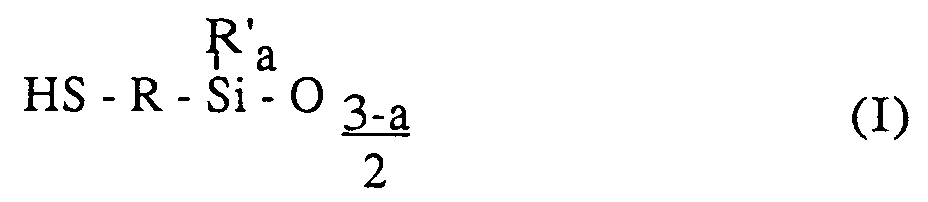
dans laquelle :
R désigne un radical aliphatique divalent ayant de 3 à 26 atomes de carbone éventuellement interropu par une fonction ester et pouvant porter des motifs d'oxyde d'éthylène ou d'oxyde de propylène ou leurs mélanges,
R′désigne un radical monovalent hydrocarboné ayant 1 à 6 atomes de carbone, alcoxy ayant 1 à 4 atomes de carbone, triméthylsilyloxy ;
a désigne un nombre entier égal à 0, 1 ou 2, les unités restantes ayant pour formule :

dans laquelle :
R˝ représente un groupement alkyle en C₁-C₁₈, phénylalkyle en C₁-C₆ ou phényle;
b est un nombre entier désignant 1, 2, ou 3;
au moins 50 % des groupements R′ et R˝ représentant un radical méthyle, comme agent de protection de la couleur de fibres kératiniques teintes.
Description
- La présente invention a pour objet l'utilisation de silicones à groupements thiols en tant qu'agents de protection de la coloration de cheveux teints, aux compositions et aux procédés mettant en oeuvre ces silicones à groupements thiols.
- On sait depuis longtemps que notamment la lumière et les agents de lavage ont tendance à agresser la couleur artificielle des cheveux teints, cette couleur s'affaiblissant peu à peu ou virant vers des couleurs peu esthétiques ou non souhaitables.
- Il est donc apparu nécessaire de protéger la couleur des fibres kératiniques teintes et plus particulièrement des cheveux teints, vis-à-vis des agents extérieurs susceptibles d'affaiblir ou de faire virer la coloration initiale obtenue après teinture.
- La demanderesse a découvert, ce qui fait l'objet de l'invention, que des silicones portant des groupements thiols préservaient la coloration artificielle des fibres kératiniques teintes et en particulier des cheveux, des dégradations dues notamment à la lumière et au lavage. Cette propriété a été mise en évidence en particulier par l'exposition à la lumière artificielle d'un simulateur solaire du type XENOTEST 150 d'ORIGINAL HANAU ou par lavage dans des conditions standards à l'aide d'une machine AHIBA TEXOMAT G6B.
- L'invention a donc pour objet l'utilisation de silicones thiols en tant qu'agents de protection de la couleur des fibres kératiniques teintes, en particulier des cheveux teints.
- Un autre objet de l'invention est constitué par les compositions de mise en oeuvre de ces silicones thiols.
- L'invention a également pour objet un procédé de protection de la coloration artificielle des fibres kératiniques, en particulier des cheveux, contre les agents extérieurs et mettant en oeuvre les silicones thiols.
- D'autres objets de l'invention apparaitront à la lecture de la description et des exemples qui suivent.
- Les silicones thiols utilisées conformément à l'invention sont des polydiorganosiloxanes comportant dans leur molécule au moins une unité de formule :

dans laquelle R désigne un radical aliphatique divalent ayant de 3 à 26 atomes de carbone, éventuellement interrompu par une fonction ester et pouvant porter des motifs d'oxyde d'éthylène ou d'oxyde de propylène ou leur mélange, R′ désigne un radical monovalent hydrocarbonné ayant 1 à 6 atomes de carbone, alcoxy ayant 1 à 4 atomes de carbone, triméthylsilyloxy ; a désigne un nombre entier égal à 0, 1 ou 2,
les unités restantes ayant pour formule :
- R˝ représente un groupe alkyle en C1-C₁₈, phénylalkyle(C1-C6) ou phényle;
- b est un nombre entier désignant 1, 2, ou 3;
au moins 50% des groupements R′ et R˝ représentant un groupement méthyle, et - 2) éventuellement des unités de formule :

- Le taux pondéral des groupements thiols présents dans le polydiorganosiloxane utilisés conformément à l'invention est compris entre 0,1 et 15 % et de préférence entre 0,15 et 13 %.
- Le radical R peut représenter notamment un groupement alkylène ayant 3 à 8 atomes de carbone tel que plus particulièrement un groupement (CH2)n où n est compris entre 3 et 8, ou un groupement de formule :

- R′ désigne plus particulièrement un radical alkyle en C1-C6 tel que méthyle, éthyle, n-propyle, isopropyle, n-butyle.
- De préférence, le radical R" représente un groupement méthyle, C₁₂H₂₅ , 2-phénylpropyle;
le radical R représente -(CH2)3,
et le radical R′ représente méthyle ou triméthylsilyloxy. - Le nombre total des unités (I), (II) et éventuellement (III) est de préférence égal ou inférieur à 500 et compris en particulier entre 10 et 500.
- La demanderesse a constaté que les polydiorganosiloxanes à fonction thiol définis ci-dessus étaient particulièrement efficaces pour préserver la couleur de cheveux teints des agressions de la lumière et des lavages.
- Les polydiorganosiloxanes à fonction thiol définis ci-dessus sont utilisés de préférence dans des quantités au moins égales à 0,1 % et généralement comprises entre 0,1 et 20 % et de préférence entre 1 et 10 % dans une composition contenant un milieu cosmétiquement acceptable, approprié pour être appliqué sur les fibres kératiniques, en particulier les cheveux humains.
- De telles compositions destinées à être appliquées sur les fibres kératiniques teintes et en particulier sur les cheveux teints en vue de protéger leur couleur artificielle, se présentent sous forme de lotions huileuses ou alcooliques, d'émulsions, de dispersions aqueuses ou hydroalcooliques.
- Lorsque les compositions destinées à être appliquées sur les fibres kératiniques teintes et en particulier les cheveux constituent des lotions huileuses, elles contiennent outre le polydiorganosiloxane à fonction thiol, des huiles minérales, végétales, animales ou synthétiques et plus particulièrement des isoparaffines telles que les ISOPARS ou des huiles de silicone telles que des huiles de silicone à structure linéaire ou cyclique comme les polyalkylsiloxanes, les polyarylsiloxanes, les polyalkylarylsiloxanes ou les polyorganosiloxanes modifiés par des groupements organofonctionnels différents des groupements thiols définis ci-dessus ou leur(s) mélange(s).
- Les lotions huileuses peuvent également contenir des cires, résines ou gommes de silicone conjointement aux huiles mentionnées ci-dessus.
- Les lotions alcooliques contiennent, outre le polydiorganosiloxane à fonction thiol, un alcool inférieur comportant 2 à 4 atomes de carbone et de préférence l'éthanol ou l'isopropanol et éventuellement d'autres solvants organiques comme les alkylèneglycols ou les éthers de glycols.
- Lorsque les compositions pour fibres kératiniques teintes conformes à l'invention se présentent sous forme d'émulsions, elles constituent des émulsions non-ioniques ou cationiques et de préférence non-ioniques.
- La phase grasse des émulsions est constituée, soit uniquement par le polydiorganosiloxane à fonction thiol tel que défini ci-dessus, soit par un mélange de ce polydiorganosiloxane avec d'autres huiles ou cires telles que celles mentionnées ci-dessus pour les lotions huileuses.
- L'autre phase des émulsions est constituée par un milieu aqueux.
- Les émulsions non-ioniques contiennent un émulsionnant non-ionique choisi parmi les alcools gras polyoxyéthylénés, les acides gras polyoxyéthylénés, les esters du sorbitan éventuellement polyoxy éthylénés, les alkylphénols polyoxyéthylénés ou polyglycérolés, les amides gras polyoxyéthylénés ou polyglycérolés, les alcools gras et alpha-diols polyglycérolés ; le nombre de groupements polyoxyéthylénés étant compris entre 2 et 50, le nombre de groupements polyglycéroles étant compris entre 2 et 30 ; les amides gras polyoxyéthylénés comportent de préférence 2 à 30 moles d'oxyde d'éthylène; les amides gras polyglycérolés comportent de préférence 1 à 5 groupements glycérol et en particulier 1,5 à 4; les esters d'acides gras du sorbitan comportent de préférence 2 à 30 moles d'oxyde d'éthylène.
- Les émulsions cationiques contiennent un émulsionnant cationique choisi parmi les halogénures d'ammonium quaternaire tels que de dialkyl (C₁₀-C₃₀) diméthylammonium, d'alkyl (C₁₀-C₃₀) triméthyl ammonium ou d'alkyl (C₁₀-C₃₀) benzyl diméthylammonium et les sels d'ammonium quaternaires polyoxyéthylénés comportant de 2 à 30 moles d'oxyde d'éthylène. On utilise de préférence le chlorure de distéaryldiméthyl ammonium et le chlorure de béhényl triméthyl-ammonium.
- Lorsque les compositions destinées à être appliquées sur les fibres kératiniques teintes et contenant le polydiorganosiloxane à fonction thiol, utilisées conformément à l'invention sont des dispersions, elles contiennent en plus de cet agent, de l'eau et un agent de dispersion ou un agent de mise en suspension de la silicone dans le milieu aqueux. Des agents de dispersion plus particulièrement préférés sont choisis parmi un copolymère d'acrylate d'ammonium et d'acrylamide réticulé, un polyacrylamide, un polymère d'acide acrylique réticulé
- Ces dispersions peuvent constituer des produits non rincés ou rincés et également des shampooings. Dans ce dernier cas, elles contiennent des tensio-actifs anioniques, non ioniques, amphotères ou leurs mélanges dans des concentrations généralement comprises entre 5 et 30% en poids.
- Lorsque les compositions conformes à l'invention contiennent des solvants, ils sont choisis plus particulièrement parmi les alcanols inférieurs tels que l'éthanol.
- Les compositions conformes à l'invention peuvent également renfermer tout autre agent habituellement appliqué sur les fibres kératiniques ; lorsqu'il s'agit de cheveux, ces adjuvants sont des adjuvants cosmétiquement acceptables. Ces adjuvants peuvent être choisis en particulier parmi des colorants, des conservateurs, des résines cosmétiques, des agents adoucissants, des parfums, etc.
- Les compositions conformes à l'invention peuvent également se présenter sous forme de sprays ou être préssurisées dans des dispositifs aérosols.
- Le procédé de protection de la couleur artificielle des fibres kératiniques teintes et en particulier de cheveux teints conforme à l'invention consiste à appliquer sur celles-ci une composition contenant au moins 0,1% d'un polydiorganosiloxane à fonction thiol comportant les unités de formules (I) et (II) telles que définies ci-dessus.
- Les fibres kératiniques et en particulier les cheveux peuvent être teints en mettant en oeuvre des colorants classiquement utilisés en teinture capillaire tels que par l'utilisation de précurseurs de colorants d'oxydation suivant un processus de coloration mettant en oeuvre un agent oxydant ou par coloration dite directe mettant en oeuvre des colorants nitrés benzéniques, des colorants anthraquinoniques, azoïques classiquement utilisés en teinture des fibres kératiniques.
- L'utilisation des silicones thiols selon l'invention est particulièrement bien adaptée aux cheveux teints par un processus de coloration mettant en oeuvre un agent oxydant.
- De telles compositions sont bien connues du technicien et sont décrites, par exemple, dans l'ouvrage HARRY'S COSMETICOLOGY, 7ème édition, 1982, pages 533 à 545.
- Les exemples suivants sont destinés à illustrer l'invention sans pour autant présenter un caractère limitatif.
- On prépare la composition suivante :

- Cette composition se présente sous forme d'une huile.
- On prépare la composition suivante :

-

- Cette composition est utilisée comme shampooing pour le lavage des cheveux.
-

- Cette composition est utilisée en application non suivie d'un rinçage pour le soin des cheveux teintés.
-
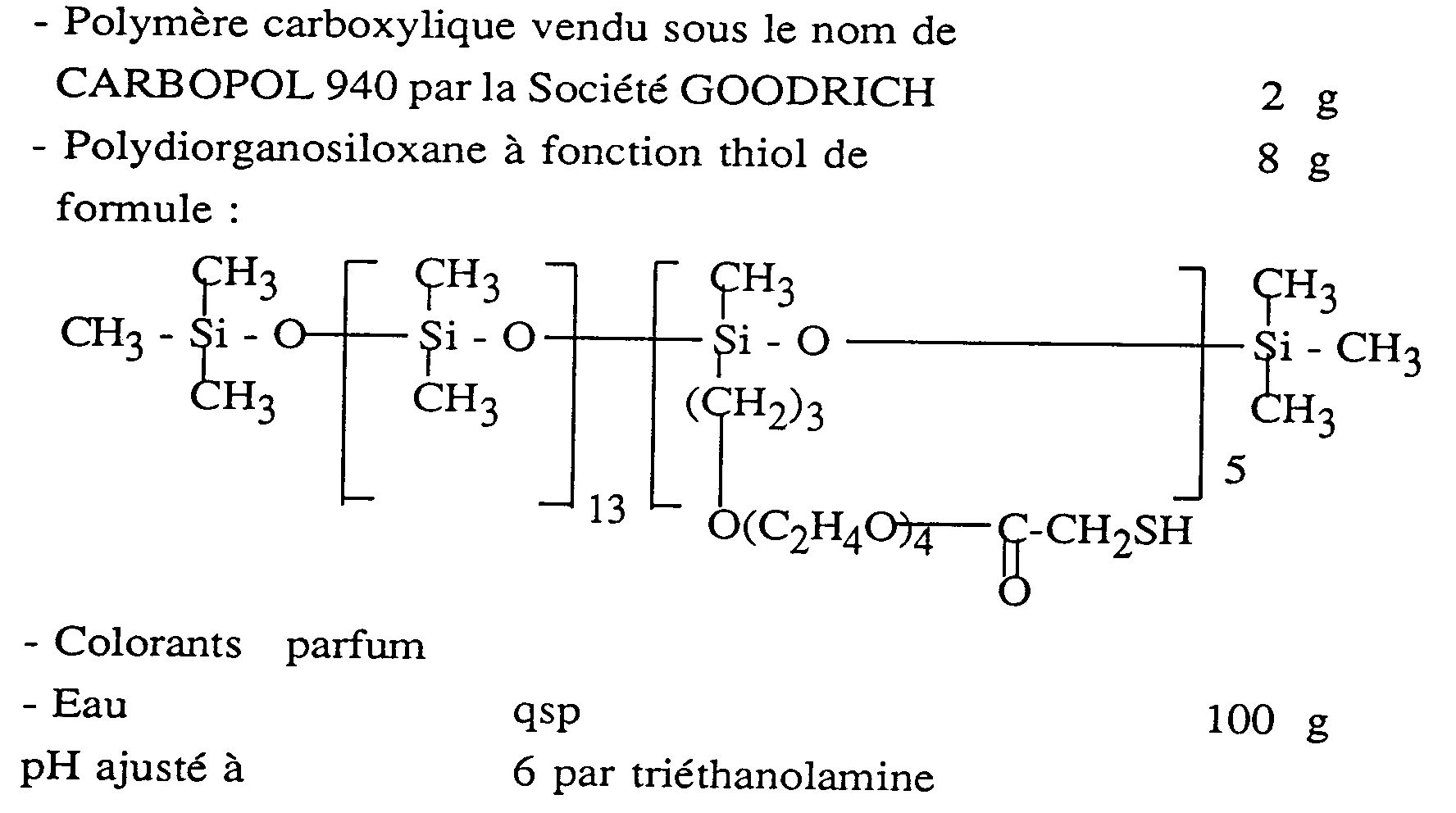
- Cette composition est appliquée sur les cheveux teints, qui sont ensuite séché et coiffé sans rinçage intermédiaire.
-

- Cette composition est utilisée comme laque pour fixer les cheveux.
-

- Les compositions des exemples 1 et 2 appliquées régulièrement sur des cheveux teints protègent leur couleur vis-à-vis des lavages et de la lumière tout en leur conférant de la douceur, du brillant et de la légèreté.
Claims (21)
- Utilisation d'un polydiorganosiloxane à fonction thiol comportant dans sa molécule au moins une unité de formule:

R désigne un radical aliphatique divalent ayant de 3 à 26 atomes de carbone éventuellement interrompu par une fonction ester et pouvant porter des motifs d'oxyde d'éthylène ou d'oxyde de propylène ou leurs mélanges;
R′ désigne un radical monovalent hydrocarboné ayant 1 à 6 atomes de carbone, alcoxy ayant 1 à 4 atomes de carbone, triméthylsilyloxy ;
a désigne un nombre entier égal à 0, 1 ou 2, les unités restantes ayant pour formule :
R˝ représente un groupement alkyle en C1-C₁₈, phénylalkyle (C1-C6) ou phényle;
b est un nombre entier désignant 1, 2, ou 3;
au moins 50 % des groupements R′ et R˝ représentant un radical méthyle, comme agent de protection de la couleur de fibres kératiniques teintes. - Utilisation selon la revendication 1 dans laquelle le polyorganosiloxane comporte en plus des unités de formule :

- Utilisation selon la revendication 1 ou 2 dans laquelle le polyorganosiloxane comprend une unité de formule (I) dans laquelle R représente un groupement alkylène ayant 3 à 8 atomes de carbone, ou un groupement de formule:

- Utilisation selon l'une quelconque des revendications 1 à 3, caractérisée par le fait que le polydiorganosiloxane à fonction thiol répondant à la définition indiquée dans la revendication 1 est choisi parmi les composés dans lesquels R représente :

- Utilisation selon l'une quelconque des revendications 1 à 4, caractérisée par le fait que l'on met en oeuvre des polydiorganosiloxanes à fonction thiol dans lesquels le taux pondéral de groupements thiols présents est compris entre 0,1 et 15 % et de préférence entre 0,15 et 13 %.
- Utilisation selon l'une quelconque des revendications 1 à 5, caractérisée par le fait que le polydiorganosiloxane à fonction thiol est utilisé en mettant en oeuvre une composition contenant au moins 0,1 % en poids dudit polydiorganosiloxane à fonction thiol dans un support approprié pour être appliqué sur les fibres kératiniques teintes.
- Composition destinée à être appliquée sur des fibres kératiniques teintes et en particulier les cheveux humains teints pour les protéger de la dégradation due à des agents extérieurs, caractérisée par le fait qu'elle contient dans un milieu approprié pour l'application sur les fibres kératiniques au moins 0,1 % d'un polydiorganosiloxane à fonction thiol tel que défini dans l'une quelconque des revendications 1 à 6.
- Composition selon la revendication 7, caractérisée par le fait que la composition se présente sous forme de lotion huileuse, d'émulsion, de dispersion aqueuse ou hydroalcoolique.
- Composition selon la revendication 7 ou 8, caractérisée par le fait que les lotions huileuses contiennent outre le polydiorganosiloxane à fonction thiol, des huiles minérales, végétales, animales ou synthétiques.
- Composition selon la revendication 9, caractérisée par le fait que les huiles sont choisies parmi les huiles de silicone ou les isoparaffines.
- Composition selon la revendication 10, caractérisée par le fait que les huiles de silicone sont des huiles à structure linéaire ou cyclique choisies parmi les polyalkylsiloxanes, les polyarylsiloxanes, les polyalkylarylsiloxanes et les polyorganosiloxanes modifiés par des groupements organofonctionnels différents du groupement thiol ou leurs mélanges.
- Composition selon l'une quelconque des revendications 7 à 11, caractérisée par le fait que les lotions huileuses contiennent en plus des cires, des résines ou gommes de silicone.
- Composition selon les revendications 7 ou 8, caractérisée par le fait qu'elle se présente sous forme d'émulsion non-ionique ou cationique.
- Composition selon la revendication 13, caractérisée par le fait que la phase grasse des émulsions est constituée soit par le polydiorganosiloxane à fonction thiol défini dans l'une quelconque des revendications 1 à 6 soit par un mélange de ce polydiorganosiloxane à fonction thiol avec d'autres huiles ou cires.
- Composition selon la revendication 13, caractérisée par le fait qu'elle se présente sous forme d'une émulsion non-ionique contenant un agent émulsionnant non-ionique, choisi parmi les alcools gras polyoxyéthylénés, les acides gras polyoxyéthylénés, les esters du sorbitan éventuellement polyoxyéthylénés, les alkylphénols polyoxyéthylénés ou polyglycérolés, les alcools gras et alpha-diols polyglycérolés.
- Composition selon la revendication 7 ou 8, caractérisée par le fait que la composition se présente sous forme d'une émulsion cationique contenant un agent émulsionnant cationique choisi parmi les halogénures d'ammonium quaternaire.
- Composition selon la revendication 7 ou 8, se présentant sous forme d'une dispersion aqueuse, caractérisée par le fait qu'elle contient en plus du polydiorganosiloxane à fonction thiol défini dans l'une quelconque des revendications 1 à 6, de l'eau et un agent de dispersion.
- Composition selon la revendication 17, caractérisée par le fait que l'agent de dispersion est constitué par un copolymère d'acrylate d'ammonium et d'acrylamide réticulé.
- Composition selon l'une quelconque des revendications 7 à 18, caractérisée par le fait qu'elle se présente sous forme de spray ou est pressurisée en aérosol.
- Composition selon les revendications 7 ou 8, caractérisé par le fait qu'elle se présente sous forme de lotion alcoolique, contenant outre le polydiorganosiloxane à fonction thiol, un alcool inférieur comportant 2 à 4 atomes de carbone et éventuellement d'autres solvants organiques.
- Procédé de protection de la couleur artificielle des cheveux teints, caractérisé par le fait que l'on applique sur ces cheveux une composition contenant dans un milieu approprié pour les cheveux au moins 0,1% d'un polydiorganosiloxane à fonction thiol tel que défini dans l'une quelconque des revendications 1 à 6.
Applications Claiming Priority (2)
| Application Number | Priority Date | Filing Date | Title |
|---|---|---|---|
| FR9104886A FR2675378B1 (fr) | 1991-04-19 | 1991-04-19 | Composition et procede mettant en óoeuvre des silicones thiols pour la protection de la couleur de fibres keratiniques teintes. |
| FR9104886 | 1991-04-19 |
Publications (3)
| Publication Number | Publication Date |
|---|---|
| EP0509922A2 true EP0509922A2 (fr) | 1992-10-21 |
| EP0509922A3 EP0509922A3 (fr) | 1992-10-28 |
| EP0509922B1 EP0509922B1 (fr) | 1996-06-26 |
Family
ID=9412080
Family Applications (1)
| Application Number | Title | Priority Date | Filing Date |
|---|---|---|---|
| EP92401061A Expired - Lifetime EP0509922B1 (fr) | 1991-04-19 | 1992-04-15 | Composition et procédé mettant en oeuvre des silicones thiols pour la protection de la couleur de fibres kératiniques teintes |
Country Status (8)
| Country | Link |
|---|---|
| US (1) | US5609856A (fr) |
| EP (1) | EP0509922B1 (fr) |
| JP (1) | JPH05124938A (fr) |
| AT (1) | ATE139688T1 (fr) |
| CA (1) | CA2066363A1 (fr) |
| DE (1) | DE69211754T2 (fr) |
| ES (1) | ES2089437T3 (fr) |
| FR (1) | FR2675378B1 (fr) |
Cited By (7)
| Publication number | Priority date | Publication date | Assignee | Title |
|---|---|---|---|---|
| FR2775479A1 (fr) * | 1998-03-02 | 1999-09-03 | Oreal | Utilisation d'un organosiloxane et/ou d'un organosilane antioxydant pour la photoprotection de la couleur des fibres keratiniques colorees naturellement ou artificiellement |
| US6390102B1 (en) | 2000-07-14 | 2002-05-21 | General Electric Company | Silicone compositions for personal care products and method for making |
| US6488921B1 (en) | 2000-07-14 | 2002-12-03 | General Electric Company | Silicone compositions for personal care products and method for making |
| US6506371B1 (en) | 2000-07-14 | 2003-01-14 | General Electric Company | Silicone compositions for personal care products and method for making |
| US6619294B1 (en) | 2000-07-14 | 2003-09-16 | General Electric Company | Silicone compositions for personal care products and method for making |
| US7118733B2 (en) | 2000-07-14 | 2006-10-10 | General Electric Company | Topical silicone compositions and method for making |
| US8058246B2 (en) | 2004-02-27 | 2011-11-15 | Akzo Nobel N.V. | Method and composition to achieve stable color of artificially colored hair |
Families Citing this family (10)
| Publication number | Priority date | Publication date | Assignee | Title |
|---|---|---|---|---|
| FR2739287B1 (fr) * | 1995-09-29 | 1997-10-31 | Oreal | Composition pour le traitement des matieres keratiniques comprenant au moins un polymere silicone greffe, a squelette polysiloxanique greffe par des monomeres organiques non-silicones et au moins un hydrocarbure liquide en c11-c26 |
| US6040282A (en) * | 1998-02-03 | 2000-03-21 | The Procter & Gamble Company | Styling shampoo compositions which deliver improved hair curl retention and hair feel |
| US6177390B1 (en) | 1998-02-03 | 2001-01-23 | The Procter & Gamble Company | Styling shampoo compositions which deliver improved hair curl retention and hair feel |
| US6703007B2 (en) | 1999-01-08 | 2004-03-09 | The Procter & Gamble Company | Topical compositions comprising functional nucleophiles protected by phosphorus-containing moieties |
| EP1143916A2 (fr) | 1999-01-08 | 2001-10-17 | The Procter & Gamble Company | Compositions topiques comprenant des thiols fonctionnels proteges |
| EP1529517A3 (fr) * | 2003-11-04 | 2005-09-14 | Clariant GmbH | Utilisation de polymères pour la tenue de la couleur dans les cheveux teints. |
| KR101290846B1 (ko) * | 2005-07-28 | 2013-07-29 | 아라까와 가가꾸 고교 가부시끼가이샤 | 경화성수지조성물, 그 경화물 및 이것들로부터 유도된 각종 물품 |
| WO2009052272A1 (fr) * | 2007-10-19 | 2009-04-23 | L'oreal | Compositions et procédés pour une utilisation sur des cheveux artificiellement colorés |
| GB201515414D0 (en) | 2015-08-29 | 2015-10-14 | Advance Performance Materials Ltd | Polyorganic groups modified silica, processes to make and use therof |
| GB2563524B (en) | 2016-03-28 | 2021-09-01 | Procter & Gamble | Long lasting and stable freshening compositions and methods of freshening the air |
Family Cites Families (13)
| Publication number | Priority date | Publication date | Assignee | Title |
|---|---|---|---|---|
| DE1163818B (de) * | 1962-05-05 | 1964-02-27 | Goldschmidt Ag Th | Verfahren zur Herstellung von ªÏ-mercaptoalkylgruppenhaltigen Organosiliciumverbindungen |
| FR1356552A (fr) * | 1962-05-05 | 1964-03-27 | Goldschmidt Ag Th | Procédé de préparation de composés organiques du silicium contenant des groupes alcoylmercapto |
| FR1378791A (fr) * | 1964-01-10 | 1964-11-13 | Goldschmidt Ag Th | Procédé de préparation de composés organosiliciques contenant des groupes thioéther |
| US3382196A (en) * | 1965-06-03 | 1968-05-07 | Dow Corning | Organic rubbers with mercaptoorganosiloxanes having improved elongation |
| NL6702766A (fr) * | 1966-07-01 | 1968-01-02 | ||
| NL6702986A (fr) * | 1966-07-07 | 1968-01-08 | ||
| JPS62255413A (ja) * | 1986-04-28 | 1987-11-07 | Kao Corp | 加温式毛髪変形用処理剤 |
| US5015717A (en) * | 1986-12-22 | 1991-05-14 | Wacker Silicones Corporation | Sulfur-containing organopolysiloxane waxes and a method for preparing the same |
| GB8713879D0 (en) * | 1987-06-13 | 1987-07-15 | Dow Corning Ltd | Treating hair |
| LU87273A1 (fr) * | 1988-07-12 | 1990-02-07 | Oreal | Composition cosmetique capillaire a base de polyorganosiloxanes a fonction hydroxyalkyle |
| US5061482A (en) * | 1989-11-29 | 1991-10-29 | Dow Corning Corporation | Siloxanes useful in permanent waving of hair |
| US5135742A (en) * | 1990-07-06 | 1992-08-04 | Dow Corning Corporation | Hair fixatives comprising silanes containing a silsesquioxane characteristic |
| US5260055A (en) * | 1991-02-19 | 1993-11-09 | John Imperante | Fatty carboxylic silicone amine salts |
-
1991
- 1991-04-19 FR FR9104886A patent/FR2675378B1/fr not_active Expired - Fee Related
-
1992
- 1992-04-15 AT AT92401061T patent/ATE139688T1/de active
- 1992-04-15 DE DE69211754T patent/DE69211754T2/de not_active Expired - Fee Related
- 1992-04-15 ES ES92401061T patent/ES2089437T3/es not_active Expired - Lifetime
- 1992-04-15 EP EP92401061A patent/EP0509922B1/fr not_active Expired - Lifetime
- 1992-04-16 CA CA002066363A patent/CA2066363A1/fr not_active Abandoned
- 1992-04-17 JP JP4098244A patent/JPH05124938A/ja active Pending
-
1994
- 1994-12-02 US US08/353,394 patent/US5609856A/en not_active Expired - Fee Related
Cited By (13)
| Publication number | Priority date | Publication date | Assignee | Title |
|---|---|---|---|---|
| FR2775479A1 (fr) * | 1998-03-02 | 1999-09-03 | Oreal | Utilisation d'un organosiloxane et/ou d'un organosilane antioxydant pour la photoprotection de la couleur des fibres keratiniques colorees naturellement ou artificiellement |
| EP0940404A1 (fr) * | 1998-03-02 | 1999-09-08 | L'oreal | Utilisation d'un organosiloxane et/ou d'un organosilane antioxydant pour la photoprotection de la couleur des fibres kérantiniques colorées naturellement ou artificiellement |
| US6390102B1 (en) | 2000-07-14 | 2002-05-21 | General Electric Company | Silicone compositions for personal care products and method for making |
| US6488921B1 (en) | 2000-07-14 | 2002-12-03 | General Electric Company | Silicone compositions for personal care products and method for making |
| US6506371B1 (en) | 2000-07-14 | 2003-01-14 | General Electric Company | Silicone compositions for personal care products and method for making |
| US6619294B1 (en) | 2000-07-14 | 2003-09-16 | General Electric Company | Silicone compositions for personal care products and method for making |
| US6752984B2 (en) | 2000-07-14 | 2004-06-22 | General Electric Company | Silicone compositions for personal care products and method for making |
| US6841164B2 (en) | 2000-07-14 | 2005-01-11 | General Electric Company | Silicone compositions for personal care products and method for making |
| US6844002B2 (en) | 2000-07-14 | 2005-01-18 | General Electric Company | Silicone compositions for personal care products and method for making |
| US6849264B2 (en) | 2000-07-14 | 2005-02-01 | General Electric Company | Silicone compositions for personal care products and method for making |
| US6849265B2 (en) | 2000-07-14 | 2005-02-01 | General Electric Company | Silicone compositions for personal care products and method for making |
| US7118733B2 (en) | 2000-07-14 | 2006-10-10 | General Electric Company | Topical silicone compositions and method for making |
| US8058246B2 (en) | 2004-02-27 | 2011-11-15 | Akzo Nobel N.V. | Method and composition to achieve stable color of artificially colored hair |
Also Published As
| Publication number | Publication date |
|---|---|
| FR2675378A1 (fr) | 1992-10-23 |
| US5609856A (en) | 1997-03-11 |
| ATE139688T1 (de) | 1996-07-15 |
| JPH05124938A (ja) | 1993-05-21 |
| EP0509922B1 (fr) | 1996-06-26 |
| DE69211754D1 (de) | 1996-08-01 |
| DE69211754T2 (de) | 1996-10-24 |
| EP0509922A3 (fr) | 1992-10-28 |
| CA2066363A1 (fr) | 1992-10-20 |
| FR2675378B1 (fr) | 1993-08-27 |
| ES2089437T3 (es) | 1996-10-01 |
Similar Documents
| Publication | Publication Date | Title |
|---|---|---|
| EP0509922B1 (fr) | Composition et procédé mettant en oeuvre des silicones thiols pour la protection de la couleur de fibres kératiniques teintes | |
| EP0601080B1 (fr) | Composition cosmetique filtrante contenant un polymere filtre liposoluble a structure hydrocarbonee et une silicone filtre | |
| EP0521748B1 (fr) | Composition de lavage et/ou de conditionnement des matières kératiniques, contenant une silicone et un polymère amphotère dérivé de diallyldialkylammonium et d'un monomère anionique | |
| EP0587637B1 (fr) | Composition de traitement des matieres keratiniques a base de silicone et de latex | |
| FR2687069A1 (fr) | Composition cosmetique contenant au moins un agent tensioactif de type alkylpolyglycoside et/ou polyglycerole et au moins un urethanne-polyether. | |
| CA2385915A1 (fr) | Composition cosmetique a base de composes organiques du silicium comportant au moins une fonction a effet cosmetique | |
| CH647688A5 (fr) | Utilisation de polysiloxanes comme agents tensioactifs. | |
| EP0551510A1 (fr) | Composition cosmetique filtrante photostable contenant un filtre uv-a et un 4-methoxy benzylidene cyanoacetate. | |
| LU87127A1 (fr) | Application cosmetique de polysiloxanes a fonction beta-cetoester et compositions mises en oeuvre | |
| FR2719468A1 (fr) | Compositions cosmétiques à base de certains bioflavonoïdes et utilisations notamment dans le domaine capillaire. | |
| EP0363252A1 (fr) | Emulsions d'organopolysiloxanes à fonction diester, leur application dans le traitement textile, cosmétique et dermatologique | |
| EP0701429B1 (fr) | Compositions cosmetiques contenant au moins un tensioactif anionique du type alkylgalactoside uronate et au moins un organopolysiloxane | |
| CA1180281A (fr) | Utilisation d'hydroxyanthraquinones pour la coloration des fibres keratiniques humaines, procede et composition les mettant en oeuvre | |
| FR2779641A1 (fr) | Compositions cosmetiques detergentes et utilisation | |
| FR2709953A1 (fr) | Composition cosmétique contenant au moins un agent tensio-actif non-ionique du type alkylpolyglycoside et/ou polyglycérolé et au moins un copolymère séquencé polydiméthylsiloxane/polyoxalkylène. | |
| US5609861A (en) | Composition and process using silicone thiols for the protection of the color of dyed keratinous fibres | |
| EP0617954B1 (fr) | Composition cosmétique contenant au moins un agent tensio-actif non-ionique du type alkylpolyglycoside et/ou polyglycérolé et au moins un copolymère réticulé d'anhydride maléique/alkyl(C1-C5) vinyléther | |
| CA1341193C (fr) | Composition cosmetique capillaire a base de polyorganosiloxanes a fonction hydroxyalkyle | |
| CH646129A5 (fr) | Agents de surface non-ioniques polyoxyethylenes a deux chaines lipophiles, leur procede de preparation et compositions les contenant. | |
| CA1180283A (fr) | Utilisation de benzoquinones pour la coloration directe des fibres keratiniques | |
| FR2771630A1 (fr) | Dispersion aqueuse comprenant un filtre uv du type organosiloxane a fonction benzalmalonate et un tensioactif cationique insoluble dans l'eau | |
| CA2222861C (fr) | Utilisation d'une composition comprenant un ceramide et un filtre uv sulfonique | |
| EP0504040A1 (fr) | Utilisation de la lactoferrine pour la protection de la kératine des cheveux contre les agressions atmosphériques, notamment la lumière, et procédé de protection des cheveux utilisant ce composé | |
| WO1994027572A1 (fr) | Compositions cosmetiques contenant au moins un tensio-actif anionique du type alkylgalactoside uronate et au moins un tensio-actif du type alkylpolyglycoside et/ou polyglycerole | |
| EP0842965B1 (fr) | Utilisation d'une silicone filtre pour la protection des fibres kératiniques colorées artificiellement contre les effets des radiations UV |
Legal Events
| Date | Code | Title | Description |
|---|---|---|---|
| PUAI | Public reference made under article 153(3) epc to a published international application that has entered the european phase |
Free format text: ORIGINAL CODE: 0009012 |
|
| PUAL | Search report despatched |
Free format text: ORIGINAL CODE: 0009013 |
|
| AK | Designated contracting states |
Kind code of ref document: A2 Designated state(s): AT BE CH DE DK ES FR GB GR IT LI NL PT SE |
|
| AK | Designated contracting states |
Kind code of ref document: A3 Designated state(s): AT BE CH DE DK ES FR GB GR IT LI NL PT SE |
|
| 17P | Request for examination filed |
Effective date: 19930119 |
|
| 17Q | First examination report despatched |
Effective date: 19940722 |
|
| GRAH | Despatch of communication of intention to grant a patent |
Free format text: ORIGINAL CODE: EPIDOS IGRA |
|
| GRAA | (expected) grant |
Free format text: ORIGINAL CODE: 0009210 |
|
| AK | Designated contracting states |
Kind code of ref document: B1 Designated state(s): AT BE CH DE DK ES FR GB GR IT LI NL PT SE |
|
| PG25 | Lapsed in a contracting state [announced via postgrant information from national office to epo] |
Ref country code: NL Free format text: LAPSE BECAUSE OF FAILURE TO SUBMIT A TRANSLATION OF THE DESCRIPTION OR TO PAY THE FEE WITHIN THE PRESCRIBED TIME-LIMIT Effective date: 19960626 Ref country code: GR Free format text: LAPSE BECAUSE OF FAILURE TO SUBMIT A TRANSLATION OF THE DESCRIPTION OR TO PAY THE FEE WITHIN THE PRESCRIBED TIME-LIMIT Effective date: 19960626 Ref country code: DK Effective date: 19960626 Ref country code: AT Effective date: 19960626 |
|
| REF | Corresponds to: |
Ref document number: 139688 Country of ref document: AT Date of ref document: 19960715 Kind code of ref document: T |
|
| ITF | It: translation for a ep patent filed | ||
| REF | Corresponds to: |
Ref document number: 69211754 Country of ref document: DE Date of ref document: 19960801 |
|
| GRAH | Despatch of communication of intention to grant a patent |
Free format text: ORIGINAL CODE: EPIDOS IGRA |
|
| GBT | Gb: translation of ep patent filed (gb section 77(6)(a)/1977) |
Effective date: 19960806 |
|
| PG25 | Lapsed in a contracting state [announced via postgrant information from national office to epo] |
Ref country code: SE Effective date: 19960926 Ref country code: PT Effective date: 19960926 |
|
| REG | Reference to a national code |
Ref country code: ES Ref legal event code: FG2A Ref document number: 2089437 Country of ref document: ES Kind code of ref document: T3 |
|
| REG | Reference to a national code |
Ref country code: ES Ref legal event code: FG2A Ref document number: 2089437 Country of ref document: ES Kind code of ref document: T3 |
|
| NLV1 | Nl: lapsed or annulled due to failure to fulfill the requirements of art. 29p and 29m of the patents act | ||
| PG25 | Lapsed in a contracting state [announced via postgrant information from national office to epo] |
Ref country code: LI Free format text: LAPSE BECAUSE OF NON-PAYMENT OF DUE FEES Effective date: 19970430 Ref country code: CH Free format text: LAPSE BECAUSE OF NON-PAYMENT OF DUE FEES Effective date: 19970430 Ref country code: BE Effective date: 19970430 |
|
| PLBE | No opposition filed within time limit |
Free format text: ORIGINAL CODE: 0009261 |
|
| STAA | Information on the status of an ep patent application or granted ep patent |
Free format text: STATUS: NO OPPOSITION FILED WITHIN TIME LIMIT |
|
| 26N | No opposition filed | ||
| BERE | Be: lapsed |
Owner name: L' OREAL Effective date: 19970430 |
|
| REG | Reference to a national code |
Ref country code: CH Ref legal event code: PL |
|
| REG | Reference to a national code |
Ref country code: GB Ref legal event code: IF02 |
|
| PGFP | Annual fee paid to national office [announced via postgrant information from national office to epo] |
Ref country code: ES Payment date: 20030429 Year of fee payment: 12 |
|
| PG25 | Lapsed in a contracting state [announced via postgrant information from national office to epo] |
Ref country code: ES Free format text: LAPSE BECAUSE OF NON-PAYMENT OF DUE FEES Effective date: 20040416 |
|
| PG25 | Lapsed in a contracting state [announced via postgrant information from national office to epo] |
Ref country code: IT Free format text: LAPSE BECAUSE OF NON-PAYMENT OF DUE FEES;WARNING: LAPSES OF ITALIAN PATENTS WITH EFFECTIVE DATE BEFORE 2007 MAY HAVE OCCURRED AT ANY TIME BEFORE 2007. THE CORRECT EFFECTIVE DATE MAY BE DIFFERENT FROM THE ONE RECORDED. Effective date: 20050415 |
|
| REG | Reference to a national code |
Ref country code: ES Ref legal event code: FD2A Effective date: 20040416 |
|
| PGFP | Annual fee paid to national office [announced via postgrant information from national office to epo] |
Ref country code: DE Payment date: 20070412 Year of fee payment: 16 |
|
| PGFP | Annual fee paid to national office [announced via postgrant information from national office to epo] |
Ref country code: GB Payment date: 20070411 Year of fee payment: 16 |
|
| PGFP | Annual fee paid to national office [announced via postgrant information from national office to epo] |
Ref country code: FR Payment date: 20070411 Year of fee payment: 16 |
|
| GBPC | Gb: european patent ceased through non-payment of renewal fee |
Effective date: 20080415 |
|
| PG25 | Lapsed in a contracting state [announced via postgrant information from national office to epo] |
Ref country code: DE Free format text: LAPSE BECAUSE OF NON-PAYMENT OF DUE FEES Effective date: 20081101 |
|
| REG | Reference to a national code |
Ref country code: FR Ref legal event code: ST Effective date: 20081231 |
|
| PG25 | Lapsed in a contracting state [announced via postgrant information from national office to epo] |
Ref country code: FR Free format text: LAPSE BECAUSE OF NON-PAYMENT OF DUE FEES Effective date: 20080430 |
|
| PG25 | Lapsed in a contracting state [announced via postgrant information from national office to epo] |
Ref country code: GB Free format text: LAPSE BECAUSE OF NON-PAYMENT OF DUE FEES Effective date: 20080415 |