EP0514630B1 - Durch Strahlung vernetzbare Beschichtungsmittel und ihre Verwendung - Google Patents
Durch Strahlung vernetzbare Beschichtungsmittel und ihre Verwendung Download PDFInfo
- Publication number
- EP0514630B1 EP0514630B1 EP92103439A EP92103439A EP0514630B1 EP 0514630 B1 EP0514630 B1 EP 0514630B1 EP 92103439 A EP92103439 A EP 92103439A EP 92103439 A EP92103439 A EP 92103439A EP 0514630 B1 EP0514630 B1 EP 0514630B1
- Authority
- EP
- European Patent Office
- Prior art keywords
- coating
- epoxy
- groups
- binder
- coating agents
- Prior art date
- Legal status (The legal status is an assumption and is not a legal conclusion. Google has not performed a legal analysis and makes no representation as to the accuracy of the status listed.)
- Expired - Lifetime
Links
- 239000011248 coating agent Substances 0.000 title claims description 44
- 238000000576 coating method Methods 0.000 title claims description 16
- 230000005855 radiation Effects 0.000 title claims description 8
- 239000011230 binding agent Substances 0.000 claims abstract description 31
- 229920003986 novolac Polymers 0.000 claims abstract description 21
- 239000004593 Epoxy Substances 0.000 claims abstract description 19
- 150000001875 compounds Chemical class 0.000 claims abstract description 17
- 125000002887 hydroxy group Chemical group [H]O* 0.000 claims abstract description 15
- 125000003700 epoxy group Chemical group 0.000 claims abstract description 14
- 229920005989 resin Polymers 0.000 claims abstract description 12
- 239000011347 resin Substances 0.000 claims abstract description 12
- 150000001735 carboxylic acids Chemical class 0.000 claims abstract description 10
- 150000002148 esters Chemical class 0.000 claims abstract description 10
- 239000007795 chemical reaction product Substances 0.000 claims abstract description 9
- IQPQWNKOIGAROB-UHFFFAOYSA-N isocyanate group Chemical group [N-]=C=O IQPQWNKOIGAROB-UHFFFAOYSA-N 0.000 claims abstract description 6
- 125000003178 carboxy group Chemical group [H]OC(*)=O 0.000 claims abstract description 4
- 238000006243 chemical reaction Methods 0.000 claims description 24
- 239000000945 filler Substances 0.000 claims description 24
- 229920000647 polyepoxide Polymers 0.000 claims description 21
- 239000003822 epoxy resin Substances 0.000 claims description 20
- 239000002904 solvent Substances 0.000 claims description 17
- 239000000203 mixture Substances 0.000 claims description 16
- 238000000034 method Methods 0.000 claims description 15
- 230000008569 process Effects 0.000 claims description 12
- 238000005266 casting Methods 0.000 claims description 9
- 239000002253 acid Substances 0.000 claims description 7
- 229910000679 solder Inorganic materials 0.000 claims description 7
- LNEPOXFFQSENCJ-UHFFFAOYSA-N haloperidol Chemical class C1CC(O)(C=2C=CC(Cl)=CC=2)CCN1CCCC(=O)C1=CC=C(F)C=C1 LNEPOXFFQSENCJ-UHFFFAOYSA-N 0.000 claims description 6
- 238000002360 preparation method Methods 0.000 claims description 5
- VVBLNCFGVYUYGU-UHFFFAOYSA-N 4,4'-Bis(dimethylamino)benzophenone Chemical compound C1=CC(N(C)C)=CC=C1C(=O)C1=CC=C(N(C)C)C=C1 VVBLNCFGVYUYGU-UHFFFAOYSA-N 0.000 claims description 4
- 239000000654 additive Substances 0.000 claims description 4
- 238000004132 cross linking Methods 0.000 claims description 4
- 238000007650 screen-printing Methods 0.000 claims description 4
- NIXOWILDQLNWCW-UHFFFAOYSA-N acrylic acid group Chemical group C(C=C)(=O)O NIXOWILDQLNWCW-UHFFFAOYSA-N 0.000 claims description 3
- 238000007792 addition Methods 0.000 claims description 3
- 238000007590 electrostatic spraying Methods 0.000 claims description 3
- 239000004849 latent hardener Substances 0.000 claims description 3
- 230000001681 protective effect Effects 0.000 claims description 3
- 238000005507 spraying Methods 0.000 claims description 3
- 230000001588 bifunctional effect Effects 0.000 claims description 2
- 238000004870 electrical engineering Methods 0.000 claims description 2
- 125000005395 methacrylic acid group Chemical group 0.000 claims description 2
- 238000007761 roller coating Methods 0.000 claims description 2
- NYVPYOCCTPDTKV-UHFFFAOYSA-N carbamic acid;isocyanic acid Chemical class N=C=O.NC(O)=O NYVPYOCCTPDTKV-UHFFFAOYSA-N 0.000 claims 2
- 239000002671 adjuvant Substances 0.000 claims 1
- 125000002843 carboxylic acid group Chemical group 0.000 claims 1
- 230000008021 deposition Effects 0.000 claims 1
- 125000003055 glycidyl group Chemical group C(C1CO1)* 0.000 claims 1
- 239000003999 initiator Substances 0.000 claims 1
- 238000007639 printing Methods 0.000 claims 1
- 239000008199 coating composition Substances 0.000 abstract description 19
- -1 epoxide compound Chemical class 0.000 abstract description 13
- GNSDJMPNLUOQKA-UHFFFAOYSA-N isocyanatocarbamic acid Chemical class OC(=O)NN=C=O GNSDJMPNLUOQKA-UHFFFAOYSA-N 0.000 abstract description 6
- 229920001651 Cyanoacrylate Polymers 0.000 abstract 1
- 150000001252 acrylic acid derivatives Chemical class 0.000 abstract 1
- NLCKLZIHJQEMCU-UHFFFAOYSA-N cyano prop-2-enoate Chemical class C=CC(=O)OC#N NLCKLZIHJQEMCU-UHFFFAOYSA-N 0.000 abstract 1
- 150000002734 metacrylic acid derivatives Chemical class 0.000 abstract 1
- 239000007787 solid Substances 0.000 description 11
- ISWSIDIOOBJBQZ-UHFFFAOYSA-N phenol group Chemical group C1(=CC=CC=C1)O ISWSIDIOOBJBQZ-UHFFFAOYSA-N 0.000 description 10
- 239000004922 lacquer Substances 0.000 description 9
- IISBACLAFKSPIT-UHFFFAOYSA-N bisphenol A Chemical compound C=1C=C(O)C=CC=1C(C)(C)C1=CC=C(O)C=C1 IISBACLAFKSPIT-UHFFFAOYSA-N 0.000 description 8
- JVTAAEKCZFNVCJ-UHFFFAOYSA-N lactic acid Chemical compound CC(O)C(O)=O JVTAAEKCZFNVCJ-UHFFFAOYSA-N 0.000 description 8
- 239000010410 layer Substances 0.000 description 8
- 238000004519 manufacturing process Methods 0.000 description 7
- YXFVVABEGXRONW-UHFFFAOYSA-N Toluene Chemical compound CC1=CC=CC=C1 YXFVVABEGXRONW-UHFFFAOYSA-N 0.000 description 6
- 238000011161 development Methods 0.000 description 6
- QWVGKYWNOKOFNN-UHFFFAOYSA-N o-cresol Chemical compound CC1=CC=CC=C1O QWVGKYWNOKOFNN-UHFFFAOYSA-N 0.000 description 6
- MDHYEMXUFSJLGV-UHFFFAOYSA-N phenethyl acetate Chemical compound CC(=O)OCCC1=CC=CC=C1 MDHYEMXUFSJLGV-UHFFFAOYSA-N 0.000 description 6
- 235000013824 polyphenols Nutrition 0.000 description 6
- 238000010992 reflux Methods 0.000 description 6
- CSCPPACGZOOCGX-UHFFFAOYSA-N Acetone Chemical compound CC(C)=O CSCPPACGZOOCGX-UHFFFAOYSA-N 0.000 description 5
- CERQOIWHTDAKMF-UHFFFAOYSA-N Methacrylic acid Chemical compound CC(=C)C(O)=O CERQOIWHTDAKMF-UHFFFAOYSA-N 0.000 description 5
- 239000003054 catalyst Substances 0.000 description 5
- 239000003795 chemical substances by application Substances 0.000 description 5
- 238000002156 mixing Methods 0.000 description 5
- SMZOUWXMTYCWNB-UHFFFAOYSA-N 2-(2-methoxy-5-methylphenyl)ethanamine Chemical compound COC1=CC=C(C)C=C1CCN SMZOUWXMTYCWNB-UHFFFAOYSA-N 0.000 description 4
- CCTFMNIEFHGTDU-UHFFFAOYSA-N 3-methoxypropyl acetate Chemical compound COCCCOC(C)=O CCTFMNIEFHGTDU-UHFFFAOYSA-N 0.000 description 4
- QIGBRXMKCJKVMJ-UHFFFAOYSA-N Hydroquinone Chemical compound OC1=CC=C(O)C=C1 QIGBRXMKCJKVMJ-UHFFFAOYSA-N 0.000 description 4
- VYPSYNLAJGMNEJ-UHFFFAOYSA-N Silicium dioxide Chemical compound O=[Si]=O VYPSYNLAJGMNEJ-UHFFFAOYSA-N 0.000 description 4
- 229940106691 bisphenol a Drugs 0.000 description 4
- 238000001723 curing Methods 0.000 description 4
- 239000012948 isocyanate Substances 0.000 description 4
- 150000002513 isocyanates Chemical class 0.000 description 4
- HJOVHMDZYOCNQW-UHFFFAOYSA-N isophorone Chemical compound CC1=CC(=O)CC(C)(C)C1 HJOVHMDZYOCNQW-UHFFFAOYSA-N 0.000 description 4
- 239000004310 lactic acid Substances 0.000 description 4
- 235000014655 lactic acid Nutrition 0.000 description 4
- 125000002496 methyl group Chemical group [H]C([H])([H])* 0.000 description 4
- GHMLBKRAJCXXBS-UHFFFAOYSA-N resorcinol Chemical compound OC1=CC=CC(O)=C1 GHMLBKRAJCXXBS-UHFFFAOYSA-N 0.000 description 4
- 239000000243 solution Substances 0.000 description 4
- ZNQVEEAIQZEUHB-UHFFFAOYSA-N 2-ethoxyethanol Chemical compound CCOCCO ZNQVEEAIQZEUHB-UHFFFAOYSA-N 0.000 description 3
- QTBSBXVTEAMEQO-UHFFFAOYSA-N Acetic acid Chemical compound CC(O)=O QTBSBXVTEAMEQO-UHFFFAOYSA-N 0.000 description 3
- UHOVQNZJYSORNB-UHFFFAOYSA-N Benzene Chemical compound C1=CC=CC=C1 UHOVQNZJYSORNB-UHFFFAOYSA-N 0.000 description 3
- YMWUJEATGCHHMB-UHFFFAOYSA-N Dichloromethane Chemical compound ClCCl YMWUJEATGCHHMB-UHFFFAOYSA-N 0.000 description 3
- RTZKZFJDLAIYFH-UHFFFAOYSA-N Diethyl ether Chemical compound CCOCC RTZKZFJDLAIYFH-UHFFFAOYSA-N 0.000 description 3
- LFQSCWFLJHTTHZ-UHFFFAOYSA-N Ethanol Chemical compound CCO LFQSCWFLJHTTHZ-UHFFFAOYSA-N 0.000 description 3
- LYCAIKOWRPUZTN-UHFFFAOYSA-N Ethylene glycol Chemical compound OCCO LYCAIKOWRPUZTN-UHFFFAOYSA-N 0.000 description 3
- PEDCQBHIVMGVHV-UHFFFAOYSA-N Glycerine Chemical compound OCC(O)CO PEDCQBHIVMGVHV-UHFFFAOYSA-N 0.000 description 3
- OKKJLVBELUTLKV-UHFFFAOYSA-N Methanol Chemical compound OC OKKJLVBELUTLKV-UHFFFAOYSA-N 0.000 description 3
- ZMXDDKWLCZADIW-UHFFFAOYSA-N N,N-Dimethylformamide Chemical compound CN(C)C=O ZMXDDKWLCZADIW-UHFFFAOYSA-N 0.000 description 3
- CTQNGGLPUBDAKN-UHFFFAOYSA-N O-Xylene Chemical compound CC1=CC=CC=C1C CTQNGGLPUBDAKN-UHFFFAOYSA-N 0.000 description 3
- 239000002318 adhesion promoter Substances 0.000 description 3
- QUMXDOLUJCHOAY-UHFFFAOYSA-N alpha-methylbenzyl acetate Natural products CC(=O)OC(C)C1=CC=CC=C1 QUMXDOLUJCHOAY-UHFFFAOYSA-N 0.000 description 3
- 239000012965 benzophenone Substances 0.000 description 3
- 239000004020 conductor Substances 0.000 description 3
- XPFVYQJUAUNWIW-UHFFFAOYSA-N furfuryl alcohol Chemical compound OCC1=CC=CO1 XPFVYQJUAUNWIW-UHFFFAOYSA-N 0.000 description 3
- 150000002763 monocarboxylic acids Chemical class 0.000 description 3
- VLKZOEOYAKHREP-UHFFFAOYSA-N n-Hexane Chemical compound CCCCCC VLKZOEOYAKHREP-UHFFFAOYSA-N 0.000 description 3
- OFBQJSOFQDEBGM-UHFFFAOYSA-N n-pentane Natural products CCCCC OFBQJSOFQDEBGM-UHFFFAOYSA-N 0.000 description 3
- 239000002245 particle Substances 0.000 description 3
- 239000005056 polyisocyanate Substances 0.000 description 3
- 229920001228 polyisocyanate Polymers 0.000 description 3
- 239000000047 product Substances 0.000 description 3
- 125000001436 propyl group Chemical group [H]C([*])([H])C([H])([H])C([H])([H])[H] 0.000 description 3
- 238000001029 thermal curing Methods 0.000 description 3
- 239000008096 xylene Substances 0.000 description 3
- WBYWAXJHAXSJNI-VOTSOKGWSA-M .beta-Phenylacrylic acid Natural products [O-]C(=O)\C=C\C1=CC=CC=C1 WBYWAXJHAXSJNI-VOTSOKGWSA-M 0.000 description 2
- QPFMBZIOSGYJDE-UHFFFAOYSA-N 1,1,2,2-tetrachloroethane Chemical compound ClC(Cl)C(Cl)Cl QPFMBZIOSGYJDE-UHFFFAOYSA-N 0.000 description 2
- UBOXGVDOUJQMTN-UHFFFAOYSA-N 1,1,2-trichloroethane Chemical compound ClCC(Cl)Cl UBOXGVDOUJQMTN-UHFFFAOYSA-N 0.000 description 2
- CFXQEHVMCRXUSD-UHFFFAOYSA-N 1,2,3-Trichloropropane Chemical compound ClCC(Cl)CCl CFXQEHVMCRXUSD-UHFFFAOYSA-N 0.000 description 2
- DURPTKYDGMDSBL-UHFFFAOYSA-N 1-butoxybutane Chemical compound CCCCOCCCC DURPTKYDGMDSBL-UHFFFAOYSA-N 0.000 description 2
- OJVAMHKKJGICOG-UHFFFAOYSA-N 2,5-hexanedione Chemical compound CC(=O)CCC(C)=O OJVAMHKKJGICOG-UHFFFAOYSA-N 0.000 description 2
- IJVRPNIWWODHHA-UHFFFAOYSA-N 2-cyanoprop-2-enoic acid Chemical class OC(=O)C(=C)C#N IJVRPNIWWODHHA-UHFFFAOYSA-N 0.000 description 2
- OMIGHNLMNHATMP-UHFFFAOYSA-N 2-hydroxyethyl prop-2-enoate Chemical group OCCOC(=O)C=C OMIGHNLMNHATMP-UHFFFAOYSA-N 0.000 description 2
- POSWICCRDBKBMH-UHFFFAOYSA-N 3,3,5-trimethylcyclohexan-1-one Chemical compound CC1CC(=O)CC(C)(C)C1 POSWICCRDBKBMH-UHFFFAOYSA-N 0.000 description 2
- UPMLOUAZCHDJJD-UHFFFAOYSA-N 4,4'-Diphenylmethane Diisocyanate Chemical compound C1=CC(N=C=O)=CC=C1CC1=CC=C(N=C=O)C=C1 UPMLOUAZCHDJJD-UHFFFAOYSA-N 0.000 description 2
- VTYYLEPIZMXCLO-UHFFFAOYSA-L Calcium carbonate Chemical compound [Ca+2].[O-]C([O-])=O VTYYLEPIZMXCLO-UHFFFAOYSA-L 0.000 description 2
- HEDRZPFGACZZDS-UHFFFAOYSA-N Chloroform Chemical compound ClC(Cl)Cl HEDRZPFGACZZDS-UHFFFAOYSA-N 0.000 description 2
- WBYWAXJHAXSJNI-SREVYHEPSA-N Cinnamic acid Chemical compound OC(=O)\C=C/C1=CC=CC=C1 WBYWAXJHAXSJNI-SREVYHEPSA-N 0.000 description 2
- XTHFKEDIFFGKHM-UHFFFAOYSA-N Dimethoxyethane Chemical compound COCCOC XTHFKEDIFFGKHM-UHFFFAOYSA-N 0.000 description 2
- BRLQWZUYTZBJKN-UHFFFAOYSA-N Epichlorohydrin Chemical compound ClCC1CO1 BRLQWZUYTZBJKN-UHFFFAOYSA-N 0.000 description 2
- LRHPLDYGYMQRHN-UHFFFAOYSA-N N-Butanol Chemical compound CCCCO LRHPLDYGYMQRHN-UHFFFAOYSA-N 0.000 description 2
- 244000028419 Styrax benzoin Species 0.000 description 2
- 235000000126 Styrax benzoin Nutrition 0.000 description 2
- 235000008411 Sumatra benzointree Nutrition 0.000 description 2
- WYURNTSHIVDZCO-UHFFFAOYSA-N Tetrahydrofuran Chemical compound C1CCOC1 WYURNTSHIVDZCO-UHFFFAOYSA-N 0.000 description 2
- GWEVSGVZZGPLCZ-UHFFFAOYSA-N Titan oxide Chemical compound O=[Ti]=O GWEVSGVZZGPLCZ-UHFFFAOYSA-N 0.000 description 2
- 150000008065 acid anhydrides Chemical class 0.000 description 2
- ADCOVFLJGNWWNZ-UHFFFAOYSA-N antimony trioxide Chemical compound O=[Sb]O[Sb]=O ADCOVFLJGNWWNZ-UHFFFAOYSA-N 0.000 description 2
- 239000007864 aqueous solution Substances 0.000 description 2
- TZCXTZWJZNENPQ-UHFFFAOYSA-L barium sulfate Chemical compound [Ba+2].[O-]S([O-])(=O)=O TZCXTZWJZNENPQ-UHFFFAOYSA-L 0.000 description 2
- 230000008901 benefit Effects 0.000 description 2
- WPYMKLBDIGXBTP-UHFFFAOYSA-N benzoic acid Chemical compound OC(=O)C1=CC=CC=C1 WPYMKLBDIGXBTP-UHFFFAOYSA-N 0.000 description 2
- ISAOCJYIOMOJEB-UHFFFAOYSA-N benzoin Chemical class C=1C=CC=CC=1C(O)C(=O)C1=CC=CC=C1 ISAOCJYIOMOJEB-UHFFFAOYSA-N 0.000 description 2
- RWCCWEUUXYIKHB-UHFFFAOYSA-N benzophenone Chemical compound C=1C=CC=CC=1C(=O)C1=CC=CC=C1 RWCCWEUUXYIKHB-UHFFFAOYSA-N 0.000 description 2
- PXKLMJQFEQBVLD-UHFFFAOYSA-N bisphenol F Chemical compound C1=CC(O)=CC=C1CC1=CC=C(O)C=C1 PXKLMJQFEQBVLD-UHFFFAOYSA-N 0.000 description 2
- JPOXNPPZZKNXOV-UHFFFAOYSA-N bromochloromethane Chemical compound ClCBr JPOXNPPZZKNXOV-UHFFFAOYSA-N 0.000 description 2
- 125000000484 butyl group Chemical group [H]C([*])([H])C([H])([H])C([H])([H])C([H])([H])[H] 0.000 description 2
- 125000004432 carbon atom Chemical group C* 0.000 description 2
- YCIMNLLNPGFGHC-UHFFFAOYSA-N catechol Chemical compound OC1=CC=CC=C1O YCIMNLLNPGFGHC-UHFFFAOYSA-N 0.000 description 2
- 235000013985 cinnamic acid Nutrition 0.000 description 2
- 229930016911 cinnamic acid Natural products 0.000 description 2
- 239000010949 copper Substances 0.000 description 2
- JHIVVAPYMSGYDF-UHFFFAOYSA-N cyclohexanone Chemical compound O=C1CCCCC1 JHIVVAPYMSGYDF-UHFFFAOYSA-N 0.000 description 2
- BGTOWKSIORTVQH-UHFFFAOYSA-N cyclopentanone Chemical compound O=C1CCCC1 BGTOWKSIORTVQH-UHFFFAOYSA-N 0.000 description 2
- QGBSISYHAICWAH-UHFFFAOYSA-N dicyandiamide Chemical compound NC(N)=NC#N QGBSISYHAICWAH-UHFFFAOYSA-N 0.000 description 2
- XBDQKXXYIPTUBI-UHFFFAOYSA-N dimethylselenoniopropionate Natural products CCC(O)=O XBDQKXXYIPTUBI-UHFFFAOYSA-N 0.000 description 2
- 150000002170 ethers Chemical class 0.000 description 2
- 125000001495 ethyl group Chemical group [H]C([H])([H])C([H])([H])* 0.000 description 2
- 239000003063 flame retardant Substances 0.000 description 2
- 150000002334 glycols Chemical class 0.000 description 2
- 235000019382 gum benzoic Nutrition 0.000 description 2
- ZSIAUFGUXNUGDI-UHFFFAOYSA-N hexan-1-ol Chemical compound CCCCCCO ZSIAUFGUXNUGDI-UHFFFAOYSA-N 0.000 description 2
- NLYAJNPCOHFWQQ-UHFFFAOYSA-N kaolin Chemical compound O.O.O=[Al]O[Si](=O)O[Si](=O)O[Al]=O NLYAJNPCOHFWQQ-UHFFFAOYSA-N 0.000 description 2
- BDAGIHXWWSANSR-UHFFFAOYSA-N methanoic acid Natural products OC=O BDAGIHXWWSANSR-UHFFFAOYSA-N 0.000 description 2
- WBYWAXJHAXSJNI-UHFFFAOYSA-N methyl p-hydroxycinnamate Natural products OC(=O)C=CC1=CC=CC=C1 WBYWAXJHAXSJNI-UHFFFAOYSA-N 0.000 description 2
- UAEPNZWRGJTJPN-UHFFFAOYSA-N methylcyclohexane Chemical compound CC1CCCCC1 UAEPNZWRGJTJPN-UHFFFAOYSA-N 0.000 description 2
- IWDCLRJOBJJRNH-UHFFFAOYSA-N p-cresol Chemical compound CC1=CC=C(O)C=C1 IWDCLRJOBJJRNH-UHFFFAOYSA-N 0.000 description 2
- 238000007649 pad printing Methods 0.000 description 2
- 239000003973 paint Substances 0.000 description 2
- FDPIMTJIUBPUKL-UHFFFAOYSA-N pentan-3-one Chemical compound CCC(=O)CC FDPIMTJIUBPUKL-UHFFFAOYSA-N 0.000 description 2
- 150000002989 phenols Chemical class 0.000 description 2
- WLJVXDMOQOGPHL-UHFFFAOYSA-N phenylacetic acid Chemical compound OC(=O)CC1=CC=CC=C1 WLJVXDMOQOGPHL-UHFFFAOYSA-N 0.000 description 2
- 229920002037 poly(vinyl butyral) polymer Polymers 0.000 description 2
- 239000004848 polyfunctional curative Substances 0.000 description 2
- 229920000642 polymer Polymers 0.000 description 2
- 238000006116 polymerization reaction Methods 0.000 description 2
- 150000008442 polyphenolic compounds Chemical class 0.000 description 2
- 238000011417 postcuring Methods 0.000 description 2
- WQGWDDDVZFFDIG-UHFFFAOYSA-N pyrogallol Chemical compound OC1=CC=CC(O)=C1O WQGWDDDVZFFDIG-UHFFFAOYSA-N 0.000 description 2
- 239000000377 silicon dioxide Substances 0.000 description 2
- 238000004528 spin coating Methods 0.000 description 2
- 239000003381 stabilizer Substances 0.000 description 2
- 238000003756 stirring Methods 0.000 description 2
- 239000000126 substance Substances 0.000 description 2
- HHVIBTZHLRERCL-UHFFFAOYSA-N sulfonyldimethane Chemical compound CS(C)(=O)=O HHVIBTZHLRERCL-UHFFFAOYSA-N 0.000 description 2
- VZGDMQKNWNREIO-UHFFFAOYSA-N tetrachloromethane Chemical compound ClC(Cl)(Cl)Cl VZGDMQKNWNREIO-UHFFFAOYSA-N 0.000 description 2
- PUPZLCDOIYMWBV-UHFFFAOYSA-N (+/-)-1,3-Butanediol Chemical compound CC(O)CCO PUPZLCDOIYMWBV-UHFFFAOYSA-N 0.000 description 1
- WSLDOOZREJYCGB-UHFFFAOYSA-N 1,2-Dichloroethane Chemical compound ClCCCl WSLDOOZREJYCGB-UHFFFAOYSA-N 0.000 description 1
- OZXIZRZFGJZWBF-UHFFFAOYSA-N 1,3,5-trimethyl-2-(2,4,6-trimethylphenoxy)benzene Chemical compound CC1=CC(C)=CC(C)=C1OC1=C(C)C=C(C)C=C1C OZXIZRZFGJZWBF-UHFFFAOYSA-N 0.000 description 1
- RYHBNJHYFVUHQT-UHFFFAOYSA-N 1,4-Dioxane Chemical compound C1COCCO1 RYHBNJHYFVUHQT-UHFFFAOYSA-N 0.000 description 1
- SBJCUZQNHOLYMD-UHFFFAOYSA-N 1,5-Naphthalene diisocyanate Chemical compound C1=CC=C2C(N=C=O)=CC=CC2=C1N=C=O SBJCUZQNHOLYMD-UHFFFAOYSA-N 0.000 description 1
- VZXPHDGHQXLXJC-UHFFFAOYSA-N 1,6-diisocyanato-5,6-dimethylheptane Chemical compound O=C=NC(C)(C)C(C)CCCCN=C=O VZXPHDGHQXLXJC-UHFFFAOYSA-N 0.000 description 1
- 229940008841 1,6-hexamethylene diisocyanate Drugs 0.000 description 1
- AIDFJGKWTOULTC-UHFFFAOYSA-N 1-butylsulfonylbutane Chemical compound CCCCS(=O)(=O)CCCC AIDFJGKWTOULTC-UHFFFAOYSA-N 0.000 description 1
- UTHDGOQKIWLLCO-UHFFFAOYSA-N 1-hydroxyhexyl prop-2-enoate Chemical class CCCCCC(O)OC(=O)C=C UTHDGOQKIWLLCO-UHFFFAOYSA-N 0.000 description 1
- HPVRZSQOEHEUKJ-UHFFFAOYSA-N 1-methoxyhexan-2-one Chemical compound CCCCC(=O)COC HPVRZSQOEHEUKJ-UHFFFAOYSA-N 0.000 description 1
- LHENQXAPVKABON-UHFFFAOYSA-N 1-methoxypropan-1-ol Chemical compound CCC(O)OC LHENQXAPVKABON-UHFFFAOYSA-N 0.000 description 1
- GKDLTXYXODKDEA-UHFFFAOYSA-N 1-phenylbutan-2-one Chemical compound CCC(=O)CC1=CC=CC=C1 GKDLTXYXODKDEA-UHFFFAOYSA-N 0.000 description 1
- UALAKBZSBJIXBP-UHFFFAOYSA-N 1-phenylethane-1,1,2,2-tetrol Chemical compound OC(O)C(O)(O)C1=CC=CC=C1 UALAKBZSBJIXBP-UHFFFAOYSA-N 0.000 description 1
- RNFJDJUURJAICM-UHFFFAOYSA-N 2,2,4,4,6,6-hexaphenoxy-1,3,5-triaza-2$l^{5},4$l^{5},6$l^{5}-triphosphacyclohexa-1,3,5-triene Chemical compound N=1P(OC=2C=CC=CC=2)(OC=2C=CC=CC=2)=NP(OC=2C=CC=CC=2)(OC=2C=CC=CC=2)=NP=1(OC=1C=CC=CC=1)OC1=CC=CC=C1 RNFJDJUURJAICM-UHFFFAOYSA-N 0.000 description 1
- KWVGIHKZDCUPEU-UHFFFAOYSA-N 2,2-dimethoxy-2-phenylacetophenone Chemical compound C=1C=CC=CC=1C(OC)(OC)C(=O)C1=CC=CC=C1 KWVGIHKZDCUPEU-UHFFFAOYSA-N 0.000 description 1
- OAYXUHPQHDHDDZ-UHFFFAOYSA-N 2-(2-butoxyethoxy)ethanol Chemical compound CCCCOCCOCCO OAYXUHPQHDHDDZ-UHFFFAOYSA-N 0.000 description 1
- XNWFRZJHXBZDAG-UHFFFAOYSA-N 2-METHOXYETHANOL Chemical compound COCCO XNWFRZJHXBZDAG-UHFFFAOYSA-N 0.000 description 1
- KXGFMDJXCMQABM-UHFFFAOYSA-N 2-methoxy-6-methylphenol Chemical compound [CH]OC1=CC=CC([CH])=C1O KXGFMDJXCMQABM-UHFFFAOYSA-N 0.000 description 1
- OELQSSWXRGADDE-UHFFFAOYSA-N 2-methylprop-2-eneperoxoic acid Chemical class CC(=C)C(=O)OO OELQSSWXRGADDE-UHFFFAOYSA-N 0.000 description 1
- WJQOZHYUIDYNHM-UHFFFAOYSA-N 2-tert-Butylphenol Chemical compound CC(C)(C)C1=CC=CC=C1O WJQOZHYUIDYNHM-UHFFFAOYSA-N 0.000 description 1
- OSWFIVFLDKOXQC-UHFFFAOYSA-N 4-(3-methoxyphenyl)aniline Chemical compound COC1=CC=CC(C=2C=CC(N)=CC=2)=C1 OSWFIVFLDKOXQC-UHFFFAOYSA-N 0.000 description 1
- OECTYKWYRCHAKR-UHFFFAOYSA-N 4-vinylcyclohexene dioxide Chemical compound C1OC1C1CC2OC2CC1 OECTYKWYRCHAKR-UHFFFAOYSA-N 0.000 description 1
- PNEYBMLMFCGWSK-UHFFFAOYSA-N Alumina Chemical class [O-2].[O-2].[O-2].[Al+3].[Al+3] PNEYBMLMFCGWSK-UHFFFAOYSA-N 0.000 description 1
- 239000005995 Aluminium silicate Substances 0.000 description 1
- 239000005711 Benzoic acid Substances 0.000 description 1
- 0 CN(*)c(cc1)ccc1C(c(cc1)ccc1N(*)I)=O Chemical compound CN(*)c(cc1)ccc1C(c(cc1)ccc1N(*)I)=O 0.000 description 1
- RYGMFSIKBFXOCR-UHFFFAOYSA-N Copper Chemical compound [Cu] RYGMFSIKBFXOCR-UHFFFAOYSA-N 0.000 description 1
- XDTMQSROBMDMFD-UHFFFAOYSA-N Cyclohexane Chemical compound C1CCCCC1 XDTMQSROBMDMFD-UHFFFAOYSA-N 0.000 description 1
- SNRUBQQJIBEYMU-UHFFFAOYSA-N Dodecane Natural products CCCCCCCCCCCC SNRUBQQJIBEYMU-UHFFFAOYSA-N 0.000 description 1
- 238000004566 IR spectroscopy Methods 0.000 description 1
- 239000005058 Isophorone diisocyanate Substances 0.000 description 1
- CERQOIWHTDAKMF-UHFFFAOYSA-M Methacrylate Chemical compound CC(=C)C([O-])=O CERQOIWHTDAKMF-UHFFFAOYSA-M 0.000 description 1
- NTIZESTWPVYFNL-UHFFFAOYSA-N Methyl isobutyl ketone Chemical compound CC(C)CC(C)=O NTIZESTWPVYFNL-UHFFFAOYSA-N 0.000 description 1
- UIHCLUNTQKBZGK-UHFFFAOYSA-N Methyl isobutyl ketone Natural products CCC(C)C(C)=O UIHCLUNTQKBZGK-UHFFFAOYSA-N 0.000 description 1
- FXHOOIRPVKKKFG-UHFFFAOYSA-N N,N-Dimethylacetamide Chemical compound CN(C)C(C)=O FXHOOIRPVKKKFG-UHFFFAOYSA-N 0.000 description 1
- KYIMHWNKQXQBDG-UHFFFAOYSA-N N=C=O.N=C=O.CCCCCC Chemical compound N=C=O.N=C=O.CCCCCC KYIMHWNKQXQBDG-UHFFFAOYSA-N 0.000 description 1
- IGFHQQFPSIBGKE-UHFFFAOYSA-N Nonylphenol Natural products CCCCCCCCCC1=CC=C(O)C=C1 IGFHQQFPSIBGKE-UHFFFAOYSA-N 0.000 description 1
- NDSKCBVTNBAERL-UHFFFAOYSA-N OOC(=O)C(=C)C#N Chemical class OOC(=O)C(=C)C#N NDSKCBVTNBAERL-UHFFFAOYSA-N 0.000 description 1
- 229910000978 Pb alloy Inorganic materials 0.000 description 1
- CYTYCFOTNPOANT-UHFFFAOYSA-N Perchloroethylene Chemical group ClC(Cl)=C(Cl)Cl CYTYCFOTNPOANT-UHFFFAOYSA-N 0.000 description 1
- 229910001128 Sn alloy Inorganic materials 0.000 description 1
- 235000021355 Stearic acid Nutrition 0.000 description 1
- ATJFFYVFTNAWJD-UHFFFAOYSA-N Tin Chemical compound [Sn] ATJFFYVFTNAWJD-UHFFFAOYSA-N 0.000 description 1
- ZJCCRDAZUWHFQH-UHFFFAOYSA-N Trimethylolpropane Chemical compound CCC(CO)(CO)CO ZJCCRDAZUWHFQH-UHFFFAOYSA-N 0.000 description 1
- 239000001089 [(2R)-oxolan-2-yl]methanol Substances 0.000 description 1
- YKTSYUJCYHOUJP-UHFFFAOYSA-N [O--].[Al+3].[Al+3].[O-][Si]([O-])([O-])[O-] Chemical compound [O--].[Al+3].[Al+3].[O-][Si]([O-])([O-])[O-] YKTSYUJCYHOUJP-UHFFFAOYSA-N 0.000 description 1
- 235000011054 acetic acid Nutrition 0.000 description 1
- LMCWVRYKYVQNTE-UHFFFAOYSA-N acetic acid;2-hydroxybutanoic acid Chemical compound CC(O)=O.CCC(O)C(O)=O LMCWVRYKYVQNTE-UHFFFAOYSA-N 0.000 description 1
- 230000002378 acidificating effect Effects 0.000 description 1
- 150000007513 acids Chemical class 0.000 description 1
- 239000012190 activator Substances 0.000 description 1
- 238000007605 air drying Methods 0.000 description 1
- 150000001298 alcohols Chemical class 0.000 description 1
- 150000001299 aldehydes Chemical class 0.000 description 1
- 150000001338 aliphatic hydrocarbons Chemical class 0.000 description 1
- 125000003545 alkoxy group Chemical group 0.000 description 1
- WNROFYMDJYEPJX-UHFFFAOYSA-K aluminium hydroxide Chemical compound [OH-].[OH-].[OH-].[Al+3] WNROFYMDJYEPJX-UHFFFAOYSA-K 0.000 description 1
- 235000012211 aluminium silicate Nutrition 0.000 description 1
- 150000001408 amides Chemical class 0.000 description 1
- 150000008064 anhydrides Chemical class 0.000 description 1
- 150000004945 aromatic hydrocarbons Chemical class 0.000 description 1
- JRPBQTZRNDNNOP-UHFFFAOYSA-N barium titanate Chemical compound [Ba+2].[Ba+2].[O-][Ti]([O-])([O-])[O-] JRPBQTZRNDNNOP-UHFFFAOYSA-N 0.000 description 1
- 229910002113 barium titanate Inorganic materials 0.000 description 1
- 235000010233 benzoic acid Nutrition 0.000 description 1
- 229960002130 benzoin Drugs 0.000 description 1
- 150000008366 benzophenones Chemical class 0.000 description 1
- 230000015572 biosynthetic process Effects 0.000 description 1
- 230000001680 brushing effect Effects 0.000 description 1
- 239000001273 butane Substances 0.000 description 1
- CDQSJQSWAWPGKG-UHFFFAOYSA-N butane-1,1-diol Chemical compound CCCC(O)O CDQSJQSWAWPGKG-UHFFFAOYSA-N 0.000 description 1
- 229910000019 calcium carbonate Inorganic materials 0.000 description 1
- 239000000378 calcium silicate Substances 0.000 description 1
- 229910052918 calcium silicate Inorganic materials 0.000 description 1
- OYACROKNLOSFPA-UHFFFAOYSA-N calcium;dioxido(oxo)silane Chemical compound [Ca+2].[O-][Si]([O-])=O OYACROKNLOSFPA-UHFFFAOYSA-N 0.000 description 1
- 150000001733 carboxylic acid esters Chemical class 0.000 description 1
- 230000015556 catabolic process Effects 0.000 description 1
- 238000006555 catalytic reaction Methods 0.000 description 1
- 229910052802 copper Inorganic materials 0.000 description 1
- 239000003431 cross linking reagent Substances 0.000 description 1
- 150000001925 cycloalkenes Chemical class 0.000 description 1
- CGZZMOTZOONQIA-UHFFFAOYSA-N cycloheptanone Chemical compound O=C1CCCCCC1 CGZZMOTZOONQIA-UHFFFAOYSA-N 0.000 description 1
- QSAWQNUELGIYBC-UHFFFAOYSA-N cyclohexane-1,2-dicarboxylic acid Chemical compound OC(=O)C1CCCCC1C(O)=O QSAWQNUELGIYBC-UHFFFAOYSA-N 0.000 description 1
- HPXRVTGHNJAIIH-UHFFFAOYSA-N cyclohexanol Chemical compound OC1CCCCC1 HPXRVTGHNJAIIH-UHFFFAOYSA-N 0.000 description 1
- 230000007547 defect Effects 0.000 description 1
- 239000013530 defoamer Substances 0.000 description 1
- 238000006731 degradation reaction Methods 0.000 description 1
- GUJOJGAPFQRJSV-UHFFFAOYSA-N dialuminum;dioxosilane;oxygen(2-);hydrate Chemical compound O.[O-2].[O-2].[O-2].[Al+3].[Al+3].O=[Si]=O.O=[Si]=O.O=[Si]=O.O=[Si]=O GUJOJGAPFQRJSV-UHFFFAOYSA-N 0.000 description 1
- FJBFPHVGVWTDIP-UHFFFAOYSA-N dibromomethane Chemical compound BrCBr FJBFPHVGVWTDIP-UHFFFAOYSA-N 0.000 description 1
- 150000001991 dicarboxylic acids Chemical class 0.000 description 1
- SBZXBUIDTXKZTM-UHFFFAOYSA-N diglyme Chemical compound COCCOCCOC SBZXBUIDTXKZTM-UHFFFAOYSA-N 0.000 description 1
- 125000005442 diisocyanate group Chemical group 0.000 description 1
- 239000003085 diluting agent Substances 0.000 description 1
- 238000010790 dilution Methods 0.000 description 1
- 239000012895 dilution Substances 0.000 description 1
- 238000007598 dipping method Methods 0.000 description 1
- 150000002019 disulfides Chemical class 0.000 description 1
- 125000003438 dodecyl group Chemical group [H]C([H])([H])C([H])([H])C([H])([H])C([H])([H])C([H])([H])C([H])([H])C([H])([H])C([H])([H])C([H])([H])C([H])([H])C([H])([H])C([H])([H])* 0.000 description 1
- 238000001035 drying Methods 0.000 description 1
- 239000000975 dye Substances 0.000 description 1
- 238000005516 engineering process Methods 0.000 description 1
- 238000011156 evaluation Methods 0.000 description 1
- 235000013312 flour Nutrition 0.000 description 1
- 235000019253 formic acid Nutrition 0.000 description 1
- 238000009472 formulation Methods 0.000 description 1
- 125000000524 functional group Chemical group 0.000 description 1
- 230000009477 glass transition Effects 0.000 description 1
- 150000008282 halocarbons Chemical class 0.000 description 1
- 238000010438 heat treatment Methods 0.000 description 1
- RRAMGCGOFNQTLD-UHFFFAOYSA-N hexamethylene diisocyanate Chemical compound O=C=NCCCCCCN=C=O RRAMGCGOFNQTLD-UHFFFAOYSA-N 0.000 description 1
- GNOIPBMMFNIUFM-UHFFFAOYSA-N hexamethylphosphoric triamide Chemical compound CN(C)P(=O)(N(C)C)N(C)C GNOIPBMMFNIUFM-UHFFFAOYSA-N 0.000 description 1
- ACCCMOQWYVYDOT-UHFFFAOYSA-N hexane-1,1-diol Chemical compound CCCCCC(O)O ACCCMOQWYVYDOT-UHFFFAOYSA-N 0.000 description 1
- 125000004051 hexyl group Chemical group [H]C([H])([H])C([H])([H])C([H])([H])C([H])([H])C([H])([H])C([H])([H])* 0.000 description 1
- 125000002768 hydroxyalkyl group Chemical group 0.000 description 1
- 150000002460 imidazoles Chemical class 0.000 description 1
- NIMLQBUJDJZYEJ-UHFFFAOYSA-N isophorone diisocyanate Chemical compound CC1(C)CC(N=C=O)CC(C)(CN=C=O)C1 NIMLQBUJDJZYEJ-UHFFFAOYSA-N 0.000 description 1
- JMMWKPVZQRWMSS-UHFFFAOYSA-N isopropanol acetate Natural products CC(C)OC(C)=O JMMWKPVZQRWMSS-UHFFFAOYSA-N 0.000 description 1
- 125000001449 isopropyl group Chemical group [H]C([H])([H])C([H])(*)C([H])([H])[H] 0.000 description 1
- 150000002576 ketones Chemical class 0.000 description 1
- 150000002596 lactones Chemical class 0.000 description 1
- 239000007788 liquid Substances 0.000 description 1
- RLSSMJSEOOYNOY-UHFFFAOYSA-N m-cresol Chemical compound CC1=CC=CC(O)=C1 RLSSMJSEOOYNOY-UHFFFAOYSA-N 0.000 description 1
- ZLNQQNXFFQJAID-UHFFFAOYSA-L magnesium carbonate Chemical compound [Mg+2].[O-]C([O-])=O ZLNQQNXFFQJAID-UHFFFAOYSA-L 0.000 description 1
- 239000001095 magnesium carbonate Substances 0.000 description 1
- 229910000021 magnesium carbonate Inorganic materials 0.000 description 1
- HCWCAKKEBCNQJP-UHFFFAOYSA-N magnesium orthosilicate Chemical compound [Mg+2].[Mg+2].[O-][Si]([O-])([O-])[O-] HCWCAKKEBCNQJP-UHFFFAOYSA-N 0.000 description 1
- 239000000391 magnesium silicate Substances 0.000 description 1
- 229910052919 magnesium silicate Inorganic materials 0.000 description 1
- 235000019792 magnesium silicate Nutrition 0.000 description 1
- 239000011159 matrix material Substances 0.000 description 1
- SHOJXDKTYKFBRD-UHFFFAOYSA-N mesityl oxide Natural products CC(C)=CC(C)=O SHOJXDKTYKFBRD-UHFFFAOYSA-N 0.000 description 1
- WSFSSNUMVMOOMR-NJFSPNSNSA-N methanone Chemical compound O=[14CH2] WSFSSNUMVMOOMR-NJFSPNSNSA-N 0.000 description 1
- GYNNXHKOJHMOHS-UHFFFAOYSA-N methyl-cycloheptane Natural products CC1CCCCCC1 GYNNXHKOJHMOHS-UHFFFAOYSA-N 0.000 description 1
- 239000010445 mica Substances 0.000 description 1
- 229910052618 mica group Inorganic materials 0.000 description 1
- 150000002762 monocarboxylic acid derivatives Chemical class 0.000 description 1
- 229910052901 montmorillonite Inorganic materials 0.000 description 1
- YKYONYBAUNKHLG-UHFFFAOYSA-N n-Propyl acetate Natural products CCCOC(C)=O YKYONYBAUNKHLG-UHFFFAOYSA-N 0.000 description 1
- IJDNQMDRQITEOD-UHFFFAOYSA-N n-butane Chemical compound CCCC IJDNQMDRQITEOD-UHFFFAOYSA-N 0.000 description 1
- SLCVBVWXLSEKPL-UHFFFAOYSA-N neopentyl glycol Chemical compound OCC(C)(C)CO SLCVBVWXLSEKPL-UHFFFAOYSA-N 0.000 description 1
- 229940117969 neopentyl glycol Drugs 0.000 description 1
- SNQQPOLDUKLAAF-UHFFFAOYSA-N nonylphenol Chemical compound CCCCCCCCCC1=CC=CC=C1O SNQQPOLDUKLAAF-UHFFFAOYSA-N 0.000 description 1
- QIQXTHQIDYTFRH-UHFFFAOYSA-N octadecanoic acid Chemical compound CCCCCCCCCCCCCCCCCC(O)=O QIQXTHQIDYTFRH-UHFFFAOYSA-N 0.000 description 1
- OQCDKBAXFALNLD-UHFFFAOYSA-N octadecanoic acid Natural products CCCCCCCC(C)CCCCCCCCC(O)=O OQCDKBAXFALNLD-UHFFFAOYSA-N 0.000 description 1
- 125000002347 octyl group Chemical group [H]C([*])([H])C([H])([H])C([H])([H])C([H])([H])C([H])([H])C([H])([H])C([H])([H])C([H])([H])[H] 0.000 description 1
- 150000004967 organic peroxy acids Chemical class 0.000 description 1
- 150000002924 oxiranes Chemical class 0.000 description 1
- 150000004965 peroxy acids Chemical class 0.000 description 1
- 229920001568 phenolic resin Polymers 0.000 description 1
- 239000005011 phenolic resin Substances 0.000 description 1
- WVDDGKGOMKODPV-ZQBYOMGUSA-N phenyl(114C)methanol Chemical compound O[14CH2]C1=CC=CC=C1 WVDDGKGOMKODPV-ZQBYOMGUSA-N 0.000 description 1
- 229960003424 phenylacetic acid Drugs 0.000 description 1
- 239000003279 phenylacetic acid Substances 0.000 description 1
- CCDXIADKBDSBJU-UHFFFAOYSA-N phenylmethanetriol Chemical compound OC(O)(O)C1=CC=CC=C1 CCDXIADKBDSBJU-UHFFFAOYSA-N 0.000 description 1
- QCDYQQDYXPDABM-UHFFFAOYSA-N phloroglucinol Chemical compound OC1=CC(O)=CC(O)=C1 QCDYQQDYXPDABM-UHFFFAOYSA-N 0.000 description 1
- 229960001553 phloroglucinol Drugs 0.000 description 1
- 229920002120 photoresistant polymer Polymers 0.000 description 1
- 239000003504 photosensitizing agent Substances 0.000 description 1
- IEQIEDJGQAUEQZ-UHFFFAOYSA-N phthalocyanine Chemical compound N1C(N=C2C3=CC=CC=C3C(N=C3C4=CC=CC=C4C(=N4)N3)=N2)=C(C=CC=C2)C2=C1N=C1C2=CC=CC=C2C4=N1 IEQIEDJGQAUEQZ-UHFFFAOYSA-N 0.000 description 1
- 239000000049 pigment Substances 0.000 description 1
- 239000004033 plastic Substances 0.000 description 1
- 229920003023 plastic Polymers 0.000 description 1
- 150000007519 polyprotic acids Polymers 0.000 description 1
- 229910052573 porcelain Inorganic materials 0.000 description 1
- 238000012545 processing Methods 0.000 description 1
- DNAJDTIOMGISDS-UHFFFAOYSA-N prop-2-enylsilane Chemical compound [SiH3]CC=C DNAJDTIOMGISDS-UHFFFAOYSA-N 0.000 description 1
- BDERNNFJNOPAEC-UHFFFAOYSA-N propan-1-ol Chemical compound CCCO BDERNNFJNOPAEC-UHFFFAOYSA-N 0.000 description 1
- 235000019260 propionic acid Nutrition 0.000 description 1
- PNXMTCDJUBJHQJ-UHFFFAOYSA-N propyl prop-2-enoate Chemical compound CCCOC(=O)C=C PNXMTCDJUBJHQJ-UHFFFAOYSA-N 0.000 description 1
- WGYKZJWCGVVSQN-UHFFFAOYSA-N propylamine Chemical compound CCCN WGYKZJWCGVVSQN-UHFFFAOYSA-N 0.000 description 1
- 239000011253 protective coating Substances 0.000 description 1
- 239000011241 protective layer Substances 0.000 description 1
- 229940079877 pyrogallol Drugs 0.000 description 1
- IUVKMZGDUIUOCP-BTNSXGMBSA-N quinbolone Chemical compound O([C@H]1CC[C@H]2[C@H]3[C@@H]([C@]4(C=CC(=O)C=C4CC3)C)CC[C@@]21C)C1=CCCC1 IUVKMZGDUIUOCP-BTNSXGMBSA-N 0.000 description 1
- 238000003847 radiation curing Methods 0.000 description 1
- 239000000376 reactant Substances 0.000 description 1
- 230000009257 reactivity Effects 0.000 description 1
- 238000005096 rolling process Methods 0.000 description 1
- 229920006395 saturated elastomer Polymers 0.000 description 1
- 235000012239 silicon dioxide Nutrition 0.000 description 1
- 239000008117 stearic acid Substances 0.000 description 1
- 238000003860 storage Methods 0.000 description 1
- 239000000758 substrate Substances 0.000 description 1
- 150000005846 sugar alcohols Polymers 0.000 description 1
- HXJUTPCZVOIRIF-UHFFFAOYSA-N sulfolane Chemical compound O=S1(=O)CCCC1 HXJUTPCZVOIRIF-UHFFFAOYSA-N 0.000 description 1
- 150000003457 sulfones Chemical class 0.000 description 1
- 239000000454 talc Substances 0.000 description 1
- 229910052623 talc Inorganic materials 0.000 description 1
- 238000010998 test method Methods 0.000 description 1
- 229950011008 tetrachloroethylene Drugs 0.000 description 1
- YLQBMQCUIZJEEH-UHFFFAOYSA-N tetrahydrofuran Natural products C=1C=COC=1 YLQBMQCUIZJEEH-UHFFFAOYSA-N 0.000 description 1
- BSYVTEYKTMYBMK-UHFFFAOYSA-N tetrahydrofurfuryl alcohol Chemical compound OCC1CCCO1 BSYVTEYKTMYBMK-UHFFFAOYSA-N 0.000 description 1
- 229920001169 thermoplastic Polymers 0.000 description 1
- 239000004416 thermosoftening plastic Substances 0.000 description 1
- 239000004408 titanium dioxide Substances 0.000 description 1
- RUELTTOHQODFPA-UHFFFAOYSA-N toluene 2,6-diisocyanate Chemical class CC1=C(N=C=O)C=CC=C1N=C=O RUELTTOHQODFPA-UHFFFAOYSA-N 0.000 description 1
- PJANXHGTPQOBST-VAWYXSNFSA-N trans-stilbene Chemical group C=1C=CC=CC=1/C=C/C1=CC=CC=C1 PJANXHGTPQOBST-VAWYXSNFSA-N 0.000 description 1
- AAAQKTZKLRYKHR-UHFFFAOYSA-N triphenylmethane Chemical compound C1=CC=CC=C1C(C=1C=CC=CC=1)C1=CC=CC=C1 AAAQKTZKLRYKHR-UHFFFAOYSA-N 0.000 description 1
- 229920001567 vinyl ester resin Polymers 0.000 description 1
- 125000000391 vinyl group Chemical group [H]C([*])=C([H])[H] 0.000 description 1
- XLYOFNOQVPJJNP-UHFFFAOYSA-N water Substances O XLYOFNOQVPJJNP-UHFFFAOYSA-N 0.000 description 1
- 239000012991 xanthate Substances 0.000 description 1
- 150000003739 xylenols Chemical class 0.000 description 1
- GFQYVLUOOAAOGM-UHFFFAOYSA-N zirconium(iv) silicate Chemical compound [Zr+4].[O-][Si]([O-])([O-])[O-] GFQYVLUOOAAOGM-UHFFFAOYSA-N 0.000 description 1
Classifications
-
- G—PHYSICS
- G03—PHOTOGRAPHY; CINEMATOGRAPHY; ANALOGOUS TECHNIQUES USING WAVES OTHER THAN OPTICAL WAVES; ELECTROGRAPHY; HOLOGRAPHY
- G03F—PHOTOMECHANICAL PRODUCTION OF TEXTURED OR PATTERNED SURFACES, e.g. FOR PRINTING, FOR PROCESSING OF SEMICONDUCTOR DEVICES; MATERIALS THEREFOR; ORIGINALS THEREFOR; APPARATUS SPECIALLY ADAPTED THEREFOR
- G03F7/00—Photomechanical, e.g. photolithographic, production of textured or patterned surfaces, e.g. printing surfaces; Materials therefor, e.g. comprising photoresists; Apparatus specially adapted therefor
- G03F7/004—Photosensitive materials
- G03F7/038—Macromolecular compounds which are rendered insoluble or differentially wettable
- G03F7/0388—Macromolecular compounds which are rendered insoluble or differentially wettable with ethylenic or acetylenic bands in the side chains of the photopolymer
-
- C—CHEMISTRY; METALLURGY
- C08—ORGANIC MACROMOLECULAR COMPOUNDS; THEIR PREPARATION OR CHEMICAL WORKING-UP; COMPOSITIONS BASED THEREON
- C08F—MACROMOLECULAR COMPOUNDS OBTAINED BY REACTIONS ONLY INVOLVING CARBON-TO-CARBON UNSATURATED BONDS
- C08F299/00—Macromolecular compounds obtained by interreacting polymers involving only carbon-to-carbon unsaturated bond reactions, in the absence of non-macromolecular monomers
- C08F299/02—Macromolecular compounds obtained by interreacting polymers involving only carbon-to-carbon unsaturated bond reactions, in the absence of non-macromolecular monomers from unsaturated polycondensates
- C08F299/026—Macromolecular compounds obtained by interreacting polymers involving only carbon-to-carbon unsaturated bond reactions, in the absence of non-macromolecular monomers from unsaturated polycondensates from the reaction products of polyepoxides and unsaturated monocarboxylic acids, their anhydrides, halogenides or esters with low molecular weight
- C08F299/028—Macromolecular compounds obtained by interreacting polymers involving only carbon-to-carbon unsaturated bond reactions, in the absence of non-macromolecular monomers from unsaturated polycondensates from the reaction products of polyepoxides and unsaturated monocarboxylic acids, their anhydrides, halogenides or esters with low molecular weight photopolymerisable compositions
-
- C—CHEMISTRY; METALLURGY
- C08—ORGANIC MACROMOLECULAR COMPOUNDS; THEIR PREPARATION OR CHEMICAL WORKING-UP; COMPOSITIONS BASED THEREON
- C08F—MACROMOLECULAR COMPOUNDS OBTAINED BY REACTIONS ONLY INVOLVING CARBON-TO-CARBON UNSATURATED BONDS
- C08F299/00—Macromolecular compounds obtained by interreacting polymers involving only carbon-to-carbon unsaturated bond reactions, in the absence of non-macromolecular monomers
- C08F299/02—Macromolecular compounds obtained by interreacting polymers involving only carbon-to-carbon unsaturated bond reactions, in the absence of non-macromolecular monomers from unsaturated polycondensates
- C08F299/06—Macromolecular compounds obtained by interreacting polymers involving only carbon-to-carbon unsaturated bond reactions, in the absence of non-macromolecular monomers from unsaturated polycondensates from polyurethanes
- C08F299/065—Macromolecular compounds obtained by interreacting polymers involving only carbon-to-carbon unsaturated bond reactions, in the absence of non-macromolecular monomers from unsaturated polycondensates from polyurethanes from polyurethanes with side or terminal unsaturations
-
- C—CHEMISTRY; METALLURGY
- C08—ORGANIC MACROMOLECULAR COMPOUNDS; THEIR PREPARATION OR CHEMICAL WORKING-UP; COMPOSITIONS BASED THEREON
- C08G—MACROMOLECULAR COMPOUNDS OBTAINED OTHERWISE THAN BY REACTIONS ONLY INVOLVING UNSATURATED CARBON-TO-CARBON BONDS
- C08G18/00—Polymeric products of isocyanates or isothiocyanates
- C08G18/06—Polymeric products of isocyanates or isothiocyanates with compounds having active hydrogen
- C08G18/28—Polymeric products of isocyanates or isothiocyanates with compounds having active hydrogen characterised by the compounds used containing active hydrogen
- C08G18/40—High-molecular-weight compounds
- C08G18/58—Epoxy resins
- C08G18/581—Reaction products of epoxy resins with less than equivalent amounts of compounds containing active hydrogen added before or during the reaction with the isocyanate component
-
- C—CHEMISTRY; METALLURGY
- C08—ORGANIC MACROMOLECULAR COMPOUNDS; THEIR PREPARATION OR CHEMICAL WORKING-UP; COMPOSITIONS BASED THEREON
- C08G—MACROMOLECULAR COMPOUNDS OBTAINED OTHERWISE THAN BY REACTIONS ONLY INVOLVING UNSATURATED CARBON-TO-CARBON BONDS
- C08G18/00—Polymeric products of isocyanates or isothiocyanates
- C08G18/06—Polymeric products of isocyanates or isothiocyanates with compounds having active hydrogen
- C08G18/70—Polymeric products of isocyanates or isothiocyanates with compounds having active hydrogen characterised by the isocyanates or isothiocyanates used
- C08G18/81—Unsaturated isocyanates or isothiocyanates
- C08G18/8141—Unsaturated isocyanates or isothiocyanates masked
- C08G18/815—Polyisocyanates or polyisothiocyanates masked with unsaturated compounds having active hydrogen
- C08G18/8158—Polyisocyanates or polyisothiocyanates masked with unsaturated compounds having active hydrogen with unsaturated compounds having only one group containing active hydrogen
- C08G18/8175—Polyisocyanates or polyisothiocyanates masked with unsaturated compounds having active hydrogen with unsaturated compounds having only one group containing active hydrogen with esters of acrylic or alkylacrylic acid having only one group containing active hydrogen
-
- C—CHEMISTRY; METALLURGY
- C08—ORGANIC MACROMOLECULAR COMPOUNDS; THEIR PREPARATION OR CHEMICAL WORKING-UP; COMPOSITIONS BASED THEREON
- C08L—COMPOSITIONS OF MACROMOLECULAR COMPOUNDS
- C08L63/00—Compositions of epoxy resins; Compositions of derivatives of epoxy resins
- C08L63/10—Epoxy resins modified by unsaturated compounds
-
- C—CHEMISTRY; METALLURGY
- C09—DYES; PAINTS; POLISHES; NATURAL RESINS; ADHESIVES; COMPOSITIONS NOT OTHERWISE PROVIDED FOR; APPLICATIONS OF MATERIALS NOT OTHERWISE PROVIDED FOR
- C09D—COATING COMPOSITIONS, e.g. PAINTS, VARNISHES OR LACQUERS; FILLING PASTES; CHEMICAL PAINT OR INK REMOVERS; INKS; CORRECTING FLUIDS; WOODSTAINS; PASTES OR SOLIDS FOR COLOURING OR PRINTING; USE OF MATERIALS THEREFOR
- C09D155/00—Coating compositions based on homopolymers or copolymers, obtained by polymerisation reactions only involving carbon-to-carbon unsaturated bonds, not provided for in groups C09D123/00 - C09D153/00
- C09D155/005—Homopolymers or copolymers obtained by polymerisation of macromolecular compounds terminated by a carbon-to-carbon double bond
-
- H—ELECTRICITY
- H05—ELECTRIC TECHNIQUES NOT OTHERWISE PROVIDED FOR
- H05K—PRINTED CIRCUITS; CASINGS OR CONSTRUCTIONAL DETAILS OF ELECTRIC APPARATUS; MANUFACTURE OF ASSEMBLAGES OF ELECTRICAL COMPONENTS
- H05K3/00—Apparatus or processes for manufacturing printed circuits
- H05K3/22—Secondary treatment of printed circuits
- H05K3/28—Applying non-metallic protective coatings
- H05K3/285—Permanent coating compositions
- H05K3/287—Photosensitive compositions
Definitions
- the invention relates to new coating compositions for the production of protective coatings which can be crosslinked by radiation.
- coating compositions which contain, as binders, a light-sensitive and thermally curable epoxy resin, a hardener, solvent and, based on the light-sensitive substance, 10 to 50% by weight of a finely divided filler.
- These coating agents are suitable for a uniform coating of printed circuit boards using the curtain casting process. They have improved edge coverage, adhesion and resistance to solder bath compared to the prior art.
- coating compositions which contain, as binder components, an olefinically unsaturated ester of an epoxy novolak resin and a binder which is obtained by reacting an epoxy compound having more than 1 epoxy group per Molecule, with one or more carboxylic acids in the molar ratio of the epoxy groups to the carboxyl groups of 1: 0.5 to 0.9 and subsequent reaction of the reaction product with one or more unsaturated isocyanatocarbamate esters, which by reaction of compounds with at least two isocyanate groups with hydroxyl-containing acrylic , Methacrylic or cyanoacrylic acid esters are produced that meet the required properties.
- systems are obtained which have different properties than corresponding systems with only one binder component with a corresponding ratio of olefinically unsaturated and epoxy groups.
- the coating compositions produced according to the invention can be crosslinked by radiation. They have good solder bath resistance and adhere well to all substrates common in the circuit board industry, in particular to copper, lead / tin as well as to epoxy and phenolic resin-bonded circuit boards. High resolution can be achieved even with fine structures.
- the corresponding lacquer layers are easy to develop after exposure and, above all, with environmentally friendly solvents or with alkaline aqueous solutions. There is no undercut, which means that fine bars remain visible after development. Above all, the hardened paint film is not brittle, but has more or less plastic or thermoplastic components. The paint does not break off. There is no risk of errors due to lacquer splinters (pin holes).
- the binder combination according to the invention allows the corresponding coating compositions to contain a high proportion of finely divided fillers even without solvents. Filler contents of 80 to 120% by weight, based on the binder mixture, are preferred.
- coating compositions with a relatively low viscosity and good flow behavior can be produced.
- the corresponding coating agents are well suited for the curtain casting process, run well and, despite the high solids content, are bubble-free even with high layer thicknesses.
- the two binder components used according to the invention are known per se:
- Olefinically unsaturated esters of an epoxy novolak resin are simple reaction products of olefinically unsaturated carboxylic acids with novolaks, the phenolic hydroxyl groups of which are etherified with glycidyl radicals.
- olefinically unsaturated carboxylic acids are acrylic, methacrylic, halogenated acrylic or methacrylic acid, cinnamic acid or hydroxyalkyl acrylate or methacrylate half-esters of dicarboxylic acids, the hydroxyalkyl group preferably having 2 to 6 carbon atoms.
- the acid is generally reacted with the polyepoxide in a ratio of 1 equivalent of acid per equivalent of epoxy. However, the corresponding equivalent ratios can be varied in the range from 0.8: 1 to 1.2: 1.
- the epoxy novolak component corresponds to that described below for the binder component b.
- the reaction of the acids with the epoxy component is carried out by means of customary methods as u. a. are described in EP-A 0 003 040 or EP-B 0 194 360.
- products from the reaction of a saturated or unsaturated polybasic acid anhydride with a reaction product of an epoxy compound of the novolak type and an unsaturated monocarboxylic acid are also to be regarded as olefinically unsaturated esters of epoxy novolaks. These products have a viscosity of 2,000 to 4,000 mPa ⁇ s at 25 ° C.
- Component B binders are known from EP-B 0 194 360.
- they are prepared by reacting an epoxy compound having more than 1 epoxy group per molecule with one or more carboxylic acids in a molar ratio of the epoxy groups to the caboxyl groups of 1: 0.5 to 0.9 and then reacting the reaction product with one or more unsaturated Isocyanatocarbamate esters which are prepared by reacting compounds having at least two isocyanate groups with hydroxyl-containing acrylic, methacrylic or cyanoacrylic acid esters.
- all compounds which contain more than 1 epoxy group per molecule are suitable as starting epoxy resins for these binders. They are obtained either by reacting polyphenols or polyalcohols with epichlorohydrin or by reacting polyunsaturated compounds with organic peracids.
- reaction products of bisphenol A with epichlorohydrin in an alkaline medium and the polyglycidyl ethers of resorcinol, butanediol, hexanediol, glycerol, trimethylolpropane and neopentylglycol are advantageous.
- Preferred representatives of the polyunsaturated compounds epoxidized by peracids are epoxidized cycloolefins such as e.g. B.
- novolaks whose phenolic hydroxyl groups are etherified with glycidyl radicals, e.g. B. bisphenol-A or bisphenol-F novolak epoxy resins or the corresponding ortho or para-cresol epoxy resin novolak systems or corresponding chlorinated or brominated products for flame-retardant settings.
- the novolaks required for this can be produced e.g. B. based on phenol, ortho-, meta- or para-cresol, dimethylphenols, higher alkylated phenols, e.g. B. nonylphenol, tert-butylphenol, or halogenated phenols and polyphenols, e.g. B.
- resorcinol hydroquinone, pyrocatechol, pyrogallol, phloroglucin or trihydroxyphenylmethane or tetrahydroxyphenylethane by reaction with aldehydes, preferably formaldehyde, under acidic catalysis.
- aldehydes preferably formaldehyde
- All common monocarboxylic acids can be used as carboxylic acids.
- these are the unbranched monocarboxylic acids, such as formic acid, acetic acid, propionic acid, lactic acid, stearic acid, and also branched carboxylic acids such as benzoic acid or Cinnamic acid and phenylacetic acid and preferably unsaturated carboxylic acids of the acrylic and methacrylic acid types.
- the reaction is carried out in a manner known per se by stirring the liquid or solution reactants together at elevated temperature.
- What is important for the properties of the end product is the molar ratio of the epoxy groups to the carboxyl groups, which must in any case be greater than 1, that free epoxy groups are present which enable thermal curing after the radiation-related crosslinking. Generally the ratio is between 1: 0.5 to 0.9.
- the reaction of the aforementioned epoxy resin systems with the monocarboxylic acids leads to reaction products which are outstandingly suitable for a further reaction with unsaturated isocyanatocarbamate esters.
- the isocyanatocarbamate esters can be prepared by reacting polyisocyanates, e.g. B.
- 2,4- or 2,6-tolylene diisocyanates or their isomer mixtures (trade name, for example, "Desmodur ® T 80"), methylene diphenyl diisocyanate, 1,6-hexamethylene diisocyanate, hexane diisocyanate, 1,5-naphthylene diisocyanate, isophorone diisocyanate , Trimethylhexamethylene diisocyanate, 4,4 ', 4' 'triphenylmethane triisocyanate or other known polyisocyanates with hydroxyl-containing esters.
- Particularly suitable hydroxyl-containing unsaturated esters are hydroxyl ethyl or propyl acrylate or the corresponding hydroxy methacrylates or hydroxy cyanoacrylates, also butane or hexanediol monoacrylates.
- the binder components A and B are mixed in a weight ratio of 80:20 to 20:80 with one another and with one or more latent hardeners and, if appropriate, with further fillers, additives and auxiliaries and solvents.
- the generally customary photoinitiators such as, for. As benzoines, or benzil dimethyl ketal, benzoin ethers, benzophenones, dithio-bis (benzothialzole), oxophosphoranes and combinations of aromatic sulfochlorides with Disulfides or xanthates can be used to increase the rate of polymerization. Exposure times of less than 30 s are easily adjustable, whereby non-stick films are achieved which show high mechanical, thermal and electrical property levels and good chemical resistance after thermal curing.
- the radiation-crosslinkable binder systems are preferably further formulated by adding catalysts for thermal post-curing to produce I- or II-component coating systems.
- Suitable latent catalysts for the thermal post-curing of the epoxy groups are, for. B. dicyandiamide, corresponding derivatives or BF 3 - or BCl 3 -amine complexes, acid anhydrides or their adducts, imidazoles and phenolic hardeners.
- Latent catalysts which act both as crosslinking agents as photoinitiators and during thermal curing as curing catalysts are particularly advantageous.
- Compounds of the Michler's ketone type, of the general formula where R CH 3 - or C 2 H 5 -.
- Very short curing times of 20 - 40 min at temperatures of 120 to 230 ° C are achieved, depending on which glass transition point is to be achieved for the coating system.
- the resulting coatings are plastically deformable in the desired manner, so that the risk of the formation of lacquer splinters is excluded with low mechanical stress.
- the coating compositions of the invention are largely insensitive to visible light. They only network when irradiated with UV light or even shorter, more energetic radiation. This has the advantage that it can be processed without special blackout measures.
- the aforementioned radiation-curable coating agent for the production of photoresists, printed circuit boards are coated with the aforementioned radiation-curable coating agent in a screen printing or pouring curtain process or the other application processes described, using solvents. After the solvent has dried or evaporated, the resin is then exposed to radiation through a negative or positive mask, the exposed areas curing by polymerization and the unpolymerized portions of the resin being able to be removed by means of a solvent.
- the coating agent is particularly characterized by this from the fact that on the one hand very fine structures can still be produced with great accuracy, and that on the other hand the removal of the unpolymerized parts, the so-called development process, with environmentally friendly solvents such as e.g. B. butyl diglycol is also possible with alkaline, aqueous solutions.
- compositions according to the invention can, depending on the intended application and the type of formulation, be used in a solvent-free manner or else contain customary solvents.
- Suitable solvents that can be used alone or in mixtures are, for.
- ketones such as dimethyl ketone, diethyl ketone, methyl isobutyl ketone, cyclohexanone, cyclopentanone, cycloheptanone, isophorone, methoxyhexanone, acetonylacetone, acetone phenone, benzyl ethyl ketone, 3,3,5-trimethylcyclohexanone, mesityl oxide; halogenated hydrocarbons such as carbon tetrachloride, chloroform, methylene chloride, methylene bromide, bromochloromethane, 1,2-dichloroethane, 1,1,2-trichloroethane, 1,1,2,2-tetrachloroethane, 1,2,3-trichloropropane, perchlorethylene; Alcohols such as methanol, ethanol, propanol, butanol, hexanol,
- the amount of solvent used depends essentially on the desired viscosity of the coating compositions, which is preferably between 200 and 800, in particular between 200 and 500 mPa s at 25 ° C., and on the amount of the fillers used. It is generally in the range from 25 to 40% by weight of the binders contained in the coating agent.
- the coating agent according to the invention can also contain fillers without solvents.
- the proportion of filler can be 80 to 120% by weight, based on the binder mixture.
- the high filler content there is still a sufficient viscosity that allows the coating agent to be used in the casting process.
- this is due to the radiation conditional crosslinking neither impairs the crosslinking layer in its speed nor in its thickness.
- high layer thicknesses can also be applied without bubbles and after exposure a high resolution is achieved, so that no so-called undercut occurs even when used in fine conductor technology.
- the fillers used must be finely divided, i.e. that is, the particle size of the filler must be less than the distance from conductors in printed circuits.
- the average particle size can be 0.01 to 10 ⁇ m, preferably 0.01 to 5 ⁇ m.
- Micronized fillers which generally have an average particle size of 0.01 to 1.5 ⁇ m, are particularly preferred.
- Suitable fillers are, for example, colloidal or hydrophobized silicon dioxide, microtalkum, micro-mica, kaolin, aluminum oxides, magnesium silicate, aluminum hydroxide, calcium silicate, aluminum silicate, Magnesium carbonate, calcium carbonate, zirconium silicate, porcelain flour, antimony trioxide, titanium dioxide, barium titanate or barium sulfate or mixtures of the fillers mentioned.
- the fillers are advantageously provided with an adhesion promoter in order to achieve good adhesion between the polymer matrix and the filler.
- adhesion promoters are e.g. B. trialkoxysilanes, the functional groups such. B. -OH, -NH 2 , epoxy or vinyl groups. Examples are trialkoxysilylglycidoxy or aminopropane and trialkoxyvinyl or allylsilane.
- the alkoxy group can contain 1 to 12 carbon atoms and z.
- the coating compositions of the invention may contain other conventional additives, such as. B. adhesion promoters, leveling agents, dyes, pigments, stabilizers, defoamers, flame retardants, photosensitizers and / or activators.
- anti-settling agents to increase the storage stability of the coating compositions according to the invention and to maintain the processability is particularly expedient. This prevents the filler from settling and must therefore be evenly distributed again before processing.
- the anti-settling agent can be added in amounts of 0.1 to 3% by weight, based on the filler. Examples of such agents are highly disperse silica, montmorillonite, bentone or xonolite.
- the coating compositions are produced in a conventional manner by mixing the components, preferably using high shear forces.
- They can be processed by the usual methods, such as. B. by brushing, spraying, rolling and dipping, in particular in screen printing, roller coating, pad printing or spin coating, and by conventional spraying (with compressed air or in the so-called airless process) or by electrostatic spraying or by a combination of these Method.
- the preferred curtain casting process for which the coating compositions according to the invention are particularly suitable can be carried out as follows.
- a thin, falling curtain of the coating agent is produced which flows with or without pressure from a gap, the viscosity of the coating agent preferably being between 200 and 500 mPa s.
- the falling speed of the curtain is chosen so that when it hits the plate it is 60 to 160, preferably 70 to 120 m / min.
- the plate to be coated is advantageously preheated, e.g. B. to 40 to 100 ° C.
- the plate is guided through the falling curtain at a speed which is approximately the same and preferably greater than the falling speed of the curtain.
- the solvent is slowly removed (exhaust air drying in a continuous or standing oven) to avoid blistering Plate exposed, developed and then the protective layer thermally hardened.
- binder component B (corresponds to EP-B 0 194 360)
- Example 5 was repeated using an o-cresol novolak epoxy resin with functionality from 6.5.
- the molar ratio of o-cresol novolak epoxy resin to lactic acid was 1: 1.63.
- Example 5 was repeated and using a bisphenol A novolak epoxy resin with a functionality of 8.
- the molar ratio of bisphenol A novolak epoxy resin to lactic acid was 1: 1.33.
- Printed circuit boards based on phenolic resin were coated with the coating agents thus produced by the curtain casting process. Flawlessly coated, bubble-free plates with good edge coverage were obtained, which were exposed in a conventional manner covered by a stencil, then developed, thermally hardened and tested and assessed using conventional test methods.
- a coating agent was prepared analogously to Example 1 of EP-B 0 075 537, the binder components from Examples 4 and 9 of the present application (in equal parts) being used as the binder.
- the coating agent thus produced had a viscosity of 360 ⁇ 20 mPa ⁇ s at 24 ° C and a solids content of 39 ⁇ 2 wt .-%.
- Binder component % By weight Epoxy novolak from example 4 (70% in PMA) 31.50 % By weight UV-crosslinkable resin from Example 9 (70% in PMA) 39.00 Dicyandiamide 0.60 Cu phthalocyanine green 0.35 talc 26.95 Defoamer (Byk® 051) 0.20 Leveling agent (Modaflow®) 0.90 Methoxypropyl acetate 0.50 Photoinitiator paste: Polyvinyl butyral resin 6.60 Benzyl dimethyl ketal 25.20 Benzophenone 1.95 Methoxypropanol 66.25
Landscapes
- Chemical & Material Sciences (AREA)
- Chemical Kinetics & Catalysis (AREA)
- Organic Chemistry (AREA)
- Health & Medical Sciences (AREA)
- Medicinal Chemistry (AREA)
- Polymers & Plastics (AREA)
- Physics & Mathematics (AREA)
- Materials Engineering (AREA)
- Engineering & Computer Science (AREA)
- Wood Science & Technology (AREA)
- Life Sciences & Earth Sciences (AREA)
- Spectroscopy & Molecular Physics (AREA)
- General Physics & Mathematics (AREA)
- Paints Or Removers (AREA)
- Macromonomer-Based Addition Polymer (AREA)
- Non-Metallic Protective Coatings For Printed Circuits (AREA)
- Coating Of Shaped Articles Made Of Macromolecular Substances (AREA)
- Epoxy Resins (AREA)
Description
- Die Erfindung betrifft neue Beschichtungmittel zur Herstellung von Schutzüberzügen, die durch Strahlung vernetzbar sind.
- An diese Beschichtungsmittel oder Lacke werden, insbesondere bei ihrer Verwendung in der Elektronik, hohe Anforderungen gestellt, die durch Auswahl der geeigneten Bindemittel und Zusatzstoffe sowie durch deren Rezeptierung im Beschichtungsmittelgemisch zu erfüllen sind.
- Aus EP-A 0 075 537 sind Beschichtungsmittel bekannt, die als Bindemittel ein lichtempfindliches und thermisch härtbares Epoxidharz, einen Härter, Lösemittel und, bezogen auf die lichempfindliche Substanz, 10 bis 50 Gew.-% eines feinteiligen Füllstoffes enthalten.
- Diese Beschichtungsmittel sind geeignet für eine gleichmäßige Beschichtung von Leiterplatten nach dem Vorhanggießverfahren. Sie haben eine gegenüber dem vorbekannten Stand der Technik verbesserte Kantendeckung, Haftung und Lötbadbeständigkeit.
- In der praktischen Anwendung der Beschichtung von Leiterplatten zeigen sich allerdings noch Mängel, die nur durch grundlegend andere Beschichtungsmittel behebbar sind:
- Die gewünschte gute Kantendeckung ist nur durch Einsatz hochmolekularer Harze möglich. Daraus ergibt sich normalerweise eine geringere Auflösung, die aber bei feinen Strukturen unabdinglich ist, eine schwierigere Entwickelbarkeit und eine erhöhte Sprödigkeit der belichteten Lackschichten. Nach der Belichtung bei der Entnahme der Platten aus den Zentrierstiften enstehende Lacksplitter führen bei nachfolgenden Leiterplatten zu Fehlern. Da diese Lacksplitter für das UV-Licht bei der Belichtung undurchlässig sind, wird an diesen Stellen der Lackfilm nicht vorpolymerisiert und während der Entwicklung abgelöst; es entstehen sogenannte pin-holes.
- Eine Mehrfachbeschichtung, um eine gute Kantendeckung zu erzielen, ist nicht möglich, da die licht- und thermisch härtbaren Polymere bei einem mehrfachen Trocknungsprozeß zu stark polymerisieren und somit eine nachträgliche Entwicklung nicht mehr möglich ist, bzw. durch die nur oberflächlich stattfindende Strahlungshärtung ein zu starkes Undercutting im Entwicklungsprozeß resultiert.
- Es ist daher Aufgabe der Erfindung, ein durch Strahlung vernetzbares Beschichtungsmittel bereitzustellen, das neben guter Haftung auch auf Blei-/Zinn-Legierungen und guter Lötbadbeständigkeit eine sehr gute Kantenabdeckung ermöglicht, das aber zudem eine hohe Auflösung auch bei feinen Strukturen ergibt, das nach Belichtung leicht entwickelbar ist, keinen sogenannten Undercut zeigt und nicht spröde ist.
- Die Lösung der Aufgabe erfolgt durch Beschichtungsmittel gemäß der Ansprüche 1 bis 9.
- Sie finden gemäß der Ansprüche 10 bis 14 Anwendung zur Herstellung von Beschichtungen für die Elektronik und Elektrotechnik, insbesondere als Lötstopplack sowie zur Herstellung von Schutzmasken, insbesondere solchen, die nach dem Vorhanggießverfahren hergestellt werden, sowie von Lötstopmasken, die im Siebdruck, Roller-coating-Verfahren, Tampondruck oder Aufschleuderverfahren oder die durch konventionelles oder elektrostatisches Spritzen oder durch Kombination dieser Verfahren hergestellt werden.
- Es wurde gefunden, daß Beschichtungsmittel die als Bindemittelkomponenten einen olefinisch ungesättigten Ester eines Epoxidnovolakharzes und ein Bindemittel enthalten, das erhalten wird durch Umsetzung einer Epoxidverbindung mit mehr als 1 Epoxidgruppe pro Molekül, mit einer oder mehreren Carbonsäuren im molaren Verhältnis der Epoxidgruppen zu den Carboxylgruppen von 1 : 0,5 bis 0,9 und anschließender Umsetzung des Reaktionsproduktes mit einer oder mehreren ungesättigten Isocyanatocarbamatestern, die durch Umsetzung von Verbindungen mit mindestens zwei Isocyanatgruppen mit hydroxylgruppenhaltigen Acryl-, Methacryl- oder Cyanacrylsäureestern hergestellt werden, die geforderten Eigenschaften erfüllen. Durch die Abmischung der beiden Komponenten werden Systeme erhalten, die in ihren Eigenschaften anders sind als entsprechende Systeme mit nur einer Bindemittelkomponente mit entsprechendem Verhältnis an olefinisch ungesättigten und Epoxid-Gruppen.
- Die erfindungsgemäß hergestellten Beschichtungsmittel sind durch Strahlung vernetzbar. Sie haben eine gute Lötbadbeständigkeit, haften gut auf allen in der Leiterplattenindustrie üblichen Untergründen, insbesondere auf Kupfer, Blei/Zinn sowie auf epoxid- und phenolharzgebundenen Leiterplatten. Auch bei feinen Strukturen läßt sich eine hohe Auflösung erzielen. Die entsprechenden Lackschichten sind nach der Belichtung leicht und vor allem mit umweltfreundlichen Lösemitteln oder mit alkalischen wäßrigen Lösungen zu entwickeln. Es entsteht dabei kein Undercut, d. h., feine Stege bleiben nach der Entwicklung darstellbar. Vor allem aber ist der gehärtete Lackfilm nicht spröde, sondern hat mehr oder minder plastische bzw. thermoplastische Anteile. Der Lack bricht nicht ab. Die Gefahr von Fehlern durch Lacksplitter (pin-holes) ist nicht gegeben.
- Eine Mehrfachbeschichtung ohne Belichtung, Entwicklung und Endaushärtung der Einzelschichten ist mit dem erfindungsgemäßen Beschichtungsmittel möglich.
- Vor allem aber erlaubt es die erfindungsgemäße Bindemittelkombination, daß die entsprechenden Beschichtungsmittel auch ohne Lösemittel einen hohen Anteil an feinteiligen Füllstoffen enthalten können. Bevorzugt sind Füllstoffgehalte von 80 bis 120 Gew.-%, bezogen auf das Bindemittelgemisch.
- Überraschenderweise lassen sich trotz dieses hohen Füllstoffanteils Beschichtungsmittel mit relativ niedriger Viskosität und gutem Fließverhalten herstellen. Die entsprechenden Beschichtungsmittel eignen sich gut für das Vorhanggießverfahren, verlaufen gut und trotz hohem Festkörpergehalt blasenfrei auch bei hohen Schichtdicken.
- Dabei wird eine hervorragende Kantenabdeckung mit nahezu senkrecht entwickelbaren Lackkanten erzielt.
- Weitere, durch den hohen Füllstoffgehalt erzielte Vorteile sind ein geringer Volumenschwund, somit die zu erzielende hohe Trockenschichtdicke, bessere Kantenabdeckung sowie das zuverlässige und selbständige Verschließen von Durchsteigerbohrungen durch die aufgebrachte Beschichtung.
- Die beiden erfindungsgemäß eingesetzten Bindemittelkomponenten sind an sich bekannt:
- Olefinisch ungesättigte Ester eines Epoxynovolakharzes sind einfache Umsetzungsprodukte von olefinisch ungesättigten Carbonsäuren mit Novolaken, deren phenolische Hydroxylgruppen mit Glycidylresten veräthert sind. Bespiele für olefinisch ungesättigte Carbonsäuren sind Acryl-, Methacryl-, halogenierte Acryl- oder Methacrylsäure, Zimtsäure oder Hydroxyalkylacrylat- oder -methacrylathalbester von Dicarbonsäuren, wobei die Hydroxyalkylgruppe vorzugsweise 2 bis 6 Kohlenstoffatome aufweist. Die Säure wird im allgemeinen mit dem Polyepoxid in einem Verhältnis von 1 Äquivalent Säure pro Äquivalent Epoxid umgesetzt. Jedoch können die entsprechenden äquivalenten Verhältnisse im Bereich von 0,8 : 1 bis 1,2 : 1 variiert werden.
- Die Epoxynovolakkomponente entspricht der nachfolgend für die Bindemittelkomponente b beschriebenen. Die Umsetzung der Säuren mit der Epoxykomponente erfolgt mittels üblicher Verfahren wie sie u. a. in EP-A 0 003 040 oder EP-B 0 194 360 beschrieben sind.
- Als olefinisch ungesättigte Ester von Epoxynovolaken sind aber auch Produkte aus der Umsetzung eines gesättigten oder ungesättigten polybasischen Säureanhydrids mit einem Reaktionsprodukt aus einer Epoxyverbindung vom Novolaktyp und einer ungesättigten Monocarbonsäure anzusehen, wie sie aus DE-A 36 13 107 bekannt sind. Diese Produkte haben bei 25 °C eine Viskosität von 2.000 bis 4.000 mPa·s.
- Bindemittel der Komponente B sind aus EP-B 0 194 360 bekannt.
- Gemäß dieser Schrift werden sie hergestellt durch Umsetzung einer Epoxidverbindung mit mehr als 1 Epoxidgruppe pro Molekül mit einer oder mehreren Carbonsäuren im molaren Verhältnis der Epoxidgruppen zu den Caboxylgruppen von 1 : 0,5 bis 0,9 und anschließender Umsetzung des Reaktionsproduktes mit einer oder mehreren ungesättigten Isocyanatocarbamatestern, die durch Umsetzung von Verbindungen mit mindestens zwei Isocyanatgruppen mit hydroxylgruppenhaltigen Acryl-, Methacryl oder Cyanacrylsäureestern hergestellt werden.
- Als Ausgangs-Epoxidharze für diese Bindemittel eignen sich prinzipiell alle Verbindungen, die mehr als 1 Epoxidgruppe pro Molekül enthalten. Sie werden erhalten entweder durch Umsetzung von Polyphenolen bzw. Polyalkoholen mit Epichlorhydrin oder durch Umsetzung von mehrfach ungesättigten Verbindungen mit organischen Persäuren.
- Vorteilhaft sind die Umsetzungsprodukte von Bisphenol A mit Epichlorhydrin in alkalischem Medium sowie die Polyglycidylether von Resorcin, Butandiol, Hexandiol, Glycerin, Trimethylolpropan und Neopentylglykol. Bevorzugte Vertreter der durch Persäuren epoxidierten mehrfach ungesättigten Verbindungen sind epoxidierte Cycloolefine wie z. B. 3,4-Diepoxi-6-methyl-tetrahydro-benzyl-3',4'-diepoxi-6-methyl-tetrahydro-benzoat, Vinylcyclohexendioxid u. a. sowie die Diglycidylester auf Basis von Anhydriden, wie Hexahydrophthalsäure- oder Methylnadicsäure-anhydrid.
- Insbesondere bevorzugt sind alle Novolake, deren phenolische Hydroxylgruppen mit Glycidylresten verethert sind, z. B. Bisphenol-A- oder Bisphenol-F-Novolak-Epoxidharze oder die entsprechenden Ortho- oder Para-Kresol-Epoxidharz-Novolaksysteme bzw. entsprechende chlorierte oder bromierte Produkte für schwer entflammbare Einstellungen. Die hierfür erforderlichen Novolake können hergestellt werden z. B. auf Basis von Phenol, ortho-, meta- oder para-Kresol, Dimethylphenolen, höheralkylierten Phenolen, z. B. Nonylphenol, tert.-Butylphenol, oder halogenierten Phenolen sowie Polyphenolen, z. B. Resorcin, Hydrochinon, Brenzkatechin, Pyrogallol, Phloroglucin oder auch Trihydroxyphenylmethan oder Tetrahydroxyphenylethan durch Umsetzung mit Aldehyden, vorzugsweise Formaldehyd unter saurer Katalyse.
- Diesen Epoxidharzen können vor der Umsetzung zum Zwecke einer besseren Viskositätseinstellung vor der Umsetzung mit Carbonsäuren Zusätze von mono- und bifunktionellen Epoxidverbindungen sog. Reaktivverdünnern, zugegeben werden.
- Als Carbonsäuren können alle gängigen Monocarbonsäuren verwendet werden. Beispiele hierfür sind die unverzweigten Monocarbonsäuren, wie die Ameisensäure, Essigsäure, Propionsäure, Milchsäure, Stearinsäure sowie auch verzweigte Carbonsäuren wie Benzoesäure oder Zimtsäure sowie die Phenylessigsäure und bevorzugt ungesättigte Carbonsäuren vom Typ der Acrylsäure und Methacrylsäure.
- Die Umsetzung erfolgt in an sich bekannter Weise durch Zusammenrühren der flüssigen oder in Lösung vorliegenden Reaktanden bei erhöhter Temperatur. Wichtig für die Eigenschaften des Endproduktes ist das molare Verhältnis der Epoxidgruppen zu den Carboxylgruppen, das in jedem Falle größer als 1 sein muß, daß freie Epoxidgruppen vorliegen, die nach der strahlungsbedingten Vernetzung eine thermische Härtung ermöglichen. Im allgemeinen liegt das Verhältnis zwischen 1 : 0,5 bis 0,9.
- Die Umsetzung der vorgenannten Epoxidharzsysteme mit den Monocarbonsäuren führt zu Umsetzungsprodukten, die sich in hervorragender Weise für eine weitere Umsetzung mit ungesättigten Isocyanatocarbamatestern eignen. Die Isocyanatocarbamatester können hergestellt werden durch Umsetzung von Polyisocyanaten, z. B. 2,4- oder 2,6-Toluylendiisocyanaten bzw. auch deren Isomeren-Mischungen (Handelsbezeichnung z. B. "Desmodur ® T 80"), Methylendiphenyldiisocyanat, 1,6-Hexamethylendiisocyanat, Hexandiisocyanat, 1,5-Naphthylendiisocyanat, Isophorondiisocyanat, Trimethylhexamethylendiisocyanat, 4,4', 4''-Triphenylmethan-Triisocyanat oder anderen bekannten Polyisocyanaten mit hydroxylgruppenhaltigen Estern.
- Als hydroxylgruppenhaltige ungesättigte Ester eignen sich insbesondere Hydroxyl-ethyl oder-propylacrylat oder die entsprechenden Hydroxy-methacrylate oder Hydroxy-cyanacrylate, auch Butan- oder Hexandiolmonoacrylate.
- Umgesetzt wird in an sich bekannter Weise im einrach molaren Verhältnis. Die ungesättigten Isocyanatocarbamatester entsprechen der allgemeinen Formel
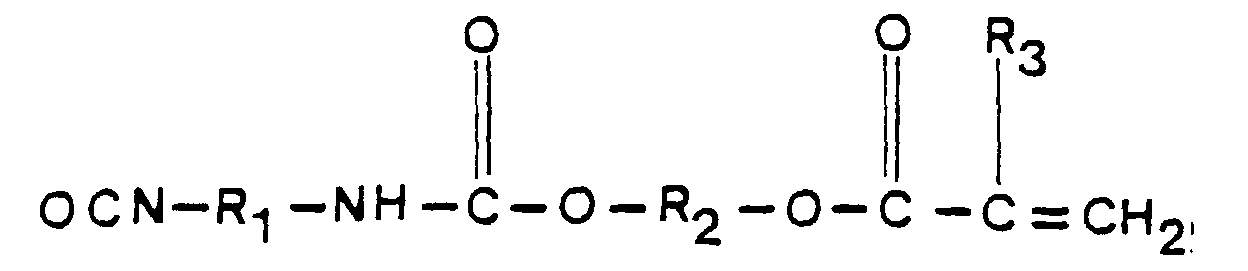
- R1 =
- Toluylen(2,4; 2,6)-, R2 = C2H4-, C3H6-, 4,4'-Diphenylmethan-, C4H8-,
1,6-Hexamethylen-,
1,5-naphthylen-, R3 = H-, CH3-, CN-,
Isophoron- C2H5-,
Trimethylhexamethylen C3H7- ist. - Zur Herstellung der erfindungsgemäßen Beschichtungsmittel werden die Bindemittelkomponenten A und B im Gewichtsverhältnis von 80 : 20 bis 20 : 80 miteinander und mit einem oder mehreren latenten Härtern und gegebenenfalls mit weiteren Füll-, Zusatz- und Hilfsstoffen sowie Lösemitteln vermischt.
- Zur gezielten Einstellung der UV-Reaktivität können die allgemein üblichen Photoinitiatoren, wie z. B. Benzoine, oder Benzildimethylketal, Benzoinether, Benzophenone, Dithio-bis(benzothialzol), Oxophosphorane und Kombinationen von aromatischen Sulfochloriden mit Disulfiden oder Xanthogenaten, zur Erhöhung der Polymerisationsgeschwindigkeit eingesetzt werden. Belichtungszeiten von unter 30 s sind problemlos einstellbar, wobei klebfreie Filme erreicht werden, die nach der thermischen Härtung hohe mechanische, thermische und elektrische Eigenschaftniveaus und gute Chemikalienbeständigkeiten zeigen.
- Die strahlungsvernetzbaren Bindemittelsysteme werden vorzugsweise durch Zusatz von Katalysatoren für die thermische Nachhärtung zur Herstellung von I- oder II-Komponenten-Beschichtungssystemen weiter formuliert. Als latente Katalysatoren für die thermische Nachhärtung der Epoxidgruppen eignen sich z. B. Dicyandiamid, entsprechende Derivate oder BF3- oder auch BCl3-Aminkomplexe, Säureanhydride oder deren Addukte, Imidazole und phenolische Härter.
- Besonders vorteilhaft sind latente Katalysatoren, die sowohl bei der Vernetzung als Photoinitiatoren als auch bei der thermischen Härtung als Härtungskatalysatoren wirken, sind Verbindungen vom Typ der Michler's Ketons, der allgemeinen Formel

- Erreicht werden sehr kurze Aushärtungszeiten von 20 - 40 min bei Temperaturen von 120 bis 230 °C, je nachdem, welcher Glasumwandlungspunkt für das Beschichtungssystem erreicht werden soll.
- Die resultierenden Beschichtungen sind in gewünschter Weise plastisch verformbar, so daß die Gefahr der Bildung von Lacksplittern bei geringer mechanischer Beanspruchung ausgeschlossen ist.
- Die erfindungsgemäßen Beschichtungsmittel sind gegenüber sichtbarem Licht weitgehend unempfindlich. Sie vernetzen lediglich bei Bestrahlung mit UV-Licht oder noch kürzerer, energiereicherer Strahlung. Dies hat den Vorteil, daß ihre Verarbeitung ohne besondere Verdunkelungsmaßnahmen möglich ist.
- Zur Herstellung von Photoresists werden Leiterplatten mit dem vorgenannten durch Strahlung härtbaren Beschichtungsmittel im Siebdruck- oder Gieß-Vorhang-Verfahren bzw. den sonstigen beschriebenen Applikationsverfahren unter Verwendung von Lösungsmitteln beschichtet. Nach der Trocknung bzw. Verdunstung des Lösungsmittels wird das Harz anschließend durch eine Negativ- oder Positiv-Maske hindurch einer Strahlung ausgesetzt, wobei die belichteten Stellen durch Polymerisation aushärten und die unpolymerisierten Anteile des Harzes mittels eines Lösungsmittels entfernt werden können. Das Beschichtungsmittel zeichnet sich besonders dadurch aus, daß einerseits sehr feine Strukturen noch mit großer Genauigkeit herstellbar sind, und daß andererseits das Herauslösen der unpolymerisierten Anteile, der sog. Entwicklungsprozeß, mit umweltfreundlichen Lösemitteln wie z. B. Butyldiglykol aber auch mit alkalischen, wäßrigen Lösungen möglich ist.
- Die erfindungsgemäßen Beschichtungsmittel können je nach geplantem Anwendungszweck und je nach Art der Formulierung lösemittelfrei eingesetzt werden oder aber auch übliche Lösemittel enthalten.
- Geeignete Lösungsmittel, die alleine oder in Gemischen eingesetzt werden können, sind z. B.: Ketone, wie Dimethylketon, Diethylketon, Methylisobutylketon, Cyclohexanon, Cyclopentanon, Cycloheptanon, Isophoron, Methoxyhexanon, Acetonylaceton, Acetonphenon, Benzylethylketon, 3,3,5-Trimethylcyclohexanon, Mesityloxid; halogenierte Kohlenwasserstoffe wie Tetrachlorkohlenstoff, Chloroform, Methylenchlorid, Methylenbromid, Bromchlormethan, 1,2-dichlorethan, 1,1,2-Trichlorethan, 1,1,2,2-Tetrachlorethan, 1,2,3-Trichlorpropan, Perchlorethylen; Alkohole wie Methanol, Ethanol, Propanol, Butanol, Hexanol, Cyclohexanol, Furfurylalkohol, Tetrahydrofurfurylalkohol, Benzylalkohol, monoalkylierte Glykole wie Methylglykol, Ethylglykol, Ethylglykol, Triethylenglykolmonoethyl- oder -monobutylether, Glykole wie Ethylen-, Propylen- oder Butylenglykol und deren Oligomere wie Triethylenglykol; aliphatische und aromatische Kohlenwasserstoffe wie Pentan, Hexan, Cyclohexan, Methylcyclohexan, Benzol, Toluol oder Xylol, Ether wie Diethylether, Dibutylether, Tetrahydrofuran, Dioxan, Ethylenglykoldimethylether, Diethylenglykoldimethylether, Carbonsäureester wie Methyl-, Ethyl-, Propyl-, Butyl- und Isopropyl- sowie Phenylacetat, Propionsäuremethylester, Glykolsäurebutylester, Ethylglykolmono- oder -diacetat, Methyl- oder Ethylglykolsäureacetat; Lactone wie Butyro-Valerolacton; Säureamide wie Dimethylformamid, Dimethylacetamid, Hexamethylphosphorsäuretriamid; Sulfone wie z. B. Dimethylsulfon, Dibutylsulfon oder Tetramethylensulfon.
- Die Menge des verwendeten Lösungsmittels richtet sich im wesentlichen nach der gewünschten Viskosität der Beschichtungsmittel, die bei 25 °C bevorzugt zwischen 200 und 800, insbesondere zwischen 200 und 500 mPa s liegt, sowie nach der Menge der eingesetzten Füllstoffe. Sie liegt im allgemeinen im Bereich von 25 bis 40 Gew.-% der im Beschichtungsmittel enthaltenen Bindemittel.
- Das erfindungsgemäße Beschichtungsmittel kann auch ohne Lösemittel Füllstoffe enthalten. Mit Lösemitteln kann der Füllstoffanteil 80 bis 120 Gew.-%, bezogen auf das Bindemittelgemisch betragen. Trotz des hohen Füllstoffgehaltes ergibt sich aber noch eine ausreichende Viskosität, die die Anwendung des Beschichtungsmittels im Gießverfahren erlaubt. Trotz des hohen Füllstoffgehaltes ist die durch die Strahlung bedingte Vernetzung weder in ihrer Geschwindigkeit noch in ihrer Dicke der vernetzenden Schicht behindert. Trotz des hohen Füllstoffgehaltes lassen sich auch hohe Schichtdicken blasenfrei auftragen und nach der Belichtung wird eine hohe Auflösung erzielt, so daß auch bei der Anwendung in der Feinstleitertechnik kein sog. Undercutting auftritt.
- Andererseits aber werden gerade durch den hohen Füllstoffanteil entscheidende Verbesserungen des Beschichtungsmittels erzielt. Die Auftragung dicker Schichten in einem Gießvorgang ist möglich. Dabei wird eine sehr gute Kantenabdeckung ermöglicht. Die Schrumpfung ist bei der Trocknung der aufgetragenen Beschichtung minimiert. Besonders vorteilhaft aber ist ein selbständiges und zuverlässiges Verschließen von Durchsteigerbohrungen durch die aufgebrachte Beschichtung.
- Die eingesetzten Füllstoffe müssen feinteilig sein, d. h., die Partikelgröße des Füllstoffs muß kleiner sein als der Abstand von Leitern in gedruckten Schaltungen. Die mittlere Partikelgröße kann 0,01 bis 10 µm, vorzugsweise 0,01 bis 5 µm betragen. Besonders bevorzugt sind mikronisierte Füllstoffe, die im allgemeinen eine mittlere Partikelgröße von 0,01 bis 1,5 µm aufweisen.
- Geeignete Füllstoffe sind beispielsweise kolloidales oder hydrophobiertes Siliziumdioxid, Mikrotalkum, Mikroglimmer, Kaolin, Aluminiumoxide, Magnesiumsilikat, Aluminiumhydroxyd, Calciumsilikat, Aluminiumsilikat, Magnesiumcarbonat, Calciumcarbonat, Zirkoniumsilikat, Porzellanmehl, Antimontrioxid, Titandioxid, Bariumtitanat oder Bariumsulfat oder Gemische der genannten Füllstoffe.
- Die Füllstoffe sind vorteilhaft mit einem Haftvermittler versehen, um eine gute Haftung zwischen Polymermatrix und Füllstoff zu erzielen. Übliche Haftvermittler sind z. B. Trialkoxysilane, die funktionelle Gruppen wie z. B. -OH, -NH2, Epoxid- oder Vinylgruppen enthalten. Beispiele sind Trialkoxysilyl-glycidoxy oder -aminopropan und Trialkoxyvinyl- oder -allylsilan. Die Alkoxygruppe kann 1 bis 12 C-Atome enthalten und z. B. Methyl, Ethyl, Propyl, Butyl, Hexyl, Octyl oder Dodecyl sein.
- Die erfindungsgemäßen Beschichtungsmittel können weitere übliche Zusätze enthalten, wie z. B. Haftvermittler, Verlaufmittel, Farbstoffe, Pigmente, Stabilisatoren, Entschäumer, Flammschutzmittel, Photosensibilisatoren und/oder -aktivatoren.
- Besonders zweckmäßig ist der Zusatz von Antiabsetzmitteln zur Erhöhung der Lagerstabilität der erfindungsgemäßen Beschichtungsmittel und zum Erhalt der Verarbeitbarkeit. Hiermit wird vermieden, daß der Füllstoff sich absetzt und daher vor der Verarbeitung erneut gleichmäßig verteilt werden muß. Das Antiabsetzmittel kann in Mengen von 0,1 bis 3 Gew.-% zugegeben werden, bezogen auf den Füllstoff. Beispiele für solche Mittel sind hochdispere Kieselsäure, Montmorillonit, Bentone oder Xonolith.
- Die Beschichtungsmittel werden in an sich üblichen Verfahren durch Mischen der Komponenten, bevorzugt unter Anwendung hoher Scherkräfte hergestellt.
- Sie können nach den üblichen Verfahren verarbeitet werden, wie z. B. durch Streichen, Spritzen, Rollen und Tauchen, insbesondere im Siebdruck-, Roller-coating-, Tampondruck- oder Aufschleuderverfahren sowie durch konventionelles Spritzen (mit Druckluft oder im sog. Airless-Verfahren) bzw. durch elektrostatisches Spritzen oder durch eine Kombination dieser Verfahren.
- Das bevorzugte Vorhanggießverfahren, für das die erfindungsgemäßen Beschichtungsmittel besonders geeignet sind, kann wie folgt durchgeführt werden.
- Man erzeugt einen dünnen, fallenden Vorhang des Beschichtungsmittels der mit oder ohne Druck aus einem Spalt fließt, wobei die Viskosität des Beschichtungsmittels bevorzugt zwischen 200 und 500 mPa s beträgt. Die Fallgeschwindigkeit des Vorhanges wird so gewählt, daß sie beim Auftreffen auf die Platte 60 bis 160, bevorzugt 70 bis 120 m/min beträgt. Die zu beschichtende Platte wird vorteilhaft vorerwärmt, z. B. auf 40 bis 100 °C. Die Platte wird mit einer Geschwindigkeit durch den fallenden Vorhang geführt, die etwa gleich und bevorzugt größer ist als die Fallgeschwindigkeit des Vorhanges. Nach der Beschichtung wird das Lösungsmittel langsam (Ablufttrocknung im Durchlauf- oder Standofen) entfernt, um eine Blasenbildung zu vermeiden, die Platte belichtet, entwickelt und danach die Schutzschicht thermisch gehärtet.
- Die nachfolgenden Beispiele erläutern die Erfindung. Teile sind hierin Gew.-Teile.
- Allgemeine Vorschrift zur Herstellung von olefinisch ungesättigten Estern eines Epoxynovolakharzes (Epoxynovolakvinylester):
- In einem Dreihalskolben mit Rührwerk, Rückflußkühler und Thermometer werden 1 Aquivalent eines Phenolnovolakepoxidharzes vorgelegt. Hierzu werden eine entsprechende Menge Lösungsmittel zugegeben, um eine 70 %ige Lösung herzustellen und unter Erwärmen und Rühren gelöst. Nach Zugabe von 1,02 Mol Acryl- bzw. Methacrylsäure und eines geeigneten Katalysators, wird auf 75 bis 85 °C erwärmt. Man läßt unter ständiger Kontrolle von Epoxidzahl und Säurezahl reagieren, bis eine Säurezahl von < 5 und eine Epoxidzahl 0,5 % erreicht ist. Anschließend wird die Lösung auf 70 % Feststoffgehalt eingestellt.
- Die Ergebnisse finden sich in der folgenden Tabelle I.

- In einem Dreihalskolben mit Rührwerk, Rückflußkühler und Thermometer werden 1 Mol (= 619 g) eines Phenol-Novolak-Epoxidharzes mit einer durchschnittlichen Funktionalität von 3,5 vorgelegt. Das Harz wird mit ca. 200 g Xylol verdünnt und auf 80 °C erhitzt. Innerhalb von etwa 30 min werden 1,2 Mol Milchsäure 90 %ig zugetropft und die Mischung 2 h bei 80 °C gerührt. Die Säurezahl soll dann < 0,5 mgKOH/g betragen. Danach wird Xylol und Wasser abdestilliert und mit Methoxipropylacetat auf 70 % Festkörper verdünnt.
Festkörper : 70 % EP-Äquivalent : 452 g OH-Äquivalent : 432 g - Beispiel 5 wurde wiederholt und unter Verwendung eines o-Kresol-Novolak-Epoxidharzes mit einer Funktionalität von 6,5. Das Molverhältnis o-Kresol-Novolak-Epoxidharz zu Milchsäure lag bei 1 : 1,63.
Festkörper : 70 % EP-Äquivalent : 430 g OH-Äquivalent : 635 g - Beispiel 5 wurde wiederholt und unter Verwendung eines Bisphenol-A-Novolak-Epoxidharzes mit einer Funktionalität von 8. Das Molverhältnis Bisphenol-A-Novolak-Epoxidharz zu Milchsäure lag bei 1 : 1,33.
Festkörper : 70 % EP-Aquivalent : 387 g OH-Äquivalent : 950 g - Umsetzung eines Polyisocyanates mit hydroxylgruppenhaltigen, ungesättigten Verbindungen.
- In einem Dreihalskolben mit Rührwerk, Rückflußkühler und Thermometer werden 1 Mol (= 174 g) Toluylen- (2.4 und 2.6) diisocyanat-Isomerengemisch (Desmodur T 80®) vorgelegt. Nach dem Verdünnen mit 130 g Methoxipropylacetat werden innerhalb von 30 min 1 Mol 2-Hydroxiethylacrylat beginnend bei Raumtemperatur zugegeben. Bedingt durch die exotherme Reaktion erwärmt sich diese Mischung auf ca. 80 °C. Man läßt 60 min bei dieser Temperatur nachreagieren. Am Ende der Reaktion versetzt man die 70 %ige Reaktionslösung mit 500 ppm eines Stabilisators (z. B. Hydrochinon).
Festkörper : 70 % NCO-Äquivalent : 420 g - Umsetzung von hydroxylgruppenhaltigen Epoxidharzen gemäß Beispiel 5 bis 7 mit isocyanatgruppenhaltigen ungesättigten Verbindungen entsprechend Beispiel 8. Die Umsetzung erfolgte jeweils im OH/NCO-Verhältnis 1 : 0,8 bei 70 °C. Der Abbau des Isocyanats wurde mittels IR-Spektroskopie verfolgt. Die Umsetzung war im allgemeinen nach 15 h Reaktion bei 70 °C abgeschlossen.
- 432 g (= 1 OH Äquivalent) hydroxylgruppenhaltiges Epoxidharz aus Beispiel 5 wurden in einen Dreihalskolben mit Rührwerk, Thermometer und Rückflußkühler vorgelegt und auf 70 °C erhitzt. 336 g Monoisocyanat = (0,8 NCO-Äquivalent) aus Beispiel 8 wurden innerhalb von 2 h bei 70 °C zugetropft. Nach 15 h Reaktion war Isocyanat nicht mehr nachweisbar.
Viskosität 25 °C : 42.500 mPa s Festkörper : 70 % - 635 g (= 1 OH Äquivalent) hydroxylgruppenhaltiges Epoxidharz aus Beispiel 6 wurden in einen Dreihalskolben mit Rührwerk, Thermometer und Rückflußkühler vorgelegt und auf 70 °C erhitzt. 336 g Monoisocyanat (0,8 NCO-Äquivalent) aus Beispiel 8 wurden innerhalb von 2 h bei 70 °C zugetropft. Nach 15 h Reaktion war Isocyanat nicht mehr nachweisbar.
Viskosität 25 °C : 62.100 mPa s Festkörper : 70 % - 950 g (= 1 OH Aquivalent) hydroxylgruppenhaltiges Epoxidharz aus Beispiel 7 wurden in einen Dreihalskolben mit Rührwerk, Thermometer und Rückflußkühler vorgelegt und auf 70 °C erhitzt. 336 g Monoisocyanat = (0,8 NCO-Äquivalent) aus Beispiel 8 wurden innerhalb von 2 h bei 70 °C zugetropft. Nach 15 h Reaktion war Isocyanat nicht mehr nachweisbar.
Viskosität 25 °C : 130.000 mPa s Festkörper : 70 % - Durch 30 minütiges Vermischen in einem Planetenmischer wurden Mischungen (A) entsprechend der in Tabelle II aufgeführten Zusammensetzungen hergestellt. Vor Gebrauch wurden diese Mischungen mit einer Photoinitiatorpaste (B) der folgenden Zusammensetzung im Gewichtsverhältnis von 6 : 1 vermischt:
Photoinitiatorpaste Polyvinylbutyralharz 4 Teile Benzildimethylketal 17,55 Teile Benzophenon 2,45 Teile Methoxypropylacetat (PMA) 76,00 Teile - Mit den so hergestellten Beschichtungsmitteln wurden Leiterplatten auf Phenolharzbasis nach dem Vorhanggießverfahren beschichtet. Es wurden einwandfrei beschichtete, blasenfreie Platten mit guter Kantendeckung erhalten, die in an sich üblicher Weise durch eine Schablone abgedeckt belichtet, danach entwickelt, thermisch gehärtet und mit üblichen Prüfungsverfahren getestet und beurteilt wurden.
- Die erhaltenen Ergebnisse sind in Tabelle III aufgeführt. Die darin enthaltene Bewertung ist wie folgt zu verstehen:
++ sehr gut + gut +- befriedigend - schlecht -- sehr schlecht 
- Analog zu Beispiel 1 der EP-B 0 075 537 wurde ein Beschichtungsmittel hergestellt, wobei als Bindemittel die Bindemittelkomponenten aus den Beispielen 4 und 9 der vorliegenden Anmeldung (zu gleichen Teilen) eingesetzt wurden.
- Das so hergestellte Beschichtungsmittel hatte eine Viskosität von 360 ±20 mPa·s bei 24 °C und einen Festkörpergehalt von 39 ± 2 Gew.-%.
- Bei der Beschichtung nach dem Vorhanggießverfahren erhielt man keine verbesserte Kantendeckung (fehlerhafte Beschichtung z. B. viele pin-holes) der Leiter, sehr schlechte Haftung und dadurch bedingte schlechte Lötbadbeständigkeit.
- Eine weitere Beurteilung ist in Tabelle III gegeben.
- Analog zu den Beispielen 12 bis 17 wurde ein Beschichtungsmittel der folgenden Zusammensetzung hergestellt, nach dem Siebdruckverfahren auf eine Leiterplatte aufgetragen und entsprechend weiter behandelt und getestet:
Bindemittelkomponente: Gew.-% Epoxynovolak aus Beispiel 4 (70 %ig in PMA) 31,50 Gew.-% UV-vernetzbares Harz aus Beispiel 9 (70 %ig in PMA) 39,00 Dicyandiamid 0,60 Cu-phthalocyaningrün 0,35 Talkum 26,95 Entschäumer (Byk® 051) 0,20 Verlaufmittel (Modaflow®) 0,90 Methoxypropylacetat 0,50 Photoinitiatorpaste: Polyvinylbutyralharz 6,60 Benzildimethylketal 25,20 Benzophenon 1,95 Methoxypropanol 66,25 - Mischungsverhältnis der Bindemittelkomponente : Photoinitiatorpaste = 6 : 1.
- Die erhaltenen Ergebnisse finden sich ebenfalls in Tabelle III.


Claims (14)
- Durch Strahlung vernetzbare Beschichtungsmittel, dadurch gekennzeichnet, daß sie neben einem oder mehreren latenten Härtern, Photoinitiator(en) und ggf. weiteren Füll-, Zusatz- und Hilfsstoffen sowie Lösemitteln folgende Bindemittelkomponenten enthält:a. einen olefinisch ungesättigten Ester eines Epoxynovolakharzes undb. ein Bindemittel, das erhalten wird durch Umsetzung einer Epoxidverbindung mit mehr als 1 Epoxidgruppe pro Molekül, mit einer oder mehreren Carbonsäuren im molaren Verhältnis der Epoxidgruppen zu den Carboxylgruppen von 1 : 0,5 bis 0,9 und anschließender Umsetzung des Reaktionsproduktes mit einer oder mehreren ungesättigten Isocyanatocarbamatestern, die durch Umsetzung von Verbindungen mit mindestens zwei Isocyanatgruppen mit hydroxylgruppenhaltigen Acryl-, Methacryl- oder Cyanacrylsäureestern hergestellt werden.
- Beschichtungsmittel nach Anspruch 1, dadurch gekennzeichnet, daß es die beiden Bindemittelkomponenten a und b im Verhältnis 80 : 20 bis 20 : 80 enthält.
- Beschichtungsmittel nach den Ansprüchen 1 und 2, dadurch gekennzeichnet, daß die Bindemittelkomponente b als Epoxidharzkomponente einen Novolak enthält, dessen phenolische Hydroxylgruppen mit Glycidylgruppen veräthert sind.
- Beschichtungsmittel nach den Ansprüchen 1 bis 3, dadurch gekennzeichnet, daß die Epoxidharzkomponente als Bindemittelkomponente b Zusätze von mono- oder bifunktionellen Epoxidverbindungen enthält.
- Beschichtungsmittel nach den Ansprüchen 1 bis 4, dadurch gekennzeichnet, daß die Bindemittelkomponente b ein Durchschnittsmolekulargewicht von 500 bis 10.000 besitzt.
- Beschichtungsmittel nach den Ansprüchen 1 bis 5, dadurch gekennzeichnet, daß die carbonsäuremodifizierten Epoxidharze und die Isocyanatocarbamatester der Bindemittelkomponente b im molaren Verhältnis der Hydroxylgruppen zu den Isocyanatgruppen von 1 : 0,8 bis 1 : 1 miteinander umgesetzt werden.
- Beschichtungsmittel nach den Ansprüchen 1 bis 6, dadurch gekennzeichnet, daß sie als latente Härter für die Vernetzung und die thermische Härtung Verbindungen vom Typ des Michler's Ketons enthalten.
- Beschichtungsmittel nach den Ansprüchen 1 bis 7, dadurch gekennzeichnet, daß sie einen Füllstoffgehalt von 80 bis 120 Gew.-%, bezogen auf das Bindemittelgemisch, enthält.
- Beschichtungsmittel nach den Ansprüchen 1 bis 7, dadurch gekennzeichnet, daß sie 25 bis 40 Gew.-% Lösemittel, bezogen auf das gesamte Beschichtungsmittel, enthält.
- Verwendung der Beschichtungsmittel nach den Ansprüchen 1 bis 9 zur Herstellung von Beschichtungen für die Elektronik und Elektrotechnik.
- Verwendung der Beschichtungsmittel nach den Ansprüchen 1 bis 9 als Lötstopplack.
- Verwendung der Beschichtungsmittel nach den Ansprüchen 1 bis 9 zur Herstellung von Schutzmasken nach dem Vorhanggießverfahren.
- Verwendung der Beschichtungsmittel nach den Ansprüchen 1 bis 9 zur Herstellung von Lötstopmasken im Siebdruck-, Roller-coating-Verfahren, Tampondruck oder Aufschleuderverfahren.
- Verwendung der Beschichtungsmittel nach den Ansprüchen 1 bis 9 zur Herstellung von Schutzmasken durch konventionelles Spritzen (Druckluft oder Airless) bzw. elektrostatisches Spritzen oder einer Kombination dieser Verfahren.
Applications Claiming Priority (2)
| Application Number | Priority Date | Filing Date | Title |
|---|---|---|---|
| DE4116957 | 1991-05-24 | ||
| DE4116957A DE4116957A1 (de) | 1991-05-24 | 1991-05-24 | Durch strahlung vernetzbare beschichtungsmittel und ihre verwendung |
Publications (2)
| Publication Number | Publication Date |
|---|---|
| EP0514630A1 EP0514630A1 (de) | 1992-11-25 |
| EP0514630B1 true EP0514630B1 (de) | 1997-07-30 |
Family
ID=6432325
Family Applications (1)
| Application Number | Title | Priority Date | Filing Date |
|---|---|---|---|
| EP92103439A Expired - Lifetime EP0514630B1 (de) | 1991-05-24 | 1992-02-28 | Durch Strahlung vernetzbare Beschichtungsmittel und ihre Verwendung |
Country Status (7)
| Country | Link |
|---|---|
| US (1) | US5436279A (de) |
| EP (1) | EP0514630B1 (de) |
| JP (1) | JP3168065B2 (de) |
| AT (1) | ATE156178T1 (de) |
| DE (2) | DE4116957A1 (de) |
| ES (1) | ES2034949T3 (de) |
| GR (1) | GR920300133T1 (de) |
Families Citing this family (21)
| Publication number | Priority date | Publication date | Assignee | Title |
|---|---|---|---|---|
| DE4240504C2 (de) * | 1992-12-02 | 2003-04-30 | Cis Inst Fuer Mikrosensorik Gg | Verfahren zur Herstellung von Leitbahnstrukturen über Grabengebieten von Substraten |
| DE4240506A1 (de) * | 1992-12-02 | 1994-12-15 | Ct Fuer Intelligente Sensorik | Verfahren zur Herstellung von Leitbahnen über Grabengebiete von integrierten Halbleiterschaltungen, wobei zur Strukturierung Lötstoppresist eingesetzt wird |
| US5489621A (en) * | 1993-05-12 | 1996-02-06 | Fuji Photo Film Co., Ltd. | Process for forming colored partial picture element and light-shielding light-sensitive resin composition used therefor |
| TW290583B (de) * | 1993-10-14 | 1996-11-11 | Alpha Metals Ltd | |
| JPH101523A (ja) * | 1996-06-14 | 1998-01-06 | Japan Synthetic Rubber Co Ltd | 放射線硬化性樹脂組成物 |
| US5910706A (en) * | 1996-12-18 | 1999-06-08 | Ultra Silicon Technology (Uk) Limited | Laterally transmitting thin film electroluminescent device |
| US6479706B1 (en) | 1997-02-04 | 2002-11-12 | Albemarle Corporation | Aminobenzophenones and photopolymerizable compositions including the same |
| DE19810549A1 (de) | 1998-03-11 | 1999-09-16 | Delo Industrieklebstoffe Gmbh | Polymerisierbare fluorhaltige Zubereitung, ihre Verwendung und Verfahren zur Herstellung ausgehärteter Polymermassen aus dieser Zubereitung |
| SE9803670L (sv) * | 1998-10-26 | 2000-04-27 | Ericsson Telefon Ab L M | Förfarande vid framställning av kretskort |
| ATE279487T1 (de) * | 1999-07-28 | 2004-10-15 | Armstrong World Ind Inc | Zusammensetzung und verfahren für eine glanzkontrollierte, abreibwiderstandsfeste beschichtung auf produktoberflächen |
| US6805917B1 (en) * | 1999-12-06 | 2004-10-19 | Roy C. Krohn | UV curable compositions for producing decorative metallic coatings |
| US7381516B2 (en) * | 2002-10-02 | 2008-06-03 | 3M Innovative Properties Company | Multiphoton photosensitization system |
| US7265161B2 (en) * | 2002-10-02 | 2007-09-04 | 3M Innovative Properties Company | Multi-photon reactive compositions with inorganic particles and method for fabricating structures |
| US7005229B2 (en) * | 2002-10-02 | 2006-02-28 | 3M Innovative Properties Company | Multiphoton photosensitization method |
| KR100538655B1 (ko) * | 2001-07-19 | 2005-12-23 | 주식회사 동진쎄미켐 | 감광성 수지 조성물 |
| US7232650B2 (en) * | 2002-10-02 | 2007-06-19 | 3M Innovative Properties Company | Planar inorganic device |
| CA2562936A1 (en) * | 2004-04-14 | 2005-10-27 | Namics Corporation | Epoxy resin composition |
| WO2007106186A2 (en) * | 2006-03-03 | 2007-09-20 | Indspec Chemical Corporation | Resorcinol resin-blocked isocyanates and their applications |
| US7794531B2 (en) * | 2007-01-08 | 2010-09-14 | Enthone Inc. | Organic solderability preservative comprising high boiling temperature alcohol |
| JP2010248297A (ja) * | 2009-04-10 | 2010-11-04 | Taiyo Ink Mfg Ltd | 光硬化性樹脂及び光硬化性樹脂組成物 |
| KR102752625B1 (ko) * | 2019-02-15 | 2025-01-10 | 엘지이노텍 주식회사 | 회로기판 |
Family Cites Families (8)
| Publication number | Priority date | Publication date | Assignee | Title |
|---|---|---|---|---|
| US3958996A (en) * | 1973-05-07 | 1976-05-25 | E. I. Du Pont De Nemours And Company | Photopolymerizable paste composition |
| US4169732A (en) * | 1978-01-09 | 1979-10-02 | International Business Machines Corporation | Photosensitive coating composition and use thereof |
| JPS5774369A (en) * | 1980-10-28 | 1982-05-10 | Mitsui Petrochem Ind Ltd | Coating composition |
| ATE14803T1 (de) * | 1981-09-17 | 1985-08-15 | Ciba Geigy Ag | Lichtempfindliches beschichtungsmittel und seine verwendung fuer schutzzwecke. |
| DE3508450A1 (de) * | 1985-03-09 | 1986-09-11 | Rütgerswerke AG, 6000 Frankfurt | Durch strahlung vernetzbare bindemittel und ihre verwendung |
| US4618658A (en) * | 1985-05-16 | 1986-10-21 | The Dow Chemical Company | Polymer modified epoxy resin compositions |
| JPH0224657A (ja) * | 1988-07-13 | 1990-01-26 | Hitachi Chem Co Ltd | 感光性樹脂組成物 |
| DE4025687A1 (de) * | 1990-08-14 | 1992-02-20 | Ruetgerswerke Ag | Durch strahlung vernetzbare bindemittelgemische |
-
1991
- 1991-05-24 DE DE4116957A patent/DE4116957A1/de not_active Withdrawn
-
1992
- 1992-02-28 ES ES92103439T patent/ES2034949T3/es not_active Expired - Lifetime
- 1992-02-28 DE DE59208740T patent/DE59208740D1/de not_active Expired - Lifetime
- 1992-02-28 EP EP92103439A patent/EP0514630B1/de not_active Expired - Lifetime
- 1992-02-28 AT AT92103439T patent/ATE156178T1/de active
- 1992-05-22 JP JP13110292A patent/JP3168065B2/ja not_active Expired - Lifetime
-
1993
- 1993-03-16 GR GR920300133T patent/GR920300133T1/el unknown
-
1994
- 1994-02-01 US US08/189,971 patent/US5436279A/en not_active Expired - Lifetime
Also Published As
| Publication number | Publication date |
|---|---|
| JP3168065B2 (ja) | 2001-05-21 |
| DE59208740D1 (de) | 1997-09-04 |
| ES2034949T1 (es) | 1993-04-16 |
| JPH05194877A (ja) | 1993-08-03 |
| DE4116957A1 (de) | 1992-11-26 |
| EP0514630A1 (de) | 1992-11-25 |
| US5436279A (en) | 1995-07-25 |
| ES2034949T3 (es) | 1997-12-16 |
| GR920300133T1 (en) | 1993-03-16 |
| ATE156178T1 (de) | 1997-08-15 |
Similar Documents
| Publication | Publication Date | Title |
|---|---|---|
| EP0514630B1 (de) | Durch Strahlung vernetzbare Beschichtungsmittel und ihre Verwendung | |
| EP0075537B1 (de) | Verfahren zum Beschichten gedruckter Schaltungen | |
| EP0233567B1 (de) | Härtbare Mischungen, enthaltend N-Sulfonylaminosulfoniumsalze als kationisch wirksame Katalysatoren | |
| DE2557408C2 (de) | Verfahren zur Herstellung eines in organischen Lösungsmitteln löslichen, vernetzbaren Acryloyl- und/oder Methacryloylgruppen und Carboxylgruppen enthaltenden Urethanharzes und seine Verwendung | |
| EP0012339B1 (de) | Strahlungshärtbare wässrige Bindemitteldispersionen, Verfahren zu deren Herstellung sowie deren Verwendung | |
| DE3613107C2 (de) | ||
| DE19622464A1 (de) | Licht- und wärmehärtbare Zusammensetzung, die mit einer wässerigen Alkalilösung entwickelbar ist | |
| EP0194360B1 (de) | Durch Strahlung vernetzbare Bindemittel und ihre Verwendung | |
| EP0146501A2 (de) | Polymerisierbare Zusammensetzungen | |
| EP0471151B1 (de) | Durch Strahlung vernetzbare Bindemittelgemische | |
| EP0101976B1 (de) | Negativ arbeitendes Verfahren zur Herstellung von Reliefbildern oder Resistmustern | |
| EP0736074B1 (de) | Strahlenhärtbare schutzlackierung, insbesondere für metallisierte oberflächen | |
| EP0101586A2 (de) | Verfahren zur Herstellung von Tiefdruckformen mit Kunststoff-Druckschichten | |
| DE69205767T2 (de) | Strahlenhärtbare Harzzusammensetzung. | |
| DE60207640T2 (de) | Durch aktive Strahlung härtbare Polyimidharz-Zusammensetzung | |
| DE2429251A1 (de) | Lichtempfindliche organophile massen und flachdruckform | |
| DE2935904A1 (de) | Positiv arbeitende photopolymerisierbare formmassen und ihre verwendung zur herstellung von druckplatten sowie aetzmittelbestaendigen resists | |
| DE2232822C2 (de) | Lichthärtbare Masse | |
| EP0632079B1 (de) | Epoxyacrylate | |
| DE3886616T2 (de) | Positive photoempfindliche harzzubereitung und verfahren zur herstellung. | |
| EP1103540B1 (de) | Vinylester mit hoher Vernetzungsdichte. Verfahren zu ihrer Herstellung und Verwendung | |
| DE102011015193A1 (de) | Epoxidierte Arylalkylphenole | |
| DE2407301B2 (de) | Härtbare Beschichtungszusammensetzung und Verfahren zu ihrer Herstellung | |
| DE19901118C2 (de) | Bei Raumtemperatur feste, modifizierte cycloaliphatische Epoxidharze, Verfahren zu ihrer Herstellung sowie ihre Verwendung | |
| EP0033140A1 (de) | Verfahren zur Herstellung einer Oberflächenbeschichtung aus einem härtbaren Mehrkomponentensystem |
Legal Events
| Date | Code | Title | Description |
|---|---|---|---|
| PUAI | Public reference made under article 153(3) epc to a published international application that has entered the european phase |
Free format text: ORIGINAL CODE: 0009012 |
|
| 17P | Request for examination filed |
Effective date: 19920918 |
|
| AK | Designated contracting states |
Kind code of ref document: A1 Designated state(s): AT BE CH DE DK ES FR GB GR IT LI LU NL PT SE |
|
| ITCL | It: translation for ep claims filed |
Representative=s name: BARZANO' E ZANARDO ROMA S.P.A. |
|
| EL | Fr: translation of claims filed | ||
| TCNL | Nl: translation of patent claims filed | ||
| GBC | Gb: translation of claims filed (gb section 78(7)/1977) | ||
| REG | Reference to a national code |
Ref country code: ES Ref legal event code: BA2A Ref document number: 2034949 Country of ref document: ES Kind code of ref document: T1 |
|
| RAP1 | Party data changed (applicant data changed or rights of an application transferred) |
Owner name: BAKELITE AG Owner name: LACKWERKE PETERS GMBH + CO KG |
|
| 17Q | First examination report despatched |
Effective date: 19961009 |
|
| GRAG | Despatch of communication of intention to grant |
Free format text: ORIGINAL CODE: EPIDOS AGRA |
|
| GRAH | Despatch of communication of intention to grant a patent |
Free format text: ORIGINAL CODE: EPIDOS IGRA |
|
| GRAH | Despatch of communication of intention to grant a patent |
Free format text: ORIGINAL CODE: EPIDOS IGRA |
|
| GRAA | (expected) grant |
Free format text: ORIGINAL CODE: 0009210 |
|
| AK | Designated contracting states |
Kind code of ref document: B1 Designated state(s): AT BE CH DE DK ES FR GB GR IT LI LU NL PT SE |
|
| PG25 | Lapsed in a contracting state [announced via postgrant information from national office to epo] |
Ref country code: GR Free format text: LAPSE BECAUSE OF FAILURE TO SUBMIT A TRANSLATION OF THE DESCRIPTION OR TO PAY THE FEE WITHIN THE PRESCRIBED TIME-LIMIT Effective date: 19970730 Ref country code: DK Effective date: 19970730 |
|
| REF | Corresponds to: |
Ref document number: 156178 Country of ref document: AT Date of ref document: 19970815 Kind code of ref document: T |
|
| REG | Reference to a national code |
Ref country code: CH Ref legal event code: EP |
|
| GBT | Gb: translation of ep patent filed (gb section 77(6)(a)/1977) |
Effective date: 19970808 |
|
| REF | Corresponds to: |
Ref document number: 59208740 Country of ref document: DE Date of ref document: 19970904 |
|
| PG25 | Lapsed in a contracting state [announced via postgrant information from national office to epo] |
Ref country code: SE Effective date: 19971030 |
|
| ET | Fr: translation filed | ||
| PG25 | Lapsed in a contracting state [announced via postgrant information from national office to epo] |
Ref country code: PT Effective date: 19971105 |
|
| REG | Reference to a national code |
Ref country code: ES Ref legal event code: FG2A Ref document number: 2034949 Country of ref document: ES Kind code of ref document: T3 |
|
| PG25 | Lapsed in a contracting state [announced via postgrant information from national office to epo] |
Ref country code: LU Free format text: LAPSE BECAUSE OF NON-PAYMENT OF DUE FEES Effective date: 19980228 |
|
| PLBE | No opposition filed within time limit |
Free format text: ORIGINAL CODE: 0009261 |
|
| STAA | Information on the status of an ep patent application or granted ep patent |
Free format text: STATUS: NO OPPOSITION FILED WITHIN TIME LIMIT |
|
| 26N | No opposition filed | ||
| REG | Reference to a national code |
Ref country code: GB Ref legal event code: IF02 |
|
| REG | Reference to a national code |
Ref country code: FR Ref legal event code: CJ Ref country code: FR Ref legal event code: CD |
|
| REG | Reference to a national code |
Ref country code: CH Ref legal event code: PFA Owner name: LACKWERKE PETERS GMBH + CO KG Free format text: BAKELITE AG#GENNAER STRASSE 2-4#58642 ISERLOHN-LETMATHE (DE) $ LACKWERKE PETERS GMBH + CO KG#HOOGHE WEG 13#47906 KEMPEN (DE) -TRANSFER TO- LACKWERKE PETERS GMBH + CO KG#HOOGHE WEG 13#47906 KEMPEN (DE) $ HEXION SPECIALTY CHEMICALS GMBH#GENNAER STRASSE 2-4#58642 ISERLOHN-LETMATHE (DE) |
|
| REG | Reference to a national code |
Ref country code: ES Ref legal event code: PC2A |
|
| REG | Reference to a national code |
Ref country code: CH Ref legal event code: PFA Owner name: LACKWERKE PETERS GMBH + CO KG Free format text: LACKWERKE PETERS GMBH + CO KG#HOOGHE WEG 13#47906 KEMPEN (DE) $ HEXION SPECIALTY CHEMICALS GMBH#GENNAER STRASSE 2-4#58642 ISERLOHN-LETMATHE (DE) -TRANSFER TO- LACKWERKE PETERS GMBH + CO KG#HOOGHE WEG 13#47906 KEMPEN (DE) $ MOMENTIVE SPECIALTY CHEMICALS GMBH#GENNAER STRASSE 2-4#58642 ISERLOHN-LETMATHE (DE) |
|
| REG | Reference to a national code |
Ref country code: ES Ref legal event code: PC2A Owner name: MOMENTIVE SPECIALTY CHEMICALS GMBH Effective date: 20110425 |
|
| PGFP | Annual fee paid to national office [announced via postgrant information from national office to epo] |
Ref country code: CH Payment date: 20110223 Year of fee payment: 20 Ref country code: NL Payment date: 20110228 Year of fee payment: 20 Ref country code: FR Payment date: 20110309 Year of fee payment: 20 Ref country code: IT Payment date: 20110225 Year of fee payment: 20 Ref country code: DE Payment date: 20110225 Year of fee payment: 20 Ref country code: AT Payment date: 20110202 Year of fee payment: 20 |
|
| PGFP | Annual fee paid to national office [announced via postgrant information from national office to epo] |
Ref country code: BE Payment date: 20110224 Year of fee payment: 20 Ref country code: ES Payment date: 20110224 Year of fee payment: 20 Ref country code: GB Payment date: 20110223 Year of fee payment: 20 |
|
| REG | Reference to a national code |
Ref country code: DE Ref legal event code: R071 Ref document number: 59208740 Country of ref document: DE |
|
| BE20 | Be: patent expired |
Owner name: LACKWERKE PETERS G.M.B.H. + CO. K.G. Effective date: 20120228 Owner name: HEXION SPECIALITY CHEMICALS G.M.B.H. Effective date: 20120228 |
|
| REG | Reference to a national code |
Ref country code: DE Ref legal event code: R071 Ref document number: 59208740 Country of ref document: DE |
|
| REG | Reference to a national code |
Ref country code: NL Ref legal event code: V4 Effective date: 20120228 |
|
| REG | Reference to a national code |
Ref country code: CH Ref legal event code: PL |
|
| REG | Reference to a national code |
Ref country code: GB Ref legal event code: PE20 Expiry date: 20120227 |
|
| PG25 | Lapsed in a contracting state [announced via postgrant information from national office to epo] |
Ref country code: DE Free format text: LAPSE BECAUSE OF EXPIRATION OF PROTECTION Effective date: 20120229 |
|
| PG25 | Lapsed in a contracting state [announced via postgrant information from national office to epo] |
Ref country code: GB Free format text: LAPSE BECAUSE OF EXPIRATION OF PROTECTION Effective date: 20120227 |
|
| REG | Reference to a national code |
Ref country code: AT Ref legal event code: MK07 Ref document number: 156178 Country of ref document: AT Kind code of ref document: T Effective date: 20120228 |
|
| REG | Reference to a national code |
Ref country code: ES Ref legal event code: FD2A Effective date: 20130719 |
|
| PG25 | Lapsed in a contracting state [announced via postgrant information from national office to epo] |
Ref country code: ES Free format text: LAPSE BECAUSE OF EXPIRATION OF PROTECTION Effective date: 20120229 |