EP0516187A2 - Procédé d'hydroconversion d'huiles lourdes et résiduelles - Google Patents
Procédé d'hydroconversion d'huiles lourdes et résiduelles Download PDFInfo
- Publication number
- EP0516187A2 EP0516187A2 EP19920112758 EP92112758A EP0516187A2 EP 0516187 A2 EP0516187 A2 EP 0516187A2 EP 19920112758 EP19920112758 EP 19920112758 EP 92112758 A EP92112758 A EP 92112758A EP 0516187 A2 EP0516187 A2 EP 0516187A2
- Authority
- EP
- European Patent Office
- Prior art keywords
- catalyst
- additive
- weight
- grain fraction
- particle size
- Prior art date
- Legal status (The legal status is an assumption and is not a legal conclusion. Google has not performed a legal analysis and makes no representation as to the accuracy of the status listed.)
- Granted
Links
- 238000000034 method Methods 0.000 title claims abstract description 50
- 239000003921 oil Substances 0.000 title claims abstract description 22
- 239000003054 catalyst Substances 0.000 claims abstract description 88
- 239000000654 additive Substances 0.000 claims abstract description 57
- 238000006243 chemical reaction Methods 0.000 claims abstract description 54
- 230000000996 additive effect Effects 0.000 claims abstract description 49
- 239000007789 gas Substances 0.000 claims abstract description 47
- 239000002245 particle Substances 0.000 claims abstract description 43
- 238000009826 distribution Methods 0.000 claims abstract description 32
- UFHFLCQGNIYNRP-UHFFFAOYSA-N Hydrogen Chemical compound [H][H] UFHFLCQGNIYNRP-UHFFFAOYSA-N 0.000 claims abstract description 25
- 239000007788 liquid Substances 0.000 claims abstract description 25
- 229910052739 hydrogen Inorganic materials 0.000 claims abstract description 24
- 239000001257 hydrogen Substances 0.000 claims abstract description 24
- 238000005984 hydrogenation reaction Methods 0.000 claims abstract description 14
- 239000002699 waste material Substances 0.000 claims abstract description 9
- XEEYBQQBJWHFJM-UHFFFAOYSA-N Iron Chemical compound [Fe] XEEYBQQBJWHFJM-UHFFFAOYSA-N 0.000 claims description 32
- 239000003077 lignite Substances 0.000 claims description 26
- 239000000571 coke Substances 0.000 claims description 24
- 239000000203 mixture Substances 0.000 claims description 23
- 239000003245 coal Substances 0.000 claims description 18
- 229910052742 iron Inorganic materials 0.000 claims description 16
- 239000007787 solid Substances 0.000 claims description 13
- 238000002309 gasification Methods 0.000 claims description 9
- 229910010272 inorganic material Inorganic materials 0.000 claims description 9
- 239000011147 inorganic material Substances 0.000 claims description 9
- 239000000463 material Substances 0.000 claims description 9
- 238000000227 grinding Methods 0.000 claims description 8
- JEIPFZHSYJVQDO-UHFFFAOYSA-N iron(III) oxide Inorganic materials O=[Fe]O[Fe]=O JEIPFZHSYJVQDO-UHFFFAOYSA-N 0.000 claims description 8
- OKTJSMMVPCPJKN-UHFFFAOYSA-N Carbon Chemical compound [C] OKTJSMMVPCPJKN-UHFFFAOYSA-N 0.000 claims description 6
- 229910001385 heavy metal Inorganic materials 0.000 claims description 6
- 239000008186 active pharmaceutical agent Substances 0.000 claims description 5
- 239000004071 soot Substances 0.000 claims description 5
- 230000001186 cumulative effect Effects 0.000 claims description 4
- 238000004821 distillation Methods 0.000 claims description 4
- 239000006229 carbon black Substances 0.000 claims description 3
- 235000019241 carbon black Nutrition 0.000 claims description 3
- 239000011335 coal coke Substances 0.000 claims description 3
- 239000000446 fuel Substances 0.000 claims description 3
- 150000003839 salts Chemical class 0.000 claims description 3
- OYPRJOBELJOOCE-UHFFFAOYSA-N Calcium Chemical compound [Ca] OYPRJOBELJOOCE-UHFFFAOYSA-N 0.000 claims description 2
- 239000002802 bituminous coal Substances 0.000 claims description 2
- 239000011575 calcium Substances 0.000 claims description 2
- 229910052791 calcium Inorganic materials 0.000 claims description 2
- 239000010419 fine particle Substances 0.000 claims description 2
- 150000002681 magnesium compounds Chemical class 0.000 claims description 2
- 239000002006 petroleum coke Substances 0.000 claims description 2
- 229940043430 calcium compound Drugs 0.000 claims 1
- 238000005187 foaming Methods 0.000 abstract description 2
- 239000000523 sample Substances 0.000 description 32
- 239000012071 phase Substances 0.000 description 21
- 238000004517 catalytic hydrocracking Methods 0.000 description 15
- 230000015572 biosynthetic process Effects 0.000 description 14
- 239000000295 fuel oil Substances 0.000 description 13
- 229910052751 metal Inorganic materials 0.000 description 12
- 239000002184 metal Substances 0.000 description 12
- 239000010779 crude oil Substances 0.000 description 10
- 239000006260 foam Substances 0.000 description 10
- 238000002156 mixing Methods 0.000 description 9
- 239000000047 product Substances 0.000 description 8
- 238000011049 filling Methods 0.000 description 6
- PXHVJJICTQNCMI-UHFFFAOYSA-N nickel Substances [Ni] PXHVJJICTQNCMI-UHFFFAOYSA-N 0.000 description 6
- 239000010426 asphalt Substances 0.000 description 5
- 230000007423 decrease Effects 0.000 description 5
- 229930195733 hydrocarbon Natural products 0.000 description 5
- 150000002430 hydrocarbons Chemical class 0.000 description 5
- 238000009835 boiling Methods 0.000 description 4
- 230000003197 catalytic effect Effects 0.000 description 4
- 239000007795 chemical reaction product Substances 0.000 description 4
- 239000012530 fluid Substances 0.000 description 4
- 230000000737 periodic effect Effects 0.000 description 4
- 239000004215 Carbon black (E152) Substances 0.000 description 3
- CWYNVVGOOAEACU-UHFFFAOYSA-N Fe2+ Chemical compound [Fe+2] CWYNVVGOOAEACU-UHFFFAOYSA-N 0.000 description 3
- 239000000428 dust Substances 0.000 description 3
- 230000002349 favourable effect Effects 0.000 description 3
- 229910052500 inorganic mineral Inorganic materials 0.000 description 3
- 229910001710 laterite Inorganic materials 0.000 description 3
- 239000011504 laterite Substances 0.000 description 3
- 239000012263 liquid product Substances 0.000 description 3
- 150000002739 metals Chemical class 0.000 description 3
- 239000011269 tar Substances 0.000 description 3
- NINIDFKCEFEMDL-UHFFFAOYSA-N Sulfur Chemical compound [S] NINIDFKCEFEMDL-UHFFFAOYSA-N 0.000 description 2
- 238000009833 condensation Methods 0.000 description 2
- 230000005494 condensation Effects 0.000 description 2
- 238000001816 cooling Methods 0.000 description 2
- 230000000694 effects Effects 0.000 description 2
- 238000004519 manufacturing process Methods 0.000 description 2
- 239000011707 mineral Substances 0.000 description 2
- 229910052759 nickel Inorganic materials 0.000 description 2
- 229920001296 polysiloxane Polymers 0.000 description 2
- 238000010791 quenching Methods 0.000 description 2
- 238000003860 storage Methods 0.000 description 2
- 239000011593 sulfur Substances 0.000 description 2
- 229910052717 sulfur Inorganic materials 0.000 description 2
- 229910052720 vanadium Inorganic materials 0.000 description 2
- LEONUFNNVUYDNQ-UHFFFAOYSA-N vanadium atom Chemical compound [V] LEONUFNNVUYDNQ-UHFFFAOYSA-N 0.000 description 2
- 238000005303 weighing Methods 0.000 description 2
- XUIMIQQOPSSXEZ-UHFFFAOYSA-N Silicon Chemical compound [Si] XUIMIQQOPSSXEZ-UHFFFAOYSA-N 0.000 description 1
- KSECJOPEZIAKMU-UHFFFAOYSA-N [S--].[S--].[S--].[S--].[S--].[V+5].[V+5] Chemical compound [S--].[S--].[S--].[S--].[S--].[V+5].[V+5] KSECJOPEZIAKMU-UHFFFAOYSA-N 0.000 description 1
- 238000009825 accumulation Methods 0.000 description 1
- PNEYBMLMFCGWSK-UHFFFAOYSA-N aluminium oxide Inorganic materials [O-2].[O-2].[O-2].[Al+3].[Al+3] PNEYBMLMFCGWSK-UHFFFAOYSA-N 0.000 description 1
- 239000002518 antifoaming agent Substances 0.000 description 1
- 238000003763 carbonization Methods 0.000 description 1
- 239000013626 chemical specie Substances 0.000 description 1
- 238000004939 coking Methods 0.000 description 1
- 230000001276 controlling effect Effects 0.000 description 1
- 230000003247 decreasing effect Effects 0.000 description 1
- 238000010586 diagram Methods 0.000 description 1
- UQSXHKLRYXJYBZ-UHFFFAOYSA-N iron oxide Inorganic materials [Fe]=O UQSXHKLRYXJYBZ-UHFFFAOYSA-N 0.000 description 1
- 238000012417 linear regression Methods 0.000 description 1
- 239000007791 liquid phase Substances 0.000 description 1
- 238000005259 measurement Methods 0.000 description 1
- 238000003801 milling Methods 0.000 description 1
- NDLPOXTZKUMGOV-UHFFFAOYSA-N oxo(oxoferriooxy)iron hydrate Chemical compound O.O=[Fe]O[Fe]=O NDLPOXTZKUMGOV-UHFFFAOYSA-N 0.000 description 1
- 239000003208 petroleum Substances 0.000 description 1
- 238000006116 polymerization reaction Methods 0.000 description 1
- 238000002360 preparation method Methods 0.000 description 1
- 230000001105 regulatory effect Effects 0.000 description 1
- 238000000926 separation method Methods 0.000 description 1
- 239000003079 shale oil Substances 0.000 description 1
- 229910052710 silicon Inorganic materials 0.000 description 1
- 239000010703 silicon Substances 0.000 description 1
- 239000002002 slurry Substances 0.000 description 1
- 239000000126 substance Substances 0.000 description 1
- 150000004763 sulfides Chemical class 0.000 description 1
- 150000003467 sulfuric acid derivatives Chemical class 0.000 description 1
- 239000000725 suspension Substances 0.000 description 1
- 239000011275 tar sand Substances 0.000 description 1
- 238000011144 upstream manufacturing Methods 0.000 description 1
- 239000012808 vapor phase Substances 0.000 description 1
- 238000010626 work up procedure Methods 0.000 description 1
Images


Classifications
-
- C—CHEMISTRY; METALLURGY
- C10—PETROLEUM, GAS OR COKE INDUSTRIES; TECHNICAL GASES CONTAINING CARBON MONOXIDE; FUELS; LUBRICANTS; PEAT
- C10M—LUBRICATING COMPOSITIONS; USE OF CHEMICAL SUBSTANCES EITHER ALONE OR AS LUBRICATING INGREDIENTS IN A LUBRICATING COMPOSITION
- C10M175/00—Working-up used lubricants to recover useful products ; Cleaning
- C10M175/0025—Working-up used lubricants to recover useful products ; Cleaning by thermal processes
- C10M175/0041—Working-up used lubricants to recover useful products ; Cleaning by thermal processes by hydrogenation processes
-
- C—CHEMISTRY; METALLURGY
- C10—PETROLEUM, GAS OR COKE INDUSTRIES; TECHNICAL GASES CONTAINING CARBON MONOXIDE; FUELS; LUBRICANTS; PEAT
- C10C—WORKING-UP PITCH, ASPHALT, BITUMEN, TAR; PYROLIGNEOUS ACID
- C10C1/00—Working-up tar
- C10C1/20—Refining by chemical means inorganic or organic compounds
- C10C1/205—Refining by chemical means inorganic or organic compounds refining in the presence of hydrogen
-
- C—CHEMISTRY; METALLURGY
- C10—PETROLEUM, GAS OR COKE INDUSTRIES; TECHNICAL GASES CONTAINING CARBON MONOXIDE; FUELS; LUBRICANTS; PEAT
- C10G—CRACKING HYDROCARBON OILS; PRODUCTION OF LIQUID HYDROCARBON MIXTURES, e.g. BY DESTRUCTIVE HYDROGENATION, OLIGOMERISATION, POLYMERISATION; RECOVERY OF HYDROCARBON OILS FROM OIL-SHALE, OIL-SAND, OR GASES; REFINING MIXTURES MAINLY CONSISTING OF HYDROCARBONS; REFORMING OF NAPHTHA; MINERAL WAXES
- C10G1/00—Production of liquid hydrocarbon mixtures from oil-shale, oil-sand, or non-melting solid carbonaceous or similar materials, e.g. wood, coal
- C10G1/08—Production of liquid hydrocarbon mixtures from oil-shale, oil-sand, or non-melting solid carbonaceous or similar materials, e.g. wood, coal with moving catalysts
- C10G1/086—Characterised by the catalyst used
-
- C—CHEMISTRY; METALLURGY
- C10—PETROLEUM, GAS OR COKE INDUSTRIES; TECHNICAL GASES CONTAINING CARBON MONOXIDE; FUELS; LUBRICANTS; PEAT
- C10G—CRACKING HYDROCARBON OILS; PRODUCTION OF LIQUID HYDROCARBON MIXTURES, e.g. BY DESTRUCTIVE HYDROGENATION, OLIGOMERISATION, POLYMERISATION; RECOVERY OF HYDROCARBON OILS FROM OIL-SHALE, OIL-SAND, OR GASES; REFINING MIXTURES MAINLY CONSISTING OF HYDROCARBONS; REFORMING OF NAPHTHA; MINERAL WAXES
- C10G47/00—Cracking of hydrocarbon oils, in the presence of hydrogen or hydrogen- generating compounds, to obtain lower boiling fractions
- C10G47/24—Cracking of hydrocarbon oils, in the presence of hydrogen or hydrogen- generating compounds, to obtain lower boiling fractions with moving solid particles
- C10G47/26—Cracking of hydrocarbon oils, in the presence of hydrogen or hydrogen- generating compounds, to obtain lower boiling fractions with moving solid particles suspended in the oil, e.g. slurries
Definitions
- the invention relates to a method for the hydrogenative conversion of heavy and residual oils, waste and waste oils, tar sands and the like.
- heavy metals V + Ni
- asphaltenes of 2 wt .-% or more
- Conradson coal of 5 wt .-% or more and a density of less than 20 ° API, which with a catalyst or additive or a mixture thereof from the group consisting of red mud, Fe2O3, iron ores, hard coal, brown coal, hard coal coke, brown coal coke, preferably impregnated with heavy metal salts, activated carbon, carbon blacks from the gasification of solid or liquid fuels, cokes from hydrogenation or distillation residues are contacted with Hydrogen at a hydrogen partial pressure between 50 and 300 bar, a temperature between 300 and 500 ° C, a throughput between 0.1 to 5 t / m3h, a gas / liquid ratio between 100 and 10,000 Nm3 / t, gas velocities
- the feedstocks are characterized by a high metal, sulfur and asphalt content as well as a high tendency to form coke.
- the invention relates in particular to a catalytic process for converting hydrocarbon-containing feedstocks such as Orinoco Belt Crudes, Maracaibo Lake Crudes, tar sands from Athabasca and Canada crude oils such as Cold Lake in the sump phase in the presence of hydrogen.
- the feedstocks have a sulfur content between 2 and 6%, a metal content (vanadium and nickel) of 200 to 1400 ppm and more, a density of less than 20 ° API, a coking residue of more than 2% and a residue content of more than 40% .-% (500 ° C+).
- hydrocracking conditions pressure, temperature, gas / oil ratio etc.
- tendency to coke a catalyst or
- Additive such as activated coke from hard coal or lignite, soot, red mud, ferric oxide, blast furnace dust, ash from the gasification process of the aforementioned crude oils, natural, inorganic minerals containing iron such as laterite and limonite, in an amount of 0.5 to 15% by weight. % Based on the liquid or liquid and solid use added to the hydrogenation process.
- the American patent US 4,396,495 describes a process for the conversion of hydrocarbon-containing dark oils in suspension reactors using finely divided metal catalysts, such as vanadium sulfide, with a particle size of 0.1 to 2000 ⁇ m, preferably 0.1 to 100 ⁇ m.
- a silicone based anti-foaming agent is also added to to reduce foam formation in the hydrocracking zone, where the reaction takes place at 510 ° C., 204 bar and a catalyst concentration of 0.1 to 10% by weight.
- This method cannot be used at temperatures above 430 ° C because the silicones decompose and lose their activity. The silicon remains in the low-boiling fraction and leads to difficulties in the upstream process.
- Canadian Patent CA 1,117,887 describes a hydrocracking process for converting heavy oil into lighter hydrocarbons under high pressure and high temperature.
- the heavy oil is mixed with a finely divided brown coal additive with a grain size of less than 149 ⁇ m, which is loaded with at least one metal from element group IVa or VIII of the periodic table.
- US Pat. No. 4,591,426 also describes a hydroconversion process for heavy feedstocks with a metal content of at least 200 ppm at temperatures above 400 ° C. and a total hydrogen pressure of 1022 bar using a natural inorganic material such as laterite or limonite.
- the invention has for its object to avoid excessive foam formation in a method of the type mentioned.
- Another object of the invention is the improved utilization of the reaction zone or the hydrogenation reaction.
- the amount of liquid in the hydrocracking zone of the reactor initially increases for a given gas velocity when larger particles are used.
- the present invention enables improved utilization of the reaction zone by using two metering streams of the catalyst or additive with two different particle size distributions.
- One embodiment of the present invention discloses a conversion process for heavy crude oils with a density of less than 20 ° API, more than 200 ppm metal content and more than 5% by weight Conradson coal in the presence of hydrogen and a catalyst or additive in a bottom phase reactor, in which an upward three-phase flow is formed.
- the catalyst can comprise metals from element group Va, VIa or VIIIa of the periodic table, with or without porous support, on which metals also contained in the crude oil are deposited.
- the present invention discloses that for very high conversion rates (90% and more) of fractions boiling above 500 ° C at moderately high flow rates (0.5t / m3h or more), a considerable proportion of small particles (below 50 microns) is needed , since this brings significant advantages for the hydrogenation capacity of the catalyst system.
- thermodynamic, fluid dynamic and kinetic relationships in the bottom phase hydrogenation with the addition of additives or catalysts in a bottom-flow tube reactor have not yet been completely clarified, it is assumed that the coarse grain fraction limits the foam formation or the gas residence time and that the amount of liquid is limited to Cost of the gas portion within the reactor, which is reflected by the differential pressure across the reactor height as well expresses the conversion rate and the preheating temperature. This phenomenon is noticeable at gas velocities in the reactor of more than 3 cm / s, temperatures of more than 250 ° C and pressures between 50 and 300 bar.
- the corresponding catalyst mixture which is formed from additives of two different particle size distributions, can also be prepared beforehand in another separate apparatus, in order then to be brought into contact with the oil insert via a single metering system.
- a remarkable aspect of the present invention is that two separate particle size distributions of the catalyst or the additive are used, both fractions being able to consist of the same or different materials.
- the present invention discloses a method for treating heavy oils of various origins, such as petroleum, shale oil, tar sand, etc. These heavy oils have a high metal and asphaltene content and a high tendency to form coke. High metal concentrations (vanadium and nickel) of over 200 ppm, asphaltene contents over 2% by weight, Conradson coal values over 5% and more than 50% by weight residue fraction (500 ° C+) are typical.
- the invention is concerned with a hydroconversion process in which the use of heavy oil in the presence of hydrogen with a catalyst or additive, such as activated coke, lignite, red mud, iron III oxide, blast furnace dust, ash from the gasification process of heavy oil, natural inorganic iron-containing mineral such as limonite or laterite, which in an amount of 0, 5 to 15 wt .-% is added in relation to the liquid content, is contacted.
- a catalyst or additive such as activated coke, lignite, red mud, iron III oxide, blast furnace dust, ash from the gasification process of heavy oil, natural inorganic iron-containing mineral such as limonite or laterite, which in an amount of 0, 5 to 15 wt .-% is added in relation to the liquid content, is contacted.
- a metering system for adding the highly active fine grain fraction, which has a grain size of less than 100 ⁇ m, preferably less than 50 ⁇ m.
- the coarse grain fraction which influences the fluid dynamic behavior of the liquid phase reaction system and increases the liquid filling in the reactor, is entered via the second metering system, this fraction being characterized by a grain size between 100 and 2000 ⁇ m, preferably 150 and 1000 ⁇ m.
- the proportion of the coarse grain fraction is between 5 and 80% by weight, preferably between 10 and 30% by weight, of the total amount of catalyst or additive.
- a special embodiment of the invention is characterized in that the coarse grain fraction contains a proportion of 0.0 to 70% by weight, preferably less than 50% by weight, of fine particles with a particle size of at most 100 ⁇ m.
- the proportion of the coarse grain fraction is 20% by weight or more, based on the total amount of the catalyst or additive used.
- a further preferred embodiment is characterized in that the proportion of the coarse grain fraction is 20% by weight and in the subsequent operating period is at least 5% by weight of the amount of catalyst or additive.
- the coarse grain fraction is added only when starting up or discontinuously in the course of the operating period.
- a method in which the fine grain fraction used as the additive and the coarse grain fraction do not consist of the same material is particularly advantageous.
- the following combinations are preferred: Fine grain fraction Coarse grain fraction Red mud Coal soot ground brown coal ground brown coal ground brown coal natural materials containing iron Bituminous coal or ground brown coal natural inorganic materials containing iron natural inorganic materials containing iron natural inorganic materials containing iron Hard coal or petroleum coke natural inorganic materials containing iron Soot from gasification processes
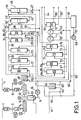
- FIG. 1 shows the hydroconversion process according to the invention with subsequent distillation and hydrosulfurization in a flow diagram.
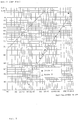
- FIG. 2 shows a double logarithmic plot of the cumulative weight fractions over the logarithm of the particle sizes of samples A and B according to Tables 1 and 2.
- FIG. 3 shows a corresponding application as in FIG. 2 for two samples which belong to a normal distribution, and for mixtures of these samples.
- Figure 4 shows the effect of the proportion of the coarse grain fraction on the differential pressure over the reactor height of the first reactor.
- the fine-grain fraction is introduced via line 1 with a grain size of less than 100 ⁇ m, preferably less than 50 ⁇ m, from the storage vessel 2 discontinuously via valve 3 into a weighing container 4, from which the desired catalyst is fed via a continuous screw conveyor 5 or the amount of additive is fed via line 6 to the mixing container 13.
- the concentration of fine catalyst particles in the mixing container is set to 0.5 to 6% by weight, preferably to 0.5 to 3% by weight.
- the coarse grain fraction of the single-use catalyst or additive which according to the invention has grain sizes of 100 to 2000 ⁇ m, preferably has 150 to 1000 microns supplied.
- the coarse grain fraction is provided via line 7 in the storage vessel 8 and fed discontinuously to the weighing container 10 via valve 9.
- the desired amount of coarse grain fraction is introduced into the mixing container 13 via a continuous screw conveyor 11 and mixed with the heavy oil and fine grain fraction fed via line 16, so that a concentration of coarse catalyst particles based on the heavy oil of 0.5 to 13%, preferably 0 , 5 to 6% is set.
- the invention is not limited to the illustrated embodiment with the two dosing systems described.
- the different grain fractions of the catalyst can also be supplied in other ways.
- the heavy oil and the two grain fractions of the catalyst or additive are fed from the mixing container 13 via line 14 to a high-pressure pump 15 and via line 15 'to the heat exchangers 49 and 50, in which this material flow is preheated using the heat of reaction of the reaction products.
- the fresh hydrogen is fed via line 61, the hydrogen-containing cycle gas via line 59 to the cycle gas preheater 63, where the gas is heated to 200 to 500 ° C. and is fed to the heater 18 together with the preheated feed stream from line 50 ′.
- the reactor system consists of one or at least two reactors connected in series. To be favoured three reactors connected in series.
- the reactors 20, 24 and 27 are vertical tubular reactors with or without internals, which are operated with the flow direction from bottom to top. Here the conversion takes place at temperatures between 400 and 490 ° C, preferably 430 and 480 ° C, a hydrogen partial pressure between 50 and 300 bar and a circulating gas volume of 100 Nm3 / t to 10000 Nm3 / t.
- a quasi-isothermal mode of operation of the reactors is possible by supplying cold gas via lines 21, 23 and 26.
- downstream hot separators which are operated at approximately the same temperature level as the reactors, the unconverted portion of the heavy and residual oils used as well as the solids is separated from the gaseous reaction products under process conditions.
- the bottom product of the hot separator is expanded in a multi-stage flash unit.
- the top product of the hot separators, the flash distillates and any crude oil distillate fractions to be processed are combined and fed to the downstream gas phase reactors. Hydrotreating or mild hydrocracking is carried out on a catalytic fixed bed under trickle flow conditions under the same total pressure as in the sump phase.
- the gaseous reaction products (C1 to C4 gases, H2S, NH3) are largely separated from the process gas, the remaining hydrogen is recycled as recycle gas.
- two or three separate and independent metering systems are required in order to add the fine grain fraction with a grain size of less than 100 ⁇ m by one metering system and the coarse grain fraction with a grain size between 100 and 2000 ⁇ m by another metering system.
- the proportion of the coarse grain fraction in the total amount of catalyst is 5 to 80%, preferably 10 to 30%, the total amount of catalyst or additive is between 0.5 and 15% by weight, based on the heavy crude oil used.
- the amount of liquid in the reactor can be optimized so that the conversion of the heavy crude oil in the reaction system increases while the preheating temperature is reduced, thereby reducing the investment and operating costs of the preheater system.
- the process according to the invention has particular advantages in the event that the gas velocity in the Reactor under reaction conditions is greater than 3 cm / s based on the reactor cross section, which is normally true for gas velocities in industrial reactors.
- the same additive or catalyst material is added as fine grain and as coarse grain fraction.
- additives of different compositions for the fine and coarse grain fraction e.g. B. Fe2O3 as a fine grain fraction with a particle size with an upper limit of 30 microns and for the coarse grain fraction activated coke from lignite with a lower grain size of 100 microns.
- the two catalyst fractions do not necessarily have to be fed to the catalyst-oil mixing container 13 (FIG. 1) via two separate metering systems. but can also be mixed beforehand and added directly as a catalyst mixture.
- the only decisive factor is the use of two different particle size distributions of the catalyst or additive from the same or different chemical species. The use of these two catalyst fractions leads to the unexpected result described in the invention.
- Tables 1 and 2 show the cumulative weight distributions of samples A and B (coarse-grain and fine-grain fractions), which are each produced by a special grinding process.
- the present invention also allows closed-circuit grinding, in which the ground product is separated and the coarse material in the Grinding device is returned.
- This customary procedure is not the same as mixing separate catalyst streams of different grain sizes, but aims to achieve a certain yield with a given sieve size.
- FIG. 3 shows mixtures of samples A and B - sample C (50% A and 50% B, table 3), sample D (30% A and 70% B, table 4), sample E (10% A and 90% B, Table 5), - and it can be seen that the mixtures cannot be represented by straight lines like the pure samples, but result in curves.
- (% By weight) % by weight rough +% By weight fine
- the amount of catalyst can be minimized if the minimum amount of coarse grain fraction required to avoid foam formation is used.
- the double catalyst metering system gives greater flexibility to reduce the total amount of catalyst.
- the coarse catalyst can be replaced by the fine-grain fraction under operating conditions when the foam formation has been brought under control. Since the latter reduces coke formation, this in turn enables a reduction in the amount of fine-grain fraction to be added, so that a minimization of the total amount added to the reactor system is made possible.
- a preferred mode of operation is therefore the supply of the fine-grain and coarse-grain fractions through two separate metering systems.
- This invention can also be used for the hydrogenation of mixtures of heavy, residual and waste oils with ground lignite and / or hard coal, the oil / coal weight ratio preferably being between 5: 1 and 1: 1.
- the coal can be used as a coarse grain fraction with a corresponding proportion of a grain size of 100 ⁇ m and more.
- the hydrocracking product is fed via line 28 into the first hot separator 29 in order to separate the gas / vapor phase from the heavier liquid products which contain unconverted residues, catalyst and additive.
- the temperature of the hot separators 29 and 33 is regulated in a range from 300 to 450 ° C. by supplying quench gas via lines 32 and 34, which is fed in at the bottom.
- the second hot separator 33 mainly serves as a scraper for the gas phase reactors 40 and 46.
- the top product of the second hot separator 33 is combined via line 36, the flash distillate 77 as well as the crude oil distillate 36 ', which is produced elsewhere, and the gas phase reactors 40 and 46 at the same total pressure and approximately the same or fed to a somewhat reduced temperature as in the bottom phase reactor.
- the operating conditions of these reactors are according to the invention for the pressure between 50 and 300 bar, for the temperature between 300 and 450 ° C and for the gas / liquid ratio between 50 and 10000 Nm3 / t.
- Hydrotreating or mild is carried out in this conventional reactor Hydrocracking at fixed bed reaction zones under trickle flow conditions using a conventional hydrodesulfurization catalyst or a mild hydrocracking catalyst from groups VIa or VIIIa of the periodic table on an alumina support.
- the product is fed via line 47 to intensive cooling and condensation (49, 50).
- the heat of reaction is used to preheat the fresh insert.
- the gas / liquid mixture is fed to the high-pressure cold separator 52 via line 51.
- the liquid product is relaxed and can then be fed to the standard refinery technology.
- the gaseous reaction product After passing through the cold separator 52, the gaseous reaction product is separated as much as possible from the process gas which is discharged via line 56. The remaining hydrogen is fed to the compressor 58 via line 57 and returned to the process via line 59.
- the bottom product of the hot separators 29 and 33 is fed via lines 32 and 34 to a multi-stage flash unit 65 and 72, decompressed and the residue of the used catalysts or additives is removed for workup, for example by carbonization, gasification or solids separation, via line 73 in order to be used again later can.
- a vertical bubble column reactor without internals the temperature of which is controlled via the outlet temperature of a preheater system and via a cold gas quench system, is charged with a specific throughput of 1.5 t / m3h with vacuum residue from a conventional residual oil of Venezuelan origin at a hydrogen partial pressure of 190 bar, whereby 2000 Nm3 of hydrogen can be used per ton of residue.
- the gas velocity is 6 cm / s. 2% by weight of lignite coke with a sharp upper grain limit at 90 ⁇ m are added to the feed product.
- a temperature in the reactor of 455 ° C. is reached at a preheater outlet temperature of 447 ° C.
- the differential pressure across the reactor height is about 100 mbar. A residue conversion of approximately 45% is achieved under these conditions.
- the system was then operated with two different dosing systems.
- the total amount of catalyst was again 2% by weight.
- the differential pressure increased from 100 mbar to approximately 300 mbar, while the preheater outlet temperature decreased from 447 ° C to 438 ° C.
- the conversion rate (RU) of the residue rose from 45 to 62%.
- H middle Temperature ° C Conversion% A 100% by weight 30 ⁇ m 0.5 461 90 B 75% by weight 30 ⁇ m 0.5 455 90 25% by weight 90-130 ⁇ m C. like B 0.75 455 78 D like B 0.75 461 90
- the differential pressure can be influenced when using two separate and independent metering systems according to this invention can ( Figure 4); an increase or decrease depends on the amount of the coarse grain fraction used (50/200 ⁇ m with 70%> 100 ⁇ m).
- the differential pressure is completely stable despite full filling of the reactor.
- the differential pressure increases at a rate of 5 mbar / h . If the addition of the coarse-grain fraction is stopped and replaced by an additional 2% by weight of fine-grain fraction, so that the total amount of catalyst is still 4%, the differential pressure drops at a rate of 7 mbar / h. This test was carried out at a total pressure of 140 bar, a gas / liquid ratio of 1500 Nm3 / t and a gas velocity of 6 cm / s.
- a natural mineral Fe2O3-containing catalyst with a grain size of less than 20 ⁇ m is fed to the reactor through one of two installed metering systems.
- a coarse grain fraction with a grain size of less than 300 ⁇ m and a 50% proportion of particles with a grain size of less than 100 ⁇ m is supplied by the second metering system.
- the total amount of catalyst was 3.1% based on the feed.
- the insert consisted of Morichal vacuum residue.
- the total pressure in this test was 170 bar with a hydrogen partial pressure of 130 bar.
- the gas velocity in the reactor system was 7.8 cm / s.
- the fine grain fraction (1.1% by weight based on the feed) with a grain size of less than 20 ⁇ m and the coarse grain fraction (2% by weight based on the use) with a grain size of less than 300 ⁇ m and a proportion of 50% by weight % with a grain size of less than 100 ⁇ m was fed to the reactor in two separate metering systems. Under these operating conditions the conversion rate was 92%, the asphaltene conversion 90% and the coke production 1.2% (test 1, table 8).
- the amount of fine grain fraction (below 30 ⁇ m) is reduced to 0.6% by weight and the amount of coarse grain fraction (below 300 ⁇ m) with 50% by weight below 100 ⁇ m is reduced to 2.5% by weight. % is increased while maintaining a total catalyst quantity of 3.1% by weight, the crude oil conversion is of the same order of magnitude, namely 92%. However, the asphaltene conversion drops to 65%, while the coke formation increases to 2.5%, which leads to considerable problems when working up in the hot separator (Test 2, Table 8).
- a 92% residue conversion and a 90% asphaltene conversion can also be achieved when the coarse grain fraction increases to 2.5% by weight if the total amount of catalyst increases by 0.5% by weight to a total of 3.6% by weight (Test 3, Table 8).
Landscapes
- Chemical & Material Sciences (AREA)
- Oil, Petroleum & Natural Gas (AREA)
- Engineering & Computer Science (AREA)
- Organic Chemistry (AREA)
- General Chemical & Material Sciences (AREA)
- Chemical Kinetics & Catalysis (AREA)
- Materials Engineering (AREA)
- Physics & Mathematics (AREA)
- Thermal Sciences (AREA)
- Combustion & Propulsion (AREA)
- Life Sciences & Earth Sciences (AREA)
- Wood Science & Technology (AREA)
- Production Of Liquid Hydrocarbon Mixture For Refining Petroleum (AREA)
- Catalysts (AREA)
- Lubricants (AREA)
Applications Claiming Priority (3)
| Application Number | Priority Date | Filing Date | Title |
|---|---|---|---|
| DE19863634275 DE3634275A1 (de) | 1986-10-08 | 1986-10-08 | Verfahren zur hydrierenden konversion von schwer- und rueckstandsoelen |
| DE3634275 | 1986-10-08 | ||
| EP87114725A EP0263522B1 (fr) | 1986-10-08 | 1987-10-08 | Procédé d'hydroconversion d'huiles lourdes et résiduelles |
Related Parent Applications (2)
| Application Number | Title | Priority Date | Filing Date |
|---|---|---|---|
| EP87114725A Division-Into EP0263522B1 (fr) | 1986-10-08 | 1987-10-08 | Procédé d'hydroconversion d'huiles lourdes et résiduelles |
| EP87114725.2 Division | 1987-10-08 |
Publications (3)
| Publication Number | Publication Date |
|---|---|
| EP0516187A2 true EP0516187A2 (fr) | 1992-12-02 |
| EP0516187A3 EP0516187A3 (en) | 1992-12-09 |
| EP0516187B1 EP0516187B1 (fr) | 1995-09-20 |
Family
ID=6311311
Family Applications (2)
| Application Number | Title | Priority Date | Filing Date |
|---|---|---|---|
| EP87114725A Expired - Lifetime EP0263522B1 (fr) | 1986-10-08 | 1987-10-08 | Procédé d'hydroconversion d'huiles lourdes et résiduelles |
| EP92112758A Expired - Lifetime EP0516187B1 (fr) | 1986-10-08 | 1987-10-08 | Procédé d'hydroconversion d'huiles lourdes et résiduelles |
Family Applications Before (1)
| Application Number | Title | Priority Date | Filing Date |
|---|---|---|---|
| EP87114725A Expired - Lifetime EP0263522B1 (fr) | 1986-10-08 | 1987-10-08 | Procédé d'hydroconversion d'huiles lourdes et résiduelles |
Country Status (8)
| Country | Link |
|---|---|
| US (1) | US4851107A (fr) |
| EP (2) | EP0263522B1 (fr) |
| JP (1) | JPH0696710B2 (fr) |
| AT (1) | ATE128174T1 (fr) |
| CA (1) | CA1302332C (fr) |
| DE (3) | DE3634275A1 (fr) |
| ES (2) | ES2043629T3 (fr) |
| NO (1) | NO171219C (fr) |
Cited By (2)
| Publication number | Priority date | Publication date | Assignee | Title |
|---|---|---|---|---|
| FR2753112A1 (fr) * | 1996-09-06 | 1998-03-13 | Us Energy | Procede pour produire des catalyseurs a partir de charbon |
| US9688934B2 (en) | 2007-11-23 | 2017-06-27 | Bixby Energy Systems, Inc. | Process for and processor of natural gas and activated carbon together with blower |
Families Citing this family (46)
| Publication number | Priority date | Publication date | Assignee | Title |
|---|---|---|---|---|
| US5166118A (en) * | 1986-10-08 | 1992-11-24 | Veba Oel Technologie Gmbh | Catalyst for the hydrogenation of hydrocarbon material |
| DE3737370C1 (de) * | 1987-11-04 | 1989-05-18 | Veba Oel Entwicklungs Gmbh | Verfahren zur hydrierenden Konversion von Schwer- und Rueckstandsoelen,Alt- und Abfalloelen in Mischung mit Klaerschlaemmen |
| DE3806365C1 (fr) * | 1988-02-27 | 1989-07-20 | Veba Oel Entwicklungs-Gesellschaft Mbh, 4650 Gelsenkirchen, De | |
| DE3912807A1 (de) * | 1989-04-19 | 1990-11-08 | Gfk Kohleverfluessigung Gmbh | Katalysator bzw. additiv zur hydrierenden behandlung von schweren erdoelen bzw. schweren erdoelfraktionen sowie verfahren zur gewinnung des katalysators |
| US5755955A (en) * | 1995-12-21 | 1998-05-26 | Petro-Canada | Hydrocracking of heavy hydrocarbon oils with conversion facilitated by control of polar aromatics |
| US5922191A (en) * | 1996-10-04 | 1999-07-13 | Intevep, S.A. | Foam control using a fluidized bed of particles |
| US5922190A (en) * | 1996-10-04 | 1999-07-13 | Intevep, S.A. | Process for suppressing foam formation in a bubble column reactor |
| DE19742266A1 (de) * | 1997-09-25 | 1999-05-06 | Ludger Dr Steinmann | Aufwertung von Chemie- und Energierohstoffen durch Reaktion mit geringwertigen Rohstoffen |
| US20100098602A1 (en) * | 2003-12-19 | 2010-04-22 | Opinder Kishan Bhan | Systems, methods, and catalysts for producing a crude product |
| US7745369B2 (en) | 2003-12-19 | 2010-06-29 | Shell Oil Company | Method and catalyst for producing a crude product with minimal hydrogen uptake |
| US7591941B2 (en) | 2003-12-19 | 2009-09-22 | Shell Oil Company | Systems, methods, and catalysts for producing a crude product |
| US10941353B2 (en) | 2004-04-28 | 2021-03-09 | Hydrocarbon Technology & Innovation, Llc | Methods and mixing systems for introducing catalyst precursor into heavy oil feedstock |
| CN1950484A (zh) * | 2004-04-28 | 2007-04-18 | 上游重油有限公司 | 使用胶体催化剂或分子催化剂提高重油品质的加氢处理法和系统 |
| US7517446B2 (en) * | 2004-04-28 | 2009-04-14 | Headwaters Heavy Oil, Llc | Fixed bed hydroprocessing methods and systems and methods for upgrading an existing fixed bed system |
| KR101354740B1 (ko) | 2004-04-28 | 2014-01-22 | 헤드워터스 헤비 오일, 엘엘씨 | 에뷸레이트 베드 하이드로프로세싱 방법 및 시스템 및기존의 에뷸레이트 베드 시스템을 개량하는 방법 |
| US7422904B2 (en) * | 2005-02-04 | 2008-09-09 | Exxonmobil Chemical Patents Inc. | Method of operating a fixed bed reactor under predetermined hydraulic conditions |
| BRPI0609416A2 (pt) | 2005-04-11 | 2011-10-11 | Shell Int Research | método para produzir um produto bruto |
| JP2008536002A (ja) * | 2005-04-11 | 2008-09-04 | シエル・インターナシヨネイル・リサーチ・マーチヤツピイ・ベー・ウイ | 原油生成物を製造するためのシステム、方法及び触媒 |
| US7918992B2 (en) | 2005-04-11 | 2011-04-05 | Shell Oil Company | Systems, methods, and catalysts for producing a crude product |
| US20080083655A1 (en) | 2006-10-06 | 2008-04-10 | Bhan Opinder K | Methods of producing a crude product |
| US20100133149A1 (en) * | 2006-10-10 | 2010-06-03 | Bioecon International Holding | Two-stage process for the conversion of tar sand to liquid fuels and specialty chemicals |
| US8034232B2 (en) | 2007-10-31 | 2011-10-11 | Headwaters Technology Innovation, Llc | Methods for increasing catalyst concentration in heavy oil and/or coal resid hydrocracker |
| US8142645B2 (en) * | 2008-01-03 | 2012-03-27 | Headwaters Technology Innovation, Llc | Process for increasing the mono-aromatic content of polynuclear-aromatic-containing feedstocks |
| US8679322B2 (en) | 2009-11-24 | 2014-03-25 | Intevep, S.A. | Hydroconversion process for heavy and extra heavy oils and residuals |
| US9168506B2 (en) * | 2010-01-21 | 2015-10-27 | Intevep, S.A. | Additive for hydroconversion process and method for making and using same |
| US9039890B2 (en) | 2010-06-30 | 2015-05-26 | Chevron U.S.A. Inc. | Two-stage, close-coupled, dual-catalytic heavy oil hydroconversion process |
| US9334452B2 (en) | 2010-06-30 | 2016-05-10 | Chevron U.S.A. Inc. | Two-stage, close-coupled, dual-catalytic heavy oil hydroconversion process |
| US20120157726A1 (en) * | 2010-12-15 | 2012-06-21 | Air Liquide Large Industries U.S. Lp | Process For The Production Of Cellulose Based Biofuels |
| US9169449B2 (en) | 2010-12-20 | 2015-10-27 | Chevron U.S.A. Inc. | Hydroprocessing catalysts and methods for making thereof |
| WO2012170167A1 (fr) * | 2011-06-10 | 2012-12-13 | 4Crgroup, Llc | Procédé d'hydroconversion d'huile lourde à deux catalyseurs, à couplage étroit, à deux étages |
| US9790440B2 (en) | 2011-09-23 | 2017-10-17 | Headwaters Technology Innovation Group, Inc. | Methods for increasing catalyst concentration in heavy oil and/or coal resid hydrocracker |
| WO2013126362A2 (fr) | 2012-02-21 | 2013-08-29 | 4CRGroup LLC | Procédé d'hydroconversion de pétrole lourd monobloc à deux zones, utilisant une première zone à lit bouillonnant |
| WO2013126364A2 (fr) | 2012-02-21 | 2013-08-29 | 4CRGroup LLC | Procédé d'hydroconversion de pétrole lourd à double catalyse, monobloc, à deux zones, utilisant un hydrotraitement amélioré |
| US9644157B2 (en) | 2012-07-30 | 2017-05-09 | Headwaters Heavy Oil, Llc | Methods and systems for upgrading heavy oil using catalytic hydrocracking and thermal coking |
| US8999145B2 (en) * | 2012-10-15 | 2015-04-07 | Uop Llc | Slurry hydrocracking process |
| US9951282B2 (en) | 2013-03-14 | 2018-04-24 | Bp Europa Se | Process for introducing fine and coarse additives for hydroconversion of heavy hydrocarbons |
| WO2015121373A1 (fr) * | 2014-02-12 | 2015-08-20 | Bp Europa Se | Procédé d'hydrocraquage d'huile lourde et de résidus d'huile |
| US11414607B2 (en) | 2015-09-22 | 2022-08-16 | Hydrocarbon Technology & Innovation, Llc | Upgraded ebullated bed reactor with increased production rate of converted products |
| US11414608B2 (en) | 2015-09-22 | 2022-08-16 | Hydrocarbon Technology & Innovation, Llc | Upgraded ebullated bed reactor used with opportunity feedstocks |
| US11421164B2 (en) | 2016-06-08 | 2022-08-23 | Hydrocarbon Technology & Innovation, Llc | Dual catalyst system for ebullated bed upgrading to produce improved quality vacuum residue product |
| KR102505534B1 (ko) | 2017-03-02 | 2023-03-02 | 하이드로카본 테크놀로지 앤 이노베이션, 엘엘씨 | 오염 침전물이 적은 업그레이드된 에뷸레이티드 베드 반응기 |
| US11732203B2 (en) | 2017-03-02 | 2023-08-22 | Hydrocarbon Technology & Innovation, Llc | Ebullated bed reactor upgraded to produce sediment that causes less equipment fouling |
| CA3057131C (fr) | 2018-10-17 | 2024-04-23 | Hydrocarbon Technology And Innovation, Llc | Reacteur a lit bouillonnant ameliore sans accumulation liee au recyclage d'asphaltenes dans des residus de tour sous vide |
| FI128237B (en) * | 2018-12-21 | 2020-01-15 | Neste Oyj | METHOD FOR UPGRADING GAME OILS |
| CN114425273B (zh) * | 2020-10-10 | 2022-11-18 | 中国石油化工股份有限公司 | 碳二加氢反应器的控制方法及应用 |
| US12497569B2 (en) | 2022-05-26 | 2025-12-16 | Hydrocarbon Technology & Innovation, Llc | Method and system for mixing catalyst precursor into heavy oil using a high boiling hydrocarbon diluent |
Family Cites Families (19)
| Publication number | Priority date | Publication date | Assignee | Title |
|---|---|---|---|---|
| US3635943A (en) * | 1969-10-16 | 1972-01-18 | Cities Service Res & Dev Co | Hydrotreating process with coarse and fine catalysts |
| CA965767A (en) * | 1970-05-18 | 1975-04-08 | Council Of Scientific And Industrial Research | Preparation of iron catalysts for hydrogenation of coal |
| US3844933A (en) * | 1972-10-16 | 1974-10-29 | Hydrocarbon Research Inc | Hydroconversion of coal-derived oils |
| US3975259A (en) * | 1975-07-10 | 1976-08-17 | Air Products And Chemicals, Inc. | Hydrodesulfurization of liquid hydrocarbon utilizing a suspended catalyst particle of less than 10 microns |
| CA1079663A (fr) * | 1976-08-13 | 1980-06-17 | Maurice M. Mitchell (Jr.) | Procede pour l'hydrodesulfurisation de matieres carbonees a l'aide d'un catalyseur en suspension |
| CA1094492A (fr) * | 1977-10-24 | 1981-01-27 | Ramaswami Ranganathan | Hydrocraquage d'huiles lourdes avec un catalyseur fer- charbon |
| JPS54106506A (en) * | 1978-02-08 | 1979-08-21 | Yamagata Daigakuchiyou | Coal direct liquefication reaction method and apparatus |
| CA1124194A (fr) * | 1979-03-05 | 1982-05-25 | Ramaswami Ranganathan | Hydrocraquage de suspensions de cendres volantes dans des huiles lourdes |
| CA1163222A (fr) * | 1981-02-12 | 1984-03-06 | Her Majesty The Queen, In Right Of Canada As Represented By The Minister Of Natural Resources Canada | Demetallisation et hydrofractionnement en simultane des hydrocarbures lourds |
| US4370221A (en) * | 1981-03-03 | 1983-01-25 | Her Majesty The Queen In Right Of Canada, As Represented By The Minister Of Energy, Mines And Resources | Catalytic hydrocracking of heavy oils |
| JPS57174384A (en) * | 1981-04-21 | 1982-10-27 | Canada Majesty In Right Of | Hydrogenolysis of bitumen-coal slurry |
| JPS5832193B2 (ja) * | 1981-06-17 | 1983-07-11 | 工業技術院長 | 反応副生コ−クスを触媒とする重質炭化水素の水素化分解法 |
| FR2511389A1 (fr) * | 1981-08-11 | 1983-02-18 | Inst Francais Du Petrole | Procede d'hydroconversion catalytique d'hydrocarbures lourds en phase liquide et en presence d'un catalyseur disperse et de particules charbonneuses |
| DD210295A1 (de) * | 1981-09-02 | 1984-06-06 | Rheinische Braunkohlenw Ag | Verfahren zum hydrieren von schwer- und rueckstandsoelen und dafuer verwendete katalysatoren |
| CA1151579A (fr) * | 1981-10-07 | 1983-08-09 | Ramaswami Ranganathan | Hydrocraquage d'hydrocarbures lourds avec fort taux de converssion des brais |
| US4396495A (en) * | 1982-01-25 | 1983-08-02 | Uop Inc. | Reduction of foaming in a slurry catalyst hydrocarbon conversion process |
| JPS58219292A (ja) * | 1982-06-14 | 1983-12-20 | カナダ国 | 重質炭化水素油の水素添加分解方法 |
| CA1202588A (fr) * | 1983-02-10 | 1986-04-01 | Theodore J.W. Debruijn | Hydrofractionnement des petroles lourds par intervention d'additifs secs |
| US4613427A (en) * | 1984-10-03 | 1986-09-23 | Intevep, S.A. | Process for the demetallization and hydroconversion of heavy crudes and residues using a natural clay catalyst |
-
1986
- 1986-10-08 DE DE19863634275 patent/DE3634275A1/de not_active Withdrawn
-
1987
- 1987-10-07 US US07/105,290 patent/US4851107A/en not_active Expired - Lifetime
- 1987-10-07 NO NO874205A patent/NO171219C/no not_active IP Right Cessation
- 1987-10-07 CA CA000548819A patent/CA1302332C/fr not_active Expired - Lifetime
- 1987-10-08 ES ES87114725T patent/ES2043629T3/es not_active Expired - Lifetime
- 1987-10-08 EP EP87114725A patent/EP0263522B1/fr not_active Expired - Lifetime
- 1987-10-08 JP JP62252644A patent/JPH0696710B2/ja not_active Expired - Fee Related
- 1987-10-08 ES ES92112758T patent/ES2078610T3/es not_active Expired - Lifetime
- 1987-10-08 DE DE87114725T patent/DE3787434D1/de not_active Expired - Fee Related
- 1987-10-08 AT AT92112758T patent/ATE128174T1/de not_active IP Right Cessation
- 1987-10-08 EP EP92112758A patent/EP0516187B1/fr not_active Expired - Lifetime
- 1987-10-08 DE DE3751534T patent/DE3751534D1/de not_active Expired - Fee Related
Cited By (3)
| Publication number | Priority date | Publication date | Assignee | Title |
|---|---|---|---|---|
| FR2753112A1 (fr) * | 1996-09-06 | 1998-03-13 | Us Energy | Procede pour produire des catalyseurs a partir de charbon |
| US9688934B2 (en) | 2007-11-23 | 2017-06-27 | Bixby Energy Systems, Inc. | Process for and processor of natural gas and activated carbon together with blower |
| US10119087B2 (en) | 2007-11-23 | 2018-11-06 | Bixby Energy Systems, Inc. | Process for and processor of natural gas and activated carbon together with blower |
Also Published As
| Publication number | Publication date |
|---|---|
| ES2043629T3 (es) | 1994-01-01 |
| EP0263522A3 (en) | 1989-04-12 |
| JPS63146989A (ja) | 1988-06-18 |
| NO874205L (no) | 1988-04-11 |
| CA1302332C (fr) | 1992-06-02 |
| EP0516187A3 (en) | 1992-12-09 |
| JPH0696710B2 (ja) | 1994-11-30 |
| ES2078610T3 (es) | 1995-12-16 |
| US4851107A (en) | 1989-07-25 |
| EP0263522B1 (fr) | 1993-09-15 |
| EP0263522A2 (fr) | 1988-04-13 |
| NO171219C (no) | 1993-02-10 |
| NO874205D0 (no) | 1987-10-07 |
| ATE128174T1 (de) | 1995-10-15 |
| DE3634275A1 (de) | 1988-04-28 |
| EP0516187B1 (fr) | 1995-09-20 |
| DE3751534D1 (de) | 1995-10-26 |
| DE3787434D1 (de) | 1993-10-21 |
| NO171219B (no) | 1992-11-02 |
Similar Documents
| Publication | Publication Date | Title |
|---|---|---|
| EP0516187B1 (fr) | Procédé d'hydroconversion d'huiles lourdes et résiduelles | |
| DE69701088T2 (de) | Wasserstoffbehandlung von schweren kohlenwasserstoffölen mit kontrolle der verteilung der teilchenförmigen additiven | |
| DE69609355T2 (de) | Hydrocracken von schweren kohlenwasserstoffölen mit kontrolle von polare aromaten | |
| DE2215664C3 (fr) | ||
| DE2932488C2 (de) | Verfahren zur Gewinnung einer Kohlenwasserstofffraktion | |
| DE3737370C1 (de) | Verfahren zur hydrierenden Konversion von Schwer- und Rueckstandsoelen,Alt- und Abfalloelen in Mischung mit Klaerschlaemmen | |
| DE3780275T2 (de) | Verfahren zum hydrocracken von schweroelen. | |
| DE1645826B1 (de) | Verfahren zur Umwandlung eines Kohlenwasserstoffeinsatzmaterials | |
| DE3930431A1 (de) | Verfahren zur hydrokonversion von schwerem kohlenwasserstoffoel in gegenwart von feinteiligen eisenverbindungen | |
| DE3880186T2 (de) | Verfahren zur Hydrokrackung eines Schweröls. | |
| DE3725764A1 (de) | Verfahren und anlage zum erzeugen von koks in anodenqualitaet | |
| DE1119438B (de) | Verfahren zum Raffinieren von schwefelhaltigen schweren OElen | |
| DE2920415C2 (de) | Verfahren zur Aufarbeitung von schweren Kohlenwasserstoffölen | |
| DE3233344A1 (de) | Verfahren zur verfluessigung von kohle | |
| DE2730159C2 (fr) | ||
| DE3229898C2 (fr) | ||
| DE3151614A1 (de) | Verfahren zur qualitaetsverbesserung eines kohlenwasserstoffhaltigen oels | |
| DE2344251C3 (de) | Verfahren zur katalytischen Hydrokrackung einer Schwefel, Asche und Asphaltene enthaltenden Kohlenwasserstoffbeschickung | |
| DE3780305T2 (de) | Verfahren zur produktion von maximum-mitteldistillaten mit minimalem wasserstoffverbrauch. | |
| CH679863A5 (fr) | ||
| DE2259959C3 (de) | Verfahren zur Herstellung von Heizölen durch Asphaltenabtrennung und zweistufige katalytische hydrierende Entschwefelung | |
| DE3734011A1 (de) | Verfahren zur hydrierenden konversion von schwer- und rueckstandsoelen | |
| DE1026904B (de) | Verfahren zum katalytischen Entschwefeln von Kohlenwasserstoffen | |
| DE69022858T2 (de) | Kohlenwasserstoffbehandlung eines gas enthaltenden zulaufes in einem gegenstromkatalysatorfliessbett. | |
| EP0209665A1 (fr) | Procédé d'hydrogénation de charbon en phase liquide et en lit fixe avec catalyseur |
Legal Events
| Date | Code | Title | Description |
|---|---|---|---|
| PUAI | Public reference made under article 153(3) epc to a published international application that has entered the european phase |
Free format text: ORIGINAL CODE: 0009012 |
|
| PUAL | Search report despatched |
Free format text: ORIGINAL CODE: 0009013 |
|
| 17P | Request for examination filed |
Effective date: 19920730 |
|
| AC | Divisional application: reference to earlier application |
Ref document number: 263522 Country of ref document: EP |
|
| AK | Designated contracting states |
Kind code of ref document: A2 Designated state(s): AT BE CH DE ES FR GB GR IT LI LU NL SE |
|
| AK | Designated contracting states |
Kind code of ref document: A3 Designated state(s): AT BE CH DE ES FR GB GR IT LI LU NL SE |
|
| RIN1 | Information on inventor provided before grant (corrected) |
Inventor name: KURZEJA,KLAUS Inventor name: MARUFFO,FRANZO,DR., QUINTA MIMIE Inventor name: KRASUK,JULIO, EDIF.LA VILLA Inventor name: GUITIAN,JOSE, QUINTA YOLE Inventor name: NIEMANN,KLAUS,DR. Inventor name: MERZ,LUDWIG,DR. Inventor name: KRETSCHMAR,KLAUS |
|
| 17Q | First examination report despatched |
Effective date: 19940427 |
|
| RAP1 | Party data changed (applicant data changed or rights of an application transferred) |
Owner name: INTEVEP S.A. Owner name: VEBA OEL TECHNOLOGIE UND AUTOMATISIERUNG GMBH |
|
| GRAA | (expected) grant |
Free format text: ORIGINAL CODE: 0009210 |
|
| AC | Divisional application: reference to earlier application |
Ref document number: 263522 Country of ref document: EP |
|
| AK | Designated contracting states |
Kind code of ref document: B1 Designated state(s): AT BE CH DE ES FR GB GR IT LI LU NL SE |
|
| REF | Corresponds to: |
Ref document number: 128174 Country of ref document: AT Date of ref document: 19951015 Kind code of ref document: T |
|
| REF | Corresponds to: |
Ref document number: 3751534 Country of ref document: DE Date of ref document: 19951026 |
|
| GBT | Gb: translation of ep patent filed (gb section 77(6)(a)/1977) |
Effective date: 19951002 |
|
| ET | Fr: translation filed | ||
| ITF | It: translation for a ep patent filed | ||
| REG | Reference to a national code |
Ref country code: ES Ref legal event code: FG2A Ref document number: 2078610 Country of ref document: ES Kind code of ref document: T3 |
|
| REG | Reference to a national code |
Ref country code: GR Ref legal event code: FG4A Free format text: 3017825 |
|
| PLBE | No opposition filed within time limit |
Free format text: ORIGINAL CODE: 0009261 |
|
| STAA | Information on the status of an ep patent application or granted ep patent |
Free format text: STATUS: NO OPPOSITION FILED WITHIN TIME LIMIT |
|
| 26N | No opposition filed | ||
| PGFP | Annual fee paid to national office [announced via postgrant information from national office to epo] |
Ref country code: ES Payment date: 20010926 Year of fee payment: 15 |
|
| PGFP | Annual fee paid to national office [announced via postgrant information from national office to epo] |
Ref country code: GR Payment date: 20010928 Year of fee payment: 15 |
|
| PGFP | Annual fee paid to national office [announced via postgrant information from national office to epo] |
Ref country code: BE Payment date: 20011003 Year of fee payment: 15 |
|
| PGFP | Annual fee paid to national office [announced via postgrant information from national office to epo] |
Ref country code: SE Payment date: 20011008 Year of fee payment: 15 Ref country code: GB Payment date: 20011008 Year of fee payment: 15 |
|
| PGFP | Annual fee paid to national office [announced via postgrant information from national office to epo] |
Ref country code: LU Payment date: 20011011 Year of fee payment: 15 |
|
| PGFP | Annual fee paid to national office [announced via postgrant information from national office to epo] |
Ref country code: AT Payment date: 20011016 Year of fee payment: 15 |
|
| PGFP | Annual fee paid to national office [announced via postgrant information from national office to epo] |
Ref country code: NL Payment date: 20011031 Year of fee payment: 15 |
|
| REG | Reference to a national code |
Ref country code: GB Ref legal event code: IF02 |
|
| PGFP | Annual fee paid to national office [announced via postgrant information from national office to epo] |
Ref country code: CH Payment date: 20020104 Year of fee payment: 15 |
|
| PG25 | Lapsed in a contracting state [announced via postgrant information from national office to epo] |
Ref country code: LU Free format text: LAPSE BECAUSE OF NON-PAYMENT OF DUE FEES Effective date: 20021008 Ref country code: GB Free format text: LAPSE BECAUSE OF NON-PAYMENT OF DUE FEES Effective date: 20021008 Ref country code: AT Free format text: LAPSE BECAUSE OF NON-PAYMENT OF DUE FEES Effective date: 20021008 |
|
| PG25 | Lapsed in a contracting state [announced via postgrant information from national office to epo] |
Ref country code: SE Free format text: LAPSE BECAUSE OF NON-PAYMENT OF DUE FEES Effective date: 20021009 Ref country code: ES Free format text: LAPSE BECAUSE OF NON-PAYMENT OF DUE FEES Effective date: 20021009 |
|
| PGFP | Annual fee paid to national office [announced via postgrant information from national office to epo] |
Ref country code: FR Payment date: 20021030 Year of fee payment: 16 |
|
| PG25 | Lapsed in a contracting state [announced via postgrant information from national office to epo] |
Ref country code: LI Free format text: LAPSE BECAUSE OF NON-PAYMENT OF DUE FEES Effective date: 20021031 Ref country code: CH Free format text: LAPSE BECAUSE OF NON-PAYMENT OF DUE FEES Effective date: 20021031 Ref country code: BE Free format text: LAPSE BECAUSE OF NON-PAYMENT OF DUE FEES Effective date: 20021031 |
|
| PGFP | Annual fee paid to national office [announced via postgrant information from national office to epo] |
Ref country code: DE Payment date: 20021121 Year of fee payment: 16 |
|
| BERE | Be: lapsed |
Owner name: S.A. *INTEVEP Effective date: 20021031 Owner name: *VEBA OEL TECHNOLOGIE UND AUTOMATISIERUNG G.M.B.H. Effective date: 20021031 |
|
| PG25 | Lapsed in a contracting state [announced via postgrant information from national office to epo] |
Ref country code: NL Free format text: LAPSE BECAUSE OF NON-PAYMENT OF DUE FEES Effective date: 20030501 |
|
| PG25 | Lapsed in a contracting state [announced via postgrant information from national office to epo] |
Ref country code: GR Free format text: LAPSE BECAUSE OF NON-PAYMENT OF DUE FEES Effective date: 20030506 |
|
| GBPC | Gb: european patent ceased through non-payment of renewal fee |
Effective date: 20021008 |
|
| EUG | Se: european patent has lapsed | ||
| REG | Reference to a national code |
Ref country code: CH Ref legal event code: PL |
|
| NLV4 | Nl: lapsed or anulled due to non-payment of the annual fee |
Effective date: 20030501 |
|
| REG | Reference to a national code |
Ref country code: ES Ref legal event code: FD2A Effective date: 20031112 |
|
| PG25 | Lapsed in a contracting state [announced via postgrant information from national office to epo] |
Ref country code: DE Free format text: LAPSE BECAUSE OF NON-PAYMENT OF DUE FEES Effective date: 20040501 |
|
| PG25 | Lapsed in a contracting state [announced via postgrant information from national office to epo] |
Ref country code: FR Free format text: LAPSE BECAUSE OF NON-PAYMENT OF DUE FEES Effective date: 20040630 |
|
| REG | Reference to a national code |
Ref country code: FR Ref legal event code: ST |
|
| PG25 | Lapsed in a contracting state [announced via postgrant information from national office to epo] |
Ref country code: IT Free format text: LAPSE BECAUSE OF NON-PAYMENT OF DUE FEES;WARNING: LAPSES OF ITALIAN PATENTS WITH EFFECTIVE DATE BEFORE 2007 MAY HAVE OCCURRED AT ANY TIME BEFORE 2007. THE CORRECT EFFECTIVE DATE MAY BE DIFFERENT FROM THE ONE RECORDED. Effective date: 20051008 |