EP0519423A2 - Phthalocyaninverbindungen und ihre Verwendung - Google Patents
Phthalocyaninverbindungen und ihre Verwendung Download PDFInfo
- Publication number
- EP0519423A2 EP0519423A2 EP92110218A EP92110218A EP0519423A2 EP 0519423 A2 EP0519423 A2 EP 0519423A2 EP 92110218 A EP92110218 A EP 92110218A EP 92110218 A EP92110218 A EP 92110218A EP 0519423 A2 EP0519423 A2 EP 0519423A2
- Authority
- EP
- European Patent Office
- Prior art keywords
- compound
- substituted
- unsubstituted
- formula
- integer
- Prior art date
- Legal status (The legal status is an assumption and is not a legal conclusion. Google has not performed a legal analysis and makes no representation as to the accuracy of the status listed.)
- Granted
Links
- 0 CCCSCCSCC(CN(C(C)C)*(C)C)Sc(cccc1C#N)c1C#N Chemical compound CCCSCCSCC(CN(C(C)C)*(C)C)Sc(cccc1C#N)c1C#N 0.000 description 3
- AIQJHXUBKUMFPY-UHFFFAOYSA-N Cc(c(C)c1C#N)c(C)c(C)c1C#N Chemical compound Cc(c(C)c1C#N)c(C)c(C)c1C#N AIQJHXUBKUMFPY-UHFFFAOYSA-N 0.000 description 1
- DTYIBMDHDGJVKA-UHFFFAOYSA-N Cc(c(C)c1C(N)N)c(C)c(C)c1N Chemical compound Cc(c(C)c1C(N)N)c(C)c(C)c1N DTYIBMDHDGJVKA-UHFFFAOYSA-N 0.000 description 1
Images

Classifications
-
- C—CHEMISTRY; METALLURGY
- C09—DYES; PAINTS; POLISHES; NATURAL RESINS; ADHESIVES; COMPOSITIONS NOT OTHERWISE PROVIDED FOR; APPLICATIONS OF MATERIALS NOT OTHERWISE PROVIDED FOR
- C09B—ORGANIC DYES OR CLOSELY-RELATED COMPOUNDS FOR PRODUCING DYES, e.g. PIGMENTS; MORDANTS; LAKES
- C09B47/00—Porphines; Azaporphines
- C09B47/04—Phthalocyanines abbreviation: Pc
- C09B47/06—Preparation from carboxylic acids or derivatives thereof, e.g. anhydrides, amides, mononitriles, phthalimide, o-cyanobenzamide
- C09B47/073—Preparation from isoindolenines, e.g. pyrrolenines
-
- C—CHEMISTRY; METALLURGY
- C07—ORGANIC CHEMISTRY
- C07D—HETEROCYCLIC COMPOUNDS
- C07D209/00—Heterocyclic compounds containing five-membered rings, condensed with other rings, with one nitrogen atom as the only ring hetero atom
- C07D209/02—Heterocyclic compounds containing five-membered rings, condensed with other rings, with one nitrogen atom as the only ring hetero atom condensed with one carbocyclic ring
- C07D209/44—Iso-indoles; Hydrogenated iso-indoles
-
- C—CHEMISTRY; METALLURGY
- C09—DYES; PAINTS; POLISHES; NATURAL RESINS; ADHESIVES; COMPOSITIONS NOT OTHERWISE PROVIDED FOR; APPLICATIONS OF MATERIALS NOT OTHERWISE PROVIDED FOR
- C09B—ORGANIC DYES OR CLOSELY-RELATED COMPOUNDS FOR PRODUCING DYES, e.g. PIGMENTS; MORDANTS; LAKES
- C09B47/00—Porphines; Azaporphines
- C09B47/04—Phthalocyanines abbreviation: Pc
- C09B47/06—Preparation from carboxylic acids or derivatives thereof, e.g. anhydrides, amides, mononitriles, phthalimide, o-cyanobenzamide
- C09B47/067—Preparation from carboxylic acids or derivatives thereof, e.g. anhydrides, amides, mononitriles, phthalimide, o-cyanobenzamide from phthalodinitriles naphthalenedinitriles, aromatic dinitriles prepared in situ, hydrogenated phthalodinitrile
- C09B47/0675—Preparation from carboxylic acids or derivatives thereof, e.g. anhydrides, amides, mononitriles, phthalimide, o-cyanobenzamide from phthalodinitriles naphthalenedinitriles, aromatic dinitriles prepared in situ, hydrogenated phthalodinitrile having oxygen or sulfur linked directly to the skeleton
-
- G—PHYSICS
- G11—INFORMATION STORAGE
- G11B—INFORMATION STORAGE BASED ON RELATIVE MOVEMENT BETWEEN RECORD CARRIER AND TRANSDUCER
- G11B7/00—Recording or reproducing by optical means, e.g. recording using a thermal beam of optical radiation by modifying optical properties or the physical structure, reproducing using an optical beam at lower power by sensing optical properties; Record carriers therefor
- G11B7/24—Record carriers characterised by shape, structure or physical properties, or by the selection of the material
- G11B7/241—Record carriers characterised by shape, structure or physical properties, or by the selection of the material characterised by the selection of the material
- G11B7/242—Record carriers characterised by shape, structure or physical properties, or by the selection of the material characterised by the selection of the material of recording layers
- G11B7/244—Record carriers characterised by shape, structure or physical properties, or by the selection of the material characterised by the selection of the material of recording layers comprising organic materials only
- G11B7/246—Record carriers characterised by shape, structure or physical properties, or by the selection of the material characterised by the selection of the material of recording layers comprising organic materials only containing dyes
- G11B7/248—Record carriers characterised by shape, structure or physical properties, or by the selection of the material characterised by the selection of the material of recording layers comprising organic materials only containing dyes porphines; azaporphines, e.g. phthalocyanines
-
- Y—GENERAL TAGGING OF NEW TECHNOLOGICAL DEVELOPMENTS; GENERAL TAGGING OF CROSS-SECTIONAL TECHNOLOGIES SPANNING OVER SEVERAL SECTIONS OF THE IPC; TECHNICAL SUBJECTS COVERED BY FORMER USPC CROSS-REFERENCE ART COLLECTIONS [XRACs] AND DIGESTS
- Y10—TECHNICAL SUBJECTS COVERED BY FORMER USPC
- Y10S—TECHNICAL SUBJECTS COVERED BY FORMER USPC CROSS-REFERENCE ART COLLECTIONS [XRACs] AND DIGESTS
- Y10S430/00—Radiation imagery chemistry: process, composition, or product thereof
- Y10S430/146—Laser beam
Definitions
- This invention relates to green dyes, which can play an important role in color filters for display devices such as liquid crystal television sets or in color separation filters for image pickup tubes or color copying machines, and also to color filters.
- the present invention is also concerned with near infrared absorbers, which can play an important role in optoelectronics-related fields such as recording of information, image sensors and protective goggles, and also with optical recording media fabricated using the near infrared absorbers.
- Known conventional filters using a phthalocyanine compound include inter alia those disclosed in Japanese Patent Laid-Open Nos. 30509/1984, 249102/1985, 140902/1986, 254903/1986, 254904/1986, 6904/1989, 88505/1989 and 233401/1989.
- phthalocyanine compounds water-soluble compounds containing one or more sulfonic groups are suited for coloring filters in which gelatin or casein is used as a base material, and have been employed in gelatin-base filters. These filters have, however, been used only to a limited extent due to the poor heat resistance and moisture resistance of the filters per se.
- the phthalocyanine compounds containing substituents at the ,8-positions thereof, which are disclosed in Japanese Patent Laid-Open No. 233401/1989, are excellent in durability but are not sufficient in transmission characteristics.
- phthalocyanine compounds containing substituents at the a-positions which are disclosed in WO 88/06175 and GB 2168372A, are accompanied by the drawback that they have poor solubility in resins and, to obtain a color density useful as a green filter, the film thickness of the filter must be increased. Further, their transmittance characteristics as green dyes are not sufficient.
- phthalocyanine compounds as near infrared absorbers is widely known, for example, from Japanese Patent Laid-Open Nos. 209583/1985, 152769/1986, 154888/1986, 197280/1986, 246091/1986 and 39286/1987.
- the absorption ability of these phthalocyanine compounds was however not sufficient as they are prone to association.
- Optical recording media making use of one or more of such phthalocyanine compounds are, therefore, accompanied by drawbacks such as low reflectance at 780-830 nm and insufficient sensitivity and recording characteristics.
- An object of this invention is to improve the poor solubility in a binder resin, transmittance characteristics, light resistance and heat resistance, which are the drawbacks common to such conventional green filters as described above and also to such green filter dyes as referred to above.
- Another object of this invention is to provide a novel near infrared absorber free of the above-mentioned drawbacks and also an optical recording medium fabricated using the novel near infrared absorber and having high reflectance and good sensitivity and recording characteristics.
- a further object of this invention is to provide a near infrared absorber, which has high solubility in liquid crystal compounds employed in liquid crystal devices and also exhibits good sensitivity to laser beam writing.
- the present inventors have conducted extensive research with a view toward attaining the above objects.
- the solubility in a resin can be improved by the use of a phthalocyanine compound substituted at the a-position thereof by particular substituents, preferably each substituent containing one or more hetero atoms, desirably one or more nitrogen atoms, thereby making it possible to obtain a filter having good transmittance characteristics and excellent durability such as heat resistance and light resistance.
- the introduction of the hetero atom in the side chain makes the polarity of the dye similar to that of the resin and, as a result, the compatibility between the resin and the dye is improved and the dye is stably distributed as discrete molecules in the resin.
- the phthalocyanine compounds substituted at the a-positions by N-containing substituents exhibit sharp absorption at 650-900 nm, have a high molecular absorption coefficient and are excellent as near infrared absorbers.
- Optical recording media making use of one or more of these near infrared absorbers have been found to have high reflectance and sensitivity in the near infrared range.
- the present invention therefore, provides a color filter and a near infrared absorber, both comprising a phthalocyanine compound represented by the following formula (I), and an optical recording medium and a liquid crystal display device, both fabricated using the same: wherein R 1 , R 4 , R 5 , R 8 , R 9 , R 12 , R 13 and R 16 independently represent a group represented by the below-described formula (II) or a hydrogen or halogen atom with the proviso that, in each of the combinations of R 1 and R 4 , R 5 and R 8 , R 9 and R 12 , and R 13 and R 16 , at least one of the groups is represented by the formula (II); R 2 , R 3 , R 6 , R 7 , R 10 , R 11 , R 14 and R 15 independently represent a substituted or unsubstituted C i - 20 alkyl, substituted or unsubstituted C 1-20 alkoxyl group, substituted or unsubstituted
- R 18 , R 19 and R 20 independently represent a hydrogen atom or a substituted or unsubstituted C 1 - 2 o alkyl group
- A, B and D represent a connecting group
- n and I stand for an integer of 0-10
- m, q, t, u, r and w are an integer of 0-2, and
- p represents 0 or 1.
- examples of the unsubstituted C 1-20 alkyl group represented by R 2 , R 3 , R 6 , R 7 , R 10 , R", R14 or R 15 include linear, branched and cyclic alkyl groups such as methyl, ethyl, n-propyl, n-butyl, n-pentyl, n-hexyl, n-dodecyl, cyclopentyl, cyclohexyl, n-heptyl, n-octyl, and n-nonyl.
- Exemplary substituted C 1 - 2o alkyl groups include alkylalkyl groups such as isopropyl, iso-butyl, sec-butyl, t-butyl, iso-pentyl, neo-pentyl, 1,2-dimethylpropyl, 2-methylbutyl, 2-methylpentyl, 1,3-dimethylbutyl, 1-iso-propylpropyl, 1,2-dimethylbutyl, 1,4-dimethylpentyl, 2-methyl-1-iso-propylpropyl, 1-ethyl-3-methylbutyl, 2-ethylhexyl, 3-methyl-1-iso-propylbutyl and 2,2-dimethyl-1-iso-propyl-1-t-butylpropyl; alkoxyalkyl groups such as methoxymethyl, methoxyethyl, ethoxyethyl, propoxyethyl, butoxyethyl, y-me
- Examples of the substituted or unsubstituted C 1 - 2 o alkoxy group include unsubstituted alkoxyl groups such as methoxy, ethoxy, n-propoxy, iso-propoxy, n-butoxy, iso-butoxy, sec-butoxy, t-butoxy, n-pentoxy, iso-pentoxy, neo-pentoxy, n-hexyloxy, cyclohexyloxy, n-heptyloxy, n-octyloxy, n-nonyloxy and n-decyloxy; alkylalkoxyl groups such as 1,2-dimethylpropoxy, 1,3-dimethylbutoxy, 1-iso-propylpropoxy, 1,2-dimethylbutoxy, 1,4-dimethylpentyloxy, 2-methyl-1-iso-propylpropoxy, 1-ethyl-3-methylbutoxy, 2-ethylhexyloxy, 3-methyl-1
- Examples of the unsubstituted C 1 - 2o alkylthio group include methylthio, ethylthio, n-propylthio, iso- propylthio, n-butylthio, iso-butylthio, sec-butylthio, t-butylthio, n-pentylthio, iso-pentylthio, neo-pentylthio, 1,2-dimethylpropylthio, n-hexylthio, cyclohexylthio, 1,3-dimethylbutylthio, 1-iso-propylpropylthio, 1,2-dimethylbutylthio, n-heptylthio, 1,4-dimethylpentylthio, 2-methyl-1-iso-propylpropylthio, 1-ethyl-3-methyl- butylthio, n-octylthio, 2-e
- Exemplary substituted alkylthio groups include alkylthioalkylthio groups such as methylthiomethylthio, methylthioethylthio, ethylthioethylthio, propyl- thioethylthio; halogenated alkylthio groups such as chloromethylthio, 2,2,2-trichloroethylthio, trifluoromethyl- thio, 1,1,1,3,3,3-hexafluoro-2-propylthio; and mercaptoalkylthio groups such as mercaptomethylthio, mercap- toethylthio, mercaptopropylthio, mercaptobutylthio, mercaptopentylthio, and mercaptooctylthio.
- alkylthioalkylthio groups such as methylthiomethylthio, methylthioethylthio, ethylthioethy
- Examples of the unsubstituted C i - 20 alkylamino groups include methylamino, ethylamino, n-propylamino, iso-propylamino, n-butylamino, iso-butylamino, sec-butylamino, t-butylamino, n-pentylamino, iso- pentylamino, neo-pentylamino, 1,2-dimethylpropylamino, n-hexylamino, n-dodecylamino, 2-methyl- butylamino, 2-methylpentylamino, cyclopentylamino, cyclohexylamino, 1,3-dimethylbutylamino, 1-iso-propyl- propylamino, 1,2-dimethylbutylamino, n-heptylamino, 1,4-dimethylpentylamino, 2-methyl-1
- Exemplary substituted alkylamino groups include alkoxyalkylamino groups such as methoxymethylamino, methoxyethylamino, ethoxyethylamino, propoxyethylamino, butoxyethylamino, y-methoxypropylamino, y-ethoxypropylamino, methoxyethoxyethylamino, ethoxyethoxyethylamino, dimethoxymethylamino, diethoxymethylamino, dimethoxyethylamino, and diethoxyethylamino; halogenated alkylamino groups such as chloromethylamino, 2,2,2-trichloroethylamino, trifluoromethylamino, 1,1,1,3,3,3-hexafluoro-2-propylamino; and hydroxyalkylamino groups such as hydroxymethylamino, hydroxyethylamino, hydroxypropyla
- Illustrative of the unsubstituted C 2 - 2o dialkylamino group include dimethylamino, diethylamino, di(n-propyl)amino, di(iso-propyl)amino, di(n-butyl)amino, di(iso-butyl)amino, di(sec-butyl)amino, di(t-butyl)amino, di(n-pentyl)amino, di(iso-pentyl)amino, di(neopentyl)amino, di(1,2-dimethylpropyl)amino, di(n-hexyl)amino, di(n-dodecyl)amino, di(2-methylbutyl)amino, di(2-methylpentyl)amino, di(cyclopentyl)amino, di(cyclohexyl)-amino, di(1,3-dimethyl
- substituted dialkylamino group examples include di(alkoxyalkyl)amino groups such as di(methoxymethyl)amino, di(methoxyethyl)amino, di(ethoxyethyl)amino, di(propoxyethyl)amino, di(butoxyethyl)amino, di(y-methoxypropyl)amino, di(y-ethoxypropyl)amino, di-(methoxyethoxyethyl)amino, di(ethoxyethoxyethyl)amino, bis(dimethoxymethyl)amino, bis(diethoxymethyl)-amino, bis(dimethoxyethyl)amino, bis(diethoxyethyl)amino; and di(halogenated alkyl)amino groups such as di(chloromethyl)amino, di(2,2,2-trichloroethyl)amino,
- Illustrative of the substituted or unsubstituted aryloxy group include a phenoxy group, which may be substituted by one or more alkyl groups such as methyl, ethyl, propyl, iso-propyl, butyl, 2-methylpropyl, pentyl and/or neo-pentyl, by one or more alkoxyl groups such as methoxy, ethoxy and/or propoxy, and/or by one or more halogen atoms such as chlorine, fluorine, bromine and/or iodine.
- alkyl groups such as methyl, ethyl, propyl, iso-propyl, butyl, 2-methylpropyl, pentyl and/or neo-pentyl
- alkoxyl groups such as methoxy, ethoxy and/or propoxy
- halogen atoms such as chlorine, fluorine, bromine and/or iodine.
- Illustrative of the substituted or unsubstituted arylthio group include a phenylthio group, which may be substituted by one or more alkyl groups such as methyl, ethyl, propyl, iso-propyl, butyl, 2-methylpropyl, pentyl and/or neo-pentyl, by one or more alkoxyl groups such as methoxy, ethoxy and/or propoxy, and/or by one or more halogen atoms such as chlorine, fluorine, bromine and/or iodine.
- alkyl groups such as methyl, ethyl, propyl, iso-propyl, butyl, 2-methylpropyl, pentyl and/or neo-pentyl
- alkoxyl groups such as methoxy, ethoxy and/or propoxy
- halogen atoms such as chlorine, fluorine, bromine and/or iodine.
- halogen atom examples include chlorine, bromine, iodine and fluorine atoms.
- Examples of the unsubstituted alkyl group represented by R 17 include linear, branched and cyclic alkyl groups such as methyl, ethyl, n-propyl, iso-propyl, n-butyl, iso-butyl, sec-butyl, t-butyl, n-pentyl, iso-pentyl, neo-pentyl, 1,2-dimethylpropyl, n-hexyl, n-dodecyl, 2-methylbutyl, 2-methylpentyl, cyclopentyl, cyclohexyl, 1,3-dimethylbutyl, 1-iso-propylpropyl, 1,2-dimethylbutyl, n-heptyl, 1,4-dimethylpentyl, 2-methyl-1-iso-propylpropyl, 1-ethyl-3-methylbutyl, n-octyl, 2-ethylhe
- substituted alkyl group examples include alkoxyalkyl groups such as methoxymethyl, methoxyethyl, ethoxyethyl, propoxyethyl, butoxyethyl, y-methoxypropyl, y-ethoxypropyl, methoxyethoxyethyl, ethoxyethoxyethyl, dimethoxymethyl, diethoxymethyl, dimethoxyethyl, diethoxyethyl; halogenated alkyl groups such as chloromethyl, 2,2,2-trichloroethyl, trifluoromethyl, and 1,1,1,3,3,3-hexafluoro-2-propyl; and hydroxyalkyl groups such as hydroxymethyl, hydroxyethyl, hydroxypropyl, hydroxybutyl, hydroxypentyl, hydroxyoctyl.
- alkoxyalkyl groups such as methoxymethyl, methoxyethyl, ethoxyethy
- Examples of the metal represented by Met include Zn, Mg, Si, Sn, Rh, Pt, Pd, Mo, Mn, Pb, Cu, Ni, Co and Fe and also include metal chlorides such as AICI, InCI, FeCI, TiC1 2 , SnC1 2 , SiC1 2 and GeC1 2 , metal oxides such as TiO and VO, and metal hydroxides such as Si(OH) 2 .
- Illustrative of the substituted or unsubstituted C 1-20 alkyl group represented by R 18 , R19 or R 20 in Formula (II) include those exemplified above with respect to the alkyl group in Formula (I).
- the connecting group represented by A can be any trivalent or tetravalent connecting group. Preferred examples of the trivalent connecting group include:
- One example of the tetravalent connecting group is
- the connecting group represented by B can be any divalent, trivalent or tetravalent connecting group.
- Preferred examples include -CH 2 -, -OCH 2 -, -OCH 2 CH 2 -, -OCH 2 CH 2 CH 2 -, -OCH 2 CH(CH 3 )-, -OCH(CH 3 )CH 2 -, -SCH 2 -, -SCH 2 CH 2 -, -SCH 2 CH(CH 3 )- and -SCH(CH 3 )CH 2 -.
- the connecting group represented by D can be any divalent, trivalent or tetravalent connecting group.
- Preferred examples include -CH 2 -, -OCH 2 -, -OCH 2 CH 2 -, -OCH 2 CH 2 CH 2 -, -OCH 2 CH(CH 3 )-, -OCH(CH 3 )CH 2 -,-SCH 2 -, -SCH 2 CH 2 -, -SCH 2 CH(CH 3 )-, -SCH(CH 3 )CH 2 -, -CH(CH 3 )-, -CH(CH 3 )-, -CH(CH 3 )CH 2 -, -CH(CH 2 CH 3 )-and -CH-(CH 2 CH 2 CH 3 )-, with -CH 2 -, -OCH 2 -, -OCH 2 CH 2 -, -OCH 2 CH 2 CH 2 -, -OCH 2 CH(CH 3 )- and -OCH(CH 3 )CH 2 - being more preferred.
- Specific phthalocyanine compounds include Compound Nos. 1-1 to I-124 shown in Table 1.
- the phthalocyanine compounds may be mixtures of their available isomers.
- the phthalocyanine compounds ranging from Compound No. 1-1 to Compound No. 1-78 and from Compound No.l-121 to Compound No. 124 are suited for use in color filters, near infrared absorbers and optical recording media while the phthalocyanine compounds ranging from Compound No. I-79 to Compound No. I-120 are suited for use in color filters.
- the dyes represented by the formula (I) can each be synthesized, for example, by reacting under heat a compound or a mixture of 2-4 compounds, all represented by the following formula (V) or (VI): wherein the benzene rings in the formulae (V) and (VI) may optionally have one or more substituents such as those described above in connection with the formula (I), with a metal compound, which is represented by the following formula (VII): wherein Met is the same as Met in formula (I), Y means a monovalent or divalent ligand such as a halogen atom, an anionic acetate ion, acetylacetonato or oxygen atom, and d stands for an integer of 1-4, for example, in the presence of 1,8-diazabicyclo[5.4.0]-7-undecene (DBU), in a solvent such as an alcohol, an alkylaminourea, a halogenated hydrocarbon or quinoline, at 80-230 C, for about 2-20
- a photosensitive resin or photopolymerizable monomer is formed into a film on a substrate by casting, spin coating or the like. After the film being patterned by exposure to light, the resin layer is colored with the dye by dipping or the like. The filter is patterned by dry etching or lifting-off and then colored with the dye by vaccum deposition. The dye is either dissolved or dispersed beforehand in a photosensitive resin or photopolymerizable monomer. The solution or dispersion so prepared is formed into a film on a substrate by casting, spin coating or the like. The film is then patterned by exposure to light. As a still further alternative, such a solution or dispersion is applied in the form of a pattern by a printing method.
- the patterning of a dye layer can be conducted on an optically transparent substrate.
- No particular limitation is imposed on the substrate to be used, insofar as it permits patterning of the dye layer and the color filter so formed functions as desired.
- the substrate examples include glass plates; and films or plates of resins such as polyvinyl alcohol, hydroxyethylcellulose, methyl methacrylate, polyesters, polybutyral, polyamides, polyethylene, polyvinyl chloride, polyvinylidene chloride, polycarbonates, polyolefin copolymers, vinyl chloride copolymers, vinylidene chloride copolymers and styrene copolymers.
- a patterned dye layer can also be formed integrally with a substrate which is applied as a color filter.
- Examples of such a substrate includes the display screen of a cathode ray tube, the image receiving screen of an image pickup tube, a wafer with a solid-state image pickup device such as CCD, BBD, CID or BASIS formed thereon, a contact-type image sensor using a thin-film semiconductor, a liquid crystal display screen, and a photosensitive body or substrate for color electrophotography.
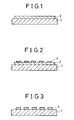
- one of the phthalocyanine compounds according to this invention is dissolved or dispersed at a proportion of 1-100 wt.%, preferably 40-100 wt.% in a photosensitive resin, and the resulting solution or dispersion is spin-coated on a substrate 1 by using a spinner (FIG. 1).
- the thickness of a resist layer 2 is usually 0.5-100 /1.m although it is determined depending on spectroscopic characteristics desired.
- the resist layer 2 is prebaked under suitable temperature conditions.
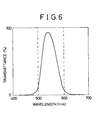
- the resist layer is exposed to light or an electron beam, to which the resist has sensitivity, via a mask 3 having a desired pattern corresponding to a pattern to be formed (i.e., a stripe pattern) - FIG. 2.
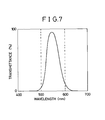
- the resist layer so exposed is then developed to form a pattern 4 (FIG. 3). If necessary, pre-treatment may be applied before the development to release any strain of the resist layer, or rinsing treatment may be conducted after the development to suppress any expansion of the resultant film. Finally, post-baking is applied under appropriate temperature conditions.
- the steps of from FIG. 1 to FIG. 3 are repeated using dyes corresponding to the respective colors as needed, namely, as many times as the number of filter colors employed, thereby making it possible to form, for example, a color filter having three colored layers 5,6,7 of different colors as shown in FIG. 4.
- the formation of colored layers may preferably be conducted after the formation of the black matrix.
- a color filter for a color copying machine or the like by using one of the phthalocyanine compound of this invention, various processes can be used.
- a thermoplastic resin such as polystyrene, polymethyl methacrylate, polycarbonate, polyester or polyvinyl chloride, with 0.5-10 wt.%, based on the resin, of the dye of this invention and then injection-molding or drawing the resultant resin composition.
- It can also be fabricated by dissolving the dye of this invention either singly or together with a binder in a solvent and forming the resultant solution into a film on a substrate in accordance with casting, spin coating or the like.
- the dye of this invention can be formed into a film on a substrate by vacuum evaporation.
- the dye of this invention is mixed with a varnish which contains a resin intermediate, and the resulting mixture is processed and then heat-treated into a resin.
- any resin can be used as long as it is optically transparent.
- Illustrative usable resins include acrylic resins, polyethylene, vinyl chloride resin, vinylidene chloride resin, polycarbonates, polyethylene copolymers, polyolefin copolymers, vinyl chloride copolymers, vinylidene chloride copolymers, and styrene copolymers.
- the dye can be coated or vacuum-evaporated on a transparent substrate.
- a binder resin and the phthalocyanine compound are dissolved in a solvent such that the concentration of the binder resin is not higher than 20 wt.%, preferably 0 wt.% and that of the phthalocyanine compound is 0.05-20 wt.%, preferably 0.5-20 wt.%, and the resultant solution is coated by a spin coater.
- the phthalocyanine compound is deposited on the substrate at 10- 5- 10- 7 torr and 100-300 C.
- the optical recording medium can be either of the WORM type that only a recording layer comprising the phthalocyanine compound of this invention is provided on a substrate or of the CD-WORM type that the above recording layer is provided on a substrate, a reflective layer made of gold or aluminum is provided over the recording layer and an overcoat is applied further.
- Any resin can be used for the production of the substrate as long as it is optically transparent.
- Illustrative usable resins include acrylic resins, polyethylene, vinyl chloride resin, vinylidene chloride resin, polycarbonate resins, polyethylene copolymers, polyolefin copolymers, vinyl chloride copolymers, vinylidene copolymers and styrene copolymers.
- the substrate may have been surface-treated with a thermosetting resin or an ultraviolet curing resin.
- optical recording medium optical disc, optical card or the like
- a polyacrylate substrate or polycarbonate substrate as a substrate and to coat and form a recording layer by spin coating.
- illustrative solvents usable upon spin coating include halogenated hydrocarbons such as dichloromethane, chloroform, carbon tetrachloride, tetrachloroethylene and dichlorodifluoroethane; ethers such as tetrahydrofuran and diethyl ether; ketones such as acetone and methyl ethyl ketone; alcohols such as methanol, ethanol and propanol; cellosolves such as methylcellosolve and ethylcellosolve; and hydrocarbons such as hexane, cyclohexane, octane, benzene, toluene and xylene.
- halogenated hydrocarbons such as dichloromethane, chloroform, carbon tetrachloride, tetrachloroethylene and dichlorodifluoroethane
- ethers such as tetrahydrofuran and diethy
- the filter so obtained was superior in durability (moisture resistance, light resistance and heat resistance) and also in transmittance characteristics.
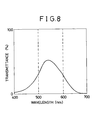
- the transmittance characteristics are shown in FIG. 5.
- a solution (10 g/1) of the phthalocyanine compound (1-1) in n-octane was coated on a polycarbonate substrate, whereby an optical recording medium with gold as a reflective layer was fabricated.
- That optical recording medium showed 70% reflectance at 780-830 nm, and also 60 dB sensitivity as measured on the basis of reflection of a 780 nm laser beam of 7 mW from its substrate at 1800 rpm.
- a solution of the phthalocyanine compound (1-2) in n-octane (10 g/l) was coated on a polycarbonate substrate, whereby an optical recording medium with gold as a reflective layer was fabricated. That optical recording medium showed 72% reflectance at 780-830 nm, and also 61 dB sensitivity as measured on the basis of reflection of a 780 nm laser beam of 7 mW from its substrate at 1800 rpm.
- a solution (10 g/l) of the phthalocyanine compound (1-3) in n-octane was coated on a polycarbonate substrate, whereby an optical recording medium with gold as a reflective layer was fabricated. That optical recording medium showed 73% reflectance at 780-830 nm, and 62 dB sensitivity as measured on the basis of reflection of a 780 nm laser beam of 7 mW from its substrate at 1800 rpm.
- Example 2 Using a known dye, a filter was fabricated in a similar manner to Example 1. Characteristics of the filter so obtained are shown in Table 2. In addition, transmittance characteristics of the filter are shown in FIG.8.
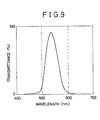
- a filter was fabricated by coloring gelatin with a known dye. Characteristics of the filter so obtained are shown in Table 2. In addition, transmittance characteristics of the filter are shown in FIG.9.
- Color difference was determined after each filter was exposed to light from a fadeometer at 60 ° C for 200 hours.
- Table 3 shows the maximum absorption wavelength ( ⁇ max ) of the compound obtained in each example and the molecular absorption coefficient (e) of the compound at the maximum wavelength, both as measured in the form of a solution, and the solubility, maximum reflectance and sensitivity of the compound, in comparison with those of the known compounds to be described next.
- the above compound was dissolved in chloroform because of its insolubility in n-hexane.
- the resulting solution was coated on a polycarbonate substrate.
- the substrate so coated was evaluated as a medium.
- the above compound was dissolved in chloroform because of its insolubility in n-hexane.
- the resulting solution was coated on a polycarbonate substrate.
- the substrate so coated was evaluated as a medium.
- a solution of the above compound in carbon tetrachloride was coated on a polycarbonate plate.
- the substrate so coated was evaluated as a medium.
- phthalocyanine compound (1-4) was added to 100 g of polystyrene.
- the resulting resin composition was injection-molded, whereby a filter was fabricated.
- the filter so obtained was found to have not only good transmittance characteristics but also excellent durability.
- a solution (10 g/1) of the phthalocyanine compound (1-4) in n-octane was coated on a polycarbonate substrate, whereby an optical recording medium with gold as a reflective layer was fabricated. That optical recording medium showed 71% reflectance at 780-830 nm, and 64 dB sensitivity as measured on the basis of reflection of a 780 nm laser beam of 7 mW from its substrate at 1800 rpm.
- the filter After heated at 70 °C for 4 hours, at 80 °C for 2 hours, at 90 °C for 2 hours, at 100 °C for 2 hours and at 120°C for 2 hours, the mold was cooled and the filter so molded was released.
- the filter exhibited good transmittance characteristics and were also excellent in light resistance and moisture resistance.
- a solution (10 g/l) of the phthalocyanine compound (1-5) in n-octane was coated on a polycarbonate substrate, whereby an optical recording medium with gold as a reflective layer was fabricated. That optical recording medium showed 73% reflectance at 780-830 nm, and 61 dB sensitivity as measured on the basis of reflection of a 780 nm laser beam of 7 mW from its substrate at 1800 rpm.
- a solution (10 g/l) of the phthalocyanine compound (1-6) in n-octane was coated on a polycarbonate substrate, whereby an optical recording medium with gold as a reflective layer was fabricated. That optical recording medium showed 72% reflectance at 780-830 nm, and 65 dB sensitivity as measured on the basis of reflection of a 780 nm laser beam of 7 mW from its substrate at 1800 rpm.
- phthalocyanine compound (1-7) was added to 100 g of polystyrene.
- the resulting resin composition was injection-molded, whereby a filter was fabricated.
- the filter so obtained was found to have not only good transmittance characteristics but also have excellent durability.
- a solution (10 g/1) of the phthalocyanine compound (1-7) in n-octane was coated on a polycarbonate substrate, whereby an optical recording medium with gold as a reflective layer was fabricated. That optical recording medium showed 72% reflectance at 780-830 nm, and 63 dB sensitivity as measured on the basis of reflection of a 780 nm laser beam of 7 mW from its substrate at 1800 rpm.
- a mixture consisting of 2.3 g of FeC1 2 and 100 g of quinoline was heated to 200 °C.
- 10 g of the above-obtained diiminoisoindoline derivative (VI-1) were added, followed by heating under reflux for 5 hours.
- the reaction mixture was poured into 500 g of methanol. After suction filtration, crystals so collected were washed with methanol, followed by drying, whereby 8.2 g of a mixture consisting of the compound (1-8) and its isomer(s) were obtained. Physical properties and elemental analysis data of the compound so obtained are shown below.
- the filter so obtained was superior in durability (moisture resistance, light resistance and heat resistance) and also in transmittance characteristics.
- a solution (10 g/1) of the phthalocyanine compound (1-9) in n-octane was coated on a polycarbonate substrate, whereby an optical recording medium with gold as a reflective layer was fabricated. That optical recording medium showed 70% reflectance at 780-830 nm, and 60 dB sensitivity as measured on the basis of reflection of a 780 nm laser beam of 7 mW from its substrate at 1800 rpm.
- the filter so obtained was superior in durability (moisture resistance, light resistance and heat resistance) and also in transmittance characteristics.
- a solution of the phthalocyanine compound (I-52) in n-octane (10 g/1) was coated on a polycarbonate substrate, whereby an optical recording medium with gold as a reflective layer was fabricated. That optical recording medium showed 70% reflectance at 780-830 nm, and 59 dB sensitivity as measured on the basis of reflection of a 780 nm laser beam of 7 mW from its substrate at 1800 rpm.
- phthalocyanine compound (I-53) was added to 100 g of polystyrene.
- the resulting resin composition was injection-molded, whereby a filter was fabricated.
- the filter so obtained was found to have not only good transmittance characteristics but also have excellent durability.
- phthalocyanine compound (I-54) was added to 100 g of polystyrene.
- the resulting resin composition was injection-molded, whereby a filter was fabricated.
- the filter so obtained was found to have not only good transmittance characteristics but also have excellent durability.
- the filter After heated at 70 °C for 4 hours, at 80 °C for 2 hours, at 90 °C for 2 hours, at 100 °C for 2 hours and at 120°C for 2 hours, the mold was cooled and the filter so molded was released.
- the filter exhibited good transmittance characteristics and were also excellent in light resistance arid moisture resistance.
- a solution (10 g/l) of the phthalocyanine compound (I-55) in n-octane was coated on a polycarbonate substrate, whereby an optical recording medium with gold as a reflective layer was fabricated. That optical recording medium showed 69% reflectance at 780-830 nm, and 62 dB sensitivity as measured on the basis of reflection of a 780 nm laser beam of 7 mW from its substrate at 1800 rpm.
- phthalocyanine compound (I-56) was added to 100 g of polystyrene.
- the resulting resin composition was injection-molded, whereby a filter was fabricated.
- the filter so obtained was found to have not only good transmittance characteristics but also excellent durability.
- a solution (10 g/1) of the phthalocyanine compound (I-56) in n-octane was coated on a polycarbonate substrate, whereby an optical recording medium with gold as a reflective layer was fabricated. That optical recording medium showed 70% reflectance at 780-830 nm, and 60 dB sensitivity as measured on the basis of reflection of a 780 nm laser beam of 7 mW from its substrate at 1800 rpm.
- a mixture consisting of 1.01 g of CuCI and 300 g of quinoline was heated to 200 °C.
- 18 g of the above-obtained diiminoisoindoline derivative (VI-12) were added, followed by heating under reflux for 5 hours.
- the reaction mixture was poured into 1000 g of methanol. After suction filtration, crystals so collected were washed with methanol, followed by drying, whereby 16 g of a mixture consisting of the compound (I-57) and its isomer(s) were obtained. Physical properties and elemental analysis data of the compound so obtained are shown below.
- phthalocyanine compound (I-57) was added to 100 g of polystyrene.
- the resulting resin composition was injection-molded, whereby a filter was fabricated.
- the filter so obtained was found to have not only good transmittance characteristics but also excellent durability.
- the optical disc thus fabricated was found to have a reflectance of 36% and a sensitivity of 51 dB in terms of C/N ratio as measured at a linear velocity of 5.5 m/sec by a 780 nm laser beam of 8 mW.
- a solution (10 g/1) of the phthalocyanine compound (I-57) in n-octane was coated on a polycarbonate substrate, whereby an optical recording medium with gold as a reflective layer was fabricated. That optical recording medium showed 70% reflectance at 780-830 nm, and 57 dB sensitivity as measured on the basis of reflection of a 780 nm laser beam of 7 mW from its substrate at 1800 rpm.
Landscapes
- Chemical & Material Sciences (AREA)
- Organic Chemistry (AREA)
- Thermal Transfer Or Thermal Recording In General (AREA)
- Nitrogen Condensed Heterocyclic Rings (AREA)
- Optical Filters (AREA)
Applications Claiming Priority (8)
| Application Number | Priority Date | Filing Date | Title |
|---|---|---|---|
| JP14731091 | 1991-06-19 | ||
| JP147310/91 | 1991-06-19 | ||
| JP14826291 | 1991-06-20 | ||
| JP148262/91 | 1991-06-20 | ||
| JP338557/91 | 1991-12-20 | ||
| JP3338557A JP3016649B2 (ja) | 1991-12-20 | 1991-12-20 | α−アルコキシフタロシアニン化合物及びそれを用いた光記録媒体 |
| JP3303192 | 1992-02-20 | ||
| JP33031/92 | 1992-02-20 |
Publications (3)
| Publication Number | Publication Date |
|---|---|
| EP0519423A2 true EP0519423A2 (de) | 1992-12-23 |
| EP0519423A3 EP0519423A3 (de) | 1994-03-09 |
| EP0519423B1 EP0519423B1 (de) | 1999-03-03 |
Family
ID=27459727
Family Applications (1)
| Application Number | Title | Priority Date | Filing Date |
|---|---|---|---|
| EP92110218A Expired - Lifetime EP0519423B1 (de) | 1991-06-19 | 1992-06-17 | Phthalocyaninverbindungen und ihre Verwendung |
Country Status (4)
| Country | Link |
|---|---|
| US (1) | US5695911A (de) |
| EP (1) | EP0519423B1 (de) |
| CA (1) | CA2071474A1 (de) |
| DE (1) | DE69228502T2 (de) |
Cited By (20)
| Publication number | Priority date | Publication date | Assignee | Title |
|---|---|---|---|---|
| EP0575816A1 (de) | 1992-06-12 | 1993-12-29 | MITSUI TOATSU CHEMICALS, Inc. | Lichtabsorbierende Verbindung und optisches Aufzeichnungsmedium das diese enthält |
| EP0619345A1 (de) * | 1993-04-09 | 1994-10-12 | MITSUI TOATSU CHEMICALS, Inc. | Phthalocyaninverbindung und optisches Aufzeichnungsmedium das diese enthält |
| EP0636664A1 (de) * | 1993-07-29 | 1995-02-01 | Zeneca Limited | Substituierte Phthalocyaninen |
| EP0669387A1 (de) * | 1994-02-24 | 1995-08-30 | Eastman Kodak Company | Rot-emittierende organische elektrolumineszente Vorrichtung |
| WO1995026381A1 (en) * | 1994-03-25 | 1995-10-05 | The Secretary Of State For Defence | Substituted phthalocyanines |
| EP0718375A3 (de) * | 1994-12-21 | 1997-03-05 | Mitsui Toatsu Chemicals | Absorber im nahen Infrarot, dessen Herstellungsverfahren sowie dessen Verwendung |
| EP0719839A3 (de) * | 1994-12-27 | 1998-03-18 | MITSUI TOATSU CHEMICALS, Inc. | Phthalocyaninverbindungen und optisches Aufzeichnungsmedium das diese enthält |
| GB2279657B (en) * | 1993-07-09 | 1998-05-06 | Zeneca Ltd | Phthalocyanine compounds |
| EP0934985A3 (de) * | 1998-02-03 | 1999-11-17 | Nippon Shokubai Co., Ltd. | Phthalocyaninverbindung, deren Herstellungsverfahren und Verwendung |
| EP0928816A3 (de) * | 1997-12-29 | 1999-11-17 | Yamamoto Chemicals, Inc. | Phthalocyaninverbindung, deren Zwischenprodukt, Verfahren zur Herstellung dieser Verbindung und deren Anwendung |
| DE19840608A1 (de) * | 1998-09-05 | 2000-03-09 | Dlr Ev | Metallierte oder unmetallierte Phthalocyanine |
| WO2001042368A1 (en) * | 1999-12-08 | 2001-06-14 | Gentian As | Substituted phthalocyanines and their precursors |
| WO2002014912A1 (fr) * | 2000-08-17 | 2002-02-21 | Mitsubishi Chemical Corporation | Composition de filtres colores et filtres colores |
| WO2002052307A1 (fr) * | 2000-12-22 | 2002-07-04 | Mitsubishi Chemical Corporation | Composition pour filtres colores et filtres colores |
| WO2004018477A3 (en) * | 2002-08-14 | 2004-04-15 | Ciba Sc Holding Ag | Liquid crystal display and colour filter with improved transparency for green light |
| WO2006021564A1 (en) * | 2004-08-26 | 2006-03-02 | Neurosearch A/S | Novel substituted aryloxy alkylamines and their use as monoamine neurotransmitter re-uptake inhibitors |
| EP1355913A4 (de) * | 2001-01-05 | 2006-04-26 | Lee Seung Yong | Komplexverbindungen aus paramagnetischem metall und phthalocyanin und kontrastmittel, bei dem diese verbindungen verwendet werden |
| WO2008083918A1 (en) * | 2007-01-11 | 2008-07-17 | Ciba Holding Inc. | Near infrared absorbing phthalocyanines and their use |
| US7625621B2 (en) | 2004-07-29 | 2009-12-01 | Clariant Finance (Bvi) Limited | Amino antipyrine based azo ligands and their metal complexes for use as optical recording media |
| EP1780598A4 (de) * | 2004-08-02 | 2012-11-28 | Fujifilm Corp | Farbige aushärtbare zusammensetzungen, farbfilter und herstellungsprozess dafür |
Families Citing this family (5)
| Publication number | Priority date | Publication date | Assignee | Title |
|---|---|---|---|---|
| JPH10332920A (ja) * | 1997-05-27 | 1998-12-18 | Sony Corp | カラー固体撮像装置のカラーフィルタの形成方法 |
| US7029526B2 (en) * | 2001-10-19 | 2006-04-18 | Ciba Specialty Chemicals Corporation | Process for making green pigment compositions useful for color filters and LCD's |
| US7153956B2 (en) | 2004-08-09 | 2006-12-26 | Silverbrook Research Pty Ltd | Cyanine dye having multifunctional peripheral groups |
| KR101281830B1 (ko) * | 2006-09-26 | 2013-07-03 | 엘지디스플레이 주식회사 | 멀티 터치 감지기능을 갖는 액정표시장치와 그 구동방법 |
| JP5697894B2 (ja) * | 2010-05-17 | 2015-04-08 | 富士フイルム株式会社 | 赤外線吸収性組成物、赤外線吸収性インキ、記録物、画像記録方法、及び画像検出方法 |
Family Cites Families (16)
| Publication number | Priority date | Publication date | Assignee | Title |
|---|---|---|---|---|
| US2456274A (en) * | 1944-02-14 | 1948-12-14 | Sandoz Ltd | Aryl thio-ethers of metal-containing phthalocyanines and process for producing same |
| EP0155780B1 (de) * | 1984-03-21 | 1990-03-28 | Imperial Chemical Industries Plc | Infrarot-Absorber |
| GB8431924D0 (en) * | 1984-12-18 | 1985-01-30 | Ici Plc | Optical recording medium |
| DE3524644A1 (de) * | 1985-07-10 | 1987-01-15 | Heyl Chem Pharm | Undulin und dessen peptidfragmente, verfahren zu deren herstellung und ihre verwendung |
| JPH0749231B2 (ja) * | 1985-08-13 | 1995-05-31 | 三菱化学株式会社 | 光学記録体 |
| EP0346354B1 (de) * | 1987-02-13 | 1992-08-19 | The Secretary of State for Defence in Her Britannic Majesty's Government of the United Kingdom of Great Britain and | Substituierte phthalocyanine |
| JPS63307987A (ja) * | 1987-06-09 | 1988-12-15 | Toyo Ink Mfg Co Ltd | 光学記録媒体 |
| JPH01206259A (ja) * | 1988-02-12 | 1989-08-18 | Hitachi Ltd | 反応容器洗浄装置 |
| JP2567022B2 (ja) * | 1988-03-15 | 1996-12-25 | 三井東圧化学株式会社 | 緑色フィルター |
| JPH0730300B2 (ja) * | 1988-04-01 | 1995-04-05 | 三井東圧化学株式会社 | アルキルフタロシアニン近赤外線吸収剤及びそれを用いた表示・記録材料 |
| DE68928559T2 (de) * | 1988-12-15 | 1998-06-18 | Mitsui Toatsu Chemicals | Absorbiermittel im nahen Infrarot und Anzeige-/Aufzeichnungsmaterialien, die daraus hergestellt sind |
| JPH0796540B2 (ja) * | 1989-06-29 | 1995-10-18 | 山本化成株式会社 | フタロシアニン化合物およびその中間体 |
| GB8923921D0 (en) * | 1989-10-24 | 1989-12-13 | Minnesota Mining & Mfg | Optical recording elements |
| JP2694036B2 (ja) * | 1989-12-29 | 1997-12-24 | 東洋インキ製造株式会社 | カラーフィルター遮光部形成用組成物 |
| JPH06239286A (ja) * | 1993-02-12 | 1994-08-30 | Yamaha Motor Co Ltd | 電動自転車 |
| JP3031247U (ja) | 1995-03-27 | 1996-11-22 | モートン インターナショナル,インコーポレイティド | エアバッグインフレーター用ガス発生器 |
-
1992
- 1992-06-17 DE DE69228502T patent/DE69228502T2/de not_active Expired - Fee Related
- 1992-06-17 CA CA002071474A patent/CA2071474A1/en not_active Abandoned
- 1992-06-17 EP EP92110218A patent/EP0519423B1/de not_active Expired - Lifetime
-
1995
- 1995-11-17 US US08/560,130 patent/US5695911A/en not_active Expired - Fee Related
Cited By (27)
| Publication number | Priority date | Publication date | Assignee | Title |
|---|---|---|---|---|
| EP0575816A1 (de) | 1992-06-12 | 1993-12-29 | MITSUI TOATSU CHEMICALS, Inc. | Lichtabsorbierende Verbindung und optisches Aufzeichnungsmedium das diese enthält |
| EP0619345A1 (de) * | 1993-04-09 | 1994-10-12 | MITSUI TOATSU CHEMICALS, Inc. | Phthalocyaninverbindung und optisches Aufzeichnungsmedium das diese enthält |
| US5646273A (en) * | 1993-04-09 | 1997-07-08 | Mitsui Toatsu Chemicals, Inc. | Phthalocyanine compound and optical recording medium containing it |
| GB2279657B (en) * | 1993-07-09 | 1998-05-06 | Zeneca Ltd | Phthalocyanine compounds |
| EP0636664A1 (de) * | 1993-07-29 | 1995-02-01 | Zeneca Limited | Substituierte Phthalocyaninen |
| EP0669387A1 (de) * | 1994-02-24 | 1995-08-30 | Eastman Kodak Company | Rot-emittierende organische elektrolumineszente Vorrichtung |
| WO1995026381A1 (en) * | 1994-03-25 | 1995-10-05 | The Secretary Of State For Defence | Substituted phthalocyanines |
| GB2302095A (en) * | 1994-03-25 | 1997-01-08 | Secr Defence | Substituted phthalocyanines |
| GB2302095B (en) * | 1994-03-25 | 1998-12-16 | Secr Defence | Substituted phthalocyanines |
| US5792860A (en) * | 1994-03-25 | 1998-08-11 | The Secretary Of State For Defence In Her Majesty's Government Of The United Kingdom Of Great Britain And Northern Ireland Of Defence Evaulation Research Agency | Substituted phthalocyanides with sulfonyl substituted with amino or carboxyl groups |
| EP0718375A3 (de) * | 1994-12-21 | 1997-03-05 | Mitsui Toatsu Chemicals | Absorber im nahen Infrarot, dessen Herstellungsverfahren sowie dessen Verwendung |
| US5705101A (en) * | 1994-12-21 | 1998-01-06 | Mitsui Toatsu Chemicals, Inc. | Near infrared absorber, preparation process therefor and use thereof |
| EP0719839A3 (de) * | 1994-12-27 | 1998-03-18 | MITSUI TOATSU CHEMICALS, Inc. | Phthalocyaninverbindungen und optisches Aufzeichnungsmedium das diese enthält |
| EP0928816A3 (de) * | 1997-12-29 | 1999-11-17 | Yamamoto Chemicals, Inc. | Phthalocyaninverbindung, deren Zwischenprodukt, Verfahren zur Herstellung dieser Verbindung und deren Anwendung |
| EP0934985A3 (de) * | 1998-02-03 | 1999-11-17 | Nippon Shokubai Co., Ltd. | Phthalocyaninverbindung, deren Herstellungsverfahren und Verwendung |
| DE19840608A1 (de) * | 1998-09-05 | 2000-03-09 | Dlr Ev | Metallierte oder unmetallierte Phthalocyanine |
| WO2001042368A1 (en) * | 1999-12-08 | 2001-06-14 | Gentian As | Substituted phthalocyanines and their precursors |
| WO2002014912A1 (fr) * | 2000-08-17 | 2002-02-21 | Mitsubishi Chemical Corporation | Composition de filtres colores et filtres colores |
| WO2002052307A1 (fr) * | 2000-12-22 | 2002-07-04 | Mitsubishi Chemical Corporation | Composition pour filtres colores et filtres colores |
| EP1355913A4 (de) * | 2001-01-05 | 2006-04-26 | Lee Seung Yong | Komplexverbindungen aus paramagnetischem metall und phthalocyanin und kontrastmittel, bei dem diese verbindungen verwendet werden |
| WO2004018477A3 (en) * | 2002-08-14 | 2004-04-15 | Ciba Sc Holding Ag | Liquid crystal display and colour filter with improved transparency for green light |
| US7625621B2 (en) | 2004-07-29 | 2009-12-01 | Clariant Finance (Bvi) Limited | Amino antipyrine based azo ligands and their metal complexes for use as optical recording media |
| EP1780598A4 (de) * | 2004-08-02 | 2012-11-28 | Fujifilm Corp | Farbige aushärtbare zusammensetzungen, farbfilter und herstellungsprozess dafür |
| WO2006021564A1 (en) * | 2004-08-26 | 2006-03-02 | Neurosearch A/S | Novel substituted aryloxy alkylamines and their use as monoamine neurotransmitter re-uptake inhibitors |
| US7973082B2 (en) | 2004-08-26 | 2011-07-05 | Neurosearch A/S | Substituted aryloxy alkylamines and their use as monoamine neurotransmitter re-uptake inhibitors |
| WO2008083918A1 (en) * | 2007-01-11 | 2008-07-17 | Ciba Holding Inc. | Near infrared absorbing phthalocyanines and their use |
| US8221657B2 (en) | 2007-01-11 | 2012-07-17 | Basf Se | Near infrared absorbing phthalocyanines and their use |
Also Published As
| Publication number | Publication date |
|---|---|
| DE69228502T2 (de) | 1999-08-12 |
| CA2071474A1 (en) | 1992-12-20 |
| EP0519423A3 (de) | 1994-03-09 |
| EP0519423B1 (de) | 1999-03-03 |
| DE69228502D1 (de) | 1999-04-08 |
| US5695911A (en) | 1997-12-09 |
Similar Documents
| Publication | Publication Date | Title |
|---|---|---|
| EP0519423A2 (de) | Phthalocyaninverbindungen und ihre Verwendung | |
| US5248538A (en) | Sulfonamido or amido substituted phthalocyanines for optical recording | |
| EP0811506B1 (de) | Optisches aufzeichnungsmaterial und optischer aufzeichnungsträger | |
| EP0313943B1 (de) | 1,2-Naphtalocyanine, Infrarotabsorber und sie verwendende Aufzeichnungsmaterialien | |
| JP3860616B2 (ja) | フタロシアニン化合物 | |
| JPH05295283A (ja) | フィルター用色素及びこれを含有するカラーフィルター | |
| GB2237284A (en) | Optical recording elements comprising tetrasubstituted phthalocyanine dyes | |
| JP3963509B2 (ja) | フタロシアニン化合物、その製造方法およびそれを用いた光記録媒体 | |
| US7332261B2 (en) | Phthalocyanine compound, process for preparing the same, and optical recording medium containing the same | |
| JP3863195B2 (ja) | フタロシアニン化合物 | |
| JP2698067B2 (ja) | フタロシアニン化合物及びその製造方法 | |
| JPH07304993A (ja) | 新規色素およびその用途 | |
| JP3265034B2 (ja) | セキュリティインキ組成物 | |
| JP3857327B2 (ja) | フタロシアニン化合物 | |
| JPH07286110A (ja) | フタロシアニン化合物 | |
| US5219706A (en) | Naphthalocyanine derivative and production process thereof, as well as optical information recording media using the derivatives and production process thereof | |
| JP5288360B2 (ja) | フタロシアニン化合物の製造方法及びこれより得られた該化合物の混合物 | |
| JP3964106B2 (ja) | 有機金属錯体および赤外線吸収色素 | |
| JP3732528B2 (ja) | 光吸収化合物及びそれを含有してなる光記録媒体 | |
| JP2585722B2 (ja) | 新規な近赤外線吸収色素 | |
| IE970460A1 (en) | Optical recording material and optical recording medium | |
| JPH07287862A (ja) | アゾ色素を用いる光学的情報記録素子 | |
| JP2012031176A (ja) | フタロシアニン系化合物及びその用途 | |
| JP2002067510A (ja) | 光記録材料、及び光記録媒体 |
Legal Events
| Date | Code | Title | Description |
|---|---|---|---|
| PUAI | Public reference made under article 153(3) epc to a published international application that has entered the european phase |
Free format text: ORIGINAL CODE: 0009012 |
|
| 17P | Request for examination filed |
Effective date: 19921019 |
|
| AK | Designated contracting states |
Kind code of ref document: A2 Designated state(s): DE FR GB NL |
|
| PUAL | Search report despatched |
Free format text: ORIGINAL CODE: 0009013 |
|
| AK | Designated contracting states |
Kind code of ref document: A3 Designated state(s): DE FR GB NL |
|
| 17Q | First examination report despatched |
Effective date: 19951020 |
|
| GRAG | Despatch of communication of intention to grant |
Free format text: ORIGINAL CODE: EPIDOS AGRA |
|
| RAP1 | Party data changed (applicant data changed or rights of an application transferred) |
Owner name: YAMAMOTO CHEMICALS, INC. Owner name: MITSUI CHEMICALS, INC. |
|
| GRAG | Despatch of communication of intention to grant |
Free format text: ORIGINAL CODE: EPIDOS AGRA |
|
| GRAH | Despatch of communication of intention to grant a patent |
Free format text: ORIGINAL CODE: EPIDOS IGRA |
|
| GRAH | Despatch of communication of intention to grant a patent |
Free format text: ORIGINAL CODE: EPIDOS IGRA |
|
| GRAA | (expected) grant |
Free format text: ORIGINAL CODE: 0009210 |
|
| AK | Designated contracting states |
Kind code of ref document: B1 Designated state(s): DE FR GB NL |
|
| REF | Corresponds to: |
Ref document number: 69228502 Country of ref document: DE Date of ref document: 19990408 |
|
| ET | Fr: translation filed | ||
| PGFP | Annual fee paid to national office [announced via postgrant information from national office to epo] |
Ref country code: NL Payment date: 19990630 Year of fee payment: 8 |
|
| PLBE | No opposition filed within time limit |
Free format text: ORIGINAL CODE: 0009261 |
|
| STAA | Information on the status of an ep patent application or granted ep patent |
Free format text: STATUS: NO OPPOSITION FILED WITHIN TIME LIMIT |
|
| 26N | No opposition filed | ||
| PG25 | Lapsed in a contracting state [announced via postgrant information from national office to epo] |
Ref country code: NL Free format text: LAPSE BECAUSE OF NON-PAYMENT OF DUE FEES Effective date: 20010101 |
|
| NLV4 | Nl: lapsed or anulled due to non-payment of the annual fee |
Effective date: 20010101 |
|
| REG | Reference to a national code |
Ref country code: GB Ref legal event code: IF02 |
|
| PGFP | Annual fee paid to national office [announced via postgrant information from national office to epo] |
Ref country code: FR Payment date: 20040608 Year of fee payment: 13 |
|
| PGFP | Annual fee paid to national office [announced via postgrant information from national office to epo] |
Ref country code: GB Payment date: 20040616 Year of fee payment: 13 |
|
| PGFP | Annual fee paid to national office [announced via postgrant information from national office to epo] |
Ref country code: DE Payment date: 20040624 Year of fee payment: 13 |
|
| PG25 | Lapsed in a contracting state [announced via postgrant information from national office to epo] |
Ref country code: GB Free format text: LAPSE BECAUSE OF NON-PAYMENT OF DUE FEES Effective date: 20050617 |
|
| PG25 | Lapsed in a contracting state [announced via postgrant information from national office to epo] |
Ref country code: DE Free format text: LAPSE BECAUSE OF NON-PAYMENT OF DUE FEES Effective date: 20060103 |
|
| PG25 | Lapsed in a contracting state [announced via postgrant information from national office to epo] |
Ref country code: FR Free format text: LAPSE BECAUSE OF NON-PAYMENT OF DUE FEES Effective date: 20060228 |
|
| GBPC | Gb: european patent ceased through non-payment of renewal fee |
Effective date: 20050617 |
|
| REG | Reference to a national code |
Ref country code: FR Ref legal event code: ST Effective date: 20060228 |