EP0521985B1 - Chimäre antikörper mit rezeptor-bindenden liganden anstelle ihrer konstanten region - Google Patents
Chimäre antikörper mit rezeptor-bindenden liganden anstelle ihrer konstanten region Download PDFInfo
- Publication number
- EP0521985B1 EP0521985B1 EP91906955A EP91906955A EP0521985B1 EP 0521985 B1 EP0521985 B1 EP 0521985B1 EP 91906955 A EP91906955 A EP 91906955A EP 91906955 A EP91906955 A EP 91906955A EP 0521985 B1 EP0521985 B1 EP 0521985B1
- Authority
- EP
- European Patent Office
- Prior art keywords
- mammal
- antibody
- polypeptide
- constant region
- polypeptides
- Prior art date
- Legal status (The legal status is an assumption and is not a legal conclusion. Google has not performed a legal analysis and makes no representation as to the accuracy of the status listed.)
- Expired - Lifetime
Links
- 0 CC(C(*)CCC1*)C1O Chemical compound CC(C(*)CCC1*)C1O 0.000 description 1
Images




Classifications
-
- C—CHEMISTRY; METALLURGY
- C07—ORGANIC CHEMISTRY
- C07K—PEPTIDES
- C07K14/00—Peptides having more than 20 amino acids; Gastrins; Somatostatins; Melanotropins; Derivatives thereof
- C07K14/435—Peptides having more than 20 amino acids; Gastrins; Somatostatins; Melanotropins; Derivatives thereof from animals; from humans
- C07K14/575—Hormones
- C07K14/62—Insulins
-
- A—HUMAN NECESSITIES
- A61—MEDICAL OR VETERINARY SCIENCE; HYGIENE
- A61P—SPECIFIC THERAPEUTIC ACTIVITY OF CHEMICAL COMPOUNDS OR MEDICINAL PREPARATIONS
- A61P25/00—Drugs for disorders of the nervous system
-
- A—HUMAN NECESSITIES
- A61—MEDICAL OR VETERINARY SCIENCE; HYGIENE
- A61P—SPECIFIC THERAPEUTIC ACTIVITY OF CHEMICAL COMPOUNDS OR MEDICINAL PREPARATIONS
- A61P25/00—Drugs for disorders of the nervous system
- A61P25/28—Drugs for disorders of the nervous system for treating neurodegenerative disorders of the central nervous system, e.g. nootropic agents, cognition enhancers, drugs for treating Alzheimer's disease or other forms of dementia
-
- A—HUMAN NECESSITIES
- A61—MEDICAL OR VETERINARY SCIENCE; HYGIENE
- A61P—SPECIFIC THERAPEUTIC ACTIVITY OF CHEMICAL COMPOUNDS OR MEDICINAL PREPARATIONS
- A61P35/00—Antineoplastic agents
-
- C—CHEMISTRY; METALLURGY
- C07—ORGANIC CHEMISTRY
- C07K—PEPTIDES
- C07K14/00—Peptides having more than 20 amino acids; Gastrins; Somatostatins; Melanotropins; Derivatives thereof
- C07K14/435—Peptides having more than 20 amino acids; Gastrins; Somatostatins; Melanotropins; Derivatives thereof from animals; from humans
- C07K14/52—Cytokines; Lymphokines; Interferons
- C07K14/54—Interleukins [IL]
- C07K14/55—IL-2
-
- C—CHEMISTRY; METALLURGY
- C07—ORGANIC CHEMISTRY
- C07K—PEPTIDES
- C07K14/00—Peptides having more than 20 amino acids; Gastrins; Somatostatins; Melanotropins; Derivatives thereof
- C07K14/435—Peptides having more than 20 amino acids; Gastrins; Somatostatins; Melanotropins; Derivatives thereof from animals; from humans
- C07K14/575—Hormones
- C07K14/65—Insulin-like growth factors, i.e. somatomedins, e.g. IGF-1, IGF-2
-
- C—CHEMISTRY; METALLURGY
- C07—ORGANIC CHEMISTRY
- C07K—PEPTIDES
- C07K14/00—Peptides having more than 20 amino acids; Gastrins; Somatostatins; Melanotropins; Derivatives thereof
- C07K14/435—Peptides having more than 20 amino acids; Gastrins; Somatostatins; Melanotropins; Derivatives thereof from animals; from humans
- C07K14/705—Receptors; Cell surface antigens; Cell surface determinants
- C07K14/70503—Immunoglobulin superfamily
- C07K14/70514—CD4
-
- C—CHEMISTRY; METALLURGY
- C07—ORGANIC CHEMISTRY
- C07K—PEPTIDES
- C07K14/00—Peptides having more than 20 amino acids; Gastrins; Somatostatins; Melanotropins; Derivatives thereof
- C07K14/435—Peptides having more than 20 amino acids; Gastrins; Somatostatins; Melanotropins; Derivatives thereof from animals; from humans
- C07K14/79—Transferrins, e.g. lactoferrins, ovotransferrins
-
- C—CHEMISTRY; METALLURGY
- C07—ORGANIC CHEMISTRY
- C07K—PEPTIDES
- C07K16/00—Immunoglobulins [IG], e.g. monoclonal or polyclonal antibodies
- C07K16/18—Immunoglobulins [IG], e.g. monoclonal or polyclonal antibodies against material from animals or humans
- C07K16/28—Immunoglobulins [IG], e.g. monoclonal or polyclonal antibodies against material from animals or humans against receptors, cell surface antigens or cell surface determinants
- C07K16/30—Immunoglobulins [IG], e.g. monoclonal or polyclonal antibodies against material from animals or humans against receptors, cell surface antigens or cell surface determinants from tumour cells
-
- C—CHEMISTRY; METALLURGY
- C07—ORGANIC CHEMISTRY
- C07K—PEPTIDES
- C07K16/00—Immunoglobulins [IG], e.g. monoclonal or polyclonal antibodies
- C07K16/44—Immunoglobulins [IG], e.g. monoclonal or polyclonal antibodies against material not provided for elsewhere, e.g. haptens, metals, DNA, RNA, amino acids
-
- C—CHEMISTRY; METALLURGY
- C07—ORGANIC CHEMISTRY
- C07K—PEPTIDES
- C07K16/00—Immunoglobulins [IG], e.g. monoclonal or polyclonal antibodies
- C07K16/46—Hybrid immunoglobulins
- C07K16/461—Igs containing Ig-regions, -domains or -residues form different species
- C07K16/462—Igs containing a variable region (Fv) from one specie and a constant region (Fc) from another
-
- A—HUMAN NECESSITIES
- A61—MEDICAL OR VETERINARY SCIENCE; HYGIENE
- A61K—PREPARATIONS FOR MEDICAL, DENTAL OR TOILETRY PURPOSES
- A61K38/00—Medicinal preparations containing peptides
-
- C—CHEMISTRY; METALLURGY
- C07—ORGANIC CHEMISTRY
- C07K—PEPTIDES
- C07K2317/00—Immunoglobulins specific features
- C07K2317/20—Immunoglobulins specific features characterized by taxonomic origin
- C07K2317/24—Immunoglobulins specific features characterized by taxonomic origin containing regions, domains or residues from different species, e.g. chimeric, humanized or veneered
-
- C—CHEMISTRY; METALLURGY
- C07—ORGANIC CHEMISTRY
- C07K—PEPTIDES
- C07K2319/00—Fusion polypeptide
Definitions
- the challenge in cancer therapy has been to find a means of selectively killing malignant cells while leaving normal cells intact.
- Traditional chemotherapy has been directed against actively dividing cells with a drawback being that it also kills normal, actively proliferating cells, e.g. the bone marrow.
- Another challenge is to produce antibodies which have access to regions of the subject generally inaccessible to most molecules, e.g., the brain.
- Antibodies because of their remarkable specificity, have long had appeal as the "magic bullet" capable of selectively identifying and eliminating malignant cells.
- Transfected cells provide an approach to improving monoclonal antibodies.
- Genetically engineered antibodies can be expressed following gene transfection into lymphoid cells (1-5).
- One of the major advantages of expressing genetically engineered antibodies is that one is not limited to using antibodies as they occur in nature.
- nonimmunoglobulin sequences can be joined to antibody sequences, creating multifunctional molecules.
- IL-2 receptor antibodies directed to the IL-2 receptor have been used to target therapy to T cell malignancies (67, 68).
- receptor ligands have been used as a therapeutic to target a particular cell.
- blocking cellular receptors effectively interferes with the cells' ability to proliferate.
- the molecules described herein include genetically engineered antibodies having insulin or insulin-like growth factors type 1 and type 2 (IGF1 and IGF2) joined to an antibody combining specificity.
- IGF1 and IGF2 are related polypeptides which affect cell metabolism and proliferation by binding to specific receptors on the plasma membrane.
- IGF1 is identical to somatomedin-C.
- the receptors for insulin and IGF1 are similar in molecular size and substructure.
- IGF1 insulin receptor
- IGF1 receptors Both the insulin and IGF receptors are thought to be present on the blood-brain barrier and to effect transcytosis across it (1, 16-19, 48).
- the molecules described herein include genetically engineered antibodies having transferrin joined to an antibody combining specificity.
- Transferrin receptors are widely distributed on human tumors (20).
- the vascular endothelium of the brain capillaries express transferrin receptors whereas those of other tissues do not (26).
- Antibodies directed against transferrin receptors inhibit growth of tumor cells by crosslinking the transferrin receptor (54).
- IgM antibodies were effective thereby suggesting that a polymer is important.
- IgG antibodies increased the turnover of the transferrin receptor (69) suggesting that an alternative approach to inhibiting cell growth would be to increase receptor degradation during recycling.
- the transferrin receptor binds to the major serum iron transport protein, i.e. transferrin, and mediates iron uptake into the cell.
- the basic mechanism by which the transferrin receptor mediates iron uptake has been established. After binding of iron-laden transferrin to the receptor, receptor-ligand complexes are taken up via coated pits and accumulate within endocytic vesicles (4, 23, 24). Acidification of this intracellular membrane compartment leads to the dissociation of iron from transferrin and the apotransferrin-transferrin receptor complex is then recycled back to the cell surface. Under neutral conditions, apotransferrin rapidly dissociates from the receptor which is then available to undergo another round of endocytosis (11, 30, 65, 70).
- IGF1 insulin growth factor receptor
- the present invention provides a modified chimeric monoclonal antibody comprising two molecules of each of two different polypeptides.
- the shorter polypeptides function as the light chains of the antibody and the longer polypeptides function as the heavy chains of the antibody.
- the polypeptide which functions as a heavy chain has a variable region characteristic of a first mammal and a constant region characteristic of a second mammal.
- Each polypeptide which functions as a light chain has a variable region characteristic of a mammal and a constant region characteristic of a mammal, wherein a receptor-binding ligand replaces at least a portion of the constant region of each of the polypeptides which function as the heavy chains of the antibody.
- the present invention provides an immunologically reactive complex comprising two different polypeptides, the shorter of which functions as a light chain and the longer of which functions as a heavy chain.
- the polypeptide which functions as the heavy chain has a variable region characteristic of a first mammal and a constant region characteristic of a second mammal and the polypeptide which functions as the light chain has a variable region characteristic of a mammal and a constant region characteristic of a second mammal.
- a receptor-binding ligand replaces at least a portion of a constant region of one of the polypeptides.
- the invention also provides a chimeric polypeptide capable of functioning as a heavy chain of an antibody.
- the chimeric polypeptide comprises a variable region characteristic of a first mammal and a constant region characteristic of a second mammal.
- a receptor-binding ligand replaces at least a portion of the constant region of the polypeptide.
- the present invention provides a chimeric polypeptide capable of functioning as a light chain of an antibody comprising a variable region characteristic of a first mammal and a constant region characteristic of a second mammal, wherein a receptor-binding ligand replaces at least a portion of the constant region of the polypeptide.
- the present invention additionally provides a modified chimeric monoclonal antibody comprising two molecules of each of two different polypeptides, the shorter of which functions as the light chains of the antibody and the longer of which polypeptides function as the heavy chains of the antibody.
- Each polypeptide which functions as a heavy chain has a variable region characteristic of a first mammal and a constant region characteristic of a second mammal.
- each polypeptide which functions as a light chain has a variable region characteristic of a mammal and a constant region characteristic of a mammal, wherein a receptor-binding ligand is covalently attached to the ends of the constant regions of each of the polypeptides which function as the heavy chains of the antibody.
- the complex comprises two different polypeptides, the shorter of which functions as a light chain and the longer of which functions as a heavy chain, the polypeptide which functions as the heavy chain having a variable region characteristic of a first mammal and a constant region characteristic of a second mammal and the polypeptide which functions as the light chain having a variable region characteristic of a mammal and a constant region characteristic of a second mammal, wherein a receptor-binding ligand is covalently attached to the ends of a constant region of one of the polypeptides.
- the present invention also provides a chimeric polypeptide capable of functioning as a heavy chain of an antibody comprising a variable region characteristic of a first mammal and a constant region characteristic of a second mammal, wherein a receptor-binding ligand is covalently attached to the constant region of the polypeptide.
- the present invention further provides a chimeric polypeptide capable of functioning as a light chain of an antibody comprising a variable region characteristic of a first mammal and a constant region characteristic of a second mammal, wherein a receptor-binding ligand is covalently attached to the constant region of the polypeptide.
- the invention provides methods of using and producing the modified chimeric monoclonal antibodies.
- FIG. 2 NaDodSO 4 /PAGE analysis of the IgG3-IGF1 chimeric protein secreted by transfectomas.
- the secreted IgG3-IGF1 chimeric protein biosynthetically labeled with [ 35 S]methionine was analyzed under non reducing ( A ) and reducing ( B ) conditions.
- the labeled chimeric protein was precipitated with either Dns-Sepharose (lanes DNS in A) or anti-human IgG Fab antiserum/Staphylococcus protein A/IgGsorb (lanes Fab in A).
- Anti-Fab precipitates free L chains as well as L chains covalently attached to H chains.
- the secreted IgG3 chimeric antibody consisting of mouse V region-human IgG3 C region has the same basic structure as the IgG3-IGF1 chimeric protein and is used as a control.
- the three bands represent the heterogeneous assembly of the processed and unprocessed chimeric protein: under reducing conditions, the processed (P) and unprocessed (unP) chimeric protein are seen (B).
- the schematic diagrams of heterogeneous assembly patterns are shown in C in which the hatched regions represent the mouse V regions, the open regions represent human C regions, the stippled regions represent the mature IGF1, and the black regions represent the carboxyl terminus of the unprocessed IGF1.
- FIG. 4 Competitive inhibition of binding of 125 I-IGF1 to IM-9 lymphocytes. Approximately 3 X 10 6 IM-9 cells were incubated at 15°C with a constant amount of 125 I-IGF1 and the indicated concentration of unlabeled competitors (recombinant IGF1, IgG3-IGF1 chimeric protein and IgG3 chimeric antibody). After 2 hr of incubation, the amount of receptor-bound radioactivity was determined. Values are expressed as the relative inhibition of binding compared to use of only labeled tracer 125 I-IGF1. Results shown for each curve are the means of duplicate experiments.
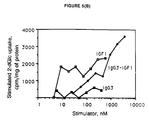
- FIG. 5 Relationships between IGF1 and IgG3-IGF1 stimulatory effects on ⁇ -aminoisobutyric acid (AIB) ( A ) and dGlc ( B ) uptakes in KB cells. Uptakes were determined in the presence of the indicated concentrations of IGF1, IgG3-IGF1, and IgG3 as control.
- AIB ⁇ -aminoisobutyric acid
- B dGlc
- FIG. 6 Schematic diagram showing the differential centrifugation protocol which was used to obtain a nuclear/plasma membrane (Nuc/Pm) fraction, a Mitochondria (Mit) fraction, a high density microsomes (H. Micro) fraction, and a low density microsomes (L. Micro) and cytosolic (Cyto) fraction.
- Nuc/Pm nuclear/plasma membrane
- Mitochondria Mitochondria
- H. Micro high density microsomes
- L. Micro low density microsomes
- Cyto cytosolic
- FIG. 7 Diagram of pAG5018 comprising hinge-IL2 in an expression vector.
- Figure 8 Line graph showing the relative activity of TUZ (an IL-2 fusion protein) versus IL-2.
- FIG. 9 Schematic of the Bluescript (KS) with the CD4-IGF1 insert.
- FIG. 10 Schematic of pSV2 V DNS HUG3 HTF comprising human transferrin.
- Figure 11 Line graph showing IgG3-IGF1 Capillary Depletion.
- the monoclonal antibodies provided herein are structurally engineered permitting greater accessibility to the target region, e.g. the brain, than naturally occurring antibodies. Further, the subject chimeric monoclonal antibodies reproducibly bind to target cells.
- the present invention provides a modified chimeric monoclonal antibody comprising two molecules of each of two different polypeptides.
- the shorter polypeptides function as the light chains of the antibody and the longer polypeptides function as the heavy chains of the antibody.
- the polypeptide which functions as a heavy chain has a variable region characteristic of a first mammal and a constant region characteristic of a second mammal.
- Each polypeptide which functions as a light chain has a variable region characteristic of a mammal and a constant region characteristic of a mammal, wherein a receptor-binding ligand replaces at least a portion of the constant region of each of the polypeptides which function as the heavy chains of the antibody.
- modified chimeric monoclonal antibody means a genetically engineered protein comprising (1) four polypeptides, two of which are designated heavy chains and two of which are designated light chains; the polypeptides encoded by a nucleic acid molecule having diverse genetic constitutions; and (2) altered at the constant region of the heavy chain.
- the heavy (H) and light (L) chains of the modified chimeric monoclonal antibody refer to the differences in the molecular weight of the polypeptides which compose the above-described antibodies.
- variable (V) region of the modified chimeric monoclonal antibody are the sequences on both the light- and heavy-chain located at the amino terminal end of the molecule.
- the constant (C) region of the modified chimeric monoclonal antibody are the sequences on both the light- and heavy-chain at the carboxyl terminal portion of the antibody. Accordingly, the chains of the immunoglobulin molecule can be divided into their V and C components so that a light chain consists of two parts, i.e. V L and C L (variable light and constant light ). Similarly, the heavy chain can be divided into V H and C H (variable heavy and constant heavy ).
- first mammal is mouse and the second mammal is human.
- first mammal is human and the second mammal is mouse.
- chimeric monoclonal antibodies which comprise polypeptides from mammals such as rats, moles, shrews, monkeys, bats, hares, rabbits, dogs, cats, whales, dolphins, elephants, horses, cows, deers or any combination thereof.
- variable region and the constant region of the light chain are both characteristic of the second mammal.
- variable region and the constant region of the light chain are both characteristic of the first mammal.
- variable region of the light chain is characteristic of either the first or the second mammal and the constant region of the light chain is characteristic of the other mammal.
- the receptor-binding ligand comprises a growth factor.
- growth factors include but are limited to insulin, insulin-like growth factor, platelet-derived growth factor, epidermal growth factor, transforming growth factor, nerve growth factor, and growth hormone.
- insulin means either (1) naturally-occurring insulin whether of human or animal origin or 2) biosynthetic insulin from human or animal whether produced by genetic engineering methods or otherwise.
- insulin-like growth factor means either the naturally-occurring or synthetic form thereof.
- insulin-like growth factor examples include but are not limited to insulin growth factor 1 and insulin growth factor 2.
- a growth hormone includes but is not limited to growth hormone releasing factor.
- examples of growth hormones include human, avian, equine, porcine, ovine, bovine, and piscine growth hormones.
- transforming growth factor examples include but are not limited to transforming growth factor- ⁇ and transforming growth factor- ⁇ , i.e. transforming growth factor- ⁇ 1, transforming growth factor- ⁇ 2, and transforming growth factor- ⁇ 3.
- the receptor-binding ligand which replaces at least a portion of the constant region of the heavy chain polypeptides comprises tumor necrosis factor.
- the receptor-binding ligand comprises transferrin.
- the receptor-binding ligand comprises a lymphokine.
- suitable lymphokines are selected from a group consisting of macrophage inhibition factor, leukocyte migration inhibition factor, macrophage activating factor, macrophage cytotoxicity factor, interleukin-1, interleukin-2, interleukin-3, interleukin-4, interleukin.5, interleukin-6, lymphotoxin, monocyte-derived lymphocyte activating factor, and T helper cell replacing factor.
- a lymphokine means either (1) a naturally-occurring lymphokine whether of human or animal origin or (2) a biosynthetic lymphokine from human or animal whether produced by genetic engineering methods or otherwise.
- the antibody is selected from, but not limited to, any antibody from a group comprising an IgG, IgA, IgD, IgE or IgM antibody or any combination thereof.
- variable region of the previously described chimeric monoclonal antibody comprises immunoglobulin-like ligand binding regions having a folded configuration.
- immunoglobulin-like ligand binding regions include, but are not limited to, domains from T cell receptors, major histocompatibility complex antigens, CD4, and CD8.
- variable region comprises the domain of a T cell receptor.
- variable region comprises the domain of a MHC antigen, e.g. an HLA antigen or an H-2 antigen.
- variable region comprises the domain of a surface glycoprotein CD4.
- variable region comprises the domain of a surface glycoprotein CD8.
- the CD4 molecule is a cell surface glycoprotein which interact with targets bearing class II major histocompatibility complex (MHC) molecules (73).
- MHC major histocompatibility complex
- CD4 acts as a recognition molecule mediating appropriate interactions between the CD4+ T lymphocytes and its target.
- CD4 is the cell surface receptor for the AIDS virus. Accordingly, the subject chimeric monoclonal antibodies having a variable region of the heavy chain comprising the CD4 domain is important as a therapeutic and diagnostic agent in mediating T lymphocyte function and alleviating AIDS.
- CD8 is a cell surface glycoprotein which is found on a subpopulation of T lymphocytes, i.e. CD8+ T lymphocytes.
- CD8+ T lymphocytes interacts with cells expressing class I MHC molecules.
- monoclonal antibodies comprising CD8 inhibit T cell function by specifically binding with molecules which are directed against CD8.
- the subject chimeric monoclonal antibody is important in mediating T lymphocyte function, specifically, the embodiment of the invention, wherein the variable region of the heavy chain comprises the CD8 domain.
- T cell receptors are special membrane-anchored cell surface proteins which are found on T cells and are analogous to antibodies. Moreover, T cell receptors are the mechanism by which T cells interact with antigen, thereby, allowing T cells to carry out cellular immune responses.
- the subject chimeric monoclonal antibodies comprising a domain of the T cell receptor, compete with naturally-occurring T cell receptors for the antigen, thus, preventing T cells from mediating cellular immunity.
- This embodiment of the subject invention is useful in treating auto-immune diseases, e.g. lupus erythmatosus, AIDS.
- a major histocompatibility antigen means a transplantation antigen, i.e. of either mouse origin such as H-2 class proteins or of human origin such as HLA proteins. Transplantation antigens are structurally similar to antibody molecules.
- the subject chimeric monoclonal antibodies comprising a domain of MHC antigens are important in preventing rapid rejection of organ grafts between individuals by engaging in binding competition with transplantation antigens, i.e. HLA or H-2 antigens, thereby preventing rapid rejection of organ grafts between individuals.
- transplantation antigens i.e. HLA or H-2 antigens
- the present invention provides an immunologically reactive complex comprising two different polypeptides, the shorter of which functions as a light chain and the longer of which functions as a heavy chain.
- the polypeptide which functions as the heavy chain has a variable region characteristic of a first mammal and a constant region characteristic of a second mammal and the polypeptide which functions as the light chain has a variable region characteristic of a mammal and a constant region characteristic of a second mammal.
- a receptor-binding ligand replaces at least a portion of a constant region of one of the polypeptides.
- an immunologically reactive complex is a biosynthetic complex and is produced by genetic engineering methods or otherwise.
- the immunologically reactive complex comprises a first mammal which is human and a second mammal which is mouse.
- the first mammal is mouse and the second mammal is human.
- immunologically reactive complexes which comprise polypeptides from mammals such as rats, moles, shrews, monkeys, bats, sloths, hares, rabbits, dogs, cats, whales, dolphins, elephants, horses, cows, deers or any combination thereof.
- variable region and the constant region of the light chain of the immunologically reactive complex are both characteristic of the second mammal.
- the variable region and the constant region of the light chain are both characteristic of the first mammal.
- the variable region of the light chain is characteristic of either the first or the second mammal and the constant region of the light chain is characteristic of the other mammal. For example, if the variable region of the light chain is characteristic of the first mammal then the constant region of the light chain is characteristic of the second mammal.
- the invention provides the immunologically reactive complex, wherein the receptor-binding ligand replaces at least a portion of the constant region of the polypeptide which functions as the light chain.
- the receptor-binding ligand replaces at least a portion of the constant region of the polypeptide which functions as the heavy chain.
- the receptor-binding ligand of the immunologically reactive complex is a growth factor.
- growth factors include, but are not limited to, insulin, insulin-like growth factor (insulin growth factor 1 or insulin growth factor 2), platelet-derived growth factor, epidermal growth factor, transforming growth factor (such as transforming growth factor- ⁇ , transforming growth factor ⁇ 1, transforming growth factor- ⁇ 2, or transforming growth factor- ⁇ 3), nerve growth factor, growth hormone (such as growth hormone releasing factor), tumor necrosis factor, transferrin, and lymphokines (such as macrophage inhibition factor, leukocyte migration inhibition factor, macrophage activating factor, macrophage cytotoxicity factor, interleukin-1, interleukin-2, interleukin-3, interleukin-4, interleukin-5, interleukin-6, interleukin-7, lymphotoxin, monocyte-derived lymphocyte activating factor, and T helper cell replacing factor).
- insulin insulin-like growth factor
- platelet-derived growth factor epidermal growth factor
- transforming growth factor
- variable regions of the polypeptides of the immunologically reactive complex comprises domains of T cell receptors.
- the variable region of the polypeptides comprise domains of MHC antigens (such as an HLA antigen or an H-2 antigen).
- the variable regions of the polypeptides comprise domains of surface glycoproteins CD4 or CD8.
- the present invention provides a chimeric polypeptide capable of functioning as a heavy chain of an antibody.
- the chimeric polypeptide comprises a variable region characteristic of a first mammal and a constant region characteristic of a second mammal, wherein a receptor-binding ligand replaces at least a portion of the constant region of the polypeptide.
- the receptor-binding ligand is joined to at least a portion of the constant region of the polypeptide.
- the present invention provides a chimeric polypeptide capable of functioning as a light chain of an antibody.
- the chimeric polypeptide comprises a variable region characteristic of a first mammal and a constant region characteristic of a second mammal, and a receptor-binding ligand which replaces at least a portion of the constant region of the polypeptide.
- the receptor-binding ligand is joined to at least a portion of the constant region of the polypeptide.
- chimeric polypeptide is a biosynthetic polypeptide and is made by genetic engineering methods or otherwise.
- the first mammal is human and the second mammal is mouse.
- the first mammal is mouse and the second mammal is human.
- chimeric polypeptides which comprise polypeptides from mammals such as rats, moles, shrews, monkeys, bats, sloths, hares, rabbits, dogs, cats, whales, dolphins, elephants, horses, cows, deers or any combination thereof.
- the present invention provides a nucleic acid molecule encoding the above-described chimeric polypeptide. Moreover, the present invention provides an expression vector for producing a chimeric polypeptide comprising a nucleic acid encoding the chimeric polypeptide and suitable regulatory elements positioned within the vector so as to permit expression of the polypeptide in a suitable host.
- suitable regulatory elements would encompass the genetic elements that control gene expression, e.g. the origin of replication, promoter, and expression control sequences such as enhancers.
- the present invention provides the previously described modified human chimeric monoclonal antibody to which a moiety is attached, i.e. a drug or a detectable label, wherein attachment may be effected at the variable region of the molecule.
- cytotoxic agents include but are not limited to a cytotoxic agent, e.g. methotrexate, decarbazine, toxins (such as ricin, diphtheria toxin, pseudomonas, exotoxin-A, abrin, supporin, and gelnoin), anti-infectious agents, anti-septic agents, and antimetabolites.
- a cytotoxic agent e.g. methotrexate, decarbazine
- toxins such as ricin, diphtheria toxin, pseudomonas, exotoxin-A, abrin, supporin, and gelnoin
- anti-infectious agents e.g. methotrexate, decarbazine
- toxins such as ricin, diphtheria toxin, pseudomonas, exotoxin-A, abrin, supporin, and gelnoin
- anti-infectious agents e.g. methotrexate, decarba
- ricin and abrin means ricin and abrin isolated from a wide variety of natural sources, e.g. seeds, or synthesized by genetic engineering methods or otherwise.
- an anti-metabolite includes 5-iodo-2'-deoxyuridine (IUdR).
- an anti-metabolite encompasses any chemical which interferes with the replication of DNA.
- suitable detectable labels include but are not limited to an enzyme, biotin, a fluorophore, a chromophore, a heavy metal, a paramagnetic isotope, or a radioisotope.
- suitable detectable labels applicants contemplate any label which would be conducive to the detection of a complex which are known in the art.
- the drug may be bound to the variable region of the subject chimeric monoclonal antibodies.
- the present invention provides a pharmaceutical composition
- a pharmaceutical composition comprising the above-described chimeric monoclonal antibody, immunological complex or polypeptide to which a moiety is attached, i.e. a drug or a detectable label, in an amount sufficient to deliver an effective dose of the drug and a pharmaceutically acceptable carrier.
- the term "pharmaceutically acceptable carrier” encompasses any of the standard pharmaceutical carriers. Such carriers are well known in the art and may include, but are in no way and are not intended to be limited to, any of the standard pharmaceutical carriers such as a phosphate buffered saline solutions, water, emulsions such as oil/water emulsion, and various types of wetting agents. Other carriers may also include sterile solutions, tablets, coated tablets, and capsules.
- Such carriers typically contain excipients such as starch, milk, sugar, certain types of clay, gelatin, stearic acid or salts thereof, magnesium or calcium sterate, talc, vegetable fats or oils, gums, glycols, or other known excipients.
- excipients such as starch, milk, sugar, certain types of clay, gelatin, stearic acid or salts thereof, magnesium or calcium sterate, talc, vegetable fats or oils, gums, glycols, or other known excipients.
- Such carriers may also include flavor and color additives or other ingredients.
- Compositions comprising such carriers are formulated by well known conventional methods.
- the administration of the composition may be effected by any of the well known methods, including but not limited to intravenous, intramuscular, subcutaneous and oral administration.
- the present invention provides a method of producing the above-described modified chimeric monoclonal antibody.
- the method comprises: a) cotransfecting a suitable/nonantibody-producing host cell with two expression plasmids, (i) one of which encodes a polypeptide capable of functioning as the heavy chain of the antibody and having a variable region characteristic of a first mammal and a constant region characteristic of a second mammal, wherein a receptor-binding ligand replaces at least a portion of the constant region of the heavy chain polypeptide and (ii) the other of which encodes a polypeptide capable of functioning as the light chain of the antibody and having a variable region characteristic of a mammal and a constant region characteristic of a mammal; (b) treating the cotransfected host cell so as to effect expression of the polypeptides encoded by the plasmids and formation of the chimeric monoclonal antibody within the host cell and excretion into the culture medium of the antibody by the host cell; and
- the present invention provides another method of producing the above-described modified chimeric monoclonal antibody.
- the method comprises: a) cotransfecting a suitable/nonantibody-producing host cell with an expression plasmid which encodes (i) a polypeptide capable of functioning as the heavy chain of the antibody and having a variable region characteristic of a first mammal and a constant region characteristic of a second mammal, wherein a receptor-binding ligand replaces at least a portion of the constant region of the heavy chain polypeptide and (ii) a polypeptide capable of functioning as the light chain of the antibody and having both a variable region characteristic of a mammal and a constant region characteristic of a mammal; (b) treating the cotransfected host cell so as to effect expression of the polypeptides encoded by the plasmid and formation of the chimeric monoclonal antibody within the host cell and excretion into the culture medium of the antibody by the host cell; and (c) recovering the resulting excreted
- One procedure for preparing monoclonal antibodies involves constructing separate light and heavy chain immunoglobulin gene transfection vectors which compatibly replicate and amplify in host cells (45). This means that each plasmid can be manipulated separately, but still be maintained together in the host cell, facilitating gene transfer of both transfection vectors into mammalian cells using protoplast fusion or electroporation methods. Each protoplast fusion event then delivers both vectors into the same mammalian cell.
- cotransfection means the essentially simultaneous insertion of both heavy and light chain genes, either by means of one or two expression vectors, into a suitable/nonantibody-producing host cell. It would be clear to those skilled in the art that a suitable/nonantibody-producing host cell would encompass any cell, both eucaryotic or procaryotic, capable of effecting expression of the polypeptides encoded by the plasmids and formation of the chimeric monoclonal antibody within the host cell and excretion into the culture medium of the antibody by the host cell.
- vectors herein comprise any vectors known in the art which are suitable for producing the modified chimeric monoclonal antibodies of this invention.
- vectors as used herein comprise plasmids, viruses (including phage) and integratable DNA fragments, i.e. fragments that are integratable into the host genome by recombination.
- the vector may be a plasmid which is cloned in a bacterial cell and integrates into the host cell genome upon cotransfection.
- the suitable, nonantibody-producing host cell is a human cell, i.e. a myeloma cell.
- the suitable, nonantibody-producing host cell is a murine cell.
- the preferred host cells are human or murine cells, in principle any higher eucaryotic cell is workable, whether from vertebrate or invertebrate culture.
- recovering the resulting excreted chimeric monoclonal antibody, from the culture medium means any method, e.g. separation by immunoprecipitation, solvent fractionation, classical and high pressure liquid column chromatography, i.e. size exclusion, ion exchange, partition, and adsorption chromatography in normal and reverse phase, which are generally known and accepted by those in the art as a means to separate and isolate proteins.
- the present invention provides a method of delivering a drug to a cell, e.g. a brain cell, an adipose cell, a blood cell, an epithelial cell, a muscle cell, a nerve cell, or a leukemic cell, having a receptor for a growth factor on a surface.
- the method comprises contacting the cell with the chimeric monoclonal antibody, immunologically reactive complex, or chimeric polypeptide, to which a moiety is attached, i.e.
- the receptor-binding ligand of the antibody, immunologically reactive complex, or chimeric polypeptide comprises the growth factor which binds to the receptor so that the antibody binds to the cell and thereby delivers the drug to the cell.
- an adipose cell means those cells responsible for the production and storage of fat.
- epithelial cells are cells which line the inner and outer surfaces of the body.
- the chimeric monoclonal antibodies, immunologically reactive complexes, and chimeric polypeptides described herein bind to receptors so as to be transported across the BBB.
- Small foreign molecules introduced into the circulation rapidly distribute themselves throughout the body's extracellular fluids; however, they are generally unable to penetrate the tissues of the brain, i.e. the blood-brain barrier (BBB).
- the BBB is a functional barrier between the brain capillaries and the brain tissue which allows some substances from the blood to enter the brain rapidly while other substances either enter slowly or not at all. Further, the BBB effectively restricts transport between blood and the central nervous system of certain molecules; especially those which are water soluble, charged, and larger than about 200 daltons.
- the BBB has been found to function over all anatomical regions of the central nervous system, except for small areas around the pituitary stalk, the preoptic recess and the area postreme beneath the floor of the 4th ventricle.
- the basis for this barrier appears to be embodied in the endothelial cells of the blood capillaries in the brain.
- the BBB is not a fixed barrier. It can be influenced by the metabolic requirements of the brain, in addition to insults such as mechanical trauma, cerebral embolism, hypercapnia, hypoxia, extensive stress, radiation, electroconvulsive shock, explosive decompression, and various toxic substances. All of these conditions may alter the permeability of the barriers and, subsequently, the composition of the extracellular fluid.
- the antibodies, immunologically reactive complexes, and chimeric polypeptides of this invention comprise receptor binding ligands which bind to receptor capable of facilitating transport across the BBB.
- the cell is a brain cell and the growth factor, i.e.insulin-like growth factor 1, insulin-like growth factor 2, insulin, and transferrin, which upon binding to the receptor results in transport of the antibody, immunologically reactive complex, or chimeric polypeptide across the blood-brain barrier.
- the growth factor i.e.insulin-like growth factor 1, insulin-like growth factor 2, insulin, and transferrin, which upon binding to the receptor results in transport of the antibody, immunologically reactive complex, or chimeric polypeptide across the blood-brain barrier.
- the brain cell is abnormal and associated with progressive dementia and the contacting with the chimeric antibody, immunologically reactive complex, or chimeric polypeptide comprises contacting the cell with an amount of the antibody, immunologically reactive complex, or chimeric polypeptide effective to halt the progressive dementia.
- progressive dementia is defined as the gradual deterioration or loss of intellectual faculties, reasoning, power, and memory.
- the brain cell is abnormal and associated with cerebral cortical atrophy and the contacting with the chimeric antibody, immunologically reactive complex, or chimeric polypeptide comprises contacting the cell with an amount of the antibody, immunologically reactive complex, or chimeric polypeptide effective to halt the cerebral cortical atrophy.
- cerebral cortical atrophy is a symptom typically characteristic of Alzheimer's disease.
- the brain cell is malignant and associated with neurosarcoma and the contacting with the chimeric antibody, immunologically reactive complex, or chimeric polypeptide comprises contacting the cell with an amount of the antibody, immunologically reactive complex, or chimeric polypeptide effective to halt the neurosarcoma.
- the brain cell is malignant and associated with a carcinoma and the contacting with the chimeric antibody, immunologically reactive complex, or chimeric polypeptide comprises contacting the cell with an amount of the antibody, immunologically reactive complex, or chimeric polypeptide effective to halt the carcinoma.
- the brain cell is malignant and associated with a carcinosarcoma and the contacting with the chimeric antibody, immunologically reactive complex, or chimeric polypeptide comprises contacting the cell with an amount of the antibody, immunologically reactive complex, or chimeric polypeptide effective to halt the carcinosarcoma.
- the brain cell is malignant and associated with a sarcoma and the contacting with the chimeric antibody, immunologically reactive complex, or chimeric polypeptide comprises contacting the cell with an amount of the antibody, immunologically reactive complex, or chimeric polypeptide effective to halt the sarcoma.
- carcinomatous cerebellar degeneration means a nonmetastic carcinoma taking the form of a diffuse degeneration of the cerebellar cortex and deep cerebellar nuclei.
- the cell is a cell selected from, but is not limited to, a group including a blood cell, a muscle cell, a nerve cell, a bone cell, and an epithelia cell.
- the cell is malignant and associated with a melanoma and the contacting with the chimeric antibody, immunologically reactive complex, or chimeric polypeptide comprises contacting the cell with an amount of the antibody effective to halt the melanoma.
- the cell is malignant and associated with a breast cancer and the contacting with the chimeric antibody, immunologically reactive complex, or chimeric polypeptide comprises contacting the cell with an amount of the antibody, immunologically reactive complex, or chimeric polypeptide effective to halt the breast cancer.
- the cell is malignant and associated with a lymphoma and the contacting with the chimeric antibody, immunologically reactive complex, or chimeric polypeptide comprises contacting the cell with an amount of the antibody, immunologically reactive complex, or chimeric polypeptide effective to halt the lymphoma.
- the cell is malignant and associated with a carcinoma and the contacting with the chimeric antibody, immunologically reactive complex, or chimeric polypeptide comprises contacting the cell with an amount of the antibody, immunologically reactive complex, or chimeric polypeptide effective to halt the carcinoma.
- the cell is malignant and associated with a sarcoma and the contacting with the chimeric antibody, immunologically reactive complex, or chimeric polypeptide comprises contacting the cell with an amount of the antibody, immunologically reactive complex, or chimeric polypeptide effective to halt the sarcoma.
- the invention further provides a method of detecting a cell having a receptor for a growth factor on its surface which comprises contacting the cell with the chimeric monoclonal antibody, immunologically reactive complex, or chimeric polypeptide to which a detectable moiety is attached, wherein the receptor-binding ligand of the antibody, immunologically reactive complex, or chimeric polypeptide comprises the growth factor which binds to the receptor so that the antibody, immunologically reactive complex, or chimeric polypeptide binds to the cell and thereby detects the cell.
- the cell is a brain cell and the growth factor upon binding to the receptor results is transport of the antibody, immunologically reactive complex, or chimeric polypeptide across the blood-brain barrier.
- suitable growth factors is selected from the group consisting of insulin-like growth factor 1, insulin-like growth factor 2, insulin, and transferrin.
- the brain cell is abnormal and associated with argyrophil plaque and the contacting with the chimeric antibody, immunologically reactive complex, or chimeric polypeptide comprises contacting the cell with an amount of the antibody, immunologically reactive complex, or chimeric polypeptide effective to permit detection of the plaque.
- the brain cell is abnormal and associated with a brain tumor and the contacting with the chimeric antibody, immunologically reactive complex, or chimeric polypeptide comprises contacting the cell with an amount of the antibody, immunologically reactive complex, or chimeric polypeptide effective to permit detection of the tumor.
- the detection is accomplished using methods which depend upon the identity of the detectable moiety but which are nevertheless well known.
- the detectable moiety is radioactive
- a liquid scintillation counter is employed.
- radioactive labels are detected by radiography or other methods which detect radioactive decay after separating the unreacted detectable antibody.
- the moiety is an enzyme, e.g. horseradish peroxidase in a standard assay, a spectrophotometer is employed.
- a fluorometer may be used, e.g. fluorescence activated cell sorting.
- the present invention additionally provides a modified chimeric monoclonal antibody comprising two molecules of each of two different polypeptides, the shorter of which functions as the light chains of the antibody and the longer of which polypeptides function as the heavy chains of the antibody.
- Each polypeptide which functions as a heavy chain has a variable region characteristic of a first mammal and a constant region characteristic of a second mammal.
- each polypeptide which functions as a light chain has a variable region characteristic of a mammal and a constant region characteristic of a mammal, wherein a receptor-binding ligand is covalently attached to the ends of the constant regions of each of the polypeptides which function as the heavy chains of the antibody.
- the complex comprises two different polypeptides, the shorter of which functions as a light chain and the longer of which functions as a heavy chain, the polypeptide which functions as the heavy chain having a variable region characteristic of a first mammal and a constant region characteristic of a second mammal and the polypeptide which functions as the light chain having a variable region characteristic of a mammal and a constant region characteristic of a second mammal, wherein a receptor-binding ligand is covalently attached to the ends of a constant region of one of the polypeptides.
- the invention also provides a chimeric polypeptide capable of functioning as a light chain of an antibody comprising a variable region characteristic of a first mammal and a constant region characteristic of a second mammal, wherein a receptor-binding ligand is covalently attached to the ends of a constant region of one of the polypeptides.
- a chimeric polypeptide capable of functioning as a heavy chain of an antibody comprising a variable region characteristic of a first mammal and a constant region characteristic of a second mammal, wherein a receptor-binding ligand is covalently attached to the constant region of the polypeptide.
- the subject chimeric monoclonal antibodies, immunologically reactive complex, or chimeric polypeptide are also of importance for the treatment of aberrant or infected cells in all other locations of the body.
- the subject chimeric monoclonal antibodies with or without a covalently linked anti-metastatic agent is useful for the treatment of all forms of cancer such as leukemia, lymphomas, carcinomas, adenomas, and melanomas, that reside in any part of the body.
- IMDM Iscove's Modified Dulbecco's Medium
- GIBCO Grand Island, NY
- Collect samples of CSF from the cisterna magna Anesthetize a few animals (rats and rabbits) and place in a Kopf stereotaxic apparatus with the ear bars raised approximately 15 cm above the surface of the table. Place the incisor bar into lowest position so that the animal's head is maximally ventroflexed. Mount a 30-gauge needle connected to PE-10 tubing horizontally on the electrode carrier and direct the needle at the midline of the neck. Determine the dorsal ventral location of the cisterna magna by lowering the needle 6.3 to 6.8 cm (depending upon the size and strain of the animal) from the occipital crest.
- mice/protein Inject 35 S-labeled chimeric antibodies intravenously through the tail vein (5 mice/protein). Bleed the mice periodically from the retro-orbital sinus with heparinized 50 to 100 microliter capillary pipet. After the procedure, kill the mice and assay for the presence of 35 S-labeled chimeric antibodies.
- Ketamine 45 mg/kg and xylazine (88 mg/kg) to rabbits.
- Ketamine 87 mg/kg and xylazine (13 mg/kg) to rats.
- the constant region of the antibody was replaced with a growth factor.
- the VH, CH1, hinge and first amino acid of CH2 from a chimeric mouse/human IgG 3 anti-dansyl antibody was joined to a cDNA encoding rat Insulin-like Growth Factor 1 (IGF1) immediately 3' to the leader sequence of IGF1.
- IGF1 Insulin-like Growth Factor 1
- the chimeric heavy chain was introduced along with an anti-dansyl specific chimeric ⁇ light chain into the immunoglobulin non-producing myeloma P3X63Ag8.653.
- the immunoglobulin/non-immunoglobulin IgG 3 -IGF1 chimeric protein was efficiently produced and secreted (up to 30 ⁇ g/10 6 cells/24 hours).
- the IgG 3 -IGF1 chimeric proteins retain their specificity to the antigen dansyl and bind to the IGF1 receptors of human lymphoblast IM-9, albeit with reduced affinity.
- the chimeric proteins elicited some of the same biologic effects (increased glucose and amino acid uptake) in human epidermoid carcinoma KB cells as human IGF1, but with reduced specific activity.
- the reduced affinity and biologic activity may result from (1) the presence of the unprocessed IGF1 moiety, (2) the large size of the IgG 3 -IGF1 chimeric protein (160 KDa) compared to IGF1 (7 KDa) and (3) three amino acid substitutions in rat IGF1 compared to human IGF1 which may lead to decreased affinity for the human IGF1 receptor.
- the chimeric proteins were less effective on a molar basis than intact IGF2, they still exhibited the proper binding specificity and the ability to elicit the biologic effects associated with IGF1; thus, demonstrating a new family of immunotherapeutic molecules targeted to growth factor receptors.
- a unique restriction enzyme site (Pvu II) was generated at the 5' site of the CH2 domain of the mouse/human IgG 3 heavy chain gene (72) and at the 3' of the leader sequence of rat IGF1 cDNA. IGF1 and IgG 3 were joined using the Pvu II sites.
- the chimeric IgG 3 -IGF1 heavy chain gene and the chimeric ⁇ light chain gene were simultaneously transfected into P3X63Ag8.653 by protoplast fusion (45, 58). Then transfected cells were selected with G418 (GIBCO) at 1.0 mg/ml and screened by Enzyme-linked Immunosorbent Assay (ELISA) for transfectomas producing the chimeric protein (58).
- the IgG 3 -IGF1 chimeric proteins biosynthetically labeled with 35 S-Methionine (Amersham, Arlington Heights, IL) were analyzed by Sodium Dodecylsulfate-Polyacrylamide Gel Electrophoresis (SDS-PAGE) with/without 2-mercaptoethanol (Kodak, Rochester) NY).
- the IgG 3 -IGF1 chimeric proteins were purified by affinity column as previously described (40). The purity of the IgG 3 -IGF1 chimeric proteins were determined by silver staining gel (41) and Fast Performance Liquid Chromatography (FPLC, Pharmacia, Piscataway, NJ).
- IM-9 cells were washed twice with 100 mM HEPES buffer containing 120 mM NaCl, 5 mM KCl, 1.2 mM MgSO 4 , 15mM Glucose, and 1% BSA, pH 7.5 (HEPES-BSA buffer), resuspended in HEPES-BSA buffer, and incubated for 1 hr at room temperature (36). Cells were counted and resuspended at a concentration of 4 - 6 x 10 7 cells/ml.
- KB cells (5 x 10 5 cells/ml) were grown to confluence in a 24 well plate (FALCON, Lincoln Park, NJ) and washed three times with IMDM. After incubation with IMDM without serum overnight at 37°C, cells were washed with HEPES-BSA buffer and 100 ⁇ l same buffer added. HEPES-BSA buffer without glucose was used for 2-DG uptake. A 100 ⁇ l aliquot of various concentrations of the test samples (IGF1, IgG 3 -IGF1, or IgG 3 ) was added into each well and incubated at 37°C for 6 hrs.
- rat insulin-like growth factor 1 (IGF1) was chosen as the growth factor.
- Mature IGF1 (a 70 amino acid protein) is formed from the IGF1 precursor (a 130 amino acid protein) through proteolytic processing of both its leader peptide and its carboxy terminus. The amino acid at which the leader peptide is cleaved is a convenient site for joining to the Ig molecule.
- the Ig molecule is human IgG 3 which has an extended hinge region of 62 amino acids. Further, IGF1 was placed distal to the hinge region of human IgG3 thus producing a spacing which facilitates simultaneous antigen and receptor binding.
- a unique restriction site (PvuII) was generated by site directed mutagenesis at the 5' end of the leader sequence of the rat IGF1 cDNA ( Figure 1A ). These mutations were confirmed by sequencing.
- the human IgG 3 gene which contains C H 1, hinge and 4 basepairs of C H 2 exon was joined to the IGF1 gene which in turn contains 2 basepairs of leader sequence, exon 2, exon 3, and exon 5.
- a chimeric constant region gene was constructed with a human IgG 3 /IGF-1 chimeric constant region gene joined to a mouse anti-dansyl (DNS) variable region gene cloned into a transfection vector pSV2 ⁇ Hgpt ( Figure 1B ). The mouse/human ⁇ light chain specific for dansyl is contained in pSV184 ⁇ H neo.
- IgG 3 -IGF1 fusion gene was as follows ( Figure 1A ).
- the fourth base (C) of the C H 2 domain in human IgG3 was mutated to G by site-directed mutagenesis, resulting in the introduction of an unique PvuII restriction enzyme site.
- a unique PvuII site was introduced in IGF1 by changing the last base (C) of the leader sequence (Leader Seq. or LS) of rat IGF1 cDNA to T (thymidine).
- Human IgG 3 and rat IGF1 cDNA digested with PvuII were ligated, resulting in an in-frame IgG 3 -IGF1 fusion gene without any significant amino acid substitutions.
- Figure 1B is a schematic representation of the transfection vectors, the genetically engineered IgG 3 -IGF1 fusion gene, and a proposed chimeric antibody.
- the mouse-human ⁇ light chain gene is cloned into pSV184 ⁇ H neo, which is derived from the pACYC184, and contains the pACYC origin of replication, a chloramphenicol resistant gene (CM r ) for selection in E. coli and the neo gene (the dotted box) with the SV40 early region promoter (the shaded box) for selection in eucaryotic cells.
- CM r chloramphenicol resistant gene
- the mouse-human IgG 3 /rat IGF 1 heavy chain genes is cloned into pSV2 ⁇ H gpt gene (the dotted box). Boxes in the chimeric genes represent exons. The thick black solid line and boxes represent DNA of mouse origin while the thin solid and open boxes represent human DNA segments. The shaded box in the heavy chain genes represents the rat IGF1 cDNA. The sites of cleavage by restriction endonucleases open triangle), BamHI (open circle) and Hind III (closed circle) are shown. The mouse-human IgG 3 /rat IGF1 chimeric protein produced by expression of both transfection vectors is shown at the bottom of the panel B. The black region of the chimeric molecule represents the mouse variable region domains specific for the hapten dansyl, the open regions represent the constant domains of human ⁇ and IgG 3 , and the shaded region represents the rat IGF1.
- Stable transfectant cells were selected using G418 and the supernatants of stable transfectomas were tested for the presence of an antibody protein by an Enzyme Linked Immunosorbent Assay (ELISA) using anti-human ⁇ chain antibody. Seventy-seven stable transfectomas secreting complete antibody molecules were identified and recovered for further characterization.
- ELISA Enzyme Linked Immunosorbent Assay
- the frequency of the desired transfectomas was 1.54 X 10 6 recipient myeloma cells. These transfectomas secreted 0.5-30 ⁇ g of chimeric molecule 10 6 cells/24 hours. The production level of the immunoglobulin/non-immunoglobulin chimeric molecules is not different from that of wild type chimeric antibodies.
- the secreted IgG 3 -IGF1 chimeric proteins were biosynthetically labeled with 35 S-methionine and the labeled proteins were purified by immunoprecipitation using dansyl-BSA (dansyl; 5-dimethylamino naphthalene-1-sulfonyl chloride) conjugated Sepharose beads or a rabbit anti-human IgG Fab antiserum and IgG Sorb. Reactivity of the fusion proteins with dansyl-BSA demonstrated that they retained their ability to react with their specific antigen. SDS-PAGE analysis ( Figures 2A and 2B ) demonstrated that the stable transfectomas produce novel chimeric molecules.
- the size of these chimeric molecules is smaller than that of a normal IgG 3 antibody.
- the secreted chimeric heavy chain appeared heterogeneous in size because the recipient cells partially process the IGF1 precursor to mature IGF1.
- the incomplete proteolytic processing at the carboxy terminal of IgG 3 -IGF1 heavy chain results in two distinctive heavy chains; a processed and an unprocessed heavy chain ( Figure 2B ).
- Figures 2A and 2B represent SDS-PAGE analysis of IgG 3 -IGF1 chimeric protein secreted by transfectomas.
- the secreted IgG 3 -IGF1 chimeric protein biosynthetically labeled with 35 S-methionine was analyzed under non-reducing (panel A) and reducing (panel B) conditions.
- the labeled chimeric protein was precipitated with either dansyl-Sepharose (DNS-Sepharose: left in panel A) or anti-human IgG Fab antisera/Staph A/IgG Sorb (a HUG/Fab-IgG-Sorb in panel A).
- the secreted IgG 3 chimeric antibody which is the basic structure of IgG 3 -IGF1 chimeric protein is used as control.
- the three bands represent the heterogeneous assembly of the processed and unprocessed chimeric protein; under reducing conditions the processed and unprocessed chimeric protein are seen (Panel B).
- IgG 3 -IGF1 chimeric proteins were purified from culture supernatants using an affinity column with 2-dimethylamino naphthalene-5-sulfonyl chloride (MW 269; dansyl isomer) coupled to AH-Sepharose 4B. Bound protein was eluted with N-5-carboxypentyl-2-dimethylamino naphthalene-5-sulfonamide (MW 364; dansyl isomer) and free hapten removed by extensive dialysis. The concentrated purified proteins were tetrameric and heterogeneous in size as expected. No other protein was observed in silver stained gel ( Figure 3A ).
- Figure 3A illustrates purified IgG3-IGF1 fusion protein fractionated by SDS-PAGE under non-reducing conditions and visualized using silver staining.
- Figure 3b is a chromatogram of the purified IgG 3 -IGF1 chimeric protein fractionated using FPLC (Superose-12 column, flow rate:0.25 ml/min). The elution time of IgG 3 -IGF1 chimeric protein is 42 min. The elution of time of mouse-human IgG 3 chimeric antibody (170 KDa) is 40 min and that of IgG1 chimeric antibody (146 KDa) is 45 min as indicated by arrows.
- a critical attribute of the fusion protein is whether it retains its ability to bind to the IGF1 receptor.
- unlabeled recombinant human IGF1, wild type chimeric IgG 3 and the IgG 3 -IGF1 chimeric protein were used to inhibit the binding of 125 I-IGF1 to human lymphoblast IM-9 cells (20). Both IGF1 and IgG 3 -IGF1 inhibited the binding of 125 I-IGF1 in a dose dependent manner ( Figure 4 ). The 50% inhibition of 125 I-IGF1 binding occurred at recombinant IGF1 concentration of 2.25 x 10 -9 M and at a IgG 3 -IGF1 chimeric protein concentration of 3.15 x 10 -7 M.
- the IgG 3 -IGF1 chimeric protein was 0.7% as effective as recombinant human IGF1 in inhibiting 125 I-IGF1 binding.
- the wild type chimeric IgG 3 did not show any inhibition of 125 I-IGF1 binding, even at a concentration as high as 2.7 x 10 -6 M. Therefore, the competition by the chimeric protein was a consequence of the presence of the IGF1 moiety.
- Figure 4 is a graph showing competitive inhibition of binding of 125 I-IGF1 to IM-9 lymphocytes. Approximately 3x10 -6 IM-9 cells were incubated at 15°C with a constant amount of 125 I-IGF1 and the indicated concentration of unlabeled competitors (recombinant IGF1, IgG3-IGF1 chimeric protein and IgG 3 chimeric antibody). After 2 hours of incubation, the amount of receptor-bound radioactivity was determined. Values are expressed as the relative inhibition of binding compared to using only labeled tracer 125 I-IGF1. Results shown for each curve are the mean of duplicate experiments.
- the IgG 3 -IGF1 chimeric proteins have been tested for binding to two different primary cultures of human brain endothelial cells; one at an early passage ( ⁇ 13) and one at a later passage ( ⁇ 22). Comparable levels of binding with both of these cell lines have been observed (data now shown).
- the IgG 3 -IGF1 chimeric proteins bound to both these cell lines in a specific manner, but the control antibody, chimeric IgG 3 , does not bind to these cells.
- IgG 3 -IGF1 chimeric protein In human epidermoid carcinoma KB cells, fluid-phase endocytosis and exocytosis are stimulated by growth hormones (Insulin, Insulin-like growth factor 1, and epidermal growth factor); these cells possess 7.5 x 10 4 /cell Type I IGF receptors (13). Therefore, the ability of IgG 3 -IGF1 chimeric protein to stimulate 2-Deoxy-D-Glucose (2-DG) and ⁇ -Aminoisobutyric acid (AIB) uptake (11) was investigated and compared to IGF1 and IgG 3 . The dose-response relationships of IgG 3 -IGF1 chimeric protein stimulation of 2-DG and AIB uptake in K cells are shown in Figure 5 .
- IGF1 and IgG 3 -IGF1 were 200:1 for AIB uptake and 25 - 100:1 for 2-DG uptake.
- IgG 3 alone did not affect 2-DG and AIB uptake by KB cells. Therefore, the chimeric proteins exert the expected biological effects, but are less potent than the human IGF1 standard.
- FIG. 5 shows the relationship between IGF1 and IgG3-IGF1 and their stimulatory effects on AIB and 2-DG uptakes in ⁇ B cells.
- AIB (panel A) and 2-DG (panel B) uptakes were determined in the presence of various concentrations of IGF1, IgG3-IGF1, and IgG3 as control.
- the constant region of the antibody was replaced with a growth factor e.g. insulin, IGF1, IGF2 and transferrin.
- a growth factor e.g. insulin, IGF1, IGF2 and transferrin.
- the VH, CH1, hinge and first amino acid of CH2 from a chimeric mouse/human IgG 3 anti-dansyl antibody was joined to a cDNA encoding rat Insulin-like Growth Factor 1 (IGF1) immediately 3' to the leader sequence of IGF1.
- IGF1 Insulin-like Growth Factor 1
- the immunoglobulin/non-immunoglobulin IgG 3 -IGF1 chimeric protein was efficiently produced and secreted (up to 30 ⁇ g/10 6 cells/24 hours).
- the IgG 3 -IGF1 chimeric proteins retain their specificity to the antigen dansyl and bind to the IGF1 receptors of human lymphoblast IM-9, albeit with reduced affinity.
- the chimeric proteins elicited some of the same biologic effects (increased glucose and amino acid uptake) in human epidermoid carcinoma KB cells as human IGF1, but with reduced specific activity.
- the reduced affinity and biologic activity may result from (1) the presence of the unprocessed IGF1 moiety, (2) the large size of the IgG 3 -IGF1 chimeric protein (160 KDa) compared to IGF1 (7 KDa) and (3) three amino acid substitutions in rat IGF1 compared to human IGF1 which may lead to decreased affinity for the human IGF1 receptor.
- the chimeric proteins were less effective on a molar basis than intact IGF2, they still exhibited the proper binding specificity and the ability to elicit the biologic effects associated with IGF1; thus, demonstrating a new family of immunotherapeutic molecules targeted to growth factor receptors.
- the novel IgG 3 -IGF1 chimeric proteins retain their specificity for the antigen dansyl, the ability to bind to the IGF1 receptor with reduced affinity and the ability to exert some of the biologic effects of receptor binding.
- the reduced affinity for receptor and biologic activity may result from (1) the presence of the unprocessed IGF1 moiety thus resulting in a heterogenous population of IgG 3 -IGF1 chimeric protein, (2) the large size of the IgG 3 -IGF1 chimeric protein (160 KDa) compared to IGF1 (7 KDa) thus leading to decreased accessibility to the IGF1 receptor and decreased binding affinity; and (3) three amino acids substitutions in rat IGF1 compared to human IGF1 may lead to lower affinity for the human receptor.
- Fab-IGF1 chimeric facilitates the determination of whether reduced affinity for receptor and biologic activity results from the large size of the IgG 3 -IGF1 chimeric protein (160 KDa) compared to IGF1 (7 KDa).
- altering three amino acids in rat IGF1 as compared to human IGF1 by site-directed mutagenesis additionally facilitates the determination of whether the reduced affinity is from the three amino acid substitutions.
- IGF1 The flexibility and accessibility of IGF1 also play an important role in the chimeric protein.
- the IGF1 moiety was disposed close to the carboxy terminal of the extended hinge of human IgG 3 .
- IgG 3 is the most flexible human IgG (61). Accordingly, this flexibility optimize the ability to simultaneously bind the IGF1 receptor and antigen.
- the position of IGF1 immediately carboxy terminal to the hinge brought the IGF1 molecules into contact with each other and interfered with their binding.
- the molecules are improved by placing the IGF1 on a ⁇ -strand in C H 2 more distal to the hinge (9). Since the C H 2 domains do not normally contact each other this places the two IGF1 moieties at some distance from each other and thereby improves their binding efficiency.
- the BBB in a normal brain effectively restricts transport between blood and the central nervous system of certain molecules, especially those which are water soluble, charged and larger than several hundred daltons (56).
- the IgG 3 -IGF1 chimeric proteins bind specifically to the IGF1 receptor and to human brain endothelial cells ( Figure 11 ).
- Figure 11 is a line graph wherein the X axis is the time in hours after injection and the Y axis is the % injected dose of the IgG3-IGF1 chimeric construct.
- Figure 11 shows that after injection in a rat animal model the IgG3-IGF1 chimeric construct was found and persisted in brain parenchyma cells compared to the capillary pellet. Accordingly, this chimeric construct crossed the BBB.
- Antibody molecules with a combining specificity, a growth factor to target to receptor-bearing cells, and immune effector functions contained in one molecule and antibody molecules with bifunctional combining specificities belong to a family of multi-functional chimeric antibodies which are directed to targeting therapy to malignant cells.
- a suitable protocol to create a family of multi-functional chimeric antibodies is:
- IgG 3 for the immunoglobulin sequences because of its extended hinge region allows the molecule greater flexibility and facilitates binding of the growth factor to its receptor.
- Molecules capable of recruiting human effector functions are: V DNS/anti-tumor specificity - C H 1 hinge - C H 2 - ligand V DNS/anti-tumor specificity - C H 1 - hinge - C H 2 C H 3 - ligand C H 2 contains the binding site for the high affinity Fc receptor and for Clq.
- the modified transfection vectors developed by Oi and Morrison (45) were used. Insert the reconstructed chimeric Ig/receptor ligand gene into the transfection vector (pSV2 ⁇ Hgpt), a derivative of pSVgpt.
- pSV2 ⁇ Hgpt contains the pBR322 origin of replication and has an ampicillin resistant gene for selection in E. coli and the gpt gene for selection in eukaryotic cells.
- Isolate stable transfectomas using selectible drug markers Screen the culture supernatant of stable transfectomas by ELISA using any of the antigen dansyl, anti-idiotypic antibody, human ⁇ chain or anti-ligand antibodies to identify clones secreting high levels of the chimeric antibodies.
- chimeric genes require efficient transcription, proper RNA processing, and exportation from the nucleus, so that the mRNA is stable and translated, and that the protein product is property processed through the cell and is secreted without being degraded in the cytoplasm or in the medium.
- RNA from stable transfectomas on Northern blots using probes specific for various regions of the transfected gene (mouse V H probe, human IgG 3 C H 1 probe, and ligand probe).
- cytoplasmic and secreted chimeric proteins label selected transfectomas with 35 S--methionine, after which purify the labeled proteins by immunoprecipitation using dansyl conjugated beads, anti-idiotypic antibody conjugated beads or anti-ligand antibody conjugated beads.
- ADCC antibody-dependent cell-mediated cytotoxicity
- target cells i.e. 3T3-L1, IM-9 and K-562
- DNS hapten using DNS-Cephalin (8)
- Label target cells with 51 Cr chromate.
- Human peripheral blood mononuclear cells from healthy donors and prepare human peripheral blood mononuclear cells by centrifugation on Ficoll-Hypaque (22). Add cells to tissue culture dishes coated with autologous serum and incubate for 90 min at 37°C in a humidified atmosphere of 8% CO 2 -air. Pool nonadherent cells, i.e.
- lymphocytes and harvest adherent cells, i.e. monocytes.
- IGF1 insulin and transferrin receptors were identified on brain blood vessels both in vivo (64) and in vitro (16), isolated brain microvessels have been used as a model system to test for binding and internalization of those ligands (16, 17, 18, 49). However those receptors also occur on non-brain cells.
- the cultured human lymphoblast cell line IM-9 expresses large numbers of IGF1 receptors (52).
- the adipose cell line 3T3-LI expresses large numbers of insulin receptors (50, 53, 54) and the human chronic myelogenous leukemia cell line K-562 expresses large numbers of transferrin receptors (63, 66).
- microvessels When necessary to isolate brain endothelial cells to study endothelial transcytosis, first produce microvessels and then separate the endothelial cells. Isolate brain microvessels from mouse, rat, and/or rabbit using mechanical homogenization (6, 48). These preparations do not always exclude trypan blue. These preparation are metabolically active and have been studied with respect to glucose, lactate, and fatty acid metabolism in vitro (3, 60).
- endothelial cells (7, 21, 29) clean cortical tissue from brain of meninges and superficial blood vessels, mince cortical tissue from brain to small cubes, incubate cubes in proper medium containing 0.5% dispase for 3 hours at 37°C, and collect endothelial cells by centrifugation at 1,000 g for 1 minute. Suspend the pellets in medium containing 13% dextran. Separate microvessels from other brain tissue by centrifugation of the suspension at 5,800 g for 10 minutes. To remove the basement membrane and most pericytes treat the microvessel to a further 9-12 hour treatment with collagenase/dispase in medium.
- each fraction by TCA precipitation Furthermore, analyze the chimeric fusion molecules by SDS-PAGE to determine the location of intracellular target sites and to determine whether any degradation has taken place. Analyze the purity of each fraction by determining the enzymes which were present.
- Micro galactosyl transferase as a Golgi apparatus marker in L.
- Micro and citrate synthase as a mitochondrial marker.
- the first two domains of CD4 have been joined to IGF1 ( Figure 9 ).
- the fusion protein was synthesized and secreted.
- CD4 cDNA Convenient sites were created in the CD4 cDNA to allow the two, NH2 terminal, extracellular domains of CD4 to be ligated into the proposed construct.
- a Bal I site was created upstream of the translation start site.
- a Sca I site was created one base after the codon for Glutamine 114.
- the resultant CD4 fragment will contain the 23 amino acids of the leader peptide and the first 114 amino acids of the mature protein.
- One additional base pair at the 3' ends of this fragment will combine with two bases 5' for the mature IGF1 to encode a threonine between glutamine 114 of CD4 and glycine 1 of IGF1.
- the first codon of the C-terminal propeptide of IGF1 has been replaced with a stop codon.
- IGF1 was inserted into this plasmid between this Sca I site and a Bam HI site in the poly linker, thus removing all downstream regions of CD4 ( Figure 9 ).
- the IGF1 insert contains the coding region from two base pairs before the first codon of the mature protein through a string of Adenines not present in the genomic gene, and linked to 600 bp of the 3' untranslated (UT) region of IgG3. This 3' region was included for the poly A signal it contains. Questions have arisen as to whether or not this region actually contains the poly A signal.
- the Poly A signal like sequences AATGAAA and AAGTAAA. These sequences seem to function as a Poly A signal in that the cDNA shows that the message was polyadenylated about 40 bases downstream.
- the IgG3-IGF1 chimeric constructs contain only these signals and appear to be expressed normally.
- the final construct encodes the 23 amino acid propeptide and first 114 residues of CD4, a threonine, and the entire 70 residues of mature IGF1.
- the construct described above has been inserted into the vector pAG4235 immediately downstream of an IgG3 promoter.
- This plasmid also contains a heavy chain enhancer as well as the pSV2-gpt selectable marker ( Figure 10 ).
- Human IL-2 has been cloned using PCR technology with IL-2 specific oligomers. Cloned IL-2 was joined to a mouse/human IgG chimeric anti-dansyl heavy chain immediately following the hinge region using the methods described herein ( Figure 7 ). This fusion heavy chain assembles with light chain and is secreted as an H 2 L 2 molecule.
- Figure 8 shows that the IL-2 fusion protein, designated TU2 has activity. Culture supernatants from a murine myeloma cell line transfectant synthesizing this protein will support the growth of an IL-2 dependent T cell line. Culture supernatants from the un-transfected myeloma cell line or from the myeloma cell line transfected with a chimeric Ig lacking IL-2 failed to support growth.
Landscapes
- Health & Medical Sciences (AREA)
- Chemical & Material Sciences (AREA)
- Organic Chemistry (AREA)
- Life Sciences & Earth Sciences (AREA)
- Medicinal Chemistry (AREA)
- General Health & Medical Sciences (AREA)
- Molecular Biology (AREA)
- Genetics & Genomics (AREA)
- Biophysics (AREA)
- Proteomics, Peptides & Aminoacids (AREA)
- Biochemistry (AREA)
- Immunology (AREA)
- Toxicology (AREA)
- Gastroenterology & Hepatology (AREA)
- Zoology (AREA)
- Animal Behavior & Ethology (AREA)
- Bioinformatics & Cheminformatics (AREA)
- Veterinary Medicine (AREA)
- Public Health (AREA)
- Pharmacology & Pharmacy (AREA)
- Nuclear Medicine, Radiotherapy & Molecular Imaging (AREA)
- General Chemical & Material Sciences (AREA)
- Chemical Kinetics & Catalysis (AREA)
- Neurosurgery (AREA)
- Neurology (AREA)
- Engineering & Computer Science (AREA)
- Biomedical Technology (AREA)
- Cell Biology (AREA)
- Endocrinology (AREA)
- Diabetes (AREA)
- Hospice & Palliative Care (AREA)
- Psychiatry (AREA)
- Peptides Or Proteins (AREA)
- Medicines Containing Antibodies Or Antigens For Use As Internal Diagnostic Agents (AREA)
- Preparation Of Compounds By Using Micro-Organisms (AREA)
- Medicines That Contain Protein Lipid Enzymes And Other Medicines (AREA)
Claims (86)
- Modifizierter chimärer monoclonaler Antikörper, umfassend zwei Moleküle von je zwei unterschiedlichen Polypeptiden, wobei das kürzere als die leichten Ketten des Antikörpers und das längere der Polypeptide als die schweren Ketten des Antikörpers wirkt, wobei jedes Polypeptid, das als eine schwere Kette wirkt, einen variablen Bereich aufweist, der kennzeichnend ist für einen ersten Säuger, und einen konstanten Bereich, der kennzeichnend ist für einen zweiten Säuger, und jedes Polypeptid, das als eine leichte Kette wirkt, einen variablen Bereich aufweist, der kennzeichnend ist für einen Säuger, und einen konstanten Bereich, der kennzeichnend ist für einen Säuger, wobei ein Rezeptor-bindender Ligand kovalent an die Enden der konstanten Bereiche jedes der Polypeptide gebunden ist, die als die schweren Ketten des Antikörpers wirken.
- Immunologisch reaktiver Komplex, umfassend zwei unterschiedliche Polypeptide, wobei das kürzere als eine leichte Kette und das längere als eine schwere Kette wirkt, wobei das Polypeptid, das als die schwere Kette wirkt, einen variablen Bereich aufweist, der kennzeichnend ist für einen ersten Säuger, und einen konstanten Bereich, der kennzeichnend ist für einen zweiten Säuger, und das Polypeptid, das als die leichte Kette wirkt, einen variablen Bereich aufweist, der kennzeichnend ist für einen Säuger, und einen konstanten Bereich, der kennzeichnend ist für einen zweiten Säuger, wobei ein Rezeptor-bindender Ligand kovalent an die Enden eines konstanten Bereichs eines der Polypeptide gebunden ist.
- Chimäres Polypeptid, das als eine schwere Kette eines Antikörpers wirken kann, umfassend einen variablen Bereich, der kennzeichnend ist für einen ersten Säuger, und einen konstanten Bereich, der kennzeichnend ist für einen zweiten Säuger, wobei ein Rezeptor-bindender Ligand kovalent an den konstanten Bereich des Polypeptids gebunden ist.
- Chimäres Polypeptid, das als eine leichte Kette eines Antikörpers wirken kann, umfassend einen variablen Bereich, der kennzeichnend ist für einen ersten Säuger, und einen konstanten Bereich, der kennzeichnend ist für einen zweiten Säuger, wobei ein Rezeptor-bindender Ligand kovalent an den konstanten Bereich des Polypeptids gebunden ist.
- Modifizierter chimärer monoclonaler Antikörper nach Anspruch 1 oder immunologisch reaktiver Komplex nach Anspruch 2, wobei der variable Bereich und der konstante Bereich der leichten Kette beide für den zweiten Säuger kennzeichnend sind.
- Modifizierter chimärer monoclonaler Antikörper nach Anspruch 1 oder immunologisch reaktiver Komplex nach Anspruch 2, wobei der variable Bereich und der konstante Bereich der leichten Kette beide für den ersten Säuger kennzeichnend sind.
- Modifizierter chimärer monoclonaler Antikörper nach Anspruch 1 oder immunologisch reaktiver Komplex nach Anspruch 2, wobei der variable Bereich der leichten Kette kennzeichnend ist entweder für den ersten oder den zweiten Säuger und der konstante Bereich der leichten Kette kennzeichnend ist für den anderen Säuger.
- Modifizierter chimärer monoclonaler Antikörper nach einem der Ansprüche 1 und 5 bis 7 oder immunologisch reaktiver Komplex nach einem der Ansprüche 2 und 5 bis 7 oder chimäres Polypeptid nach Anspruch 3 oder 4, wobei der erste Säuger eine Maus und der zweite Säuger ein Mensch ist.
- Modifizierter chimärer monoclonaler Antikörper nach einem der Ansprüche 1 und 5 bis 7 oder immunologisch reaktiver Komplex nach einem der Ansprüche 2 und 5 bis 7 oder chimäres Polypeptid nach Anspruch 3 oder 4, wobei der erste Säuger ein Mensch und der zweite Säuger eine Maus ist.
- Modifizierter chimärer monoclonaler Antikörper, umfassend zwei Moleküle von je zwei unterschiedlichen Polypeptiden, wobei das kürzere als die leichten Ketten des Antikörpers und das längere der Polypeptide als die schweren Ketten des Antikörpers wirkt, wobei jedes Polypeptid, das als eine schwere Kette wirkt, einen variablen Bereich aufweist, der kennzeichnend ist für einen ersten Säuger, und einen konstanten Bereich, der kennzeichnend ist für einen zweiten Säuger, und jedes Polypeptid, das als eine leichte Kette wirkt, einen variablen Bereich aufweist, der kennzeichnend ist für einen Säuger, und einen konstanten Bereich, der kennzeichnend ist für einen Säuger,
wobei ein Rezeptor-bindender Ligand kovalent an die Enden der konstanten Bereiche jedes der Polypeptide gebunden ist, die als die schweren Ketten des Antikörpers wirken, oder mindestens einen Teil des konstanten Bereichs jedes der Polypeptide ersetzt, die als die schweren Ketten des Antikörpers wirken; oder
immunologisch reaktiver Komplex, umfassend zwei unterschiedliche Polypeptide, wobei das kürzere als eine leichte Kette und das längere als eine schwere Kette wirkt, wobei das Polypeptid, das als die schwere Kette wirkt, einen variablen Bereich aufweist, der kennzeichnend ist für einen ersten Säuger, und einen konstanten Bereich, der kennzeichnend ist für einen zweiten Säuger, und das Polypeptid, das als die leichte Kette wirkt, einen variablen Bereich aufweist, der kennzeichnend ist für einen Säuger, und einen konstanten Bereich, der kennzeichnend ist für einen zweiten Säuger,
wobei ein Rezeptor-bindender Ligand kovalent an die Enden eines konstanten Bereichs von einem der Polypeptide gebunden ist, oder mindestens einen Teil eines konstanten Bereichs einer der Polypeptide ersetzt; oder
chimäres Polypeptid, das als schwere oder leichte Kette eines Antikörpers wirken kann, umfassend einen variablen Bereich, der kennzeichnend ist für einen ersten Säuger, und einen konstanten Bereich, der kennzeichnend ist für einen zweiten Säuger,
wobei ein Rezeptor-bindender Ligand kovalent an den konstanten Bereich des Polypeptids gebunden ist oder mindestens einen Teil des konstanten Bereichs des Polypeptids ersetzt;
wobei der Rezeptor-bindende Ligand einen Wachstumsfaktor umfaßt. - Modifizierter chimärer monoclonaler Antikörper, immunologisch reaktiver Komplex oder chimäres Polypeptid nach Anspruch 10, wobei der Wachstumsfaktor Insulin umfaßt.
- Modifizierter chimärer monoclonaler Antikörper, immunologisch reaktiver Komplex oder chimäres Polypeptid nach Anspruch 10, wobei der Wachstumsfaktor einen Insulin-ähnlichen Wachstumsfaktor umfaßt.
- Modifizierter chimärer monoclonaler Antikörper, immunologisch reaktiver Komplex oder chimäres Polypeptid nach Anspruch 12, wobei der Insulin-ähnliche Wachstumsfaktor den Insulin-ähnlichen Wachstumsfaktor 1 umfaßt.
- Modifizierter chimärer monoclonaler Antikörper, immunologisch reaktiver Komplex oder chimäres Polypeptid nach Anspruch 13, wobei der Insulin-ähnliche Wachstumsfaktor den Insulin-ähnlichen Wachstumsfaktor 2 umfaßt.
- Modifizierter chimärer monoclonaler Antikörper, immunologisch reaktiver Komplex oder chimäres Polypeptid nach Anspruch 10, wobei der Wachstumsfaktor einen von Thrombocyten stammenden Wachstumsfaktor umfaßt.
- Modifizierter chimärer monoclonaler Antikörper, immunologisch reaktiver Komplex oder chimäres Polypeptid nach Anspruch 10, wobei der Wachstumsfaktor einen epidermalen Wachstumsfaktor umfaßt.
- Modifizierter chimärer monoclonaler Antikörper, immunologisch reaktiver Komplex oder chimäres Polypeptid nach Anspruch 10, wobei der Wachstumsfaktor einen transformierenden Wachstumsfaktor umfaßt.
- Modifizierter chimärer monoclonaler Antikörper, immunologisch reaktiver Komplex oder chimäres Polypeptid nach Anspruch 17, wobei der transformierende Wachstumsfaktor den transformierenden Wachstumsfaktor-α umfaßt.
- Modifizierter chimärer monoclonaler Antikörper, immunologisch reaktiver Komplex oder chimäres Polypeptid nach Anspruch 17, wobei der transformierende Wachstumsfaktor den transformierenden Wachstumsfaktor-β umfaßt.
- Modifizierter chimärer monoclonaler Antikörper, immunologisch reaktiver Komplex oder chimäres Polypeptid nach Anspruch 19, wobei der transformierende Wachstumsfaktor-β, den transformierenden Wachstumsfaktor-β1 umfaßt.
- Modifizierter chimärer monoclonaler Antikörper, immunologisch reaktiver Komplex oder chimäres Polypeptid nach Anspruch 19, wobei der transformierende Wachstumsfaktor-β, den transformierenden Wachstumsfaktor-β2 umfaßt.
- Modifizierter chimärer monoclonaler Antikörper, immunologisch reaktiver Komplex oder chimäres Polypeptid nach Anspruch 19, wobei der transformierende Wachstumsfaktor-β, den transformierenden Wachstumsfaktor-β3 umfaßt.
- Modifizierter chimärer monoclonaler Antikörper, immunologisch reaktiver Komplex oder chimäres Polypeptid nach Anspruch 10, wobei der Wachstumsfaktor einen Nervenwachstumsfaktor umfaßt.
- Modifizierter chimärer monoclonaler Antikörper, immunologisch reaktiver Komplex oder chimäres Polypeptid nach Anspruch 10, wobei der Wachstumsfaktor ein Wachstumshormon umfaßt.
- Modifizierter chimärer monoclonaler Antikörper, immunologisch reaktiver Komplex oder chimäres Polypeptid nach Anspruch 10, wobei der Wachstumsfaktor einen Wachstumshormon freisetzenden Faktor umfaßt.
- Modifizierter chimärer monoclonaler Antikörper, umfassend zwei Moleküle von je zwei unterschiedlichen Polypeptiden, wobei das kürzere als die leichten Ketten des Antikörpers und das längere der Polypeptide als die schweren Ketten des Antikörpers wirkt, wobei jedes Polypeptid, das als eine schwere Kette wirkt, einen variablen Bereich aufweist, der kennzeichnend ist für einen ersten Säuger, und einen konstanten Bereich, der kennzeichnend ist für einen zweiten Säuger, und jedes Polypeptid, das als eine leichte Kette wirkt, einen variablen Bereich aufweist, der kennzeichnend ist für einen Säuger, und einen konstanten Bereich, der kennzeichnend ist für einen Säuger,
wobei ein Rezeptor-bindender Ligand kovalent an die Enden der konstanten Bereiche von jedem der Polypeptide gebunden ist, die als die schweren Ketten des Antikörpers wirken, oder mindestens einen Teil des konstanten Bereichs jedes der Polypeptide ersetzt, die als die schweren Ketten des Antikörpers wirken; oder
immunologisch reaktiver Komplex, umfassend zwei unterschiedliche Polypeptide, wobei das kürzere als eine leichte Kette und das längere als eine schwere Kette wirkt, wobei das Polypeptid, das als die schwere Kette wirkt, einen variablen Bereich aufweist, der kennzeichnend ist für einen ersten Säuger, und einen konstanten Bereich, der kennzeichnend ist für einen zweiten Säuger, und das Polypeptid, das als die leichte Kette wirkt, einen variablen Bereich aufweist, der kennzeichnend ist für einen Säuger, und einen konstanten Bereich, der kennzeichnend ist für einen zweiten Säuger,
wobei ein Rezeptor-bindender Ligand kovalent an die Enden eines konstanten Bereiches eines der Polypeptide gebunden ist oder mindestens einen Teil eines konstanten Bereichs einer der Polypeptide ersetzt; oder
chimäres Polypeptid, das als eine schwere Kette oder leichte Kette eines Antikörpers wirken kann, umfassend einen variablen Bereich, der kennzeichnend ist für einen ersten Säuger, und einen konstanten Bereich, der kennzeichnend ist für einen zweiten Säuger,
wobei ein Rezeptor-bindender Ligand kovalent an den konstanten Bereich des Polypeptids gebunden ist oder mindestens einen Teil des konstanten Bereichs des Polypeptids ersetzt;
wobei der Rezeptor-bindende Ligand Tumornekrosefaktor umfaßt. - Modifizierter chimärer monoclonaler Antikörper, umfassend zwei Moleküle von je zwei unterschiedlichen Polypeptiden, wobei das kürzere als die leichten Ketten des Antikörpers und das längere der Polypeptide als die schweren Ketten des Antikörpers wirkt, wobei jedes Polypeptid, das als eine schwere Kette wirkt, einen variablen Bereich aufweist, der kennzeichnend ist für einen ersten Säuger, und einen konstanten Bereich, der kennzeichnend ist für einen zweiten Säuger, und jedes Polypeptid, das als eine leichte Kette wirkt, einen variablen Bereich aufweist, der kennzeichnend ist für einen Säuger, und einen konstanten Bereich, der kennzeichnend ist für einen Säuger,
wobei ein Rezeptor-bindender Ligand kovalent an die Enden der konstanten Bereiche jedes der Polypeptide gebunden ist, die als die schweren Ketten des Antikörpers wirken, oder mindestens einen Teil des konstanten Bereichs jedes der Polypeptide ersetzt, die als die schweren Ketten des Antikörpers wirken; oder
immunologisch reaktiver Komplex, umfassend zwei unterschiedliche Polypeptide, wobei das kürzere als eine leichte Kette und das längere als eine schwere Kette wirkt, wobei das Polypeptid, das als eine schwere Kette wirkt, einen variablen Bereich aufweist, der kennzeichnend ist für einen ersten Säuger, und einen konstanten Bereich, der kennzeichnend ist für einen zweiten Säuger, und das Polypeptid, das als die leichte Kette wirkt, einen variablen Bereich aufweist, der kennzeichnend ist für einen Säuger, und einen konstanten Bereich, der kennzeichnend ist für einen zweiten Säuger,
wobei ein Rezeptor-bindender Ligand kovalent an die Enden eines konstanten Bereiches eines der Polypeptide gebunden ist, oder mindestens einen Teil eines konstanten Bereichs einer der Polypeptide ersetzt; oder
chimäres Polypeptid, das als eine schwere Kette oder leichte Kette eines Antikörpers wirken kann, umfassend einen variablen Bereich, der kennzeichnend ist für einen ersten Säuger, und einen konstanten Bereich, der kennzeichnend ist für einen zweiten Säuger,
wobei ein Rezeptor-bindender Ligand kovalent an den konstanten Bereich des Polypeptids gebunden ist oder mindestens einen Teil des konstanten Bereichs des Polypeptids ersetzt;
wobei der Rezeptor-bindende Ligand Transferrin umfaßt. - Modifizierter chimärer monoclonaler Antikörper nach einem der Ansprüche 1 und 5 bis 9, immunologisch reaktiver Komplex nach einem der Ansprüche 2 und 5 bis 9 oder chimäres Polypeptid nach Anspruch 3, 4, 8 oder 9, wobei der Rezeptor-bindende Ligand ein Lymphokin umfaßt.
- Modifizierter chimärer monoclonaler Antikörper, immunologisch reaktiver Komplex oder chimäres Polypeptid nach Anspruch 28, wobei das Lymphokin ausgewählt ist aus Makrophagen-Hemmfaktor, Leukocytenmigration-Hemmfaktor, Makrophagen-aktivierender Faktor, Makrophagen-cytotoxischer Faktor, Interleukin-1, Interleukin-2, Interleukin-3, Interleukin-4, Interleukin-5, Interleukin-6, Interleukin-7, Lymphotoxin, von Monocyten stammender Lymphocyten-aktivierender Faktor und T-Helferzellen ersetzender Faktor.
- Modifizierter chimärer monoclonaler Antikörper, umfassend zwei Moleküle von je zwei unterschiedlichen Polypeptiden, wobei das kürzere als die leichten Ketten des Antikörpers und das längere der Polypeptide als die schweren Ketten des Antikörpers wirkt, wobei jedes Polypeptid, das als eine schwere Kette wirkt, einen variablen Bereich aufweist, der kennzeichnend ist für einen ersten Säuger, und einen konstanten Bereich, der kennzeichnend ist für einen zweiten Säuger, und jedes Polypeptid, das als eine leichte Kette wirkt, einen variablen Bereich aufweist, der kennzeichnend ist für einen Säuger, und einen konstanten Bereich, der kennzeichnend ist für einen Säuger,
wobei ein Rezeptor-bindender Ligand kovalent an die Enden der konstanten Bereiche jedes der Polypeptide gebunden ist, die als die schweren Ketten des Antikörpers wirken, oder mindestens einen Teil des konstanten Bereichs jedes der Polypeptide ersetzt, die als die schwere Ketten des Antikörpers wirken; oder
immunologisch reaktiver Komplex, umfassend zwei unterschiedliche Polypeptide, wobei das kürzere als eine leichte Kette und das längere als eine schwere Kette wirkt, wobei das Polypeptid, das als die schwere Kette wirkt, einen variablen Bereich aufweist, der kennzeichnend ist für einen ersten Säuger, und einen konstanten Bereich, der kennzeichnend ist für einen zweiten Säuger, und das Polypeptid, das als die leichte Kette wirkt, einen variablen Bereich aufweist, der kennzeichnend ist für einen Säuger, und einen konstanten Bereich, der kennzeichnend ist für einen zweiten Säuger,
wobei ein Rezeptor-bindender Ligand kovalent an die Enden eines konstanten Bereiches eines der Polypeptide gebunden ist oder mindestens einen Teil eines konstanten Bereichs eines der Polypeptide ersetzt;
wobei die variablen Bereiche der Polypeptide eine Domäne eines T-Zell-Rezeptors umfassen. - Modifizierter chimärer monoclonaler Antikörper, umfassend zwei Moleküle von je zwei unterschiedlichen Polypeptiden, wobei das kürzere als die leichten Ketten des Antikörpers und das längere der Polypeptide als die schweren Ketten des Antikörpers wirkt, wobei jedes Polypeptid, das als eine schwere Kette wirkt, einen variablen Bereich aufweist, der kennzeichnend ist für einen ersten Säuger, und einen konstanten Bereich, der kennzeichnend ist für einen zweiten Säuger, und jedes Polypeptid, das als eine leichte Kette wirkt, einen variablen Bereich aufweist, der kennzeichnend ist für einen Säuger, und einen konstanten Bereich, der kennzeichnend ist für einen Säuger,
wobei ein Rezeptor-bindender Ligand kovalent an die Enden der konstanten Bereiche jedes der Polypeptide gebunden ist, die als die schweren Ketten des Antikörpers wirken, oder mindestens einen Teil des konstanten Bereichs von jedem der Polypeptide ersetzt, die als die schweren Ketten des Antikörpers wirken; oder
immunologisch reaktiver Komplex, umfassend zwei unterschiedliche Polypeptide, wobei das kürzere als eine leichte Kette und das längere als eine schwere Kette wirkt, wobei das Polypeptid, das als die schwere Kette wirkt, einen variablen Bereich aufweist, der kennzeichnend ist für einen ersten Säuger, und einen konstanten Bereich, der kennzeichnend ist für einen zweiten Säuger, und das Polypeptid, das als die leichte Kette wirkt, einen variablen Bereich aufweist, der kennzeichnend ist für einen Säuger, und einen konstanten Bereich, der kennzeichnend ist für einen zweiten Säuger,
wobei ein Rezeptor-bindender Ligand kovalent an die Enden eines konstanten Bereiches eines der Polypeptide gebunden ist, oder mindestens einen Teil eines konstanten Bereichs einer der Polypeptide ersetzt;
wobei die variablen Bereiche der Polypeptide eine Domäne eines MHC-Antigens umfassen. - Modifizierter chimärer monoclonaler Antikörper oder immunologisch reaktiver Komplex nach Anspruch 31, wobei das MHC-Antigen ein HLA-Antigen ist.
- Modifizierter chimärer monoclonaler Antikörper oder immunologisch reaktiver Komplex nach Anspruch 31, wobei das MHC-Antigen ein H-2-Antigen ist.
- Modifizierter chimärer monoclonaler Antikörper, umfassend zwei Moleküle von je zwei unterschiedlichen Polypeptiden, wobei das kürzere als die leichten Ketten des Antikörpers und das längere der Polypeptide als die schweren Ketten des Antikörpers wirkt, wobei jedes Polypeptid, das als eine schwere Kette wirkt, einen variablen Bereich aufweist, der kennzeichnend ist für einen ersten Säuger, und einen konstanten Bereich, der kennzeichnend ist für einen zweiten Säuger, und jedes Polypeptid, das als eine leichte Kette wirkt, einen variablen Bereich aufweist, der kennzeichnend ist für einen Säuger, und einen konstanten Bereich, der kennzeichnend ist für einen Säuger,
wobei ein Rezeptor-bindender Ligand kovalent an die Enden der konstanten Bereiche jedes der Polypeptide gebunden ist, die als die schweren Ketten des Antikörpers wirken, oder mindestens einen Teil des konstanten Bereichs jedes der Polypeptide ersetzt, die als die schweren Ketten des Antikörpers wirken; oder
immunologisch reaktiver Komplex, umfassend zwei unterschiedliche Polypeptide, wobei das kürzere als eine leichte Kette und das längere als eine schwere Kette wirkt, wobei das Polypeptid, das als die schwere Kette wirkt, einen variablen Bereich aufweist, der kennzeichnend ist für einen ersten Säuger, und einen konstanten Bereich, der kennzeichnend ist für einen zweiten Säuger, und das Polypeptid, das als die leichte Kette wirkt, einen variablen Bereich aufweist, der kennzeichnend ist für einen Säuger, und einen konstanten Bereich, der kennzeichnend ist für einen zweiten Säuger,
wobei ein Rezeptor-bindender Ligand kovalent an die Enden eines konstanten Bereiches eines der Polypeptide gebunden ist oder mindestens einen Teil eines konstanten Bereichs eines der Polypeptide ersetzt;
wobei die variablen Bereiche der Polypeptide eine Domäne eines Oberflächenglykoproteins CD4 umfassen. - Modifizierter chimärer monoclonaler Antikörper, umfassend zwei Moleküle von je zwei unterschiedlichen Polypeptiden, wobei das kürzere als die leichten Ketten des Antikörpers und das längere der Polypeptide als die schweren Ketten des Antikörpers wirkt, wobei jedes Polypeptid, das als eine schwere Kette wirkt, einen variablen Bereich aufweist, der kennzeichnend ist für einen ersten Säuger, und einen konstanten Bereich, der kennzeichnend ist für einen zweiten Säuger, und jedes Polypeptid, das als eine leichte Kette wirkt, einen variablen Bereich aufweist, der kennzeichnend ist für einen Säuger, und einen konstanten Bereich, der kennzeichnend ist für einen Säuger,
wobei ein Rezeptor-bindender Ligand kovalent an die Enden der konstanten Bereiche jedes der Polypeptide gebunden ist, die als die schweren Ketten des Antikörpers wirken, oder mindestens einen Teil des konstanten Bereichs jedes der Polypeptide ersetzt, die als die schweren Ketten des Antikörpers wirken;
wobei die variablen Bereiche der Polypeptide eine Domäne eines Oberflächenglykoproteins CD8 umfassen. - Chimärer monoclonaler Antikörper nach einem der Ansprüche 1 und 5 bis 35, wobei der Antikörper ein IgG-Antikörper ist.
- Modifizierter chimärer monoclonaler Antikörper, umfassend zwei Moleküle von je zwei unterschiedlichen Polypeptiden, wobei das kürzere als die leichten Ketten des Antikörpers und das längere der Polypeptide als die schweren Ketten des Antikörpers wirkt, wobei jedes Polypeptid, das als eine schwere Kette wirkt, einen variablen Bereich aufweist, der kennzeichnend ist für einen ersten Säuger, und einen konstanten Bereich, der kennzeichnend ist für einen zweiten Säuger, und jedes Polypeptid, das als eine leichte Kette wirkt, einen variablen Bereich aufweist, der kennzeichnend ist für einen Säuger, und einen konstanten Bereich, der kennzeichnend ist für einen Säuger,
wobei ein Rezeptor-bindender Ligand kovalent an die Enden der konstanten Bereiche jedes der Polypeptide gebunden ist, die als die schweren Ketten des Antikörpers wirken, oder mindestens einen Teil des konstanten Bereichs jedes der Polypeptide ersetzt, die als die schweren Ketten des Antikörpers wirken;
wobei der Antikörper ein IgA-Antikörper ist. - Modifizierter chimärer monoclonaler Antikörper, umfassend zwei Moleküle von je zwei unterschiedlichen Polypeptiden, wobei das kürzere als die leichten Ketten des Antikörpers und das längere der Polypeptide als die schweren Ketten des Antikörpers wirkt, wobei jedes Polypeptid, das als eine schwere Kette wirkt, einen variablen Bereich aufweist, der kennzeichnend ist für einen ersten Säuger, und einen konstanten Bereich, der kennzeichnend ist für einen zweiten Säuger, und jedes Polypeptid, das als eine leichte Kette wirkt, einen variablen Bereich aufweist, der kennzeichnend ist für einen Säuger, und einen konstanten Bereich, der kennzeichnend ist für einen Säuger,
wobei ein Rezeptor-bindender Ligand kovalent an die Enden der konstanten Bereiche jedes der Polypeptide gebunden ist, die als die schweren Ketten des Antikörpers wirken, oder mindestens einen Teil des konstanten Bereichs jedes der Polypeptide ersetzt, die als schwere Ketten des Antikörpers wirken;
wobei der Antikörper ein IgD-Antikörper ist. - Modifizierter chimärer monoclonaler Antikörper, umfassend zwei Moleküle von je zwei unterschiedlichen Polypeptiden, wobei das kürzere als die leichten Ketten des Antikörpers und das längere der Polypeptide als die schweren Ketten des Antikörpers wirkt, wobei jedes Polypeptid, das als eine schwere Kette wirkt, einen variablen Bereich aufweist, der kennzeichnend ist für einen ersten Säuger, und einen konstanten Bereich, der kennzeichnend ist für einen zweiten Säuger, und jedes Polypeptid, das als eine leichte Kette wirkt, einen variablen Bereich aufweist, der kennzeichnend ist für einen Säuger, und einen konstanten Bereich, der kennzeichnend ist für einen Säuger,
wobei ein Rezeptor-bindender Ligand kovalent an die Enden der konstanten Bereiche jedes der Polypeptide gebunden ist, die als die schweren Ketten des Antikörpers wirken, oder mindestens einen Teil des konstanten Bereichs jedes der Polypeptide ersetzt, die als die schweren Ketten des Antikörpers wirken;
wobei der Antikörper ein IgE-Antikörper ist. - Modifizierter chimärer monoclonaler Antikörper, umfassend zwei Moleküle von je zwei unterschiedlichen Polypeptiden, wobei das kürzere als die leichten Ketten des Antikörpers und das längere der Polypeptide als die schweren Ketten des Antikörpers wirkt, wobei jedes Polypeptid, das als eine schwere Kette wirkt, einen variablen Bereich aufweist, der kennzeichnend ist für einen ersten Säuger, und einen konstanten Bereich, der kennzeichnend ist für einen zweiten Säuger, und jedes Polypeptid, das als eine leichte Kette wirkt, einen variablen Bereich aufweist, der kennzeichnend ist für einen Säuger, und einen konstanten Bereich, der kennzeichnend ist für einen Säuger,
wobei ein Rezeptor-bindender Ligand kovalent an die Enden der konstanten Bereiche jedes der Polypeptide gebunden ist, die als die schweren Ketten des Antikörpers wirken, oder mindestens einen Teil des konstanten Bereichs jedes der Polypeptide ersetzt, die als die schweren Ketten des Antikörpers wirken;
wobei der Antikörper ein IgM-Antikörper ist. - Immunologisch reaktiver Komplex, umfassend zwei unterschiedliche Polypeptide, wobei das kürzere als eine leichte Kette und das längere als eine schwere Kette wirkt, wobei das Polypeptid, das als die schwere Kette wirkt, einen variablen Bereich aufweist, der kennzeichnend ist für einen ersten Säuger, und einen konstanten Bereich, der kennzeichnend ist für einen zweiten Säuger, und das Polypeptid, das als die leichte Kette wirkt, einen variablen Bereich aufweist, der kennzeichnend ist für einen Säuger, und einen konstanten Bereich, der kennzeichnend ist für einen zweiten Säuger,
wobei ein Rezeptor-bindender Ligand kovalent an die Enden eines konstanten Bereiches eines der Polypeptide gebunden ist oder mindestens einen Teil eines konstanten Bereichs eines der Polypeptide ersetzt;
wobei der rezeptorbindende Ligand mindestens einen Teil des konstanten Bereichs des Polypeptids ersetzt, das als die leichte Kette wirkt. - Modifizierter chimärer monoclonaler Antikörper, umfassend zwei Moleküle von je zwei unterschiedlichen Polypeptiden, wobei das kürzere als die leichten Ketten des Antikörpers und das längere der Polypeptide als die schweren Ketten des Antikörpers wirkt, wobei jedes Polypeptid, das als eine schwere Kette wirkt, einen variablen Bereich aufweist, der kennzeichnend ist für einen ersten Säuger, und einen konstanten Bereich, der kennzeichnend ist für einen zweiten Säuger, und jedes Polypeptid, das als eine leichte Kette wirkt, einen variablen Bereich aufweist, der kennzeichnend ist für einen Säuger, und einen konstanten Bereich, der kennzeichnend ist für einen Säuger,
wobei ein Rezeptor-bindender Ligand kovalent an die Enden der konstanten Bereiche jedes der Polypeptide gebunden ist, die als die schweren Ketten des Antikörpers wirken, oder mindestens einen Teil des konstanten Bereichs jedes der Polypeptide ersetzt, die als die schweren Ketten des Antikörpers wirken; oder
immunologisch reaktiver Komplex, umfassend zwei unterschiedliche Polypeptide, wobei das kürzere als eine leichte Kette und das längere als eine schwere Kette wirkt, wobei das Polypeptid, das als die schwere Kette wirkt, einen variablen Bereich aufweist, der kennzeichnend ist für einen ersten Säuger, und einen konstanten Bereich, der kennzeichnend ist für einen zweiten Säuger, und das Polypeptid, das als die leichte Kette wirkt, einen variablen Bereich aufweist, der kennzeichnend ist für einen Säuger, und einen konstanten Bereich, der kennzeichnend ist für einen zweiten Säuger, wobei ein Rezeptor-bindender Ligand kovalent an die Enden eines konstanten Bereichs eines der Polypeptide gebunden ist oder mindestens einen Teil eines konstanten Bereichs einer der Polypeptide ersetzt; oder
chimäres Polypeptid, das als schwere oder leichte Kette eines Antikörpers wirken kann, umfassend einen variablen Bereich, der kennzeichnend ist für einen ersten Säuger, und einen konstanten Bereich, der kennzeichnend ist für einen zweiten Säuger, wobei ein Rezeptor-bindender Ligand kovalent an den konstanten Bereich des Polypeptids gebunden ist oder mindestens einen Teil des konstanten Bereichs des Polypeptids ersetzt;
an den eine Einheit kovalent gebunden ist. - Chimärer monoclonaler Antikörper, immunologisch reaktiver Komplex oder chimäres Polypeptid nach Anspruch 42, wobei die Einheit einen Wirkstoff umfaßt.
- Chimärer monoclonaler Antikörper, immunologisch reaktiver Komplex oder chimäres Polypeptid nach Anspruch 43, wobei der Wirkstoff ein cytotoxisches Mittel ist.
- Chimärer monoclonaler Antikörper, immunologisch reaktiver Komplex oder chimäres Polypeptid nach Anspruch 44, wobei das cytotoxische Mittel Methotrexat ist.
- Chimärer monoclonaler Antikörper, immunologisch reaktiver Komplex oder chimäres Polypeptid nach Anspruch 44, wobei das cytotoxische Mittel ein Toxin ist.
- Chimärer monoclonaler Antikörper, immunologisch reaktiver Komplex oder chimäres Polypeptid nach Anspruch 42, wobei die Einheit einen nachweisbaren Marker umfaßt.
- Chimärer monoclonaler Antikörper, immunologisch reaktiver Komplex oder chimäres Polypeptid nach Anspruch 47, wobei der nachweisbare Marker Biotin, ein Fluorophor, ein Chromophor, ein Schwermetall, ein paramagnetisches Isotop oder ein Radioisotop ist.
- Arzneimittel, umfassend den chimären monoclonalen Antikörper, immunologisch reaktiven Komplex oder das chimäre Polypeptid nach einem der Ansprüche 43 bis 46 und einen pharmazeutisch verträglichen Träger.
- Nucleinsäuremolekül, das das chimäre Polypeptid nach einem der Ansprüche 3, 4 und 8 bis 28 codiert.
- Expressionsvektor zur Produktion des chimären Polypeptids nach einem der Ansprüche 3, 4 und 8 bis 28, umfassend eine Nucleinsäure, die das chimäre Polypeptid codiert, und geeignete regulatorische Elemente, die so innerhalb des Vektors angeordnet sind, daß sie die Expres-sion des Polypeptids in einem geeigneten Wirt erlauben.
- Verfahren zur Produktion eines modifizierten chimären monoclonalen Antikörpers, umfassend:(a)(i) Cotransfektion einer geeigneten/nicht-Antikörper produzierenden Wirtszelle mit zwei Expressionsplasmiden, wobei (A) eines dieser ein Polypeptid codiert, das als die schwere Kette des Antikörpers wirken kann und einen variablen Bereich aufweist, der kennzeichnend ist für einen ersten Säuger, und einen konstanten Bereich, der kennzeichend ist für einen zweiten Säuger, wobei ein Rezeptor-bindender Ligand mindestens einen Teil des konstanten Bereichs des schwere Kette-Polypeptids ersetzt, und (B) das andere ein Polypeptid codiert, das als die leichte Kette des Antikörpers wirkt und einen variablen Bereich aufweist, der kennzeichnend ist für einen Säuger, und einen konstanten Bereich, der kennzeichnend ist für einen Säuger, oder(ii) Cotransfektion einer geeigneten/nicht-Antkörper produzierenden Wirtszelle mit einem Expressionsplasmid, das (A) ein Polypeptid codiert, das als die schwere Kette des Antikörpers wirken kann und einen variablen Bereich aufweist, der kennzeichnend ist für einen ersten Säuger, und einen konstanten Bereich, der kennzeichnend ist für einen zweiten Säuger, wobei ein Rezeptor-bindender Ligand mindestens einen Teil des konstanten Bereichs des schwere Kette-Polypeptids ersetzt, und (B) ein Polypeptid codiert, das als die leichte Kette des Antikörpers wirken kann und einen variablen Bereich aufweist, der kennzeichnend ist für einen Säuger, und einen konstanten Bereich, der kennzeichnend ist für einen Säuger;(b) Behandlung der cotransfizierten Wirtszelle, so daß die Expression der Polypeptide erfolgt, die vom Plasmid oder den Plasmiden codiert werden, und Erzeugung des chimären monoclonalen Antikörpers innerhalb der Wirtszelle und Ausschleusung des Antikörpers in das Kulturmedium durch die Wirtszelle; und(c) Gewinnung des erhaltenen ausgeschleusten chimären monoclonalen Antikörpers aus dem Kulturmedium;wobei die menschliche Zelle eine Myelomzelle ist.
- Verwendung des chimären monoclonalen Antikörpers, des immunologisch reaktiven Komplexes oder des chimären Polypeptids nach einem der Ansprüche 43 bis 46 für die Herstellung eines Arzneimittels nach Anspruch 49 zur Bereitstellung eines Wirkstoffes für eine Zelle, die einen Rezeptor für einen Wachstumsfaktor an ihrer Oberfläche aufweist, wobei der Rezeptor-bindende Ligand des Antikörpers den Wachstumsfaktor umfaßt, der an den Rezeptor bindet, so daß der Antikörper an die Zelle bindet und dadurch den Wirkstoff an die Zelle liefert.
- Verwendung nach Anspruch 53, wobei die Zelle eine Gehirnzelle ist und wobei der Wachstumsfaktor durch die Bindung an den Rezeptor einen Transport des Antikörpers durch die Blut-Hirn-Schranke bewirkt.
- Verwendung nach Anspruch 53, wobei die Zelle eine Blutzelle ist.
- Verwendung nach Anspruch 53, wobei die Zelle eine Muskelzelle ist.
- Verwendung nach Anspruch 53, wobei die Zelle eine Nervenzelle ist.
- Verwendung nach Anspruch 53, wobei die Zelle eine Knochenzelle ist.
- Verwendung nach Anspruch 53, wobei die Zelle eine Epithelzelle ist.
- Verwendung nach Anspruch 53, wobei der Wachstumsfaktor ausgewählt ist aus insulinähnlichem Wachstumsfaktor 1, insulinähnlichem Wachstumsfaktor 2, Insulin und Transferrin.
- Verwendung nach Anspruch 54, wobei die Gehirnzelle anomal ist und mit progressiver Dementia verbunden ist und wobei das Arzneimittel eine Menge des chimären Antikörpers umfaßt, die wirksam ist, um die progressive Dementia zum Stillstand zu bringen.
- Verwendung nach Anspruch 54, wobei die Gehirnzelle anomal ist und mit einer Hirnrinden-Atrophie verbunden ist und wobei das Arzneimittel eine Menge des chimären Antikörpers umfaßt, die wirksam ist, um die Hirnrinden-Atrophie zum Stillstand zu bringen.
- Verwendung nach Anspruch 54, wobei die Gehirnzelle maligne ist und mit einem Neurosarcom verbunden ist und wobei das Arzneimittel eine Menge des chimären Antikörpers umfaßt, die wirksam ist, um das Neurosarcom zum Stillstand zu bringen.
- Verwendung nach einem der Ansprüche 54 bis 59, wobei die Gehirnzelle maligne ist und mit einem Lymphom verbunden ist und wobei das Arzneimittel eine Menge des chimären Antikörpers umfaßt, die wirksam ist, um das Lymphom zum Stillstand zu bringen.
- Verwendung nach Anspruch 54, wobei die Gehirnzelle maligne ist und mit einem Carcinosarcom verbunden ist und wobei das Arzneimittel eine Menge des chimären Antikörpers umfaßt, die wirksam ist, um das Carcinosarcom zum Stillstand zu bringen.
- Verwendung nach einem der Ansprüche 54 bis 59, wobei die Gehirnzelle maligne ist und mit einem Sarcom verbunden ist und wobei das Arzneimittel eine Menge des chimären Antikörpers umfaßt, die wirksam ist, um das Sarcom zum Stillstand zu bringen.
- Verwendung nach Anspruch 54, wobei die Gehirnzelle maligne ist, und mit einer carcinomatösen Kleinhirn-Degeneration verbunden ist, und wobei das Arzneimittel eine Menge des chimären Antikörpers umfaßt, die wirksam ist, um die carcinomatöse Kleinhirn-Degeneration zum Stillstand zu bringen.
- Verwendung nach Anspruch 53, wobei die Zelle maligne ist und mit einem Melanom verbunden ist, und wobei das Arzneimittel eine Menge des chimären Antikörpers umfaßt, die wirksam ist, um das Melanom zum Stillstand zu bringen.
- Verwendung nach Anspruch 53, wobei die Zelle maligne ist und mit Brustkrebs verbunden ist und wobei das Arzneimittel eine Menge des chimären Antikörpers umfaßt, die wirksam ist, um Brustkrebs zum Stillstand zu bringen.
- Verwendung nach Anspruch 53, wobei die Zelle maligne ist und mit einem Carcinom verbunden ist und wobei das Arzneimittel eine Menge des chimären Antikörpers umfaßt, die wirksam ist, um das Carcinom zum Stillstand zu bringen.
- Verwendung des chimären monoclonalen Antikörpers, des immunologisch reaktiven Komplexes oder des chimären Polypeptids nach Anspruch 47 oder 48 für die Herstellung eines Diagnosemittels zum Nachweis einer Zelle mit einem Rezeptor für einen Wachstumsfaktor an ihrer Oberfläche, wobei der Rezeptor-bindende Ligand des Antikörpers den Wachstumsfaktor umfaßt, der an den Rezeptor bindet, so daß der Antikörper an die Zelle bindet und dadurch die Zelle nachweist.
- Verwendung nach Anspruch 71, wobei die Zelle eine Gehirnzelle ist und wobei der Wachstumsfaktor durch Bindung an den Rezeptor den Transport des Antikörpers durch die Blut-Hirn-Schranke bewirkt.
- Verwendung nach Anspruch 71 oder 72, wobei der Wachstumsfaktor ausgewählt ist aus insulinähnlichem Wachstumsfaktor 1, insulinähnlichem Wachstumsfaktor 2, Insulin und Transferrin.
- Verwendung nach einem der Ansprüche 71 bis 73, wobei die Gehirnzelle anomal ist und mit einem argyrophilen Plaque verbunden ist und wobei das Diagnosemittel eine Menge des Antikörpers umfaßt, die wirksam ist, um den Nachweis des Plaques zu erlauben.
- Verwendung nach einem der Ansprüche 71 bis 73, wobei die Gehirnzelle anomal ist und mit einem Gehirntumor verbunden ist und wobei das Diagnosemittel eine Menge des Antikörpers umfaßt, die wirksam ist, um den Nachweis des Tumors zu erlauben.
- Verwendung nach Anspruch 53 oder 71, wobei die Zelle eine adipöse Zelle ist.
- Verwendung nach Anspruch 53 oder 71, wobei die Zelle eine chronische myelogene Leukämie-Zelle ist.
- Modifizierter chimärer monoclonaler Antikörper oder immunologisch reaktiver Komplex nach einem der Ansprüche 10 bis 27, 30 bis 35 und 37 bis 48, wobei der variable Bereich und der konstante Bereich der leichten Kette beide kennzeichnend für den zweiten Säuger sind.
- Modifizierter chimärer monoclonaler Antikörper oder immunologisch reaktiver Komplex nach einem der Ansprüche 10 bis 27, 30 bis 35 und 37 bis 48, wobei der variable Bereich und der konstante Bereich der leichten Kette beide kennzeichnend für den ersten Säuger sind.
- Modifizierter chimärer monoclonaler Antikörper oder immunologisch reaktiver Komplex nach einem der Ansprüche 10 bis 27, 30 bis 35 und 37 bis 48, wobei der variable Bereich der leichten Kette kennzeichnend für entweder den ersten oder den zweiten Säuger und der konstante Bereich der leichten Kette kennzeichnend für den anderen Säuger ist.
- Modifizierter chimärer monoclonaler Antikörper, immunologisch reaktiver Komplex oder chimäres Polypeptid nach einem der Ansprüche 10 bis 27, 30 bis 35 und 37 bis 48, wobei der erste Säuger eine Maus und der zweite Säuger ein Mensch ist.
- Modifizierter chimärer monoclonaler Antikörper, immunologisch reaktiver Komplex oder chimäres Polypeptid nach einem der Ansprüche 10 bis 27, 30 bis 35 und 37 bis 48, wobei der erste Säuger ein Mensch und der zweite Säuger eine Maus ist.
- Verfahren zur Herstellung eines modifizierten chimären monoclonalen Antikörpers nach einem der Ansprüche 1, 5 bis 40, 42 bis 48 und 78 bis 82, umfassend:(a)(i) Cotransfektion einer geeigneten/nicht-Antikörper produzierenden Wirtszelle mit zwei Expressionsplasmiden, wobei (A) eines der beiden ein Polypeptid codiert, das als die schwere Kette des Antikörpers wirken kann und einen variablen Bereich aufweist, der kennzeichnend für einen ersten Säuger ist, und einen konstanten Bereich, der kennzeichend für einen zweiten Säuger ist, wobei ein Rezeptor-bindender Ligand mindestens einen Teil des konstanten Bereichs des schwere Kette-Polypeptids ersetzt, und (B) das andere der beiden ein Polypeptid codiert, das als die leichte Kette des Antikörpers wirken kann und einen variablen Bereich aufweist, der kennzeichnend für einen Säuger ist, und einen konstanten Bereich, der kennzeichnend für einen Säuger ist, oder(ii) Cotransfektion einer geeigneten/nicht-Antkörper produzierenden Wirtszelle mit einem Expressionsplasmid, das (A) ein Polypeptid codiert, das als die schwere Kette des Antikörpers wirken kann und einen variablen Bereich aufweist, der kennzeichnend für einen ersten Säuger ist, und einen konstanten Bereich, der kennzeichnend für einen zweiten Säuger ist, wobei ein Rezeptor-bindender Ligand mindestens einen Teil des konstanten Bereichs des schwere Kette-Polypeptids ersetzt, und (B) ein Polypeptid codiert, das als die leichte Kette des Antikörpers wirken kann und einen variablen Bereich aufweist, der kennzeichnend für einen Säuger ist, und einen konstanten Bereich, der kennzeichnend für einen Säuger ist;(b) Behandlung der cotransfizierten Wirtszelle, so daß die Expression der durch das Plasmid oder die Plasmide codierten Polypeptide erfolgen kann, und Erzeugung des chimären monoclonalen Antikörpers innerhalb der Wirtszelle und Ausschleusung des Antikörpers in das Kulturmedium durch die Wirtszelle; und(c) Gewinnung des erhaltenen ausgeschleusten chimären monoclonalen Antikörpers aus dem Kulturmedium;wobei die menschliche Zelle eine Myelomzelle ist.
- Verfahren zur Herstellung eines immunologisch reaktiven Komplexes nach einem der Ansprüche 2, 5 bis 34, 41 bis 48 und 78 bis 82, umfassend die Synthese der entsprechenden Komponenten unter Verwendung gentechnischer Verfahren oder anderer auf dem Fachgebiet bekannter Verfahren.
- Verfahren zur Herstellung eines chimären Polypeptids nach einem der Ansprüche 3, 4, 8, 9 bis 29, 42 bis 48, 81 und 82, umfassend die Synthese des Polypeptids unter Verwendung gentechnischer Verfahren oder anderer auf dem Fachgebiet bekannter Verfahren.
- Verfahren zur Herstellung des Arzneimittels nach Anspruch 49, umfassend die Kombination des Wirkstoffes mit einem pharmazeutisch verträglichen Träger.
Applications Claiming Priority (3)
| Application Number | Priority Date | Filing Date | Title |
|---|---|---|---|
| US49640990A | 1990-03-20 | 1990-03-20 | |
| US496409 | 1990-03-20 | ||
| PCT/US1991/001844 WO1991014438A1 (en) | 1990-03-20 | 1991-03-20 | Chimeric antibodies with receptor binding ligands in place of their constant region |
Publications (3)
| Publication Number | Publication Date |
|---|---|
| EP0521985A1 EP0521985A1 (de) | 1993-01-13 |
| EP0521985A4 EP0521985A4 (en) | 1993-03-24 |
| EP0521985B1 true EP0521985B1 (de) | 1997-09-24 |
Family
ID=23972503
Family Applications (1)
| Application Number | Title | Priority Date | Filing Date |
|---|---|---|---|
| EP91906955A Expired - Lifetime EP0521985B1 (de) | 1990-03-20 | 1991-03-20 | Chimäre antikörper mit rezeptor-bindenden liganden anstelle ihrer konstanten region |
Country Status (7)
| Country | Link |
|---|---|
| EP (1) | EP0521985B1 (de) |
| JP (1) | JP3319594B2 (de) |
| AT (1) | ATE158615T1 (de) |
| AU (1) | AU654811B2 (de) |
| CA (1) | CA2078689C (de) |
| DE (1) | DE69127749T2 (de) |
| WO (1) | WO1991014438A1 (de) |
Families Citing this family (241)
| Publication number | Priority date | Publication date | Assignee | Title |
|---|---|---|---|---|
| US5672683A (en) * | 1989-09-07 | 1997-09-30 | Alkermes, Inc. | Transferrin neuropharmaceutical agent fusion protein |
| US6329508B1 (en) | 1989-09-07 | 2001-12-11 | Alkermes, Inc. | Transferrin receptor reactive chimeric antibodies |
| US5827819A (en) | 1990-11-01 | 1998-10-27 | Oregon Health Sciences University | Covalent polar lipid conjugates with neurologically active compounds for targeting |
| US5543390A (en) | 1990-11-01 | 1996-08-06 | State Of Oregon, Acting By And Through The Oregon State Board Of Higher Education, Acting For And On Behalf Of The Oregon Health Sciences University | Covalent microparticle-drug conjugates for biological targeting |
| EP0556328A4 (en) * | 1990-11-09 | 1994-06-08 | Abbott Lab | Bridging antibody fusion constructs |
| US5650150A (en) * | 1990-11-09 | 1997-07-22 | Gillies; Stephen D. | Recombinant antibody cytokine fusion proteins |
| DE69133036T2 (de) * | 1990-11-09 | 2003-02-06 | Stephen D. Gillies | Cytokine immunokonjugate |
| DE69523857T2 (de) * | 1994-09-16 | 2002-06-13 | Merck Patent Gmbh | Immunokonjugate |
| US7597886B2 (en) | 1994-11-07 | 2009-10-06 | Human Genome Sciences, Inc. | Tumor necrosis factor-gamma |
| US7429646B1 (en) | 1995-06-05 | 2008-09-30 | Human Genome Sciences, Inc. | Antibodies to human tumor necrosis factor receptor-like 2 |
| US6015555A (en) * | 1995-05-19 | 2000-01-18 | Alkermes, Inc. | Transferrin receptor specific antibody-neuropharmaceutical or diagnostic agent conjugates |
| US5817789A (en) * | 1995-06-06 | 1998-10-06 | Transkaryotic Therapies, Inc. | Chimeric proteins for use in transport of a selected substance into cells |
| US7888466B2 (en) | 1996-01-11 | 2011-02-15 | Human Genome Sciences, Inc. | Human G-protein chemokine receptor HSATU68 |
| AU1952497A (en) * | 1996-02-13 | 1997-09-02 | Regents Of The University Of California, The | Novel antibody-cytokine fusion protein, and methods of making and using the same |
| ATE550042T1 (de) | 1997-11-20 | 2012-04-15 | Vical Inc | Behandlung von krebs mithilfe cytokin- exprimierender polynukleotide und zusammensetzungen dafür |
| ES2590912T3 (es) | 1997-12-08 | 2016-11-24 | Merck Patent Gmbh | Proteínas de fusión heterodiméricas útiles para inmunoterapia dirigida y estimulación general del sistema inmunitario |
| AU3072799A (en) | 1998-03-19 | 1999-10-11 | Human Genome Sciences, Inc. | Cytokine receptor common gamma chain like |
| GB9822763D0 (en) * | 1998-10-20 | 1998-12-16 | Univ Sheffield | Immunoglobin variant |
| AU3501700A (en) | 1999-02-26 | 2000-09-14 | Human Genome Sciences, Inc. | Human endokine alpha and methods of use |
| US7067110B1 (en) | 1999-07-21 | 2006-06-27 | Emd Lexigen Research Center Corp. | Fc fusion proteins for enhancing the immunogenicity of protein and peptide antigens |
| MXPA02001417A (es) | 1999-08-09 | 2002-08-12 | Lexigen Pharm Corp | Complejos multiples de citosina-anticuerpo. |
| CA2391080A1 (en) | 1999-11-12 | 2001-05-25 | Merck Patent Gesellschaft Mit Beschraenkter Haftung | Erythropoietin forms with improved properties |
| AU2002219944B2 (en) | 2000-11-28 | 2008-02-21 | Medimmune, Llc | Methods of administering/dosing anti-RSV antibodies for prophylaxis and treatment |
| HUP0204475A2 (en) | 2000-02-11 | 2003-04-28 | Merck Patent Gmbh | Enhancing the circulating half-life of antibody-based fusion proteins |
| US20030031675A1 (en) | 2000-06-06 | 2003-02-13 | Mikesell Glen E. | B7-related nucleic acids and polypeptides useful for immunomodulation |
| EP2431054A3 (de) | 2000-06-15 | 2013-03-06 | Human Genome Sciences, Inc. | Menschlicher Tumornekrosefaktor Delta und Ypsilon |
| PT2281843T (pt) | 2000-06-16 | 2017-01-02 | Human Genome Sciences Inc | Anticorpos que se ligam imunoespecificamente a blys |
| KR20030064275A (ko) | 2000-06-29 | 2003-07-31 | 메르크 파텐트 게엠베하 | 면역싸이토카인 흡수 증강제와의 조합 치료에 의한항체-싸이토카인 융합 단백질 매개 면역 반응 증강 |
| US7658921B2 (en) | 2000-12-12 | 2010-02-09 | Medimmune, Llc | Molecules with extended half-lives, compositions and uses thereof |
| US7083784B2 (en) | 2000-12-12 | 2006-08-01 | Medimmune, Inc. | Molecules with extended half-lives, compositions and uses thereof |
| WO2002064612A2 (en) | 2001-02-09 | 2002-08-22 | Human Genome Sciences, Inc. | Human g-protein chemokine receptor (ccr5) hdgnr10 |
| RU2003129528A (ru) | 2001-03-07 | 2005-04-10 | Мерк Патент ГмбХ (DE) | Способ экспрессии белков, содержащих в качестве компонента гибридный изотип антитела |
| WO2002079415A2 (en) | 2001-03-30 | 2002-10-10 | Lexigen Pharmaceuticals Corp. | Reducing the immunogenicity of fusion proteins |
| JP2004536579A (ja) | 2001-04-13 | 2004-12-09 | ヒューマン ジノーム サイエンシーズ, インコーポレイテッド | 血管内皮増殖因子2 |
| US7629309B2 (en) | 2002-05-29 | 2009-12-08 | Zystor Therapeutics, Inc. | Targeted therapeutic proteins |
| US7560424B2 (en) | 2001-04-30 | 2009-07-14 | Zystor Therapeutics, Inc. | Targeted therapeutic proteins |
| EP1383785B1 (de) | 2001-05-03 | 2011-03-16 | Merck Patent GmbH | Rekombinanter, tumorspezifischer antikörper und dessen verwendung |
| US7064189B2 (en) | 2001-05-25 | 2006-06-20 | Human Genome Sciences, Inc. | Antibodies that immunospecifically bind to trail receptors |
| US6867189B2 (en) | 2001-07-26 | 2005-03-15 | Genset S.A. | Use of adipsin/complement factor D in the treatment of metabolic related disorders |
| US20030072761A1 (en) | 2001-10-16 | 2003-04-17 | Lebowitz Jonathan | Methods and compositions for targeting proteins across the blood brain barrier |
| US7045543B2 (en) | 2001-11-05 | 2006-05-16 | Enzrel Inc. | Covalent conjugates of biologically-active compounds with amino acids and amino acid derivatives for targeting to physiologically-protected sites |
| DK1454138T3 (da) | 2001-12-04 | 2012-02-13 | Merck Patent Gmbh | Immunocytokiner med moduleret selektivitet |
| WO2003086458A1 (en) | 2002-04-12 | 2003-10-23 | Medimmune, Inc. | Recombinant anti-interleukin-9 antibodies |
| EP1506286B1 (de) | 2002-05-24 | 2014-03-19 | Merck Sharp & Dohme Corp. | Neutralisierung eines menschlichen anti-igfr-antikörpers |
| AU2003274463B2 (en) | 2002-06-10 | 2009-10-29 | University Of Rochester | Gene differentially expressed in breast and bladder cancer and encoded polypeptides |
| US7425618B2 (en) | 2002-06-14 | 2008-09-16 | Medimmune, Inc. | Stabilized anti-respiratory syncytial virus (RSV) antibody formulations |
| US7132100B2 (en) | 2002-06-14 | 2006-11-07 | Medimmune, Inc. | Stabilized liquid anti-RSV antibody formulations |
| WO2004055056A1 (en) | 2002-12-17 | 2004-07-01 | Merck Patent Gmbh | Humanized antibody (h14.18) of the mouse 14.18 antibody binding to gd2 and its fusion with il-2 |
| JP2006518997A (ja) | 2003-01-21 | 2006-08-24 | ブリストル−マイヤーズ スクイブ カンパニー | 新規アシルコエンザイムa:モノアシルグリセロールアシルトランスフェラーゼ−3(mgat3)をコードするポリヌクレオチドおよびその用途 |
| CA2519227C (en) | 2003-03-19 | 2013-12-03 | Biogen Idec Ma Inc. | Nogo receptor binding protein |
| CA2525929A1 (en) | 2003-05-13 | 2004-11-25 | Chiron Corporation | Methods of modulating metastasis and skeletal related events resulting from metastases |
| US7244764B2 (en) | 2003-06-23 | 2007-07-17 | Neurochem (International) Limited | Methods and compositions for treating amyloid-related diseases |
| US7414076B2 (en) | 2003-06-23 | 2008-08-19 | Neurochem (International) Limited | Methods and compositions for treating amyloid-related diseases |
| US7326567B2 (en) | 2003-11-12 | 2008-02-05 | Schering Corporation | Plasmid system for multigene expression |
| TW200526684A (en) | 2003-11-21 | 2005-08-16 | Schering Corp | Anti-IGFR1 antibody therapeutic combinations |
| PL3718564T3 (pl) | 2003-12-23 | 2024-03-18 | Genentech, Inc. | Nowe przeciwciała anty-IL 13 i ich zastosowania |
| ES2305886T3 (es) | 2003-12-30 | 2008-11-01 | Merck Patent Gmbh | Proteinas de fusion de il-7 con porciones de anticuerpo, su preparacion y su empleo. |
| RU2370276C2 (ru) | 2003-12-31 | 2009-10-20 | Мерк Патент Гмбх | Fc-ЭРИТРОПОЭТИН СЛИТЫЙ БЕЛОК С УЛУЧШЕННОЙ ФАРМАКОКИНЕТИКОЙ |
| EP1702069A2 (de) | 2004-01-05 | 2006-09-20 | EMD Lexigen Research Center Corp. | Auf onkofötales fibronectin gerichtetes interleukin-12 |
| CA2553955C (en) | 2004-02-10 | 2012-08-28 | Zystor Therapeutics, Inc. | Acid alpha-glucosidase and fragments thereof |
| US8486893B2 (en) | 2004-06-24 | 2013-07-16 | Biogen Idec Ma Inc. | Treatment of conditions involving demyelination |
| EP1789070B1 (de) | 2004-08-03 | 2012-10-24 | Biogen Idec MA Inc. | Taj in der neuronalen funktion |
| PT1828249E (pt) | 2004-12-03 | 2011-02-25 | Schering Corp | Biomarcadores para a pré-selecção de pacientes para terapêutica anti-igf1r |
| RU2437893C2 (ru) | 2004-12-09 | 2011-12-27 | Мерк Патент Гмбх | Варианты il-7 со сниженной иммуногенностью |
| BRPI0519243A2 (pt) | 2004-12-22 | 2009-01-06 | Neurochem Int Ltd | mÉtodos e composiÇÕes para tratar doenÇas relacionadas a amilàide |
| WO2006078776A2 (en) | 2005-01-19 | 2006-07-27 | The Trustees Of The University Of Pennsylvania | Inhibitors and methods of treatment of cardiovascular diseases, and methods for identifying inhibitors |
| KR20080025174A (ko) | 2005-06-23 | 2008-03-19 | 메디뮨 인코포레이티드 | 응집 및 단편화 프로파일이 최적화된 항체 제제 |
| HRP20131066T1 (hr) | 2005-07-08 | 2013-12-06 | Biogen Idec Ma Inc. | Sp35 antitijela i njihova upotreba |
| EP1904652A2 (de) | 2005-07-08 | 2008-04-02 | Brystol-Myers Squibb Company | Mit dosisabhängigem ödem assoziierte einzelnukleotid-polymorphismen und verfahren zur verwendung davon |
| WO2007056161A1 (en) | 2005-11-04 | 2007-05-18 | Biogen Idec Ma Inc. | Methods for promoting neurite outgrowth and survival of dopaminergic neurons |
| SG10201804008UA (en) | 2005-11-04 | 2018-06-28 | Genentech Inc | Use of complement pathway inhibitors to treat ocular diseases |
| NZ568762A (en) | 2005-11-07 | 2011-11-25 | Scripps Research Inst | Use of an inhibitor of tissue factor signaling in the manufacture of a medcament for inhibiting or suppressing tissue factor/tissue factor VIIa signaling involving protease activated receptor 2 in a mammal |
| JP5312039B2 (ja) | 2005-12-02 | 2013-10-09 | バイオジェン・アイデック・エムエイ・インコーポレイテッド | 脱髄の関与する状態の処置 |
| PT1981902E (pt) | 2006-01-27 | 2015-11-02 | Biogen Ma Inc | Antagonistas dos recetores nogo |
| TW200813231A (en) | 2006-04-13 | 2008-03-16 | Novartis Vaccines & Diagnostic | Methods of treating, diagnosing or detecting cancer |
| CA2652703C (en) | 2006-06-07 | 2018-08-28 | Bioalliance C.V. | Antibodies recognizing a carbohydrate containing epitope on cd-43 and cea expressed on cancer cells and methods using same |
| US7572618B2 (en) | 2006-06-30 | 2009-08-11 | Bristol-Myers Squibb Company | Polynucleotides encoding novel PCSK9 variants |
| AU2007290570C1 (en) | 2006-08-28 | 2013-08-15 | Kyowa Kirin Co., Ltd. | Antagonistic human LIGHT-specific human monoclonal antibodies |
| US9382327B2 (en) | 2006-10-10 | 2016-07-05 | Vaccinex, Inc. | Anti-CD20 antibodies and methods of use |
| DK2089417T3 (en) | 2006-10-12 | 2015-03-23 | Bhi Ltd Partnership | Methods, Compounds, Compositions and Vehicles for Delivery of 3-Amion-1-Propanesulfonic Acid |
| AU2007333805B2 (en) | 2006-12-18 | 2013-07-25 | Genentech, Inc. | Antagonist anti-Notch3 antibodies and their use in the prevention and treatment of Notch3-related diseases |
| WO2008081008A1 (en) | 2007-01-05 | 2008-07-10 | University Of Zurich | Method of providing disease-specific binding molecules and targets |
| US8128926B2 (en) | 2007-01-09 | 2012-03-06 | Biogen Idec Ma Inc. | Sp35 antibodies and uses thereof |
| BRPI0806340B8 (pt) | 2007-01-09 | 2021-05-25 | Biogen Idec Inc | anticorpo isolado que se liga especificamente a sp35, seu uso e composição farmacêutica |
| SG178744A1 (en) | 2007-02-02 | 2012-03-29 | Biogen Idec Inc | Use of semaphorin 6a for promoting myelination and oligodendrocyte differentiation |
| EP2474556A3 (de) | 2007-03-14 | 2012-10-17 | Novartis AG | APCDD1-Inhibitoren zur Behandlung, Diagnose und Erkennung von Krebs |
| EP2599791A1 (de) | 2007-04-27 | 2013-06-05 | Genentech, Inc. | Starke, stabile und nicht immunsuppressive Anti-CD4-Antikörper |
| MX338397B (es) | 2007-08-29 | 2016-04-15 | Sanofi Aventis | Anticuerpos anti - cxcr5 humanizados, derivados de los mismos y su uso. |
| EP2050764A1 (de) | 2007-10-15 | 2009-04-22 | sanofi-aventis | Neues polyvalentes bispezifisches Antikörperformat und Verwendung |
| JP2011504371A (ja) | 2007-11-21 | 2011-02-10 | オレゴン ヘルス アンド サイエンス ユニバーシティー | 抗第xi因子モノクローナル抗体およびその使用方法 |
| HUE026846T2 (en) | 2007-12-18 | 2016-08-29 | Bioalliance Cv | Antibodies to Recognize Carbohydrate-Containing Epitope on CD43 and CEA Expressed on Cancer Cells and Procedures for their Use |
| CA2710680C (en) | 2007-12-26 | 2018-10-16 | Vaccinex, Inc. | Anti-c35 antibody combination therapies and methods |
| BRPI0907046A2 (pt) | 2008-01-18 | 2015-07-28 | Medimmune Llc | Anticorpo de cisteína engenheirada, ácido nucleico isolado, vetor, célula hospedeira, conjugado de anticorpo, composição farmacêutica, métodos de detecção de câncer, doenças ou distúrbios autoimunes, inflamatórios ou infecciosos em um indivíduo e de inibição de proliferação de uma célula alvo |
| EP2260102A1 (de) | 2008-03-25 | 2010-12-15 | Novartis Forschungsstiftung, Zweigniederlassung Friedrich Miescher Institute For Biomedical Research | Tumorbehandlung mittels herunterregelung von frizzled-4 und/oder frizzled-1 |
| AU2009236653B2 (en) | 2008-04-16 | 2014-09-25 | Biogen Ma Inc. | Method of isolating biomacromolecules using polyalkylene glycol and transition metals |
| JP5627571B2 (ja) | 2008-05-07 | 2014-11-19 | バイオマリン ファーマシューティカル インコーポレイテッド | リソソーム標的化ペプチドおよびその使用 |
| CA2729961C (en) | 2008-07-09 | 2018-05-01 | Biogen Idec Ma Inc. | Li113, li62 variant co2, anti-lingo antibodies |
| NZ591488A (en) | 2008-09-07 | 2012-11-30 | Glyconex Inc | Anti-extended type i glycosphingolipid antibody, derivatives thereof and use |
| US20110178024A1 (en) | 2008-09-29 | 2011-07-21 | Ben Gurion University Of The Negev Research And Development Authority | Amyloid beta-peptides and methods of use thereof |
| WO2010068722A1 (en) | 2008-12-12 | 2010-06-17 | Medimmune, Llc | Crystals and structure of a human igg fc variant with enhanced fcrn binding |
| CN102317316B (zh) | 2008-12-19 | 2014-08-13 | 帕尼玛制药股份公司 | 人抗α突触核蛋白自身抗体 |
| JP2012514458A (ja) | 2008-12-31 | 2012-06-28 | バイオジェン・アイデック・エムエイ・インコーポレイテッド | 抗リンホトキシン抗体 |
| WO2010100247A1 (en) | 2009-03-06 | 2010-09-10 | Novartis Forschungsstiftung, Zweigniederlassung, Friedrich Miescher Institute For Biomedical Research | Novel therapy for anxiety |
| EP2233500A1 (de) | 2009-03-20 | 2010-09-29 | LFB Biotechnologies | Optimierte Fc Varianten |
| WO2010111180A1 (en) | 2009-03-24 | 2010-09-30 | Teva Biopharmaceuticals Usa, Inc. | Humanized antibodies against light and uses thereof |
| EP2241323A1 (de) | 2009-04-14 | 2010-10-20 | Novartis Forschungsstiftung, Zweigniederlassung Friedrich Miescher Institute For Biomedical Research | Tenascin-W und Hirnkrebs |
| SG175233A1 (en) | 2009-04-22 | 2011-11-28 | Merck Patent Gmbh | Antibody fusion proteins with modified fcrn binding sites |
| WO2010129917A2 (en) | 2009-05-08 | 2010-11-11 | Vaccinex, Inc. | Anti-cd100 antibodies and methods for using the same |
| EP2437767B1 (de) | 2009-06-01 | 2015-07-08 | MedImmune, LLC | Moleküle mit verlängerter halbwertzeit und verwendungen dafür |
| EP2711018A1 (de) | 2009-06-22 | 2014-03-26 | MedImmune, LLC | Manipulierte Fc-Regionen für standortspezifische Konjugation |
| JP5762408B2 (ja) | 2009-08-13 | 2015-08-12 | クルセル ホランド ベー ヴェー | ヒト呼吸器合胞体ウイルス(rsv)に対する抗体および使用方法 |
| EP2292266A1 (de) | 2009-08-27 | 2011-03-09 | Novartis Forschungsstiftung, Zweigniederlassung | Behandlung von Krebs durch Modulation von Copine III |
| WO2011035205A2 (en) | 2009-09-18 | 2011-03-24 | Calmune Corporation | Antibodies against candida, collections thereof and methods of use |
| US20120244170A1 (en) | 2009-09-22 | 2012-09-27 | Rafal Ciosk | Treating cancer by modulating mex-3 |
| WO2011045352A2 (en) | 2009-10-15 | 2011-04-21 | Novartis Forschungsstiftung | Spleen tyrosine kinase and brain cancers |
| US20120213801A1 (en) | 2009-10-30 | 2012-08-23 | Ekaterina Gresko | Phosphorylated Twist1 and cancer |
| CA2780221A1 (en) | 2009-11-04 | 2011-05-12 | Fabrus Llc | Methods for affinity maturation-based antibody optimization |
| WO2011107586A1 (en) | 2010-03-05 | 2011-09-09 | Novartis Forschungsstiftung, Zweigniederlassung, Friedrich Miescher Institute For Biomedical Research, | Smoc1, tenascin-c and brain cancers |
| EP2561076A1 (de) | 2010-04-19 | 2013-02-27 | Novartis Forschungsstiftung, Zweigniederlassung Friedrich Miescher Institute For Biomedical Research | Modulation von xrn1 |
| US20130089538A1 (en) | 2010-06-10 | 2013-04-11 | Novartis Forschungsstiftung, Zweigniederlassung Friedrich Miescher Institute forBiomedical Researh | Treating cancer by modulating mammalian sterile 20-like kinase 3 |
| BR112012031638B1 (pt) | 2010-07-09 | 2021-01-12 | Janssen Vaccines & Prevention B.V. | anticorpo anti-rsv ou fragmento de ligação de antígeno do mesmo, anticorpo multivalente, composição farmacêutica, uso de anticorpo ou fragmento de ligação de antígeno, método de detectar infecção por rsv, e, ácido nucleico isolado |
| WO2012025636A1 (en) | 2010-08-27 | 2012-03-01 | University Of Zurich | Method for target and drug validation in inflammatory and/or cardiovascular diseases |
| SG188285A1 (en) | 2010-09-02 | 2013-04-30 | Vaccinex Inc | Anti-cxcl13 antibodies and methods of using the same |
| EP2614080A1 (de) | 2010-09-10 | 2013-07-17 | Novartis Forschungsstiftung, Zweigniederlassung Friedrich Miescher Institute For Biomedical Research | Phosphoryliertes twist1 und metastasen |
| CA2813493C (en) | 2010-10-11 | 2019-07-09 | University Of Zurich | Human anti-tau antibodies |
| EP2640738A1 (de) | 2010-11-15 | 2013-09-25 | Novartis Forschungsstiftung, Zweigniederlassung Friedrich Miescher Institute For Biomedical Research | Antimykotische wirkstoffe |
| TWI504609B (zh) | 2010-11-23 | 2015-10-21 | Glaxo Group Ltd | 抗原結合蛋白質 |
| AU2011333738A1 (en) | 2010-11-24 | 2013-07-11 | Glaxo Group Limited | Multispecific antigen binding proteins targeting HGF |
| AU2011343161B2 (en) | 2010-12-17 | 2017-02-02 | Neurimmune Holding Ag | Human anti-SOD1 antibodies |
| TWI719112B (zh) | 2011-03-16 | 2021-02-21 | 賽諾菲公司 | 雙重v區類抗體蛋白質之用途 |
| US9181553B2 (en) | 2011-06-06 | 2015-11-10 | Novartis Forschungsstiftung Zweigniederlassung Friedrich Miescher Institute For Biomedical Research | Method of treatment of breast cancers over-expressing the SHP2 signature genes |
| US9244074B2 (en) | 2011-06-07 | 2016-01-26 | University Of Hawaii | Biomarker of asbestos exposure and mesothelioma |
| WO2012170742A2 (en) | 2011-06-07 | 2012-12-13 | University Of Hawaii | Treatment and prevention of cancer with hmgb1 antagonists |
| SI2723379T1 (sl) | 2011-06-23 | 2019-03-29 | Biogen International Neuroscience Gmbh | Molekule, ki se vežejo ma anti alfa-sinuklein |
| JP5987057B2 (ja) | 2011-07-27 | 2016-09-06 | グラクソ グループ リミテッドGlaxo Group Limited | Fcドメインと融合した抗vegf単一可変ドメイン |
| US20140234903A1 (en) | 2011-09-05 | 2014-08-21 | Eth Zurich | Biosynthetic gene cluster for the production of peptide/protein analogues |
| UY34317A (es) | 2011-09-12 | 2013-02-28 | Genzyme Corp | Anticuerpo antireceptor de célula T (alfa)/ß |
| WO2013039954A1 (en) | 2011-09-14 | 2013-03-21 | Sanofi | Anti-gitr antibodies |
| EP3753567A1 (de) | 2011-10-11 | 2020-12-23 | Viela Bio, Inc. | Cd40l-spezifische, aus tn3 gewonnene gerüste und verfahren zur verwendung davon |
| US9221907B2 (en) | 2011-11-01 | 2015-12-29 | Bionomics Inc. | Anti-GPR49 monoclonal antibodies |
| WO2013067057A1 (en) | 2011-11-01 | 2013-05-10 | Bionomics, Inc. | Anti-gpr49 antibodies |
| CN104053671A (zh) | 2011-11-01 | 2014-09-17 | 生态学有限公司 | 治疗癌症的抗体和方法 |
| US10598653B2 (en) | 2011-11-01 | 2020-03-24 | Bionomics Inc. | Methods of blocking cancer stem cell growth |
| US20140314787A1 (en) | 2011-11-08 | 2014-10-23 | Novartis Forschungsstiftung, Zweigniederlassung, Friedrich Miescher Institute | Treatment for neurodegenerative diseases |
| US20140294732A1 (en) | 2011-11-08 | 2014-10-02 | Novartis Forschungsstiftung, Zweigniederlassung, Friedrich Miescher Institute | Early diagnostic of neurodegenerative diseases |
| AU2012347972B2 (en) | 2011-12-05 | 2018-05-10 | X-Body, Inc. | PDGF receptor beta binding polypeptides |
| JP2015502397A (ja) | 2011-12-23 | 2015-01-22 | ファイザー・インク | 部位特異的コンジュゲーションのための操作された抗体定常領域、ならびにそのための方法および使用 |
| WO2013102825A1 (en) | 2012-01-02 | 2013-07-11 | Novartis Ag | Cdcp1 and breast cancer |
| NZ629828A (en) | 2012-03-02 | 2017-05-26 | Vaccinex Inc | Methods for the treatment of b cell-mediated inflammatory diseases |
| US9592289B2 (en) | 2012-03-26 | 2017-03-14 | Sanofi | Stable IgG4 based binding agent formulations |
| HUE037720T2 (hu) | 2012-03-28 | 2018-09-28 | Sanofi Sa | Bradikinin B1 receptor ligandumok elleni antitestek |
| US20150266961A1 (en) | 2012-03-29 | 2015-09-24 | Novartis Forschungsstiftung, Zweigniederlassung, Fridrich Miescher Institute | Inhibition of interleukin-8 and/or its receptor cxcr1 in the treatment of her2/her3-overexpressing breast cancer |
| EP2832856A4 (de) | 2012-03-29 | 2016-01-27 | Chugai Pharmaceutical Co Ltd | Anti-lamp5-antikörper und verwendung davon |
| MX2014013637A (es) | 2012-05-07 | 2015-02-05 | Sanofi Sa | Metodos para prevencion de la formacion de biopelicula. |
| KR102142161B1 (ko) | 2012-05-14 | 2020-08-06 | 바이오젠 엠에이 인코포레이티드 | 운동 뉴런 관련 병태 치료용 lingo-2 길항제 |
| WO2013175276A1 (en) | 2012-05-23 | 2013-11-28 | Argen-X B.V | Il-6 binding molecules |
| IN2014KN02831A (de) | 2012-05-24 | 2015-05-08 | Mountgate Group Ltd | |
| US20150218238A1 (en) | 2012-06-29 | 2015-08-06 | Novartis Forschungsstiftung, Zweigniederlassung Friedrich Miescher Institute For Biomedical Resear | Treating diseases by modulating a specific isoform of mkl1 |
| WO2014006114A1 (en) | 2012-07-05 | 2014-01-09 | Novartis Forschungsstiftung, Zweigniederlassung Friedrich Miescher Institute For Biomedical Research | New treatment for neurodegenerative diseases |
| US20150224190A1 (en) | 2012-07-06 | 2015-08-13 | Mohamed Bentires-Alj | Combination of a phosphoinositide 3-kinase inhibitor and an inhibitor of the IL-8/CXCR interaction |
| EP2888279A1 (de) | 2012-08-22 | 2015-07-01 | Glaxo Group Limited | Anti-lrp6-antikörper |
| ES2702315T3 (es) | 2012-08-24 | 2019-02-28 | Univ California | Anticuerpos y vacunas para su uso en tratar cánceres ROR1 e inhibir metástasis |
| CA2896066C (en) | 2012-12-21 | 2022-07-12 | Biogen Ma Inc. | Human anti-tau antibodies |
| CN104936980B (zh) | 2012-12-31 | 2019-06-07 | 生物控股有限公司 | 用于治疗和预防多瘤病毒相关的疾病的重组人抗体 |
| AU2013205589A1 (en) | 2013-03-08 | 2014-09-25 | Vaccinex, Inc. | Anti-CXCL13 antibodies and associated epitope sequences |
| US10344088B2 (en) | 2013-03-15 | 2019-07-09 | Glaxosmithkline Intellectual Property Development Limited | Antigen binding proteins |
| WO2014145174A1 (en) | 2013-03-15 | 2014-09-18 | Biological Mimetics, Inc. | Immunogenic human rhinovirus (hrv) compositions |
| CN105189786B (zh) | 2013-03-15 | 2018-04-03 | 萨特西湾医院 | 用作治疗癌症的疗法的靶标的falz |
| SG11201509982UA (de) | 2013-06-06 | 2016-04-28 | Igenica Biotherapeutics Inc | |
| ES2761587T3 (es) | 2013-08-07 | 2020-05-20 | Friedrich Miescher Institute For Biomedical Res | Nuevo método de cribado para el tratamiento de la ataxia de Friedreich |
| HK1221725A1 (zh) | 2013-08-13 | 2017-06-09 | Sanofi | 纤溶酶原激活剂抑制剂-1(pai-1)的抗体及其用途 |
| TW201722994A (zh) | 2013-08-13 | 2017-07-01 | 賽諾菲公司 | 胞漿素原活化素抑制劑-1(pai-1)之抗體及其用途 |
| CA2926089C (en) | 2013-10-24 | 2022-08-30 | Medimmune, Llc | Stable, aqueous antibody formulations |
| US10272117B2 (en) | 2014-02-24 | 2019-04-30 | Celgene Corporation | Methods of using an activator of cereblon for neural cell expansion and the treatment of central nervous system disorders |
| GB201403775D0 (en) | 2014-03-04 | 2014-04-16 | Kymab Ltd | Antibodies, uses & methods |
| KR102399028B1 (ko) | 2014-03-21 | 2022-05-17 | 엑스-바디 인코포레이티드 | 이중-특이적 항원-결합 폴리펩티드 |
| CA2944649C (en) | 2014-04-04 | 2022-06-21 | Bionomics, Inc. | Humanized antibodies that bind lgr5 |
| ES2869459T3 (es) | 2014-05-16 | 2021-10-25 | Medimmune Llc | Moléculas con unión a receptor de fc de neonato alterada que tiene propiedades terapéuticas y de diagnóstico potenciadas |
| US20170137824A1 (en) | 2014-06-13 | 2017-05-18 | Indranil BANERJEE | New treatment against influenza virus |
| JP6655074B2 (ja) | 2014-06-20 | 2020-02-26 | ジェネンテック, インコーポレイテッド | シャガシンに基づく足場組成物、方法及び使用 |
| EP3157535A1 (de) | 2014-06-23 | 2017-04-26 | Friedrich Miescher Institute for Biomedical Research | Verfahren zur auslösung der novo-bildung von heterochromatin und/oder zur epigenetischen abschaltung mit kleinen rnas |
| EP3164129A1 (de) | 2014-07-01 | 2017-05-10 | Friedrich Miescher Institute for Biomedical Research | Kombination eines brafv600e-hemmers und mertk-hemmers zur melanombehandlung |
| CA2954738A1 (en) | 2014-07-29 | 2016-02-04 | Neurimmune Holding Ag | Human-derived anti-huntingtin (htt) antibodies and uses thereof |
| EP3197557A1 (de) | 2014-09-24 | 2017-08-02 | Friedrich Miescher Institute for Biomedical Research | Lats und brustrkrebs |
| SG10201902850TA (en) | 2014-09-30 | 2019-04-29 | Neurimmune Holding Ag | Human-derived anti-dipeptide repeats (dprs) antibody |
| BR112017008383A2 (en) | 2014-10-31 | 2018-07-31 | Medimmune, Llc | improved production method |
| JP6800853B2 (ja) | 2014-12-11 | 2020-12-16 | ピエール、ファーブル、メディカマン | 抗c10orf54抗体およびその使用 |
| JP2018504400A (ja) | 2015-01-08 | 2018-02-15 | バイオジェン・エムエイ・インコーポレイテッドBiogen MA Inc. | Lingo‐1拮抗薬及び脱髄障害の治療のための使用 |
| US10441649B2 (en) | 2015-02-02 | 2019-10-15 | The University Of Birmingham | Targeting moiety peptide epitope complexes having a plurality of T-cell epitopes |
| KR20250005465A (ko) | 2015-03-03 | 2025-01-09 | 키맵 리미티드 | 항체, 용도 및 방법 |
| HRP20210096T1 (hr) | 2015-03-31 | 2021-03-05 | Medimmune Limited | Novi oblik il33, mutirani oblici il33, protutijela, testovi i postupci njegove upotrebe |
| CN117510633A (zh) | 2015-09-02 | 2024-02-06 | 伊缪泰普有限公司 | 抗lag-3抗体 |
| HK1258218A1 (zh) | 2015-09-15 | 2019-11-08 | Board Of Regents, The University Of Texas System | T细胞受体(tcr)结合抗体及其应用 |
| TWI799366B (zh) | 2015-09-15 | 2023-04-21 | 美商建南德克公司 | 胱胺酸結骨架平臺 |
| US20180348224A1 (en) | 2015-10-28 | 2018-12-06 | Friedrich Miescher Institute For Biomedical Resear Ch | Tenascin-w and biliary tract cancers |
| IL260289B (en) | 2016-01-08 | 2022-08-01 | Bioalliance Cv | Tetravalent anti-psgl-1 antibodies and uses thereof |
| AU2017231833B2 (en) | 2016-03-10 | 2024-03-14 | Viela Bio, Inc. | ILT7 binding molecules and methods of using the same |
| WO2017161414A1 (en) | 2016-03-22 | 2017-09-28 | Bionomics Limited | Administration of an anti-lgr5 monoclonal antibody |
| JP2018035137A (ja) | 2016-07-13 | 2018-03-08 | マブイミューン ダイアグノスティックス エイジーMabimmune Diagnostics Ag | 新規な抗線維芽細胞活性化タンパク質(fap)結合薬剤およびその使用 |
| EP3509616A1 (de) | 2016-09-09 | 2019-07-17 | H. Hoffnabb-La Roche Ag | Selektive peptidinhibitoren des frizzled |
| EP3534947A1 (de) | 2016-11-03 | 2019-09-11 | Kymab Limited | Antikörper, kombinationen mit antikörpern, biomarker, verwendungen und verfahren |
| CA3061963A1 (en) | 2017-05-05 | 2018-11-08 | Vaccinex, Inc. | Human anti-semaphorin 4d antibody |
| EP3634978A1 (de) | 2017-06-07 | 2020-04-15 | Adrx, Inc. | Tau-aggregationshemmer |
| EP3668886A2 (de) | 2017-08-18 | 2020-06-24 | Adrx, Inc. | Peptidinhibitoren der tau-aggregation |
| EP3706795A4 (de) | 2017-11-09 | 2021-10-13 | Pinteon Therapeutics Inc. | Verfahren und zusammensetzungen zur erzeugung und verwendung von humanisierten konformationsspezifischen phosphorylierten tau-antikörpern |
| CN111727075B (zh) | 2017-11-27 | 2024-04-05 | 普渡制药公司 | 靶向人组织因子的人源化抗体 |
| CN119930831A (zh) | 2018-03-14 | 2025-05-06 | 纪念斯隆凯特琳癌症中心 | 抗聚唾液酸抗体及其用途 |
| TW202016144A (zh) | 2018-06-21 | 2020-05-01 | 日商第一三共股份有限公司 | 包括cd3抗原結合片段之組成物及其用途 |
| IT201900000651A1 (it) | 2019-01-16 | 2019-04-16 | Pastore Lucio | Tecnologia di trasferimento genico |
| CA3130103A1 (en) | 2019-02-13 | 2020-08-20 | The Brigham And Women's Hospital, Inc. | Anti-peripheral lymph node addressin antibodies and uses thereof |
| EP3938400B1 (de) | 2019-03-11 | 2025-07-30 | Memorial Sloan Kettering Cancer Center | Cd22-antikörper und verfahren zur verwendung davon |
| CN120192414A (zh) | 2019-04-03 | 2025-06-24 | 建新公司 | 具有降低的断裂的抗αβTCR结合多肽 |
| JP7784898B2 (ja) | 2019-05-24 | 2025-12-12 | サノフイ | 全身性硬化症を治療するための方法 |
| CN120204384A (zh) | 2019-08-06 | 2025-06-27 | 葛兰素史密斯克莱知识产权发展有限公司 | 生物药物组合物和相关方法 |
| CN115379850A (zh) | 2019-12-24 | 2022-11-22 | 裘美娜治疗公司 | 再生性多肽及其用途 |
| US20230220085A1 (en) | 2020-02-28 | 2023-07-13 | The Brigham And Women’S Hospital, Inc. | Selective modulation of transforming growth factor beta superfamily signaling via multi-specific antibodies |
| WO2021202463A1 (en) | 2020-03-30 | 2021-10-07 | Danisco Us Inc | Anti-rsv antibodies |
| US20230382978A1 (en) | 2020-10-15 | 2023-11-30 | The United States Of America, As Represented By The Secretary, Department Of Health & Human Services | Antibody specific for sars-cov-2 receptor binding domain and therapeutic methods |
| WO2022087274A1 (en) | 2020-10-21 | 2022-04-28 | The United States Of America, As Represented By The Secretary, Department Of Health And Human Services | Antibodies that neutralize type-i interferon (ifn) activity |
| CA3204628A1 (en) | 2021-01-13 | 2022-07-21 | John T. POIRIER | Antibody-pyrrolobenzodiazepine derivative conjugate |
| MX2023008285A (es) | 2021-01-13 | 2023-09-12 | Memorial Sloan Kettering Cancer Center | Conjugado de anticuerpo anti-dll3-farmaco. |
| CN117321076A (zh) | 2021-02-19 | 2023-12-29 | 美国卫生及公众服务部代表 | 中和SARS-CoV-2的单结构域抗体 |
| CN117396513A (zh) | 2021-05-28 | 2024-01-12 | 葛兰素史密斯克莱知识产权发展有限公司 | 治疗癌症的联合疗法 |
| WO2022271466A1 (en) | 2021-06-21 | 2022-12-29 | Juvena Therapeutics, Inc. | Regenerative polypeptides and uses thereof |
| WO2022271981A2 (en) * | 2021-06-23 | 2022-12-29 | Lycia Therapeutics, Inc. | Bifunctional compounds containing igf-2 polypeptides |
| EP4370157A1 (de) | 2021-07-14 | 2024-05-22 | Lycia Therapeutics, Inc. | Verbindungen und konjugate zur bindung des aspr-zelloberflächenrezeptors |
| TW202323822A (zh) | 2021-08-03 | 2023-06-16 | 英商葛蘭素史密斯克藍智慧財產發展有限公司 | 生藥組合物及穩定同位素標記肽之圖譜定位方法 |
| CA3233953A1 (en) | 2021-10-05 | 2023-04-13 | Matthew Bruce | Combination therapies for treating cancer |
| US12290565B2 (en) | 2021-11-17 | 2025-05-06 | Altrubio Inc. | Methods of using anti-PSGL-1 antibodies in combination with JAK inhibitors to treat T-cell mediated inflammatory diseases or cancers |
| KR20240122840A (ko) | 2021-12-17 | 2024-08-13 | 비이브 헬쓰케어 컴퍼니 | Hiv 감염에 대한 조합 요법 및 그의 용도 |
| WO2023212304A1 (en) | 2022-04-29 | 2023-11-02 | 23Andme, Inc. | Antigen binding proteins |
| US20250296995A1 (en) | 2022-08-25 | 2025-09-25 | Glaxosmithkline Intellectual Property Development Limited | Antigen binding protein and uses thereof |
| AR130792A1 (es) | 2022-10-20 | 2025-01-22 | Glaxosmithkline Intellectual Property No 3 Ltd | Proteínas de unión a antígeno |
| EP4611813A1 (de) | 2022-11-02 | 2025-09-10 | VIIV Healthcare UK (No.5) Limited | Antigenbindende proteine |
| PL445164A1 (pl) * | 2023-06-07 | 2024-12-09 | Recepton Spółka Z Ograniczoną Odpowiedzialnością | Cząsteczki indukujące internalizację receptorów i białek zewnątrzkomórkowych |
| WO2025114862A1 (en) | 2023-11-27 | 2025-06-05 | Glaxosmithkline Intellectual Property Development Limited | Il-33 binding antibodies |
| TW202544037A (zh) | 2023-12-11 | 2025-11-16 | 英商葛蘭素史密斯克藍智慧財產發展有限公司 | 抗原結合蛋白 |
| WO2025229019A1 (en) | 2024-04-30 | 2025-11-06 | VIIV Healthcare UK (No.5) Limited | Neutralizing antibody constructs against hiv |
| WO2025229018A1 (en) | 2024-04-30 | 2025-11-06 | VIIV Healthcare UK (No.5) Limited | Neutralizing antibody constructs against hiv |
| US12606639B2 (en) | 2024-05-23 | 2026-04-21 | GlaxoSmith Kline Intellectual Property Development Limited | Antigen binding proteins |
| US20260008843A1 (en) | 2024-06-21 | 2026-01-08 | Glaxosmithkline Intellectual Property Development Limited | Multispecific antigen binding proteins |
Family Cites Families (5)
| Publication number | Priority date | Publication date | Assignee | Title |
|---|---|---|---|---|
| US4816567A (en) * | 1983-04-08 | 1989-03-28 | Genentech, Inc. | Recombinant immunoglobin preparations |
| CA1339445C (en) * | 1986-11-12 | 1997-09-09 | The General Hospital Corporation | Recombinant hybrid immunoglobulin molecules and method of use |
| ATE243754T1 (de) * | 1987-05-21 | 2003-07-15 | Micromet Ag | Multifunktionelle proteine mit vorbestimmter zielsetzung |
| AU625613B2 (en) * | 1988-01-05 | 1992-07-16 | Novartis Ag | Novel chimeric antibodies |
| US5314995A (en) * | 1990-01-22 | 1994-05-24 | Oncogen | Therapeutic interleukin-2-antibody based fusion proteins |
-
1991
- 1991-03-20 WO PCT/US1991/001844 patent/WO1991014438A1/en not_active Ceased
- 1991-03-20 AU AU75582/91A patent/AU654811B2/en not_active Ceased
- 1991-03-20 JP JP50727691A patent/JP3319594B2/ja not_active Expired - Fee Related
- 1991-03-20 AT AT91906955T patent/ATE158615T1/de not_active IP Right Cessation
- 1991-03-20 DE DE69127749T patent/DE69127749T2/de not_active Expired - Fee Related
- 1991-03-20 EP EP91906955A patent/EP0521985B1/de not_active Expired - Lifetime
- 1991-03-20 CA CA002078689A patent/CA2078689C/en not_active Expired - Fee Related
Non-Patent Citations (3)
| Title |
|---|
| Cancer Research, vol.54, pp.4719-4725 (MR.Zalutsky et al, 1994) J.Neuroimmunol, vol.52, pp.127-137 (X.He et al, 1994) Progr. in Brain Res., vol.101, pp.213-223 (CJ.Wikstrand et al, 1994) Investigative Radiology vol.28, pp.488-496 (SC.Schold et al, 1993) Proc.Natl.Acad.Sci. USA, vol.92, pp.5689-5693 (YW.He et al, 1995) Blood, vol.84, pp.2457-2466 (DG.Maloney et al, 1994) * |
| J.Biol.Chem., vol.269, pp.4979-4985 (S-U.Shin et al, 1994) Cell Biophysics vol.24-25, pp.45-50 (GT.Stevenson et al, 1994) Cell Biophysics vol.24-25, pp.209-218 (WC.Dougall and MI-Greene. 1994) Cell Biophysics, vol.24-25, pp.219-228 (SK.Sharma et al, 1994) Cancer Immunology, Immunotherapy, vol.32, pp.303-310 (RD.Blumenthal et al, 1991) Proc.Natl.Acad.Sci. USA vol.91, pp.9077-9080 (JH.Kordower et al,1994) Proc.Natl.Acad.Sci. USA vol.88, pp.4771-4775 (PM.Friden et al, 1991) * |
| J.Exp.Medicine, vol.161, pp.1315-1325 (G.Schulz et al, 1985) Cancer Research, vol.47, pp.2771-2776 (A.Eisenthal et al, 1987) Int.J.Cancer, Suppl.2, pp.89-94 (G.Schulz et al, 1988) J.Exp.Medicine, vol.168, pp.2193-2206 (M.Awwad et al, 1988) Int.J.Hyperthermia, vol.11, pp.59-72 (JM.Schuster et al, 1995) Proc.Natl.Acad.Sci. USA, vol.92, pp.2765-2769 (IH.Pastan et al, 1995) * |
Also Published As
| Publication number | Publication date |
|---|---|
| JP3319594B2 (ja) | 2002-09-03 |
| EP0521985A1 (de) | 1993-01-13 |
| DE69127749T2 (de) | 1998-04-16 |
| AU7558291A (en) | 1991-10-21 |
| CA2078689A1 (en) | 1991-09-21 |
| CA2078689C (en) | 2003-02-11 |
| DE69127749D1 (de) | 1997-10-30 |
| EP0521985A4 (en) | 1993-03-24 |
| JPH05506574A (ja) | 1993-09-30 |
| ATE158615T1 (de) | 1997-10-15 |
| AU654811B2 (en) | 1994-11-24 |
| WO1991014438A1 (en) | 1991-10-03 |
Similar Documents
| Publication | Publication Date | Title |
|---|---|---|
| EP0521985B1 (de) | Chimäre antikörper mit rezeptor-bindenden liganden anstelle ihrer konstanten region | |
| KR100301146B1 (ko) | Cd4ob-세포항원에대한역-수용체및이에대한리간드 | |
| JP2657221B2 (ja) | ヒトFcγレセプター▲III▼ | |
| KR100365632B1 (ko) | 인간b임파구제한분화항원에대한키메릭및방사선표지화된항체의b세포임파종치료를위한치료학적응용 | |
| CA2086325C (en) | Ligand for cd28 receptor on b cells and methods | |
| JP4065554B2 (ja) | 抗体の調製 | |
| JP3095175B2 (ja) | B細胞リンパ腫の治療のためのヒトbリンパ球限定分化抗原に対するキメラ抗体と放射能標識抗体の療法利用 | |
| JP2005507870A (ja) | 低毒性のインターロイキン−2突然変異体 | |
| JP2001095566A (ja) | サイトカインの免疫複合体 | |
| EP0517754A1 (de) | Antikörper mit erhöhter bindungsaffinität | |
| NZ278740A (en) | Treating disease characterised by neoplastic cells expressing cd40 using a cd40 binding protein | |
| BRPI0413489B1 (pt) | molécula de anticorpo anti-cd20 fusionada a il-2 e composição farmacêutica compreendendo a mesma | |
| JPH08502246A (ja) | T細胞抗原レセプターの画定された領域と反応性のモノクローナル抗体 | |
| US6830937B1 (en) | Method for generating and identifying antibodies directed against a B7 | |
| Lorberboum-Galski et al. | IL2-PE664Glu, a new chimeric protein cytotoxic to human-activated T lymphocytes. | |
| JP2002509158A (ja) | アーム付きリガンドの送達向上のための抗体と受容体ターゲティング部分 | |
| US6737064B2 (en) | Method for the diagnosis of neoplastic tissue comprising administering a vasopermeability enhancing peptide of human interleukin-2 | |
| US20030219446A1 (en) | Ligand for CD28 receptor on B cells and methods | |
| Nicola et al. | Neutralizing and nonneutralizing monoclonal antibodies to the human granulocyte-macrophage colony-stimulating factor receptor alpha-chain | |
| CA2290067A1 (en) | Human tumor necrosis factor receptor-like 2 (tr2) antibodies | |
| CA2220098A1 (en) | Cd6 ligand | |
| JPH01126558A (ja) | 抗体依存性細胞性細胞毒性の測定方法 | |
| Reisfeld et al. | Potential of genetically engineered anti-ganglioside GD2 antibodies for cancer immunotheraphy | |
| US20020102258A1 (en) | Human tumor necrosis factor receptor-like 2 (TR2) antibodies | |
| JP2002510643A (ja) | 狼瘡およびその関連腎臓疾患の治療および/または後退のための抗−gp39抗体の使用 |
Legal Events
| Date | Code | Title | Description |
|---|---|---|---|
| PUAI | Public reference made under article 153(3) epc to a published international application that has entered the european phase |
Free format text: ORIGINAL CODE: 0009012 |
|
| 17P | Request for examination filed |
Effective date: 19921020 |
|
| AK | Designated contracting states |
Kind code of ref document: A1 Designated state(s): AT BE CH DE DK ES FR GB GR IT LI LU NL SE |
|
| A4 | Supplementary search report drawn up and despatched |
Effective date: 19930204 |
|
| AK | Designated contracting states |
Kind code of ref document: A4 Designated state(s): AT BE CH DE DK ES FR GB GR IT LI LU NL SE |
|
| 17Q | First examination report despatched |
Effective date: 19940817 |
|
| GRAG | Despatch of communication of intention to grant |
Free format text: ORIGINAL CODE: EPIDOS AGRA |
|
| GRAH | Despatch of communication of intention to grant a patent |
Free format text: ORIGINAL CODE: EPIDOS IGRA |
|
| GRAH | Despatch of communication of intention to grant a patent |
Free format text: ORIGINAL CODE: EPIDOS IGRA |
|
| GRAA | (expected) grant |
Free format text: ORIGINAL CODE: 0009210 |
|
| AK | Designated contracting states |
Kind code of ref document: B1 Designated state(s): AT BE CH DE DK ES FR GB GR IT LI LU NL SE |
|
| PG25 | Lapsed in a contracting state [announced via postgrant information from national office to epo] |
Ref country code: IT Free format text: LAPSE BECAUSE OF FAILURE TO SUBMIT A TRANSLATION OF THE DESCRIPTION OR TO PAY THE FEE WITHIN THE PRE;WARNING: LAPSES OF ITALIAN PATENTS WITH EFFECTIVE DATE BEFORE 2007 MAY HAVE OCCURRED AT ANY TIME BEFORE 2007. THE CORRECT EFFECTIVE DATE MAY BE DIFFERENT FROM THE ONE RECORDED.SCRIBED TIME-LIMIT Effective date: 19970924 Ref country code: BE Effective date: 19970924 Ref country code: LI Effective date: 19970924 Ref country code: GR Free format text: LAPSE BECAUSE OF FAILURE TO SUBMIT A TRANSLATION OF THE DESCRIPTION OR TO PAY THE FEE WITHIN THE PRESCRIBED TIME-LIMIT Effective date: 19970924 Ref country code: NL Free format text: LAPSE BECAUSE OF FAILURE TO SUBMIT A TRANSLATION OF THE DESCRIPTION OR TO PAY THE FEE WITHIN THE PRESCRIBED TIME-LIMIT Effective date: 19970924 Ref country code: ES Free format text: THE PATENT HAS BEEN ANNULLED BY A DECISION OF A NATIONAL AUTHORITY Effective date: 19970924 Ref country code: DK Free format text: LAPSE BECAUSE OF NON-PAYMENT OF DUE FEES Effective date: 19970924 Ref country code: CH Effective date: 19970924 Ref country code: AT Effective date: 19970924 |
|
| REF | Corresponds to: |
Ref document number: 158615 Country of ref document: AT Date of ref document: 19971015 Kind code of ref document: T |
|
| REG | Reference to a national code |
Ref country code: CH Ref legal event code: EP |
|
| REF | Corresponds to: |
Ref document number: 69127749 Country of ref document: DE Date of ref document: 19971030 |
|
| PG25 | Lapsed in a contracting state [announced via postgrant information from national office to epo] |
Ref country code: SE Effective date: 19971224 |
|
| ET | Fr: translation filed | ||
| NLV1 | Nl: lapsed or annulled due to failure to fulfill the requirements of art. 29p and 29m of the patents act | ||
| PG25 | Lapsed in a contracting state [announced via postgrant information from national office to epo] |
Ref country code: LU Free format text: LAPSE BECAUSE OF NON-PAYMENT OF DUE FEES Effective date: 19980320 |
|
| REG | Reference to a national code |
Ref country code: CH Ref legal event code: PL |
|
| PLBE | No opposition filed within time limit |
Free format text: ORIGINAL CODE: 0009261 |
|
| STAA | Information on the status of an ep patent application or granted ep patent |
Free format text: STATUS: NO OPPOSITION FILED WITHIN TIME LIMIT |
|
| 26N | No opposition filed | ||
| REG | Reference to a national code |
Ref country code: GB Ref legal event code: IF02 |
|
| PGFP | Annual fee paid to national office [announced via postgrant information from national office to epo] |
Ref country code: FR Payment date: 20060313 Year of fee payment: 16 |
|
| PGFP | Annual fee paid to national office [announced via postgrant information from national office to epo] |
Ref country code: GB Payment date: 20060316 Year of fee payment: 16 |
|
| PGFP | Annual fee paid to national office [announced via postgrant information from national office to epo] |
Ref country code: DE Payment date: 20060317 Year of fee payment: 16 |
|
| GBPC | Gb: european patent ceased through non-payment of renewal fee |
Effective date: 20070320 |
|
| REG | Reference to a national code |
Ref country code: FR Ref legal event code: ST Effective date: 20071130 |
|
| PG25 | Lapsed in a contracting state [announced via postgrant information from national office to epo] |
Ref country code: DE Free format text: LAPSE BECAUSE OF NON-PAYMENT OF DUE FEES Effective date: 20071002 |
|
| PG25 | Lapsed in a contracting state [announced via postgrant information from national office to epo] |
Ref country code: GB Free format text: LAPSE BECAUSE OF NON-PAYMENT OF DUE FEES Effective date: 20070320 |
|
| PG25 | Lapsed in a contracting state [announced via postgrant information from national office to epo] |
Ref country code: FR Free format text: LAPSE BECAUSE OF NON-PAYMENT OF DUE FEES Effective date: 20070402 |