EP0523534A2 - Verbessertes Verfahren zur Herstellung von Polyenen - Google Patents
Verbessertes Verfahren zur Herstellung von Polyenen Download PDFInfo
- Publication number
- EP0523534A2 EP0523534A2 EP92111598A EP92111598A EP0523534A2 EP 0523534 A2 EP0523534 A2 EP 0523534A2 EP 92111598 A EP92111598 A EP 92111598A EP 92111598 A EP92111598 A EP 92111598A EP 0523534 A2 EP0523534 A2 EP 0523534A2
- Authority
- EP
- European Patent Office
- Prior art keywords
- allyl
- allylation
- cleavage
- general formula
- acid
- Prior art date
- Legal status (The legal status is an assumption and is not a legal conclusion. Google has not performed a legal analysis and makes no representation as to the accuracy of the status listed.)
- Granted
Links
- SJCXMAAXXMJQRQ-UHFFFAOYSA-N CC(CCS(c1ccccc1)(=O)=O)C1OCC(C)(C)CO1 Chemical compound CC(CCS(c1ccccc1)(=O)=O)C1OCC(C)(C)CO1 SJCXMAAXXMJQRQ-UHFFFAOYSA-N 0.000 description 1
- OXSGVQFMQNXRCN-IWGRKNQJSA-N CC1(C)COC(/C=C(\C)/CC(/C=C(\C)/C2OCC(C)(C)CO2)S(c2ccccc2)(=O)=O)OC1 Chemical compound CC1(C)COC(/C=C(\C)/CC(/C=C(\C)/C2OCC(C)(C)CO2)S(c2ccccc2)(=O)=O)OC1 OXSGVQFMQNXRCN-IWGRKNQJSA-N 0.000 description 1
Classifications
-
- C—CHEMISTRY; METALLURGY
- C07—ORGANIC CHEMISTRY
- C07C—ACYCLIC OR CARBOCYCLIC COMPOUNDS
- C07C403/00—Derivatives of cyclohexane or of a cyclohexene or of cyclohexadiene, having a side-chain containing an acyclic unsaturated part of at least four carbon atoms, this part being directly attached to the cyclohexane or cyclohexene or cyclohexadiene rings, e.g. vitamin A, beta-carotene, beta-ionone
- C07C403/06—Derivatives of cyclohexane or of a cyclohexene or of cyclohexadiene, having a side-chain containing an acyclic unsaturated part of at least four carbon atoms, this part being directly attached to the cyclohexane or cyclohexene or cyclohexadiene rings, e.g. vitamin A, beta-carotene, beta-ionone having side-chains substituted by singly-bound oxygen atoms
- C07C403/12—Derivatives of cyclohexane or of a cyclohexene or of cyclohexadiene, having a side-chain containing an acyclic unsaturated part of at least four carbon atoms, this part being directly attached to the cyclohexane or cyclohexene or cyclohexadiene rings, e.g. vitamin A, beta-carotene, beta-ionone having side-chains substituted by singly-bound oxygen atoms by esterified hydroxy groups
-
- C—CHEMISTRY; METALLURGY
- C07—ORGANIC CHEMISTRY
- C07C—ACYCLIC OR CARBOCYCLIC COMPOUNDS
- C07C403/00—Derivatives of cyclohexane or of a cyclohexene or of cyclohexadiene, having a side-chain containing an acyclic unsaturated part of at least four carbon atoms, this part being directly attached to the cyclohexane or cyclohexene or cyclohexadiene rings, e.g. vitamin A, beta-carotene, beta-ionone
- C07C403/06—Derivatives of cyclohexane or of a cyclohexene or of cyclohexadiene, having a side-chain containing an acyclic unsaturated part of at least four carbon atoms, this part being directly attached to the cyclohexane or cyclohexene or cyclohexadiene rings, e.g. vitamin A, beta-carotene, beta-ionone having side-chains substituted by singly-bound oxygen atoms
- C07C403/08—Derivatives of cyclohexane or of a cyclohexene or of cyclohexadiene, having a side-chain containing an acyclic unsaturated part of at least four carbon atoms, this part being directly attached to the cyclohexane or cyclohexene or cyclohexadiene rings, e.g. vitamin A, beta-carotene, beta-ionone having side-chains substituted by singly-bound oxygen atoms by hydroxy groups
-
- C—CHEMISTRY; METALLURGY
- C07—ORGANIC CHEMISTRY
- C07C—ACYCLIC OR CARBOCYCLIC COMPOUNDS
- C07C403/00—Derivatives of cyclohexane or of a cyclohexene or of cyclohexadiene, having a side-chain containing an acyclic unsaturated part of at least four carbon atoms, this part being directly attached to the cyclohexane or cyclohexene or cyclohexadiene rings, e.g. vitamin A, beta-carotene, beta-ionone
- C07C403/14—Derivatives of cyclohexane or of a cyclohexene or of cyclohexadiene, having a side-chain containing an acyclic unsaturated part of at least four carbon atoms, this part being directly attached to the cyclohexane or cyclohexene or cyclohexadiene rings, e.g. vitamin A, beta-carotene, beta-ionone having side-chains substituted by doubly-bound oxygen atoms
-
- C—CHEMISTRY; METALLURGY
- C07—ORGANIC CHEMISTRY
- C07C—ACYCLIC OR CARBOCYCLIC COMPOUNDS
- C07C403/00—Derivatives of cyclohexane or of a cyclohexene or of cyclohexadiene, having a side-chain containing an acyclic unsaturated part of at least four carbon atoms, this part being directly attached to the cyclohexane or cyclohexene or cyclohexadiene rings, e.g. vitamin A, beta-carotene, beta-ionone
- C07C403/22—Derivatives of cyclohexane or of a cyclohexene or of cyclohexadiene, having a side-chain containing an acyclic unsaturated part of at least four carbon atoms, this part being directly attached to the cyclohexane or cyclohexene or cyclohexadiene rings, e.g. vitamin A, beta-carotene, beta-ionone having side-chains substituted by sulfur atoms
-
- C—CHEMISTRY; METALLURGY
- C07—ORGANIC CHEMISTRY
- C07C—ACYCLIC OR CARBOCYCLIC COMPOUNDS
- C07C45/00—Preparation of compounds having >C = O groups bound only to carbon or hydrogen atoms; Preparation of chelates of such compounds
- C07C45/56—Preparation of compounds having >C = O groups bound only to carbon or hydrogen atoms; Preparation of chelates of such compounds from heterocyclic compounds
- C07C45/57—Preparation of compounds having >C = O groups bound only to carbon or hydrogen atoms; Preparation of chelates of such compounds from heterocyclic compounds with oxygen as the only heteroatom
- C07C45/60—Preparation of compounds having >C = O groups bound only to carbon or hydrogen atoms; Preparation of chelates of such compounds from heterocyclic compounds with oxygen as the only heteroatom in six-membered rings
-
- C—CHEMISTRY; METALLURGY
- C07—ORGANIC CHEMISTRY
- C07D—HETEROCYCLIC COMPOUNDS
- C07D319/00—Heterocyclic compounds containing six-membered rings having two oxygen atoms as the only ring hetero atoms
- C07D319/04—1,3-Dioxanes; Hydrogenated 1,3-dioxanes
- C07D319/06—1,3-Dioxanes; Hydrogenated 1,3-dioxanes not condensed with other rings
-
- C—CHEMISTRY; METALLURGY
- C07—ORGANIC CHEMISTRY
- C07C—ACYCLIC OR CARBOCYCLIC COMPOUNDS
- C07C2601/00—Systems containing only non-condensed rings
- C07C2601/12—Systems containing only non-condensed rings with a six-membered ring
- C07C2601/16—Systems containing only non-condensed rings with a six-membered ring the ring being unsaturated
Definitions
- the invention relates to an improved process for the preparation of polyenes by reacting ⁇ -allylic arylsulfones with ⁇ -allylic halides or other allylating agents and then eliminating arylsulfinates.
- Polyenes are generally understood to mean unsaturated aliphatic hydrocarbons with at least three or more conjugated double bonds in the molecule, i.e. Connections with numerous alternating single and double bonds.
- Naturally occurring colored polyenes are, for example, lycopene and ⁇ -carotene. Some of the naturally occurring compounds are of interest as food colors, others have become important as biological medicinal agents. The most important polyenes are the carotenoids, retinoids and especially vitamin A.
- DOS 27 08 210 describes a process for the preparation of sulfone acetals, in which the sulfones are metalized and allylated in a water-miscible basic polar aprotic medium, such as dimethylformamide or dimethyl sulfoxide.
- a water-miscible basic polar aprotic medium such as dimethylformamide or dimethyl sulfoxide.
- the reaction mixture obtained is then hydrolyzed and the product of value extracted into a water-immiscible solvent, for example diisopropyl ether.
- the invention accordingly relates to a process for the preparation of polyenes by the so-called Julia reaction, ie the allylation of an allyl-arylsulfone anionized by means of a strong base with an allylating agent in the ⁇ -position and subsequent cleavage of the arylsulfinic acid with a strong base to form an olefinic one Double bond, which is characterized in that the allylation of the allyl aryl sulfone and the cleavage of the aryl sulfinic acid in the same inert, water-immiscible polar solvent, preferably in a ketone of the general formula I.
- R1-CO-R2 (I) in which R1 and R2 each represent a straight-chain or branched alkyl radical having 2 to 4 carbon atoms or R1 and R2 together represent a tetramethylene or a pentamethylene radical.
- the process according to the invention can be carried out with particular advantage if the allylation of the allyl aryl sulfone and the cleavage of the aryl sulfinic acid are carried out in diethyl ketone, dipropyl ketone, cyclopentanone, cyclohexanone or diisopropyl ether, preferably in diethyl ketone.
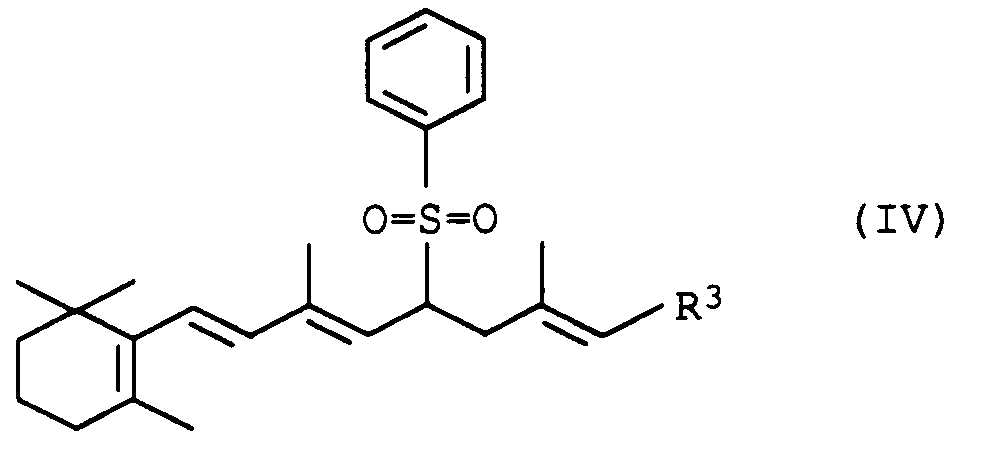
- the invention relates in particular to a process for the preparation of vitamin A derivatives by allylating an anionized allyl aryl sulfone of the formula II with an allyl compound of the general formula III in which X is a negative leaving group and R3 can stand for one of the following radicals: H, -CH2-OCOCH3, -COOR4 or wherein R4, R5 and R6 can represent an alkyl group having 1 to 4 carbon atoms or R5 and R6 together represent an ethylene radical or a propylene radical, which can be substituted with one or more methyl groups, to form an arylsulfone compound of the general formula IV and subsequent cleavage of the arylsulfinic acid to form the corresponding vitamin A derivative, which is characterized in that the allylation of the allyl-arylsulfone and the cleavage of the arylsulfinic acid in a ketone of the general formula I R1-CO-R2 (I), in which R1 and
- the process for the preparation of vitamin A derivatives, in particular vitamin A acetate, is particularly advantageous if the alkylation of the allyl aryl sulfone and the cleavage of the aryl sulfinic acid in diethyl ketone are carried out.
- Polyenes are generally understood to mean unsaturated aliphatic compounds which contain at least three conjugated double bonds in the molecule.
- the improvements according to the invention can be used in the production of all polyenes which are in principle obtainable by the so-called Julia method.
- Examples of polyenes which can be prepared by the process according to the invention are: ⁇ -carotene, astaxanthin, canthaxantin, neurosporaxanthin, and vitamin A derivatives, such as vitamin A alcohol (retinol), vitamin A acetate, vitamin A acid or Vitamin A aldehyde (retinal).
- the process is particularly advantageous for the production of vitamin A derivatives, in particular vitamin A acetate and vitamin A aldehyde.
- allyl aryl sulfones used as starting materials are obtained in a manner known per se by reacting allyl alcohols or allyl halides with salts of aryl sulfinic acids (cf. for example D. Arnould et al in Bull. Soc. Chim. France 1985, II, pages 130-31 and PS Manchand et al in Helv. Chim. Acta 59 (1976) pp. 387f).
- Suitable allyl-aryl sulfones are: ⁇ -ionylidene-phenyl sulfone of the formula II, retinyl-phenyl sulfone or 3- (5,5-dimethyl-1,3-dioxan-2-yl) -crotyl-phenyl sulfone.
- allyl compounds of the general formula III are all compounds of this formula in which X is a negative leaving group and R3 has the meaning given above.
- a negative leaving group is understood to be those residues which can convert into an acid anion when exposed to a base.
- groups are especially halogen, such as, in particular, chloride and bromide; Acyloxy groups such as the acetoxy group, the trifluoroacetoxy group and the nonafluorobutoxy group; Sulfonyloxy groups such as the p-toluenesulfonyloxy group and the methanesulfonyloxy group.
- the allyl aryl sulfones are anionized by reaction with a strong base in a solvent.
- suitable strong bases are: KOH, KOCH3, NaOCH3, NaNH2, KO-tert-butyl.
- the base used does not decompose one of the reactants.
- no KOCH3 may be used, since this would saponify the acetyl group and the prenol which forms would escape the desired reaction by a ring-closing reaction.
- KO-tert-butyl or NaNH2 this implementation would be successful.
- Which base can be used can be determined by simple preliminary tests.
- Alkali alcoholates such as KOCH3 and KOC2H5, in particular the potassium tert-butoxide, are particularly suitable.
- the arylsulfinic acid is also split off using strong bases.
- strong bases are, for example, NaOH, KOH, KOCH3, KOC2H5 or KO-tert-butyl.
- Alkaline alcoholates are used with particular advantage, in particular, if possible, the same ones as were used for the anionization of the allyl aryl sulfones.
- potassium tert-butanolate or NaNH2 or later when eliminating arylsulfinic acid are used to anionize ⁇ -ionylidenylphenylsulfone however, alkali methylates or alkali hydroxides. Nevertheless, both stages can be carried out as a one-pot reaction.
- the process according to the invention is particularly advantageous in the production of retinal, since KOCH3 or NaOCH3, preferably KOCH3, can be used very advantageously as a base in both stages.
- both reaction steps are carried out in the same inert, water-immiscible solvent.
- suitable solvents are: ketones such as 4-heptanone (dipropyl ketone), 3-pentanone (diethyl ketone), cyclopentanone and cyclohexanone and ethers such as diisopropyl ether.
- Diethyl ketone is used with particular advantage. In contrast, methyl ketones are not suitable.
- the procedure is generally such that a solution of the allyl-phenylsulfone and the allylating agent is initially taken and the suitable strong base is added to this.
- polyenes which are suitable, for example, as dyes or active ingredients can also be produced very advantageously on an industrial scale.
- the aqueous solution of KCl and potassium benzene sulfinate obtained according to Example 1B was mixed with 300 ml of glacial acetic acid, the reaction mixture was heated to 60 ° C., then 178 g (0.81 mol) of vinyl ionol were added dropwise over the course of 25 minutes and the mixture was then stirred at 60 ° for 1 h C stirred. The mixture was then extracted 3 times with 100 ml of DEK, and the combined extracts were washed acid-free with dilute sodium carbonate solution. A yield of 92% cis-trans-C15-sulfone, based on vinylionol, was found by means of HPLC analysis.
- the reaction mixture was then stirred at RT for a further 1 h and then warmed to 60.degree. After 1 h the phenyl sulfone had split off completely.
- the potassium sulfinate and KCl formed were completely dissolved out of the organic phase with 50 ml of water.
- the aqueous phase could be used without problems for the renewed production of C15 sulfone from vinyl ionol.
- the organic phase with the alkylation / elimination product was mixed with 30 ml of isopropanol, 30 ml of 2% sulfuric acid and 6 g of propanal. After 20 min at 60 ° C the acetal was completely saponified.
Landscapes
- Chemical & Material Sciences (AREA)
- Organic Chemistry (AREA)
- Organic Low-Molecular-Weight Compounds And Preparation Thereof (AREA)
Abstract
R¹-CO-R² (I)
in der R¹ und R² jeweils einen geradkettigen oder verzweigten Alkylrest mit 2 bis 4 C-Atomen bedeuten oder aber R¹ und R² zusammen einen Tetramethylen- oder einen Pentamethylenrest bedeuten, durchführt. Besondere Bedeutung hat das Verfahren für die Herstellung von Vitamin-A-derivaten. Bei der Herstellung von Vitamin-A-aldehyd z.B. verwendet man mit Vorteil in beiden Reaktionsstufen die gleichen Alkalialkoholate als starke Basen, so daß die Umsetzung als Eintopfreaktion durchgeführt werden kann.
Description
- Die Erfindung betrifft ein verbessertes Verfahren zur Herstellung von Polyenen durch Umsetzung von α-allylischen Arylsulfonen mit α-allylischen Halogeniden oder anderen Allylierungsmitteln und anschließende Eliminierung von Arylsulfinaten.
- Unter Polyenen versteht man ganz allgemein ungesättigte aliphatische Kohlenwasserstoffe mit mindestens drei oder mehr konjugierten Doppelbindungen im Molkül, d.h. Verbindungen mit zahlreichen alternierenden Einfach- und Doppelbindungen. Natürlich vorkommende farbige Polyene sind beispielsweise Lycopin und β-Carotin. Einige der natürlich vorkommenden Verbindungen sind als Lebensmittelfarbstoffe von Interesse, andere haben als biologisch medizinische Wirkstoffe Bedeutung erlangt. Die wichtigsten Polyene sind die Carotinoide, Retinoide und speziell das Vitamin A.
- Entsprechend ihrer Bedeutung sind viele verschiedene Methoden zur Herstellung dieser Substanzklasse entwickelt worden (Übersicht vgl. O. Isler Carotenoids, Birkhäuser-Verlag, 1971).
- Besonders bekannte Methoden zur Herstellung von Polyenen sind die Wittig-Reaktion, d.h. das Verknüpfen von α, β-ungesättigten Aldehyden mit Phosphoniumyliden (vgl. beispielsweise "Organic Reactions", Vol. 14, Verlag John Wiley, New York, 1965); die Müller-Cunradi-Reaktion, d.h. das Anlagern von Enolethern an Dialkylacetale von α, β-ungesättigten Aldehyden (vgl. beispielsweise US 2 165 962 und Chem. Abstr., 33 (1939), 8210) sowie die sogenannte Julia-Methode, d.h. das Alkylieren α-metallierter Sulfone mit Allylhalogeniden und anschließende Abspaltung eines Sulfinats (vgl. M. Julia und D. Arnould, Bull. Soc. Chim, Fr, 1973, Seiten 743 und 746). Gemäß dieser Methode wird beispielsweise von G.L. Olsen et al in "J. Org. Chem., 41 (1976), 3287, eine Synthese von all-trans-Vitamin A auf folgendem Wege beschrieben:

- Weiterhin wird in der DOS 27 08 210 ein Verfahren zur Herstellung von Sulfonacetalen beschrieben, bei dem die Sulfone in einem mit Wasser mischbaren basischen polaren aprotischen Medium, wie Dimethylformamid oder Dimethylsulfoxid, metalliert und allyliert werden. Das dabei erhaltene Reaktionsgemisch wird anschließend hydrolysiert und das Wertprodukt in ein mit Wasser nicht mischbares Lösemittel, beispielsweise Diisopropylether extrahiert.
- Alle bisher beschriebenen Verfahren zur Herstellung von Polyenen durch Alkylieren von Sulfonen weisen hinsichtlich der verwendeten Lösemittel große Nachteile auf. So wird das bei der Alkylierung erhaltene Reaktionsgemisch üblicherweise auf Eiswasser gegossen und das Wertprodukt muß aus der wäßrigen Phase isoliert werden. Hierbei geht das für die Umsetzung eingesetzte Lösemittel größtenteils verloren und führt dadurch zu einer starken Abwasserbelastung. Zur Extraktion des Wertproduktes aus der wäßrigen Phase wird zusätzlich ein nicht mit Wasser mischbares Lösungsmittel benötigt. Die weitere Umsetzung des Sulfons, vor allem die Abspaltung des Arylsulfinats erfordert wieder ein anderes Reaktionsmedium.
- Beispielsweise arbeitet man bei der Herstellung von Vitamin A oder seinen Derivaten gemäß der oben beschriebenen Literaturstelle in J. Org. Chem., 41 mit einem System NaNH₂, flüssiger Ammoniak, tertiär-Butanol, oder aber in Tetrahydrofuran (THF), Lithiumdiisopropylamide. In beiden Fällen wird nach Abschluß der Reaktion auf Wasser gegossen und das Gemisch mit Diethylether extrahiert.
- Es war daher die Aufgabe der Erfindung das Verfahren zur Herstellung von Polyenen durch Umsetzen von α-metallierten Sulfonen mit Alkylierungsmitteln, wie insbesondere Allylhalogeniden, unter Eliminieren der gravierenden Nachteile des Standes der Technik so zu verbessern, daß es auch in technischem Maßstab vorteilhaft durchgeführt werden kann.
- Es wurde nun überraschenderweise gefunden, daß man alle notwendigen Reaktionsschritte dieses Verfahrens, wie die Allylierung, eine eventuelle Wäsche des Reaktionsgemisches mit Wasser, die Eliminierung des Arylsulfinats, eine eventuell erforderliche anschließende weitere Wäsche mit Wasser und sogar eine weitere Umsetzung des erhaltenen Olefins in demselben Lösungsmittel durchführen kann, wenn man als Lösungsmittel ein inertes mit Wasser nicht mischbares polares Lösungsmittel aus der Reihe der Ketone und Ether verwendet. Überraschend war ebenfalls, daß bei dieser vorteilhaften Verfahrensführung das Hilfsreagenz Natrium-benzolsulfinat nach der Eliminierung weitgehend als Feststoff anfällt und daher besonders einfach recyclisiert werden kann.
- Gegenstand der Erfindung ist dementsprechend ein Verfahren zur Herstellung von Polyenen durch die sogenannte Julia-Reaktion, d.h. die Allylierung eines mittels einer starken Base anionisierten Allyl-arylsulfons mit einem Allylierungsmittel in α-Stellung und anschließende Abspaltung der Arylsulfinsäure mit einer starken Base unter Bildung einer olefinischen Doppelbindung, das dadurch gekennzeichnet ist, daß man die Allylierung des Allyl-arylsulfons und die Abspaltung der Arylsulfinsäure im gleichen inerten, mit Wasser nicht mischbaren polaren Lösungsmittel, vorzugsweise in einem Keton der allgemeinen Formel I
R¹-CO-R² (I)
in der R¹ und R² jeweils einen geradkettigen oder verzweigten Alkylrest mit 2 bis 4 c-Atomen bedeuten oder aber R¹ und R² zusammen einen Tetramethylen- oder einen Pentamethylenrest bedeuten, durchführt. - Mit besonderem Vorteil kann das erfindungsgemäße Verfahren durchgeführt werden, wenn man die Allylierung des Allyl-arylsulfons und die Abspaltung der Arylsulfinsäure in Diethylketon, Dipropylketon, Cyclopentanon, Cyclohexanon oder Diisopropylether, vorzugsweise in Diethylketon durchführt.
- Gegenstand der Erfindung ist insbesondere ein Verfahren zur Herstellung von Vitamin-A-derivaten durch Allylieren eines anionisierten Allyl-arylsulfons der Formel II

mit einer Allylverbindung der allgemeinen Formel III
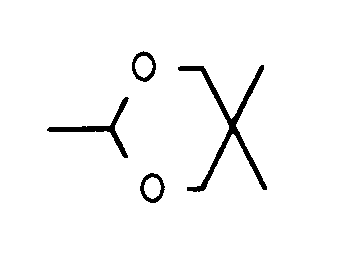
in der X eine negative Abgangsgruppe bedeutet und R³ für einen der folgenden Reste stehen kann: H, -CH₂-OCOCH₃, -COOR⁴ oder
worin R⁴, R⁵ und R⁶ eine Alkylgruppe mit 1 bis 4 C-Atomen bedeuten können oder R⁵ und R⁶ zusammen einen Ethylenrest oder einen Propylenrest bedeuten, die mit einer oder mehreren Methylgruppen substituiert sein können, zu einer Arylsulfonverbindung der allgemeinen Formel IV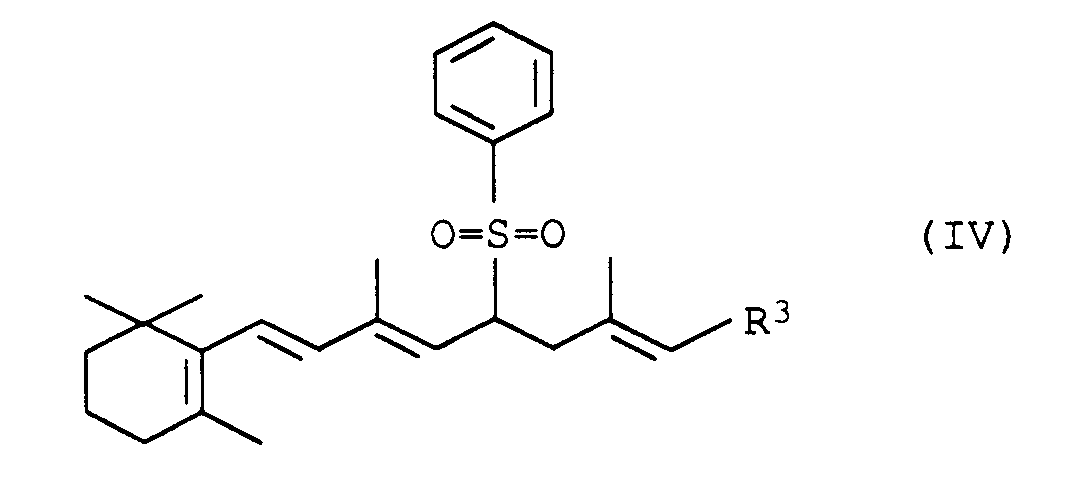
und anschließende Abspaltung der Arylsulfinsäure unter Bildung des entsprechenden Vitamin-A-derivats, das dadurch gekennzeichnet ist, daß man die Allylierung des Allyl-arylsulfons und die Abspaltung der Arylsulfinsäure in einem Keton der allgemeinen Formel I
R¹-CO-R² (I),
in der R¹ und R² jeweils einen geradkettigen oder verzweigten Alkylrest mit 2 bis 4 C-Atomen bedeuten, oder aber R¹ und R² zusammen für einen Tetramethylen- oder Pentamethylenrest steht, durchführt. - Auch das Verfahren zur Herstellung von Vitamin-A-derivaten, insbesondere von Vitamin-A-acetat, gestaltet sich besonders vorteilhaft, wenn man die Alkylierung des Allyl-arylsulfons und die Abspaltung der Arylsulfinsäure in Diethylketon durchführt.
- Unter Polyenen werden im allgemeinen ungesättigte aliphatische Verbindungen verstanden, die mindestens drei konjugierte Doppelbindungen im Molekül enthalten. Die erfindungsgemäßen Verbesserungen können bei der Herstellung aller Polyene angewendet werden, die prinzipiell durch die sogenannte Julia-Methode erhältlich sind. Als nach dem erfindungsgemäßen Verfahren herstellbare Polyene seien beispielsweise genannt: β-Carotin, Astaxanthin, Canthaxantin, Neurosporaxanthin, sowie Vitamin-A-derivate, wie Vitamin-A-alkohol (Retinol), Vitamin-A-acetat, Vitamin-A-säure oder Vitamin-A-aldehyd (Retinal). Besonders vorteilhaft ist das Verfahren für die Herstellung von Vitamin-A-derivaten, insbesondere von Vitamin-A-acetat und Vitamin-A-aldehyd.
- Die als Ausgangsstoffe verwendeten Allyl-arylsulfone erhält man in an sich bekannter Weise durch Umsetzen von Allylalkoholen oder Allylhalogeniden mit Salzen der Arylsulfinsäuren (vgl. beispielsweise D. Arnould et al in Bull. Soc. Chim. France 1985, II, Seite 130-31 sowie P.S. Manchand et al in Helv. Chim. Acta 59 (1976) S. 387f).
- Als geeignete Allyl-arylsulfone seien beispielsweise genannt: β-Ionyliden-phenylsulfon der Formel II, Retinyl-phenylsulfon oder 3-(5,5-Dimethyl-1,3-dioxan-2-yl)-crotyl-phenylsulfon.
- Als Allylverbindungen der allgemeinen Formel III

kommen alle Verbindungen dieser Formel in Betracht, in denen X für eine negative Abgangsgruppe steht und R³ die oben angegebene Bedeutung hat. - Als negative Abgangsgruppe versteht man solche Reste, die bei Einwirkung einer Base in ein Säureanion übergehen können. Beispiele für solche Gruppen sind vor allem Halogen, wie insbesondere Chlorid und Bromid; Acyloxygruppen, wie die Acetoxygruppe, die Trifluoracetoxygruppe und die Nonafluorbutoxygruppe; Sulfonyloxygruppen, wie die p-Toluolsulfonyloxygruppe und die Methansulfonyloxygruppe.
- Mit besonderem Vorteil arbeitet man mit Verbindungen der Formel III, in der X für Cl oder Br steht. Genannt seien vor allem γ-Chlor-prenalneopentylglykolacetal, γ-Brom-prenal-neopentylglykolacetal, 3-(5,5-Dimethyl-1,3-dioxan-2-yl)-crotylchlorid, 3-Chlormethyl-crotonaldehydneopentylglycolacetal und Vitamin-A-acetat.
- Das Anionisieren der Allyl-arylsulfone erfolgt durch Umsetzen mit einer starken Base in einem Lösungsmittel. Als geeignete starke Basen seien beispielsweise genannt: KOH, KOCH₃, NaOCH₃, NaNH₂, KO-tert.-butyl.
- Hierbei ist zu beachten, daß die verwendete Base nicht einen der Reaktionspartner zersetzt. Beispielsweise bei der Allylierung mit γ-Brom-Prenylacetat darf kein KOCH₃ verwendet werden, da dieses die Acetylgruppe verseifen würde und das sich bildende Prenol sich durch Ringschlußreaktion der gewünschten Umsetzung entziehen würde. Mit KO-tert.-butyl oder NaNH₂ wäre dagegen diese Umsetzung erfolgreich. Welche Base eingesetzt werden kann, kann man durch einfache Vorversuche feststellen.
- Besonders geeignet sind Alkalialkoholate, wie KOCH₃ und KOC₂H₅, insbesondere das Kalium-tert.-butylat.
- Auch die Abspaltung der Arylsulfinsäure erfolgt mit starken Basen. Geeignete starke Basen sind beispielsweise NaOH, KOH, KOCH₃, KOC₂H₅ oder KO-tert.-butyl.
- Mit besonderem Vorteil verwendet man Alkalialkoholate, insbesondere - wenn möglich - die gleichen, wie sie für die Anionisierung der Allyl-arylsulfone verwendet wurden.
- So verwendet man beispielsweise bei der erfindungsgemäßen Herstellung von Vitamin-A-acetat aus dem β-Ionyliden-phenylsulfon und γ-Brom-prenylacetat beim Anionisieren des β-Ionylidenylphenylsulfons Kaliumtert.-butanolat oder NaNH₂, später beim Eliminieren der Arylsulfinsäure dagegen Alkalimethylate oder Alkalihydroxide. Dennoch können beide Stufen als Eintopfreaktion durchgeführt werden.
- Besonders vorteilhaft gestaltet sich das erfindungsgemäße Verfahren bei der Herstellung von Retinal, da hierbei in beiden Stufen sehr vorteilhaft KOCH₃ oder NaOCH₃, vorzugsweise KOCH₃ als Base eingesetzt werden kann.
- Beide Reaktionsschritte werden erfindungsgemäß in dem gleichen inerten, mit Wasser nicht mischbaren Lösungsmittel durchgeführt. Als geeignete Lösungsmittel seien beispielsweise folgende genannt: Ketone, wie 4-Heptanon (Dipropylketon), 3-Pentanon (Diethylketon), Cyclopentanon und Cyclohexanon und Ether, wie Diisopropylether.
- Mit besonderem Vorteil verwendet man Diethylketon. Methylketone dagegen sind nicht geeignet.
- Zur Durchführung des erfindungsgemäßen Verfahrens geht man im allgemeinen so vor, daß man eine Lösung des Allyl-phenylsulfons und des Allylierungsmittels vorlegt und hierzu die geeignete starke Base addiert.
- Mit Hilfe des erfindungsgemäßen Verfahrens können beispielsweise als Farbstoffe oder Wirkstoffe geeignete Polyene auch in technischem Maßstab sehr vorteilhaft hergestellt werden.
-
- A. Herstellung der Lösung eines C₁₅-Sulfons in Diethylketon

- B. Allylierung, Benzolsulfinat-Eliminierung und Hydrolyse in Diethylketon

Die abgetrennte organische Phase wurde mit 300 ml Isopropanol und 300 ml einer 2 %igen H₂SO₄ versetzt und 10 min bei 40°C gerührt. Nach Abkühlen auf 20°C wurde die wäßrige Phase abgetrennt und die organische Phase unter vermindertem Druck eingeengt. Man erhielt 222 g (entsprechend einer Ausbeute von 84 % der Theorie) reines Retinal, das sich zu 79 % aus der all-trans-Form, zu 18 % aus dem 13-cis-Isomeren und zu ca. 1 % aus dem 9-cis-Isomeren zusammensetzte. - 34,5 g reines C₁₅-Sulfon (hergestellte analog Beispiel 1A) wurden in 100 ml DPK gelöst und 23 g γ-Chlor-prenal-neopentylglykolacetal zugefügt. Anschließend wurde innerhalb von 30 min unter Kühlen auf ca. 20°C portionsweise 18 g Kaliummethylatpulver eingebracht. Nach 20 min Rühren bei RT wurde auf 55°C erwärmt und noch 2 h bei 55°C gerührt. Anschließend wurden 50 ml Wasser eingetropft, durchmischt und danach die gebildete Unterphase abgetrennt. Die abgetrennte Oberphase wurde mit 30 ml Isopropanol und 30 ml 2 %ig. H₂SO₄ versetzt, 30 min auf 70°C erwärmt und dann die Phasen getrennt. Aus der organischen Phase wurden 24,1 g Retinal in überwiegend all-trans-Form isoliert.
- Man arbeitete wie in Beispiel 2 beschrieben, verwendete jedoch 100 ml Cyclohexanon anstelle von 100 ml Dipropylketon. Man erhielt nach der Hydrolyse durch Einengen der abgetrennten organischen Phase 28,4 g eines 82 %igen rohen Retinals.
- Die gemäß Beispiel 1B erhaltene wäßrige Lösung von KCl und Kaliumbenzolsulfinat wurde mit 300 ml Eisessig versetzt, das Reaktionsgemisch auf 60°C erwärmt, dann innerhalb von 25 min tropfenweise mit 178 g (0,81 mol) Vinylionol versetzt und noch 1 h bei 60°C gerührt. Anschließend wurde 3x mit 100 ml DEK extrahiert, die vereinigten Extrakte mit verdünnter Sodalösung Säure-frei gewaschen. Mittels HPLC-Untersuchung wurde eine Ausbeute von 92 % cis-trans-C₁₅-Sulfon, bezogen auf Vinylionol festgestellt.
-

- A. Herstellung des Phenylsulfons 1
Zu einer Lösung von 52,6 g (0,25 mol) 3-(5,5-Dimethyl-1,3-dioxan-2-yl)-crotylchlorid (hergestellt gemäß Liebigs Ann. Chem. 1976, Seite 2194) in 200 ml DEK wurden 42 g (0,25 mol) Natriumbenzolsulfinat addiert, das erhaltene Reaktionsgemisch 4 h unter Rückfluß zum Sieden erhitzt, das dabei auskristallisierte NaCl abfiltriert und der Niederschlag mit 300 ml DEK gewaschen. - B. Allylierung, Benzolsulfinat-Eliminierung und Hydrolyse
Zu der gemäß Beispiel 5A erhaltenen Lösung des Phenylsulfons 1 wurden 52,6 g (0,25 mol) 3-(5,5-Dimethyl-1,3-dioxan-2-yl)crotylchlorid (2) addiert und das Gemisch auf 0°C abgekühlt. Anschließend wurden 16,4 g pulverisiertes KOH zugefügt und noch 60 min bei 0°C gerührt. Anschließend fügte man 21 g (0,3 mol) Kaliummethylat in pulverisierter Form zu und ließ das Gemisch unter Rühren auf RT erwärmen. Nach 2 h hatte sich alles Allylierungsprodukt zu 2,7-Dimethyl-octatrien-1,8-dial-dineopentylglykolacetal umgesetzt. Man erhielt nach Wäsche des Reaktionsaustrages mit Wasser 68 g (entsprechend 81 % der Theorie) 2,7-Dimethyl-octatrien-1,8-dialdineopentylglykolacetal (3) überwiegend in der trans-Form. Das Diacetal (3) wurde in einem Zweiphasensystem mit DEK und 200 ml verdünnter H₂SO₄ vollständig zu 2,7-Dimethyl-octatrien-1,8-dial verseift. Das Ziel wurde in einer Ausbeute von 79 %, bezogen auf 3-(5,5-Dimethyl-1,3-dioxan-2-yl)-crotylchlorid isoliert. - Allylierung von 3-(5,5-Dimethyl-1,3-dioxan-2-yl)-crotyl-phenylsulfon mit 3-Chlormethyl-crotonaldehydneopentylglykolacetal.
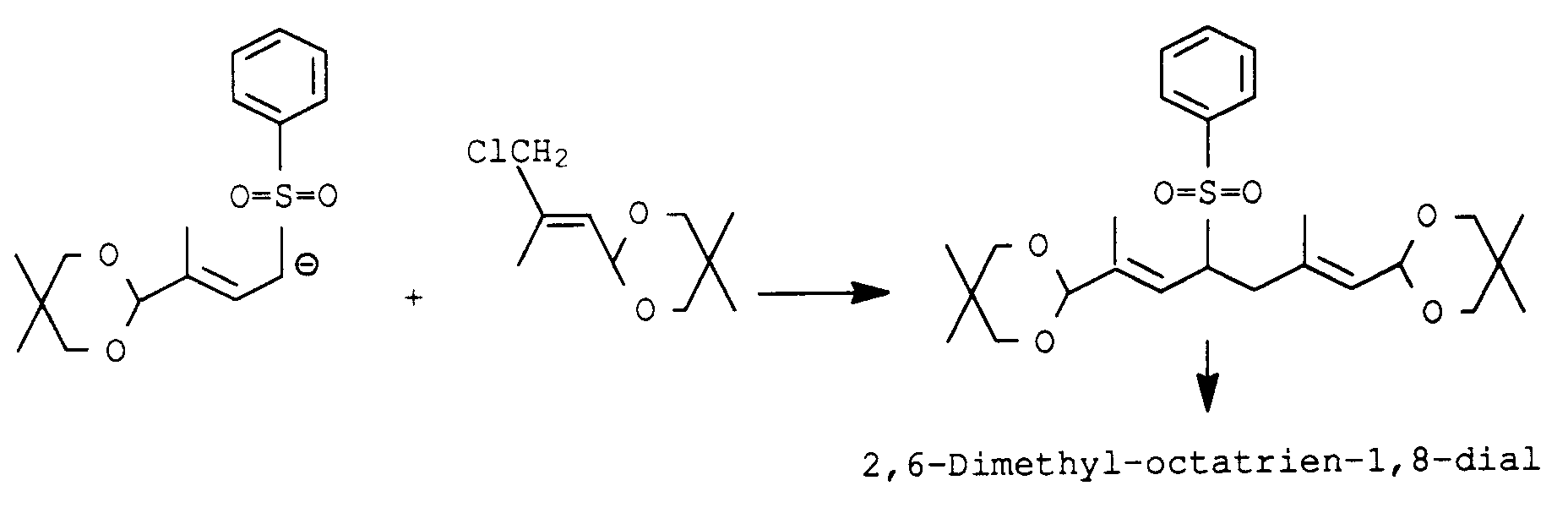
Zu einer analog Beispiel 5A hergestellten Lösung von 31,0 g (0,1 mol) 3-(5,5-Dimethyl-1,3-dioxan-2-yl)-crotyl-phenylsulfon in 200 ml DEK wurden 20,5 g (0,1 mol) 3-Chlormethyl-crotonaldehyd-neopentylglykolacetal addiert. Anschließend wurde unter Rühren auf 0°C abgekühlt, und dann innerhalb von 20 min 17 g (0,24 mol) festes Kaliummethylat zugegeben. Nach 1 h ließ man das Reaktionsgemisch auf RT erwärmen und rührte dann 2 h. Mittels HPLC-Kontrollen wurde nachgewiesen, daß 30,6 g (entsprechend 91 % der Theorie) 2,7-Bis-(5,5-dimethyl-1,3-dioxan-2-yl)-6-methyl-hepta-2,4,6-trien entstanden waren. Das Reaktionsgemisch wurde mit wenig Wasser gewaschen und zu der isolierten DEK-Lösung des Wertprodukts 60 ml Isopropanol und 60 ml 2 %iger H₂SO₄ und 17,4 g Propionaldehyd zwecks Umacetalisierung addiert. Nach 2 h Rühren bei 40°C waren die Acetalgruppen vollständig hydrolysiert. Anschließend wurde die wäßrige Phase abgetrennt und die organische Phase eingeengt. Nach Zugabe von 50 ml Isopropanol zum Rückstand kristallisierten 11,1 g (entsprechend 75 % d. Th.) an 2,6-Dimethyl-octatrien-1,8-dial vom Fp. 99-100°C aus. -

Zu 34,5 g (0,1 mol) eines gemäß Beispiel 1A hergestellten C₁₅-Sulfons in 200 ml DEK wurden 22 g γ-Brom-prenylacetat (hergestellt gemäß Beispiel 1 von US 4 175 204) addiert. Anschließend kühlte man auf 0°C ab und tropfte bei dieser Temperatur in 30 min eine Lösung von 15 g (ca. 0,13 mol) Kalium-tert.-butanolat in 100 ml DEK zu. Nach weiteren 60 min gab man 17 g (0,24 mol) Kaliummethylat zu und erwärmte auf 70°C. Nach 4-stündigem Rühren wurden 200 ml Wasser zugegeben und die Unterphase abgetrennt. Zur Oberphase gab man 30,6 g (0,3 mol) Acetanhydrid und 3 Tropfen conc. H₂SO₄. Nach 60 min war aller Vitamin-A-alkohol verestert. Man wusch mit verdünnter Sodalösung säurefrei. In der DEK-Phase hatten sich 26,9 g (82 % d. T.) Vitamin-A-acetat überwiegend in der trans-Form gebildet. Man isolierte das Wertprodukt durch schonendes Abdampfen des Lösungsmittels und Kristallisation aus Methanol. - 34,5 g β-Ionylidenethyl-phenylsulfon (C₁₅-Sulfon; hergestellt nach D. Arnould et al. in Bull. Soc. Chim. France 1985, II-130) und 22 g γ-Chlor-prenal-neopentylglykolacetal wurden in 300 ml Diisopropylether gelöst, die Lösung auf 0°C gekühlt und bei dieser Temperatur innerhalb 1 h portionsweise mit 21 g pulverisiertem Kaliummethylat versetzt.
- Anschließend wurde das Reaktionsgemisch noch 1 h bei RT gerührt und dann auf 60°C erwärmt. Nach 1 h hatte sich das Phenylsulfon vollständig abgespalten. Mit 50 ml Wasser wurden das gebildete Kaliumsulfinat und KCl vollständig aus der organischen Phase herausgelöst. Die wäßrige Phase ließ sich problemlos zur erneuten Herstellung von C₁₅-Sulfon aus Vinylionol einsetzen. Die organische Phase mit dem Alkylierungs-/Eliminierungsprodukt wurde mit 30 ml Isopropanol, 30 ml 2 %iger Schwefelsäure und 6 g Propanal versetzt. Nach 20 min bei 60°C war das Acetal vollständig verseift. Man trennte die wäßrige Phase ab, wusch die organische zweimal mit verdünnter NaHCO₃-Lösung und mit Wasser. Nach Trocknen über Na₂SO₄ erhielt man 279 g einer Lösung von 25,3 g Retinal in Diisopropylether entsprechend einer Ausbeute von 89 % der Theorie.
Claims (9)
- Verbessertes Verfahren zur Herstellung von Polyenen durch die sogenannte Julia-Reaktion, d.h. die Allylierung eines anionisierten Allyl-arylsulfons mit einer Allylverbindung in α-Stellung und anschließende Abspaltung der Arylsulfinsäure mittels einer starken Base unter Bildung einer olefinischen Doppelbindung, dadurch gekennzeichnet, daß man die Allylierung des Allyl-arylsulfones und die Abspaltung der Arylsulfinsäure im gleichen inerten, mit Wasser nicht mischbaren polaren Lösungsmittel aus der Reihe der Ketone und Ether durchführt.
- Verfahren gemäß Anspruch 1, dadurch gekennzeichnet, daß man die Allylierung des Allyl-arylsulfons und die Abspaltung der Arylsulfinsäure in einem Keton der allgemeinen Formel I
R¹-CO-R² (I)
in der R¹ und R² jeweils einen geradkettigen oder verzweigten Alkylrest mit 2 bis 4 Kohlenstoffatomen bedeuten oder aber R¹ und R² zusammen einen Tetramethylen- oder einen Pentamethylenrest bedeuten, durchführt. - Verfahren gemäß Anspruch 1, dadurch gekennzeichnet, daß man die Allylierung des Allyl-arylsulfons und die Abspaltung der Arylsulfinsäure in Diethylketon, Dipropylketon, Cyclopentanon, Cyclohexanon oder Diisopropylether durchführt.
- Verfahren gemäß Anspruch 2, dadurch gekennzeichnet, daß man die Allylierung des Allyl-arylsulfons und die Abspaltung der Arylsulfinsäure in Diethylketon durchführt.
- Verfahren gemäß Anspruch 1 zur Herstellung von einem Vitamin-A-derivat durch Allylieren eines anionisierten Allyl-arylsulfons der Formel II


R¹-CO-R² (I),
in der R¹ und R² jeweils einen geradkettigen oder verzweigten Alkylrest mit 2 bis 4 C-Atomen bedeuten, oder aber R¹ und R² zusammen für einen Tetramethylen- oder Pentamethylenrest bedeuten, durchführt. - Verfahren gemäß Anspruch 5, dadurch gekennzeichnet, daß man die Allylierung des Allyl-arylsulfons und die Abspaltung der Arylsulfinsäure in Diethylketon durchführt.
- Verfahren gemäß Anspruch 5, dadurch gekennzeichnet, daß man die Allylierung des Allyl-arylsulfons mit einer Allylverbindung der allgemeinen Formel III durchführt

- Verfahren gemäß Anspruch 5 zur Herstellung eines Retinalacetals durch Allylieren eines anionisierten Allylarylsulfons der Formel II


- Verfahren gemäß Anspruch 5 zur Herstellung von Vitamin-A-acetat durch Allylieren eines anionisierten Allyl-arylsulfons der Formel II


Applications Claiming Priority (2)
| Application Number | Priority Date | Filing Date | Title |
|---|---|---|---|
| DE4123994A DE4123994A1 (de) | 1991-07-19 | 1991-07-19 | Verbessertes verfahren zur herstellung von polyenen |
| DE4123994 | 1991-07-19 |
Publications (3)
| Publication Number | Publication Date |
|---|---|
| EP0523534A2 true EP0523534A2 (de) | 1993-01-20 |
| EP0523534A3 EP0523534A3 (en) | 1993-04-28 |
| EP0523534B1 EP0523534B1 (de) | 1995-02-01 |
Family
ID=6436567
Family Applications (1)
| Application Number | Title | Priority Date | Filing Date |
|---|---|---|---|
| EP92111598A Expired - Lifetime EP0523534B1 (de) | 1991-07-19 | 1992-07-08 | Verbessertes Verfahren zur Herstellung von Polyenen |
Country Status (5)
| Country | Link |
|---|---|
| US (1) | US5276209A (de) |
| EP (1) | EP0523534B1 (de) |
| JP (1) | JP2503346B2 (de) |
| CA (1) | CA2071772A1 (de) |
| DE (2) | DE4123994A1 (de) |
Cited By (3)
| Publication number | Priority date | Publication date | Assignee | Title |
|---|---|---|---|---|
| US6297416B1 (en) | 1998-11-06 | 2001-10-02 | Sangho Koo | Process for making β-carotene |
| WO2002062752A1 (en) * | 2001-02-06 | 2002-08-15 | Sumitomo Chemical Company, Limited | Novel sulfone derivatives and process for producing these |
| WO2006038764A1 (en) * | 2004-10-05 | 2006-04-13 | Sangho Koo | ClO DIALDEHYDE, SYNTHETIC METHOD THEREOF, AND SYNTHETIC METHOD OF BETA-CAROTENE USING THE SAME |
Families Citing this family (4)
| Publication number | Priority date | Publication date | Assignee | Title |
|---|---|---|---|---|
| KR100477899B1 (ko) * | 2001-04-12 | 2005-03-18 | 구상호 | 레티놀 및 카로틴 화합물의 실용적인 합성방법 |
| CN103172504B (zh) * | 2011-12-26 | 2014-10-08 | 南京工业大学 | 2,7-二甲基-2,4,6-辛三烯-1,8-二醛的合成方法 |
| JP6512424B2 (ja) * | 2014-12-24 | 2019-05-15 | Dic株式会社 | E−オレフィンの製造方法 |
| CN108752178B (zh) * | 2018-05-31 | 2021-04-20 | 万华化学集团股份有限公司 | 一种2,7-二甲基-2,4,6-辛三烯-1,8-二醛的制备方法 |
Family Cites Families (3)
| Publication number | Priority date | Publication date | Assignee | Title |
|---|---|---|---|---|
| US2165962A (en) * | 1936-10-29 | 1939-07-11 | Ig Farbenindustrie Ag | Production of alkylidene diethers or ether-esters |
| BE794872A (fr) * | 1972-02-02 | 1973-08-01 | Rhone Poulenc Sa | Nouvelles sulfones derivees de dimethyl-1,5 hexadiene-1,5 ylene |
| FR2342282A1 (fr) * | 1976-02-25 | 1977-09-23 | Rhone Poulenc Ind | Procede de preparation de sulfones acetals et leur utilisation pour la preparation d'aldehydes ethyleniques |
-
1991
- 1991-07-19 DE DE4123994A patent/DE4123994A1/de not_active Withdrawn
-
1992
- 1992-06-22 CA CA002071772A patent/CA2071772A1/en not_active Abandoned
- 1992-07-08 DE DE59201325T patent/DE59201325D1/de not_active Expired - Lifetime
- 1992-07-08 EP EP92111598A patent/EP0523534B1/de not_active Expired - Lifetime
- 1992-07-16 JP JP4189119A patent/JP2503346B2/ja not_active Expired - Lifetime
- 1992-07-17 US US07/914,128 patent/US5276209A/en not_active Expired - Fee Related
Cited By (6)
| Publication number | Priority date | Publication date | Assignee | Title |
|---|---|---|---|---|
| US6297416B1 (en) | 1998-11-06 | 2001-10-02 | Sangho Koo | Process for making β-carotene |
| US6326519B1 (en) | 1998-11-06 | 2001-12-04 | Sangho Koo | Diallylic sulfides and processes for preparing the same |
| US6403838B1 (en) | 1998-11-06 | 2002-06-11 | Sangho Koo | Process for preparing 2,7-dimethyl-2,4,6-octatriene-1,8-dial |
| WO2002062752A1 (en) * | 2001-02-06 | 2002-08-15 | Sumitomo Chemical Company, Limited | Novel sulfone derivatives and process for producing these |
| WO2006038764A1 (en) * | 2004-10-05 | 2006-04-13 | Sangho Koo | ClO DIALDEHYDE, SYNTHETIC METHOD THEREOF, AND SYNTHETIC METHOD OF BETA-CAROTENE USING THE SAME |
| US7470822B2 (en) | 2004-10-05 | 2008-12-30 | Myongji University Industry And Academia Cooperation | C10 dialdehyde, synthetic method thereof, and synthetic method of beta-carotene using the same |
Also Published As
| Publication number | Publication date |
|---|---|
| DE59201325D1 (de) | 1995-03-16 |
| CA2071772A1 (en) | 1993-01-20 |
| EP0523534A3 (en) | 1993-04-28 |
| JPH05221962A (ja) | 1993-08-31 |
| US5276209A (en) | 1994-01-04 |
| DE4123994A1 (de) | 1993-01-21 |
| JP2503346B2 (ja) | 1996-06-05 |
| EP0523534B1 (de) | 1995-02-01 |
Similar Documents
| Publication | Publication Date | Title |
|---|---|---|
| DE2505869C3 (de) | Verfahren zur Herstellung von symmetrischen Carotinoiden | |
| EP0298404A2 (de) | Sulfonylpolyene | |
| EP0523534B1 (de) | Verbessertes Verfahren zur Herstellung von Polyenen | |
| DE19649564A1 (de) | Verfahren zur Herstellung von gamma,delta-ungesättigter Ketone durch Umsetzung tertiärer Allylalkohole mit Alkenylalkylethern | |
| EP0847976A1 (de) | Verfahren zur Herstellung von Glyoxalmonoacetalen | |
| EP0895997A1 (de) | Verfahren zur Herstellung von Phosphoniumsalzen | |
| EP1241157B1 (de) | Verfahren zur Herstellung von 2,7-Dimethyl-2,4,6-octatrienal-monoacetalen | |
| DE2734172C2 (de) | ||
| EP0742205B1 (de) | Verfahren zur Herstellung von beta-Carotin-Präparaten mit hohem 9(Z)-Gehalt | |
| EP0011758B1 (de) | Verfahren zur Herstellung von Polyenaldehyden | |
| DE2225612C2 (de) | Cyclische Methyl-fumardialdehyd-monoacetale und Verfahren zu ihrer Herstellung | |
| EP0579113B1 (de) | Verbessertes Verfahren zur Herstellung von cyclischen Acetalen von 3-formyl-2-butenyl-triphenylphosphoniumchlorid | |
| EP0061669B1 (de) | Verbessertes Verfahren zur Herstellung von Cyclohexan-1,3-dionen sowie einige neue bicyclische Cyclohexan-1,3-dione | |
| EP0114612B1 (de) | Racemisches und optisch aktives 3-Hydroxy-alpha-cyclocitral, deren Acetale und optisch aktive 3-Oxo-alpha-cyclocitralacetale sowie Herstellung und Verwendung dieser Verbindungen | |
| EP0182168B1 (de) | Verfahren zur Herstellung von Hydroxymethylen-alkoxyessigsäureestern | |
| CH632263A5 (de) | Verfahren zur herstellung cyclischer 2-methyl-2,4-dialkoxy-3-buten-1-al-acetale und deren verwendung. | |
| EP0009752A1 (de) | 3-Chlor-3-methyl-butan- bzw. 3-Methyl-2-buten-1,4-dial-bis-acetale, ein Verfahren zur Herstellung dieser Verbindungen sowie deren Verwendung | |
| CH638780A5 (de) | Cyclohexenderivate, verfahren zu ihrer herstellung und ihre verwendung zur herstellung der entsprechenden aldehyde. | |
| DE1023027B (de) | Verfahren zur Herstellung von Polyendialdehyden | |
| EP0087712B1 (de) | Verfahren zur Herstellung von 3-Cyan-2-alkylalkanalen und die Verwendung von 3-Cyan-2-ethylhexanal zur Herstellung von 2-Propylpentansäure | |
| DE1468080C (de) | Verfahren sur Herstellung von Cyclododecanmonocarbonsäure | |
| CH333917A (de) | Verfahren zur Herstellung von Polyenaldehyden | |
| EP0036143A1 (de) | Verfahren zur Herstellung von 1-Amino-2-ethoxy-naphthalin-6-sulfonsäure | |
| DE1205538B (de) | Verfahren zur Herstellung von Phosphonsaeureestern | |
| DE3635622A1 (de) | Verfahren zur herstellung von, gegebenenfalls in der 11-stellung substituierten, 3,7,11-tri-(methyl)-2e,4e-dodecadiensaeureestern |
Legal Events
| Date | Code | Title | Description |
|---|---|---|---|
| PUAI | Public reference made under article 153(3) epc to a published international application that has entered the european phase |
Free format text: ORIGINAL CODE: 0009012 |
|
| AK | Designated contracting states |
Kind code of ref document: A2 Designated state(s): CH DE FR GB LI NL |
|
| PUAL | Search report despatched |
Free format text: ORIGINAL CODE: 0009013 |
|
| AK | Designated contracting states |
Kind code of ref document: A3 Designated state(s): CH DE FR GB LI NL |
|
| 17P | Request for examination filed |
Effective date: 19930413 |
|
| 17Q | First examination report despatched |
Effective date: 19940627 |
|
| GRAA | (expected) grant |
Free format text: ORIGINAL CODE: 0009210 |
|
| AK | Designated contracting states |
Kind code of ref document: B1 Designated state(s): CH DE FR GB LI NL |
|
| REF | Corresponds to: |
Ref document number: 59201325 Country of ref document: DE Date of ref document: 19950316 |
|
| GBT | Gb: translation of ep patent filed (gb section 77(6)(a)/1977) |
Effective date: 19950221 |
|
| ET | Fr: translation filed | ||
| PLBE | No opposition filed within time limit |
Free format text: ORIGINAL CODE: 0009261 |
|
| STAA | Information on the status of an ep patent application or granted ep patent |
Free format text: STATUS: NO OPPOSITION FILED WITHIN TIME LIMIT |
|
| 26N | No opposition filed | ||
| PGFP | Annual fee paid to national office [announced via postgrant information from national office to epo] |
Ref country code: FR Payment date: 19990618 Year of fee payment: 8 |
|
| PGFP | Annual fee paid to national office [announced via postgrant information from national office to epo] |
Ref country code: CH Payment date: 19990629 Year of fee payment: 8 |
|
| PGFP | Annual fee paid to national office [announced via postgrant information from national office to epo] |
Ref country code: NL Payment date: 19990630 Year of fee payment: 8 |
|
| PGFP | Annual fee paid to national office [announced via postgrant information from national office to epo] |
Ref country code: GB Payment date: 19990701 Year of fee payment: 8 |
|
| PGFP | Annual fee paid to national office [announced via postgrant information from national office to epo] |
Ref country code: DE Payment date: 19990716 Year of fee payment: 8 |
|
| PG25 | Lapsed in a contracting state [announced via postgrant information from national office to epo] |
Ref country code: GB Free format text: LAPSE BECAUSE OF NON-PAYMENT OF DUE FEES Effective date: 20000708 |
|
| PG25 | Lapsed in a contracting state [announced via postgrant information from national office to epo] |
Ref country code: DE Free format text: LAPSE BECAUSE OF THE APPLICANT RENOUNCES Effective date: 20000714 |
|
| PG25 | Lapsed in a contracting state [announced via postgrant information from national office to epo] |
Ref country code: LI Free format text: LAPSE BECAUSE OF NON-PAYMENT OF DUE FEES Effective date: 20000731 Ref country code: CH Free format text: LAPSE BECAUSE OF NON-PAYMENT OF DUE FEES Effective date: 20000731 |
|
| PG25 | Lapsed in a contracting state [announced via postgrant information from national office to epo] |
Ref country code: NL Free format text: LAPSE BECAUSE OF NON-PAYMENT OF DUE FEES Effective date: 20010201 |
|
| GBPC | Gb: european patent ceased through non-payment of renewal fee |
Effective date: 20000708 |
|
| REG | Reference to a national code |
Ref country code: CH Ref legal event code: PL |
|
| PG25 | Lapsed in a contracting state [announced via postgrant information from national office to epo] |
Ref country code: FR Free format text: LAPSE BECAUSE OF NON-PAYMENT OF DUE FEES Effective date: 20010330 |
|
| NLV4 | Nl: lapsed or anulled due to non-payment of the annual fee |
Effective date: 20010201 |
|
| REG | Reference to a national code |
Ref country code: FR Ref legal event code: ST |