EP0529098B1 - Tube cathodique couleur - Google Patents
Tube cathodique couleur Download PDFInfo
- Publication number
- EP0529098B1 EP0529098B1 EP92906681A EP92906681A EP0529098B1 EP 0529098 B1 EP0529098 B1 EP 0529098B1 EP 92906681 A EP92906681 A EP 92906681A EP 92906681 A EP92906681 A EP 92906681A EP 0529098 B1 EP0529098 B1 EP 0529098B1
- Authority
- EP
- European Patent Office
- Prior art keywords
- phosphor
- rare earth
- europium
- red
- earth element
- Prior art date
- Legal status (The legal status is an assumption and is not a legal conclusion. Google has not performed a legal analysis and makes no representation as to the accuracy of the status listed.)
- Expired - Lifetime
Links
Images


Classifications
-
- C—CHEMISTRY; METALLURGY
- C09—DYES; PAINTS; POLISHES; NATURAL RESINS; ADHESIVES; COMPOSITIONS NOT OTHERWISE PROVIDED FOR; APPLICATIONS OF MATERIALS NOT OTHERWISE PROVIDED FOR
- C09K—MATERIALS FOR MISCELLANEOUS APPLICATIONS, NOT PROVIDED FOR ELSEWHERE
- C09K11/00—Luminescent materials, e.g. electroluminescent or chemiluminescent
- C09K11/08—Luminescent materials, e.g. electroluminescent or chemiluminescent containing inorganic luminescent materials
- C09K11/77—Luminescent materials, e.g. electroluminescent or chemiluminescent containing inorganic luminescent materials containing rare earth metals
- C09K11/7783—Luminescent materials, e.g. electroluminescent or chemiluminescent containing inorganic luminescent materials containing rare earth metals containing two or more rare earth metals one of which being europium
- C09K11/7784—Chalcogenides
- C09K11/7787—Oxides
- C09K11/7789—Oxysulfides
-
- C—CHEMISTRY; METALLURGY
- C09—DYES; PAINTS; POLISHES; NATURAL RESINS; ADHESIVES; COMPOSITIONS NOT OTHERWISE PROVIDED FOR; APPLICATIONS OF MATERIALS NOT OTHERWISE PROVIDED FOR
- C09K—MATERIALS FOR MISCELLANEOUS APPLICATIONS, NOT PROVIDED FOR ELSEWHERE
- C09K11/00—Luminescent materials, e.g. electroluminescent or chemiluminescent
- C09K11/08—Luminescent materials, e.g. electroluminescent or chemiluminescent containing inorganic luminescent materials
-
- C—CHEMISTRY; METALLURGY
- C09—DYES; PAINTS; POLISHES; NATURAL RESINS; ADHESIVES; COMPOSITIONS NOT OTHERWISE PROVIDED FOR; APPLICATIONS OF MATERIALS NOT OTHERWISE PROVIDED FOR
- C09K—MATERIALS FOR MISCELLANEOUS APPLICATIONS, NOT PROVIDED FOR ELSEWHERE
- C09K11/00—Luminescent materials, e.g. electroluminescent or chemiluminescent
- C09K11/02—Use of particular materials as binders, particle coatings or suspension media therefor
- C09K11/025—Use of particular materials as binders, particle coatings or suspension media therefor non-luminescent particle coatings or suspension media
-
- C—CHEMISTRY; METALLURGY
- C09—DYES; PAINTS; POLISHES; NATURAL RESINS; ADHESIVES; COMPOSITIONS NOT OTHERWISE PROVIDED FOR; APPLICATIONS OF MATERIALS NOT OTHERWISE PROVIDED FOR
- C09K—MATERIALS FOR MISCELLANEOUS APPLICATIONS, NOT PROVIDED FOR ELSEWHERE
- C09K11/00—Luminescent materials, e.g. electroluminescent or chemiluminescent
- C09K11/08—Luminescent materials, e.g. electroluminescent or chemiluminescent containing inorganic luminescent materials
- C09K11/77—Luminescent materials, e.g. electroluminescent or chemiluminescent containing inorganic luminescent materials containing rare earth metals
-
- C—CHEMISTRY; METALLURGY
- C09—DYES; PAINTS; POLISHES; NATURAL RESINS; ADHESIVES; COMPOSITIONS NOT OTHERWISE PROVIDED FOR; APPLICATIONS OF MATERIALS NOT OTHERWISE PROVIDED FOR
- C09K—MATERIALS FOR MISCELLANEOUS APPLICATIONS, NOT PROVIDED FOR ELSEWHERE
- C09K11/00—Luminescent materials, e.g. electroluminescent or chemiluminescent
- C09K11/08—Luminescent materials, e.g. electroluminescent or chemiluminescent containing inorganic luminescent materials
- C09K11/77—Luminescent materials, e.g. electroluminescent or chemiluminescent containing inorganic luminescent materials containing rare earth metals
- C09K11/7783—Luminescent materials, e.g. electroluminescent or chemiluminescent containing inorganic luminescent materials containing rare earth metals containing two or more rare earth metals one of which being europium
- C09K11/7784—Chalcogenides
-
- C—CHEMISTRY; METALLURGY
- C09—DYES; PAINTS; POLISHES; NATURAL RESINS; ADHESIVES; COMPOSITIONS NOT OTHERWISE PROVIDED FOR; APPLICATIONS OF MATERIALS NOT OTHERWISE PROVIDED FOR
- C09K—MATERIALS FOR MISCELLANEOUS APPLICATIONS, NOT PROVIDED FOR ELSEWHERE
- C09K11/00—Luminescent materials, e.g. electroluminescent or chemiluminescent
- C09K11/08—Luminescent materials, e.g. electroluminescent or chemiluminescent containing inorganic luminescent materials
- C09K11/77—Luminescent materials, e.g. electroluminescent or chemiluminescent containing inorganic luminescent materials containing rare earth metals
- C09K11/7783—Luminescent materials, e.g. electroluminescent or chemiluminescent containing inorganic luminescent materials containing rare earth metals containing two or more rare earth metals one of which being europium
- C09K11/7784—Chalcogenides
- C09K11/7787—Oxides
-
- H—ELECTRICITY
- H01—ELECTRIC ELEMENTS
- H01J—ELECTRIC DISCHARGE TUBES OR DISCHARGE LAMPS
- H01J29/00—Details of cathode-ray tubes or of electron-beam tubes of the types covered by group H01J31/00
- H01J29/02—Electrodes; Screens; Mounting, supporting, spacing or insulating thereof
- H01J29/10—Screens on or from which an image or pattern is formed, picked up, converted or stored
- H01J29/18—Luminescent screens
- H01J29/20—Luminescent screens characterised by the luminescent material
-
- H—ELECTRICITY
- H01—ELECTRIC ELEMENTS
- H01J—ELECTRIC DISCHARGE TUBES OR DISCHARGE LAMPS
- H01J29/00—Details of cathode-ray tubes or of electron-beam tubes of the types covered by group H01J31/00
- H01J29/02—Electrodes; Screens; Mounting, supporting, spacing or insulating thereof
- H01J29/10—Screens on or from which an image or pattern is formed, picked up, converted or stored
- H01J29/18—Luminescent screens
- H01J29/30—Luminescent screens with luminescent material discontinuously arranged, e.g. in dots, in lines
- H01J29/32—Luminescent screens with luminescent material discontinuously arranged, e.g. in dots, in lines with adjacent dots or lines of different luminescent material, e.g. for colour television
Definitions
- This invention relates to a color picture tube having a red emission composition comprising a combination of phosphors having specified emission colors on the fluorescent screen.
- europium activated rare earth element oxysulfide which will hereinafter often be referred to as "Ln 2 O 2 :Eu” including, for example, “Y 2 O 2 S: Eu” for europium activated yttrium oxysulfide
- phosphors have been employed as a red emitting phosphor for a color picture tube, since these phosphors each have a high emission efficiency, are capable of controlling the color tone and are chemically stable so as to be suitable for use in a slurry coating method.
- red emitting phosphors are europium activated rare earth element oxide phosphors, europium activated rare earth element vanadate phosphors, silver activated zinc cadmium sulfide phosphors and manganese activated zinc phosphate phosphors.
- a method comprising using a face plate containing neodymium or other elements, a method comprising providing a face plate with a special color filter on the surface thereof, and a method comprising adding a specified pigment to a fluorescent film.
- These methods consist in adding a filtering function to a specified wavelength of emitting colors of a phosphor to limit the transmittance of the light with the specified wavelength and thus enlarging the scope of color production. In each case, the effective brightness decrease.
- a europium activated rare earth element oxide which will hereinafter often be referred to as Ln 2 O 3 :Eu
- the present invention provides a color picture tube having a face plate on which dot-shaped or stripe-shaped fluorescent films of blue, green and red emission components are respectively formed characterised in that the fluorescent film of the red emission component comprises a mixture of a red emission composition comprising a europium activated rare earth element oxide phosphor having an x value of 0.630 to 0.652 in CIE Chromaticity Representation and a europium activated rare earth element oxysulfide phosphor having an x value of 0.652 to 0.674 in the same representation, the said mixture having an x value of 0.647 to 0.662 in the same representation.
- a red emission composition comprising a europium activated rare earth element oxide phosphor having an x value of 0.630 to 0.652 in CIE Chromaticity Representation and a europium activated rare earth element oxysulfide phosphor having an x value of 0.652 to 0.674 in the same representation, the said mixture having an x value of 0.647 to
- a color picture tube in which the above described europium activated rare earth oxide phosphor is subjected to an insolubilization treatment of the surface thereof and the above described fluorescent films of blue, green and red emission components are respectively formed by the slurry coating method.
- a color picture tube in which the emission colors of the green emission fluorescent film and blue emission fluorescent film are respectively in the range of x of 0.200 to 0.330 and 0.145 to 0.155 in CIE Chromaticity Representation.
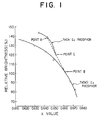
- Fig. 1 is a graph showing the relationship between the emission chromaticity (x value) and relative brightness in the same scale as to an europiumactivated yttrium oxide (hereinafter referred to as Y 2 O 3 :Eu) phosphor and Y 2 O 2 S:Eu phosphor and the characteristic of a red emission composition comprising a mixture of both the phosphors.
- Y 2 O 3 :Eu europiumactivated yttrium oxide
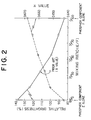
- Fig. 2 is a graph showing the relationship between the emission chromaticity (x value) and relative brightness and the mixture ratio of a Y 2 O 3 :Eu phosphor and pigment-adhered Y 2 O 2 S:Eu phosphor.
- Fig. 3 is a graph showing the relationship between the emission chromaticity (x value) and relative brightness when the concentration of the activator Eu is varied as to a Y 2 O 3 :Eu phosphor.
- Fig. 4 is a graph showing the relationship between the emission chromaticity (x value) and relative brightness when the concentration of the activator Eu is varied as to a Y 2 O 2 S:Eu phosphor.
- Fig. 5 is a graph showing change of the slurry viscosity of Y 2 O 3 :Eu phosphors of Examples 6, 8 and 9 and that of the prior art having not been subjected to an insolubilizing treatment with the passage of time.
- Fig. 6 is a graph showing change of the slurry pH of Y 2 O 3 :Eu phosphors of Examples 6, 8, 9 and 10 and that of the prior art having not been subjected to an insolubilizing treatment with the passage of time.
- Fig. 7 is a graph showing the relationship between the acid resistance and continuous slurry running time as to Y 2 O 3 : Eu phosphors of Examples 6, 8 and 9 and that of the prior art having not been subjected to an insolubilizing treatment.
- lanthanide element (Ln) of the phosphor forming the red emission composition of the present invention means at least one element of Y, Lu, Gd or La, preferably Y or a part of Y being substituted by Gd in a proportion of up to at most 70 mole %.
- europium (Eu)activator means not only Eu but also Eu containing a trace amount of at least one lanthanide element excluding the above described lanthanide elements (Ln), for example, Tb, Pr, Sm, or Dy.
- Ln is Y or Y a part of which is substituted by Gd, for example, Ln 2 O 3 :Eu, Tb phosphor, Ln 2 O 3 :Eu, Dy phosphor, Ln 2 O 2 S:Eu, Tb phosphor, Ln 2 O 2 S:Eu, Pr phosphor, Ln 2 O 2 S:Eu, Tb, Sm phosphor, Ln 2 O 2 S:Eu, Pr, Sm phosphor and the like.
- the concentration of the activator is generally 2 to 8 mole %, preferably 3 to 6 mole % for a Ln 2 O 3 type phosphor, and is generally 4 to 8 mole % for a Ln 2 O 2 S type phosphor. Furthermore, a Ln 2 O 3 type phosphor and Ln 2 O 2 S type phosphor are preferably mixed in a proportion of 85/15 to 25/75 by weight, more preferably in a proportion of 50/50 to 70/30 by weight.
- the red pigment which may be adhered to the above described phosphor may be any materials capable of hardly changing color even when heated at about 450°C, for example, iron oxide red or indium sulfide.
- the amount of the red pigment adhered to the phosphors is generally from 0.05 to 0.70 weight %, preferably 0.10 to 0.50 weight % based on the weight of the phosphor.
- the Ln 2 O 3 :Eu phosphor has somewhat been employed as a red phosphor for a color picture tube by a dusting method.
- this phosphor is chemically unstable to some extent in a coating slurry in the slurry coating method having at present been put to practical use as a method of making a fluorescent screen, is hard to be regenerated and reused and is in a much narrower range for controlling the color tone, as compared with the Ln 2 O 2 S:Eu phosphor, the former phosphor has completely been replaced by the Ln 2 O 2 S:Eu phosphor.
- the color tone can somewhat be changed as shown in Fig. 3.
- the Eu concentration means 100a mole % in the Ln 2 O 3 :Eu phosphor composition (Ln 1-a Eu a ) 2 O 3 and so forth.
- the degree of change of the color tone is smaller than that of the Ln 2 O 2 S:Eu phosphor as shown in Fig. 4.
- the inventors have found that unexpected results in solving the above described problems can be obtained by the use of a red emission composition having an x value adjusted to 0.647 to 0.662, which is obtained by mixing an Ln 2 O 3 :Eu phopshor having an x value of 0.630 to 0.652 according to CIE chromaticity representation and an Ln 2 O 2 S:Eu phopshor having an x value of 0.647 to 0.662.
- the above described red emission composition comprises preferably a mixture of an Eu-activated rare earth element oxide phopshor having an Eu concentration of 2.0 to 8.0 mole %, more preferably 3.0 to 6.0 mole % and an Eu-activated rare earth element oxysulfide phopshor having an Eu concentration of 4.0 to 8.0 mole % with a rare earth element oxide phopshor/rare earth element oxysulfide phosphor mixed weight ratio of 85/15 to 25/75, more preferably 50/50 to 70/30.
- the Ln 2 O 3 :Eu phopshor of the prior art which has not been subjected to an insolubilization treatment, tends to be slightly dissolved in a slurry to form the corresponding hydroxide, raise the pH value, aggregate the phosphor and increase the slurry viscosity with the passage of time, thus causing to change the property of the slurry.
- the phosphor slurry is generally used in a continuous and circular manner for at least several days to ten several days, the changes of pH and viscosity of the slurry during the passage of time hinders formation of fine pitch picture elements (dots, stripes) with a high density and excellent shape and unfavorably affects the quality of the resulting fluorescent film.
- the insolubilizing agent there can be used coating agents of silica type, silicon-containing organic compound type and zinc aluminate type, hydrophilicity-imparted acrylic resins and styrene-butadiene resins. Above all, it is preferable to coat the surface of a phopshor with at least one of these insolubilizing agent.
- Fig. 1 The relationship of the chromaticity (x value) and brightness between a Y 2 O 3 :Eu phosphor and R 2 O 2 S:Eu phosphor, on a same scale, is shown in Fig. 1.
- the Y 2 O 3 :Eu phosphor exhibits a varied width of color tone as represented by an x value of 0.630 to 0.652, which is smaller than that of the R 2 O 2 S:Eu phosphor, but in comparison concerning the brightness at the same chromaticity (x value), the former exhibits an about 10 to 20 % higher value than the latter.
- a red emission composition comprising a pigment-adhered Y 2 O 2 S:Eu phosphor and a pigment-free Y 2 O 3 :Eu phosphor, in combination, is most excellent. It is considered that a red pigment such as iron oxide red is localized in a Y 2 O 2 S:Eu phosphor needing improvement of the contrast, whereby the internal light absorption in a mixed system can be reduced and it is rendered possible to improve the brightness.
- a fluorescent film can more uniformly be formed with a stronger bonding strength as compared with a case of allowing the pigment adhere to either the former or the latter. This is more preferable for a color picture tube.
- the adhesion quantity of a red pigment to the above described two phosphors is respectively in the range of preferably 0.05 to 0.70 weight %, more preferably 0. 10 to 0.50 weight %.
- the Y 2 O 2 S:Eu phosphor there is generally used one whose emission color is reprsented by an x value of 0.652 to 0.674, during which the activator quantity is 4 to 8 mole %.
- the emission color is somewhat shifted to the longer wavelength side (larger x value side).
- the Eu activator quanity can be reduced by 0.1 to 0.5 mole % and in the case of a same Eu activator quantity, the emission color can be maintained in a deeper red region.
- the Eu activator quantity when using no red pigment, the Eu activator quantity is 4.0 to 8.0 mole % and when allowing a red pigment adhering, the Eu activator quantity is 3.5 to 8.0 mole %, preferably 3.8 to 8.0 mole %, which ranges are suitable in view of balance of the emission color and brightness.
- the Y 2 O 3 :Eu phosphor there is generally used one whose emission color is reprsented by an x value of 0.630 to 0.652, during which the activator quantity is 2 to 8 mole %.
- the emission color is slightly shifted to the longer wavelength side (larger x value side).
- the Eu activator quanity can be reduced by 0.03 to 0.15 mole % and in the case of a same Eu activator quantity, the emission color can slihgtly be maintained in a deeper red region.
- the Eu activator quantity when using no red pigment, is 2.0 to 8.0 mole %, preferably 3.8 to 6.0 mole % and when allowing a red pigment adhering, the Eu activator quantity is 2.0 to 8.0 mole %, preferably 2.85 to 6.0 mole %.
- the maximum value of the emission color (x value) can be increased to 0.670, 0.008 larger than 0.662 when using no red pigment, by allowing a red pigment to adhere respectively to the above described two phosphors, and consequently, the above described advantages of the present invention can be obtained.
- this red emission composition it is desirable to adjust the mixing weight ratio of (Y 2 O 3 phosphor/Y 2 O 2 S phosphor) to 85/15 to 25/75, since if the mixing weight ratio is more than 85/15, the color reproduction is degraded and if less than 25/75, the effect of improving the brightness is not sufficient.
- a preferable range of the mixing weight ratio is 50/50 to 70/30.
- the ratio of emission intensities ( ⁇ 626 / ⁇ 611 ) of the Y 2 O 2 S:Eu phosphor and Y 2 O 3 :Eu phosphor at emission peaks of 626 nm and 611 nm is in the range of 0.2 to 0.3.
- the relative brightness was improved by about 8 % to give higher brightness.
- a phosphor component C of Y 2 O 3 :Eu (Eu, 5.7 mole %) and phosphor component D of Y 2 O 2 S:Eu (Eu, 4.8 mole %) were prepared and subjected to an insolubilizing treatment in an analogous manner to Example 1 and mixed in mixing weight ratios (C/D) of 1/1 and 7/3 to obtain red emission compositions of Examples 2 and 3.
- reproduction of the chromaticity could be accomplished up to an x value of about 0.656 while maintaining the brightness superior by mixing the above described Y 2 O 3 :Eu phopshor and pigment-free Y 2 O 2 S:Eu phosphor.
- a phosphor component E of Y 2 O 3 :Eu (Eu, 3.8 mole %) and phosphor component G of Y 2 O 3 :Eu (Eu, 5.7 mole %) were prepared and subjected to an insolubilizing treatment in an analogous manner to Example 1.
- a phosphor component F of Y 2 O 2 S:Eu (Eu, 4.7 mole %) was further prepared, to which 0.5 weight % of Fe 2 O 3 pigment was adhered by a coacervation method using gelatin and gum arabic.
- phopshor components E and F were mixed in a proportion of 65/35 by weight to obtain a red emission composition of Example 4.
- this red emission composition of Example 4 was compared with a 0.15 weight % Fe 2 O 3 pigment-adhered Y 2 O 2 S:Eu phosphor (Eu, 3.8 mole %) of the prior art, having a substantially same emission chromaticity and reflectance, the relative brightness of the red emission composition of Example 4 was improved by about 12 % to give hgiher brightness.
- Fig. 2 is a graph showing changes of the emission chromaticity (x value) and relative brightness of a red emission composition, obtained when the mixing weight ratio (E/F) of the above described two phopshor components is changed.
- Example 5 the above described phosphor component G with a deep chromaticity and the above described pigment-adhered phosphor component F were mixed in a weight ratio of 65/35 to obtain a red emission composition of Example 5.
- this red emission composition of Example 5 was compared with a 0.15 weight % Fe 2 O 3 pigment-adhered Y 2 O 2 S:Eu phosphor (Eu, 4.7 mole %) of the prior art, having a substantially same emission chromaticity and reflectance, the relative brightness of the red emission composition of Example 5 was improved by about 14 % to give hgiher brightness. It is apparent from this Example that reproduction of the chromaticity could be accomplished up to an x value of about o.663, while maintaining the brightness superior.
- Example 2 100 g of a phosphor component of Y 2 O 3 :Eu (Eu, 3.8 mole %) prepared in the similar manner to Example 1 was charged in a 500 ml beaker, to which 200 ml of pure water was added, and the mixture was stirred. Furthermore, 1.25 ml of potassium water glass (PS-A -commercial name- made by Tokyo Oka KK) containing 20 % of SiO 2 was added thereto, adequately stirred, suspended and dispersed. This suspension was warmed at 70 °C with agitation and dilute acetic acid was added little by little to adjust the pH to 6.0.
- PS-A potassium water glass
- the mixture was warmed at 90 °C , stirred for 2 hours and allowed to stand for 30 minutes to precipitate a phosphor, followed by separating the supernatant by decantation and rinsing with pure water two times.
- the resulting phosphor was then filtered, dehydrated, dried at 120 °C for 15 hours, passed through a sieve of 300 mesh and subjected to an insolubilizing treatment with a silicon-type insolubilizing agent to obtain a phopshor component.
- the phosphor component When the thus obtained phosphor component was dispersed in a light-sensitive liquid of PVA-Cr type to form a slurry and changes of the slurry viscosity and pH during the passage of time were examined, the phosphor component exhibited much better stability to slurry as compared with the prior art phosphor component free from the insolubilizing treatment with potassium water glass, as shown in Fig. 5 and Fig. 6.
- the relationship of the acid resistance (insolubilizing property) and continuous using time of the slurry was similarly examined, much better property than that of the prior art article was exhibited, as shown in Fig. 7.
- Fig. 7 shows results of an accelerated test in which 10 g of the above described phosphor was added to an acidic solution of 50 ml of pure water and 1 ml of dilute acetic acid and while stirring, change of the pH of the slurry was determined during the passage of time.
- the rising of this pH value is due to that the Y 2 O 3 :Eu phosphor is dissolved to form yttrium hydroxide, thus causing aggregation of the phosphor, rising of the slurry viscosity and hindrance of a uniform coating.
- a small rising of the pH value means that the acid resistance property is excellent.
- the red emission composition of this Example 7 exhibited an improved brightness by about 12 % similar to Example 4 in comoparison with a Fe 2 O 3 pigment-adhered Y 2 O 2 S:Eu (Eu, 3.8 mole %) phosphor (iron oxide red adhered 0.15 weight %) of the prior art, having a substantially same emission chromaticity.
- Example 6 2.5 ml of a colloidal silica containing 20 % of SiO 2 (SI-500, -commercial name- made by Shokubai Kasei KK) was added in place of 1.25 ml of the potassium water glass as an insolubilizing agent of the Y 2 O 3 :Eu (Eu, 3.8 mole %) phosphor component, adequately stirred and suspended and dispersed. The resulting suspension was warmed at 50°C with agitation and dilute hydrochloric acid was added little by little to adjust the pH to 6.0.
- SI-500 -commercial name- made by Shokubai Kasei KK
- the mixture was warmed at 70 °C , stirred for 2 hours and allowed to stand for 30 minutes to precipitate a phosphor, followed by separating the supernatant by decantation and rinsing with pure water two times.
- the resulting phosphor was then filtered, dehydrated, dried at 150 °C for 10 hours, passed through a sieve of 300 mesh and subjected to an insolubilizing treatment with a silicon-type insolubilizing agent to obtain a phopshor component.
- the phosphor component When the thus obtained phosphor component was dispersed in a light-sensitive liquid of PVA-Cr type to form a slurry and changes of the slurry viscosity and pH during the passage of time were examined, the phosphor component exhibited much better stability to slurry, similar to Example 6, as compared with the prior art phopshor component free from the insolubilizing treatment with the colloidal silica as described above, as shown in Fig. 5 and Fig. 6. When the acid resistance (insolubilizing property) was also examined, much better property than that of the prior art article, similar to Example 6 was exhibited, as shown in Fig. 7.
- Example 2 100 g of a phosphor component of Y 2 O 3 :Eu (Eu, 5.7 mole %) prepared in the similar manner to Example 1 was charged in a 500 ml beaker, to which 200 ml of pure water was added, and the mixture was stirred. Furthermore, 1.25 ml of potassium water glass (PS-A -commercial name- made by Tokyo Oka KK) containing 20 % of SiO 2 was added thereto, adequately stirred, suspended and dispersed. This suspension was warmed at 70 °C with agitation and dilute acetic acid was added little by little to adjust the pH to 6.0.
- PS-A potassium water glass
- the mixture was warmed at 90 °C , stirred for 2 hours and allowed to stand for 30 minutes to precipitate a phosphor, followed by separating the supernatant by decantation and rinsing with pure water two times.
- the slurry was adequately stirred, to which an acrylic emulsion (LC-40 -commercial name- made by Nippon Acryl KK) was added in a proportion of 500 ppm to the weight of the phosphor and dilute acetic acid was further added to adjust the pH to 5.0, and the mixture was allowed to stand for 30 minutes to precipitate a phosphor, follwed by washing with pure water two times.
- an acrylic emulsion LC-40 -commercial name- made by Nippon Acryl KK
- the resulting phosphor was then filtered, dehydrated, dried at 120°C for 15 hours, passed through a sieve of 300 mesh and subjected to an insolubilizing treatment with a silicon-type insolubilizing agent and acrylic resin to obtain a phopshor component.
- Example 2 100 g of a phosphor component of Y 2 O 3 :Eu (Eu, 5.7 mole %) prepared in the similar manner to Example 1 was charged in a 500 ml beaker, to which 200 ml of pure water was added, and the mixture was stirred. Furthermore, 2.5 ml of a 20 % aqueous solution of zinc sulfate (ZnSO 4 ⁇ 7H 2 O) was added thereto, adequately stirred, suspended and dispersed. This suspension was warmed at 60 °C with agitation and dilute caustic soda was added little by little to adjust the pH to 11.0.
- ZnSO 4 ⁇ 7H 2 O zinc sulfate
- the mixture was warmed at 60°C , stirred for 1 hour, to which 5.5 ml of a 10 % aqueous solution of sodium aluminate (NaAlO 2 ) was then gradually added, followed by stirring for further 1 hour. Then, the mixture was allowed to stand for 30 minutes to precipitate a phosphor, followed by separating the supernatant by decantation and rinsing with pure water once. Pure water was added thereto, dilute acetic acid was added little by little with agitation to adjust the pH to 7.5, and the mixture was stirred for further 20 minutes, allowed to stand for 30 minutes to precipitate a phosphor, follwed by separating the supernatant by decantation and washing with pure water two times.
- NaAlO 2 sodium aluminate
- the resulting phosphor was then filtered, dehydrated, dried at 120°C for 15 hours, passed through a sieve of 300 mesh and subjected to an insolubilizing treatment with a coating agent of zinc aluminate to obtain a phopshor component.
- the phosphor component When the thus obtained phosphor component was dispersed in a light-sensitive liquid of PVA-Cr type to form a slurry and changes of the slurry viscosity and pH during the passage of time were examined, the phosphor component exhibited very good stability to slurry as shown in Fig. 6.
- Example 9 When a color picture tube was produced in an analogous manner to Example 9 except using this phosphor, similar results were obtained to Example 9.
- a cathode ray tube for color television provided with a red emission film having a satisfactory color tone and high brightness by the use of a red emission composition comprising a Ln 2 O 3 :Eu phopsphor having an excellent relative brightness property and an x value in the specified range by CIE chromaticity representation and a Ln 2 O 2 S Eu phopsphor having a deep chromaticity and an x value in the specified range by CIE chromaticity representation, or a red emission composition comprising the same phosphors but having a pigment adhered thereto.
- a color picture tube excellent in emission brightness color reproduction and beam current balance, can be obtained by combination of a fluorescent film of a green emission component having an emission color in the specified range and a fluorescent film of a blue emission component having an emission color in the specified range with a fluorescent film of this red emission component.
Landscapes
- Chemical & Material Sciences (AREA)
- Engineering & Computer Science (AREA)
- Materials Engineering (AREA)
- Organic Chemistry (AREA)
- Inorganic Chemistry (AREA)
- Luminescent Compositions (AREA)
Abstract
Claims (14)
- Tube image couleur, comportant une dalle sur laquelle des films fluorescents en points ou en bandes de composants d'émission de bleu, de vert et de rouge sont formés respectivement, caractérisé en ce que le film fluorescent du composant d'émission de rouge comprend un mélange d'une composition d'émission de rouge consistant en un luminophore d'oxyde d'élément de terres rares activé à l'europium ayant une valeur x de 0,630 à 0,652 dans la Représentation de la Chromaticité de la C.I.E, et un luminophore d'oxysulfure d'élément de terres rares activé à l'europium ayant une valeur x de 0,652 à 0,674 dans la même représentation, ledit mélange ayant une valeur x de 0,647 à 0,662 dans la même représentation.
- Tube image couleur selon la revendication 1, dans lequel la composition d'émission de rouge comprend un mélange d'un luminophore d'oxyde d'élément de terres rares activé à l'europium avec une concentration d'europium de 2 à 8 % en moles et d'un luminophore d'oxysulfure d'élément de terres rares activé à l'europium avec une concentration d'europium de 4 à 8 % en moles dans un rapport de mélange en poids (luminophore d'oxyde d'élément de terres rares/luminophore d'oxysulfure d'élément de terres rares) de 85/15 à 25/75.
- Tube image couleur selon la revendication 2, dans lequel le rapport de mélange en poids du luminophore d'oxyde d'élément de terres rares activé à l'europium et du luminophore d'oxysulfure d'élément de terres rares activé à l'europium (luminophore d'oxyde d'élément de terres rares/luminophore d'oxysulfure d'élément de terres rares) est dans la plage de 50/50 à 70/30.
- Tube image couleur selon l'une quelconque des revendications précédentes, dans lequel la composition d'émission de rouge comprend en outre un pigment rouge.
- Tube image couleur selon la revendication 4, dans lequel la la composition d'émission de rouge comprend des luminophores à adhérence de pigment obtenus en faisant adhérer un pigment rouge au luminophore d'oxysulfure d'élément de terres rares activé à l'europium et au luminophore d'oxyde d'élément de terres rares activé à l'europium, respectivement.
- Tube image couleur selon la revendication 4, dans lequel la composition d'émission de rouge comprend un mélange d'un luminophore d'oxyde d'élément de terres rares activé à l'europium à adhérence de pigment rouge avec une concentration d'europium de 2 à 8 % en moles et d'un luminophore d'oxysulfure d'élément de terres rares activé à l'europium à adhérence de pigment rouge avec une concentration d'europium de 3,5 à 8 % en moles dans un rapport de mélange en poids (luminophore d'oxyde d'élément de terres rares/luminophore d'oxysulfure d'élément de terres rares) de 85/15 à 25/75.
- Tube image couleur selon l'une quelconque des revendications 4 à 6, dans lequel le pigment rouge est du rouge à base d'oxyde de fer.
- Tube image couleur selon l'une quelconque des revendications 4 à 7, dans lequel la quantité à adhérence du rouge à base d'oxyde de fer est dans la plage de 0,05 à 0,70 % en poids.
- Tube image couleur selon l'une quelconque des revendications précédentes, dans lequel les couleurs d'émission d'un film fluorescent d'émission de vert et d'un film fluorescent d'émission de bleu sont représentées par des valeurs x de 0,200 à 0,330 et 0,145 à 0,155 dans la Représentation de la Chromaticité de la C.I.E., respectivement.
- Tube image couleur selon la revendication 1, dans lequel la composition d'émission de rouge comprend un luminophore d'oxysulfure d'yttrium activé à l'europium et un luminophore d'oxyde d'yttrium activé à l'europium avec un rapport d'intensité d'émission ( 626/ 611) de 0,2 à 3 à des crêtes d'émission de 620 nm et 611 nm.
- Tube image couleur selon la revendication 1, dans lequel le luminophore d'oxyde de terres rares activé à l'europium est soumis à un traitement d'insolubilisation de sa surface et les films fluorescents de composants d'émission de bleu, de vert et de rouge sont formés respectivement par un procédé de revêtement de bouillie.
- Tube image couleur selon la revendication 11, dans lequel le luminophore d'oxyde de terres rares activé à l'europium est soumis à un traitement d'insolubilisation en revêtant la surface du luminophore d'un agent insolubilisateur hydrophile.
- Tube image couleur selon la revendication 12, dans lequel l'agent insolubilisateur hydrophile est un agent traitant du type silicium ou du type aluminate d'oxyde zinc.
- Tube image couleur selon la revendication 12, dans lequel l'agent insolubilisateur hydrophile est une résine acrylique ou une résine styrène-butadiène, à laquelle des propriétés d'hydrophilie ont été données.
Applications Claiming Priority (3)
| Application Number | Priority Date | Filing Date | Title |
|---|---|---|---|
| JP4968391 | 1991-03-14 | ||
| JP49683/91 | 1991-03-14 | ||
| PCT/JP1992/000309 WO1992016598A1 (fr) | 1991-03-14 | 1992-03-13 | Tube cathodique couleur |
Publications (3)
| Publication Number | Publication Date |
|---|---|
| EP0529098A1 EP0529098A1 (fr) | 1993-03-03 |
| EP0529098A4 EP0529098A4 (en) | 1993-08-04 |
| EP0529098B1 true EP0529098B1 (fr) | 1996-11-27 |
Family
ID=12837980
Family Applications (1)
| Application Number | Title | Priority Date | Filing Date |
|---|---|---|---|
| EP92906681A Expired - Lifetime EP0529098B1 (fr) | 1991-03-14 | 1992-03-13 | Tube cathodique couleur |
Country Status (6)
| Country | Link |
|---|---|
| US (1) | US5394055A (fr) |
| EP (1) | EP0529098B1 (fr) |
| KR (1) | KR0184292B1 (fr) |
| CA (1) | CA2082961C (fr) |
| DE (1) | DE69215453T2 (fr) |
| WO (1) | WO1992016598A1 (fr) |
Families Citing this family (10)
| Publication number | Priority date | Publication date | Assignee | Title |
|---|---|---|---|---|
| KR950701374A (ko) * | 1993-02-26 | 1995-03-23 | 사토 후미오 | 형광체 및 그것을 사용한 형광램프 |
| JP2809084B2 (ja) * | 1994-01-28 | 1998-10-08 | 双葉電子工業株式会社 | 電界放出形蛍光表示装置 |
| KR0144194B1 (ko) * | 1995-04-17 | 1998-07-01 | 구자홍 | 칼라브라운관 형광막 구조 |
| US5858616A (en) * | 1995-10-13 | 1999-01-12 | Hitachi Chemical Company, Ltd. | Photosensitive resin composition, photosensitive film and process for preparing fluorescent pattern using the same, and phosphor subjected to surface treatment and process for preparing the same |
| JP3276105B2 (ja) * | 1996-10-08 | 2002-04-22 | 松下電器産業株式会社 | カラー受像管 |
| JPH10195432A (ja) * | 1997-01-14 | 1998-07-28 | Toshiba Corp | プラズマディスプレイパネル用蛍光体 |
| US6157126A (en) * | 1997-03-13 | 2000-12-05 | Matsushita Electric Industrial Co., Ltd. | Warm white fluorescent lamp |
| JPH10334823A (ja) * | 1997-06-04 | 1998-12-18 | Toshiba Corp | カラー受像管 |
| CN1285096C (zh) * | 2002-12-26 | 2006-11-15 | 株式会社东芝 | 显示装置 |
| US7601276B2 (en) * | 2004-08-04 | 2009-10-13 | Intematix Corporation | Two-phase silicate-based yellow phosphor |
Family Cites Families (8)
| Publication number | Priority date | Publication date | Assignee | Title |
|---|---|---|---|---|
| JPS50132864A (fr) * | 1974-04-05 | 1975-10-21 | ||
| JPS513775A (ja) * | 1974-06-28 | 1976-01-13 | Mitsubishi Electric Corp | Karaainkyokusenkan |
| JPS5219187A (en) * | 1975-08-06 | 1977-02-14 | Mitsubishi Electric Corp | Fluorescent face of a cathode ray tube for displaying |
| JPS5314177A (en) * | 1976-07-23 | 1978-02-08 | Dainippon Toryo Co Ltd | Pigment-coated fluorescent substance |
| JPS53132255A (en) * | 1977-04-25 | 1978-11-17 | Toshiba Corp | Red color emitting fluorescent substance for filter coating |
| DE2850081A1 (de) * | 1978-11-18 | 1980-05-29 | Licentia Gmbh | Rotleuchtstoffe |
| JPH01139686A (ja) * | 1987-11-26 | 1989-06-01 | Toshiba Corp | 顔料付蛍光体 |
| DE69019687T2 (de) * | 1989-12-12 | 1995-11-16 | Toshiba Kawasaki Kk | Farbkathodenstrahlröhre. |
-
1992
- 1992-03-13 US US07/946,453 patent/US5394055A/en not_active Expired - Fee Related
- 1992-03-13 DE DE69215453T patent/DE69215453T2/de not_active Expired - Fee Related
- 1992-03-13 WO PCT/JP1992/000309 patent/WO1992016598A1/fr not_active Ceased
- 1992-03-13 CA CA002082961A patent/CA2082961C/fr not_active Expired - Fee Related
- 1992-03-13 EP EP92906681A patent/EP0529098B1/fr not_active Expired - Lifetime
- 1992-03-14 KR KR1019920702858A patent/KR0184292B1/ko not_active Expired - Fee Related
Also Published As
| Publication number | Publication date |
|---|---|
| KR0184292B1 (ko) | 1999-05-01 |
| CA2082961C (fr) | 2002-03-05 |
| CA2082961A1 (fr) | 1992-09-15 |
| WO1992016598A1 (fr) | 1992-10-01 |
| DE69215453T2 (de) | 1997-03-27 |
| EP0529098A4 (en) | 1993-08-04 |
| DE69215453D1 (de) | 1997-01-09 |
| US5394055A (en) | 1995-02-28 |
| KR930700623A (ko) | 1993-03-15 |
| EP0529098A1 (fr) | 1993-03-03 |
Similar Documents
| Publication | Publication Date | Title |
|---|---|---|
| EP0529098B1 (fr) | Tube cathodique couleur | |
| EP0019710B1 (fr) | Phosphore revêtu d'un filtre | |
| EP0549327B1 (fr) | Matériau luminescent pour tube à rayons cathodiques | |
| KR920010099B1 (ko) | 안료부착 형광체의 제조방법 | |
| JPH10130642A (ja) | 蛍光体複合物 | |
| KR940007563B1 (ko) | 안료부착 형광체 및 그 제조방법 | |
| EP0221715A1 (fr) | Matière luminescente utilisable dans un tube à rayons cathodiques | |
| JPH07119411B2 (ja) | 球形の二酸化ケイ素を付着した蛍光体の製造方法 | |
| JP2782962B2 (ja) | 蛍光体の表面処理方法 | |
| JPH02209989A (ja) | 極小球形の二酸化ケイ素を付着した蛍光体の製造方法 | |
| JP3148333B2 (ja) | カラーブラウン管 | |
| JP3379973B2 (ja) | 赤色発光組成物 | |
| JP3327959B2 (ja) | 青色発光組成物 | |
| KR100189803B1 (ko) | 형광체의 표면처리 방법 | |
| KR910004678B1 (ko) | 청색 안료 부착 형광체와 그 제조방법 | |
| JP2908092B2 (ja) | 緑色発光蛍光体 | |
| JPS61136578A (ja) | 赤色発光蛍光体 | |
| KR930010520B1 (ko) | 녹색형광체 슬러리 | |
| KR940005194B1 (ko) | ZnS계 형광체의 표면처리 방법 | |
| JPH04183779A (ja) | 顔料付き緑色発光蛍光体 | |
| KR100263306B1 (ko) | 플리커리스 음극선관용 형광체 및 그의 제조 방법 | |
| JPH04233991A (ja) | 赤色発光蛍光体 | |
| KR930009253B1 (ko) | 안료부착 적색형광체 및 그 제조방법 | |
| JP2000063822A (ja) | 陰極線管用赤色発光蛍光体および陰極線管 | |
| KR19990035453A (ko) | 적색 발광 형광체 |
Legal Events
| Date | Code | Title | Description |
|---|---|---|---|
| PUAI | Public reference made under article 153(3) epc to a published international application that has entered the european phase |
Free format text: ORIGINAL CODE: 0009012 |
|
| 17P | Request for examination filed |
Effective date: 19921117 |
|
| AK | Designated contracting states |
Kind code of ref document: A1 Designated state(s): DE FR GB IT NL |
|
| A4 | Supplementary search report drawn up and despatched |
Effective date: 19930617 |
|
| AK | Designated contracting states |
Kind code of ref document: A4 Designated state(s): DE FR GB IT NL |
|
| 17Q | First examination report despatched |
Effective date: 19950420 |
|
| GRAH | Despatch of communication of intention to grant a patent |
Free format text: ORIGINAL CODE: EPIDOS IGRA |
|
| GRAH | Despatch of communication of intention to grant a patent |
Free format text: ORIGINAL CODE: EPIDOS IGRA |
|
| GRAA | (expected) grant |
Free format text: ORIGINAL CODE: 0009210 |
|
| AK | Designated contracting states |
Kind code of ref document: B1 Designated state(s): DE FR GB IT NL |
|
| ITF | It: translation for a ep patent filed | ||
| ET | Fr: translation filed | ||
| REF | Corresponds to: |
Ref document number: 69215453 Country of ref document: DE Date of ref document: 19970109 |
|
| PLBE | No opposition filed within time limit |
Free format text: ORIGINAL CODE: 0009261 |
|
| 26N | No opposition filed | ||
| PGFP | Annual fee paid to national office [announced via postgrant information from national office to epo] |
Ref country code: FR Payment date: 20010222 Year of fee payment: 10 |
|
| PGFP | Annual fee paid to national office [announced via postgrant information from national office to epo] |
Ref country code: GB Payment date: 20010226 Year of fee payment: 10 |
|
| PGFP | Annual fee paid to national office [announced via postgrant information from national office to epo] |
Ref country code: NL Payment date: 20010312 Year of fee payment: 10 |
|
| PGFP | Annual fee paid to national office [announced via postgrant information from national office to epo] |
Ref country code: DE Payment date: 20010330 Year of fee payment: 10 |
|
| REG | Reference to a national code |
Ref country code: GB Ref legal event code: IF02 |
|
| PG25 | Lapsed in a contracting state [announced via postgrant information from national office to epo] |
Ref country code: GB Free format text: LAPSE BECAUSE OF NON-PAYMENT OF DUE FEES Effective date: 20020313 |
|
| PG25 | Lapsed in a contracting state [announced via postgrant information from national office to epo] |
Ref country code: NL Free format text: LAPSE BECAUSE OF NON-PAYMENT OF DUE FEES Effective date: 20021001 Ref country code: DE Free format text: LAPSE BECAUSE OF NON-PAYMENT OF DUE FEES Effective date: 20021001 |
|
| GBPC | Gb: european patent ceased through non-payment of renewal fee |
Effective date: 20020313 |
|
| PG25 | Lapsed in a contracting state [announced via postgrant information from national office to epo] |
Ref country code: FR Free format text: LAPSE BECAUSE OF NON-PAYMENT OF DUE FEES Effective date: 20021129 |
|
| NLV4 | Nl: lapsed or anulled due to non-payment of the annual fee |
Effective date: 20021001 |
|
| REG | Reference to a national code |
Ref country code: FR Ref legal event code: ST |
|
| PG25 | Lapsed in a contracting state [announced via postgrant information from national office to epo] |
Ref country code: IT Free format text: LAPSE BECAUSE OF NON-PAYMENT OF DUE FEES Effective date: 20050313 |