EP0529444B1 - 2-Arylpropensäuren und ihre Verwendung bei der Herstellung von S-Ketoprofen - Google Patents
2-Arylpropensäuren und ihre Verwendung bei der Herstellung von S-Ketoprofen Download PDFInfo
- Publication number
- EP0529444B1 EP0529444B1 EP92113945A EP92113945A EP0529444B1 EP 0529444 B1 EP0529444 B1 EP 0529444B1 EP 92113945 A EP92113945 A EP 92113945A EP 92113945 A EP92113945 A EP 92113945A EP 0529444 B1 EP0529444 B1 EP 0529444B1
- Authority
- EP
- European Patent Office
- Prior art keywords
- atoms
- general formula
- compounds
- meaning given
- mmol
- Prior art date
- Legal status (The legal status is an assumption and is not a legal conclusion. Google has not performed a legal analysis and makes no representation as to the accuracy of the status listed.)
- Expired - Lifetime
Links
- 0 *C(*I)(C1CC(C(C(O)=O)=C)=CCC1)c1ccccc1 Chemical compound *C(*I)(C1CC(C(C(O)=O)=C)=CCC1)c1ccccc1 0.000 description 7
Classifications
-
- C—CHEMISTRY; METALLURGY
- C07—ORGANIC CHEMISTRY
- C07C—ACYCLIC OR CARBOCYCLIC COMPOUNDS
- C07C59/00—Compounds having carboxyl groups bound to acyclic carbon atoms and containing any of the groups OH, O—metal, —CHO, keto, ether, groups, groups, or groups
- C07C59/40—Unsaturated compounds
- C07C59/76—Unsaturated compounds containing keto groups
- C07C59/84—Unsaturated compounds containing keto groups containing six membered aromatic rings
-
- C—CHEMISTRY; METALLURGY
- C07—ORGANIC CHEMISTRY
- C07C—ACYCLIC OR CARBOCYCLIC COMPOUNDS
- C07C1/00—Preparation of hydrocarbons from one or more compounds, none of them being a hydrocarbon
- C07C1/32—Preparation of hydrocarbons from one or more compounds, none of them being a hydrocarbon starting from compounds containing hetero-atoms other than or in addition to oxygen or halogen
- C07C1/321—Preparation of hydrocarbons from one or more compounds, none of them being a hydrocarbon starting from compounds containing hetero-atoms other than or in addition to oxygen or halogen the hetero-atom being a non-metal atom
-
- C—CHEMISTRY; METALLURGY
- C07—ORGANIC CHEMISTRY
- C07C—ACYCLIC OR CARBOCYCLIC COMPOUNDS
- C07C43/00—Ethers; Compounds having groups, groups or groups
- C07C43/02—Ethers
- C07C43/03—Ethers having all ether-oxygen atoms bound to acyclic carbon atoms
- C07C43/14—Unsaturated ethers
- C07C43/164—Unsaturated ethers containing six-membered aromatic rings
- C07C43/166—Unsaturated ethers containing six-membered aromatic rings having unsaturation outside the aromatic rings
-
- C—CHEMISTRY; METALLURGY
- C07—ORGANIC CHEMISTRY
- C07C—ACYCLIC OR CARBOCYCLIC COMPOUNDS
- C07C43/00—Ethers; Compounds having groups, groups or groups
- C07C43/02—Ethers
- C07C43/03—Ethers having all ether-oxygen atoms bound to acyclic carbon atoms
- C07C43/14—Unsaturated ethers
- C07C43/17—Unsaturated ethers containing halogen
- C07C43/174—Unsaturated ethers containing halogen containing six-membered aromatic rings
- C07C43/1742—Unsaturated ethers containing halogen containing six-membered aromatic rings with halogen atoms bound to the aromatic rings
-
- C—CHEMISTRY; METALLURGY
- C07—ORGANIC CHEMISTRY
- C07C—ACYCLIC OR CARBOCYCLIC COMPOUNDS
- C07C43/00—Ethers; Compounds having groups, groups or groups
- C07C43/02—Ethers
- C07C43/03—Ethers having all ether-oxygen atoms bound to acyclic carbon atoms
- C07C43/14—Unsaturated ethers
- C07C43/178—Unsaturated ethers containing hydroxy or O-metal groups
- C07C43/1787—Unsaturated ethers containing hydroxy or O-metal groups containing six-membered aromatic rings and having unsaturation outside the aromatic rings
-
- C—CHEMISTRY; METALLURGY
- C07—ORGANIC CHEMISTRY
- C07C—ACYCLIC OR CARBOCYCLIC COMPOUNDS
- C07C57/00—Unsaturated compounds having carboxyl groups bound to acyclic carbon atoms
- C07C57/30—Unsaturated compounds having carboxyl groups bound to acyclic carbon atoms containing six-membered aromatic rings
- C07C57/38—Unsaturated compounds having carboxyl groups bound to acyclic carbon atoms containing six-membered aromatic rings polycyclic
-
- C—CHEMISTRY; METALLURGY
- C07—ORGANIC CHEMISTRY
- C07C—ACYCLIC OR CARBOCYCLIC COMPOUNDS
- C07C59/00—Compounds having carboxyl groups bound to acyclic carbon atoms and containing any of the groups OH, O—metal, —CHO, keto, ether, groups, groups, or groups
- C07C59/40—Unsaturated compounds
- C07C59/42—Unsaturated compounds containing hydroxy or O-metal groups
- C07C59/48—Unsaturated compounds containing hydroxy or O-metal groups containing six-membered aromatic rings
-
- C—CHEMISTRY; METALLURGY
- C07—ORGANIC CHEMISTRY
- C07C—ACYCLIC OR CARBOCYCLIC COMPOUNDS
- C07C59/00—Compounds having carboxyl groups bound to acyclic carbon atoms and containing any of the groups OH, O—metal, —CHO, keto, ether, groups, groups, or groups
- C07C59/40—Unsaturated compounds
- C07C59/42—Unsaturated compounds containing hydroxy or O-metal groups
- C07C59/52—Unsaturated compounds containing hydroxy or O-metal groups a hydroxy or O-metal group being bound to a carbon atom of a six-membered aromatic ring
-
- C—CHEMISTRY; METALLURGY
- C07—ORGANIC CHEMISTRY
- C07C—ACYCLIC OR CARBOCYCLIC COMPOUNDS
- C07C59/00—Compounds having carboxyl groups bound to acyclic carbon atoms and containing any of the groups OH, O—metal, —CHO, keto, ether, groups, groups, or groups
- C07C59/40—Unsaturated compounds
- C07C59/58—Unsaturated compounds containing ether groups, groups, groups, or groups
- C07C59/64—Unsaturated compounds containing ether groups, groups, groups, or groups containing six-membered aromatic rings
-
- C—CHEMISTRY; METALLURGY
- C07—ORGANIC CHEMISTRY
- C07C—ACYCLIC OR CARBOCYCLIC COMPOUNDS
- C07C69/00—Esters of carboxylic acids; Esters of carbonic or haloformic acids
- C07C69/612—Esters of carboxylic acids having a carboxyl group bound to an acyclic carbon atom and having a six-membered aromatic ring in the acid moiety
- C07C69/618—Esters of carboxylic acids having a carboxyl group bound to an acyclic carbon atom and having a six-membered aromatic ring in the acid moiety having unsaturation outside the six-membered aromatic ring
-
- C—CHEMISTRY; METALLURGY
- C07—ORGANIC CHEMISTRY
- C07C—ACYCLIC OR CARBOCYCLIC COMPOUNDS
- C07C69/00—Esters of carboxylic acids; Esters of carbonic or haloformic acids
- C07C69/66—Esters of carboxylic acids having esterified carboxylic groups bound to acyclic carbon atoms and having any of the groups OH, O—metal, —CHO, keto, ether, acyloxy, groups, groups, or in the acid moiety
- C07C69/73—Esters of carboxylic acids having esterified carboxylic groups bound to acyclic carbon atoms and having any of the groups OH, O—metal, —CHO, keto, ether, acyloxy, groups, groups, or in the acid moiety of unsaturated acids
- C07C69/734—Ethers
-
- C—CHEMISTRY; METALLURGY
- C07—ORGANIC CHEMISTRY
- C07F—ACYCLIC, CARBOCYCLIC OR HETEROCYCLIC COMPOUNDS CONTAINING ELEMENTS OTHER THAN CARBON, HYDROGEN, HALOGEN, OXYGEN, NITROGEN, SULFUR, SELENIUM OR TELLURIUM
- C07F7/00—Compounds containing elements of Groups 4 or 14 of the Periodic Table
- C07F7/02—Silicon compounds
- C07F7/08—Compounds having one or more C—Si linkages
- C07F7/0803—Compounds with Si-C or Si-Si linkages
- C07F7/0805—Compounds with Si-C or Si-Si linkages comprising only Si, C or H atoms
-
- C—CHEMISTRY; METALLURGY
- C07—ORGANIC CHEMISTRY
- C07F—ACYCLIC, CARBOCYCLIC OR HETEROCYCLIC COMPOUNDS CONTAINING ELEMENTS OTHER THAN CARBON, HYDROGEN, HALOGEN, OXYGEN, NITROGEN, SULFUR, SELENIUM OR TELLURIUM
- C07F7/00—Compounds containing elements of Groups 4 or 14 of the Periodic Table
- C07F7/02—Silicon compounds
- C07F7/08—Compounds having one or more C—Si linkages
- C07F7/0803—Compounds with Si-C or Si-Si linkages
- C07F7/081—Compounds with Si-C or Si-Si linkages comprising at least one atom selected from the elements N, O, halogen, S, Se or Te
-
- C—CHEMISTRY; METALLURGY
- C07—ORGANIC CHEMISTRY
- C07F—ACYCLIC, CARBOCYCLIC OR HETEROCYCLIC COMPOUNDS CONTAINING ELEMENTS OTHER THAN CARBON, HYDROGEN, HALOGEN, OXYGEN, NITROGEN, SULFUR, SELENIUM OR TELLURIUM
- C07F7/00—Compounds containing elements of Groups 4 or 14 of the Periodic Table
- C07F7/02—Silicon compounds
- C07F7/08—Compounds having one or more C—Si linkages
- C07F7/18—Compounds having one or more C—Si linkages as well as one or more C—O—Si linkages
- C07F7/1804—Compounds having Si-O-C linkages
Definitions
- the present invention relates to new 2-arylpropene acids, their derivatives, processes for their preparation and their use in the production of S-ketoprofen.
- Racemic ketoprofen is a well-known analgesic and antipyretic. As with other arylpropionic acids such as Naproxen and ibuprofen are known to have specific advantages over the racemate such as halving the effective dose and accelerating the onset of action (cf. 49 62 124).
- Rhodium, ruthenium and iridium complexes with chiral bisphosphines may be mentioned as catalytic chiral transition metal complexes.
- the bisphosphines which can be used for this are known or can be prepared by known methods (cf. EPA 403 188).
- the ruthenium, iridium and rhodium complexes are also known or can be prepared by known customary methods (cf. EPA 369 691, 366 390, 245 959, 398 132 or Tetrahedron Letters 32 , 3101 (1991) or Tetrahedron Asymmetry 1 , 859 (1990)).
- Lower alcohols such as methanol, ethanol or toluene, benzene, tetrahydrofuran or their mixtures, preferably methanol, are used as solvents for the hydrogenations; the concentrations are 0.5 to 20 l per mole of starting material.
- the catalyst is used in a concentration of 0.05 to 0.0001 mol, preferably in a concentration of 0.01 to 0.001 mol, per mole of arylpropenic acid.
- the hydrogen pressure of the reaction is 1 to 200 atm, preferably 10 to 100 atm, the temperature 5 to 100 ° C, preferably 10 to 70 ° C, and the reaction time 10 min to 52 h.
- the hydrogenation is preferably carried out in a degassed, inert solvent with exclusion of oxygen with stirring or shaking.
- the water is split off according to process variant A) preferably by the action of heat and / or acid, optionally in the presence of a solvent at temperatures between 50 and 250 ° C., preferably between 70 and 150 ° C., in particular at the boiling point of the solvent used.
- Preferred solvents are ethers, hydrocarbons, chlorinated hydrocarbons, dimethylformamide, dimethyl sulfoxide or mixtures thereof.
- Mineral acids, sulfonic acids or carboxylic acids are preferably used as acids. 5 to 30% hydrochloric acid, polyphosphoric acid, 2 to 15% sulfuric acid in dioxane or solutions of 0.1 to 5% p-toluenesulfonic acid in toluene or benzene are particularly preferred.
- the saponification of the compounds of the general formula (IV) according to process variant B) is carried out by customary methods, if appropriate in the presence of inert organic solvents at temperatures between 20 and 150 ° C., in particular between 40 and 120 ° C.
- heterogeneous catalysts are desired for simplified use, which allow a very simple separation from the reaction mixture while avoiding all of the aforementioned problems. It is known from the literature that palladium on activated carbon is an unsuitable catalyst for this reaction (GP Giusoli, et al., Gazz. Chim. Ital., 115 , 691 (1985)). It was therefore all the more surprising that arylpropenoic acids with palladium on activated carbon could be produced in good yields.
- the amount of the palladium-activated carbon catalyst is preferably 0.1 to 25% by weight, preferably 1 to 20% by weight and in particular 5 to 15% by weight, based on the compound of the general formula (V) used.
- the reaction is preferably carried out at pressures between 5 and 150 bar, in particular between 10 and 100 bar.
- the mineral acid is preferably added in amounts of 0.1 to 10 mol, in particular 0.2 to 5 mol, particularly 0.5 to 2 mol, in each case based on the alkyne of the general formula (V) used.
- Particularly preferred mineral acids are hydrogen halide acids such as bromic, chloric and hydroiodic acid.
- alkali metal halides based on the alkyne used.
- alkali metal halides based on the alkyne used.
- iodides are preferred.
- the reaction temperature is preferably 40 to 140 ° C, in particular 50 to 120 ° C with reaction times between 1 and 48 hours, in particular between 4 and 24 hours.
- the products of general formula (IV) obtained are obtained by customary methods such as e.g. Chromatography, distillation and crystallization purified.
- the Grignard compounds of the general formula (VI) to be used as starting compounds are known or can be prepared by known methods (cf. DE-A-26 13 817).
- the metal salts of pyruvic acid of the general formula (VII) are also known and commercially available.
- the use of the sodium salt of pyruvic acid is of particular importance.
- the corresponding ammonium salts can also be used.
- the reaction is preferably carried out by mixing the Grignard compound of the general formula (VI) with compounds of the general formula (VII) which are optionally dissolved or suspended in an ether or an inert hydrocarbon or a mixture of the two. Diethyl ether, tetrahydrofuran and dimethoxyethane are particularly suitable.
- the reaction is preferably carried out at temperatures between 0 and 100 ° C.
- Examples of direct oxidation of the ethers of secondary benzyl alcohols to ketones are: nitronium tetrafluoroborate, sodium bromate / (NH 4 ) 2 Ce (IV) (NO 3 ) 6 , IF 5 , UF 6 , trityltetrafluoroborate, chromyl chloride.
- an inert solvent such as carbon tetrachloride with 1-2 eq, preferably with 1.05 to 1.2 eq N-bromo-succinimide or N -Chlorosuccinimide, preferably oxidized with N-bromo-succinimide with the addition of the usual radical
- Oxidation with sodium bromate / (NH 4 ) 2 Ce (IV) (NO 3 ) 6 is also suitable.
- a catalyst for example co-naphthenate or other transition metal salts or with O 2 / co-naphthenate.
- Oxidation with CrO 3 in glacial acetic acid at 10 to 50 ° C is also suitable.
- the oxidation is preferably carried out at room temperature in a chlorinated hydrocarbon or an alcohol, preferably in methanol with 1-10 eq bromine, preferably with 1.5-3 eq.
- the process according to the invention makes it possible on an industrial scale to produce relatively large amounts of the compound (S) -ketoprofen, which is difficult to obtain by the processes known to date.
- the (S) -ketoprofen produced by the process according to the invention is used as an analgesic and antipyretic (US Pat. No. 4,962,124).
- the pure (S) enantiomer has improved properties compared to the racemate.
- Example 10 The product from Example 10 was reacted analogously to Example 4. 0.42 g (94%) of 2- (S) - (3- (methoxyphenylmethyl) phenyl) propionic acid were obtained from 0.44 g of starting material.
- Example 9 The product from Example 9 was reacted analogously to Example 4. 0.42 g (94%) of 2- (S) - (3- (hydroxyphenylmethyl) phenyl) propionic acid were obtained from 0.44 g of starting material.
- the organic phase is separated off and extracted twice with 1N NaOH.
- the combined aqueous solutions are adjusted to pH 2 with concentrated HCl and extracted twice with ethyl acetate.
- the solvent is distilled off and 12.5 g (81%) of the title product remain.
- the combined aqueous solutions are adjusted to pH 2 with concentrated HCl and extracted twice with ethyl acetate. After drying the organic phase with saturated sodium chloride solution and magnesium sulfate, the solvent is distilled off and 27.5 g (88.7%) of the title product remain.
- the reaction mixture is added dropwise to a suspension of 1.1 g (10.0 mmol) of sodium pyruvate in 200 ml of THF at 0 ° C. and the mixture is stirred at 50 ° C. for a further 24 h.
- ammonium chloride solution After adding ammonium chloride solution, the mixture is largely concentrated and ethyl acetate is added.
- the organic phase is separated off and extracted twice with 1N NaOH.
- the combined aqueous solutions are adjusted to pH 2 with concentrated HCl and extracted twice with ethyl acetate. After drying the organic phase with saturated sodium chloride solution and magnesium sulfate, the solvent is distilled off and 1.99 g (70%) of the title product remain.
- a suspension of 225.20 g (0.80 mol) of 3- (3-hydroxy-3-methylbutinyl) diphenylmethoxymethane and 32.80 g of powdered sodium hydroxide in 3000 ml of anhydrous toluene is heated to reflux under nitrogen for 16 hours. Then the powdered sodium hydroxide is filtered off and washed twice with water, dried and concentrated.
- the crude product is purified by chromatography on silica gel (mobile phase: ethyl acetate: cyclohexane 1:10 v: v).
Landscapes
- Chemical & Material Sciences (AREA)
- Organic Chemistry (AREA)
- Organic Low-Molecular-Weight Compounds And Preparation Thereof (AREA)
- Acyclic And Carbocyclic Compounds In Medicinal Compositions (AREA)
- Pharmaceuticals Containing Other Organic And Inorganic Compounds (AREA)
- Measuring Pulse, Heart Rate, Blood Pressure Or Blood Flow (AREA)
- Enzymes And Modification Thereof (AREA)
Description
- Die vorliegende Erfindung betrifft neue 2-Arylpropensäuren, deren Derivate, Verfahren zu ihrer Herstellung sowie ihre Verwendung bei der Herstellung von S-Ketoprofen.
- Racemisches Ketoprofen ist ein bekanntes Analgetikum und Antipyretikum. Wie bei anderen Arylpropionsäuren wie z.B. Naproxen und Ibuprofen ist bekannt, daß das S-Enantiomer gegenüber dem Racemat spezifische Vorteile wie Halbierung der Wirkdosis und Beschleunigung des Wirkungseintritts besitzt (vgl. 49 62 124).
- Während für racemische Arylpropionsäuren und somit auch für racemisches Ketoprofen zahlreiche Synthesewege bekannt sind (vgl. z.B. J.P. Rieu et al, Tetrahedron, 42, 4095 (1986)), kann enantiomerenreines (S)-Ketoprofen nur sehr schwierig, in geringen Mengen und mit schlechten Ausbeuten hergestellt werden. Es wurde z.B. vorgeschlagen eine Racematspaltung von 2-(3-Benzylphenyl)-propionsäure mit anschließender Oxidation zu (S)-Ketoprofen durchzuführen (G. Comisso et al, Gazz. Chim. Italia 110, 123 (1980)). Die dort angegebene Ausbeute von 16 % ist bereits sehr niedrig. Bei einer Nacharbeitung dieses Verfahrens konnten nur noch schlechtere Ausbeuten erreicht werden.
- In US-Pat. 3 641 127 wird eine Racematspaltung von 2-(2-Thiaxanthonyl)-propionsäuren mit nachfolgender mehrstufiger Überführung in (S)-Ketoprofen vorgeschlagen. Die hierbei erreichbaren Gesamtausbeuten sind noch wesentlich schlechter als bei dem obengenannten Verfahren von G. Comisso.
- Durch eine chromatographische Diastereomerentrennung der Amide des Ketoprofens mit chiralen Aminen sind nach Verseifung der Amide nur mg-Mengen von (S)-Ketoprofen zugänglich (vgl. Abas et al., J. Pharmacol. Exp. Ther. 240 , 637 (1987)). Die in DE-A 3 824 353 beschriebene Racematspaltung mit Phenethylamin wurde ebenfalls versucht, führte aber nicht zum Erfolg.
- Als weitere Möglichkeit wurde die asymmetrische Hydrierung von Dehydroketoprofen mit chiralen Rhodiumkatalysatoren vorgeschlagen. Diese Hydrierungen zeigen aber eine schlechte Enantioselektivität. In der obengenannten Publikation von G. Comisso wird z.B. eine Enantioselektivität von 60 % Enantiomerenüberschuß, nachfolgend e.e. genannt, angegeben. Selbst bei Durchführung einer Hydrierung in 2-Phasen-Systemen wie in EPA 419 312 beschrieben, ergeben sich nur Enantioselektivitäten von 71 % e.e.. Ein wesentlicher Nachteil der dort genannten asymmetrischen Hydrierungen ist ihre schwierige großtechnische Durchführung, die nur mit großem Aufwand erfolgen kann. Weiterhin sind die einzusetzenden chiralen Katalysatoren äußerst schwer herstellbar.
- Zusammenfassend ist festzustellen, daß bisher kein technisches Verfahren bekannt ist, das die Produktion größerer Mengen von (S)-Ketoprofen ermöglicht.
- Die Erfindung betrifft neue (2)-Arylpropensäuren der allgemeinen Formel (II)

- R1 und R2
- gleich oder verschieden sind und jeweils für Wasserstoff, Hydroxy, Alkoxy mit bis zu 10 C-Atomen, Cycloalkoxy mit 5 bis 10 C-Atomen, Aralkoxy mit 7 bis 12 C-Atomen oder Aryloxy mit 6 bis 10 C-Atomen, der gegebenenfalls substituiert ist durch Alkyl oder Alkoxy mit jeweils 1 bis 5 C-Atomen, stehen
- R1 und R2
- gemeinsam für eine Gruppierung der Struktur

- D1 und D2
- unabhängig voneinander jeweils Sauerstoff, Schwefel oder die Gruppe NR3 bedeuten, wobei R3 die oben angegebene Bedeutung hat und
- n
- für 1, 2 oder 3 steht.
- Von besonderem Interesse sind Verbindungen der allgemeinen Formel (II), in welcher
- R und R2
- jeweils für Wasserstoff, Hydroxyl, Alkoxy mit 1 bis 4 C-Atomen, Benzyloxy, Acetyloxy, Benzoyloxy, Tri(alkyl)silyl mit jeweils 1 bis 4 C-Atomen in den Alkylresten, Dialkylamino mit jeweils 1 bis 4 C-Atomen in den Alkylresten oder für 2-Tetrahydropyryl stehen
- R1 und R2
- zusammen für die Gruppe -O(CH2)n-CH2-D2-stehen, wobei n für 1, 2 oder 3 steht und D2 für Sauerstoff oder Alkylamin mit 1 bis 4 C-Atomen steht.
- Besonders bevorzugt sind die folgenden Vertreter der Verbindungen der allgemeinen Formel (II):
- der Alkohol (R1 = OH, R2 = H),
- die Alkylether (R1 = OCH3, OC2H5, R2 = H),
- Dioxoverbindung (R1 und R2 = -O(CH2)2O- oder -O(CH2)3O-),
- das Ketal (R1 und R2 = (-OC2H5)2),
- Ester (R1 = OOCCH3, R2 = H),
- Trialkylsiloxyl-Ether (R1 = (CH3)3SiO, R2 = H).
- Die Erfindung betrifft weiterhin die Verwendung der neuen Verbindungen der allgemeinen Formel (II) zur Herstellung von (S)-Ketoprofen, dadurch gekennzeichnet, daß man die Verbindungen der allgemeinen Formel (II) in Gegenwart eines Katalysators der aus einem chiralen Übergangs-Metallkomplex besteht und gegebenenfalls in Gegenwart von inerten organischen Lösungsmitteln zu Verbindungen der allgemeinen Formel (I)

- R1 und R2
- die oben angegebene Bedeutung haben, aber nicht gleichzeitig für Wasserstoff stehen,
- Als katalytisch einsetzbare chirale Übergangs-Metallkomplexe seien bevorzugt Rhodium-, Ruthenium- und Iridium-Komplexe mit chiralen Bisphosphinen genannt.
- Die hierfür verwendbaren Bisphosphine sind bekannt oder können nach bekannten Methoden hergestellt werden (vgl. EPA 403 188).
- Die Ruthenium-, Iridium- und Rhodium-Komplexe sind ebenfalls bekannt oder können nach bekannten üblichen Methoden hergestellt werden (vgl. EPA 369 691, 366 390, 245 959, 398 132 oder Tetrahedron Letters 32, 3101 (1991) oder Tetrahedron Asymmetry 1, 859 (1990)).
- Als Lösungsmittel für die Hydrierungen finden Verwendung niedere Alkohole wie Methanol, Ethanol oder Toluol, Benzol, Tetrahydrofuran oder ihre Mischungen, vorzugsweise Methanol, die Konzentrationen betragen 0,5 bis 20 l per mol Edukt.
- Der Katalysator wird benutzt in einer Konzentration von 0,05 bis 0,0001 mol, bevorzugt in einer Konzentration von 0,01 bis 0,001 mol, per mol Arylpropensäure.
- Im Falle der Rhodium-Katalysatoren werden besonders bevorzugt 0,1 bis 1,1 eq tert. Amine zugegeben. Der Wasserstoffdruck der Reaktion beträgt 1 bis 200 atm, vorzugsweise 10 bis 100 atm, die Temperatur 5 bis 100°C, vorzugsweise 10 bis 70°C und die Reaktionsdauer 10 min bis 52 h.
- Die Hydrierung wird bevorzugt in einem entgasten inerten Lösungsmittel unter Sauerstoffausschluß unter Rühren oder Schütteln vorgenommen.
- Die Erfindung betrifft ebenfalls mehrere Verfahren zur Herstellung der Verbindungen der allgemeinen Formel (II)

- R1 und R2
- die oben angegebene Bedeutung haben,
- A) Verbindungen der allgemeinen Formel (III)

- R1 und R2
- die oben angegebene Bedeutung haben,
oder - B) Verbindungen der Formel (IV)

- R1 und R2
- die oben angegebene Bedeutung haben und
- R9
- für Alkoxy mit 1 bis 10 C-Atomen, Cycloalkoxy mit 5 bis 10 C-Atomen, Aralkoxy mit 7 bis 12 C-Atomen oder Aryloxy mit 6 bis 10 C-Atomen, das gegebenenfalls durch Alkyl oder Alkoxy mit jeweils 1 bis 5 C-Atomen substituiert ist, steht,
- Die Abspaltung des Wassers gemäß Verfahrensvariante A) erfolgt vorzugsweise durch Einwirkung von Hitze und/oder Säure gegebenenfalls in Gegenwart eines Lösungsmittels bei Temperaturen zwischen 50 und 250°C, vorzugsweise zwischen 70 und 150°C, insbesondere beim Siedepunkt des verwendeten Lösungsmittels.
- Als Lösungsmittel finden vorzugsweise Ether, Kohlenwasserstoffe, chlorierte Kohlenwasserstoffe, Dimethylformamid, Dimethylsulfoxid oder ihre Gemische Verwendung. Als Säuren werden vorzugsweise Mineralsäuren, Sulfonsäuren oder Carbonsäuren verwandt. Besonders bevorzugt ist 5 bis 30 %ige Salzsäure, Polyphosphorsäure, 2 bis 15 % Schwefelsäure in Dioxan oder Lösungen von 0,1 bis 5 % p-Toluolsulfonsäure in Toluol oder Benzol.
- Die Verseifung der Verbindungen der allgemeinen Formel (IV) gemäß Verfahrensvariante B) erfolgt nach üblichen Methoden gegebenenfalls in Gegenwart von inerten organischen Lösungsmitteln bei Temperaturen zwischen 20 und 150°C, insbesondere zwischen 40 und 120°C.
- Ein weiterer Gegenstand der Erfindung sind Verbindungen der allgemeinen Formel (IV), worin R1, R2 und R9 die zuvor beschriebenen Bedeutungen besitzen, sowie ein Verfahren zu ihrer Herstellung, das dadurch gekennzeichnet ist, daß Verbindungen der allgemeinen Formel (V)

- R1 und R2
- die obengenannte Bedeutung haben,
- Aus der Literatur sind bereits Methoden zur Herstellung von 2-Propensäureestern und 2-Arylpropensäuren durch Reaktion von Alkinen mit Kohlenmonoxid in Gegenwart von Katalysatoren bekannt (siehe T. Kusumoto, et al., Chem. Lett., 1990, 523; T. Hiyama, et al., Bull. Chem. Soc. Jpn., 63, 640 (1990)). Als Katalysatoren werden Palladium-Schwarz, Metallsalze oder Metallsalz-Komplexe, die z.B. Triarylphosphine enthalten, eingesetzt, die hergestellt werden müssen oder durch gelösten Wasserstoff zur teilweisen Reduktion der eingesetzten Alkine zu Alkenen oder durch Abtrennung der Phosphine vom Reaktionsgemisch zu Schwierigkeiten führen.
- Weiterhin sind aus der Literatur Reaktionen von Alkinen mit stöchiometrischen Mengen von Metallcarbonylen (siehe E.R.H. Jones, et al., J. Chem. Soc., 230 (1958); C.W. Bird, Chem. Rev., 283, (1962)) bekannt, die jedoch wegen der Giftigkeit der Metallcarbonyle keine echte Alternative zu den obigen Methoden darstellen.
- Für die Umsetzung von Alkinen zu den 2-Arylpropensäuren bzw. deren Estern werden für eine vereinfachte Anwendung heterogene Katalysatoren gewünscht, die eine sehr einfache Abtrennung vom Reaktionsgemisch unter Vermeidung aller zuvor genannter Probleme gestatten. Aus der Literatur ist bekannt, daß Palladium auf Aktivkohle ein für diese Reaktion ungeeigneter Katalysator ist (G.P. Giusoli, et al., Gazz. Chim. Ital., 115, 691 (1985)). Es war daher um so überraschender, daß sich Arylpropensäuren mit Palladium auf Aktivkohle in guten Ausbeuten herstellen ließen.
- Die Menge des Palladium-Aktivkohle-Katalysators beträgt vorzugsweise 0,1 bis 25 Gew.-%, vorzugsweise 1 bis 20 Gew.-% und insbesondere 5 bis 15 Gew.-%, bezogen auf die eingesetzte Verbindung der allgemeinen Formel (V).
- Die Umsetzung erfolgt vorzugsweise bei Drucken zwischen 5 und 150 bar, insbesondere zwischen 10 und 100 bar.
- Als besonders geeignete Alkohole seien niedere Alkohole mit bis zu 6, insbesondere mit bis zu 4 C-Atomen, ganz besondere Methanol und Ethanol genannt. Die Mineralsäure wird vorzugsweise in Mengen von 0,1 bis 10 mol, insbesondere 0,2 bis 5 mol, besonders 0,5 bis 2 mol, jeweils bezogen auf das eingesetzte Alkin der allgemeinen Formel (V), zugegeben. Besonders bevorzugte Mineralsäuren sind Halogen-Wasserstoffsäuren wie Brom-, Chlor- und Iodwasserstoffsäure.
- Es hat sich als vorteilhaft erwiesen 0,1 bis 10 mol, vorzugsweise 0,2 bis 5 mol, besonders 0,5 bis 2 mol Alkalimetallhalogenide (bezogen auf eingesetztes Alkin) einzusetzen. Neben Chloriden und Bromiden seien Iodide bevorzugt genannt.
- Die Reaktionstemperatur beträgt vorzugsweise 40 bis 140°C, insbesondere 50 bis 120°C bei Reaktionszeiten zwischen 1 und 48 Stunden, insbesondere zwischen 4 und 24 Stunden.
- Die erhaltenen Produkte der allgemeinen Formel (IV) werden nach üblichen Methoden wie z.B. Chromatographie, Destillation und Kristallisation gereinigt.
- Ein weiterer Gegenstand der Erfindung sind Verbindungen der allgemeinen Formel (III)

- R1 und R2
- die oben angegebene Bedeutung haben.
- Die Herstellung der Verbindung der allgemeinen Formel (III) erfolgt, indem man Grignardverbindungen der allgemeinen Formel (VI)

- R1 und R2
- die oben angegebene Bedeutung haben und
- Hal
- für Fluor, Chlor, Jod oder Brom, insbesondere für Brom und Chlor steht,
- Me
- für Alkali, Erdalkali (ein halbes Äquivalent) oder MgBr steht,
- Die als Ausgangsverbindungen einzusetzenden Grignardverbindungen der allgemeinen Formel (VI) sind bekannt oder können nach bekannten Methoden hergestellt werden (vgl. DE-A-26 13 817).
- Die Metallsalze der Brenztraubensäure der allgemeinen Formel (VII) sind ebenfalls bekannt und kommerziell erhältlich. Von besonderer Bedeutung ist die Verwendung des Natriumsalzes der Brenztraubensäure. Neben den Metallsalzen können auch die entsprechenden Ammoniumsalze eingesetzt werden.
- Die Umsetzung erfolgt vorzugsweise durch Mischen der Grignardverbindung der allgemeinen Formel (VI) mit Verbindungen der allgemeinen Formel (VII), die gegebenenfalls in einem Ether oder einem inerten Kohlenwasserstoff oder einem Gemisch von beiden gelöst oder suspendiert sind. Besonders geeignet sind Diethylether, Tetrahydrofuran und Dimethoxyethan. Die Reaktion erfolgt bevorzugt bei Temperaturen zwischen 0 und 100°C.
- Die erfindungsgemäße Umwandlung von Verbindungen der allgemeinen Formel (I) in (S)-Ketoprofen erfolgt nach üblichen Methoden je nach Art der Substituenten R1 und R2 die variiert werden können. Folgende Oxidationsmethoden seien beispielhaft genannt:
- Für die direkte Oxidation der Ether von sekundären Benzylalkoholen zu Ketonen seien beispielhaft genannt: Nitroniumtetrafluoroborat, Natriumbromat/(NH4)2Ce(IV)(NO3)6, IF5, UF6, Trityltetrafluoroborat, Chromylchlorid.
- Die Alkylether (R1 = OR3, R2 = H) werden bevorzugt erfindungsgemäß racemisierungsfrei durch Erhitzen in einem inerten Lösungsmittel wie z.B. Tetrachlorkohlenstoff mit 1-2 eq, bevorzugt mit 1,05 bis 1,2 eq N-Brom-Succinimid oder N-Chlor-Succinimid, bevorzugt mit N-Brom-Succinimid unter Zugabe der üblichen Radikalkettenstarter wie Benzoylperoxid oder Azo-bis-isobutyronitril oder unter Bestrahlung mit Licht, bevorzugt mit Benzoylperoxid oder unter Bestrahlung mit Licht, oxidiert.
- Die Oxidation mit Natriumbromat/(NH4)2Ce(IV)(NO3)6 ist ebenfalls geeignet.
- Alternativ kann zunächst in einer literaturbekannten Etherspaltung der Alkohol (R1CR2 = HCOH) hergestellt werden, der nach unten beschriebenen Verfahren dann weiter zu Ketoprofen oxidiert wird.
- Alternativ kann in einem literaturüblichen Verfahren hydrogenolytisch (z.B. Pd/C; H2) zur Benzylgruppe (R1CR2 = HCH) reduziert werden, die dann nach unten beschriebenen Verfahren zu Ketoprofen oxidiert wird.
- Die Methylenverbindung (R1, R2 = H) kann mit KMnO4 und einem Katalysator, z.B. Co-Naphthenat oder anderen Übergangsmetall-Salzen oder mit O2/Co-Naphthenat zu Ketoprofen (I) oxidiert werden.
- Ebenfalls geeignet ist eine Oxidation mit CrO3 in Eisessig bei 10 bis 50°C.
- Für die racemisierungsfreie Oxidation des Alkohols (R1 = OH, R2 = H) zu (S)-Ketoprofen (I) verwendet man bekannte Oxidationsmittel wie Cr(VI)-Salze, Selendioxid, Brom, Natriumbromat/(NH4)2Ce(IV)(NO3)6, bevorzugt jedoch Brom.
- Die Oxidation wird vorzugsweise bei Raumtemperatur in einem chlorierten Kohlenwasserstoff oder einem Alkohol, bevorzugt in Methanol mit 1-10 eq Brom, bevorzugt mit 1,5-3 eq durchgeführt.
- Ketale der allgemeinen Formel II (R1, R2 = -O-CH2-(CH2)nO-) n = 1, 2 und können nach üblichen Verfahren mit Sulfonsäuren oder wäßriger Mineralsäure racemisierungsfrei in Ketoprofen (I) überführt werden.
- Ester (R1 = H, R2 = OOCR3) können nach üblichen Verfahren in die Alkohole umgewandelt werden.
- Tetrahydropyryl-ether und Silylether (R2 = Me3SiO, R2 = H) können nach üblichen Verfahren in die Alkohole umgewandelt werden.
- Alternativ zu den oben angegebenen Methoden können Benzylether (R1 = O2CR3, R2 =H) oder Ether (R1 = OR9, R2 =H) hydrogenolytisch (Houben-Weyl, Band 4/1c S. 400-401) in die Benzylverbindung (R1 = H, R2 = H) umgewandelt werden, die nach oben beschriebenen Methoden in Ketoprofen überführt werden können.
- Bei der einfachen Übertragung der asymmetrischen Hydrierung von Naproxen, die in DEA 0 272 787 beschrieben wird, auf die Reaktion von Dehydroketoprofen zu Ketoprofen wurde überraschenderweise nur ein sehr schlechter Enantiomerenüberschuß von 47 % e.e. gefunden. Es ist daher ausgesprochen überraschend, daß sich die Verbindungen der Formel (II) mit so guten Enantioselektivitäten hydrieren lassen.
- Das erfindungsgemäße Verfahren ermöglicht in technischem Maßstab größere Mengen der nach den bisher bekannten Verfahren nur schwer zugänglichen Verbindung (S)-Ketoprofen herzustellen.
- Das nach dem erfindungsgemäßen Verfahren hergestellte (S)-Ketoprofen wird als Analgetikum und Antipyretikum (US 49 62 124) verwendet. Dabei hat das reine (S)-Enantiomer verbesserte Eigenschaften gegenüber dem Racemat.
- Die Herstellung von (S)-Ketoprofen wird durch die Beispiele 1, 2 und 3 gestützt.
- Die Herstellung der Verbindungen der allgemeinen Formel (I) wird durch die Beispiele 4, 5 und 6 gestützt.
- Die Herstellung von Verbindungen der allgemeinen Formel (II) wird durch die Beispiele 7, 8, 9 und 10 gestützt.
- Die Herstellung von Verbindungen der Formel (III) wird durch die Beispiele 11, 12 und 13 gestützt.
- Die Herstellung von Verbindungen der Formel (IV) wird durch die Beispiele 14, 15 und 16 gestützt.
- Falls nicht ausdrücklich anders angegeben steht die Abkürzung BINAP für die Formel

- Der Begriff Enantiomerenüberschuß ist wie folgt definiert; die Angaben erfolgen in %:

- Die Bestimmung des Enantiomerenüberschusses erfolgte nach literaturbekannten Methoden (EP-A-O- 379917) durch HPLC an chiralen Phasen.
- In einen 100 ml Autoklaven wird eine Lösung von 0,3 g (1,2 mmol) 2-((3-Benzoyl)-phenyl)-propensäure (Gazz. Chim. Ital. 110, 123 (1980)) in 5 ml sauerstoff-freiem Methanol und 10 mg (0,012 mmol) Ru(S)-BINAP-(O2CCH3)2 (EPA 0 245 959) unter Schutzgas eingefüllt. Nach 48 h Reaktion unter 100 atm Wasserstoff wird das Lösungsmittel entfernt, der Rückstand mit Essigester aufgenommen und zur Entfernung des Katalysators über Kieselgel filtriert.
- Ausbeute: 0,287 g (95 %).
- Enantiomerenüberschuß: 47 % e.e.
- 1H-NMR (250 MHz, CDCl3) δ = (ppm) 1,58 (d, J=7,5 Hz; 3H, CH3), 3,85 (q, J=7 Hz; 1H, CHCH3), 7,4-7,95 (m; 9H, Haromat.).
- 1 g (4,16 mmol) des Produktes aus Beispiel 4 und 2,5 g Kaliumpermanganat werden in einer Mischung aus 80 ml Wasser und 20 ml 1N NaOH gelöst und 6 h bei Raumtemperatur gerührt. Anschließend wird mit 4 ml konzentrierter Schwefelsäure angesäuert und 10 min mit 40 ml gesättigter Natriumsulfit-Lösung gerührt. Es wird filtriert und das Filtrat 5 mal mit Methylenchlorid extrahiert. Die vereinigten organischen Extrakte werden getrocknet und vom Lösungsmittel befreit. Der in Ether aufgenommene Rückstand wird mit 1N NaOH extrahiert. Die wäßrige Phase wird mit 1N HCl auf pH 2 angesäuert und mit Methylenchlorid extrahiert. Nach der Trocknung verbleiben 0,54 g (51 %) (S)-Ketoprofen.
- Enantiomerenüberschuß: 80 % e.e.
- Eine Lösung von 3,00 g (11,1 mmol) des Produktes von Beispiel 5 in 45 ml Tetrachlorkohlenstoff werden zusammen mit 2,2 g (12,2 mmol) N-Brom-Succinimid und einer Spatelspitze Dibenzoylperoxid am Rückfluß erhitzt. Nach 3,5 h wird die erkaltete Lösung filtriert, das Filtrat vom Lösungsmittel befreit und in Essigester gelöst. Die organische Phase wird dreimal mit 1N NaOH extrahiert. Die vereinigten, angesäuerten wäßrigen Phasen werden zweimal mit Essigester extrahiert. Die vereinigten organischen Phasen werden mit gesättigter Natriumchloridlösung und Magnesiumsulfat getrocknet und einrotiert. Ausbeute 2,59 g (91 %) (S)-Ketoprofen.
Enantiomerenüberschuß: 92 % e.e. - Man gibt zu 1,00 g (3,9 mmol) Produkt des Beispiels 6 in 5 ml Methanol 6 ml einer 1M Lösung von Brom (6 mmol) in Methanol und läßt bei Raumtemperatur bis zur Abreaktion des Eduktes rühren (ca. 4h). Anschließend wird die Reaktionslösung mit Eiswasser und 0,948 g (6 mmol) Natriumthiosulfat behandelt und am Rotationsverdampfer eingeengt. Durch Extraktion des wäßrigen Rückstandes mit Essigester, Trocknung der organischen Phase und Säulenchromatographie an Kieselgel gewinnt man 0,694 mg (70 %) (S)-Ketoprofen.
Enantiomerenüberschuß: 84 % e.e. - In einen 100 ml Autoklaven wird eine Lösung von 0,440 g (1,64 mmol) 2-(3-Benzyl-phenyl)-propensäure (Produkt von Beispiel 7 oder 8) in 5 ml sauerstoffreien Methanol und 10 mg (0,012 mmol) Ru-((S)-BINAP-O2CCH3)2) unter Schutzgas eingefüllt. Nach 48 h Reaktion unter 100 atm Wasserstoff wird das Lösungsmittel entfernt, der Rückstand mit Essigester aufgenommen und zur Entfernung des Katalysators über Kieselgel filtriert. Ausbeute 0,42 g (95 %).
Enantiomerenüberschuß: 80 % e.e. - 1H-NMR (250 MHz, CDCl3) δ = (ppm) 1,42 (d, J=7 Hz; 3H, CH3), 3,62 (q, J=7,5 Hz; 1H, CHCH3), 3,90 (s; 2H, CH2), 7,1-7,3 (m; 9H, Haromat.).
- Der Versuch wurde analog zu Beispiel 4a, aber mit 10 mg [(p-(CH3)2CH-C6H4-CH3)Ru(S)-BINAP J]+J- (0,0090 mmol) (EPA 366 390) durchgeführt.
Ausbeute: 0,425 g (96 %)
Enantiomerenüberschuß: 85 % e.e. - 7,8 mg (0,011 mmol) (S)-BINAP, 3,57 mg (0,011 mmol) [(p-(CH3)2CH-C6H4-CH3)RuCl2] in 3 ml DMF wurden 10 min auf 100°C erhitzt und anschließend wurde das Lösungsmittel im Pumpenvakuum entfernt. Der Rückstand wurde als Katalysator analog dem Beispiel 4a verwendet.
Ausbeute: 0,42 g (95 %)
Enantiomerenüberschuß: 80 % e.e. - Das Produkt von Beispiel 10 wurde analog zu Beispiel 4 umgesetzt. Aus 0,44 g Edukt wurden 0,42 g (94 %) 2-(S)-(3-(Methoxy-phenyl-methyl)-phenyl)-propionsäure erhalten.
- Die Enantiomerenanalytik erfolgte auf der Stufe des Ketoprofens (siehe Beispiel 2)
- 1H-NMR (250 MHz, CDCl3) δ = (ppm) 1,48 (2xd, J=7 Hz; 3H, CH3), 3,38 (s; OCH3), 3,72 (q, J=7,5 Hz; CHCH3), 5,21 (s; 1H, HCCH3), 7,1-7,4 (m; 9H, Haromat.).
- Das Produkt von Beispiel 9 wurde analog zu Beispiel 4 umgesetzt. Aus 0,44 g Edukt wurden 0,42 g (94 %) 2-(S)-(3-(Hydroxy-phenyl-methyl)-phenyl)-propionsäure erhalten.
- Die Enantiomerenanalytik erfolgte auf der Stufe des Ketoprofens (siehe Beispiel 3).
- 1H-NMR (250 MHz, CDCl3) δ = (ppm) 1,49 (d, J=7 Hz; 3H, CH3), 3,73 (q, J=7,5 Hz; 1H, CHCH3), 5,81 (s; 1H, HOCH), 7,1-7,4 (m; 9H, Haromat.).
- 136 g (0,531 mol) 2-Hydroxy-2-(3-benzyl-phenyl)-propansäure (Produkt des Beispiels 11) wird in einer Mischung aus 3 l Dioxan und 180 ml konzentrierter Schwefelsäure 12 h unter Rückfluß gekocht. Das auf ca. 500 ml eingeengte Gemisch wurde mit Wasser versetzt und dreimal mit Ether extrahiert. Nach Trocknung der organischen Phasen mit gesättigtem NaCl und Magnesiumsulfat bleibt ein braunes Öl, welches durch Filtration über 1 kg Kieselgel (Essigester/Cyclohexan 5:1) gereinigt wurde.
Ausbeute: 83 g (66 %). - 1H-NMR (250 MHz, CDCl3) δ = (ppm) 3,99 (s; 2H, ArCH2Ar), 5,95 (d; 1H, C=CH2), 6,47 (d; 1H, C=CH2), 7,1-7,5 (m; 9H, H-aromat.).
- GC/MS/CI (Isobutan) m/z = 239 (100 %, M++1), 238 (80 %, M+), 161 (90 %, m+-C6H5), 91 (80 %, CH2Ph+).
- Eine Mischung von 3.48 g (13,80 mmol) 2-(3-Benzyl-phenyl)-propensäuremethylester (Produkt des Beispiels 14a) in 2,70 g Lithiumhydroxid, 25 ml Wasser, 27 ml Acetonitril und 27 ml Heptan wird über Nacht unter intensiver Rührung mit einem Flügelrührer behandelt. Danach wird die Acetonitril/Wasser-Phase abgetrennt und eingeengt. Der erhaltene Rückstand wird in Essigester aufgenommen und mit Natriumhydroxid-Lösung extrahiert. Der basische Extrakt wird mit Salzsäure angesäuert und mit Essigester extrahiert, getrocknet und eingeengt.
- Ausbeute: 1,87 g (8.00 mmol) (57.0 % d.Th.)
- Die spektroskopischen Daten sind mit denen der Verbindung aus Beispiel 7 identisch.
- Eine Mischung von 2.40 g (8.96 mmol) 2-(3-(Hydroxy-phenyl-methyl)-phenyl)-propensäuremethylester (Produkt des Beispiels 15a) in 1.76 g Lithiumhydroxid, 16 ml Wasser, 18 ml Acetonitril und 18 ml Heptan wird über Nacht unter intensiver Rührung mit einem Flügelrührer behandelt. Danach wird die Acetonitril/Wasser-Phase abgetrennt und eingeengt. Der erhaltene Rückstand wird in Essigester aufgenommen und mit Natriumhydroxid-Lösung extrahiert. Der basische Extrakt wird mit Salzsäure angesäuert und mit Essigester extrahiert, getrocknet und eingeengt.
Ausbeute: 1.87 g (7.36 mmol) (82.1 % d.Th.) - Eine Mischung von 97.26 g (345.00 mmol) 2-(3-(Methoxy-phenyl-methyl)-phenyl)-propensäuremethylester (Produkt des Beispiels 16a) in 67.00 g Lithiumhydroxid, 620 ml Wasser, 670 ml Acetonitril und 670 ml Heptan wird für 3 Tage unter intensiver Rührung mit einem Flügelrührer behandelt. Danach wird die Acetonitril/Wasser-Phase abgetrennt und eingeengt. Der erhaltene Rückstand wird in Acetessigester aufgenommen und mit Natriumhydroxid-Lösung extrahiert. Der basische Extrakt wird mit Salzsäure angesäuert und mit Essigester extrahiert, getrocknet und eingeengt.
- Ausbeute: 45.99 g (171.60 mmol) (49.7 % d.Th.)
- 1H-NMR:
- (CDCl3, 200 MHz) δ = 3,38 (s, 3H; -OCH3), 5,26 (s, 1H; -CH), 5,96 (s, 1H; =CH2), 6,48 (s, 1H; =CH2), 7,15-7,46 (m, 9H; aromat. H), 11,47 (s, br, 1H; -COOH)
- MS-CI:
- (Isobutan, 70 eV) m/e = 269 (10 %, M+H+), 237 (100 %), 211 (65 %), 191 (10 %), 121 (10 %)
- Zu 1,62 g (67,5 mmol) Magnesium in 90 ml THF tropft man 15 g (60,7 mmol) 3-Benzyl-brombenzol (J. Chem. Soc. 1961, 1405) in 30 ml THF so zu, daß die Mischung lebhaft siedet und kocht noch weitere 2 h. Die erkaltete Lösung wird zu einer Suspension von 6,68 g (71 mmol) Natriumpyruvat bei 0°C in 20 ml THF zugetropft und es wird noch 1 h bei dieser Temperatur und 2 h unter Rückfluß gerührt. Nach Zugabe von 1N HCl wird das Gemisch weitgehend eingeengt und Essigester zugegeben. Die organische Phase wird abgetrennt und zweimal mit 1N NaOH extrahiert. Die vereinigten wäßrigen Lösungen werden mit konzentriertem HCl auf pH 2 eingestellt und zweimal mit Essigester extrahiert. Nach Trocknung der organischen Phase mit gesättigter Natriumchloridlösung und Magnesiumsulfat wird das Lösungsmittel abdestilliert und es verbleiben 12,5 g (81 %) des Titelproduktes.
- 1H-NMR (250 MHz, CDCl3) δ = (ppm) 1,81 (s; 3H, CCH3), 40,1 (s; 3H, ArCH2Ar), 7,1-7,5 (m; 9H, Haromat.).
- MS/CI (Isobutan) m/z = 257 (5 %, M++1), 239 (100 %, 257-H2O), 211 (60 %, 257-CO-H2O).
- Zu 3,14 g (0,131 mmol) Magnesium in 200 ml THF tropft man 30 g (108 mmol) 3-Brom-diphenyl-methoxymethan (Produkt des Beispiels 16d) in 60 ml THF so zu, daß die Mischung lebhaft siedet und kocht noch weitere 2 h. Die erkaltete Lösung wird zu einer Suspension von 21 g (190 mmol) Natriumpyruvat bei 0°C zugetropft und es wird noch 24 h bei 50°C gerührt. Nach Zugabe von Ammoniumchloridlösung wird das Gemisch weitgehend eingeengt und Essigester zugegeben. Die organische Phase wird abgetrennt und zweimal mit 1N NaOH extrahiert. Die vereinigten wäßrigen Lösungen werden mit konzentriertem HCl auf pH 2 eingestellt und zweimal mit Essigester extrahiert. Nach Trocknung der organischen Phase mit gesättigter Natriumchlorid-Lösung und Magnesiumsulfat wird das Lösungsmittel abdestilliert und es verbleiben 27,5 g (88,7 %) des Titelproduktes.
- 1H-NMR (250 MHz, CDCl3) δ = (ppm) 1,77 (s; 3H, C-CH3), 3,36 (s; 3H, OCH3), 5,26 (s; 1H, ArCH2Ar), 7,2-7,7 (m; 9H, H-Ar).
- MS/CI (Isobutan) m/z = 269 (50 %, M++1-H2O), 255 (100 %, M++1-OCH3), 241 (40 %, 255-CO).
- Zu 0,290 g (11,9 mmol) Magnesium in 15 ml THF tropft man 2,77 g (10,0 mmol 3-Brom-diphenyl-methoxymethan (Produkt des Beispiels 16d) in 60 ml THF so zu, daß die Mischung lebhaft siedet und kocht noch weitere 2 h. Die erkaltete Lösung wird abdekantiert und bei Raumtemperatur mit 0,68 g (4,99 mmol) trockenem Zink(II)chlorid gerührt.
- Das Reaktionsgemisch wird zu einer Suspension von 1,1 g (10,0 mmol) Natriumpyruvat in 200 ml THF bei 0°C zugetropft und es wird noch 24 h bei 50°C gerührt. Nach Zugabe von Ammoniumchloridlösung wird das Gemisch weitgehend eingeengt und Essigester zugegeben. Die organische Phase wird abgetrennt und zweimal mit 1N NaOH extrahiert. Die vereinigten wäßrigen Lösungen werden mit konzentriertem HCl auf pH 2 eingestellt und zweimal mit Essigester extrahiert. Nach Trocknung der organischen Phase mit gesättigter Natriumchlorid-Lösung und Magnesiumsulfat wird das Lösungsmittel abdestilliert und es verbleiben 1,99 g (70 %) des Titelproduktes.
- Zu 0,228 g (9,5 mmol) Magnesium in 30 ml THF tropft man 3,35 g (10 mmol) 3-Brom-diphenyl-trimethylsiloxymethan in 10 ml Tetrahydrofuran so zu, daß die Mischung lebhaft siedet und kocht noch weitere 2 h. Die erkaltete Lösung wird zu einer Suspension von 1,1 g (10 mmol) Natriumpyruvat bei 40°C gegeben, es wird 1 h bei dieser Temperatur und 24 h unter Rückfluß gerührt.
- Nach Zugabe von 15 ml 1N HCl wird 1 h gerührt und das Gemisch weitgehend eingeengt und Essigester zugegeben. Die organische Phase wird abgetrennt und zweimal mit 1n NaOH extrahiert. Die vereinigten wäßrigen Lösungen werden mit konzentriertem HCl auf pH 2 eingestellt und zweimal mit Essigester extrahiert. Nach Trocknung der organischen Phase mit gesättigter Natriumchlorid-Lösung und Magnesiumsulfat wird das Lösungsmittel abdestilliert und der Rückstand an Kieselgel chromatographiert. Ausbeute 1,5 g (55 %) des Titelproduktes.
- 1H-NMR (250 MHz, CDCl3) δ = (ppm) 1,72 (s; 3H, CCH3), 5,79 (s; 1H, HOCH), 7,2-7,7 (m; 9H, H-aromat.).
- Eine Lösung von 50 g (0.19 mol) 3-Brom-diphenylmethanol, (Synth. Commun., 12, 881 (1982)), 26.8 g (0.25 mol) Trimethylsilylchlorid, 26.9 g Triethylamin, 1 g Dimethylaminopyridin in 600 ml Methylenchlorid wird 48 h bei RT gerührt, mit 1 % HCl, 1 % NaHCO3 und mit ges. NaCl-Lösung extrahiert und mit MgSO4 getrocknet. Nach dem Entfernen des Lösungsmittels wird durch fraktionierte Kieselgelfiltration (Essigester in Cyclohexan, 0-3 %) gereinigt. Ausbeute: 54 g (85 %).
- 1H-NMR (CDCl3, 250 MHz) δ = (ppm) 0.10 (s, 9H, (CH3)3C), 5.7 (S, 1H, Ar2CH), 7,1-7,5 (m, 9H)
- GC/MS/EI (70 eV) m/z = 336/334 (20 % M++1), 319/321 (30 %, M++1-CH3), 255 (40 %, M+-Br), 243/245 (80 %, PhCHC6H4Br+), 165 (100 %, C6H5CC6H4 +), 73 (90 %, Si(CH3)3 +)
- Eine Lösung von 2,25 g (11,80 mmol) 3-Ethinyl-diphenylmethan (Produkt der Beispiele 14b oder 14d), 0,71 g Natriumiodid, 0,224 g konzentrierte Salzsäure und 0,13 g Hydrochinon in 15 ml Methanol wird in einem 0,1 l VA-Autoklaven für 24 Stunden bei 60°C mit 20 bar Kohlenmonoxid beaufschlagt. Nach Entspannen des Autoklaven wird zur Trockne eingeengt und der Rückstand durch Chromatographie an Kieselgel gereinigt.
- Ausbeute: 0,48 g (1,92 mmol) (16,3 % d.Th.).
- MS-CI:
- 70 eV, Isobutan) m/e = 253 (100 %, M+H+), 221 (6 %), 175 (8 %), 91 (6 %),
- 1H-NMR:
- (CDCl3, 200 MHz) δ = 3,74 (s, 3H; -OCH3), 3,99 (s, 2H; -CH2-), 5,85 (s, 1H; =CH2), 6,33 (s, 1H; =CH2), 6,85-7,35 (m, 9H; arom. H)
- Neben dem Produkt wurden 1,10 g (5,76 mmol) (48,9 % d.Th.) des Eduktes reisoliert.
- Eine Lösung von 4,00 g (15,00 mmol) 3-(Trimethylsilylethinyl)-diphenylmethan in 200 ml Ethanol wird mit 0,97 g Kaliumfluorid versetzt und über Nacht bei Raumtemperatur gerührt. Es wird abgesaugt, eingeengt und durch Chromatographie an Kieselgel (Cyclohexan : Essigester 50:1 v:v) gereinigt.
- Ausbeute: 2,25 g (11,70 mmol) (78,0 % d.Th.).
- MS-CI:
- (70 eV, Isobutan) m/e = 193 (100 %, M+H+), 157 (6 %), 115 (35 %), 91 (100 %)
- 1H-NMR:
- (CDCl3, 200 MHz) δ = 3,03 (s, 1H; =C-H), 3,96 (s, 2H; -CH2), 7,10-7,40 (m, 9H; arom. H)
- Zu einer Lösung von 3,70 g (15,00 mmol) 3-Bromdiphenylmethan (J. Chem. Soc. 1961, 1405), 0,119 g (1,50 mmol) Palladium-bis-triphenylphosphin-dichlorid, 0,158 g (24,00 mmol) Triphenylphosphin, 0,029 g (0,20 mmol) Kupfer(I)iodid in 20 ml wasserfreiem Triethylamin wird unter Schutzgas mit 2,22 g (22,50 mmol) Trimethylsilylacetylen versetzt und über Nacht auf Rückfluß erhitzt, wobei der Intensivkühler mit einem Kühlaggregat auf -8°C temperiert wird. Man verdünnt mit Methylenchlorid, saugt von den ausgefallenen Salzen ab, wäscht zweimal mit Wasser, trocknet und engt ein. Das Rohprodukt wird durch Chromatographie über Kieselgel (Essigester : Cyclohexan 1:20 v:v) gereinigt.
- Ausbeute: 4,05 g (15,30 mmol) (100 % d.Th.).
- MS-EI:
- (70 eV) m/e = 264 (26 %, M+), 249 (100 %), 124 (6 %), 91 (8 %)
- 1H-NMR:
- (CDCl3, 200 MHz) δ = 0,75 (s, 9H; -Si-(CH3)3-), 3,96 (s, 2H; -CH2-), 7,10-7,40 (m, 9H; arom. H)
- Eine Lösung von 2.50 g (9.54 mmol) 3-Hydroxy-3-methyl-butinyl-diphenylmethan in 20 ml Toluol wird mit 0,06 g Natriumhydrid (80 proz. in Weißöl) versetzt und über Nacht erhitzt, so daß nur wenig Toluol abdestillierte. Anschließend wurde abfiltriert, in Methylenchlorid aufgenommen und mit Salzsäure, Natriumcarbonat und Wasser gewaschen. Das nach der Trocknung und dem Einengen erhaltenen Rohprodukt wurde durch Chromatographie an Kieselgel im System Essigester/Cyclohexan (1/20 v/v) gereinigt.
- Ausbeute: 1.54 g (8.02 mmol) (84.1 % d.Th.)
Spektroskopische Daten siehe Beispiel 14b - Zu einer Lösung von 6.00 g (24.30 mmol) 3-Bromdiphenylmethan (J. Chem. Soc. 161, 1405), 0.170 g (0.24 mmol) Palladium-bis-triphenylphosphin-dichlorid, 0.25 g (9.72 mmol) Triphenylphosphin, 0,046 g (0.24 mmol) Kupfer(I)iodid in 25 ml wasserfreiem Triethylamin wird unter Stickstoff bei 95°C mit 3.06 g (36.45 mmol) 2-Methyl-3-butin-2-ol versetzt und über Nacht auf Rückfluß erhitzt. Man verdünnt mit Methylenchlorid, saugt von den ausgefallenen Salzen ab, wäscht zweimal mit Wasser, trocknet und engt ein. Das Rohprodukt wird durch Chromatographie über Kieselgel gereinigt.
- Ausbeute: 5.19 g (20.76 mmol) (85.4 % d.Th.)
- MS-CI:
- (Isobutan, 70 eV) m/e = 251 (8 %, M+H+), 250 (18 %, M+), 233 (100 %), 193 (12 %), 173 (10 %), 91 (21 %)
- Eine Lösung von 22.50 g (109.00 mmol) 3-Ethinyl-diphenylmethanol (Produkt der Beispiele 15b oder 15d), 6.60 g Natriumiodid, 2.12 g konz. Salzsäure und 1.19 g Hydrochinon in 132 ml Methanol wird in einem 0,3 l VA-Autoklaven für 24 Stunden bei 60°C mit 20 bar Kohlenmonoxid beaufschlagt. Nach Entspannen des Autoklaven wird zur Trockne eingeengt und der Rückstand durch Chromatographie an Kieselgel (Essigester:Cyclohexan 1:50 -> 1:1 v:v) gereinigt.
- Ausbeute: 3.22 g (11.41 mmol) (10.5 % d. Th.)
- 1H-NMR:
- (CDCl3, 200 MHz) δ = 3,77 (s, 3H; -OCH3), 3,93 (s, 3H; -OCH3), 5,25 (s, 1H; -CH-OCH3), 7,20 bis 7,57 (m, 9H; arom. H)
- MS-EI:
- (EI, 70 eV) m/e = 282 (28 %, M+), 251 (100 %), 250 (80 %), 222 (20 %), 205 (82 %), 191 (100 %), 189 (52 %), 178 (12 %), 165 (24 %), 121 (85 %), 105 (44 %).
- Ausbeute: 2.50 g (9.33 mmol) (8.6 % d.Th.)
- MS-EI:
- (EI, 70 eV) m/e = 268 (28 %, M+), 250 (12 %), 236 (22 %), 208 (80 %), 191 (26 %), 189 (87 %) 163 (84 %), 131 (78 %) 105 (96 %), 103 (100 %).
- Neben den Produkten wurden 2.80 g (13.46 mmol) (12.3 % d.Th.) des Eduktes reisoliert und 2,99 g 3-Bromdiphenylmethoxymethan isoliert.
- Eine Lösung von 6.30 g (22.00 mmol) 3-(Trimethylsilylethinyl)-diphenylmethanol in 50 ml Ethanol wird mit 1.44 g Kaliumfluorid versetzt und über Nacht bei Raumtemperatur gerührt. Es wird abgesaugt, eingeengt und durch Chromatographie an Kieselgel (Cyclohexan:Essigester 50:1 v:v) gereinigt.
- Ausbeute: 3.45 g (15.90 mmol) (72.0 % d.Th.)
- MS-EI:
- (EI, 70 eV) m/e = 208 (84 %, M+), 189 (17 %), 178 (12 %), 129 (65 %), 105 (100 %), 103 (28 %)
- Zur einer Lösung von 7.89 g (30.00 mmol) 3-Bromdiphenylmethanol (Synth. Commun. 12, 881 (1982)), 0.237 g (0.30 mmol) Palladium-bis-triphenylphosphindichlorid, 0.315 g (1.20 mmol) Triphenylphosphin, 0,057 g (0.30 mmol) Kupfer(I)-iodid in 30 ml wasserfreiem Triethylamin wird unter Stickstoff mit 4.49 g (45.00 mmol) Trimethylsilylacetylen versetzt und über Nacht auf Rückfluß erhitzt, wobei der Intensivkühler mit einem Kühlaggregat auf -8°C temperiert wird. Man verdünnt mit Methylenchlorid, saugt von den ausgefallenen Salzen ab, wäscht zweimal mit Wasser, trocknet und engt ein. Das Rohprodukt wird durch Chromatographie über Kieselgel (Essigester:Cyclohexan 1:20 v:v) gereinigt.
- Ausbeute: 6.35 g (22.00 mmol) (73.0 % d. Th.)
- MS-CI:
- (70 eV, Isobutan) m/e = 279 (10 %, M+H+), 211 (5 %), 201 (10 %), 183 (5 %)
- 1H-NMR:
- (CDCl3, 200 MHz) δ = 0,25 (s, 9H; -Si(CH3)3), 2,28 (s, 1H; -CH-OH), 5,77 (s, 1H; -CH-OH), 7,20-7,57 (m, 9H; arom. H)
- Eine Lösung von 10.00 g (35.97 mmol) in 3-(3-Hydroxy-3-methyl-butinyl)-diphenylmethanol in Toluol wird mit 0,36 g Natriumhydrid 60 proz. in Weißöl versetzt und über Nacht erhitzt, so daß nur wenig Toluol abdestilliert. Anschließend wurde abfiltriert, in Methylenchlorid aufgenommen und mit Natriumcarbonat und Wasser gewaschen. Das nach der Trocknung und dem Einengen erhaltene Rohprodukt wurde durch Chromatographie an Kieselgel (Essigester:Cyclohexan 1:10 v:v) gereinigt.
- Ausbeute: 0.78 g (3.59 mmol) (10 % d.Th.)
- Die spektroskopischen Daten stimmen mit denen der Verbindung aus Beispiel 15b überein.
- Zu einer Lösung von 18.00 g (68.40 mmol) 3-Bromdiphenylmethanol (Synth. Commun. 12, 881 (1982)), 0.48 g (0,68 mmol) Palladium-bis-triphenylphosphin-dichlorid, 0,71 g (2.70 mmol) Triphenylphosphin, 0,13 g (0.68 mmol) Kupfer-(I)-iodid in 20 ml wasserfreiem Triethylamin wird unter Schutzgas bei 95°C mit 8.62 g (102.60 mmol) 2-Methyl-3-butin-2-ol versetzt und über Nacht auf Rückfluß erhitzt. Man verdünnt mit Methylenchlorid, saugt von den ausgefallenen Salzen ab, wäscht zweimal mit Wasser, trocknet und engt ein. Das Rohprodukt wird durch Chromatographie über Kieselgel (Laufmittel: Essigester:Cyclohexan 1:3 v:v) gereinigt.
- Ausbeute: 20.10 g (15.4 mmol) (quant.)
- MS-CI:
- (Isobutan, 70 eV) m/e = 266 (12 %, M+H+), 249 (100 %), 191 (33 %)
- Eine Lösung von 104.80 g (0.472 mol) 3-Ethinyl-diphenylmethoxymethan, 28.60 g Natriumiodid, 9.18 g konz. Salzsäure und 5.15 g Hydrochinon in 570 ml Methanol und 250 ml Toluol wird in einem 1.3 l VA-Autoklaven für 12 Stunden bei 60°C mit 20 bar Kohlenmonoxid beaufschlagt. Nach Entspannen des Autoklaven wird zur Trockne eingeengt und der Rückstand durch Chromatographie an Kieselgel (Essigester:Cyclohexan 1:50 -> v:v) gereinigt.
- Ausbeute: 27.60 g (97.87 mmol) (20.7 % d.Th.)
- Die spektroskopischen Daten stimmen mit denen der Verbindung aus Beispiel 15a überein.
- Neben dem Produkt wurden 25.32 g (114.05 mmol) (24.2 % d.Th.) des Eduktes reisoliert.
- Eine Suspension von 225.20 g (0.80 mol) 3-(3-Hydroxy-3-methyl-butinyl)-diphenylmethoxymethan und 32.80 g gepulvertem Natriumhydroxid in 3000 ml wasserfreiem Toluol wird unter Stickstoff für 16 Stunden auf Rückfluß erhitzt. Danach wird das gepulverte Natriumhydroxid abgesaugt und man wäscht zweimal mit Wasser, trocknet und engt ein.
- Das Rohprodukt wird durch Chromatographie über Kieselgel (Laufmittel: Essigester:Cyclohexan 1:10 v:v) gereinigt.
- Ausbeute: 439.68 g (1.57 mol) (83 % d.Th.)
- 1H-NMR:
- (CDCl3, 200 MHz) δ = 2,34 (s, 1H; =C-H), 3,36 (s, 3H; -OCH3), 5,19 (s, 1H; -CH-), 7,10 bis 7,45 (m, 9H; arom. H)
- Zu einer Lösung von 524.65 g (1.90 mol) 3-Brom-diphenylmethoxymethan, 13.30 g (19.00 mmol) Palladium-bis-triphenylphosphindichlorid, 19.76 g (76.00 mmol) Triphenylphosphin, 3.59 g (19.00 mmol) Kupfer-(I)-iodid in 20 ml wasserfreiem Triethylamin wird unter Stickstoff bei 95°C mit 237.17 g (2.85 mol) 2-Methyl-3-butin-2-ol versetzt und über Nacht auf Rückfluß erhitzt. Man verdünnt mit Methylenchlorid, saugt von den ausgefallenen Salzen ab, wäscht zweimal mit Wasser, trocknet und engt ein. Das Rohprodukt wird durch Chromatographie über Kieselgel (Laufmittel: Essigester:Cyclohexan 1:10 v:v) gereinigt.
- Ausbeute: 439.68 g (1.57 mol) (83 % d.Th.)
- 1H-NMR:
- (CDCl3, 200 MHz) δ = 1,40 (s, 6H; -CH3), 2,10 (s, br, 1H; -OH), 3,37 (s, 3H; -OCH3), 5,19 (s, 1H, -CH), 7,20-7,46 (m, 9H; aromat. H)
- MS-CI:
- (Isobutan, 70 eV) m/e = 281 (6 %, M+H+), 280 (18 %, M+), 263 (100 %), 249 (64 %), 191 (94 %), 121 (40 %)
- Eine Lösung von 272.00 g (1.03 mol) 3-Brom-diphenylmethanol (J. Chem. Soc., 1961, 1405) in 2500 ml wasserfreiem Tetrahydrofuran wird bei ca. 15°C portionsweise mit insgesamt 42.00 g Natriumhydrid 80 proz. in Weißöl versetzt. Nach beendeter Wasserstoffentwicklung läßt man noch eine Stunde bei Raumtemperatur nachrühren, danach hält man auf 50-60°C und tropft 98.0 ml Methyliodid zu. Nach beendeter Zugabe wird noch 4 Stunden auf Rückfluß erhitzt. Es wird dann unter Kühlung mit 2N Salzsäure versetzt, mit 1250 ml Essigester zugesetzt und zweimal mit Wasser extrahiert. Das nach der Trocknung und dem Einengen erhaltene Rohprodukt wird destilliert. Man erhält ein leicht gelbliches Öl.
- Ausbeute: 165.65 g (0.59 mol) (58.1 % d.Th.)
- 1H-NMR:
- (CDCl3, 200 MHz) δ = 3,36 (s, 3H; -OCH3), 5,18 (s, 1H; -CH-), 7,10-7,55 (m, 9H; aromat. H)
- MS-EI:
- (EI, 70 eV) m/e = 222 (82 %, M+), 207 (26 %), 191 (100 %) 189 (58 %), 145 (50 %), 129 (24 %) 121 (70 %), 115 (8 %), 105 (28 %), 101 (14 %)
für die Gruppe O2CR3 stehen, wobei R3 für Wasserstoff, Alkyl mit bis zu 10 C-Atomen, Cycloalkyl mit 5 bis 10 C-Atomen, Aralkyl mit 7 bis 12 C-Atomen oder Aryl mit 6 bis 10 C-Atomen, gegebenenfalls substituiert mit Alkyl oder Alkoxy mit jeweils 1 bis 5 C-Atomen steht,
oder
für die Gruppe OSiR4R5R6 stehen, wobei R4, R5 und R6 unabhängig voneinander jeweils die für R3 angegebene Bedeutung haben
oder
für die Gruppe NR7R8 stehen, wobei R7 und R8 unabhängig voneinander die für R3 angegebene Bedeutung haben
oder
für eine 2-Tetrahydropyrylgruppe stehen
oder
Me⊕ ⊖OCC-CO-CH3 (VII)
in welcher
Claims (8)
- (2)-Arylpropensäuren der allgemeinen Formel (II)
 R1 und R2 gleich oder verschieden sind und jeweils für Wasserstoff, Hydroxy, Alkoxy mit bis zu 10 C-Atomen, Cycloalkoxy mit 5 bis 10 C-Atomen, Aralkoxy mit 7 bis 12 C-Atomen oder Aryloxy mit 6 bis 10 C-Atomen, der gegebenenfalls substituiert ist durch Alkyl oder Alkoxy mit jeweils 1 bis 5 C-Atomen, stehenoder
für die Gruppe O2CR3 stehen, wobei R3 für Wasserstoff, Alkyl mit bis zu 10 C-Atomen, Cycloalkyl mit 5 bis 10 C-Atomen, Aralkyl mit 7 bis 12 C-Atomen oder Aryl mit 6 bis 10 C-Atomen, gegebenenfalls substituiert mit Alkyl oder Alkoxy mit jeweils 1 bis 5 C-Atomen steht,
oder
für die Gruppe OSiR4R5R6 stehen, wobei R4, R5 und R6 unabhängig voneinander jeweils die für R3 angegebene Bedeutung haben
oder
für die Gruppe NR7R8 stehen, wobei R7 und R8 unabhängig voneinander die für R3 angegebene Bedeutung haben
oder
für eine 2-Tetrahydropyrylgruppe steht
oderR1 und R2 gemeinsam für eine Gruppierung der Strukturstehen, worin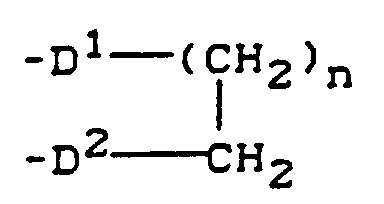 D1 und D2 unabhängig voneinander jeweils Sauerstoff, Schwefel oder die Gruppe NR3 bedeuten, wobei R3 die oben angegebene Bedeutung hat undn für 1, 2 oder 3 steht.
 - Verbindungen der allgemeinen Formel (II) gemäß Anspruch 1, in welcherR1 und R2 gleich oder verschieden sind und jeweils für Wasserstoff, Hydroxyl, Alkoxy mit 1 bis 4 C-Atomen, Benzyloxy, Acetyloxy, Benzoyloxy, Tri(alkyl)silyl mit jeweils 1 bis 4 C-Atomen in den Alkylresten, Dialkylamino mit jeweils 1 bis 4 C-Atomen in den Alkylresten oder für 2-Tetrahydropyryl stehtoderR1 und R2 zusammen für die Gruppe -O(CH2)n-CH2-D2-stehen, wobei n für 1, 2 oder 3 steht und D2 für Sauerstoff oder Alkylamin mit 1 bis 4 C-Atomen steht.
- Verfahren zur Herstellung von Verbindungen der allgemeinen Formel (II) gemäß Anspruch 1, dadurch gekennzeichnet, daß manA) Verbindungen der allgemeinen Formel (III)
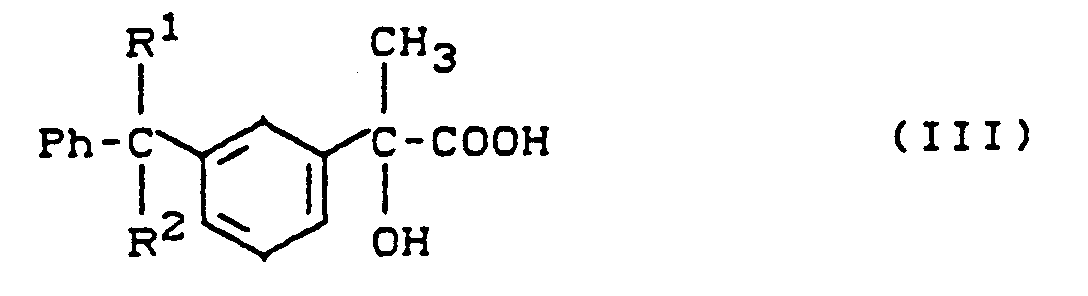 R1 und R2 die oben angegebene Bedeutung haben,nach üblichen Methoden dehydratisiert
oderB) Verbindungen der Formel (IV) R1 und R2 die oben angegebene Bedeutung haben undR9 für Alkoxy mit 1 bis 10 C-Atomen, Cycloalkoxy mit 5 bis 10 C-Atomen, Aralkoxy mit 7 bis 12 C-Atomen oder Aryloxy mit 6 bis 10 C-Atomen, das gegebenenfalls durch Alkyl oder Alkoxy mit jeweils 1 bis 5 C-Atomen substituiert ist, steht,nach üblichen Methoden hydrolysiert.
 - Verwendung von Verbindungen der allgemeinen Formel (II) gemäß Anspruch 1 zur Herstellung von (S)-Ketoprofen, dadurch gekennzeichnet, daß man die Verbindungen der allgemeinen Formel (II) in Gegenwart eines Katalysators der aus einem chiralen Übergangs-Metallkomplex besteht und gegebenenfalls in Gegenwart von inerten organischen Lösungsmitteln zu Verbindungen der allgemeinen Formel (I)
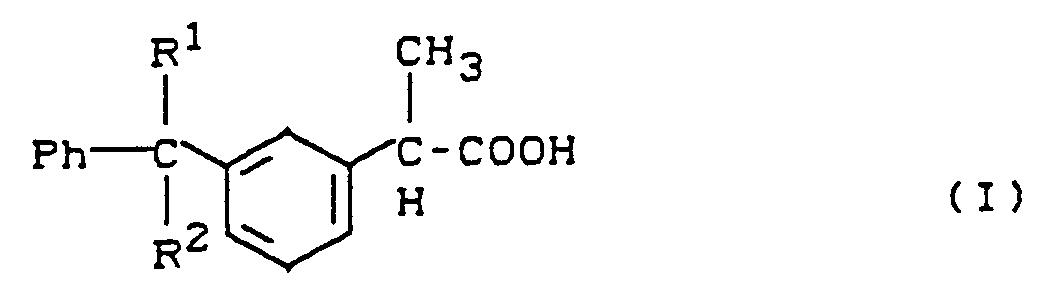 R1 und R2 die oben angegebene Bedeutung haben, aber nicht gleichzeitig für Wasserstoff stehen,hydriert und anschließend die Gruppe CR1R2 nach üblichen Methoden in eine Ketogruppe umwandelt.
 - Verbindungen der allgemeinen Formel (III)
 R1 und R2 die im Anspruch 1 angegebene Bedeutung haben.
 - Verbindungen der allgemeinen Formel (IV)
 R1 und R2 die im Anspruch 1 angegebene Bedeutung haben undR9 für Alkoxy mit 1 bis 10 C-Atomen, Cycloalkoxy mit 5 bis 10 C-Atomen, Aralkoxy mit 7 bis 12 C-Atomen oder Aryloxy mit 6 bis 10 C-Atomen, das gegebenenfalls durch Alkyl oder Alkoxy mit jeweils 1 bis 5 C-Atomen substituiert ist, steht.
 - Verfahren zur Herstellung von Verbindungen der allgemeinen Formel (IV), dadurch gekennzeichnet, daß man Verbindungen der allgemeinen Formel (V)
 R1 und R2 die im Anspruch 1 angegebene Bedeutung haben,in Gegenwart von Palladium auf Aktivkohle als Katalysator und Kohlenmonoxid bei Drucken zwischen 1 und 200 bar mit einem Alkohol unter Zugabe von Mineralsäure, gegebenenfalls in Anwesenheit eines inerten aprotischen Lösungsmittels bei Temperaturen zwischen 25 und 160°C umsetzt.
 - Verfahren zur Herstellung von Verbindungen der allgemeinen Formel (III), dadurch gekennzeichnet, daß man Grignard-Verbindungen der Formel (VI)
 R1 und R2 die im Anspruch 1 angegebene Bedeutung haben undHal für Fluor, Jod, Chlor oder Brom steht,mit einem Metall-pyruvat der allgemeinen Formel (VII)
Me⊕ ⊖OCC-CO-CH3 (VII)
in welcherMe für Alkali, Erdalkali (ein halbes Äquivalent) oder MgBr steht,in Gegenwart von organischen Lösungsmitteln bei Temperaturen zwischen -10°C und +120°C umsetzt.
Applications Claiming Priority (2)
| Application Number | Priority Date | Filing Date | Title |
|---|---|---|---|
| DE4128787A DE4128787A1 (de) | 1991-08-30 | 1991-08-30 | Neue zwischenprodukte und ihre verwendung bei der herstellung von s-ketoprofen |
| DE4128787 | 1991-08-30 |
Publications (3)
| Publication Number | Publication Date |
|---|---|
| EP0529444A2 EP0529444A2 (de) | 1993-03-03 |
| EP0529444A3 EP0529444A3 (en) | 1994-09-07 |
| EP0529444B1 true EP0529444B1 (de) | 1997-04-16 |
Family
ID=6439458
Family Applications (1)
| Application Number | Title | Priority Date | Filing Date |
|---|---|---|---|
| EP92113945A Expired - Lifetime EP0529444B1 (de) | 1991-08-30 | 1992-08-17 | 2-Arylpropensäuren und ihre Verwendung bei der Herstellung von S-Ketoprofen |
Country Status (11)
| Country | Link |
|---|---|
| US (1) | US5362907A (de) |
| EP (1) | EP0529444B1 (de) |
| JP (1) | JPH05279293A (de) |
| KR (1) | KR930004245A (de) |
| AT (1) | ATE151736T1 (de) |
| CA (1) | CA2077000A1 (de) |
| DE (2) | DE4128787A1 (de) |
| ES (1) | ES2100257T3 (de) |
| FI (1) | FI923842L (de) |
| HU (1) | HUT63599A (de) |
| TW (1) | TW213450B (de) |
Families Citing this family (2)
| Publication number | Priority date | Publication date | Assignee | Title |
|---|---|---|---|---|
| DE10212301A1 (de) | 2002-03-20 | 2003-10-02 | Bayer Ag | Verfahren zur Herstellung von Aryl-aminopropanolen |
| US20050079454A1 (en) * | 2003-10-14 | 2005-04-14 | Best Leroy E. | Contrast enhancement materials containing non-PFOS surfactants |
Family Cites Families (16)
| Publication number | Priority date | Publication date | Assignee | Title |
|---|---|---|---|---|
| FR1546478A (fr) * | 1967-01-27 | 1968-11-22 | Rhone Poulenc Sa | Nouveaux dérivés de l'acide benzoyl-3 phénylacétique et leur préparation |
| ES446581A1 (es) * | 1975-04-04 | 1977-06-16 | Boots Co Ltd | Un procedimiento para preparar acidos 2-arilpropionicos. |
| JPS54117404A (en) * | 1978-03-06 | 1979-09-12 | Sagami Chem Res Center | Reductive desulfurization of sulfides |
| JPS54148761A (en) * | 1978-05-16 | 1979-11-21 | Takayuki Shioiri | Novel 22*33*alphaahydroxybenzyl*phenyl* propionic acid and its manufacture |
| JPS552614A (en) * | 1978-06-21 | 1980-01-10 | Ota Seiyaku Kk | Preparation of 2-artl alkane acid |
| JPH064561B2 (ja) * | 1986-02-08 | 1994-01-19 | 日本石油化学株式会社 | (置換アリ−ル)カルボン酸の製造方法 |
| JPS62265293A (ja) * | 1986-05-13 | 1987-11-18 | Takasago Corp | ルテニウム−ホスフイン錯体 |
| DE3778857D1 (de) * | 1986-11-14 | 1992-06-11 | Takasago Perfumery Co Ltd | Katalytische produktion von optisch aktiven carbonsaeuren. |
| US4962124A (en) * | 1987-11-17 | 1990-10-09 | Analgesic Associates | Onset-hastened/enhanced antipyretic response |
| DE3824353A1 (de) * | 1988-07-19 | 1990-01-25 | Paz Arzneimittelentwicklung | Verfahren zur trennung von gemischen enantiomerer arylpropionsaeuren |
| JPH0757758B2 (ja) * | 1988-10-24 | 1995-06-21 | 高砂香料工業株式会社 | ルテニウム―ホスフィン錯体 |
| JPH0623150B2 (ja) * | 1988-11-15 | 1994-03-30 | 高砂香料工業株式会社 | 光学活性3−ヒドロキシブタン酸類の製造方法 |
| DE59009485D1 (de) * | 1989-01-26 | 1995-09-14 | Bayer Ag | Optisch aktive (Meth)Acrylsäure-Derivate, ihre Herstellung, ihre Polymerisation zu optisch aktiven Polymeren und deren Verwendung. |
| DE59009670D1 (de) * | 1989-05-18 | 1995-10-26 | Hoffmann La Roche | Phosphorverbindungen. |
| JPH0733392B2 (ja) * | 1989-06-16 | 1995-04-12 | 高砂香料工業株式会社 | 2,2’―ビス〔ジー(m―トリル)ホスフィノ〕―1,1’―ビナフチル |
| FR2651494B1 (fr) * | 1989-09-05 | 1993-01-08 | Rhone Poulenc Sante | Procede de preparation d'acides aryl-2 propioniques optiquement actifs. |
-
1991
- 1991-08-30 DE DE4128787A patent/DE4128787A1/de not_active Withdrawn
-
1992
- 1992-07-31 TW TW081106051A patent/TW213450B/zh active
- 1992-08-17 DE DE59208349T patent/DE59208349D1/de not_active Expired - Fee Related
- 1992-08-17 AT AT92113945T patent/ATE151736T1/de not_active IP Right Cessation
- 1992-08-17 ES ES92113945T patent/ES2100257T3/es not_active Expired - Lifetime
- 1992-08-17 EP EP92113945A patent/EP0529444B1/de not_active Expired - Lifetime
- 1992-08-21 US US07/934,044 patent/US5362907A/en not_active Expired - Fee Related
- 1992-08-27 CA CA002077000A patent/CA2077000A1/en not_active Abandoned
- 1992-08-27 FI FI923842A patent/FI923842L/fi unknown
- 1992-08-28 JP JP4251936A patent/JPH05279293A/ja active Pending
- 1992-08-29 HU HU9202787A patent/HUT63599A/hu unknown
- 1992-08-29 KR KR1019920015637A patent/KR930004245A/ko not_active Withdrawn
Also Published As
| Publication number | Publication date |
|---|---|
| TW213450B (de) | 1993-09-21 |
| ES2100257T3 (es) | 1997-06-16 |
| FI923842A7 (fi) | 1993-03-01 |
| JPH05279293A (ja) | 1993-10-26 |
| FI923842L (fi) | 1993-03-01 |
| EP0529444A3 (en) | 1994-09-07 |
| DE4128787A1 (de) | 1993-03-04 |
| KR930004245A (ko) | 1993-03-22 |
| US5362907A (en) | 1994-11-08 |
| EP0529444A2 (de) | 1993-03-03 |
| ATE151736T1 (de) | 1997-05-15 |
| CA2077000A1 (en) | 1993-03-01 |
| DE59208349D1 (de) | 1997-05-22 |
| FI923842A0 (fi) | 1992-08-27 |
| HUT63599A (en) | 1993-09-28 |
| HU9202787D0 (en) | 1992-12-28 |
Similar Documents
| Publication | Publication Date | Title |
|---|---|---|
| CH652385A5 (fr) | 5-(2-facultativement substitue-4-trifluoromethyl-6-facultativement substitue-phenoxy)-2-nitro, -halo ou -cyano-phenylcarbonyle alpha substitues-oximes et derives carbonyles correspondants. | |
| Burckhalter et al. | Ethylene and Phenylacetyl Chloride in the Friedel-Crafts Reaction. Novel Syntheses of 2-Tetralones and Benzofuranones1 | |
| DE2458164A1 (de) | Verfahren zur herstellung von neuen heterocyclischen verbindungen | |
| DE2439294A1 (de) | Neue phenyl-alkenole und alkanole und verfahren zu deren herstellung | |
| DE2542612C2 (de) | ||
| DE69713040T2 (de) | Verfahren zur Herstellung von Cyclopropylacetylen und dessen Derivaten | |
| DE3046512A1 (de) | Verfahren zur kupplung von anilin- und phenyl-verbindungen | |
| EP0565975A2 (de) | Verfahren zur Herstellung von Isoprenderivaten | |
| EP0529444A2 (de) | 2-Arylpropensäuren und ihre Verwendung bei der Herstellung von S-Ketoprofen | |
| DD206371A5 (de) | Verfahren zur herstellung eines 2s chiralen alkohols | |
| DE2613817A1 (de) | Phenylpropionsaeuren, pyruvatverfahren zu ihrer herstellung und verwendung | |
| DE69903498T2 (de) | Verfahren zur Herstellung von 13-cis-Retinsäure | |
| DD202427A5 (de) | Verfahren zur herstellung von alpha-halogenalkylamiden | |
| DE60304226T2 (de) | Verfahren zur herstellung 2,5-disubstituierter 3-alkylthiophenen | |
| EP0311086A1 (de) | N-fluorierte Sulfonamide, Verfahren zu deren Herstellung und deren Verwendung | |
| DE3046523A1 (de) | Verfahren zur herstellung von hydratrop-saeuren | |
| DE2552615A1 (de) | Verfahren zur herstellung von dihalogenvinylcyclopropancarboxylaten | |
| DE3145455A1 (de) | In 1-stellung substituierte (3r,7r)-3,7,11-trimethyl-5-dodecene, deren verwendung als zwischenprodukt fuer die synthese der seitenkette von (r,r,r)-(alpha)-tocopherol sowie deren herstellung aus teilweise neuen ausgangsverbindungen | |
| EP0153689A2 (de) | Prostaglandin-Zwischenprodukte | |
| EP0051791A1 (de) | 2,2-Dimethylcyclobutanone und Verfahren zu ihrer Herstellung | |
| DD209617A5 (de) | Verfahren zur herstellung von optisch aktivem 1-(6-methoxy-2-naphthyl)-2-(alkoxycarbonyl)-amino-propanon sowie von dessen derivaten und halogenanalogen | |
| DE3145436A1 (de) | Neue optisch aktive 5-chlor- oder 5-brom-3-methyl-pentanderivate, deren hertellung und deren verwendung als zwischenprodukt fuer die synthese der seitenkette von (r,r,r)- - tocopherol | |
| DE3733792A1 (de) | Verfahren zur herstellung von polyfluorenolaten | |
| DE2532799C2 (de) | 7-Alkoxy-6-methyl-5-hepten-2-one | |
| WO2009040054A1 (de) | Verfahren zur herstellung optisch aktiver alpha-alkylcarbonylverbindungen |
Legal Events
| Date | Code | Title | Description |
|---|---|---|---|
| PUAI | Public reference made under article 153(3) epc to a published international application that has entered the european phase |
Free format text: ORIGINAL CODE: 0009012 |
|
| AK | Designated contracting states |
Kind code of ref document: A2 Designated state(s): AT BE CH DE DK ES FR GB GR IT LI LU MC NL PT SE |
|
| PUAL | Search report despatched |
Free format text: ORIGINAL CODE: 0009013 |
|
| RHK1 | Main classification (correction) |
Ipc: C07C 43/166 |
|
| AK | Designated contracting states |
Kind code of ref document: A3 Designated state(s): AT BE CH DE DK ES FR GB GR IT LI LU MC NL PT SE |
|
| 17P | Request for examination filed |
Effective date: 19950220 |
|
| 17Q | First examination report despatched |
Effective date: 19951228 |
|
| GRAG | Despatch of communication of intention to grant |
Free format text: ORIGINAL CODE: EPIDOS AGRA |
|
| GRAH | Despatch of communication of intention to grant a patent |
Free format text: ORIGINAL CODE: EPIDOS IGRA |
|
| GRAH | Despatch of communication of intention to grant a patent |
Free format text: ORIGINAL CODE: EPIDOS IGRA |
|
| GRAA | (expected) grant |
Free format text: ORIGINAL CODE: 0009210 |
|
| AK | Designated contracting states |
Kind code of ref document: B1 Designated state(s): AT BE CH DE DK ES FR GB GR IT LI LU MC NL PT SE |
|
| PG25 | Lapsed in a contracting state [announced via postgrant information from national office to epo] |
Ref country code: NL Effective date: 19970416 Ref country code: GR Free format text: LAPSE BECAUSE OF FAILURE TO SUBMIT A TRANSLATION OF THE DESCRIPTION OR TO PAY THE FEE WITHIN THE PRESCRIBED TIME-LIMIT Effective date: 19970416 Ref country code: DK Effective date: 19970416 |
|
| REF | Corresponds to: |
Ref document number: 151736 Country of ref document: AT Date of ref document: 19970515 Kind code of ref document: T |
|
| REG | Reference to a national code |
Ref country code: CH Ref legal event code: EP |
|
| GBT | Gb: translation of ep patent filed (gb section 77(6)(a)/1977) |
Effective date: 19970421 |
|
| REG | Reference to a national code |
Ref country code: CH Ref legal event code: NV Representative=s name: E. BLUM & CO. PATENTANWAELTE |
|
| REF | Corresponds to: |
Ref document number: 59208349 Country of ref document: DE Date of ref document: 19970522 |
|
| ITF | It: translation for a ep patent filed | ||
| REG | Reference to a national code |
Ref country code: ES Ref legal event code: FG2A Ref document number: 2100257 Country of ref document: ES Kind code of ref document: T3 |
|
| ET | Fr: translation filed | ||
| PGFP | Annual fee paid to national office [announced via postgrant information from national office to epo] |
Ref country code: DE Payment date: 19970710 Year of fee payment: 6 |
|
| PG25 | Lapsed in a contracting state [announced via postgrant information from national office to epo] |
Ref country code: SE Effective date: 19970716 Ref country code: PT Effective date: 19970716 |
|
| PGFP | Annual fee paid to national office [announced via postgrant information from national office to epo] |
Ref country code: FR Payment date: 19970730 Year of fee payment: 6 |
|
| PGFP | Annual fee paid to national office [announced via postgrant information from national office to epo] |
Ref country code: GB Payment date: 19970808 Year of fee payment: 6 Ref country code: ES Payment date: 19970808 Year of fee payment: 6 Ref country code: CH Payment date: 19970808 Year of fee payment: 6 |
|
| PG25 | Lapsed in a contracting state [announced via postgrant information from national office to epo] |
Ref country code: LU Free format text: LAPSE BECAUSE OF NON-PAYMENT OF DUE FEES Effective date: 19970817 |
|
| PGFP | Annual fee paid to national office [announced via postgrant information from national office to epo] |
Ref country code: AT Payment date: 19970820 Year of fee payment: 6 |
|
| PGFP | Annual fee paid to national office [announced via postgrant information from national office to epo] |
Ref country code: BE Payment date: 19970827 Year of fee payment: 6 |
|
| NLV1 | Nl: lapsed or annulled due to failure to fulfill the requirements of art. 29p and 29m of the patents act | ||
| PLBE | No opposition filed within time limit |
Free format text: ORIGINAL CODE: 0009261 |
|
| PG25 | Lapsed in a contracting state [announced via postgrant information from national office to epo] |
Ref country code: MC Free format text: LAPSE BECAUSE OF NON-PAYMENT OF DUE FEES Effective date: 19980228 |
|
| 26N | No opposition filed | ||
| PG25 | Lapsed in a contracting state [announced via postgrant information from national office to epo] |
Ref country code: GB Free format text: LAPSE BECAUSE OF NON-PAYMENT OF DUE FEES Effective date: 19980817 Ref country code: AT Free format text: LAPSE BECAUSE OF NON-PAYMENT OF DUE FEES Effective date: 19980817 |
|
| PG25 | Lapsed in a contracting state [announced via postgrant information from national office to epo] |
Ref country code: ES Free format text: LAPSE BECAUSE OF NON-PAYMENT OF DUE FEES Effective date: 19980818 |
|
| PG25 | Lapsed in a contracting state [announced via postgrant information from national office to epo] |
Ref country code: LI Free format text: LAPSE BECAUSE OF NON-PAYMENT OF DUE FEES Effective date: 19980831 Ref country code: CH Free format text: LAPSE BECAUSE OF NON-PAYMENT OF DUE FEES Effective date: 19980831 Ref country code: BE Free format text: LAPSE BECAUSE OF NON-PAYMENT OF DUE FEES Effective date: 19980831 |
|
| BERE | Be: lapsed |
Owner name: BAYER A.G. Effective date: 19980831 |
|
| GBPC | Gb: european patent ceased through non-payment of renewal fee |
Effective date: 19980817 |
|
| REG | Reference to a national code |
Ref country code: CH Ref legal event code: PL |
|
| PG25 | Lapsed in a contracting state [announced via postgrant information from national office to epo] |
Ref country code: FR Free format text: LAPSE BECAUSE OF NON-PAYMENT OF DUE FEES Effective date: 19990430 |
|
| PG25 | Lapsed in a contracting state [announced via postgrant information from national office to epo] |
Ref country code: DE Free format text: LAPSE BECAUSE OF NON-PAYMENT OF DUE FEES Effective date: 19990601 |
|
| REG | Reference to a national code |
Ref country code: FR Ref legal event code: ST |
|
| REG | Reference to a national code |
Ref country code: ES Ref legal event code: FD2A Effective date: 19990910 |
|
| PG25 | Lapsed in a contracting state [announced via postgrant information from national office to epo] |
Ref country code: IT Free format text: LAPSE BECAUSE OF NON-PAYMENT OF DUE FEES;WARNING: LAPSES OF ITALIAN PATENTS WITH EFFECTIVE DATE BEFORE 2007 MAY HAVE OCCURRED AT ANY TIME BEFORE 2007. THE CORRECT EFFECTIVE DATE MAY BE DIFFERENT FROM THE ONE RECORDED. Effective date: 20050817 |