EP0531437B1 - Supplement d'hemicellulase ameliorant le rendement en energie d'aliments contenant de l'hemicellulose et produit alimentaire pour animaux - Google Patents
Supplement d'hemicellulase ameliorant le rendement en energie d'aliments contenant de l'hemicellulose et produit alimentaire pour animaux Download PDFInfo
- Publication number
- EP0531437B1 EP0531437B1 EP91911371A EP91911371A EP0531437B1 EP 0531437 B1 EP0531437 B1 EP 0531437B1 EP 91911371 A EP91911371 A EP 91911371A EP 91911371 A EP91911371 A EP 91911371A EP 0531437 B1 EP0531437 B1 EP 0531437B1
- Authority
- EP
- European Patent Office
- Prior art keywords
- hemicellulase
- enzyme
- feed
- mannanase
- feed composition
- Prior art date
- Legal status (The legal status is an assumption and is not a legal conclusion. Google has not performed a legal analysis and makes no representation as to the accuracy of the status listed.)
- Revoked
Links
- 241001465754 Metazoa Species 0.000 title claims description 62
- 229920002488 Hemicellulose Polymers 0.000 title claims description 35
- 108010002430 hemicellulase Proteins 0.000 title abstract description 127
- 229940059442 hemicellulase Drugs 0.000 title abstract description 123
- 235000013305 food Nutrition 0.000 title description 15
- 239000013589 supplement Substances 0.000 title description 2
- 108090000790 Enzymes Proteins 0.000 claims abstract description 120
- 102000004190 Enzymes Human genes 0.000 claims abstract description 120
- 239000000203 mixture Substances 0.000 claims abstract description 71
- 150000001720 carbohydrates Chemical class 0.000 claims abstract description 27
- 235000014633 carbohydrates Nutrition 0.000 claims abstract description 27
- 229920000057 Mannan Polymers 0.000 claims description 33
- 235000010469 Glycine max Nutrition 0.000 claims description 24
- 238000002360 preparation method Methods 0.000 claims description 22
- 230000015556 catabolic process Effects 0.000 claims description 21
- 238000006731 degradation reaction Methods 0.000 claims description 21
- 241000193830 Bacillus <bacterium> Species 0.000 claims description 19
- 244000068988 Glycine max Species 0.000 claims description 17
- 102000004169 proteins and genes Human genes 0.000 claims description 15
- 108090000623 proteins and genes Proteins 0.000 claims description 15
- 238000004519 manufacturing process Methods 0.000 claims description 14
- 102100032487 Beta-mannosidase Human genes 0.000 claims description 13
- 108010055059 beta-Mannosidase Proteins 0.000 claims description 13
- 240000008042 Zea mays Species 0.000 claims description 11
- 235000005824 Zea mays ssp. parviglumis Nutrition 0.000 claims description 11
- 235000002017 Zea mays subsp mays Nutrition 0.000 claims description 11
- 235000005822 corn Nutrition 0.000 claims description 11
- 230000012010 growth Effects 0.000 claims description 11
- 229940088594 vitamin Drugs 0.000 claims description 10
- 235000013343 vitamin Nutrition 0.000 claims description 10
- 239000011782 vitamin Substances 0.000 claims description 10
- 229930003231 vitamin Natural products 0.000 claims description 10
- 229910052500 inorganic mineral Inorganic materials 0.000 claims description 8
- 239000011707 mineral Substances 0.000 claims description 8
- 241000219823 Medicago Species 0.000 claims description 7
- 235000017587 Medicago sativa ssp. sativa Nutrition 0.000 claims description 7
- 235000019786 weight gain Nutrition 0.000 claims description 7
- 230000004584 weight gain Effects 0.000 claims description 4
- 241000282412 Homo Species 0.000 claims description 3
- 230000007423 decrease Effects 0.000 claims description 3
- 238000005453 pelletization Methods 0.000 claims description 2
- 229940088598 enzyme Drugs 0.000 abstract description 119
- 244000005700 microbiome Species 0.000 abstract description 64
- 239000002689 soil Substances 0.000 abstract description 21
- 235000016709 nutrition Nutrition 0.000 abstract description 4
- 230000002068 genetic effect Effects 0.000 abstract description 2
- 230000002708 enhancing effect Effects 0.000 abstract 1
- 230000000694 effects Effects 0.000 description 64
- 238000000034 method Methods 0.000 description 43
- 238000000855 fermentation Methods 0.000 description 40
- 230000004151 fermentation Effects 0.000 description 40
- PEDCQBHIVMGVHV-UHFFFAOYSA-N Glycerine Chemical compound OCC(O)CO PEDCQBHIVMGVHV-UHFFFAOYSA-N 0.000 description 36
- 239000000243 solution Substances 0.000 description 33
- 238000012360 testing method Methods 0.000 description 29
- 244000303965 Cyamopsis psoralioides Species 0.000 description 23
- 235000019764 Soybean Meal Nutrition 0.000 description 23
- 239000004455 soybean meal Substances 0.000 description 23
- CSCPPACGZOOCGX-UHFFFAOYSA-N Acetone Chemical compound CC(C)=O CSCPPACGZOOCGX-UHFFFAOYSA-N 0.000 description 18
- 239000002609 medium Substances 0.000 description 18
- 241000287828 Gallus gallus Species 0.000 description 17
- 238000011534 incubation Methods 0.000 description 17
- 239000002244 precipitate Substances 0.000 description 17
- 210000004027 cell Anatomy 0.000 description 16
- 239000012141 concentrate Substances 0.000 description 16
- FAPWRFPIFSIZLT-UHFFFAOYSA-M Sodium chloride Chemical compound [Na+].[Cl-] FAPWRFPIFSIZLT-UHFFFAOYSA-M 0.000 description 15
- 239000006228 supernatant Substances 0.000 description 15
- 239000012528 membrane Substances 0.000 description 14
- 239000008188 pellet Substances 0.000 description 14
- 235000013330 chicken meat Nutrition 0.000 description 13
- 235000018102 proteins Nutrition 0.000 description 13
- 235000013619 trace mineral Nutrition 0.000 description 13
- 239000011573 trace mineral Substances 0.000 description 13
- 235000011187 glycerol Nutrition 0.000 description 12
- OKTJSMMVPCPJKN-UHFFFAOYSA-N Carbon Chemical compound [C] OKTJSMMVPCPJKN-UHFFFAOYSA-N 0.000 description 11
- 229920002907 Guar gum Polymers 0.000 description 11
- 229910052799 carbon Inorganic materials 0.000 description 11
- 235000005911 diet Nutrition 0.000 description 11
- 239000000665 guar gum Substances 0.000 description 11
- 235000010417 guar gum Nutrition 0.000 description 11
- 229960002154 guar gum Drugs 0.000 description 11
- 238000000108 ultra-filtration Methods 0.000 description 11
- 229910001868 water Inorganic materials 0.000 description 11
- 241000271566 Aves Species 0.000 description 10
- 229940041514 candida albicans extract Drugs 0.000 description 10
- 235000012054 meals Nutrition 0.000 description 10
- 230000000813 microbial effect Effects 0.000 description 10
- 239000007787 solid Substances 0.000 description 10
- 239000000758 substrate Substances 0.000 description 10
- 239000012138 yeast extract Substances 0.000 description 10
- 238000010790 dilution Methods 0.000 description 9
- 239000012895 dilution Substances 0.000 description 9
- 230000037396 body weight Effects 0.000 description 8
- 230000037213 diet Effects 0.000 description 8
- 239000000463 material Substances 0.000 description 8
- 239000008363 phosphate buffer Substances 0.000 description 8
- 239000000523 sample Substances 0.000 description 8
- XLYOFNOQVPJJNP-UHFFFAOYSA-N water Substances O XLYOFNOQVPJJNP-UHFFFAOYSA-N 0.000 description 8
- QGZKDVFQNNGYKY-UHFFFAOYSA-N Ammonia Chemical compound N QGZKDVFQNNGYKY-UHFFFAOYSA-N 0.000 description 7
- 244000060011 Cocos nucifera Species 0.000 description 7
- 235000013162 Cocos nucifera Nutrition 0.000 description 7
- 229910052921 ammonium sulfate Inorganic materials 0.000 description 7
- QVGXLLKOCUKJST-UHFFFAOYSA-N atomic oxygen Chemical compound [O] QVGXLLKOCUKJST-UHFFFAOYSA-N 0.000 description 7
- 229910052564 epsomite Inorganic materials 0.000 description 7
- 238000011081 inoculation Methods 0.000 description 7
- 229910052760 oxygen Inorganic materials 0.000 description 7
- 239000001301 oxygen Substances 0.000 description 7
- 239000011780 sodium chloride Substances 0.000 description 7
- 239000007836 KH2PO4 Substances 0.000 description 6
- 229920000161 Locust bean gum Polymers 0.000 description 6
- BFNBIHQBYMNNAN-UHFFFAOYSA-N ammonium sulfate Chemical compound N.N.OS(O)(=O)=O BFNBIHQBYMNNAN-UHFFFAOYSA-N 0.000 description 6
- 238000005187 foaming Methods 0.000 description 6
- 235000010420 locust bean gum Nutrition 0.000 description 6
- 235000010755 mineral Nutrition 0.000 description 6
- 229910000402 monopotassium phosphate Inorganic materials 0.000 description 6
- 235000015097 nutrients Nutrition 0.000 description 6
- GNSKLFRGEWLPPA-UHFFFAOYSA-M potassium dihydrogen phosphate Chemical compound [K+].OP(O)([O-])=O GNSKLFRGEWLPPA-UHFFFAOYSA-M 0.000 description 6
- 239000000843 powder Substances 0.000 description 6
- 239000000047 product Substances 0.000 description 6
- 238000000746 purification Methods 0.000 description 6
- 238000011084 recovery Methods 0.000 description 6
- 229920001817 Agar Polymers 0.000 description 5
- 240000004808 Saccharomyces cerevisiae Species 0.000 description 5
- 239000008272 agar Substances 0.000 description 5
- 238000013019 agitation Methods 0.000 description 5
- 238000004458 analytical method Methods 0.000 description 5
- 239000002518 antifoaming agent Substances 0.000 description 5
- 238000012258 culturing Methods 0.000 description 5
- 235000014113 dietary fatty acids Nutrition 0.000 description 5
- 239000000194 fatty acid Substances 0.000 description 5
- 229930195729 fatty acid Natural products 0.000 description 5
- 150000004665 fatty acids Chemical class 0.000 description 5
- XLYOFNOQVPJJNP-ZSJDYOACSA-N heavy water Substances [2H]O[2H] XLYOFNOQVPJJNP-ZSJDYOACSA-N 0.000 description 5
- 239000004615 ingredient Substances 0.000 description 5
- 238000005259 measurement Methods 0.000 description 5
- 108091033319 polynucleotide Proteins 0.000 description 5
- 102000040430 polynucleotide Human genes 0.000 description 5
- 239000002157 polynucleotide Substances 0.000 description 5
- 229920001296 polysiloxane Polymers 0.000 description 5
- 230000009467 reduction Effects 0.000 description 5
- 230000001954 sterilising effect Effects 0.000 description 5
- 238000004659 sterilization and disinfection Methods 0.000 description 5
- WQZGKKKJIJFFOK-SVZMEOIVSA-N (+)-Galactose Chemical compound OC[C@H]1OC(O)[C@H](O)[C@@H](O)[C@H]1O WQZGKKKJIJFFOK-SVZMEOIVSA-N 0.000 description 4
- 235000014469 Bacillus subtilis Nutrition 0.000 description 4
- 241001414203 Bruchus lentis Species 0.000 description 4
- 241000233866 Fungi Species 0.000 description 4
- DHMQDGOQFOQNFH-UHFFFAOYSA-N Glycine Chemical compound NCC(O)=O DHMQDGOQFOQNFH-UHFFFAOYSA-N 0.000 description 4
- QAOWNCQODCNURD-UHFFFAOYSA-N Sulfuric acid Chemical compound OS(O)(=O)=O QAOWNCQODCNURD-UHFFFAOYSA-N 0.000 description 4
- 238000005119 centrifugation Methods 0.000 description 4
- 239000000470 constituent Substances 0.000 description 4
- 230000003247 decreasing effect Effects 0.000 description 4
- 229940079919 digestives enzyme preparation Drugs 0.000 description 4
- 210000001035 gastrointestinal tract Anatomy 0.000 description 4
- 239000012510 hollow fiber Substances 0.000 description 4
- JVTAAEKCZFNVCJ-UHFFFAOYSA-N lactic acid Chemical compound CC(O)C(O)=O JVTAAEKCZFNVCJ-UHFFFAOYSA-N 0.000 description 4
- 150000002632 lipids Chemical class 0.000 description 4
- 238000012545 processing Methods 0.000 description 4
- 238000012216 screening Methods 0.000 description 4
- 239000007858 starting material Substances 0.000 description 4
- YTPMCWYIRHLEGM-BQYQJAHWSA-N 1-[(e)-2-propylsulfonylethenyl]sulfonylpropane Chemical compound CCCS(=O)(=O)\C=C\S(=O)(=O)CCC YTPMCWYIRHLEGM-BQYQJAHWSA-N 0.000 description 3
- 241000894006 Bacteria Species 0.000 description 3
- UXVMQQNJUSDDNG-UHFFFAOYSA-L Calcium chloride Chemical compound [Cl-].[Cl-].[Ca+2] UXVMQQNJUSDDNG-UHFFFAOYSA-L 0.000 description 3
- 108020004414 DNA Proteins 0.000 description 3
- LYCAIKOWRPUZTN-UHFFFAOYSA-N Ethylene glycol Chemical compound OCCO LYCAIKOWRPUZTN-UHFFFAOYSA-N 0.000 description 3
- 241000186660 Lactobacillus Species 0.000 description 3
- 240000003183 Manihot esculenta Species 0.000 description 3
- 235000016735 Manihot esculenta subsp esculenta Nutrition 0.000 description 3
- OKKJLVBELUTLKV-UHFFFAOYSA-N Methanol Chemical compound OC OKKJLVBELUTLKV-UHFFFAOYSA-N 0.000 description 3
- HEMHJVSKTPXQMS-UHFFFAOYSA-M Sodium hydroxide Chemical compound [OH-].[Na+] HEMHJVSKTPXQMS-UHFFFAOYSA-M 0.000 description 3
- 150000001413 amino acids Chemical group 0.000 description 3
- 235000011130 ammonium sulphate Nutrition 0.000 description 3
- 238000013459 approach Methods 0.000 description 3
- 239000001110 calcium chloride Substances 0.000 description 3
- 229910001628 calcium chloride Inorganic materials 0.000 description 3
- 229910052927 chalcanthite Inorganic materials 0.000 description 3
- 230000008859 change Effects 0.000 description 3
- 239000002299 complementary DNA Substances 0.000 description 3
- 230000000378 dietary effect Effects 0.000 description 3
- 230000007062 hydrolysis Effects 0.000 description 3
- 238000006460 hydrolysis reaction Methods 0.000 description 3
- 239000000711 locust bean gum Substances 0.000 description 3
- 229910000357 manganese(II) sulfate Inorganic materials 0.000 description 3
- 229910052603 melanterite Inorganic materials 0.000 description 3
- 238000009629 microbiological culture Methods 0.000 description 3
- 239000012466 permeate Substances 0.000 description 3
- 229920001282 polysaccharide Polymers 0.000 description 3
- 244000144977 poultry Species 0.000 description 3
- 235000013594 poultry meat Nutrition 0.000 description 3
- 238000001556 precipitation Methods 0.000 description 3
- 230000008569 process Effects 0.000 description 3
- 230000010076 replication Effects 0.000 description 3
- 150000003839 salts Chemical class 0.000 description 3
- 239000013598 vector Substances 0.000 description 3
- 229910000368 zinc sulfate Inorganic materials 0.000 description 3
- YBJHBAHKTGYVGT-ZKWXMUAHSA-N (+)-Biotin Chemical compound N1C(=O)N[C@@H]2[C@H](CCCCC(=O)O)SC[C@@H]21 YBJHBAHKTGYVGT-ZKWXMUAHSA-N 0.000 description 2
- LUEWUZLMQUOBSB-FSKGGBMCSA-N (2s,3s,4s,5s,6r)-2-[(2r,3s,4r,5r,6s)-6-[(2r,3s,4r,5s,6s)-4,5-dihydroxy-2-(hydroxymethyl)-6-[(2r,4r,5s,6r)-4,5,6-trihydroxy-2-(hydroxymethyl)oxan-3-yl]oxyoxan-3-yl]oxy-4,5-dihydroxy-2-(hydroxymethyl)oxan-3-yl]oxy-6-(hydroxymethyl)oxane-3,4,5-triol Chemical compound O[C@H]1[C@@H](O)[C@H](O)[C@@H](CO)O[C@H]1O[C@@H]1[C@@H](CO)O[C@@H](O[C@@H]2[C@H](O[C@@H](OC3[C@H](O[C@@H](O)[C@@H](O)[C@H]3O)CO)[C@@H](O)[C@H]2O)CO)[C@H](O)[C@H]1O LUEWUZLMQUOBSB-FSKGGBMCSA-N 0.000 description 2
- 241000607534 Aeromonas Species 0.000 description 2
- 241000228212 Aspergillus Species 0.000 description 2
- 244000063299 Bacillus subtilis Species 0.000 description 2
- 241000149420 Bothrometopus brevis Species 0.000 description 2
- 101100070731 Bradyrhizobium diazoefficiens (strain JCM 10833 / BCRC 13528 / IAM 13628 / NBRC 14792 / USDA 110) hisE2 gene Proteins 0.000 description 2
- VTYYLEPIZMXCLO-UHFFFAOYSA-L Calcium carbonate Chemical compound [Ca+2].[O-]C([O-])=O VTYYLEPIZMXCLO-UHFFFAOYSA-L 0.000 description 2
- 229910021580 Cobalt(II) chloride Inorganic materials 0.000 description 2
- WQZGKKKJIJFFOK-QTVWNMPRSA-N D-mannopyranose Chemical compound OC[C@H]1OC(O)[C@@H](O)[C@@H](O)[C@@H]1O WQZGKKKJIJFFOK-QTVWNMPRSA-N 0.000 description 2
- 229920002581 Glucomannan Polymers 0.000 description 2
- 239000004471 Glycine Substances 0.000 description 2
- SIKJAQJRHWYJAI-UHFFFAOYSA-N Indole Chemical compound C1=CC=C2NC=CC2=C1 SIKJAQJRHWYJAI-UHFFFAOYSA-N 0.000 description 2
- 229910021578 Iron(III) chloride Inorganic materials 0.000 description 2
- GUBGYTABKSRVRQ-QKKXKWKRSA-N Lactose Natural products OC[C@H]1O[C@@H](O[C@H]2[C@H](O)[C@@H](O)C(O)O[C@@H]2CO)[C@H](O)[C@@H](O)[C@H]1O GUBGYTABKSRVRQ-QKKXKWKRSA-N 0.000 description 2
- 229910004619 Na2MoO4 Inorganic materials 0.000 description 2
- PVNIIMVLHYAWGP-UHFFFAOYSA-N Niacin Chemical compound OC(=O)C1=CC=CN=C1 PVNIIMVLHYAWGP-UHFFFAOYSA-N 0.000 description 2
- 241000316848 Rhodococcus <scale insect> Species 0.000 description 2
- AUNGANRZJHBGPY-SCRDCRAPSA-N Riboflavin Chemical compound OC[C@@H](O)[C@@H](O)[C@@H](O)CN1C=2C=C(C)C(C)=CC=2N=C2C1=NC(=O)NC2=O AUNGANRZJHBGPY-SCRDCRAPSA-N 0.000 description 2
- 241000187747 Streptomyces Species 0.000 description 2
- 244000299461 Theobroma cacao Species 0.000 description 2
- DRTQHJPVMGBUCF-XVFCMESISA-N Uridine Chemical compound O[C@@H]1[C@H](O)[C@@H](CO)O[C@H]1N1C(=O)NC(=O)C=C1 DRTQHJPVMGBUCF-XVFCMESISA-N 0.000 description 2
- 230000003698 anagen phase Effects 0.000 description 2
- 238000000540 analysis of variance Methods 0.000 description 2
- 238000003556 assay Methods 0.000 description 2
- 230000008901 benefit Effects 0.000 description 2
- SRBFZHDQGSBBOR-UHFFFAOYSA-N beta-D-Pyranose-Lyxose Natural products OC1COC(O)C(O)C1O SRBFZHDQGSBBOR-UHFFFAOYSA-N 0.000 description 2
- 210000004556 brain Anatomy 0.000 description 2
- 238000012512 characterization method Methods 0.000 description 2
- 239000003795 chemical substances by application Substances 0.000 description 2
- 235000020940 control diet Nutrition 0.000 description 2
- 238000007796 conventional method Methods 0.000 description 2
- 230000002255 enzymatic effect Effects 0.000 description 2
- 239000003797 essential amino acid Substances 0.000 description 2
- 235000020776 essential amino acid Nutrition 0.000 description 2
- 235000020774 essential nutrients Nutrition 0.000 description 2
- 238000001914 filtration Methods 0.000 description 2
- 239000000499 gel Substances 0.000 description 2
- 229940046240 glucomannan Drugs 0.000 description 2
- 239000001963 growth medium Substances 0.000 description 2
- 238000001802 infusion Methods 0.000 description 2
- RBTARNINKXHZNM-UHFFFAOYSA-K iron trichloride Chemical compound Cl[Fe](Cl)Cl RBTARNINKXHZNM-UHFFFAOYSA-K 0.000 description 2
- 238000002955 isolation Methods 0.000 description 2
- 235000014655 lactic acid Nutrition 0.000 description 2
- 239000004310 lactic acid Substances 0.000 description 2
- 229940039696 lactobacillus Drugs 0.000 description 2
- 239000008101 lactose Substances 0.000 description 2
- SQQMAOCOWKFBNP-UHFFFAOYSA-L manganese(II) sulfate Chemical compound [Mn+2].[O-]S([O-])(=O)=O SQQMAOCOWKFBNP-UHFFFAOYSA-L 0.000 description 2
- LXCFILQKKLGQFO-UHFFFAOYSA-N methylparaben Chemical compound COC(=O)C1=CC=C(O)C=C1 LXCFILQKKLGQFO-UHFFFAOYSA-N 0.000 description 2
- 244000005706 microflora Species 0.000 description 2
- 238000002156 mixing Methods 0.000 description 2
- 150000002772 monosaccharides Chemical class 0.000 description 2
- 230000000050 nutritive effect Effects 0.000 description 2
- 230000003287 optical effect Effects 0.000 description 2
- 238000003752 polymerase chain reaction Methods 0.000 description 2
- 239000005017 polysaccharide Substances 0.000 description 2
- 150000004804 polysaccharides Chemical class 0.000 description 2
- LXNHXLLTXMVWPM-UHFFFAOYSA-N pyridoxine Chemical compound CC1=NC=C(CO)C(CO)=C1O LXNHXLLTXMVWPM-UHFFFAOYSA-N 0.000 description 2
- 238000002415 sodium dodecyl sulfate polyacrylamide gel electrophoresis Methods 0.000 description 2
- 239000011684 sodium molybdate Substances 0.000 description 2
- TVXXNOYZHKPKGW-UHFFFAOYSA-N sodium molybdate (anhydrous) Chemical compound [Na+].[Na+].[O-][Mo]([O-])(=O)=O TVXXNOYZHKPKGW-UHFFFAOYSA-N 0.000 description 2
- 241000894007 species Species 0.000 description 2
- 239000007921 spray Substances 0.000 description 2
- 230000001131 transforming effect Effects 0.000 description 2
- 235000013311 vegetables Nutrition 0.000 description 2
- 150000003722 vitamin derivatives Chemical class 0.000 description 2
- NWONKYPBYAMBJT-UHFFFAOYSA-L zinc sulfate Chemical compound [Zn+2].[O-]S([O-])(=O)=O NWONKYPBYAMBJT-UHFFFAOYSA-L 0.000 description 2
- 239000011686 zinc sulphate Substances 0.000 description 2
- -1 β-mannans Chemical class 0.000 description 2
- HDTRYLNUVZCQOY-UHFFFAOYSA-N α-D-glucopyranosyl-α-D-glucopyranoside Natural products OC1C(O)C(O)C(CO)OC1OC1C(O)C(O)C(O)C(CO)O1 HDTRYLNUVZCQOY-UHFFFAOYSA-N 0.000 description 1
- OMDQUFIYNPYJFM-XKDAHURESA-N (2r,3r,4s,5r,6s)-2-(hydroxymethyl)-6-[[(2r,3s,4r,5s,6r)-4,5,6-trihydroxy-3-[(2s,3s,4s,5s,6r)-3,4,5-trihydroxy-6-(hydroxymethyl)oxan-2-yl]oxyoxan-2-yl]methoxy]oxane-3,4,5-triol Chemical compound O[C@@H]1[C@@H](O)[C@@H](O)[C@@H](CO)O[C@@H]1OC[C@@H]1[C@@H](O[C@H]2[C@H]([C@@H](O)[C@H](O)[C@@H](CO)O2)O)[C@H](O)[C@H](O)[C@H](O)O1 OMDQUFIYNPYJFM-XKDAHURESA-N 0.000 description 1
- 108091032973 (ribonucleotides)n+m Proteins 0.000 description 1
- OWEGMIWEEQEYGQ-UHFFFAOYSA-N 100676-05-9 Natural products OC1C(O)C(O)C(CO)OC1OCC1C(O)C(O)C(O)C(OC2C(OC(O)C(O)C2O)CO)O1 OWEGMIWEEQEYGQ-UHFFFAOYSA-N 0.000 description 1
- XKLJLHAPJBUBNL-UHFFFAOYSA-N 12-methyltetradecanoic acid Chemical compound CCC(C)CCCCCCCCCCC(O)=O XKLJLHAPJBUBNL-UHFFFAOYSA-N 0.000 description 1
- TYEYBOSBBBHJIV-UHFFFAOYSA-N 2-oxobutanoic acid Chemical compound CCC(=O)C(O)=O TYEYBOSBBBHJIV-UHFFFAOYSA-N 0.000 description 1
- QFVHZQCOUORWEI-UHFFFAOYSA-N 4-[(4-anilino-5-sulfonaphthalen-1-yl)diazenyl]-5-hydroxynaphthalene-2,7-disulfonic acid Chemical compound C=12C(O)=CC(S(O)(=O)=O)=CC2=CC(S(O)(=O)=O)=CC=1N=NC(C1=CC=CC(=C11)S(O)(=O)=O)=CC=C1NC1=CC=CC=C1 QFVHZQCOUORWEI-UHFFFAOYSA-N 0.000 description 1
- 101100451087 Acetobacter pasteurianus hisC gene Proteins 0.000 description 1
- 241000251468 Actinopterygii Species 0.000 description 1
- 229920001450 Alpha-Cyclodextrin Polymers 0.000 description 1
- GUBGYTABKSRVRQ-XLOQQCSPSA-N Alpha-Lactose Chemical compound O[C@@H]1[C@@H](O)[C@@H](O)[C@@H](CO)O[C@H]1O[C@@H]1[C@@H](CO)O[C@H](O)[C@H](O)[C@H]1O GUBGYTABKSRVRQ-XLOQQCSPSA-N 0.000 description 1
- 239000004475 Arginine Substances 0.000 description 1
- 238000009631 Broth culture Methods 0.000 description 1
- OYPRJOBELJOOCE-UHFFFAOYSA-N Calcium Chemical compound [Ca] OYPRJOBELJOOCE-UHFFFAOYSA-N 0.000 description 1
- 235000005881 Calendula officinalis Nutrition 0.000 description 1
- 241000282472 Canis lupus familiaris Species 0.000 description 1
- 102100035882 Catalase Human genes 0.000 description 1
- 108010053835 Catalase Proteins 0.000 description 1
- 108010059892 Cellulase Proteins 0.000 description 1
- KRKNYBCHXYNGOX-UHFFFAOYSA-K Citrate Chemical compound [O-]C(=O)CC(O)(CC([O-])=O)C([O-])=O KRKNYBCHXYNGOX-UHFFFAOYSA-K 0.000 description 1
- 108091026890 Coding region Proteins 0.000 description 1
- 108700010070 Codon Usage Proteins 0.000 description 1
- 240000007154 Coffea arabica Species 0.000 description 1
- GUBGYTABKSRVRQ-CUHNMECISA-N D-Cellobiose Chemical compound O[C@@H]1[C@@H](O)[C@H](O)[C@@H](CO)O[C@H]1O[C@@H]1[C@@H](CO)OC(O)[C@H](O)[C@H]1O GUBGYTABKSRVRQ-CUHNMECISA-N 0.000 description 1
- RFSUNEUAIZKAJO-VRPWFDPXSA-N D-Fructose Natural products OC[C@H]1OC(O)(CO)[C@@H](O)[C@@H]1O RFSUNEUAIZKAJO-VRPWFDPXSA-N 0.000 description 1
- FBPFZTCFMRRESA-FSIIMWSLSA-N D-Glucitol Natural products OC[C@H](O)[C@H](O)[C@@H](O)[C@H](O)CO FBPFZTCFMRRESA-FSIIMWSLSA-N 0.000 description 1
- AUNGANRZJHBGPY-UHFFFAOYSA-N D-Lyxoflavin Natural products OCC(O)C(O)C(O)CN1C=2C=C(C)C(C)=CC=2N=C2C1=NC(=O)NC2=O AUNGANRZJHBGPY-UHFFFAOYSA-N 0.000 description 1
- FBPFZTCFMRRESA-KVTDHHQDSA-N D-Mannitol Chemical compound OC[C@@H](O)[C@@H](O)[C@H](O)[C@H](O)CO FBPFZTCFMRRESA-KVTDHHQDSA-N 0.000 description 1
- 239000011665 D-biotin Substances 0.000 description 1
- 235000000638 D-biotin Nutrition 0.000 description 1
- FBPFZTCFMRRESA-JGWLITMVSA-N D-glucitol Chemical compound OC[C@H](O)[C@@H](O)[C@H](O)[C@H](O)CO FBPFZTCFMRRESA-JGWLITMVSA-N 0.000 description 1
- SRBFZHDQGSBBOR-IOVATXLUSA-N D-xylopyranose Chemical compound O[C@@H]1COC(O)[C@H](O)[C@H]1O SRBFZHDQGSBBOR-IOVATXLUSA-N 0.000 description 1
- 229920001353 Dextrin Polymers 0.000 description 1
- 239000004375 Dextrin Substances 0.000 description 1
- RWSOTUBLDIXVET-UHFFFAOYSA-N Dihydrogen sulfide Chemical compound S RWSOTUBLDIXVET-UHFFFAOYSA-N 0.000 description 1
- 238000001057 Duncan's new multiple range test Methods 0.000 description 1
- KCXVZYZYPLLWCC-UHFFFAOYSA-N EDTA Chemical compound OC(=O)CN(CC(O)=O)CCN(CC(O)=O)CC(O)=O KCXVZYZYPLLWCC-UHFFFAOYSA-N 0.000 description 1
- 241000196324 Embryophyta Species 0.000 description 1
- 101710121765 Endo-1,4-beta-xylanase Proteins 0.000 description 1
- 241000282326 Felis catus Species 0.000 description 1
- 235000019733 Fish meal Nutrition 0.000 description 1
- RFSUNEUAIZKAJO-ARQDHWQXSA-N Fructose Chemical compound OC[C@H]1O[C@](O)(CO)[C@@H](O)[C@@H]1O RFSUNEUAIZKAJO-ARQDHWQXSA-N 0.000 description 1
- 230000005526 G1 to G0 transition Effects 0.000 description 1
- 101150094690 GAL1 gene Proteins 0.000 description 1
- 229920000926 Galactomannan Polymers 0.000 description 1
- 102100021736 Galectin-1 Human genes 0.000 description 1
- 108010010803 Gelatin Proteins 0.000 description 1
- 229920001503 Glucan Polymers 0.000 description 1
- WQZGKKKJIJFFOK-GASJEMHNSA-N Glucose Natural products OC[C@H]1OC(O)[C@H](O)[C@@H](O)[C@@H]1O WQZGKKKJIJFFOK-GASJEMHNSA-N 0.000 description 1
- 108010068370 Glutens Proteins 0.000 description 1
- 229920002527 Glycogen Polymers 0.000 description 1
- 241000238631 Hexapoda Species 0.000 description 1
- 240000005979 Hordeum vulgare Species 0.000 description 1
- 235000007340 Hordeum vulgare Nutrition 0.000 description 1
- SRBFZHDQGSBBOR-HWQSCIPKSA-N L-arabinopyranose Chemical compound O[C@H]1COC(O)[C@H](O)[C@H]1O SRBFZHDQGSBBOR-HWQSCIPKSA-N 0.000 description 1
- FFEARJCKVFRZRR-BYPYZUCNSA-N L-methionine Chemical compound CSCC[C@H](N)C(O)=O FFEARJCKVFRZRR-BYPYZUCNSA-N 0.000 description 1
- COLNVLDHVKWLRT-QMMMGPOBSA-N L-phenylalanine Chemical compound OC(=O)[C@@H](N)CC1=CC=CC=C1 COLNVLDHVKWLRT-QMMMGPOBSA-N 0.000 description 1
- 108010048581 Lysine decarboxylase Proteins 0.000 description 1
- GUBGYTABKSRVRQ-PICCSMPSSA-N Maltose Natural products O[C@@H]1[C@@H](O)[C@H](O)[C@@H](CO)O[C@@H]1O[C@@H]1[C@@H](CO)OC(O)[C@H](O)[C@H]1O GUBGYTABKSRVRQ-PICCSMPSSA-N 0.000 description 1
- 229930195725 Mannitol Natural products 0.000 description 1
- 208000006758 Marek Disease Diseases 0.000 description 1
- OVRNDRQMDRJTHS-UHFFFAOYSA-N N-acelyl-D-glucosamine Natural products CC(=O)NC1C(O)OC(CO)C(O)C1O OVRNDRQMDRJTHS-UHFFFAOYSA-N 0.000 description 1
- OVRNDRQMDRJTHS-FMDGEEDCSA-N N-acetyl-beta-D-glucosamine Chemical compound CC(=O)N[C@H]1[C@H](O)O[C@H](CO)[C@@H](O)[C@@H]1O OVRNDRQMDRJTHS-FMDGEEDCSA-N 0.000 description 1
- MBLBDJOUHNCFQT-LXGUWJNJSA-N N-acetylglucosamine Natural products CC(=O)N[C@@H](C=O)[C@@H](O)[C@H](O)[C@H](O)CO MBLBDJOUHNCFQT-LXGUWJNJSA-N 0.000 description 1
- AYRXSINWFIIFAE-UHFFFAOYSA-N O6-alpha-D-Galactopyranosyl-D-galactose Natural products OCC1OC(OCC(O)C(O)C(O)C(O)C=O)C(O)C(O)C1O AYRXSINWFIIFAE-UHFFFAOYSA-N 0.000 description 1
- 108020005187 Oligonucleotide Probes Proteins 0.000 description 1
- 102000052812 Ornithine decarboxylases Human genes 0.000 description 1
- 108700005126 Ornithine decarboxylases Proteins 0.000 description 1
- 102000004316 Oxidoreductases Human genes 0.000 description 1
- 108090000854 Oxidoreductases Proteins 0.000 description 1
- 239000002033 PVDF binder Substances 0.000 description 1
- OAICVXFJPJFONN-UHFFFAOYSA-N Phosphorus Chemical compound [P] OAICVXFJPJFONN-UHFFFAOYSA-N 0.000 description 1
- 241000235648 Pichia Species 0.000 description 1
- 108020004511 Recombinant DNA Proteins 0.000 description 1
- 241000282849 Ruminantia Species 0.000 description 1
- 108010073771 Soybean Proteins Proteins 0.000 description 1
- 229920002472 Starch Polymers 0.000 description 1
- 229930006000 Sucrose Natural products 0.000 description 1
- CZMRCDWAGMRECN-UGDNZRGBSA-N Sucrose Chemical compound O[C@H]1[C@H](O)[C@@H](CO)O[C@@]1(CO)O[C@@H]1[C@H](O)[C@@H](O)[C@H](O)[C@@H](CO)O1 CZMRCDWAGMRECN-UGDNZRGBSA-N 0.000 description 1
- 241000282887 Suidae Species 0.000 description 1
- 241000282898 Sus scrofa Species 0.000 description 1
- 240000000785 Tagetes erecta Species 0.000 description 1
- 244000269722 Thea sinensis Species 0.000 description 1
- 235000009470 Theobroma cacao Nutrition 0.000 description 1
- 239000007983 Tris buffer Substances 0.000 description 1
- DRQXUCVJDCRJDB-UHFFFAOYSA-N Turanose Natural products OC1C(CO)OC(O)(CO)C1OC1C(O)C(O)C(O)C(CO)O1 DRQXUCVJDCRJDB-UHFFFAOYSA-N 0.000 description 1
- 108010046334 Urease Proteins 0.000 description 1
- 229930003779 Vitamin B12 Natural products 0.000 description 1
- 235000019742 Vitamins premix Nutrition 0.000 description 1
- 238000002835 absorbance Methods 0.000 description 1
- QPMSXSBEVQLBIL-CZRHPSIPSA-N ac1mix0p Chemical compound C1=CC=C2N(C[C@H](C)CN(C)C)C3=CC(OC)=CC=C3SC2=C1.O([C@H]1[C@]2(OC)C=CC34C[C@@H]2[C@](C)(O)CCC)C2=C5[C@]41CCN(C)[C@@H]3CC5=CC=C2O QPMSXSBEVQLBIL-CZRHPSIPSA-N 0.000 description 1
- 230000009471 action Effects 0.000 description 1
- HDTRYLNUVZCQOY-LIZSDCNHSA-N alpha,alpha-trehalose Chemical compound O[C@@H]1[C@@H](O)[C@H](O)[C@@H](CO)O[C@@H]1O[C@@H]1[C@H](O)[C@@H](O)[C@H](O)[C@@H](CO)O1 HDTRYLNUVZCQOY-LIZSDCNHSA-N 0.000 description 1
- HFHDHCJBZVLPGP-RWMJIURBSA-N alpha-cyclodextrin Chemical compound OC[C@H]([C@H]([C@@H]([C@H]1O)O)O[C@H]2O[C@@H]([C@@H](O[C@H]3O[C@H](CO)[C@H]([C@@H]([C@H]3O)O)O[C@H]3O[C@H](CO)[C@H]([C@@H]([C@H]3O)O)O[C@H]3O[C@H](CO)[C@H]([C@@H]([C@H]3O)O)O3)[C@H](O)[C@H]2O)CO)O[C@@H]1O[C@H]1[C@H](O)[C@@H](O)[C@@H]3O[C@@H]1CO HFHDHCJBZVLPGP-RWMJIURBSA-N 0.000 description 1
- 229940043377 alpha-cyclodextrin Drugs 0.000 description 1
- 238000003277 amino acid sequence analysis Methods 0.000 description 1
- 229910021529 ammonia Inorganic materials 0.000 description 1
- 239000003674 animal food additive Substances 0.000 description 1
- 239000007900 aqueous suspension Substances 0.000 description 1
- ODKSFYDXXFIFQN-UHFFFAOYSA-N arginine Natural products OC(=O)C(N)CCCNC(N)=N ODKSFYDXXFIFQN-UHFFFAOYSA-N 0.000 description 1
- 108010054309 bacitracin methylenedisalicylic acid Proteins 0.000 description 1
- 230000001580 bacterial effect Effects 0.000 description 1
- 235000013527 bean curd Nutrition 0.000 description 1
- 230000009286 beneficial effect Effects 0.000 description 1
- WQZGKKKJIJFFOK-VFUOTHLCSA-N beta-D-glucose Chemical compound OC[C@H]1O[C@@H](O)[C@H](O)[C@@H](O)[C@@H]1O WQZGKKKJIJFFOK-VFUOTHLCSA-N 0.000 description 1
- DRTQHJPVMGBUCF-PSQAKQOGSA-N beta-L-uridine Natural products O[C@H]1[C@@H](O)[C@H](CO)O[C@@H]1N1C(=O)NC(=O)C=C1 DRTQHJPVMGBUCF-PSQAKQOGSA-N 0.000 description 1
- GUBGYTABKSRVRQ-QUYVBRFLSA-N beta-maltose Chemical compound OC[C@H]1O[C@H](O[C@H]2[C@H](O)[C@@H](O)[C@H](O)O[C@@H]2CO)[C@H](O)[C@@H](O)[C@@H]1O GUBGYTABKSRVRQ-QUYVBRFLSA-N 0.000 description 1
- 238000006065 biodegradation reaction Methods 0.000 description 1
- 230000004071 biological effect Effects 0.000 description 1
- 229910021538 borax Inorganic materials 0.000 description 1
- KGBXLFKZBHKPEV-UHFFFAOYSA-N boric acid Chemical compound OB(O)O KGBXLFKZBHKPEV-UHFFFAOYSA-N 0.000 description 1
- 235000019751 broiler diet Nutrition 0.000 description 1
- 206010006451 bronchitis Diseases 0.000 description 1
- 239000011575 calcium Substances 0.000 description 1
- 229910052791 calcium Inorganic materials 0.000 description 1
- 229910000019 calcium carbonate Inorganic materials 0.000 description 1
- 239000005018 casein Substances 0.000 description 1
- BECPQYXYKAMYBN-UHFFFAOYSA-N casein, tech. Chemical compound NCCCCC(C(O)=O)N=C(O)C(CC(O)=O)N=C(O)C(CCC(O)=N)N=C(O)C(CC(C)C)N=C(O)C(CCC(O)=O)N=C(O)C(CC(O)=O)N=C(O)C(CCC(O)=O)N=C(O)C(C(C)O)N=C(O)C(CCC(O)=N)N=C(O)C(CCC(O)=N)N=C(O)C(CCC(O)=N)N=C(O)C(CCC(O)=O)N=C(O)C(CCC(O)=O)N=C(O)C(COP(O)(O)=O)N=C(O)C(CCC(O)=N)N=C(O)C(N)CC1=CC=CC=C1 BECPQYXYKAMYBN-UHFFFAOYSA-N 0.000 description 1
- 235000021240 caseins Nutrition 0.000 description 1
- 210000002421 cell wall Anatomy 0.000 description 1
- 229940106157 cellulase Drugs 0.000 description 1
- 239000001913 cellulose Substances 0.000 description 1
- 229920002678 cellulose Polymers 0.000 description 1
- 235000013339 cereals Nutrition 0.000 description 1
- 238000006243 chemical reaction Methods 0.000 description 1
- 239000007795 chemical reaction product Substances 0.000 description 1
- 235000019219 chocolate Nutrition 0.000 description 1
- 229960001231 choline Drugs 0.000 description 1
- OEYIOHPDSNJKLS-UHFFFAOYSA-N choline Chemical compound C[N+](C)(C)CCO OEYIOHPDSNJKLS-UHFFFAOYSA-N 0.000 description 1
- AGVAZMGAQJOSFJ-WZHZPDAFSA-M cobalt(2+);[(2r,3s,4r,5s)-5-(5,6-dimethylbenzimidazol-1-yl)-4-hydroxy-2-(hydroxymethyl)oxolan-3-yl] [(2r)-1-[3-[(1r,2r,3r,4z,7s,9z,12s,13s,14z,17s,18s,19r)-2,13,18-tris(2-amino-2-oxoethyl)-7,12,17-tris(3-amino-3-oxopropyl)-3,5,8,8,13,15,18,19-octamethyl-2 Chemical compound [Co+2].N#[C-].[N-]([C@@H]1[C@H](CC(N)=O)[C@@]2(C)CCC(=O)NC[C@@H](C)OP(O)(=O)O[C@H]3[C@H]([C@H](O[C@@H]3CO)N3C4=CC(C)=C(C)C=C4N=C3)O)\C2=C(C)/C([C@H](C\2(C)C)CCC(N)=O)=N/C/2=C\C([C@H]([C@@]/2(CC(N)=O)C)CCC(N)=O)=N\C\2=C(C)/C2=N[C@]1(C)[C@@](C)(CC(N)=O)[C@@H]2CCC(N)=O AGVAZMGAQJOSFJ-WZHZPDAFSA-M 0.000 description 1
- 239000003224 coccidiostatic agent Substances 0.000 description 1
- 235000016213 coffee Nutrition 0.000 description 1
- 235000013353 coffee beverage Nutrition 0.000 description 1
- 239000013065 commercial product Substances 0.000 description 1
- 230000000295 complement effect Effects 0.000 description 1
- 238000011109 contamination Methods 0.000 description 1
- 238000001816 cooling Methods 0.000 description 1
- 230000009849 deactivation Effects 0.000 description 1
- 230000034994 death Effects 0.000 description 1
- 238000000354 decomposition reaction Methods 0.000 description 1
- 230000002939 deleterious effect Effects 0.000 description 1
- 230000001419 dependent effect Effects 0.000 description 1
- 235000019425 dextrin Nutrition 0.000 description 1
- 235000019621 digestibility Nutrition 0.000 description 1
- 230000001079 digestive effect Effects 0.000 description 1
- 102000038379 digestive enzymes Human genes 0.000 description 1
- 108091007734 digestive enzymes Proteins 0.000 description 1
- 238000007599 discharging Methods 0.000 description 1
- BNIILDVGGAEEIG-UHFFFAOYSA-L disodium hydrogen phosphate Chemical compound [Na+].[Na+].OP([O-])([O-])=O BNIILDVGGAEEIG-UHFFFAOYSA-L 0.000 description 1
- 229910000397 disodium phosphate Inorganic materials 0.000 description 1
- UQGFMSUEHSUPRD-UHFFFAOYSA-N disodium;3,7-dioxido-2,4,6,8,9-pentaoxa-1,3,5,7-tetraborabicyclo[3.3.1]nonane Chemical compound [Na+].[Na+].O1B([O-])OB2OB([O-])OB1O2 UQGFMSUEHSUPRD-UHFFFAOYSA-N 0.000 description 1
- 239000011363 dried mixture Substances 0.000 description 1
- 238000001962 electrophoresis Methods 0.000 description 1
- 238000010828 elution Methods 0.000 description 1
- 210000003527 eukaryotic cell Anatomy 0.000 description 1
- 230000001747 exhibiting effect Effects 0.000 description 1
- 239000013604 expression vector Substances 0.000 description 1
- 239000000284 extract Substances 0.000 description 1
- 235000019387 fatty acid methyl ester Nutrition 0.000 description 1
- 239000006052 feed supplement Substances 0.000 description 1
- 239000000835 fiber Substances 0.000 description 1
- 239000004467 fishmeal Substances 0.000 description 1
- 235000013312 flour Nutrition 0.000 description 1
- 238000009472 formulation Methods 0.000 description 1
- 235000015203 fruit juice Nutrition 0.000 description 1
- 239000003517 fume Substances 0.000 description 1
- 239000007789 gas Substances 0.000 description 1
- 238000001030 gas--liquid chromatography Methods 0.000 description 1
- 239000008273 gelatin Substances 0.000 description 1
- 229920000159 gelatin Polymers 0.000 description 1
- 235000019322 gelatine Nutrition 0.000 description 1
- 235000011852 gelatine desserts Nutrition 0.000 description 1
- DLRVVLDZNNYCBX-CQUJWQHSSA-N gentiobiose Chemical compound O[C@@H]1[C@@H](O)[C@H](O)[C@@H](CO)O[C@H]1OC[C@@H]1[C@@H](O)[C@H](O)[C@@H](O)C(O)O1 DLRVVLDZNNYCBX-CQUJWQHSSA-N 0.000 description 1
- 239000011521 glass Substances 0.000 description 1
- 239000006480 glucose mineral salts medium Substances 0.000 description 1
- 235000021312 gluten Nutrition 0.000 description 1
- 239000007986 glycine-NaOH buffer Substances 0.000 description 1
- 229940096919 glycogen Drugs 0.000 description 1
- 239000003102 growth factor Substances 0.000 description 1
- 101150118121 hisC1 gene Proteins 0.000 description 1
- 210000005260 human cell Anatomy 0.000 description 1
- 229910000037 hydrogen sulfide Inorganic materials 0.000 description 1
- PZOUSPYUWWUPPK-UHFFFAOYSA-N indole Natural products CC1=CC=CC2=C1C=CN2 PZOUSPYUWWUPPK-UHFFFAOYSA-N 0.000 description 1
- RKJUIXBNRJVNHR-UHFFFAOYSA-N indolenine Natural products C1=CC=C2CC=NC2=C1 RKJUIXBNRJVNHR-UHFFFAOYSA-N 0.000 description 1
- 239000000411 inducer Substances 0.000 description 1
- 230000000977 initiatory effect Effects 0.000 description 1
- 239000002054 inoculum Substances 0.000 description 1
- 229960000367 inositol Drugs 0.000 description 1
- 230000000968 intestinal effect Effects 0.000 description 1
- 210000000936 intestine Anatomy 0.000 description 1
- 230000001788 irregular Effects 0.000 description 1
- ZOCYQVNGROEVLU-UHFFFAOYSA-N isopentadecanoic acid Chemical compound CC(C)CCCCCCCCCCCC(O)=O ZOCYQVNGROEVLU-UHFFFAOYSA-N 0.000 description 1
- JCQLYHFGKNRPGE-FCVZTGTOSA-N lactulose Chemical compound OC[C@H]1O[C@](O)(CO)[C@@H](O)[C@@H]1O[C@H]1[C@H](O)[C@@H](O)[C@@H](O)[C@@H](CO)O1 JCQLYHFGKNRPGE-FCVZTGTOSA-N 0.000 description 1
- 229960000511 lactulose Drugs 0.000 description 1
- PFCRQPBOOFTZGQ-UHFFFAOYSA-N lactulose keto form Natural products OCC(=O)C(O)C(C(O)CO)OC1OC(CO)C(O)C(O)C1O PFCRQPBOOFTZGQ-UHFFFAOYSA-N 0.000 description 1
- 239000007788 liquid Substances 0.000 description 1
- 239000012669 liquid formulation Substances 0.000 description 1
- 238000012423 maintenance Methods 0.000 description 1
- 210000004962 mammalian cell Anatomy 0.000 description 1
- LUEWUZLMQUOBSB-GFVSVBBRSA-N mannan Chemical class O[C@H]1[C@@H](O)[C@H](O)[C@@H](CO)O[C@H]1O[C@@H]1[C@@H](CO)O[C@@H](O[C@@H]2[C@H](O[C@@H](O[C@H]3[C@H](O[C@@H](O)[C@@H](O)[C@H]3O)CO)[C@@H](O)[C@H]2O)CO)[C@H](O)[C@H]1O LUEWUZLMQUOBSB-GFVSVBBRSA-N 0.000 description 1
- 239000000594 mannitol Substances 0.000 description 1
- 235000010355 mannitol Nutrition 0.000 description 1
- DLRVVLDZNNYCBX-ABXHMFFYSA-N melibiose Chemical compound O[C@@H]1[C@@H](O)[C@@H](O)[C@@H](CO)O[C@@H]1OC[C@@H]1[C@@H](O)[C@H](O)[C@@H](O)C(O)O1 DLRVVLDZNNYCBX-ABXHMFFYSA-N 0.000 description 1
- 229910021645 metal ion Inorganic materials 0.000 description 1
- 229930182817 methionine Natural products 0.000 description 1
- 235000010270 methyl p-hydroxybenzoate Nutrition 0.000 description 1
- 239000004292 methyl p-hydroxybenzoate Substances 0.000 description 1
- 229960002216 methylparaben Drugs 0.000 description 1
- 230000007483 microbial process Effects 0.000 description 1
- 229950006780 n-acetylglucosamine Drugs 0.000 description 1
- 229960003512 nicotinic acid Drugs 0.000 description 1
- 235000001968 nicotinic acid Nutrition 0.000 description 1
- 239000011664 nicotinic acid Substances 0.000 description 1
- 108020004707 nucleic acids Proteins 0.000 description 1
- 102000039446 nucleic acids Human genes 0.000 description 1
- 150000007523 nucleic acids Chemical class 0.000 description 1
- 239000002773 nucleotide Substances 0.000 description 1
- 125000003729 nucleotide group Chemical group 0.000 description 1
- 230000035764 nutrition Effects 0.000 description 1
- 239000003921 oil Substances 0.000 description 1
- 239000002751 oligonucleotide probe Substances 0.000 description 1
- 229920001542 oligosaccharide Polymers 0.000 description 1
- 150000002482 oligosaccharides Chemical class 0.000 description 1
- 230000003647 oxidation Effects 0.000 description 1
- 238000007254 oxidation reaction Methods 0.000 description 1
- 238000006213 oxygenation reaction Methods 0.000 description 1
- 229940055726 pantothenic acid Drugs 0.000 description 1
- 239000011713 pantothenic acid Substances 0.000 description 1
- COLNVLDHVKWLRT-UHFFFAOYSA-N phenylalanine Natural products OC(=O)C(N)CC1=CC=CC=C1 COLNVLDHVKWLRT-UHFFFAOYSA-N 0.000 description 1
- 150000003017 phosphorus Chemical class 0.000 description 1
- 239000011574 phosphorus Substances 0.000 description 1
- 229910052698 phosphorus Inorganic materials 0.000 description 1
- 238000003969 polarography Methods 0.000 description 1
- 229920002401 polyacrylamide Polymers 0.000 description 1
- 229920000728 polyester Polymers 0.000 description 1
- 229920000642 polymer Polymers 0.000 description 1
- 229920001184 polypeptide Polymers 0.000 description 1
- 229920002981 polyvinylidene fluoride Polymers 0.000 description 1
- 239000008057 potassium phosphate buffer Substances 0.000 description 1
- 239000003755 preservative agent Substances 0.000 description 1
- 108090000765 processed proteins & peptides Proteins 0.000 description 1
- 102000004196 processed proteins & peptides Human genes 0.000 description 1
- 210000001236 prokaryotic cell Anatomy 0.000 description 1
- 239000012264 purified product Substances 0.000 description 1
- 235000008160 pyridoxine Nutrition 0.000 description 1
- 239000011677 pyridoxine Substances 0.000 description 1
- 230000001105 regulatory effect Effects 0.000 description 1
- 229960002477 riboflavin Drugs 0.000 description 1
- 235000019192 riboflavin Nutrition 0.000 description 1
- 239000002151 riboflavin Substances 0.000 description 1
- 210000004767 rumen Anatomy 0.000 description 1
- 239000002002 slurry Substances 0.000 description 1
- 239000011734 sodium Substances 0.000 description 1
- 235000010378 sodium ascorbate Nutrition 0.000 description 1
- PPASLZSBLFJQEF-RKJRWTFHSA-M sodium ascorbate Substances [Na+].OC[C@@H](O)[C@H]1OC(=O)C(O)=C1[O-] PPASLZSBLFJQEF-RKJRWTFHSA-M 0.000 description 1
- 229960005055 sodium ascorbate Drugs 0.000 description 1
- WXMKPNITSTVMEF-UHFFFAOYSA-M sodium benzoate Chemical compound [Na+].[O-]C(=O)C1=CC=CC=C1 WXMKPNITSTVMEF-UHFFFAOYSA-M 0.000 description 1
- 235000010234 sodium benzoate Nutrition 0.000 description 1
- 239000004299 sodium benzoate Substances 0.000 description 1
- 239000001509 sodium citrate Substances 0.000 description 1
- NLJMYIDDQXHKNR-UHFFFAOYSA-K sodium citrate Chemical compound O.O.[Na+].[Na+].[Na+].[O-]C(=O)CC(O)(CC([O-])=O)C([O-])=O NLJMYIDDQXHKNR-UHFFFAOYSA-K 0.000 description 1
- 235000011083 sodium citrates Nutrition 0.000 description 1
- 235000010339 sodium tetraborate Nutrition 0.000 description 1
- 239000004328 sodium tetraborate Substances 0.000 description 1
- PPASLZSBLFJQEF-RXSVEWSESA-M sodium-L-ascorbate Chemical compound [Na+].OC[C@H](O)[C@H]1OC(=O)C(O)=C1[O-] PPASLZSBLFJQEF-RXSVEWSESA-M 0.000 description 1
- 239000000600 sorbitol Substances 0.000 description 1
- 235000010356 sorbitol Nutrition 0.000 description 1
- 235000019710 soybean protein Nutrition 0.000 description 1
- 239000003381 stabilizer Substances 0.000 description 1
- 230000000087 stabilizing effect Effects 0.000 description 1
- 239000008107 starch Substances 0.000 description 1
- 235000019698 starch Nutrition 0.000 description 1
- 238000007619 statistical method Methods 0.000 description 1
- 238000003860 storage Methods 0.000 description 1
- 239000005720 sucrose Substances 0.000 description 1
- 230000019086 sulfide ion homeostasis Effects 0.000 description 1
- 239000000725 suspension Substances 0.000 description 1
- 235000013616 tea Nutrition 0.000 description 1
- DPJRMOMPQZCRJU-UHFFFAOYSA-M thiamine hydrochloride Chemical compound Cl.[Cl-].CC1=C(CCO)SC=[N+]1CC1=CN=C(C)N=C1N DPJRMOMPQZCRJU-UHFFFAOYSA-M 0.000 description 1
- 229960000344 thiamine hydrochloride Drugs 0.000 description 1
- 235000019190 thiamine hydrochloride Nutrition 0.000 description 1
- 239000011747 thiamine hydrochloride Substances 0.000 description 1
- 238000013518 transcription Methods 0.000 description 1
- 230000035897 transcription Effects 0.000 description 1
- 238000013519 translation Methods 0.000 description 1
- LENZDBCJOHFCAS-UHFFFAOYSA-N tris Chemical compound OCC(N)(CO)CO LENZDBCJOHFCAS-UHFFFAOYSA-N 0.000 description 1
- 239000006150 trypticase soy agar Substances 0.000 description 1
- RULSWEULPANCDV-PIXUTMIVSA-N turanose Chemical compound OC[C@@H](O)[C@@H](O)[C@@H](C(=O)CO)O[C@H]1O[C@H](CO)[C@@H](O)[C@H](O)[C@H]1O RULSWEULPANCDV-PIXUTMIVSA-N 0.000 description 1
- DRTQHJPVMGBUCF-UHFFFAOYSA-N uracil arabinoside Natural products OC1C(O)C(CO)OC1N1C(=O)NC(=O)C=C1 DRTQHJPVMGBUCF-UHFFFAOYSA-N 0.000 description 1
- 229940045145 uridine Drugs 0.000 description 1
- 239000011720 vitamin B Substances 0.000 description 1
- 235000019156 vitamin B Nutrition 0.000 description 1
- 235000019163 vitamin B12 Nutrition 0.000 description 1
- 239000011715 vitamin B12 Substances 0.000 description 1
- 229940011671 vitamin b6 Drugs 0.000 description 1
- 230000004580 weight loss Effects 0.000 description 1
- 229920001221 xylan Polymers 0.000 description 1
- 150000004823 xylans Chemical class 0.000 description 1
Images



Classifications
-
- C—CHEMISTRY; METALLURGY
- C12—BIOCHEMISTRY; BEER; SPIRITS; WINE; VINEGAR; MICROBIOLOGY; ENZYMOLOGY; MUTATION OR GENETIC ENGINEERING
- C12Y—ENZYMES
- C12Y302/00—Hydrolases acting on glycosyl compounds, i.e. glycosylases (3.2)
- C12Y302/01—Glycosidases, i.e. enzymes hydrolysing O- and S-glycosyl compounds (3.2.1)
- C12Y302/01101—Mannan endo-1,6-alpha-mannosidase (3.2.1.101), i.e. endo-1,6-beta-mannanase
-
- A—HUMAN NECESSITIES
- A23—FOODS OR FOODSTUFFS; TREATMENT THEREOF, NOT COVERED BY OTHER CLASSES
- A23K—FODDER
- A23K10/00—Animal feeding-stuffs
- A23K10/10—Animal feeding-stuffs obtained by microbiological or biochemical processes
-
- A—HUMAN NECESSITIES
- A23—FOODS OR FOODSTUFFS; TREATMENT THEREOF, NOT COVERED BY OTHER CLASSES
- A23K—FODDER
- A23K20/00—Accessory food factors for animal feeding-stuffs
- A23K20/10—Organic substances
- A23K20/189—Enzymes
-
- A—HUMAN NECESSITIES
- A23—FOODS OR FOODSTUFFS; TREATMENT THEREOF, NOT COVERED BY OTHER CLASSES
- A23L—FOODS, FOODSTUFFS OR NON-ALCOHOLIC BEVERAGES, NOT OTHERWISE PROVIDED FOR; PREPARATION OR TREATMENT THEREOF
- A23L29/00—Foods or foodstuffs containing additives; Preparation or treatment thereof
- A23L29/06—Enzymes
-
- A—HUMAN NECESSITIES
- A23—FOODS OR FOODSTUFFS; TREATMENT THEREOF, NOT COVERED BY OTHER CLASSES
- A23L—FOODS, FOODSTUFFS OR NON-ALCOHOLIC BEVERAGES, NOT OTHERWISE PROVIDED FOR; PREPARATION OR TREATMENT THEREOF
- A23L29/00—Foods or foodstuffs containing additives; Preparation or treatment thereof
- A23L29/20—Foods or foodstuffs containing additives; Preparation or treatment thereof containing gelling or thickening agents
- A23L29/206—Foods or foodstuffs containing additives; Preparation or treatment thereof containing gelling or thickening agents of vegetable origin
- A23L29/262—Cellulose; Derivatives thereof, e.g. ethers
-
- C—CHEMISTRY; METALLURGY
- C12—BIOCHEMISTRY; BEER; SPIRITS; WINE; VINEGAR; MICROBIOLOGY; ENZYMOLOGY; MUTATION OR GENETIC ENGINEERING
- C12N—MICROORGANISMS OR ENZYMES; COMPOSITIONS THEREOF; PROPAGATING, PRESERVING, OR MAINTAINING MICROORGANISMS; MUTATION OR GENETIC ENGINEERING; CULTURE MEDIA
- C12N9/00—Enzymes; Proenzymes; Compositions thereof; Processes for preparing, activating, inhibiting, separating or purifying enzymes
- C12N9/14—Hydrolases (3)
- C12N9/24—Hydrolases (3) acting on glycosyl compounds (3.2)
- C12N9/2402—Hydrolases (3) acting on glycosyl compounds (3.2) hydrolysing O- and S- glycosyl compounds (3.2.1)
- C12N9/2405—Glucanases
- C12N9/2434—Glucanases acting on beta-1,4-glucosidic bonds
- C12N9/2437—Cellulases (3.2.1.4; 3.2.1.74; 3.2.1.91; 3.2.1.150)
-
- C—CHEMISTRY; METALLURGY
- C12—BIOCHEMISTRY; BEER; SPIRITS; WINE; VINEGAR; MICROBIOLOGY; ENZYMOLOGY; MUTATION OR GENETIC ENGINEERING
- C12N—MICROORGANISMS OR ENZYMES; COMPOSITIONS THEREOF; PROPAGATING, PRESERVING, OR MAINTAINING MICROORGANISMS; MUTATION OR GENETIC ENGINEERING; CULTURE MEDIA
- C12N9/00—Enzymes; Proenzymes; Compositions thereof; Processes for preparing, activating, inhibiting, separating or purifying enzymes
- C12N9/14—Hydrolases (3)
- C12N9/24—Hydrolases (3) acting on glycosyl compounds (3.2)
- C12N9/2402—Hydrolases (3) acting on glycosyl compounds (3.2) hydrolysing O- and S- glycosyl compounds (3.2.1)
- C12N9/2477—Hemicellulases not provided in a preceding group
- C12N9/2488—Mannanases
- C12N9/2494—Mannan endo-1,4-beta-mannosidase (3.2.1.78), i.e. endo-beta-mannanase
-
- C—CHEMISTRY; METALLURGY
- C12—BIOCHEMISTRY; BEER; SPIRITS; WINE; VINEGAR; MICROBIOLOGY; ENZYMOLOGY; MUTATION OR GENETIC ENGINEERING
- C12Y—ENZYMES
- C12Y302/00—Hydrolases acting on glycosyl compounds, i.e. glycosylases (3.2)
- C12Y302/01—Glycosidases, i.e. enzymes hydrolysing O- and S-glycosyl compounds (3.2.1)
- C12Y302/01078—Mannan endo-1,4-beta-mannosidase (3.2.1.78), i.e. endo-beta-mannanase
Definitions
- Different enzymes are categorized as a specific type of hemicellulase -- a glucanase, a xylanase or a mannanase, for example -- based on an ability to catalyze the hydrolysis of heteropolysaccharides composed of glucan, xylan or mannan, respectively. It is known that enzymes that effect hydrolysis of mannans, such as a galactan or a glucomannan, are produced by various microorganisms, including bacteria and fungi, and that they also occur in some animals and in numerous plants.
- mannanases are species of Aeromonas, Aspergillus, Streptomyces, Rhodococcus and Bacillus . See METHODS IN ENZYMOLOGY, Vol. 160, Part A, Sect. II (1988).
- Hemicellulases have been employed commercially in the processing of coffee, chocolate, cocoa, tea and cereals.
- the primary advantage gained by using a hemicellulase in this regard is a reduction in solution viscosity which allows for more inexpensive processing of food products.
- hemicellulases are used to clarify fruit juices, to reduce the viscosity of slurries or purees, to liquefy certain cell wall solids, and to modify taste.
- the available energy content of human food and animal feed products could be increased, particularly in animal feed, there would be an opportunities for cost savings.
- the successful use of glucanase-treated barley as a corn substitute in poultry diets is one such example. See Feedstuffs 62(4): 10 (1990).
- Hemicellulosic materials such as alfalfa, coconut residue, guar, locust bean gum, carob bean gum, cassava, copra and soybeans are common constituents of food and feed products.
- Soybean derivatives comprise a substantial proportion of the ingredients of tofu for human consumption, for example, and soybean protein concentrates are used in many feeds for dogs and cats, swine, fish and chickens. Soybean meal may comprise as much as 25% of the feed for baby chickens.
- the feed rations for chickens such as broilers, are complex mixtures, formulated from a number of components on a least cost basis. The rations are required in very large volumes. As a result, costly storage facilities for the feed components are necessary for the blending operations.
- the feed components are blended to provide an optimal nutritional mixture of protein, essential amino acids, minerals, vitamins and calories (that is, an energy source).
- soybean meal has been found to be a preferred concentrated source of protein with essential amino acids. Soy meal supplies about 20% of the energy requirements of broiler chickens.
- soybean mean provides some carbohydrates and oils which yield energy, approximately 10% of its total carbohydrate content is comprised of galactans and pentosans. These carbohydrates are not absorbed to any appreciable degree by monogastric animals, as the animals are unable to digest them rapidly enough to obtain the monosaccharides for further biochemical oxidation.
- One approach to increasing the energy content of soybean meal would be to reduce the galactans and pentosans to low molecular weight oligosaccharides or monosaccharides which can be more easily metabolized by monogastric animals.
- US-A-3 640 723 discloses soya meal treated with hemicellulase (e.g. galactomannase) for animal fodder.
- hemicellulase e.g. galactomannase
- Lactobacillus as a dietary adjunct are attributed to the ability of the organism to colonize the intestinal tract, to compete effectively with deleterious microbes and to produce lactic acid, rather than to an ability of the organism to have a direct effect on the food ingested by the animal.
- US-A-3 455 696 discloses feed (e.g. soybean meal, fish meal) for improving growth of animals (e.g. poultry) comprising a supplement of microorganisms selected from the group consisting of Bacillus subtilis or Bacillus natto treated at a pH of 4-8, at a temperature of 50-80°C, for 1-3 hours.
- Yeast and fungi have been similarly utilized as dietary adjuncts since the early 1960's. Yeast and fungi are believed to produce certain digestive enzymes, unidentified growth factors and B vitamins that may increase the available energy content of food. In this regard, direct feeding of certain rumen fungi has been shown to increase the utilization of cellulose in animals. Hutcheson, supra . This result is explainable by the fact that a ruminant typically obtains essentially all of its nutrients by virtue of microbial action in its intestine.
- a further object of the present invention is to provide a method for producing nutritive materials that contain complex carbohydrates but nevertheless are usable by a human or monogastric animal.
- a consumable composition comprising (A) protein, vitamins and minerals nutritionally suitable for a monogastric animal or a human; (B) a source of carbohydrates, comprising a mannan-containing hemicellulose; and (C) an enzyme that catalyzes the degradation of said mannan-containing hemicellulose, wherein the enzyme has a pH profile for its activity in catalyzing said degradation that ranges from about pH 4.5 to about pH 11.
- the consumable composition is for human consumption, i.e., its constituents meet applicable regulatory requirements for human food, as opposed to animal feeds.
- the composition is for a monogastric animal and, hence, need meet only those requirements which apply to animal feeds.
- a composition containing the above-described components includes, as component (C), an enzyme that is active in catalyzing the degradation of mannan-containing hemicellulose under conditions where both (1) pH is in the range of 8-11 and (2) temperature is at least 60° C.
- a consumable composition comprising soybean meal and an enzyme component that consists essentially of a Bacillus hemicellulase having a pH profile, relative to its activity in catalyzing degradation of hemicellulose, that ranges from about pH 4.5 to about pH 11.
- the aforementioned pH profile peaks between about pH 7 and about pH 9.
- a consumable composition comprising (A) protein, vitamins and minerals nutritionally suitable for a monogastric animal or a human; (B) a source of carbohydrates, comprising a mannan-containing hemicellulose; and (C) a culture consisting essentially of a microorganism that produces an enzyme that catalyzes the degradation of said mannan-containing hemicellulose, wherein the enzyme has a pH profile for its activity in catalyzing said degradation that ranges from about pH 4.5 to about pH 11.
- component (C) is a culture consisting essentially of a microorganism that produces an enzyme active in catalyzing the degradation of mannan-containing hemicellulose under conditions where both pH is in the range of 8-11 and temperature is at least 60° C.
- a consumable composition comprising soybean meal and a culture consisting essentially of a microorganism that produces an enzyme having a pH profile, relative to its activity in catalyzing degradation of hemicellulose, that ranges from about pH 4.5 to about pH 11.
- the aforementioned pH profile peaks between about pH 7 and about pH 9.
- a consumable composition comprising (A) protein, vitamins and minerals nutritionally suitable for a monogastric animal or a human; (B) a source of carbohydrates, comprising a mannan-containing hemicellulose; and (C) a fermentation broth comprising (i) a culture consisting essentially of a microorganism that produces an enzyme that catalyzes the degradation of said mannan-containing hemicellulose, wherein the enzyme has a pH profile for its activity in catalyzing said degradation that ranges from about pH 4.5 to about pH 11; and said enzyme.
- component (C) is fermentation broth comprising (i) a culture consisting essentially of a microorganism that produces an enzyme active in catalyzing the degradation of mannan-containing hemicellulose under conditions where both pH is in the range of 8-11 and temperature is at least 60° C and (ii) said enzyme.
- a consumable composition comprising soybean meal and a fermentation broth comprising (i) a culture consisting essentially of a microorganism that produces an enzyme having a pH profile, relative to its activity in catalyzing degradation of hemicellulose, that ranges from about pH 4.5 to about pH 11; and (ii) said enzyme.
- the aforementioned pH profile peaks between about pH 7 and about pH 9.
- a nutritive method comprises the steps of (A) preparing a consumable composition comprised of protein, vitamins and minerals nutritionally suitable for a monogastric animal or human, and further comprising a carbohydrate source comprised of mannan-containing hemicellulose; and (B) incorporating into that composition an enzyme that catalyzes the degradation of the mannan-containing hemicellulose, wherein the enzyme has a pH profile for its activity in catalyzing said degradation that ranges from about pH 4.5 to about pH 11, such that said enzyme renders the mannan-containing portion of said hemicellulose usable by a monogastric animal or a human.
- step (B) comprises incorporating into the composition a culture consisting essentially of a microorganism producing an enzyme that catalyzes the degradation of the mannan-containing hemicellulose, wherein the enzyme has the aforementioned pH profile for its activity and renders the mannan-containing portion of hemicellulose usable by a monogastric animal, as described above.
- step (B) comprises incorporating into the composition a fermentation broth comprising (i) a culture and (ii) an enzyme as described above.
- the aforementioned source of carbohydrates is vegetable matter selected from the group consisting of soybeans, alfalfa, guar, locust bean gum, carob bean gum, cassava, copra and coconut residue, and more preferably soybeans and alfalfa.
- step (B) comprises producing a mixture containing the enzyme and the composition and then pelletizing that mixture.
- step (B) comprises producing a mixture containing the composition and a culture consisting essentially of a microorganism that produces an enzyme as described above.
- step (B) comprises producing a mixture containing the composition and a fermentation broth comprising (i) a culture and (ii) an enzyme as described above.
- a hemicellulase capable of catalyzing the degradation of hemicellulose in a food material, with a resulting increase in available energy content of that material can be obtained from microorganisms which produce the enzyme.
- Microorganisms having the ability to produce a hemicellulase within the present invention can be isolated by conventional methods from the soil, where they comprise a reproducible, finite subsection of indigenous microflora.
- Hemicellulase-producing microorganisms can also be produced by transforming another microorganism, such as B. subtilis or B. brevis , with hemicellulase-encoding DNA obtained, via standard recombinant DNA techniques, from such indigenous soil microflora.
- a "culture consisting essentially of a specified type of microorganism,” such as a hemicellulase-producing microorganism, is a culture that is comprised primarily of microbes of that type, to the extent that the salient functional property or properties of the culture are determined by those microbes.
- microorganisms may be present, for example, in a culture consisting essentially of a hemicellulase-producing microorganism, so long as the other types do not interfere significantly with hemicellulase production by the culture.
- Microorganisms which produce a hemicellulase within the present invention can be isolated from soil samples collected from diverse geographical areas.
- the soil samples are collected primarily from the top 5,08 cm (two inches) of soil and cultured in selective enrichment media.
- Microorganisms can be selected for the capacity to produce a particular enzyme by exposing samples potentially containing such microorganisms to conditions wherein replication and growth are dependent upon the capacity to produce the desired enzyme.
- One widely used method of selection is exposing a sample containing a large and diverse population of microorganisms to a medium consisting of a single carbon source. See METHODS IN ENZYMOLOGY, Vol. 160: 180-86 (1988). Only those microorganisms capable of producing enzymes that can degrade the carbon source will be recovered by this method.
- Selective culturing techniques of this sort effectively separate microorganisms producing the desired enzyme from the myriad of other microorganisms comprising the normal flora of the habitat sampled.
- aliquots of soil samples are inoculated into an alkaline culture medium, wherein hemicellulose serves as the sole carbon source. Dilutions of the sub-cultures grown in the same medium are plated out onto a solid medium which also contains hemicellulose as the sole carbon source. Morphologically distinct colonies are isolated and then screened for hemicellulase activity.
- a selective enrichment broth at a pH range of 9-9.5, wherein guar is the sole carbon source is inoculated with a sample of soil, incubated at 37° C and aerobically agitated. After incubation, further dilutions of the initial culture are made using the selective enrichment broth.
- a dilution series of the most dilute broth culture is made in normal saline and plated out on a solid medium which contains guar as the sole carbon source. After incubation at 34° C for 5-7 days, morphologically distinct colonies are isolated from the solid medium and screened for hemicellulase activity.
- microorganisms which utilize hemicellulose as a sole carbon source at an elevated pH results in the recovery of a finite fraction of all soil microorganisms. Typically, about 40% of the isolates are characterized by an ability to produce a hemicellulase of the present invention. A particularly preferred subgroup of this fraction includes species of the Gram-positive genus Bacillus .
- Exemplary of this preferred subgroup is a strain of B. lentis designated CMG1240, the general properties of which are summarized in Table I below.
- Strain CMG1240 has been deposited, in accordance with the Budapest Treaty, at the American Type Culture Collection (Rockville, Maryland) under accession No. 55045.
- the key characteristic of strain CMG1240, as for any microbial strain of the preferred subgroup, is its ability to produce in culture medium a hemicellulase suitable for use according to the present invention.
- the resulting enzyme preparations can be assayed for specific activity by methods known to the art, including those that are keyed, respectively, to weight loss of insoluble substrates, changes in turbidity of polysaccharide suspensions, an increase in reducing end groups, a decrease in the viscosity of polysaccharides such as ⁇ -mannans, colorimetric determinations, measurements of clearance zones in polysaccharide-agar, or polarography.
- Morphology (1) bacillus shape; (0.8 X 1.7-2.3) ⁇ m (2) occurs predominately in singles and pairs (3) capable of forming endospores (4) Gram-positive (also appears Gram-variable or Gram-negative) b.
- soil isolates are screened for hemicellulase production by culturing isolated colonies of the microorganisms in a hemicellulose-containing broth medium. After incubation, the broth medium is centrifuged and the resulting supernatant is filtered to remove cells and to produce a crude preparation of hemicellulase.
- the enzyme is added to alkaline, viscous preparations of a preferred hemicellulose and the degree of liquefaction of the substrate over time is measured.
- soil isolates are cultured in a broth medium wherein a mannan-containing hemicellulose is the sole carbon source. After incubation, the broth medium is centrifuged and the resulting supernatant is filtered. The resulting crude enzyme preparation is added to a highly viscous preparation of a mannan-containing hemicellulose at a pH in the range of 8-11. The relative activity of the enzyme is determined by the amount of time required to liquefy the hemicellulose.
- soil isolates are cultured, as described above, in a selective enrichment medium wherein guar is the sole carbon source. After incubation, the culture is centrifuged and the resulting supernatant filtered to recover crude enzyme. The crude enzyme is then introduced into tubes containing a cross-linked guar preparation, with metal ions added to enhance the viscosity of the preparation, at a pH in the range of 9-9.5. After incubation for at least one hour at 39-40° C, enzyme activity is measured by determining the viscosity of a enzyme/guar solution using conventional viscosimetric procedures. See, e.g., Biochim. Biophys. Acta 139: 238 & 248 (1967); Eur. J. Biochem . 51: 207 (1975).
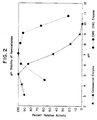
- a hemicellulase obtained as described above will generally display an activity characterized by a pH profile -- the curve defined by the relationship between a given enzymatic activity and pH -- that ranges over some 6.5 pH units, between minima at about pH 4.5 and about pH 11, respectively.
- a pH profile is highly distinctive when compared, for example, to corresponding profiles for known Bacillus mannanases, which are virtually inactive at above about pH 8. See Araujo & Ward, J. App. Bacteriol. , 68: 253-61 (1990).
- a hemicellulase used in the present invention preferably has a pH profile with a peak (i.e., the portion of the profile where activity is greatest) that is in a range from about pH 9 to about pH 7. It is also preferred that the enzyme display significant biological activity under conditions characterized both by high alkalinity and by elevated temperatures. Such a suitable enzyme would display significant activity, for example, when pH is in the range of 8-11 and the temperature is 60° C or higher.
- a hemicellulase particularly preferred for use according to the present invention is an endo- ⁇ -D-mannanase having the following properties:
- the enzyme in this final permeate can be concentrated with a 5,000 molecular weight cut-off membrane or precipitated with three volumes of acetone. After the precipitate is centrifuged, the supernatant is siphoned off and the pellet resuspended in 50 mM phosphate buffer. This concentrate is dialyzed versus 10 mM phosphate buffer (pH 7.0) and then applied to a DEAE-Sephacel column. The enzyme is eluted with a solution gradient of sodium chloride of increasing ionic strength ranging from 0-1.25 M in 50 mM phosphate buffer (pH 7.0). Fractions are collected and tested for enzyme activity. The fractions exhibiting maximum activity are pooled and examined using SDS-polyacrylamide gel electrophoresis and compared to protein molecular weight standards.
- hemicellulase can be produced by culturing the foregoing hemicellulase-producing microorganisms using conventional fermentation techniques.
- "fermentation” is used broadly to refer to any controlled microbial action by which useful products are obtained from the substrate(s) of that action.
- fermentation can be carried out in a stirred-tank reactor.
- This type of reactor is essentially a closed cylindrical tank containing agitators, baffles, heat exchange coils, and automatic controls for temperature, air flow, pressure, pH and foaming.
- a fermentor of this sort would be charged with essential nutrients and a hemicellulase inducer such as guar gum.
- the reactor is inoculated with a culture consisting essentially of microorganisms that have been selected for their capacity to produce hemicellulase as described above.
- Continuous culture can increase fermentor productivity by eliminating the downtime of batch cultures. But it is sometimes difficult to maintain productivity in large scale continuous cultures. Accordingly, batch fermentations which utilize the bacteria of the present invention are preferred.
- a Gram-positive Bacillus strain such as B. lentis CMG1240, is utilized to produce commercially useful quantities of the enzyme.
- the fermentor is maintained at about 35° C (500-1,000 rpm agitation) for about 12 hours.
- the hemicellulose, such as guar is added to the fermentor during the growth phase to further induce enzyme production.
- the fermentation is harvested after about 1 to 7.5 hours, and then enzyme activity is measured, for example, by viscosimetric means.
- Enzyme activity of the fermentation product is assayed by centrifuging aliquots of the fermentation broth and testing the resultant supernatant. Aliquots of the supernatant (or dilutions thereof) are added to a guar solution and any reduction in the viscosity of the enzyme/guar solution is measured routinely by recording the time required for a constant bore pipette to discharge a predetermined volume [see item (1) under the preferred hemicellulase properties enumerated above].
- the enzyme is recovered from the fermentation broth by filtration through a 0.5 ⁇ m filter to remove cells followed by ultrafiltration using a 5,000, 10,000 or 50,000 molecular weight cut-off ultrafiltration membrane.
- the concentrate is combined with three volumes of acetone at about 4° C to precipitate the enzyme.
- the precipitate is allowed to settle for approximately 24 hours before the supernatant is siphoned off.
- the precipitate is then centrifuged at about 4° C and the resultant pellet resuspended in phosphate buffer to form a paste.
- a Gram-positive Bacillus strain such as B. lenti s CMG1240
- a Gram-positive Bacillus strain such as B. lenti s CMG1240
- two 14-liter fermentors charged with a medium consisting of glycerol, yeast extract, necessary minerals and trace elements can be inoculated with a culture consisting essentially of a Gram-positive Bacillus strain as described above.
- the fermentors would be maintained at 36-37° C, with a concentration of > 40% dissolved oxygen, and agitation speed of 300-1000 rpm, until the optical density (OD) at 600 nm reaches approximately 2.0.
- OD optical density
- temperature Upon reaching an OD of 2.0, temperature would be reduced to 29-30° C and incubation continued for approximately another 13.5 hours until OD reaches 14, at which time the temperature would be decreased to 10° C.
- a 250-liter fermentor charged with a medium as described above but with a substantially greater content of yeast extract would be inoculated with the contents of the two 14-liter fermentors.
- Dissolved oxygen would be maintained at about 70% of saturation with an agitation rate between 300 and 500 rpm.
- Temperature would be maintained at 28° C and the pH at a range of 8.0 to 8.45.
- Foaming could be controlled, for instance, with a silicone anti-foam agent.
- an OD of 14 would be reached and the temperature would be decreased to 20° C. Incubation would generally continue for about 25 hours, until an OD of 20 was reached.
- a 1500-liter fermentor charged with a medium consisting of glycerol, yeast extract, soy flour, guar gum and necessary nutrient and trace elements would then be inoculated with the contents of the 250-liter fermentor, as described above.
- the temperature would be maintained at 28° C and the pH with a range between about 8.11 and 8.44.
- the dissolved oxygen concentration would be maintained at a concentration approximately 25% above saturation with agitation at a rate between 240 and 288 rpm.
- Air flow in the fermentor would preferably be maintained at 600-1000 liters per minute and the tank air pressure between 2.1 ⁇ 10 4 and 7.6 ⁇ 10 4 Pa (3 and 11 psi). Again, foaming could be controlled with a silicone anti-foam agent.
- guar gum would be added to the fermentor. Thus, some 1 to 2 kilograms of guar gum could be added every hour for about 9 hours until a total of approximately 13.8 grams per liter was added. Ten to thirteen hours after inoculation, glycerol would be added slowly to the fermentor until a total of approximately 3 grams per liter was added. Fermentation would be stopped about 14 hours after inoculation when the OD reached approximately 23 and the enzyme activity measured about 2.67 X 10 7 Units per liter.
- the enzyme would be recovered by removing cell mass and media solids by passage through a Westphalia continuous centrifuge or similar device. Remaining solids and high molecular weight materials would removed by filtration, for example, through a 0.1 ⁇ m, hollow fiber filter.
- the crude enzyme would then be concentrated using a hollow fiber ultrafiltration membrane with a 50,000 molecular weight cut off.
- the concentrate would be filtered thereafter by means of a sterile, 0.1 ⁇ m filter and then suspended in ammonium sulfate, at a concentration of 550 grams per liter, in order to salt out the crude enzyme.
- the enzyme precipitate could then collected by centrifugation at 8,000 rpm at 5° C. By such an approach, the enzyme activity of the precipitate typically measures about 5.0 X 10 8 Units per kilogram.
- DNA encoding hemicellulase could be isolated and used, via known procedures, to transform a suitable host organism such that the enzyme is produced by the recombinant host in commercially useful amounts.
- Hemicellulase-encoding DNA could be isolated by screening nucleic acid libraries generated from microorganisms expressing a hemicellulase according to the present invention. See, e.g., Ausubel et al., CURRENT PROTOCOLS IN MOLECULAR BIOLOGY at ⁇ 5 & 6 (John Wiley and Sons, New York) (1987, 1990) ("Ausubel”).
- Such libraries would be screened by means of oligonucleotide probes that are complementary to a polynucleotide encoding, for example, a portion of the N-terminus of a hemicellulase within the present invention.
- Illustrative of such an N-terminal portion is the amino acid sequence Ala-Ser-Gly-Phe-Tyr-Val-Xxx-Gly-Thr-Ile-Leu-Xxx-Asp-Ser-Thr-Gly-Asn-Pro-Phe-Lys-Ile-Xxx-Gly-Xxx-Asn [Xxx denotes an indeterminate amino acid], as discussed in Example 14 infra . See Ausubel at ⁇ 6.
- a probe as a template for generating other probes useful for isolating a hemicellulase-encoding polynucleotide according to the present invention, e.g., based on the N-terminal sequence described above.
- a probe could be used in a known manner to screen a genomic or cDNA library as described above, see Ausubel, loc. cit. , or to synthesize polymerase chain reaction (PCR) probes for use in amplifying a cDNA generated from an isolated RNA which codes for a hemicellulase of the present invention.
- PCR polymerase chain reaction
- a suitable polynucleotide in this regard would preferably comprise a nucleotide sequence, corresponding to the desired amino-acid sequence, that is optimized for the host of choice, as described below, with regard to codon usage, the initiation of translation, and the expression of recoverable amounts of a commercially useful hemicellulase within the present invention.
- a vector selected for transforming the chosen host organism with such a polynucleotide molecule should allow for efficient maintenance and transcription of the sequence encoding the polypeptide.
- Such a vector is readily available or derivable from commercial sources, and is suited to a particular host cell employed for expressing a hemicellulase according to the present invention.
- For vectors exemplary of those suitably used to the present invention see Ausubel at ⁇ 2-4.
- Host cells suitable for expressing a hemicellulase according to the present invention would include prokaryotic or eukaryotic cells, for example, bacterial, algal, yeast, insect, mammalian and human cells.
- prokaryotic or eukaryotic cells for example, bacterial, algal, yeast, insect, mammalian and human cells.
- host cells suitable for the present invention would be microorganisms of the genera Aeromonas, Aspergillus, Bacillus, Ezcherichia, Kluyveromycez, Pichia, Rhodococcus, Saccbaromyces and Streptomyces . More specifically illustrative of the suitable host microorganisms would be the bacteria E. coil, B. subtilis, B. brevis ( J. Bacteriol . 172: 1312-20) and B.
- yeast S. cerevisiae strain X2181-1B with genotype a trp1 gal1 ade1 his2 (available from the Yeast Genetic Stock Center, Berkeley, California); strain ATCC 52683, with genotype a his2 ade1 trp1 met14 ura3 (available from the American Type Culture Collection, Rockville, Maryland); and strain ATCC 46183, with genotype a his1 trp1 (also available from the American Type Culture Collection).
- Host cells comprising a polynucleotide encoding a hemicellulase according to the present invention can be grown under conditions that provide expression of a hemicellulase of the present invention in recoverable or commercially useful amounts. See, e.g., Ausubel at ⁇ 1 & 13.
- Galactans are a major component of the total carbohydrate content of commercial soybean products, however, and do not contribute significantly to the available energy content of soybean meal when employed as a component of feed for monogastric animals because these carbohydrates are not easily digested, and consequently, they are not absorbed. In order to exploit their energy content, galactans must be reduced to smaller molecular weight carbohydrates which can be absorbed and metabolized by monogastric animals and humans.
- a hemicellulase possessing the above-mentioned properties can be employed to degrade galactans and other mannan carbohydrates present in hemicellulosic constituents of food and animal feedstuffs, especially those containing complex carbohydrates from soybeans.
- the enzyme component included in a consumable composition of present invention should consist essentially of a hemicellulase, particularly a Bacillus hemicellulase, as described above.
- “consisting essentially” means that the enzyme component displays a hemicellulose-degrading activity which is determined principally by the aforementioned hemicellulase.
- Other enzymes, possibly with other activities, may be present, however, so long as they do not unduly interfere with the hemicellulose-degrading activity of the enzyme component.
- an effective amount of hemicellulase according to the present invention is added to an aliquot of soybean meal and allowed to dry.
- the resulting composition is ground to a fine powder and then mixed with dry animal feed consisting, for example, of corn and other nutrients.
- a mixture of this sort can be processed under conditions, particularly of heat and pH, that would inactivate conventional hemicellulases.
- the aforementioned soybean-based composition can be processed through a press mill to form pellets of animal feed containing hemicellulase, soybean meal and other animal feed components in predetermined proportions.
- chickens on the average gain more body weight per kg (per pound) of feed ingested than chickens maintained on an identical diet absent hemicellulase.
- a culture consisting essentially of a microorganism that produces a hemicellulase within the present invention can be fed directly to monogastric animals, such as pigs, having suitable digestive tracts such that the microorganism, once ingested, will produce a hemicellulase within the present invention.
- monogastric animals such as pigs
- Such a culture can be fed directly to the above-described animals in combination with feedstuffs in order to facilitate the degradation of galactans and other mannan carbohydrates present in hemicellulosic constituents thereof, especially those containing complex carbohydrates from soybeans.
- the culture component is primarily comprised of a microorganism producing a hemicellulase within the present invention. Other microorganisms may be present, however, so long as they do not unduly interfere with the hemicellulase producing activity of the culture component. It is preferable that the culture component included in a consumable composition of the present invention should consist essentially of a microorganism producing a hemicellulase, particularly a Bacillus hemicellulase, as described above. In a preferred embodiment, an effective amount of a culture consisting essentially of a microorganism according to the present invention is added to an aliquot of soybean meal and allowed to dry.
- the resulting composition can be ground to a fine powder and then mixed with dry animal feed consisting, for example, of corn and other nutrients.
- the composition can then be processed through a press mill to form pellets of animal feed containing a culture of a microorganism according to the present invention, soybean meal and other animal feed components in predetermined proportions.
- a preparation consisting only of a culture as described above can be prepared and directly fed to such animals.
- Such a preparation would consist of an effective amount of a concentrated paste consisting of viable microorganisms within the present invention.
- the preparation can also consist of an effective amount of a freeze-dried culture of such microorganisms.
- a fermentation broth comprising a culture of a microorganism that produces a hemicellulase within the present invention and an effective amount of such a hemicellulase would be fed directly to monogastric animals in combination with feedstuffs in order to facilitate the degradation of galactans and other mannan carbohydrates as described above.
- the fermentation broth component included in a consumable composition of the present invention comprise a culture of a microorganism producing a hemicellulase, particularly a Bacillus hemicellulase, as described above and an effective amount of such a hemicellulase within the present invention.
- a fermentation broth would comprise, in addition to the above-described culture and enzyme produced by such culture, nutrients suitable for culturing a microorganism that produces an enzyme according to the present invention.
- an effective amount of such a fermentation broth would be spray dried to produce a dried powder that would be added to the other feed components.
- a fermentation broth as described above would be directly mixed with one of the feed components, such as soy meal, dried and then mixed with the other components.
- such a fermentation broth would be directly mixed with the complete feed.
- the fermentation broth would be dried to form a concentrate that would be transported to the feed mills and combined with an otherwise complete feed mixture.
- Such feed compositions can then be processed through a press mill to form pellets of animal feed containing a fermentation broth comprised of a culture of a microorganism and an effective amount of a hemicellulase according to the present invention, soybean meal and other animal feed components in predetermined proportions.
- Vitamin Solution (amount/liter)
- Example 1 Isolation of hemicellulase-producing microorganisms from soil
- Soil samples collected from both a tropical rain-forest and a temperate garden were added to selective enrichment broth in a 10% w/v concentration.
- the cultures were shaken in baffled Erlenmeyer shake flasks at 37° C for four days.
- Four dilutions [1:10, 1:20, 1:800 and 1:50,000] of the initial cultures were made with fresh selective enrichment broth and incubated at 37° C for four days.
- the 1:50,000 dilution was used to prepare a dilution series (10 -1 to 10 -8 ) in 0.85% NaCl which were plated out on selective enrichment agar and incubated at 34° C for 5-7 days.
- Example 2 Screening of soil isolates for hemicellulase activity
- Each purified isolate from the tropical rainforest soil was transferred to a shake flask containing selective enrichment broth and shaken for 48-72 hours at 34° C. After incubation, the culture was centrifuged for 20-30 minutes at 10,000 rpm (4° C). The resultant supernatant was filtered sequentially through a 0.8 ⁇ m and a 0.45 ⁇ m filter to recover crude enzyme free of microbial cells.
- Each purified isolate from the temperate garden soil was transferred to tubes containing selective enrichment broth and shaken 12-48 hours at 34° C. After incubation, the cultures were centrifuged and filtered as described above.
- the crude enzyme solution was added to tubes containing 5 ml of a cross-linked guar preparation (5.0 g guar, 2.0 g (NH 4 ) 2 SO 4 and 0.6 g sodium tetraborate per 400 ml water, pH 9.5) and incubated for at least 1 hour in a water bath at 39-40° C.
- a constant bore 1 ml pipette was charged with 1.0 ml of the mixture and allowed to discharge 0.9 ml.
- a stopwatch was used to measure the time required for this discharge to occur (hereinafter "drop time").
- a drop time of less than two seconds indicated measurable amounts of hemicellulase activity. Twelve of the twenty-four isolates recovered from temperate garden soil, and four of the nine isolates recovered from tropical rainforest soil produced measurable amounts of hemicellulase.
- the refined method referred to as the MIDI microbial identification system, analyzes fatty acid methyl esters prepared from microbial lipids by gas-liquid chromatography.
- a microorganism isolated according to the methods of Examples 1 and 2 and designated strain CMG1240 was analyzed using the MIDI microbial identification system. The results of the analysis are presented in Table II. In tests 1 through 4, the cells were grown at 28° C and pH 6.7 on TSBA agar according to the standard Microbial ID method. In test 5, the cells were grown at 35° C and pH 8.5, conditions which cause a significant change in lipid composition.
- a single, isolated colony of Bacillus lentis was inoculated into a 500 ml Erlenmeyer baffled shake (pre-seed) flask containing 50 ml of brain heart infusion broth.
- the inoculated flask was shaken (300 rpm) while incubating for 12-16 hours at 35°C.
- the entire volume of the pre-seed flask was aseptically transferred to a 4 l Erlenmeyer baffled shake-flask (seed) containing one liter of seed medium.
- the seed-flask was incubated with shaking for 12-16 hours at 35°C.
- the entire volume of the seed flask was aseptically transferred to a 14-liter fermentor containing 9.0 liters of fermentation broth.
- the fermentor was maintained at 40°C, >20% dissolved oxygen and 500-1000 rpm.
- Guar gum was added to make a final concentration of 0.05% to the fermentor two or three times during the growth phase and once (0.5%) during the stationary phase to induce enzyme production.
- the fermentation was terminated and enzyme activity assayed according to the procedure of Example 6. Assay data are shown in Figure 3.
- Example 5 Measurement of hemicellulase activity to determine optimal culture conditions for hemicellulase production
- Sample enzyme activity was calculated from a standard curve prepared by plotting the log of the drop time (seconds) of dilution of a standard hemicellulase (Miles B-1500) versus incubation time in minutes. The slope (on a linear scale) of the log plot was calculated and replotted versus grams or "chamber units" of hemicellulase.
- Example 6 Assay for hemicellulase activity suitable for testing standards and purified enzyme preparations
- Example 7 Recovery of hemicellulase from fermentation
- Example 4 The procedure described in Example 4 was used in the production of useful quantities of hemicellulase in each of six 14-liter fermentations. After the fermentation was terminated, cells were removed from 60 l of culture broth by ultrafiltration with a 0.1 ⁇ m filter. Then, the enzyme was concentrated to a volume of approximately 3.5 l with a 10,000 molecular weight cut-off ultrafiltration membrane. The concentrate was combined with three volumes of acetone at 4° C to precipitate the hemicellulase. The precipitate was collected by allowing it to settle for 24 hours and then siphoning off the supernatant. The precipitate was then centrifuged at 6000 rpm for 10 minutes at 4° C.
- the resulting pellet was immediately resuspended in 170 ml of 50 mM potassium phosphate buffer (pH 7.0) to a final volume of 300 ml.
- the enzyme activity of the resulting hemicellulase solution was determined according to the method of Example 6.
- the recovered hemicellulase paste had 9.45 x 10 6 chamber units/liter, which was equivalent to 6.3 kg/l of standard commercial hemicellulase (assayed at pH 9.0) or 1.89 kg total of standard hemicellulase formulation.
- Example 8 Alternate process for recovering hemicellulase
- Hemicellulase was recovered by the method described in Example 7, wherein methanol was used alternatively to precipitate hemicellulase. The supernatant was siphoned off and the precipitate centrifuged as described above. The paste-like precipitate was then blended with 10 volumes (w/w) of lactose and dried under vacuum at temperatures up to 40° C.
- Hemicellulase was concentrated to a volume of approximately 15 l with a 10,000 molecular weight cut-off ultrafiltration membrane. Solid ammonium sulfate was slowly added to 75% saturation with continuous mixing. The precipitate formed in the resulting solution was harvested by centrifugation at 8,000 rpm for 45 minutes. The enzyme activity of the resulting pellet was determined according to the method of Example 6. The recovery yield of enzyme activity was 1.85 X 10 5 units/gram (2.22 X 10 8 total units). The recovery yield of enzyme activity of the precipitate was 77% of the total enzyme activity of the 15 l concentrate.
- Example 10 Alternative method for the production of commercially useful quantities of hemicellulase
- a single, isolated colony of Bacillus lentis was inoculated into two 500 ml Erlenmeyer baffled shake (pre-seed) flasks each containing 50 ml of brain heart infusion broth.
- the inoculated flasks were shaken (300 rpm) while incubating for 12-16 hours at 35° C. After incubation, the entire volume of each flask was aseptically transferred to one of two 4 l Erlenmeyer baffled shake flasks each containing 500 ml of Shake Flask Broth. The shake flasks were incubated with shaking for 12-16 hours at 35° C.
- each shake flask was aseptically transferred to one of two 14-liter fermentors each containing 8.0 liters of 14 Liter Fermentor Broth.
- the 14-liter fermentors were maintained at a temperature of 36 to 37° C, with a concentration of >40% dissolved oxygen and an agitator speed between 300 and 1000 rpm.
- Foaming in the fermentors was controlled with silicone anti-foam (Union Carbide, SAG 5693).
- Cell density was estimated by observing the change in absorbance at 600 nm. The temperature was decreased to 29-30° C when the optical density (OD) reached 2.0. After approximately 13.5 hours, the temperature was reduced to 10° C when the OD reached 14.
- a 250-liter fermentor containing 160 liters of 250 Liter Fermentor Broth was then inoculated with the contents of the 14 liter fermentors.
- the concentration of dissolved oxygen was maintained at 70% saturation with an agitation rate between 300 and 500 rpm.
- the pH was maintained at a range of 8.0 to 8.45.
- Foaming in the fermentor was controlled with silicone anti-foam (Union Carbide SAG 5693).
- the temperature was maintained at 28° C until, after about 15.5 hours after inoculation, an OD of 14 at 600 nm was reached. At that point, the temperature was decreased to 20° C until the OD reached about 20 approximately 25 hours after inoculation.
- a 1500 liter fermentor containing 800 liters of 1500 Liter Fermentor Broth was then inoculated with the 166 liter contents of the 250 liter fermentor.
- the pH of the medium was maintained at a pH range of 8.11 to 8.44.
- the temperature was maintained at 28° C and the concentration of dissolved oxygen was maintained above 25% saturation with impeller speeds between 240 and 288 rpm and an air flow between 600 and 1000 liters per minute.
- Tank air pressure was maintained between 2.1 ⁇ 10 4 and 7.6 ⁇ 10 4 Pa (3 and 11 psi). Foaming was controlled with silicone anti-foam (Union Carbide SAG 5693).
- guar gum was added to the fermentor. About 1 to 2 kilograms of solid guar gum was added to the fermentor every hour for the next 9 hours. A total of 13.8 grams/liter of guar gum was added to the fermentor. Between 10.5 and 13 hours after inoculation, glycerol was slowly added to the fermentor. A total of 3 grams/liter of glycerol was added to the fermentor. Fermentation was stopped approximately 14.25 hours after incubation when the OD of the contents had reached 23.3 at 600 nm and the enzyme activity measured 2.67 X 10 7 Units/liter.
- Example 11 Alternative method for recovery of hemicellulase from fermentation
- Example 10 After fermentation by the method of Example 10 was terminated, cell mass and media solids were partially removed by passage through a Westphalia continuous centrifuge. The remaining solids and high molecular weight materials in the Westphalia centrifuge effluent were removed by passage through a 0.1 ⁇ m hollow fiber filter. The crude enzyme solution which passed through the 0.1 ⁇ m filter was then concentrated using a hollow fiber ultra filtration membrane with a 50,000 molecular weight cut off. The concentrate was sterile filtered with a 0.1 ⁇ m sterile filter and then suspended in ammonium sulfate at a concentration of 550 grams/liter in order to salt out the crude enzyme.
- Enzyme precipitate was collected by centrifugation at 8,000 rpm in a Sorvall centrifuge with a GS3 rotor at 5°C.
- the enzyme activity of the resulting precipitate was approximately 5.0 X 10 8 Units/kilogram.
- a concentrate from ultrafiltration was prepared according to the method described in Example 7.
- the concentrate contained 6.39 x 10 6 units/liter, with a specific activity of 1.11 x 10 3 units/mg.
- Equal volumes (2.2 liters) of the concentrate and acetone were mixed to make a 50% (v/v) solution, and the resultant precipitate was then allowed to settle for 18 hours at 10°C.
- an additional volume of acetone was added to make the solution 75% (v/v).
- the resultant precipitate was allowed to settle for 24 hours at 10° C, after which the supernatant was first removed by siphoning and finally by centrifugation at 5000 rpm.
- the precipitate was then dissolved in 222 ml of 50 mM phosphate buffer (pH 7.0). Activity was determined to be 5.71 x 10 7 units/liter, with a specific activity of 6.17 x 10 3 units/mg. This purification step resulted in a recovery of 90% of the total activity with only 20% of the protein, causing a 5.56 fold increase in the specific activity.
- Example 13 Alternative hemicellulase purification process
- Example 12 An alternative purification process was employed to avoid the precipitation step of Example 12.
- the hemicellulase was concentrated to the desired concentration by ultrafiltration as described in Example 12.
- a liquid formulation of the concentrate was then prepared by adding stabilizing and preservative agents such as ethylene glycol, or alternatively, glycerol, sorbitol, sodium benzoate, sodium citrate, methylparaben, sodium ascorbate or an equivalent.
- a broth concentrate was prepared by ultrafiltration; i.e., cells were removed with a 0.1 ⁇ m membrane and the enzyme concentrated with a 10,000 molecular weight cut-off membrane. When the enzyme became concentrated, it was observed that some of the hemicellulase passed through the membrane. This permeate fraction was reconcentrated with the 10,000 molecular weight cut-off membrane and then used for further purification. The reconcentrated permeate was precipitated by the addition of 3 volumes of acetone at 4° C. The supernatant was siphoned off, and the precipitate resuspended in 50 mM phosphate buffer (pH 7.0) to a final volume of 222 ml.
- the enzyme concentrate was subsequently dialyzed versus 10 mM phosphate buffer (pH 7.0) to remove any salts.
- the dialyzed concentrate was then applied to a DEAE-Sephacel column (2.8 x 30 cm). Elution of the hemicellulase was carried out by adding a solution of increasing ionic strength to the column at a flow rate of 1 ml/minute.
- the solution consisted of 0-1.25 M NaCl in 50 mM phosphate buffer.
- Ten milliliter fractions were collected and tested for enzyme activity by measuring viscosity reduction of a 1% guar solution as described in Example 6.
- Example 15 Composition of animal feed to study body weight gain/pound feed ingested
- Example 16 Preparation of hemicellulase/soybean meal feed supplement
- Example 4 The procedure described in Example 4 was used in the production of useful quantities of hemicellulase.
- the hemicellulase was recovered as described in Example 9.
- Approximately 1 kg (2.2 lbs) of the resulting hemicellulase paste was mixed with a small aliquot (4 kg (8.8 lbs)) of soybean meal (48% protein) to achieve a concentration of 31.75 X 10 6 units of enzyme activity per pound of hemicellulase/soybean meal mixture.
- the mixture was allowed to air dry in a large open pan under a fume hood.
- the dried mixture was ground to a fine powder in a Waring blender and stored at 4° C until used.
- Example 17 Preparation of hemicellulase containing animal feed
- Example 16 Three types of animal feed containing 1 g per kg (2 lbs per ton) of a hemicellulase/soybean meal mixture according to the method of Example 16 were prepared. 0.9 kg (two pounds)of the hemicellulase/soybean meal mixture prepared according to the method described in Example 15 were added to the ingredients (excluding the yellow corn and soybean meal) comprising each of the three types of animal feed prepared according to Example 15. The hemicellulase/soybean meal mixture and the other ingredients were mixed for one minute in a vertical agitator. This mixture was then combined with predetermined amounts yellow corn and soybean meal and mixed in the vertical agitator for 3.5 minutes.
- the resulting hemicellulase/feed mixture was formed into pellets by processing the feed mixture in a California press mill equipped to deliver moist steam (10% v/w).
- the feed mixture was stamped into pellets which were cooled immediately in a vertical forced-air cooling tower.
- the pellets were shaken to remove any fine powder material, which was recycled to the pelleting chamber.
- the starter feed pellets were crumbled by processing them through a roller mill.
- Example 18 The use of hemicellulase as a feed additive
- Each group was housed in a separate pen.
- the temperature of the pens was checked daily for the first two weeks of the study.
- the house temperature and humidity was checked daily for the duration of the study.
- Air exchange was enhanced by wall fans.
- the birds were placed on built-up litter. Wet litter from previous studies was removed and replaced by one inch of new litter. Artificial lighting was provided continuously and all birds had ready access to water.
- Feed efficiency was determined by dividing the amount of feed, in kg (and pounds), which the chicken consumed by the weight it gained, again in kg (and pounds).
- the results of the study at Day 21 are reported in Tables IV, V and VI are illustrated in Figure 5.
- Results at Day 46 are reported in Tables VII, VIII and IX and illustrated in Figure 5.
- a statistical analysis of the results employing Duncan's New Multiple Range Test is presented in Table X.
- Example 19 Preparation of direct-fed microbial culture-containing animal feed
- a culture consisting essentially of a microorganism that produces a hemicellulase within the present invention can be prepared according to the methods described in Examples 1, 2 and 10. Effective amounts of such a culture can be combined with animal feed batches such as those described in Example 15 in order to increase the ratio of body weight gained to the amount of feed ingested by animals having a digestive tract that will allow such a microorganism, once ingested, to produce a hemicellulase according to the present invention.
- Example 20 Preparation of animal feed comprising a fermentation broth containing a direct-fed microbial culture and hemicellulase
- a fermentation broth comprising microorganisms and a hemicellulase within the present invention can be prepared according to the method of Example 10D. Effective amounts of such a fermentation broth can be combined with animal feed batches such as those described in Example 15 in order to increase the ratio of body weight gained to the amount of feed ingested.
- a fermentation broth prepared according to the method of Example 10D can be added per 907.8 kg (ton) of a feed mixture containing 30% soy meal.
- the fermentation broth can be spray dried to produce a dried powder that can then be combined with the feed components.
- the fermentation broth can also be mixed directly with some of the feed components, for example, the soy meal or a portion of the soy meal, and then dried. This dried broth/soy meal mixture can then be mixed at a later time with the other feed components.
- the fermentation broth can be mixed directly with a complete feed mixture.
- the fermentation broth can be dried forming a concentrate that can be transported to feed mills and combined with a complete feed mixture.
Landscapes
- Chemical & Material Sciences (AREA)
- Life Sciences & Earth Sciences (AREA)
- Engineering & Computer Science (AREA)
- Health & Medical Sciences (AREA)
- Zoology (AREA)
- Organic Chemistry (AREA)
- Bioinformatics & Cheminformatics (AREA)
- Polymers & Plastics (AREA)
- Genetics & Genomics (AREA)
- Wood Science & Technology (AREA)
- Biochemistry (AREA)
- Food Science & Technology (AREA)
- General Health & Medical Sciences (AREA)
- General Engineering & Computer Science (AREA)
- Microbiology (AREA)
- Molecular Biology (AREA)
- Biomedical Technology (AREA)
- Biotechnology (AREA)
- Nutrition Science (AREA)
- Medicinal Chemistry (AREA)
- Animal Husbandry (AREA)
- Physiology (AREA)
- Dispersion Chemistry (AREA)
- Enzymes And Modification Thereof (AREA)
- Fodder In General (AREA)
- Beans For Foods Or Fodder (AREA)
- Preparation Of Compounds By Using Micro-Organisms (AREA)
- Micro-Organisms Or Cultivation Processes Thereof (AREA)
Claims (8)
- Composition alimentaire comprenant :(A) des protéines, des vitamines et des minéraux convenables, d'un point de vue nutritionnel, à un animal monogastrique ou à un être humain ;(B) une source d'hydrates de carbone, comprenant une hémicellulose contenant de la mannane et choisie dans le groupe comprenant le soja, le maïs et la luzerne ; et(C) une mannanase qui catalyse la dégradation de ladite hémicellulose contenant de la mannane, l'addition de ladite mannanase diminuant le rapport de l'alimentation au gain, ou augmentant le gain de poids, au cours de la croissance d'un animal alimenté avec ladite composition alimentaire, comparativement audit animal alimenté avec une composition alimentaire identique ne contenant pas ladite mannanase.
- Composition alimentaire selon la revendication 1, dans laquelle ladite mannanase est une enzyme de type Bacillus.
- Composition alimentaire selon la revendication 1 ou 2, dans laquelle ladite mannanase est une endo-β-D-mannanase.
- Composition alimentaire selon l'une quelconque des revendications 1 à 3, dans laquelle ledit groupe comprend le soja et la luzerne.
- Composition alimentaire selon l'une quelconque des revendications 1 à 4, dans laquelle ladite source d'hydrates de carbone est le soja.
- Composition alimentaire selon l'une quelconque des revendications 1 à 5, dans laquelle ladite composition est destinée à la consommation humaine ou a la consommation par un animal monogastrique.
- Utilisation d'une composition alimentaire selon l'une quelconque des revendications 1 à 6, dans la fabrication d'une préparation favorisant la croissance d'animaux monogastriques ou d'êtres humains, comprenant les étapes consistant à :(A) préparer une composition alimentaire comprenant (a) des protéines, des vitamines et des minéraux convenables, d'un point de vue nutritionnel, à un animal monogastrique ou à un être humain ; et (b) une source d'hydrates de carbone, comprenant une hémicellulose contenant de la mannane et choisie dans le groupe comprenant le soja, le maïs et la luzerne ; et(B) incorporer dans ladite composition une mannanase qui catalyse la dégradation de ladite hémicellulose contenant de la mannane, l'addition de ladite mannanase diminuant le rapport de l'alimentation au gain, ou augmentant le gain de poids, au cours de la croissance d'un animal alimenté avec ladite composition alimentaire, comparativement audit animal alimenté avec une composition alimentaire identique ne contenant pas ladite mannanase.
- Utilisation selon la revendication 7, dans laquelle l'étape (B) comprend (i) la production d'un mélange contenant ladite mannanase et ladite composition puis (ii) la granulation dudit mélange dans des conditions comprenant une température d'au moins 60°C.
Applications Claiming Priority (3)
| Application Number | Priority Date | Filing Date | Title |
|---|---|---|---|
| US52932790A | 1990-05-29 | 1990-05-29 | |
| US529327 | 1990-05-29 | ||
| PCT/US1991/003754 WO1991018521A1 (fr) | 1990-05-29 | 1991-05-29 | Supplement d'hemicellulase ameliorant le rendement en energie d'aliments contenant de l'hemicellulose et produit alimentaire pour animaux |
Publications (3)
| Publication Number | Publication Date |
|---|---|
| EP0531437A1 EP0531437A1 (fr) | 1993-03-17 |
| EP0531437A4 EP0531437A4 (en) | 1993-09-15 |
| EP0531437B1 true EP0531437B1 (fr) | 1997-12-29 |
Family
ID=24109453
Family Applications (1)
| Application Number | Title | Priority Date | Filing Date |
|---|---|---|---|
| EP91911371A Revoked EP0531437B1 (fr) | 1990-05-29 | 1991-05-29 | Supplement d'hemicellulase ameliorant le rendement en energie d'aliments contenant de l'hemicellulose et produit alimentaire pour animaux |
Country Status (10)
| Country | Link |
|---|---|
| US (2) | US5429828A (fr) |
| EP (1) | EP0531437B1 (fr) |
| JP (1) | JP3608620B2 (fr) |
| AT (1) | ATE161395T1 (fr) |
| AU (1) | AU8004891A (fr) |
| CA (1) | CA2084071C (fr) |
| DE (1) | DE69128531T2 (fr) |
| DK (1) | DK0531437T3 (fr) |
| ES (1) | ES2114889T3 (fr) |
| WO (1) | WO1991018521A1 (fr) |
Families Citing this family (32)
| Publication number | Priority date | Publication date | Assignee | Title |
|---|---|---|---|---|
| WO1995017103A1 (fr) * | 1993-12-23 | 1995-06-29 | Nutreco Nederland B.V. | Utilisation de materiaux riches en mannane dans des aliments de l'homme et des animaux |
| US5441109A (en) * | 1994-04-19 | 1995-08-15 | The Western Company Of North America | Enzyme breakers for breaking fracturing fluids and methods of making and use thereof |
| GB9409336D0 (en) * | 1994-05-10 | 1994-06-29 | Finnfeeds Int Ltd | Use of an enzyme for manufacturing an agent for the treatment and/or prophylaxis of coccidiosis |
| US5437331A (en) * | 1994-08-24 | 1995-08-01 | The Western Company Of North America | Method for fracturing subterranean formations using controlled release breakers and compositions useful therein |
| US6162473A (en) * | 1996-05-03 | 2000-12-19 | Chemgen Corporation | Hemicellulase use in feeds with low caloric content |
| CN1092495C (zh) * | 1996-05-03 | 2002-10-16 | 开姆根有限公司 | 半纤维素酶在低热焓饲料中的应用 |
| KR100515184B1 (ko) * | 1997-08-15 | 2005-09-16 | 유니티카 가부시끼가이샤 | 만노스-함유 사료 및 그의 제조방법 |
| US6086885A (en) * | 1998-04-09 | 2000-07-11 | Kemin Industries, Inc. | Anti-bacterial protein extracts from seeds of marigold and paprika |
| US6331426B1 (en) | 1999-02-11 | 2001-12-18 | Novozymes A/S | Bacterial galactanases and use thereof |
| GB9905542D0 (en) * | 1999-03-10 | 1999-05-05 | Mars Uk Ltd | Pet food |
| UA78486C2 (uk) * | 1999-12-10 | 2007-04-10 | Хемджен Корпорейшн | Композиція для перорального введення птахам та тваринам для лікування або зниження ризику інфекції травного тракту (варіанти), її застосування (варіанти) та спосіб лікування або зниження ризику інфекцій травного тракту (варіанти) |
| ATE308895T1 (de) * | 2000-03-10 | 2005-11-15 | Mars Uk Ltd | Behandlung von infektionen in tieren |
| US7608291B2 (en) | 2000-03-10 | 2009-10-27 | Mars, Inc. | Treatment of infection in animals |
| KR100390565B1 (ko) * | 2000-06-20 | 2003-07-07 | 주식회사 씨티씨바이오 | 만난아제를 생산하는 신규한 바실러스 속 wl-1 균주 |
| US6506423B2 (en) | 2000-12-21 | 2003-01-14 | Kansas State University Research Foundation | Method of manufacturing a ruminant feedstuff with reduced ruminal protein degradability |
| WO2003015533A1 (fr) * | 2001-08-20 | 2003-02-27 | K.U. Leuven Research And Development | Polysaccharides non-amylaces |
| ES2195796B1 (es) * | 2002-05-30 | 2005-02-01 | Institut De Recerca I Tecnologia Agroalimentaries | Premezcla a base de goma natural para alimentacion animal. |
| US7960148B2 (en) | 2003-07-02 | 2011-06-14 | Verenium Corporation | Glucanases, nucleic acids encoding them and methods for making and using them |
| US7087425B2 (en) * | 2004-03-31 | 2006-08-08 | Embrex, Inc. | Method of purifying oocysts using enzymatic digestion of fecal debris |
| US20060127530A1 (en) * | 2004-12-10 | 2006-06-15 | Axelrod Glen S | Avian feed |
| MX2007013725A (es) | 2005-05-05 | 2008-04-09 | Sensient Flavors Inc | Produccion de beta-glucanos y mananos. |
| TR201809912T4 (tr) | 2006-02-14 | 2018-07-23 | Bp Corp North America Inc | Ksilanazlar, bunları kodlayan nükleik asitler ve bunları yapmak ve kullanmak için yöntemler. |
| DK2069389T3 (en) | 2006-08-04 | 2015-01-12 | Bp Corp North America Inc | Glucanases, nucleic acids encoding them, and processes for their preparation and use |
| US9420807B2 (en) * | 2007-04-02 | 2016-08-23 | Purina Animal Nutrition Llc | Method of feeding young monogastric mammals and composition fed to young monogastric mammals |
| GB0718974D0 (en) | 2007-09-28 | 2007-11-07 | Univ Leuven Kath | oligosaccharides derived from arabinoxylan for prevention of gastrointestinal infection |
| BRPI0817811A2 (pt) | 2007-10-03 | 2014-10-14 | Verenium Corp | Xilanases, ácidos nucleicos que codificam as mesmas e métodos para fabricação e uso das mesmas. |
| GB0805360D0 (en) * | 2008-03-25 | 2008-04-30 | Univ Leuven Kath | Arabinoxylan oligosaccharide preparation |
| BRPI0902564A2 (pt) * | 2009-08-17 | 2011-05-03 | Auster Nutricao Animal Ltda | composto de 1 monopropionina e seu isÈmero 3 monopropionina como agentes preservantes de rações, grãos e farinhas de origem animal |
| US8877272B2 (en) * | 2009-08-17 | 2014-11-04 | Paulo Roberto De Lima Portilho | 1-monopropionine compound and its isomer 3-monopropionine as preserving agents for animal feed, grains and animal-origin meals |
| US20130045498A1 (en) * | 2010-03-01 | 2013-02-21 | Novozymes A/S | Viscosity pressure assay |
| US20140328815A1 (en) * | 2011-11-11 | 2014-11-06 | Nutrition Physiology Company, Llc | Lactic Acid Bacteria And Their Use As Dietary Supplementals For Poultry |
| CN113100352B (zh) * | 2021-05-25 | 2023-02-10 | 海南(潭牛)文昌鸡股份有限公司 | 一种含有椰蓉渣的白皮文昌鸡饲料及制备方法 |
Family Cites Families (24)
| Publication number | Priority date | Publication date | Assignee | Title |
|---|---|---|---|---|
| DE1212826B (de) * | 1960-02-24 | 1966-03-17 | Bierhefe Verarbeitungsgesellsc | Futtermittelzusatzstoff und Verfahren zu seiner Herstellung |
| US3455696A (en) * | 1965-11-08 | 1969-07-15 | Nagase & Co Ltd | Feed supplement for animals and production thereof |
| US3615721A (en) * | 1967-12-26 | 1971-10-26 | Philip Morris Inc | Method for the manufacture of food from plant material |
| DE1792142A1 (de) * | 1968-07-26 | 1971-10-21 | Roehm Gmbh | Verfahren zur Herstellung eines Viehfuttermittels aus Sojamehl |
| US3585047A (en) * | 1968-10-30 | 1971-06-15 | Us Agriculture | Enzymatic improvement of soybean flavor and stability |
| JPS5221076B2 (fr) * | 1972-01-19 | 1977-06-08 | ||
| FR2302336A1 (fr) * | 1975-02-26 | 1976-09-24 | Baxter Laboratories Inc | Procede pour la fabrication d'un melange d'enzymes |
| DE2602260A1 (de) * | 1976-01-22 | 1977-08-04 | Henkel & Cie Gmbh | Verfahren zur herstellung enzymhaltiger tierfuttermittel |
| JPS5362848A (en) * | 1976-11-17 | 1978-06-05 | Tokuo Tamano | Production of digestable nutritious fluid food |
| DE3032134A1 (de) * | 1979-08-28 | 1981-03-19 | Fuji Photo Film Co. Ltd., Minami-Ashigara, Kanagawa | Lichtempfindliches bildausbildungsmaterial |
| AU531852B2 (en) * | 1979-10-17 | 1983-09-08 | Hayes, F.W. | Production of ethanol from sugar cane |
| NL7908722A (nl) * | 1979-12-03 | 1981-07-01 | Naarden International Nv | Werkwijze voor de bereiding van citrussap bevattende dranken met verbeterde troebelingsstabiliteit. |
| US4338399A (en) * | 1980-09-15 | 1982-07-06 | Standard Oil Company (Indiana) | Process for recovering hydrocarbons from hydrocarbon-containing biomass |
| JPS58141755A (ja) * | 1982-02-15 | 1983-08-23 | Kazuyoshi Seki | 玄米を利用した食品の製造法 |
| US4639375A (en) * | 1983-08-12 | 1987-01-27 | The Procter & Gamble Company | Enzymatic treatment of black tea leaf |
| GB8406866D0 (en) * | 1984-03-16 | 1984-04-18 | British Petroleum Co Plc | Separating cellulose and hemicellulose |
| US4833128A (en) * | 1984-12-28 | 1989-05-23 | Neil Solomon | Dietary supplement |
| US4670268A (en) * | 1985-01-29 | 1987-06-02 | Abbott Laboratories | Enteral nutritional hypoallergenic formula |
| DK80588A (da) * | 1987-02-23 | 1988-08-24 | Suomen Sokeri Oy | Fjerkrae-foder, fodringsmetode og fremgangsmaade til forbedring af fordoejeligheden af fjerkrae-foder |
| JPS63209580A (ja) * | 1987-02-25 | 1988-08-31 | Karupisu Shokuhin Kogyo Kk | バチルス・ズブチリスc−3102 |
| FI78814C (fi) * | 1987-03-30 | 1989-10-10 | Cultor Oy | Nollfiber innehaollande foderraoaemne och foder samt foerfarande foer deras framstaellning. |
| JP2603470B2 (ja) * | 1987-04-28 | 1997-04-23 | 大日本製薬株式会社 | 難消化性多糖類の部分分解物を含有する食品 |
| JPS63279761A (ja) * | 1987-05-11 | 1988-11-16 | Tanabe Seiyaku Co Ltd | 味噌の品質改良法 |
| FI84970C (fi) * | 1988-04-22 | 1992-02-25 | Suomen Sokeri Oy | Foerfarande foer foerbaettring av degens egenskaper och broedets kvalitet. |
-
1991
- 1991-05-29 WO PCT/US1991/003754 patent/WO1991018521A1/fr not_active Ceased
- 1991-05-29 DE DE69128531T patent/DE69128531T2/de not_active Expired - Lifetime
- 1991-05-29 CA CA002084071A patent/CA2084071C/fr not_active Expired - Lifetime
- 1991-05-29 AT AT91911371T patent/ATE161395T1/de active
- 1991-05-29 DK DK91911371T patent/DK0531437T3/da active
- 1991-05-29 JP JP51098991A patent/JP3608620B2/ja not_active Expired - Lifetime
- 1991-05-29 AU AU80048/91A patent/AU8004891A/en not_active Abandoned
- 1991-05-29 EP EP91911371A patent/EP0531437B1/fr not_active Revoked
- 1991-05-29 ES ES91911371T patent/ES2114889T3/es not_active Expired - Lifetime
-
1992
- 1992-07-14 US US07/912,675 patent/US5429828A/en not_active Ceased
-
2001
- 2001-03-08 US US09/800,499 patent/USRE38047E1/en not_active Expired - Lifetime
Non-Patent Citations (2)
| Title |
|---|
| Biodeterioration Abs, TEVES, F. G. et al. :"Nutritional value of copra meal treated with bacterial mannanase in broiler diets", & RECENT ADVANCES IN BIOTECHNOLOGY AND APPLIED BIOLOGY. PROCEEDINGS OF EIGHTH INTERNATIONAL CONFERENCE ON GLOBAL IMPACTS OF APPLIED MICROBIOLOGY AND INTERNATIONAL CONFERENCE ON APPLIED BIOLOGY AND BIOTECHNOLOGY, 1-5 August 1988, HONG KONG; CHINESE UNIVERSITY PRESS, 1988, p. 497-507, * |
| J. HANSEN, "Alginase Enzyme Production by Bacillus Circulans", Applied and Environmental Microbiology, Volume 47, Number 4, April 1984, pages 704-709, see pages 704 and 708. * |
Also Published As
| Publication number | Publication date |
|---|---|
| CA2084071C (fr) | 2004-09-28 |
| DK0531437T3 (da) | 1998-08-31 |
| WO1991018521A1 (fr) | 1991-12-12 |
| DE69128531T2 (de) | 1998-08-20 |
| EP0531437A1 (fr) | 1993-03-17 |
| ATE161395T1 (de) | 1998-01-15 |
| EP0531437A4 (en) | 1993-09-15 |
| US5429828A (en) | 1995-07-04 |
| ES2114889T3 (es) | 1998-06-16 |
| USRE38047E1 (en) | 2003-03-25 |
| JP3608620B2 (ja) | 2005-01-12 |
| JPH05507202A (ja) | 1993-10-21 |
| AU8004891A (en) | 1991-12-31 |
| CA2084071A1 (fr) | 1991-11-30 |
| DE69128531D1 (de) | 1998-02-05 |
Similar Documents
| Publication | Publication Date | Title |
|---|---|---|
| EP0531437B1 (fr) | Supplement d'hemicellulase ameliorant le rendement en energie d'aliments contenant de l'hemicellulose et produit alimentaire pour animaux | |
| JP2780833B2 (ja) | ケラチン質原料の減成方法及びこれに有用な細菌 | |
| KR100877086B1 (ko) | 미생물 배양액 | |
| JP2015521029A (ja) | 新たなバチルス・サブチルス{novelbacillussubtilis} | |
| KR100513218B1 (ko) | 효소복합체 | |
| CA2179970A1 (fr) | Alimentation a fermentation rapide; preparation et utilisations | |
| Kim et al. | Culture conditions for a new phytase-producing fungus | |
| EP1292669B1 (fr) | Souche wl-1 d'espece bacille produisant une mannanase | |
| EP1347688B1 (fr) | Milieu de fermentation epuise concentre de saccharopolyspora erythraea active par un melange d'enzymes utilise en tant que complement alimentaire | |
| KR101532471B1 (ko) | 바이오 리액션을 이용한 옥수수를 원료로 하는 사료곡물의 가공방법 | |
| US6558693B1 (en) | Animal feed additives | |
| KR101444196B1 (ko) | 신규한 미생물 바실러스 코아귤란스 km-1, 및 이를 이용한 발효대두박 및 양어용 사료의 제조방법 | |
| Aziz et al. | Bioconversion of acid-and gamma-ray-treated sweet potato residue to microbial protein by mixed cultures | |
| US6180390B1 (en) | Phytase-producing bacteria, phytase and production method of phytase | |
| CN113502249A (zh) | 一株解淀粉芽孢杆菌HTGC-10及其产β-甘露聚糖酶的发酵应用方法 | |
| US5063161A (en) | Method of degrading keratinaceous material and bacteria useful therefor | |
| KR101190790B1 (ko) | 신규 바실러스 속 cjb-01 균주 및 사료 첨가제 | |
| CN111607581B (zh) | 富含β-甘露聚糖酶的复合酶的制备及其菌株和应用 | |
| Roy et al. | Optimization of fermentation conditions for phytase production by two strains of Bacillus licheniformis (LF1 and LH1) isolated from the intestine of rohu, Labeo rohita (Hamilton) | |
| CN115747080A (zh) | 一种食用菌菌丝体浸粉及其制备方法与其作为发酵氮源的应用 | |
| Williams | Factors affecting the formation of polysaccharide-degrading enzymes by rumen micro-organisms | |
| KR100477456B1 (ko) | 만난아제를 생산하는 신규한 바실러스 속 wl-7 균주 | |
| EP4696778A1 (fr) | Procédé de production de xylanase à partir de la souche trichoderma spp. faisant appel à l'ion mn2+ | |
| Polsa et al. | Bacterial Mutation by Low-Energy Plasma for Dairy Cattle Feed | |
| Jha et al. | Food (Idli and Jalebi batter)” |
Legal Events
| Date | Code | Title | Description |
|---|---|---|---|
| PUAI | Public reference made under article 153(3) epc to a published international application that has entered the european phase |
Free format text: ORIGINAL CODE: 0009012 |
|
| 17P | Request for examination filed |
Effective date: 19921208 |
|
| AK | Designated contracting states |
Kind code of ref document: A1 Designated state(s): AT BE CH DE DK ES FR GB GR IT LI LU NL SE |
|
| A4 | Supplementary search report drawn up and despatched |
Effective date: 19930729 |
|
| AK | Designated contracting states |
Kind code of ref document: A4 Designated state(s): AT BE CH DE DK ES FR GB GR IT LI LU NL SE |
|
| 17Q | First examination report despatched |
Effective date: 19950118 |
|
| GRAG | Despatch of communication of intention to grant |
Free format text: ORIGINAL CODE: EPIDOS AGRA |
|
| GRAH | Despatch of communication of intention to grant a patent |
Free format text: ORIGINAL CODE: EPIDOS IGRA |
|
| GRAH | Despatch of communication of intention to grant a patent |
Free format text: ORIGINAL CODE: EPIDOS IGRA |
|
| GRAH | Despatch of communication of intention to grant a patent |
Free format text: ORIGINAL CODE: EPIDOS IGRA |
|
| GRAA | (expected) grant |
Free format text: ORIGINAL CODE: 0009210 |
|
| AK | Designated contracting states |
Kind code of ref document: B1 Designated state(s): AT BE CH DE DK ES FR GB GR IT LI LU NL SE |
|
| PG25 | Lapsed in a contracting state [announced via postgrant information from national office to epo] |
Ref country code: AT Free format text: LAPSE BECAUSE OF FAILURE TO SUBMIT A TRANSLATION OF THE DESCRIPTION OR TO PAY THE FEE WITHIN THE PRESCRIBED TIME-LIMIT Effective date: 19971229 Ref country code: GR Free format text: LAPSE BECAUSE OF FAILURE TO SUBMIT A TRANSLATION OF THE DESCRIPTION OR TO PAY THE FEE WITHIN THE PRESCRIBED TIME-LIMIT Effective date: 19971229 |
|
| REF | Corresponds to: |
Ref document number: 161395 Country of ref document: AT Date of ref document: 19980115 Kind code of ref document: T |
|
| REG | Reference to a national code |
Ref country code: CH Ref legal event code: EP |
|
| REF | Corresponds to: |
Ref document number: 69128531 Country of ref document: DE Date of ref document: 19980205 |
|
| ITF | It: translation for a ep patent filed | ||
| PG25 | Lapsed in a contracting state [announced via postgrant information from national office to epo] |
Ref country code: SE Free format text: LAPSE BECAUSE OF FAILURE TO SUBMIT A TRANSLATION OF THE DESCRIPTION OR TO PAY THE FEE WITHIN THE PRESCRIBED TIME-LIMIT Effective date: 19980329 |
|
| ET | Fr: translation filed | ||
| REG | Reference to a national code |
Ref country code: CH Ref legal event code: NV Representative=s name: PATENTANWAELTE SCHAAD, BALASS, MENZL & PARTNER AG |
|
| REG | Reference to a national code |
Ref country code: ES Ref legal event code: FG2A Ref document number: 2114889 Country of ref document: ES Kind code of ref document: T3 |
|
| REG | Reference to a national code |
Ref country code: DK Ref legal event code: T3 |
|
| PLBQ | Unpublished change to opponent data |
Free format text: ORIGINAL CODE: EPIDOS OPPO |
|
| PLBI | Opposition filed |
Free format text: ORIGINAL CODE: 0009260 |
|
| PLBF | Reply of patent proprietor to notice(s) of opposition |
Free format text: ORIGINAL CODE: EPIDOS OBSO |
|
| 26 | Opposition filed |
Opponent name: FINNFEEDS INTERNATIONAL LTD Effective date: 19980928 |
|
| BERE | Be: lapsed |
Owner name: CHEMGEN CORP. Effective date: 19980531 |
|
| NLR1 | Nl: opposition has been filed with the epo |
Opponent name: FINNFEEDS INTERNATIONAL LTD |
|
| REG | Reference to a national code |
Ref country code: CH Ref legal event code: PL |
|
| GBPC | Gb: european patent ceased through non-payment of renewal fee |
Effective date: 19980529 |
|
| NLV4 | Nl: lapsed or anulled due to non-payment of the annual fee |
Effective date: 19981201 |
|
| REG | Reference to a national code |
Ref country code: CH Ref legal event code: AEN Free format text: DAS PATENT IST AUFGRUND DES WEITERBEHANDLUNGSANTRAGS VOM 14.01.1999 REAKTIVIERT WORDEN. |
|
| PLBF | Reply of patent proprietor to notice(s) of opposition |
Free format text: ORIGINAL CODE: EPIDOS OBSO |
|
| REG | Reference to a national code |
Ref country code: FR Ref legal event code: ST |
|
| NLXE | Nl: other communications concerning ep-patents (part 3 heading xe) |
Free format text: A REQUEST FOR RESTORATION TO THE PRIOR STATE HAS BEEN FILED ON 17.02.99. |
|
| PLBF | Reply of patent proprietor to notice(s) of opposition |
Free format text: ORIGINAL CODE: EPIDOS OBSO |
|
| REG | Reference to a national code |
Ref country code: FR Ref legal event code: RN |
|
| REG | Reference to a national code |
Ref country code: FR Ref legal event code: FC |
|
| REG | Reference to a national code |
Ref country code: GB Ref legal event code: 728V |
|
| REG | Reference to a national code |
Ref country code: GB Ref legal event code: 728Y |
|
| NLXE | Nl: other communications concerning ep-patents (part 3 heading xe) |
Free format text: THE REQUEST FOR RESTORATION TO THE PRIOR STATE AS PROVIDED FOR IN ART. 23 OF THE PATENTS ACT 1995 (SEE PUBLICATION IN HEADING XE OF THE PATENT BULLETIN OF 03.05.1999/05) HAS BEEN GRANTED; THE RESTORATION OF THE PATENT HAS BEEN ENTERED IN THE PATENT REGISTER. |
|
| BERR | Be: reestablished |
Owner name: *CHEMGEN CORP. Effective date: 20000509 |
|
| REG | Reference to a national code |
Ref country code: DK Ref legal event code: EBP |
|
| REG | Reference to a national code |
Ref country code: DK Ref legal event code: EGE |
|
| REG | Reference to a national code |
Ref country code: GB Ref legal event code: IF02 |
|
| PG25 | Lapsed in a contracting state [announced via postgrant information from national office to epo] |
Ref country code: IT Free format text: LAPSE BECAUSE OF NON-PAYMENT OF DUE FEES;WARNING: LAPSES OF ITALIAN PATENTS WITH EFFECTIVE DATE BEFORE 2007 MAY HAVE OCCURRED AT ANY TIME BEFORE 2007. THE CORRECT EFFECTIVE DATE MAY BE DIFFERENT FROM THE ONE RECORDED. Effective date: 20050529 |
|
| APBP | Date of receipt of notice of appeal recorded |
Free format text: ORIGINAL CODE: EPIDOSNNOA2O |
|
| APAH | Appeal reference modified |
Free format text: ORIGINAL CODE: EPIDOSCREFNO |
|
| APBP | Date of receipt of notice of appeal recorded |
Free format text: ORIGINAL CODE: EPIDOSNNOA2O |
|
| PLBI | Opposition filed |
Free format text: ORIGINAL CODE: 0009260 |
|
| APBQ | Date of receipt of statement of grounds of appeal recorded |
Free format text: ORIGINAL CODE: EPIDOSNNOA3O |
|
| APBQ | Date of receipt of statement of grounds of appeal recorded |
Free format text: ORIGINAL CODE: EPIDOSNNOA3O |
|
| 26 | Opposition filed |
Opponent name: FINNFEEDS INTERNATIONAL LTD Effective date: 19980928 |
|
| NLR1 | Nl: opposition has been filed with the epo |
Opponent name: FINNFEEDS INTERNATIONAL LTD |
|
| APBU | Appeal procedure closed |
Free format text: ORIGINAL CODE: EPIDOSNNOA9O |
|
| PGFP | Annual fee paid to national office [announced via postgrant information from national office to epo] |
Ref country code: FR Payment date: 20100611 Year of fee payment: 20 Ref country code: LU Payment date: 20100518 Year of fee payment: 20 Ref country code: ES Payment date: 20100525 Year of fee payment: 20 Ref country code: DK Payment date: 20100512 Year of fee payment: 20 |
|
| PGFP | Annual fee paid to national office [announced via postgrant information from national office to epo] |
Ref country code: NL Payment date: 20100514 Year of fee payment: 20 Ref country code: DE Payment date: 20100521 Year of fee payment: 20 |
|
| PGFP | Annual fee paid to national office [announced via postgrant information from national office to epo] |
Ref country code: CH Payment date: 20100525 Year of fee payment: 20 Ref country code: BE Payment date: 20100517 Year of fee payment: 20 |
|
| PGFP | Annual fee paid to national office [announced via postgrant information from national office to epo] |
Ref country code: GB Payment date: 20100519 Year of fee payment: 20 |
|
| REG | Reference to a national code |
Ref country code: DE Ref legal event code: R071 Ref document number: 69128531 Country of ref document: DE |
|
| BE20 | Be: patent expired |
Owner name: *CHEMGEN CORP. Effective date: 20110529 |
|
| REG | Reference to a national code |
Ref country code: CH Ref legal event code: PL |
|
| REG | Reference to a national code |
Ref country code: DK Ref legal event code: EUP |
|
| REG | Reference to a national code |
Ref country code: GB Ref legal event code: PE20 Expiry date: 20110528 |
|
| PG25 | Lapsed in a contracting state [announced via postgrant information from national office to epo] |
Ref country code: GB Free format text: LAPSE BECAUSE OF EXPIRATION OF PROTECTION Effective date: 20110528 |
|
| REG | Reference to a national code |
Ref country code: NL Ref legal event code: V4 Effective date: 20110529 |
|
| PG25 | Lapsed in a contracting state [announced via postgrant information from national office to epo] |
Ref country code: DE Free format text: LAPSE BECAUSE OF EXPIRATION OF PROTECTION Effective date: 20110530 |
|
| REG | Reference to a national code |
Ref country code: ES Ref legal event code: FD2A Effective date: 20130802 |
|
| PG25 | Lapsed in a contracting state [announced via postgrant information from national office to epo] |
Ref country code: ES Free format text: LAPSE BECAUSE OF EXPIRATION OF PROTECTION Effective date: 20110530 |
|
| RDAF | Communication despatched that patent is revoked |
Free format text: ORIGINAL CODE: EPIDOSNREV1 |
|
| REG | Reference to a national code |
Ref country code: DE Ref legal event code: R064 Ref document number: 69128531 Country of ref document: DE Ref country code: DE Ref legal event code: R103 Ref document number: 69128531 Country of ref document: DE |
|
| RDAG | Patent revoked |
Free format text: ORIGINAL CODE: 0009271 |
|
| STAA | Information on the status of an ep patent application or granted ep patent |
Free format text: STATUS: PATENT REVOKED |
|
| 27W | Patent revoked |
Effective date: 20140718 |
|
| REG | Reference to a national code |
Ref country code: CH Ref legal event code: PK Free format text: DAS DATUM DES WIDERRUFS DURCH EPA IST NICHT KORREKT Ref country code: DE Ref legal event code: R107 Ref document number: 69128531 Country of ref document: DE Effective date: 20141231 |