EP0533609B1 - Procédé pour la manufacture de friandises gazéifiées - Google Patents
Procédé pour la manufacture de friandises gazéifiées Download PDFInfo
- Publication number
- EP0533609B1 EP0533609B1 EP92500064A EP92500064A EP0533609B1 EP 0533609 B1 EP0533609 B1 EP 0533609B1 EP 92500064 A EP92500064 A EP 92500064A EP 92500064 A EP92500064 A EP 92500064A EP 0533609 B1 EP0533609 B1 EP 0533609B1
- Authority
- EP
- European Patent Office
- Prior art keywords
- candy
- mass
- range
- process according
- gas
- Prior art date
- Legal status (The legal status is an assumption and is not a legal conclusion. Google has not performed a legal analysis and makes no representation as to the accuracy of the status listed.)
- Expired - Lifetime
Links
Images

Classifications
-
- A—HUMAN NECESSITIES
- A23—FOODS OR FOODSTUFFS; TREATMENT THEREOF, NOT COVERED BY OTHER CLASSES
- A23G—COCOA; COCOA PRODUCTS, e.g. CHOCOLATE; SUBSTITUTES FOR COCOA OR COCOA PRODUCTS; CONFECTIONERY; CHEWING GUM; ICE-CREAM; PREPARATION THEREOF
- A23G3/00—Sweetmeats; Confectionery; Marzipan; Coated or filled products
- A23G3/02—Apparatus specially adapted for manufacture or treatment of sweetmeats or confectionery; Accessories therefor
- A23G3/0236—Shaping of liquid, paste, powder; Manufacture of moulded articles, e.g. modelling, moulding, calendering
- A23G3/0294—Moulding or shaping of cellular or expanded articles
-
- A—HUMAN NECESSITIES
- A23—FOODS OR FOODSTUFFS; TREATMENT THEREOF, NOT COVERED BY OTHER CLASSES
- A23G—COCOA; COCOA PRODUCTS, e.g. CHOCOLATE; SUBSTITUTES FOR COCOA OR COCOA PRODUCTS; CONFECTIONERY; CHEWING GUM; ICE-CREAM; PREPARATION THEREOF
- A23G3/00—Sweetmeats; Confectionery; Marzipan; Coated or filled products
- A23G3/02—Apparatus specially adapted for manufacture or treatment of sweetmeats or confectionery; Accessories therefor
- A23G3/0205—Manufacture or treatment of liquids, pastes, creams, granules, shred or powder
- A23G3/0215—Mixing, kneading apparatus
- A23G3/0221—Mixing, kneading apparatus with introduction or production of gas or under vacuum; Whipping; Manufacture of cellular mass
Definitions
- the present invention refers to a process for manufacturing a gasified candy of the type which essentially consists of heating a mass of candy to a temperature in the range between 60 and 150 degrees centigrades in such a way that it becomes liquid or paste-like; in then placing the mass of candy in a container into which an inert gas is introduced in such a way that the gas is retained within said mass of candy; and in cooling the candy mass in a way that it solidifies retaining in its interior bubbles of gas.
- a high quality candy is obtained using the process of the invention which achieves a viscosity and cooling optimum for obtaining a candy giving off the greatest number of poppings which also have an improved intensity.
- Japanese patent JP-A-56029958 (published in Patent Abstracts in Japan vol 5, no. 85 (C-57), 3 june 1981) refers to an apparatus for preparation of gas-filled candy.
- the gas-filled candy is obtained in a continuous process which consists of providing a single cylinder with a heater which heats de molten candy and the gas during stirring, and a cooler which cools and solidifies the mixture.
- Molten candy in a candy tank is pumped to the cylinder and at the same time carbon dioxide gas is forced from an inert gas bomb to the cylinder.
- the candy in the cylinder is stirred and mixed with a proper amount of the gas and it is kept to fluid with the heater.
- the gas-filled candy is transferred to the lower part of the cylinder by the pressure of the candy, it is pumped to the cylinder, cooled and solidified to a gas-filled candy block.
- solid foam When, later, the molten sugar or dispersing medium solidifies, with the gas or dispersed phase remaining inside, the resulting product is known as "solid foam".
- the surface tension of the bubble of a solid foam produced by mixing crystallized sugars at normal room temperature and which maintains the gas under pressure within the bubble, may be weakened in two ways:
- the "popping” occurs when the candy film is ruptured as a result of the pressure of the occluded gas and a “sound” is produced.
- Sound is understood anything which stimulates the sense of hearing. This stimulation produces sensations caused by the succession of variations of atmospheric pressure which propagate through the air (sound), and these variations in pressure, on reaching the eardrum, cause it to vibrate, and the consequent vibrations of the eardrum are transmitted, transformed and elaborated by the ear until they arrive at the cortex in the form of bioelectrical energy: here the sensation of sound is produced.
- the improvement in the analytic system of the poppings of the gasified candy has been achieved by adapting the analytic system to the reality of human consumption given that it is not the same thing to "hear” the poppings of a gasified candy introduced into a glass of water as it is to "hear” the poppings of a gasified candy introduced in the mouth.
- the transmission mean is much more direct since the "popping" is transmitted directly from the mouth (which acts as a resonance chamber) to the middle ear across the eustachian tube which connects the the throat to the middle ear.
- the popping then, is not “heard” via the external ear.
- those who are present when someone else has a gasified candy in their mouth “hear” the popping via their external ear.
- the analytic system which has been developed allows the intensity and quantity of poppings to be sensed in a way which resembles as closely as possible what is "heard" by a person when they place a gasified candy in their mouth.
- the quantity of bubbles depends on the viscosity of the mass and the stirring device (velocity and shape).
- the intensity of the popping depends on the relation: pressure of occluded gas - resistance of the film of the bubble (composition of the sugars), and on the diameter of the bubble. For example if gasified sorbitol is compared with a mixture of sugars: sucrose-glucoselactose 55:15:30, when both have the same diameter of bubble, the mixture of sugars produces a popping of far greater intensity than that produced by sorbitol alone.
- the consumer basically defines the quality of a gasified candy by the intensity of the poppings.
- the size of the bubble generated in a mass of molten candy depends on the viscosity of the mass and the stirring device (type ad velocity).
- the popping and the diameter of the bubble depend on the viscosity of the molten candy mass.
- the bubbles coming from the base of the container and which pass through the mass have a rapid passage to the surface and in ascending join one with another to create larger bubbles which are not retained within the mass; it is to be additionally understood that the gas is insoluble in the candy mass.
- the viscosity or fluidity of the molten candy mass depends fundamentally on:
- the gasification of the sugar mass at a predetermined viscosity of some 15,000 c.p.s. is produced by introducing the gas below the stirring device in such a way that on entering the mass the stirring device breaks up, cuts and disperses the incoming gas; the greater the viscosity of the sugar mass the slower the bubbles rise to the surface and the more time the stirring device has to break up the bubbles of the stream of incoming gas.
- the majority of the bubbles have a diameter in the range 0.1 and 0.3 mm.
- Refrigeration takes place, therefore, through the interior and the exterior of the container In which the candy mass is placed.
- This has the important advantage that it allows the utilization of large crystallizers, with a consequent increase in production, without diminishing the quality of the product, thus reducing the cost of the product.
- every point in the candy mass should be less than 400 mm from the cooling surface of either the external liner or the internal tube. Distances greater than this lead to a deterioration in the physicochemical and organoleptical qualities of the mass.
- the refrigerating liquid is kept at a temperature in the range between +20 °C and -25°C.
- the mass of sugars which can be gasified is considerable and variable and basically depends on two factors:
- lactose is present in the formula due to the fact that this sugar gives a higher resistance to the film.
- the quantity of lactose can fluctuate between 12-35% of the total candy mass depending on the other ingredients present.
- the formula contains glucose since this sugar inhibits crystallization during gasification and racking.
- Glucose has this property since it is in fact not a single sugar but a mixture of different saccharides such as dextrose, maltose, trisaccharides, tetrasaccharides, hexasaccharides and higher polysaccharides.
- sucrose is a non-crystallized and supersaturated product whose normal physical state is crystal, and that it returns to this state whenever the conditions are appropriate. If the sucrose molecules encounter difficulties in moving and orienting themselves due to the presence of other molecules then crystallization is avoided. Apart from this effect there is the additional one that a mixture of two products lowers the crystallization point: this principle is well known in physical chemistry. As a result of this, by mixing various products with sucrose we lower its ease and point of crystallization. The quantity of glucose may fluctuate between 5 and 25%.
- inverted sugar and fructose may be used even though these sugars have the disadvantage that they increase the price and the hygroscopicity of the final product.
- quantity of fructose may vary between 5 and 35%.
- the inert gas it is possible to use a whole series of gases such as nitrogen, oxygen etc, but the gas which proves most practical and manageable is carbon dioxide.
- the pressure of the gas is comprised between 10 and 60 bars.
- the mass of solidified candy is sieved through a mesh of between 0.5 and 5 mm.
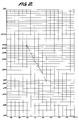
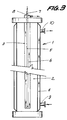
- figures 1 and 2 are two graphs which indicate the variation in viscosity (in c.p.s.) with temperature (in °C) corresponding to the examples which will be described below; and figure 3 is a longitudinal section of the crystallizer of the invention which is provided with an external refrigeration chamber.
- the crystallizer device of figure 3 consists of a container -1- in whose interior -2- is located a refrigeration tube -3- and whose exterior is surrounded by a chamber -4- which is substantially cylindrical.
- the refrigeration tube -3- contains in its interior a tube of smaller diameter -5- open at its lower end.
- the refrigerating liquid circulates by descending through the smaller diameter tube -5- and ascending through the chamber -6-, which is contained between the two tubes -3- and -5- as is indicated by the arrows, from an inlet -7- to an outlet -8-.
- the refrigerating liquid also circulates through the external chamber -4- in the direction indicated by the arrows from an inlet -9- to an outlet -10-.
- the cooling of the candy mass located in the interior of the container -1- takes place both from the exterior and from the interior. If the condition that the distance of every point in the candy mass is less than 400 mm from the cooling surface is fulfilled, whether this be from the interior refrigeration tube -3- or from the external refrigeration chamber -4-, then it is understood that a high capacity for cooling the candy mass is available.
- This example refers to sorbitol monohydrate with a melting point of 100 °C. This is a simple sugar with a low melting point.
- the mass of sorbitol has a low viscosity (very liquid) and the bubbles are not retained with the consequence that the candy mass is not gasified.
- the sorbitol mass has a viscosity which allows gasification since a high proportion of the bubbles are retained occluded.
- the sorbitol mass has a suitable viscosity for obtaining optimal gasification.
- sucrose-lactose-glucose in the proportion 65:30:15, and with a humidity of 2% according to the method of K.F. (Karl Fisher).
- the viscosity has been measured under the same conditions and with the same instrument as in the case of sorbitol.
Landscapes
- Life Sciences & Earth Sciences (AREA)
- Chemical & Material Sciences (AREA)
- Engineering & Computer Science (AREA)
- Food Science & Technology (AREA)
- Polymers & Plastics (AREA)
- Confectionery (AREA)
- Seasonings (AREA)
Claims (11)
- Procédé destiné à obtenir un bonbon gazéïfié qui comprend le chauffage d'une masse de bonbon à une température comprise entre 60 et 150° C de manière à le rendre liquide ou analogue à une pâte ; puis la mise en place de cette masse de bonbon dans un récipient dans lequel un gaz inerte est introduit sous pression, ce gaz étant retenu dans la masse de bonbon ; et le refroidissement de cette masse de bonbon de manière à la rendre solide tout en retenant des bulles de gaz à l'intérieur, et caractérisé en ce que la masse de bonbon placée à l'intérieur du récipient est d'une humidité comprise entre 0,1 et 5,5 % et a une viscosité comprise entre 5000 et 50000 cps.
- Procédé selon la revendication 1, caractérisé en ce que le gaz est introduit au travers de la partie inférieure du récipient maintenant la masse de bonbon.
- Procédé selon la revendication 1, caractérisé en ce que la viscosité de la masse de bonbon est comprise entre 14000 et 16000 cps.
- Procédé selon les revendications 1, 2 et 3, caractérisé en ce que les bulles possèdent un diamètre optimum compris entre 0,1 et 0,3 mm.
- Procédé selon les revendications 1, 2 et 3, caractérisé en ce que la masse de bonbon solidifiée est tamisée grâce à un crible dont le calibre est compris entre 0,5 et 5 mm.
- Procédé selon la revendication 1, caractérisé en ce que la masse de bonbon est refroidie dans des cristalliseurs dans lesquels le liquide réfrigérant est maintenu à une température comprise entre + 20°C et - 25° C.
- Procédé selon la revendication 1, caractérisé en ce que la masse de bonbon comprend un mélange de sucres qui contient du lactose dans une proportion comprise entre 12 et 35 %.
- Procédé selon la revendication 1, caractérisé en ce que la masse de bonbon comprend un mélange de sucres qui contient du glucose et/ou du sucre inverti dans une portion comprise entre 5 et 25 %.
- Procédé selon la revendication 1, caractérisé en ce que la masse de bonbon comprend un mélange de sucres qui contient du frutose dans une proportion comprise entre 5 et 35 %, dans le cas où le mélange ne contient pas du glucose et/ou du sucre inverti.
- Procédé selon la revendication 1, caractérisé en ce que le gaz inerte utilisé est du dioxyde de carbone.
- Procédé selon la revendication 1, caractérisé en ce que la pression de gaz inerte introduit dans la masse de bonbon est comprise entre 10 et 60 bars.
Applications Claiming Priority (2)
| Application Number | Priority Date | Filing Date | Title |
|---|---|---|---|
| US760562 | 1991-09-16 | ||
| US07/760,562 US5165951A (en) | 1991-09-16 | 1991-09-16 | Gasified candy, and process and apparatus for its manufacture |
Publications (2)
| Publication Number | Publication Date |
|---|---|
| EP0533609A1 EP0533609A1 (fr) | 1993-03-24 |
| EP0533609B1 true EP0533609B1 (fr) | 1995-11-22 |
Family
ID=25059483
Family Applications (1)
| Application Number | Title | Priority Date | Filing Date |
|---|---|---|---|
| EP92500064A Expired - Lifetime EP0533609B1 (fr) | 1991-09-16 | 1992-05-21 | Procédé pour la manufacture de friandises gazéifiées |
Country Status (7)
| Country | Link |
|---|---|
| US (1) | US5165951A (fr) |
| EP (1) | EP0533609B1 (fr) |
| BR (1) | BR9203594A (fr) |
| DE (1) | DE69206226T2 (fr) |
| ES (1) | ES2082422T3 (fr) |
| IE (1) | IE71176B1 (fr) |
| RU (1) | RU2078517C1 (fr) |
Cited By (1)
| Publication number | Priority date | Publication date | Assignee | Title |
|---|---|---|---|---|
| WO2011117638A2 (fr) | 2010-03-23 | 2011-09-29 | Cadbury Uk Limited | Confiseries et procédés de production associés |
Families Citing this family (19)
| Publication number | Priority date | Publication date | Assignee | Title |
|---|---|---|---|---|
| KR950015111B1 (ko) * | 1993-04-27 | 1995-12-22 | 안성애 | 가스함포캔디의 제조방법 및 장치 |
| IL109965A0 (en) * | 1994-06-09 | 1994-10-07 | Oded Broshi | Bubble solution |
| WO1999003357A1 (fr) * | 1997-07-18 | 1999-01-28 | Meiji Seika Kaisha, Ltd. | Procede de fabrication de sucre candi charge de gaz sous haute pression et appareil chargeur de gaz sous haute pression pour la realisation de ce procede |
| TR199800160A2 (xx) | 1998-02-02 | 1999-09-21 | Hleks Gida San Ve T�C. A�. | Patlayan �eker �retiminde yeni bir y�ntem. |
| NL1009069C2 (nl) * | 1998-05-05 | 1999-11-09 | Kees Van Der Manden B V | Opklopinrichting. |
| EP1616555B1 (fr) | 1999-06-09 | 2010-03-10 | The Procter & Gamble | Préparation d'un gel instantané et utilisation de particules solides gazifiées comme indicator acoustique |
| DE19945481A1 (de) * | 1999-09-22 | 2001-04-05 | Suedzucker Ag | Hartkaramellen mit verbesserter Lagerstabilität |
| US6310014B1 (en) * | 1999-10-05 | 2001-10-30 | Phyzz Inc. | Personal and household care compositions |
| US6516974B2 (en) | 2000-12-19 | 2003-02-11 | Adam Straus | Apparatus and method for dispensing candy |
| US6884447B2 (en) | 2001-06-04 | 2005-04-26 | Brad Baker | Confectionery with body, handle and container |
| US20020192329A1 (en) * | 2001-06-05 | 2002-12-19 | Corriveau Christine L. | Confectionery product with pockets of trapped gas |
| RU2182435C1 (ru) * | 2001-06-14 | 2002-05-20 | Московский Государственный Университет пищевых производств | Способ получения карамели |
| EP1771081A4 (fr) | 2003-12-15 | 2007-11-14 | Smithkline Beecham Corp | Preparations de nettoyage emettant un signal sensitif |
| US20050260323A1 (en) * | 2004-05-24 | 2005-11-24 | Target Brands, Inc. | Effervescent drink product and method of creation |
| RU2305412C2 (ru) * | 2005-04-21 | 2007-09-10 | Сергей Борисович Матвеев | Способ получения газифицированной карамели |
| US10881132B2 (en) | 2011-12-14 | 2021-01-05 | R.J. Reynolds Tobacco Company | Smokeless tobacco product comprising effervescent composition |
| JP2023530239A (ja) | 2020-06-08 | 2023-07-14 | ニコベンチャーズ トレーディング リミテッド | 発泡性口腔組成物 |
| MX2023012535A (es) | 2021-04-22 | 2024-01-24 | Nicoventures Trading Ltd | Composicion oral efervescente. |
| EP4585059A1 (fr) | 2024-01-12 | 2025-07-16 | Nicoventures Trading Limited | Produit effervescent en sachet |
Family Cites Families (15)
| Publication number | Priority date | Publication date | Assignee | Title |
|---|---|---|---|---|
| US3012893A (en) * | 1959-01-06 | 1961-12-12 | Gen Foods Corp | Gasified confection and method of making the same |
| US3985909A (en) * | 1975-10-01 | 1976-10-12 | General Foods Corporation | Incorporating a gas in candy |
| US4001457A (en) * | 1976-07-01 | 1977-01-04 | General Foods Corporation | Method of making a gasified confection |
| CH632420A5 (de) * | 1977-07-27 | 1982-10-15 | Oakes E T Ltd | Verfahren zur herstellung eines zellfoermigen erzeugnisses, und anwendung desselben zur herstellung eines erzeugnisses aus schokolade. |
| US4282263A (en) * | 1979-05-10 | 1981-08-04 | Sunmark, Inc. | Process for producing a gasified fusible sugar composition |
| US4262029A (en) * | 1979-10-26 | 1981-04-14 | General Foods Corporation | Apparatus and process for the preparation of gasified confectionaries by pressurized deposit molding |
| US4241092A (en) * | 1979-10-26 | 1980-12-23 | General Foods Corporation | Gasified candy dispersed in a matrix of sorbitol |
| US4273793A (en) * | 1979-10-26 | 1981-06-16 | General Foods Corporation | Apparatus and process for the preparation of gasified confectionaries by pressurized injection molding |
| US4275083A (en) * | 1979-10-26 | 1981-06-23 | General Foods Corporation | Gasified candy enrobed with oleaginous material |
| US4271206A (en) * | 1979-10-26 | 1981-06-02 | General Foods Corporation | Gasified candy having a predetermined shape |
| US4289794A (en) * | 1980-03-12 | 1981-09-15 | General Foods Corporation | Process of preparing gasified candy |
| ES2038123T3 (es) * | 1985-12-20 | 1993-07-16 | Morinaga & Co., Ltd. | Productos de dulceria. |
| US4837039A (en) * | 1987-02-09 | 1989-06-06 | Ramon Escola Gallart | Process of gasification for obtention of gasified candies |
| US4952417A (en) * | 1987-02-09 | 1990-08-28 | Ramon Escola Gallart | Apparatus for incorporating gas into a sugar mass |
| JP2556718B2 (ja) * | 1987-12-24 | 1996-11-20 | 明治製菓 株式会社 | 高圧ガス封入キャンディーの製造方法 |
-
1991
- 1991-09-16 US US07/760,562 patent/US5165951A/en not_active Expired - Lifetime
-
1992
- 1992-02-24 IE IE920574A patent/IE71176B1/en not_active IP Right Cessation
- 1992-05-21 EP EP92500064A patent/EP0533609B1/fr not_active Expired - Lifetime
- 1992-05-21 DE DE69206226T patent/DE69206226T2/de not_active Expired - Fee Related
- 1992-05-21 ES ES92500064T patent/ES2082422T3/es not_active Expired - Lifetime
- 1992-09-15 BR BR929203594A patent/BR9203594A/pt not_active IP Right Cessation
- 1992-09-15 RU SU925052892A patent/RU2078517C1/ru not_active IP Right Cessation
Non-Patent Citations (1)
| Title |
|---|
| 1981; & JP - A - 56029958 (ICHIHARA TAKUZO) 25.03.1981 * |
Cited By (1)
| Publication number | Priority date | Publication date | Assignee | Title |
|---|---|---|---|---|
| WO2011117638A2 (fr) | 2010-03-23 | 2011-09-29 | Cadbury Uk Limited | Confiseries et procédés de production associés |
Also Published As
| Publication number | Publication date |
|---|---|
| BR9203594A (pt) | 1993-04-13 |
| DE69206226T2 (de) | 1996-07-25 |
| EP0533609A1 (fr) | 1993-03-24 |
| IE920574A1 (en) | 1993-03-24 |
| US5165951A (en) | 1992-11-24 |
| DE69206226D1 (de) | 1996-01-04 |
| ES2082422T3 (es) | 1996-03-16 |
| IE71176B1 (en) | 1997-01-29 |
| RU2078517C1 (ru) | 1997-05-10 |
Similar Documents
| Publication | Publication Date | Title |
|---|---|---|
| US5165951A (en) | Gasified candy, and process and apparatus for its manufacture | |
| US3012893A (en) | Gasified confection and method of making the same | |
| US4289794A (en) | Process of preparing gasified candy | |
| US6805894B1 (en) | Soft candy and its production method | |
| US4883685A (en) | Meso-erythritol hard candy and process for producing the same | |
| AU652200B2 (en) | Directly compressible pulverulent composition based on xylitol and process for producing the same | |
| JPH0662745A (ja) | ミルクチョコレート生成物およびその製造方法 | |
| US4393660A (en) | Quiescent formation of gasified ice product and process | |
| AU2009295698B2 (en) | Confectionery and methods of production thereof | |
| EP2549885A2 (fr) | Confiseries et procédés de production associés | |
| BRPI0918866B1 (pt) | Material de confeitaria à base de gordura com uma fase contínua de gordura e produto de confeitaria | |
| KR20060089224A (ko) | 응고된 말티톨의 제조방법 및 식품과 의약품에서의 이의용도 | |
| JPH0687742B2 (ja) | 気泡入りチョコレートの製造法 | |
| JPH119192A (ja) | チューイング糖菓製品 | |
| US10932479B2 (en) | Process for the manufacture of a frozen product | |
| JP3343300B2 (ja) | フォンダン様糖菓の製造方法 | |
| EP1834528B1 (fr) | Procede d'elaboration de boissons gelifiees | |
| US2639238A (en) | Effervescent drink concentrate | |
| JPS60237947A (ja) | 多泡質キヤンデ−の製法 | |
| JP4462838B2 (ja) | α波放出増強剤、リラックス状態に導くことのできる剤、及び前記剤を含む飲食物 | |
| NL8002672A (nl) | Nieuwe werkwijze voor het vervaardigen van bruisend snoepgoeed. | |
| JP3371063B2 (ja) | エリスリトールを含有するシャーベットおよびその製造方法 | |
| JPH03183443A (ja) | 含気グミキャンデーの製造法 | |
| JP3371064B2 (ja) | シャーベットおよびその製造方法 | |
| JP2000189075A (ja) | 粉末形態のデキストロ―ス及びその調製方法 |
Legal Events
| Date | Code | Title | Description |
|---|---|---|---|
| PUAI | Public reference made under article 153(3) epc to a published international application that has entered the european phase |
Free format text: ORIGINAL CODE: 0009012 |
|
| AK | Designated contracting states |
Kind code of ref document: A1 Designated state(s): DE ES FR GB PT |
|
| 17P | Request for examination filed |
Effective date: 19930513 |
|
| 17Q | First examination report despatched |
Effective date: 19941014 |
|
| GRAA | (expected) grant |
Free format text: ORIGINAL CODE: 0009210 |
|
| AK | Designated contracting states |
Kind code of ref document: B1 Designated state(s): DE ES FR GB PT |
|
| REF | Corresponds to: |
Ref document number: 69206226 Country of ref document: DE Date of ref document: 19960104 |
|
| REG | Reference to a national code |
Ref country code: ES Ref legal event code: FG2A Ref document number: 2082422 Country of ref document: ES Kind code of ref document: T3 |
|
| ET | Fr: translation filed | ||
| SC4A | Pt: translation is available |
Free format text: 960214 AVAILABILITY OF NATIONAL TRANSLATION |
|
| PLBE | No opposition filed within time limit |
Free format text: ORIGINAL CODE: 0009261 |
|
| 26N | No opposition filed | ||
| REG | Reference to a national code |
Ref country code: GB Ref legal event code: IF02 |
|
| PGFP | Annual fee paid to national office [announced via postgrant information from national office to epo] |
Ref country code: ES Payment date: 20040519 Year of fee payment: 13 |
|
| PGFP | Annual fee paid to national office [announced via postgrant information from national office to epo] |
Ref country code: DE Payment date: 20040521 Year of fee payment: 13 |
|
| PGFP | Annual fee paid to national office [announced via postgrant information from national office to epo] |
Ref country code: FR Payment date: 20040528 Year of fee payment: 13 |
|
| PGFP | Annual fee paid to national office [announced via postgrant information from national office to epo] |
Ref country code: GB Payment date: 20040618 Year of fee payment: 13 |
|
| PGFP | Annual fee paid to national office [announced via postgrant information from national office to epo] |
Ref country code: PT Payment date: 20041007 Year of fee payment: 13 |
|
| PG25 | Lapsed in a contracting state [announced via postgrant information from national office to epo] |
Ref country code: GB Free format text: LAPSE BECAUSE OF NON-PAYMENT OF DUE FEES Effective date: 20050521 |
|
| PG25 | Lapsed in a contracting state [announced via postgrant information from national office to epo] |
Ref country code: ES Free format text: LAPSE BECAUSE OF NON-PAYMENT OF DUE FEES Effective date: 20050523 |
|
| PG25 | Lapsed in a contracting state [announced via postgrant information from national office to epo] |
Ref country code: PT Free format text: LAPSE BECAUSE OF NON-PAYMENT OF DUE FEES Effective date: 20051121 |
|
| PG25 | Lapsed in a contracting state [announced via postgrant information from national office to epo] |
Ref country code: DE Free format text: LAPSE BECAUSE OF NON-PAYMENT OF DUE FEES Effective date: 20051201 |
|
| GBPC | Gb: european patent ceased through non-payment of renewal fee |
Effective date: 20050521 |
|
| PG25 | Lapsed in a contracting state [announced via postgrant information from national office to epo] |
Ref country code: FR Free format text: LAPSE BECAUSE OF NON-PAYMENT OF DUE FEES Effective date: 20060131 |
|
| REG | Reference to a national code |
Ref country code: FR Ref legal event code: ST Effective date: 20060131 |
|
| REG | Reference to a national code |
Ref country code: ES Ref legal event code: FD2A Effective date: 20050523 |