EP0535806B1 - Thermoplastisch überzogene Eisenpulvermaterialien und Verfahren zu deren Herstellung - Google Patents
Thermoplastisch überzogene Eisenpulvermaterialien und Verfahren zu deren Herstellung Download PDFInfo
- Publication number
- EP0535806B1 EP0535806B1 EP92308017A EP92308017A EP0535806B1 EP 0535806 B1 EP0535806 B1 EP 0535806B1 EP 92308017 A EP92308017 A EP 92308017A EP 92308017 A EP92308017 A EP 92308017A EP 0535806 B1 EP0535806 B1 EP 0535806B1
- Authority
- EP
- European Patent Office
- Prior art keywords
- temperature
- thermoplastic material
- iron
- thermoplastic
- particles
- Prior art date
- Legal status (The legal status is an assumption and is not a legal conclusion. Google has not performed a legal analysis and makes no representation as to the accuracy of the status listed.)
- Expired - Lifetime
Links
Images

Classifications
-
- B—PERFORMING OPERATIONS; TRANSPORTING
- B22—CASTING; POWDER METALLURGY
- B22F—WORKING METALLIC POWDER; MANUFACTURE OF ARTICLES FROM METALLIC POWDER; MAKING METALLIC POWDER; APPARATUS OR DEVICES SPECIALLY ADAPTED FOR METALLIC POWDER
- B22F3/00—Manufacture of workpieces or articles from metallic powder characterised by the manner of compacting or sintering; Apparatus specially adapted therefor ; Presses and furnaces
- B22F3/12—Both compacting and sintering
-
- B—PERFORMING OPERATIONS; TRANSPORTING
- B22—CASTING; POWDER METALLURGY
- B22F—WORKING METALLIC POWDER; MANUFACTURE OF ARTICLES FROM METALLIC POWDER; MAKING METALLIC POWDER; APPARATUS OR DEVICES SPECIALLY ADAPTED FOR METALLIC POWDER
- B22F1/00—Metallic powder; Treatment of metallic powder, e.g. to facilitate working or to improve properties
- B22F1/16—Metallic particles coated with a non-metal
-
- C—CHEMISTRY; METALLURGY
- C04—CEMENTS; CONCRETE; ARTIFICIAL STONE; CERAMICS; REFRACTORIES
- C04B—LIME, MAGNESIA; SLAG; CEMENTS; COMPOSITIONS THEREOF, e.g. MORTARS, CONCRETE OR LIKE BUILDING MATERIALS; ARTIFICIAL STONE; CERAMICS; REFRACTORIES; TREATMENT OF NATURAL STONE
- C04B35/00—Shaped ceramic products characterised by their composition; Ceramics compositions; Processing powders of inorganic compounds preparatory to the manufacturing of ceramic products
- C04B35/01—Shaped ceramic products characterised by their composition; Ceramics compositions; Processing powders of inorganic compounds preparatory to the manufacturing of ceramic products based on oxide ceramics
- C04B35/03—Shaped ceramic products characterised by their composition; Ceramics compositions; Processing powders of inorganic compounds preparatory to the manufacturing of ceramic products based on oxide ceramics based on magnesium oxide, calcium oxide or oxide mixtures derived from dolomite
- C04B35/04—Shaped ceramic products characterised by their composition; Ceramics compositions; Processing powders of inorganic compounds preparatory to the manufacturing of ceramic products based on oxide ceramics based on magnesium oxide, calcium oxide or oxide mixtures derived from dolomite based on magnesium oxide
-
- C—CHEMISTRY; METALLURGY
- C22—METALLURGY; FERROUS OR NON-FERROUS ALLOYS; TREATMENT OF ALLOYS OR NON-FERROUS METALS
- C22C—ALLOYS
- C22C33/00—Making ferrous alloys
- C22C33/02—Making ferrous alloys by powder metallurgy
-
- H—ELECTRICITY
- H01—ELECTRIC ELEMENTS
- H01F—MAGNETS; INDUCTANCES; TRANSFORMERS; SELECTION OF MATERIALS FOR THEIR MAGNETIC PROPERTIES
- H01F1/00—Magnets or magnetic bodies characterised by the magnetic materials therefor; Selection of materials for their magnetic properties
- H01F1/01—Magnets or magnetic bodies characterised by the magnetic materials therefor; Selection of materials for their magnetic properties of inorganic materials
- H01F1/03—Magnets or magnetic bodies characterised by the magnetic materials therefor; Selection of materials for their magnetic properties of inorganic materials characterised by their coercivity
- H01F1/12—Magnets or magnetic bodies characterised by the magnetic materials therefor; Selection of materials for their magnetic properties of inorganic materials characterised by their coercivity of soft-magnetic materials
- H01F1/14—Magnets or magnetic bodies characterised by the magnetic materials therefor; Selection of materials for their magnetic properties of inorganic materials characterised by their coercivity of soft-magnetic materials metals or alloys
- H01F1/20—Magnets or magnetic bodies characterised by the magnetic materials therefor; Selection of materials for their magnetic properties of inorganic materials characterised by their coercivity of soft-magnetic materials metals or alloys in the form of particles, e.g. powder
- H01F1/22—Magnets or magnetic bodies characterised by the magnetic materials therefor; Selection of materials for their magnetic properties of inorganic materials characterised by their coercivity of soft-magnetic materials metals or alloys in the form of particles, e.g. powder pressed, sintered, or bound together
- H01F1/24—Magnets or magnetic bodies characterised by the magnetic materials therefor; Selection of materials for their magnetic properties of inorganic materials characterised by their coercivity of soft-magnetic materials metals or alloys in the form of particles, e.g. powder pressed, sintered, or bound together the particles being insulated
- H01F1/26—Magnets or magnetic bodies characterised by the magnetic materials therefor; Selection of materials for their magnetic properties of inorganic materials characterised by their coercivity of soft-magnetic materials metals or alloys in the form of particles, e.g. powder pressed, sintered, or bound together the particles being insulated by macromolecular organic substances
Definitions
- This invention relates to methods of making high-strength components from a powder composition of thermoplastic-coated iron-based particles. More particularly, the invention relates to a method in which the compositions are molded and pressed, and the pressed component then annealed or heat treated. The method is particularly useful to make magnetic core components.
- Iron-based particles have long been used as a base material in the manufacture of structural components by powder metallurgical methods.
- the iron-based particles are first molded in a die under high pressures in order to produce the desired shape.
- the structural component After the molding step, the structural component usually undergoes a sintering step to impart the necessary strength to the component.
- Magnetic core components have also been manufactured by such power metallurgical methods, but the iron-based particles used in these methods are generally coated with a circumferential layer of insulating material.
- the magnetic permeability of a material is an indication of its ability to become magnetized, or its ability to carry a magnetic flux. Permeability is defined as the ratio of the induced magnetic flux to the magnetizing force or field intensity.
- the iron particles When molding a core component for AC power applications, it is generally required that the iron particles have an electrically insulating coating to decrease core losses.
- the use of a plastic coating see U.S. Patent No. 3,935,340 to Yamaguchi
- the use of doubly-coated iron particles see U.S. Patent No. 4,601,765 to Soileau et al.
- these powder compositions require a high level of binder, resulting in decreased density of the pressed core part and, consequently, a decrease in permeability.
- EP-A-0112577 describes a process for manufacturing a magnetic core in which particles of iron or iron alloy are coated with an insulating binder resin and then compression molded.
- the present invention provides a method of making a high strength powder metallurgical component, particularly a magnetic core component, by the method steps recited in claim 1 and in claim 10. The method enhances the strength of the pressed part without the need for sintering.
- the method is applicable to any powder composition of iron particles in combination with an organic thermoplastic material where the thermoplastic material constitutes from 0.001% to 15% of the combined weights of the iron particles and thermoplastic.
- the thermoplastic material is present as a coating on the individual iron particles, but the thermoplastic can also be present in the form of discrete particles that are intimately admixed with the iron particles.
- the thermoplastic material is a polyphenylene ether or a polyetherimide.
- the powder composition is pressed in a die at a temperature above the glass transition temperature of the thermoplastic material for a time sufficient to form an integral component, and the compacted component is then heat-treated at a temperature at least as high as the temperature at which it was pressed.
- the compacted component is cooled to a temperature at least as low as the glass transition temperature prior to the heat treatment step.
- the heat-treating step is preferably conducted at a temperature up to 121°C (250°F) above the pressing temperature.
- the thermoplastic material is present as a coating on the surfaces of the individual iron particles.
- the iron particles can be doubly-coated, such as where, in addition to an outer layer of the thermoplastic material, the particles have a first, inner coating of an insulative material such as iron phosphate.
- Fig. 1 depicts the strength of pressed components of the invention as a function of heat-treating temperature.
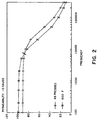
- Fig. 2 depicts the initial permeability of the pressed components of the invention compared to pressed components that were not heat-treated in accordance with the invention.
- the strength of iron core components made, via powder metallurgical methods, from a powder composition of thermoplastic-coated iron particles can be enhanced by subjecting the die-pressed part to a heat-treating or annealing step.
- magnetic core components have been made by compacting in a die a powder composition of iron particles having an outer coating of thermoplastic material, followed by heating the die and composition above the glass transition temperature of the thermoplastic and applying a pressure of 77-1540 MN/m 2 (5-100 tons per square inch). The compacted part was substantially finished upon removal from the die and cooling.
- the method of the present invention is particularly useful as applied to a powder composition
- a powder composition comprising particles of iron core material having an outer coating of an organic thermoplastic material.
- the starting iron-based core particles are high-compressibility powders of iron or ferromagnetic material having a weight average particle size of 1-500 microns, although for some applications a weight average particle size up to about 850 microns can be used.
- Preferred are particles in the range of 10-350 microns, and more preferred in the range of 10-250 microns or in the range of 10-200 microns.
- An example of such a metallurgy grade powder is ANCORSTEEL 1000C powder, available from Hoeganaes Corporation, Riverton, New Jersey.
- This product is a powder of substantially pure iron having a typical screen profile of about 13% by weight of the particles below 325 mesh and about 17% by weight of the particles greater than 100 mesh with the remainder between these two sizes.
- the ANCORSTEEL 1000C powder typically has an apparent density of from about 2.8 to about 3.0 g/cm 3 .
- the iron-based particles of the invention have a substantially uniform coating of the thermoplastic material.
- each particle has a substantially uniform circumferential coating.
- the coating can be applied by any method that substantially uniformly coats the individual iron particles with the thermoplastic material.
- sufficient thermoplastic material is used to provide a coating of 0.001-15% by weight of the iron particles as coated.
- the thermoplastic material is present in an amount of at least about 0.2% by weight.
- a coated powder is used in which the thermoplastic material is 0.4-2% by weight, and more preferably 0.6-0.9% by weight, of the coated particles.
- the use of iron-based powders having an outer coating of thermoplastic material as described above provides advantages for magnetic core components such as improved pressed strength and the ability to mold magnetic components of complex shapes that have a substantially uniform magnetic permeability over a wide frequency range.
- the iron particles can first be coated with another insulative inorganic material to provide an inner coating that underlies the coating of thermoplastic material.
- This inner coating is preferably no greater than about 0.2% by total weight of the doubly coated particles.
- Such inner coatings include iron phosphate as discussed in allowed U.S. Application Serial No. 07/365,186, filed June 12, 1989, and alkaline metal silicates, such as disclosed in U.S. Patent No. 4,601,765.
- thermoplastic materials used in the coated powders of this invention are polymers having a weight average molecular weight in the range of about 10,000 to 50,000 having a level of crystallinity that allows them to be dissolved in an organic solvent. Generally the polymers will have a glass transition temperature in the range of about 79-232°C (175-450°F). It has been found that the method of the present invention is particularly advantageous for use with iron core particles coated with a polyphenylene ether or polyetherimide, which are the preferred thermoplastic materials for use herein.
- a suitable polyphenylene ether thermoplastic is poly(2,6-dimethyl-1,4-phenylene oxide) which has an empirical formula of (C 8 H 8 O) n .
- the polyphenylene ether homopolymer can be admixed with an alloying/blending resin such as a high impact polystyrene, such as poly(butadiene-styrene); or a polyamide, such as Nylon 66, either as polycaprolactam or poly(hexamethylenediamine-adipate).
- These thermoplastic materials have a specific gravity in the range of about 1.0 to 1.4.
- a commercially available polyphenylene is sold under the trademark NORYL® resin by the General Electric Company. The most preferred NORYL® resins are the NORYL® 844, 888, and 1222 grades.
- a suitable polyetherimide thermoplastic is poly[2,2'-bis(3,4-dicarboxyphenoxy) phenylpropane)-2-phenylene bismide] which has an empirical formula of (C 37 H 24 O 6 N 2 ) n where n is 15-27.
- the polyetherimide thermoplastics have a specific gravity in the range of about 1.2 to 1.6.
- a commercially available polyetherimide is sold under the trade name ULTEM® resin by the General Electric Company. The most preferred ULTEM® resin is the ULTEM® 1000 grade.
- a preferred method for applying the thermoplastic coating to the iron core particles, whether or not the particles have a first coating of insulative material as described above, uses a fluidized bed process.
- This process can be conducted in a Wurster coater such as manufactured by Glatt, Inc.
- the iron particles are fluidized in air, and a solution of the thermoplastic material in an appropriate organic solvent is sprayed through an atomizing nozzle into the inner portion of the Wurster coater, where the solution contacts the fluidized bed of iron particles.
- Any organic solvent for the thermoplastic material can be used, but preferred solvents are methylene chloride and 1,1,2 trichloroethane.
- the concentration of thermoplastic material in the coating solution is preferably at least 3% and more preferably about 5-10% by weight.
- the use of a peristaltic pump to transport the thermoplastic solution to the nozzle is preferred.
- the fluidized iron particles are preferably heated to a temperature of at least about 25°C, more preferably at least about 30°C, but below the solvent boiling point, prior to being contacted with the solution of thermoplastic material.
- the iron particles are wetted by the droplets of dissolved thermoplastic, and the wetted particles are then transferred to an expansion chamber in which the solvent is removed from the particles by evaporation, leaving a substantially uniform outer coating of thermoplastic material around the iron core particles.
- the amount of thermoplastic material coated onto the iron particles can be monitored or controlled by various means, such as by operating the coater apparatus in a batchwise fashion and administering the amount of thermoplastic necessary for the desired coating percentage at a constant rate during the batch cycle.
- Another method is to take samples continuously from the particles being coated within the fluidized bed and to test for carbon content, using known correlations to the thermoplastic content.
- thermoplastic-coated iron particles are characterized by having an apparent density of about 2.4-2.7 g/cm 3 and a thermoplastic coating that constitutes 0.4-2% by weight of the particles as coated. It has been found that components made from particles within these limits exhibit superior magnetic properties.
- thermoplastic coated particles employs a Glatt GPCG-5 Wurster coater having a 17.8 cm (7 in.) coating insert.
- a 17 kg (37.5 lb.) load of ANCORSTEEL A1000C iron powder (from Hoeganaes Co.) having an apparent density of about 3.0 g/cm 3 is charged into the coater.
- This powder is fluidized and maintained at a process temperature of about 33-37°C.
- a solvent is sprayed into the coater to clean out the nozzle assembly.
- a solution (7.5 weight percent concentration) of ULTEM® resin 1000 grade polyetherimide in methylene chloride is sprayed into the coater via a peristaltic pump at a rate of about 110-120 grams of solution per minute.
- the solution is atomized through a 1.2 mm nozzle at the bottom of the coater with a 4 bar atomizing pressure.
- the coater is operated at a 40% air flap setting with an "A" plate with an inlet air temperature of about 35-40°C.
- the process continues until about 1,700 g (3.75 lb) of solution are sprayed into the coater.
- the solution addition is then stopped, but the coated powder is maintained in a fluidized state until the solvent evaporates.
- the final coated powder has a thermoplastic content of about 0.75% by weight.
- the thermoplastic material is in particulate form and is admixed with the iron particles to form a powder composition of discrete particles of the iron-based material in intimate admixture with discrete particles of thermoplastic material.
- the thermoplastic particles are generally in a size below about 400 microns and preferably below 200 microns. Preferably the particles are fine enough to pass through a No. 60 sieve, U.S. Series, (about 250 microns or less), more preferably through a No. 100 sieve (about 150 microns or less), and most preferably through a No. 140 sieve (about 100-105 microns or less) in order to reduce segregation and enhance the mixing between the iron and thermoplastic particles.
- the amount of thermoplastic is generally 0.001-15% by weight of the admixed iron/thermoplastic composition, preferably at least about 0.2% by weight, more preferably 0.4-2% by weight, and most preferably 0.6-0.9% by weight.
- This admixture of iron particles and thermoplastic particles can be prepared by conventional mixing techniques to form a substantially homogeneous particle mixture.
- this dry admixture is then contacted with a solvent for the thermoplastic material in an amount sufficient to wet the particles, and more particularly to soften and/or partially dissolve the surfaces of the polymeric particles, causing those particles to become tacky and to adhere or bond to the surfaces of the iron particles.
- the solvent is applied to the dry admixture by spraying fine droplets of the solvent during mixing of the dry blend. Most preferably mixing is continued throughout the solvent application to ensure wetting of the polymer materials and homogeneity of the final mixture.
- the solvent is thereafter removed by evaporation, optionally with the aid of heating, forced ventilation, or vacuum.
- the initial dry blending of the particles as well as the application and removal of the solvent can be effected in conventional mixing equipment outfitted with suitable solvent application and recovery means.
- the conical screw mixers available from the Nauta Company can be used for this purpose.
- Any organic solvent for the polymeric material can be used. Preferred are methylene chloride, 1,1,2-trichloroethane, and acetone. Blends of these solvents can also be used.
- a preferred combination for use in this invention uses a polyetherimide thermoplastic as the polymeric material and methylene chloride as the solvent. The amount of solvent applied to the dry admixture will be about 1.5-50 weight parts, preferably about 3-20 weight parts, of solvent per unit weight part of polymer.
- thermoplastic-coated iron powders or iron/thermoplastic particle powders can be formed into molded components by an appropriate molding technique employing sufficient heat to soften the thermoplastic material.
- a compression molding process utilizing a die heated to a temperature above the glass transition temperature of the thermoplastic material, is used to form the components.
- the die is generally heated to a temperature that is 28 to 83°C (50-150 degrees Fahrenheit), preferably 56-83°C (100-150 degrees Fahrenheit), above the glass transition temperature.
- the powder mixture is charged into the die, and normal powder metallurgy pressures are applied at the indicated temperatures to press out the desired component.
- Typical compression molding techniques employ compaction pressures of from 77 to 1540 MN/m 2 (5 to 100 tons per square inch), preferably in the range of 462 to 924 MN/m 2 (30 to 60 tsi).
- the temperature and pressures used in the compression molding step are generally those that will be sufficient to form a strong integral part from the powder composition.
- a lubricant can be employed with the iron powder mixture in order to reduce the stripping and sliding pressures experienced with the use of the compression molding technique described above.
- One such lubricant is particulate boron nitride, which can be admixed with the coated powders in an amount of from about 0.1% to about 0.3% by weight of the coated powder.
- thermoplastic material can generally be admixed with the iron powder using a traditional compounding system.
- the thermoplastic material and the iron particles are fed through a screw blender, which has been heated to a temperature of at least 28°C (50 degrees F) above, and preferably 56 to 83°C (100-150 degrees F) above, the glass transition temperature of the thermoplastic.
- the thermoplastic material is melted and mixed with the iron particles as the materials are pressed through the screw.
- the resulting mixture is extruded into pellet form to be fed into the injection molding apparatus.
- the powder mixture can also be prepared by the fluidized bed process described above. In either event, when the composition is intended for use in an injection molding process, it is preferred that the thermoplastic material constitute about 8% to about 15% by weight of the coated particles.
- the molded component is heat treated in order to "cure" the thermoplastic material and provide a component with superior strength.
- the molded component preferably after removal from the die and after being permitted to cool to at least the glass transition temperature, is then separately heated to a process or annealing temperature that is above the glass transition temperature of the thermoplastic material.
- the process temperature is preferably up to about 138°C (250°F) above, more preferably in the range of 28-138°C (50-250°F) above, the temperature at which the component was compacted.
- the temperature is generally controlled so as to be below the flash point of the thermoplastic material.
- the process temperature will be 93-427°C (200°-800°F), preferably 232-427°C (450°-800°F), and most preferably between 232-343°C (450°-650°F).
- the molded component is maintained at the process temperature for a time sufficient for the component to be thoroughly heated and its internal temperature brought substantially to the process temperature. Generally heating is required for about 0.5 to 3 hours, depending on the size and initial temperature of the part.
- the heat treatment can be conducted in air or in an inert atmosphere such as nitrogen.
- the heat treatment is a separate heating step from the compaction process. It has been found, however, that the performance of the heat treatment step can occur at any time after compaction. That is, the heat treatment step can proceed immediately after compaction with no intervening cooling, or it can proceed, after compaction, after the component has cooled or been permitted to cool to a temperature at least as low as the glass transition temperature, and optionally as low as ambient temperature.
- the benefits of this method to produce a molded component are seen by the following data.
- Table 1 the temperature-related physical characteristics of certain thermoplastic materials are shown.
- the ULTEM® and NORYL® materials are described above.
- the LEXAN® resin is available from General Electric Company.
- test bars prepared from a powder composition of A1000C iron particles (Hoeganaes Corp.) that were coated with 0.75% by weight of a thermoplastic material as identified below.
- the test bars were uniformly molded at 616 MN/m 2 (40 tons per square inch) in a compression molding process.
- the bars were pressed at a temperature of 204°C (400°F) for the NORYL® material, 274°C (525°F) for the ULTEM® material, and 232°C (450°F) for the LEXAN® material.
- the pressing temperatures were chosen to be within the range of 56-83°C (100°-150°F) above the glass transition temperature of the respective thermoplastic material.
- the heat treatment process temperature was varied in 28°C (50°F) increments from about the pressing temperature to about 138°C (250°F) above the pressing temperature.
- the components were heat treated for one hour in air immediately following the compaction step.
- Table 2 discloses the densities of the pressed components and the effect that the heat treatment step had on the density in comparison to the reference ("as pressed") component, which was not heat-treated.
- the transverse rupture strength of the test components was determined as described in Materials Standards for PM Structured Parts, Standard 41, published by Metal Powder Industry Federation (1990-91 Ed.). The strength data is shown in Figure 1.
- the components made from iron powder coated with ULTEM® and NORYL® materials exhibited surprising increases in strength at the higher heat treatment temperatures; in the case of the component made from ULTEM® coated powders, the strength nearly doubled.
- the atmosphere in which the heat treating is conducted is not thought to affect the final strength of the component.
- Table 3 is shown a comparison between heat treatment conducted in air and in a nitrogen atmosphere.
- the materials used were A1000C iron particles coated with 0.75 weight percent of the indicated thermoplastic material pressed at 616 MN/m 2 (40 tsi) and then heat treated, immediately following compaction, at 315°C (600°F) for 60 minutes. Although slight increases in strength were observed for the nitrogen environment, it is unclear whether or not these increases in strength are the result of a lack of oxygen during the heat treatment step.
- Table 4 is shown the effect of the time of heat treatment on the strength of the component.
- the materials used were A1000C iron particles coated with 0.75 weight percent of the indicated thermoplastic material pressed at 616 MN/m 2 (40 tsi) and heat treated, immediately following compaction, at 315°C (600°F) in air.
- the length of the heat treatment step is not considered to affect the strength of the component.
- the heat treatment step should however be continued until the internal temperature of the component is brought substantially to the process temperature.
- the powder used has a weight average particle size of about 170 microns, and is further characterized as an annealed sponge iron powder having a typical apparent density of about 2.3-2.6 g/cm 3 and a particle size distribution, by weight, of 0.1% +40 mesh, 19.3% +60 mesh, 39.3% +80 mesh, 15.4% +100 mesh, 16.5% +200 mesh, and 9.4% +250 mesh.
- the powder was coated with 0.75 weight percent of ULTEM® 1000 resin and pressed at 616 MN/m 2 (40 tsi) at 274°C (525°F).
- the heat treated components were thereafter cured at 315°C (600°F) in air for 1 hour.
- the "As Pressed" component was not subjected to a heat treating step after the compaction.
- An iron/thermoplastic particle powder was prepared by admixing Ancorsteel 1000C iron particles with particulate ULTEM® 1000 polyetherimide screened to exclude particles larger than 100 mesh (0.006 in., 0.015 cm). The final powder contained 0.6% by weight of the thermoplastic.
- the powder composition was pressed at 274°C (525°F) at compaction pressures of from 462 to 770 MN/m 2 (30 to 50 tsi). Heat treatment was at 315°C (600°F) for one hour.
- the admixed powder had an increased green strength of from about 40-60% after the heat treating step.
Landscapes
- Chemical & Material Sciences (AREA)
- Engineering & Computer Science (AREA)
- Organic Chemistry (AREA)
- Materials Engineering (AREA)
- Mechanical Engineering (AREA)
- Dispersion Chemistry (AREA)
- Physics & Mathematics (AREA)
- Spectroscopy & Molecular Physics (AREA)
- Metallurgy (AREA)
- Power Engineering (AREA)
- Manufacturing & Machinery (AREA)
- Ceramic Engineering (AREA)
- Structural Engineering (AREA)
- Powder Metallurgy (AREA)
- Soft Magnetic Materials (AREA)
- Application Of Or Painting With Fluid Materials (AREA)
Claims (17)
- Verfahren zur Herstellung eines hochfesten pulvermetallurgischen Materials, welches folgende Schritte aufweist:a) Herstellung eines Pulvergemisches auf Eisenbasis, welches Eisenpartikel umfaßt, die eine äußere Beschichtung aus einem thermoplastischen Material haben, wobei das thermoplastische Material zwischen 0,001 Gewichtsprozent und 15 Gewichtsprozent der beschichteten Eisenpartikel ausmacht;b) Verdichtung des Gemisches in einer Preßform bei einer Temperatur oberhalb der Glasübergangstemperatur des Thermoplastes; undc) separates Aufheizen des Materials bis zu einer Temperatur, welche zumindest so hoch ist wie die Verdichtungstemperatur bis zu 427 °C.
- Verfahren nach Anspruch 1, dadurch gekennzeichnet, daß man das verdichtete Material vor dem Aufheizschritt abkühlen läßt bis zu einer Temperatur, welche zumindest so niedrig ist wie die Glasübergangstemperatur des Thermoplastes.
- Verfahren nach Anspruch 1 oder 2, dadurch gekennzeichnet, daß das thermoplastische Material ein Polyphenylenether oder ein Polyetherimid ist und daß das thermoplastische Material 0,4 bis 2 Gewichtsprozent der beschichteten Partikel ausmacht.
- Verfahren nach Anspruch 1, 2 oder 3, dadurch gekennzeichnet, daß der Aufheizschritt bei einer Temperatur zwischen 232 °C bis 427 °C durchgeführt wird.
- Verfahren nach Anspruch 1, 2 oder 3, dadurch gekennzeichnet, daß der Verdichtungsschritt durchgeführt wird bei einem Druck von 462 bis 924 MN/m2 und bei einer Temperatur im Bereich von 28 bis 83 °C oberhalb der Glasübergangstemperatur des thermoplastischen Materials.
- Verfahren nach Anspruch 5, dadurch gekennzeichnet, daß die Eisenpartikel eine gewichtete mittlere Partikelgröße von 10 bis 200 Mikron haben und daß der Aufheizschritt bei einer Temperatur zwischen 232 °C und 427 °C durchgeführt wird.
- Verfahren nach einem der vorhergehenden Ansprüche, dadurch gekennzeichnet, daß die Eisenkernpartikel eine erste, innere Beschichtung aus einem isolierenden anorganischen Material aufweisen.
- Verfahren nach einem der vorhergehenden Ansprüche, dadurch gekennzeichnet, daß der Verdichtungsschritt Formpressen umfaßt.
- Verfahren nach Anspruch 1 oder 2, dadurch gekennzeichnet, daß der Verdichtungsschritt ein Spritzgießverfahren umfaßt und daß das thermoplastische Material zumindest etwa 8 Gewichtsprozent der beschichteten Partikel ausmacht.
- Verfahren zur Herstellung eines hochfesten pulvermetallurgischen Materials, welches folgende Schritte umfaßt:a) Herstellung eines Eisen/Thermoplastpulvergemisches, welches Eisenpartikel umfaßt, denen ein thermoplastisches Material in bestimmter Form beigemengt wird, wobei das thermoplastische Material zwischen 0,001 Gewichtsprozent und 15 Gewichtsprozent des Gemisches ausmacht;b) Verdichtung des Gemisches in einer Preßform bei einer Temperatur oberhalb der Glasübergangstemperatur des Thermoplastes undc) separates Aufheizen des Materials bis zu einer Temperatur, welche zumindest so hoch ist wie die Verdichtungstemperatur bis zu 427 °C.
- Verfahren nach Anspruch 10, dadurch gekennzeichnet, daß man das verdichtete Material vor dem Aufheizschritt abkühlen läßt bis zu einer Temperatur, welche zumindest so niedrig ist wie die Glasübergangstemperatur des Thermoplastes.
- Verfahren nach Anspruch 10 oder 11, dadurch gekennzeichnet, daß das thermoplastische Material ein Polyphenylenether oder ein Polyetherimid ist und daß das thermoplastische Material 0,4 bis 2 Gewichtsprozent der beschichteten Partikel ausmacht.
- Verfahren nach Anspruch 10, 11 oder 12, dadurch gekennzeichnet, daß der Aufheizschritt durchgeführt wird bei einer Temperatur zwischen 232 °C und 427 °C.
- Verfahren nach Anspruch 10, 11 oder 12, dadurch gekennzeichnet, daß der Verdichtungsschritt bei einem Druck von 462 bis 924 MN/m2 und bei einer Temperatur im Bereich von 28 bis 83 °C oberhalb der Glasübergangstemperatur des thermoplastischen Materials durchgeführt wird.
- Verfahren nach Anspruch 14, dadurch gekennzeichnet, daß die Eisenpartikel eine gewichtete, mittlere Partikelgröße von 10 bis 200 Mikron und daß die Partikel des thermoplastischen Materials eine Größe unter 200 Mikron aufweisen, und daß der Aufheizschritt bei einer Temperatur zwischen 232 °C und 427 °C durchgeführt wird.
- Verfahren nach einem der Ansprüche 10 bis 15, dadurch gekennzeichnet, daß das Eisen/Thermoplastpulvergemisch hergestellt wird mittels einer Methode, welche folgende Schritte umfaßt:a) Herstellung eines trockenen Gemisches von Eisenpartikeln und Partikeln des thermoplastischen Materials;b) Benetzung der trockenen Mischung mit einem Lösungsmittel für das thermoplastische Material undc) Entfernung des Lösungsmittels.
- Ein pulvermetallurgisches Material, welches hergestellt wird mittels einer Methode gemäß einem der vorhergehenden Ansprüche.
Applications Claiming Priority (4)
| Application Number | Priority Date | Filing Date | Title |
|---|---|---|---|
| US77064891A | 1991-10-03 | 1991-10-03 | |
| US770648 | 1991-10-03 | ||
| US07/830,234 US5268140A (en) | 1991-10-03 | 1992-01-31 | Thermoplastic coated iron powder components and methods of making same |
| US830234 | 1992-01-31 |
Publications (2)
| Publication Number | Publication Date |
|---|---|
| EP0535806A1 EP0535806A1 (de) | 1993-04-07 |
| EP0535806B1 true EP0535806B1 (de) | 1997-07-02 |
Family
ID=27118340
Family Applications (1)
| Application Number | Title | Priority Date | Filing Date |
|---|---|---|---|
| EP92308017A Expired - Lifetime EP0535806B1 (de) | 1991-10-03 | 1992-09-03 | Thermoplastisch überzogene Eisenpulvermaterialien und Verfahren zu deren Herstellung |
Country Status (8)
| Country | Link |
|---|---|
| US (1) | US5268140A (de) |
| EP (1) | EP0535806B1 (de) |
| JP (1) | JP2983776B2 (de) |
| KR (1) | KR100241677B1 (de) |
| AT (1) | ATE154952T1 (de) |
| DE (1) | DE69220641T2 (de) |
| DK (1) | DK0535806T3 (de) |
| ES (1) | ES2104837T3 (de) |
Families Citing this family (42)
| Publication number | Priority date | Publication date | Assignee | Title |
|---|---|---|---|---|
| US5595609A (en) * | 1993-04-09 | 1997-01-21 | General Motors Corporation | Annealed polymer-bonded soft magnetic body |
| US5589010A (en) * | 1993-04-09 | 1996-12-31 | General Motors Corporation | Annealed polymer-bonded soft magnetic body |
| SE9402497D0 (sv) * | 1994-07-18 | 1994-07-18 | Hoeganaes Ab | Iron powder components containing thermoplastic resin and methods of making same |
| US5828142A (en) * | 1994-10-03 | 1998-10-27 | Mrs Technology, Inc. | Platen for use with lithographic stages and method of making same |
| US5567746A (en) * | 1994-12-16 | 1996-10-22 | General Motors Corporation | Moldable ferromagnetic particles and method |
| US5594186A (en) * | 1995-07-12 | 1997-01-14 | Magnetics International, Inc. | High density metal components manufactured by powder metallurgy |
| US5767426A (en) * | 1997-03-14 | 1998-06-16 | Hoeganaes Corp. | Ferromagnetic powder compositions formulated with thermoplastic materials and fluoric resins and compacted articles made from the same |
| KR19980082777A (ko) * | 1997-05-09 | 1998-12-05 | 윤종용 | 예약시동 내장형 카 스테레오 |
| SE9702744D0 (sv) * | 1997-07-18 | 1997-07-18 | Hoeganaes Ab | Soft magnetic composites |
| US5935722A (en) * | 1997-09-03 | 1999-08-10 | Lockheed Martin Energy Research Corporation | Laminated composite of magnetic alloy powder and ceramic powder and process for making same |
| US6051324A (en) * | 1997-09-15 | 2000-04-18 | Lockheed Martin Energy Research Corporation | Composite of ceramic-coated magnetic alloy particles |
| US5982073A (en) | 1997-12-16 | 1999-11-09 | Materials Innovation, Inc. | Low core loss, well-bonded soft magnetic parts |
| US5993507A (en) * | 1997-12-29 | 1999-11-30 | Remington Arms Co., Inc. | Composition and process for metal injection molding |
| US5980603A (en) * | 1998-05-18 | 1999-11-09 | National Research Council Of Canada | Ferrous powder compositions containing a polymeric binder-lubricant blend |
| US6372348B1 (en) | 1998-11-23 | 2002-04-16 | Hoeganaes Corporation | Annealable insulated metal-based powder particles |
| US6455100B1 (en) | 1999-04-13 | 2002-09-24 | Elisha Technologies Co Llc | Coating compositions for electronic components and other metal surfaces, and methods for making and using the compositions |
| US6742774B2 (en) | 1999-07-02 | 2004-06-01 | Holl Technologies Company | Process for high shear gas-liquid reactions |
| US7538237B2 (en) * | 1999-07-02 | 2009-05-26 | Kreido Laboratories | Process for high shear gas-liquid reactions |
| US6652805B2 (en) * | 1999-07-02 | 2003-11-25 | Holl Technologies Company | Highly filled composites of powdered fillers and polymer matrix |
| US6471392B1 (en) | 2001-03-07 | 2002-10-29 | Holl Technologies Company | Methods and apparatus for materials processing |
| US6391082B1 (en) * | 1999-07-02 | 2002-05-21 | Holl Technologies Company | Composites of powdered fillers and polymer matrix |
| US6534564B2 (en) * | 2000-05-31 | 2003-03-18 | Hoeganaes Corporation | Method of making metal-based compacted components and metal-based powder compositions suitable for cold compaction |
| DE10106172A1 (de) * | 2001-02-10 | 2002-08-29 | Bosch Gmbh Robert | Verfahren zur Herstellung eines Formteils aus einem weichmagnetischen Verbundwerkstoff |
| US6830806B2 (en) * | 2001-04-12 | 2004-12-14 | Kreido Laboratories | Methods of manufacture of electric circuit substrates and components having multiple electric characteristics and substrates and components so manufactured |
| AU2002336510A1 (en) * | 2001-09-13 | 2003-03-24 | Holl Technologies Company | Methods and apparatus for transfer of heat energy between a body surface and heat transfer fluid |
| US7504920B2 (en) * | 2001-09-26 | 2009-03-17 | Tekonsha Engineering Company | Magnetic brake assembly |
| US6787246B2 (en) | 2001-10-05 | 2004-09-07 | Kreido Laboratories | Manufacture of flat surfaced composites comprising powdered fillers in a polymer matrix |
| KR100916891B1 (ko) * | 2001-10-29 | 2009-09-09 | 스미또모 덴꼬 쇼오께쯔 고오낑 가부시끼가이샤 | 복합 자성 재료 및 그 제조 방법 |
| JP2003183702A (ja) * | 2001-12-18 | 2003-07-03 | Aisin Seiki Co Ltd | 軟磁性粉末材料、軟磁性成形体及び軟磁性成形体の製造方法 |
| US7098360B2 (en) * | 2002-07-16 | 2006-08-29 | Kreido Laboratories | Processes employing multiple successive chemical reaction process steps and apparatus therefore |
| US7165881B2 (en) * | 2002-09-11 | 2007-01-23 | Holl Technologies Corporation | Methods and apparatus for high-shear mixing and reacting of materials |
| US20040126483A1 (en) * | 2002-09-23 | 2004-07-01 | Heimann Robert L. | Coating compositions for electronic components and other metal surfaces, and methods for making and using the compositions |
| WO2004030802A2 (en) * | 2002-10-03 | 2004-04-15 | Kreido Laboratories | Apparatus for transfer of heat energy between a body surface and heat transfer fluid |
| CA2432820A1 (en) * | 2003-06-19 | 2004-12-19 | Green-Kore Inc. | Composition for production of non-toxic projectiles and method of manufacturing thereof |
| US20080096009A1 (en) * | 2004-06-24 | 2008-04-24 | University Of Delaware | High Frequency Soft Magnetic Materials With Laminated Submicron Magnetic Layers And The Methods To Make Them |
| JP4504212B2 (ja) * | 2005-01-28 | 2010-07-14 | 株式会社ビー・アンド・プラス | 電磁信号伝送装置用コアの製造方法 |
| US7824324B2 (en) | 2005-07-27 | 2010-11-02 | Neuronetics, Inc. | Magnetic core for medical procedures |
| US20070186722A1 (en) | 2006-01-12 | 2007-08-16 | Hoeganaes Corporation | Methods for preparing metallurgical powder compositions and compacted articles made from the same |
| US20100007169A1 (en) * | 2008-07-11 | 2010-01-14 | Trinh Anh Hieu Nguyen | Vehicle protection assembly |
| US8911663B2 (en) * | 2009-03-05 | 2014-12-16 | Quebec Metal Powders, Ltd. | Insulated iron-base powder for soft magnetic applications |
| WO2016043026A1 (ja) * | 2014-09-17 | 2016-03-24 | 株式会社オートネットワーク技術研究所 | 複合材料の製造方法 |
| KR20250048794A (ko) * | 2017-02-24 | 2025-04-10 | 이노막 21, 소시에다드 리미타다 | 경량 부품의 경제적 제조 방법 |
Family Cites Families (12)
| Publication number | Priority date | Publication date | Assignee | Title |
|---|---|---|---|---|
| US3766096A (en) * | 1971-11-02 | 1973-10-16 | Du Pont | Compositions of matter containing ferromagnetic particles with electrically insulative coatings and nonmagnetic aluminum particles in an elastic material |
| JPS5146552B2 (de) * | 1972-12-04 | 1976-12-09 | ||
| US4106932A (en) * | 1974-07-31 | 1978-08-15 | H. L. Blachford Limited | Lubricants for powdered metals, and powdered metal compositions containing said lubricants |
| US4543208A (en) * | 1982-12-27 | 1985-09-24 | Tokyo Shibaura Denki Kabushiki Kaisha | Magnetic core and method of producing the same |
| US4601765A (en) * | 1983-05-05 | 1986-07-22 | General Electric Company | Powdered iron core magnetic devices |
| US4601753A (en) * | 1983-05-05 | 1986-07-22 | General Electric Company | Powdered iron core magnetic devices |
| EP0177276B2 (de) * | 1984-09-29 | 1998-11-18 | Kabushiki Kaisha Toshiba | Gepresster Magnetpulverkern |
| US4792586A (en) * | 1986-11-21 | 1988-12-20 | General Electric Company | Impact strength of polyphenylene ether-linear polyester articles |
| JPH0614485B2 (ja) * | 1988-05-25 | 1994-02-23 | 大八化学工業株式会社 | 表面改質磁性粉末およびそれを含有するボンド磁石組成物 |
| US5063011A (en) * | 1989-06-12 | 1991-11-05 | Hoeganaes Corporation | Doubly-coated iron particles |
| CA2019257A1 (en) * | 1989-06-27 | 1990-12-27 | Takuji Nomura | Magnet and method for manufacturing the same |
| US4947065A (en) * | 1989-09-22 | 1990-08-07 | General Motors Corporation | Stator assembly for an alternating current generator |
-
1992
- 1992-01-31 US US07/830,234 patent/US5268140A/en not_active Expired - Lifetime
- 1992-09-03 EP EP92308017A patent/EP0535806B1/de not_active Expired - Lifetime
- 1992-09-03 DK DK92308017.0T patent/DK0535806T3/da active
- 1992-09-03 DE DE69220641T patent/DE69220641T2/de not_active Expired - Fee Related
- 1992-09-03 ES ES92308017T patent/ES2104837T3/es not_active Expired - Lifetime
- 1992-09-03 AT AT92308017T patent/ATE154952T1/de not_active IP Right Cessation
- 1992-10-02 KR KR1019920018100A patent/KR100241677B1/ko not_active Expired - Fee Related
- 1992-10-02 JP JP4264402A patent/JP2983776B2/ja not_active Expired - Fee Related
Also Published As
| Publication number | Publication date |
|---|---|
| US5268140A (en) | 1993-12-07 |
| JPH05209203A (ja) | 1993-08-20 |
| ES2104837T3 (es) | 1997-10-16 |
| ATE154952T1 (de) | 1997-07-15 |
| JP2983776B2 (ja) | 1999-11-29 |
| EP0535806A1 (de) | 1993-04-07 |
| DK0535806T3 (da) | 1997-10-27 |
| KR100241677B1 (ko) | 2000-03-02 |
| DE69220641T2 (de) | 1998-02-12 |
| DE69220641D1 (de) | 1997-08-07 |
| KR930007547A (ko) | 1993-05-20 |
Similar Documents
| Publication | Publication Date | Title |
|---|---|---|
| EP0535806B1 (de) | Thermoplastisch überzogene Eisenpulvermaterialien und Verfahren zu deren Herstellung | |
| EP0554009B1 (de) | Verfahren zur Herstellung einer Eisen/Polymer-Pulverzusammensetzung | |
| EP0647180B1 (de) | Thermoplastisch überzogene magnetpulverzusammensetzungen und verfahren zu deren herstellung | |
| US5595609A (en) | Annealed polymer-bonded soft magnetic body | |
| EP0765199B1 (de) | Eisenpulverkomponenten mit thermoplastischem harz und verfahren zu deren herstellung | |
| US5063011A (en) | Doubly-coated iron particles | |
| US6126715A (en) | Iron-based powder compositions containing green strength enhancing lubricant | |
| EP1808242B1 (de) | Verfahren zur herstellung eines mit einem mg-haltigen oxidierten film beschichteten weichmagnetischen metallpulvers und verfahren zur herstellung eines weichmagnetischen verbundmaterials unter verwendung des pulvers | |
| JP4689038B2 (ja) | 軟磁性合成材およびその製造方法 | |
| EP0881959B1 (de) | Phosphatbeschichtetes eisenpulver und verfahren zu dessen herstellung | |
| US5306524A (en) | Thermoplastic coated magnetic powder compositions and methods of making same | |
| EP0757840B1 (de) | Wärmebehandlung von magnetischen eisenpuder | |
| JPH07254522A (ja) | 圧粉コアおよびその製造方法 | |
| JPH02290002A (ja) | Fe―Si系合金圧粉磁心およびその製造方法 | |
| US5271891A (en) | Method of sintering using polyphenylene oxide coated powdered metal | |
| US6534564B2 (en) | Method of making metal-based compacted components and metal-based powder compositions suitable for cold compaction | |
| EP0619584B1 (de) | Magnetkörper aus eingebetteten ferromagnetischen Partikeln und Herstellungsverfahren dafür | |
| EP1675137B1 (de) | Prozess zur herstellung von weichmagnetischem material | |
| US5589010A (en) | Annealed polymer-bonded soft magnetic body |
Legal Events
| Date | Code | Title | Description |
|---|---|---|---|
| PUAI | Public reference made under article 153(3) epc to a published international application that has entered the european phase |
Free format text: ORIGINAL CODE: 0009012 |
|
| AK | Designated contracting states |
Kind code of ref document: A1 Designated state(s): AT BE CH DE DK ES FR GB GR IE IT LI LU MC NL PT SE |
|
| 17P | Request for examination filed |
Effective date: 19930917 |
|
| 17Q | First examination report despatched |
Effective date: 19950530 |
|
| GRAG | Despatch of communication of intention to grant |
Free format text: ORIGINAL CODE: EPIDOS AGRA |
|
| GRAH | Despatch of communication of intention to grant a patent |
Free format text: ORIGINAL CODE: EPIDOS IGRA |
|
| ITF | It: translation for a ep patent filed | ||
| GRAH | Despatch of communication of intention to grant a patent |
Free format text: ORIGINAL CODE: EPIDOS IGRA |
|
| GRAA | (expected) grant |
Free format text: ORIGINAL CODE: 0009210 |
|
| AK | Designated contracting states |
Kind code of ref document: B1 Designated state(s): AT BE CH DE DK ES FR GB GR IE IT LI LU MC NL PT SE |
|
| PG25 | Lapsed in a contracting state [announced via postgrant information from national office to epo] |
Ref country code: NL Free format text: LAPSE BECAUSE OF FAILURE TO SUBMIT A TRANSLATION OF THE DESCRIPTION OR TO PAY THE FEE WITHIN THE PRESCRIBED TIME-LIMIT Effective date: 19970702 Ref country code: GR Free format text: LAPSE BECAUSE OF FAILURE TO SUBMIT A TRANSLATION OF THE DESCRIPTION OR TO PAY THE FEE WITHIN THE PRESCRIBED TIME-LIMIT Effective date: 19970702 Ref country code: BE Effective date: 19970702 |
|
| REF | Corresponds to: |
Ref document number: 154952 Country of ref document: AT Date of ref document: 19970715 Kind code of ref document: T |
|
| REG | Reference to a national code |
Ref country code: CH Ref legal event code: EP |
|
| REF | Corresponds to: |
Ref document number: 69220641 Country of ref document: DE Date of ref document: 19970807 |
|
| PG25 | Lapsed in a contracting state [announced via postgrant information from national office to epo] |
Ref country code: IE Free format text: LAPSE BECAUSE OF NON-PAYMENT OF DUE FEES Effective date: 19970903 |
|
| ET | Fr: translation filed | ||
| REG | Reference to a national code |
Ref country code: CH Ref legal event code: NV Representative=s name: BOVARD AG PATENTANWAELTE |
|
| PG25 | Lapsed in a contracting state [announced via postgrant information from national office to epo] |
Ref country code: LU Free format text: LAPSE BECAUSE OF NON-PAYMENT OF DUE FEES Effective date: 19970930 |
|
| REG | Reference to a national code |
Ref country code: ES Ref legal event code: FG2A Ref document number: 2104837 Country of ref document: ES Kind code of ref document: T3 |
|
| REG | Reference to a national code |
Ref country code: DK Ref legal event code: T3 |
|
| REG | Reference to a national code |
Ref country code: PT Ref legal event code: SC4A Free format text: AVAILABILITY OF NATIONAL TRANSLATION Effective date: 19970822 |
|
| NLV1 | Nl: lapsed or annulled due to failure to fulfill the requirements of art. 29p and 29m of the patents act | ||
| PG25 | Lapsed in a contracting state [announced via postgrant information from national office to epo] |
Ref country code: MC Free format text: LAPSE BECAUSE OF NON-PAYMENT OF DUE FEES Effective date: 19980331 |
|
| PLBE | No opposition filed within time limit |
Free format text: ORIGINAL CODE: 0009261 |
|
| STAA | Information on the status of an ep patent application or granted ep patent |
Free format text: STATUS: NO OPPOSITION FILED WITHIN TIME LIMIT |
|
| 26N | No opposition filed | ||
| PGFP | Annual fee paid to national office [announced via postgrant information from national office to epo] |
Ref country code: CH Payment date: 20010930 Year of fee payment: 10 |
|
| REG | Reference to a national code |
Ref country code: GB Ref legal event code: IF02 |
|
| PG25 | Lapsed in a contracting state [announced via postgrant information from national office to epo] |
Ref country code: LI Free format text: LAPSE BECAUSE OF NON-PAYMENT OF DUE FEES Effective date: 20020930 Ref country code: CH Free format text: LAPSE BECAUSE OF NON-PAYMENT OF DUE FEES Effective date: 20020930 |
|
| REG | Reference to a national code |
Ref country code: CH Ref legal event code: PL |
|
| PGFP | Annual fee paid to national office [announced via postgrant information from national office to epo] |
Ref country code: SE Payment date: 20040906 Year of fee payment: 13 |
|
| PGFP | Annual fee paid to national office [announced via postgrant information from national office to epo] |
Ref country code: AT Payment date: 20040913 Year of fee payment: 13 |
|
| PGFP | Annual fee paid to national office [announced via postgrant information from national office to epo] |
Ref country code: DK Payment date: 20040916 Year of fee payment: 13 |
|
| PGFP | Annual fee paid to national office [announced via postgrant information from national office to epo] |
Ref country code: GB Payment date: 20050831 Year of fee payment: 14 |
|
| PGFP | Annual fee paid to national office [announced via postgrant information from national office to epo] |
Ref country code: PT Payment date: 20050902 Year of fee payment: 14 Ref country code: DE Payment date: 20050902 Year of fee payment: 14 |
|
| PG25 | Lapsed in a contracting state [announced via postgrant information from national office to epo] |
Ref country code: IT Free format text: LAPSE BECAUSE OF NON-PAYMENT OF DUE FEES Effective date: 20050903 Ref country code: AT Free format text: LAPSE BECAUSE OF NON-PAYMENT OF DUE FEES Effective date: 20050903 |
|
| PG25 | Lapsed in a contracting state [announced via postgrant information from national office to epo] |
Ref country code: SE Free format text: LAPSE BECAUSE OF NON-PAYMENT OF DUE FEES Effective date: 20050904 |
|
| PG25 | Lapsed in a contracting state [announced via postgrant information from national office to epo] |
Ref country code: DK Free format text: LAPSE BECAUSE OF NON-PAYMENT OF DUE FEES Effective date: 20050930 |
|
| PGFP | Annual fee paid to national office [announced via postgrant information from national office to epo] |
Ref country code: ES Payment date: 20051027 Year of fee payment: 14 |
|
| EUG | Se: european patent has lapsed | ||
| REG | Reference to a national code |
Ref country code: DK Ref legal event code: EBP |
|
| PG25 | Lapsed in a contracting state [announced via postgrant information from national office to epo] |
Ref country code: PT Free format text: LAPSE BECAUSE OF NON-PAYMENT OF DUE FEES Effective date: 20070305 |
|
| REG | Reference to a national code |
Ref country code: PT Ref legal event code: MM4A Free format text: LAPSE DUE TO NON-PAYMENT OF FEES Effective date: 20070305 |
|
| PG25 | Lapsed in a contracting state [announced via postgrant information from national office to epo] |
Ref country code: DE Free format text: LAPSE BECAUSE OF NON-PAYMENT OF DUE FEES Effective date: 20070403 |
|
| GBPC | Gb: european patent ceased through non-payment of renewal fee |
Effective date: 20060903 |
|
| REG | Reference to a national code |
Ref country code: FR Ref legal event code: ST Effective date: 20070531 |
|
| PG25 | Lapsed in a contracting state [announced via postgrant information from national office to epo] |
Ref country code: GB Free format text: LAPSE BECAUSE OF NON-PAYMENT OF DUE FEES Effective date: 20060903 |
|
| REG | Reference to a national code |
Ref country code: ES Ref legal event code: FD2A Effective date: 20060904 |
|
| PG25 | Lapsed in a contracting state [announced via postgrant information from national office to epo] |
Ref country code: ES Free format text: LAPSE BECAUSE OF NON-PAYMENT OF DUE FEES Effective date: 20060904 |
|
| PG25 | Lapsed in a contracting state [announced via postgrant information from national office to epo] |
Ref country code: FR Free format text: LAPSE BECAUSE OF NON-PAYMENT OF DUE FEES Effective date: 20061002 |
|
| PGFP | Annual fee paid to national office [announced via postgrant information from national office to epo] |
Ref country code: FR Payment date: 20070515 Year of fee payment: 17 |