EP0540135B1 - Spezifische Nukleotidsequenz enthaltender Masernvirusvakzinstamm und Verfahren zu seiner absoluten Identifizierung - Google Patents
Spezifische Nukleotidsequenz enthaltender Masernvirusvakzinstamm und Verfahren zu seiner absoluten Identifizierung Download PDFInfo
- Publication number
- EP0540135B1 EP0540135B1 EP92302004A EP92302004A EP0540135B1 EP 0540135 B1 EP0540135 B1 EP 0540135B1 EP 92302004 A EP92302004 A EP 92302004A EP 92302004 A EP92302004 A EP 92302004A EP 0540135 B1 EP0540135 B1 EP 0540135B1
- Authority
- EP
- European Patent Office
- Prior art keywords
- virus
- strain
- measles
- sequence
- aik
- Prior art date
- Legal status (The legal status is an assumption and is not a legal conclusion. Google has not performed a legal analysis and makes no representation as to the accuracy of the status listed.)
- Expired - Lifetime
Links
Images


Classifications
-
- C—CHEMISTRY; METALLURGY
- C12—BIOCHEMISTRY; BEER; SPIRITS; WINE; VINEGAR; MICROBIOLOGY; ENZYMOLOGY; MUTATION OR GENETIC ENGINEERING
- C12N—MICROORGANISMS OR ENZYMES; COMPOSITIONS THEREOF; PROPAGATING, PRESERVING, OR MAINTAINING MICROORGANISMS; MUTATION OR GENETIC ENGINEERING; CULTURE MEDIA
- C12N7/00—Viruses; Bacteriophages; Compositions thereof; Preparation or purification thereof
- C12N7/04—Inactivation or attenuation; Producing viral sub-units
-
- C—CHEMISTRY; METALLURGY
- C07—ORGANIC CHEMISTRY
- C07K—PEPTIDES
- C07K14/00—Peptides having more than 20 amino acids; Gastrins; Somatostatins; Melanotropins; Derivatives thereof
- C07K14/005—Peptides having more than 20 amino acids; Gastrins; Somatostatins; Melanotropins; Derivatives thereof from viruses
-
- A—HUMAN NECESSITIES
- A61—MEDICAL OR VETERINARY SCIENCE; HYGIENE
- A61P—SPECIFIC THERAPEUTIC ACTIVITY OF CHEMICAL COMPOUNDS OR MEDICINAL PREPARATIONS
- A61P31/00—Antiinfectives, i.e. antibiotics, antiseptics, chemotherapeutics
- A61P31/12—Antivirals
-
- C—CHEMISTRY; METALLURGY
- C12—BIOCHEMISTRY; BEER; SPIRITS; WINE; VINEGAR; MICROBIOLOGY; ENZYMOLOGY; MUTATION OR GENETIC ENGINEERING
- C12N—MICROORGANISMS OR ENZYMES; COMPOSITIONS THEREOF; PROPAGATING, PRESERVING, OR MAINTAINING MICROORGANISMS; MUTATION OR GENETIC ENGINEERING; CULTURE MEDIA
- C12N7/00—Viruses; Bacteriophages; Compositions thereof; Preparation or purification thereof
-
- A—HUMAN NECESSITIES
- A61—MEDICAL OR VETERINARY SCIENCE; HYGIENE
- A61K—PREPARATIONS FOR MEDICAL, DENTAL OR TOILETRY PURPOSES
- A61K39/00—Medicinal preparations containing antigens or antibodies
-
- C—CHEMISTRY; METALLURGY
- C12—BIOCHEMISTRY; BEER; SPIRITS; WINE; VINEGAR; MICROBIOLOGY; ENZYMOLOGY; MUTATION OR GENETIC ENGINEERING
- C12N—MICROORGANISMS OR ENZYMES; COMPOSITIONS THEREOF; PROPAGATING, PRESERVING, OR MAINTAINING MICROORGANISMS; MUTATION OR GENETIC ENGINEERING; CULTURE MEDIA
- C12N2760/00—MICROORGANISMS OR ENZYMES; COMPOSITIONS THEREOF; PROPAGATING, PRESERVING, OR MAINTAINING MICROORGANISMS; MUTATION OR GENETIC ENGINEERING; CULTURE MEDIA ssRNA viruses negative-sense
- C12N2760/00011—Details
- C12N2760/18011—Paramyxoviridae
- C12N2760/18411—Morbillivirus, e.g. Measles virus, canine distemper
- C12N2760/18421—Viruses as such, e.g. new isolates, mutants or their genomic sequences
-
- C—CHEMISTRY; METALLURGY
- C12—BIOCHEMISTRY; BEER; SPIRITS; WINE; VINEGAR; MICROBIOLOGY; ENZYMOLOGY; MUTATION OR GENETIC ENGINEERING
- C12N—MICROORGANISMS OR ENZYMES; COMPOSITIONS THEREOF; PROPAGATING, PRESERVING, OR MAINTAINING MICROORGANISMS; MUTATION OR GENETIC ENGINEERING; CULTURE MEDIA
- C12N2760/00—MICROORGANISMS OR ENZYMES; COMPOSITIONS THEREOF; PROPAGATING, PRESERVING, OR MAINTAINING MICROORGANISMS; MUTATION OR GENETIC ENGINEERING; CULTURE MEDIA ssRNA viruses negative-sense
- C12N2760/00011—Details
- C12N2760/18011—Paramyxoviridae
- C12N2760/18411—Morbillivirus, e.g. Measles virus, canine distemper
- C12N2760/18422—New viral proteins or individual genes, new structural or functional aspects of known viral proteins or genes
Definitions
- This invention relates the identification of measles virus vaccine strains.
- Measles virus which is the causative virus of measles, which belongs to the Paramyxoviridae family of RNA virus.
- the inventors of the present invention have isolated four strains of a cold variant derived from an attenuated measles virus of the Edmonston strain supplied by Dr. Enders ( Makino, S. et al., Japan. J. Microbiol., 14 : 501 - 504, 1970 ).
- an inventor of the present invention has isolated a virus clone which is a strain adapted with chick embryo cells obtained from specific pathogen free eggs, having same temperature marker, and designated as AIK-C strain ( Sasaki K., Kitasato Arch. Exp. Med., 47 ; 13 - 21, 1974 ).
- the pyrogenicity ratio ( ⁇ 37.5 °C ) of AIK-C strain live vaccine produced from the seeds of AIK-C strain in measles - sensitive infants is approximately 1/3 - 1/4 that of the Schwarz strain vaccine.
- the AIK-C strain is more attenuated than the Schwarz strain and possesses a unique characteristic: a high immunogenicity response without lowering immunogenicity ( Makino, S. et al., Kitasato Arch. Exp. Med.,47 ; 13 - 21, 1974).
- Encephalitis which seems to be caused by administered live measles vaccine has been observed in from 1 to 3 infants per million of vaccinated infants. No information on such neurological complications has been reported for AIK-C strain live measles vaccine in spite of the administration of this vaccine to ten million people in Japan. ( Hirayama, M. et al., Inf. Dis., 5 ; 495 - 503, 1983, Makino, S., ibid., 5 ; 504 - 505, 1983 ).
- the biological properties of the AIK-C strain are unique and different from other strains of measles virus.
- the virus is easily mutated and, even for an attenuated measles virus strain as like the AIK-C strain, a little formation of variant strains can be observed at the growth phase. Accordingly, at the production of measles live vaccine, a quality control check for identity between the seed virus and vaccine virus produced therefrom is most important.
- a temperature marker test for AIK-C strain has been applied as a quality control test ( Sasaki, K., Kitasato Arch. Exp. Med., 47 ; 1 - 12, 1974 ). However that is not always an absolute identification method for AIK-C strain.
- the fundamental biological properties of a virus depend on its gene, which consists of nucleic acid.
- the nucleic acid of measles virus consists of single strand negative RNA.
- Each strain of measles virus has its own nucleic acid consisting of a specific nucleotide sequence.
- a complete differential identification method between viral strains is, therefore, to determine the nucleotide sequence of the viral nucleic acid of the strains.
- the inventors of the present invention has focused on this point and have analysed the nucleotide sequence of nucleic acid relating to measles virus infection, thereby provided an administrative control method for stable AIK-C strain of measles virus without variant and mutation.
- RNA viruses Methods for cloning and sequencing full length RNAs are known, for example Schmid et al., 1987, Nucleic Acids Research, Volume 15, page 3987 to 3996. However it has proved difficult to obtain a definitive sequence for the AIK-C strain because of the high mutation rate of RNA viruses.
- the inventors of the present invention have now determined the whole nucleotide sequence of the genome of the AIK-C strain virus in order to establish an absolute identification method. Since the entire specific nucleotide sequence consisting of 15,894 bases of the AIK-C strain has been clearly determined, the virus can be identified at the genetic level.
- the specific nucleotide sequence of 15,894 bases is set out below as Sequence I.D. No. 1.
- This identification method can thus be an absolute determination method, so that quality control on stable AIK-C strain vaccine can easily be exactly determined.
- the present invention is thus based on the detection of a specific nucleotide sequence consisting of 15,894 nucleotides in a sequence corresponding to the DNA sequence set out in Sequence I.D. No. 1, in the genomic RNA of a measles vaccine virus strain.
- the present invention provides a method for identifying a measles vaccine virus strain, which method comprises determining the nucleotide sequence of cDNA corresponding to the genomic RNA of the measles vaccine virus strain and comparing the sequence thus determined with the DNA sequence set out in Sequence I.D. No. 1.
- the measles virus vaccine strain may have been taken from an infant vaccinated with the AIK-C strain of measles virus.
- measles virus for vaccines is produced from seed AIK-C strain measles virus and the quality of the virus thus produced is checked by determining the nucleotide sequence of the cDNA corresponding to the genomic RNA of the virus and comparing the sequence thus determined with the DNA sequence set out in Sequence I.D. No. 1.
- the invention also provides a cDNA, for example an isolated cDNA, having the nucleotide sequence set out in Sequence I.D. No. 1.
- the invention further provides a RNA having a nucleotide sequence corresponding to that set out in the Sequence I.D. No. 1.
- seed virus of the measles virus AIK-C strain is used.
- This virus is propagated in chick embryo cells derived from specific pathogen-free hen's eggs to prepare so-called vaccine bulk, from which a virus suspension can be prepared for purification.
- the vaccine bulk can be a part of a virus pool, prepared for the market, of measles AIK-C strain vaccine.
- the clarified virus suspension is purified by ultra-centrifugation through continuous sucrose gradients.
- Virus RNA is extracted by SDS-phenol method.
- Synthetic primer can be synthesized with approx. 25 mer synthetic primer by amidide method.
- Deoxyoligonucleotides used as synthetic primers, can be synthesized, for example, on a CYCLONE DNA SYNTHESIZER (Biosearch, Inc.).
- the AIK-C virus genome RNA is used as a template for the synthesis of cDNA using the above synthetic oligonucleotide primer.
- the AIK-C virus genome RNA is reverse-transcribed by reverse transcriptase to prepare single-strand cDNA which is treated by the RNase H method to prepare double-strand cDNA.
- the double-stranded cDNAs are treated with appropriate restriction enzymes and are inserted into the pUC plasmid ( pUC 18 or pUC 19).
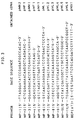
- the above process is illustrated in Fig. 1.
- E. coli K 12 strain HB101 is transformed with the resulting recombinant plasmid. The transformants are selected by ampicillin resistance.
- Colonies containing recombinant plasmids are screened by measuring the size of palsmid DNA with agarose gel electrophoresis. To determine the AIK-C genome sequence, the cDNA is subcloned into the bacteriophage M 13 series, and the single-strand M 13 phage DNAs are isolated from candidate subclones.
- Determination of the obtained cDNA clone can be made by several restriction enzyme cleavage types.
- the cDNA obtained from synthetic primer such as MP-1 restriction enzyme sites of BamHI, EcoRV and XbaI are located.
- the plasmid extracted from ampicillin resistant strain in case that the said type of cDNA is observed, approximately 1504 base fragments are identified by splitting with BamHI and XbaI on an agarose gel electrophoresis. Further treatment of these fragments with EcoRV provides two fragments of 650 and 854 base fragments. Accordingly, an identification of the obtained cDNA clone has been made by cleaving the inserted fragment in the plasmid and its size determination, or by determining the specific restriction site of measles DNA in the fragments.
- the cDNA which is split by a restriction enzyme to prepare cohesive or blunt ends, is inserted into M 13 phage vector in which its cloning parts are cleaved by the preferable restriction enzymes.
- the phage holding the thus prepared recombinant DNA is infected into E. coli.
- Single-strand recombinant DNA is extracted from the infected phage plaques, from which the nucleotide sequence is determined by the dideoxy chain termination method ( dideoxy sequence method ).
- a primer such as pMN 2 the cDNA obtained from MP-1, is split by BamHI and XbaI, and is cloned into a pUC plasmid. After determining cDNA, the DNA fragment originating from the AIK-C strain by splitting with the same restriction enzyme is further split by EcoRV to prepare two fragments consisting of 650 bp and 854 bp.
- the virus genome of AIK-C strain has been found to consist of 15,894 nucleotides and its whole sequence is shown above.
- a measles virus containing the said RNA genome has the superior properties of the AIK-C virus strain.
- the specific nucleotide sequence of AIK-C virus strain genome is determined by PCR and can be compared with the virus strain to determine whether the said strain can be used for AIK-C strain virus vaccine or whether the prepared AIK-C strain virus vaccine is strictly holding the properties of AIK-C strain.
- the cause can be determined by comparing the nucleotide sequence of the measles vaccine virus with the nucleotide sequence of the AIK-C virus.
- a seed virus of measles AIK-C strain ( Seed Lot 0 - 2 ) was inoculated up to an infectivity titer of 0.05 in chick embryo cells derived from specific pathogen-free hen's egg cultured in a surface area of cell culture ( 230 cm 2 ) in a large Roux bottle ( approx. 1 liter volume).
- a culture medium ( 150 ml ) of Eagle's minimum essential medium ( MEM ) containing 1 % calf serum was added therein and the virus was cultured at 33 °C.
- Vaccine bulk solution was centrifuged at 3,000 r.p.m. for 30 minutes and the supernatant solution was further centrifuged at 25,000 r.p.m. for 90 minutes. ( Beckman. L 8 - 55 M, rotor : SW 28)
- TEN buffer solution (10 mM-Tris HCl, 1 mM-EDTA, 100 mM-NaCl, pH 7.4 )( 1 ml ) was added to a precipitate in each centrifugal tube, and suspended well to prepare concentrated virus.
- the thus obtained concentrated virus suspension was adjusted to a final volume of 10 ml by addition of TEN buffer solution to prepare a clarified virus suspension.
- the clarified virus suspension ( 5 ml ) was layered on the 30 ⁇ 60 % continuous sucrose gradients in two centrifugal tubes ( Beckman centrifuge SW 41 rotor ), prepared by 60 % ( w/v ) sucrose solution in TEN buffer solution ( 6.8 ml ) and 30 % ( w/v ) sucrose solution in TEN buffer solution (6.8 ml ) per tube, then centrifuged for 90 minutes at 207,000 g at 4 °C. The suspension was fractionated and the fractions showing highest infectivity titer ( 10 8.3 TCID 50 /ml ) were collected and again centrifuged by the same way to prepare purified virus particles.
- the purified virus particles were diluted fivefold with TEN buffer solution, separately added each 200 ⁇ l into 1.5 ml microtest tube, further added 20 % SDS ( 5 ⁇ l, phenol ( 100 ⁇ l ) and chloroform ( 100 ⁇ l ) therein, then stirred completely using a vortex mixer. The mixture was further centrifuged at 12,000 r.p.m. for 5 minutes to separate the organic layer from the aqueous layer. The aqeous layer was collected into another 1.5 ml microtest tube and subjected twice with phenol extraction ( SDS-phenol extraction ).
- the recovered aqueous layer was mixed with 5M-NaCl (1/25 volume ), and ethanol (2.5 volume ), allowed to stand at -20°C for 2 hours, then centrifuged at 12,000 r.p.m. for 10 minutes to collect precipitated RNA which was washed with 70 % ethanol and dried. The dried material was dissolved in double-distilled water( 50 ⁇ l )which was sterilized by autoclaving to prepare a RNA suspension.
- Synthetic primer deoxyoligonucleotides in particular the 12 primers comprising approx. 25 mer of MP-1 ⁇ MP-11 and BEP( dT ) 7 shown in Fig. 3, were synthesized by using Cyclone DNA synthesizer ( Biosearch INC. U.S.A. ).
- RNA suspension ( 10 ⁇ l ) obtained in the above Step : h ( AIK-C virus genome RNA ) was used as template for the synthesis of DNA using synthetic oligonucleotide primers (the above synthetic DNA )( 2 ⁇ l of synthetic primer, MP-1 or MP-11 ) and cDNA was prepared by reverse transcriptase treatment.
- the cDNA was converted to double-strand cDNA by using RNase H-DNA polymerase I ( Gubler and Hoffman, GENE 25, p 263 - 269, 1983 ).
- the obtained cDNA was cleaved at each restriction enzyme cleavage site by BamHI-XbaI, XbaI-BamHI, BamHI-EcoRI, EcoRI-BamHI, BamHI-EcoRI, EcoRI-BglII, BglII-SacI and SacI-NcoI-XbaI. Each fragment was inserted into a corresponding cloning site in pUC plasmid ( pUC 18 and pUC 19 ).
- E. coli HB101 was transformed with the above recombinant plasmids to obtain ampicillin resistant colonies. Plasmid DNA was extracted from the thus obtained colonies and the colonies containing recombinant plasmids were screened by measuring the size length of the fragments plasmid DNA with 0.8 % agarose gel electrophoresis.
- poly ( A ) was tailed at the 3' end of the genomic RNA, an RNA suspension obtained in the above step : h, with poly ( A ) polymerase and adenosine triphosphate ( ATP ).
- the thus obtained 3' A tailed RNA suspension, i. e. the polyadenylated RNA was reversely transcribed using BEP ( dT ) 7 primer to prepare cDNA according to the step : j.
- the BEP ( dt ) 7 primer has the sequence ; 5'-CTGTGAATTCTGCAGGATCCTTTTTTT-3'.
- the 5' terminal clone was synthesized using a primer located close to the 5' terminus. Namely the primer contained complementary DNA in the domain of nucleotides 15,592-15,615 of the measles virus genome.
- the synthetic primer has the sequence ; 5'-TGGAAGCTTATCCAGAATCTCAAGTCCGGCT-3'.
- DNA-RNA hybrid was prepared by using the said synthetic DNA as a primer with reverse transcriptase. After alkaline treatment of the hybrid, poly ( dA ), i. e. dATP was tailed to the 3' end of the resulting cDNA with terminal deoxynucleotidyl transferase. It was subsequently converted to the double-stranded cDNA using the BEP ( dT ) 7 primer in the step : m and the Klenow fragment.
- poly ( dA ) i. e. dATP was tailed to the 3' end of the resulting cDNA with terminal deoxynucleotidyl transferase. It was subsequently converted to the double-stranded cDNA using the BEP ( dT ) 7 primer in the step : m and the Klenow fragment.
- cDNAs were subcloned into the bacteriophage M 13 series vector ( mp 18 and mp 19 ), and the single-strand M 13 Phage DNAs were isolated. Nucleotide sequence of those cDNAs was determined with the said single-stranded DNA by means of the dideoxy chain termination method using 7-DEAZA-dGTP sequencing Kit ( Takara Shuzo ).
- AIK-C strain seed virus Seed Lot No. 0 - 2
- Vero cells previously cultured in a large size Roux bottle according to the method described in the Example 1, and incubated at 33 °C.
- infected cell layers were washed with Hank's solution, then Eagle's MEM ( 200 ml ) without calf serum was added thereto and further incubated for 2 days. Incubated viral culture was collected to obtain virus bulk suspension ( approx. 200 ml, infective titer : 10 6.5 TCID 50 /ml ).
- the vaccine bulk was centrifuged at 3,000 r.p.m. for 30 min., thereafter the supernatant suspension was centrifuged at 25,000 r.p.m. for 90 min. [ Centrifuge: Beckman L8-55M, rotor : SW 28]
- TEN buffer solution (10 mM Tris-HCl, 1 mM EDTA, 100 mM NaCl, pH 7.4, 1 ml ) was added to the precipitate in each centrifugal tube. The precipitate was suspended completely to prepare conc. virus material, which was adjusted to a volume of 10 ml by adding TEN buffer solution to prepare a starting virus suspension.
- the starting virus suspension ( 5 ml ) was layered on a 30 - 60 % continuous sucrose gradients in two tubes consisting of, in one tube, 60 % ( w/v ) sucrose solution ( TEN buffer solution )( 6.8 ml ) and 30 % ( w/v ) sucrose solution ( TEN buffer solution )( 6.8 ml ), then centrifuged at 207,000 g for 90 min. at 4 °C.
- the centrifuged suspension in each tube was fractionated by means of a fraction collector and fractions showing high infectivity ( 10 8.3 TCID 50 /ml ) were collected.
- the collected fraction was again centrifuged by the same manner to recover purified virus.
- RNA suspension was prepared with sterilisation of the dried material and dissolved in redistilled water ( 50 ⁇ l ).
- Synthetic primer deoxyoligonucleotides in particular the 12 primers, comprising approx. 25 mer of MP-1 ⁇ MP-11 and BEP ( dT ) 7 shown in Fig. 3, were synthesized by using cyclone DNA synthesizer ( Biosearch Inc. U.S.A. ).
- RNA suspension ( 10 ⁇ l ) obtained in the above Example : 1 ( AIK-C virus genome RNA ) was used as a template for the synthesis of cDNA using the synthetic oligonucleotide primers (the above synthetic DNA ) ( 2 ⁇ l of synthetic primer, MP-1 or MP-11 ) and cDNA was prepared by reverse transcriptase treatment.
- the cDNA was converted to double-strand cDNA by using RNaseH-DNA polymerase I ( Gubler and Hoffman, GENE 25, p. 263-269, 1983).
- the obtained cDNA was cleaved at each restriction enzyme cleavage site by BamHI-XbaI, XbaI-BamHI, BamHI-EcoRI, EcoRI-BamHI, BamHI-EcoRI, EcoRI-Bg1II, Bg1II-SacI and SacI-NcoI-XbaI. Each fragment was inserted into a corresponding cloning site in pUC plasmid ( pUC18 and pUC 19 ).
- E. coli HB101 was transformed with the above recombinant plasmids to obtain ampicillin resistant colonies. Plasmid DNA was extracted from the thus obtained colonies and the colonies containing recombinant plasmids were screened by measuring the size length of fragment plasmid DNA with 0.8 % agarose gel electrophoresis.
- poly ( A ) was tailed at the 3' end of the genomic RNA, an RNA suspension obtained in the above step : f, with poly ( A ) polymerase and adenosine triphosphate ( ATP ).
- the thus obtained 3' tailed RNA suspension, i. e. the polyadenylated RNA was reversely transcribed using BEP ( dT ) 7 primer to prepare cDNA according to the step : h.
- the BEP ( dT ) 7 primer has the sequence ; 5'-CTGTGAATTCTGCAGGATCCTTTTTTT-3'.
- the 5' terminal clone was synthesized using a primer located close to the 5' terminus. Namely the primer contained complementary DNA in the domain of nucleotides 15,592-15,615 of the measles virus genome.
- the synthetic primer has the sequence ; 5'-TGGAAGCTTATCCAGAATCTCAAGTCCGGCT-3'.
- DNA-RNA hybrid was prepared by using the said synthetic DNA as a primer with reverse transcriptase. After alkaline treatment of the hybrid, poly ( dA ), i. e. dATP was tailed to the 3' end of the resulting cDNA with terminal deoxynucleotidyl transferase. It was subsequently converted to the double-stranded cDNA using the BEP ( dT ) 7 primer in the step : k and the Klenow fragment.
- poly ( dA ) i. e. dATP was tailed to the 3' end of the resulting cDNA with terminal deoxynucleotidyl transferase. It was subsequently converted to the double-stranded cDNA using the BEP ( dT ) 7 primer in the step : k and the Klenow fragment.
- cDNAs were subcloned into the bacteriophage M 13 series vector ( mp 18 and mp 19 ), and the single-stranded M 13 phage DNAs were isolated. Nucleotide sequence of those cDNAs was determined with the said single-stranded DNA by means of the dideoxy chain termination method using 7-DEAZA-dGTP sequencing kit ( Takara Shuzo ).
- a blood specimen ( approx. 5 ml ) was collected from a patient on the first day that measles exanthem appeared. Lymphocytes were separately by Ficoll ( trade name).
- the lymphocytes were washed twice with PBS.
- a denaturation solution D 4M guanidium thiocyanate, 25 mM sodium citrate, pH 7.5 ; 0.5 % sacrosine, 0.1 M 2-mercapto ethanol, 200 ⁇ l ) was added thereto. After gently stirred, 2 M sodium acetate ( 20 ⁇ l, pH 4 ), phenol ( 200 ⁇ l ) and chloroform ( 100 ⁇ l ) were added in this order.
- the mixture was treated with vortex mixer for 10 sec. and allowed to stand in ice-water for 15 min. Then the mixture was centrifuged at 10,000 g for 20 min. to recover the aqueous layer. An equal volume of isopropanol was added. The mixture was allowed to stand at -20 °C for one hour and then centrifuged at 10,000 g for 20 min. to precipitate RNA [ Chomczynski and Sacchi, Anal. Biochem., 162, 156-159 ( 1987 ) ].
- RNA was subjected to the reverse transcriptase reaction and PCR method.
Landscapes
- Health & Medical Sciences (AREA)
- Chemical & Material Sciences (AREA)
- Life Sciences & Earth Sciences (AREA)
- Organic Chemistry (AREA)
- Genetics & Genomics (AREA)
- Engineering & Computer Science (AREA)
- Zoology (AREA)
- Bioinformatics & Cheminformatics (AREA)
- Virology (AREA)
- General Health & Medical Sciences (AREA)
- Medicinal Chemistry (AREA)
- Wood Science & Technology (AREA)
- Biochemistry (AREA)
- Biomedical Technology (AREA)
- Microbiology (AREA)
- General Engineering & Computer Science (AREA)
- Biotechnology (AREA)
- Immunology (AREA)
- Gastroenterology & Hepatology (AREA)
- Biophysics (AREA)
- Molecular Biology (AREA)
- Proteomics, Peptides & Aminoacids (AREA)
- Chemical Kinetics & Catalysis (AREA)
- Oncology (AREA)
- Communicable Diseases (AREA)
- General Chemical & Material Sciences (AREA)
- Nuclear Medicine, Radiotherapy & Molecular Imaging (AREA)
- Pharmacology & Pharmacy (AREA)
- Animal Behavior & Ethology (AREA)
- Public Health (AREA)
- Veterinary Medicine (AREA)
- Medicines Containing Antibodies Or Antigens For Use As Internal Diagnostic Agents (AREA)
- Micro-Organisms Or Cultivation Processes Thereof (AREA)
- Measuring Or Testing Involving Enzymes Or Micro-Organisms (AREA)
Claims (6)
- Verfahren zur Identifizierung eines Masernvakzine-Virusstamms, das umfaßt: Bestimmen der Nucleotidsequenz der der genomischen RNA des Masern-Virusstammes entsprechenden cDNA und Vergleichen der so bestimmten Sequenz mit der in Sequenz I.D. No. 1 angegebenen DNA-Sequenz.
- Verfahren nach Anspruch 1, dadurch gekennzeichnet, daß der Masernvakzine-Virusstamm einem mit dem AIK-C-Stamm von Masernvirus geimpftem Kind entnommen wurde.
- Verfahren nach Anspruch 1, dadurch gekennzeichnet, daß der Masernvirus für Vakzine aus Impfkultur-AIK-C-Stamm-Masernvirus hergestellt wird und die Qualität des so hergestellten Virus durch Bestimmen der Nucleotidsequenz der der genomischen RNA des Virus entsprechenden cDNA geprüft wird, und die so bestimmte Sequenz mit der in Sequenz I.D. No. 1 angegebenen DNA-Sequenz verglichen wird.
- cDNA mit der in Sequenz I.D. No. 1 angegebenen Nucleotidsequenz.
- Isolierte cDNA nach Anspruch 4.
- RNA mit einer Nucleotidsequenz, die der in Sequenz I.D. No. 1 angegebenen entspricht.
Applications Claiming Priority (3)
| Application Number | Priority Date | Filing Date | Title |
|---|---|---|---|
| JP29362591 | 1991-10-14 | ||
| JP293625/91 | 1991-10-14 | ||
| JP3293625A JP3045581B2 (ja) | 1991-10-14 | 1991-10-14 | 麻疹ワクチンウイルス株同定方法 |
Publications (3)
| Publication Number | Publication Date |
|---|---|
| EP0540135A2 EP0540135A2 (de) | 1993-05-05 |
| EP0540135A3 EP0540135A3 (en) | 1993-12-08 |
| EP0540135B1 true EP0540135B1 (de) | 2000-06-07 |
Family
ID=17797135
Family Applications (1)
| Application Number | Title | Priority Date | Filing Date |
|---|---|---|---|
| EP92302004A Expired - Lifetime EP0540135B1 (de) | 1991-10-14 | 1992-03-10 | Spezifische Nukleotidsequenz enthaltender Masernvirusvakzinstamm und Verfahren zu seiner absoluten Identifizierung |
Country Status (10)
| Country | Link |
|---|---|
| US (2) | US5654136A (de) |
| EP (1) | EP0540135B1 (de) |
| JP (1) | JP3045581B2 (de) |
| KR (1) | KR950012759B1 (de) |
| AT (1) | ATE193726T1 (de) |
| DE (1) | DE69231143T2 (de) |
| DK (1) | DK0540135T3 (de) |
| ES (1) | ES2148164T3 (de) |
| GR (1) | GR3034278T3 (de) |
| PT (1) | PT540135E (de) |
Families Citing this family (14)
| Publication number | Priority date | Publication date | Assignee | Title |
|---|---|---|---|---|
| JPH07509122A (ja) * | 1992-04-08 | 1995-10-12 | ザ ガバメント オブ ザ ユナイテッド ステイツ オブ アメリカ,アズ レプリゼンテッド バイ ザ セクレター,デパートメント オブ ヘルス アンド ヒューマン サービシーズ | 野生型麻疹ウイルス糖タンパク質:ワクチンおよびその検出方法 |
| US6638482B1 (en) * | 1993-11-01 | 2003-10-28 | Nanogen, Inc. | Reconfigurable detection and analysis apparatus and method |
| WO1998005682A2 (en) * | 1996-07-31 | 1998-02-12 | Muller Claude P | Peptides corresponding or imitating at least one antigenic determinant of the hamagglutinin protein of mobillivirus |
| KR20000048628A (ko) * | 1996-09-27 | 2000-07-25 | 윌리암 에이취 캘넌, 에곤 이 버그 | 모노네가비랄레스 목의 바이러스에서 감쇠를 책임지는 3' 게놈프로모터 영역 및 폴리머라제 유전자 돌연변이 |
| WO1998055627A1 (en) * | 1997-06-04 | 1998-12-10 | The Research Foundation For Microbial Diseases Of Osaka University | Mutant measles virus antigens and genes encoding the same |
| JP2002507408A (ja) * | 1998-03-26 | 2002-03-12 | アメリカン・サイアナミド・カンパニー | 麻疹ウイルスもしくはヒト呼吸合胞体ウイルスサブグループbの弱毒化の原因である突然変異 |
| CA2392190C (en) * | 1999-11-19 | 2011-01-25 | The Kitasato Institute | Method of constructing cell-fusion mutants of morbillivirus |
| EP1166797B1 (de) * | 2000-01-31 | 2006-12-06 | The Research Foundation for Microbial Diseases of Osaka University | Verfahren zum kontrollieren der qualitäten eines abgeschwächten varicella phasen-impfstoffes |
| US7208163B1 (en) * | 2000-02-10 | 2007-04-24 | The Kitasato Institute | Method for producing temperature-sensitive morbillivirus |
| EP1375670B1 (de) | 2002-06-20 | 2013-06-12 | Institut Pasteur | Rekombinante Masernviren, welche Epitope der Antigene von RNA-Viren exprimieren, sowie die Verwendung der rekombinanten Viren zur Herstellung von Impfstoffen |
| EP1375512B1 (de) | 2002-06-20 | 2009-07-22 | Institut Pasteur | Infektiöse cDNA eines zugelassenen Impfstammes des Masern Virus. Verwendung in immunogenen Zusammensetzungen |
| CA2432738A1 (en) | 2003-02-26 | 2004-08-26 | Philippe Despres | New dengue and west nile viruses proteins and genes coding the foregoing, and their use in vaccinal, therapeutic and diagnostic applications |
| EP2420242A1 (de) | 2010-08-20 | 2012-02-22 | Lauer, Ulrich M. | Onkolytisches Masernvirus |
| CN104211769B (zh) * | 2013-05-30 | 2018-08-03 | 中国科学院过程工程研究所 | 一种小分子抗体亲和肽及其应用 |
Family Cites Families (3)
| Publication number | Priority date | Publication date | Assignee | Title |
|---|---|---|---|---|
| US4617261A (en) * | 1984-03-21 | 1986-10-14 | Cetus Corporation | Process for labeling nucleic acids and hybridization probes |
| JPS63307827A (ja) * | 1987-06-08 | 1988-12-15 | Kitasato Inst:The | 安定化された生ウイルスワクチンおよびその製造法 |
| AU7007491A (en) * | 1990-02-02 | 1991-08-08 | Schweiz. Serum- & Impfinstitut Bern | Cdna corresponding to the genome of negative-strand rna viruses, and process for the production of infectious negative-strand rna viruses |
-
1991
- 1991-10-14 JP JP3293625A patent/JP3045581B2/ja not_active Expired - Lifetime
-
1992
- 1992-03-07 KR KR1019920003759A patent/KR950012759B1/ko not_active Expired - Lifetime
- 1992-03-10 ES ES92302004T patent/ES2148164T3/es not_active Expired - Lifetime
- 1992-03-10 DK DK92302004T patent/DK0540135T3/da active
- 1992-03-10 AT AT92302004T patent/ATE193726T1/de active
- 1992-03-10 DE DE69231143T patent/DE69231143T2/de not_active Expired - Lifetime
- 1992-03-10 EP EP92302004A patent/EP0540135B1/de not_active Expired - Lifetime
- 1992-03-10 PT PT92302004T patent/PT540135E/pt unknown
-
1994
- 1994-11-25 US US08/348,891 patent/US5654136A/en not_active Expired - Lifetime
-
1997
- 1997-08-04 US US08/905,817 patent/US5824777A/en not_active Expired - Lifetime
-
2000
- 2000-08-30 GR GR20000401965T patent/GR3034278T3/el unknown
Also Published As
| Publication number | Publication date |
|---|---|
| ES2148164T3 (es) | 2000-10-16 |
| EP0540135A3 (en) | 1993-12-08 |
| DE69231143T2 (de) | 2000-10-19 |
| DK0540135T3 (da) | 2000-08-07 |
| KR950012759B1 (ko) | 1995-10-21 |
| JP3045581B2 (ja) | 2000-05-29 |
| US5654136A (en) | 1997-08-05 |
| PT540135E (pt) | 2000-11-30 |
| ATE193726T1 (de) | 2000-06-15 |
| JPH05103665A (ja) | 1993-04-27 |
| EP0540135A2 (de) | 1993-05-05 |
| GR3034278T3 (en) | 2000-12-29 |
| US5824777A (en) | 1998-10-20 |
| DE69231143D1 (de) | 2000-07-13 |
| KR930008138A (ko) | 1993-05-21 |
Similar Documents
| Publication | Publication Date | Title |
|---|---|---|
| ES2523587T3 (es) | Virus influenza B que tienen alteraciones en el polipéptido hemaglutinina | |
| EP0540135B1 (de) | Spezifische Nukleotidsequenz enthaltender Masernvirusvakzinstamm und Verfahren zu seiner absoluten Identifizierung | |
| Klimov et al. | Sequence changes in the live attenuated, cold-adapted variants of influenza A/Leningrad/134/57 (H2N2) virus | |
| CN111560354A (zh) | 重组新型冠状病毒及其制备方法和应用 | |
| KR19990022335A (ko) | 인플루엔자의 신규한 재조합 감온성 돌연변이체 | |
| US7411058B2 (en) | Cold-adapted equine influenza viruses | |
| CN113322264A (zh) | 具有沉默突变的重组rsv、其相关疫苗和方法 | |
| JP2003506039A (ja) | cDNAからの流行性耳下腺炎ウイルスのレスキュー | |
| JP2022515172A (ja) | 複数の外来遺伝子を含む組換えトリヘルペスウイルス | |
| Tolley et al. | Identification of mutations contributing to the reduced virulence of a modified strain of respiratory syncytial virus | |
| JPH01501357A (ja) | ヒト呼吸器系ウイルス用ワクチン | |
| JPH06311885A (ja) | C型肝炎ウイルス遺伝子に相補的なアンチセンス化合物 | |
| KR100584831B1 (ko) | 인터페론 (아이에프엔) 반응을 길항시키는 뉴모바이러스엔에스 단백질 | |
| Ivancic et al. | Genetic characterization of L-Zagreb mumps vaccine strain | |
| Sadeghi et al. | Characterisation of a strain of Potato virus Y causing eggplant mosaic in southern Iran | |
| Semler et al. | Persistent vesicular stomatitis virus infection mediates base substitutions in viral RNA termini | |
| Goto et al. | Nucleotide sequence of the nucleoprotein gene of the RC· HL strain of rabies virus, a seed strain used for animal vaccine production in Japan | |
| CN112111467B (zh) | 一种基因vii型新城疫标记疫苗株及其制备方法与应用 | |
| US7935807B2 (en) | Chicken RNA polymerase I promoter and the use thereof | |
| JPH09173100A (ja) | ホップ潜在ウイルスの遺伝子及び該ウイルスの検出方法 | |
| CN1318592C (zh) | O型口蹄疫病毒dna疫苗及其制备方法 | |
| JP2002507408A (ja) | 麻疹ウイルスもしくはヒト呼吸合胞体ウイルスサブグループbの弱毒化の原因である突然変異 | |
| CN101475942A (zh) | 一种b19病毒vp1独特区基因 | |
| JP4043054B2 (ja) | 変異麻疹ウイルス抗原及びそれをコードする遺伝子 | |
| AU2005237174B2 (en) | Rescue of mumps virus from CDNA |
Legal Events
| Date | Code | Title | Description |
|---|---|---|---|
| PUAI | Public reference made under article 153(3) epc to a published international application that has entered the european phase |
Free format text: ORIGINAL CODE: 0009012 |
|
| AK | Designated contracting states |
Kind code of ref document: A2 Designated state(s): AT BE CH DE DK ES FR GB GR IT LI LU MC NL PT SE |
|
| PUAL | Search report despatched |
Free format text: ORIGINAL CODE: 0009013 |
|
| RHK1 | Main classification (correction) |
Ipc: C12N 15/45 |
|
| AK | Designated contracting states |
Kind code of ref document: A3 Designated state(s): AT BE CH DE DK ES FR GB GR IT LI LU MC NL PT SE |
|
| 17P | Request for examination filed |
Effective date: 19940210 |
|
| 17Q | First examination report despatched |
Effective date: 19960126 |
|
| GRAG | Despatch of communication of intention to grant |
Free format text: ORIGINAL CODE: EPIDOS AGRA |
|
| GRAG | Despatch of communication of intention to grant |
Free format text: ORIGINAL CODE: EPIDOS AGRA |
|
| GRAH | Despatch of communication of intention to grant a patent |
Free format text: ORIGINAL CODE: EPIDOS IGRA |
|
| GRAH | Despatch of communication of intention to grant a patent |
Free format text: ORIGINAL CODE: EPIDOS IGRA |
|
| GRAA | (expected) grant |
Free format text: ORIGINAL CODE: 0009210 |
|
| AK | Designated contracting states |
Kind code of ref document: B1 Designated state(s): AT BE CH DE DK ES FR GB GR IT LI LU MC NL PT SE |
|
| REF | Corresponds to: |
Ref document number: 193726 Country of ref document: AT Date of ref document: 20000615 Kind code of ref document: T |
|
| REG | Reference to a national code |
Ref country code: CH Ref legal event code: EP Ref country code: CH Ref legal event code: NV Representative=s name: PATENTANWAELTE SCHAAD, BALASS, MENZL & PARTNER AG |
|
| REF | Corresponds to: |
Ref document number: 69231143 Country of ref document: DE Date of ref document: 20000713 |
|
| REG | Reference to a national code |
Ref country code: DK Ref legal event code: T3 |
|
| ITF | It: translation for a ep patent filed | ||
| ET | Fr: translation filed | ||
| REG | Reference to a national code |
Ref country code: ES Ref legal event code: FG2A Ref document number: 2148164 Country of ref document: ES Kind code of ref document: T3 |
|
| REG | Reference to a national code |
Ref country code: PT Ref legal event code: SC4A Free format text: AVAILABILITY OF NATIONAL TRANSLATION Effective date: 20000901 |
|
| PLBE | No opposition filed within time limit |
Free format text: ORIGINAL CODE: 0009261 |
|
| 26N | No opposition filed | ||
| REG | Reference to a national code |
Ref country code: GB Ref legal event code: IF02 |
|
| PGFP | Annual fee paid to national office [announced via postgrant information from national office to epo] |
Ref country code: MC Payment date: 20060228 Year of fee payment: 15 |
|
| PGFP | Annual fee paid to national office [announced via postgrant information from national office to epo] |
Ref country code: LU Payment date: 20060310 Year of fee payment: 15 Ref country code: PT Payment date: 20060310 Year of fee payment: 15 |
|
| PG25 | Lapsed in a contracting state [announced via postgrant information from national office to epo] |
Ref country code: PT Free format text: LAPSE BECAUSE OF NON-PAYMENT OF DUE FEES Effective date: 20070910 |
|
| REG | Reference to a national code |
Ref country code: PT Ref legal event code: MM4A Free format text: LAPSE DUE TO NON-PAYMENT OF FEES Effective date: 20070910 |
|
| PG25 | Lapsed in a contracting state [announced via postgrant information from national office to epo] |
Ref country code: MC Free format text: LAPSE BECAUSE OF NON-PAYMENT OF DUE FEES Effective date: 20070331 |
|
| PG25 | Lapsed in a contracting state [announced via postgrant information from national office to epo] |
Ref country code: LU Free format text: LAPSE BECAUSE OF NON-PAYMENT OF DUE FEES Effective date: 20070310 |
|
| PGFP | Annual fee paid to national office [announced via postgrant information from national office to epo] |
Ref country code: DK Payment date: 20110310 Year of fee payment: 20 |
|
| PGFP | Annual fee paid to national office [announced via postgrant information from national office to epo] |
Ref country code: FR Payment date: 20110317 Year of fee payment: 20 Ref country code: IT Payment date: 20110315 Year of fee payment: 20 Ref country code: NL Payment date: 20110317 Year of fee payment: 20 Ref country code: CH Payment date: 20110314 Year of fee payment: 20 Ref country code: AT Payment date: 20110228 Year of fee payment: 20 Ref country code: SE Payment date: 20110311 Year of fee payment: 20 |
|
| PGFP | Annual fee paid to national office [announced via postgrant information from national office to epo] |
Ref country code: GR Payment date: 20110217 Year of fee payment: 20 |
|
| PGFP | Annual fee paid to national office [announced via postgrant information from national office to epo] |
Ref country code: DE Payment date: 20110302 Year of fee payment: 20 Ref country code: GB Payment date: 20110309 Year of fee payment: 20 Ref country code: ES Payment date: 20110414 Year of fee payment: 20 Ref country code: BE Payment date: 20110311 Year of fee payment: 20 |
|
| REG | Reference to a national code |
Ref country code: DE Ref legal event code: R071 Ref document number: 69231143 Country of ref document: DE |
|
| REG | Reference to a national code |
Ref country code: DE Ref legal event code: R071 Ref document number: 69231143 Country of ref document: DE |
|
| REG | Reference to a national code |
Ref country code: CH Ref legal event code: PL |
|
| REG | Reference to a national code |
Ref country code: NL Ref legal event code: V4 Effective date: 20120310 |
|
| REG | Reference to a national code |
Ref country code: DK Ref legal event code: EUP |
|
| BE20 | Be: patent expired |
Owner name: THE *KITASATO INSTITUTE Effective date: 20120310 |
|
| REG | Reference to a national code |
Ref country code: GB Ref legal event code: PE20 Expiry date: 20120309 |
|
| PG25 | Lapsed in a contracting state [announced via postgrant information from national office to epo] |
Ref country code: DE Free format text: LAPSE BECAUSE OF EXPIRATION OF PROTECTION Effective date: 20120311 |
|
| REG | Reference to a national code |
Ref country code: GR Ref legal event code: MA Ref document number: 20000401965 Country of ref document: GR Effective date: 20120311 |
|
| PG25 | Lapsed in a contracting state [announced via postgrant information from national office to epo] |
Ref country code: GB Free format text: LAPSE BECAUSE OF EXPIRATION OF PROTECTION Effective date: 20120309 |
|
| REG | Reference to a national code |
Ref country code: SE Ref legal event code: EUG |
|
| REG | Reference to a national code |
Ref country code: AT Ref legal event code: MK07 Ref document number: 193726 Country of ref document: AT Kind code of ref document: T Effective date: 20120310 |
|
| REG | Reference to a national code |
Ref country code: ES Ref legal event code: FD2A Effective date: 20130726 |
|
| PG25 | Lapsed in a contracting state [announced via postgrant information from national office to epo] |
Ref country code: ES Free format text: LAPSE BECAUSE OF EXPIRATION OF PROTECTION Effective date: 20120311 |