EP0543384B1 - Epoxygruppen-enthaltendes Organopolysiloxan und Verfahren zur Herstellung - Google Patents
Epoxygruppen-enthaltendes Organopolysiloxan und Verfahren zur Herstellung Download PDFInfo
- Publication number
- EP0543384B1 EP0543384B1 EP92119748A EP92119748A EP0543384B1 EP 0543384 B1 EP0543384 B1 EP 0543384B1 EP 92119748 A EP92119748 A EP 92119748A EP 92119748 A EP92119748 A EP 92119748A EP 0543384 B1 EP0543384 B1 EP 0543384B1
- Authority
- EP
- European Patent Office
- Prior art keywords
- organopolysiloxane
- epoxy
- groups
- group
- value
- Prior art date
- Legal status (The legal status is an assumption and is not a legal conclusion. Google has not performed a legal analysis and makes no representation as to the accuracy of the status listed.)
- Expired - Lifetime
Links
Images


Classifications
-
- C—CHEMISTRY; METALLURGY
- C08—ORGANIC MACROMOLECULAR COMPOUNDS; THEIR PREPARATION OR CHEMICAL WORKING-UP; COMPOSITIONS BASED THEREON
- C08L—COMPOSITIONS OF MACROMOLECULAR COMPOUNDS
- C08L83/00—Compositions of macromolecular compounds obtained by reactions forming in the main chain of the macromolecule a linkage containing silicon with or without sulfur, nitrogen, oxygen or carbon only; Compositions of derivatives of such polymers
- C08L83/04—Polysiloxanes
-
- C—CHEMISTRY; METALLURGY
- C08—ORGANIC MACROMOLECULAR COMPOUNDS; THEIR PREPARATION OR CHEMICAL WORKING-UP; COMPOSITIONS BASED THEREON
- C08G—MACROMOLECULAR COMPOUNDS OBTAINED OTHERWISE THAN BY REACTIONS ONLY INVOLVING UNSATURATED CARBON-TO-CARBON BONDS
- C08G77/00—Macromolecular compounds obtained by reactions forming a linkage containing silicon with or without sulfur, nitrogen, oxygen or carbon in the main chain of the macromolecule
- C08G77/48—Macromolecular compounds obtained by reactions forming a linkage containing silicon with or without sulfur, nitrogen, oxygen or carbon in the main chain of the macromolecule in which at least two but not all the silicon atoms are connected by linkages other than oxygen atoms
- C08G77/50—Macromolecular compounds obtained by reactions forming a linkage containing silicon with or without sulfur, nitrogen, oxygen or carbon in the main chain of the macromolecule in which at least two but not all the silicon atoms are connected by linkages other than oxygen atoms by carbon linkages
-
- C—CHEMISTRY; METALLURGY
- C08—ORGANIC MACROMOLECULAR COMPOUNDS; THEIR PREPARATION OR CHEMICAL WORKING-UP; COMPOSITIONS BASED THEREON
- C08L—COMPOSITIONS OF MACROMOLECULAR COMPOUNDS
- C08L101/00—Compositions of unspecified macromolecular compounds
-
- C—CHEMISTRY; METALLURGY
- C08—ORGANIC MACROMOLECULAR COMPOUNDS; THEIR PREPARATION OR CHEMICAL WORKING-UP; COMPOSITIONS BASED THEREON
- C08G—MACROMOLECULAR COMPOUNDS OBTAINED OTHERWISE THAN BY REACTIONS ONLY INVOLVING UNSATURATED CARBON-TO-CARBON BONDS
- C08G77/00—Macromolecular compounds obtained by reactions forming a linkage containing silicon with or without sulfur, nitrogen, oxygen or carbon in the main chain of the macromolecule
- C08G77/04—Polysiloxanes
- C08G77/12—Polysiloxanes containing silicon bound to hydrogen
-
- C—CHEMISTRY; METALLURGY
- C08—ORGANIC MACROMOLECULAR COMPOUNDS; THEIR PREPARATION OR CHEMICAL WORKING-UP; COMPOSITIONS BASED THEREON
- C08G—MACROMOLECULAR COMPOUNDS OBTAINED OTHERWISE THAN BY REACTIONS ONLY INVOLVING UNSATURATED CARBON-TO-CARBON BONDS
- C08G77/00—Macromolecular compounds obtained by reactions forming a linkage containing silicon with or without sulfur, nitrogen, oxygen or carbon in the main chain of the macromolecule
- C08G77/04—Polysiloxanes
- C08G77/14—Polysiloxanes containing silicon bound to oxygen-containing groups
- C08G77/18—Polysiloxanes containing silicon bound to oxygen-containing groups to alkoxy or aryloxy groups
-
- C—CHEMISTRY; METALLURGY
- C08—ORGANIC MACROMOLECULAR COMPOUNDS; THEIR PREPARATION OR CHEMICAL WORKING-UP; COMPOSITIONS BASED THEREON
- C08G—MACROMOLECULAR COMPOUNDS OBTAINED OTHERWISE THAN BY REACTIONS ONLY INVOLVING UNSATURATED CARBON-TO-CARBON BONDS
- C08G77/00—Macromolecular compounds obtained by reactions forming a linkage containing silicon with or without sulfur, nitrogen, oxygen or carbon in the main chain of the macromolecule
- C08G77/04—Polysiloxanes
- C08G77/20—Polysiloxanes containing silicon bound to unsaturated aliphatic groups
Definitions
- Polymer Journal, Vol. 16, No. 6, pages 495 to 504 (1984) discloses the synthesis and application of polymerizable silicone oligomers from water glass. These oligomers can be subjected to a hydrosilylation to produce polysiloxane or silicone containing copolymers having interesting properties like a wide temperature range, thermal, UV and oxidative stability, low surface energy, bio-compatibility and high oxygen permeability.
- Epoxy Resins are used for photopolymerizable coatings, inks and adhesives.
- organo silicone compounds The preparation of organo silicone compounds is known from GB-A 834 326 which teaches to heat a mixture of an unsaturated organic compound containing at least one epoxy group and a silicone compound containing at least one SiH group to obtain organo silicone compounds having at least one or two organic radicals bounded to the organo silicone backbone by a silicone carbon linkage wherein the organic radical contains at least one epoxide group.
- EP-A 0 541 988 discloses a MQ organopolysiloxane which is compatible with organic plastics.
- the present invention relates to organopolysiloxane and method for the preparation thereof. More specifically, the present invention relates to organopolysiloxane (i) that has monofunctional siloxane units (M unit) and tetrafunctional siloxane units (Q unit), (ii) that contains in each molecule at least one epoxy group-containing organic group, and (iii) that contains in each molecule at least one diorganopolysiloxane residue bonded therein through a divalent hydrocarbon group.
- M unit monofunctional siloxane units
- Q unit tetrafunctional siloxane units
- A is a hydroxyphenyl group
- R' is an alkylene group having 1 to 4 carbon atoms
- n is zero or one
- R'' is an alkyl group having 1 to 4 carbon atoms
- x and z are positive numbers
- y is zero or a positive number
- x , y , and z have values such that their ratios are 0 ⁇ ( x + y )/ z ⁇ 4, and zero ⁇ y / x ⁇ 5.
- the groups bonded to the silicon in the monofunctional siloxane units (M unit) of these MQ organopolysiloxanes are limited to the hydrogen atom, alkyl, alkenyl, hydroxyphenyl, and chloromethyl.
- MQ organopolysiloxane in which the silicon in the monofunctional siloxane unit (M unit) carries both an epoxy-containing organic group and a polydiorganosiloxane residue bonded thereto through a divalent hydrocarbon group.
- the present invention was developed as the result of extensive investigations by the present inventor in order to solve the preceding problem.
- the present invention takes as its object the introduction of organopolysiloxane that consists of monofunctional siloxane units (M unit) and tetrafunctional siloxane units (Q unit) and that contains in each molecule at least one epoxy-containing organic group and at least one polydiorganosiloxane residue bonded therein across a divalent hydrocarbon group.
- organopolysiloxane that consists of monofunctional siloxane units (M unit) and tetrafunctional siloxane units (Q unit) and that contains in each molecule at least one epoxy-containing organic group and at least one polydiorganosiloxane residue bonded therein across a divalent hydrocarbon group.
- a further object of the present invention is the introduction of a method for the preparation of this organopolysiloxane.
- This invention relates to a composition
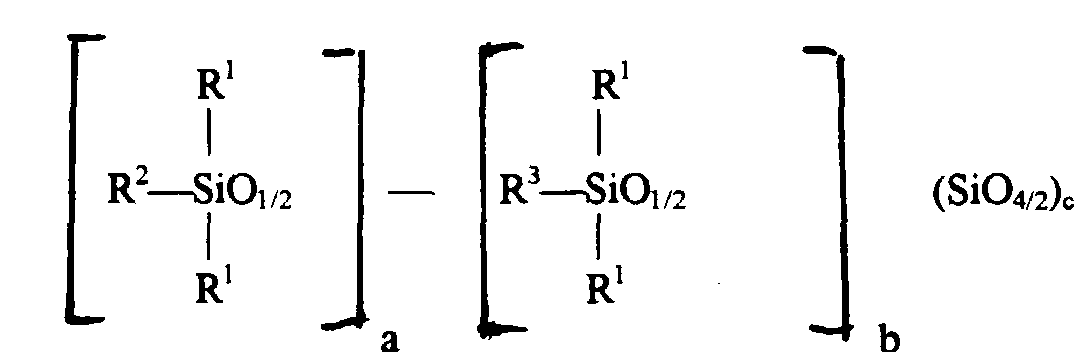
- a composition comprising an organopolysiloxane containing in each molecule at least one epoxy group-containing organic group and at least one polydiorganosiloxane residue where the organopolysiloxane has a general formula
- R 1 represents monovalent hydrocarbon groups exclusive of alkenyl groups
- R 2 represents the hydrogen atom and monovalent hydrocarbon groups exclusive of alkenyl groups
- R 3 is a group selected from the group consisting of epoxy group-containing organic groups, alkoxysilylalkyl groups, and polydiorganosiloxane residues as represented by the general formula in which R 1 represents monovalent hydrocarbon groups exclusive of alkenyl groups, R 4 represents divalent hydrocarbon groups, and n has a value of 1 to 500; a is zero or a positive number; b is a positive number; c is a positive number; a / c has a value of zero to less than 4; b / c has a value
- This invention also relates to a method for the preparation of the organopolysiloxane of claim 1 comprising addition reacting, in the presence of (A) a hydrosilylation-reaction catalyst, (B) an SiH-containing organopolysiloxane with the general formula in which R 1 represents monovalent hydrocarbon groups exclusive of alkenyl groups, d is zero or a positive number, e is a positive number, f is a positive number, d / f has a value of zero to less than 4, e / f has a value of 0.05 4, and ( d + e )/ f has a value of 0.2 to 4, C) epoxy-containing aliphatically unsaturated organic compound.
- A a hydrosilylation-reaction catalyst
- B an SiH-containing organopolysiloxane with the general formula in which R 1 represents monovalent hydrocarbon groups exclusive of alkenyl groups, d is zero or a positive number, e is a positive number, f
- Figure 1 contains an absorbance infrared spectrogram of the organopolysiloxane prepared in Example 1.
- Figure 2 contains an absorbance infrared spectrogram of the organopolysiloxane prepared in Example 2.
- Figure 3 contains an absorbance infrared spectrogram of the organopolysiloxane prepared in Example 3.
- Figure 4 contains an absorbance infrared spectrogram of the organopolysiloxane prepared in Example 4.
- the organopolysiloxane in accordance with the present invention has the general formula given below and contains in each molecule at least one epoxy group-containing organic group and at least one polydiorganosiloxane residue bonded therein across a divalent hydrocarbon group (hereinafter referred to as a divalent hydrocarbon-linked polydiorganosiloxane residue).
- the organopolysiloxane has a general formula in which R 1 in the preceding formula represents monovalenthydrocarbon groups exclusive of alkenyl groups.
- R 1 is specifically but nonexhaustively exemplified by alkyl groups such as methyl, ethyl, propyl, and butyl; aryl groups such as phenyl and tolyl; aralkyl groups such as benzyl and phenethyl; and haloalkyl groups such as chloromethyl and 3,3,3-trifluoro-propyl.
- R 2 represents the hydrogen atom and monovalent hydrocarbon groups exclusive of alkenyl groups, and it is specifically but nonexhaustively exemplified by the hydrogen atom and the groups exemplified by R 1 .
- the group R 3 is a group selected from epoxy-containing organic groups, alkoxysilylalkyl groups, and divalent hydrocarbon-linked polydiorganosiloxane residues. Said epoxy-containing organic groups are specifically exemplified by glycidoxyethyl, glycidoxypropyl, and 3,4-epoxycyclohexylethyl.
- Said alkoxysilylalkyl groups are specifically exemplified by trimethoxysilylethyl, triethoxy-silylethyl, and methyldimethoxysilylethyl.
- Said divalent hydrocarbon-linked polydiorganosiloxane residue has the following general formula: In this formula, R 1 is defined above, and R 4 represents divalent hydrocarbon groups, and it is specifically exemplified by methylmethylene, ethylene, propylene, methylethylene, and butylene.
- the polydiorganosiloxane residue under consideration is itself specifically exemplified by polydimethylsiloxane residues, polymethylphenylsiloxane residues, dimethylsiloxane-methylphenylsiloxane copolymer residues, and polydiphenyl-siloxane residues.
- the subscript a is zero or a positive number, and it specifies the number of monofunctional siloxane units (M unit) that do not contain epoxy-containing organic groups or divalent hydrocarbon-linked diorganopolysiloxane residues.
- the subscript b is a positive number, and it specifies the number of monofunctional siloxane units (M unit) that carry an epoxy-containing organic group or alkoxysilylalkyl group or divalent hydrocarbon-linked diorganopolysiloxane residue.
- the subscript c is a positive number, and it specifies the number of tetrafunctional siloxane units (Q unit).
- a / c zero to less than 4
- b / c 0.05 to 4
- ( a + b )/ c 0.2 to 4.
- the bases for these ratios are as follows: there cannot be more than 4 M units per 1 Q unit, and, in order for the organopoly-siloxane of the present invention to exhibit a strong stress-relaxing activity and high compatibility for organic resins, at least 0.05 monofunctional siloxane units (M unit) carrying an epoxy-containing organic group or alkoxysilylalkyl group or divalent hydrocarbon-linked diorganopolysiloxane residue must be present per 1 Q unit.
- M unit monofunctional siloxane units carrying an epoxy-containing organic group or alkoxysilylalkyl group or divalent hydrocarbon-linked diorganopolysiloxane residue
- the organopolysiloxane of the present invention is a liquid or solid at room temperature. While its molecular weight is not specifically restricted, molecular weights in the range of 500 to 500,000 are preferred in order to obtain a good compatibility with organic resins.
- the preparative method in accordance with the present invention is an addition reaction between (B) an Si-H containing organopolsiloxane, (C) an epoxy containing aliphatically unsaturated organic compound, and (D) an unsaturated polydiorganosiloxane in the presence of (A) a hydrosilylation-reaction catalyst.
- the hydrosilylation-reaction catalyst of component (A) is a catalyst of the addition reaction between the silicon-bonded hydrogen atoms in component (B) and the aliphatically unsaturated bonds in components (C), (D), and (E).
- This component is specifically exemplified by platinum compounds, rhodium compounds, and palladium compounds.
- Platinum compounds are particularly preferred, and these platinum compounds are specifically exemplified by chloroplatinic acid, alcohol solutions of chloroplatinic acid, complexes between platinum and aliphatically unsaturated hydrocarbon compounds, platinum/vinyl-siloxane complexes, platinum black, and Pt/active carbon.
- Component (A) should be added in a catalytic quantity, and its quantity of addition is not specifically restricted.
- component (A) is a platinum compound, it is preferably used within the range of 0.01 to 500 ppm as platinum metal atoms in (A) based on organopolysiloxane (B), i.e. 0.01 to 500 parts by weight of platinum per one million parts by weight of organopolysiloxane (B).
- the SiH-containing organopolysiloxane of component (B) is the main starting material in the present invention, and it has the following general formula.
- R 1 is defined and illustrated above.
- the subscript d is zero or a positive number, and it specifies the number of SiH-free monofunctional siloxane units (M unit).
- the subscript e is a positive number, and it specifies the number of SiH-containing monofunctional siloxane units (M unit).
- the subscript f is a positive number, and it specifies the number of tetrafunctional siloxane units (Q unit).
- the basis for these ratios are as follows: (i) there cannot be more than 4 M units per 1 Q unit; (ii) at least 0.05 SiH-containing monofunctional siloxane units (M unit) must be present per 1 Q unit in order for the organo-polysiloxane of the present invention (after introduction of epoxy-containing organic group or alkoxysilylalkyl group or divalent hydrocarbon-linked diorganopolysiloxane residue into this organopolysiloxane) to be reactive with organic resins and to exhibit an excellent miscibility with organic resins.
- Component (B) can be prepared by methods already known in the art. Methods for the preparation of component (B) are specifically exemplified as follows: (i) the cohydrolysis of tetrahalosilane and monohalosilane, (ii) the cohydrolysis of tetraalkoxysilane and monoalkoxysilane, and (iii) the cohydrolysis of tetraalkoxysilane and tetraorganodisiloxane followed by a re-equilibration polymerization reaction. A preferred method is disclosed in U.S. Patent No. 4,707,531 showing the preparation of organopolysiloxanes.
- This method consists of dripping tetraalkoxysilane with stirring into organosilicon compound(s) selected from hexaorganodisiloxane, tetraorganodisiloxane, triorganohalosilane, and diorganohalosilane in aqueous hydrochloric acid solution.
- the epoxy-containing aliphatically unsaturated compound of (C) is the component that introduces epoxy-containing organic groups into the organopolysiloxane of the present invention.
- Component (C) is specifically exemplified by vinyl glycidoxy ether, allyl glycidoxy ether, butenyl glycidoxy ether, 1,2-epoxy-4-acrylcyclohexane, 1,2-epoxy-4-vinylcyclo-hexane, 2,3-epoxy-5-vinylnorbornane, and 1,2-epoxy-1-methyl-4-isopropenylcyclohexane.
- the polydiorganosiloxane of (D) is the component that introduces the polydiorganosiloxane residue into the organopolysiloxane of the present invention.
- This polydiorganosiloxane has the following general formula: In the preceding formula, R 1 is defined and illustrated above. R 5 represents alkenyl groups, and it is specifically exemplified by vinyl, allyl, butenyl, and hexenyl. The subscript n is a number with a value of 1 to 500, and it corresponds to the degree of polymerization of this polydiorganosiloxane.
- Component (D) is specifically exemplified by polydimethyl-siloxane blocked at one molecular chain terminal by dimethylvinylsiloxy and by trimethylsiloxy at the other chain terminal, polymethylphenylsiloxane blocked at one molecular chain terminal by dimethylvinylsiloxy and by trimethylsiloxy at the other chain terminal, dimethylsiloxane-methylphenylsiloxane copolymer blocked at one molecular chain terminal by dimethylvinylsiloxy and by trimethylsiloxy at the other chain terminal, polydiphenylsiloxane blocked at one molecular chain terminal by dimethylvinylsiloxy and by trimethylsiloxy at the other chain terminal.
- component (D) is preferably added in a quantity that provides less than 1 component (D) alkenyl group per 1 silicon-bonded hydrogen atom in component (B).
- component (C) plus (D) provide less than 1 aliphatically unsaturated bond per 1 silicon-bonded hydrogen atom in component (B) in the preparative method of the present invention
- the resulting organopolysiloxane of the present invention will contain silicon-bonded hydrogen plus epoxy-containing organic group plus divalent hydrocarbon-linked polydiorganosiloxane residue.
- organopolysiloxane is produced that is almost free of silicon-bonded hydrogen but which contains epoxy-containing organic group and divalent hydrocarbon-linked polydiorganosiloxane residue.
- Component (E) is added on an optional basis in the preparative method of the present invention.
- the alkoxysilyl-alkene of (E) is the component that introduces the alkoxysilyl-alkyl group into the organopolysiloxane of the present invention.
- Component (E) is specifically exemplified by trimethoxyvinylsilane, methyldimethoxyvinylsilane,dimethyldimethyl-methoxyvinylsilane, triethoxyvinylsilane, methyldiethoxyvinyl-silane, and trimethoxyallylsilane.
- Component (E) is added in the preparative method of the present invention in arbitrary quantities. This component is reacted along with components (C) and (D) when the alkoxysilylalkyl group must be introduced into the organopolysiloxane of the present invention.
- the organopolysiloxane product of the present invention will contain silicon-bonded hydrogen plus epoxy-containing organic group plus alkoxysilylalkyl plus divalent hydrocarbon-linked polydiorganosiloxane residue when components (C) plus (D) plus (E) provide less than 1 aliphatically unsaturated bond per 1 silicon-bonded hydrogen in component (B).
- the organopolysiloxane product of the present invention will be free of silicon-bonded hydrogen but will contain epoxy-containing organic group plus alkoxysilylalkyl plus divalent hydrocarbon-linked polydiorganosiloxane residue when components (C) plus (D) plus (E) provide at least 1 aliphatically unsaturated bond per 1 silicon-bonded hydrogen in component (B).
- reaction sequence Any reaction sequence may be employed in the preparative method of the present invention. Suitable reaction sequences are specifically but nonexhaustively exemplified as follows:
- reaction temperature in the preparative method of the present invention is not particularly restricted, a reaction temperature range of 50°C to 150°C is preferred in order to rapidly bring the addition reaction to completion.
- organic solvent can be used in the preparative method of the present invention.
- Organic solvents operable for the present invention are specifically but nonexhaustively exemplified by aromatic solvents such as toluene and xylene; aliphatic solvents such as hexane, heptane, and octane; and ketone solvents such as acetone and methyl ethyl ketone.
- the organopolysiloxane of the present invention prepared as described above is obtained as a reaction mixture, and it can be isolated from this reaction mixture by the distillation of unreacted components (C) and (E).
- the organopolysiloxane of the present invention contains at least 1 epoxy-containing organic group and at least 1 divalent hydrocarbon-linked polydiorganosiloxane residue in each molecule, it is useful as an internal stress-relaxing agent or internal mold-release agent for thermosetting resin compositions (e.g., of imide resins, phenolic resins, and epoxy resins) or thermoplastic resins (e.g., acrylic resins and polyethylene resins).
- thermosetting resin compositions e.g., of imide resins, phenolic resins, and epoxy resins
- thermoplastic resins e.g., acrylic resins and polyethylene resins
- the organopolysiloxane of the present invention contains in each molecule at least 1 epoxy-containing organic group, at least 1 alkoxysilylalkyl group, and at least 1 divalent hydrocarbon-linked polydiorganosiloxane residue
- the organopolysiloxane of the present invention is useable as an adhesion promoter for curable organopolysiloxane compositions.
- organopolysiloxane with the formula 55.7 parts dimethylpolysiloxane with the following formula 10.4 parts allyl glycidyl ether, and 150 parts toluene.
- the organopolysiloxane of the present invention is a novel organopolysiloxane that consists of monofunctional siloxane units and tetrafunctional siloxane units and that contains in each molecule at least one epoxy group-containing organic group and at least one divalent hydrocarbon-linked polydiorganosiloxane residue.
- the preparative method in accordance with the present invention is characterized by the ability to synthesize this novel organopolysiloxane.
Landscapes
- Chemical & Material Sciences (AREA)
- Health & Medical Sciences (AREA)
- Chemical Kinetics & Catalysis (AREA)
- Medicinal Chemistry (AREA)
- Polymers & Plastics (AREA)
- Organic Chemistry (AREA)
- Silicon Polymers (AREA)
- Adhesives Or Adhesive Processes (AREA)
- Compositions Of Macromolecular Compounds (AREA)
Claims (2)
- Zusammensetzung umfassend ein Organopolysiloxan, das in jedem Molekül mindestens eine epoxygruppenhaltige organische Gruppe und mindestens einen Polydiorganosiloxanrest enthält, wobei das Organopolysiloxan die allgemeine Formel

- Verfahren zur Herstellung des Organopolysiloxans von Anspruch 1 umfassend daß man in Gegenwart von(A) einem Katalysator für die Hydrosilylierungsreaktion(B) ein SiH-haltiges Organopolysiloxan der allgemeinen Formel
 (C) einer epoxyhaltigen aliphatisch ungesättigten organischen Verbindung,(D) einem Polydiorganosiloxan der allgemeinen Formel
 (E) einem Alkoxysilylalken in einer Additionsreaktion umsetzt.
Applications Claiming Priority (2)
| Application Number | Priority Date | Filing Date | Title |
|---|---|---|---|
| JP33140991A JP3161786B2 (ja) | 1991-11-20 | 1991-11-20 | オルガノポリシロキサンおよびその製造方法 |
| JP331409/91 | 1991-11-20 |
Publications (2)
| Publication Number | Publication Date |
|---|---|
| EP0543384A1 EP0543384A1 (de) | 1993-05-26 |
| EP0543384B1 true EP0543384B1 (de) | 1997-05-28 |
Family
ID=18243367
Family Applications (1)
| Application Number | Title | Priority Date | Filing Date |
|---|---|---|---|
| EP92119748A Expired - Lifetime EP0543384B1 (de) | 1991-11-20 | 1992-11-19 | Epoxygruppen-enthaltendes Organopolysiloxan und Verfahren zur Herstellung |
Country Status (4)
| Country | Link |
|---|---|
| US (1) | US5283309A (de) |
| EP (1) | EP0543384B1 (de) |
| JP (1) | JP3161786B2 (de) |
| DE (1) | DE69220004T2 (de) |
Families Citing this family (44)
| Publication number | Priority date | Publication date | Assignee | Title |
|---|---|---|---|---|
| US5369205A (en) * | 1992-07-30 | 1994-11-29 | General Electric Company | UV-curable epoxysilicones bearing pendant silicone resin |
| JP3251655B2 (ja) * | 1992-08-05 | 2002-01-28 | 東レ・ダウコーニング・シリコーン株式会社 | ジオルガノポリシロキサンおよびその製造方法 |
| EP0620242B1 (de) * | 1993-04-15 | 1998-08-19 | Dow Corning Toray Silicone Company, Limited | Epoxygruppen enthaltendes Siliconharz und Massen auf seiner Basis |
| US5952439A (en) * | 1993-04-15 | 1999-09-14 | Dow Corning Toray Silicone Co., Ltd. | Epoxy group-containing silicone resin and compositions based thereon |
| JP3406646B2 (ja) * | 1993-06-29 | 2003-05-12 | 東レ・ダウコーニング・シリコーン株式会社 | オルガノポリシロキサンおよびその製造方法 |
| JP3466238B2 (ja) * | 1993-08-18 | 2003-11-10 | 東レ・ダウコーニング・シリコーン株式会社 | オルガノポリシロキサンおよびその製造方法 |
| US20100273011A1 (en) * | 1996-12-20 | 2010-10-28 | Bianxiao Zhong | Silicone Composition, Silicone Adhesive, Coated and Laminated Substrates |
| US6224382B1 (en) | 1999-03-30 | 2001-05-01 | Prosoft, Inc. | Method and apparatus for developing computer screen layout |
| JP4664032B2 (ja) | 2004-10-13 | 2011-04-06 | 東レ・ダウコーニング株式会社 | シリルアルコキシメチルハライドの製造方法 |
| CN101120054B (zh) * | 2005-02-16 | 2013-01-09 | 陶氏康宁公司 | 增强的有机硅树脂膜及其制备方法 |
| US8092910B2 (en) * | 2005-02-16 | 2012-01-10 | Dow Corning Toray Co., Ltd. | Reinforced silicone resin film and method of preparing same |
| JP5166677B2 (ja) * | 2005-03-15 | 2013-03-21 | 東レ・ダウコーニング株式会社 | 硬化性シリコーン組成物および電子部品 |
| JP4931366B2 (ja) * | 2005-04-27 | 2012-05-16 | 東レ・ダウコーニング株式会社 | 硬化性シリコーン組成物および電子部品 |
| WO2007018756A1 (en) * | 2005-08-04 | 2007-02-15 | Dow Corning Corporation | Reinforced silicone resin film and method of preparing same |
| CN101313392B (zh) | 2005-10-05 | 2011-03-16 | 陶氏康宁公司 | 涂布的基底及其制备方法 |
| ATE517947T1 (de) * | 2005-12-21 | 2011-08-15 | Dow Corning | Silikonharzfilm, herstellungsverfahren dafür und nanomaterialgefüllte silikonzusammensetzung |
| US8084532B2 (en) * | 2006-01-19 | 2011-12-27 | Dow Corning Corporation | Silicone resin film, method of preparing same, and nanomaterial-filled silicone composition |
| WO2007097835A2 (en) | 2006-02-20 | 2007-08-30 | Dow Corning Corporation | Silicone resin film, method of preparing same, and nanomaterial-filled silicone composition |
| JP4849602B2 (ja) * | 2006-03-14 | 2012-01-11 | 旭化成ケミカルズ株式会社 | 変性シリコーンの製造方法 |
| JP5285846B2 (ja) * | 2006-09-11 | 2013-09-11 | 東レ・ダウコーニング株式会社 | 硬化性シリコーン組成物および電子部品 |
| JP5388409B2 (ja) * | 2006-09-28 | 2014-01-15 | 東レ・ダウコーニング株式会社 | 硬化性シリコーン組成物およびその硬化物 |
| JP2008081675A (ja) * | 2006-09-28 | 2008-04-10 | Dow Corning Toray Co Ltd | ジオルガノポリシロキサンおよびその製造方法 |
| KR20090074758A (ko) * | 2006-10-05 | 2009-07-07 | 다우 코닝 코포레이션 | 실리콘 수지 필름 및 이의 제조방법 |
| JP5306592B2 (ja) * | 2006-12-04 | 2013-10-02 | 東レ・ダウコーニング株式会社 | 硬化性エポキシ樹脂組成物、硬化物、およびその用途 |
| CN101563300B (zh) * | 2006-12-20 | 2012-09-05 | 陶氏康宁公司 | 用固化的有机硅树脂组合物涂布或层压的玻璃基底 |
| CN101600664B (zh) * | 2006-12-20 | 2013-02-06 | 陶氏康宁公司 | 用多层固化的有机硅树脂组合物涂覆或层合的玻璃基材 |
| WO2008088523A1 (en) * | 2006-12-21 | 2008-07-24 | Dow Corning Corporation | Dual curing polymers and methods for their preparation and use |
| WO2008097435A1 (en) * | 2007-02-06 | 2008-08-14 | Dow Corning Corporation | Silicone resin, silicone composition, coated substrate, and reinforced silicone resin film |
| EP2118217B1 (de) * | 2007-02-22 | 2012-05-23 | Dow Corning Corporation | Verstärkte silikonharzfolie und verfahren zu ihrer herstellung |
| CN101636270B (zh) * | 2007-02-22 | 2012-07-04 | 道康宁公司 | 增强硅树脂膜 |
| EP2118203B1 (de) * | 2007-02-22 | 2012-05-23 | Dow Corning Corporation | Verstärkte silikonharzfolie und verfahren zu ihrer herstellung |
| JP5426402B2 (ja) * | 2007-02-22 | 2014-02-26 | ダウ コーニング コーポレーション | 強化シリコーン樹脂フィルム |
| US20100143686A1 (en) * | 2007-05-01 | 2010-06-10 | Bizhong Zhu | Nanomaterial-Filled Silicone Composition and Reinforced Silicone Resin Film |
| US20100129625A1 (en) * | 2007-05-01 | 2010-05-27 | Bizhong Zhu | Reinforced Silicone Resin Film |
| JP5547369B2 (ja) * | 2007-09-28 | 2014-07-09 | 東レ・ダウコーニング株式会社 | 硬化性液状エポキシ樹脂組成物およびその硬化物 |
| CN101848960A (zh) * | 2007-10-12 | 2010-09-29 | 陶氏康宁公司 | 强化的硅酮树脂膜和纳米纤维填充的硅酮组合物 |
| KR20100082766A (ko) * | 2007-10-12 | 2010-07-19 | 다우 코닝 코포레이션 | 산화알루미늄 분산액 및 이의 제조방법 |
| CN101925656A (zh) * | 2008-03-04 | 2010-12-22 | 陶氏康宁公司 | 硅氧烷组合物,硅氧烷粘合剂,涂布和层压的基底 |
| JP2011518893A (ja) * | 2008-03-04 | 2011-06-30 | ダウ・コーニング・コーポレイション | ボロシロキサン組成物、ボロシロキサン接着剤、塗装基板及び積層基板 |
| CN102046371B (zh) * | 2008-05-27 | 2013-11-06 | 陶氏康宁公司 | 粘合带和层压玻璃 |
| TW201004795A (en) * | 2008-07-31 | 2010-02-01 | Dow Corning | Laminated glass |
| EP2638106A1 (de) | 2010-11-09 | 2013-09-18 | Dow Corning Corporation | Anhand von organophosphorverbindungen weichgemachte hydrosilylierungsgehärtete silikonharze |
| TW201245352A (en) | 2011-03-25 | 2012-11-16 | Dow Corning | Fluoro surface segregated monolayer coating |
| PL3023467T3 (pl) * | 2014-11-20 | 2017-10-31 | Byk Chemie Gmbh | Masa do formowania, termoplast lub środek powłokowy zawierający polisiloksany jako dodatki antyadhezyjne i odpychające zanieczyszczenia |
Citations (1)
| Publication number | Priority date | Publication date | Assignee | Title |
|---|---|---|---|---|
| GB834326A (en) * | 1956-10-29 | 1960-05-04 | Midland Silicones Ltd | Organosilicon compounds |
Family Cites Families (15)
| Publication number | Priority date | Publication date | Assignee | Title |
|---|---|---|---|---|
| US2970150A (en) * | 1957-12-17 | 1961-01-31 | Union Carbide Corp | Processes for the reaction of silanic hydrogen-bonded siloxanes with unsaturated organic compounds with a platinum catalyst |
| US3431143A (en) * | 1965-04-22 | 1969-03-04 | Union Carbide Corp | Process for sizing paper with epoxy silicone and resulting products |
| US3761444A (en) * | 1969-08-18 | 1973-09-25 | Union Carbide Corp | Equilibration of epoxy substituted siloxanes in presence of water andsilanol |
| US4421904A (en) * | 1979-08-03 | 1983-12-20 | General Electric Company | Ultraviolet curable silicone coating compositions |
| US4279717A (en) * | 1979-08-03 | 1981-07-21 | General Electric Company | Ultraviolet curable epoxy silicone coating compositions |
| US4310678A (en) * | 1980-12-02 | 1982-01-12 | Dow Corning Corporation | Liquid copolymeric organopolysiloxanes comprising SiO2 and method therefor |
| JPS60181162A (ja) * | 1984-02-28 | 1985-09-14 | Toray Silicone Co Ltd | 硬化性オルガノポリシロキサン組成物 |
| JPS61195129A (ja) * | 1985-02-22 | 1986-08-29 | Toray Silicone Co Ltd | 有機けい素重合体の製造方法 |
| JPH0641562B2 (ja) * | 1985-05-16 | 1994-06-01 | 東レ・ダウコーニング・シリコーン株式会社 | 硬化性オルガノポリシロキサン組成物 |
| JPS6451467A (en) * | 1987-08-21 | 1989-02-27 | Toray Silicone Co | Curable resin composition |
| US4822687A (en) * | 1988-01-22 | 1989-04-18 | Minnesota Mining And Manufacturing Company | Silicone release compositions |
| JP2630986B2 (ja) * | 1988-05-18 | 1997-07-16 | 東レ・ダウコーニング・シリコーン株式会社 | アルカリ可溶性オルガノポリシロキサン |
| JP2739222B2 (ja) * | 1988-05-25 | 1998-04-15 | 東レ・ダウコーニング・シリコーン株式会社 | 高エネルギー線硬化用オルガノポリシロキサンおよびその製造方法 |
| GB8902184D0 (en) * | 1989-02-01 | 1989-03-22 | Dow Corning | Alkoxy functional resins and compositions containing them |
| US5232959A (en) * | 1990-05-25 | 1993-08-03 | Dow Corning Toray Silicone Co., Ltd. | Organohydrogenpolysiloxanes and curable organosiloxane compositions containing same |
-
1991
- 1991-11-20 JP JP33140991A patent/JP3161786B2/ja not_active Expired - Fee Related
-
1992
- 1992-11-12 US US07/974,780 patent/US5283309A/en not_active Expired - Fee Related
- 1992-11-19 EP EP92119748A patent/EP0543384B1/de not_active Expired - Lifetime
- 1992-11-19 DE DE69220004T patent/DE69220004T2/de not_active Expired - Fee Related
Patent Citations (1)
| Publication number | Priority date | Publication date | Assignee | Title |
|---|---|---|---|---|
| GB834326A (en) * | 1956-10-29 | 1960-05-04 | Midland Silicones Ltd | Organosilicon compounds |
Non-Patent Citations (2)
| Title |
|---|
| Journal of Polymer Sci,28(3) 1990,pp.479-503, J.V.Crivello et al.. * |
| Polymer Journal, 16(6) 1984, pp 495-504, Y.Chujo et all. * |
Also Published As
| Publication number | Publication date |
|---|---|
| DE69220004D1 (de) | 1997-07-03 |
| DE69220004T2 (de) | 1997-10-09 |
| JPH05140317A (ja) | 1993-06-08 |
| JP3161786B2 (ja) | 2001-04-25 |
| EP0543384A1 (de) | 1993-05-26 |
| US5283309A (en) | 1994-02-01 |
Similar Documents
| Publication | Publication Date | Title |
|---|---|---|
| US5283309A (en) | Epoxy-containing organopolysiloxane and method for the preparation thereof | |
| EP0541988B1 (de) | Organopolysiloxane und Verfahren zur Herstellung | |
| JP3406646B2 (ja) | オルガノポリシロキサンおよびその製造方法 | |
| US5581008A (en) | Branched organosilicon compounds and a method for their preparation | |
| US5344905A (en) | Diorganopolysiloxane and method for the preparation thereof | |
| CA2082835C (en) | Novel organosilicon compounds and compositions containing them | |
| KR20000048250A (ko) | 다수의 가수분해성 기와 함께 적어도 하나의 유기작용기를갖는 폴리오르가노실록산 | |
| JPH0623255B2 (ja) | パーフルオロアルキル基含有オルガノポリシロキサンの製造方法 | |
| JPH06172536A (ja) | 室温硬化性シリコーンシーラント及びその製造方法 | |
| EP0154898B1 (de) | Alkenylorganopolysiloxane und härtbare Zusammensetzung daraus | |
| US5527873A (en) | Method for the preparation of silicone resins | |
| US5110967A (en) | Crosslinkers and chain extenders for room temperature vulcanization or crosslinking of polymers | |
| EP0639606B1 (de) | Organopolysiloxane und Verfahren zu dessen Herstellung | |
| JPH0684476B2 (ja) | 硬化性オルガノポリシロキサン組成物 | |
| KR20170129248A (ko) | 유기폴리실록산, 이의 제조 방법, 및 경화성 실리콘 조성물 | |
| JPH06299079A (ja) | エポキシ末端分岐状シリコーン及びそれらの共重合体 | |
| EP0575972B1 (de) | Aminogruppen-enthaltende Organipolysiloxane und Verfahren zur deren Herstellung | |
| JPH06298773A (ja) | ジオール置換有機ケイ素化合物及びその製造方法 | |
| JP2715652B2 (ja) | ハイドロジェンポリシロキサンの製造方法 | |
| CA2040497A1 (en) | Charge-dissipating silicone rubber compositions | |
| JP2511348C (de) | ||
| CA2141986A1 (en) | Metal complexes of transition group viii having unsaturated siloxane ligands, their preparation and use | |
| JPH09296047A (ja) | オルガノポリシロキサンおよびその製造方法 |
Legal Events
| Date | Code | Title | Description |
|---|---|---|---|
| PUAI | Public reference made under article 153(3) epc to a published international application that has entered the european phase |
Free format text: ORIGINAL CODE: 0009012 |
|
| AK | Designated contracting states |
Kind code of ref document: A1 Designated state(s): DE FR GB IT |
|
| 17P | Request for examination filed |
Effective date: 19930830 |
|
| 17Q | First examination report despatched |
Effective date: 19950511 |
|
| GRAG | Despatch of communication of intention to grant |
Free format text: ORIGINAL CODE: EPIDOS AGRA |
|
| GRAH | Despatch of communication of intention to grant a patent |
Free format text: ORIGINAL CODE: EPIDOS IGRA |
|
| GRAH | Despatch of communication of intention to grant a patent |
Free format text: ORIGINAL CODE: EPIDOS IGRA |
|
| GRAA | (expected) grant |
Free format text: ORIGINAL CODE: 0009210 |
|
| AK | Designated contracting states |
Kind code of ref document: B1 Designated state(s): DE FR GB IT |
|
| REF | Corresponds to: |
Ref document number: 69220004 Country of ref document: DE Date of ref document: 19970703 |
|
| ET | Fr: translation filed | ||
| PLBE | No opposition filed within time limit |
Free format text: ORIGINAL CODE: 0009261 |
|
| STAA | Information on the status of an ep patent application or granted ep patent |
Free format text: STATUS: NO OPPOSITION FILED WITHIN TIME LIMIT |
|
| 26N | No opposition filed | ||
| PGFP | Annual fee paid to national office [announced via postgrant information from national office to epo] |
Ref country code: DE Payment date: 20011008 Year of fee payment: 10 |
|
| PGFP | Annual fee paid to national office [announced via postgrant information from national office to epo] |
Ref country code: FR Payment date: 20011010 Year of fee payment: 10 |
|
| PGFP | Annual fee paid to national office [announced via postgrant information from national office to epo] |
Ref country code: GB Payment date: 20011011 Year of fee payment: 10 |
|
| REG | Reference to a national code |
Ref country code: GB Ref legal event code: IF02 |
|
| PG25 | Lapsed in a contracting state [announced via postgrant information from national office to epo] |
Ref country code: GB Free format text: LAPSE BECAUSE OF NON-PAYMENT OF DUE FEES Effective date: 20021119 |
|
| PG25 | Lapsed in a contracting state [announced via postgrant information from national office to epo] |
Ref country code: DE Free format text: LAPSE BECAUSE OF NON-PAYMENT OF DUE FEES Effective date: 20030603 |
|
| GBPC | Gb: european patent ceased through non-payment of renewal fee | ||
| PG25 | Lapsed in a contracting state [announced via postgrant information from national office to epo] |
Ref country code: FR Free format text: LAPSE BECAUSE OF NON-PAYMENT OF DUE FEES Effective date: 20030731 |
|
| REG | Reference to a national code |
Ref country code: FR Ref legal event code: ST |
|
| PG25 | Lapsed in a contracting state [announced via postgrant information from national office to epo] |
Ref country code: IT Free format text: LAPSE BECAUSE OF NON-PAYMENT OF DUE FEES;WARNING: LAPSES OF ITALIAN PATENTS WITH EFFECTIVE DATE BEFORE 2007 MAY HAVE OCCURRED AT ANY TIME BEFORE 2007. THE CORRECT EFFECTIVE DATE MAY BE DIFFERENT FROM THE ONE RECORDED. Effective date: 20051119 |